Russia VAT guidelines
| FACTSHEET | |
|---|---|
| Country code | RU |
| Tax name | Value Added Tax (VAT) — Налог на добавленную стоимость (НДС) |
| Tax Authority | Federal Tax Service (Федеральная налоговая служба, ФНС России) |
Overview
Russia levies Value Added Tax — налог на добавленную стоимость (НДС) — under Chapter 21 of Part Two of the Tax Code of the Russian Federation, administered by the Federal Tax Service (ФНС России). [1]
Currency. All figures in this guide are in Russian roubles (RUB).
A note on sources. There is no consolidated official Tax Code published on pravo.gov.ru's legal-information system — it serves only original redactions. Where this guide cites Tax Code articles it uses the consolidated Code the Federal Tax Service itself publishes at nalog.garant.ru/fns/nk/, which carries the FTS masthead and is footed "Copyright © 2005-2026 ФНС России" on every page. That is an FTS-published surface rather than a commercial database, and it is a deliberate choice. Where an operative figure also appears on nalog.gov.ru or publication.pravo.gov.ru, it was cross-checked there.
Tax period basis. The VAT tax period is the calendar quarter. The return is due by the 25th of the month following the quarter, and the tax itself is paid in three equal instalments across the following three months — see Filing and payment.
Layering. VAT is a single federal tax. There is no regional or municipal VAT layer.
The one figure to check first. Russia's standard VAT rate has been 22% since 1 January 2026, raised from 20% by Federal Law of 28.11.2025 No. 425-FZ. A great deal of English-language material still says 20%. The FTS states it plainly: "Ставка НДС 22% применяется во всех остальных случаях (п.3 ст. 164 НК РФ)" — the 22% rate applies in all other cases. The calculated rate used on advances and by foreign e-service suppliers moved in step, from 16.67% to 18.03% (22/122).

Registration
Who should register
There is no VAT registration threshold in Russia, and no separate VAT registration. This is the single most commonly misunderstood point on the page, so it is worth stating as the rule rather than as a threshold.
Article 83(2) provides that registration of organisations and individual entrepreneurs with the tax authority is carried out "irrespective of the existence of the circumstances with which this Code links the arising of an obligation to pay any particular tax or levy", and Article 83(3) has Russian organisations and individual entrepreneurs entered automatically on the basis of the data in the ЕГРЮЛ and ЕГРИП unified state registers. Every Russian business is therefore already registered, and there is nothing separate to register for. [3]
Who is a VAT taxpayer. Organisations — including non-profit and foreign organisations — and individual entrepreneurs. Not treated as VAT taxpayers: persons on the patent system (ПСН), persons on the automated simplified system (АУСН), persons relieved under Art. 145, and Skolkovo and "Era" technopolis participants. But note the sting in the tail: any of them who issues an invoice showing VAT must pay that VAT over, with no right to input credit. [1]
Registration threshold
None — but see the Article 145 relief, which is what readers are usually reaching for and is a different mechanism.
The general relief. Article 145 gives relief from performing the obligations of a VAT taxpayer, claimed by notification (уведомление), where turnover from sales of goods, works or services excluding VAT over the three preceding consecutive calendar months did not exceed RUB 2,000,000 in aggregate. It runs for twelve consecutive calendar months and cannot be given up early. Sellers of excise goods are excluded. Renewal or waiver, with supporting documents, is due no later than the 20th of the month following the twelve-month period. The relief is lost from the first day of the month in which the test is breached or excise goods are sold. [4]
The USN relief, and the freeze. Businesses on the simplified taxation system (УСН) are relieved automatically, with no notification, where income does not exceed:
| Income measured for these years | Must not exceed | Relief then lost when in-year income exceeds that figure, in |
|---|---|---|
| 2025–2028 | RUB 20 million | 2026–2029 |
| 2029 | RUB 15 million | 2030 |
| 2030 and later | RUB 10 million | 2031 and later |
Read the first column as the year whose income is measured, not the year the relief applies to — Article 145 is drafted on the income year, and mixing the two framings is the commonest way to misread it.
A newly formed USN entity is relieved from its date of tax registration. Relief is lost from the first day of the month following the month in which the in-year figure is exceeded. [4]
What changed. Federal Law of 04.07.2026 No. 228-FZ amended Article 145 to freeze the step-down. Before it, the schedule was RUB 20 million for 2025, 15 million for 2026 and 10 million for 2027. It now holds at RUB 20 million through the 2028 income year, pushing 15 million to 2029 and 10 million to 2030.
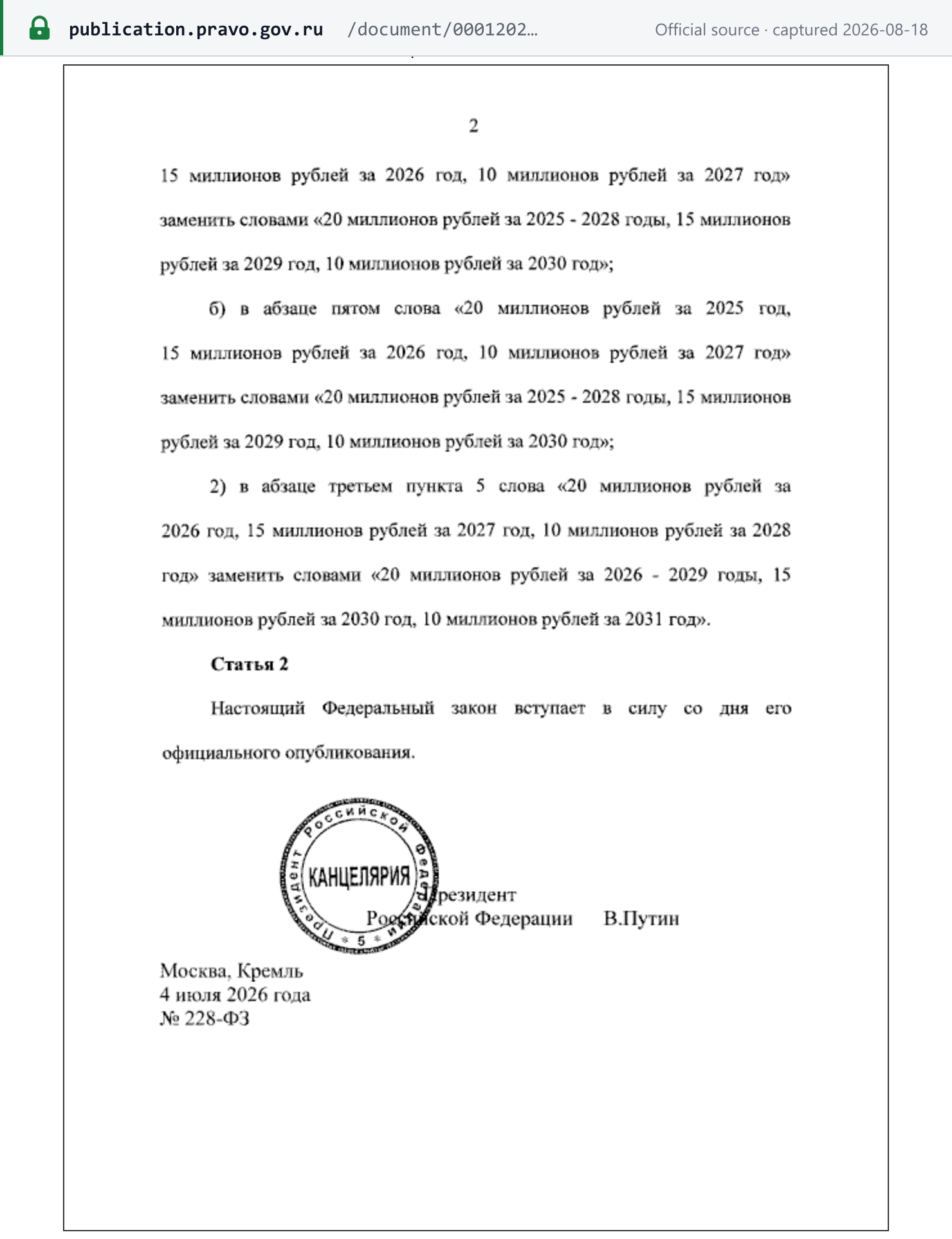 [5] See Recent changes.
A live inconsistency to be aware of. The FTS's own VAT guidance page still displays the pre-228-FZ schedule, expressed in relief-year framing — "from 01.01.2027 where 2026 income is up to 15 million; from 01.01.2028 where 2027 income is up to 10 million". The table above uses the income-year framing of the statute. Once the framings are aligned the FTS page is simply out of date: the statutory text of Article 145 carries the frozen figures, and where the guidance page and the Code disagree, the Code governs.
Non-resident registration
A foreign organisation operating in Russia through a branch, representative office or other separate subdivision is registered at the place of that activity and receives an INN beginning 9909. [6]
A foreign company without a Russian presence does not register merely because it makes supplies with a Russian place of supply — the Russian customer withholds instead, under the tax-agent mechanism described in Cross-border rules.
The one self-registration route for a non-established foreign business is Article 83(4.6), covering a foreign person supplying Article 174.2(1) electronic services to individuals who are not individual entrepreneurs and settling directly with them; a foreign intermediary treated as tax agent under Article 174.2(3); and a foreign person within Article 174.3 selling EAEU goods to Russian individuals through an electronic trading platform. The application must be made within 30 calendar days of starting or ceasing those supplies, through the FTS's НДС-офис интернет-компании portal; Personal Account access is set up within 30 working days. [3]
Tax registration number
The ИНН (INN) is the VAT-relevant identifier — it is what appears on the счёт-фактура under Article 169(5)(2) and in the purchase and sales ledgers. A legal entity's INN is 10 digits; a foreign legal entity's begins 9909; an individual's is 12 digits.
The КПП (KPP) is a 9-digit reason-for-registration code, always quoted with the INN, and it is what distinguishes each separate subdivision of one legal entity. Individual entrepreneurs have no KPP. The ОГРН / ОГРНИП is the state registration number in the company registers — a registry number, not a tax number, though Article 169(6) requires an individual entrepreneur to state the ОГРНИП and its date of assignment when signing an invoice. [6]
For format detail see the dedicated Russia TIN number guide and the Russia INN validator. Verify a counterparty through the FTS's ЕГРЮЛ/ЕГРИП extract service.
Deregistration
For residents — not applicable in the usual sense. There is no VAT deregistration for a Russian business. It stops being a VAT payer by moving onto ПСН or АУСН, or by falling under the Article 145 relief, and it leaves the tax register only on liquidation or removal from the ЕГРЮЛ/ЕГРИП. That follows from Article 83(2), under which registration is not tied to any tax liability in the first place. (Checked 2026-08-18.)
For foreign e-service suppliers, Article 84(5.5) lets the tax authority deregister an Article 83(4.6) person without any application where it finds false information in the registration documents; a demand for payment of arrears is unmet for 12 months; a document request under Article 93 is unmet for 3 months; no VAT return is filed for 6 months after the due date while the FTS holds information that taxable supplies were made; or arrears, пеня or fines written off under Article 59(1.1) are restored. [7]
Group registration
Not available. Chapter 21 of the Tax Code contains no group-registration or VAT-grouping provision. The Code's only consolidated-group regime — the консолидированная группа налогоплательщиков (Arts. 25.1–25.6) — is by its own terms a corporate profits tax regime: Article 25.1(1) defines it as a voluntary association of corporate profits tax payers "for the purpose of calculating and paying corporate profits tax". (Checked 2026-08-18.) [8]
Rates
| Rate | Legal basis | Applies to |
|---|---|---|
| 22% standard | Art. 164(3) | everything not covered by the 0% or 10% rates |
| 10% reduced | Art. 164(2) | foodstuffs, goods for children, periodicals and book products, and medical goods — each by a closed list approved by Government decree |
| 0% zero | Art. 164(1) | goods exported under the customs export procedure, goods under the free-customs-zone procedure, international transport services, and other listed operations |
| 5% / 7% special | Art. 164(8) | USN taxpayers only — see below |
| 18.03%, 9.09% calculated | Arts. 174.2, 174.3 | foreign e-service suppliers and EAEU marketplace sellers |
| 5/105, 7/107, 10/110, 22/122 calculated | Art. 164(4) | advances, and bases determined under Arts. 154, 155, 161 |
The 10% lists are Government Decrees No. 908 of 31.12.2004, No. 688 of 15.09.2008 and No. 41 of 23.01.2003. Zero-rating must be substantiated within 180 calendar days of the goods being placed under the export customs procedure; if it is not, output VAT falls due and input VAT is deducted at the end of the quarter in which the 180 days expire. [1]
The USN special rates
From 1 January 2025, only USN taxpayers may elect 5% or 7% under Article 164(8). For 2026: 5% where income for 2025, or during 2026, exceeded RUB 20 million and is up to RUB 250 million; 7% from RUB 250 million to RUB 450 million. Both ceilings are indexed by a deflator coefficient of 1.090 for 2026 — so RUB 272.5 million and RUB 490.5 million in practice. A USN taxpayer that must charge VAT may instead apply the ordinary rates. [1]
The trade-off is input VAT. On the special rates, deductions are available only in limited cases — shipment against advances, refund of advances, and contract termination or variation. On the ordinary 22% you recover input VAT normally. A business with little taxable input cost usually gains from the low headline rate; one carrying significant input VAT often does not.
And the choice locks you in. Article 164(9) requires a taxpayer electing a special rate to apply it for at least 12 consecutive tax periods — three years — with only a narrow escape for first-time electors within four periods. This is not a decision to revisit quarter by quarter: model the input-VAT position across the whole three years before electing.
Announced future rates
We found none. As at 18 August 2026 the FTS VAT page publishes no announced future change to the 0%, 10% or 22% rates, and none appeared among the 2026 VAT publications we reviewed on publication.pravo.gov.ru. Treat that as "none found" rather than "none exists" — neither source offers an exhaustive forward index. (Checked 2026-08-18.)
One proposal, not law. On 24 September 2026 the Ministry of Finance announced that it had submitted to the Government a 2027-2029 budget package that includes a Tax Code bill applying VAT at the standard 22% rate to purchases of cross-border e-commerce goods, with electronic trading platforms paying it as agents. The same package would add a RUB 100 customs fee per postal parcel of personal-use goods worth up to EUR 200. It is a bill, its figures are provisional, and nothing here changes the rules above until it passes the State Duma and is enacted (Ministry of Finance announcement).
Cross-border rules
Foreign companies selling into Russia — B2B and B2C
Russia answers these two very differently, and the B2B answer changed in 2022 in a way most secondary sources have not caught up with.
B2B — the Russian buyer withholds. Where a foreign person not registered in Russia (or registered only because it owns Russian real estate or vehicles, or has a Russian bank account, or is registered only at the location of a separate subdivision) makes a supply with a Russian place of supply, the Russian organisation or individual entrepreneur buying is the tax agent (налоговый агент). The tax agent must calculate, withhold from the supplier, and pay over the VAT, whether or not it is itself a VAT payer. The base is determined separately for each transaction as the income from the supply including the tax — so VAT is extracted at the calculated rate 22/122, not added on top. [9]
Mechanically, the tax agent issues a счёт-фактура to itself in the Article 169(5)–(6) form, records it in the sales ledger and reports it in the VAT return — and may then deduct that VAT as input tax if the purchase is for taxable use.
Other tax-agent triggers worth knowing: lease or purchase of state or municipal property; sale of confiscated or court-ordered property; acting under commission or agency in Russia for goods belonging to unregistered foreign persons; and purchase of copper semi-finished products, raw animal hides, ferrous and non-ferrous scrap, secondary aluminium and its alloys, and waste paper (Art. 161(8)).
B2C electronic services — the foreign supplier self-accounts. A foreign organisation supplying Article 174.2(1) electronic services to individuals with a Russian place of supply registers under Article 83(4.6), computes tax at the calculated rate of 18.03%, files quarterly by the 25th through the foreign taxpayer's Personal Account and pays by the 28th. It gets no input VAT deduction at all (Art. 174.2(6)). [10]
What changed for B2B. From Q4 2022, Article 174.2(10.1) moved the B2B leg to the customer.
 The FTS puts it in two sentences: "If electronic services are supplied by foreign providers to organisations and individual entrepreneurs, then from Q4 2022 the latter will begin paying VAT as tax agents. When electronic services are supplied to individuals, foreign organisations continue to calculate VAT themselves." [11]
A research trap worth naming. The FTS's own e-services portal at
lkioreg.nalog.rustill carries FAQ text describing the pre-October-2022 position, and its page footer reads "Latest update 22.12.2016". Use that portal for process, for forms and for the registered-supplier list — but not for the substantive B2B rule. This is the most common source of wrong answers on Russian VAT.

What counts as an electronic service (Art. 174.2(1)): rights to use software (including computer games) and databases over the internet, including remote access, updates and extra functionality; internet advertising and provision of advertising space; posting of offers to buy or sell goods, works, services or property rights; providing technical, organisational or information capability for buyers and sellers to make contact and conclude deals, including real-time trading platforms; and maintaining a commercial or personal internet presence and supporting users' websites.
Imports from EAEU member states — the distinctive mechanism
If you take one thing from this page, take this. Imports from Armenia, Belarus, Kazakhstan and Kyrgyzstan are not taxed at customs.
Under Annex 18 to the Treaty on the Eurasian Economic Union, indirect taxes on goods imported from another member state are levied by the tax authority of the importing state, at the place where the owner of the goods is registered — including owners on special tax regimes. They are paid, and the declaration filed, no later than the 20th of the month following the month in which the imported goods were taken onto account (or the lease payment date under a leasing contract). [12]
The declaration must be accompanied by an application on the importation of goods and payment of indirect taxes (заявление о ввозе товаров и уплате косвенных налогов) — four paper copies plus electronic, or electronic with the taxpayer's e-signature — together with a bank statement evidencing payment, transport and shipping documents, invoices and the contract. A later price increase re-triggers the same obligation on the difference. Exports to EAEU states are zero-rated with input recovery, on production of the Protocol's document set.
Three different dates, and implementers routinely conflate them:
| Obligation | Deadline | Frequency |
|---|---|---|
| EAEU import — indirect-tax declaration and payment | 20th of the following month | monthly |
| Ordinary VAT return | 25th of the month after the quarter | quarterly |
| VAT payment | 28th of each of the three following months | quarterly, in thirds |
A new declaration form is now in use. FTS Order of 08.05.2026 No. КЧ-1-3/299@ approves the form, completion procedure and electronic format of the EAEU indirect-tax declaration, and amends the control-ratio rows 18.1–18.5 of FTS Order No. ЕД-7-3/164@. It was registered with the Ministry of Justice on 29 May 2026 and published 30 May 2026, entering into force two months after publication and applying from the declaration for the month in which it entered into force — so the first period filed on the new form is July 2026, due 20 August 2026. It repeals the previous form (FTS Order of 27.09.2017 No. СА-7-3/765@) outright rather than amending it. [13] See Recent changes.
Imports and exports generally
Third-country imports are taxed at the customs border on release for domestic consumption, and the import VAT is deductible where the goods are for taxable use. Exports are zero-rated under Article 164(1), subject to the 180-day substantiation rule above.
Reverse charge on imported services
Russia has no separate "reverse charge" self-assessment. The mechanism is withholding by the buyer under Article 161(1)–(2), described above, and it applies only where the foreign supplier is not registered or is registered only incidentally. Where the foreign supplier is registered under Article 83(4.6) and supplies e-services to a business, Article 174.2(10.1) puts the same withholding duty on the buyer.
Marketplace and platform deemed-supplier liability
Three distinct rules, and they should not be merged: [10]
- Foreign intermediary in the e-services chain settling directly with Russian individuals is the tax agent — and where several intermediaries are in the chain, it is the one that settles directly with the consumer, whether or not it has a contract with the actual supplier (Art. 174.2(3)).
- Russian intermediary settling directly with the buyer for a foreign supplier's e-services is the tax agent under Art. 174.2(10). Payment-system operators and telecom operators are expressly not intermediaries for this purpose.
- EAEU goods sold to Russian individuals via an electronic trading platform (Art. 174.3, in force from 1 July 2024): the taxable person is the foreign seller, the foreign intermediary or the Russian intermediary whose platform carries the sale. The base is the price including tax at the last day of the quarter in which payment was received, translated at the CBR rate on that day, and tax is computed at 18.03% — or 9.09% where the 10% rate applies.
Place of supply
Goods. Russia is the place of supply where the goods are located in Russia and are not shipped or transported, or where they are in Russia at the moment shipment begins. Two newer heads matter for e-commerce: goods within Article 164(1)(1.2) sold to individuals abroad, and EAEU goods sold through an electronic trading platform where the individual buyer receives them in Russia.
Services. The general rule turns on the customer's location, with the exceptions set out in Article 148.
Invoice requirements
Mandatory content
The Russian VAT invoice is the счёт-фактура (schet-faktura). Article 169(5) requires: [14]
| # | Field |
|---|---|
| 1 | Sequential number and date of drawing up |
| 2 | Name, address and INN of the taxpayer (or tax agent) and of the buyer |
| 3 | Name and address of consignor and consignee |
| 4 | Payment/settlement document number where an advance was received, and details identifying the shipment document |
| 5 | Line number, name of goods or description of works/services, and unit of measure |
| 6 | Quantity or volume supplied in those units |
| 6.1 | Name of currency |
| 6.2 | Identifier of the state contract, where there is one |
| 7 | Unit price or tariff excluding tax |
| 8 | Value for the whole quantity, excluding tax |
| 9 | Excise amount, for excisable goods |
| 10 | Tax rate |
| 11 | Amount of tax presented to the buyer |
| 12 | Total value including tax |
| 13 | Country of origin — only where origin is not Russia |
| 14 | Registration number of the goods declaration — only where origin is not an EAEU member state |
| 15 | EAEU TN VED commodity code — for goods exported to an EAEU member state |
| 16–19 | For traceable goods: the РНПТ, the traceability unit of measure, the quantity in that unit, and the value |
The error-tolerance rule — this is the reader's real question. Article 169(2) provides that "errors in invoices and corrective invoices which do not prevent the tax authorities, in the course of a tax audit, from identifying the seller, the buyer, the name of the goods (works, services) or property rights, their value, the tax rate and the amount of tax presented to the buyer … are not grounds for refusing a deduction." Failure to state, or misstatement of, the traceability fields in sub-paragraphs 16–18 is likewise not a ground for refusal.
An advance invoice (Art. 169(5.1)) needs a shorter set: number and date; names, addresses and INNs of the parties; payment document number; description; currency; state-contract identifier; advance amount; rate; and tax amount.
Issuance deadline
No later than five calendar days from the day of shipment, performance of works, supply of services or transfer of property rights, or from the day an advance is received. A корректировочный счёт-фактура must be issued within five calendar days of drawing up the document evidencing the customer's agreement to the change. [15]
Numbering and sequencing
Line 1 carries the sequential number and date. Where a company supplies through separate subdivisions, the invoice number is extended with the subdivision's numeric index after a "/" separator, the index being fixed in the accounting policy for tax purposes. The same convention applies to a partnership participant or trustee acting as VAT payer. Commission agents number invoices according to their own individual chronology. [16]
Credit and debit notes — корректировочный vs исправленный
Russia's two correction documents do not map onto "credit note" and "debit note", and using the wrong one puts the deduction at risk. State them side by side: [16]
| Корректировочный (corrective) | Исправленный (corrected) | |
|---|---|---|
| Used for | A change in the value of a supply that has already shipped — price or tariff change, or quantity adjustment | Fixing a mistake in the original invoice |
| Requires | The buyer's documented agreement or notification | Nothing from the buyer |
| Form | A new, additional document showing before, after and the difference, with its own mandatory content in Art. 169(5.2) | Not a separate document type — a new copy of the same invoice |
| Key rule | A downward corrective invoice is the seller's basis for deducting VAT it over-charged; one corrective invoice may cover two or more earlier invoices | Line 1 — the original number and date — must not be changed; line 1а carries the sequential number and date of the correction |
A wrong VAT rate is an error, not a change in value, so it calls for a corrected invoice. And where the error does not prevent identification of seller, buyer, goods, value, rate and tax, no new copy is drawn up at all.
Currency and language
Line 7 carries the name and numeric code of the currency, and it must be the same currency for every line on the invoice. Where the obligation is expressed in roubles in an amount equivalent to a foreign-currency sum, the invoice must state the Russian currency. Article 169(7) permits foreign-currency amounts only where the contractual obligation itself is expressed in foreign currency. [16]
Signature
A paper счёт-фактура is signed by the head and the chief accountant, or by persons authorised by order or power of attorney. An individual entrepreneur signs personally and must state the ОГРНИП and the date it was assigned. An electronic invoice is signed with a strengthened qualified electronic signature (усиленная квалифицированная электронная подпись). In an electronic invoice, unfilled fields and the chief-accountant field are not generated at all. [14]
Self-billing
Not provided for. Chapter 21 places the invoicing duty on the supplier, and the only case in which a buyer draws up an invoice is the tax agent issuing a счёт-фактура to itself under Article 168(3) — a statutory withholding mechanic, not a recipient-created invoice by agreement. (Checked 2026-08-18.)
Ledgers and retention
Every VAT payer keeps a purchase ledger (книга покупок) and a sales ledger (книга продаж), whose forms and rules sit in Government Decree No. 1137 of 26.12.2011. The ledger data is filed inside the quarterly VAT return (Art. 174(5.1)) — which is what feeds the FTS's automated cross-matching, so a mismatch between your ledger and your counterparty's is visible to the tax authority without any audit being opened.
Non-taxpayer intermediaries must additionally file the журнал учета полученных и выставленных счетов-фактур electronically by the 20th of the month after the quarter (Art. 174(5.2)).
Retention: five years. Article 23(1)(8) requires taxpayers to keep the accounting and tax data needed to compute and pay tax — including the documents evidencing income, expenses and tax paid — for five years.
A specimen of a compliant invoice
Decree 1137 prescribes the invoice form itself, so the layout below follows that form rather than inventing one; the labels map to the Article 169(5) items above. All names, numbers and figures are fictional:
Счёт-фактура — VAT invoice
| Name of goods | Unit | Quantity | Price excl. tax | Value excl. tax | Rate | Tax | Value incl. tax |
|---|---|---|---|---|---|---|---|
| Power cable VVGng 3×2.5 | m | 4,000 | 92.00 | 368,000.00 | 22% | 80,960.00 | 448,960.00 |
| Cable gland, brass, M20 | pc | 600 | 45.00 | 27,000.00 | 22% | 5,940.00 | 32,940.00 |
- Total excluding taxArt. 169(5)(8)
- RUB 395,000.00
- VAT at 22%Art. 169(5)(10)–(11)
- RUB 86,900.00
- Total including taxArt. 169(5)(12)
- RUB 481,900.00
- Country of origin and the goods-declaration number are filled only where the origin is not Russia (Art. 169(5)(13)–(14)); they are blank here because the goods are Russian.
- For traceable goods four further columns appear — the РНПТ, the traceability unit, the quantity in that unit and the value (Art. 169(5)(16)–(19)) — and the invoice must then be issued electronically through an EDI operator.
- Signed by the head and the chief accountant on paper; an electronic invoice is signed with a strengthened qualified electronic signature, and the chief-accountant field is not generated at all (Art. 169(6)).
- An error that still lets the tax authority identify seller, buyer, goods, value, rate and tax is not a ground for refusing the buyer a deduction (Art. 169(2)) — and in that case no corrected copy is drawn up.
E-invoicing status
As at 18 August 2026 Russia operates a partial mandate with no clearance model. There is no government portal through which every invoice must pass. [17]
- General rule — voluntary. Article 169(1): electronic invoices are drawn up by mutual agreement of the parties, where both hold compatible technical means, in the prescribed formats and order.
- Mandatory for traceable goods. Article 169(1.1) requires invoices, including corrective invoices, to be issued electronically on the sale or transfer of traceable goods, with three carve-outs: sales to individuals for personal needs and to professional-income-tax payers; export or re-export out of Russia; and movement to another EAEU member state. Article 169(1.2) puts a mirror obligation on the buyer — organisations and individual entrepreneurs acquiring traceable goods must ensure they receive those invoices electronically through an EDI operator that is a Russian organisation meeting FTS requirements.
- Operator model, not a portal. Exchange runs through operators of electronic document flow (ОЭД) on the FTS's federal register, under FTS Orders No. ЕД-7-26/546@ and No. ЕД-7-26/936@.
- Formats. FTS Order No. ЕД-7-26/970@ of 19.12.2023 sets the formats of the счёт-фактура, the universal transfer document (УПД) and the invoice-inclusive shipment document; FTS Order No. ЕД-7-26/736@ of 12.10.2020 sets the format of the корректировочный счёт-фактура. XSD schemas are published on the same FTS page.
- B2G and B2C. No separate B2G e-invoicing mandate appears in the FTS's e-invoice section as at 2026-08-18. B2C is served by the online fiscal cash-register (ККТ) regime, not by счета-фактуры.
What drives the mandate: traceability. Russia runs a national goods traceability system for imported goods. Traceability is documentary rather than physical: each consignment gets an РНПТ (регистрационный номер партии товара), normally the goods-declaration number plus the item number, and the РНПТ travels through invoices, the purchase and sales ledgers, the VAT return and separate traceability reporting. The list of traceable goods is approved by Government Decree No. 1110 of 01.07.2021. [18]
Do not confuse traceability (прослеживаемость) with marking (маркировка). Goods marking — Честный ЗНАК — is a separate system run outside the FTS. The Article 169(1.1) electronic-invoice mandate is keyed to traceable goods only. We found no FTS source making electronic invoices mandatory for marked goods as such. (Checked 2026-08-18.)
Filing and payment
Filing frequency
Quarterly, and the return must be electronic, in the prescribed format, over telecommunication channels through an EDI operator. A return that had to be electronic but was filed on paper is deemed not filed. No returns are filed at the location of separate subdivisions. [19]
The current form is FTS Order No. ЕД-7-3/989@ of 05.11.2024, as amended for periods from 2026 by FTS Order No. ЕД-7-3/1227@ of 18.12.2025.
Return due date
No later than the 25th of the month following the expired quarter, filed at the place of registration.
A consequence worth planning around: if the return is more than 20 days late, the tax authority may freeze bank account operations under Article 76(3). [1]
Payment due date and method — the instalment rule
VAT for a quarter is paid in equal shares (равными долями), no later than the 28th of each of the three months following the expired quarter. The FTS's own worked example: a Q1 2026 return with RUB 240 payable is paid RUB 80 by 28 April, RUB 80 by 28 May, RUB 80 by 28 June. [1] [19]
Exception: persons who are not VAT payers but who issued an invoice showing VAT (Art. 173(5)) pay the whole amount by the 28th of the month following the quarter — no thirds. EAEU import VAT follows the 20th rule instead.
Payment is made into the единый налоговый счёт (ЕНС) as a единый налоговый платёж (ЕНП).
Older sources say the 25th for payment. That was the pre-2023 rule; the ЕНС/ЕНП reform moved payment to the 28th. The 25th is now the return date only.
Additional listings
No separate annual VAT return and no separate sales or purchase listing — the ledger data sits inside the quarterly return. What does exist: the intermediary's invoice journal by the 20th after the quarter; the monthly EAEU import declaration plus the application on importation by the 20th; and traceability reporting for operations in traceable goods.
Input-tax recovery and blocked items
Input VAT is deductible where the goods, works or services are taken onto account, the primary documents and the счёт-фактура are held, and the purchase is for VAT-taxable use including resale. The general time limit is three years from the date the goods were taken onto account — one year for a returned advance. Deductible categories include supplier-charged VAT (including on advances paid), import VAT, VAT paid on imports from EAEU member states, and VAT self-computed as a tax agent. [1]
Blocked or restricted:
- Foreign organisations registered under Article 83(4.6) get no input VAT deduction at all (Arts. 174.2(6), 174.3(5)).
- USN payers on the 5% or 7% special rates may deduct only in limited cases — shipment against advances, refund of advances, contract termination or variation.
- Exempt use and regime changes trigger restoration (восстановление) of previously deducted VAT under Article 170(3), with immovable property restored at one-tenth per year over ten years under Article 171.1.
Russia has no general blocked-input schedule, but it does cap one item. There is no list of categorically blocked purchases of the kind many jurisdictions keep, and passenger cars are not blocked — recovery turns on taxable use and documentation. The exception is entertainment (представительские расходы): Article 171(7) allows the input VAT deduction only to the extent the expense itself is deductible for corporate profits tax, which puts it inside the Article 264(2) cap of 4% of payroll. (The second paragraph of Art. 171(7), which extended that rationing to all capped expenses, lapsed on 1 January 2015; the entertainment limb survives.) So if you are coming from a jurisdiction that blocks entertainment outright, Russia restricts rather than blocks it — and does not touch company cars. (Checked 2026-08-18.)
Refunds
Where input VAT exceeds output VAT the excess is refundable (возмещение). The standard route is a refund after the desk audit (камеральная проверка), which runs two months and may be extended to three where indicators of possible breaches are found. [1]
The accelerated route (заявительный порядок, Art. 176.1) returns the money within 7 days against a bank guarantee, with the desk audit following. Taxpayers who have paid at least RUB 2 billion of taxes over the previous three years need no bank guarantee. Refunded amounts are credited to the ЕНС, and a positive ЕНС balance can then be returned or offset.
Non-resident refunds — not available. There is no 13th-Directive-style refund scheme for foreign businesses not registered in Russia, and a registered Article 83(4.6) foreign e-services supplier is expressly denied input deduction. The only cross-border refund mechanism in Chapter 21 is Article 169.1 "tax free", which compensates VAT to individual foreign nationals exporting goods bought at retail. (Checked 2026-08-18.)
Bad-debt relief — none found. Chapter 21 publishes no VAT relief for a debt that goes bad after the tax has been accounted for. (Checked 2026-08-18.)
Exemptions
Exempt supplies
Two concepts that must be kept apart:
- Outside the scope — the closed list in Article 146(2): transactions that do not form an object of taxation at all.
- Exempt (не подлежащие налогообложению) — the closed list in Article 149.
A taxpayer making both taxable and exempt supplies must keep separate records (раздельный учет) under Article 149(4). [1]
Exempt is not zero-rated
The consequence is the same as elsewhere and it is the most expensive thing to get wrong. A zero-rated supply under Article 164(1) is taxable at 0% and preserves input recovery. An exempt supply under Article 149 does not — input VAT attributable to it is not deductible, and where inputs are mixed you must apportion under the separate-records rule. Where previously deducted input VAT becomes attributable to exempt use, it must be restored under Article 170(3).
Special regimes
- USN special rates 5% and 7% — see Rates.
- ПСН (patent) and АУСН (automated simplified) payers are not VAT taxpayers at all.
- Article 145 relief — described under Registration.
- Skolkovo and "Era" technopolis participants — Articles 145.1 and 145.2.
- Traceability and the online cash-register (ККТ) regime are compliance systems rather than reliefs, but they determine how invoices and receipts must be issued.
Offences and penalties
Offences
The Tax Code offences a VAT-registered business is most exposed to: [1]
- Art. 116 — breach of the tax-registration procedure;
- Art. 119 — failure to file a tax return;
- Art. 119.1 — breach of the prescribed method of filing, i.e. filing on paper what must be electronic;
- Art. 120 — gross breach of the rules for accounting for income, expenses and objects of taxation, defined as the absence of primary documents, or absence of invoices, or absence of accounting or tax registers, or systematic (twice or more in a calendar year) late or incorrect recording of transactions;
- Art. 122 — non-payment or underpayment of tax;
- Art. 123 — failure by a tax agent to withhold or remit;
- Arts. 126, 126.1, 129.1 — failure to supply information required for tax control, supplying documents with false information, and unlawful failure to notify.
A non-monetary consequence to plan for: suspension of bank account operations where a return is more than 20 days late (Art. 76(3)).
Large-scale evasion also carries criminal exposure under the Criminal Code. This guide does not state those figures, because we did not verify them against the Criminal Code itself. (Checked 2026-08-18.)
Penalties
| Offence | Penalty |
|---|---|
| Late application for tax registration (Art. 116(1)) | RUB 10,000 |
| Carrying on business without tax registration (Art. 116(2)) | 10% of income earned in that period, minimum RUB 40,000 |
| Failure to file a return on time (Art. 119(1)) | 5% of the unpaid tax due on that return for each full or partial month, capped at 30%, minimum RUB 1,000 |
| Gross breach of accounting rules, one tax period (Art. 120(1)) | RUB 10,000 |
| …across more than one tax period (Art. 120(2)) | RUB 30,000 |
| …where it understated the tax base (Art. 120(3)) | 20% of the unpaid tax, minimum RUB 40,000 |
| Non-payment or underpayment (Art. 122(1)) | 20% of the unpaid amount |
| …committed intentionally (Art. 122(3)) | 40% of the unpaid amount |
A safe harbour worth knowing: no Article 122 penalty arises to the extent that, from the payment due date until the decision imposing liability, the taxpayer continuously held a positive ЕНС balance sufficient to cover the tax (Art. 122(4)).
Late-payment interest (пеня)
Пеня accrues for each calendar day of delay, from the day the arrears arise until the liability is discharged. For individuals and individual entrepreneurs it is 1/300 of the CBR key rate. For organisations, Article 75(5.1) makes it tiered — and the tiers are temporary, running from 1 January 2025 to 31 December 2026: [20]
| Days of delay | Rate |
|---|---|
| 1–30 | 1/300 of the CBR key rate |
| 31–90 | 1/150 of the CBR key rate |
| 91 onwards | back to 1/300 of the CBR key rate |
The permanent rule — 1/300 for the first 30 days, then 1/150 indefinitely — resumes from 1 January 2027 unless extended again.
The key rate to plug in is 14.00% per annum as at 18 August 2026. It moves, so check the CBR series before relying on a calculation. At that rate, an organisation 45 days late on RUB 1,000,000 accrues roughly RUB 28,000 — 30 days at 14%/300 plus 15 days at 14%/150. [21]
No пеня accrues on arrears covered by a positive ЕНС balance, nor where assets were arrested or accounts frozen by decision of the tax authority or a court, nor where the position followed written FTS or Ministry of Finance guidance.
Frequently asked questions
What is the VAT registration threshold in Russia?
There isn't one, and there is no separate VAT registration either.
Article 83(2) provides that registration with the tax authority happens irrespective of whether any circumstance giving rise to a tax liability exists, and Article 83(3) has Russian companies and sole traders entered automatically from the unified state registers on incorporation. Every Russian business is already on the tax register.
What people usually mean is Article 145, and that is a different thing: a relief from performing the obligations of a VAT taxpayer, claimed by notification, available where turnover excluding VAT over the three preceding consecutive calendar months did not exceed RUB 2,000,000. It runs twelve months, cannot be given up early, excludes sellers of excise goods, and is lost from the first day of the month in which the test is breached. Businesses on the simplified system get their own version, applied automatically with no notification and keyed to prior-year income.
The distinction matters because the Article 145 relief is something you can lose mid-year while still being a registered taxpayer.
I am a foreign company selling software to Russian businesses — do I still register for Russian VAT?
Almost certainly not, and most English-language guidance on this is years out of date.
From Q4 2022, where a foreign organisation supplies electronic services to Russian organisations or individual entrepreneurs, Article 174.2(10.1) makes the Russian customer account for the VAT as tax agent — not the supplier. The FTS states it directly. The Article 83(4.6) registration route therefore exists for B2C supplies to individuals, for foreign intermediaries settling directly with consumers, and for EAEU goods sold to individuals through electronic trading platforms.
Registering is not a free choice with no downside: a foreign organisation registered under Article 83(4.6) gets no input VAT deduction at all (Art. 174.2(6)).
One warning specific to researching this. The FTS's own e-services portal at lkioreg.nalog.ru still carries FAQ text describing the pre-October-2022 position, and its footer reads "Latest update 22.12.2016". Use it for process and the registered-supplier list, not for the substantive rule.
My business on the simplified system has crossed into VAT — should I take the 5% or 7% rate, or the ordinary 22%?
The trade-off is input VAT.
Since 1 January 2025 only USN taxpayers may elect the Article 164(8) special rates: 5% where income exceeded RUB 20 million and is up to RUB 250 million, 7% from RUB 250 million to RUB 450 million — both ceilings indexed by a deflator coefficient of 1.090 for 2026, giving RUB 272.5 million and RUB 490.5 million. A USN taxpayer that must charge VAT may instead apply the ordinary rates.
The catch: on the special rates you may claim input deductions only in limited situations — shipment against advances, refund of advances, and contract termination or variation. On the ordinary 22% you recover input VAT normally. If your business buys little that carries Russian VAT, the low headline rate usually wins; if you carry significant taxable input costs, the ordinary rate can be cheaper despite the higher rate.
Model it across three years, not one. Article 164(9) requires a taxpayer electing a special rate to apply it for at least 12 consecutive tax periods, with only a narrow escape for first-time electors within four periods.
On the threshold, Federal Law No. 228-FZ of 4 July 2026 froze the step-down: RUB 20 million for 2025–2028, then 15 million for 2029 and 10 million for 2030 onward. Be careful with the FTS guidance page, which still displays the pre-228-FZ schedule.
I bought goods from Kazakhstan and nobody charged me VAT at the border — what have I missed?
A filing, and probably a payment. Imports from Armenia, Belarus, Kazakhstan and Kyrgyzstan are not taxed at customs at all.
Under Annex 18 to the EAEU Treaty, indirect taxes on goods imported from another member state are levied by the tax authority of the importing state, at the place where the owner of the goods is registered — including owners on special tax regimes. You pay the import VAT and file a separate monthly indirect-tax declaration no later than the 20th of the month following the month in which you took the goods onto account. With it you file the application on the importation of goods and payment of indirect taxes, in four paper copies plus electronic form or electronically with your e-signature, together with a bank statement evidencing payment, transport documents, invoices and the contract.
Note the three different dates: the 20th for an EAEU import declaration, the 25th for the ordinary quarterly VAT return, and the 28th for payment.
There is also a live change: FTS Order of 08.05.2026 No. КЧ-1-3/299@ approved a new form, procedure and electronic format, repealing the 2017 form outright. It applies from the declaration for the month it entered into force, so the first period on the new form is July 2026, due 20 August 2026.
My supplier sent a корректировочный invoice to fix a wrong VAT rate — is that right?
No, and using the wrong document puts the deduction at risk.
A корректировочный счёт-фактура (corrective) is for a change in the value of a supply that has already shipped — a price or tariff change, or a quantity adjustment — and only with the buyer's documented agreement or notification. It is a new, additional document showing before, after and the difference, with its own mandatory content in Article 169(5.2).
An исправленный счёт-фактура (corrected) is for fixing a mistake. It is not a separate document type: the seller draws up a new copy of the same invoice, in which line 1 — the original number and date — must not be changed, and line 1а carries the sequential number and date of the correction.
A wrong VAT rate is an error, not a change in value, so it calls for a corrected invoice.
There is also a threshold below which nothing needs reissuing. Article 169(2) provides that errors which do not prevent the tax authorities from identifying the seller, the buyer, the goods, their value, the rate and the tax presented are not grounds for refusing a deduction — and Decree 1137 says that in that case no new copy is drawn up.
Important websites
| Site | Purpose |
|---|---|
| Federal Tax Service — VAT hub | Rates, base, deductions, filing, payment and penalties |
| Personal cabinet — legal entities | Filing and correspondence for Russian companies |
| Personal cabinet — sole traders | Filing and correspondence for individual entrepreneurs |
| Personal cabinet — foreign organisations | Filing the VAT return and corresponding with the FTS |
| VAT office for Online Service Providers | Registration under Art. 83(4.6), online test, forms — not a source for the B2B rule |
| Registered foreign e-service suppliers | Checking whether a foreign supplier is registered |
| INN / KPP counterparty check (ЕГРЮЛ/ЕГРИП) | Look up a company or sole trader and download a signed extract |
| Прозрачный бизнес | Consolidated taxpayer risk information for due diligence |
| Business registration | Filing ЕГРЮЛ/ЕГРИП registration documents online |
| EAEU import — check the заявление о ввозе | Confirms the electronic copy of the application has arrived |
| Exporter's office | Building the registers needed to substantiate 0% |
| Traceability services | Check whether a good is traceable and validate an РНПТ |
| Electronic invoices and EDI operator register | Formats, XSD schemas and the federal register of EDI operators |
| CBR key rate | Drives the пеня calculation |
| Official publication of legal acts | Where 425-ФЗ, 228-ФЗ and КЧ-1-3/299@ were promulgated |
Several FTS service links resolve on nalog.ru rather than nalog.gov.ru — that is how the FTS itself publishes them on its own services index, and they should be used as published.
Recent changes
- 2026-09-24 (proposed) — the Ministry of Finance announced a Tax Code bill, submitted to the Government within the 2027-2029 budget package, that would apply VAT at the 22% standard rate to cross-border e-commerce goods, with electronic trading platforms paying as agents; the same package proposes a RUB 100 customs fee per parcel of personal-use goods worth up to EUR 200. These are proposals, not law; figures are provisional. (minfin.gov.ru) — see event record
- 2026-08-20 (deadline) — the first EAEU indirect-tax declaration on the new form approved by FTS Order of 08.05.2026 No. КЧ-1-3/299@ falls due, for the July 2026 period. (publication.pravo.gov.ru) — see event record and issue
- 2026-07-04 — Federal Law No. 228-FZ froze the USN VAT-exemption income threshold at RUB 20 million through the 2028 income year (15 million in 2029, 10 million in 2030), amending Article 145. (publication.pravo.gov.ru) — see event record and issue
- 2026-05-30 — FTS Order of 08.05.2026 No. КЧ-1-3/299@ published: new EAEU import indirect-tax declaration form, completion procedure and electronic format, repealing FTS Order of 27.09.2017 No. СА-7-3/765@ outright. (publication.pravo.gov.ru)
- 2026-01-23 — Government Decree No. 26 amended Decree No. 1137 on invoice, corrective-invoice and ledger forms and rules — the 12th redaction. (pravo.gov.ru)
- 2026-01-01 — the standard VAT rate rose from 20% to 22% under Federal Law of 28.11.2025 No. 425-FZ; the calculated rate for foreign e-service suppliers and EAEU marketplaces moved from 16.67% to 18.03%. (publication.pravo.gov.ru · ФНС России)
- 2025-12-18 — FTS Order No. ЕД-7-3/1227@ amended the VAT return form for periods from 2026. (ФНС России)
- 2024-07-01 — Article 174.3 came into force: EAEU sellers and marketplaces selling goods to Russian individuals through electronic trading platforms account for Russian VAT. (ФНС России)
Reference links
- Tax Code of the Russian Federation, Parts One and Two — consolidated, published by the FTS
- Federal Tax Service — Value Added Tax (НДС)
- Federal Tax Service — Electronic invoices
- Federal Tax Service — Register of federal-level EDI operators
- Federal Tax Service — Goods traceability services
- Federal Tax Service — VAT office for Online Service Providers
- Federal Tax Service — explanation of VAT on electronic services from 01.10.2022
- Federal Tax Service — INN structure
- Government Decree of 26.12.2011 No. 1137, current redaction
- Federal Law of 28.11.2025 No. 425-FZ — the 22% rate
- Federal Law of 04.07.2026 No. 228-FZ — Article 145 thresholds
- FTS Order of 08.05.2026 No. КЧ-1-3/299@ — EAEU import declaration
- Treaty on the EAEU, Annex 18 — Protocol on the collection of indirect taxes (document card)
- Treaty on the EAEU — official English courtesy translation, incl. Annex 18 paras 13, 19 and 20 (PDF, 855 pp)
- Bank of Russia — key rate
- Lookuptax — Russia TIN number guide
- Lookuptax — Official links to check VAT numbers worldwide
- Lookuptax — E-invoicing status and the networks worldwide