Tanzania VAT guidelines
| FACTSHEET | |
|---|---|
| Country code | TZ |
| Tax name | Value Added Tax (VAT) |
| Tax Authority | Tanzania Revenue Authority (TRA) |
Overview
Tanzania levies Value Added Tax under the Value Added Tax Act, CAP 148, administered by the Tanzania Revenue Authority (TRA). This guide covers Mainland Tanzania in most sections; Zanzibar operates its own VAT regime (standard rate 15%, 18% on banking, postal, telecommunications, insurance and digital services) administered separately by the Zanzibar Revenue Authority (ZRA) — renamed from the Zanzibar Revenue Board by the Zanzibar Revenue Authority Act No. 11 of 2022, effective 13 January 2023. See Zanzibar — a separate VAT jurisdiction below for Zanzibar's own rules, including its digital-services VAT. [1]
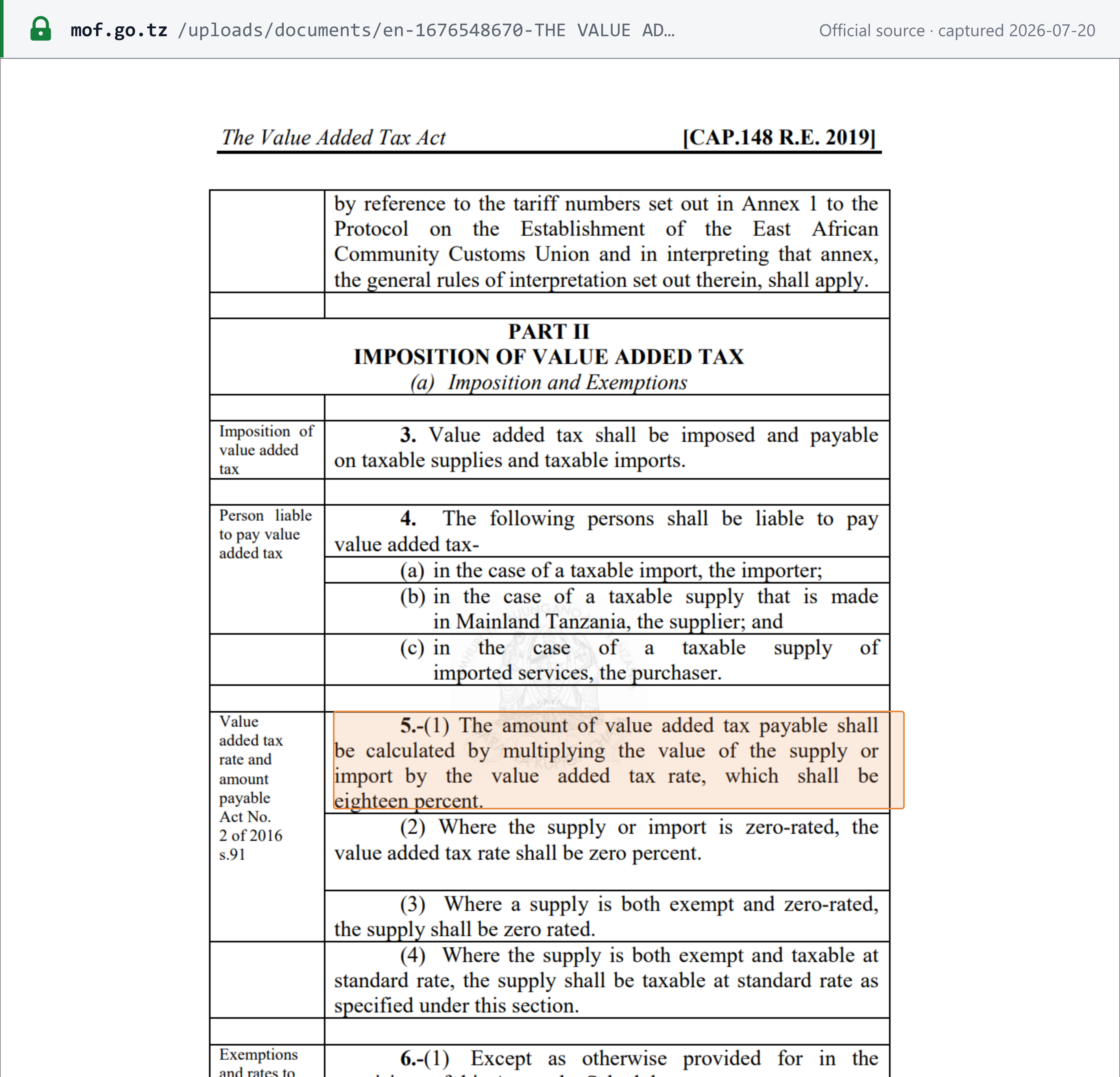
The standard VAT rate is 18%. [1]
The most recent major amendment is the Finance Act, 2026 (Act No. 2 of 2026), assented to by the President on 30 June 2026, published as a Special Gazette (No. 8 Vol. 107) and in force from 1 July 2026. Among other things, it amends the VAT Act's withholding-VAT mechanics (sections 5 and 71), makes online marketplaces the deemed supplier of electronic services sold to unregistered persons (section 51), adds new import exemptions to the Schedule, Part II, exempts goods and services used to construct a mining project under a Cabinet-approved Government framework agreement (section 6), amends Part I of the Schedule's exempt-goods list (section 96), and amends the deferral-of-VAT-on-imported-capital-goods provision (section 11) — deleting the proviso at the end of section 11(1) and adding a further condition, to be prescribed by the Minister by Gazette order, on which the Commissioner General may approve a deferral application. [2]
TIN and VAT registration
- Every taxpayer first obtains a Taxpayer Identification Number (TIN) from the TRA. A person who becomes liable to tax by reason of carrying on a business, investment or employment must apply for a TIN within 15 days of commencing that activity. [1] [2]
- TIN applications are made online through the TRA's Taxpayer Portal, supplying identity documents, business-registration papers and a description of business premises.
- Once the VAT registration threshold is reached, a person must apply to the Commissioner General for VAT registration within 30 days; an intending trader may apply at any time before the threshold is reached. Required documents typically include the VAT application form, certificate of incorporation and business licence, memorandum and articles of association, lease agreement, TIN certificate, revenue projections and proof of identity, and a TRA officer may interview the applicant and inspect the business premises before registration is granted. [3]
Registration threshold
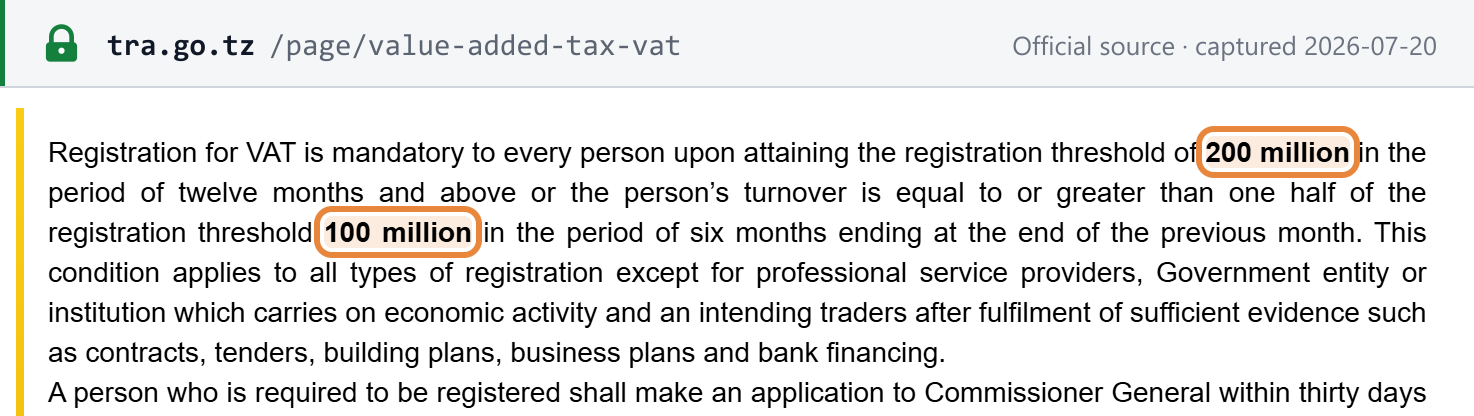
Registration for VAT is mandatory once a person's taxable turnover:
- is equal to or greater than TZS 200 million in a period of twelve months and above, or
- is equal to or greater than TZS 100 million in a period of six months ending at the end of the previous month. A business that reaches exactly TZS 200 million is liable — VAT Act section 28(2) applies "equal to or greater than" to both limbs, and TRA's own wording uses "reaches." [1]
The turnover threshold does not apply to professional service providers, Government entities, or institutions carrying on economic activities — these are liable to register for VAT regardless of turnover. [1]
 Source snapshot captured 2026-07-20 — original
The Commissioner also has discretion to register, as an intending trader, an investor whose project has not yet commenced production. [2]
Filing and payment
VAT is payable, and the VAT return for the period is due, on or before the 20th day of the month following the tax period — Tanzania runs on monthly VAT return periods. [1]
Rates
| Rate | Applies to |
|---|---|
| 18% (standard) | Most taxable supplies of goods and services in Mainland Tanzania [1] |
| 16% (reduced) | Specified business-to-consumer purchases paid through a bank or an approved electronic payment system, in effect since 1 September 2025 — but only for the categories of persons the Commissioner General designates by public notice; the reduced rate is not automatically available to every qualifying transaction until that designation is made [1] [3] |
| 0% (zero-rated) | Exports of goods and certain services — zero-rating is conferred by the body of the Act (including s.54 immovable property where the land is outside the United Republic, s.55 exported goods, s.56 locally manufactured fertiliser to 30 June 2028, s.61 international transport, s.62 and s.64 services used or enjoyed outside the United Republic, s.65 electricity supplied to Zanzibar), not by the Schedule [3] |
| Exempt | Schedule Part I (supplies and imports exempt) — agricultural products, education, healthcare, insurance and water supply; Part II (imports exempt) covers import-specific items (e.g., from 1 July 2026, LPG smart meters of HS Code 9028.10.00 imported by a distributor of liquefied petroleum gas, and electric-vehicle charging stations of HS Code 8504.40.00 imported by a licensed EV charging service provider) [1] [2] |
Cross-border transport subcontracting zero-rated — TRA Public Notice (6 August 2026)
A TRA Public Notice, issued 6 August 2026 as a tax ruling under section 11 of the Tax Administration Act, Cap 438, directs that transportation services rendered between a Subcontractor and a Lead Transporter in the course of transporting goods across Tanzania's borders are to be treated as the provision of international transport service, and are therefore zero-rated under section 61(3) of the VAT Act, Cap 148. Such zero-rated supplies form the basis of VAT refund claims, notwithstanding other provisions of the law relevant to refund eligibility. [4]
To rely on the ruling, a taxable person must hold evidence that the cross-border transport actually took place:
- Lead Transporters — a fiscal receipt issued to the customer, proof of receipt of payment, a TANSAD, bill of lading, invoice, packing list, and transit travel records.
- Subcontractors — fiscal receipts issued to the lead transporter or a customs agent (CFA), plus customs documentation specific to transit or export-transit cargo, including licences such as C28 and C40, release orders, movement sheets and cargo manifests.
The ruling applies prospectively from its date of issuance (6 August 2026), and stays binding only while the Subcontractor remains fully tax-compliant — timely filing, prompt payment, and no fictitious or sham transactions inflating input tax claims or reported purchases. [4]
New exemptions and Schedule changes — Finance Act 2026
Mining framework agreement exemption (section 92, amending section 6). The Finance Act, 2026 adds an exemption for the importation by, or supply to, a holder of a mining licence or special mining licence who has a framework agreement with the Government approved by the Cabinet, of goods or services to be used solely for the implementation of mining activities in which the Government has an ownership interest — provided the framework agreement itself provides for VAT exemption on the goods or services it specifies. The exemption is confined to goods or services exclusively for construction of the mining project and ceases immediately upon the commencement of production. [1]
Schedule Part I exemptions updated (section 96), effective 1 July 2026. The Act amends Part I of the Schedule to the VAT Act:
- Dog or cat food put up for retail sale (HS Code 2309.10.00) loses its exemption — it is now excluded from the animal-feed exemption it previously fell under, so VAT applies to it going forward.
- Fishing nets lose exemption unless locally manufactured. The exemption for fishing net (HS Code 5608.11.00) is narrowed to nets that are locally manufactured — an imported fishing net no longer qualifies. Polyester fishing yarn used exclusively for the manufacture of fishing net (HS Code 5402.20.00) is newly added as exempt.
- The description of exempt dairy packaging materials (HS Codes 3920.30.90, 3923.30.00, 4819.10.00, 4819.20.10 and 4819.20.90) is revised: the description text is unchanged and only the HS-code list moves — 3922.30.00 (plastic sanitary ware) is dropped, and 3920.30.90 and 3923.30.00 are added.
- Pneumatic tyres for aircraft (HS Code 4011.30.00) and turbo-jets, turbo-propellers and other gas turbines (Heading 84.11) are added from 1 July 2026 — but inside Part I item 31(b), which exempts these goods only when supplied to a local manufacturer or assembler of aircraft, or to a local operator of air transportation. A supply of the same goods to anyone else remains standard-rated; this is not a general exemption for aircraft parts.
- Locally manufactured garments made from locally grown cotton move from zero-rated to exempt under a new item 36, for the period 1 July 2026 to 30 June 2027. This is not a new benefit: a zero-rated supply lets the seller recover input VAT and charges the customer 0%, while an exempt supply charges no VAT but blocks the seller's input-tax recovery — so a manufacturer in this position loses the ability to reclaim input VAT on this line of business.
Deferral of VAT on imported capital goods — new condition (section 93, amending section 11). Section 11 of the VAT Act is not a registration provision — it governs deferral of VAT on imported or locally manufactured capital goods: on application, the Commissioner General may approve deferring the VAT otherwise payable on a capital good imported by a registered person, subject to the conditions listed in section 11(2)(a)-(d). The Finance Act, 2026 deletes the proviso at the end of section 11(1) and adds a further condition, new paragraph (e), on which such a deferral application may be approved: that the person has fulfilled requirements the Minister may, by order published in the Gazette, prescribe. The deleted proviso was the sunset on the imported-goods limb (the locally manufactured limb never had an end date) — it read that deferment on the imported capital goods "shall cease to apply on the 30th day of June, 2026" — so removing it keeps the deferral scheme alive beyond that date. An importer of capital goods eligible to apply for deferral should watch for the Minister's Gazette order, since it sets a further condition for approval. [1]
Digital marketplaces and VAT withholding — Finance Act 2026
The Finance Act, 2026 (Act No. 2 of 2026, certified 30 June 2026, in force from 1 July 2026) makes three changes to the VAT Act CAP 148: [1]
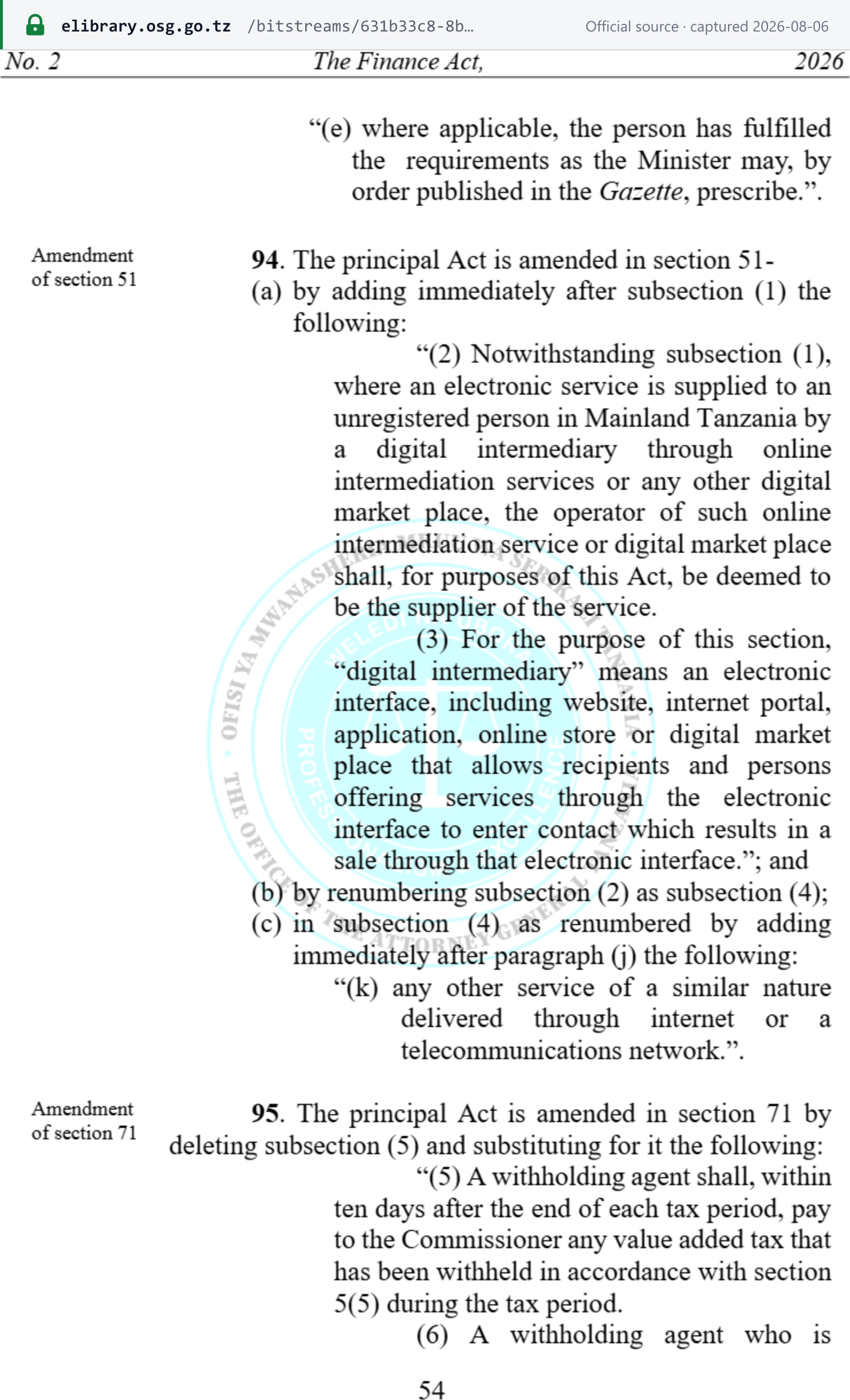
- Marketplace deemed supplier (section 51). Where an electronic service is supplied to an unregistered person in Mainland Tanzania by a digital intermediary — through an online intermediation service or any other digital marketplace — the operator of that intermediation service or marketplace is, for VAT purposes, deemed to be the supplier of the service and must account for the tax.
 Source snapshot captured 2026-08-06 — original
"Digital intermediary" is defined as an electronic interface, including a website, internet portal, application, online store or digital marketplace, that lets recipients and persons offering services through the interface make contact resulting in a sale. The statutory list of "electronic services" is also widened to add "any other service of a similar nature delivered through internet or a telecommunications network."
Source snapshot captured 2026-08-06 — original
"Digital intermediary" is defined as an electronic interface, including a website, internet portal, application, online store or digital marketplace, that lets recipients and persons offering services through the interface make contact resulting in a sale. The statutory list of "electronic services" is also widened to add "any other service of a similar nature delivered through internet or a telecommunications network."
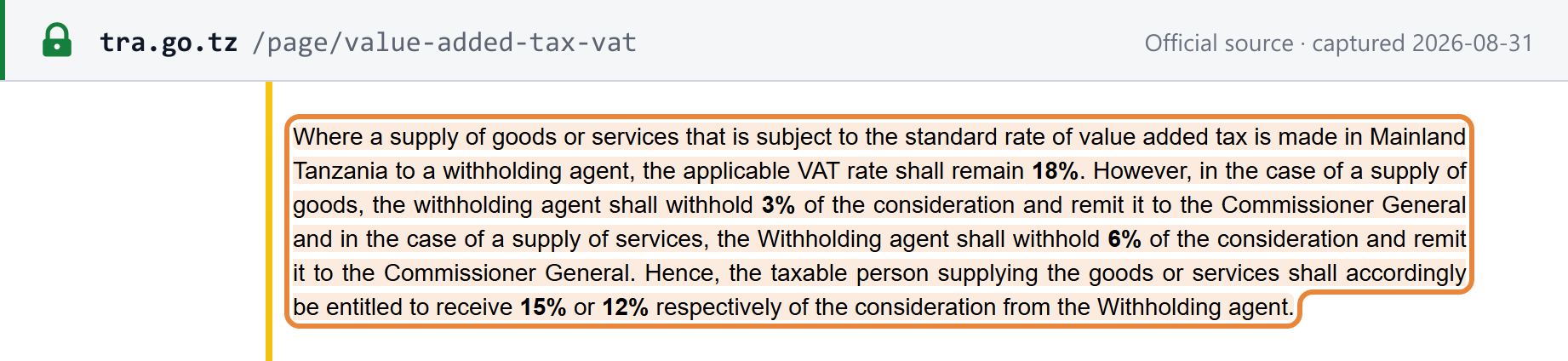
- Withholding VAT rate split (section 5). VAT remains chargeable at the standard 18% rate on the supply. The withholding agent must withhold 3% of the consideration on a supply of goods (and 6% on a supply of services) and remit that to the Commissioner General — so the supplier receives the balance, 15% or 12% of the consideration respectively, from the withholding agent. Where a single supply has both goods and services elements, the taxable value subject to withholding is apportioned 3:2 between goods and services.
 Source snapshot captured 2026-08-31 — original
- Monthly withholding statement (section 71). A withholding agent must pay any VAT withheld to the Commissioner within ten days after the end of each tax period, and must separately file a monthly withholding VAT statement with the Commissioner within ten days of the month following the tax period to which the VAT relates.
The Act also adds two new exemptions to the Schedule, Part II, effective 1 July 2026: imports of LPG smart meters (HS Code 9028.10.00) by a distributor of liquefied petroleum gas, and imports of electric vehicle charging stations (HS Code 8504.40.00) by a licensed electric vehicle charging service provider. [1]
Excise duty on non-resident service providers (GN 158E)
Government Notice No. 158E, the Excise (Non-Resident Service Provider) Regulations, 2026 (published 30 June 2026, made under the Excise (Management and Tariff) Act Cap. 147), came into operation on 1 July 2026. This is an excise-duty regime, separate from VAT. [1]
- Who: non-resident providers of electronic communication, pay-to-view TV and streaming, betting, gaming and lottery advertising, and money transfer and payment services delivered over the internet to unregistered persons in Tanzania.
- Registration: register online with the Commissioner General; providers already operating at commencement had 90 days.
- Returns and payment: file monthly returns and pay the duty by the 7th of the following month, in TZS or convertible currency.
- Fiscal devices: exempt from using electronic fiscal devices.
Invoice requirements
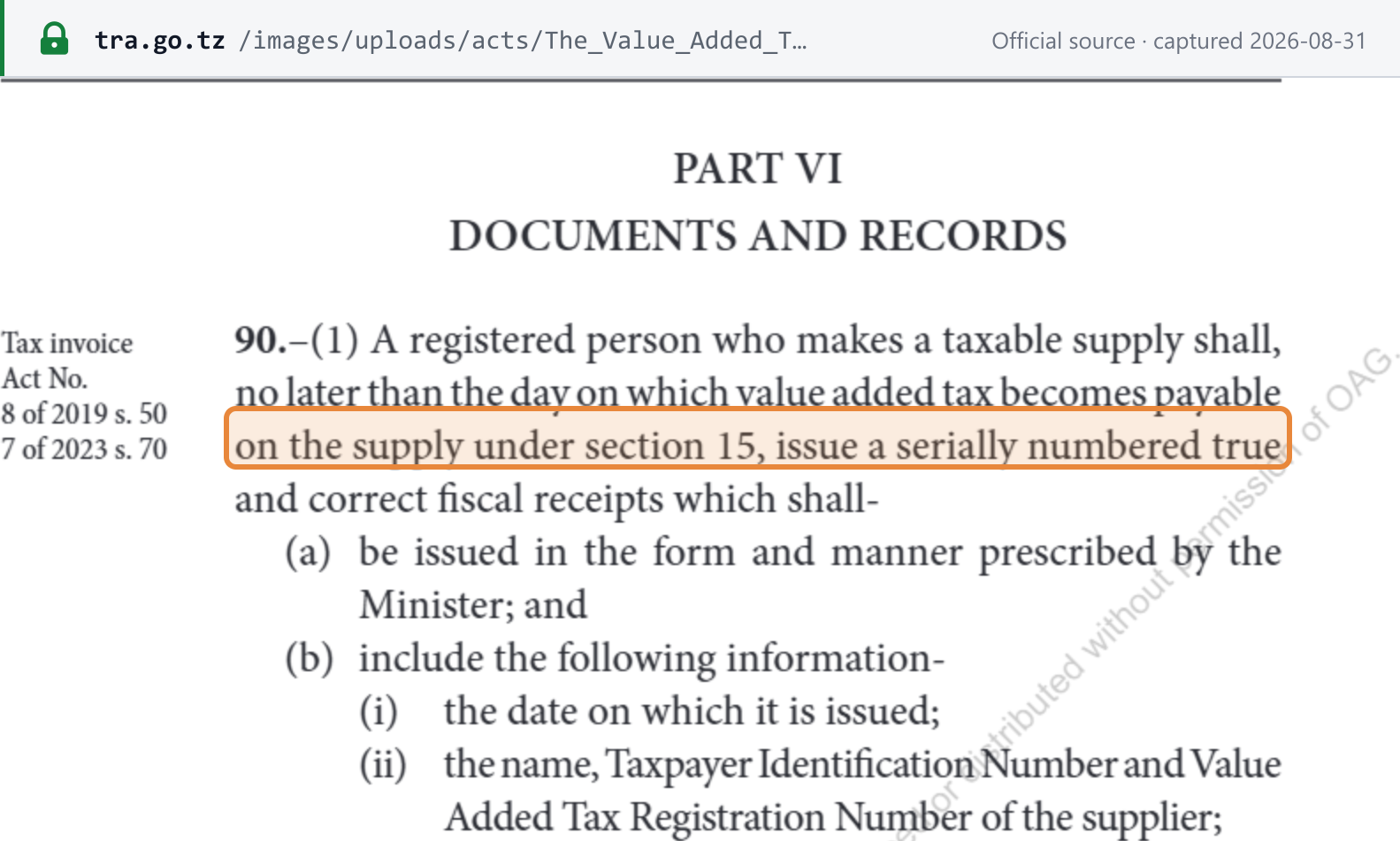
Tanzania is unusual in that the device, not just the document, is prescribed by statute. Section 90(1) of the VAT Act requires a registered person making a taxable supply to issue a serially numbered, true and correct fiscal receipt — no later than the day on which VAT becomes payable on the supply under section 15. (The provision was numbered 86 in the R.E. 2019 edition; until the Finance Act 2023, Act No. 7 of 2023, substituted "fiscal receipt", it read "tax invoice generated by electronic fiscal device for the supply".) That a manually produced document will not do follows from the fiscal-device regime and from section 90(3), which lets the Minister make regulations requiring invoices to be created using certified machines — it is not stated in section 90(1) itself, and it is qualified: under section 36 of the Tax Administration Act the Commissioner General may publish a list of persons excluded from the fiscal-receipt requirement, and those persons issue a manual receipt instead. [5]
Mandatory content — section 90
| Required information | Notes |
|---|---|
| The date on which it is issued | — |
| Name, Taxpayer Identification Number (TIN) and VAT Registration Number of the supplier | Tanzania requires both the TIN and the VAT number |
| Description, quantity and other relevant specifications of the things supplied | — |
| Total consideration payable and the amount of VAT included in that consideration | VAT-inclusive presentation, with the tax shown separately |
| Name, address, TIN and VAT registration number of the customer | Required only where the value of the supply exceeds the minimum amount prescribed in the regulations |
| Any other additional information prescribed in the regulations | — |
 Source snapshot captured 2026-08-31 — original
Section 90(2) draws a distinction worth understanding. A tax invoice that omits the customer particulars required by section 90(1)(b)(v) is still a valid invoice — but it cannot be used to support an input tax credit claim or any refund claim. The supplier stays compliant; the customer loses the deduction. One caveat on the citation: the Finance Act 2023 purported to delete this subsection and renumber those that follow it, but the R.E. 2023 consolidation did not carry that through and still prints it. The numbering here follows the Revised Edition, which is the edition the Finance Acts of 2025 and 2026 legislate against; confirm with the TRA before relying on the subsection number alone. If you are the buyer, check that your name, address, TIN and VAT number are on the invoice before you accept it. [5]
Why this guide shows no specimen invoice
Most guides in this set show what a compliant document looks like. Tanzania deliberately does not, and the reason is worth stating rather than leaving as a silent gap.
TRA publishes no sample fiscal receipt: its EFD pages describe the four device classes and the obligations, not the output. Nor could this guide build one. A Tanzanian tax invoice is not a document the seller lays out — it is printed by an approved electronic fiscal device and carries a fiscal signature and a verification code that TRA's own receipt-verification service will check. Drawing a facsimile of that would produce something shaped exactly like a verifiable fiscal receipt while verifying against nothing, which is a forgeable artifact rather than a teaching aid.
So the section above is the answer: section 90(1)(b) fixes the particulars the device must print, and the device fixes the arrangement. If you need to see one, the receipt from any VAT-registered Tanzanian seller is the specimen — and it can be checked against TRA's verification service, which no picture here could be.
Originals and copies
One original tax invoice must be issued for each taxable supply. Where the customer is a registered person and claims to have lost it, the issuer may provide a copy marked as such. [5]
Adjustment notes — Tanzania's credit/debit note
Tanzania does not use "credit note" and "debit note" as statutory terms. Corrections travel on an adjustment note under section 91, which must contain: [5]
- the date on which it is issued;
- the name, TIN and VAT registration number of the supplier;
- the nature of the adjustment event and the supply to which it relates;
- the effect on the amount of VAT payable on the supply; and
- the customer's name, TIN and VAT registration number, where the effect on the VAT payable exceeds the prescribed minimum.
The same asymmetry applies: an adjustment note is not invalid merely for omitting the customer particulars, but it cannot support a claim for a decreasing adjustment. An amended tax invoice may serve as an adjustment note if it complies with the regulations. [5]
Who must hold an EFD
A person whose annual turnover is assessed at TZS 11 million and above must acquire an electronic fiscal device from an approved supplier and issue fiscal receipts or fiscal invoices with it. Failing to issue a fiscal receipt or fiscal invoice on receiving payment is an offence. EFDs hold data for at least 5 years or 1,800 days of transactions. See E-invoicing status below. [6]
E-invoicing status
Tanzania runs a real-time fiscal-reporting regime built around Electronic Fiscal Devices (EFDs) rather than a Peppol- or EN 16931-style continuous transaction control network. A person whose annual turnover is assessed at TZS 11 million and above must acquire a certified EFD from an approved supplier and use it to issue fiscal receipts or fiscal invoices — see Who must hold an EFD above. Transaction data is transmitted to the TRA's central Electronic Fiscal Device Management System (EFDMS) in near real time, enabling continuous VAT monitoring. [1]
Zanzibar — a separate VAT jurisdiction
Zanzibar is not covered by the Value Added Tax Act, CAP 148 — everything above in this guide applies to Mainland Tanzania only. The United Republic of Tanzania runs two VAT systems: Mainland Tanzania (administered by the TRA, this guide) and Zanzibar (administered separately by the Zanzibar Revenue Authority (ZRA) under Zanzibar's own VAT Act No. 4 of 1998). A business supplying into Zanzibar — including a non-resident digital-services supplier — should check both regimes: registering and accounting for VAT with the TRA does not satisfy a Zanzibar obligation, and vice versa. [1]
Zanzibar's standard VAT rate is 15%, rising to 18% on banking, postal, telecommunications, insurance and digital services. [1]
Zanzibar VAT on digital/electronic services — 18%, confirmed by the ZRA
The Zanzibar Revenue Authority confirms that 18% VAT applies to electronic/digital services supplied by non-resident suppliers to non-VAT-registered persons in Zanzibar, under sections 4A and 4B of the VAT Act No. 4 of 1998 (inserted in 2024) and the Tax Administration Procedures (Simplified Registration for Non-resident Suppliers of Electronic Services) Regulations, 2022. A supply to a Zanzibar-VAT-registered customer sits outside this charge — the registered customer self-accounts instead. [2]
Transitional grace period. As an exceptional transitional measure, non-resident businesses that have not yet registered are told to register now as a preparatory step, but are given lead time until 1 January 2027 to build their internal systems before they must start collecting and remitting VAT to the ZRA. Businesses that will not be ready by then are told to contact the ZRA directly to discuss their circumstances. [2]
This is a separate registration and filing obligation from Mainland Tanzania's marketplace deemed-supplier rule described in Digital marketplaces and VAT withholding above (Finance Act, 2026, section 51). A non-resident supplier selling digital services into both Mainland Tanzania and Zanzibar may need to register, charge and remit VAT to both the TRA and the ZRA — they are not interchangeable registrations. [1] [2]
This guide does not otherwise cover Zanzibar VAT registration, rates, invoicing or e-invoicing in the depth it covers Mainland Tanzania above — treat the rest of this page as Mainland-only unless stated otherwise.
Recent changes
- 2026-08-17 — Zanzibar Revenue Authority confirms 18% VAT applies to electronic/digital services supplied by non-resident suppliers to non-VAT-registered persons in Zanzibar (VAT Act No. 4 of 1998, ss.4A–4B), with a transitional grace period for registered-but-not-yet-collecting non-residents ending 1 January 2027. Zanzibar is a separate VAT jurisdiction from Mainland Tanzania — see Zanzibar — a separate VAT jurisdiction above. (Zanzibar Revenue Authority) — see issue
- 2026-08-06 — TRA Public Notice (a tax ruling under section 11, Tax Administration Act Cap 438) zero-rates transportation services rendered between a Subcontractor and a Lead Transporter on cross-border routes as international transport services under VAT Act s.61(3), forming the basis for refund claims. (Tanzania Revenue Authority) — see issue
- 2026-07-01 — Government Notice No. 158E, the Excise (Non-Resident Service Provider) Regulations, 2026, came into operation: non-resident providers of electronic communication, pay-to-view TV/streaming, betting/gaming/lottery advertising and money transfer/payment services delivered over the internet to unregistered persons in Tanzania must register online with the Commissioner General (existing providers had 90 days), file monthly returns and pay excise duty by the 7th of the following month, and are exempt from using electronic fiscal devices. See Excise duty on non-resident service providers. (Tanzania Revenue Authority) — see event
- 2026-07-01 — Finance Act, 2026 amended section 51 of the VAT Act: platform operators are deemed the supplier of electronic services sold to unregistered persons in Mainland Tanzania, and the "electronic services" definition was widened. (United Republic of Tanzania — e-Gazette) — see issue
- 2026-07-01 — Finance Act, 2026 amended sections 5 and 71 of the VAT Act: VAT withholding agents must file a monthly withholding statement within 10 days of the following month, and must withhold 3% of the consideration on goods (6% on services) and remit it to the Commissioner General, with the supplier receiving the balance — 15% or 12% of the consideration respectively (mixed supplies apportioned 3:2). (United Republic of Tanzania — e-Gazette) — see issue
- 2026-07-01 — Finance Act, 2026 added VAT import exemptions to the Schedule, Part II, for LPG smart meters (HS 9028.10.00) imported by a distributor of liquefied petroleum gas, and electric-vehicle charging stations (HS 8504.40.00) imported by a licensed EV charging service provider. (United Republic of Tanzania — e-Gazette) — see issue
- 2026-07-01 — Finance Act, 2026 raised the single-instalment digital service tax on non-resident digital-service providers from 2% to 3% of gross payment (Income Tax Act, CAP 332, section 116(1) — a separate income-tax charge, not a VAT rate). (United Republic of Tanzania — e-Gazette) — see issue
- 2026-07-01 — Finance Act, 2026 amended VAT Act section 6 to exempt goods and services used solely for construction of a mining project, where the holder of a mining or special mining licence has a Cabinet-approved framework agreement with the Government — the exemption ceases immediately on commencement of production. (Parliament of the United Republic of Tanzania (Bunge)) — see issue
- 2026-07-01 — Finance Act, 2026 amended Part I of the VAT Act's Schedule: excludes retail dog/cat food (HS 2309.10.00) from exemption; narrows the fishing-net exemption to locally manufactured nets (imported nets lose exemption) and adds polyester fishing yarn (HS 5402.20.00) as exempt; adds aircraft tyres (HS 4011.30.00) and gas turbines (Heading 84.11) to Part I item 31(b), exempt only when supplied to a local aircraft manufacturer or assembler or a local air-transport operator; and adds a new item 36 moving locally manufactured garments from locally grown cotton from zero-rated to exempt (removing input-tax recovery), for 1 July 2026 to 30 June 2027. (Parliament of the United Republic of Tanzania (Bunge)) — see issue
- 2026-07-01 — Finance Act, 2026 amended VAT Act section 11 (deferral of VAT on imported capital goods): deletes the proviso at the end of section 11(1) and adds a new paragraph (e) conditioning approval of a deferral application on requirements the Minister may prescribe by an order published in the Gazette. (Parliament of the United Republic of Tanzania (Bunge)) — see issue
Reference links
- Tanzania Revenue Authority — Value Added Tax (VAT)
- Tanzania Revenue Authority — Electronic Fiscal Devices (EFD)
- The Value Added Tax Act, CAP 148 R.E. 2023 — sections 90–91 (fiscal receipts and adjustment notes; formerly ss.86–87 in R.E. 2019)
- The Finance Act, 2026 (Act No. 2 of 2026)
- PwC Tax Summaries — Tanzania, Other taxes (VAT)
- org-id.guide — Tanzania Revenue Authority (TZ-TRA) TIN identifier scheme
- Tanzania Revenue Authority — Public Notice on cross-border transport services VAT zero-rating (6 August 2026)
- Zanzibar Revenue Authority — VAT on Digital Service in Zanzibar
Frequently Asked Questions
What is the standard VAT rate in Tanzania, and are there other rates?
The standard rate is 18% in Mainland Tanzania.
 Source snapshot captured 2026-07-20 — original
A reduced 16% rate applies to specified B2C purchases paid through a bank or an approved electronic payment system, in effect since 1 September 2025 — but only for the categories of persons the Commissioner General designates by public notice, per TRA's own proviso. Exports of goods and certain services are zero-rated under sections 54, 55, 56, 61, 62, 64 and 65 of the VAT Act, among others (zero-rating sits in the body of the Act, not in its Schedule); cross-border transport subcontracting is also zero-rated under section 61(3) — see Cross-border transport subcontracting zero-rated above. Zanzibar runs a separate VAT regime (15% standard rate; 18% on banking, postal, telecoms, insurance and digital services) administered by the Zanzibar Revenue Authority — see Zanzibar — a separate VAT jurisdiction below. [1]
Source snapshot captured 2026-07-20 — original
A reduced 16% rate applies to specified B2C purchases paid through a bank or an approved electronic payment system, in effect since 1 September 2025 — but only for the categories of persons the Commissioner General designates by public notice, per TRA's own proviso. Exports of goods and certain services are zero-rated under sections 54, 55, 56, 61, 62, 64 and 65 of the VAT Act, among others (zero-rating sits in the body of the Act, not in its Schedule); cross-border transport subcontracting is also zero-rated under section 61(3) — see Cross-border transport subcontracting zero-rated above. Zanzibar runs a separate VAT regime (15% standard rate; 18% on banking, postal, telecoms, insurance and digital services) administered by the Zanzibar Revenue Authority — see Zanzibar — a separate VAT jurisdiction below. [1]
What is the VAT registration threshold in Tanzania?
Registration is mandatory once taxable turnover is equal to or greater than TZS 200 million in a twelve-month period, or is equal to or greater than TZS 100 million in a six-month period ending at the end of the previous month — a business that reaches exactly TZS 200 million is liable. The threshold does not apply to professional service providers, Government entities, or institutions carrying on economic activities, which must register regardless of turnover. Application to the Commissioner General is due within 30 days of reaching the threshold; an intending trader may apply earlier. [1]
When is VAT due in Tanzania?
VAT runs on monthly return periods. VAT is payable by a registered person on or before the 20th day of the month following the tax period, which is also the deadline for submitting the VAT return for that period. [1]
Do foreign digital marketplaces have to charge VAT on sales to Tanzanian consumers?
From 1 July 2026, yes, for electronic services sold to unregistered customers. The Finance Act, 2026 added a deemed-supplier rule to section 51 of the VAT Act: where an electronic service is supplied to an unregistered person in Mainland Tanzania through an online intermediation service or digital marketplace, the platform operator — not the underlying seller — is treated as the supplier and must account for VAT. The definition of "electronic services" was also widened to cover any similar service delivered through the internet or a telecommunications network. [1]
Is e-invoicing mandatory in Tanzania?
Real-time fiscal reporting already is. A person whose annual turnover is assessed at TZS 11 million and above must acquire a certified Electronic Fiscal Device (EFD) from an approved supplier and use it to issue fiscal receipts or fiscal invoices — reporting to the TRA's EFDMS in near real time. [1]
What are Tanzania's VAT withholding rules from July 2026?
From 1 July 2026, a withholding agent must file a monthly withholding VAT statement within ten days of the month following the tax period, and must pay withheld VAT within ten days after the end of each tax period (VAT Act section 71, as amended). VAT remains chargeable at the standard 18% rate; the withholding agent must withhold 3% of the consideration on a supply of goods or 6% on a supply of services and remit it to the Commissioner General, so the supplier receives the balance — 15% or 12% of the consideration respectively — from the withholding agent. Mixed supplies of goods and services are apportioned 3:2 between the two (VAT Act section 5, as amended). [1]
Source snapshot captured 2026-08-31 — original
Are cross-border transport services provided by a subcontractor to a lead transporter zero-rated in Tanzania?
Yes, as of a TRA Public Notice dated 6 August 2026. Issued as a tax ruling under section 11 of the Tax Administration Act, Cap 438, it directs that transportation services rendered between a Subcontractor and a Lead Transporter in the course of transporting goods across the borders of the United Republic are treated as the provision of an international transport service, and are therefore zero-rated under section 61(3) of the VAT Act, Cap 148. Such zero-rated supplies form the basis of refund claims, provided the taxable person holds the required evidence — for Lead Transporters, a fiscal receipt, proof of payment, TANSAD, bill of lading, invoice, packing list and transit travel records; for Subcontractors, fiscal receipts issued to the lead transporter or a customs agent, plus C28/C40 licences, release orders, movement sheets and cargo manifests. The ruling applies prospectively from 6 August 2026. [1]
Does Tanzania's VAT apply the same way in Zanzibar, and is 18% VAT really due on digital services there?
No, and yes. Zanzibar runs a separate VAT system from Mainland Tanzania — its own VAT Act No. 4 of 1998, administered by the Zanzibar Revenue Authority (ZRA), not the TRA. The ZRA confirms that 18% VAT applies to electronic/digital services supplied by non-resident suppliers to non-VAT-registered persons in Zanzibar, under sections 4A and 4B of the VAT Act No. 4 of 1998 and the Tax Administration Procedures (Simplified Registration for Non-resident Suppliers of Electronic Services) Regulations, 2022. As an exceptional transitional measure, non-resident businesses that have not yet registered are told to register now, with lead time until 1 January 2027 to build internal systems before they must start collecting and remitting VAT to the ZRA. A supplier selling digital services into both Mainland Tanzania and Zanzibar may have separate registration and filing obligations to both the TRA and the ZRA. [1]