Bolivia VAT (IVA) guidelines
| FACTSHEET | |
|---|---|
| Country code | BO |
| Tax name | Impuesto al Valor Agregado (IVA) |
| Tax Authority | Servicio de Impuestos Nacionales (SIN) |
Overview
Bolivia levies Value Added Tax — the Impuesto al Valor Agregado (IVA) — under Ley N° 843 (Título I, Texto Ordenado vigente), administered by the Servicio de Impuestos Nacionales (SIN). IVA applies to sales of movable goods located in Bolivian territory, works contracts and the provision of services or any other supply, and definitive imports. [1]
The general and unique rate is 13% (Article 15 of Ley N° 843). [1] Critically, that 13% is currently applied "por dentro" — treated as already embedded in the invoiced price rather than added on top of it — which produces an effective rate on the pre-tax (net) price of approximately 14.94% (13 ÷ 87). SIN's own announcement of the tax-relief bill that became Ley N° 1733 described this exact mechanic and figure. [2]
The pending "por fuera" reform — Ley N° 1733
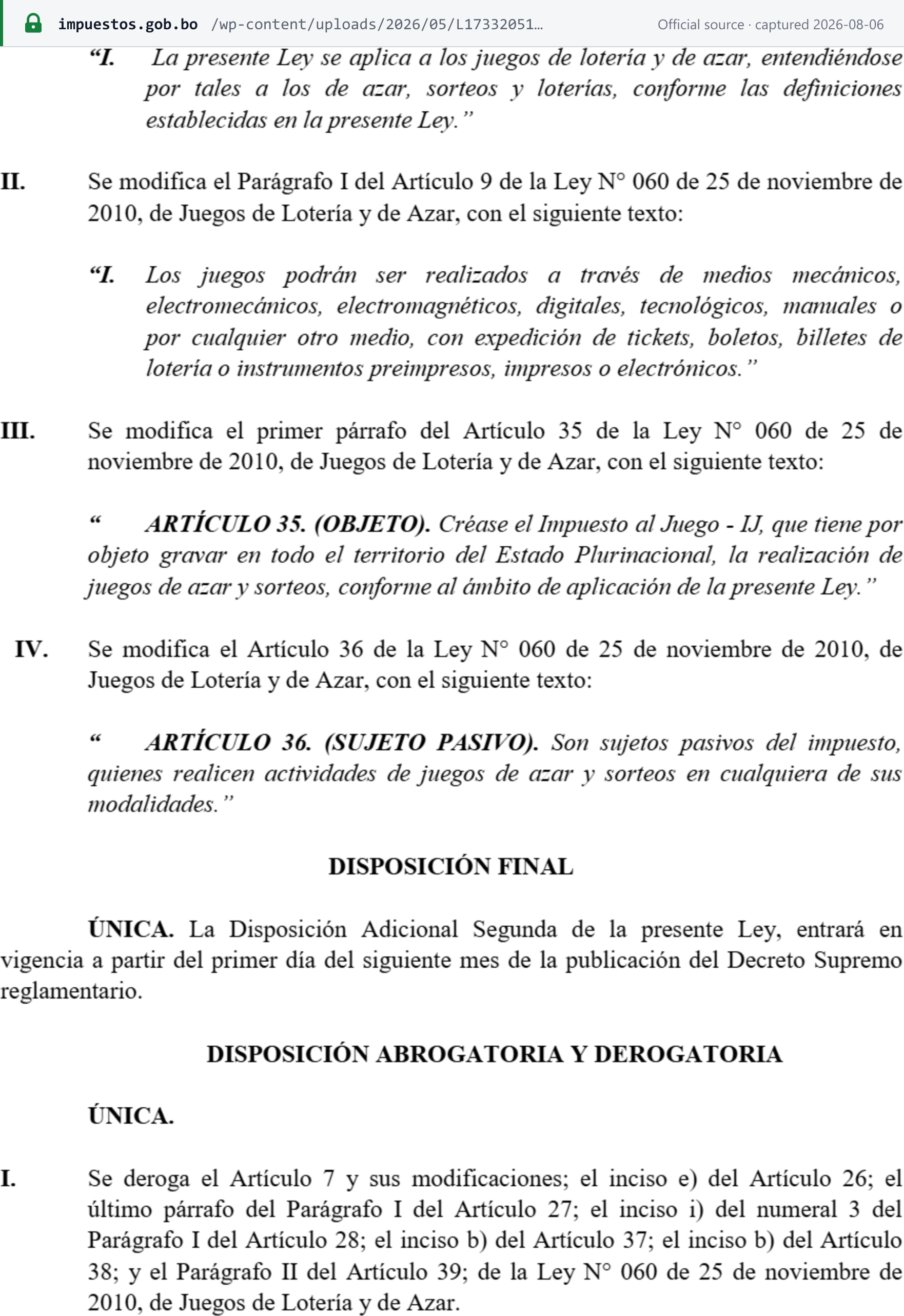
Ley N° 1733 (Ley de Alivio Tributario), promulgated 27 May 2026, rewrites Article 5 of Ley N° 843 so that IVA is calculated on the net price and shown separately on the invoice ("por fuera"), ending the embedded/"por dentro" method — this is the single biggest change on the horizon for Bolivian IVA. [3]
Ley N° 1733's own Disposición Final Única states that this specific change (its Disposición Adicional Segunda) "entrará en vigencia a partir del primer día del siguiente mes de la publicación del Decreto Supremo reglamentario" — it only takes effect from the first day of the month after an implementing Decreto Supremo is published. No Decreto Supremo regulating Ley N° 1733 had been located as at 2026-10-07. The "por fuera" method is therefore not yet in force — invoices should continue to be issued under the current "por dentro" method (13% nominal / ~14.94% effective) until SIN or the Gaceta Oficial confirm the decree's publication. [3]
 Source snapshot captured 2026-08-06 — original
Regardless of when the "por fuera" reform itself enters into force, SIN has already started adjusting the Sistema de Facturación for Ley N° 1733. Resolución Normativa de Directorio N° 102600000034 (La Paz, 1 September 2026) published version 0.0 of the Anexo Técnico Ley N° 1733 under "Información Técnica Guías de Uso y Consultas" at impuestos.gob.bo, and its Article 2 requires every taxpayer with an own or provider invoicing software system to comply with that Anexo Técnico in order to begin pilot-environment testing and obtain the subsequent authorisation, in a window that opened on 1 October 2026 and runs until 16 November 2026. Until the RND implementing the Sistema de Facturación changes is published and in force, RND N° 102100000011 remains fully applicable. [7]
Ley N° 1733 also, separately and already effective from its own promulgation (its condonation/regularization provisions are not gated by a decree), condones certain pre-2018 and 2020 tax debts and shortens the general tax-administration prescription period to four (4) years (amending Article 59 of the Código Tributario Boliviano, Ley N° 2492). [3]
Other national taxes alongside IVA
General-regime businesses also pay the Impuesto a las Transacciones (IT) at a general rate of 3% on gross income (Ley N° 843, Articles 72 and 75), and the Impuesto sobre las Utilidades de las Empresas (IUE) at 25% of net taxable profit (Article 50). The IUE paid annually is credited monthly as a payment on account ("pago a cuenta") against IT until exhausted (Article 77) — so a profitable, IUE-compliant taxpayer typically owes little or no IT in cash. [1]
Fuel VAT credit restored to 100%
Under RND N° 102600000012 of 13 April 2026 (published 14 April), SIN restored the full (100%) VAT fiscal credit on gasoline and diesel purchase invoices, removing a prior cap that allowed only 70% of the input VAT on fuel to be credited — the entire VAT paid on a fuel invoice is now recoverable. [4]
Hotel-sector periodic reporting obligation abrogated
Resolución Normativa de Directorio (RND) N° 102600000035, of 2 September 2026, abrogates RND N° 102000000030 (4 November 2020) and eliminates the formal obligation for the hospitality sector to submit periodic reports of additional information. The abrogated rule covered "hoteles y apart-hoteles, hostales y residenciales, alojamientos, cabañas y refugios de vacaciones, y otros establecimientos de pernocte" — hotels and apart-hotels, hostels and residential lodging, other accommodation, vacation cabins/refuges, and other overnight-stay establishments generally (SIN's own wording is an open list with a catch-all, not limited to the five named categories). [5]
Taxpayers covered by the abrogated rule must still file one final report, covering the July–August 2026 period; no further periodic reports of this kind are required after that submission. [5]
Tax ID / NIT registration
Bolivia identifies taxpayers with a single Número de Identificación Tributaria (NIT), issued by SIN through the Padrón Nacional de Contribuyentes Biométrico Digital (PBD-11), governed by RND N° 10-0009-11. [1]
How to register:
- Go to
impuestos.gob.bo, select "SIAT en Línea", then "Padrón Biométrico Digital". - Create an inscription account with an email address and password.
- Scan and attach the documents required for the applicant type (a natural person needs an ID card and proof of fiscal/habitual address; a legal entity needs incorporation and legal-representation documents).
- Attend an in-person biometric verification appointment at a SIN office to finalize the registration.
- SIN allocates the NIT on approval. [1] [2]
Registration in the Padrón Biométrico Digital is mandatory for all natural and legal persons, unipersonal businesses and undivided successions, national or foreign, that carry out taxable economic activity in Bolivia — it is triggered by the activity itself, not by a turnover threshold, unlike the VAT-registration thresholds used in many other countries. See Registration thresholds below for the simplified regimes some small taxpayers can use instead of Régimen General. [1]
Documents issued through an online invoicing modality (Electrónica en Línea, Computarizada en Línea or Portal Web en Línea) carry a verifiable QR code / Código Único de Facturación (CUF) that can be checked against SIN's records through the options published at impuestos.gob.bo. [3]
Online taxpayer-type and regime changes, and RNC certifications
RND N° 102600000031, issued 13 August 2026, modifies RND N° 102500000017 on the Registro Nacional de Contribuyentes (RNC). Taxpayers may now request, online or in person, a change of taxpayer type — between Persona Natural and Empresa Unipersonal — and a change of regime — between the simplified and special regimes and Régimen General. A new Chapter V creates electronic services, through the Oficina Virtual Tributaria at impuestos.gob.bo, for consulting NIT status, certifying registration in the RNC, and certifying non-possession of a NIT — each carrying a verifiable QR code. The Resolution entered into force on its publication date, 15 August 2026. No action is required beyond monitoring. [4]
Registration thresholds
There is no minimum-turnover threshold for the general regime: any person carrying out commerce, industry, a profession, a business, or renting out goods or services in Bolivia must register for a NIT and, if their activity is taxed under Ley N° 843, charge IVA. [1]
Instead, Bolivia routes very small taxpayers into alternative simplified regimes rather than gating Régimen General by revenue. The best-documented of these is the Régimen Tributario Simplificado (RTS), available to small merchants, artisans and food vendors whose business capital does not exceed Bs60,000, under Decretos Supremos N° 24484, N° 27924 and N° 3698. RTS taxpayers pay a fixed bimonthly quota by capital category instead of registering for IVA under Régimen General: [2]
| Category | Capital (Bs) | Bimonthly payment (Bs) |
|---|---|---|
| 1 | 12,001 – 15,000 | 47 |
| 2 | 15,001 – 18,700 | 90 |
| 3 | 18,701 – 23,500 | 147 |
| 4 | 23,501 – 29,500 | 158 |
| 5 | 29,501 – 37,000 | 200 |
| 6 | 37,001 – 60,000 | 350 |
A taxpayer whose capital exceeds Bs60,000 (Category 6) must move to Régimen General — register a NIT for VAT purposes and begin issuing fiscal documents under the Sistema de Facturación. [2] Bolivia also runs separate simplified regimes for the transport sector (Sistema Tributario Integrado) and small agricultural producers (Régimen Agropecuario Unificado).
Rates
| Rate | Applies to |
|---|---|
| 13% (nominal, "por dentro") | The single general IVA rate on virtually all taxable sales of goods, works contracts, services and definitive imports (Ley N° 843, Art. 15). [1] |
| ~14.94% (current effective rate) | Because the 13% is calculated "por dentro" (embedded in the price) rather than added to it, the effective burden on the pre-tax net price is 13 ÷ 87 ≈ 14.94% — until Ley N° 1733's "por fuera" reform enters into force (see above). [2] |
| Relieved of output IVA | Exports (Article 11, Ley N° 843) — the exporter is released from the output-tax debit and may still recover related input credit. [1] |
| Exempt (narrow list) | Goods imported by accredited diplomatic personnel/entities, and bona fide travelers' goods within customs-tariff limits (Article 14, Ley N° 843). [1] |
Fuel purchases: under RND N° 102600000012 of 13 April 2026 (published 14 April), the VAT fiscal credit on gasoline and diesel invoices is 100% creditable, up from a prior 70% cap. [3]
Invoice requirements
Bolivia's core VAT-compliance rules live in the Sistema de Facturación, set out in RND N° 102100000011 (11 August 2021, as periodically amended) — invoicing detail matters enormously here because so much of day-to-day IVA compliance turns on getting the fiscal document right. [1]
Mandatory content
| Required field | Notes |
|---|---|
| Date of emission | Recorded per the modality's rules; some prevalored/prepaid formats may omit it. |
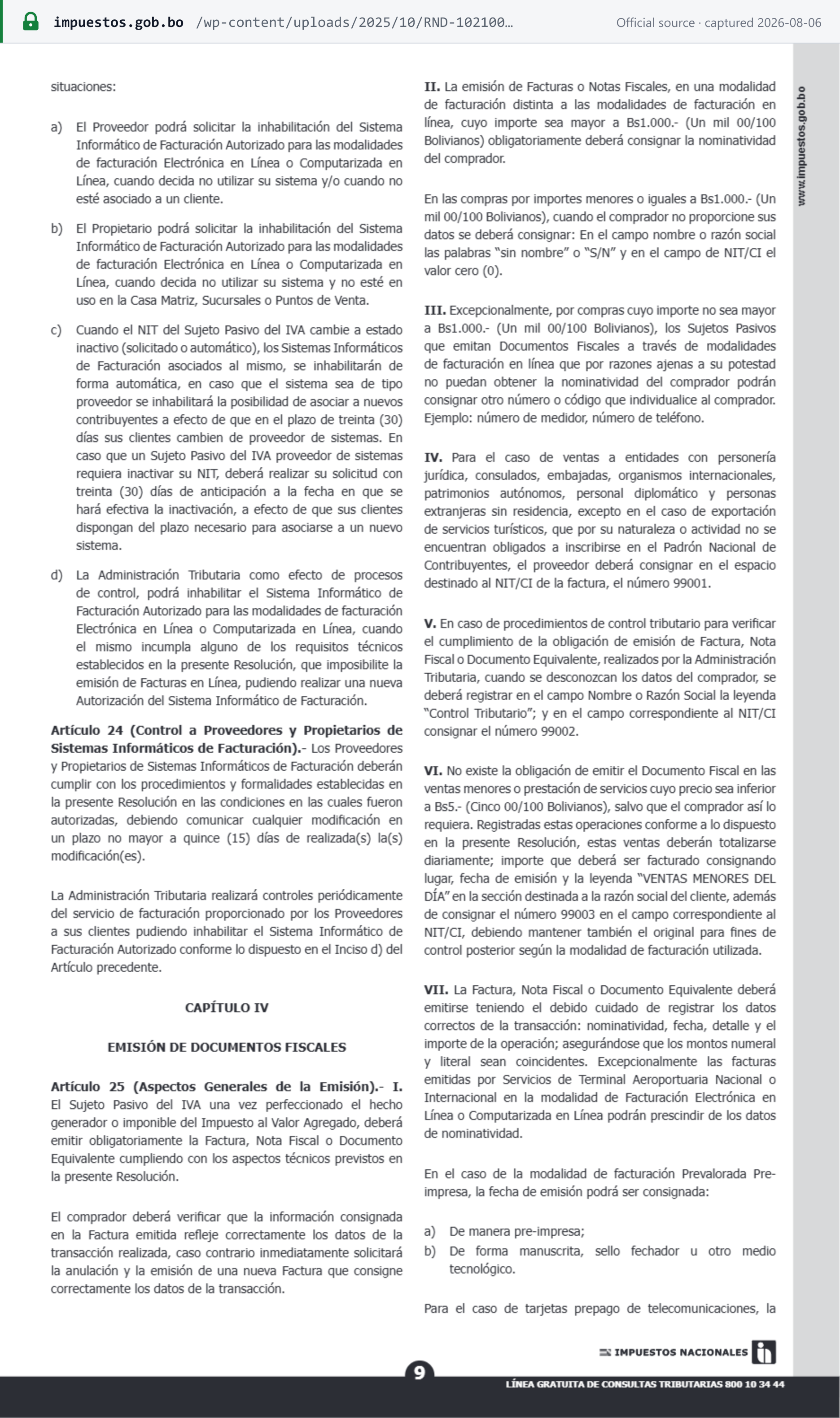
| Buyer name and NIT/CI | Required in full only when the invoice value exceeds Bs1,000. At or below Bs1,000, if the buyer does not provide details the seller enters "sin nombre"/"S/N" and NIT 0. |
| Itemized description, quantity, unit price and subtotal (goods) or detail/description and subtotal (services) | Numeral and literal amounts must match. |
| Applicable taxes | IVA and, where relevant, ICE, IEHD or IPJ, discriminated separately. |
| Authorization / Código de Control or CUF | Alphanumeric control code (offline modalities) or Código Único de Facturación with QR code (online modalities), individualizing the document. |
| Tipo de Cambio Oficial (TCO) for foreign-currency transactions | Since 16 July 2026 (publication of RND N° 102600000026), the Banco Central de Bolivia's daily official exchange rate at the transaction date, per RND N° 102600000026 (see Currency below). |
 Source snapshot captured 2026-08-06 — original
Article 25(VI) exempts sales or services under Bs5 from any document requirement unless the buyer requests one (daily totals are then booked under a "VENTAS MENORES DEL DÍA" line with NIT 99003), and Article 25(VIII) lets restaurants and similar Manual-modality sellers write "Consumo" instead of an itemized detail for bills of Bs300 or less. [1]
What a compliant invoice looks like
Bolivia is one of the few jurisdictions that publishes a model graphic format for every document type. Article 69 of RND 102100000011 provides that the models of the fiscal-document formats and their representación gráfica are published in the Anexo Técnico on the SIN website, and the SIN hosts a "Formato Gráfico" PDF alongside the XML/XSD for each type. [1] [6]
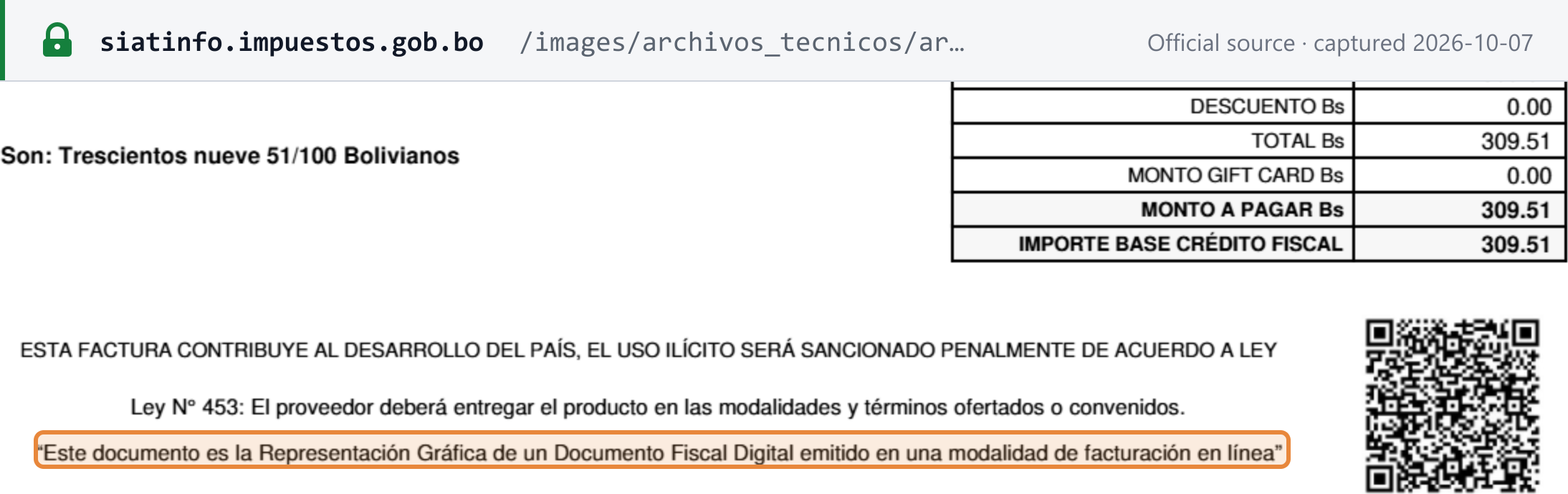
The Factura de Compra y Venta model shows the NIT, invoice number and código de autorización, the buyer block, a seven-column item table, the totals ladder down to importe base crédito fiscal, the QR code, the Ley 453 legend, and the mandatory footer "Este documento es la Representación Gráfica de un Documento Fiscal Digital emitido en una modalidad de facturación en línea". It is watermarked SIN VALOR LEGAL. [6]
Unlike most countries in this guide set, Bolivia constrains the physical document too: Article 69 permits only additional fields, Article 70 fixes size limits, and Article 71 fixes paper colour and weight, a minimum 8-point type size, and bans italics. [1]
 Source snapshot captured 2026-08-06 — original
Issuance deadlines (by modality)
| Modality | Deadline to issue |
|---|---|
| Portal Web en Línea, Computarizada en Línea, Electrónica en Línea | Same day as the transaction |
| Manual | 180 days (720 days for rentals) |
| Computarizada SFV | 180 days |
| Prevalorada | 360 days (720 days for telecommunications; day of the event for public performances) |
| Factura por Contingencia | 360 days |
[1] There is no obligation, in any modality, to defer issuance to a fiscal period after the one in which the taxable event occurred.
Cancellation, credit/debit notes and late corrections
- A validly registered fiscal document in an online modality can be changed to "ANULADO" up to day 9 of the following month (Article 38.II of RND N° 102100000011, as amended by RND N° 102100000021), and only where the underlying operation never took place. [1]
- Since 15 July 2026, RND N° 102600000025 (dated 13 July 2026, in force on publication) adds a formal procedure for cancelling a fiscal document after that deadline: the taxpayer files a request with supporting documentation to their Gerencia Distrital/GRACO, and where the document has already been included in a filed tax return (DDJJ), SIN resolves it (approval or rejection, notified through the taxpayer's tax mailbox) within up to six months; otherwise the request is dealt with the same day at the GRACO or district office. A transitional rule lets requests for documents issued before this RND use the new process until 30 November 2026. [2]
- Notas de Crédito-Débito adjust the fiscal debit/credit where goods or services are returned or an agreed operation is rescinded; Notas de Conciliación correct the amount billed (e.g., for utilities) within 12 months of the original invoice. [1]
Currency
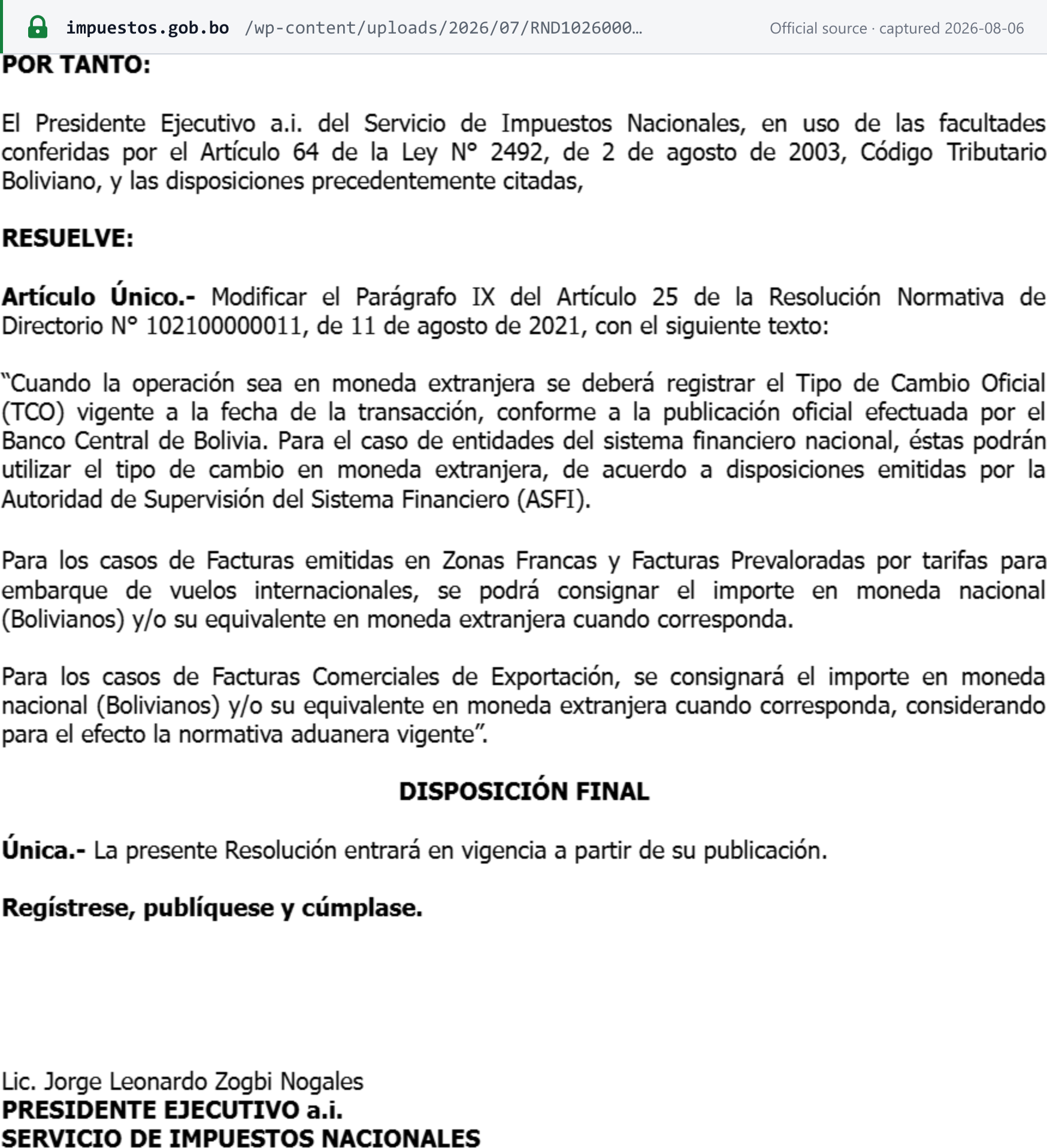
Since 16 July 2026, RND N° 102600000026 (dated 15 July 2026, in force on publication) amends Article 25(IX) of RND N° 102100000011 so that a foreign-currency fiscal document must record the Tipo de Cambio Oficial (TCO) published by the Banco Central de Bolivia (BCB) for the transaction date — following Bolivia's move to a flexible exchange-rate regime under Resolución Ministerial N° 245 and BCB Resolución de Directorio N° 88/2026 (both 26 June 2026). Regulated financial institutions may instead use the exchange rate set under ASFI rules. Export invoices, free-zone invoices and prevalored international-flight fares may still show Bolivianos and/or their foreign-currency equivalent under customs rules. [3]
 Source snapshot captured 2026-08-06 — original
Retention
Fiscal documents (and, where cancelled, the original marked "ANULADO") must be kept for the duration of the tax-administration's prescription period under the Código Tributario Boliviano — now four (4) years, following Ley N° 1733's amendment of Article 59 of Ley N° 2492 (this prescription change, unlike the IVA "por fuera" reform, is not gated by a pending decree). [1] [4]
Technical format
Documents issued in an online modality must be generated and transmitted as an XML Documento Fiscal Digital, authenticated with a digital signature (Electrónica en Línea) or a hash/huella digital (Computarizada en Línea), following the technical annex SIN publishes at impuestos.gob.bo. See E-invoicing status below for the mandate timeline. [1]
E-invoicing status (Sistema de Facturación)
Bolivia does not run a Peppol- or EN 16931-style network; its Sistema de Facturación (RND N° 102100000011) defines six modalities, three of them online: [1]
| Modality | Description |
|---|---|
| Facturación Electrónica en Línea | Digital-signature XML documents via an authorized (own or third-party) invoicing system. |
| Facturación Computarizada en Línea | Hash/fingerprint-authenticated documents via an authorized system, using the taxpayer's own credentials. |
| Facturación Portal Web en Línea | SIN's free web portal at impuestos.gob.bo, open to all IVA taxpayers by subscription. |
| Facturación Computarizada (SFV) | Transitional software-based modality inherited from the earlier Sistema de Facturación Virtual. |
| Facturación Manual | Pre-printed, hand-completed documents from an authorized printer (max. 300 per activity/branch). |
| Facturación Prevalorada | Pre-priced documents (fixed-price/high-volume goods and services), pre-printed or online. |
SIN assigns each taxpayer to a modality and assigns online modalities by resolution (previously in numbered "grupos"), based on criteria such as economic activity, invoicing volume and e-commerce exposure. [1] RND N° 102600000038 (30 September 2026) abrogated RND N° 102400000004, 102400000005, 102400000012 and 102400000025 and their amendments, which had designated the ninth to twelfth taxpayer groups (Grupos 9 to 12) to implement an online invoicing modality. This removes the Grupos 9–12 implementation deadlines, including the dual-modality window to 30 September 2026 and the online-only date of 1 October 2026 last set by RND N° 102600000007 (23 March 2026). In their place, SIN will periodically assign an online invoicing modality to IVA taxpayers that had not implemented any online modality at the date of publication. The resolution gives as its reason the application of Ley N° 1733 (IVA computed on the net sale price and shown separately on the tax document). [2] It does not say which modality those taxpayers use in the meantime; when the regime started in 2021, Article 10 of RND N° 102100000011 let taxpayers keep their authorised modality until SIN assigned a new one. For the full group timeline, formats and onboarding, see E-invoicing in Bolivia.
Two amendments in July 2026 refine the online rules further: RND N° 102600000026 (in force 16 July 2026) requires foreign-currency documents in any modality to record the BCB's daily official exchange rate (see Currency), and RND N° 102600000025 (in force 15 July 2026) adds a formal late-cancellation procedure for fiscal documents past the normal day-9-of-next-month annulment deadline (see Cancellation, credit/debit notes and late corrections). [3] [4]
Anexo Técnico Ley N° 1733: mandatory pilot testing, 1 October – 16 November 2026
Separately from the online-modality assignments above, RND N° 102600000034 (La Paz, 1 September 2026) put the Anexo Técnico Ley N° 1733, version 0.0, on the SIN website's "Información Técnica Guías de Uso y Consultas" section, as part of the Sistema de Facturación adjustments tied to Ley N° 1733's reform. Its Article 2 requires every taxpayer running an own or provider invoicing software system to comply with that Anexo Técnico to begin pilot-environment testing and obtain re-authorisation, in the window that opened on 1 October 2026 and runs until 16 November 2026. A sole Additional Provision keeps RND N° 102100000011's normative, technical and operational framework fully in force and mandatory until the implementing RND for these Sistema de Facturación changes is published. [7]
Homologation of products/services with RNC economic activities
Separately from the online-modality assignments above, SIN also requires taxpayers to homologate — align — the products and services in their invoicing systems with the economic-activity classifications recorded for them in the Registro Nacional de Contribuyentes (RNC). RND N° 102600000028, dated 29 July 2026 and published (and in force) on 30 July 2026, extends that homologation deadline to 30 October 2026. It is the latest in a chain of extensions of the deadline first set by RND N° 102500000018 (31 October 2025), most recently by RND N° 102600000017 (31 July 2026). [5]
Recent changes
- 2026-10-01 (deadline opens) — RND N° 102600000034 (1 September 2026) published version 0.0 of the Anexo Técnico Ley N° 1733 and requires every taxpayer with an own or provider invoicing system to complete pilot-environment testing and re-authorisation in the window that opened on 1 October 2026 and runs until 16 November 2026; RND N° 102100000011 stays fully in force until the implementing RND is published. (Servicio de Impuestos Nacionales) — see issue
- 2026-09-30 — RND N° 102600000038 abrogated RND N° 102400000004, 102400000005, 102400000012 and 102400000025 and their amendments, which designated the ninth to twelfth taxpayer groups to implement an online invoicing modality, removing the dual-modality window to 30 September 2026 and the online-only date of 1 October 2026 set by RND N° 102600000007 (23 March 2026); SIN will instead periodically assign an online modality to IVA taxpayers that had not implemented any. (Servicio de Impuestos Nacionales) — see event
- 2026-09-02 — RND N° 102600000035 abrogated RND N° 102000000030 (4 November 2020), eliminating the formal obligation for hotels, apart-hotels, hostels/residenciales, other accommodation, vacation cabins/refuges and other overnight-stay establishments to submit periodic reports of additional information; covered taxpayers must still file one final report for the July–August 2026 period. (Servicio de Impuestos Nacionales) — see issue
- 2026-08-15 — RND N° 102600000031 (13 August 2026) modified RND N° 102500000017 on the Registro Nacional de Contribuyentes: taxpayers can now request a change of taxpayer type (Persona Natural / Empresa Unipersonal) or of regime (simplified/special regimes / Régimen General) online or in person, and a new Chapter V creates electronic services for NIT-status consultation and RNC registration/non-possession certificates, each with a verifiable QR code. (Servicio de Impuestos Nacionales) — see issue
- 2026-07-30 — SIN published RND N° 102600000028 (dated 29 July 2026), extending to 30 October 2026 the deadline for taxpayers to homologate the products and services in their invoicing systems with the economic-activity classifications in the Registro Nacional de Contribuyentes (RNC), modifying deadlines originally set by RND N° 102500000018 and RND N° 102600000017. (Servicio de Impuestos Nacionales) — see issue
- 2026-07-16 — RND N° 102600000026 (dated 15 July 2026, in force on publication) amended Article 25(IX) of RND N° 102100000011 (Sistema de Facturación): foreign-currency fiscal documents must now record the Tipo de Cambio Oficial published daily by the Banco Central de Bolivia, following Bolivia's move to a flexible exchange-rate regime (Resolución Ministerial N° 245 and BCB Resolución de Directorio N° 88/2026, both 26 June 2026). (Servicio de Impuestos Nacionales) — see issue
- 2026-07-15 — RND N° 102600000025 (dated 13 July 2026, in force on publication) amended Article 38(II) of RND N° 102100000011: taxpayers may now request late cancellation of a fiscal document past the normal day-9-of-next-month deadline, resolved by SIN within up to six months; a transitional rule extends this to documents issued earlier, until 30 November 2026. (Servicio de Impuestos Nacionales) — see issue
- 2026-05-27 — Ley N° 1733 (Ley de Alivio Tributario) enacted, reforming Article 5 of Ley N° 843 to move IVA from "por dentro" (13% embedded, ~14.94% effective) to "por fuera" (13% added to the net price) — not yet in force, pending publication of an implementing Decreto Supremo (none located as at 2026-10-07). The same law also condones certain pre-2018/2020 tax debts and shortens the tax-prescription period to 4 years, both already effective. (Gaceta Oficial del Estado Plurinacional de Bolivia; law text also published at impuestos.gob.bo)
- 2026-04-13 — SIN restored the full (100%) VAT fiscal credit on gasoline and diesel purchase invoices, removing a prior cap that allowed only 70% of the input VAT to be credited. (Servicio de Impuestos Nacionales)
Reference links
- Servicio de Impuestos Nacionales — Ley N° 843 y Decretos Reglamentarios, Texto Ordenado (IVA Art. 1–18, IT Art. 72–78, IUE Art. 50–51)
- Servicio de Impuestos Nacionales — RND N° 102100000011, Sistema de Facturación (modalidades, requisitos, plazos)
- Servicio de Impuestos Nacionales — RND N° 102600000026: emisión de documentos fiscales en operaciones con moneda extranjera (15 July 2026)
- Servicio de Impuestos Nacionales — RND N° 102600000025: procedimiento de anulación fuera de plazo (13 July 2026)
- Servicio de Impuestos Nacionales — Ley N° 1733, Ley de Alivio Tributario (27 May 2026)
- Gaceta Oficial del Estado Plurinacional de Bolivia — Ley N° 1733
- Servicio de Impuestos Nacionales — press release: dos meses más para la homologación de productos y servicios con actividades económicas del RNC, RND N° 102600000028 (30 July 2026)
- Servicio de Impuestos Nacionales — press release: 100% del crédito fiscal en facturas de combustible (13 April 2026)
- Servicio de Impuestos Nacionales — press release: proyecto de ley transparenta el IVA y fija tasa efectiva real del 13% (19 February 2026)
- Servicio de Impuestos Nacionales — press release: ampliación de plazo para facturación en línea al 30 de septiembre 2026, RND N° 102600000007 (25 March 2026)
- Servicio de Impuestos Nacionales — RND N° 10-0009-11: Padrón Nacional de Contribuyentes Biométrico Digital
- Servicio de Impuestos Nacionales — RND N° 102600000031: cambio de tipo de contribuyente/régimen y certificaciones del RNC (13 August 2026)
- Servicio de Impuestos Nacionales — press release: se elimina el reporte de información adicional del sector hotelero, RND N° 102600000035 (2 September 2026)
- Servicio de Impuestos Nacionales / SIAT — Régimen Tributario Simplificado (RTS): categorías y montos
- Servicio de Impuestos Nacionales — SIAT en Línea (registro, facturación y consultas)
- Servicio de Impuestos Nacionales — RND N° 102600000034: Anexo Técnico Ley N° 1733, ajustes al Sistema de Facturación (1 September 2026)
Frequently Asked Questions
What is Bolivia's standard IVA rate, and is it calculated "por dentro" or "por fuera"?
Ley N° 843 sets a single general IVA rate of 13% (Article 15). Today that 13% is still applied "por dentro" — treated as already included in the invoiced price rather than added on top — producing an effective rate on the pre-tax net price of approximately 14.94% (13 ÷ 87). SIN itself described this exact mechanic and figure in its February 2026 announcement of what became Ley N° 1733. Ley N° 1733, enacted 27 May 2026, will end "por dentro" and switch to "por fuera" (13% on the net price, shown separately) — but only once its implementing Decreto Supremo is published, and no such decree had been located as at 2026-10-07. Until then, invoices continue under the current method. [1] [2]
Is the change from IVA "por dentro" to "por fuera" under Ley N° 1733 already in force?
No. Ley N° 1733's Disposición Final Única ties its Disposición Adicional Segunda (the "por fuera" rewrite of Article 5, Ley N° 843) to a future event: entry into force "a partir del primer día del siguiente mes de la publicación del Decreto Supremo reglamentario." No Decreto Supremo regulating Ley N° 1733 had been located as at 2026-10-07. Keep issuing "por dentro" invoices at 13% nominal / ~14.94% effective until SIN or the Gaceta Oficial confirm publication. [1]
How do I get a NIT to register for IVA in Bolivia?
Register online at impuestos.gob.bo via "SIAT en Línea" > "Padrón Biométrico Digital" (RND N° 10-0009-11): create an inscription account, attach the required documents for your applicant type, then attend an in-person biometric appointment at a SIN office. SIN then issues the NIT. Registration is required for any natural or legal person carrying out taxable economic activity — it is triggered by the activity, not by a turnover threshold. Small merchants below a Bs60,000 capital threshold may instead register under the simplified RTS regime — see Registration thresholds. [1]
What must a valid Bolivian factura contain, and when can buyer details be left off?
Under Article 25 of RND N° 102100000011, a factura must show the date, an itemized description/quantity/unit price and subtotal (or service detail), matching numeral and literal amounts, applicable taxes, and — only above Bs1,000 — the buyer's name and NIT/CI (at or below Bs1,000, unidentified buyers can be recorded as "sin nombre"/"S/N" with NIT 0). No document is required at all for sales under Bs5 unless requested, and restaurants may write "Consumo" for Manual-modality bills of Bs300 or less. Since 16 July 2026, foreign-currency invoices must also show the Banco Central de Bolivia's official exchange rate (RND N° 102600000026). [1] [2]
What is the Anexo Técnico Ley N° 1733, and what is the 1 October – 16 November 2026 deadline?
Resolución Normativa de Directorio N° 102600000034 (La Paz, 1 September 2026) published version 0.0 of the Anexo Técnico Ley N° 1733 under "Información Técnica Guías de Uso y Consultas" at impuestos.gob.bo, as part of adjustments to the Sistema de Facturación tied to Ley N° 1733's reform. Article 2 requires every taxpayer that runs an own or provider invoicing software system to comply with that Anexo Técnico in order to begin pilot-environment testing and obtain subsequent authorisation, from 1 October to 16 November 2026. This applies to every invoicing-system operator. Until the RND implementing the Sistema de Facturación changes is published and in force, RND N° 102100000011 remains fully in force and mandatory. [1]
Is e-invoicing mandatory in Bolivia?
Increasingly, but not universally. The Sistema de Facturación offers three online modalities — Electrónica en Línea, Computarizada en Línea and Portal Web en Línea — alongside Manual, Prevalorada and transitional Computarizada SFV. SIN assigns taxpayers to a modality. RND N° 102600000038 (30 September 2026) abrogated the resolutions that designated the ninth to twelfth taxpayer groups (Grupos 9–12) to implement an online modality, including the 1 October 2026 online-only date. SIN will instead periodically assign an online modality to IVA taxpayers that had not implemented any online modality at the date of publication; the resolution does not say which modality those taxpayers use in the meantime (full guide). Foreign-currency documents in any modality must show the BCB's official exchange rate since 16 July 2026. [1]
Does the Bolivian hotel sector still have to file periodic additional-information reports with SIN?
No, not after the July–August 2026 report. RND N° 102600000035 (2 September 2026) abrogates RND N° 102000000030 (4 November 2020) and eliminates the formal obligation for the hospitality sector — SIN's own wording covers "hoteles y apart-hoteles, hostales y residenciales, alojamientos, cabañas y refugios de vacaciones, y otros establecimientos de pernocte" (hotels and apart-hotels, hostels and residential lodging, other accommodation, vacation cabins/refuges, and other overnight-stay establishments generally — an open list, not limited to those five named categories) — to submit periodic reports of additional information. Taxpayers covered by the abrogated rule must still submit one final report, for the July–August 2026 period, after which no further such reports are required. [1]