Argentina VAT (IVA) guidelines
| FACTSHEET | |
|---|---|
| Country code | AR |
| Tax name | Impuesto al Valor Agregado (IVA) |
| Tax Authority | Agencia de Recaudación y Control Aduanero (ARCA), formerly AFIP |
Overview
Argentina levies value added tax as the Impuesto al Valor Agregado (IVA), a national tax. The text in force is the Ley de Impuesto al Valor Agregado, texto ordenado en 1997, approved by Decreto 280/97. Article 1 establishes the tax «en todo el territorio de la Nación» — throughout the national territory — on domestic sales of movable goods; works, leases and services performed in Argentina; definitive imports of goods; services performed abroad and used in Argentina where the customer is a registered taxpayer; and digital services supplied by non-residents and used in Argentina. [1]
Authority. IVA, customs and the Monotributo are administered by the Agencia de Recaudación y Control Aduanero (ARCA), which replaced AFIP under Decreto 953/2024. ARCA's resolutions (resoluciones generales, "RG") implement the law; the procedure, penalties and interest sit in Ley 11.683 (texto ordenado 1998). ARCA still serves most of its microsites from the older afip.gob.ar hosts, with the same content as arca.gob.ar. [7] [2]
Currency. All amounts in this guide are in Argentine pesos (ARS); the law and ARCA's pages write them with "$". An invoice may be issued in a foreign currency — see Currency and language.
Tax period. Article 27: the tax «se liquidará y abonará por mes calendario sobre la base de declaración jurada efectuada en formulario oficial» — is settled and paid per calendar month on a sworn return on the official form. Taxpayers with only agricultural activity may opt to pay by financial year, an option that binds for three years. On definitive imports, IVA is settled and paid together with the import duties. [1]
Layering. IVA is a single national tax; there is no provincial IVA. The provinces and the City of Buenos Aires levy their own turnover tax (impuesto sobre los ingresos brutos, IIBB), which is not a VAT and gives no input credit. It is outside the scope of this guide, but it surfaces on every invoice: RG 1415 requires the issuer's IIBB registration number, or the words "no contribuyente", as a mandatory field. Provincial IIBB rates and withholding regimes are not covered here. [3]
Registration
Who should register
Article 4 defines taxable persons by what they do, not by how much they sell: «Son sujetos pasivos del impuesto quienes» — the taxable persons are those who habitually sell movable goods; buy or sell in their own name for third parties; import definitively; build; «Presten servicios gravados» (supply taxed services); lease taxed property; receive services from abroad that are used in Argentina; act as local representatives or intermediaries of foreign suppliers, as substitute taxpayers; or receive digital services from abroad. [1]
A business inside article 4 has two ways to be in the system:
- Responsable inscripto (RI) — registered in IVA under the general regime (Régimen General), charging and crediting IVA and filing monthly. Companies (SA, SRL and the like) always register here.
- Monotributo (Régimen Simplificado para Pequeños Contribuyentes) — a simplified regime for small individual taxpayers. ARCA: «El monotributo es un régimen para pequeños contribuyentes, que unifica el pago de IVA y Ganancias con los aportes jubilatorios y la obra social» — it replaces IVA and income tax (Ganancias) with one monthly payment that also covers pension and health contributions. A Monotributo taxpayer charges no IVA and recovers none. [19]
The Monotributo is barred to anyone who exceeds the category K ceiling below, «Realizaste importaciones de cosas muebles y/o servicios para su comercialización posterior, durante los últimos 12 meses» (imported goods or services for resale in the last 12 months), runs more than three activities or business units, or sells an item above the maximum unit price. Anyone who does not qualify must register in the general regime. [19]
Registration threshold
Not applicable — there is no IVA registration threshold. Article 4 defines taxable persons by activity, and the Ley de IVA contains no turnover figure that triggers liability. The only size line in the system is the Monotributo ceiling: an individual below it may choose the simplified regime instead of registering as a responsable inscripto.
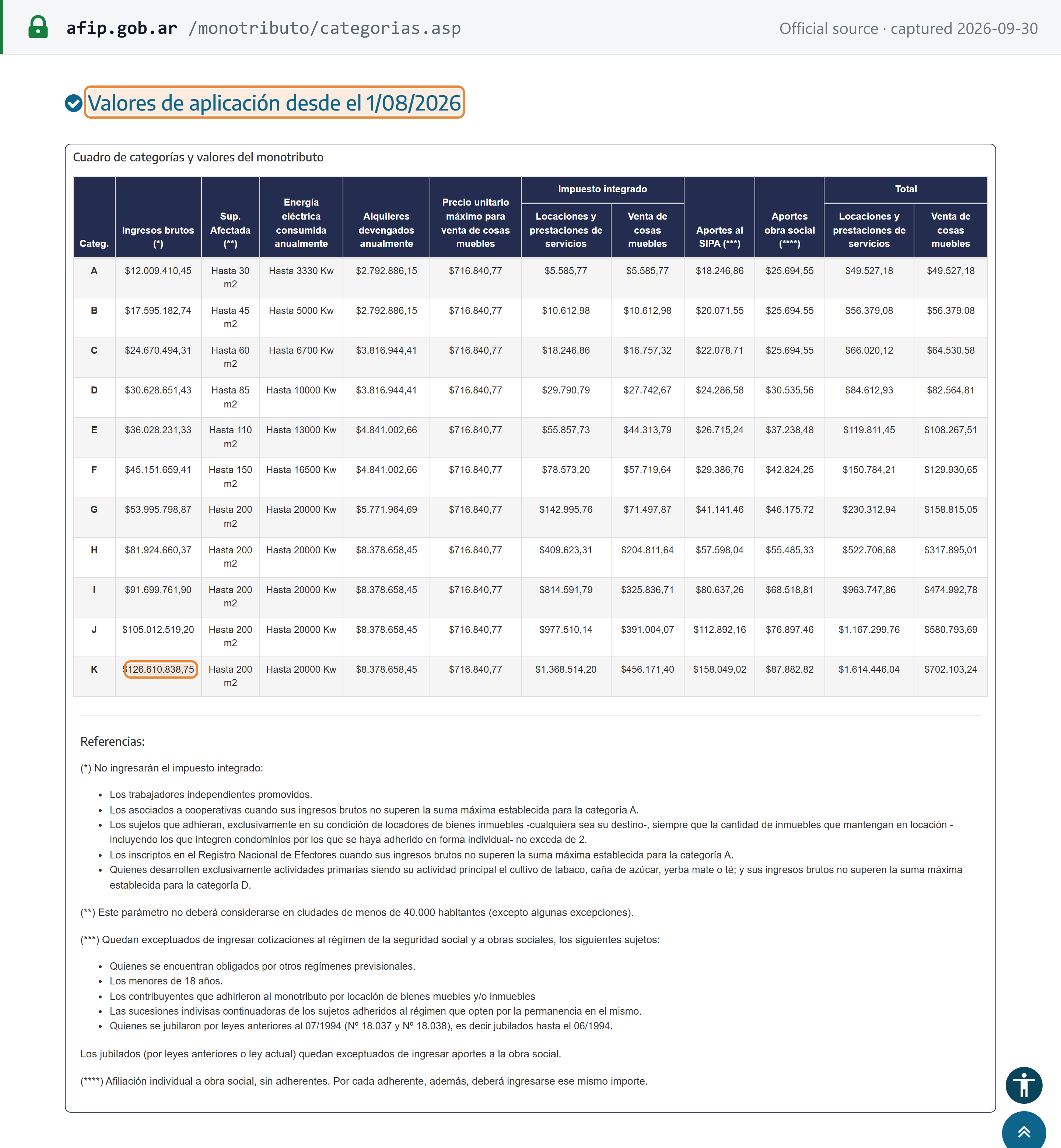
Monotributo categories from 1 August 2026. ARCA's table of current amounts, «Valores de aplicación desde el 1/08/2026», sets eleven categories by annual gross income. The monthly payment combines the integrated tax with the pension (SIPA) and health (obra social) contributions: [5]
| Category | Annual gross income up to (ARS) | Monthly payment, services (ARS) | Monthly payment, sale of goods (ARS) |
|---|---|---|---|
| A | 12,009,410.45 | 49,527.18 | 49,527.18 |
| B | 17,595,182.74 | 56,379.08 | 56,379.08 |
| C | 24,670,494.31 | 66,020.12 | 64,530.58 |
| D | 30,628,651.43 | 84,612.93 | 82,564.81 |
| E | 36,028,231.33 | 119,811.45 | 108,267.51 |
| F | 45,151,659.41 | 150,784.21 | 129,930.65 |
| G | 53,995,798.87 | 230,312.94 | 158,815.05 |
| H | 81,924,660.37 | 522,706.68 | 317,895.01 |
| I | 91,699,761.90 | 963,747.86 | 474,992.78 |
| J | 105,012,519.20 | 1,167,299.76 | 580,793.69 |
| K | 126,610,838.75 | 1,614,446.04 | 702,103.24 |
- Other caps. The maximum unit sale price for goods is ARS 716,840.77 in every category. The table also caps floor area (30 m² in category A up to 200 m²), electricity (3,330 to 20,000 kW a year) and annual rent (ARS 2,792,886.15 to 8,378,658.45).
- Updated twice a year. ARCA's parameters page: gross income «es el monto máximo que se puede facturar por año. Este valor se actualiza dos veces al año, considerando la variación del Índice de Precios al Consumidor (IPC)» — the maximum that may be invoiced per year, updated twice a year by the consumer price index. The next update is due from 1 February 2027. [19]
- Recategorisation and exclusion. Taxpayers recategorise every February and August on the last 12 months' figures: «El trámite puede realizarse hasta el día 5 de febrero o de agosto». Exceeding the category K ceiling, the floor-area, rent or unit-price caps, or making unbilled sales, among other causes, excludes the taxpayer, and «no se podrá volver al régimen hasta que hayan transcurrido 3 años calendario» — there is no return to the regime for three calendar years. [19]
- Moving to the general regime. A taxpayer leaving or excluded from the Monotributo may add to its first IVA credit «el impuesto que les fuera facturado en los 12 meses anteriores» — the VAT invoiced to it in the previous 12 months, for purchases related to the activity, provided its gross income in those 12 months did not exceed 50% of the micro-enterprise sales ceiling. [19]
 Source snapshot captured 2026-09-30 — original
Non-resident registration
Not applicable as a VAT regime — there is no non-resident threshold and no simplified non-resident registration (Ley de IVA). Instead, the law places the tax on the Argentine party:
- Services from abroad to a responsable inscripto: the customer self-assesses (article 1 d and article 4).
- Digital services from abroad to consumers: the Argentine payment intermediary collects the tax, or the customer pays it (article 1 e; RG 4240).
- Local representatives or intermediaries of foreign suppliers performing taxed services in Argentina are substitute taxpayers (article 4 h).
- Goods: the importer pays at customs.
See Foreign companies selling into Argentina. A foreign company that wants to trade in Argentina in its own right registers a branch or permanent representation with the Inspección General de Justicia (IGJ) under article 118 of the Ley General de Sociedades 19.550, and then obtains a CUIT as a legal entity. [20]
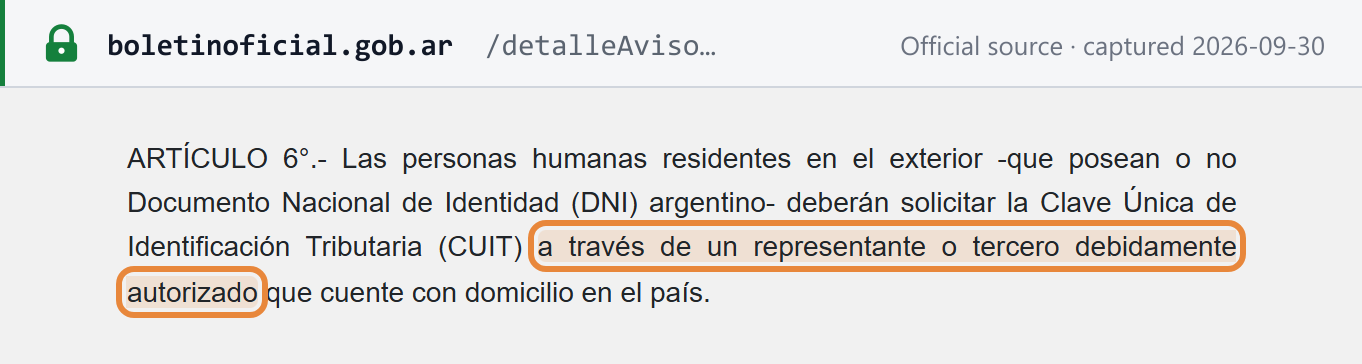
Non-resident individuals now obtain a CUIT through a local representative. RG 5803/2025 art. 6: «Las personas humanas residentes en el exterior -que posean o no Documento Nacional de Identidad (DNI) argentino- deberán solicitar la Clave Única de Identificación Tributaria (CUIT) a través de un representante o tercero debidamente autorizado que cuente con domicilio en el país» — individuals resident abroad, with or without an Argentine DNI, must request a CUIT through a duly authorised representative or third party with an address in Argentina. The request goes through ARCA's "Presentaciones Digitales" service. [6]
 Source snapshot captured 2026-09-30 — original
The CDI is no longer issued to individuals. RG 5803 withdrew the CDI (Clave de Identificación) procedure for individuals and undivided successions and replaced it with a CUIT; its preamble states the aim «dejar sin efecto el procedimiento de solicitud de la Clave de Identificación (CDI) para personas humanas y sucesiones indivisas», and art. 33 b) is the operative provision on «Las Claves de Identificación (CDI) otorgadas en el marco de la Resolución General N° 3.995 (DGI)». Existing CDIs stay valid only until the holder has to change their registry data. A CDI survives only for diplomatic missions and similar bodies with no tax reason to hold a CUIT. RG 5803 has applied since 2 March 2026. [6]
Tax identification number
The taxpayer number is the CUIT (Clave Única de Identificación Tributaria): 11 digits, written NN-NNNNNNNN-N — a two-digit type prefix, an eight-digit base (the DNI number for individuals) and a modulo-11 check digit. There is no separate VAT number: the CUIT identifies the taxpayer for IVA, income tax and customs, and its registration record shows whether the holder is a responsable inscripto, a Monotributo taxpayer or exempt.
For the prefixes, the check-digit algorithm and a worked example, see Lookuptax's Argentina tax ID (CUIT) guide. To check a supplier's registration, see how to verify a CUIT, and check a number's format with the Argentina CUIT validator.
How to register
RG 5803/2025 unified the registration, amendment and cancellation procedures, with effect from 2 March 2026: «Esta resolución general entrará en vigencia el 2 de marzo de 2026». [6]
- Get a CUIT.
- Individuals with a DNI apply online through ARCA's Inscripción digital service or the ARCA Móvil app. People without a DNI while their residence is in process, undivided successions, holders of a DNI without an expiry date, and minors finish the procedure in person.
- Companies: «La solicitud de inscripción la debe realizar el representante legal de la sociedad, a través del servicio con clave fiscal "Inscripción y Modificación de Personas Jurídicas"» — the legal representative applies through that Clave Fiscal service, attaching notarised digital documents. The CUIT is notified to the company's electronic tax address (Domicilio Fiscal Electrónico). A company in formation has 90 days, extendable once by 90, to prove its final incorporation. [24]
- Register for IVA. In Sistema Registral, menu "Registro Tributario", choose "Alta de impuestos", then the month and year of registration and the tax: «El sistema mostrará una pantalla de confirmación del trámite realizado y se podrá ver e imprimir el Formulario 420/T» — the system confirms the registration and issues Form 420/T. [24]
- Credentials. These services need a Clave Fiscal of security level 3 or higher.
- Monotributo. Individuals opting for the simplified regime register on the Monotributo portal; ARCA states «Todos los trámites necesarios son 100% gratuitos» — all the necessary steps are free. [19]
Timeline. ARCA publishes no processing time for CUIT or IVA registration.
Voluntary registration
Not applicable as such — with no threshold, there is no below-threshold position to register out of. The real choice belongs to an individual under the Monotributo ceilings, for whom the simplified regime is optional (ARCA: «Podés ser monotributista si:» — you may be a monotributista if…). Such an individual may register as a responsable inscripto instead; a common reason is to recover input IVA and to charge IVA separately on class A invoices, which business customers can credit. [19]
Deregistration
- When. Cancellation must be requested when the activity that required registration ends, and separately for a tax when its cause ends. A responsable inscripto may leave IVA once all goods linked to the taxed activity have been realised (RG 5803 art. 21).
- Deadline. RG 5803 art. 22: cancellation «deberá ser solicitada ante este Organismo hasta el último día hábil del mes siguiente a aquel en que se produzca el cese definitivo» — by the last business day of the month after definitive cessation, taking effect from the next fiscal period. Until then, formal duties keep running.
- How. In Sistema Registral, menu "Registro Tributario", choose «F 420/T Baja de Impuestos/Regímenes», then the reason and date of cessation. [6] [24]
- Final return. No special final return is prescribed beyond the monthly F.2051 for the last period of activity (RG 5803 and RG 5705).
Group registration
Not available. The Ley de IVA defines taxable persons individually (article 4) and contains no grouping provision; ARCA's general-regime pages describe none. [1]
Rates
| Rate | Applies to | Legal basis |
|---|---|---|
| 21% — general rate | All taxable supplies and imports not listed elsewhere; in force since 1 April 1995 | Ley de IVA art. 28, first paragraph [1] |
| 27% — increased rate | Gas, electricity, metered water and telecommunications supplied outside homes to a responsable inscripto or Monotributo customer | Ley de IVA art. 28, second paragraph |
| 10.5% — reduced rate (50% of the general rate) | Listed food, farm, housing, financial, transport, medical and capital goods — see below | Ley de IVA art. 28, fourth paragraph |
| Sliding rates: 2.5%, 5%, 10.5% or 21% | Advertising space sold by newspaper, magazine and digital news publishers, by publisher turnover | Article after art. 28 |
| Exempt (no IVA, no input credit — except exports) | See Exemptions | Ley de IVA arts. 7 and 8 |
General rate: 21%. Article 28: «La alícuota del impuesto será del veintiuno por ciento (21%).» The consolidated text's rate-history table shows the general rate at 21% since 1 April 1995; a temporary 19% ran from 18 November 2002 to 17 January 2003. [1]
 Source snapshot captured 2026-09-30 — original
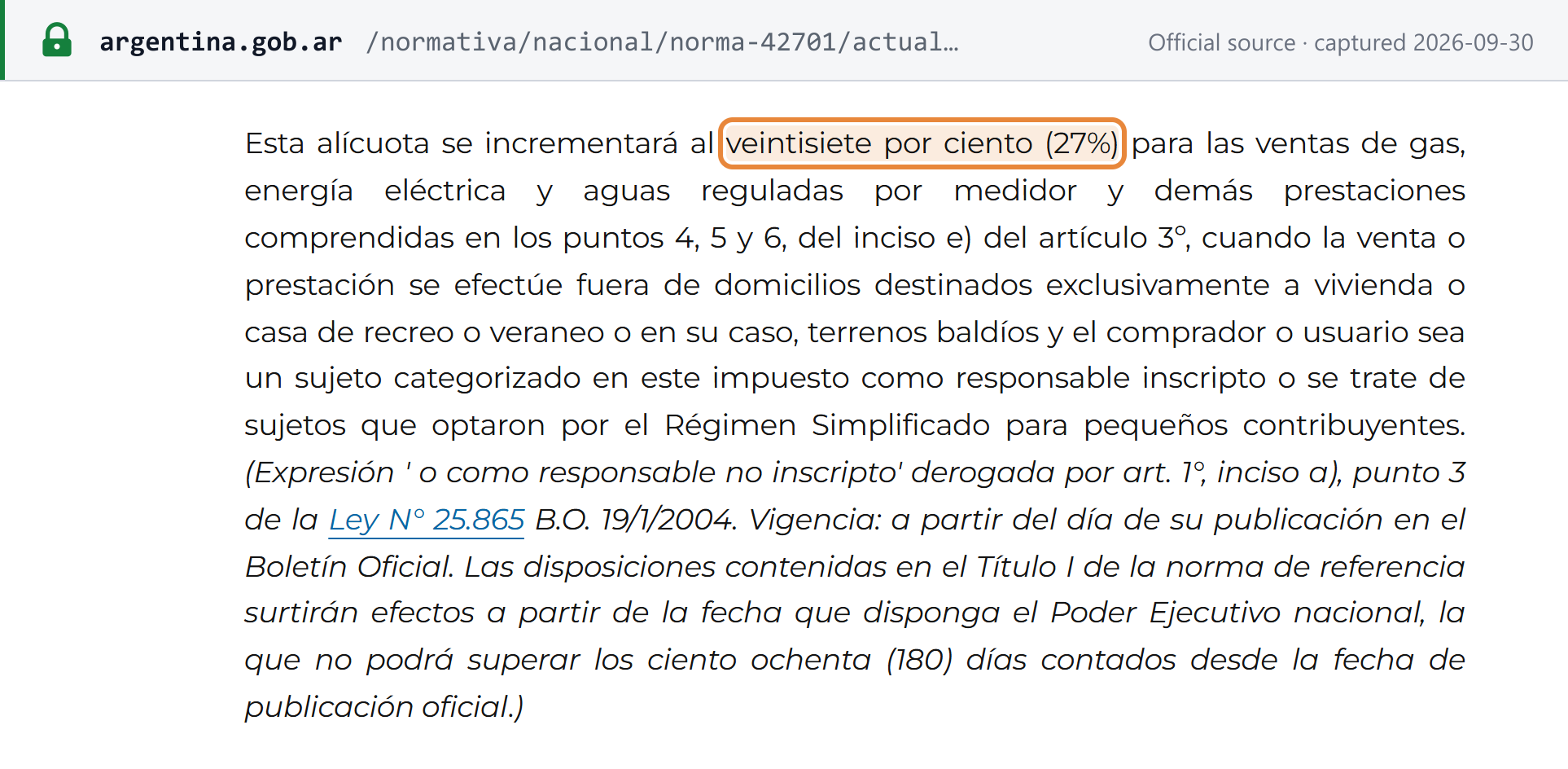
Increased rate: 27%. The rate rises «al veintisiete por ciento (27%) para las ventas de gas, energía eléctrica y aguas reguladas por medidor y demás prestaciones comprendidas en los puntos 4, 5 y 6, del inciso e) del artículo 3º» — for sales of gas, electricity and metered water and the services in article 3 e) points 4, 5 and 6, which include telecommunications — when the supply is made outside premises used exclusively as a home, holiday home or vacant land, and the buyer is a responsable inscripto or has opted for the Monotributo. The same supplies to households and consumers stay at 21%. [1]
 Source snapshot captured 2026-09-30 — original
Reduced rate: 10.5%. Article 28: «Estarán alcanzados por una alícuota equivalente al cincuenta por ciento (50%) de la establecida en el primer párrafo» — the listed items are taxed at 50% of the general rate. They include: [1]
- Food and farming: live cattle and other listed animals, and fresh meat; fresh, chilled or frozen fruit and vegetables that have not been cooked or processed; grains (except rice) and dried pulses; wheat flour; unpackaged bread and bakery products; bulk honey; and farm-labour services such as sowing, harvesting and applying agrochemicals.
- Housing: construction work on buildings used as homes.
- Finance: interest and fees on loans by financial entities under Ley 21.526 to responsables inscriptos.
- Capital goods: the goods listed in the annexed schedules.
- Transport: «Los servicios de taxímetros, remises con chofer y todos los demás servicios de transporte de pasajeros, terrestres, acuáticos o aéreos, realizados en el país» — taxis, chauffeured cars and other domestic passenger transport not exempted by article 7 h) 12.
- Health: medical services of cooperatives, mutuals and prepaid-health plans that are not exempt.
- Energy: sales of liquefied petroleum gas; and, since 2026, «La provisión de energía eléctrica utilizada en sistemas y/o equipos de riego con destino al sector agroindustrial» — electricity used in agro-industrial irrigation systems, added by article 189 of Ley 27.802 (Boletín Oficial 6 March 2026), with effect from the first day of the month after that law came into force.
Sliding rates on newspaper advertising. Under the article that follows article 28, as substituted by Ley 27.701 with effect from 1 January 2023, publishers of newspapers, magazines and digital news charge IVA on advertising space at a rate set by their annual turnover: [1]
| Publisher's annual turnover (bands as enacted) | Rate |
|---|---|
| Up to ARS 250,000,000 | 2.5% |
| Over ARS 250,000,000 up to ARS 500,000,000 | 5% |
| Over ARS 500,000,000 up to ARS 1,000,000,000 | 10.5% |
| Over ARS 1,000,000,000 | 21% |
The turnover bands are the amounts as enacted; they have been indexed since 1 January 2024, so check the current bands before applying them. The same article taxes distribution services for newspapers and magazines supplied to publishers at 10.5%.
Zero rate. Not applicable — no 0% rate is in force. The last one, a 0% on basic food for consumers under Decreto 567/2019, ran until 31 December 2019. Exports are exempt with input-tax recovery (articles 8 d and 43), which works like zero-rating: see Imports and exports.
Announced future rates. None enacted as of 2026-09-30. The latest change to article 28 is the Ley 27.802 irrigation-electricity item above.
For Argentina alongside other jurisdictions, see Lookuptax's worldwide tax rates table and VAT registration thresholds table.
Cross-border rules
Imports and exports
- Imports of goods. Definitive imports are taxed (article 1 c), and the IVA is settled and paid together with the import duties (article 27). The customs authority also collects an IVA perception — an advance payment on account of the importer's IVA — at the moment of definitive import under RG 2937/2010: «Establécese un régimen de percepción del impuesto al valor agregado, que se hará efectivo en el momento de la importación definitiva de cosas muebles gravadas». Under article 7 of its current text, the perception is 20% for goods at the general rate («VEINTE POR CIENTO (20%), cuando se trate de operaciones de importación definitiva de las mercaderías que se encuentren alcanzadas por la alícuota general») and 10% for goods at the reduced rate. It applies to responsables inscriptos and to importers who do not prove exempt or non-taxed status, with exceptions such as goods imported for an individual's personal use. The importer credits it in its monthly return. Imports of the goods listed in a transitory annex are excluded from the perception until 31 December 2026 (RG 5868/2026). [10]
- Exports: exempt, with recovery. Article 8 d) exempts «Las exportaciones». Article 43 lets exporters credit the input IVA «que por bienes, servicios y locaciones que destinaren efectivamente a las exportaciones … les hubiera sido facturado» — invoiced to them on goods and services used for exports — against their other IVA; any excess is offset against other ARCA taxes, refunded or transferred, capped at the IVA rate applied to the export value. Refunds are claimed through ARCA's Sistema Integral de Recupero (SIR), regime code 404, form F 8147 (RG 5879/2026). [1] [15]
- Exports of services. Article 1 b): services performed in Argentina «cuya utilización o explotación efectiva se lleve a cabo en el exterior» — whose effective use takes place abroad — are not treated as made in Argentina and get the article 43 export treatment. Exports are invoiced on class E — see Document types.
- Imported services: the registered customer pays. Services performed abroad and used in Argentina are taxed when the customer is a responsable inscripto (article 1 d), and the customer is the taxable person. ARCA's due-date agenda: «Determinación e Ingreso dentro de los 10 días hábiles siguientes de perfeccionado el hecho imponible» — the customer determines and pays the tax within 10 business days of the taxable event (RG 549). Article 12 lets it take the credit only «en el período fiscal inmediato siguiente» — in the following fiscal period. [1] [8]
Digital products and services
Article 1 e) taxes digital services supplied by a non-resident and used in Argentina by a customer that is not a responsable inscripto. There is no threshold. [1] [9]
- What is caught. The digital services listed in article 3 e) 21 m). ARCA's list of concepts includes, for example, «La concesión, a Título oneroso, del derecho a comercializar un bien o servicio en un sitio de Internet que funcione como un mercado en línea» (granting, for consideration, the right to sell on an online marketplace). [9]
- Where they are used. ARCA: «Los servicios digitales prestados por un sujeto residente o domiciliado en el exterior se entenderán, en todos los casos, realizados en el exterior» — they are always deemed performed abroad. Use in Argentina is presumed from the IP address or the SIM's country code, the billing address, or the address held by the customer's bank or card issuer. [9]
- Who collects (RG 4240/2018). «Cuando las prestaciones de servicios digitales sean pagadas a sujetos residentes o domiciliados en el exterior por intermedio de entidades del país que faciliten o administren los pagos al exterior, éstas deberán actuar en carácter de agentes de percepción y liquidación del impuesto» — Argentine entities that handle the payment abroad (card issuers, banks, payment aggregators) collect the 21% by perception. On credit cards the perception is taken on the statement payment date; on debit cards, on the debit date. The agents remit it under ARCA's SICORE system.
- The supplier list. ARCA publishes the list of foreign digital-service suppliers whose payments trigger the perception — the version «vigente para operaciones a partir de septiembre 2025» applies to operations from September 2025. For suppliers on the list's section B, intermediaries collect only on payments of up to USD 10 (RG 4240 art. 4). [9]
- Otherwise the customer pays. Where no local intermediary collects, «el prestatario deberá ingresar el gravamen correspondiente hasta el último día del mes en que se efectuó el pago al prestador del exterior, mediante volante electrónico de pago» — the customer pays the tax by the last day of the month of payment, with an electronic payment slip.
- Registered customers buying digital services self-assess under article 1 d), as for any imported service.
 Source snapshot captured 2026-09-30 — original
Foreign companies selling into Argentina — B2B and B2C
A foreign supplier does not register for IVA in any of these cases; the tax is collected from the Argentine side: [1] [9]
- Goods to businesses (B2B). The Argentine importer pays import IVA and the RG 2937 perception at customs.
- Services, including digital services, to registered businesses (B2B). The responsable inscripto customer self-assesses under article 1 d) within 10 business days (RG 549). The foreign supplier issues its own invoice and has no Argentine IVA obligation.
- Digital services to consumers (B2C). The Argentine payment intermediary collects 21% under RG 4240, or the consumer pays it.
- Goods to consumers (B2C). The goods pass through customs, where the importer — the consumer — pays.
- Other services to consumers (B2C). Services that are neither digital nor supplied to a responsable inscripto fall outside article 1 d) and article 1 e); the Ley de IVA sets no rule taxing them when performed abroad.
A foreign business that trades in Argentina through a branch or representation registers that establishment and follows the domestic rules.
Marketplace / platform deemed-supplier liability
Not applicable — Argentina has no deemed-supplier rule (Ley de IVA and RG 4240). Collection on foreign digital services falls on payment intermediaries as perception agents, not on marketplaces as suppliers. The platform's own commission for selling on an online marketplace is itself a taxed digital service; the underlying sale is not shifted to the platform. [9]
Place of supply
- Goods. Taxed when «situadas o colocadas en el territorio del país» — located or placed in Argentina (article 1 a); imports on definitive importation (article 1 c).
- Services. Taxed when performed in Argentina (article 1 b). International telecommunications are treated as made in Argentina to the extent their price is attributable to the company located there. Services performed in Argentina but used abroad are treated as exports; services performed abroad and used in Argentina are taxed on the registered customer (article 1 d).
- Digital services by non-residents follow the customer's location, presumed from IP, SIM, billing or bank data (article 1 e; see above).
Courier and low-value import rules are customs matters outside the scope of this guide.
Invoice requirements
Argentina's invoicing rules sit in RG 1415/2003, as amended most recently by RG 5866/2026, and its Anexo II lists what every document must show. Most invoices are now electronic and each needs an ARCA authorisation code (CAE) before it has tax effect — see E-invoicing status. The first question on any Argentine invoice is its class (A, B, C or E), which depends on the IVA status of the issuer and of the customer.
Document types
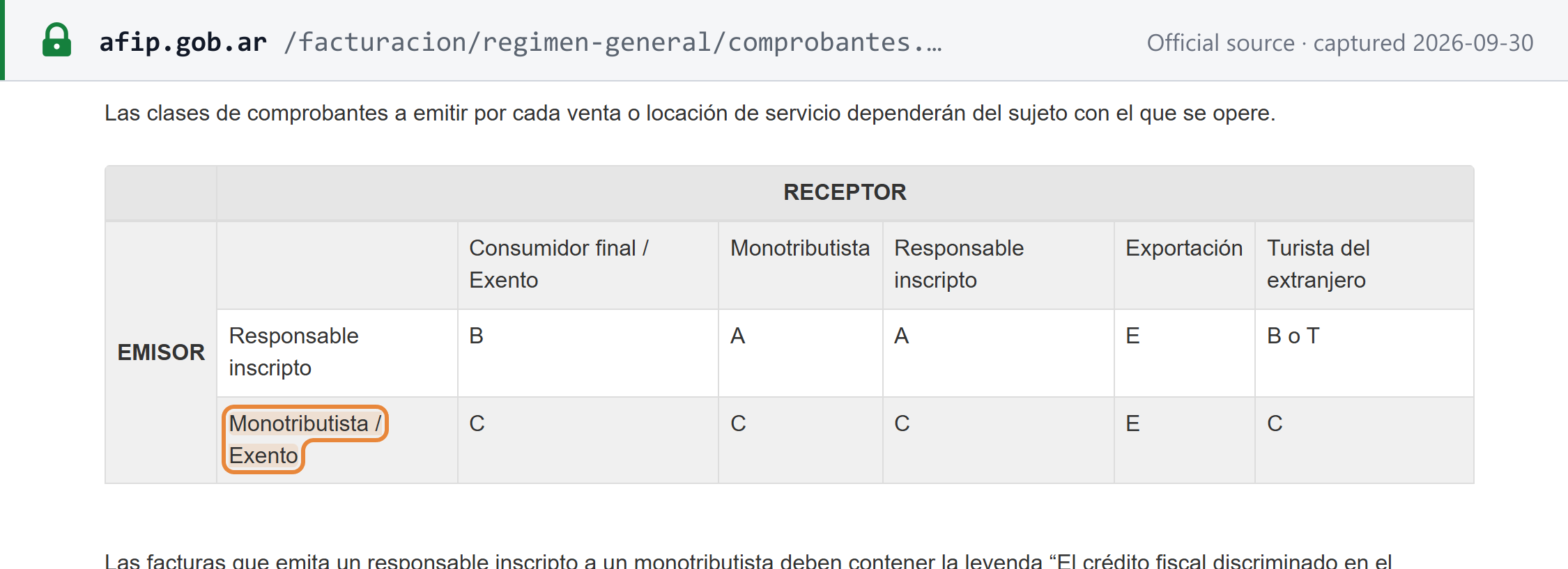
ARCA's class table, by issuer and customer: [4]
| Issuer ↓ / Customer → | Final consumer, exempt or non-taxed | Monotributo | Responsable inscripto | Export | Foreign tourist |
|---|---|---|---|---|---|
| Responsable inscripto | B | A | A | E | B or T |
| Monotributo or VAT-exempt | C | C | C | E | C |
- Class A — issued by a responsable inscripto to another responsable inscripto or to a Monotributo customer, showing the IVA separately. The Monotributo pairing has been class A since RG 5003/2021, which changed it so that registered sellers issue class «“A” por sus operaciones con sujetos adheridos al Régimen Simplificado … -en lugar de comprobantes clase “B”-» — class A instead of class B. Such invoices must carry the legend «El crédito fiscal discriminado en el presente comprobante, solo podrá ser computado a efectos del Régimen de Sostenimiento e Inclusión Fiscal para Pequeños Contribuyentes de la Ley Nº 27.618» — the IVA shown may be computed only under the Ley 27.618 regime. [17]
- Class A variants. ARCA may require an issuer to use class A «con leyenda Pago en CBU informada» (payment only into the declared bank account) or «con leyenda Operación sujeta a retención». The second replaced class M from 1 December 2025 (RG 5762). A responsable inscripto receiving an "operación sujeta a retención" invoice withholds 100% of the IVA and 6% income tax.
- Class B — issued by a responsable inscripto «por operaciones realizadas con consumidores finales, sujetos exentos en dicho impuesto, sujetos no alcanzados, sujetos no categorizados y con turistas del extranjero» — to final consumers, exempt, non-taxed and uncategorised customers and foreign tourists. The customer gets no input credit. Since 1 April 2025 the VAT contained in the price is shown in a transparency block — see Consumer tax transparency.
- Class C — issued by Monotributo and VAT-exempt issuers for all their operations except exports; no IVA is shown.
- Class E — exports of goods and services.
- Other documents. Tickets from fiscal controllers (cash registers approved by ARCA) and buyer-issued settlement documents in listed sectors — see Self-billing.
- No simplified invoice. There is no reduced-particulars invoice for low values: every class carries the Anexo II content, with lighter customer identification on class B below ARS 10,000,000.
 Source snapshot captured 2026-09-30 — original
Mandatory content
RG 1415 Anexo II, Apartado A: «DATOS QUE DEBEN CONTENER LOS COMPROBANTES CLASE "A", "B", "C" o "E"» — the data that class A, B, C and E documents must contain, in the text in force after RG 5866/2026: [3]
| # | Required content | Anexo II, Apartado A |
|---|---|---|
| 1 | Issuer's name or company name and commercial address | I |
| 2 | Issuer's CUIT | I |
| 3 | Issuer's IIBB (provincial turnover tax) number, or "no contribuyente" | I a) 4 |
| 4 | Issuer's IVA status legend: "IVA RESPONSABLE INSCRIPTO", "IVA EXENTO", "NO RESPONSABLE IVA", "RESPONSABLE MONOTRIBUTO", "MONOTRIBUTO TRABAJADOR INDEPENDIENTE PROMOVIDO" or "MONOTRIBUTISTA SOCIAL" | I |
| 5 | Date the issuer started business, headed "INICIO DE ACTIVIDADES" | I |
| 6 | Class letter (A, B, C or E) with its document-type code, and "ORIGINAL" or "DUPLICADO" | I |
| 7 | Number: 13 digits, point of sale plus sequential number — see Numbering and sequencing | V 4 |
| 8 | Issue date, and the numbers of any related delivery notes (remitos) | I |
| 9 | Authorisation code «precedido de la sigla “C.A.I. N° ....”, “C.A.E. N° ….” o “C.A.E.A. N° …..”» with its expiry date ("Fecha de Vto.") | I a) 10 |
| 10 | Customer data by status: a responsable inscripto — name, address, CUIT and "IVA RESPONSABLE INSCRIPTO"; a Monotributo customer — the same with its Monotributo legend; exempt or non-taxed — "IVA EXENTO" or "NO RESPONSABLE IVA"; uncategorised — "SUJETO NO CATEGORIZADO" | II |
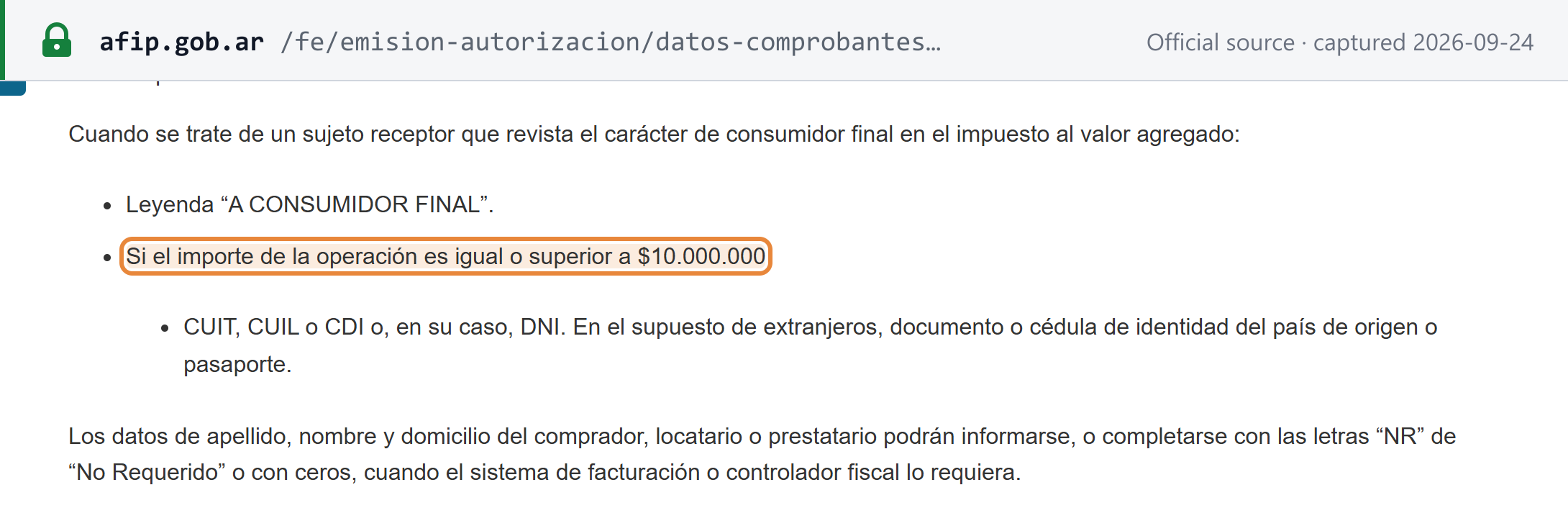
| 11 | Consumer sales: "A CONSUMIDOR FINAL"; the buyer's ID only when the operation is ARS 10,000,000 or more; name and address may be "NR"; the buyer's CUIT at any amount if the buyer asks for it | II d) |
| 12 | Exports: the foreign buyer's tax ID (or a CUIT) and "IVA EXENTO OPERACION DE EXPORTACION" | II |
| 13 | Description, quantity, unit price and total price; codes are allowed with a signed catalogue | III |
| 14 | For foreign-currency operations, the exchange rate used | III d) |
| 15 | IVA treatment: to a responsable inscripto or Monotributo customer, the rate, the IVA amount, other taxes not in the net price and any perception; to exempt, non-taxed or consumer customers, the IVA contained in the operation | IV a) 1 and 2 |
| 16 | A Monotributo issuer never shows IVA: «en ningún caso corresponderá efectuar discriminación alguna del impuesto al valor agregado» | IV b) |
Consumer ID at ARS 10,000,000. Anexo II II d) 2: «Si el importe de la operación es igual o superior a PESOS DIEZ MILLONES ($10.000.000.-): Documento Nacional de Identidad (DNI), Código Único de Identificación Laboral (CUIL) o Clave de Identificación (CDI)» — and for foreigners, their identity document or passport. RG 5866 set this threshold from 1 July 2026. The annex still names the CDI, a legacy identifier for individuals since RG 5803/2025. For checking a DNI, see how to verify a DNI in Argentina.
 Source snapshot captured 2026-09-24 — original
Consumer tax transparency
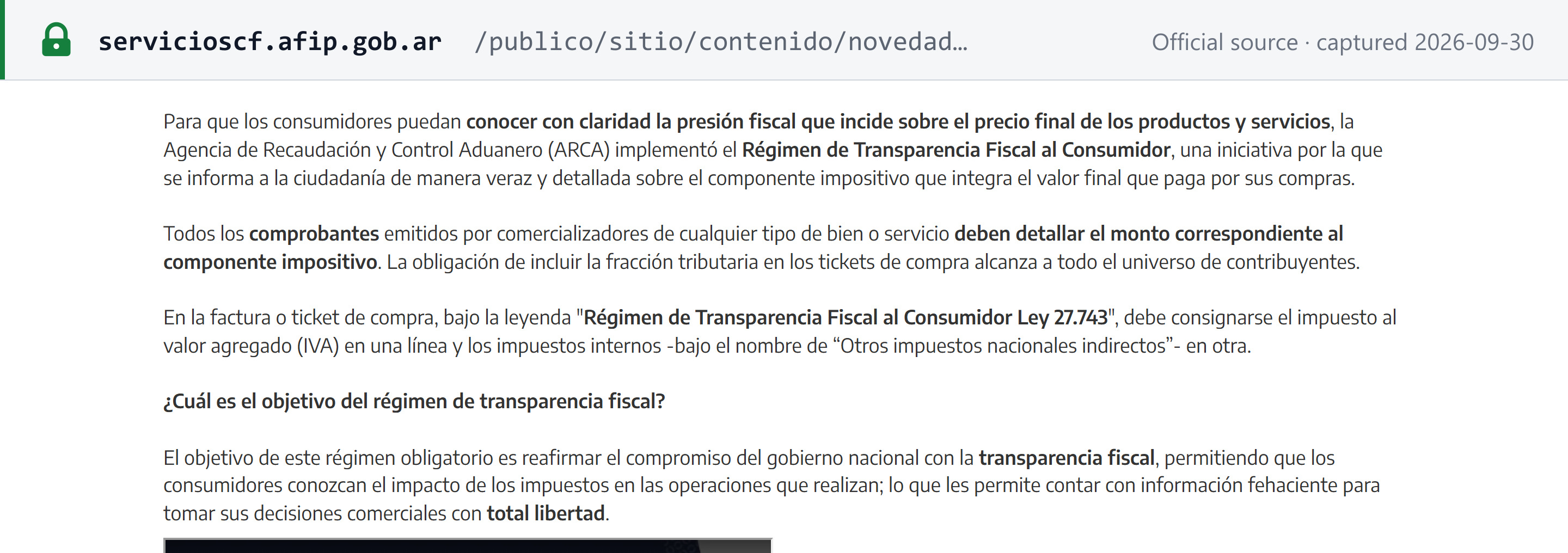
Since 1 April 2025, a responsable inscripto's invoices to consumers show the VAT they contain. Ley 27.743 (Boletín Oficial 8 July 2024) rewrote article 39 of the Ley de IVA: «Cuando un responsable inscripto realice ventas, locaciones o prestaciones de servicios gravadas a consumidores finales, deberá discriminar en la factura o documento equivalente el gravamen que recae sobre la operación» — a responsable inscripto selling to final consumers must show the tax on the invoice. [1]
- The block. RG 5614/2024 adds to RG 1415 a block titled «Régimen de Transparencia Fiscal al Consumidor (Ley 27.743)», with a line «IVA Contenido» and, beneath it, «Otros Impuestos Nacionales Indirectos» (excise), each with its amount, placed bottom left. [13]
- Timing. Large companies from 1 January 2025. For everyone else it was optional from 1 January 2025, «siendo obligatorio su cumplimiento a partir del 1 de abril del citado año» — mandatory from 1 April 2025 (RG 5614 art. 6 b).
- No credit. The consumer still gets no input credit; the block is information.
- Monotributo registrants. The second sentence of article 39 applies «el mismo criterio» — the same criterion — to operations with exempt subjects, «incluyendo a aquellos … inscriptos en el Régimen Simplificado» — including Monotributo registrants — without saying whether as issuers or as customers; ARCA says the obligation to show the tax component «alcanza a todo el universo de contribuyentes» — reaches every taxpayer. RG 1415 Anexo II IV b) still says a Monotributo issuer does not break out IVA on the invoice, so follow ARCA's current guidance on how the block appears on class C documents. [1] [21]
 Source snapshot captured 2026-09-30 — original
Issuance deadline
RG 1415 art. 13: invoices «deberán ser emitidos y entregados en los momentos que, para cada operación se indican» — must be issued and delivered at the times the article sets for each kind of operation (sales of goods, services, continuous services, leases, advance payments, utilities); take the exact moment for your operation from the article. [3]
For sales to final consumers, the document is delivered or made available at the moment of the operation. The taxable event for goods is delivery, invoice issue or an equivalent act, whichever is earlier (Ley de IVA article 5 a).
Numbering and sequencing
Anexo II, Apartado A, V 4: «Numeración consecutiva y progresiva: Tendrá TRECE (13) dígitos». [3]
- The first 5 digits identify the point of sale (00001 to 99998).
- The last 8 digits are the invoice number, starting at 00000001 and running «en forma consecutiva, progresiva e independiente por cada punto de venta o emisión, cada clase (“A”, “B”, “C” o “E”) y tipo de comprobante» — consecutively and independently per point of sale, per class and per document type.
- A change of CUIT, name or IVA status restarts numbering at 00000001.
- A new point of sale must be notified at least 3 business days before use, and «Cuando se ingrese la baja de un punto de venta, el mismo no podrá volver a utilizarse» — a deregistered point of sale can never be reused (RG 1415 art. 47).
Credit and debit notes
RG 1415 Anexo IV: credit and debit notes «que se emitan en concepto de descuentos, bonificaciones, quitas, devoluciones, rescisiones, intereses, etc., se ajustarán a los requisitos que se deben cumplir con relación a los comprobantes emitidos por las operaciones originarias» — for discounts, rebates, returns, rescissions, interest and the like, they meet the same requirements as the original document, in the same class. Because an authorised electronic invoice cannot be withdrawn once its CAE is granted, errors are corrected by a credit note and a new invoice. Discounts and returns adjust the IVA of the period in which they are granted (Ley de IVA article 12 b). [3]
Currency and language
- Currency. An invoice may be issued in a foreign currency. Anexo II III d): «En los casos de operaciones realizadas en moneda extranjera se consignará en el comprobante que se emita el tipo de cambio utilizado» — the invoice states the exchange rate used. Where the operation is invoiced and settled in the same foreign currency, the rate is the Banco de la Nación Argentina seller rate at the close of the previous business day, which ARCA's e-invoicing system fills in (RG 5616/2024). [3]
- Language. RG 1415 fixes the legends in Spanish ("ORIGINAL", "A CONSUMIDOR FINAL", the IVA status legends); it contains no general language clause for the rest of the document.
Self-billing
Not provided for as a general mechanism. RG 1415 has no general self-billing authorisation. It does provide buyer-issued documents for listed cases, such as «Compra de bienes usados a consumidores finales para su reventa» — purchases of used goods from consumers for resale (art. 23 b 2) — and the settlement documents (liquidaciones) used in the grain, livestock, milk, sugar-cane and tobacco trades. [3]
Retention and audit trail
- Retention. Decreto 1397/79 art. 48: taxpayers «deberán conservar los comprobantes y documentos que acrediten las operaciones vinculadas a la materia imponible, por un término que se extenderá hasta cinco (5) años después de operada la prescripción del período fiscal a que se refieran» — keep vouchers and documents until five years after the fiscal period prescribes. The duty extends to withholding and perception agents. [14]
- Prescription. For registered taxpayers, ARCA's powers prescribe after five years (Ley 11.683 art. 56 as substituted by Ley 27.799), reduced to three years where the registered taxpayer filed its return on time, on the conditions the article sets. The retention period therefore runs from that date, not from issue. [11]
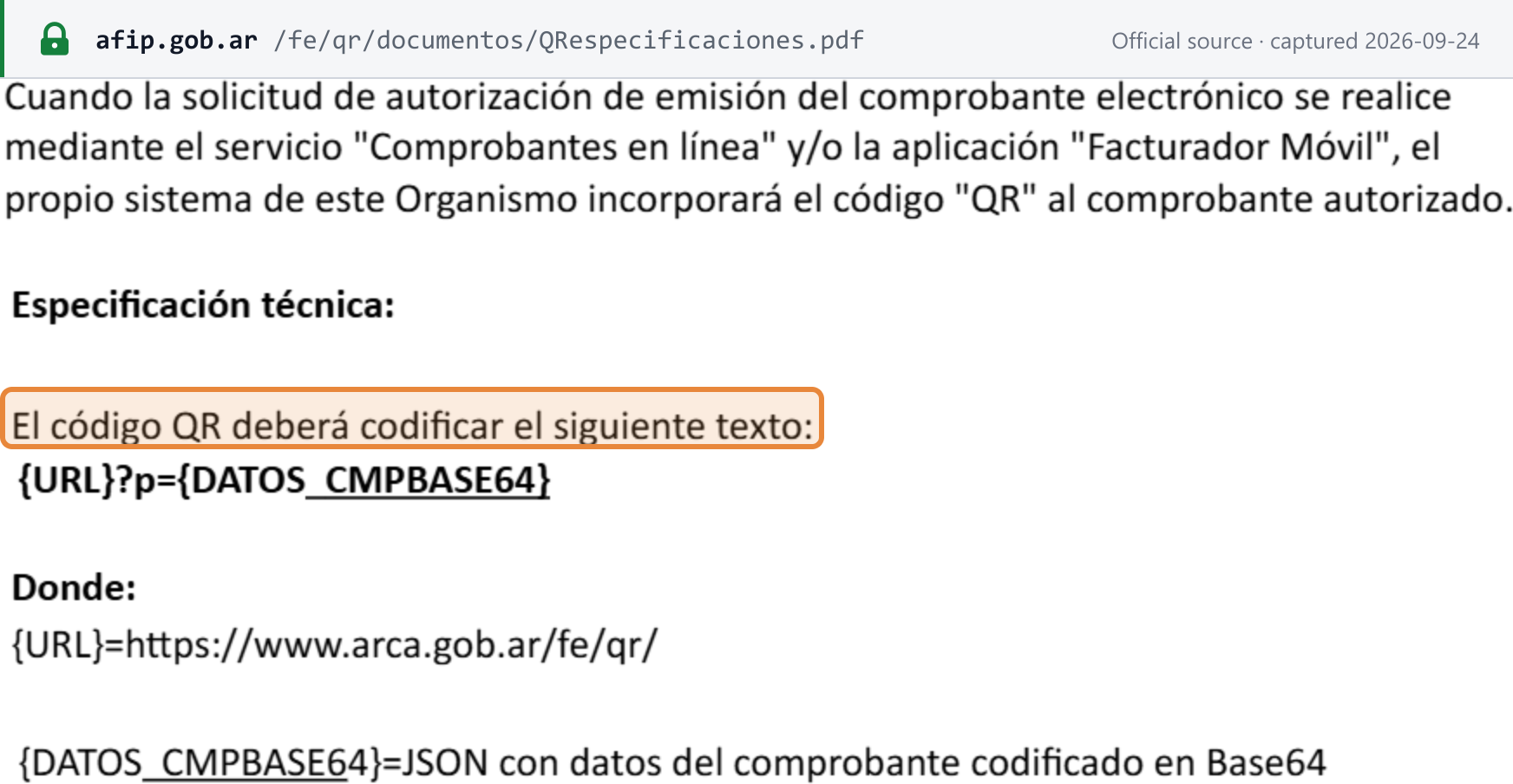
- Audit trail. Integrity comes from clearance rather than a hash chain: every e-invoice needs an ARCA-issued CAE before it has tax effect; numbering is sequential per point of sale and class; points of sale are pre-registered and never reused; every e-invoice carries a QR code that resolves to ARCA; and anyone can check an invoice's CAE on ARCA's public "Constatación de comprobantes" service. The invoices issued and received are also pre-loaded into the monthly IVA return — see Filing and payment.
 Source snapshot captured 2026-09-24 — original
A specimen of a compliant invoice
ARCA publishes no annotated specimen of a class A or class B invoice on its e-invoicing, invoicing or IVA microsites. What RG 1415 does prescribe is where some fields sit (Anexo II, Apartado B): the IVA breakdown for registered customers follows the line items, «debiendo estar dispuestos en forma vertical u horizontal», and the transparency block goes at the bottom left. [13]
The layout below is Lookuptax's own illustration of a class B invoice to a final consumer issued by a responsable inscripto, with English labels. Every name, number and amount in it is fictional:
Factura B — electronic, to a final consumer
| DescriptionAnexo II A.III | QtyAnexo II A.III | Unit priceAnexo II A.III | AmountAnexo II A.III |
|---|---|---|---|
| Equipment maintenance service (fictional) | 1 | ARS 121,000.00 | ARS 121,000.00 |
- TotalAnexo II A.III
- ARS 121,000.00
- Régimen de Transparencia Fiscal al Consumidor (Ley 27.743) — IVA ContenidoAnexo II B g) 1; Ley de IVA art. 39
- ARS 21,000.00
- Otros Impuestos Nacionales IndirectosAnexo II B g) 1
- ARS 0.00
- C.A.E. N° SPECIMEN-CAE-0000 — Fecha de Vto. del CAE 25/10/2026: the authorisation code ARCA returns for this invoice, with its expiry date — Anexo II A.I a) 10.
- QR code resolving to ARCA, carrying the invoice data — RG 4892/2020.
- The IVA Contenido amount is 21/121 of the price: the consumer gets no input credit; the block is information — RG 5614/2024.
- On a class A invoice to a responsable inscripto or Monotributo customer, the customer block would carry name, address, CUIT and IVA status, and the totals would show the net amount, the rate and the IVA amount separately — Anexo II A.II and A.IV a) 1. To a Monotributo customer, the Ley 27.618 legend is added.
E-invoicing status
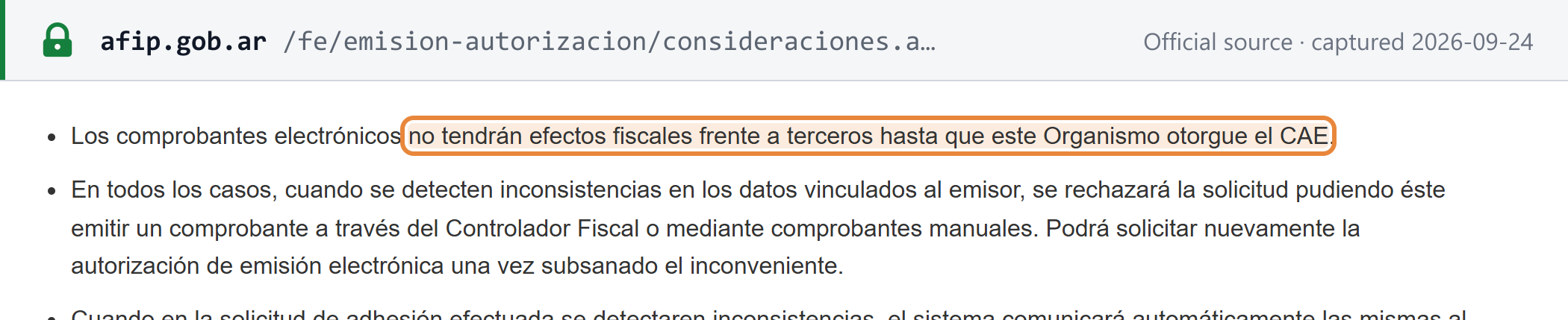
Status (as of 2026-09-30): mandatory, with real-time clearance, for B2B, B2C and B2G alike. Responsables inscriptos, VAT-exempt issuers and Monotributo taxpayers document their domestic sales with electronic invoices under RG 4291/2018 (the Régimen de Emisión de Comprobantes Electrónicos) and/or fiscal-controller tickets. ARCA's rule: «Los comprobantes electrónicos no tendrán efectos fiscales frente a terceros hasta que este Organismo otorgue el CAE» — electronic invoices have no tax effect until ARCA grants the CAE. There is no turnover threshold. Lookuptax's Argentina e-invoicing guide covers the regime in full; in summary:
- System. ARCA's own SOAP web services — WSFEv1 for classes A, B and C, WSMTXCA with item detail, WSFEXv1 for class E exports — plus the web tools "Comprobantes en línea" and "Facturador Móvil". It is not Peppol and uses no UBL or CII format. A QR code is mandatory on every electronic invoice (RG 4892/2020).
- CAEA contingency-only since 1 August 2026. The advance authorisation code (CAEA) may now be used only in contingencies; per-invoice CAE is the rule (RG 5782 and RG 5785/2025, as postponed by RG 5852/2026).
- RG 5866/2026, in force 1 July 2026, reorganised the regime: consumer ID at ARS 10,000,000 or more, an optional monthly consolidated invoice for financial, insurance and card businesses, and a staged roll-in of those sectors from 1 September 2026 to 1 March 2027.
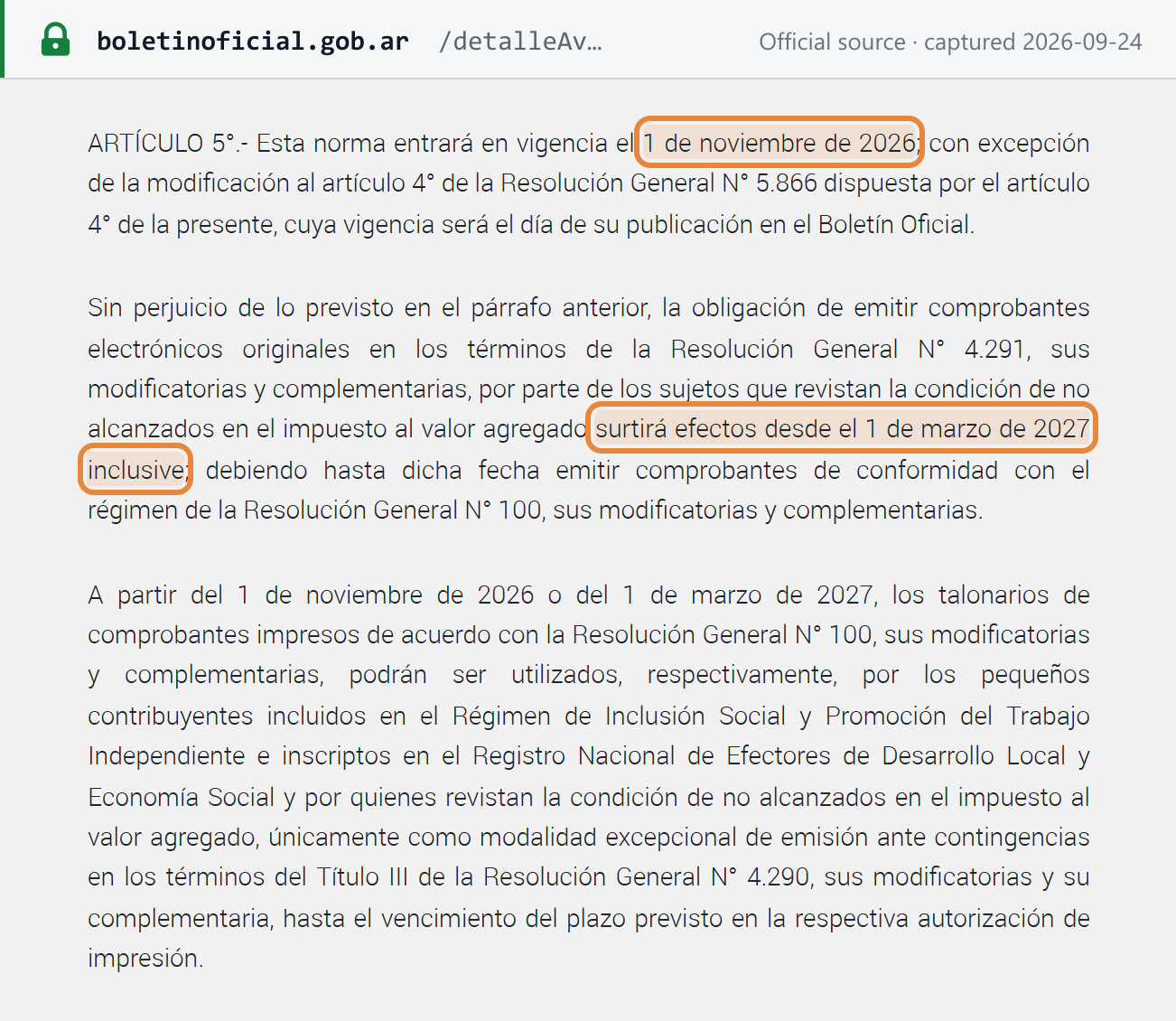
- Newly obliged groups. Monotributo social and promovido taxpayers must issue electronic invoices from 1 November 2026, and taxpayers outside VAT (no alcanzados) from 1 March 2027 (RG 5893/2026).
- B2B large-company overlay. A micro, small or medium company (MiPyME) selling to a large company must issue a Factura de Crédito Electrónica (FCE MiPyME) under Ley 27.440 for operations of ARS 5,549,862 or more (from 14 April 2026).
- B2G. Suppliers to the national public sector issue only electronic invoices, through the same CAE clearance.
 Source snapshot captured 2026-09-24 — original
 Source snapshot captured 2026-09-24 — original
For Argentina alongside other mandates, see Lookuptax's e-invoicing status and networks table.
Filing and payment
Filing frequency
Monthly for every responsable inscripto, with no turnover bands (Ley de IVA art. 27). Agricultural-only taxpayers may opt for annual settlement. Monotributo taxpayers file no IVA return; they pay their monthly Monotributo amount instead. [1]
Return due date
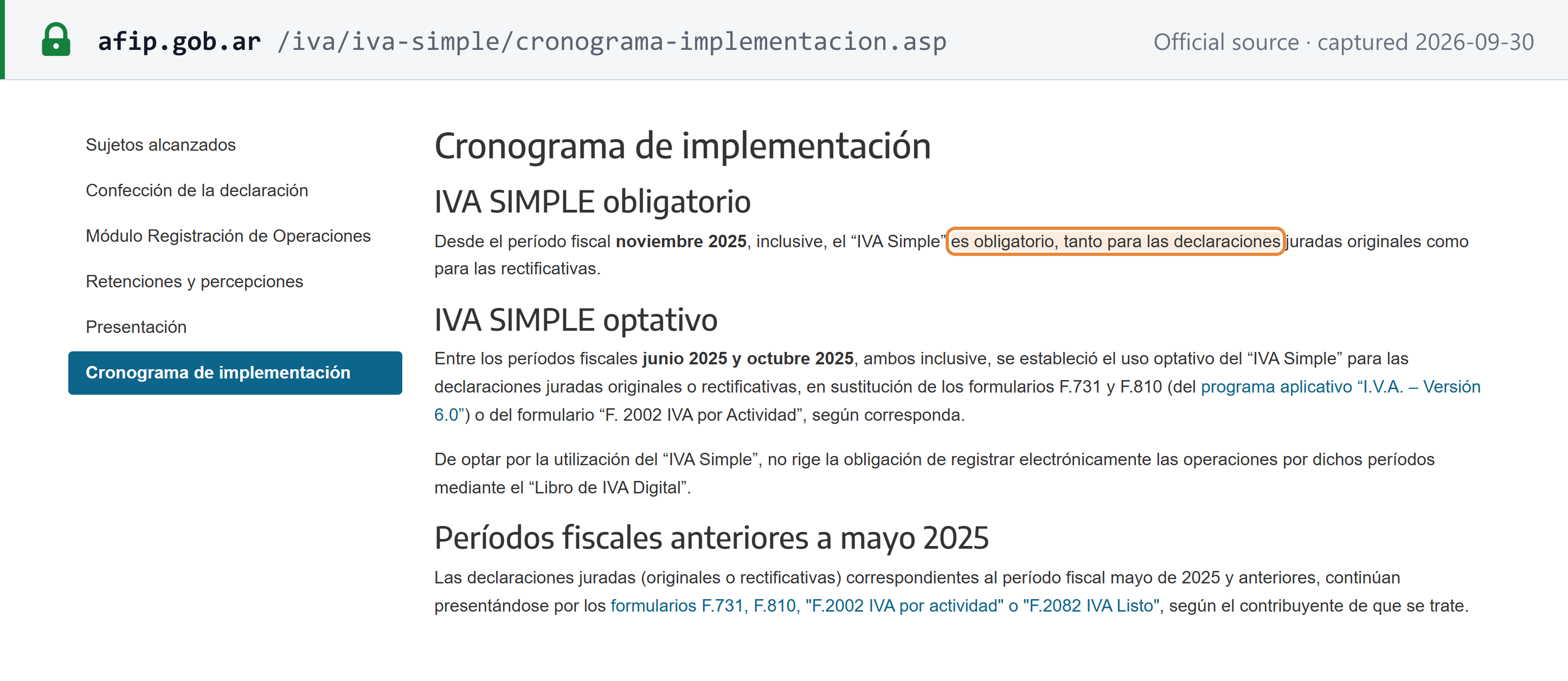
- The form: F.2051 "IVA Simple". RG 5705/2025 art. 2: the monthly sworn return F. 2051 «deberá efectuarse a través del servicio denominado “PORTAL IVA”» — is filed through ARCA's Portal IVA service (Clave Fiscal level 3 or higher). ARCA: «Desde el período fiscal noviembre 2025, inclusive, el “IVA Simple” es obligatorio, tanto para las declaraciones juradas originales como para las rectificativas» — mandatory from the November 2025 period for original and amended returns. It was optional for June to October 2025; periods up to May 2025 stay on the older forms (F.731/F.810, F.2002 "IVA por actividad" and F.2082 "IVA Listo"). [7]
- Pre-loaded data. The system loads the invoices issued and received that ARCA holds, and the withholdings and perceptions reported by agents through the SIRE and SICORE systems; the taxpayer validates and adjusts them before filing. [23]
- Nil returns. «La obligación de efectuar la registración debe cumplirse incluso cuando no se hayan efectuado operaciones» — a period with no operations is still recorded, as "SIN MOVIMIENTO". [23]
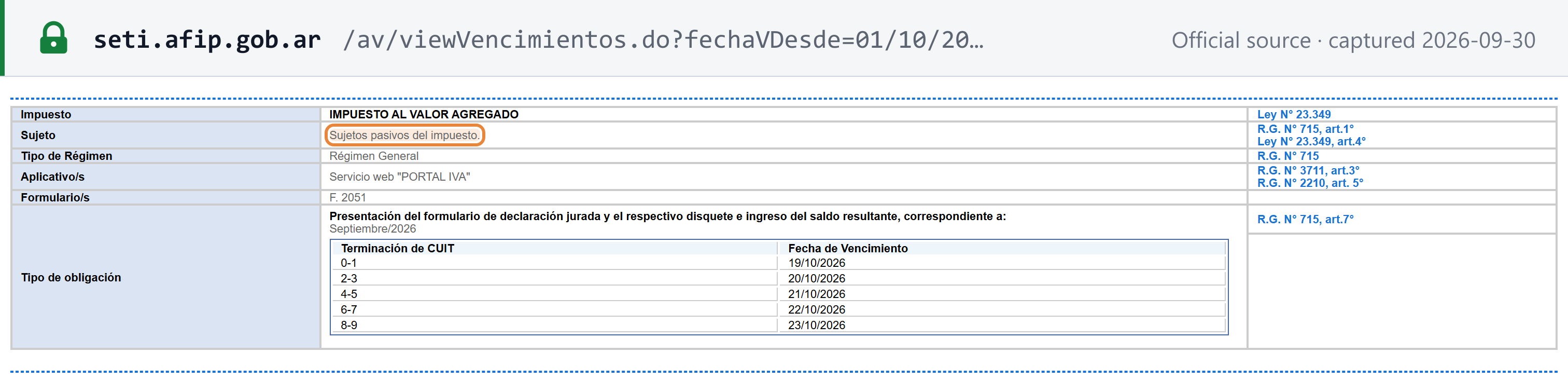
- The due date. RG 5705 art. 5 ties filing and payment to ARCA's annual Agenda General de Vencimientos, staggered by the last digit of the CUIT. The rule: in the month after the period, on the date for the CUIT's final digit. Exact days move each month for weekends and holidays. For the September 2026 period: [8]
| CUIT ends in | Filing and payment due |
|---|---|
| 0 or 1 | 19 October 2026 |
| 2 or 3 | 20 October 2026 |
| 4 or 5 | 21 October 2026 |
| 6 or 7 | 22 October 2026 |
| 8 or 9 | 23 October 2026 |
 Source snapshot captured 2026-09-30 — original
 Source snapshot captured 2026-09-30 — original
Payment due date and method
- Same date as the return. The balance is paid on the F.2051 due date above, «conforme las formas de pago autorizadas actualmente vigentes» — by ARCA's authorised payment methods, listed on its "Cómo pagar impuestos" page. [23]
- Micro and small companies pay later. Holders of a MiPyME certificate in the micro or small band file on the normal date but pay the balance of the period two months earlier: in the October 2026 agenda they file September 2026 and pay «Julio/2026» on the same CUIT-digit dates (RG 4010). [8]
- Imported services are paid within 10 business days of the taxable event (RG 549), and import IVA at customs — see Cross-border rules.
Additional listings
- No separate sales or purchase listing. F.2051 embeds the purchase and sales ledger (its "Registración electrónica de operaciones" module). Argentina has no EC-sales-list equivalent.
- Withholding and perception agents report through SIRE — «Es un sistema para que los agentes de retención y/o percepción de los regímenes de la seguridad social, del IVA y del Impuesto a las Ganancias, puedan informar el detalle de las operaciones y emitir los certificados correspondientes» — and through SICORE on F. 744; in October 2026, September's SICORE returns were due on 9, 13 and 14 October by CUIT digit. [22]
- Libro de IVA Digital. ARCA's October 2026 agenda still lists «Registración y presentación del "Libro de IVA Digital"» for responsables inscriptos. RG 5705 relieved IVA Simple filers of it only for June to October 2025, and neither RG 5705 nor ARCA's IVA Simple pages state whether it must still be filed separately from F.2051; confirm with ARCA for your case.
- Sector information regimes listed in the agenda (debit cards, hotel refunds to tourists and others) apply to the businesses concerned.
Withholdings and perceptions
Argentina collects much of its IVA in advance through withholdings (retenciones, by payers) and perceptions (percepciones, by sellers, customs and card issuers), which the taxpayer then credits in its monthly return: [22]
- the customs perception on imports (RG 2937) and the digital-services perception (RG 4240), above;
- 100% withholding on class A invoices marked "operación sujeta a retención";
- perception regimes on uncategorised customers, and sector withholding regimes (grain, milk, honey, sugar cane, cotton, wool and others) listed in ARCA's agenda.
Withholdings are credited in the return of the period in which they were suffered. Perceptions «pueden ser computadas en la declaración jurada del período fiscal en el que se practicó la percepción o, en su caso, en la correspondiente a alguno de los 5 períodos fiscales inmediatos siguientes» — in that period or any of the five following periods (RG 5750).
Input-tax recovery and blocked items
Article 12: «Sólo darán lugar a cómputo del crédito fiscal las compras o importaciones definitivas, las locaciones y las prestaciones de servicios en la medida en que se vinculen con las operaciones gravadas» — input IVA is creditable only to the extent it relates to taxed operations. Blocked, in whole or part: [1]
- Cars. The credit is capped at the IVA on a cost of ARS 20,000, net of IVA — a figure unchanged since 2001, which in practice blocks almost all of it — unless the car is stock in trade or the core of the taxed activity (rentals, taxis, chauffeured cars, travelling salespeople).
- Hospitality and personal services. The services in article 3 e) points 1, 2, 3, 12, 13, 15 and 16: restaurants and bars, hotels, hourly lodgings, baths and massage, pools and gyms, hairdressers and beauty salons, parking and garages.
- Clothing other than work wear.
- Mixed use. Where inputs serve taxed and exempt operations and cannot be assigned, the credit is apportioned by the taxed share (article 13).
- Timing. Credit on imported services comes in the following period (article 12); input IVA on a class A invoice that ARCA flags with customer inconsistencies at CAE time gives no credit.
Refunds
- Domestic credit balance: carried forward. Article 24: the balance in favour of the taxpayer «sólo deberá aplicarse a los débitos fiscales correspondientes a los ejercicios fiscales siguientes» — only against future output IVA. The exception is the part that comes from withholdings and perceptions suffered, which can be offset against other taxes, refunded or transferred. [1]
- Capital goods. Input IVA on capital goods other than cars that is still part of the credit balance after six consecutive periods is refunded (the article after article 24).
- Exporters. Through SIR, regime code 404, form F 8147 — see Imports and exports.
- Mining exploration. IVA on mining investments (Ley 24.196 art. 14 bis) is recovered through SIR, regime code 006, form F 8147, under RG 5879/2026 (Boletín Oficial 23 July 2026): «resultará de aplicación obligatoria a partir del período de solicitud de recupero marzo 2026, inclusive» — mandatory from the March 2026 recovery period. [15]
- Foreign tourists can recover IVA on listed goods and certain hotel services (the article after article 43).
- Non-resident businesses. No refund scheme for foreign businesses without Argentine operations appears in the Ley de IVA.
This guide does not cover the general IVA withholding regimes (rates and designation of agents) or bad-debt relief.
Exemptions
Exempt supplies
Exemptions are listed in article 7 (goods and services) and article 8 (imports). Among them: [1]
- Publications: books, pamphlets, newspapers and magazines, including digital news subscriptions (art. 7 a); and «El acceso y/o la descarga de libros digitales» — access to and downloads of digital books (7 h 29).
- Basic goods: ordinary water, and plain milk sold to consumers or the State (7 f).
- Stamps, banknotes and investment gold from official entities (7 b, 7 d); passenger and cargo aircraft (7 g).
- Education: services of private schools that are part of the official curriculum and recognised as such (7 h 3).
- Health: medical and paramedical services covered by health insurers (obras sociales), within the article's limits (7 h 7).
- Transport: «Los servicios de taxímetros y remises con chofer, realizados en el país, siempre que el recorrido no supere los CIEN KILOMETROS (100 km.)» — taxis and chauffeured cars for trips up to 100 km (7 h 12); and «El transporte internacional de pasajeros y cargas … el que tendrá el tratamiento del artículo 43» — international passenger and cargo transport, which keeps the export credit (7 h 13).
- Financial services: listed operations such as bank deposits and certain interest (7 h 16).
- Housing: residential rental to the tenant and family, rural land leases and leases to the State (7 h 22).
- Public services of the State (7 h 1) and domestic service (7 h 17).
- Exports (art. 8 d) and imports with duty franchises (art. 8 a–c).
Exempt is not zero-rated
Input IVA on exempt supplies is not creditable. Article 12 allows credit only on inputs «en la medida en que se vinculen con las operaciones gravadas» — to the extent they relate to taxed operations — and article 13 apportions mixed inputs. An exempt business therefore bears the IVA on its costs. The exception is exports and export-like services such as international transport, which are exempt but keep the right to recover input IVA under article 43. [1]
Special regimes
- Monotributo — the simplified regime for small individual taxpayers; see Registration threshold.
- Micro and small company payment deferral (RG 4010) — see Payment due date and method.
- Margin, second-hand and cash-accounting schemes. No general margin or cash-accounting scheme appears in the Ley de IVA. Purchases of used goods from consumers are documented by the buyer — see Self-billing.
- Free zones. Imports from free zones into the general customs territory are subject to the RG 2937 perception; the free-zone regime itself and the special regime of Tierra del Fuego are outside the scope of this guide.
Offences and penalties
Offences
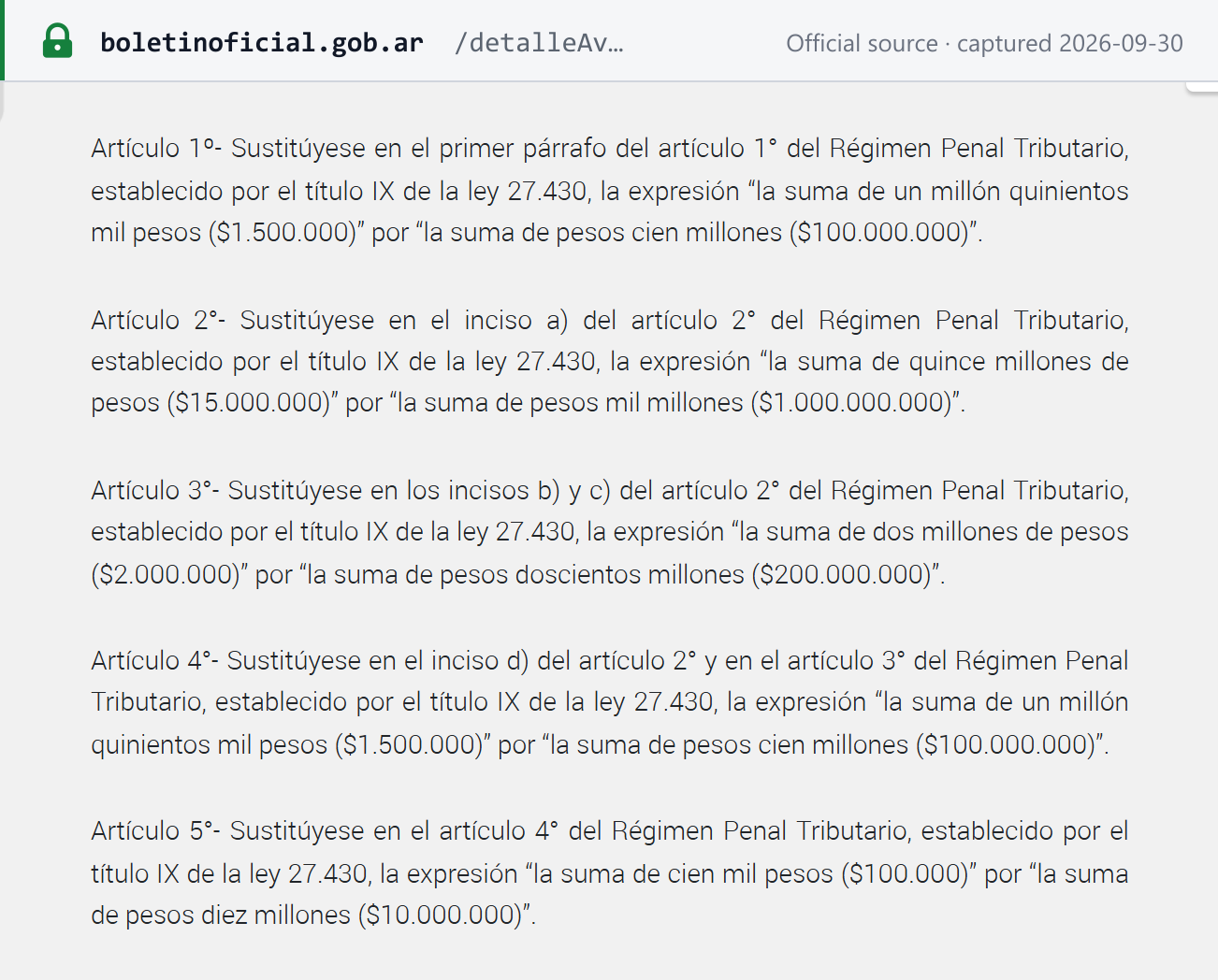
Criminal offences (Régimen Penal Tributario, Title IX of Ley 27.430). Ley 27.799 raised the thresholds from 2 January 2026: [16] [11]
| Offence | Threshold | Penalty |
|---|---|---|
| Simple evasion (art. 1) — evading tax by deceptive returns, malicious concealment or other deceit | Amount evaded above ARS 100,000,000 per tax and per year | 2 to 6 years' prison |
| Aggravated evasion (art. 2) | Amount above ARS 1,000,000,000, or interposed persons and other listed circumstances | 3½ to 9 years' prison |
| Misappropriation by a withholding or perception agent (art. 4) — not depositing tax withheld or collected within 30 calendar days of the due date | Amount above ARS 10,000,000 per month | 2 to 6 years' prison |
 Source snapshot captured 2026-09-30 — original
Article 1: «Será reprimido con prisión de dos (2) a seis (6) años el obligado que mediante declaraciones engañosas, ocultaciones maliciosas, o cualquier otro ardid o engaño … evadiere total o parcialmente el pago de tributos … siempre que el monto evadido excediere la suma de pesos cien millones ($100.000.000) por cada tributo y por cada ejercicio anual». Ley 27.799 also bars ARCA from filing a criminal complaint where the evaded tax and interest are paid on the conditions it sets, and indexes the amounts annually by the UVA index from 1 January 2027.
Administrative offences that are not just fines:
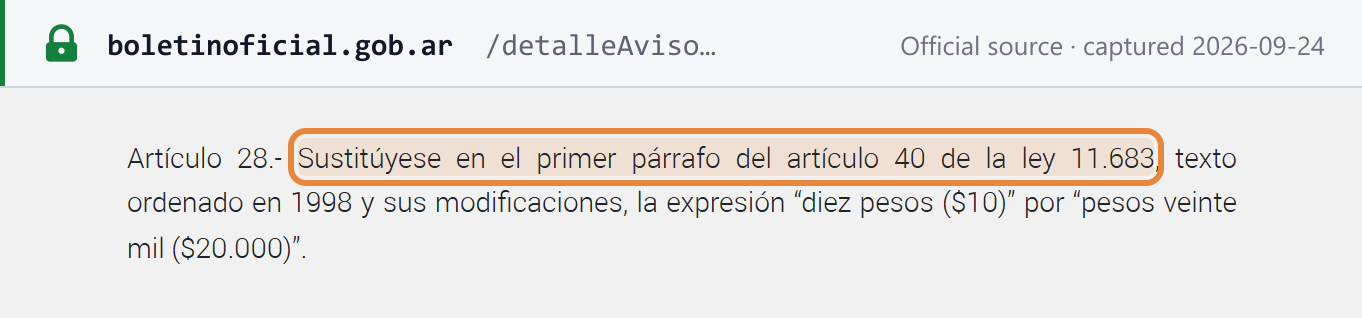
- Failing to issue invoices in the form ARCA requires, where the goods or services exceed ARS 20,000, is punished with closure of the business for 2 to 6 days, doubled for a repeat within two years (Ley 11.683 art. 40 a), threshold raised by Ley 27.799 art. 28). [2]
- Invoicing breaches short of non-issuance, such as defective data, fall under the formal-duty fine below (art. 39).
- Unbilled operations are also a ground for exclusion from the Monotributo (see Registration threshold).
- Misusing e-invoicing contingency modes can lead ARCA to bar electronic issuing for a calendar year — see the e-invoicing guide.
 Source snapshot captured 2026-09-24 — original
Penalties
Figures in Ley 11.683 as amended by Ley 27.799 (Boletín Oficial 2 January 2026); from 1 January 2027 the fixed amounts are updated each year by the UVA index. [2] [11]
| Breach | Penalty | Ley 11.683 |
|---|---|---|
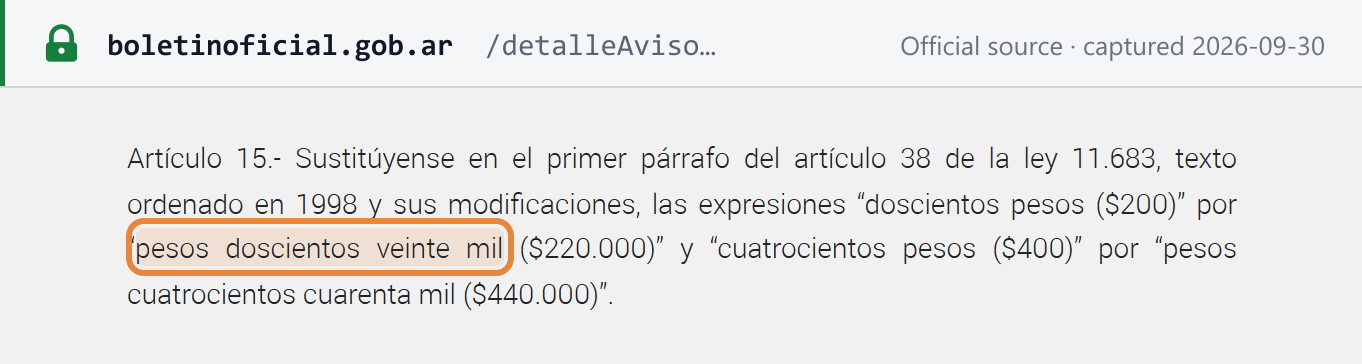
| Late filing of a return | ARS 220,000; ARS 440,000 for companies and associations constituted in Argentina and for permanent businesses of foreign persons. Halved, and not counted as a precedent, if the fine is paid and the return filed within 15 days of ARCA's notice | art. 38 |
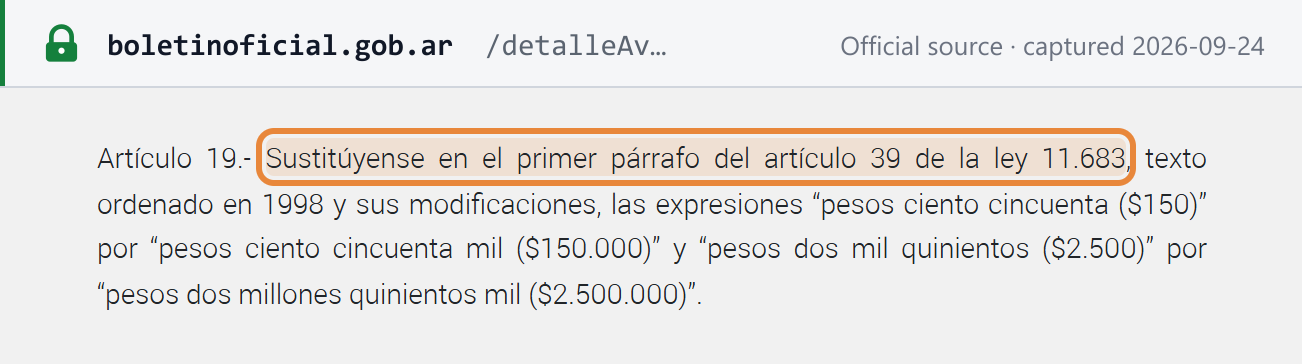
| Breach of formal duties (including defective invoices) | ARS 150,000 to ARS 2,500,000 | art. 39 |
| Not issuing invoices (above ARS 20,000) | Closure for 2 to 6 days | art. 40 |
| Omission — underpaying through a missing or inaccurate return, or an agent failing to withhold or collect | 100% of the tax omitted; 200% where it concerns transactions with persons domiciled abroad; on a repeat, 200% (300% in the cross-border case) | art. 45 |
| Fraud (defraudación) — deceptive returns or malicious concealment | 2 to 6 times the tax evaded | art. 46 |
| Agents keeping tax withheld or collected after the due date | 2 to 6 times the amount kept | art. 48 |
Article 38: a late return «será sancionada, sin necesidad de requerimiento previo, con una multa de pesos doscientos veinte mil ($220.000), la que se elevará a pesos cuatrocientos cuarenta mil ($440.000)» for companies — the fine applies automatically, without prior notice.
 Source snapshot captured 2026-09-30 — original
 Source snapshot captured 2026-09-24 — original
Voluntary correction. A taxpayer that is not a repeat offender and files the missing or corrected return before being notified of an inspection order «quedará exento de responsabilidad infraccional» — is relieved of liability for the infraction (art. 49), with graduated reductions later in the process.
Interest (as at 2026-09-30). Unpaid tax accrues compensatory interest from the due date, without notice (art. 37), at 2.75% a month; amounts in judicial collection carry punitive interest (art. 52) of 3.50% a month. Both rates were set by Resolución 3/2024 of the Ministry of Economy as substituted by Resolución 823/2025, with effect from 1 July 2025: «Establécese la tasa de interés resarcitorio prevista en el artículo 37 de la Ley N° 11.683 … en el dos coma setenta y cinco por ciento (2,75%) mensual». Interest on refunds to taxpayers is 0.50% a month. [12] [25]
Frequently asked questions
We are a responsable inscripto selling to a Monotributo customer. Do we issue a Factura A or a Factura B?
A Factura A. Since RG 5003/2021 a responsable inscripto issues class A invoices, not class B, to customers in the Monotributo simplified regime, and ARCA's invoice-class table shows class A for that pairing. The invoice shows the VAT rate and amount, and must carry the legend that the VAT shown can be computed only for the purposes of the Ley 27.618 regime. Class B is for final consumers, exempt and non-taxed customers, and foreign tourists (who may also receive a class T document). [4] [17]
Which form is the monthly IVA return, and when is it due?
Responsables inscriptos file the F.2051 IVA Simple return through ARCA's Portal IVA service. It has been mandatory since the November 2025 period, for original and amended returns, under RG 5705/2025. The return and the payment are due in the month after the period, on a date set by the last digit of the CUIT: for the September 2026 period, 19 October 2026 for CUITs ending 0 or 1 through 23 October 2026 for CUITs ending 8 or 9. A nil return is still required. The older F.731, F.2002 and F.2082 forms apply only to past periods. [7] [8]
What are the Monotributo limits right now?
From 1 August 2026, ARCA's table of Monotributo categories runs from A (annual gross income up to ARS 12,009,410.45) to K (up to ARS 126,610,838.75), with a maximum unit sale price for goods of ARS 716,840.77. The ceilings are updated twice a year, in February and August, by the consumer price index, so check ARCA's categories page before relying on them after January 2027. Anyone above the category K ceiling cannot use the Monotributo and must register in the general regime. [5] [19]
We are a foreign software company selling to consumers in Argentina. Do we need to register for IVA?
There is no registration route for a foreign supplier of digital services. Under RG 4240/2018, when an Argentine consumer pays a non-resident for digital services through a local entity that handles payments abroad, such as a card issuer or bank, that entity collects the 21% IVA as a perception agent. Where no local intermediary collects it, the customer must pay the tax by the last day of the month of payment. If the customer is a responsable inscripto, it self-assesses the IVA on the imported service instead, within 10 business days of the taxable event (RG 549). [9] [8]
Why do our invoices to consumers now show an IVA Contenido line?
Ley 27.743 rewrote article 39 of the Ley de IVA so that a responsable inscripto selling to final consumers must show the VAT on the invoice. RG 5614/2024 implements it: the invoice carries a block headed Régimen de Transparencia Fiscal al Consumidor (Ley 27.743), with one line for IVA Contenido and one for Otros Impuestos Nacionales Indirectos. It was optional from 1 January 2025 and has been mandatory for all responsables inscriptos since 1 April 2025. The consumer still gets no input credit. [1] [13]
Can we recover IVA on a company car or a business dinner?
Largely no. Article 12 of the Ley de IVA caps the credit on cars at the VAT on ARS 20,000 of cost, net of VAT, a figure unchanged since 2001, so in practice almost all of it is blocked, unless the car is stock in trade or the core of the taxed activity, such as rentals or taxis. VAT on restaurants and bars, hotels, gyms and pools, hairdressers and parking is not creditable at all, and neither is VAT on clothing other than work wear. [1]
Our IVA credit balance keeps growing. Can we get it refunded?
Usually not in cash. Under article 24 of the Ley de IVA a technical credit balance is carried forward against future output VAT. The exceptions are exporters, who reclaim input VAT linked to exports through ARCA's Sistema Integral de Recupero (SIR, regime code 404); input VAT on capital goods other than cars that is still in the balance after six consecutive periods; and balances built up from withholdings and perceptions suffered, which can be offset, refunded or transferred. [1] [15]
What is the fine for filing the IVA return late?
Article 38 of Ley 11.683, as amended by Ley 27.799 from 2 January 2026, fines a late return ARS 220,000, or ARS 440,000 for companies and associations constituted in Argentina and for permanent businesses of foreign persons. The fine halves if the taxpayer pays it and files the missing return within 15 days of ARCA's notice. Unpaid tax also carries compensatory interest of 2.75% a month, the rate in force since 1 July 2025. [11] [12]
Can a non-resident still get a CDI?
Not an individual. RG 5803/2025, in force since 2 March 2026, withdrew the CDI (Clave de Identificación) procedure for individuals and undivided successions and replaced it with a CUIT. Existing CDIs stay valid only until the holder has to change their registry data. A non-resident individual, with or without an Argentine DNI, requests a CUIT through a representative or authorised third party with an address in Argentina. [6]
Important websites
| Site | Purpose |
|---|---|
| Inscripción digital | Getting a CUIT online (individuals with a DNI) |
| Régimen General | Registering a company, adding IVA ("alta de impuestos") and deregistering, through Sistema Registral |
| Monotributo · current categories | Joining the simplified regime and checking the category ceilings |
| IVA Simple | Filing the monthly F.2051 return through Portal IVA |
| Agenda de vencimientos | Due dates, filtered by tax and final CUIT digit |
| Cómo pagar impuestos — IVA | Paying the balance |
| Constancia de inscripción | Checking a CUIT's registration and IVA status |
| Constatación de comprobantes | Checking that an invoice's CAE was granted |
| Facturas apócrifas | ARCA's database of issuers of unreliable invoices |
| Factura electrónica | ARCA's e-invoicing microsite |
| Factura de Crédito Electrónica MiPyME | The FCE regime for sales by MiPyMEs to large companies |
| Servicios digitales — supplier list | Foreign digital-service suppliers covered by the RG 4240 perception |
| SIRE | Withholding and perception returns and certificates |
| IGJ — foreign company registration | Registering a branch or representation of a foreign company |
| InfoLEG | The consolidated Ley de IVA, including the article 28 rates |
For the CUIT itself, see Lookuptax's Argentina tax ID guide, how to verify a CUIT, how to verify a DNI and the CUIT validator. For the full e-invoicing regime, see the Argentina e-invoicing guide.
Recent changes
- 2026-08-31 — RG 5893/2026 published: electronic invoicing becomes mandatory for Monotributo social and promovido taxpayers from 1 November 2026, and for taxpayers outside VAT from 1 March 2027. (Boletín Oficial) — see event
- 2026-08-01 — New Monotributo categories: category K ceiling ARS 126,610,838.75 of annual gross income; maximum unit price ARS 716,840.77. (ARCA)
- 2026-08-01 — CAEA becomes contingency-only and per-invoice CAE the rule (RG 5782 and RG 5785/2025, as postponed by RG 5852/2026). (Boletín Oficial) — see event
- 2026-07-23 — RG 5879/2026: IVA recovery on mining investments moves to SIR (regime code 006), mandatory from the March 2026 recovery period. (Argentina.gob.ar)
- 2026-07-01 — RG 5866/2026 in force: it reorganises e-invoicing, sets consumer ID at ARS 10,000,000 or more and abrogates RG 5824/2026. (Boletín Oficial) — see event
- 2026-03-06 — Ley 27.802 adds electricity for agro-industrial irrigation to the 10.5% rate, from the first day of the month after it took effect. (InfoLEG)
- 2026-03-02 — RG 5803/2025 in force: unified CUIT registration; the CDI is withdrawn for individuals; non-resident individuals obtain a CUIT through a local representative. (Boletín Oficial)
- 2026-01-02 — Ley 27.799 raises penalty amounts and criminal thresholds: late filing ARS 220,000/440,000; simple evasion above ARS 100,000,000. (Boletín Oficial)
For the full chronology, see Argentina tax changes on Lookuptax.
Reference links
- Ley de Impuesto al Valor Agregado, texto ordenado 1997 (Decreto 280/97) — consolidated text (InfoLEG)
- Ley 11.683 de Procedimiento Tributario, t.o. 1998 — consolidated text (InfoLEG)
- RG 1415/2003 — invoicing and records regime, consolidated (ARCA Biblioteca Electrónica)
- ARCA — Comprobantes: invoice classes by issuer and customer
- ARCA — Monotributo, montos y categorías vigentes
- RG 5803/2025 — registration, CUIT and CDI (Boletín Oficial, 24 December 2025)
- ARCA — IVA Simple implementation schedule · RG 5705/2025 (ARCA Biblioteca Electrónica)
- ARCA — Agenda de vencimientos, October 2026
- ARCA — digital services: RG 4240 perception · who is liable · concepts · supplier list · RG 4240/2018 (ARCA Biblioteca Electrónica)
- RG 2937/2010 — IVA perception on imports, consolidated (ARCA Biblioteca Electrónica)
- Ley 27.799 (Boletín Oficial, 2 January 2026)
- Resolución 3/2024 (Ministerio de Economía) — interest rates, updated text (Argentina.gob.ar)
- RG 5614/2024 — Régimen de Transparencia Fiscal al Consumidor (Boletín Oficial, 13 December 2024)
- Decreto 1397/79 — regulation of Ley 11.683, art. 48 (InfoLEG)
- RG 5879/2026 — Sistema Integral de Recupero (Argentina.gob.ar)
- Ley 27.430, Title IX — Régimen Penal Tributario (InfoLEG)
- RG 5003/2021 — class A invoices to Monotributo customers (Boletín Oficial, 2 June 2021)
- Ley de IVA — consolidated text (Argentina.gob.ar Normativa)
- ARCA — Monotributo: ¿Qué es? · parameters · recategorisation · exclusion · moving to the general regime · getting started
- IGJ — registering a company constituted abroad (Argentina.gob.ar)
- ARCA — Régimen de Transparencia Fiscal al Consumidor news item
- ARCA — SIRE · IVA Simple: withholdings and perceptions
- ARCA — IVA Simple: preparing the return · filing and payment · special specifications, nil returns
- ARCA — company registration steps · tax registrations · deregistration
- Resolución 823/2025 (Ministerio de Economía) — interest rates (Argentina.gob.ar)
Related Lookuptax pages: