Poland VAT guidelines
| FACTSHEET | |
|---|---|
| Country code | PL |
| Tax name | Podatek od towarów i usług (PTU) — Value Added Tax (VAT) |
| Tax Authority | Krajowa Administracja Skarbowa (KAS), under the Minister Finansów i Gospodarki |
Overview
Poland levies podatek od towarów i usług — literally "tax on goods and services", abbreviated PTU and universally called VAT in practice — under the Ustawa z dnia 11 marca 2004 r. o podatku od towarów i usług (the VAT Act, originally Dz.U. 2004 nr 54 poz. 535). Its current consolidated text is Dz.U. 2026 poz. 1263 — the Marshal of the Sejm's announcement of 1 September 2026, published on 28 September 2026 — which restates the 2025 consolidated text (Dz.U. 2025 poz. 775) with the legal status as at 26 August 2026, including eight later amending acts up to Dz.U. 2026 poz. 846. The Act of 4 September 2026 (Dz.U. 2026 poz. 1270) amends it further. The tax is a state-budget revenue under article 1(2). [1]
Administering authority. VAT is administered by the Krajowa Administracja Skarbowa (KAS) — the National Revenue Administration — through the naczelnik urzędu skarbowego (head of the tax office) for registration, returns and assessment, the naczelnik urzędu celno-skarbowego for customs-and-fiscal control and import VAT, and the Szef KAS for the central systems, including the taxpayer register under article 96b and the National e-Invoicing System under article 106nd. Policy sits with the Minister Finansów i Gospodarki. Taxpayer-facing guidance and services are published on podatki.gov.pl and gov.pl/web/finanse. [1]
Currency. All figures in this guide are in Polish złoty (PLN, zł), subdivided into 100 grosze. Article 106e(11) requires the VAT amount on an invoice to be shown in złoty even where the rest of the invoice is in a foreign currency, rounded to whole grosze. [1]
Tax period basis. There is no annual VAT return. The operative unit is the taxable period — a calendar month by default under article 99(1), or a calendar quarter for small taxpayers under article 99(2) and (3). The rok podatkowy (tax year) matters only for the registration threshold in article 113, which is measured on the previous and current tax year. [1]
Layering. Polish VAT is a single national tax. There is no regional, voivodeship or municipal VAT layer, and no local surcharge on it — every rate and threshold below applies uniformly across the country. As an EU member state, Poland's VAT Act implements Directive 2006/112/EC, so the EU-level machinery — intra-Community supplies and acquisitions, the reverse charge on cross-border services, OSS and IOSS — applies here as it does across the single market.
What is different about Poland. Two obligations dominate day-to-day compliance and neither has a close equivalent in most peer jurisdictions: KSeF, the mandatory structured e-invoicing system that went live on 1 February 2026 for the largest taxpayers and on 1 April 2026 for the rest (see E-invoicing status), and JPK_V7M/JPK_V7K, the SAF-T file that merges the VAT return and the full VAT records into a single monthly transmission (see Filing and payment).
Registration
Who should register
Article 96(1) states the liability rule directly: any entity that is a taxable person under article 15 or a VAT group under article 15a must file a registration declaration (zgłoszenie rejestracyjne) with the head of the tax office before the day on which it performs its first taxable transaction under article 5. Registration is therefore transaction-triggered, not turnover-triggered — the PLN 240,000 figure below is an exemption from tax that removes the need to register, not a permission to trade untaxed until it is reached. [1]
Two rules sit alongside it:
- Article 96(1a) — a supplier with no Polish seat of business making intra-Community distance sales of goods that are in Poland when dispatch begins files its registration declaration before the day of the supply.
- Article 97(1) — a taxpayer registered as podatnik VAT czynny must additionally notify its intention to make intra-Community supplies or acquisitions before the first such transaction, which is how it becomes registered as podatnik VAT UE and receives the PL-prefixed VAT number used in VIES. Article 97(3) extends the same notification to taxpayers who merely buy article 28b services from abroad (import of services) or supply them to another member state.
After verifying the declaration, article 96(4) has the tax office register the applicant either as "podatnik VAT czynny" (an active, fully taxable person) or "podatnik VAT zwolniony" (an exempt person who registered voluntarily). The distinction is visible to counterparties in the public register and drives input-tax entitlement.
Registration threshold
| Trigger | Threshold | Measurement period | Notes |
|---|---|---|---|
| Small-business exemption — business established in Poland (art. 113(1)) | PLN 240,000, excluding VAT | Previous and current tax year | Raised from PLN 200,000 with effect from 1 January 2026. Exceeding it ends the exemption from the transaction that breaches it (art. 113(5)). [1] [8] |
| Business starting in-year (art. 113(9)) | PLN 240,000 pro-rated to the part of the year traded | Current tax year | Same cut-off rule on breach (art. 113(10)). [1] |
| Business NOT established in Poland | Zero | — | This is the figure most readers get wrong. See below. [1] |
| Cross-border SME exemption (art. 113a) | EUR 100,000 EU-wide annual turnover and the art. 113(1) figure for Polish sales | Previous and current tax year | Only for a taxpayer established in another EU member state, and only with an EX identification number obtained in its own state (art. 113a(2)). Unavailable if it makes any art. 113(13) excluded supply. [1] |
| Intra-Community acquisitions by non-taxable legal persons (art. 10(1)(2), art. 97(2)) | PLN 50,000 | Tax year | Below this a non-taxable legal person need not account for acquisitions; it may opt in under art. 10(6). [1] |
| Intra-Community distance sales / TBE services (art. 22a(1)(3)) | EUR 10,000, expressed for a Poland-established supplier as PLN 42,000 | Current and previous tax year | Below it the supply stays taxable in the supplier's own state; above it the place of supply moves to the customer's state and OSS becomes the practical route. [1] |
Enacted change from 1 January 2027. The Act of 4 September 2026 (Dz.U. 2026 poz. 1270, published 29 September 2026) adds article 113(1a), under which supplies under article 13(3) also count towards the sales value tested against the small-taxpayer exemption. The PLN 240,000 figure itself is unchanged, and the current article 113 text applies until then. See Recent changes.
The non-resident threshold is zero — say it plainly
Readers routinely assume the PLN 240,000 figure protects any small seller. It does not. Article 113(1) opens: "Zwalnia się od podatku sprzedaż dokonywaną przez podatnika posiadającego siedzibę działalności gospodarczej na terytorium kraju…" — the exemption is granted only to a taxpayer whose seat of business is in Poland. A business established anywhere else has no de-minimis at all: article 96(1) requires registration before the first taxable transaction in Poland, whatever its value. [1]
The only relief that comes close is article 113a, and it is a different mechanism with a different gatekeeper: it is open only to a business established in another EU member state, it is capped by an EU-wide EUR 100,000 turnover test as well as the Polish figure, and it works through an EX identification number issued by the home member state rather than a Polish registration. A business established outside the EU has neither route, and under article 18a(1) must appoint a Polish fiscal representative (przedstawiciel podatkowy) as a condition of being registered as podatnik VAT czynny, unless it is established in a member state — in which case article 18a(2) makes a representative optional. [1]
Tax registration number
Poland uses the NIP (Numer Identyfikacji Podatkowej) as its single tax identifier across VAT and other taxes, governed by the Ustawa z dnia 13 października 1995 r. o zasadach ewidencji i identyfikacji podatników i płatników (consolidated text Dz.U. 2026 poz. 151). Article 3(1) of that Act makes the NIP the tax identifier for every entity other than a natural person who is neither VAT-registered nor in business — and article 3(1a) pulls a sole trader back to the NIP as soon as they are VAT-registered or operate a cash register. Article 3(2) forbids the NIP from encoding any characteristic of its holder. [13]
The NIP is a 10-digit number. Its shape is visible in the official FA(3) invoice schema, whose KSeF-number pattern embeds the seller's NIP as [1-9]((\d[1-9])|([1-9]\d))\d{7} — ten digits whose second and third digits cannot both be zero (so 1054567890 is valid, 1004567890 is not). For VAT-UE purposes the same digits are used with the PL prefix, which article 106e(1)(24)(a) requires on invoices for intra-Community triangulation. [7] [1]
For the full format walkthrough, the check-digit algorithm, and how the NIP relates to PESEL and REGON, see Lookuptax's Poland TIN number guide. To check a counterparty's number, use the Poland NIP validator.
How to register
- Form. The registration declaration is form VAT-R, prescribed by the rozporządzenie Ministra Finansów w sprawie wzorów dokumentów związanych z rejestracją w zakresie podatku od towarów i usług (consolidated text Dz.U. 2024 poz. 408, most recently amended by Dz.U. 2024 poz. 1898 with effect from 1 January 2025). The same form is used to notify VAT-UE registration under article 97. Ceasing activity is notified on form VAT-Z. [14]
- Channel. Online through the e-Urząd Skarbowy service at podatki.gov.pl/e-urzad-skarbowy, or — for a sole trader — as part of the CEIDG business-registration application at biznes.gov.pl. A company registers in the KRS first and files VAT-R afterwards.
- Fiscal representative. Required for a non-EU-established taxable person under article 18a(1); article 18b sets the conditions the representative must meet, including a Polish seat of business.
- Timeline. The Act sets no fixed processing deadline. Article 96(4a) lets the tax office refuse registration without notifying the applicant where the declared data are untrue, the entity does not exist, contact attempts documented by the office fail, or the applicant does not answer a summons — so getting the address and representation details right the first time is the practical determinant of how long it takes. [1]
Voluntary registration
Available. Article 96(3) lets an entity whose sales are exempt under article 113(1) or (9), or which makes only supplies exempt under article 43(1), file a registration declaration anyway; article 96(4) then registers it as podatnik VAT zwolniony. A business below the threshold that wants full input-tax recovery instead waives the article 113 exemption under article 113(4), by written notice to the tax office before the start of the month in which the waiver takes effect — or, for a business starting in-year, before its first transaction. Registering is worthwhile where inputs are largely standard-rated and customers are themselves VAT-registered; it is a cost where customers are consumers. [1]
Deregistration
Two routes, and a tax charge to plan for:
- On request. Article 96(6): a registered taxpayer that has ceased performing taxable transactions must notify the cessation to the head of the tax office (form VAT-Z), and that notification is itself the basis for removal from the register.
- Ex officio. Article 96(9) lets the tax office strike a taxpayer off without any notice where the taxpayer does not exist, cannot be contacted despite documented attempts, gave untrue registration data, ignores summonses, appears to be using banks or credit unions for tax fraud within the meaning of article 119zg of the Tax Ordinance, or has been banned from business by a court. Article 96(7) removes a deceased taxpayer automatically.
- Final charge. Article 14(1) taxes own-produced goods and goods bought but not yet supplied on the dissolution of a partnership, or on a natural person's or inherited enterprise's cessation notified under article 96(6) — a closing-stock charge that has to be budgeted before the last return.
Group registration
Available. Article 15a permits a grupa VAT: a group of entities linked financially, economically and organisationally that conclude a group agreement and are then treated as a single taxable person. Membership is open to taxpayers with a Polish seat, and to taxpayers without one to the extent they trade in Poland through a Polish branch (article 15a(2)). The financial link is defined quantitatively — one member holding directly more than 50% of the share capital, of the voting rights in the controlling, decision-making or managing bodies, or of the profit entitlement, in each of the others (article 15a(3)). Under article 96(3b) the group representative files the registration declaration, together with the group agreement, at its own tax office. [1]
Rates
| Rate | Applies to | Legal basis and effective date |
|---|---|---|
| 23% (standard) | Every taxable supply not specifically reduced, zero-rated or exempt | Article 41(1) sets a base rate of 22%, which article 146ef(1)(1) raises to 23%. The 23% figure has applied continuously since 1 January 2011 — first under article 146a, then article 146aa, and since 1 January 2024 under article 146ef, which keeps it in place until the end of the year in which defence spending exceeds 3% of GDP — the elevated rates run while the condition in article 146ef(1) is met, and article 146ef(2) has the Minister announce, in Monitor Polski, the end of the period for which that condition was satisfied. [1] |
| 8% (reduced) | The goods and services listed in Annex 3 to the Act — including coffee and tea preparations, sauces and spices, live animals and agricultural inputs, and (under article 41(12)) the supply, construction, renovation, thermal upgrading and conversion of housing within the social housing programme, plus conservation works on residential buildings. Restaurant and catering services (PKWiU 56) take 8% under article 41(12f) of the VAT Act itself — not the reduced-rate regulation below — subject to that provision's own exclusions for alcoholic beverages, certain other beverages, and unprocessed goods. | Article 41(2) sets 7%, raised to 8% by article 146ef(1)(2); the Annex 3 heading is read at 8% accordingly. Further 8% items sit in the rozporządzenie w sprawie obniżonych stawek podatku od towarów i usług (Dz.U. 2023 poz. 2670) — an annex of goods such as Braille equipment and animal semen, containing no catering services — amended repeatedly since. Most recently, the Minister's regulation of 13 August 2026, Dz.U. 2026 poz. 1095, in force the same day, inserted a new §11b applying 8% to motor petrol (CN 2710 12 45 and 2710 12 49), diesel oil (CN 2710 19 42, 2710 19 44 and 2710 20 11) and stand-alone biocomponent fuels, for the fixed window from 17 August 2026 to 31 August 2026 inclusive. §11b applied through 31 August 2026 and was not extended, so motor fuels were at the 23% standard rate from 1 September 2026. The Minister's regulation of 2 October 2026, Dz.U. 2026 poz. 1288, then inserted a new §11c: from 3 October 2026 to 31 December 2026 an 8% rate applies to the supply, intra-Community acquisition and import of motor petrol, diesel and fuel biocomponents (see the note below this table). [1] [16] (Dz.U. 2026 poz. 1288) |
| 5% (super-reduced) | The goods listed in Annex 10 — meat and edible offal, fish and shellfish, dairy, eggs and honey, vegetables, fruit and nuts, cereals and milling products, edible oils and fats, prepared foods, soups, ice cream, infant formula, dietary foods for special medical purposes, menstrual cups, and printed books, children's picture books, sheet music, maps and regional or local periodicals | Article 41(2a). [1] |
| 0% (zero-rated) | Intra-Community supplies of goods (article 41(3), subject to the article 42 evidence conditions) and exports of goods (article 41(4) and (5), subject to the article 41(6) documentary condition). A domestic 0% list in article 83 covers, among others, seagoing vessels and their supply and equipping, aircraft used by airlines operating chiefly on international routes, and related services | Articles 41(3)–(6) and 83. Zero-rating is a taxable supply at 0%, so input tax remains fully recoverable. [1] |
| Exempt | See Exemptions — no VAT charged and no input-tax recovery | Article 43(1), read with article 86(1). [1] |
Two related flat rates move with the standard rate under the same article 146ef: the flat-rate refund to flat-rate farmers under article 115(2) is 7%, and the flat-rate tax on taxi services under article 114(1) is 4%.
Fuel rate history — the cut has been restarted more than once. §11c is not the first temporary cut to the fuel rate: its predecessors were §11b (17 to 31 August 2026) and, before that, §11a (also 8%, on the same fuel categories though not an identical set of CN codes, running from 31 March 2026), which was extended four times, each time by a regulation published on or within days of the then-current expiry — Dz.U. 2026 poz. 573, 642, 699 and 771. It then expired on 30 June 2026 and was not extended again: motor fuels went back to 23% for the 47 days from 1 July to 16 August 2026, before §11b restarted the cut for 17 to 31 August 2026. §11b was not extended, and motor fuels were at 23% from 1 September 2026 until the regulation of 2 October 2026 (Dz.U. 2026 poz. 1288, in force on publication on 2 October 2026) inserted §11c, which applies 8% from 3 October 2026 to 31 December 2026. So the window has both rolled and been allowed to lapse. No bill restoring 8% on fuels beyond 31 December 2026 is law. Sejm print 2724 proposed a similar 8% VAT cut for 15 March to 30 June 2026 (on a wider set of goods, and paired with excise measures); it was referred to first reading on 19 June 2026, never passed, and its window has expired. In practice these cuts are made by ministerial regulation under article 146ej rather than by statute, so the regulation's own amending-acts list, not the Sejm register, is the thing to watch. The regulation's list of amending acts is published at api.sejm.gov.pl/eli/acts/DU/2023/2670.
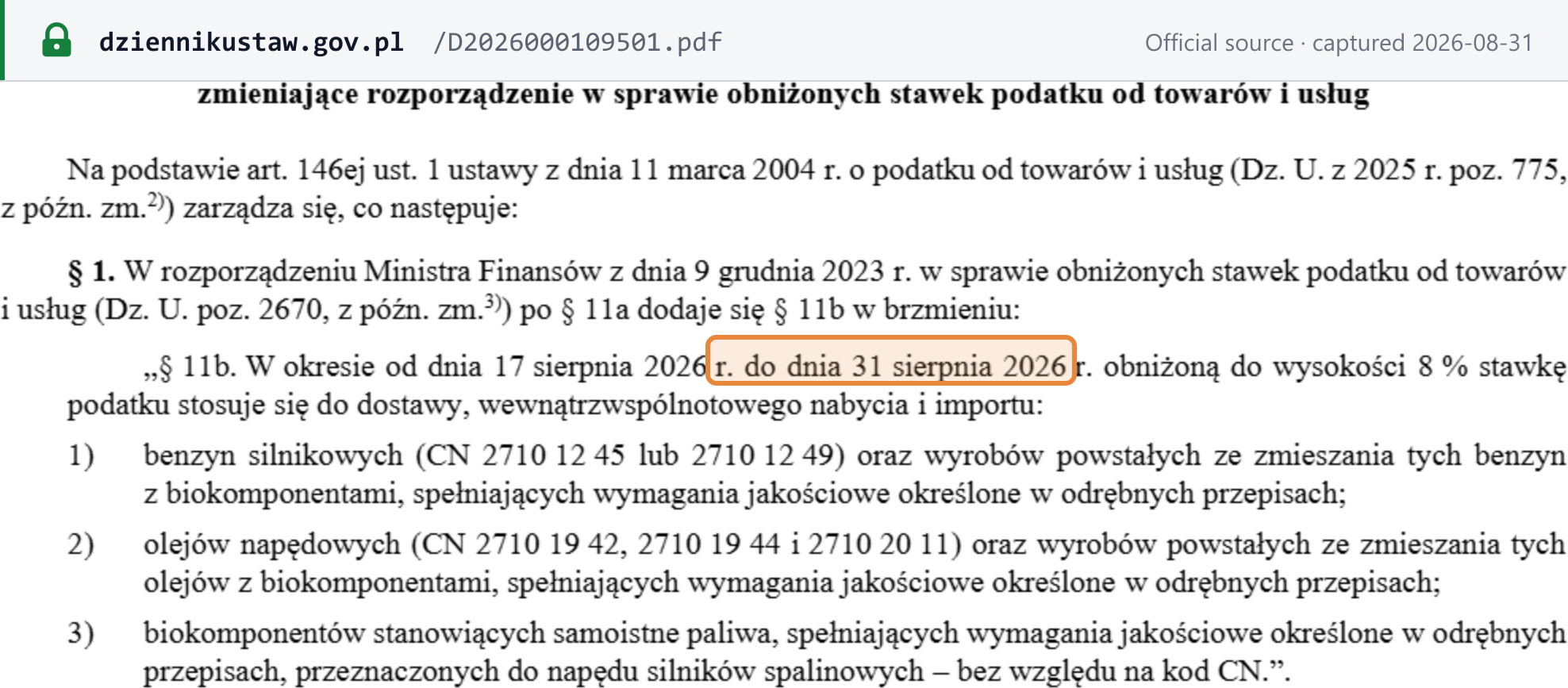 Source snapshot captured 2026-08-31 — original
Announced future rates. None to the 23%, 8%, or 5% rate figures themselves are in force yet — those percentages are unchanged today, and no article 146ef(2) Monitor Polski announcement ending the elevated-rate period has been made. (This is a narrower statement than it looks: the 8% rate's application to motor fuels was itself changed by §11b and again by §11c, above — a change to what the 8% rate reaches, not to the 8% figure.) Article 146ef is open-ended by design — it runs until the Minister announces the end of the period in Monitor Polski. Sejm print 2838 — amended by the Senate by resolution dated 24 September 2026 (65th Senate sitting, print 3132) and now back with the Sejm to vote on those amendments before going to the President (see Recent changes) — touches the conditions for the 0% export rate in article 41(6) to (6c), not any rate figure. Separately, on 22 September 2026 the Council of Ministers adopted a draft law that would raise VAT to 23% (from 5% in retail, 8% in catering) on selected non-alcoholic drinks containing at least 20% fruit/vegetable juice and on drinks with added caffeine or taurine, with all non-alcoholic beers moving to the standard rate regardless of juice content; the planned commencement is 1 January 2027. The government bill was filed in the Sejm on 24 September 2026 as print 3135 and referred to first reading on 28 September 2026; it is a bill, not law. [1] [10] [19]
Cross-border rules
Imports and exports
- Imports of goods. Article 17(1)(1) makes the person liable for the customs debt the VAT taxable person on import, whether or not duty is actually charged. The default is payment at the border with the customs debt, but article 33a lets a taxpayer registered as podatnik VAT czynny account for import VAT in the VAT return for the period in which the import tax point arises — the Polish equivalent of postponed accounting — subject to article 33a(2) conditions including certificates, no more than six months old, that social-security and tax arrears do not exceed 3% of the amounts due. Article 33b provides an import declaration route for centralised customs clearance.
- Exports of goods. Zero-rated under article 41(4) and (5), but only where the taxpayer holds, before the deadline for filing the return for the period, documents confirmed by the customs authority showing the goods left the EU (article 41(6) and (6a)). If that evidence is missing the supply is not shown in that period's records at all (article 41(7)) and moves to the next period.
- De-minimis on imports. The EUR 150 customs-duty relief for low-value consignments is being abolished EU-wide by Council Regulation (EU) 2026/382 of 11 February 2026, from 1 July 2026 — a change the Polish government's own bill (Sejm print 2838) cites as its reason for adapting the article 138i special import arrangements and the customs-declaration regulations they depend on. Poland's own VAT-side response passed the Sejm on 18 September 2026 (393 votes to 2, with 16 abstentions); the Senate adopted three amendments by resolution dated 24 September 2026 (65th Senate sitting, print 3132) — citing article 3(12) of the Postal Law in the postal-operator references and rewording two transitional provisions — and the bill has returned to the Sejm to vote on those amendments before going to the President. It is not yet law; until publication the current article 33a/33b import-VAT rules apply unchanged — see Recent changes. [10]
- Reverse charge on imported services. Article 17(1)(4) shifts the tax to the recipient where the supplier has neither a seat nor a fixed establishment in Poland and the recipient is a Polish taxable person (or a non-taxable legal person registered or required to register under article 97(4)) — for article 28b services, the general B2B rule. Article 17(1)(5) does the same for goods supplied within Poland by a supplier with no Polish establishment. The recipient self-accounts for output tax and deducts the same amount as input tax on the same return, subject to the ordinary article 86 and 88 restrictions.
Digital products and services
Poland has no separate "digital services" registration regime. Electronically supplied, telecommunications and broadcasting services follow the EU place-of-supply rules transposed into the Act:
- B2B — article 28b: taxed where the business customer is established, so a supply to a Polish business is Polish-taxed and article 17(1)(4) puts the tax on that customer by reverse charge.
- B2C — article 28k: taxed where the consumer belongs. Below the EUR 10,000 / PLN 42,000 combined threshold in article 22a(1)(3), a supplier established in a single member state may keep taxing in its own state; above it, or by election, the supply is taxed in Poland.
- The practical route is the One Stop Shop. Article 130a to 130d cover the Union scheme, article 131 onwards the non-Union scheme, and article 138a onwards the import scheme (IOSS). Article 130c(2) sets a quarterly OSS VAT return due by the end of the month following the quarter, and article 130c(3) confirms the deadline is not extended when it falls on a Saturday or public holiday. The competent office for these schemes, and for non-established taxpayers generally, is the Naczelnik Drugiego Urzędu Skarbowego Warszawa-Śródmieście.
Foreign companies selling into Poland — B2B and B2C answered separately
The two answers differ, and picking the wrong one is the most common cause of an unnecessary Polish registration or an unpaid Polish liability.
B2B — services. For services falling under the general article 28b rule, the Polish business customer accounts for the VAT by reverse charge under article 17(1)(4). The foreign supplier does not register in Poland for that transaction and does not charge Polish VAT; it issues an invoice bearing the words "odwrotne obciążenie" (reverse charge) where article 106e(1)(18) applies. The shift is disapplied for services taxed under article 28e (immovable property) where the supplier is itself registered under article 96(4), and for the other special place-of-supply rules article 28b(1) reserves.
B2B — goods supplied within Poland. Article 17(1)(5) applies the same shift where the goods are already in Poland and the supplier has no Polish establishment and is not registered under article 96(4) — but note the condition: registering in Poland switches the reverse charge off and puts the charging obligation back on the supplier.
B2C. There is no reverse charge, because a consumer cannot self-account. A foreign business selling to Polish consumers has three positions:
- Goods dispatched from another member state — intra-Community distance sales. Above the article 22a EUR 10,000 threshold the place of supply is Poland; the seller either registers in Poland or, in practice, declares Polish VAT through the Union OSS in its own member state.
- Goods dispatched from outside the EU — distance sales of imported goods, declared through IOSS under article 138a onwards, or through the article 138i special arrangements at import.
- Services taxed in Poland under article 28k — Polish VAT is due, again either through a Polish registration or through OSS.
- Any other taxable supply made in Poland — article 96(1) applies with no threshold, and for a non-EU-established seller article 18a(1) adds a mandatory Polish fiscal representative.
Marketplace / platform deemed-supplier liability
Yes — the EU deemed-supplier rules are in force, transposed in article 7a of the VAT Act, in two limbs:
- Article 7a(1) — where a taxable person facilitates through an electronic interface (a platform, marketplace, portal or similar) distance sales of imported goods in consignments of an intrinsic value not exceeding the PLN equivalent of EUR 150, that person is deemed to have received and supplied the goods itself.
- Article 7a(2) — where it facilitates, for a supplier not established in the EU, either intra-Community distance sales or a supply of goods to a non-taxable person, the same deeming applies.
"Facilitating" takes its meaning from article 5b of Implementing Regulation (EU) No 282/2011 (article 7a(3)). Poland has not added a separate national platform regime on top of that. [1]
ViDA e-commerce transposition — a bill before the Sejm, not yet law
On 2 September 2026 Poland's Council of Ministers backed a draft law amending the VAT Act to implement the first tranche of the EU's ViDA package (Directive (EU) 2025/516) into the domestic e-commerce VAT rules that have applied since 1 July 2021. The draft would: clarify which supplies count as facilitated by an electronic interface for the article 7a deemed-supplier rule; fix how the EUR 10,000 distance-sales/TBE threshold in article 22a is calculated; set when the tax point arises for OSS-settled supplies; drop the requirement to list a taxpayer's websites on non-Union OSS and import-IOSS registration; exclude VAT-exempt small businesses from the import-IOSS distance-sales rules; and allow OSS reporting for B2C supplies of electricity, heating, cooling and gas. A separate proposal in the same draft would repeal the call-off-stock procedure from 1 July 2028. [18]
The government's own target is 1 January 2027, the commencement date Article 2 of ViDA itself sets. The bill reached the Sejm on 8 September 2026 as print 3074, had its first reading at the Sejm's 65th sitting on 17 September 2026, and was referred to the Public Finance Committee (report due 6 October 2026). The bill transposes articles 2 and 4 of the Directive; under its article 9 it would take effect on 1 January 2027, with some provisions from 1 July 2028 and others from 1 July 2029. As of this guide's update date it is still not in force. See Lookuptax's event record. Compare Malta, which transposes the same Article 2 through an already-enacted Act III of 2026 for the same commencement date — see Malta VAT guidelines. [18]
Place of supply
Goods and services run on different tests, and the Act keeps them in separate chapters:
- Goods — article 22. Goods dispatched or transported are supplied where the dispatch begins; goods not moved are supplied where they are at the time of supply; article 22(1)(1a) carries the special rule for intra-Community distance sales, disapplied below the article 22a threshold.
- Services, B2B — article 28b: the place is where the customer has its seat of business, or its fixed establishment where the service is supplied to that establishment (article 28b(2)), or its permanent address or usual residence in the absence of both (article 28b(3)).
- Services, B2C — article 28c: where the supplier is established, subject to the specific rules that follow.
- Overriding specific rules — immovable property (article 28e), passenger transport (article 28f), admission to events (article 28g), restaurant and catering (article 28i), short-term hire of means of transport (article 28j), and telecommunications, broadcasting and electronic services to consumers (article 28k). These displace the general rules, not the other way round.
Invoice requirements
Mandatory content
Article 106e(1) prescribes the particulars of a Polish VAT invoice. Read as a schema, the always-required core is:
| # | Required field (art. 106e(1)) | Notes |
|---|---|---|
| 1 | Date of issue | — |
| 2 | Sequential number within one or more series, uniquely identifying the invoice | See Numbering and sequencing |
| 3 | Names and addresses of the supplier and the customer | May be omitted on a simplified invoice (see below) |
| 4 | Supplier's VAT identification number | The NIP; PL-prefixed in the art. 97(10) cases |
| 5 | Customer's VAT identification number under which it received the supply | Art. 106ba obliges a taxable-person or legal-person customer to give that number where it uses one for the transaction |
| 6 | Date of the supply or completion of the service, or of receipt of a prepayment | Only where determined and different from the issue date |
| 7 | Name (type) of the goods or service | — |
| 8 | Measure and quantity supplied, or the extent of the services | — |
| 9 | Unit net price | — |
| 10 | Discounts and price reductions, including early-payment rebates | Only where not already in the unit net price |
| 11 | Net value of the goods or services in the transaction | — |
| 12 | Tax rate | — |
| 13 | Sum of net values, split by rate and by exempt sales | — |
| 14 | Tax amount on that sum, split by rate | — |
| 15 | Total amount due | — |
Conditional particulars, each triggered by a specific fact:
| Trigger | Required addition (art. 106e(1)) |
|---|---|
| Cash accounting (art. 19a(5)(1) or art. 21(1)) | The words "metoda kasowa" (pkt 16) |
| Self-billing under art. 106d(1) | The word "samofakturowanie" (pkt 17) |
| Customer liable for the tax | The words "odwrotne obciążenie" (pkt 18) |
| Total above PLN 15,000 covering Annex 15 goods or services supplied to a taxable person | The words "mechanizm podzielonej płatności" (pkt 18a) — split payment |
| Exempt supply (art. 43(1), 113(1) or (9), 113a(1)) | The legal basis for the exemption — the Polish provision, the Directive 2006/112/EC article, or another basis (pkt 19) |
| Enforcement sale under art. 106c | Name and address of the enforcement authority or court bailiff, with the debtor in the supplier field (pkt 20) |
| Invoice issued by a fiscal representative | The representative's name, address and VAT number (pkt 21) |
| Intra-Community supply of a new means of transport | Date first put into service, plus mileage / engine hours / flight hours (pkt 22) |
| Triangulation — invoice by the second party in a simplified chain | The art. 136 particulars (pkt 23) |
| Art. 97(10)(2)–(3) cases | Supplier's number prefixed PL, customer's number with its member-state prefix (pkt 24) |
| Supplier using the art. 113a cross-border SME exemption | Its EX identification number (pkt 25) |
| Customer is an unregistered taxable person or non-taxable legal person | That customer's NIP, if it has one (pkt 26) |
| Customer is a taxable person exempt under art. 113a(1) | That customer's EX identification number (pkt 27) |
Points 26 and 27, and the article 106ba duty on the customer to supply its number, are new from 1 February 2026 — added by article 1(1) to (4) of the Act of 5 August 2025, which article 3 of that Act brought into force on exactly that date. [2] [1]
Issuance deadline
Article 106i(1): no later than the 15th day of the month following the month in which the goods were supplied or the service performed. Article 106i(2) applies the same 15th-of-the-following-month rule to prepayments, counted from the month of receipt. Article 106i(7) allows an invoice to be issued up to 60 days before the supply or the prepayment.
Special deadlines in article 106i(3) to (5) displace the general rule: 30 days from performance for construction and construction-assembly services; 60 days from delivery for books and printed materials (120 days where the contract provides for returns of publications); 90 days for printing services; the payment due date for the article 19a(5)(4) continuous supplies (utilities, telecoms, leasing, security, permanent legal and office services); and 7 days from the contractual return date for returnable packaging, or 60 days from release if no return date was agreed.
Numbering and sequencing
Article 106e(1)(2) requires a sequential number assigned within one or more series that uniquely identifies the invoice. The Act does not prescribe a format, so a series prefix per branch, per year or per document type is permitted as long as uniqueness holds.
For invoices issued through KSeF a second identifier applies on top. The KSeF number (numer identyfikujący fakturę w Krajowym Systemie e-Faktur) is assigned by the system, and its structure is fixed by the official FA(3) schema: the seller's 10-digit NIP (or an M plus nine digits, or three letters plus seven digits), a hyphen, the date as YYYYMMDD, a hyphen, then hexadecimal blocks — [0-9A-F]{6}, [0-9A-F]{6} and a two-character checksum. Article 106j(2)(2a) requires a correcting invoice to carry the KSeF number of the invoice it corrects, except where that invoice never received one. [7] [1]
Credit and debit notes
Poland uses a single instrument, the faktura korygująca (correcting invoice), for both directions. Article 106j(1) requires one where, after the invoice was issued, the taxable amount or tax changed, goods or packaging were returned, a prepayment was refunded, or any item on the invoice is found to be wrong. Article 106j(2) sets its content: its own sequential number and date, the KSeF number of the corrected invoice, the article 106e(1)(1) to (5) particulars of that invoice, the name of the goods or service corrected, and either the correction amounts split by rate or the corrected wording. The words "FAKTURA KORYGUJĄCA" or "KOREKTA" and the reason for the correction are optional (article 106j(2a)). Article 106j(3) allows a period credit note covering all supplies to one customer in a period.
Article 106j(4), as substituted with effect from 1 February 2026, requires a correcting invoice to a structured invoice to itself be a structured invoice, or an invoice issued in the article 106nda offline mode. [2]
Currency and language
- Currency. The invoice may be denominated in a foreign currency, but article 106e(11) requires the tax amount to be shown in złoty, rounded to whole grosze (fractions below 0.5 grosza dropped, 0.5 and above rounded up).
- FX conversion. Article 31a(1): convert at the average rate published by Narodowy Bank Polski for the last working day before the tax point; the taxpayer may instead elect the European Central Bank rate for the last day before the tax point, converting non-euro currencies through the euro. Article 31a(2) applies the same rule to the last working day before the invoice date where the invoice precedes the tax point. Article 31a(2a) permits, as an alternative, the FX rules the taxpayer already uses for income-tax purposes on the same transaction.
- Language. The Act does not prescribe an invoice language. In practice the structured FA(3) format fixes the field names in Polish, so an in-scope invoice is Polish-labelled by construction even where free-text descriptions are in another language.
Document types
| Document | When it is allowed | Threshold |
|---|---|---|
| Full invoice (faktura) | Mandatory under art. 106b(1) for supplies to another taxable person or to a non-taxable legal person, for intra-Community distance sales, for intra-Community supplies, and for prepayments on those | — |
| Simplified invoice | Art. 106e(5)(3): where the total due does not exceed PLN 450, or EUR 100 if expressed in euro, the invoice may omit the customer's name and address and the fields in art. 106e(1)(8), (9) and (11) to (14), provided it still carries data allowing the tax per rate to be determined | PLN 450 / EUR 100 |
| — not available for | Art. 106e(6) excludes intra-Community distance sales, distance sales of imported goods, supplies where the art. 106e(1)(5) customer number is not shown, intra-Community supplies, and art. 106a(2)(a) cases | — |
| Cash-register receipt as invoice | A fiscal receipt bearing the buyer's NIP up to PLN 450 / EUR 100 is treated as a simplified invoice; art. 145n allowed such receipts and cash-register invoices to stay outside KSeF, but only until 31 December 2026 | Same PLN 450 / EUR 100 |
| Reduced-content invoice | The rozporządzenie w sprawie wystawiania faktur (Dz.U. 2021 poz. 1979) permits shorter invoices for motorway tolls, single-journey passenger transport tickets, and services exempt under art. 43(1)(7) and (37) to (41). Dz.U. 2025 poz. 1742 tightened these from 1 February 2026 to require the issuer's VAT number or NIP and the customer's identifying number | — |
| Invoice on request | Art. 106b(3): where art. 106b(1) does not itself require one — a supply to a consumer, or an exempt sale — an invoice must be issued on the buyer's request, if the request is made within 3 months from the end of the month of supply or payment. Art. 106i(6) then sets the issuing deadline: the ordinary art. 106i(1) date if the request came within the month of supply, otherwise 15 days from the request | — |
Self-billing
Permitted. Article 106d(1) allows the customer to issue invoices in the supplier's name and on its behalf where the two have previously concluded an agreement specifying the procedure by which the supplier approves each invoice. Article 106d(2) extends the same possibility to any authorised third party, expressly including a fiscal representative under article 18a.
Under KSeF, self-billing has a limit worth checking before go-live: the regulation Dz.U. 2025 poz. 1740 removes the structured-invoice obligation for self-billed supplies where either the customer issuing the invoice or the supplier who authorised it does not use a Polish NIP for the transaction (§ 2(5) and (6)) — with a carve-back in § 3 letting structured invoices still be issued for an intra-Community supply where the self-billing customer is identified in another member state. [4]
Retention and audit trail
- Retention period. Article 112 requires records and all documents used for the VAT computation — invoices in particular — to be kept until the tax liability becomes time-barred. Article 70(1) of the Tax Ordinance sets that at 5 years from the end of the calendar year in which the payment deadline fell, so a January 2026 liability payable on 25 February 2026 is retained until the end of 2031. [1] [11]
- How. Article 112a(1) requires invoices issued and received to be kept by tax period, in a way that ensures easy retrieval and the authenticity of origin, integrity of content and legibility of each invoice from issue or receipt until the limitation period expires. Electronic-only archiving is expressly permitted.
- Where. Article 112a(2) requires a taxpayer with a Polish seat of business to keep invoices in Poland — but article 112a(3) disapplies that where they are held electronically abroad in a way that gives the tax authorities online access, download and processing rights. In practice this makes an EU-hosted archive workable and a paper-only foreign archive not.
- Audit trail. Two mechanisms, and they are not the same obligation. The general one is the article 112a(1) authenticity/integrity/legibility duty, evidenced by whatever business controls create a reliable audit trail between the invoice and the supply. The KSeF-specific one is structural: a structured invoice is deemed issued on the day it is sent to KSeF (article 106na(1)) and received on the day the system assigns its KSeF number (article 106na(3)), the system itself is operated by the Szef KAS under article 106nd, and an invoice taken outside KSeF must be marked with a QR verification code with the KSeF number printed directly beneath it — or, for an offline invoice not yet uploaded, the same code with the word "OFFLINE" beneath it, plus a second code carrying a KSeF certificate and labelled "CERTYFIKAT" where article 106nda(6) applies. The QR codes must conform to ISO/IEC 18004:2024. That is a genuine tamper-evidence chain an auditor can test independently of the taxpayer's own systems. [3] [1]
A specimen of a compliant invoice
The Ministry of Finance publishes the structure of a Polish invoice — the FA(3) XSD in the Central Repository of Electronic Document Templates — but not an annotated specimen sheet. The sheet below is ours: it shows where the article 106e(1) particulars sit on a structured invoice presented to a human reader, with the clause for each field printed beside it. Every name, number and figure is fictional.
Faktura — VAT invoice (structured, issued through KSeF)
| Nazwa towaru / usługiart. 106e(1)(7) | Ilośćart. 106e(1)(8) | Cena jedn. nettoart. 106e(1)(9) | Wartość nettoart. 106e(1)(11) | Stawkaart. 106e(1)(12) |
|---|---|---|---|---|
| Usługa wdrożeniowa — implementation services | 40 h | 250,00 zł | 10 000,00 zł | 23% |
| Licencja roczna — annual licence | 1 szt. | 4 000,00 zł | 4 000,00 zł | 23% |
- Suma wartości sprzedaży netto (23%)art. 106e(1)(13)
- 14 000,00 zł
- Kwota podatku (23%)art. 106e(1)(14)
- 3 220,00 zł
- Kwota należności ogółemart. 106e(1)(15)
- 17 220,00 zł
- The KSeF number is assigned by the system, not by the issuer — the invoice is treated as issued on the day it is sent to KSeF (art. 106na(1)) and as received on the day the number is assigned (art. 106na(3)).
- When this invoice is used outside KSeF — printed, emailed as a PDF, or handed to a customer who does not receive it through the system — it must carry a QR verification code with the KSeF number printed directly beneath it (§ 9(1) of Dz.U. 2025 poz. 1815). An invoice issued in offline24 mode and handed over before upload carries the same QR code with the word "OFFLINE" beneath it instead (§ 9(3)).
- Where the total exceeded 15 000 zł and the invoice covered Annex 15 goods or services, it would additionally have to carry the words "mechanizm podzielonej płatności" (art. 106e(1)(18a)), and the buyer would be obliged to pay through the split-payment mechanism (art. 108a(1a)).
- If any line were exempt, the invoice would have to state the legal basis for the exemption — the Polish provision, the Directive 2006/112/EC article, or another basis (art. 106e(1)(19)).
- A foreign-currency invoice would show the same line values in that currency, but the tax amount would still be printed in złoty at the NBP average rate for the last working day before the tax point (art. 31a(1) and art. 106e(11)).
E-invoicing status
Status: mandatory and live. Poland's Krajowy System e-Faktur (KSeF) — the National e-Invoicing System — has been compulsory since 1 February 2026 for the largest taxpayers and since 1 April 2026 for every other in-scope taxpayer. It is a clearance model: article 106ga(1) obliges taxpayers to issue faktury ustrukturyzowane through KSeF, article 106na(1) treats the invoice as issued when it is sent to the system, and article 106na(3) treats it as received when the system assigns its KSeF number.
Poland has a dedicated e-invoicing guide that covers the system in depth — access and authentication, the API and the Ministry's free tools, offline and outage handling, corrections, self-billing, security, and an implementation checklist. Read it at E-invoicing in Poland — KSeF. This section states only what a reader of the country guide needs to place the obligation.
| Phase | Who | From | Basis |
|---|---|---|---|
| Voluntary | Any taxpayer | 1 January 2022 | Original KSeF provisions |
| Mandatory — phase 1 | Taxpayers whose total 2024 sales including VAT exceeded PLN 200,000,000 | 1 February 2026 | Art. 145l — the paper/electronic window it opens is available only below that figure, and closes 31 March 2026 |
| Mandatory — phase 2 | All other in-scope taxpayers | 1 April 2026 | Art. 145l window expires |
| Mandatory — phase 3 | Taxpayers relying on the small-volume opt-out (PLN 10,000 or less of invoices in a month, art. 145m) and on the cash-register opt-out (art. 145n) | 1 January 2027 | Both opt-outs expire 31 December 2026 |
| Penalties begin | All | 1 January 2027 | Art. 106ni(1)–(3), (5)–(7); art. 23(4) of the 2023 amending Act as substituted by Dz.U. 2025 poz. 1203 |
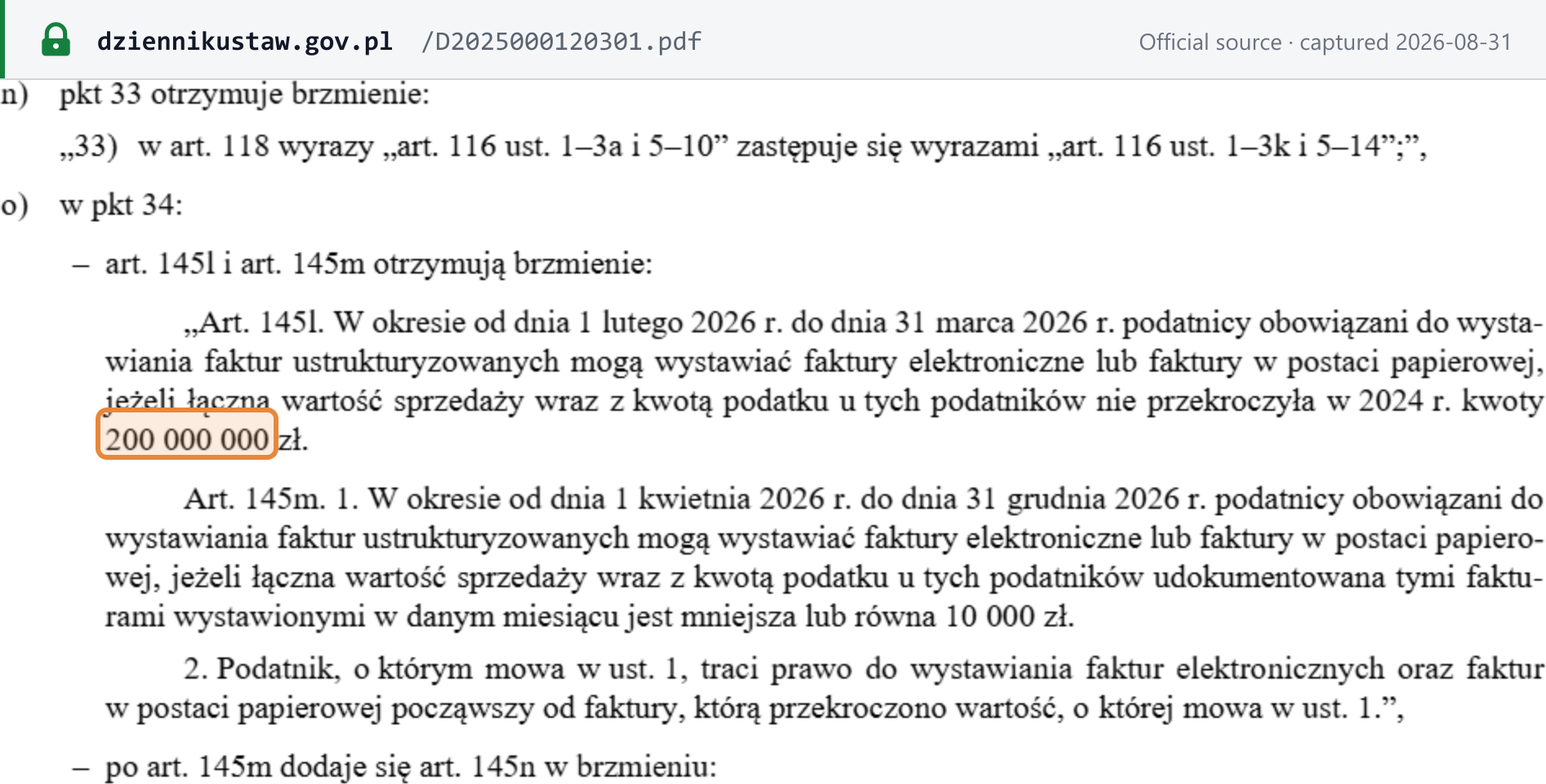 Consolidated VAT Act, art. 145l and 145m — the one-off 2024 gross-sales test that decides which phase a taxpayer falls in.
- Format. A structured XML document conforming to the FA(3) schema —
kodSystemowyfixed toFA (3),wersjaSchemyfixed to1-0E,WariantFormularzafixed to3— published by the Ministry of Finance in the Central Repository of Electronic Document Templates as template 2025/06/25/13775. Article 106gba, in force since 1 January 2026, additionally allows invoices with an attachment for supplies with complex quantity or unit-price data, after a prior notification to the Szef KAS filed through e-Urząd Skarbowy. [7] [2] - Scope — B2B, B2G, B2C. B2B is in scope. B2C is out: article 106ga(2)(4) excludes invoices to a natural person not carrying on a business. B2G structured electronic invoices sent through the PEF platform or an OpenPEPPOL network under the 2018 public-procurement e-invoicing Act are treated separately by article 106gb(7). Also outside the mandate: taxpayers with no Polish seat and no Polish fixed establishment, or whose Polish fixed establishment does not participate in the supply (article 106ga(2)(1) and (2)); supplies under the non-Union OSS scheme, the special procedure for occasional international road passenger transport, and IOSS — Dział XII rozdziały 7, 7a and 9 respectively (article 106ga(2)(3)). The Union OSS scheme sits in rozdział 6a and is not on that list, so supplies declared through it stay inside the mandate; the cases listed in the regulation Dz.U. 2025 poz. 1740 — motorway tolls, transport tickets, air-traffic control charges billed by EUROCONTROL, financial services exempt under article 43(1)(7) and (37) to (41), and certain self-billing arrangements (article 106ga(2)(5)); and taxpayers using the article 113a cross-border SME exemption (article 106ga(2)(6)). Anyone excluded under (2)(1), (2) or (4) may still opt in under article 106ga(4).
- Offline and outage modes. Three, with two different deadlines. offline24 (article 106nda) lets any in-scope taxpayer issue in the published schema outside the system and upload by the next business day — a permanent facility, not a transitional one. A declared awaria (article 106ne(1), announced in the BIP bulletin) gives 7 business days from the end of the outage (article 106nf(4)), restarting if a further outage is declared inside that window (article 106nf(5)). A period of niedostępność (article 106ne(4), scheduled unavailability) is uploaded by the next business day after it ends (article 106nh(2)).
- What happens to an invoice issued outside KSeF. It is still an invoice, and it must be marked. Under § 9 of Dz.U. 2025 poz. 1815 an invoice handed to the customer before upload carries a QR verification code — the interface address, the invoice date, the seller's NIP and the invoice discriminator — with the word "OFFLINE" beneath it; once uploaded and used outside the system, the same code carries the KSeF number beneath it instead; and where article 106nda(6) applies, a second code sealed with a KSeF certificate and labelled "CERTYFIKAT". Failing to issue through KSeF, issuing outside the published schema during an outage, or missing an upload deadline attracts the article 106ni penalty from 1 January 2027. In the VAT records the same invoice is flagged "OFF" or "BFK" under Dz.U. 2025 poz. 1800. [3] [6]
- Retention inside the system. KSeF stores structured invoices itself; article 116(11), as amended, keeps VAT RR and VAT RR KOREKTA invoices in KSeF for 10 years from the end of the year of issue, disapplying the general retention rule for them. [2]
 Source snapshot captured 2026-08-22 — original
Filing and payment
Filing frequency
| Frequency | Who | Basis |
|---|---|---|
| Monthly (default) | All taxable persons under art. 15 | Art. 99(1) |
| Quarterly (mandatory) | Small taxpayers who elected the cash method | Art. 99(2) |
| Quarterly (elective) | Small taxpayers who did not elect the cash method, and companies taxed under the CIT ryczałt od dochodów spółek whose prior-year sales including VAT did not exceed the PLN equivalent of EUR 4,000,000 | Art. 99(3), on written notice by the 25th day of the second month of the first quarter concerned. The euro figure is converted at the NBP average rate on the first business day of October of the previous year, rounded to PLN 1,000 |
Return due date
The 25th day of the month following the period. Article 99(1) sets it for monthly filers and article 99(2) for quarterly filers — the same 25th, counted from the end of the quarter. OSS returns run on a different clock: article 130c(2) makes them quarterly, due by the end of the month following the quarter, and article 130c(3) refuses to extend that when it lands on a weekend or public holiday.
JPK_V7M and JPK_V7K — the return is the records
Poland does not accept a return and records separately. Article 109(3b) requires monthly filers to transmit the VAT records together with the return, by the return deadline, in the form prescribed under article 99(11c). The combined file is published as JPK_V7M for monthly filers and JPK_V7K for quarterly filers — and quarterly filers do not get to file records quarterly: article 109(3c) requires the records for the first and second month of each quarter by the 25th of the following month, with the records for the third month going in with the return.
The detailed data set is fixed by the rozporządzenie w sprawie szczegółowego zakresu danych zawartych w deklaracjach podatkowych i w ewidencji w zakresie podatku od towarów i usług, whose KSeF-era amendment (Dz.U. 2025 poz. 1800) replaced the old sales-document markers with a shorter list tied to KSeF: "OFF" for an article 106nf outage-mode invoice with no KSeF number yet at the filing date, "BFK" for an electronic or paper invoice, "FP" for an invoice issued to a cash-register receipt, plus "DI", "RO" and "WEW" for non-invoice sales evidence. The same regulation extended its transitional period from 31 July 2026 to 31 December 2026. [6]
Payment due date and method
Article 103(1): the tax is self-assessed and paid without any demand, by the 25th day of the month following the month in which the tax point arose, to the tax office's bank account — the same date as the return. Quarterly filers pay quarterly on the same 25th under article 103(2).
Split payment (mechanizm podzielonej płatności). Voluntary in general under article 108a(1), but mandatory under article 108a(1a) for payments against an invoice with a total above PLN 15,000 covering Annex 15 goods or services. Article 108a(1b) obliges the supplier that had to flag the invoice under article 106e(1)(18a) to accept payment in that form. Set-off of mutual claims removes the obligation to the extent of the set-off (article 108a(1d)).
Additional listings
- Informacja podsumowująca (VAT-UE). Article 100(1) requires a recapitulative statement of intra-Community supplies, intra-Community acquisitions, triangulation supplies under article 136, article 28b services supplied to VAT-identified persons in other member states, and call-off stock movements. Article 100(3): monthly, electronically, by the 25th day of the following month — note this is monthly even for quarterly VAT filers.
- Annual return. None. Polish VAT has no annual return. The only annual step is the mixed-use input-tax adjustment under article 91, made after the end of the year in which the deduction right arose.
- OSS and IOSS returns. Filed to the Naczelnik Drugiego Urzędu Skarbowego Warszawa-Śródmieście — quarterly for the Union and non-Union schemes (article 130c(2)), monthly for IOSS.
The OSS quarterly deadline is the one Polish VAT deadline that does not move. Article 130c ust. 3 states that the ust. 2 term expires even where its last day falls on a Saturday or a statutory non-working day — so a 30 April or 31 October falling on a weekend still ends the period, unlike a domestic return under the Ordynacja podatkowa. [17]
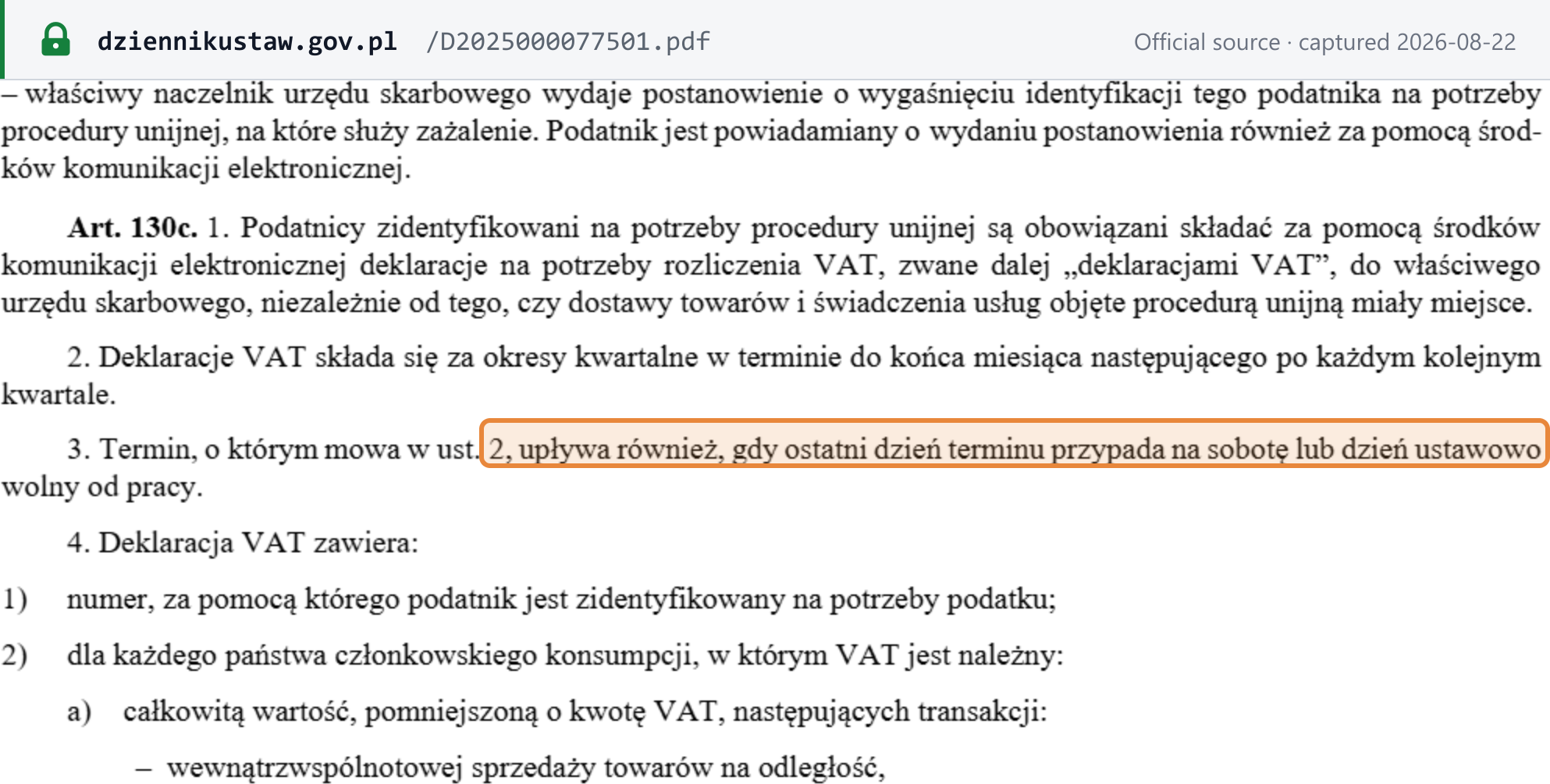 Source snapshot captured 2026-08-22 — original
Input-tax recovery and blocked items
Input tax is deductible against output tax under article 86, but:
- Article 88(1)(4) blocks recovery on accommodation and catering services, with two live carve-outs — a third, lit. a), is repealed: ready meals bought for passengers by passenger-transport operators, and accommodation bought for onward resale taxed under article 8(2a).
- Article 86a(1) limits recovery to 50% of the tax on expenditure connected with motor vehicles — the purchase, intra-Community acquisition, import, lease, fuel, repairs and parts — unless the vehicle is used exclusively for business and the statutory usage records and notification conditions are met.
- Article 88(3a) denies recovery on invoices that were issued by a non-existent entity, that document transactions not subject to VAT or exempt, that record transactions that never happened, that state amounts inconsistent with reality, or that confirm acts void or simulated under articles 58 and 83 of the Civil Code.
- Article 86(1) grants the right to deduct only "to the extent that the goods and services are used to perform taxable transactions" — which is what blocks input tax attributable to exempt supplies. Where a business does both, article 90 apportions the input tax by a turnover-based proportion and article 91 requires an adjustment after the year end, with a 2-percentage-point tolerance under article 91(1a) below which no adjustment is needed.
Refunds
| Route | Deadline | Conditions (art. 87) |
|---|---|---|
| Standard refund | 40 days from filing | The default under art. 87(2). The office may extend it for verification, and must then pay interest at the deferral-charge rate if the refund proves due |
| Accelerated refund | 25 days | Art. 87(6): all the input tax in the return, other than credits carried forward, must come from invoices paid in full through the taxpayer's Polish bank or credit-union account, plus the other conditions in that provision |
| Refund to the VAT account | 25 days | Art. 87(6a): on request in the return, paid to the taxpayer's split-payment VAT account by transfer message |
| Fast-track for "cashless" taxpayers | 15 days | Art. 87(6d) and (6e): available where, over three consecutive periods (one for quarterly filers), at least 80% of recorded sales went through online cash registers and a set percentage of receipts came through electronic payment instruments — verified by the Szef KAS against the Central Cash Register Repository |
| No taxable transactions in the period | 180 days, cut to 60 days on written request with security | Art. 87(5a) |
| Carry-forward | — | Art. 87(1) always allows the excess to be carried forward to the next period instead of refunded |
Bad-debt relief. Article 89a lets a supplier correct the taxable amount and output tax where a debt has not been paid or assigned within 90 days of the contractual or invoiced due date. Conditions include that the creditor is a registered podatnik VAT czynny on the day before the correcting return is filed, and that no more than 3 years have passed from the end of the year in which the invoice was issued. Article 89a(2a) opens the relief for supplies to non-business customers only where the debt is confirmed by a final court judgment and sent to enforcement, entered in a national debt register, or the debtor has been declared bankrupt as a consumer.
Non-resident refunds. EU-established businesses not registered in Poland reclaim Polish VAT through the Directive 2008/9/EC electronic refund procedure filed in their own member state; non-EU businesses use the Thirteenth Directive procedure, which in Poland runs under the rozporządzenie Ministra Finansów, Funduszy i Polityki Regionalnej z 20 października 2021 r. w sprawie zwrotu podatku od towarów i usług niektórym podmiotom (Dz.U. 2021 poz. 1982, as amended by Dz.U. 2026 poz. 736 in force 6 June 2026). Article 89(1) separately covers refunds to diplomatic missions and consular posts. [1]
Exemptions
Exempt supplies
Article 43(1) lists the exemptions. The list is long; the ones that decide most cases are:
- Land and buildings — undeveloped land other than building land (pkt 9); the supply of buildings and structures, except within or before first occupation or where less than 2 years have passed since first occupation (pkt 10); and a residual exemption in pkt 10a where no input tax was recoverable on acquisition and improvement spending stayed below 30% of initial value.
- Financial and insurance services — currency, banknote and coin transactions (pkt 7), investment-fund and portfolio management (pkt 12), and the credit, guarantee, deposit, payment and securities exemptions in pkt 38 to 41.
- Health, education and welfare — medical services, education, and MQA-equivalent training and social-care services in the pkt 18 onwards range.
- Goods used exclusively for exempt activity where no input tax was recoverable on acquisition, import or production (pkt 2), and ready meals for passengers on the same basis (pkt 2a).
- Supplies by flat-rate farmers of agricultural produce and agricultural services (pkt 3).
- Housing-cooperative charges to members and owners of residential units (pkt 11).
- Human organs, breast milk, blood and blood products, postage stamps at face value, and gold supplied to Narodowy Bank Polski (pkt 4 to 8).
Exempt is not zero-rated
This is the distinction that costs businesses money. A zero-rated supply — an export, an intra-Community supply, an article 83 supply — is a taxable supply charged at 0%: the supplier charges no VAT and keeps full input-tax recovery. An exempt supply is outside the charge: no VAT is charged, and the input tax used to make it is not recoverable, because article 86(1) gives the right to deduct only "to the extent that the goods and services are used to perform taxable transactions". Where a business makes both, article 90 apportions the input tax by a turnover-based proportion and article 91 requires an adjustment after the year end — with a 2-percentage-point tolerance under article 91(1a), and a multi-year adjustment period for capital goods.
A second consequence follows for registration: a business making only exempt article 43(1) supplies is not obliged to register at all under article 96(3), though it may register voluntarily as podatnik VAT zwolniony.
Special regimes
- Small-business exemption — article 113, PLN 240,000, described under Registration. Article 113(13) shuts it off entirely for suppliers of Annex 12 goods, most excise goods, buildings and building land, new means of transport, cosmetics, computers and electronics, electrical equipment and machinery sold under distance contracts, and motor-vehicle and motorcycle parts — and for suppliers of legal services, advisory services (other than specified agricultural advice), jewellery services, and debt collection including factoring.
- Cross-border SME exemption — article 113a and the EX number, for businesses established in another member state.
- Cash accounting (metoda kasowa) — article 21, for small taxpayers; the tax point moves to payment, and the invoice must be marked "metoda kasowa".
- Margin schemes — article 119 for tour operators (invoice marked "procedura marży dla biur podróży") and article 120 for second-hand goods, works of art, collectors' items and antiques (invoice marked "procedura marży — towary używane" and its variants). Article 106e(2) and (3) cut both invoices back to a reduced particulars set.
- Flat-rate farmers (rolnicy ryczałtowi) — article 115, with a 7% flat-rate refund and VAT RR invoices issued by the buyer, which since 1 April 2026 may be issued through KSeF.
- Flat-rate taxi services — article 114, at 4%.
- Special import arrangements (procedura USZ) — article 138i, for distance sales of imported goods declared at import rather than through IOSS.
- Free zones and customs warehouses. Poland operates free zones and customs warehousing under EU customs law, not under a separate VAT regime: goods under a suspensive customs procedure are not yet imported for VAT, and the tax arises when the procedure ends. The VAT Act adds no Polish-specific free-zone VAT exemption beyond that. (Checked against the VAT Act, 2026-08-24.) Separately, the Act of 4 September 2026 (Dz.U. 2026 poz. 1270) adds a new Chapter 11 to the VAT Act introducing a VAT warehouse (skład VAT) regime from 1 January 2027 (some provisions earlier or later): it may be operated only under a permit from the head of the tax office, by an operator with its seat in the EU that has been an active VAT payer for at least 12 months. It is not yet in force.
Offences and penalties
Poland separates three tracks, and a compliance plan needs all three: administrative money penalties in the VAT Act, criminal and quasi-criminal offences in the Fiscal Penal Code, and interest under the Tax Ordinance.
Offences — Kodeks karny skarbowy
Fines for przestępstwa skarbowe (fiscal crimes) are set in daily rates (stawki dzienne). Article 23 §1 KKS caps the number at 720; article 23 §3 puts each daily rate between one thirtieth of the minimum wage and 400 times that thirtieth. The minimum wage from 1 January 2026 is PLN 4,806 per month, so in 2026 a single daily rate runs from PLN 160.20 to PLN 64,080. Where the tax at risk does not exceed the ustawowy próg — five times the minimum wage, so PLN 24,030 in 2026 (article 53 §3 KKS) — the conduct is a lesser wykroczenie skarbowe, fined between one tenth and twenty times the minimum wage under article 48 §1 KKS (PLN 480.60 to PLN 96,120 in 2026), or up to five times it by on-the-spot ticket. [15] [12]
| Offence | Conduct | Exposure |
|---|---|---|
| Art. 54 §1 KKS | Evading tax by not disclosing the object or base of taxation, or not filing a return, thereby exposing the tax to loss | Fine up to 720 daily rates, or imprisonment, or both |
| Art. 56 §1 KKS | Filing a return or statement that states an untruth or conceals the truth, or failing to notify a change in the data it contained, thereby exposing the tax to loss | Fine up to 720 daily rates, or imprisonment, or both |
| Art. 56 §4 KKS | Filing the return late, or not filing it electronically or not to the prescribed electronic template, despite having disclosed the base | Wykroczenie skarbowe fine |
| Art. 62 §1 KKS | Not issuing an invoice when obliged, issuing it defectively (wadliwie), or refusing to hand it over | Fine up to 180 daily rates |
| Art. 62 §2 KKS | Issuing an invoice unreliably (nierzetelnie) — recording something that did not happen — or using such a document | Fine up to 720 daily rates, or imprisonment of not less than one year, or both |
| Art. 62 §3 KKS | Not retaining an issued or received invoice, or a purchase document | Fine up to 180 daily rates |
| Art. 62 §4 KKS | Selling bypassing the cash register, or not issuing the cash-register document | Fine up to 180 daily rates |
| Art. 81 §1 KKS | Failing to make, or update, the identification (NIP) declaration on time, giving untrue or incomplete data in it, registering more than once, or giving a false NIP | Wykroczenie skarbowe fine |
Penalties — administrative, under the VAT Act
| Default | Penalty |
|---|---|
| Understating the liability, overstating a refund or a carry-forward, or not filing and not paying (art. 112b(1)) | Additional tax liability of up to 30% of the understatement or overstatement |
| The same, where the taxpayer corrects the return and pays after an audit closes (art. 112b(2)) | Reduced to up to 20% |
| The part of an understatement traceable to input tax on an invoice from a non-existent entity, documenting transactions that never happened, stating amounts inconsistent with reality, or confirming void or simulated acts — where the irregularity was the deliberate act of the taxpayer or of a counterparty it knew about (art. 112c) | 100% of the input tax from that invoice |
| Issuing an invoice outside KSeF in breach of art. 106ga(1), issuing outside the published schema during an outage or in offline mode, or missing the upload deadline (art. 106ni(1)) | Up to 100% of the VAT shown on that invoice, or up to 18.7% of the total amount due where the invoice shows no VAT. Payable within 14 days of service of the decision (art. 106ni(3)). In force from 1 January 2027 |
| Failing to flag an invoice with "mechanizm podzielonej płatności" where art. 106e(1)(18a) required it (art. 106e(12)) | 30% of the tax attributable to the Annex 15 goods or services shown on that invoice. Not imposed on a natural person already liable for the same act as a fiscal offence, and not imposed at all where the customer in fact paid using the split-payment mechanism (art. 106e(13)) |
Article 106ni(4) is worth reading carefully before assuming the two tracks overlap: it bars fiscal-penal proceedings for the specific KSeF failures it lists (article 106ga(1), 106nda(2), 106nf(4), 106nh(2)) — it does not switch off article 62 KKS generally.
Interest on late payment
Article 56 §1 of the Tax Ordinance sets the late-payment interest rate at 200% of the NBP lombard rate plus 2%, with a floor of 8%. The Minister announces the resulting figures in Monitor Polski. As announced on 6 March 2026 (M.P. 2026 poz. 269), the rates are:
- Standard: 10.50% per year of the arrears
- Reduced: 5.25% — available under article 56a where the taxpayer files a legally effective correction within 6 months of the filing deadline and pays within 7 days of that correction, and not available where the correction follows a notice of audit or a verification exercise
- Increased: 15.75% — applied under article 56b to VAT and excise arrears in the circumstances that provision specifies
Frequently asked questions
I am a foreign company with a Polish NIP but no fixed establishment in Poland — do I have to issue my invoices through KSeF?
No. Article 106ga(2)(1) excludes from the structured-invoice obligation any taxpayer that has neither its seat of business (siedziba działalności gospodarczej) nor a fixed establishment (stałe miejsce prowadzenia działalności gospodarczej) in Poland. Article 106ga(2)(2) extends the same exclusion to a taxpayer that has a Polish fixed establishment which does not participate in the supply being invoiced. Holding a Polish VAT registration and a NIP does not by itself put you in scope. Those taxpayers issue ordinary electronic or paper invoices under article 106ga(3), and article 106ga(4) lets them opt into KSeF voluntarily.
Note the other side of the transaction: your Polish supplier is in scope, and where the buyer falls within article 106gb(4) — which includes a buyer with no Polish seat or participating fixed establishment — the structured invoice is made available to you in a manner agreed between the parties rather than through KSeF, marked with a QR verification code and the KSeF number printed directly beneath it. [1] [3]
My Polish turnover is small — does the PLN 240,000 VAT registration threshold protect me if my business is established outside Poland?
No. The threshold is zero for a business not established in Poland. Article 113(1) grants the small-business exemption only to a taxpayer "posiadającego siedzibę działalności gospodarczej na terytorium kraju" — one whose seat of business is in Poland — whose sales excluding VAT did not exceed PLN 240,000 in the previous or the current tax year (raised from PLN 200,000 with effect from 1 January 2026 by Dz.U. 2025 poz. 896). A business established elsewhere cannot use it, so article 96(1) applies in full: register before the first taxable transaction, whatever its value.
There is one narrow alternative and it is not the domestic threshold. Article 113a lets a taxpayer established in another EU member state use the cross-border SME exemption in Poland where its EU-wide annual turnover stayed at or below EUR 100,000 in the previous and current year, its Polish sales stayed within the article 113(1) figure, and it makes none of the article 113(13) excluded supplies — and that route requires an individual EX identification number issued by its own member state, not a Polish registration. A business established outside the EU has neither option, and under article 18a must additionally appoint a Polish fiscal representative. [1] [8]
There are no KSeF fines during 2026 — can I keep invoicing outside the system until 2027?
No. The obligation and the money penalty start on different dates, and only the penalty is deferred. Article 106ga(1) — the duty to issue structured invoices through KSeF — has applied since 1 February 2026 for taxpayers whose 2024 sales including VAT exceeded PLN 200 million and since 1 April 2026 for everyone else in scope. The administrative penalty in article 106ni(1) to (3) and (5) to (7) — up to 100% of the VAT shown, or up to 18.7% of the gross amount where the invoice shows no VAT, payable within 14 days of the decision — only enters into force on 1 January 2027, under article 23(4) of the 2023 amending Act as substituted by Dz.U. 2025 poz. 1203.
Two things still bite during 2026. First, article 106ni(4) bars fiscal-penal proceedings only for the specific KSeF transmission failures it lists, so ordinary exposure under article 62 KKS for not issuing or defectively issuing an invoice is not switched off wholesale. Second, the transitional opt-outs that make paper or ordinary electronic invoicing lawful — article 145m (invoices totalling PLN 10,000 or less in a given month) and article 145n (cash-register invoicing) — both expire on 31 December 2026, the day before the penalty starts. [1] [2] [15]
Which KSeF phase was I in — 1 February or 1 April 2026 — and what exactly does the PLN 200 million figure measure?
It is measured on calendar year 2024, on gross sales, and it is a one-off test — nothing recalculates it later. Article 145l, in the wording given by Dz.U. 2025 poz. 1203, allowed taxpayers otherwise obliged to issue structured invoices to keep issuing electronic or paper invoices between 1 February and 31 March 2026 "jeżeli łączna wartość sprzedaży wraz z kwotą podatku u tych podatników nie przekroczyła w 2024 r. kwoty 200 000 000 zł" — total sales including the tax, for calendar 2024. So a taxpayer above PLN 200 million lost that window and was in KSeF from 1 February 2026; everyone else joined on 1 April 2026 when the window closed.
A separate and much smaller carve-out runs on to 31 December 2026: article 145m lets any in-scope taxpayer keep issuing electronic or paper invoices in a month where those invoices total PLN 10,000 or less including VAT, and article 145m(2) cuts that right off from the invoice that breaches the figure — a per-month test, not an annual allowance. [2] [1]
Now that invoices flow through KSeF, do I still have to file JPK_V7M?
Yes. They are two separate obligations and KSeF does not replace the return. Article 99(1) requires a monthly return by the 25th of the following month, and article 109(3b) requires the VAT records to be transmitted together with that return — the combined file published as JPK_V7M for monthly filers, JPK_V7K for quarterly filers, whose records still go in monthly under article 109(3c) with the return following the quarter.
What KSeF changed is the content of the records, not their existence. The amending regulation Dz.U. 2025 poz. 1800 rewrote the sales-document markers so an entry now carries "OFF" for an article 106nf outage-mode invoice with no KSeF number yet at the filing date, "BFK" for an electronic or paper invoice outside KSeF, and "FP" for an invoice issued to a cash-register receipt. That regulation also pushed the end of its own transitional period from 31 July 2026 to 31 December 2026. Payment is due on the same date as the return under article 103(1). [1] [6]
Is the Sejm bill on import VAT and the EUR 150 parcel exemption law yet?
Not yet — the Senate amended it and it is back with the Sejm. Sejm print 2838, a government bill amending the VAT Act described in its own covering letter as deregulacyjny, reached the Sejm on 23 July 2026, had its first reading at the 63rd sitting on 30 July 2026, and was referred that day to the Public Finance Committee (FPB) and the Deregulation Committee (DER). The two committees issued their joint report on 3 September 2026 (print 3054, rapporteur Marek Jan Chmielewski), recommending the Sejm pass the bill unchanged. The Sejm held its second reading on 15 September 2026 and moved immediately to a third reading at the same sitting, passing the bill on 18 September 2026 by 393 votes to 2, with 16 abstentions (uchwalono).

The bill then went to the Senate, which by resolution dated 24 September 2026 (65th Senate sitting, on print 3132) adopted three amendments: citing article 3(12) of the Postal Law (Prawo pocztowe) in the postal-operator references, and rewording two transitional provisions. The bill has returned to the Sejm, which must vote on the Senate's amendments before the bill goes to the President for signature and, finally, publication in Dziennik Ustaw. None of its provisions are in force yet: the revised export definition in article 2(8), the relaxed article 41(6) to (6c) evidence rules, the electronic article 33b import declaration, and the article 138i adaptation to the customs changes that follow Council Regulation (EU) 2026/382 abolishing the customs-duty relief for consignments up to EUR 150 from 1 July 2026. Until publication, the current article 33a and 33b rules apply unchanged. [10] [20]
Is Poland's ViDA e-commerce transposition already law, like Malta's?
No — it is still a bill before parliament. On 2 September 2026 Poland's Council of Ministers backed a draft law transposing the first tranche of the EU's ViDA package (Directive (EU) 2025/516) into the VAT Act's e-commerce and OSS/IOSS rules, targeting 1 January 2027, the commencement date Article 2 of ViDA itself sets. The bill reached the Sejm on 8 September 2026 as print 3074, had its first reading at the Sejm's 65th sitting on 17 September 2026, and was referred to the Public Finance Committee (report due 6 October 2026). Under its article 9 it would take effect on 1 January 2027, with some provisions from 1 July 2028 and others from 1 July 2029. None of its provisions — the facilitated-supply clarification, the EUR 10,000 threshold calculation, the OSS tax-point rule, or the proposed 1 July 2028 repeal of call-off stock — are in force yet. Malta, by contrast, already enacted its own Article 2 transposition through Act III of 2026, published in the Government Gazette of Malta No. 21,599 on 10 March 2026, for the same 1 January 2027 date — see Malta VAT guidelines. [18]
Important websites
| Site | What it is for |
|---|---|
| e-Urząd Skarbowy | The taxpayer account — VAT-R registration, JPK_V7M/V7K filing, correspondence with the tax office, and the article 106gba notification for KSeF invoices with attachments |
| urzadskarbowy.gov.pl | Direct entry point to the same e-Urząd Skarbowy service |
| KSeF | The National e-Invoicing System — issuing, receiving and viewing structured invoices, authentication and token management |
| podatki.gov.pl — KSeF section | Ministry of Finance guidance, technical specifications and the free KSeF taxpayer application |
| Wykaz podatników VAT (the "biała lista") | The article 96b register — check whether a counterparty is registered, and its declared bank account, on a chosen date |
| wl-api.mf.gov.pl | Machine-readable API for the same register, for automated counterparty checks |
| VIES | EU-wide validation of a PL-prefixed VAT number for intra-Community trade |
| biznes.gov.pl | Sole-trader registration through CEIDG, with VAT-R filed alongside |
| Krajowy Rejestr Sądowy | Company register — the entity data behind a NIP |
| ISAP — Internetowy System Aktów Prawnych | The Sejm's legal-acts database: the VAT Act and every amending instrument, in consolidated form |
| Dziennik Ustaw | The Journal of Laws — where every act and implementing regulation is officially published |
Also see Lookuptax's own Poland NIP validator and the Poland TIN number guide.
Recent changes
-
2026-10-03 (in effect through 2026-12-31) — The Minister of Finance and Economy's regulation of 2 October 2026 (Dz.U. 2026 poz. 1288), in force on publication on 2 October 2026, adds §11c to the reduced-rate regulation of 9 December 2023: from 3 October 2026 to 31 December 2026 an 8% VAT rate applies to the supply, intra-Community acquisition and import of motor petrol, diesel and fuel biocomponents. (Dziennik Ustaw — Dz.U. 2026 poz. 1288) — see the event record
-
2026-10-01 — Article 11 of the Act of 29 May 2026 amending the Tax Ordinance (Dz.U. 2026 poz. 846) took effect and gave article 99(12) of the VAT Act new wording: the tax liability, refund of the difference, refund of input tax, the difference under article 87(1) and input tax carried forward are taken in the amount shown in the tax return unless the tax authority determines them otherwise. (Dziennik Ustaw — Dz.U. 2026 poz. 846) — see the event record
-
2026-10-01 (excise duty, not VAT) — The Minister of Finance and Economy's Regulation of 10 September 2026 (Dz.U. 2026 poz. 1224), published 18 September 2026, replaced Annexes 1–5, 7, 9–11, 13–18 and 20 to the Regulation of 17 December 2021 on excise-tax declaration and excise-prepayment declaration form templates (the AKC-4 series); the new form templates took effect on 1 October 2026. Listed here because Poland has no standalone excise guide. (Dziennik Ustaw — Dz.U. 2026 poz. 1224) — see issue
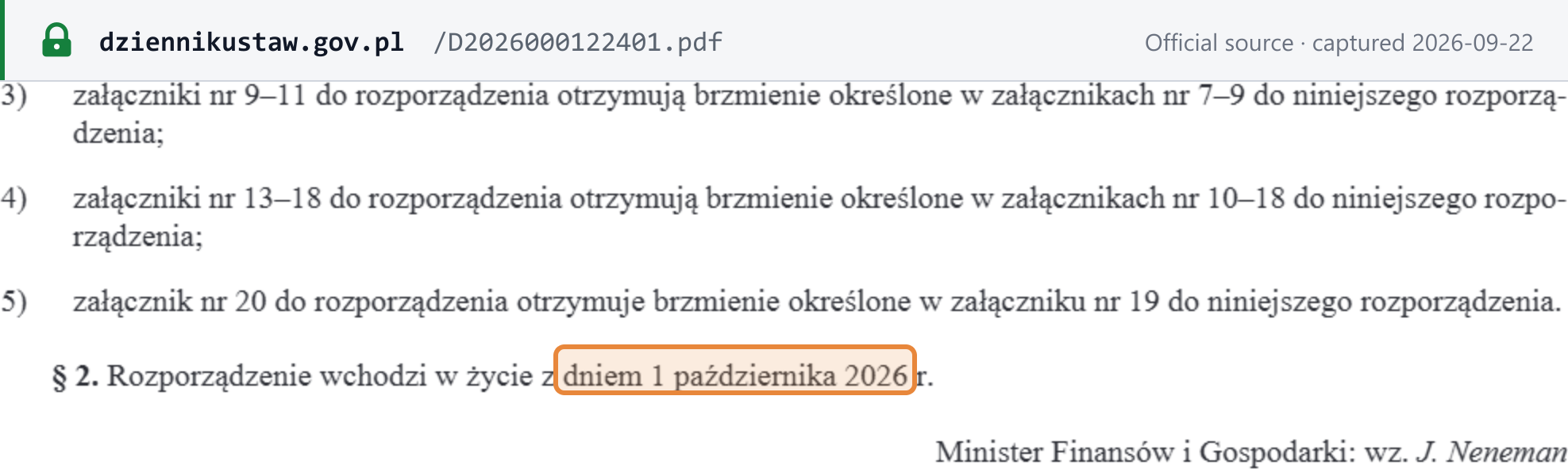 Dziennik Ustaw 2026 poz. 1224 — § 2: “Rozporządzenie wchodzi w życie z dniem 1 października 2026 r.”
 -
2026-09-29 (enacted — applies from 2027-01-01) — The Act of 4 September 2026 (Dz.U. 2026 poz. 1270) was published. It adds a VAT warehouse regime (new Chapter 11 of the VAT Act): a permit from the head of the tax office, an operator seated in the EU and an active VAT payer for at least 12 months, a warehouse-entry document, weekly summary notifications by the 3rd day of the following week, and a tax liability payable within 5 days when the procedure ends. The Act takes effect on 1 January 2027, with listed provisions on 1 December 2026, 1 July 2027, 1 January 2028 and 1 July 2028. (Dziennik Ustaw — Dz.U. 2026 poz. 1270) — see the event record
-
2026-09-29 (enacted — applies from 2027-01-01; TAX FREE terminal from 2028-07-01) — The same Act of 4 September 2026 (Dz.U. 2026 poz. 1270) also counts supplies under article 13(3) towards the sales value for the small-taxpayer exemption (new article 113(1a)); rewrites the joint-and-several liability rule in article 105a around a replaced annex 15 (goods) and a new annex 16 (services), with a carve-out for service purchases invoiced below PLN 15,000 unless purchases from one supplier exceed PLN 50,000 in a month; lets travellers obtain TAX FREE export confirmation through a terminal at designated border crossings (new article 128(3a), which under article 9 applies only from 1 July 2028); and introduces a PLN 300 penalty for failing to apply to deregister a cash register by the deadline. Effective 1 January 2027 except the provisions listed in its article 9. (Dziennik Ustaw — Dz.U. 2026 poz. 1270) — see the event record
-
2026-09-28 (bill, not yet law) — The government bill ending preferential VAT on non-alcoholic equivalents of alcoholic drinks and on energy drinks, and raising VAT to 23% on certain non-alcoholic drinks containing at least 20% fruit, vegetable or fruit-and-vegetable juice, was filed in the Sejm on 24 September 2026 as print 3135 and referred to first reading on this date. It supersedes the Council of Ministers' draft of 22 September 2026; the 1 January 2027 date is the date stated for that draft. (Sejm Rzeczypospolitej Polskiej) — see the event record
-
2026-09-24 (Senate amendments — not yet law) — The Senate adopted three amendments to Sejm print 2838 (resolution on print 3132): citing article 3(12) of the Postal Law in the postal-operator references, and rewording two transitional provisions. The bill (which passed the Sejm on 18 September 2026, 393–2 with 16 abstentions) has returned to the Sejm to vote on the amendments before going to the President and, finally, publication in Dziennik Ustaw; until then the current article 33a/33b import-VAT rules and the article 41(6) export-evidence rules are unchanged. (updated from the 18 September 2026 Sejm-passage stage) (Senat RP / Kancelaria Sejmu) — see issue
-
2026-09-22 (proposed — Council of Ministers, not law) — Poland's Council of Ministers adopted a draft law raising VAT to 23% on selected non-alcoholic drinks containing at least 20% fruit or vegetable juice, and on drinks with added caffeine or taurine: from 5% in retail and from 8% in catering. All non-alcoholic beers would be taxed at the standard rate regardless of added juice. Planned entry into force 1 January 2027; the bill must still pass Parliament (it was filed in the Sejm as print 3135 on 24 September 2026 — see the 2026-09-28 entry). (Ministerstwo Finansów) — see event and issue
-
2026-09-17 (bill, not yet law) — Poland's ViDA e-commerce transposition bill — which the Council of Ministers had backed on 2 September 2026 — reached the Sejm on 8 September 2026 as print 3074 and had its first reading at the Sejm's 65th sitting on this date; it was referred to the Public Finance Committee, report due 6 October 2026. Under article 9 of the bill it would take effect on 1 January 2027, with some provisions from 1 July 2028 and others from 1 July 2029. (Sejm Rzeczypospolitej Polskiej) — see the event record
-
2026-09-02 (proposed — not law) — Poland's Council of Ministers backed a draft law transposing the first tranche of the EU's ViDA package (Directive (EU) 2025/516) into the VAT Act's e-commerce/OSS/IOSS rules: clarifying facilitated-supply and the EUR 10,000 distance-sales threshold, the OSS tax point, dropping the website-listing requirement for non-Union OSS/import-IOSS registration, excluding exempt SMEs from import-IOSS, adding OSS reporting for B2C electricity/heating/cooling/gas, and — as a separate proposal — repealing the call-off-stock procedure from 1 July 2028. Target commencement 1 January 2027; the draft reached the Sejm on 8 September 2026 (see the entry above). (Ministerstwo Finansów) — see issue
-
2026-08-17 (in effect through 2026-08-31) — The Minister of Finance and Economy's regulation of 13 August 2026 (Dz.U. 2026 poz. 1095) applies a temporary 8% VAT rate to motor fuels — motor petrol (CN 2710 12 45, 2710 12 49), diesel oil (CN 2710 19 42, 2710 19 44, 2710 20 11) and stand-alone biocomponent fuels — for the fixed window 17–31 August 2026 inclusive. §11b applied through 31 August 2026, the last day of that window, and was not extended; its predecessor §11a had been extended four times (Dz.U. 2026 poz. 573, 642, 699 and 771) before lapsing on 30 June 2026. Motor fuels were at the 23% standard rate from 1 September 2026 until §11c restarted the 8% rate on 3 October 2026 (see the 2026-10-03 entry). (Dziennik Ustaw — Dz.U. 2026 poz. 1095) — see issue
-
2026-07-01 — The EU abolished the customs-duty relief for consignments up to EUR 150 by Council Regulation (EU) 2026/382 of 11 February 2026, which is why Poland's customs-declaration regulations for low-value parcels are being unwound and the article 138i special import arrangements adapted. (Sejm Rzeczypospolitej Polskiej — print 2838 explanatory memorandum) — see the event record and the issue
-
2026-04-01 — KSeF became mandatory for all remaining in-scope taxpayers as the article 145l window closed on 31 March 2026. From the same date, VAT RR and VAT RR KOREKTA invoices for purchases from flat-rate farmers may be issued through KSeF (article 17c of the 2023 amending Act, as inserted by Dz.U. 2025 poz. 1203). (Dziennik Ustaw — Dz.U. 2025 poz. 1203) — see the event record and the issue
-
2026-02-01 — KSeF went live as a mandatory system for taxpayers whose total 2024 sales including VAT exceeded PLN 200,000,000 (article 145l). On the same date: the new invoice particulars in article 106e(1)(26) and (27) and the customer's duty to supply its number under article 106ba took effect; the regulation on cases with no structured-invoice obligation (Dz.U. 2025 poz. 1740) and the regulation on using KSeF (Dz.U. 2025 poz. 1815) came into force; and the amendment to the reduced-content invoice regulation (Dz.U. 2025 poz. 1742) applied. A fourth instrument in the same package, the JPK records amendment (Dz.U. 2025 poz. 1800), had already entered into force on 18 December 2025 — it is dated with the others but not commenced with them. (Dziennik Ustaw) — see the event record and the issue
-
2026-01-01 — The small-business exemption threshold rose from PLN 200,000 to PLN 240,000 (article 113(1), amended by the Act of 24 June 2025). Transitional article 2 of that Act let taxpayers whose 2025 sales fell between the two figures use the new exemption straight away. (Dziennik Ustaw — Dz.U. 2025 poz. 896)
-
2026-01-01 — Article 106gba took effect, allowing structured invoices with an attachment for supplies with complex quantity or unit-price data, on prior notification to the Szef KAS through e-Urząd Skarbowy; notifications could be filed from this date. (Dziennik Ustaw — Dz.U. 2025 poz. 1203)
-
2025-11-01 — Taxpayers could begin downloading the KSeF certificate used to seal offline invoices under article 106nda(7). (Dziennik Ustaw — Dz.U. 2025 poz. 1203)
-
2025-09-02 — The Act of 5 August 2025 (Dz.U. 2025 poz. 1203), signed by the President, entered into force and reset the KSeF architecture: it rewrote articles 145l to 145n to create the 1 February / 1 April 2026 phasing, added the offline24 mode's supporting provisions, introduced invoices with attachments, and moved the article 106ni penalty to 1 January 2027. (Dziennik Ustaw — Dz.U. 2025 poz. 1203)
-
2025-01-01 — The cross-border SME exemption in article 113a and the EX identification number began, transposing Council Directive (EU) 2020/285 and giving businesses established in other member states a route to trade in Poland exempt without a Polish registration. (Sejm — consolidated VAT Act)
Ahead — scheduled changes that have not yet taken effect:
- 2027-01-01 (enacted — scheduled) — The Act of 4 September 2026 (Dz.U. 2026 poz. 1270) takes effect: the VAT warehouse regime, article 113(1a), the revised article 105a liability rule and the PLN 300 cash-register deregistration penalty, except the provisions in its article 9 that take effect on 1 December 2026, 1 July 2027, 1 January 2028 and 1 July 2028. (Dziennik Ustaw — Dz.U. 2026 poz. 1270) — see the event record
- 2027-01-01 (scheduled) — The KSeF penalty in article 106ni enters into force: up to 100% of the VAT shown on an invoice issued outside KSeF, or up to 18.7% of the gross amount where the invoice shows no VAT, payable within 14 days of the decision. On the same date the transitional opt-outs expire — article 145m (invoices totalling PLN 10,000 or less in a month) and article 145n (cash-register invoicing) both ran only to 31 December 2026 — and the article 108a and 108g rules tying payments to the KSeF number begin to apply to payments made from 1 January 2027. (Dziennik Ustaw — Dz.U. 2025 poz. 1203) — see the event record and the issue
- 2027-01-01 (scheduled) — Article 2 of Commission Implementing Regulation (EU) 2026/1869 applies, from 1 January 2027 until 30 June 2028, replacing Annex I to Implementing Regulation (EU) 2020/194 — the common electronic message set for OSS, non-Union OSS, IOSS and the new transfer-of-own-goods scheme, which reaches Poland as it reaches every member state. The Regulation was adopted on 27 July 2026, published on 28 July 2026 and entered into force on 17 August 2026. (Publications Office of the European Union) — see the event record and the issue
- 2028-07-01 (scheduled) — Articles 1 and 3 of Commission Implementing Regulation (EU) 2026/1869 apply, replacing Annexes I, II and III to Implementing Regulation (EU) 2020/194 for the full ViDA Single VAT Registration architecture. (Publications Office of the European Union) — see the event record and the issue
- 2028-07-01 (enacted — scheduled) — TAX FREE terminal confirmation under new article 128(3a) of the VAT Act, and the article 2 point 46a definition of a TAX FREE terminal, apply: article 9 point 4 of the Act of 4 September 2026 brings article 1 point 1, point 33(b) and point 34(b) into force on 1 July 2028. (Dziennik Ustaw — Dz.U. 2026 poz. 1270) — see the event record
Reference links
- Sejm Rzeczypospolitej Polskiej — Ustawa z dnia 11 marca 2004 r. o podatku od towarów i usług, consolidated text Dz.U. 2026 poz. 1263, legal status as at 26 August 2026 (PDF)
- Dziennik Ustaw — Ustawa z dnia 5 sierpnia 2025 r. o zmianie ustawy o podatku od towarów i usług oraz ustawy o zmianie ustawy o VAT, Dz.U. 2025 poz. 1203 (PDF)
- Dziennik Ustaw — Rozporządzenie z dnia 12 grudnia 2025 r. w sprawie korzystania z Krajowego Systemu e-Faktur, Dz.U. 2025 poz. 1815 (PDF)
- Dziennik Ustaw — Rozporządzenie z dnia 7 grudnia 2025 r. w sprawie przypadków, w których nie ma obowiązku wystawiania faktur ustrukturyzowanych, Dz.U. 2025 poz. 1740 (PDF)
- Dziennik Ustaw — Rozporządzenie z dnia 7 grudnia 2025 r. zmieniające rozporządzenie w sprawie wystawiania faktur, Dz.U. 2025 poz. 1742 (PDF)
- Dziennik Ustaw — Rozporządzenie z dnia 12 grudnia 2025 r. w sprawie zmiany rozporządzenia zmieniającego rozporządzenie w sprawie szczegółowego zakresu danych zawartych w deklaracjach podatkowych i w ewidencji, Dz.U. 2025 poz. 1800 (PDF)
- Ministerstwo Finansów — FA(3) structured invoice schema, Central Repository of Electronic Document Templates, template 2025/06/25/13775 (XSD)
- Dziennik Ustaw — Ustawa z dnia 24 czerwca 2025 r. o zmianie ustawy o podatku od towarów i usług (threshold PLN 240,000), Dz.U. 2025 poz. 896 (PDF)
- Monitor Polski — Obwieszczenie z dnia 6 marca 2026 r. w sprawie stawki odsetek za zwłokę od zaległości podatkowych, M.P. 2026 poz. 269 (PDF)
- Sejm Rzeczypospolitej Polskiej — Kodeks karny skarbowy, consolidated text (PDF)
- Sejm Rzeczypospolitej Polskiej — Ordynacja podatkowa, consolidated text (PDF)
- Dziennik Ustaw — Rozporządzenie Rady Ministrów z dnia 11 września 2025 r. w sprawie wysokości minimalnego wynagrodzenia za pracę w 2026 r., Dz.U. 2025 poz. 1242 (PDF)
- Sejm Rzeczypospolitej Polskiej — legislative-process record for print 2838 (JSON)
- Sejm Rzeczypospolitej Polskiej — Ustawa o zasadach ewidencji i identyfikacji podatników i płatników, consolidated text Dz.U. 2026 poz. 151 (PDF)
- Dziennik Ustaw — Rozporządzenie z dnia 13 grudnia 2024 r. zmieniające rozporządzenie w sprawie wzorów dokumentów związanych z rejestracją w zakresie VAT (VAT-R), Dz.U. 2024 poz. 1898 (PDF)
- Publications Office of the European Union — Commission Implementing Regulation (EU) 2026/1869
- Dziennik Ustaw — Rozporządzenie Ministra Finansów i Gospodarki z dnia 13 sierpnia 2026 r. (temporary 8% VAT on motor fuels, 17–31 August 2026), Dz.U. 2026 poz. 1095
- Dziennik Ustaw — Rozporządzenie Ministra Finansów i Gospodarki z dnia 2 października 2026 r. (8% VAT on motor fuels, 3 October to 31 December 2026), Dz.U. 2026 poz. 1288
- Dziennik Ustaw — Ustawa z dnia 4 września 2026 r. (VAT warehouse and other VAT Act amendments), Dz.U. 2026 poz. 1270
- Dziennik Ustaw — Rozporządzenie Ministra Finansów i Gospodarki z dnia 10 września 2026 r. zmieniające rozporządzenie w sprawie wzorów deklaracji podatkowych w sprawie podatku akcyzowego oraz deklaracji w sprawie przedpłaty podatku akcyzowego, Dz.U. 2026 poz. 1224 (excise, not VAT)
- Senat RP / Kancelaria Sejmu — Uchwała Senatu z dnia 24 września 2026 r. w sprawie ustawy o zmianie ustawy o podatku od towarów i usług (druk 3132)
- Ministerstwo Finansów — Rząd przyjął przepisy likwidujące preferencyjne opodatkowanie napojów bezalkoholowych i energetyzujących
- Ministerstwo Finansów — Rząd przyjął projekt, który usprawni funkcjonowanie pakietu VAT e-commerce (2 September 2026) [18]
- Ministerstwo Finansów — Krajowy System e-Faktur (KSeF)
- Lookuptax — E-invoicing in Poland (KSeF)
- Lookuptax — Poland TIN number guide
- Lookuptax — Malta VAT guidelines
- Lookuptax — Official links to check VAT numbers worldwide
- Lookuptax — E-invoicing status and the networks worldwide