Finland VAT guidelines
| FACTSHEET | |
|---|---|
| Country code | FI |
| Tax name | Value Added Tax — Arvonlisävero (ALV); Swedish: mervärdesskatt (moms) |
| Tax Authority | Finnish Tax Administration — Verohallinto |
Overview
Finland levies Value Added Tax — in Finnish arvonlisävero (ALV), in Swedish mervärdesskatt (moms) — under the Value Added Tax Act (arvonlisäverolaki, 1501/1993), in force since 1 June 1994. Section 1 charges VAT on sales of goods and services in Finland in the course of business, on imports of goods, and on intra-Community acquisitions of goods. [1]
Authority. The tax is administered by the Finnish Tax Administration (Verohallinto): "Verotuksesta ja sen valvonnasta vastaa Verohallinto" (AVL 157 §). Finnish Customs (Tulli) collects import VAT only where the importer is not on the VAT register when the tax falls due (AVL 160 §). [1]
Currency. All amounts in this guide are in euros (EUR). On a Finnish supply the VAT amount must be stated in euros whatever the invoice currency (AVL 209 e § 1 mom. 10 kohta). [1]
Tax period. The standard VAT period is the calendar month: "Verokausi on kalenterikuukausi, jollei 2–6 momentissa toisin säädetä" (Act on the Taxation Procedure for Self-Assessed Taxes, OVML 768/2016, 11 §). Smaller businesses may apply for a quarterly or annual period — see Filing and payment. [2]
Layering. VAT is a single national tax: AVL 1 § levies it "valtiolle" — to the State. The Act provides no regional or municipal VAT. Åland (Ahvenanmaa) is part of Finland but outside the EU VAT area; its exceptions sit in a separate act, 1266/1996 (AVL 1 a §). This guide covers mainland Finland. [1]
Registration
Who should register
Any business selling goods or services in Finland is liable for VAT unless the small-business exemption applies. Since 1 January 2025 (Law 448/2024), a seller is outside the VAT system only while its turnover is EUR 20,000 or less in both the current and the previous calendar year. Before 2025 the limit was EUR 15,000 per accounting period. [1] [4]
"Myyjä ei ole verovelvollinen, jos kuluvan kalenterivuoden ja sitä edeltäneen kalenterivuoden liikevaihto on enintään 20 000 euroa, ellei häntä ole oman ilmoituksensa perusteella merkitty verovelvolliseksi." (AVL 3 §)
(A seller is not liable for VAT if its turnover in the current calendar year and the previous calendar year is at most EUR 20,000, unless it has been registered on its own application.)
- What counts as turnover. Taxable sales, zero-rated sales (exports, intra-EU supplies) and sales of real estate, financial and insurance services, measured excluding VAT. Ancillary financial and insurance sales and sales of fixed assets are left out. [4]
- From when. Liability starts on the day the threshold is exceeded, and the sale that crosses it is taxable in full. The Tax Administration's example: turnover of EUR 19,800, then a sale of EUR 210 — VAT is due on the whole EUR 210. Its registration page: "If the turnover (= net sales) goes over the threshold of €20,000 for the calendar year, it means that your company must submit an application for VAT registration and pay VAT starting on the day of threshold exceedance." [3] [4]
- Late registration. Registration is backdated: "you must register for VAT retroactively starting from the day on which the threshold was exceeded." [3]

The graduated small-business relief (alarajahuojennus) that used to reduce VAT for businesses just above the threshold was abolished from 1 January 2025: AVL chapter 14 a "on kumottu L:lla 28.6.2024/448" (was repealed by Law 448/2024). Older Tax Administration pages describing the relief no longer apply. [1]
Non-resident registration
The EUR 20,000 exemption is not a non-resident threshold. AVL 3 § 4 mom. switches it off for "ulkomaalaiseen, jonka liiketoiminnan kotipaikka on Yhteisön ulkopuolella" — a foreigner whose place of business is outside the EU. The Tax Administration: "The possibility of companies established outside the EU to apply the VAT exemption for small businesses in Finland was eliminated. The VAT exemption cannot be applied even if the company would have a permanent establishment in Finland." [1] [4]

| Where the business is established | Threshold in Finland |
|---|---|
| Outside the EU | None — the small-business exemption does not apply (AVL 3 § 4 mom.) |
| Another EU member state | Only through the EU cross-border SME scheme: Union-wide turnover EUR 100,000 or less in the current and previous calendar year, and Finnish turnover within EUR 20,000 (AVL 3 a §, from 1 January 2025) |
| Finland | EUR 20,000 in the current and previous calendar year (AVL 3 §) |
Having no threshold does not mean every non-resident must register. Where a foreign business has no fixed establishment in Finland, AVL 9 § makes the buyer liable for the VAT on its Finnish sales, so B2B sales to Finnish VAT-registered customers are reverse-charged. The seller is nevertheless always liable — and must register — where: [1]
- the buyer is itself a non-established foreigner not on the Finnish VAT register;
- the buyer is a private individual;
- the sale is an intra-EU distance sale of goods (AVL 19 a §); or
- the sale is passenger transport or admission to events under AVL 69 d §.
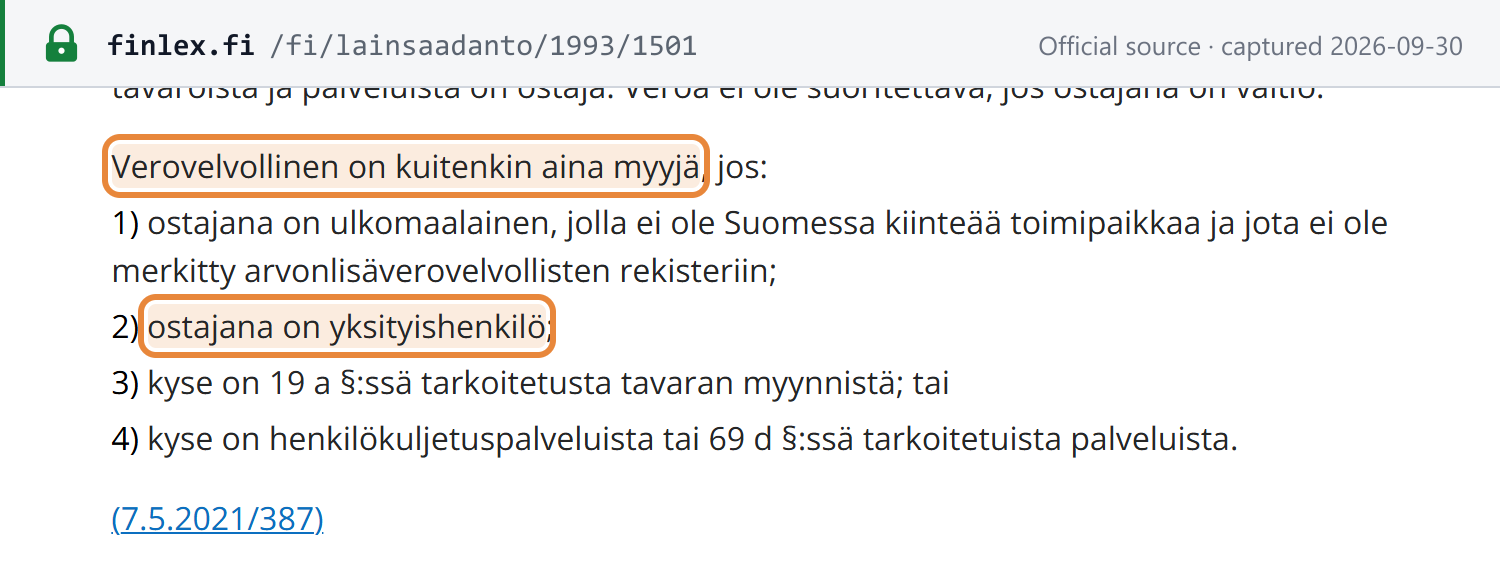
"Verovelvollinen on kuitenkin aina myyjä, jos: 1) ostajana on ulkomaalainen, jolla ei ole Suomessa kiinteää toimipaikkaa ja jota ei ole merkitty arvonlisäverovelvollisten rekisteriin; 2) ostajana on yksityishenkilö; …" (AVL 9 §)
B2C sales of services and distance sales of goods can usually go through an OSS scheme instead of a Finnish registration — see Cross-border rules.
VAT representative. A representative domiciled in Finland and approved by the Tax Administration is required only when a business with no establishment in the EU (or in a state with an equivalent mutual-assistance arrangement) applies voluntarily for registration under AVL 12 § 2 mom.; the Tax Administration may also demand a guarantee (AVL 173 a §). The representative shares responsibility for the filings (OVML 20 §). The Act sets no representative requirement for a foreign business that must register because it sells to consumers. [1] [2]
Tax identification number
The Finnish VAT number is FI followed by the 8-digit Business ID (Y-tunnus) without the hyphen. The Tax Administration: "the VAT number is formed using the country code FI and a string of digits that is the same as the Business ID without the dash between the two last digits. For example, if the Business ID is 0765432-1, the Finnish VAT number is FI07654321." [6]
| Identifier | Format | Example (vero.fi) |
|---|---|---|
| Business ID (Y-tunnus) | 7 digits, hyphen, 1 check digit | 0765432-1 |
| VAT number (ALV-numero) | FI + 8 digits | FI07654321 |
The last digit of the Business ID is a check digit; its algorithm is covered on Lookuptax's Finland tax ID guide. To check a number, use Lookuptax's Finland ALV number validator, see how to verify a Finnish VAT number, or query the EU's VIES service.
How to register
- Finnish businesses apply through the start-up or change notification in the Business Information System (YTJ, ytj.fi), electronically or on the paper Y-form. "Companies that already have a business ID can also apply for VAT registration in MyTax." [4]
- Paper route. The same notification is also available as a paper form (the Y-form) in the YTJ service. [4]
- When. The start-up notification is due before taxable activity begins (AVL 161 §). The Tax Administration registers a business from the date taxable business starts, or earlier from its first purchases (AVL 173 §). [1]
- Processing time. The Tax Administration's processing-times page (updated 17 September 2026) gives "Registrations and processing of changes in MyTax: 3 weeks", adding: "Our registration service is busy at the moment, and the processing time is 4–9 weeks on average." [24]
Voluntary registration
Available under AVL 12 § 1 mom. — useful to recover input VAT on start-up costs or when selling mostly to VAT-registered customers. A voluntary registration runs at the earliest from the date the application is received: "An applicant is registered as liable to pay VAT at the earliest from the date of the application." Once registered, the business charges VAT on all its sales, even below EUR 20,000. A non-established foreign business may also opt in under AVL 12 § 2 mom. (see the representative rule above). [4] [1]
Deregistration
- How. A business that closes entirely files a termination notification in YTJ; one that only stops VAT-liable activity asks for removal in MyTax. [7]
- From when. "Verohallinto poistaa verovelvollisen rekisteristä siitä lukien, kun verollinen liiketoiminta on päättynyt" — from the date taxable business ended (AVL 174 §). A voluntary registrant is removed "as of the date when the notice of termination is received, not earlier." [1] [7]
- Falling below EUR 20,000. Because the test covers two calendar years, a business can leave on small-business grounds only once both the current and the previous year are within EUR 20,000. The Tax Administration's example: turnover of EUR 22,000 in 2024 means the earliest exit is 1 January 2026. [4]
- Final return. "You must submit a VAT return for the final month when the activities are wound up", and VAT is self-assessed on remaining inventory as own use. [7]
Group registration
Available, but only to the financial and insurance sector. Under AVL 13 a §, the Tax Administration may, on application, treat two or more businesses as one (verovelvollisuusryhmä). Members must have their place of business or a fixed establishment in Finland, and a group may contain only businesses that mainly supply financial services (AVL 41 §) or insurance services (AVL 44 §), their holding companies and entities they control, with close financial, economic and organisational links. Invoicing obligations still apply to each member separately. [1]
Rates
| Rate | Applies to | Effective |
|---|---|---|
| 25.5% (general) | Most goods and services — e.g. alcohol and tobacco, clothing, building supplies, construction, accounting and repair services | Since 1 September 2024 (Law 462/2024; previously 24%) [1] |
| 13.5% (reduced) | Food and non-alcoholic drink, restaurant and catering (not alcohol), animal feed, books, medicines, passenger transport, accommodation, cultural and sports admissions, sports services, sanitary products and nappies, public broadcasting | Since 1 January 2026 (Law 1358/2025; previously 14%) [9] |
| 10% (reduced) | Newspapers and magazines only, printed or electronic | AVL 85 a § [1] |
| 0% (exempt with credit) | Exports outside the EU, intra-EU supplies of goods to VAT-registered buyers, certain vessels, tax-warehouse supplies, international transport | See Exemptions [5] |
General rate — 25.5%. AVL 84 §, as amended by Law 462/2024 of 5 July 2024: "Suoritettava vero on 25,5 prosenttia veron perusteesta, ellei 85 tai 85 a §:ssä toisin säädetä" (the tax is 25.5% of the taxable amount unless sections 85 or 85 a provide otherwise), in force from 1 September 2024. [1]
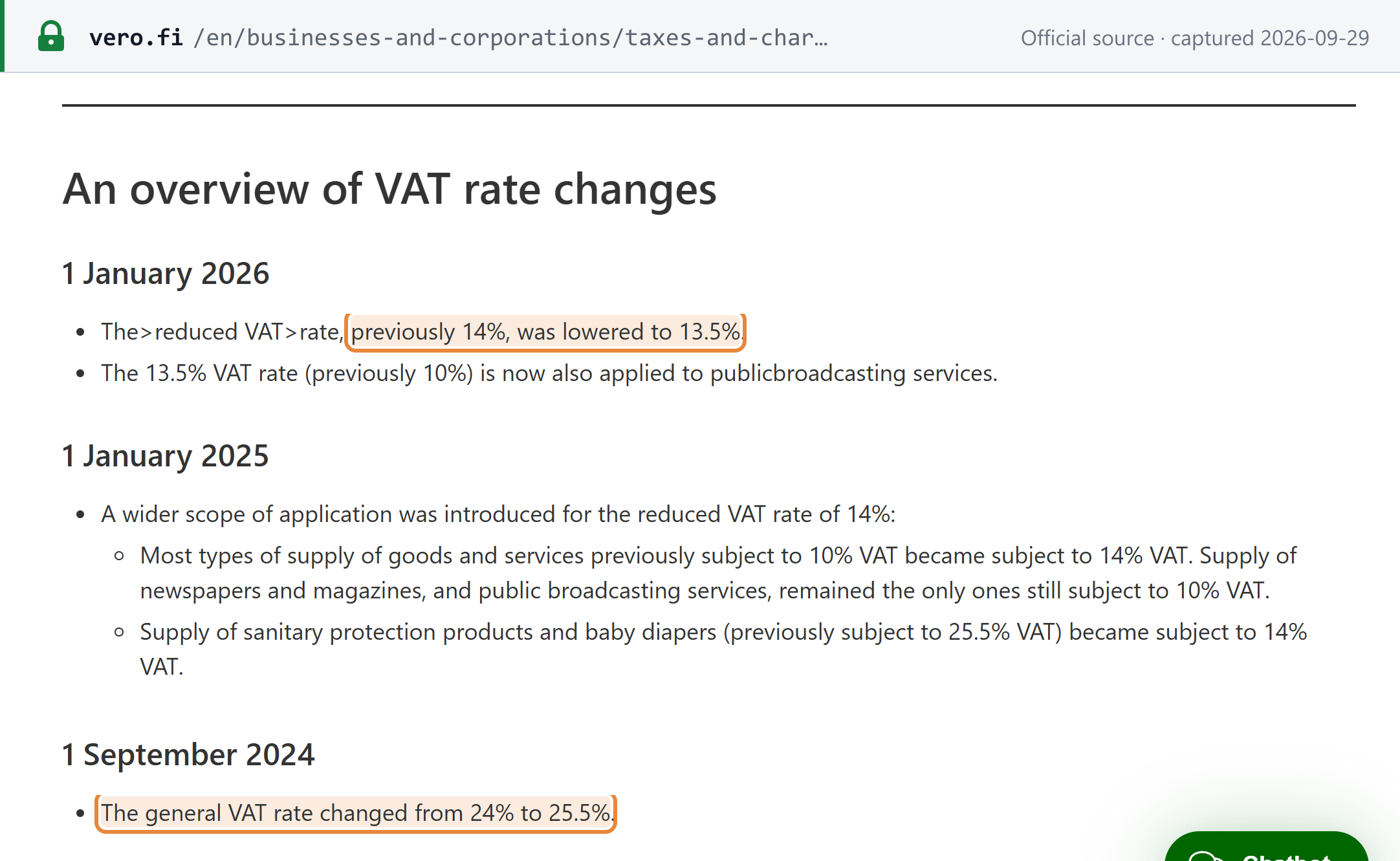
Reduced rate — 13.5%. The reduced rate was cut from 14% to 13.5% on 1 January 2026 by Law 1358/2025, which amended the opening words of AVL 85 §: "suoritettava vero on 13,5 prosenttia veron perusteesta". The rate's scope was set a year earlier: on 1 January 2025 (Law 691/2024) most goods and services then at 10% — books, medicines, passenger transport, accommodation, cultural, entertainment and sports admissions (including live streaming of them), sports services, and performers' fees where the recipient is VAT-registered — moved to the reduced rate, as did sanitary protection products and baby nappies (from 25.5%). Public broadcasting funding followed on 1 January 2026 (Law 921/2024). The Tax Administration notes that "the reduced VAT rate of 13,5% is not applicable to supply of alcohol, supply of tobacco products, serving of alcoholic drinks." [9] [1] [5]

Reduced rate — 10%. Since the 2025 and 2026 changes, 10% applies only to newspapers and periodicals, printed or delivered electronically (AVL 85 a §); publications consisting mainly of advertising or of video or music content are excluded and taxed at 25.5%. [1] [5]
The Tax Administration's rates page summarises the sequence:
| Supply | Until 31 Aug 2024 | 1 Sep – 31 Dec 2024 | 2025 | Since 1 Jan 2026 |
|---|---|---|---|---|
| Standard-rated goods and services | 24% | 25.5% | 25.5% | 25.5% |
| Food, restaurants, animal feed | 14% | 14% | 14% | 13.5% |
| Books, medicines, hotels, passenger transport, culture and sport | 10% | 10% | 14% | 13.5% |
| Sanitary products, nappies | 24% | 25.5% | 14% | 13.5% |
| Public broadcasting | 10% | 10% | 10% | 13.5% |
| Newspapers and magazines | 10% | 10% | 10% | 10% |
Announced future rates. None. The government's 2027 State budget proposal, under VAT item 11.04.01, describes the current 25.5 / 13.5 / 10 structure and announces no VAT rate change. It records that the reduced rate "keveni puolella prosenttiyksiköllä ja on jatkossa 13,5 prosenttia" — fell by half a point in 2026 and will henceforth be 13.5%. [8]

For Finland alongside other jurisdictions, see Lookuptax's worldwide tax rates table and VAT registration thresholds table. The EU-wide small-business rules behind the EUR 20,000 and EUR 100,000 limits are explained in Lookuptax's EU VAT SME scheme guide.
Cross-border rules
Imports and exports
- Imports of goods — who collects the VAT. An importer that is on the Finnish VAT register when the customs declaration is accepted and imports for its business reports import VAT on its periodic VAT return to the Tax Administration: "If you are an importer and you are on the Finnish VAT register, the Tax Administration handles your VAT on the imports." A pending application is not enough ("it is not enough if a registration application is pending"). Otherwise Finnish Customs collects the VAT at clearance (AVL 160 §). Deducting import VAT requires the customs decision (AVL 102 a § 3 mom.). [11] [1]
- De minimis. Finland has no VAT de minimis for imports; IOSS covers consignments of up to EUR 150 (not excise goods) sold at a distance to consumers, which can be declared through the import scheme — see Lookuptax's IOSS guide. [10]
- Exports and intra-EU supplies. Exports (AVL 70 §) and intra-EU supplies of goods to VAT-registered buyers (AVL 72 a §) are VAT-free with the right to recover input VAT (AVL 131 §). Intra-EU supplies of goods and B2B services taxed in another member state are reported on the monthly recapitulative statement (yhteenvetoilmoitus, AVL 162 §) in MyTax; the Tax Administration's example: "The recapitulative statement for April must be submitted by 20 May." [1] [13]
- Reverse charge on imported services. A Finnish business buying services from a supplier with no fixed establishment in Finland self-assesses the VAT (AVL 9 §) and deducts it on the same return if the purchase is for taxable business (AVL 102 §). See Lookuptax's reverse charge explainer. [1]
- Domestic reverse charges. The buyer is also liable for investment gold and gold material sold to registered buyers (AVL 8 a §), emission allowances (8 b §), construction services and construction staff leasing bought by a business that regularly sells construction services (8 c §), and scrap and waste sold to registered buyers (8 d §). The Tax Administration: "the reverse charge mechanism is not applied if construction services are sold to a private person or if goods (e.g. building materials) are being sold instead of services." [1] [12]
Digital products and services
Telecommunications, broadcasting and electronically supplied services to consumers are taxed where the consumer is: under AVL 69 i § such a service "on myyty Suomessa silloin, kun palvelu luovutetaan ostajalle, joka on sijoittautunut Suomeen tai jonka kotipaikka tai vakinainen asuinpaikka on Suomessa" (is sold in Finland when supplied to a buyer established, domiciled or habitually resident in Finland). [1]
- EU sellers count these services, together with intra-EU distance sales of goods, towards the EU-wide EUR 10,000 threshold; below it (in the current and previous calendar year) a seller established in one member state may charge its home VAT (AVL 69 m §). Above it, Finnish VAT applies and can be declared through the Union OSS. [10]
- Non-EU sellers have no threshold and can declare all their B2C services through the non-Union OSS. [10]
The Tax Administration: "The currently existing special scheme for VAT consists of three parts: the Union scheme, the non-Union scheme and the import scheme." A non-EU seller using the import scheme "must appoint an intermediary that has a domicile or a fixed establishment in the EU" in most cases. A seller established in Finland cannot use the OSS for its sales to Finnish consumers; those go on the domestic return. [10]

See Lookuptax's One-Stop Shop guide and VAT on digital services by non-resident suppliers.
Foreign companies selling into Finland — B2B and B2C
The answer depends on who the customer is (AVL 9 §): [1]
- B2B — usually no Finnish registration. A foreign seller with no fixed establishment in Finland does not charge Finnish VAT to a Finnish VAT-registered business: the buyer accounts for it. This covers goods and services supplied in Finland, not only services. No VAT is due at all where the buyer is the State. The exception is a buyer that is itself a non-established foreigner not on the Finnish register — then the seller must register.
- B2C — the seller is liable. Where the buyer is a private individual, the foreign seller is always liable. Services taxed in Finland (electronic services, for example) and intra-EU distance sales of goods can be declared through the Union or non-Union OSS; imported goods in consignments up to EUR 150 through IOSS. Goods held in Finland and sold to consumers require a Finnish VAT registration, with no threshold for a non-EU business.
- Passenger transport and event admissions (AVL 69 d §) always make the seller liable, whoever the customer is.
Marketplace / platform deemed-supplier liability
Applies. Under AVL 19 b §, a business that facilitates, through a "markkinapaikkaa, alustaa, portaalia tai vastaavaa sähköistä rajapintaa" (marketplace, platform, portal or similar electronic interface), another business's sales of goods is deemed to have bought and resold the goods where: [1]
- the goods are imported goods sold at a distance in consignments of intrinsic value up to EUR 150; or
- a seller not established in the EU supplies goods within the EU to non-taxable persons.
The underlying sale to the platform is exempt (AVL 60 b §), and platforms must keep records of the supplies they facilitate for 10 years (AVL 209 u §). From 1 January 2027, Law 597/2026 rewords 19 b § so that the deemed-supplier rule for non-EU sellers' supplies covers sales to private individuals, businesses not entitled to deduct VAT, non-business legal persons and primary producers on the flat-rate scheme ("L:lla 597/2026 muutettu 19 b § tulee voimaan 1.1.2027"). See Lookuptax's marketplace deemed-supplier explainer. [1]
Place of supply
- Goods. Where the goods are when handed over; for transported goods, where transport starts (AVL 63 §). Intra-EU distance sales are supplied in Finland when transport ends in Finland (AVL 63 a §), subject to the EUR 10,000 EU-wide threshold (AVL 69 m §). [1]
- Services, B2B. Where the customer is established — its fixed establishment receiving the service, otherwise its place of business (AVL 65 §). [1]
- Services, B2C. Where the supplier is established (AVL 66 §). [1]
- Exceptions. Services connected with immovable property are supplied where the property is (AVL 67 §); passenger transport and event admissions have their own rules; telecom, broadcasting and electronic services to consumers are supplied where the consumer is (AVL 69 i §). [1]
Invoice requirements
The invoicing rules sit in AVL 209 a–209 u §. The Tax Administration's detailed guidance 48090, VAT invoice requirements (valid from 1 September 2023), explains them in English. [1] [14]
When an invoice is required. AVL 209 b § requires an invoice for taxable supplies (and listed zero-rated supplies) to businesses and non-business legal persons, for distance sales of goods and new means of transport to consumers, for advance payments and for adjustments. An invoice is not required for ordinary sales to consumers, nor for sales declared through the non-Union OSS. [1]
Mandatory content
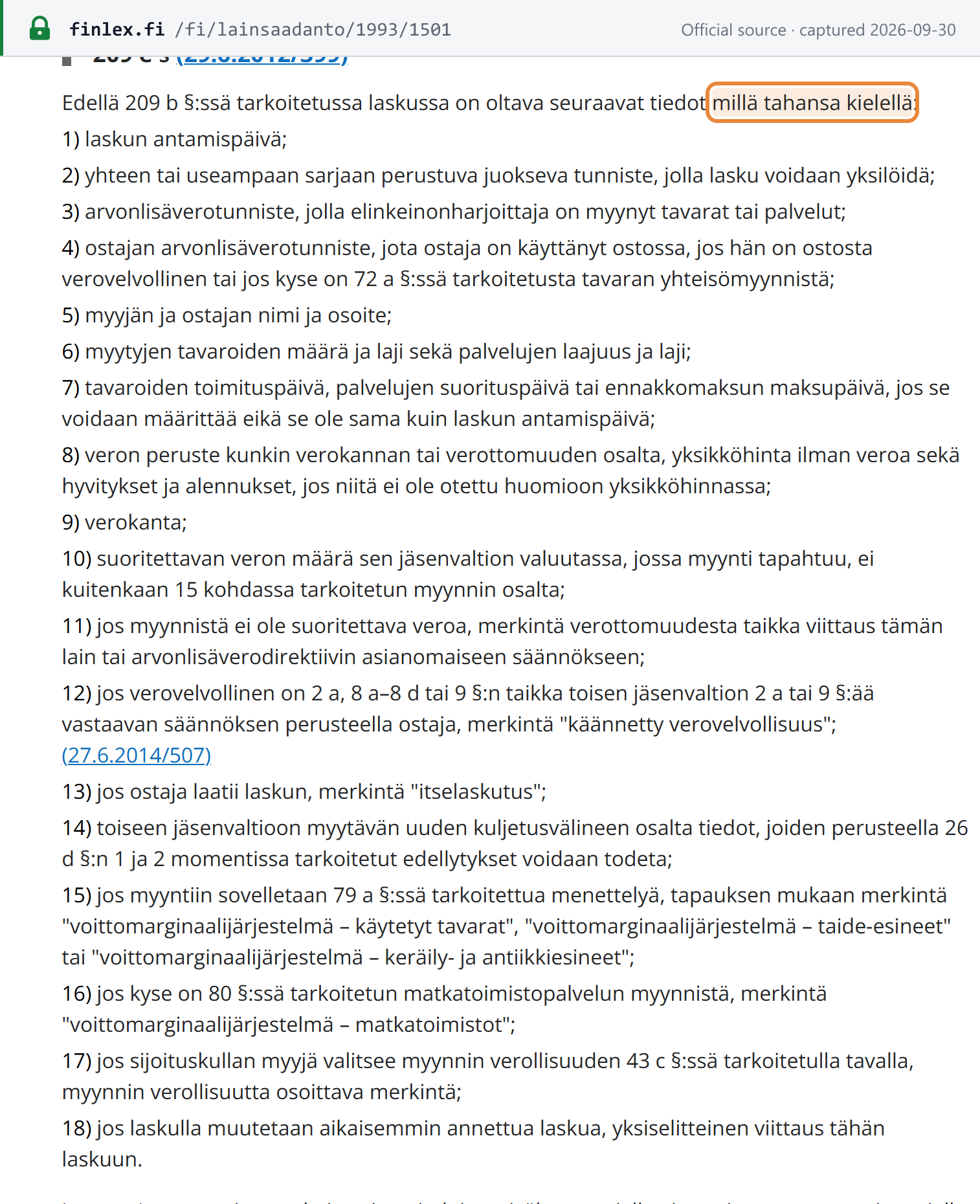
An invoice under AVL 209 b § must carry the following particulars, "millä tahansa kielellä" — in any language (AVL 209 e §): [1]
| # | Required field | Legal cite |
|---|---|---|
| 1 | Date of issue | AVL 209 e § 1 mom. 1 k. |
| 2 | Sequential identifier, in one or more series, that identifies the invoice uniquely | 209 e § 1 mom. 2 k. |
| 3 | Seller's VAT identifier | 209 e § 1 mom. 3 k. |
| 4 | Buyer's VAT identifier, where the buyer is liable for the VAT or receives an intra-EU supply of goods | 209 e § 1 mom. 4 k. |
| 5 | Seller's and buyer's names and addresses | 209 e § 1 mom. 5 k. |
| 6 | Quantity and nature of the goods, or extent and nature of the services | 209 e § 1 mom. 6 k. |
| 7 | Date of supply or advance payment, where it differs from the issue date | 209 e § 1 mom. 7 k. |
| 8 | Taxable amount per rate or exemption, unit price excluding VAT, and discounts not in the unit price | 209 e § 1 mom. 8 k. |
| 9 | VAT rate | 209 e § 1 mom. 9 k. |
| 10 | VAT amount, in the currency of the member state where the supply takes place | 209 e § 1 mom. 10 k. |
| 11 | Exemption note, or a reference to the provision of the Act or the VAT Directive | 209 e § 1 mom. 11 k. |
| 12 | "käännetty verovelvollisuus" (reverse charge), where the buyer is liable | 209 e § 1 mom. 12 k. |
| 13 | "itselaskutus" (self-billing), where the buyer issues the invoice | 209 e § 1 mom. 13 k. |
| 14 | Details of a new means of transport sold to another member state | 209 e § 1 mom. 14 k. |
| 15 | Margin-scheme notes: "voittomarginaalijärjestelmä – käytetyt tavarat / taide-esineet / keräily- ja antiikkiesineet" | 209 e § 1 mom. 15 k. |
| 16 | Travel agents' scheme note: "voittomarginaalijärjestelmä – matkatoimistot" | 209 e § 1 mom. 16 k. |
| 17 | Note of the option to tax investment gold | 209 e § 1 mom. 17 k. |
| 18 | On a corrective invoice, an unambiguous reference to the original invoice | 209 e § 1 mom. 18 k. |
A seller not on the VAT register may not show a VAT amount or rate on its invoices: "Laskuun ei kuitenkaan saa merkitä veron määrää tai verokantaa, ellei myyjää ole merkitty arvonlisäverovelvollisten rekisteriin." The exception is a pending registration: "Jos rekisteröinti on vireillä ja laskussa on tätä koskeva merkintä, vero ja verokanta voidaan kuitenkin merkitä" — if registration is pending and the invoice says so, the VAT and the rate may be shown (AVL 209 e §). [1]
Issuance deadline
The Act sets no general deadline for domestic invoices. The only statutory deadline is for intra-EU supplies of goods and cross-border B2B services taxed in another member state: "viimeistään tavaran toimituskuukautta seuraavan kalenterikuukauden 15 päivänä" — no later than the 15th day of the month after the supply (AVL 209 c §). Guidance 48090: "The Value Added Tax Act does not define any other time limits for issuing an invoice except the ones discussed above." [1] [14]
Numbering and sequencing
Each invoice carries a sequential identifier based on one or more series that identifies it uniquely (AVL 209 e § 1 mom. 2 k.). Several series may run in parallel, provided each number identifies one invoice. [1]
Credit and debit notes
An invoice is required for rebates and other adjustments not already reflected in the original invoice (AVL 209 b §), and the corrective invoice must refer unambiguously to the original (AVL 209 e § 1 mom. 18 k.). Guidance 48090: "The seller must issue a separate invoice when the purchaser becomes entitled to the rebate, discount, etc. that was agreed subject to certain conditions when the original invoice was issued. However, the seller need not issue any separate corrective invoice for the usual commercial cash discounts". [1] [14]
Currency and language
- Language. Any language (AVL 209 e §); in an audit the Tax Administration may ask for a translation (AVL 209 i §). [1]
- Currency and FX. An invoice may be issued in any currency, but the VAT on a Finnish supply must be shown in euros. Guidance 48090: "Amounts in foreign currencies are converted into euros by applying the most recent conversion rate published by a commercial bank or by the European Central Bank at the time when the liability to pay VAT arose". [14]
Document types
| Document | When it is used | Cite |
|---|---|---|
| Full invoice | Default for supplies to businesses and legal persons | AVL 209 e § |
| Simplified invoice | Invoices totalling up to EUR 400; retail-type sales almost exclusively to private persons (any amount); restaurant, catering and passenger transport (unless for resale); parking-meter tickets. Not for distance sales, intra-EU supplies of goods or cross-border reverse-charge supplies | AVL 209 f § |
| Corrective invoice | Adjustments to an earlier invoice, referring to it unambiguously | AVL 209 e § 1 mom. 18 k. |
| Self-billed invoice | Issued by the buyer under an agreement with the seller | AVL 209 b § |
A simplified invoice needs only the date, the seller's name and VAT identifier, the quantity and nature of the goods or type of services, and either the VAT per rate or the taxable amount per rate: "loppusummaltaan enintään 400 euron suuruiset laskut" (invoices with a total of at most EUR 400). [1]
Self-billing
Permitted. "Ostajan laatima lasku katsotaan myyjän antamaksi, jos myyjä ja ostaja ovat sopineet asiasta ja jos on olemassa järjestely, jonka mukaan myyjä hyväksyy laskun" — an invoice drawn up by the buyer counts as issued by the seller if they have agreed so and there is an arrangement for the seller to accept each invoice (AVL 209 b §). It carries the note "itselaskutus". [1]
Retention and audit trail
- Retention. Invoices issued and received are kept at least six years from the start of the year following the calendar year of the period the transaction is allocated to: "vähintään kuusi vuotta sitä kalenterivuotta seuraavan vuoden alusta" (AVL 209 n §). Records for real-property investment adjustments are kept 13 years (AVL 209 q §). [1]
- Electronic storage and storage abroad. Invoices may be kept electronically, but must be stored so the Tax Administration can inspect them in Finland without undue delay; invoices stored electronically abroad also need full real-time computer access (AVL 209 o §). Sending an invoice electronically requires the recipient's consent (AVL 209 d §). [1]
- Audit trail. Businesses must ensure the authenticity of origin, integrity and legibility of the invoices they issue and receive from issue to the end of the retention period, by any business control that "luotettavasti todentaa laskun ja tavaroiden tai palvelujen myynnin välisen yhteyden" — reliably links the invoice to the supply (AVL 209 g §). The Act names no required technology such as a signature, hash or QR code. [1]
A specimen of a compliant invoice
No official specimen invoice is published; the example below is ours — Lookuptax's illustration of the AVL 209 e § particulars for a domestic B2B supply at two rates. Every name, number and amount in it is fictional:
Lasku — Invoice
| DescriptionAVL 209 e § 1 mom. 6 k. | QuantityAVL 209 e § 1 mom. 6 k. | Unit price (excl. VAT)AVL 209 e § 1 mom. 8 k. | VAT rateAVL 209 e § 1 mom. 9 k. | Value (excl. VAT) |
|---|---|---|---|---|
| IT consulting (hours) | 10 | EUR 100.00 | 25.5% | EUR 1,000.00 |
| Catering for workshop | 1 | EUR 200.00 | 13.5% | EUR 200.00 |
- Taxable amount at 25.5%AVL 209 e § 1 mom. 8 k.
- EUR 1,000.00
- VAT at 25.5%AVL 209 e § 1 mom. 10 k.
- EUR 255.00
- Taxable amount at 13.5%AVL 209 e § 1 mom. 8 k.
- EUR 200.00
- VAT at 13.5%AVL 209 e § 1 mom. 10 k.
- EUR 27.00
- Total including VAT
- EUR 1,482.00
- The VAT amounts must be stated in euros, even if the rest of the invoice is in another currency — AVL 209 e § 1 mom. 10 k.
- Where the buyer is liable for the VAT, the invoice shows no VAT, carries the buyer's VAT identifier and the note "käännetty verovelvollisuus" — AVL 209 e § 1 mom. 4 and 12 k.; where the buyer issues it, "itselaskutus" — 13 k.
- A seller that is not on the VAT register may not show a VAT rate or amount, unless its registration is pending and the invoice says so — AVL 209 e §.
- A buyer entitled under Act 241/2019 can ask for this invoice as a structured EN 16931 e-invoice instead of a PDF — see E-invoicing status.
E-invoicing status
Status (as of 2026-09-30): no B2B e-invoicing mandate and no clearance or real-time reporting system. B2G: public buyers must accept e-invoices. B2B: a statutory right to receive an e-invoice on request since 1 April 2020. For Finland alongside other jurisdictions, see Lookuptax's e-invoicing status and networks table, and for formats and networks, Lookuptax's Finland e-invoicing guide.
The Act on Electronic Invoicing by Contracting Entities and Traders (laki hankintayksiköiden ja elinkeinonharjoittajien sähköisestä laskutuksesta, 241/2019), in force since 1 April 2019, is the only Finnish e-invoicing statute. It does two things: [15]
| Scope | Rule | Since |
|---|---|---|
| B2G | Contracting authorities must receive and process e-invoices based on procurement and concession contracts (241/2019 3 §) | Central government 1 April 2019; other contracting authorities 1 April 2020 |
| B2B and G2B | A contracting authority or business has the right to receive an invoice as an e-invoice on request from another contracting authority or business (241/2019 4 §) | 1 April 2020 |
| B2C | No rule — an e-invoice needs the recipient's consent (AVL 209 d §) | — |
Section 4: "Hankintayksiköllä ja elinkeinonharjoittajalla on oikeus saada pyynnöstä lasku toiselta hankintayksiköltä tai elinkeinonharjoittajalta sähköisenä laskuna" — a contracting authority and a business have the right to receive, on request, an invoice from another contracting authority or business as an e-invoice. [15]

- Who counts as a business. For the Act, elinkeinonharjoittaja means a business "jonka toiminnan tilikauden liikevaihto on enemmän kuin 10 000 euroa" — whose turnover for the financial year is more than EUR 10,000 (241/2019 2 § 3 kohta). The same defined term is used for the business making the request and the business receiving it. [15]
- What counts as an e-invoice. A structured invoice that complies with the European standard EN 16931 and uses a syntax on the EU list. A PDF is not an e-invoice under the Act. [15]
- A right, not a mandate. Absent a request, no Finnish rule obliges a business to e-invoice another business, and Finland operates no clearance or real-time invoice-reporting system: the Act and AVL 209 d § (e-invoices only with the recipient's consent) are the only rules (as of 2026-09-30). [15] [1]
Networks. E-invoicing is nonetheless widespread. The State Treasury (Valtiokonttori), which is the Finnish Peppol Authority, reported on 28 May 2026 that 353.2 million invoices passed through e-invoice operators in 2025. Formats in use include Finvoice, TEAPPSXML and Peppol BIS Billing 3.0 — see Lookuptax's Peppol guide. [16]
ViDA outlook. The EU's VAT in the Digital Age package (Directive (EU) 2025/516) makes e-invoicing mandatory for cross-border intra-EU B2B supplies from 1 July 2030; the State Treasury notes that the directive "tekee sähköisestä laskutuksesta pakollista rajat ylittävässä EU-kaupassa". Finland's first implementing law, 597/2026 (government proposal HE 78/2026), covers only the elements applying from 1 January 2027 — the single-VAT-registration pillar — and not e-invoicing or digital reporting, which HE 78/2026 leaves to separate legislation. See Lookuptax's ViDA guide. [16] [17]
Filing and payment
Filing frequency
Monthly by default (OVML 11 §). On application, a business may choose (OVML 12 §): [2] [18]
| Calendar-year turnover | Available VAT period |
|---|---|
| Any | Calendar month (default) |
| EUR 100,000 or less | Calendar quarter |
| EUR 30,000 or less | Calendar quarter or calendar year |

A chosen period must be kept for at least one year ("Verokauden on oltava sama vähintään yhden vuoden ajan", OVML 14 § 3 mom.). Primary producers and visual artists with no other VAT activity have a calendar-year period by law (OVML 11 § 2 mom.). The Tax Administration may impose monthly periods on new businesses or on businesses that neglect their obligations. [2]
Return due date
Returns are filed electronically — in MyTax (OmaVero) or through an interface ("Veroilmoitus on annettava sähköisesti", OVML 18 §). A return is due even for a period with no sales. [2] [19]
- Monthly and quarterly periods: by the 12th day of the second month after the period — "verokautta seuraavan toisen kalenterikuukauden yleisenä eräpäivänä" (OVML 17 § 2 mom.); the "general due date" is the 12th, or the next banking day (OVML 2 §). Quarterly returns are therefore due on 12 May, 12 August, 12 November and 12 February.
- Annual period: by the last day of February of the following year (OVML 17 § 3 mom.).
The Tax Administration: "File and pay your VAT every month. The due date is the 12th of the second month after the reportable month. Example: For March, you must file and pay VAT by 12 May." And: "VAT return due dates cannot be extended." [19]

Payment due date and method
Payment falls on the same date as the return (OVML 32 § 2 mom. mirrors 17 §). VAT is paid to the self-assessed-tax account using the payment details and reference number shown in MyTax. [2] [19]
Cash-basis allocation. A business whose calendar-year turnover is EUR 500,000 or less, or which is outside the Accounting Act, may allocate output VAT to the month in which payment is received (AVL 137 §, as amended by Law 448/2024 from 1 January 2025). [1]
Additional listings
- Recapitulative statement (yhteenvetoilmoitus, EC sales list): monthly, for intra-EU supplies of goods and B2B services taxed in another member state (AVL 162 §), filed in MyTax. The Tax Administration's example gives the deadline: "The recapitulative statement for April must be submitted by 20 May." [1] [13]
- OSS returns: filed in MyTax for businesses registered for the Union, non-Union or import scheme. [10]
- Annual VAT return. None: the periodic returns are the whole filing cycle (VAT has no separate annual return in OVML).
See Lookuptax's VAT listings explainer and VIES and Intrastat guide.
Input-tax recovery and blocked items
VAT on purchases for taxable business is deductible (AVL 102 §), provided the business holds an invoice meeting AVL 209 e or 209 f § (AVL 102 a §); mixed use is apportioned (AVL 117 §). AVL 114 § blocks the deduction for: [1]
- property used as housing, a day-care centre or recreation premises for the owner or staff;
- transport between home and work;
- entertainment and representation ("edustustarkoitukseen käytettävät tavarat ja palvelut");
- passenger cars, motorcycles, caravans, leisure boats and aircraft up to 1,550 kg, and goods and services related to them — unless bought for resale, rental, professional passenger transport or driving instruction, or used exclusively for deductible purposes.
Refunds
- Resident businesses. A negative balance on the return is refunded or offset against other taxes once the Tax Administration has confirmed it: "you can see this in your account balance in MyTax only after the Tax Administration has confirmed the refund." Zero-rated suppliers recover input VAT under AVL 131 §. The Tax Administration's processing-times page (updated 17 September 2026) gives 1 week for a VAT return, and about 8 weeks on average for cases that need clarification. [24] [19] [1]
- Non-resident businesses. A foreign business with no fixed establishment in Finland whose only Finnish sales are reverse-charged (or made to the State) or exempt transport services may reclaim Finnish input VAT by refund application (AVL 122 §): EU businesses through their home tax portal under Directive 2008/9/EC, non-EU businesses under the procedure based on the 13th Directive. [1]
Exemptions
Exempt supplies
Exempt without the right to deduct input VAT (AVL chapter 4, 27–61 §): health and medical care, social services, education, financial and insurance services, certain performers' fees and copyright payments, sale and letting of real estate and dwellings, universal postal services and lotteries. Letting of property to a VAT-registered tenant can be made taxable on application (AVL 30 §). [20] [1]
Exempt is not zero-rated. A business making exempt sales charges no VAT on them and cannot deduct the VAT on related purchases. Zero-rated sales — exports and intra-EU supplies of goods — are also VAT-free, but the input VAT is recoverable. The Tax Administration: "there are also VAT-exempt sales for which VAT deductions can be claimed if purchases relating to them have been made. These sales are called "zero-rated". … Note that zero-rated activity does not mean the same as VAT-exempt activity". Exempt real estate, financial and insurance sales still count towards the EUR 20,000 turnover test. [20] [4]

Special regimes
- Small-business exemption — EUR 20,000 in the current and previous calendar year; EU cross-border SME scheme for businesses established in other member states (EUR 100,000 of Union turnover). See Registration. [1]
- Graduated small-business relief — abolished from 1 January 2025 (AVL chapter 14 a repealed by Law 448/2024). [1]
- Cash-basis allocation — turnover up to EUR 500,000 (AVL 137 §). [1]
- Margin schemes — second-hand goods, works of art, collectors' items and antiques (AVL 79 a § ff.) and travel agents (AVL 80 §), each with its mandatory invoice note (AVL 209 e § 15–16 k.). [1]
- Primary producers and visual artists — annual VAT period by law (OVML 11 § 2 mom.). [2]
- Tax warehouses — supplies under the VAT warehousing procedure are zero-rated (AVL 72 h §). The VAT Act contains no free-zone or special-economic-zone regime beyond this. [1] [5]
Offences and penalties
Finland separates criminal offences under the Criminal Code (rikoslaki 39/1889, chapter 29) from the administrative penalties the Tax Administration imposes under OVML.
Offences
| Offence | Conduct | Sanction |
|---|---|---|
| Tax fraud (veropetos, RL 29:1) | Causing or attempting to cause tax to go unassessed, be assessed too low, or be refunded without grounds | Fine or up to 2 years' imprisonment |
| Aggravated tax fraud (RL 29:2) | Tax fraud seeking considerable benefit or committed in a particularly methodical way | 4 months to 4 years' imprisonment |
| Petty tax fraud (RL 29:3) | Tax fraud that is minor as a whole | Fine |
| Tax violation (verorikkomus, RL 29:4) | Failing, to gain a benefit and for a reason other than insolvency, to pay collected VAT on time | Fine or up to 6 months' imprisonment |
RL 29:1: "…on tuomittava veropetoksesta sakkoon tai vankeuteen enintään kahdeksi vuodeksi." [21]
Administrative wrongdoing. Failing, despite a request from the Tax Administration, to file a registration notification (including the start-up notification and OSS registrations), to issue an invoice under AVL 209 b §, to keep the required records, or to show the mandatory invoice particulars under AVL 209 e or 209 f § is sanctioned with a negligence penalty of up to EUR 5,000 (OVML 39 §). There is no separate fine for late registration: registration is backdated to the day the threshold was crossed, so the missed returns attract the late-filing penalty and interest below. [2] [3]
Penalties
- Late filing (myöhästymismaksu, OVML 36 §). EUR 3 per day, up to EUR 135. If the return is more than 45 days late, 2% of the tax reported late is added, with that part capped at EUR 15,000 per tax type and period. It applies to nil returns too. The Tax Administration's example: a return filed 50 days late reporting EUR 5,000 of tax costs EUR 235. [2] [22]

- Tax increase (veronkorotus, OVML 38 §). For an incorrect, incomplete or missing return: 10% of the tax assessed to the taxpayer's detriment; 15–50% for a repeated failure or manifest disregard; 25% of an estimated tax; 3% for unclear points of interpretation; up to EUR 200 where no tax is assessed. [2]

- Negligence penalty — up to EUR 5,000 (OVML 39 §, above). [2]
- Late-payment interest (viivekorko). Runs from the day after the due date up to and including the day of payment, and is also charged on penalty fees. The rate is set annually; the Tax Administration: "In 2026, the rate is 4.5% (inheritance tax) or 9.5% (other tax types)" — so 9.5% for VAT in 2026. [23]

Frequently asked questions
Our Finnish turnover passed EUR 20,000 in October — do we owe VAT from January?
No. Since 1 January 2025 a seller established in Finland is outside the VAT system only while its turnover is EUR 20,000 or less in both the current and the previous calendar year (section 3 of the VAT Act, as amended by Law 448/2024). VAT is due from the day the threshold is exceeded, and the sale that crosses it is taxable in full. If you register late, the Tax Administration registers you retroactively from the day the threshold was exceeded, so the returns for the missed months become late returns. [1] [3]
We are a US software company selling to Finnish businesses and consumers — do we need a Finnish VAT number?
It depends on the customer. Where a foreign seller has no fixed establishment in Finland, section 9 of the VAT Act makes the Finnish buyer liable for the VAT, so sales to VAT-registered Finnish businesses are reverse-charged and need no Finnish registration. The seller is always liable where the buyer is a private individual, so B2C sales of electronic services are taxed in Finland; a non-EU seller can declare them through the non-Union One-Stop Shop instead of registering. There is no threshold for a business established outside the EU: Finland's EUR 20,000 small-business exemption does not apply to it. [1] [10]
We are a German company — can we use Finland's EUR 20,000 small-business exemption?
Only through the EU cross-border SME scheme. Since 1 January 2025, section 3 a of the VAT Act lets a business established in another EU member state use the Finnish exemption only if its total turnover in the EU is EUR 100,000 or less in both the current and the previous calendar year, and it still has to stay within Finland's EUR 20,000 limit. A business established outside the EU cannot use the exemption at all, even with a fixed establishment in Finland. [1] [4]
Which VAT rate applies to books, hotel stays and taxi rides in Finland now?
13.5%. Books, medicines, accommodation, passenger transport and admission to cultural and sports events moved from 10% to the 14% reduced rate on 1 January 2025, and the reduced rate itself fell from 14% to 13.5% on 1 January 2026 (Law 1358/2025). The 10% rate now covers only newspapers and magazines. The general rate has been 25.5% since 1 September 2024. [5] [9]
Can a Finnish customer insist that we send an e-invoice?
Yes, if it asks. Since 1 April 2020, section 4 of Act 241/2019 gives contracting authorities and businesses the right to receive an invoice as an e-invoice on request from another contracting authority or business. The Act defines a business for this purpose as one whose turnover for the financial year is more than EUR 10,000, and an e-invoice as a structured invoice complying with the European standard EN 16931. It is a right on request, not a general mandate: Finland has no B2B e-invoicing obligation and no real-time invoice reporting system. [15]
What does it cost to file a Finnish VAT return 50 days late?
The late-filing penalty is EUR 3 for each day late, up to EUR 135. If the return is more than 45 days late, 2% of the tax reported late is added, with that part capped at EUR 15,000 per tax type and period. The Tax Administration's own example: a return filed 50 days late reporting EUR 5,000 of tax costs EUR 235. If the tax is also paid late, late-payment interest runs from the day after the due date; the Tax Administration gives the 2026 rate as 9.5%. [22] [23]
Important websites
| Site | Purpose |
|---|---|
| MyTax (OmaVero) | VAT registration for businesses with a Business ID, VAT returns, recapitulative statements, OSS returns, payments and period changes (login via Suomi.fi) |
| Business Information System (YTJ) | Start-up, change and termination notifications; Business IDs; public register of VAT-registered businesses |
| Tax Administration — How to register for VAT | Registration rules and forms, including forms for foreign businesses |
| Tax Administration — Rates of VAT | Current rates, examples and a VAT calculator |
| Tax Administration — When to file and pay VAT | Due dates and payment |
| Tax Administration — VAT special schemes (OSS/IOSS) | Union, non-Union and import schemes |
| Tax Administration — VAT number | How Finnish VAT numbers are formed and checked; phone check on 029 497 008 |
| VIES | EU VAT-number check |
| Tax Administration — Interest on late payments | Current rate and interest calculator |
| Finnish Customs (Tulli) | Import VAT for importers not on the VAT register |
| State Treasury (Valtiokonttori) | Finnish Peppol Authority; public-sector e-invoicing |
Also see Lookuptax's own Finland ALV number validator.
Recent changes
- 2026-01-01 — The reduced rate fell from 14% to 13.5% (Law 1358/2025), and public broadcasting moved from 10% to 13.5% (Law 921/2024). (Finlex) — see event
- 2025-01-01 — The small-business threshold rose from EUR 15,000 to EUR 20,000, tested on the current and previous calendar year; the graduated relief was abolished; the EU cross-border SME scheme and the EUR 500,000 cash-basis limit applied (Law 448/2024). Most 10% supplies, plus sanitary products and nappies, moved to 14% (Law 691/2024). (Finlex)
- 2024-09-01 — The general rate rose from 24% to 25.5% (Law 462/2024). (Tax Administration)
Ahead — enacted changes that have not yet taken effect:
- 2027-01-01 — Law 597/2026 (HE 78/2026) applies the first ViDA changes: OSS for non-established suppliers of electricity, gas and heating to consumers, a wider platform deemed-supplier rule (AVL 19 b §), a EUR 10,000 micro-business threshold counting only distance sales dispatched from the home state, and call-off-stock transfers allowed only until 30 June 2028. The law was given on 26 June 2026 and applies where the tax liability arises on or after 1 January 2027. (Finlex — Law 597/2026; HE 78/2026) — see event
For the full chronology, see Finland tax changes on Lookuptax.
Reference links
- Finlex — Value Added Tax Act 1501/1993 (arvonlisäverolaki), consolidated
- Finlex — Act on the Taxation Procedure for Self-Assessed Taxes 768/2016 (OVML)
- Finlex — Act 241/2019 on electronic invoicing by contracting entities and traders
- Finlex — Law 1358/2025 (reduced rate 13.5%)
- Finlex — Criminal Code 39/1889 (rikoslaki), chapter 29
- Finlex — Government proposal HE 78/2026 (ViDA, in force 1 January 2027)
- Ministry of Finance — Budget proposal 2027, item 11.04.01 VAT
- Tax Administration — How to register for VAT
- Tax Administration — Detailed guidance 48658, VAT exemption for small businesses
- Tax Administration — Rates of VAT
- Tax Administration — VAT number
- Tax Administration — Termination of VAT-liable activities
- Tax Administration — VAT special schemes (OSS)
- Tax Administration — VAT on imported goods
- Tax Administration — Reverse charge in the construction sector
- Tax Administration — EU VAT recapitulative statement
- Tax Administration — Detailed guidance 48090, VAT invoice requirements
- Tax Administration — Tax period
- Tax Administration — When to file and pay VAT
- Tax Administration — Business operations exempt from VAT
- Tax Administration — Late-filing penalty
- Tax Administration — Interest on late payments
- Tax Administration — Processing times for returns and applications
- State Treasury — Finnish e-invoicing at a record level, 28 May 2026
- Lookuptax — Finland tax ID guide
- Lookuptax — How to verify a Finnish VAT number
- Lookuptax — Finland e-invoicing guide
- Lookuptax — How to verify an EU VAT number in VIES
- Lookuptax — EU VAT SME scheme
- Lookuptax — E-invoicing status and networks worldwide
- Lookuptax — VAT registration thresholds worldwide
- Lookuptax — Worldwide tax rates