South Korea VAT guidelines
| FACTSHEET | |
|---|---|
| Country code | KR |
| Tax name | Value-Added Tax — 부가가치세 (bugagachise) |
| Tax Authority | National Tax Service (NTS, 국세청); Korea Customs Service for import VAT |
Overview
South Korea levies Value-Added Tax (부가가치세) under the Value-Added Tax Act (부가가치세법), in the version in force from 2 January 2026 (Act No. 21065). Article 4 taxes two events: supplies of goods or services by a business operator, and imports of goods. [1]
Authority. VAT on domestic supplies is administered by the National Tax Service (NTS, 국세청) through the district tax office for the place of business; VAT on imports is levied by the heads of customs of the Korea Customs Service (Art 7). Tax policy sits with the Ministry of Finance and Economy (재정경제부). [1]
Currency. All amounts in this guide are in Korean won (KRW).
Tax period. General taxpayers have two six-month taxable periods — 1 January to 30 June and 1 July to 31 December — each with a preliminary return for its first quarter. Simplified taxpayers have one taxable period, the calendar year (Art 5(1)). See Filing and payment. [1] [3]
Layering: the Local Consumption Tax is inside the 10%, not on top of it. Of the tax payable, 74.7% is VAT and 25.3% is Local Consumption Tax (지방소비세), but the two are filed, paid, assessed and refunded as one amount (Art 72). There is no separate local rate or local return, and the customer-facing rate stays 10%. [1]

Registration
Who should register
Every business operator registers — registration is not turnover-based. A business operator (사업자) is anyone who independently supplies goods or services in the course of business, whether or not for profit (Art 2(3)). Each must apply to the district tax office for business registration (사업자등록) for each place of business within 20 days of the business start date, and a new business may apply before it starts (Art 8(1)). [1]

Threshold
Registration threshold: none (VAT Act Art 8, as in force on 2026-09-30). The two KRW figures readers often mistake for one are thresholds for the simplified taxation regime, not for registration:
| Figure | What it is | Source |
|---|---|---|
| No threshold | Every business operator registers within 20 days of starting | VAT Act Art 8(1) [1] |
| KRW 104,000,000 | An individual whose prior-year VAT-inclusive supply value (공급대가) is below this may be a simplified taxpayer (간이과세자); the status runs from 1 July to 30 June after the measurement year | Decree Art 109(1) (amended 29 February 2024); Act Arts 61(1), 62(1) [2] |
| KRW 48,000,000 | A simplified taxpayer whose supply value for the period is below this owes no VAT for it and issues receipts rather than tax invoices; real-estate lessors and certain entertainment venues at or above it cannot be simplified taxpayers | Act Arts 69(1), 36(1)2, 61(1)3 [1] |

General and simplified taxpayers. A simplified taxpayer must be an individual — a corporation never qualifies. The Act sets a band from KRW 80 million to 130% of that figure, and the Decree fixes the amount at the top of the band. Some businesses are excluded whatever their size, including mining, most manufacturing, wholesale, real-estate sales and listed professions such as lawyers, certified public accountants, tax accountants, doctors and architects (Decree Art 109(2)). Everyone else is a general taxpayer (일반과세자). A simplified taxpayer computes tax as supply value × the industry value-added ratio × 10% — the ratio is 15% for retail and restaurants, for example — and credits 0.5% of purchases evidenced by tax invoices (Act Art 63). [1] [2]
Non-resident threshold: also none. A foreign business with a fixed place of business in Korea registers under Art 8 like any other operator. A foreign supplier of electronic services to Korean consumers registers under a separate simplified business registration (간편사업자등록) within 20 days of starting, and Art 53-2(1) sets no threshold for it — see Cross-border rules. [1]
Tax identification number
The registration number is the Business Registration Number (사업자등록번호): 10 digits, written XXX-XX-XXXXX, assigned per place of business by the district tax office, or a single number for an operator registered for business-unit taxation (Decree Art 12(1)). Non-business bodies receive a "unique number" (고유번호) instead (Decree Art 12(2)), and foreign e-service suppliers receive a separate simplified business registration number (Decree Art 96-2(4)). [2]
For the digit structure, the Resident Registration Number and the Corporation Registration Number, see Lookuptax's South Korea tax ID guide — RRN, BRN and CRN. To check a number's format, use Lookuptax's South Korea BRN validator.
How to register
Apply at any tax office or online through Hometax (홈택스), the NTS online system (Act Art 8(2); Decree Art 11(1)). The tax office issues the business registration certificate (사업자등록증) within 2 days of the application, extendable by up to 5 days where the NTS needs to inspect the premises or the business (Decree Art 11(5)). The documents to attach are listed in Decree Art 11(3). [2] For the general steps across jurisdictions, see How to register for VAT, sales tax and GST.
Voluntary registration
Not applicable in the usual sense — registration is compulsory for every operator, so there is no below-threshold opt-in. The choices that do exist: [1]
- Register before trading starts (Art 8(1) proviso). Input VAT incurred before the application is blocked, except purchases in the same taxable period where the application is made within 20 days after that period ends (Art 39(1)8).
- Give up simplified status to recover input VAT in full as a general taxpayer (Art 70); the choice is locked in for 3 years (Art 70(3)).
- Waive an exemption (면세의 포기) for supplies such as those that would qualify for zero-rating, residential lettings, writers' and composers' independent personal services (Art 26(1)15), or supplies by public-interest bodies (Art 28); locked in for 3 years (Art 28(2)).
Deregistration
A business that suspends or closes (휴업·폐업) must report it without delay (Act Art 8(8); Decree Art 13(1)); writing the closure date and reason on the final VAT return counts as the report (Decree Art 13(3)). The tax office cancels the registration on closure, including de facto closure — for example where no business starts within 6 months without good reason, or no returns are filed for two or more consecutive periods (Act Art 8(9); Decree Art 15(2)). The taxable period ends on the closure date (Art 5(3)), and the final return is due by the 25th of the month after the month of closure (Art 49(1); Art 67(1) for simplified taxpayers). [1] [2]
Group registration
Not available. The VAT Act provides consolidation only across one operator's own sites; it contains no grouping of separate legal entities. An operator with two or more places of business can choose business-unit taxation (사업자 단위 과세) — one registration number and one return at the head office (Art 8(3)–(5), Art 6(4)) — applying at least 20 days before the taxable period starts (Art 8(4)); or head-office consolidated payment (주사업장 총괄 납부), which keeps returns per site but centralises payment (Art 51). [1]
Rates
| Rate | Applies to | Source |
|---|---|---|
| 10% (standard) | All taxable supplies and imports not zero-rated or exempt | VAT Act Art 30 [1] |
| 0% (zero rate, 영세율) | Exports of goods (including supplies under a local letter of credit or purchase confirmation; gold bullion excluded); services supplied abroad; international transport by ship or aircraft; other foreign-currency-earning supplies, such as supplies to diplomatic missions and qualifying international organisations | Arts 21–24 [1] |
| Exempt (no VAT charged, no input recovery) | See Exemptions | Arts 26–27 |
Article 30 reads: "부가가치세의 세율은 10퍼센트로 한다" (the VAT rate is 10 percent). There is no reduced or super-reduced rate in the VAT Act — the only rates are 10% and 0%. The consolidated Act dates from its full revision in force on 1 July 2013; the 10% rate predates that revision. [1]
Zero-rating for foreign suppliers is reciprocal. Where the supplier is a non-resident or foreign corporation, zero-rating applies only if its home country grants the same treatment to Korean residents and corporations, or has no VAT (Art 25). Zero-rated suppliers must attach export documents to their returns, or the zero-rated portion is treated as not filed (Art 56). [1]
Announced future rates
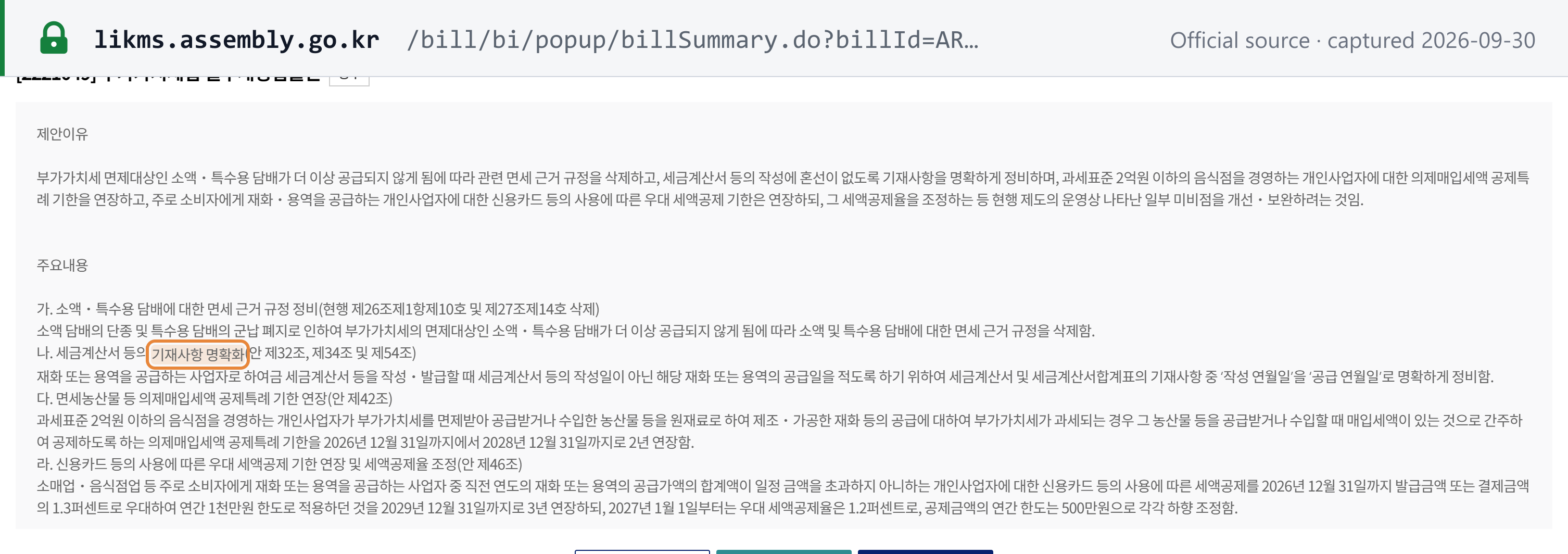
None. The Ministry of Finance and Economy's 2026 Tax Reform Proposal and the government VAT Act bill that followed it (Bill 2221049) contain no rate change. [10] [11]
Cross-border rules
Imports and exports
- Imports of goods. Import VAT is declared and paid to Customs together with customs duty (Art 50). The head of customs issues an import tax invoice (수입세금계산서), which supports the importer's input credit (Arts 35, 38(1)2). Qualifying small and medium-sized and mid-sized exporters can apply for import VAT deferral on raw materials and settle it in their VAT return instead (Art 50-2). [1]
- De minimis. The VAT Act exempts "small-value goods received by a resident that are exempt from customs duty" (Art 27(6)), so the low-value import relief follows the customs-duty exemption, which is set in customs law rather than the VAT Act. [1]
- Exports. Exported goods, services supplied abroad and international transport are zero-rated (Arts 21–23), with full input recovery and access to early refunds — see Refunds.
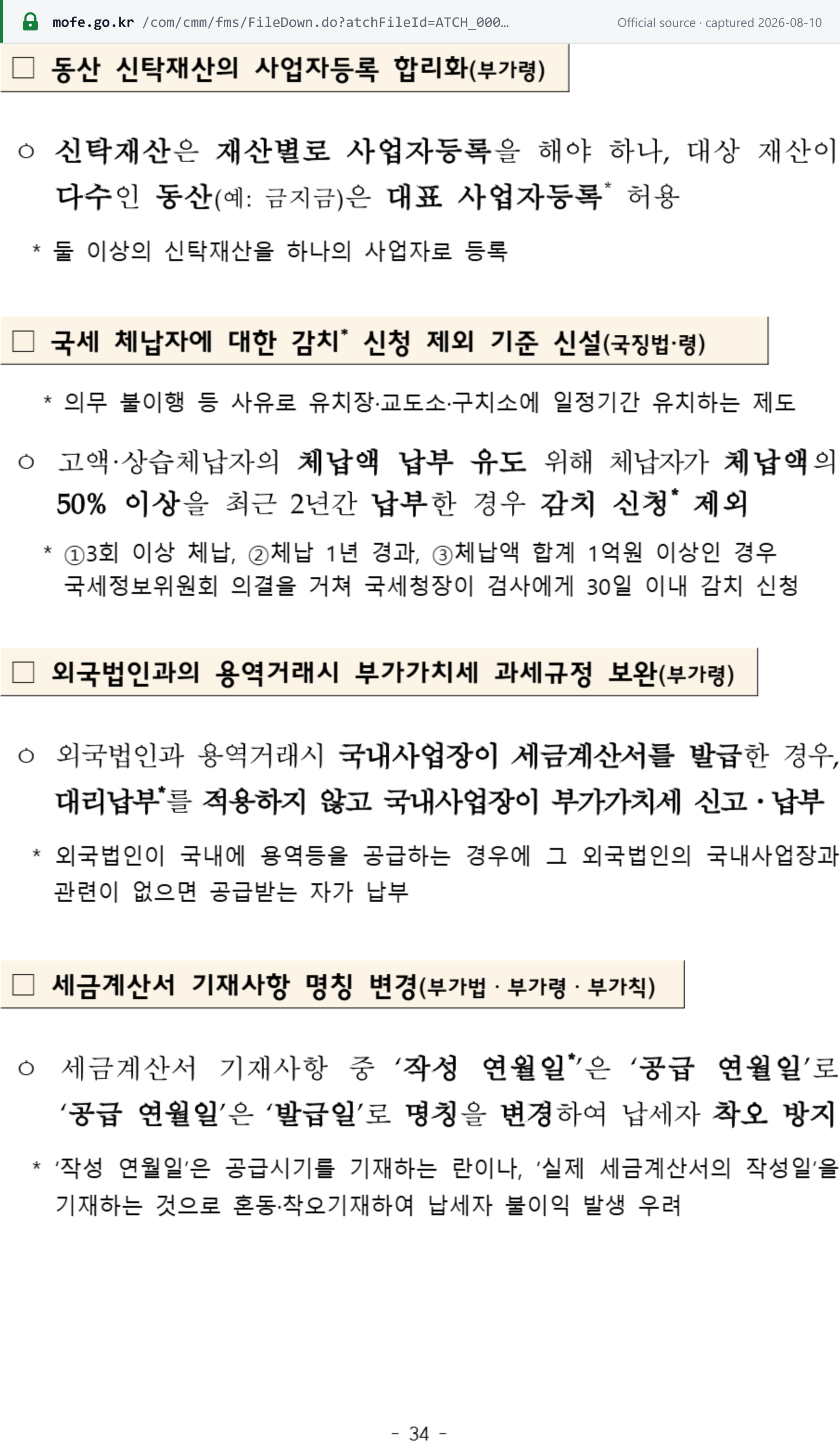
- Imported services — proxy payment (대리납부), Korea's reverse charge. Where services or rights are supplied in Korea by a non-resident or foreign corporation without a Korean permanent establishment, or by one with a PE where the supply is unconnected with it, the recipient withholds the VAT from the payment and pays it with a proxy-payment return (Art 52(1)–(2); Decree Art 95). The obligation applies only where the recipient does not use the service in its taxable business — that is, exempt businesses, non-business recipients, and businesses whose input VAT on the service would be blocked. A fully taxable business recipient has nothing to self-account, because output and input would cancel. Proxy payment follows the preliminary and final return deadlines (Art 52(2)). [1] [2]

For how this compares with other countries' reverse-charge rules, see What is reverse charge?.
Digital products and services
A foreign business supplying electronic services to Korea must complete simplified business registration (간편사업자등록) within 20 days of starting, online through the NTS system (Act Art 53-2(1); Decree Art 96-2(3)). Electronic services cover games, audio and video files, electronic documents and software, and improvements to them; advertising; cloud computing services; intermediation of goods, services or rentals in Korea; and similar services (Decree Art 96-2(1)–(2)). Art 53-2(1) sets no threshold. [1] [2]

Simplified registrants file and pay on the preliminary and final cycle — in practice quarterly, by the 25th of the following month (Art 53-2(4)) — online (Decree Art 96-2(5)), paying into a foreign-exchange bank account (Decree Art 96-2(6)). They may convert foreign-currency sales at the base exchange rate on the last day of the period (Decree Art 96-2(7)), credit input VAT only where it is deductible under Arts 38–39 (Art 53-2(5)), keep transaction records for 5 years after the final-return deadline (Art 53-2(6)), and must produce a statement of their electronic-service transactions within 60 days of an NTS request (Art 53-2(7)–(8)). They issue no tax invoice for these supplies (Decree Art 71(1)8). Registering late costs 1% of the supply value from the start of business to the day before registration, for supplies from 1 January 2024 (Art 60(1)1-2). [1] [2]
See also VAT on digital services by non-resident suppliers.
Foreign companies selling into South Korea — B2B and B2C
The two answers differ, and the customer's status decides which applies: [1]
| Situation | Who accounts for the 10% | Source |
|---|---|---|
| B2B services or rights, foreign seller with no Korean PE | The foreign seller does not register. A customer using the service in its taxable business has nothing to account; an exempt, non-business or input-blocked customer withholds and pays by proxy payment | Art 52 |
| B2B electronic services to a Korean-registered operator for its taxable or exempt business | Outside simplified registration — the bracket in Art 53-2(1) excludes them; proxy payment rules above apply | Art 53-2(1) |
| B2C electronic services | The foreign seller registers under simplified business registration within 20 days of starting, no threshold, and files quarterly — unless a platform is the deemed supplier | Art 53-2(1), (2), (4) |
| Goods | VAT is collected by Customs from the importer at import; a foreign seller with a fixed place of business in Korea registers under Art 8 like any operator | Arts 50, 8 |
| Foreign company with a Korean PE | A supply connected with the PE is the PE's own supply; proxy payment applies only to supplies unconnected with it | Art 52(1)2 |
Proposed change for PEs (not in force). The 2026 Tax Reform Proposal (Ministry of Finance and Economy, published 3 August 2026) includes an Enforcement Decree amendment: where the Korean place of business of a foreign corporation issues the tax invoice for a services transaction, proxy payment would not apply and the PE would report and pay the VAT itself. This is a Decree item, not part of the National Assembly bill; Decree items are made by Presidential Decree, normally in the regular revision early the following year. Status as of 2026-09-30: proposed. [10] — see the event record.
Marketplace / platform deemed-supplier liability
- Electronic services through platforms. Where a foreign supplier sells electronic services through an open market, a payment-collecting intermediary or a similar third party — including a foreign one — the platform is treated as the supplier and must register itself (Art 53-2(2)). [1]
- Agents for foreign suppliers. Where a foreign business supplies services or rights in Korea through a registered commission agent, agent, or broker that collects the price, the agent is treated as the supplier (Art 53(1)), and the tax invoice carries the foreign supplier's name and address (Decree Art 69(19)). [1] [2]
- Quarterly data reporting. Online marketplace operators, payment agents, e-money businesses, specialised foreign-exchange businesses and similar businesses must file sales and settlement details by the 15th of the month after each quarter (Art 75(1)). Since 1 July 2025 this includes their non-resident and foreign counterparts (Art 75(1)6, added by Act No. 20776). Breaching a correction order carries an administrative fine of up to KRW 20 million (Art 76(1)2). [1]
See also Marketplace deemed-supplier rules.
Place of supply
- Goods: where transport begins; or, if the goods do not move, where they are at the time of supply (Art 19(1)).
- Services: where the service is performed or the goods or rights are used (Art 20(1)1); for international transport by a non-resident or foreign corporation, the place of boarding or loading (Art 20(1)2); for electronic services under Art 53-2, the customer's place of business, address or residence (Art 20(1)3).
- Rights supplied by a foreign business: the customer's Korean place of business or address (Art 53(2)).
Invoice requirements
Mandatory content
A tax invoice (세금계산서) is required for every taxable supply; exempt supplies are excluded (Art 32(1)). The Act lists four mandatory particulars (필요적 기재사항). A missing or wrong one blocks the buyer's input credit (Art 39(1)2) and costs the issuer a 1% penalty (Art 60(2)5). The Decree adds the other particulars (Decree Art 67(2)). [1] [2]
| Field | Status | Source |
|---|---|---|
| Supplier's registration number and name or trade name | Mandatory | Act Art 32(1)1 |
| Recipient's registration number — or its unique number or resident registration number where the buyer is not a registered operator | Mandatory | Act Art 32(1)2 |
| Supply value and VAT amount | Mandatory | Act Art 32(1)3 |
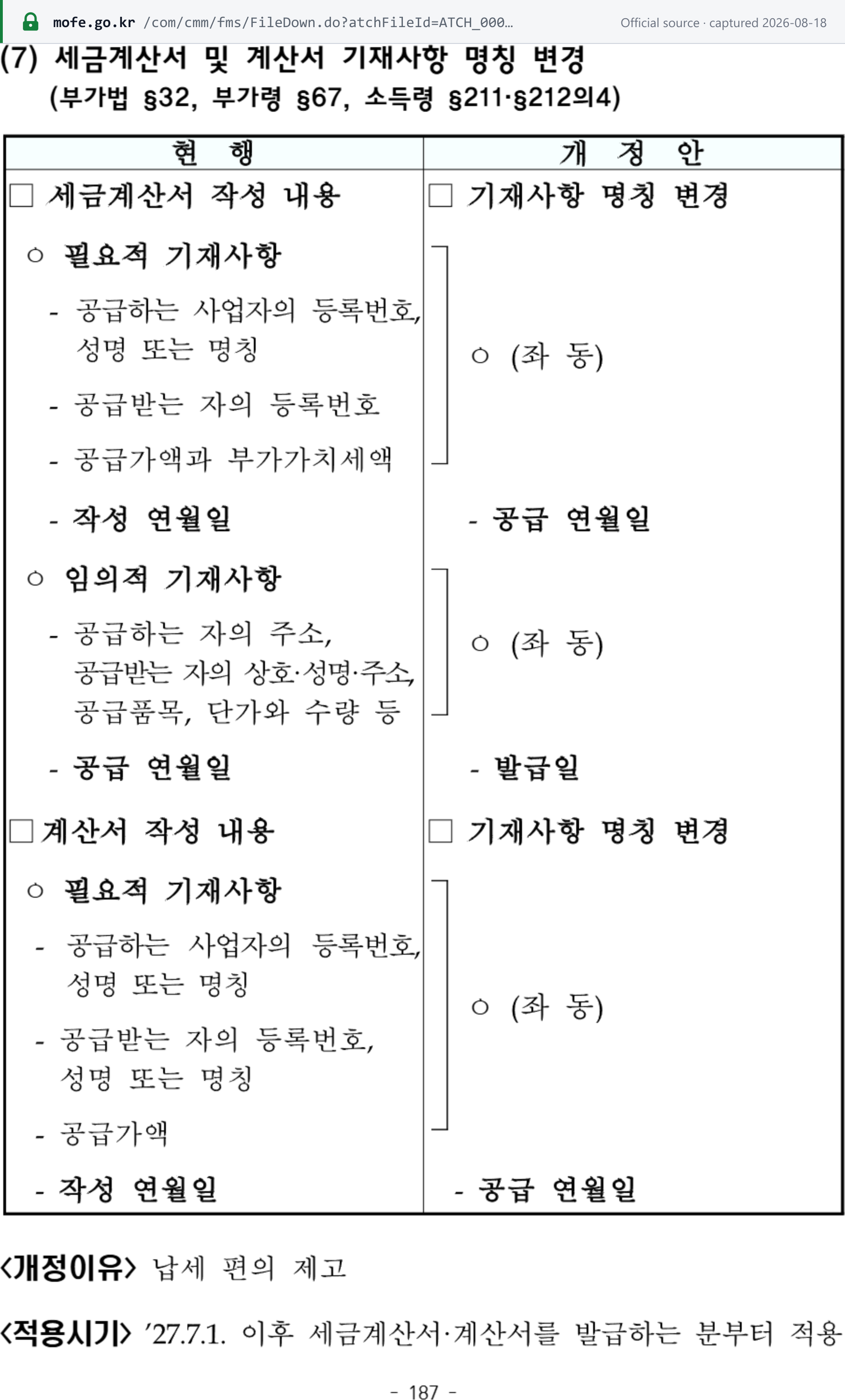
| Date of preparation (작성 연월일) — must carry the time of supply | Mandatory (proposed rename, see below) | Act Art 32(1)4 |
| Supplier's address | Other particular | Decree Art 67(2)1 |
| Recipient's trade name, name and address | Other particular | Decree Art 67(2)2 |
| Business type and item (업태·종목) of both parties | Other particular | Decree Art 67(2)3 |
| Items supplied | Other particular | Decree Art 67(2)4 |
| Unit price and quantity | Other particular | Decree Art 67(2)5 |
| Date of supply (공급 연월일) | Other particular (proposed rename, see below) | Decree Art 67(2)6 |
| Type of transaction | Other particular | Decree Art 67(2)7 |
| For business-unit taxpayers: the branch that actually supplied or received | Other particular | Decree Art 67(2)8 |
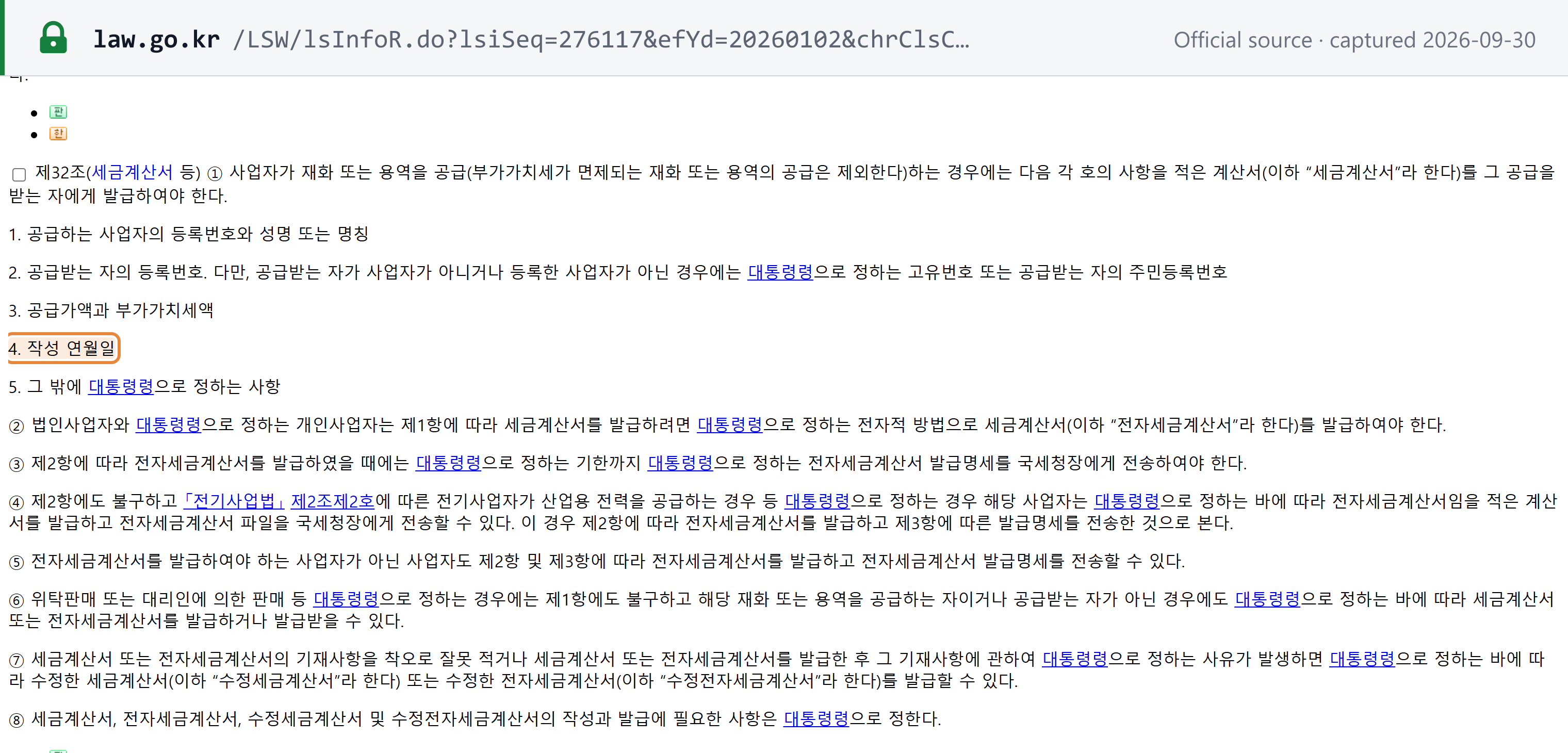
Proposed: the date fields are to be renamed (not enacted). The 2026 Tax Reform Proposal would rename the mandatory 작성 연월일 ("date of preparation") to 공급 연월일 ("date of supply"), and the existing optional 공급 연월일 to 발급일 ("date of issue"). The stated reason is that taxpayers misread the mandatory field as the date the invoice was drawn up, when it must carry the time of supply. The detailed proposal applies the change to tax invoices and invoices issued on or after 1 July 2027. The Act-level half (Arts 32, 34 and 54) is item 나 of government Bill 2221049, submitted on 3 September 2026 and pending in committee; the 공급 연월일 → 발급일 half sits in the Decree and the Enforcement Rule. Status as of 2026-09-30: proposed. [10] [11] — see the event record.
Issuance deadline
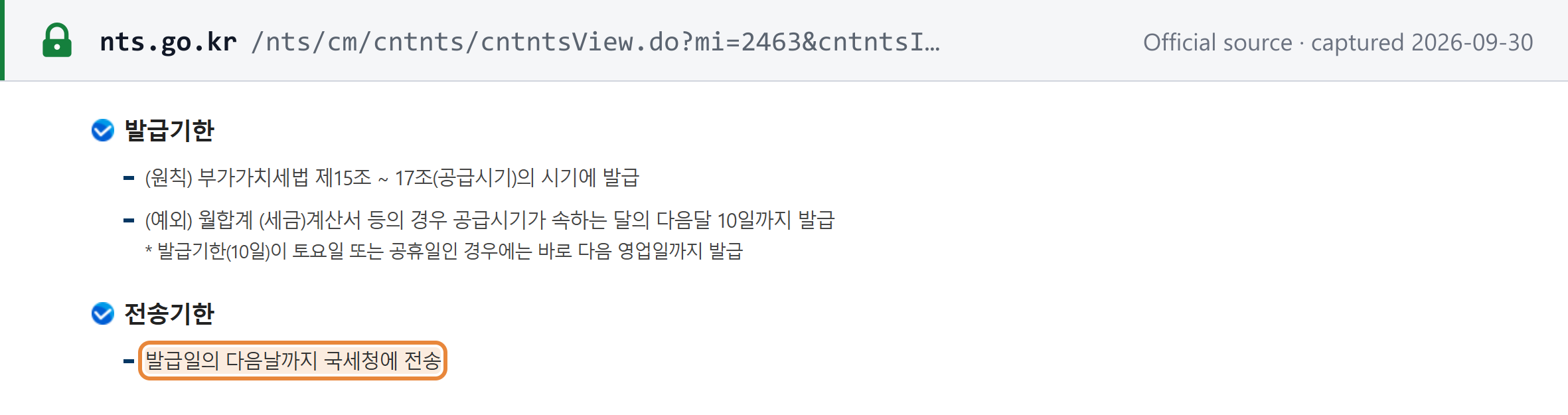
Issue the tax invoice at the time of supply under the supply-time rules of Arts 15–16 (Art 34(1)); early issue is allowed in the Art 17 cases (Art 34(2)). A monthly consolidated invoice — one per customer for a calendar month, or a shorter period within the month, dated the last day — or an invoice dated the actual transaction day where documents prove it, may be issued by the 10th of the following month, or the next business day where the 10th is a Saturday or public holiday (Art 34(3)). An electronic tax invoice is then transmitted to the NTS by the day after issue — a separate deadline, covered under E-invoicing status. [1] [5]
Numbering and sequencing
The VAT Act (Arts 32–36) and Enforcement Decree (Arts 67–73) set no sequential-numbering rule for tax invoices. Electronic tax invoices carry an approval number from the NTS system. [1] [2]
Credit and debit notes
There is no separate credit-note document. Corrections are made with an amended (electronic) tax invoice (수정세금계산서) (Act Art 32(7)), on nine grounds set out in Decree Art 70(1): [2]
- goods returned — dated the day of return, with a negative amount;
- contract cancelled — dated the day of cancellation, negative;
- price increased or reduced — dated the day the change arises, additions in black and reductions negative;
- a local letter of credit or purchase confirmation obtained within 25 days after the period — re-issued at 0%;
- a clerical error in required particulars — the original reversed and a correct invoice issued, unless a tax audit or similar notice has been received;
- other errors — within 1 year after the final-return deadline;
- an electronic invoice issued twice by mistake;
- an invoice issued for an exempt or non-invoice transaction;
- the wrong rate applied.
Negative amounts are shown in red or with a minus sign.
Currency and language
Where the price is in foreign currency, the taxable value is the KRW amount actually converted if converted before the time of supply; otherwise the amount at the base rate or arbitrage rate under the Foreign Exchange Transactions Act on the time of supply (Decree Art 59). Simplified e-service registrants may use the period-end base rate instead (Decree Art 96-2(7)). The Act and Decree contain no rule on invoice language; electronic tax invoices are issued in the NTS standard format. [2]
Document types
| Document | When | Source |
|---|---|---|
| Tax invoice (세금계산서) | The general rule for taxable supplies | Act Art 32 |
| Receipt (영수증) instead of a tax invoice | Businesses supplying mainly non-business customers — retail, restaurants, lodging, hairdressing and baths, passenger transport, ticketed admission and similar — and simplified taxpayers under KRW 48 million or in their first period. Credit-card slips and cash receipts count as receipts. A buyer who shows a business registration certificate can demand a tax invoice in prescribed cases | Act Art 36(1), (3), (5); Decree Art 73(1) |
| Import tax invoice (수입세금계산서) | Issued by Customs on imports | Act Art 35 |
| No invoice | Taxis and street vendors; retail and hairdressing or bath services unless the buyer asks (retail); deemed supplies; most exports and services abroad; supplies to diplomatic missions; electronic services by simplified registrants; supplies to non-residents without a Korean PE unless they prove business status and ask | Decree Art 71(1) |
| Invoice (계산서) for exempt supplies | Exempt supplies are outside the tax invoice (Act Art 32(1)); they are documented with an invoice (계산서), for which the NTS runs a parallel electronic invoice (전자계산서) obligation | Act Art 32(1); NTS [4] |
There is no monetary threshold for the receipt option: it depends on the type of business and taxpayer class, not on invoice value. [1] [2]
Self-billing
General self-billing is not provided for. The one buyer-issued form is the purchaser-issued tax invoice (매입자발행세금계산서): where a supplier obliged to issue a tax invoice fails to — including on bankruptcy or closure, or where the supplier cannot be found — the buyer may issue one after confirmation by its tax office and claim input credit on it (Act Art 34-2). The buyer applies within 1 year after the end of the taxable period of the supply, with evidence (Decree Art 71-2(3)), and only for transactions of KRW 50,000 or more each, VAT included (Decree Art 71-2(4)). [1] [2]
Retention and audit trail
Retention: 5 years after the final-return deadline of the period, for books and for all tax invoices, import tax invoices and receipts issued or received (Art 71(3)). Exception: an operator that issued electronic tax invoices and transmitted them to the NTS need not keep those — the NTS holds the record (Art 71(3) proviso). Books must record the supplier and recipient, items, values, and output and input tax (Decree Art 117(1)). [1] [2]

Audit trail. Tamper-evidence is built into issuance: an electronic tax invoice must pass through a certification system that verifies the issuer's identity and whether the invoice has been altered (Decree Art 68(5)). The permitted channels are a registered ERP system, a registered issuing-agent (ASP) system, the NTS system (Hometax), or an NTS-designated point-of-sale or cash-receipt device (Decree Art 68(5)1–4), and ERP and ASP operators must register with the NTS in advance (Decree Art 68(6)). [2]
A specimen of a compliant invoice
The NTS prescribes the tax invoice form in the Enforcement Rule annex, but no officially annotated specimen is reproduced here. The example below is LookupTax's own illustration of where the Act Art 32(1) and Decree Art 67(2) fields sit. All names, numbers and figures are fictional:
Electronic Tax Invoice (전자세금계산서)
| Date of supply (공급 연월일)Decree Art 67(2)6 | ItemDecree Art 67(2)4 | Quantity × unit priceDecree Art 67(2)5 | Supply value | VAT |
|---|---|---|---|---|
| 09-15 | Office desks | 10 × KRW 100,000 | KRW 1,000,000 | KRW 100,000 |
- Supply value (공급가액)Act Art 32(1)3
- KRW 1,000,000
- VAT at 10% (세액)Act Art 32(1)3; Art 30
- KRW 100,000
- Total
- KRW 1,100,000
- The four mandatory particulars are the supplier number and name, the recipient number, the supply value and VAT, and the 작성 연월일. A missing or wrong one blocks the buyer’s input credit.
- Proposed, not enacted (as of 30 September 2026): for invoices issued on or after 1 July 2027, 작성 연월일 would be renamed 공급 연월일 (date of supply) and the current 공급 연월일 field renamed 발급일 (date of issue).
- An electronic tax invoice is digitally signed, delivered to the buyer’s designated inbox or the NTS system, and transmitted to the NTS by the day after issue; the NTS system adds its own approval number.
E-invoicing status
Status (as of 2026-09-30): mandatory for all corporations and for individual operators at or above KRW 80 million of prior-year supply value per place of business. Corporations and decree-designated individuals must issue tax invoices electronically (Act Art 32(2)) and transmit the issuance details to the NTS by the day after the issue date (Act Art 32(3); Decree Art 68(7)). Any other operator may issue electronically by choice (Act Art 32(5); Decree Art 68(10)). [1] [2] [5]
System. The NTS electronic tax invoice system (전자세금계산서, via Hometax) is the hub, alongside NTS-registered ERP and ASP systems and designated devices (Decree Art 68(5)–(6)). There is no Peppol or other network. An invoice counts as received when it reaches the buyer's designated inbox or the NTS system, and the NTS system is the default inbox where the buyer has none (Decree Art 68(11)–(12)). The NTS states that an SMS or link notice, or an unsigned file, is not issuance: issuance is complete when a digitally signed file generated in the e-(tax) invoice standard reaches the buyer's inbox. [2] [5]
Phase timeline
The NTS publishes the rollout; individuals are measured on prior-year supply value per place of business, taxable and exempt combined: [4]
| From | Who must issue electronically |
|---|---|
| January 2010 | System introduced |
| January 2011 | All corporations |
| January 2012 | Individuals with prior-year supply value of KRW 1 billion or more |
| July 2014 | Individuals, KRW 300 million or more |
| July 2019 | Individuals, KRW 300 million or more (taxable and exempt supplies combined) |
| July 2022 | Individuals, KRW 200 million or more |
| July 2023 | Individuals, KRW 100 million or more |
| July 2024 | Individuals, KRW 80 million or more (current) |
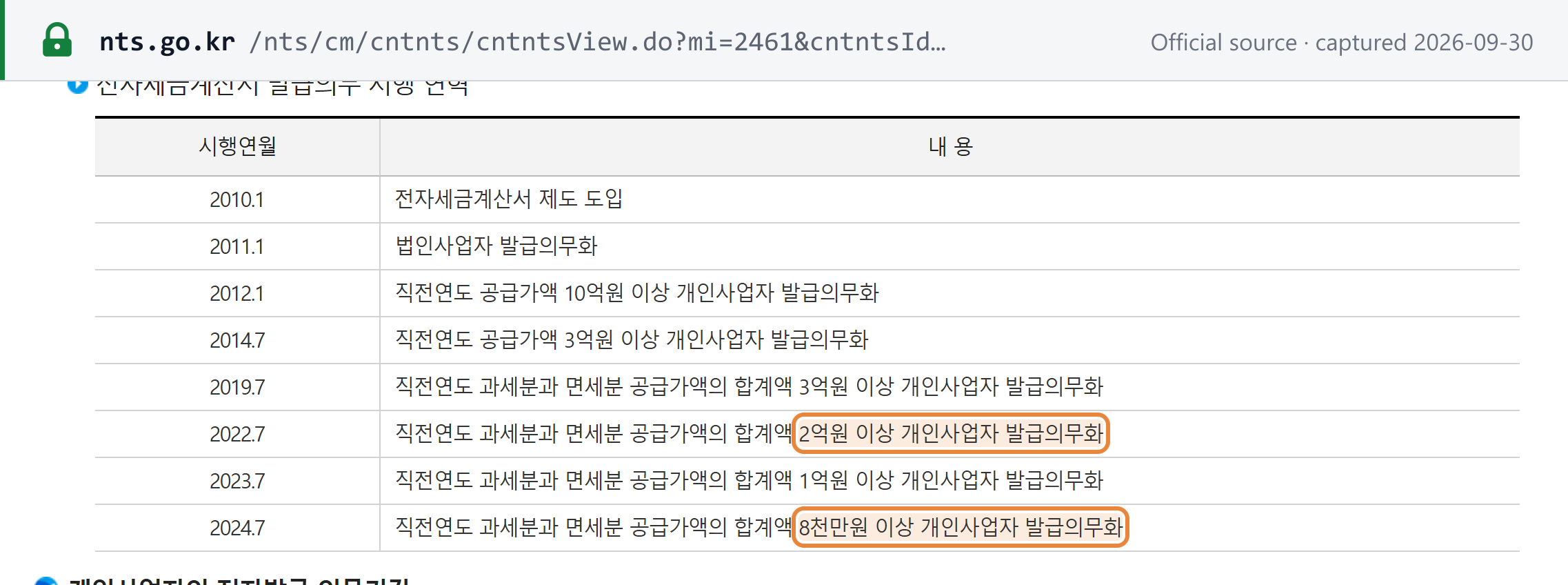
How an individual moves in. An individual whose prior-year supply value per place of business is KRW 80 million or more must issue electronically from 1 July of the following year (the start of the second taxable period), and stays obliged even if later below KRW 80 million (Decree Art 68(1)–(2)). Where the threshold is reached through an amended return or an assessment, the obligation starts in the next period (Decree Art 68(2) proviso). The tax office must notify the operator one month before the obligation starts; if the notice arrives late, the obligation starts on the first day of the second month after it is received (Decree Art 68(3)–(4)). No further threshold cut is announced in the Act, the Decree or the 2026 proposal. [2] [4]
Format and scope
- Format. A digitally signed file in the NTS e-(tax) invoice standard (전자(세금)계산서 표준). [5]
- B2B and B2G: covered — the obligation attaches to tax invoices, so it covers every supply for which a tax invoice is issued, including to a non-business buyer identified by resident registration number (Art 32(1)2).
- B2C: retail-type supplies use receipts, credit-card slips or cash receipts (Art 36), which are outside the electronic tax invoice mandate.
- Incentives. Individual general taxpayers with prior-year supply value below KRW 300 million get a credit of KRW 200 per electronic tax invoice, capped at KRW 1 million a year, for invoices issued until 31 December 2027 (Act Art 47(1); simplified taxpayers via Art 63(4)). Electronic tax invoices transmitted by the 11th of the month after the period need not be listed per customer in the return (Act Art 54(2)). [1] [6]
Filing and payment
Filing frequency
General taxpayers file for two six-month taxable periods, each with a preliminary return for its first quarter and a final return for the half-year. Individuals (and small corporations designated by decree) do not file preliminary returns: the tax office instead assesses 50% of the previous period's tax by notice, payable by the 25th after the preliminary period, and does not collect amounts under KRW 500,000 (Art 48(3)). They may file an actual preliminary return where business has deteriorated (Art 48(4)). Simplified taxpayers file one annual return; they receive a 50% interim assessment for January–June and must file an interim return if they issued a tax invoice in that half (Art 66(1), (3)). [1] [3]
Return due date
The 25th of the month after the quarter or period ends (Arts 48, 49, 67). The NTS filing table: [3]
| Period | Return | Covers | Due | Who files |
|---|---|---|---|---|
| H1 | Preliminary | 1 Jan – 31 Mar | 25 April | Corporations |
| H1 | Final | 1 Jan – 30 Jun | 25 July | Corporations and individuals |
| H2 | Preliminary | 1 Jul – 30 Sep | 25 October | Corporations |
| H2 | Final | 1 Jul – 31 Dec | 25 January of the following year | Corporations and individuals |
| Year | Final | 1 Jan – 31 Dec | 25 January of the following year | Simplified taxpayers |
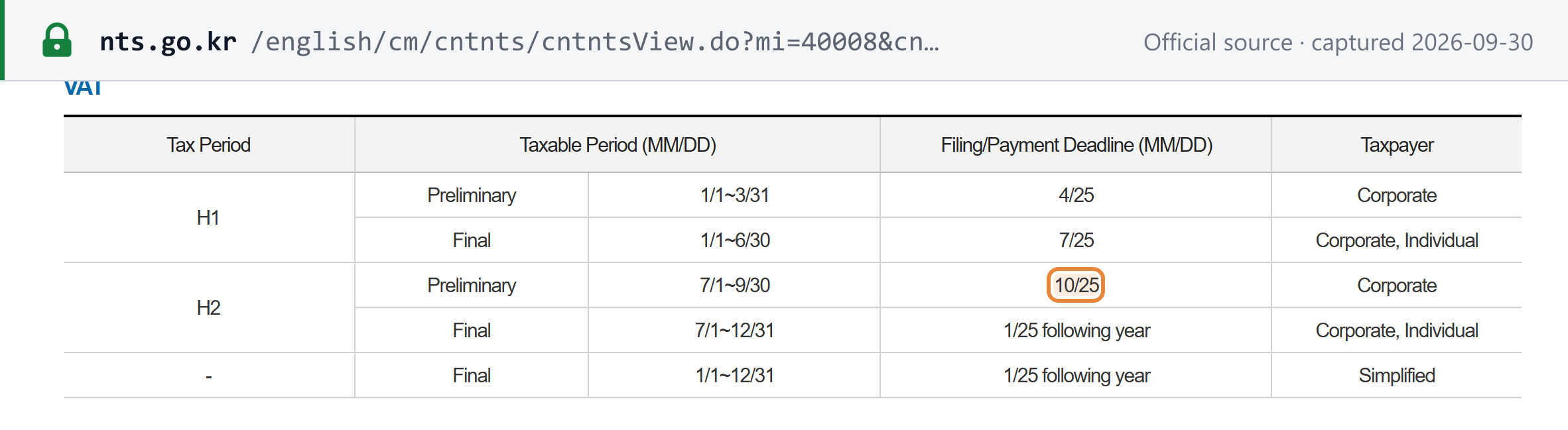
A business that closes files its final return by the 25th of the month after the month of closure (Art 49(1)). A due date that falls on a Saturday or public holiday moves to the next business day (Framework Act on National Taxes Art 5(1)). [7]
Payment due date and method
Payment is due with the return, to the tax office, the Bank of Korea or a post office (Arts 48(2), 49(2)). Simplified e-service registrants pay into a foreign-exchange bank account (Decree Art 96-2(6)). [1]
Additional listings
- Sales and purchase tax invoice summary tables (매출·매입처별 세금계산서합계표) with each preliminary and final return (Art 54(1)) — not required for electronic tax invoices transmitted to the NTS by the 11th of the month after the period (Art 54(2)).
- Cash-sales statement for businesses in real estate, professional, scientific and technical services, health, other personal services, and — for returns filed from 1 April 2026 — media-content creation (Art 55(1); Act No. 21218).
- Rental supply-value statement for real-estate lessors (Art 55(2)).
- Export documents attached by zero-rated suppliers (Art 56).
- Government bodies that receive tax invoices file purchase summaries within 25 days after the period (Art 54(5)).
- Platforms and payment agents: quarterly data by the 15th (Art 75) — see Marketplace / platform deemed-supplier liability.
There is no separate annual VAT return beyond the final returns and no EC-sales-list equivalent (VAT Act). [1]
Input-tax recovery and blocked items
VAT on goods and services used, or to be used, for the business — including proxy-paid VAT and import VAT — is credited in the period of receipt or import (Art 38). Blocked (Art 39(1)): [1]
- purchases not listed, or mis-listed, in the purchase summary (item 1);
- purchases with no tax invoice, or with one missing or misstating a mandatory particular (item 2);
- expenditure not directly related to the business (item 4);
- purchase, lease and running costs of passenger cars subject to Individual Consumption Tax, except cars used directly in transport, car sales and similar businesses (item 5);
- business entertainment expenses (기업업무추진비) (item 6);
- inputs for exempt businesses, and land-related inputs (item 7);
- pre-registration inputs, subject to the 20-day grace described under Voluntary registration (item 8).
A business making both taxable and exempt supplies apportions common inputs by the exempt-supply ratio (Art 40), recomputed for depreciable assets where the ratio moves by 5% or more (Art 41). Card slips and cash receipts that show VAT separately support input credit with a receipt statement (Art 46(3)). A deemed input credit applies to VAT-exempt farm and fishery inputs used in taxable supplies (Art 42).
Refunds
- Standard refund: excess input VAT is refunded within 30 days after the final-return deadline (Art 59(1)).
- Early refund (조기환급): for zero-rated supplies, acquiring or expanding business facilities, or businesses under a financial restructuring plan (Art 59(2)) — paid within 15 days after the (preliminary) return deadline (Art 59(1); Decree Art 107(1)).
- Bad-debt relief: the supplier deducts 10/110 of the bad debt in the period it becomes irrecoverable — on bankruptcy, enforcement or other decree grounds — filing with the final return, and the customer reverses its input credit (Art 45).
- Non-resident refund scheme: none in the VAT Act.
Exemptions
Exempt supplies
Exempt under Art 26(1): [1]
- unprocessed foodstuffs (edible agricultural, livestock, fishery and forestry products) and certain domestic non-edible primary products;
- tap water; coal briquettes and anthracite; feminine hygiene products;
- medical and health services (including veterinary) and blood; education services within the decree's scope;
- passenger transport, except aircraft, express and chartered buses, taxis, special vehicles and vessels, high-speed rail and tourist transport;
- books (including lending), newspapers, magazines, official gazettes, news agency services and broadcasting — excluding advertising;
- postage stamps, revenue stamps, lottery tickets and public telephones;
- low-price and special-purpose tobacco (proposed for repeal by Bill 2221049 — see Recent changes);
- financial and insurance services within the decree's scope;
- residential lettings and attached land; land;
- independent personal services of writers, composers and similar; artistic and cultural events and amateur sports; admission to libraries, museums, galleries, zoos and botanical gardens;
- supplies by religious, charitable, academic and similar public-interest bodies; supplies by the State and local governments; free supplies to the State, local governments and public-interest bodies.
Supplies normally incidental to an exempt supply are exempt too (Art 26(2)); imports have a parallel list in Art 27. Further exemptions sit in the Special Tax Treatment Control Act (조세특례제한법).
Exempt is not zero-rated
- Exempt: no output VAT, and input VAT on purchases for the exempt business is not deductible (Art 39(1)7); mixed businesses apportion (Art 40); the supplier issues a 계산서, not a tax invoice.
- Zero-rated: output taxed at 0%, input VAT fully deductible and refundable, with access to the 15-day early refund (Art 59(2)1).
An exempt supplier whose supply would qualify for zero-rating can waive the exemption to move into the second group (Art 28(1)1). [1]
Special regimes
- Simplified taxation for small individuals — see Threshold.
- Deemed input credit for businesses using VAT-exempt farm and fishery inputs (Art 42). Individual restaurants with a tax base of KRW 200 million or less get a preferential rate that currently runs to 31 December 2026; Bill 2221049 would extend it to 31 December 2028 (proposed).
- Credit-card and cash-receipt sales credit for consumer-facing individuals and receipt-issuing simplified taxpayers: 1.3% of card and cash-receipt sales, capped at KRW 10 million a year, until 31 December 2026; the base rule is 1% with a KRW 5 million cap (Art 46(1)3). Bill 2221049 would extend the preference to 31 December 2029 at 1.2% with a KRW 5 million cap from 1 January 2027 (proposed).
- Import VAT deferral for qualifying exporters (Art 50-2).
- Waiver of exemption (Art 28).
- Margin schemes and cash accounting: none in the VAT Act. Free zones: treatment sits outside the VAT Act.
Offences and penalties
Offences
Criminal offences sit in the Punishment of Tax Offenses Act (조세범 처벌법): [9]
| Offence | Maximum sentence | Source |
|---|---|---|
| Tax evasion — evading tax, or obtaining a refund or credit, by fraud or other wrongful acts (including double books, false evidence, destroying records, and manipulating tax invoices or their summary tables) | Imprisonment up to 2 years or a fine up to twice the evaded tax; habitual offenders face up to 50% more | Art 3(1), (4), (6) |
| Failing to issue a tax invoice, or issuing a false one, or filing a false sales summary | Imprisonment up to 1 year or a fine up to twice the VAT on the supply value | Art 10(1) |
| A buyer colluding in non-issuance or a false tax invoice | The same as above | Art 10(2) |
| Issuing or receiving tax invoices with no underlying supply (fake invoices) | Imprisonment up to 3 years or a fine up to three times the VAT on the stated supply value | Art 10(3) |
A higher tier applies to large evasion: imprisonment up to 3 years or a fine up to three times the evaded tax where the evaded tax is KRW 500 million or more, or KRW 300 million or more and 30% or more of the tax due (Art 3(1)).
Penalties
VAT Act additional taxes (가산세), as a percentage of the supply value unless stated (Art 60): [1] [6]
| Default | Penalty | Source |
|---|---|---|
| Late business registration | 1% of supplies from the start of business to the day before application | Art 60(1)1 |
| Late simplified registration (foreign e-service suppliers) | 1% | Art 60(1)1-2 |
| Trading under another person's registration | 2% | Art 60(1)2 |
| Tax invoice issued late (after the issue time, but by the final-return deadline) | 1% | Art 60(2)1 |
| Tax invoice not issued by the final-return deadline | 2% | Art 60(2)2 |
| Obliged e-issuer issuing on paper, or issuing in another branch's name | 1% | Art 60(2)2 proviso 가, 나 |
| Electronic tax invoice transmitted late (after the day after issue, by the final-return deadline) | 0.3% | Art 60(2)3 |
| Electronic tax invoice not transmitted by the final-return deadline | 0.5% | Art 60(2)4 |
| Mandatory particulars missing or wrong by error, unless the transaction is otherwise verified | 1% | Art 60(2)5 |
| Fake invoices — issued or received with no supply, including card slips | 4% (from 1 January 2026, Act No. 21218) | Art 60(3), (4) |
| Invoices in a non-supplier's or non-buyer's name; overstated supply value (on the excess) | 2% | Art 60(3) |
| Sales summary not filed or wrong / filed late with the final return | 0.5% / 0.3% | Art 60(6) |
| Purchase-side credit claimed without a proper summary | 0.5% | Art 60(7) |
| Cash-sales or rental statements not filed or wrong | 1% of the unreported amount | Art 60(8) |
| Buyer receiving a late-issued electronic tax invoice | 0.5% | NTS [6] |
| Payment-exempt simplified taxpayers failing to register | The larger of 0.5% or KRW 50,000 | Art 69(2) |
Where an issue penalty applies, the transmission penalty does not (Art 60(2)). For simplified taxpayers, only the Art 60(1) registration penalties are halved and computed on VAT-inclusive value — 1% becomes 0.5% and 2% becomes 1% (Art 68-2(1)); the invoice and transmission penalties (Art 60(2)) and the Art 60(3) penalties apply to them at the normal rates. Cap: the penalties under Art 60(1), 60(2)1 and 3–5, and 60(5)–(8) — late registration, late or paper issue, late or missing transmission, wrong particulars and the summary and statement penalties — are capped at KRW 50 million per type of breach (KRW 100 million for non-SMEs), with no cap for intentional breaches (Framework Act on National Taxes Art 49(1)3). The 2% penalty for not issuing a tax invoice (Art 60(2)2) and all Art 60(3) penalties — 4% for fake invoices, 2% for wrong-name or overstated invoices — are not capped. [6] [7]
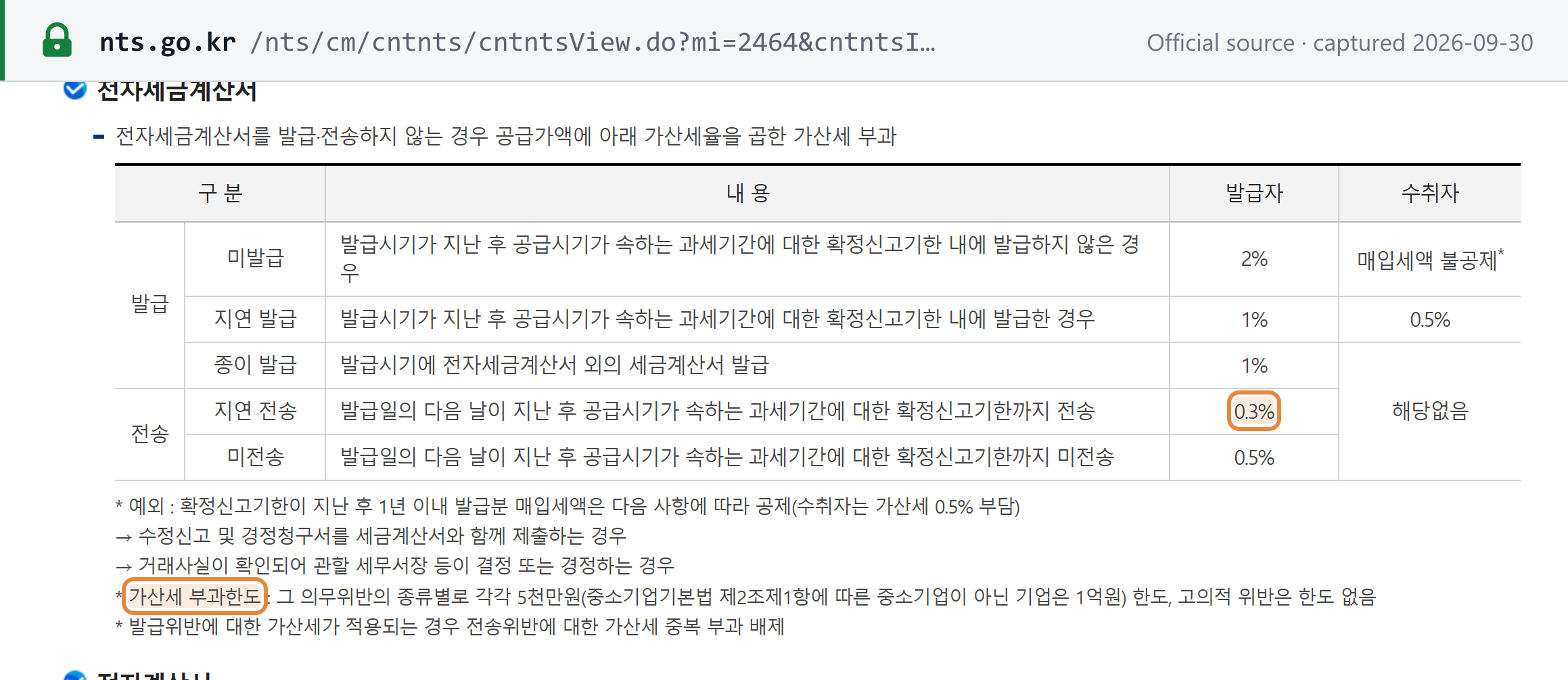
Filing and payment penalties under the Framework Act on National Taxes (국세기본법): [7] [8]
| Default | Penalty | Source |
|---|---|---|
| Failure to file (including preliminary returns) | 20% of the tax that should have been reported; 40% where fraudulent (60% for offshore transactions); plus 0.5% of an unreported zero-rated tax base | Art 47-2(1), (2)2 |
| Under-reporting, or over-claiming a refund | 10%; 40% (60% offshore) on the fraudulent part; plus 0.5% of under-reported zero-rated base | Art 47-3(1), (2)2 |
| Late payment | 0.022% per day from the day after the statutory due date to the date of the payment notice; 3% of the amount unpaid by the deadline set in the notice; and, from 1 July 2026, 0.67% a month after that designated deadline — capped at 5 years, and not applied to a notice or item under KRW 1.5 million | Art 47-4(1)1, 1의2, 2의2, 3, (7), (8); Decree Art 27-4(1), (2) |
Reductions for voluntary amended returns: 90% within 1 month, 75% within 3 months, 50% within 6 months, 30% within 1 year, 20% within 18 months and 10% within 2 years (Art 48(2)1). Obstructing an NTS order, or breaching a platform correction order, carries an administrative fine of up to KRW 20 million (VAT Act Art 76). [7] [1]
Frequently asked questions
Is there a VAT registration threshold in South Korea?
No. Every business operator — anyone who independently supplies goods or services in the course of business, whether or not for profit — must apply for business registration for each place of business within 20 days of starting business, and may apply before starting (VAT Act Art 8(1)). KRW 104 million is not a registration threshold: it is the ceiling below which an individual may be a simplified taxpayer (VAT Enforcement Decree Art 109(1)). KRW 48 million is the line below which a simplified taxpayer owes no VAT for the period (VAT Act Art 69(1)). Foreign suppliers of electronic services to consumers have their own 20-day simplified registration, also with no threshold (Art 53-2). [1] [2]
We are a foreign SaaS company and our Korean customer is a business — do we need to register for Korean VAT?
Not for that sale. Simplified business registration under VAT Act Art 53-2 covers electronic services supplied to Korea, but it excludes supplies to a Korean-registered business operator for its taxable or exempt business. For those B2B supplies the foreign seller does not register; a customer that uses the service in its taxable business has nothing to self-account, while an exempt, non-business or input-blocked customer withholds the 10% from the payment and pays it under proxy payment (Art 52). Sales to Korean consumers are different: they require simplified registration within 20 days of starting, with no threshold, and quarterly returns — unless an open market or payment intermediary is treated as the supplier (Art 53-2(2)). [1]
When must an e-tax invoice reach the NTS — the day after issue, or the 10th of the next month?
The day after issue. An electronic tax invoice must be transmitted to the National Tax Service by the day after its issue date (VAT Enforcement Decree Art 68(7)). The 10th of the following month is a different deadline: it is the latest date for issuing a monthly consolidated tax invoice covering a calendar month's supplies to one customer (VAT Act Art 34(3)), moved to the next business day when the 10th is a Saturday or public holiday. Transmitting after the next day but by the final-return deadline costs 0.3% of the supply value; not transmitting by that deadline costs 0.5% (VAT Act Art 60(2)). [5] [6]
Which date goes in the 작성 연월일 field of a tax invoice — and is that field being renamed?
Enter the time of supply, not the date you drew the invoice up. 작성 연월일 ("date of preparation") is a mandatory particular under VAT Act Art 32(1), and the government says taxpayers misread it as the drafting date. Its 2026 tax reform proposes renaming it 공급 연월일 ("date of supply") and renaming the existing optional 공급 연월일 field to 발급일 ("date of issue"), for invoices issued on or after 1 July 2027. As of 30 September 2026 this is only proposed: the Act-level change is in government Bill 2221049, pending in the National Assembly's committee, and the decree-level half is made by Presidential Decree, normally in the regular revision early the following year. [10] [11]
Do we still have to keep copies of our electronic tax invoices?
Not if they were transmitted to the NTS. Books, tax invoices, import tax invoices and receipts must be kept for 5 years after the final-return deadline of the period, but an operator that issued electronic tax invoices and transmitted them to the NTS is relieved of keeping those (VAT Act Art 71(3)). Everything else — paper tax invoices, receipts and the other records — still falls under the 5-year rule. [1]
Why was input VAT on our company car denied?
Input VAT on buying, leasing and running passenger cars subject to Individual Consumption Tax is blocked by VAT Act Art 39(1)5, unless the car is used directly in a business such as transport or car sales. Business entertainment expenses are blocked by the same article (Art 39(1)6). [1]
We are a foreign company with a Korean branch — who pays VAT on services our head office supplies to Korean customers?
A supply connected with the Korean branch is the branch's own supply, reported under its business registration. For a supply unconnected with the branch, a Korean customer that is exempt, non-business or input-blocked applies proxy payment (VAT Act Art 52(1)2). The 2026 tax reform proposes an Enforcement Decree change: where the Korean place of business issues the tax invoice for a services transaction, proxy payment would not apply and the branch would report and pay the VAT itself. That change is proposed, not in force, as of 30 September 2026. [1] [10]
Has the 2026 tax reform changed Korean VAT yet?
No. The rate stays 10% and the reform contains no rate change. The cabinet approved the government's tax bills on 1 September 2026, and the VAT Act amendment, Bill 2221049, was submitted to the National Assembly on 3 September 2026. As of 30 September 2026 it is pending in committee. Its four items — repealing the exemption for low-price and special-purpose tobacco, renaming 작성 연월일 to 공급 연월일, extending the restaurant deemed-input preference to 31 December 2028, and extending the card-sales credit to 31 December 2029 at 1.2% with a KRW 5 million cap from 1 January 2027 — all remain proposals until enacted. [11] [13]
Important websites
| Site | Purpose |
|---|---|
| Hometax (홈택스) | Business registration, VAT returns and payment, electronic tax invoice issuance, and simplified business registration and filing for foreign e-service suppliers |
| NTS English site | Filing deadlines, forms and tax office contacts in English |
| NTS — VAT on Electronic Services (English) | Entry point for foreign e-service suppliers to the Hometax simplified registration and filing service |
| Korea Customs Service | Import VAT, collected with customs duty |
| National Law Information Center — VAT Act | Current consolidated text of the VAT Act (and its Enforcement Decree) |
| National Assembly Bill Information System | Tracking Bill 2221049 and other tax bills |
Rate lookup: not applicable — there is a single 10% rate. To check a Business Registration Number's format, use Lookuptax's South Korea BRN validator; for official lookup links worldwide, see Official links to check VAT numbers.
Recent changes
-
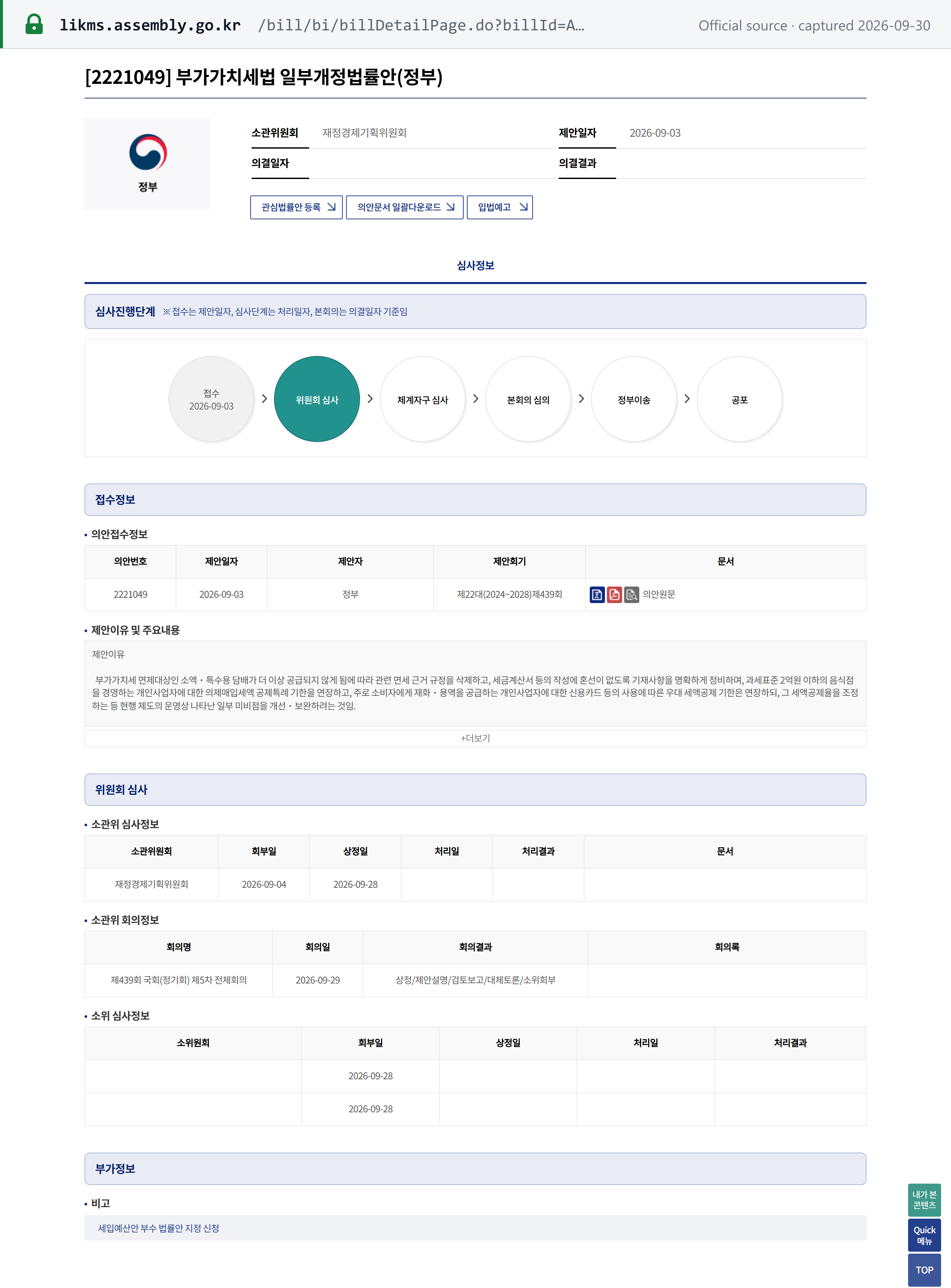
2026-09-03 — The government's VAT Act amendment, Bill 2221049, was submitted to the National Assembly: repeal of the low-price and special-purpose tobacco exemption, renaming 작성 연월일 to 공급 연월일, the restaurant deemed-input preference extended to 31 December 2028, and the card-sales credit extended to 31 December 2029 at 1.2% (KRW 5 million cap) from 1 January 2027. Pending in committee as of 2026-09-30 — proposed, not enacted. (National Assembly) [12] — see event
-
2026-09-01 — The cabinet approved the government's 2026 tax reform bills for submission to the National Assembly by 3 September. (Ministry of Finance and Economy)
-
2026-08-03 — The 2026 Tax Reform Proposal proposed renaming the tax invoice date fields for invoices issued from 1 July 2027, and letting a foreign corporation's Korean PE self-account when it issues the tax invoice (Decree item) — both proposed. (Ministry of Finance and Economy) — see event
-
2026-04-01 — The cash-sales statement extended to media-content creators, for returns filed from this date (Act No. 21218). (National Law Information Center)
-
2026-01-01 — The penalty for fake tax invoices set at 4% of the supply value (Act No. 21218). (National Law Information Center)
-
2025-07-01 — Quarterly sales-data reporting extended to non-resident and foreign marketplace and payment businesses (Art 75(1)6, Act No. 20776). (National Law Information Center)
-
2024-07-01 — The electronic tax invoice threshold for individuals lowered to KRW 80 million of prior-year supply value. (National Tax Service)
Ahead — the government has requested that Bill 2221049 be designated a bill accompanying the 2027 revenue budget; the reform's Decree items are made by Presidential Decree, normally in the regular revision early the following year. For the full chronology, see South Korea tax changes on Lookuptax.
Reference links
- National Law Information Center — Value-Added Tax Act (부가가치세법)
- National Law Information Center — Enforcement Decree of the Value-Added Tax Act (부가가치세법 시행령)
- National Tax Service (English) — Filing returns: filing deadlines
- National Tax Service — Electronic tax invoice: who must issue (발급의무대상자)
- National Tax Service — Issue timing and issue and transmission deadlines (발급시기 및 발급·전송기한)
- National Tax Service — Benefits and penalties (혜택과 가산세)
- National Law Information Center — Framework Act on National Taxes (국세기본법)
- National Law Information Center — Enforcement Decree of the Framework Act on National Taxes
- National Law Information Center — Punishment of Tax Offenses Act (조세범 처벌법)
- Ministry of Finance and Economy — 2026 Tax Reform Proposal, outline (PDF)
- National Assembly — Bill 2221049, proposal reasons and main contents
- National Assembly — Bill 2221049, bill details
- Ministry of Finance and Economy — Government 2026 tax reform bills finalised (1 September 2026)
Related Lookuptax pages: