Sri Lanka VAT guidelines
| FACTSHEET | |
|---|---|
| Country code | LK |
| Tax name | Value Added Tax (VAT) |
| Tax Authority | Inland Revenue Department (IRD) |
Overview
Sri Lanka levies Value Added Tax under the Value Added Tax Act, No. 14 of 2002, administered by the Inland Revenue Department (IRD). The standard rate is 18%, in effect since 1 January 2024. [1]
The most recent major amendment is the Value Added Tax (Amendment) Act, No. 14 of 2026, certified on 30 June 2026 and published as a supplement to the Gazette of 3 July 2026. It brings non-resident digital services into VAT from 1 July 2026, raises the financial-services rate to 20.5%, and tightens invoicing and compliance rules. [2]
TIN and VAT registration
- Every taxpayer first obtains a Taxpayer Identification Number (TIN) — a 9-digit number — from the IRD, which can be requested through the IRD e-Services (RAMIS) portal. [1] [2]
- After obtaining a TIN, the taxpayer registers for VAT as a tax type (mandatorily once over the threshold, or voluntarily), with documentary proof of taxable supplies. [2]
- A Temporary VAT registration is available for import/export activities via Sri Lanka Customs for persons without a permanent VAT registration, and a Simplified VAT (SVAT) scheme operates for exporters and other specified categories. [2]
Registration threshold
Registration is mandatory when the value of taxable supplies of goods or services (other than financial services) exceeds:
- LKR 15 million per quarter, or
- LKR 60 million per 12-month period (with effect from 1 January 2024). [1]
The 2026 Budget proposed cutting the annual threshold to LKR 36 million from 1 July 2026 (VAT (Amendment) Bill No. 65, gazetted 29 April 2026), but the cut was dropped before enactment — the VAT (Amendment) Act No. 14 of 2026 keeps the threshold at LKR 60 million. [2] [3]
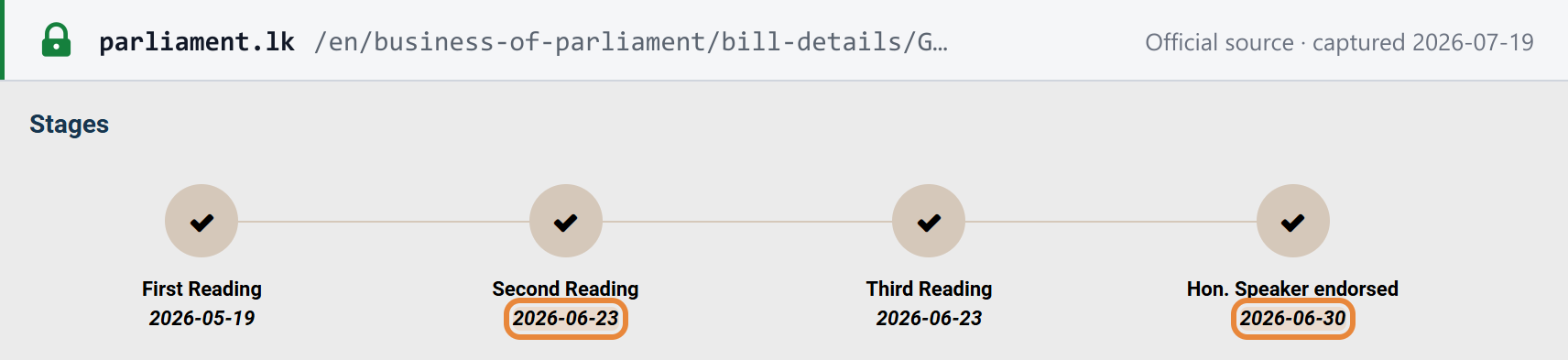 Source snapshot captured 19 July 2026 — original (Parliament of Sri Lanka)
Rates
| Rate | Applies to |
|---|---|
| 18% (standard) | Most taxable supplies of goods and services, since 1 January 2024 [1] |
| 20.5% | Supply of financial services, for taxable periods commencing on or after 1 July 2026 (18% for periods ending on or before 30 June 2026) [2] |
| 0% (zero-rated) | Exports of goods [1] |
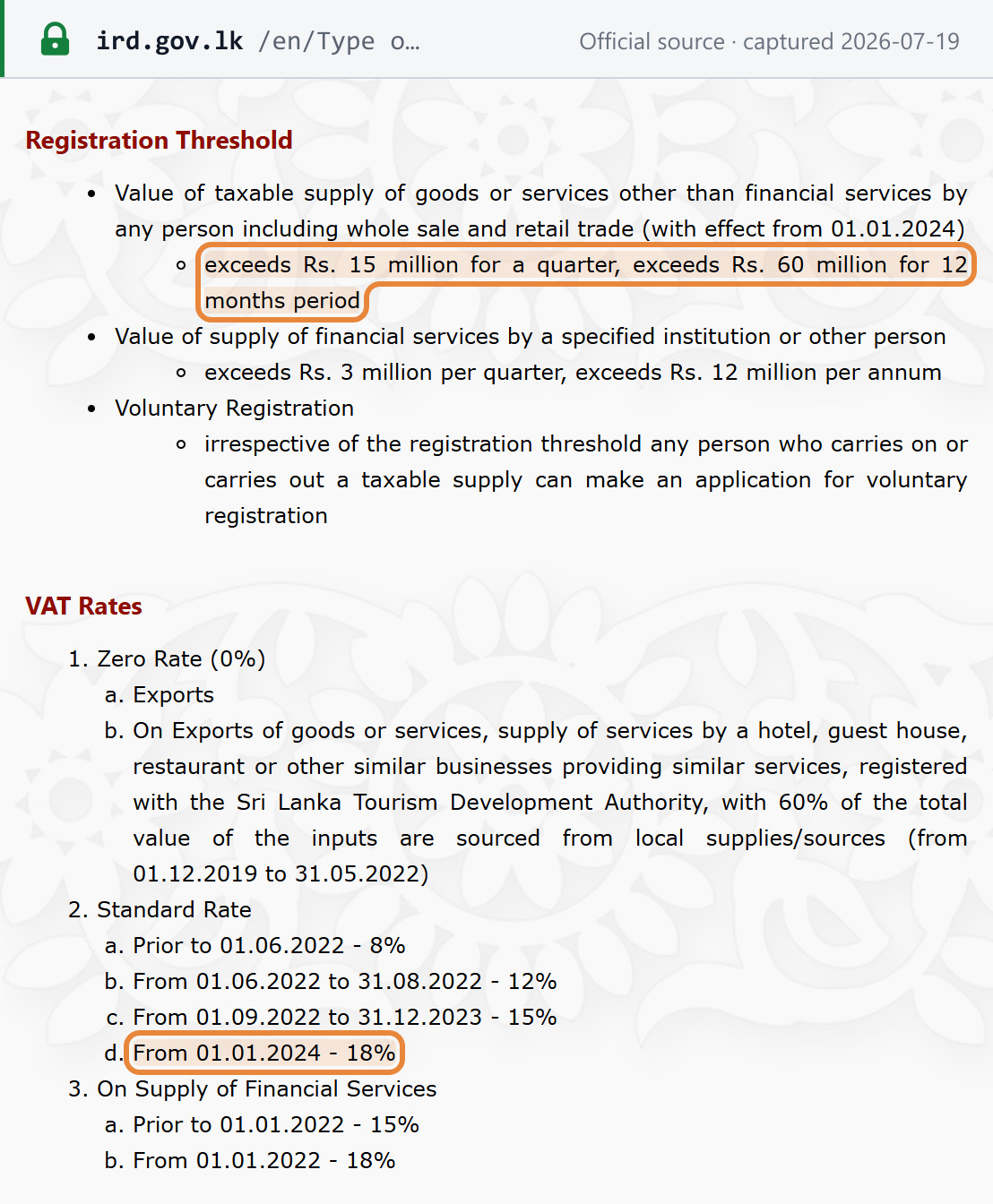 Source snapshot captured 19 July 2026 — original (Inland Revenue Department)
VAT on non-resident digital services
From 1 July 2026, 18% VAT applies to services supplied by a non-resident person through an electronic platform to a person in Sri Lanka. The charge was originally legislated by the VAT (Amendment) Act No. 04 of 2025 with effect from 1 October 2025, was postponed twice, and the VAT (Amendment) Act No. 14 of 2026 fixed the statutory effective date at 1 July 2026. [1] [2] [3]
Key rules under the new Chapter IIIC of the VAT Act: [1]
- Registration threshold: supplies exceeding LKR 60 million (or equivalent in another currency) in the 12 months then ending, or LKR 15 million in a quarter, on or after 1 July 2026. Application is made electronically within three months.
- Location of the customer: a recipient is deemed to be in Sri Lanka when two or more of these indicators are met — billing/residential/business address in Sri Lanka; payment made through a bank or financial institution in Sri Lanka; payment instrument issued in Sri Lanka; IP address of the device located in Sri Lanka.
- B2B carve-out: the tax is not charged where the recipient is a VAT-registered person; the non-resident instead files a simplified statement of such supplies (penalty up to LKR 50,000 for non-compliance).
- Compliance: returns are filed electronically for each taxable period, and tax is paid by electronic remittance in Sri Lankan rupees or a permitted foreign currency, directly or through an appointed representative.
Invoice requirements
A revised, legally binding tax invoice format applies to all VAT-registered persons from 1 October 2026 (Gazette Extraordinary No. 2481/22 of 27 March 2026; IRD Circular SEC/2026/E/03 of 20 May 2026), superseding the prior format under Gazette No. 2463/05, which is withdrawn from that date. The mandatory effective date was postponed from the original 1 July 2026 by Gazette Extraordinary No. 2500/106 of 6 August 2026, issued by the Commissioner General of Inland Revenue under section 20 of the VAT Act, No. 14 of 2002; all other matters in the original notice remain unchanged. [3] [4]
This is a content mandate, not a clearance mandate — it binds paper and electronic invoices alike, and applies whether or not a business has joined the National e-Invoicing System described under E-invoicing status below.
Mandatory tax invoice format (from 1 October 2026)
Every VAT invoice must display, at minimum: [3]
- A prominent "TAX INVOICE" header, distinguishing it from quotations, proforma invoices, or receipts.
- Supplier details exactly as per the VAT registration certificate: 9-digit TIN, registered business name, and registered address.
- Purchaser details, where the purchaser is VAT-registered: TIN, name, and address.
- A unique invoice serial number in the structure
YYMMM_QQQQ_XXXXX—YY(year),MMM(month), a 1–15 characterQQQQclassification code (branch/department/customer/invoice type, letters and/or numbers), and a sequential numericXXXXXsuffix — with no spaces and a maximum of 40 characters overall. - Two separate dates: the invoice date (when issued) and the date of supply (when ownership/service passes), used to determine the correct VAT period.
- A three-line value/VAT breakdown in LKR to two decimal places: value of supply excluding VAT, VAT amount charged, and total value including VAT (plus LKR-equivalent figures, converted at the Central Bank's selling rate, for invoices issued in an approved foreign currency).
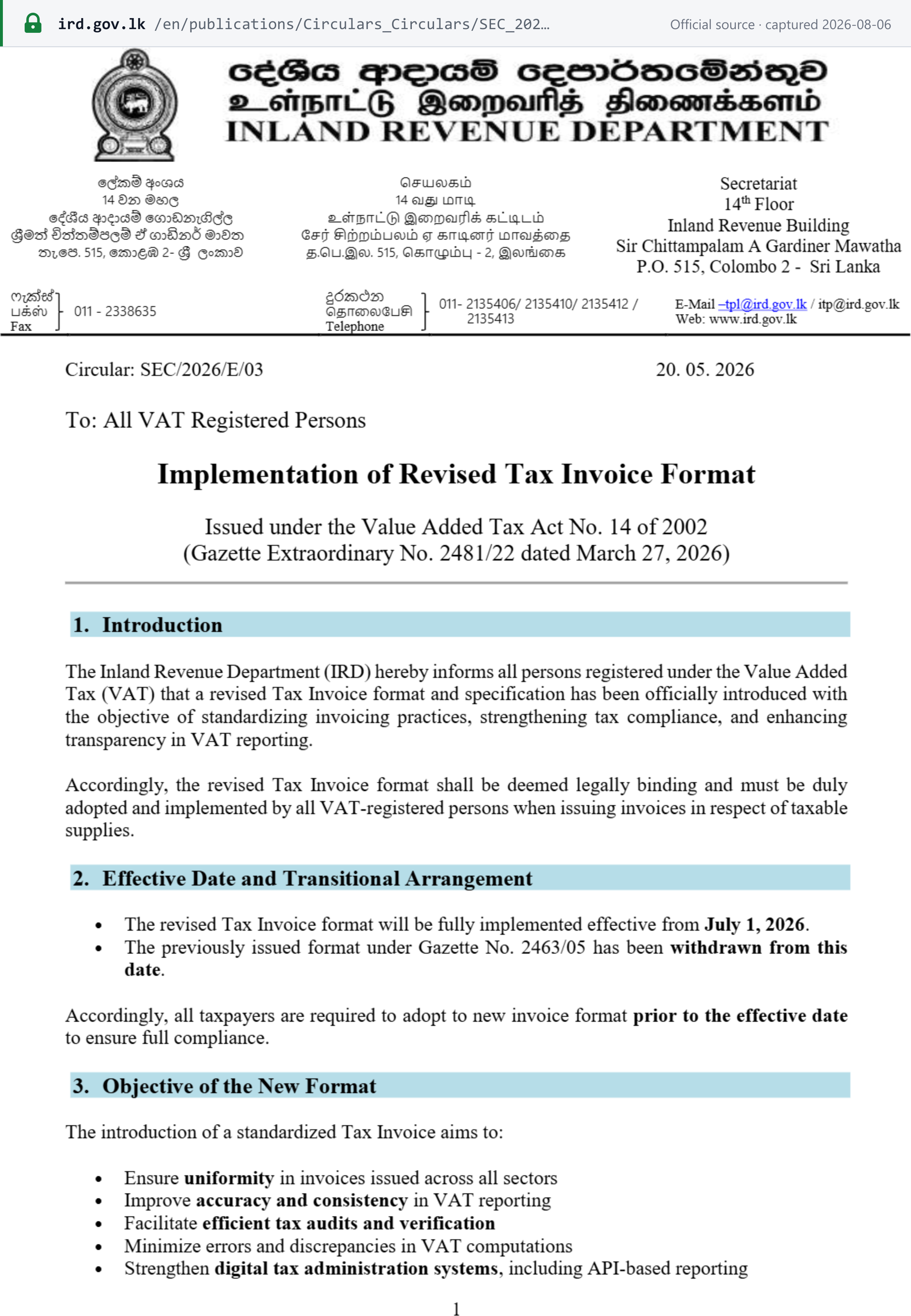 Source snapshot captured 2026-08-03 — original
Businesses that obtain the Commissioner-General's approval before 1 July 2026 to integrate their ERP with RAMIS via Web API for real-time transmission of invoice data may treat the YYMMM_QQQQ_ prefix as optional, provided the integration is completed by 31 December 2026. Non-compliant invoices risk rejection for input VAT credit. [3]
The layout itself is not prescribed
Despite the name, the "revised tax invoice format" fixes the invoice's content, not its design. Under section 6 of the circular, taxpayers may customise the layout of invoices and add logos, branding or additional columns, provided all mandatory elements are clearly included and readily identifiable in accordance with the Gazette notification. Four fields are expressly optional: mode of payment, place of supply, total amount in words, and additional notes or references. [3]
There is an official specimen — see below — but it is a specimen, not a straitjacket: it shows where the mandatory elements belong without forbidding you to move them. Failure to comply with the prescribed content can lead to rejection of the invoice for input VAT credit, inconsistencies in VAT returns, increased audit scrutiny, and penalties under the VAT Act. [3]
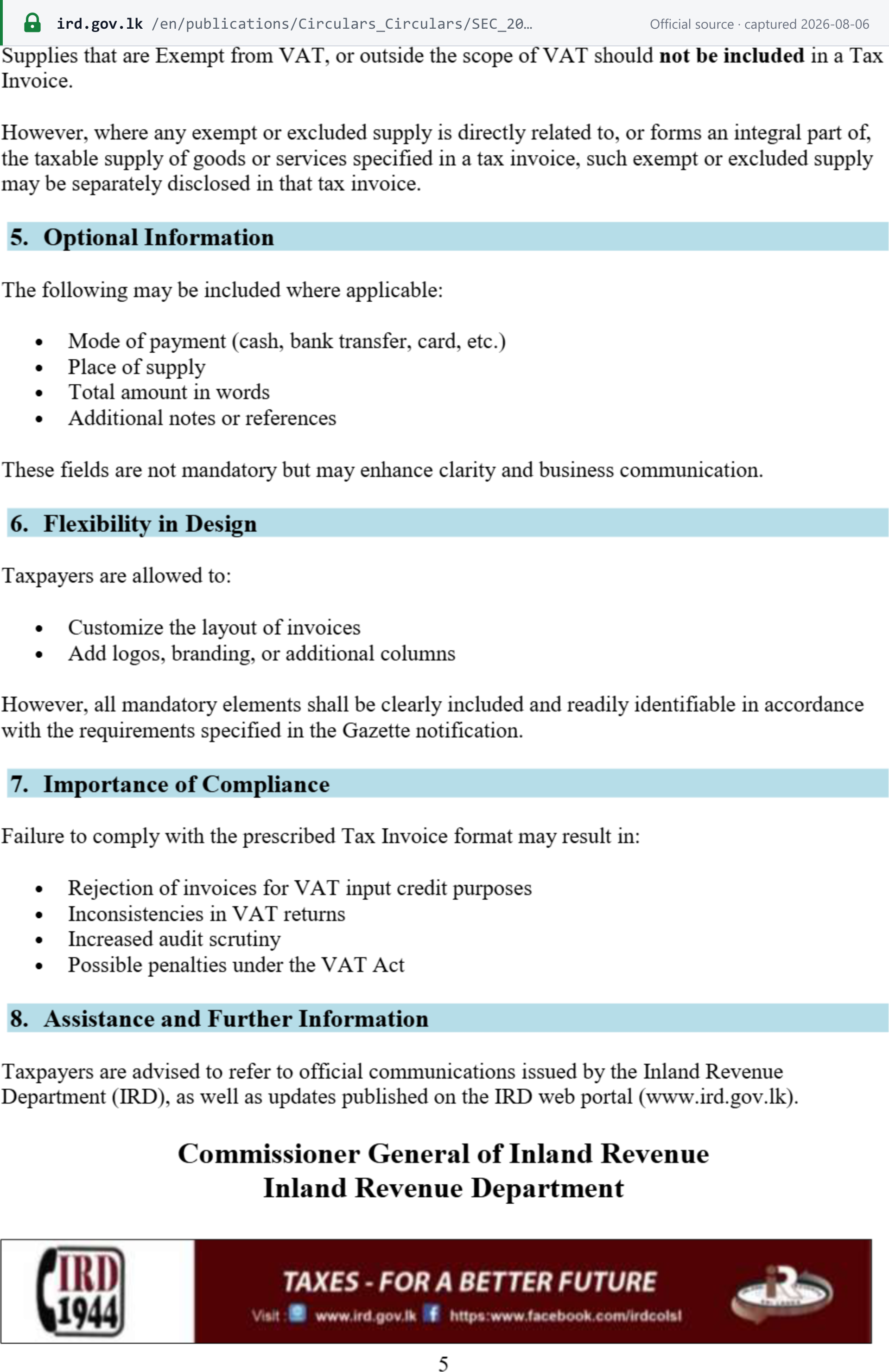 Source snapshot captured 2026-08-03 — original
What a compliant invoice looks like
The Gazette does not stop at the element list: Annexure I closes with a drawn specimen — a blank TAX INVOICE laid out box by box, which is the clearest statement of where the Commissioner-General expects each element to sit. Read it alongside the flexibility above: the boxes show the intended arrangement, the circular lets you rearrange it.
Note the specimen's own conventions. Supplier details occupy the top-left block and purchaser details the top-right, exactly as the specification's paragraphs 2.1 and 3.1 direct. The four optional fields carry an asterisk on the face of the form — Reference, Place of Supply, Total Amount in words, Mode of Payment — as do the two telephone numbers, so the specimen distinguishes what is required from what is merely provided for. The value ladder runs Total Value of Supply → VAT Amount → Total Amount/consideration including VAT, which is the three-line breakdown described above rendered as three stacked rows.
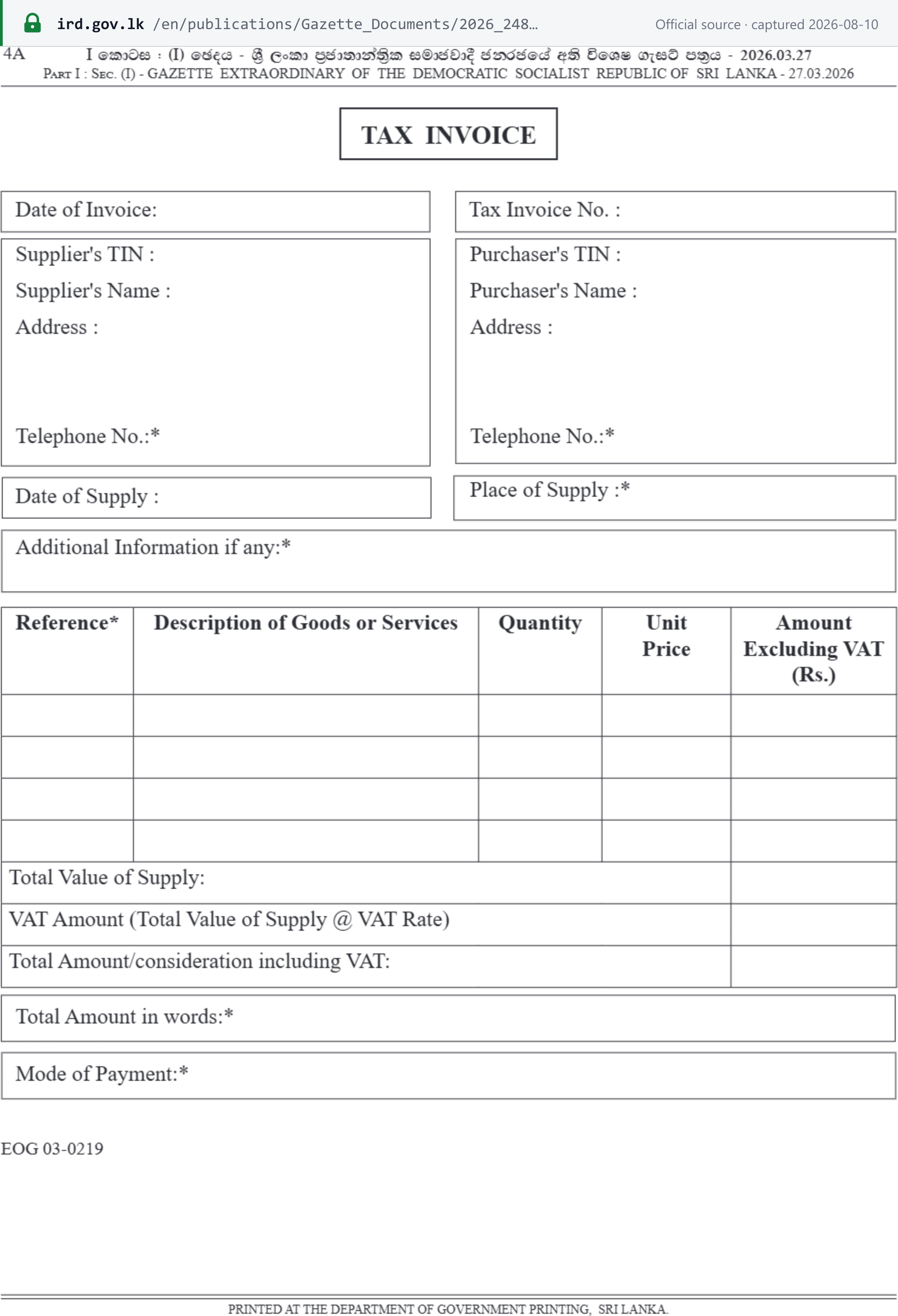 Source snapshot captured 2026-08-10 — original
E-invoicing status
The IRD announced a National e-Invoicing System under the 2026 Budget (notice of 4 May 2026), enabling real-time transmission of VAT invoice data from taxpayers' ERP systems to the IRD's RAMIS platform via Web API. A pilot began 1 May 2026 with tea brokers transmitting Colombo Tea Auction invoice data; Phase 1 covers export-oriented VAT-registered businesses (tea and garments) and Phase 2 is targeted to extend to all VAT-registered persons by end-2026. [1] [2]
The invoice content rules that apply from 1 October 2026 (postponed from the original 1 July 2026 by Gazette Extraordinary No. 2500/106 of 6 August 2026) are separate from this rollout and bind every VAT-registered person regardless of participation — see Invoice requirements above.
Recent changes
- 2026-08-06 — Gazette Extraordinary No. 2500/106, issued by the Commissioner General of Inland Revenue under section 20 of the VAT Act, No. 14 of 2002, postponed the mandatory tax-invoice-format effective date from 1 July 2026 to 1 October 2026 (amending Gazette Extraordinary No. 2481/22 of 27 March 2026); all other requirements in the original notice are unchanged. This corrects the effective date carried on this page since the 2026-05-20 entry below (updated from 1 July 2026). (Inland Revenue Department) — see issue
- 2026-07-03 — VAT (Amendment) Act No. 14 of 2026 (certified 30 June 2026) published as a Gazette supplement: it retains the LKR 60 million annual registration threshold (dropping Bill No. 65's proposed cut to LKR 36 million) and sets the non-resident digital-services registration trigger at LKR 60 million per 12 months / LKR 15 million per quarter. (Inland Revenue Department) — see issue
- 2026-07-01 — 18% VAT on digital services supplied by non-residents through electronic platforms came into force, and the VAT rate on financial services rose from 18% to 20.5%. (Inland Revenue Department) — see issue
- 2026-05-20 — IRD Circular SEC/2026/E/03 made the revised tax invoice format (Gazette Extraordinary No. 2481/22 of 27 March 2026) mandatory for all VAT-registered persons from 1 July 2026 (later postponed to 1 October 2026 — see the 2026-08-06 entry above), with an ERP–RAMIS Web API integration alternative until 31 December 2026. (Inland Revenue Department)
- 2026-05-04 — IRD announced the National e-Invoicing System for VAT under the 2026 Budget (notice SEC/PN/VAT/2026-03): pilot from 1 May 2026, Web API integration with RAMIS, full rollout to all VAT-registered persons targeted by end-2026. (Inland Revenue Department) — see issue
- 2026-04-29 — VAT (Amendment) Bill No. 65 gazetted, proposing 18% VAT on non-resident digital services from 1 July 2026, a financial-services rate rise from 18% to 20.5%, and a registration-threshold cut from LKR 60 million to LKR 36 million (the threshold cut was later dropped at enactment). (Parliament of Sri Lanka) — see issue
Reference links
- IRD — Value Added Tax (VAT)
- IRD — VAT (Amendment) Act No. 14 of 2026
- IRD — Taxpayer guidelines for registration (TIN, tax types, SVAT)
- IRD — Circular SEC/2026/E/03: revised tax invoice format
- IRD — Gazette Extraordinary No. 2500/106: postponement of the tax invoice format effective date to 1 October 2026
- Parliament of Sri Lanka — VAT (Amendment) bill status (G6427)
Frequently Asked Questions
What is the VAT registration threshold in Sri Lanka?
Registration is mandatory once taxable supplies exceed LKR 15 million in a quarter or LKR 60 million in a 12-month period (in effect since 1 January 2024). [1] The 2026 Budget proposal to cut the annual threshold to LKR 36 million was dropped before enactment — the VAT (Amendment) Act No. 14 of 2026 keeps it at LKR 60 million. [2]
Do foreign providers of digital services have to register for VAT in Sri Lanka?
Yes. From 1 July 2026, 18% VAT applies to services supplied by non-residents through electronic platforms to persons in Sri Lanka. A non-resident digital service provider must register once such supplies exceed LKR 60 million (or equivalent) in the preceding 12 months or LKR 15 million in a quarter, applying electronically within three months. A recipient is deemed to be in Sri Lanka when two or more indicators are met: Sri Lankan billing/residential/business address, payment through a Sri Lankan bank, a payment instrument issued in Sri Lanka, or a Sri Lankan IP address. [1]
Are B2B digital services supplied by non-residents subject to Sri Lankan VAT?
No. VAT is not charged where the recipient is a VAT-registered person in Sri Lanka (section 25N of the VAT Act, inserted by the VAT (Amendment) Act No. 14 of 2026). The non-resident must instead file a simplified statement of supplies made to registered persons (date, recipient TIN and name, value, invoice number, description); non-compliance can attract a penalty of up to LKR 50,000. VAT wrongly charged and already remitted is treated as deductible input tax for the registered recipient. [1]
What is the VAT rate on financial services in Sri Lanka?
20.5% for taxable periods commencing on or after 1 July 2026 (18% applied from 1 January 2022 to 30 June 2026), under section 25C of the VAT Act as amended by the VAT (Amendment) Act No. 14 of 2026. The standard 18% rate on other supplies is unchanged. [1]
Is e-invoicing mandatory in Sri Lanka?
Not yet as a universal mandate. The National e-Invoicing System announced on 4 May 2026 is rolling out in phases — a pilot from 1 May 2026, Phase 1 for export-oriented VAT-registered businesses, and Phase 2 targeted to reach all VAT-registered persons by end-2026 via Web API integration with RAMIS. [1] Separately, a revised mandatory tax invoice format applies to all VAT-registered persons from 1 October 2026 — postponed from the original 1 July 2026 by Gazette Extraordinary No. 2500/106 of 6 August 2026 — with an exemption from the prescribed invoice-number structure for businesses approved to integrate their ERP with RAMIS by 31 December 2026. [2] [3]