Chile VAT (IVA) guidelines
| FACTSHEET | |
|---|---|
| Country code | CL |
| Tax name | Value Added Tax — Impuesto al Valor Agregado (IVA) |
| Tax Authority | Servicio de Impuestos Internos (SII) |
Overview
Chile levies Value Added Tax — in Spanish Impuesto al Valor Agregado (IVA) — under Title II of the Ley sobre Impuesto a las Ventas y Servicios (LIVS), Decreto Ley 825 of 1974. Article 1 establishes "un impuesto sobre las ventas y servicios, que se regirá por las normas de la presente ley". The consolidated text is published by the Biblioteca del Congreso Nacional (BCN Ley Chile). [1]
Additional taxes are not IVA. Title III of the same law levies separate additional and special taxes on, for example, luxury goods and beverages. They are charged on top of IVA, not instead of it, and they are not reduced IVA rates (see Rates). [1]
Authority. IVA is administered by the Servicio de Impuestos Internos (SII). Tax is paid to the Tesorería General de la República (TGR), and IVA on imports is collected by the Servicio Nacional de Aduanas (customs). Procedure, interest, penalties and offences are in the Código Tributario (D.L. 830 of 1974). [1] [2]
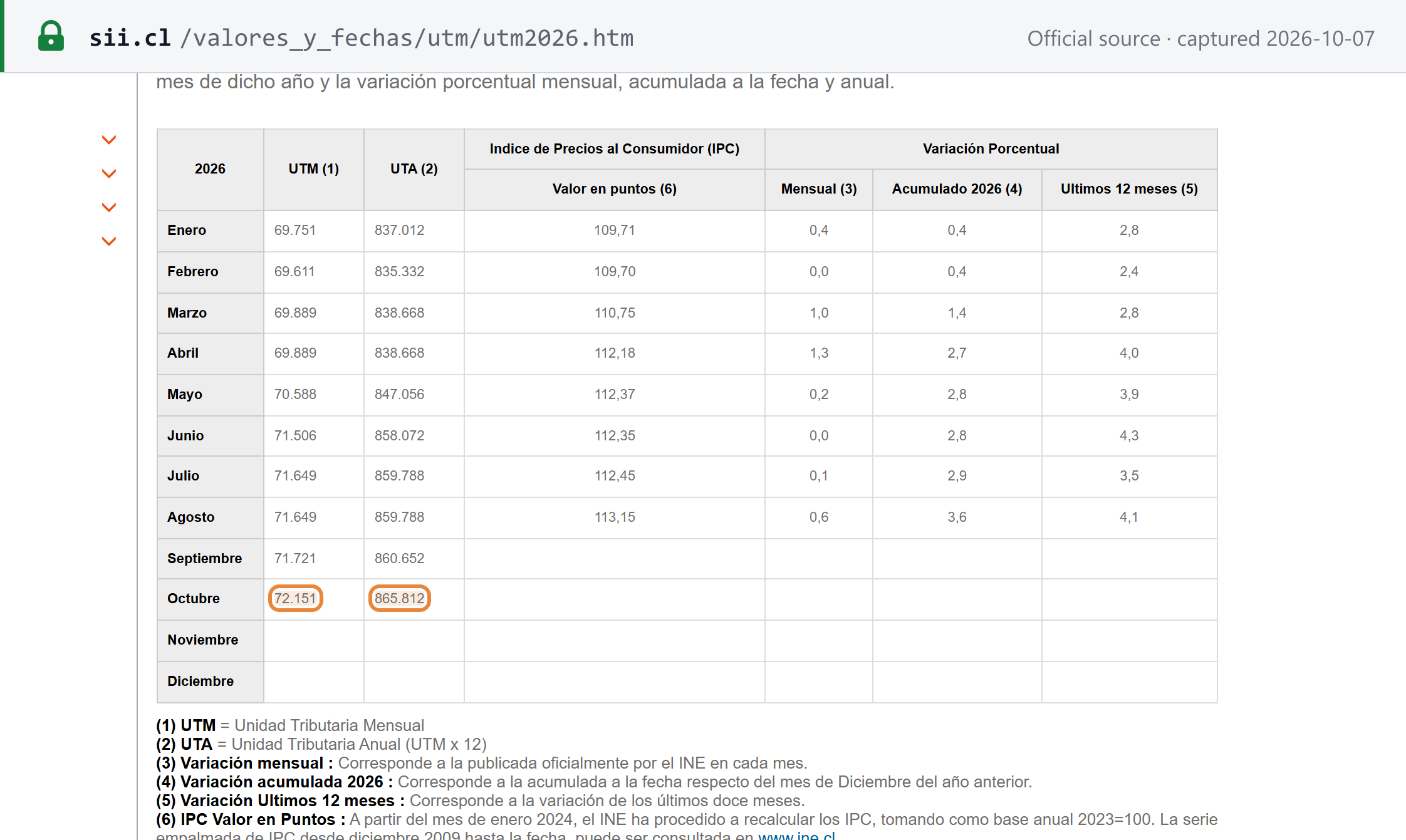
Currency and tax period. Amounts are in Chilean pesos (CLP). Penalties are set in tax units: the monthly UTM and the annual UTA. For October 2026 the SII publishes UTM = CLP 72,151 and UTA = CLP 865,812. The tax period is the calendar month: "Por "periodo tributario", un mes calendario, salvo que esta ley o la Dirección Nacional de Impuestos Internos señale otro diferente" (LIVS art. 2 N°5). Non-residents in IVA Digital may instead choose a quarter (see Cross-border rules). [1] [26]
Layering. IVA is a single national tax. The LIVS sets one rate (art. 14) and provides for no regional or municipal IVA (as at 2026-10-07). [1]
For the RUT in detail, see Lookuptax's Chile RUT tax ID guide. For a neighbouring system, see the Argentina VAT (IVA) guide.
Registration
Who should register
Taxpayers are persons who make sales, provide services or carry out other operations taxed by the LIVS (art. 3). A "vendedor" is someone who sells habitually (art. 2 N°3). A "prestador de servicios" is anyone providing services "en forma habitual o esporádica" (art. 2 N°4). [1]
There are two steps:
- Enrol in the RUT before starting. Article 51 of the LIVS: "las personas que inicien actividades susceptibles de originar impuestos de esta ley, deberán solicitar su inscripción en el Rol Unico Tributario, antes de dar comienzo a dichas actividades." [1]
- File the declaración de inicio de actividades within two months of starting (Código Tributario art. 68): "deberán presentar al Servicio, dentro de los dos meses siguientes a aquél en que comiencen sus actividades, una declaración jurada sobre dicha iniciación." [2]
Registration threshold
None. Liability starts with the first taxed operation (LIVS arts. 3 and 51). The LIVS sets no turnover or value threshold for registration (as at 2026-10-07). [1]
Non-resident registration
Also no threshold. The answer depends on who the customer is:
- Selling to non-taxpayers (B2C). Article 35 A puts every non-resident that sells goods or provides services to persons in Chile "que no sean contribuyentes de los impuestos establecidos en esta ley" into the simplified regime (IVA Digital). The article states no minimum, and neither do the SII's IVA Digital portal and FAQs (as at 2026-10-07). [1] [4]
- Selling to IVA taxpayers (B2B). The simplified regime does not apply. For services, the Chilean customer accounts for the IVA (see Foreign companies selling into Chile).
- With an establishment in Chile. An agency or permanent establishment of a foreign entity enrols in the RUT and declares inicio de actividades in the ordinary way (see How to register).
IVA Digital registration is done online at sii.cl/vat using a bilingual form: [5] [3]
- After email verification the SII issues a User Number, not a RUT: "After verification, a Tax ID Number called User Number will be sent which will enable the business to create a password."
- No Chilean representative is needed: "Is it necessary for the company to have a contact person in Chile? No. It is enough for the company to register an official contact at the time of Registration."
- The currency (USD, EUR or CLP) and the filing period (monthly or quarterly) are chosen at registration. The portal says any change "deberá ser solicitado entre el 21 de enero y el 31 de enero de cada año" (must be requested between 21 and 31 January each year).
Tax identification number
The registration number is the RUT (Rol Único Tributario): a number followed by a check digit. The SII's specimen invoice prints it with thousands separators and a hyphenated check digit, for example "R.U.T.: 69.507.000-4" (an SII test RUT). The SII's printing manual requires the issuer's RUT "con separador de miles". [10]
| Identifier | Format | Who has it |
|---|---|---|
| RUT | Digits + hyphen + check digit, e.g. 69.507.000-4 | Residents, Chilean entities, agencies and permanent establishments |
| IVA Digital User Number | Numeric, issued by the SII | Non-residents in the simplified regime |
The check-digit algorithm, and how the RUT relates to the personal RUN, are covered in Lookuptax's Chile RUT tax ID guide. To check a number, see how to verify a RUT in Chile or use Lookuptax's Chile RUT validator.
How to register
- Form and channel. RUT enrolment and inicio de actividades use Formulario 4415. The SII says that since 1 June 2020 the procedure "debe ser presentado por internet", using the RUT and Clave Tributaria, except for cases the law excludes. [31] [7]
- Foreign agencies and establishments. These use the same electronic form, which collects the data of Formulario 4415.1, the version for "extranjeros sin residencia". The SII FAQ was updated 4 June 2026. [7]
- Processing time. The SII registration pages publish no processing time (as at 2026-10-07).

Voluntary registration
Not applicable. No voluntary route exists because there is no threshold to fall below: everyone starting a taxed activity must enrol (LIVS art. 51; Código Tributario art. 68). [1]
Deregistration
- Término de giro. A taxpayer that stops activity must notify the SII "a través de la carpeta tributaria electrónica del contribuyente", attach a closing balance, and pay the tax "dentro de los dos meses siguientes a la fecha de término de su giro o de sus actividades" (Código Tributario art. 69). [2]
- By the SII. The SII may also declare término de giro itself. SII Resolution 117 of 2 September 2026 did so for taxpayers showing 36 or more tax periods without operations, under the last paragraph of article 69. [29]
Group registration
Not available. The LIVS contains no VAT-grouping provision (as at 2026-10-07). [1]
Rates
| Rate | Applies to | Effective |
|---|---|---|
| 19% (standard, and the only IVA rate) | All taxed sales, services and imports | Since 1 October 2003 (Ley 19.888); LIVS art. 14 |
| Exempt with input-tax recovery | Exports of goods (art. 12 D) and services qualified as exports by customs (art. 12 E N°16) | See Exemptions |
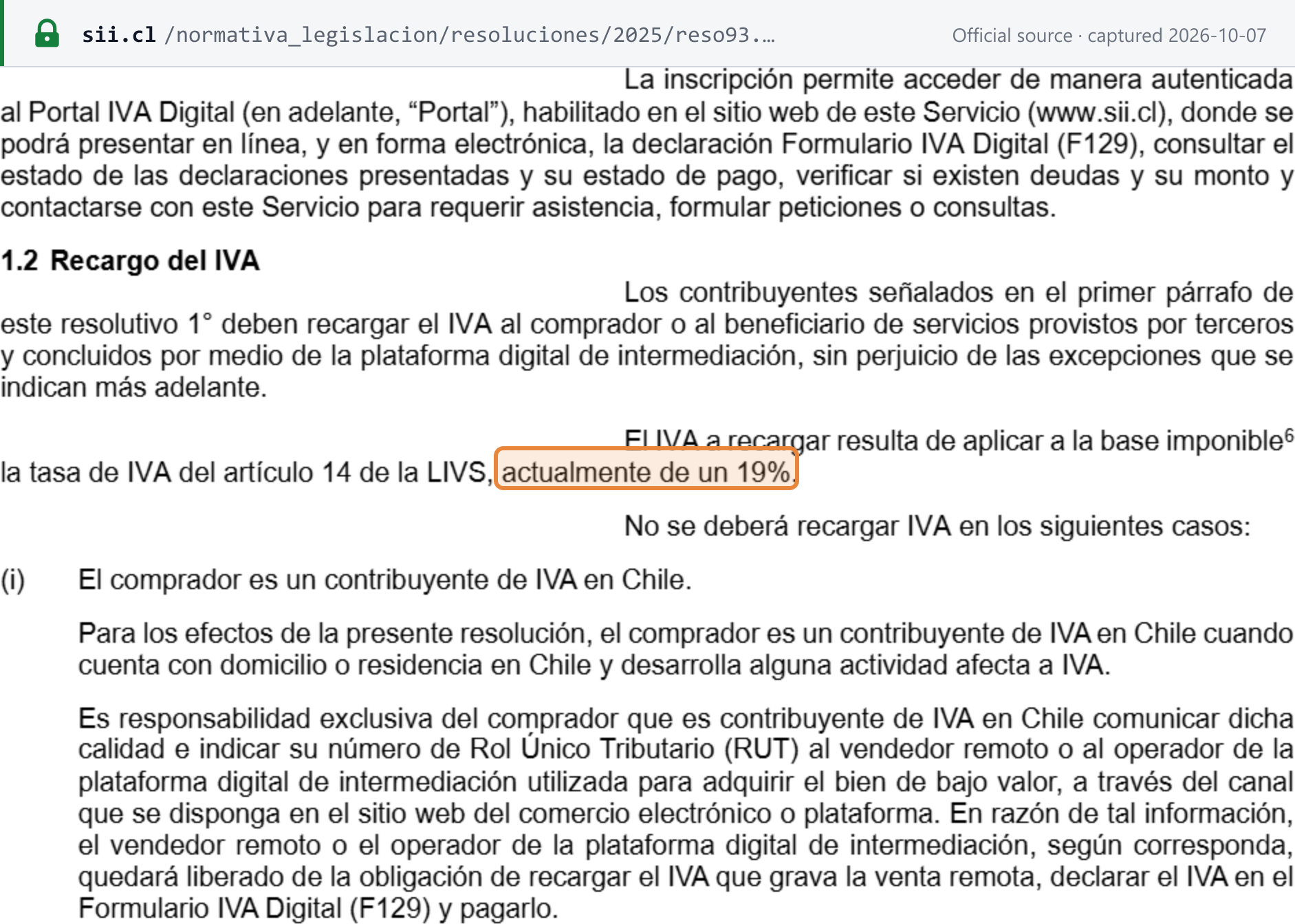
Article 14 of the LIVS: "Los contribuyentes afectos a las disposiciones del presente Título pagarán el impuesto con una tasa de 19% sobre la base imponible." [1] The SII applies the same figure: in Resolution 93 of 2025 it describes the article 14 rate as "actualmente de un 19%". [13]
Standard rate — 19%. The rate rose to 19% under Ley 19.888 (Diario Oficial, 13 August 2003). SII Circular 47 of 12 September 2003: "la nueva tasa de 19% del impuesto al valor agregado rige desde el día 1 de Octubre del año en curso". Ley 19.888 originally planned a return to 18% from 1 January 2007. The current article 14 sets 19% with no end date. [8] [1]

No reduced or zero IVA rate. Article 14 sets a single rate, and the LIVS sets no other IVA rate, substitute regimes aside (as at 2026-10-07). Exports are exempt with recovery of input IVA (art. 12 D with art. 36), so in practice they work like a zero rate. [1]
Additional taxes on top of IVA. Title III levies separate taxes that are charged in addition to the 19%. In the SII's electronic document format, for example, tax code 23 is the "IMPUESTO ADICIONAL Art 37 Letras a, b, c" at a "Tasa del 15%" on gold, platinum and ivory articles, jewellery and precious stones, and fine furs. These taxes are not reduced IVA rates; they are set out in Title III of the LIVS. [9]
Announced future rates. None, as at 2026-10-07: the SII's 2026 resolutions, up to Resolution 135 of 2 October 2026, contain no rate change. [29]
For Chile alongside other jurisdictions, see Lookuptax's worldwide tax rates table and VAT registration thresholds table.
Cross-border rules
Imports and exports
- Imports of goods. Imports are taxed "tengan o no el carácter de habituales" (art. 8 a), and the importer is the taxpayer (art. 11 a). The base is the customs value, or failing that the CIF value, plus customs duties (art. 16 a). Customs collects the IVA: "Las Aduanas no autorizarán el retiro de los bienes del recinto aduanero sin que se les acredite previamente la cancelación del respectivo tributo" (art. 9 b). [1]
- Remote low-value goods (USD 500 or less), since 25 October 2025. Goods abroad bought remotely from a non-resident by someone who is not an IVA taxpayer are treated as located in Chile when bound for Chile, if their price, including accessory charges, "no exceda de USD 500 o su equivalente en moneda nacional" (art. 4). The seller or platform charges the IVA through IVA Digital. The import itself is then exempt from IVA and from customs duties, provided the IVA "fue efectivamente cobrado por el vendedor o plataforma digital" (art. 12 B N°18). [1]
- Start date. The SII portal announced that from 25 October 2025 IVA would apply to sales of low-value goods located abroad and sent to Chile, bought remotely through digital intermediation platforms or from direct sellers without domicile or residence in Chile. [3]
- Per item. SII Resolution 84 of 10 July 2025 applies the USD 500 cap to "el precio del artículo o ítem, individualmente considerado", including shipping, insurance and packaging charged for that item. It also requires platforms and redelivery companies to register. [12]
- Exports. Exported goods are exempt (art. 12 D), and exporters recover the input IVA on their export activity (art. 36): "Los exportadores tendrán derecho a recuperar el impuesto de este Título que se les hubiere recargado al adquirir bienes o utilizar servicios destinados a su actividad de exportación." Services to non-residents are exempt only "siempre que el Servicio Nacional de Aduanas califique dichos servicios como exportación" (art. 12 E N°16). [1]
- Reverse charge on imported services. A Chilean IVA taxpayer that receives a service from a provider resident abroad is itself the taxpayer (art. 11 e). See Lookuptax's reverse charge explainer. [1]

Digital products and services
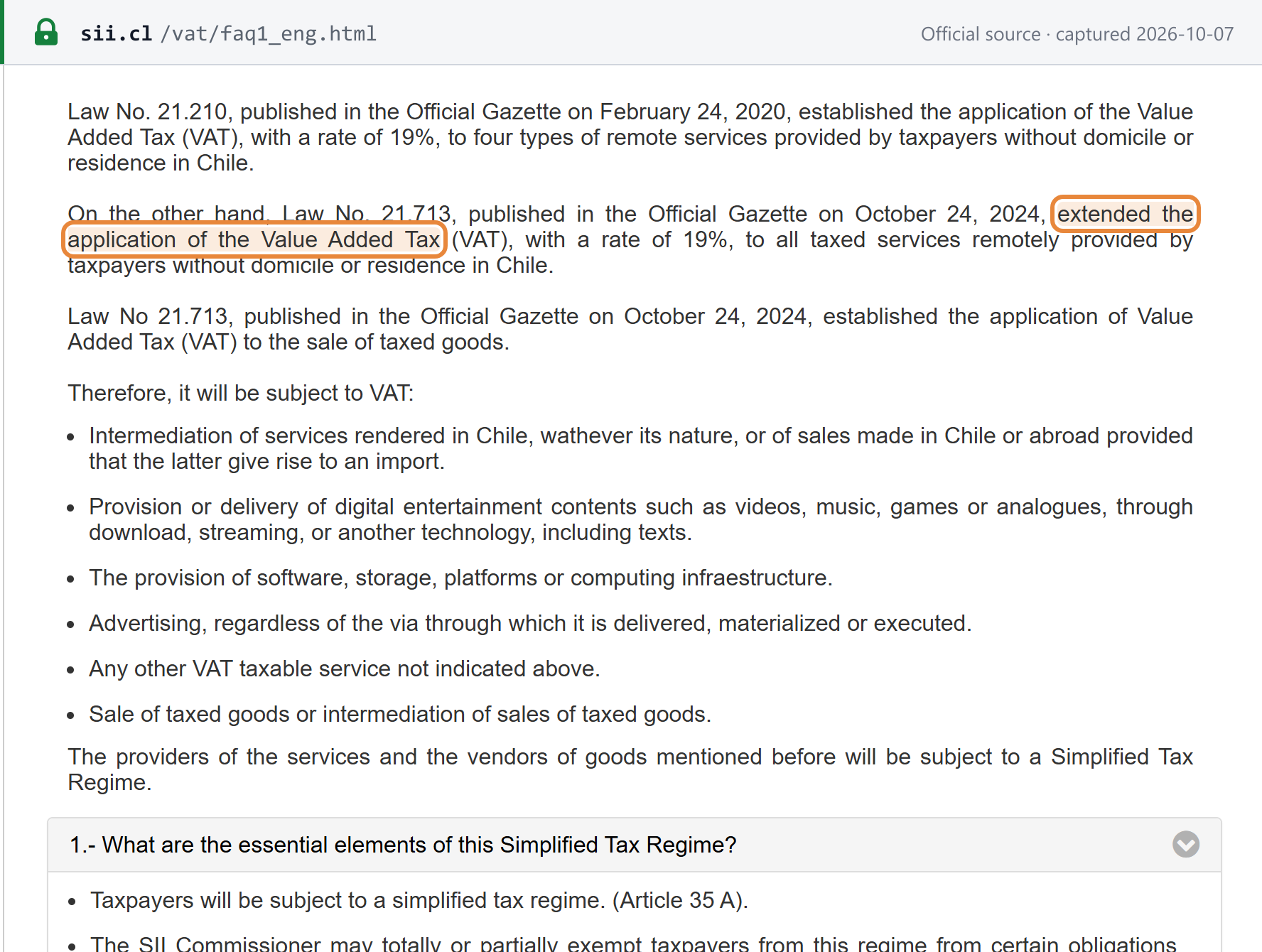
- Scope. Ley 21.210 (Diario Oficial, 24 February 2020) taxed four kinds of remote service at 19% when supplied by non-residents: intermediation, digital entertainment, software, storage and IT infrastructure, and advertising. Ley 21.713 (Diario Oficial, 24 October 2024) extended the tax to all taxed services supplied remotely by non-residents and to sales of taxed goods. The SII: "Law No. 21.713, published in the Official Gazette on October 24, 2024, extended the application of the Value Added Tax (VAT), with a rate of 19%, to all taxed services remotely provided by taxpayers without domicile or residence in Chile." The portal dates the all-services rule from November 2024 and the goods rule from 25 October 2025. [4] [3]
- Threshold. None (see Non-resident registration).
- Regime rules. The simplified regime gives no input credit, and suppliers issue no tax documents: they "no tendrán derecho a crédito fiscal y se encontrarán liberados de la obligación de emitir documentos tributarios por sus operaciones" (art. 35 C). The period is "un periodo de uno o tres meses seguidos, a elección del contribuyente" (art. 35 D). Suppliers file and pay "hasta el día 20 del primer mes siguiente" (art. 35 E) on Formulario 129. [1]
- Payment. Payment can be made in USD, EUR or CLP. Foreign-currency payments go by SWIFT: "In code 70, the User Number must be registered, followed by the name of the form, tax period and Folio. For example: 556545253-F129-202006-853201533." Field 71-A is set to OUR. A return cannot be amended online to a lower amount ("you cannot amend a tax return for an amount less than previously declared"). [6]
- Unregistered providers. If a non-resident has not joined the simplified regime, the SII may order card issuers and similar payment systems to charge, withhold and pay the IVA on payments to it (art. 3, final paragraph). The IVA Digital portal links a list of unregistered foreign companies ("Nómina Empresas Extranjeras No Inscritas"). [1] [3]
- Online gambling. SII Resolution 69 of 2026 brought offshore gambling platforms into IVA Digital (Formulario 129), including the previous 36 periods. See the event record. [30]
See also Lookuptax's VAT on digital services by non-resident suppliers.
Foreign companies selling into Chile — B2B and B2C
- B2C (to non-taxpayers) — the foreign seller registers. The non-resident registers in IVA Digital and charges 19% on remote services and on low-value goods of USD 500 or less (arts. 35 A and 4). It issues no Chilean tax documents (art. 35 C). [1]
- B2B (to IVA taxpayers) — the customer accounts. For services, the Chilean customer is the taxpayer: "El beneficiario del servicio que sea un contribuyente del impuesto de este Título, siempre que la prestación sea realizada por un prestador domiciliado o residente en el extranjero" (art. 11 e). The simplified regime does not apply, because article 35 A covers only buyers that are not taxpayers. [1]
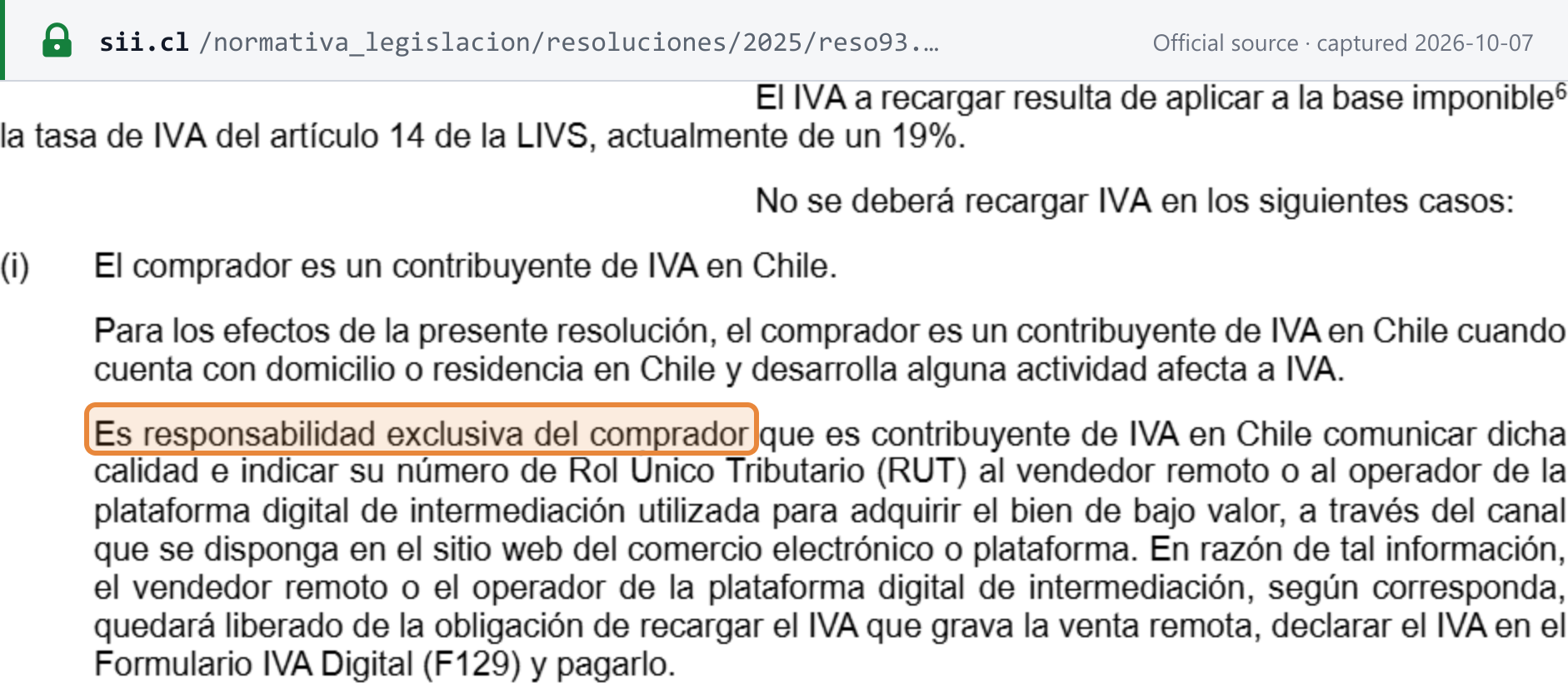
- B2B low-value goods and platform sales. SII Resolution 93 of 30 July 2025: "No se deberá recargar IVA en los siguientes casos: (i) El comprador es un contribuyente de IVA en Chile." The burden of proving that status is on the buyer: "Es responsabilidad exclusiva del comprador que es contribuyente de IVA en Chile comunicar dicha calidad e indicar su número de Rol Único Tributario (RUT) al vendedor remoto o al operador de la plataforma digital de intermediación utilizada para adquirir el bien de bajo valor". [13]
- Goods above USD 500, or goods held in Chile. Goods above the cap are taxed at import, with the importer as taxpayer (arts. 8 a and 11 a). A foreign business selling goods located in Chile is an ordinary seller and enrols in the RUT before starting (art. 51).
Marketplace / platform deemed-supplier liability
Applies since 25 October 2025. Article 3 bis, added by Ley 21.713 (Diario Oficial 24 October 2024), makes the operator of a digital intermediation platform a taxpayer "como si fuera un vendedor habitual del bien o prestador del servicio que se concluye a través de la plataforma digital que opere y siempre que se trate de una operación gravada". [1]
- Not when a taxpayer is involved. The rule does not apply "cuando el servicio subyacente sea prestado o el bien sea vendido por o a un contribuyente de esta ley".
- More than one platform. Only the platform "que autorice o procese el pago de la operación gravada" is the taxpayer.
- Non-resident operators account through the simplified regime.
- Not platforms. Services that only advertise or process payments are not platforms for this purpose.
Card-issuer withholding (art. 3, final paragraph) remains a fallback for foreign providers that have not registered. See Lookuptax's marketplace deemed-supplier explainer. [1]
Place of supply
- Goods. Sales of goods located in Chile are taxed wherever the contract is signed (art. 4), plus the remote low-value-goods rule above. [1]
- Services. Services are taxed when provided or used in Chile (art. 5). [1]
- A service is provided in Chile when the activity is carried out in Chile.
- A remote service is presumed used in Chile if, when it is contracted or paid for, at least two of these point to Chile: the IP address or other geolocation of the device; the card, bank account or other means of payment; the billing address; the country code of the SIM card.
Invoice requirements
The invoicing rules sit in articles 52–58 of the LIVS. The technical layer is set by SII rules: the Formato DTE (XML format, v2.2), the Instructivo Técnico for issuing documents, and the Manual de Muestras Impresas (printed representation, v4.0). The SII publishes an official printed specimen, shown below. [1] [9] [10]
Electronic only. Article 54: "Las facturas, facturas de compra, guías de despacho, boletas de ventas y servicios, liquidaciones facturas y notas de débito y crédito que deban emitir los contribuyentes, consistirán exclusivamente en documentos electrónicos emitidos en conformidad a la ley, sin perjuicio de las excepciones legales pertinentes." Paper is allowed only by exception: [1]
- places without data coverage or electricity;
- declared disaster zones, by SII resolution (see E-invoicing status);
- guías de despacho in agriculture and forestry, artisanal fishing and small-scale mining.
A document for every operation. Every operation needs a tax document, taxed or not (art. 52). [1]
Mandatory content
The Manual de Muestras Impresas sets what the printed document carries and where. The Formato DTE v2.2 gives the matching XML tags. [10] [9]
| # | Zone | Field | XML tag |
|---|---|---|---|
| 1 | Issuer (top left) | Razón social (legal name) in full | RznSoc |
| 2 | Issuer | Giro (economic activity), not abbreviated | GiroEmis |
| 3 | Issuer | Head-office address and comuna; branch addresses optional, but must be registered with the SII | DirOrigen, CmnaOrigen |
| 4 | Document box (top right) | Issuer's RUT, with "." thousands separators | RUTEmisor |
| 5 | Document box | Document type in Spanish, in capitals (e.g. FACTURA ELECTRÓNICA) | TipoDTE |
| 6 | Document box | Folio number, from an SII-authorised range | Folio |
| 7 | Under the box | SII office for the head office (e.g. "S.I.I. - SANTIAGO CENTRO") | — |
| 8 | Header | Issue date | FchEmis (YYYY-MM-DD) |
| 9 | Receiver | Legal name, RUT, giro, address and comuna | RznSocRecep, RUTRecep, GiroRecep, DirRecep, CmnaRecep |
| 10 | References (if any) | Type of referenced document (in words), folio, date and reason | Referencia block |
| 11 | Detail | Lines: code, description, quantity, unit, unit price, line discount (as an amount), value | Detalle block |
| 12 | Totals | Net amount, exempt amount (if any), IVA with the rate shown, total | MntNeto, MntExe, TasaIVA, IVA, MntTotal |
| 13 | Footer | Electronic stamp (PDF417 barcode), the legend "Timbre electrónico SII", the authorising resolution and "Verifique documento: www.sii.cl" | TED |
| 14 | Footer, copia cedible only | Acuse de recibo box (name, RUT, date, place, signature), the Ley 19.983 text and the word "CEDIBLE" | — |
Points from the manual worth noting:
- IVA rate on the face. "En el totalizador de IVA debe siempre incorporar la tasa (19% o la vigente a la fecha)."
- Giro in full. "Giro: Se deben registrar las Actividades económicas inscritas por el contribuyente y/o la Glosa descriptiva, la cual no debe estar abreviada."
- Stamp legend. Below the stamp go "Timbre electrónico SII" and "Res. XX de AAAA", where XX and AAAA are the number and year of the resolution authorising the issuer to issue electronic documents, then "Verifique documento: www.sii.cl".
Document type codes (TipoDTE, Formato DTE v2.2): 33 Factura Electrónica; 34 Factura No Afecta o Exenta Electrónica; 43 Liquidación-Factura Electrónica; 46 Factura de Compra Electrónica; 52 Guía de Despacho Electrónica; 56 Nota de Débito Electrónica; 61 Nota de Crédito Electrónica; 110 Factura de Exportación. [9]
Issuance deadline
Article 55 of the LIVS: [1]
- Goods. The factura is issued "en el mismo momento en que se efectúe la entrega real o simbólica de las especies" — at actual or symbolic delivery.
- Services. It is issued "en el mismo período tributario en que la remuneración se perciba o se ponga, en cualquier forma, a disposición del prestador del servicio" — in the tax period in which the payment is received or made available.
- Deferral. Issue may be deferred "hasta el décimo día posterior a la terminación del período en que se hubieren realizado las operaciones" (up to the 10th day after the period ends), but the invoice must be dated in the period of the operation.
- Guía de despacho. If goods are moved before the factura is issued, a guía de despacho (dispatch note) is issued at delivery, and the later factura cites its number and date.
- Boletas are issued at delivery for goods, and on payment for services.
Numbering and sequencing
Every DTE carries a folio from a range the SII authorises through a Código de Autorización de Folios (CAF). The Instructivo Técnico: "Todo documento electrónico debe estar numerado con un folio único y estar firmado en forma electrónica en su totalidad, incluyendo el timbre". Folios must be assigned "rigurosamente en forma unívoca para cada documento" — strictly one per document. [11]
Credit and debit notes
- When required. Article 57 requires credit notes "por los descuentos o bonificaciones otorgados con posterioridad a la facturación" (discounts or bonuses after invoicing) and for returns and cancelled services. It requires debit notes "por aumentos del impuesto facturado" (increases in the tax invoiced). [1]
- Six-month limit. A return of goods or cancellation of a service reduces output tax only if it happens within six months (art. 21 N°2, referring to art. 70). [1]
- References. A note references the original: "Los campos mínimos de referencia son: Nombre completo del documento de referencia, Folio, fecha y motivo." [10]
Currency and language
- Currency. Domestic invoices are in pesos. SII Oficio 1794 of 2017, citing Circular 12 of 1991, requires unit prices, item totals, the IVA and the final total "siempre en moneda nacional". Foreign-currency values may be shown in the detail area, "con indicación del tipo de cambio utilizado que será el vigente al del día de la emisión de la factura" — with the exchange rate in force on the issue date. Export documents carry a currency field (
TpoMoneda). [15] [9] - Language. Document names are printed "sólo en español, sin traducción" (Spanish only, untranslated). Accounting books "deberán ser llevados en lengua castellana" (Código Tributario art. 17). [10] [2]
Document types
| Document | When it is used | Cite |
|---|---|---|
| Factura electrónica (33) / exenta (34) | Operations with other sellers, importers and service providers (B2B), "incluso respecto de sus ventas o servicios exentos" | LIVS art. 53 a |
| Boleta electrónica | All other cases (B2C), also for exempt sales | art. 53 b |
| Factura de compra (46) | Issued by the buyer where the SII has shifted the IVA to it (cambio de sujeto) | art. 3; Manual §1.4 |
| Guía de despacho (52) | Moving goods before the factura is issued | art. 55 |
| Nota de crédito / débito (61 / 56) | Corrections after invoicing | art. 57 |
| Factura de exportación (110) | Exports | Formato DTE |
No minimum for boletas. SII Resolution 60 of 2023 set the minimum amount for issuing a boleta at "$1 (un peso)" from 1 July 2023, so every sale needs a boleta. (The boleta de honorarios is a separate income-tax document for independent professionals, not an IVA document.) [14]
Self-billing
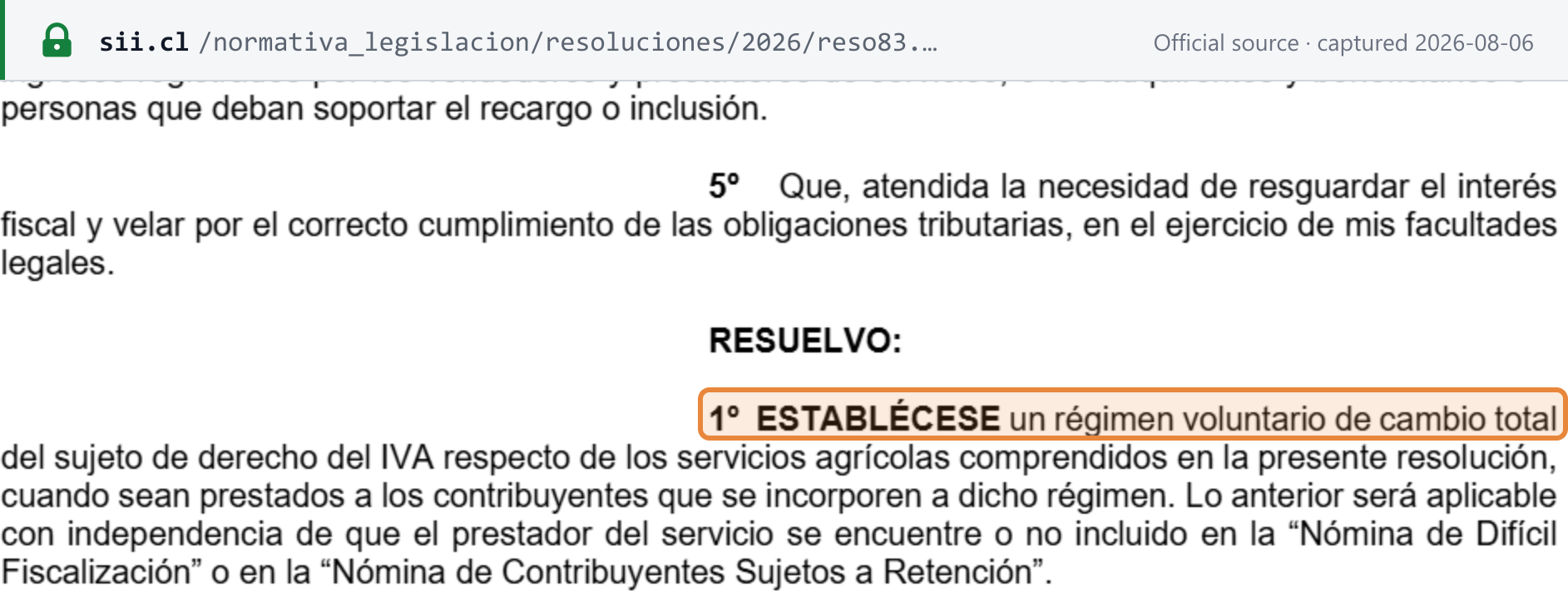
Available, through the factura de compra. Under article 3 the SII may move liability for the IVA to the buyer, for all or part of the rate ("también sólo por una parte de la tasa del impuesto"). The buyer then issues a factura de compra, which "se debe confeccionar de acuerdo al formato de cambio de sujeto del Impuesto al Valor Agregado y debe llevar copia cedible". SII Resolution 83 of 2026 is a recent example. It set up a voluntary regime for agricultural services in which the full IVA is shifted to the buyer, documented with a factura de compra and 100% withheld. [1] [10] [28]
Retention and audit trail
- Retention. "Los duplicados de las facturas y los originales de las boletas a que se refiere este párrafo deberán ser conservados por los respectivos contribuyentes durante seis años" (LIVS art. 58). Books and documents are also kept while the SII review period runs (Código Tributario art. 17). That period is three years, or six years where no return was filed or the return was maliciously false (art. 200). [1] [2]
- Audit trail. Every DTE carries a CAF-authorised folio, an electronic stamp and a full-document digital signature. The stamp is printed as a PDF417 barcode: "El Timbre Electrónico del DTE consiste en una firma electrónica, sobre los campos que se definen como representativos del documento e incluyendo el Código de Autorización de Folios proporcionado por el SII." [11]
- Registro de Compras y Ventas. The SII records every DTE issued or received "en forma automatizada y cronológica" in an electronic register, the Registro de Compras y Ventas (art. 59). [1]
- Buyer acceptance. The buyer's IVA credit arises in the period of the acuse de recibo (art. 23 N°7). The invoice is irrevocably accepted unless the buyer claims "dentro de los ocho días corridos siguientes a su recepción" (Ley 19.983 art. 3). [1] [27]
A specimen of a compliant invoice
The SII publishes an official printed specimen of a Factura Electrónica in its Manual de Muestras Impresas (version 4.0, July 2014), section 1.7, page 16: "Se adjunta ejemplo de una muestra impresa de Factura Electrónica en tipo de formato hoja". It is reproduced below. The parties and RUTs are the SII's own test data, not real taxpayers. [10]
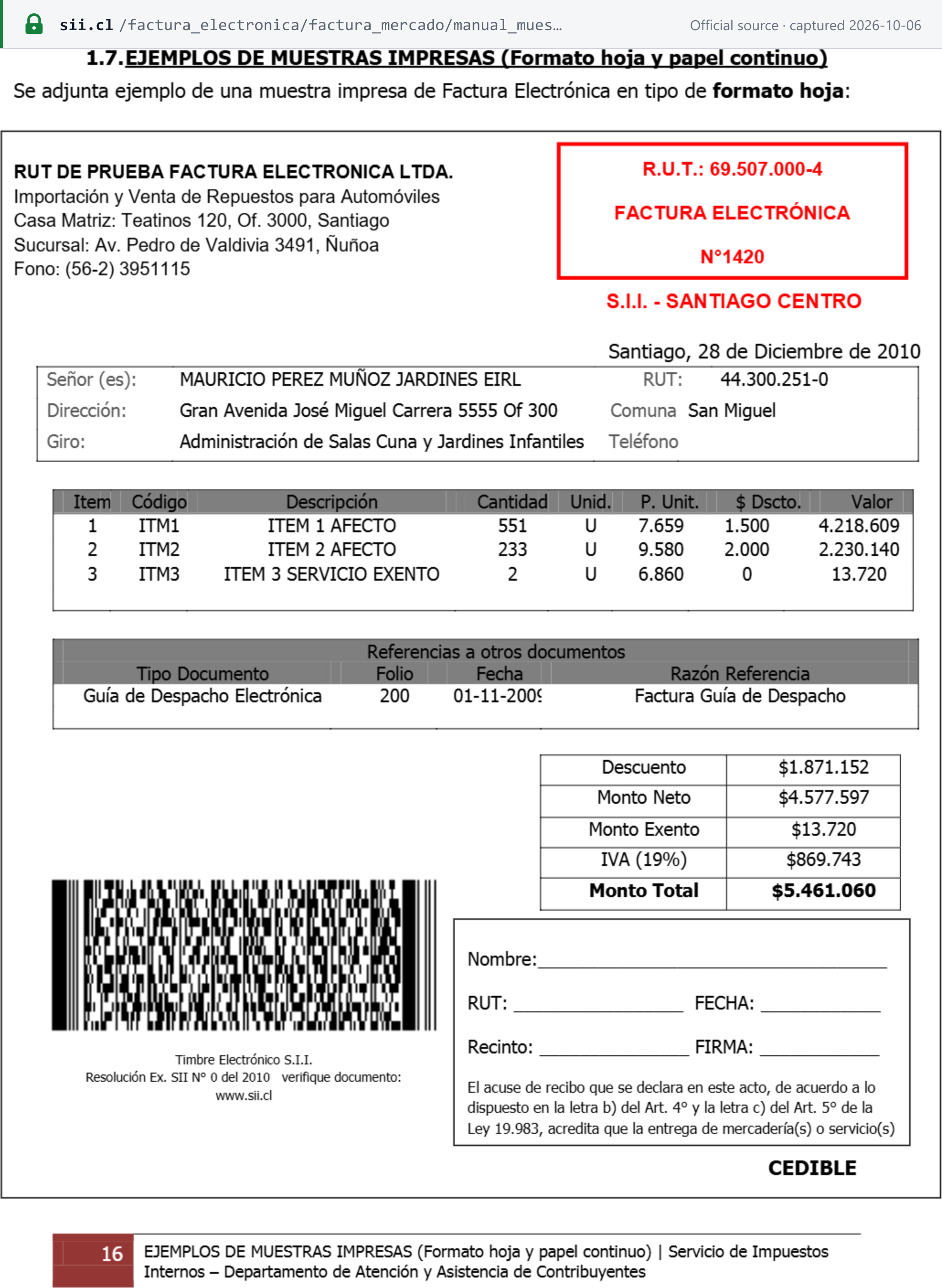
How the specimen maps to the mandatory content (numbers refer to the table above):
- Issuer (1–3) — "RUT DE PRUEBA FACTURA ELECTRONICA LTDA.", its giro ("Importación y Venta de Repuestos para Automóviles"), the head office (Casa Matriz) and a branch (Sucursal).
- Document box (4–6) — a red box with "R.U.T.: 69.507.000-4", "FACTURA ELECTRÓNICA" and "N°1420", with "S.I.I. - SANTIAGO CENTRO" underneath (7).
- Date and receiver (8–9) — "Santiago, 28 de Diciembre de 2010"; the receiver's name, RUT, address, comuna and giro.
- Detail (11) — two taxed lines and one exempt service line, each with code, description, quantity, unit, unit price, discount amount and value.
- References (10) — a Guía de Despacho Electrónica, folio 200.
- Totals (12) — Descuento $1.871.152; Monto Neto $4.577.597; Monto Exento $13.720; IVA (19%) $869.743; Monto Total $5.461.060. As printed: the two taxed lines (4.218.609 + 2.230.140) less the discount give the net amount; 19% of the net amount is the IVA; and net + exempt + IVA is the total.
- Footer (13–14) — the PDF417 stamp with "Timbre Electrónico S.I.I." and the resolution and verification legend, then the acuse de recibo box with the Ley 19.983 text and "CEDIBLE".
The specimen dates from 2010. It shows the layout; it does not reflect later rules such as the CLP 1 boleta minimum (2023) or the Resolution 121 validations (2026).
E-invoicing status
Status (as at 2026-10-07): mandatory. Facturas (B2B) and boletas (B2C) must be electronic documents (DTE) under LIVS articles 53–54. The LIVS has no separate B2G track: the State is itself subject to the tax (art. 6) and receives facturas like any other buyer. [1]
- System. Every DTE is an XML document in the SII format. It is signed, sent to the SII, exchanged with the receiver and recorded in the Registro de Compras y Ventas. Businesses issue through the free SII invoicing system ("Sistema de Facturación Gratuito del SII") or through market or own software ("Sistema de Facturación de Mercado"), which must pass SII certification. [17]
- B2B timeline. Ley 20.727 (published 31 January 2014) made electronic facturas mandatory nine months after publication for large companies; the SII gave 1 November 2014. For smaller companies (Ley 20.416) the deadline was 30 months (urban) or 36 months (rural) after publication, and for micro-enterprises 36 months (urban) or 48 months (rural). [16] [17]
- B2C timeline. Electronic boletas became mandatory on "1° de enero del 2021 para los que ya son facturadores electrónicos, y 1° de marzo 2021 para los que no son facturadores electrónicos" (Resolution 74 of 2020, as modified by Ley 21.256). [18]
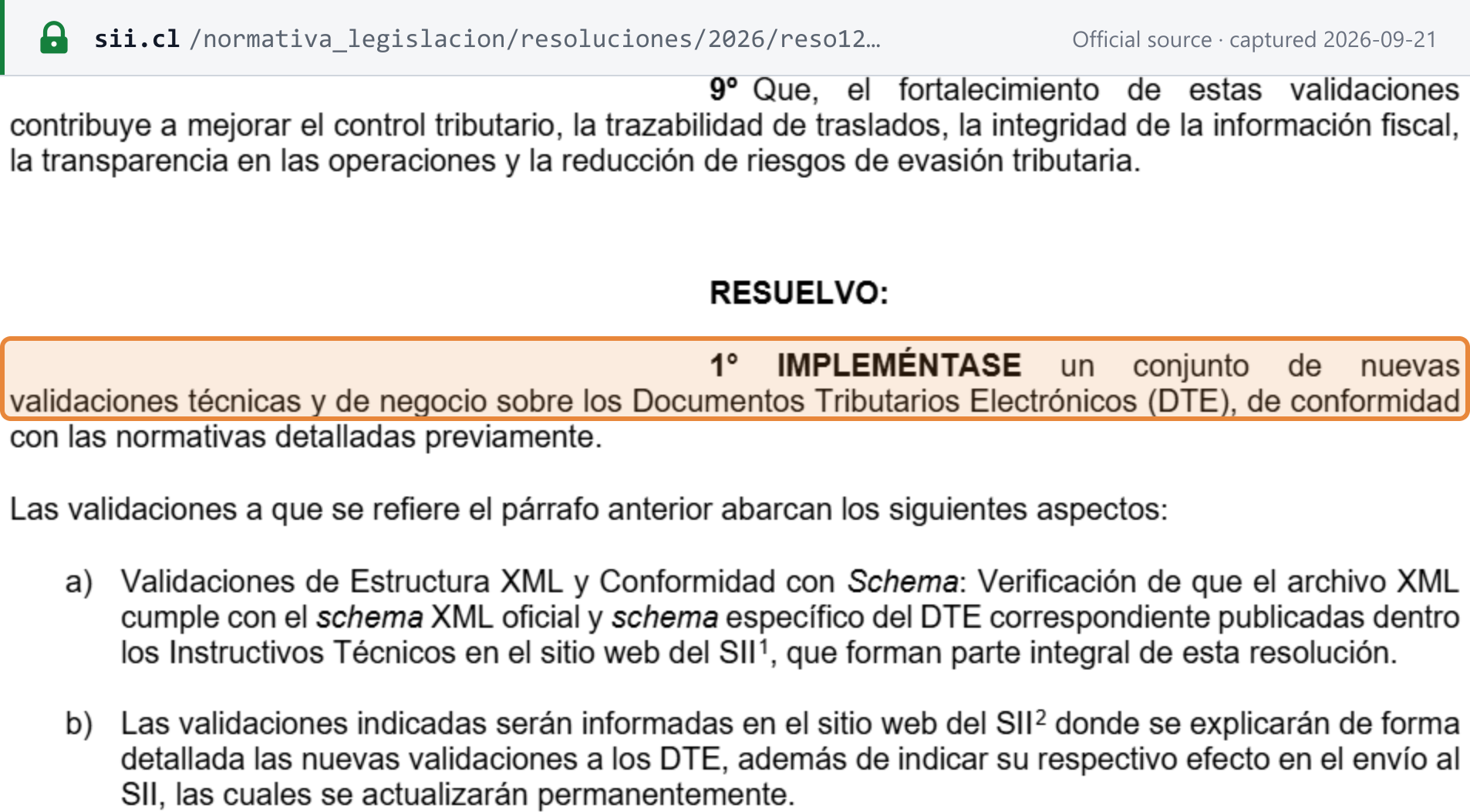
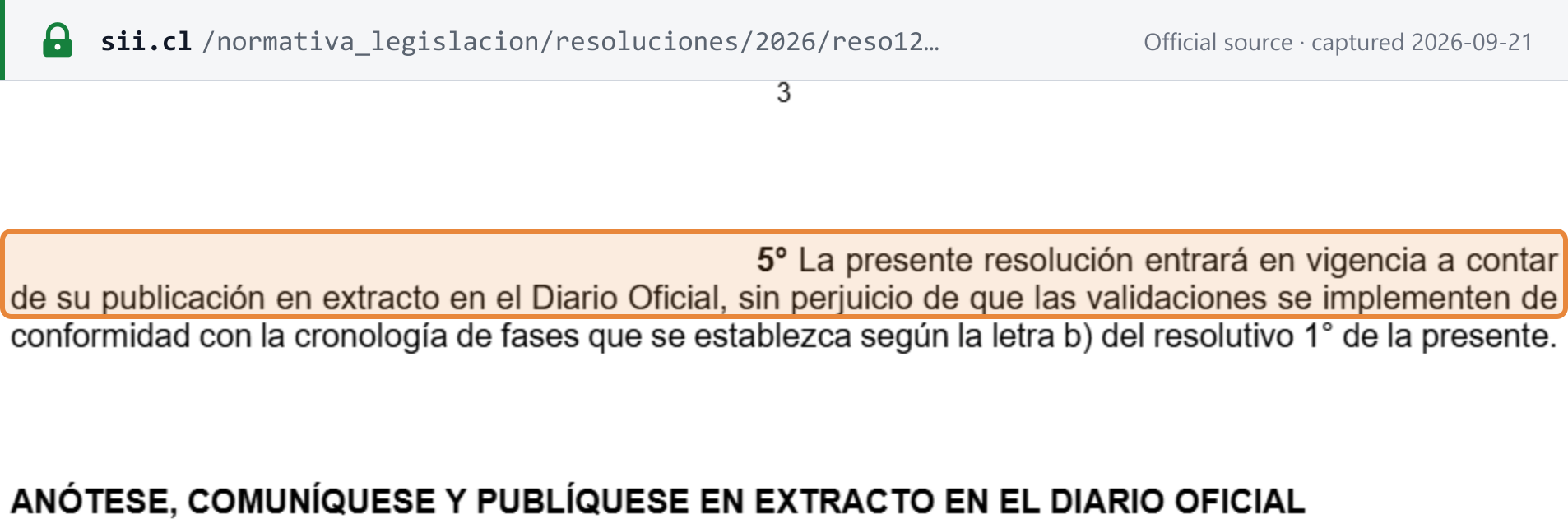
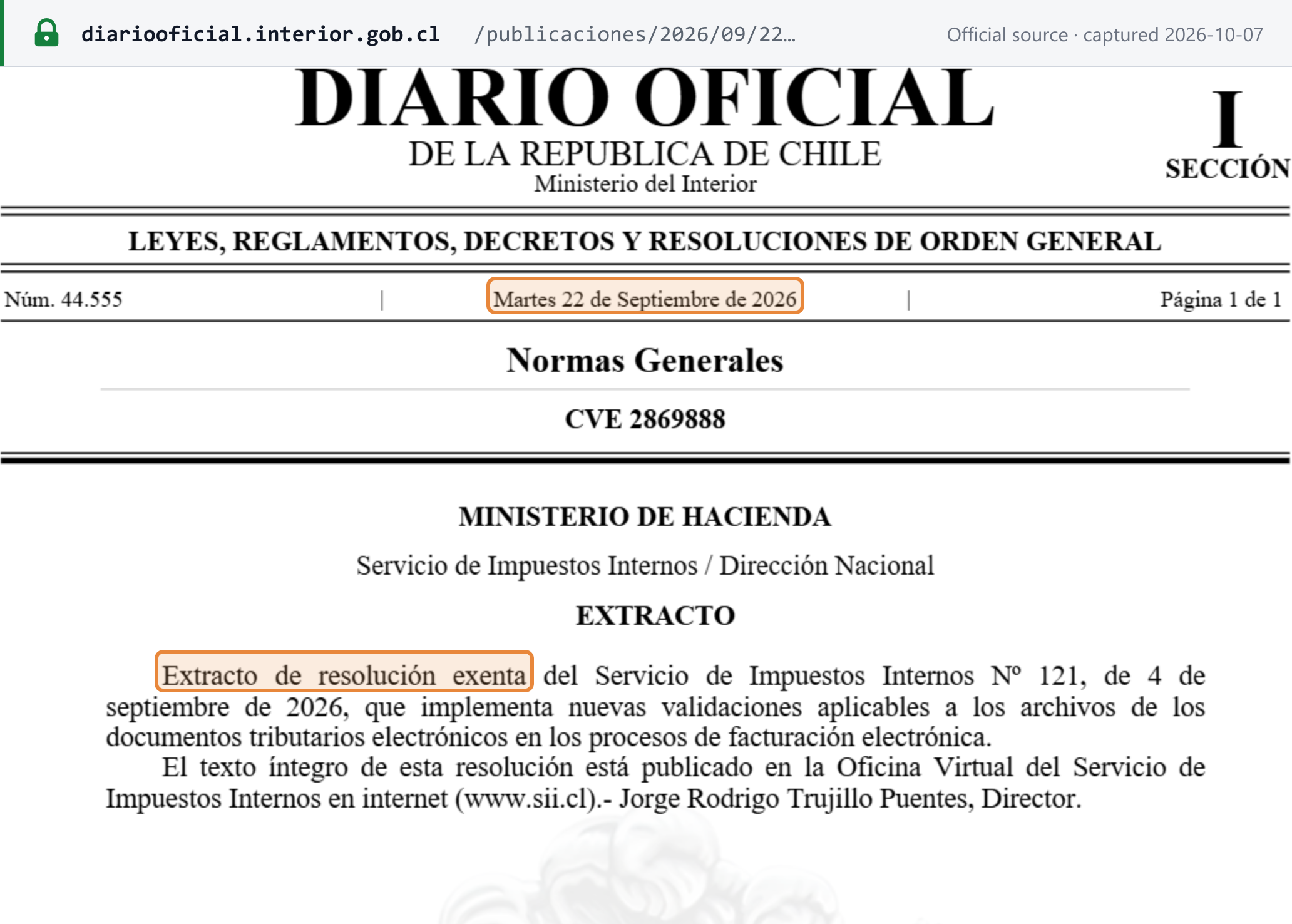
- New validations (Resolution 121 of 2026). SII Resolution 121 of 4 September 2026 adds XML technical and business validations, with three reception outcomes: Aceptado, Aceptado con reparos (accepted with defects) and Rechazado. Its extract was published in the Diario Oficial No. 44.555 on 22 September 2026, so it is in force; individual validations are phased in on a schedule the SII is to publish. See the event record. [19] [20]
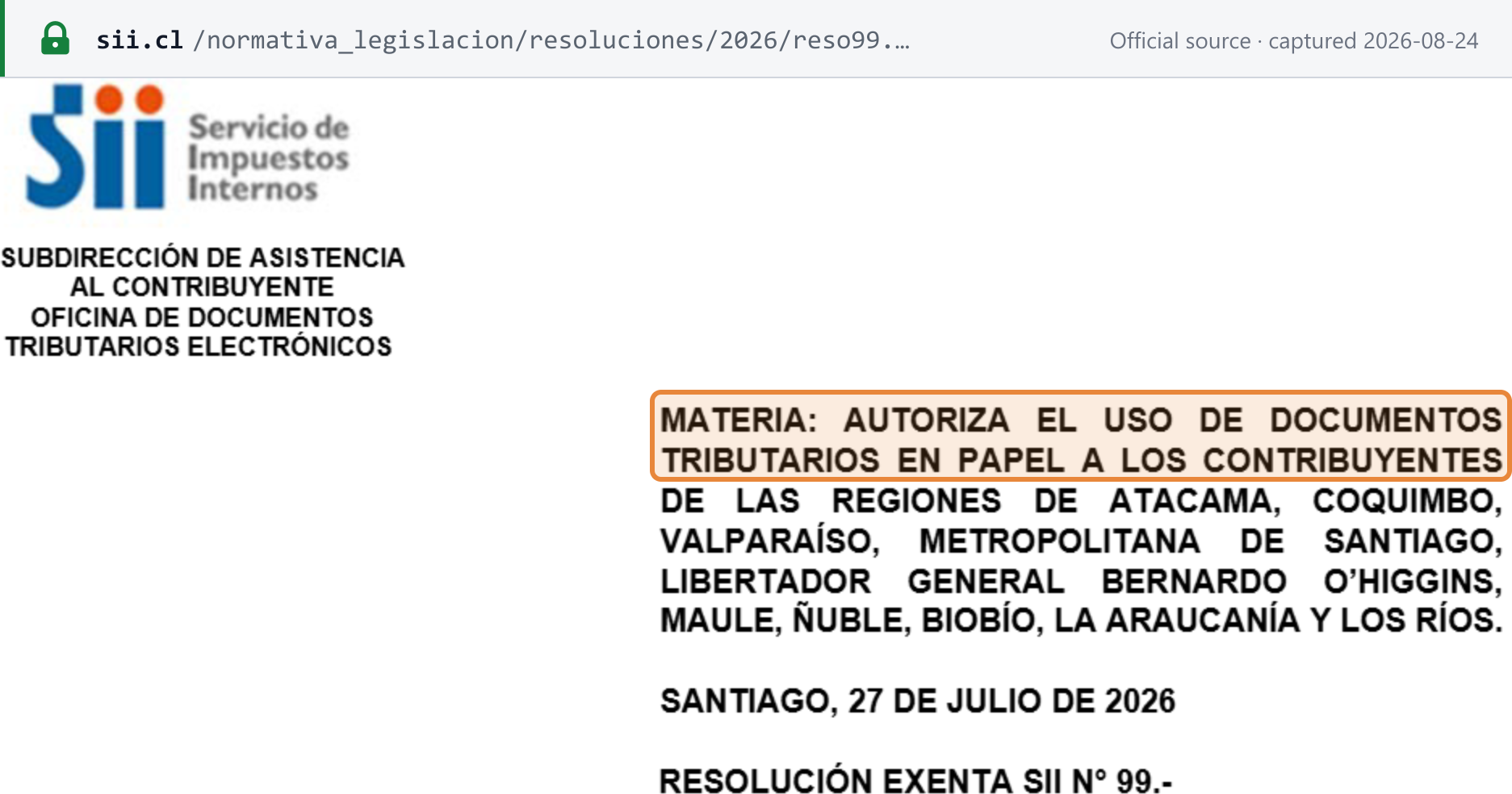
- Paper exception in disaster zones (Resolution 99 of 2026). It authorises paper tax documents for 12 months in ten regions declared disaster zones, using the article 54 power. See the event record. [21]
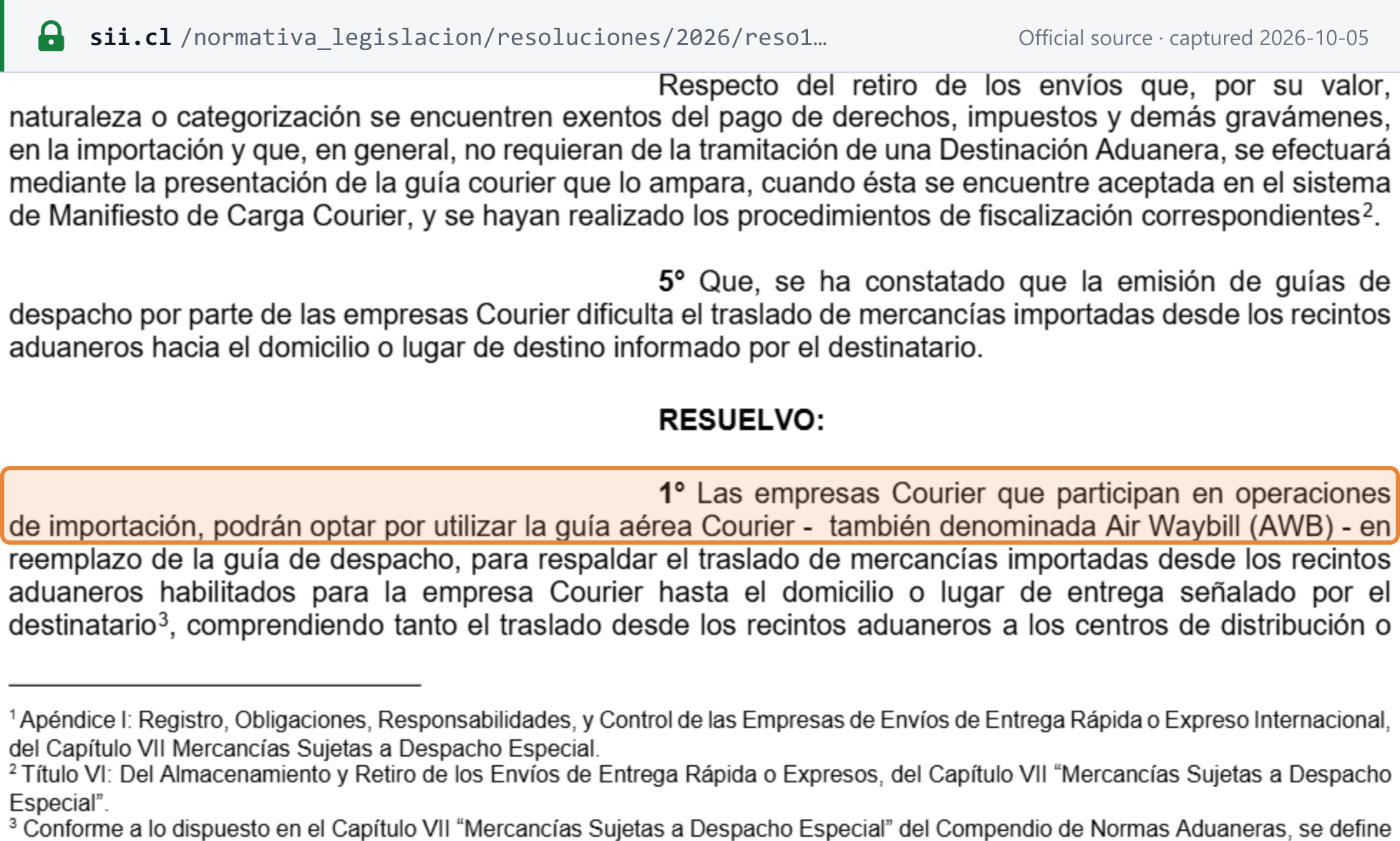
- Courier AWB (Resolution 134 of 2026). Courier companies may use the air waybill instead of the guía de despacho to move imported goods from customs to the recipient. Resolution 134 enters into force on publication of its extract in the Diario Oficial. See the event record. [22]
For the full DTE rules — document types, XML schema, timbre electrónico, acceptance window, certification and penalties — see the Chile e-invoicing (SII DTE) guide. For Chile alongside other jurisdictions, see Lookuptax's e-invoicing status and networks table.
Filing and payment
Filing frequency
Monthly, for every IVA taxpayer. The tax period is the calendar month (art. 2 N°5). The monthly return, Formulario 29, declares "el monto total de las operaciones realizadas en el mes anterior, incluso las exentas de impuesto" — all the month's operations, including exempt ones (art. 64). The quarterly option exists only for non-residents in IVA Digital (art. 35 D). [1]
Return due date
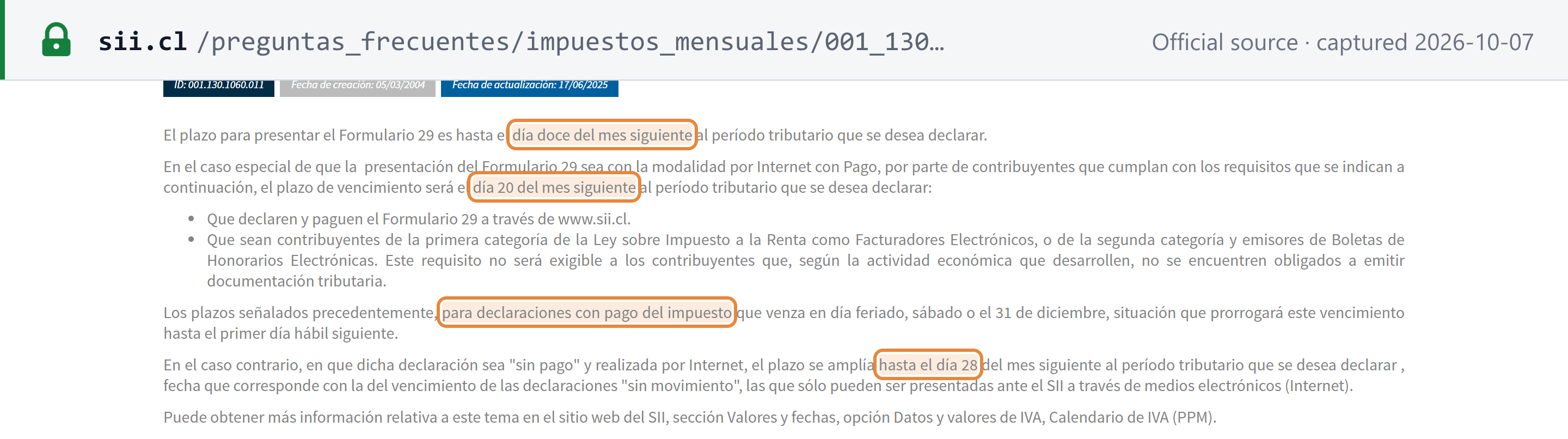
- The 12th, by statute. Taxes are paid "hasta el día 12 de cada mes, los impuestos devengados en el mes anterior" (art. 64). [1]
- The 20th, if you file and pay online as an electronic invoicer (or, for second-category taxpayers, as an issuer of electronic boletas de honorarios): "el plazo de vencimiento será el día 20 del mes siguiente al período tributario que se desea declarar". [23] [24]
- The 28th, for online returns with no payment ("sin pago" and "sin movimiento"): "el plazo se amplía hasta el día 28 del mes siguiente". [23]
- Weekends and holidays. For returns with payment of the tax ("declaraciones con pago del impuesto"), a due date on a Saturday, a holiday or 31 December moves to the next business day. [23]
- IVA Digital (Formulario 129). Due by the 20th of the month after the monthly or quarterly period (art. 35 E). A period with no operations needs no Formulario 129. [1] [6]
Payment due date and method
Payment is made together with the declaration ("Declaración Mensual y Pago Simultáneo"), so the payment date is the filing date above. The tax is paid to the Tesorería, online or through authorised banks (art. 64). [1]
SME payment deferral. A taxpayer "cuyo promedio anual de los ingresos de su giro no supere las 100.000 unidades de fomento en los últimos tres años calendario" may defer full payment of a month's IVA "hasta dos meses después" (art. 64, third paragraph). Conditions include signing up for email notifications and having no repeated arrears. [1]
Additional listings
- No separate sales or purchase listing. The SII builds the Registro de Compras y Ventas automatically from the DTEs (art. 59). Taxpayers complete it only for non-electronic documents, and for electronic documents whose detail is not reported to the SII. [1]
- Annual sworn returns (declaraciones juradas) have due dates set each year. For example, Resolution 135 of 2 October 2026 sets the dates for tax year 2027. Most of them are income-tax returns. [29]
Input-tax recovery and blocked items
- Credit. The input credit is the IVA charged on purchase invoices, or paid on imports, relating to the business (art. 23 N°1). [1]
- No credit for exempt use. "No procede el derecho al crédito fiscal por la importación o adquisición de bienes o la utilización de servicios que se afecten a hechos no gravados por esta ley o a operaciones exentas o que no guarden relación directa con la actividad del vendedor" (art. 23 N°2). Mixed use is apportioned (N°3). [1]
- Blocked: cars. No credit on the import, purchase or leasing of "automóviles, station wagons y similares", or on their fuel, lubricants, spare parts and repairs, "salvo que el giro o actividad habitual del contribuyente sea la venta o el arrendamiento de dichos bienes" (N°4). [1]
- Blocked: false invoices. An invoice later found to be false loses the credit unless the buyer proves payment by cheque or transfer and meets other proofs (N°5). [1]
- Timing. For electronic facturas, the credit arises in the period of the acuse de recibo, or of deemed receipt (N°7). [1]
Refunds
- Excess credit carries forward. An unused balance "se acumulará a los créditos que tengan su origen en el período tributario inmediatamente siguiente", adjusted for inflation by converting it to UTM (arts. 26–27). There is no general cash refund, except under articles 27 bis, 27 ter and 36. [1]
- Fixed assets. An excess credit from buying fixed assets, built up over at least two consecutive periods, can be offset against other taxes or refunded by the Tesorería (art. 27 bis). [1]
- Exporters recover input IVA under article 36 (see Imports and exports).
- Non-residents. The LIVS provides no IVA refund scheme for businesses not established in Chile, and suppliers in the simplified regime have no input credit (art. 35 C). [1]
- Bad-debt relief. There is no general bad-debt relief. Article 27 ter gives limited relief: a creditor in a reorganisation procedure under the Ley de Reorganización y Liquidación de Activos de Empresas y Personas may offset the IVA charged on unpaid invoices issued to debtors of an Acuerdo de Reorganización against other taxes, or have it refunded by the Tesorería. [1]
Exemptions
Exempt supplies
Exemptions are in article 12 (exempt goods, imports and services) and article 13 (exempt persons and institutions). Article 12 was last amended by Ley 21.806 (art. 90, Diario Oficial 5 February 2026), which added article 12 A N°7: used movable goods sold by non-profit charities, where the goods come exclusively from donations they receive and the charity is entered in a special SII register. A selection from the consolidated text, as at 2026-10-07: [1]
- Financial income: "Los intereses provenientes de operaciones e instrumentos financieros y de créditos de cualquier naturaleza" (art. 12 E N°10).
- Leasing of unfurnished real estate, with exceptions (art. 12 E N°11).
- Independent professionals: income under articles 42 and 48 of the Income Tax Law, i.e. independent professionals and professional partnerships (art. 12 E N°8).
- Ambulatory health services without accommodation, food or in-patient treatment: "Los servicios de laboratorio no se incluyen en esta exención" (art. 12 E N°20). Health benefits financed by FONASA or ISAPRE, up to the FONASA tariff (art. 12 E N°19).
- Export services qualified as such by customs (art. 12 E N°16), and hotels' foreign-currency income from foreign tourists (art. 12 E N°17).
- Goods: exported goods (art. 12 D); used motor vehicles, with exceptions (art. 12 A N°1).
- Article 13 institutions: broadcasters, except for advertising; passenger transport companies, "sólo respecto de los ingresos provenientes del transporte de pasajeros"; educational establishments, for teaching income; and State and university hospitals.
Exempt is not zero-rated. A domestic exempt supply carries no IVA, and the IVA on related costs cannot be recovered (art. 23 N°2). A business with both kinds of supply apportions. Exports are also exempt, but with recovery under article 36, so they are the functional equivalent of a zero rate. Exempt operations still require a factura or boleta (art. 53) and are declared on the Formulario 29 (art. 64). [1]
Special regimes
- Small-business fixed quota (art. 29). Small traders, artisans and small service providers selling to consumers, as the SII determines, may pay "sobre la base de una cuota fija mensual". Legal persons cannot use it (art. 35). [1]
- Change of subject (art. 3). The SII may shift liability to the buyer, who withholds the IVA and issues a factura de compra. Resolution 83 of 2026 is an example (see Self-billing). [1]
- SME payment deferral (art. 64), see Payment due date and method.
- Ferias libres (Párrafo 7° ter, arts. 35 J–Ñ). Individuals selling goods at street markets (ferias libres) with a municipal permit may opt for a substitute tax of 1.5% on sales paid by authorised electronic means, without any deduction and without input credit (art. 35 K). [1]
- Free zones. Article 3 refers to withholding on goods imported "desde los recintos de Zonas Francas"; the free-zone regime itself is set by the separate Ley de Zonas Francas.
- Margin scheme for second-hand goods. The LIVS has none (as at 2026-10-07).
Offences and penalties
The Código Tributario (art. 97) defines both the criminal offences and the administrative fines. Late-payment interest is in article 53. Fines are set as a percentage of the tax, or in UTM and UTA. The peso amounts below use the October 2026 values (UTM CLP 72,151; UTA CLP 865,812). [2] [26]
Offences
| Offence (Código Tributario art. 97) | Conduct | Sanction |
|---|---|---|
| Tax fraud (N°4, ¶1) | Maliciously false or incomplete returns, concealment in books, reusing invoices or boletas already used, other fraudulent conduct | Fine of 100%–300% of the tax evaded, plus presidio menor en su grado máximo (imprisonment) |
| Maliciously inflating IVA credits (N°4, ¶2) | Increasing input credits by fraudulent means | Presidio menor máximo to presidio mayor mínimo, plus 100%–300% |
| Fraudulent refunds (N°4, ¶3) | Obtaining refunds by fraud | Up to presidio mayor medio, plus 100%–400% |
| False documents (N°4, ¶5) | Making, selling or supplying false guías, facturas, notes or boletas | Presidio menor medio and a fine of up to 40 UTA; if done to commit fraud, presidio menor máximo and up to 100 UTA |
| Malicious omission of returns (N°5) | Omitting returns that determine tax, with intent | 50%–300% of the tax, plus presidio menor medio to máximo |
| Repeated failure to issue documents (N°10, ¶3) | Two or more infractions within three years | Presidio or relegación menor máximo |
On false documents: "El que confeccione, venda o facilite, a cualquier título, guías de despacho, facturas, notas de débito, notas de crédit o boletas falsas, con o sin timbre del Servicio, será sancionado con la pena de presidio menor en su grado medio y multa de hasta 40 unidades tributarias anuales" (N°4). [2]
Penalties
| Infraction (Código Tributario art. 97) | Fine | October 2026, CLP |
|---|---|---|
| Late or missing registration, and other declarations that do not determine tax (N°1) | 1 UTM to 1 UTA | 72,151 to 865,812 |
| Late filing of a return that determines tax (N°2) | 10% of the tax if up to five months late, then +2% per month or part-month, capped at 30% | — |
| Late payment of withheld or charged taxes, including IVA (N°11) | 10%, then +2% per month, capped at 30%; 20% rising to 60% where the SII finds the omission in an audit | — |
| Failure to issue, or send electronically, invoices, guías, notes or boletas (N°10) | 50%–500% of the operation, minimum 2 UTM, maximum 40 UTA, plus closure of up to 20 days | 144,302 to 34,632,480 |
| Erroneous or incomplete return (N°3) | 5%–20% of the tax difference, unless due diligence is shown | — |
| Obstructing an audit (N°6) | 1 UTM to 1 UTA (higher caps for large taxpayers) | 72,151 to 865,812 |
Notes on the table:
- Late filing (N°2). The fine is "diez por ciento de los impuestos que resulten de la liquidación, siempre que dicho retardo u omisión no sea superior a 5 meses", increased "en un dos por ciento por cada mes o fracción de mes de retardo, no pudiendo exceder el total de ella del treinta por ciento". It does not apply when the N°11 late-payment fine applies and the return could not be filed without payment.
- Failure to issue documents (N°10). The closure can extend to "el sitio en internet o del sitio dentro de la plataforma virtual o digital a través de la cual el contribuyente realiza el ejercicio de la actividad comercial" — the website or the marketplace storefront.
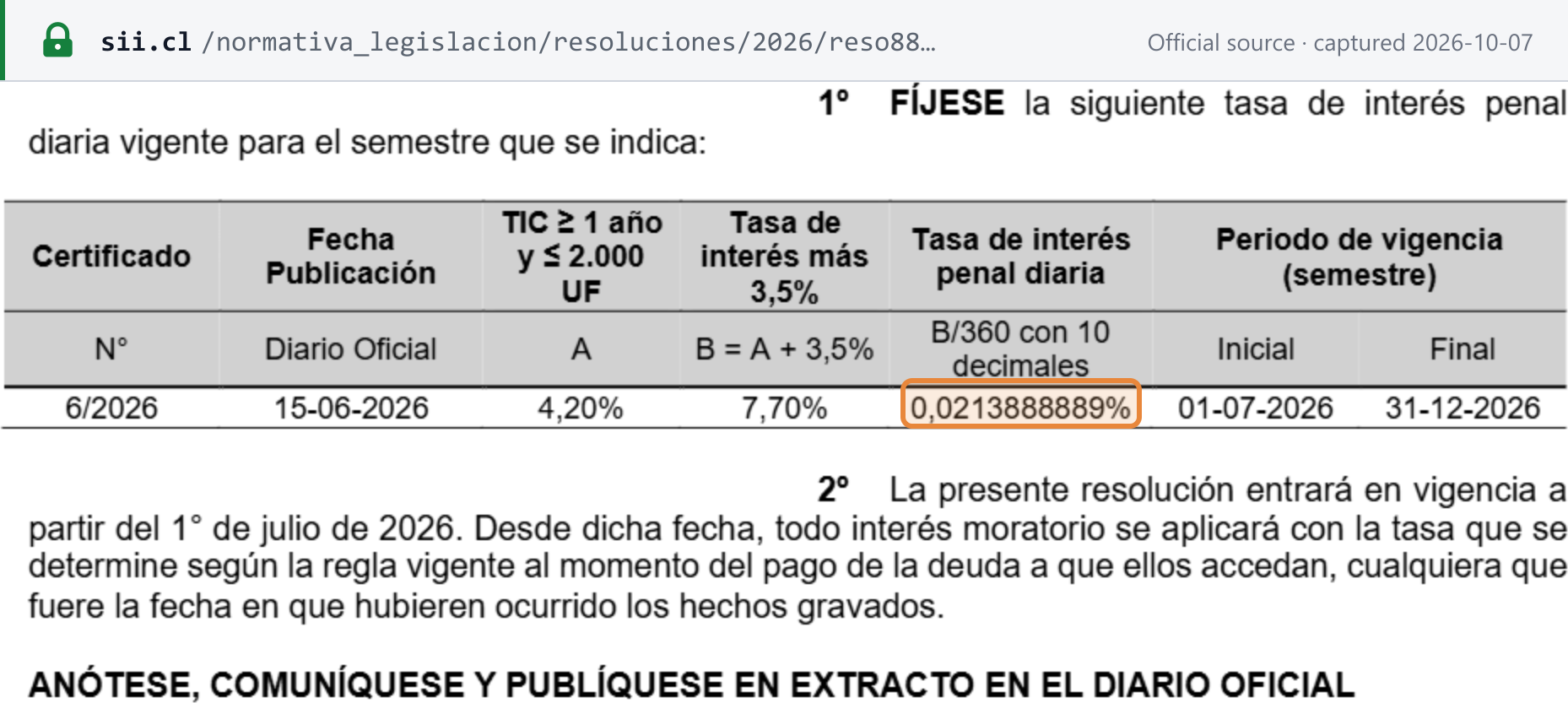
Late-payment interest. Unpaid tax is adjusted for inflation (CPI) and bears daily penal interest. Article 53, as amended by Ley 21.713, sets it at the Comisión para el Mercado Financiero's tasa de interés corriente for readjustable operations of one year or more, up to 2,000 UF, "incrementada en 3,5%". The SII fixes the rate each half-year. For 1 July – 31 December 2026 it is 7.70% a year (4.20% + 3.5%), applied as 0.0213888889% per day (SII Resolution 88 of 26 June 2026). For the first half of 2026 it was 0.0220000000% per day (base rate 4.42%; Resolution 205 of 2025). The old flat monthly rate no longer applies. [2] [25]
Frequently asked questions
We are a foreign SaaS company selling to Chilean businesses. Do we charge Chilean IVA?
No, not where the customer is an IVA taxpayer. The simplified IVA Digital regime in article 35 A of the Ley sobre Impuesto a las Ventas y Servicios covers only sales and services to persons who are not IVA taxpayers. When a Chilean IVA taxpayer buys a service from a supplier resident abroad, the Chilean customer is the taxpayer and accounts for the IVA itself (article 11 e). For low-value goods and platform sales, SII Resolution 93 of 2025 says the seller must not charge IVA to a buyer who is an IVA taxpayer, and it is the buyer's sole responsibility to tell the seller or platform its status and RUT. A business customer that never identifies itself can end up being charged IVA it cannot recover. [1] [13]
Is there a sales threshold before a foreign seller must register for IVA Digital?
No threshold is set. Article 35 A applies to every non-resident that sells goods or provides services to Chilean non-taxpayers, and neither the article nor the SII's IVA Digital portal and FAQs states a minimum (as at 2026-10-07). The supplier registers online at sii.cl/vat, receives a User Number instead of a RUT, and needs no contact person in Chile. [1] [5]
Is our monthly Formulario 29 due on the 12th or the 20th?
The statutory deadline is the 12th of the following month (article 64). The SII extends it to the 20th for taxpayers who file and pay online and are electronic invoicers, and to the 28th for online returns with no payment due. For returns with payment of the tax, a deadline that falls on a Saturday, a holiday or 31 December moves to the next business day. [23]
Can we issue a Chilean factura in US dollars?
Not for a domestic sale. SII Circular 12 of 1991, restated in Oficio 1794 of 2017, requires unit prices, the total for each item, the IVA and the final total to be stated in Chilean pesos. The dollar values may be shown in the detail area together with the exchange rate in force on the day the invoice is issued. Export documents carry their own currency field. [15]
Our electronic invoice came back from the SII as Aceptado con reparos. Is it valid?
Yes, it is accepted, but with defects to correct. SII Resolution 121 of 4 September 2026 introduced new XML technical and business validations with three reception outcomes: Aceptado, Aceptado con reparos and Rechazado. The resolution took effect when its extract was published in the Diario Oficial on 22 September 2026, with the individual validations phased in on a schedule the SII is to publish. Software that only distinguishes accepted from rejected will miss the warning. [19] [20]
When can our Chilean customer use the IVA on our invoice as a credit?
In the period in which the customer gives the acuse de recibo, or in which the goods or services are deemed received (article 23 N°7). Under Ley 19.983, an invoice is irrevocably accepted unless the customer claims against it within eight calendar days of receiving it. The timing rule does not apply to services. [1] [27]
Can we deduct the IVA on a company car in Chile?
No, unless selling or renting vehicles is your line of business. Article 23 N°4 denies the credit on the import, purchase or leasing of cars, station wagons and similar vehicles, and on their fuel, lubricants, spare parts and repairs. [1]
Important websites
| Site | Purpose |
|---|---|
| SII — home and Mi SII login | RUT and Clave Tributaria login; online RUT enrolment and inicio de actividades (Formulario 4415); Formulario 29 filing and payment |
| SII — RUT and inicio de actividades help | How to enrol online and declare the start of activities |
| SII — IVA Digital portal | Non-resident registration (User Number), Formulario 129 filing and payment, list of unregistered foreign companies |
| SII — factura electrónica services | Free SII invoicing system, certification of market software, CAF folios |
| SII — e-invoicing rules index | Resolutions and technical documents for DTE |
| SII — Registro de Compras y Ventas | View and complete the purchase and sales register built from DTEs (login required) |
| SII — Formulario 29 deadlines | Monthly return due dates (12th, 20th, 28th) |
| SII — UTM and UTA values 2026 | Monthly tax-unit values used to compute fines |
| Tesorería General de la República | Tax payments and refunds |
| Servicio Nacional de Aduanas | Import IVA and customs clearance |
| BCN Ley Chile — D.L. 825 | Official consolidated text of the IVA law |
The SII publishes no separate rate-lookup service (as at 2026-10-07); the single 19% rate sits in article 14 of D.L. 825. To check a RUT, see Lookuptax's RUT verification guide and Chile RUT validator.
Recent changes
- 2026-09-30 — SII Resolution 134: courier companies may use the air waybill (AWB) instead of the guía de despacho for imported goods; enters into force on publication of its extract in the Diario Oficial. (SII) — see event
- 2026-09-22 — Extract of SII Resolution 121 published in the Diario Oficial, bringing in force new DTE XML validations and the "Aceptado con reparos" outcome. (Diario Oficial) — see event
- 2026-07-27 — SII Resolution 99: paper tax documents authorised for 12 months in ten disaster-zone regions. (SII) — see event
- 2026-07-01 — Late-payment interest for the second half of 2026 set at 7.70% a year (0.0213888889% per day). (SII Resolution 88)
- 2026-06-23 — SII Resolution 83: voluntary full change of subject (factura de compra, 100% IVA withheld) for agricultural services. (SII) — see event
- 2026-06-02 — SII Resolution 69: offshore online gambling platforms pay IVA Digital (Formulario 129), including the previous 36 periods. (SII) — see event
- 2025-10-25 — IVA charged on remote sales of low-value goods (USD 500 or less) by foreign sellers and platforms. (SII)
For the full chronology, see Chile tax changes on Lookuptax.
Reference links
- BCN Ley Chile — D.L. 825, Ley sobre Impuesto a las Ventas y Servicios (consolidated)
- BCN Ley Chile — D.L. 830, Código Tributario (consolidated)
- SII — IVA Digital portal
- SII — IVA Digital FAQ 1: the simplified regime
- SII — IVA Digital FAQ 2: registration
- SII — IVA Digital FAQ 3: returns and payment
- SII — FAQ: RUT and inicio de actividades for agencies and permanent establishments
- SII — Circular 47 of 12 September 2003, the 19% rate
- SII — Formato de Documentos Tributarios Electrónicos, v2.2
- SII — Manual de Muestras Impresas, v4.0 (July 2014)
- SII — Instructivo Técnico de emisión de DTE
- SII — Resolution 84 of 10 July 2025, low-value goods
- SII — Resolution 93 of 30 July 2025, low-value goods and platforms
- SII — Resolution 60 of 2023, minimum boleta amount
- SII — Oficio 1794 of 2017, invoices in national currency
- BCN Ley Chile — Ley 20.727 (factura electrónica)
- SII — Ley 20.727 FAQ
- SII — FAQ: mandatory electronic boleta dates
- Diario Oficial No. 44.555, 22 September 2026 — extract of SII Resolution 121
- SII — Resolution 121 of 4 September 2026, DTE validations
- SII — Resolution 99 of 27 July 2026, paper documents in disaster zones
- SII — Resolution 134 of 2026, courier AWB
- SII — FAQ: Formulario 29 deadlines
- SII — FAQ: who may file Formulario 29 by the 20th
- SII — Resolution 88 of 26 June 2026, late-payment interest for the second half of 2026
- SII — UTM and UTA values, 2026
- BCN Ley Chile — Ley 19.983 (factura as an executive title; acuse de recibo)
- SII — Resolution 83 of 2026, voluntary change of subject for agricultural services
- SII — Index of 2026 resolutions
- SII — News, 3 June 2026: Resolution 69 on online gambling platforms
- SII — FAQ: RUT enrolment and inicio de actividades online
Related Lookuptax pages:
- Chile RUT tax ID guide
- Chile e-invoicing (SII DTE) guide
- How to verify a RUT in Chile
- Chile RUT validator
- VAT on digital services by non-resident suppliers
- Marketplace deemed-supplier rules
- Reverse charge explained
- E-invoicing status and networks worldwide
- Worldwide tax rates
- VAT registration thresholds worldwide