Norway VAT (MVA) guidelines
| FACTSHEET | |
|---|---|
| Country code | NO |
| Tax name | Value Added Tax — Merverdiavgift (MVA) |
| Tax Authority | Norwegian Tax Administration — Skatteetaten |
Overview
Norway levies Value Added Tax — in Norwegian merverdiavgift (MVA) — under the Value Added Tax Act (lov 19. juni 2009 nr. 58 om merverdiavgift, merverdiavgiftsloven). The Act sets the scope, exemptions and registration rules; the rates are fixed each year by a plenary resolution of the Storting (section 5-1(2) of the Act). VAT is administered by the Norwegian Tax Administration (Skatteetaten), which also collects import VAT from registered businesses through the VAT return; Norwegian Customs (Tolletaten) handles customs declarations. [1] [9]
Norway is in the EEA but outside the EU VAT area. The VAT Act has no concept of intra-EU supplies or acquisitions, and every supply of goods out of the Norwegian VAT area is treated as an export (chapter 6 III, utførsel). So none of the EU mechanisms apply: there is no intra-Community supply or acquisition, no OSS or IOSS, no EC Sales List and no VIES number. Every cross-border movement of goods is an import or an export through customs, and cross-border services are handled by Norway's own reverse charge and the VOEC scheme described under Cross-border rules. [1]
Territory. The Act applies in the merverdiavgiftsområdet — the Norwegian mainland and territorial waters, "men ikke Svalbard, Jan Mayen eller de norske bilandene" (but not Svalbard, Jan Mayen or the Norwegian dependencies) (section 1-2(2)). [1]
Currency. All amounts in this guide are in Norwegian kroner (NOK). An invoice may be made out in another currency, but the VAT on it must be stated in NOK (see Invoice requirements). [14]
Tax period. The ordinary VAT period is two calendar months — six periods a year — with annual and monthly alternatives described under Filing and payment. [21]
Layering. MVA is a single national tax under one Act. There is no regional or municipal VAT layer. [1]
Registration
Who should register
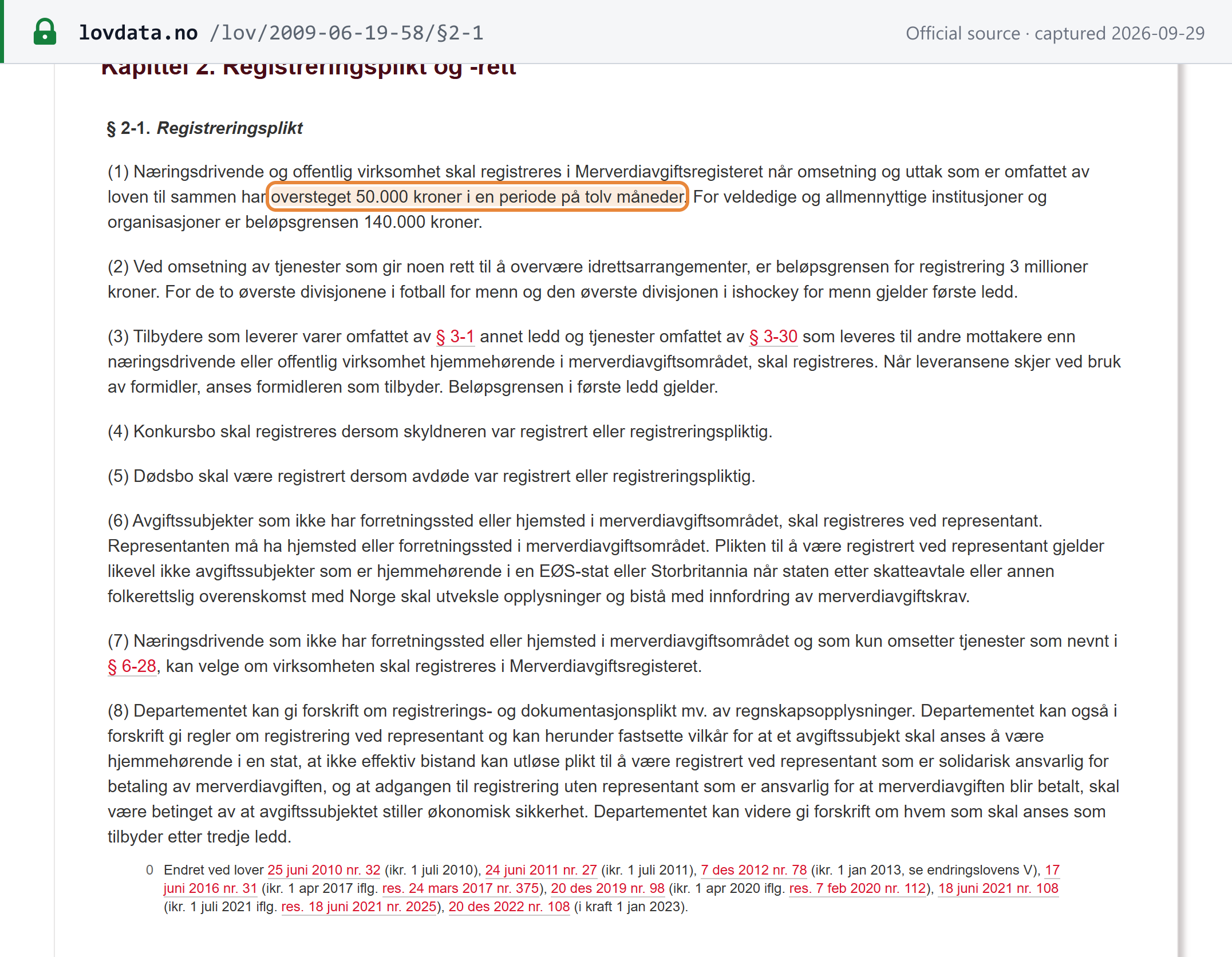
Businesses and public bodies must register in the VAT Register (Merverdiavgiftsregisteret) once their taxable supplies and self-supplies exceed NOK 50,000 in a period of twelve months. The limit is NOK 140,000 for charitable and non-profit institutions and organisations. Section 2-1(1) of the VAT Act: [1]
"Næringsdrivende og offentlig virksomhet skal registreres i Merverdiavgiftsregisteret når omsetning og uttak som er omfattet av loven til sammen har oversteget 50.000 kroner i en periode på tolv måneder."
(Businesses and public bodies shall be registered in the VAT Register when supplies and self-supplies covered by the Act have together exceeded NOK 50,000 in a period of twelve months.)
How the threshold works:
- Rolling, not calendar-year. Skatteetaten's examples of a 12-month period run "from February of one year to January the next year, or from August one year to July the next year". [2]
- Sports-event tickets. A separate limit of NOK 3 million applies to the sale of tickets to sports events (section 2-1(2)), although clubs in the top two men’s football divisions and the top men’s ice-hockey division fall under the ordinary NOK 50,000 limit. [1]
- Excluding VAT, taxable supplies only. The limit is "NOK 50,000 (not including VAT)". Zero-rated supplies count towards it; exempt supplies do not (see Exemptions). [2] [25]
- No VAT before approval. "You cannot include VAT in your invoices until your enterprise been registered." Once registered, the sale that crossed the threshold is invoiced with VAT; if it was already invoiced without, the seller issues a credit note and a new invoice with VAT. Registering too late means interest on the VAT that should have been paid for earlier periods. [2]
Non-resident registration
The threshold for non-residents is the same NOK 50,000 — not zero. A foreign business making supplies in Norway outside the VOEC scheme registers once it passes NOK 50,000 in 12 months, however short its stay. Altinn, the government's business portal: "if you are in Norway for two days and carry out an assignment with a value of in excess of NOK 50,000, your enterprise must register in the VAT Register." [3]
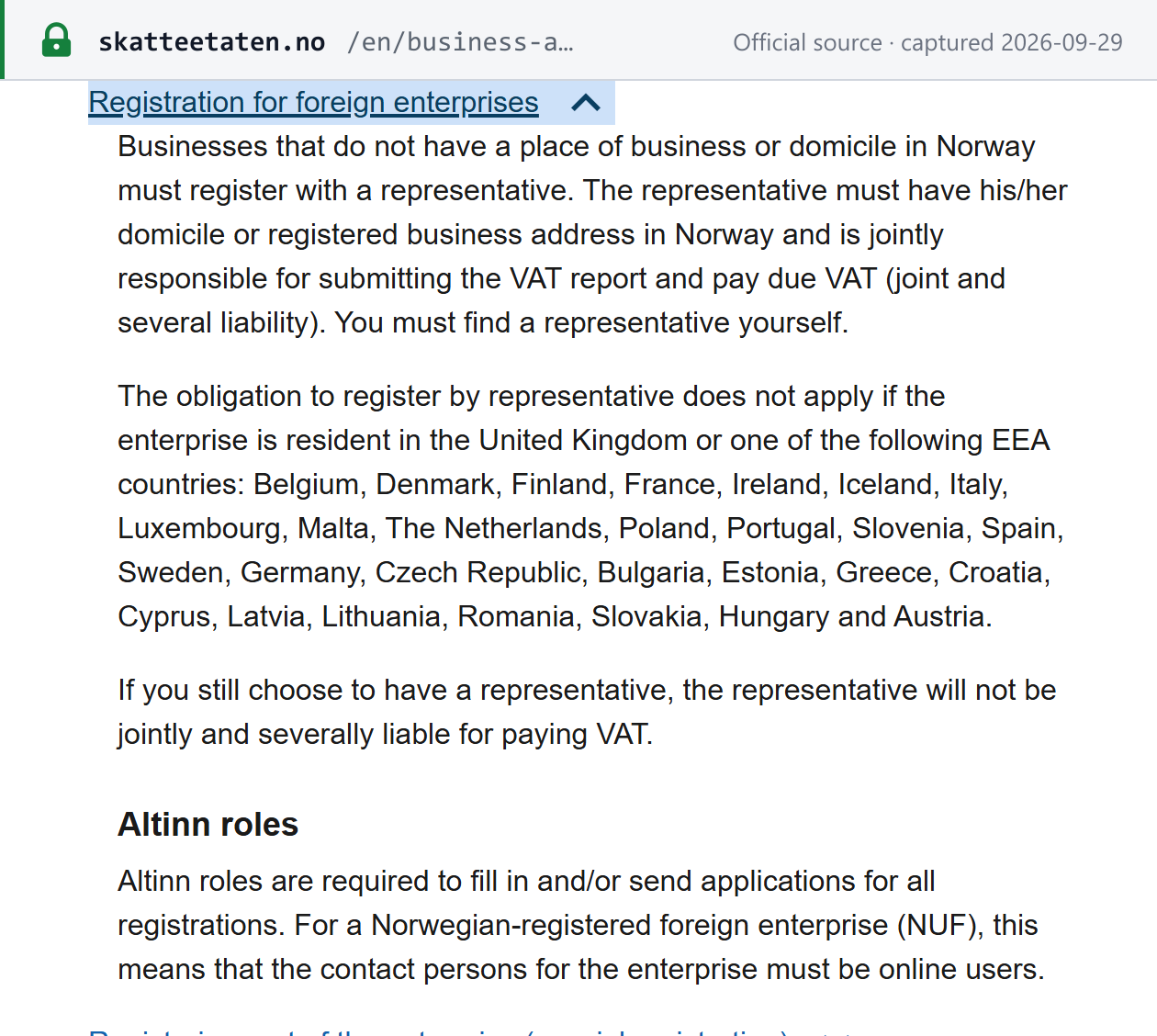
- VAT representative. A business with no place of business or domicile in Norway must register through a representative who is domiciled or has a registered business address in Norway and is jointly and severally liable for filing and paying the VAT (section 2-1(6)). [2] [1]
- Exception — UK and listed EEA states. The duty does not apply to a business resident "in the United Kingdom or one of the following EEA countries", after which Skatteetaten lists all 27 EU member states and Iceland. Liechtenstein is not listed. The statutory test is residence in an EEA state or the UK that has a treaty with Norway on exchanging information and assisting with the recovery of VAT claims. A representative appointed voluntarily by such a business is not jointly liable. [2]
- Register the entity first. The foreign business must be in the Central Coordinating Register for Legal Entities (Enhetsregisteret) before it applies for VAT registration — typically as a Norwegian-registered foreign business (NUF). [2]
- Sales to consumers of low-value goods or remote services go through the simplified VOEC register instead, with no representative — see Foreign companies selling into Norway.
Tax identification number
A legal entity receives a nine-digit organisation number (organisasjonsnummer) from the Brønnøysund Register Centre. The last digit is a modulus-11 check digit computed with the weights 3, 2, 7, 6, 5, 4, 3, 2 from the first digit onwards; if the computed check digit is 10, the number is not valid. Brreg's own worked example is 123456785. [29]
Once VAT-registered, the business writes the organisation number followed by "MVA" on its invoices — "skal organisasjonsnummer etterfølges av bokstavene MVA" (bookkeeping regulation section 5-1-2) — so the VAT number takes the form 123456785MVA. [14]
For the full format, check-digit worked example and the personal identifiers, see the Norway tax ID guide. To check a number, use Lookuptax's Norway MVA number validator; the Brønnøysund register's open API also returns whether an entity is in the VAT Register (field registrertIMvaregisteret).
How to register
- Register the legal entity in Enhetsregisteret at brreg.no. Skatteetaten: "Make sure your enterprise is registered in the Central Coordinating Register of Legal Entities before you continue." [2]
- Apply for VAT registration in Skatteetaten's MVA portal, logging in through Altinn with the "Value added tax" access package. [2]
- Wait for the reply in the Altinn inbox. "This will usually only take a few minutes, but on some occasions, we'll need more information. In those cases, it can take up to 3 weeks before you receive a reply." [2]
Altinn access from 1 January 2027. "On 1 January 2027, roles and delegation of roles in Altinn II will be removed. From that point on, you must have the correct access package to gain access." This affects accountants and the contact persons of NUFs who file on a business's behalf. [2]
Voluntary registration
Not available as a general option. A business below NOK 50,000 cannot simply opt in. Section 2-3 of the VAT Act allows voluntary registration only in listed cases — chiefly letting buildings or facilities to VAT-registered tenants (where rent from such tenants reaches NOK 50,000 in 12 months), plus leasing farmland, forest-road associations, private builders of water and sewage facilities, and track-facility providers. [1]
Pre-registration (forhåndsregistrering, section 2-4) is the route for a start-up: it is available where the business has made significant purchases directly linked to later taxable supplies, or where its taxable supplies will exceed the threshold within three weeks of starting. Skatteetaten asks for documented VAT-able purchases of at least NOK 250,000 and expects more than 4 months to pass before the threshold is reached. Once registered, input VAT on purchases made up to three years before registration can be deducted (section 8-6). [1] [2]
Deregistration
- When. A business is deleted from the VAT Register when it has ceased trading, or when the tax office finds special reasons to delete it (section 14-3(1)). [1]
- Falling below the threshold is not enough. If taxable turnover merely drops under NOK 50,000, the business "skal … forbli registrert i minst to hele kalenderår" — stays registered for at least two full calendar years (section 14-3(2)). [1]
- Final return. "Remember to submit your final VAT return." After deletion the business may not charge VAT; it keeps its organisation number. A member of a joint registration must leave the joint registration first. [2]
Group registration
Available as joint registration (fellesregistrering, section 2-2(3)). Two or more cooperating companies may register as one taxable person where at least 85% of each company's capital is owned by one or more of the others. All members are jointly and severally liable for the VAT, the group files one return, and sales between members carry no VAT. Skatteetaten adds that "at least one of the enterprises must have external turnover that exceeds the monetary limit for registration." [1] [2]
Rates
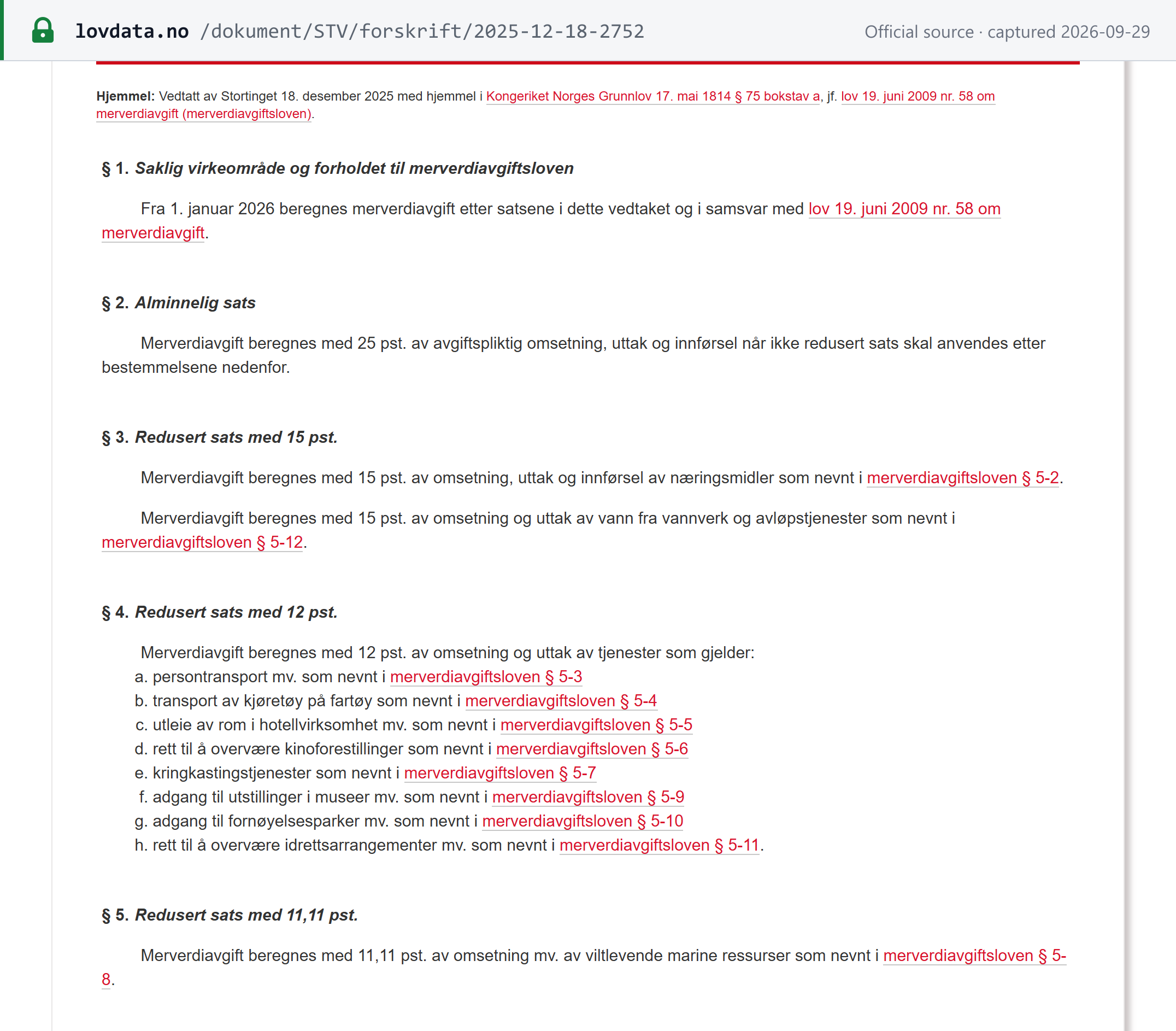
Rates are set annually by the Storting's VAT resolution. The resolution for 2026 (Stortingsvedtak om merverdiavgift for 2026, FOR-2025-12-18-2752) applies "fra 1. januar 2026" (from 1 January 2026): [4]
| Rate | Applies to | Effective |
|---|---|---|
| 25% (general, alminnelig sats) | Every taxable supply, self-supply and import not covered by a reduced rate or zero-rating | Since 1 January 2005 (up from 24%) [6] |
| 15% | Foodstuffs (section 5-2) — but food served as part of a restaurant or catering service is 25%, and medicines, tobacco, alcoholic drinks and tap water are not "foodstuffs"; water from waterworks and wastewater services (section 5-12) | Water and wastewater: since 1 July 2025 [8] |
| 12% | Passenger transport (5-3); vehicle ferries on domestic road links (5-4); hotel and holiday accommodation, including camping and holiday homes (5-5); cinema (5-6); public broadcasting (5-7); museums and galleries (5-9); amusement parks and activity centres (5-10); sports events (5-11) | — [7] |
| 11.11% | Fishers' sales of wild marine resources through sales cooperatives (5-8) | — |
| 0% (zero-rated, fritatt) | Newspapers, periodicals, books at the last sale, exports, battery-electric cars up to NOK 300,000 and more — see Exemptions | — |
| Exempt (unntatt) | Health, education, financial services, letting of real property and more — see Exemptions | — |
The standard rate's start date comes from the 2005 transitional regulation: "Standardsatsen for merverdiavgift er med virkning fra 1. januar 2005 økt fra 24 pst. til 25 pst." (with effect from 1 January 2005 the standard VAT rate is increased from 24% to 25%). [6]

Skatteetaten's own rates page ("Normal rate 25 % / Foodstuffs 15 % / Water and wastewater services 15 % / Passenger transport, cinema tickets, letting of rooms 12 %") matches the resolution. [5]
Services bought from abroad follow the domestic rate: electronic services, software, streaming, e-learning and consulting, legal, advertising and IT services at 25%; intermediation of room rental at 12%; newspapers, periodicals and books, including audiobooks, at 0%. [32]
Announced future rates. The government's 2027 budget, Prop. 1 LS (2026–2027), presented on 7 October 2026, proposes no change to the 25 / 15 / 12 / 11.11% schedule for 2027; the Storting adopts each year's VAT resolution in December, so anything in the budget is a proposal until then. Electric cars: when it adopted the 2026 budget, the Storting asked the government to step the section 6-8 zero-rate cap down to NOK 150,000 from 1 January 2027 and to zero from 1 January 2028 (Innst. 2 S (2025–2026)). Prop. 1 LS (2026–2027) proposes the first step: cutting the cap from NOK 300,000 to NOK 150,000 from 1 January 2027, with full VAT on electric cars planned for 2028. That is a proposal, not law: it needs the Storting's vote and, as state aid, ESA approval. Until then, section 6-8 of the VAT Act still zero-rates battery-electric cars up to NOK 300,000 (see Exemptions). [40] [38] [1]
Cross-border rules
Because Norway is outside the EU VAT area, there are no intra-EU rules here — no distance-selling threshold, no OSS/IOSS and no EC Sales List. Goods cross the border as imports or exports; services turn on whether they are "remotely deliverable".
Imports and exports
Imports of goods. VAT is charged on every import of goods into the VAT area (section 3-29(1)). VAT-registered businesses do not pay import VAT to Customs: "VAT-registered enterprises must calculate import VAT themselves and enter the amounts under specific items in the VAT return." They report it for the period in which the shipping date falls — the day Customs registers the goods' arrival: "The shipping date determines the period under which the import should be declared in the VAT return" — and deduct it on the same return where it is deductible. The basis is "the sum of the statistical value + customs duties and taxes". Private individuals and unregistered businesses pay import VAT to Norwegian Customs, or to the carrier that clears the goods. [1] [9]
De minimis. Since 1 April 2020 there has been no general low-value VAT relief for goods sent to Norwegian consumers; low-value B2C goods are taxed through VOEC instead (below). Section 7-2 of the VAT Act relieves only goods that are exempt from the customs-declaration duty. [1]
Exports. "Omsetning av varer ut av merverdiavgiftsområdet, er fritatt for merverdiavgift" — supplies of goods out of the VAT area are zero-rated (section 6-21). Services wholly used outside the VAT area are zero-rated (section 6-22(1)), and so are remotely deliverable services to a recipient resident outside the VAT area (section 6-22(2)). Zero-rating keeps the input-VAT deduction. [1]
Digital products and services
Digital and other remotely deliverable services are taxed where the recipient is resident:
- to a Norwegian business or public body — reverse charge by the buyer (sections 3-30 and 11-3);
- to a Norwegian consumer — the foreign supplier registers in VOEC once its consumer sales exceed NOK 50,000 in 12 months and charges Norwegian VAT (section 2-1(3));
- to a recipient outside Norway — zero-rated (section 6-22(2)).
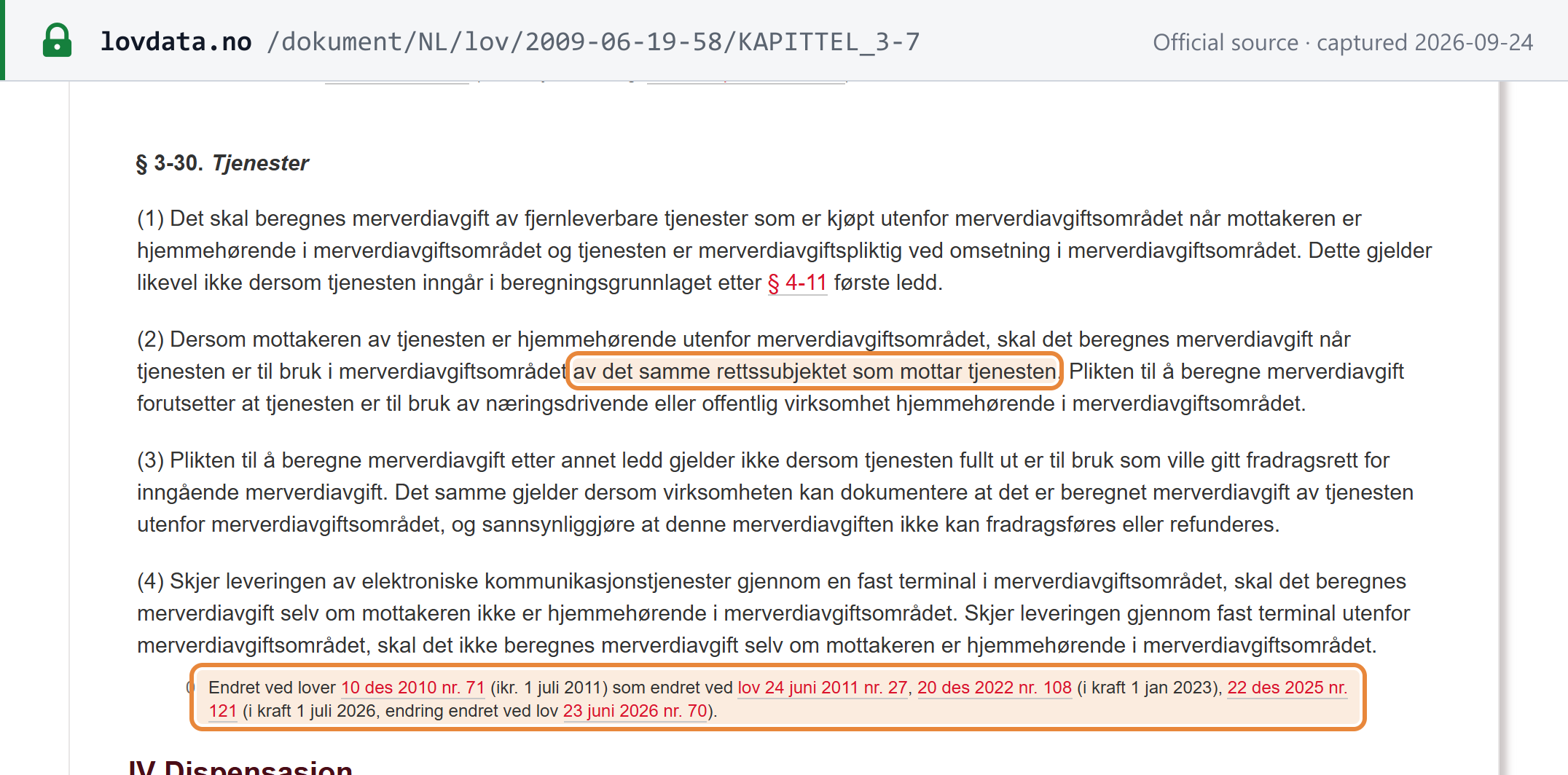
Multi-location entities (from 1 July 2026). Where a remotely deliverable service is bought by a foreign head office or establishment and used in Norway by the same legal entity — typically a Norwegian branch — VAT is now due in Norway (section 3-30(2)). It is not due if the service is wholly used for purposes that would give full input-VAT deduction, or if the business documents that VAT was charged on it abroad and shows that VAT cannot be deducted or refunded (section 3-30(3)). The rule was enacted by lov 22. desember 2025 nr. 121 (part II, in force 1 July 2026); lov 23. juni 2026 nr. 70 reworded the second sentence of section 3-30(3) before it took effect. [1] [12]
Foreign companies selling into Norway — B2B and B2C
The two halves differ, and a foreign business often has both.
B2B — the Norwegian customer reverse-charges services. "Det skal beregnes merverdiavgift av fjernleverbare tjenester som er kjøpt utenfor merverdiavgiftsområdet når mottakeren er hjemmehørende i merverdiavgiftsområdet" — VAT is due on remotely deliverable services bought from outside the VAT area when the recipient is resident in it (section 3-30(1)) — and a business or public-body recipient calculates and pays it (section 11-3(1)). [1]
- A VAT-registered buyer reports it in its ordinary return: "There is no lower threshold amount for such buyers." [10]
- An unregistered business buyer accounts only when its purchases for a period "overstiger 2 000 kroner, merverdiavgift ikke medregnet" — exceed NOK 2,000 excluding VAT (section 11-3(1)) — on a separate return with quarterly periods (Tax Administration Regulation section 8-3-9). [1] [21]
- The foreign supplier does not register for these sales and charges no Norwegian VAT.
- A legal person in the VAT Register reverse-charges even for non-economic use. The Tax Directorate's statement of 1 October 2026 says a registered legal person must itself calculate and pay the VAT under section 11-3(1) on remote services from a foreign supplier, including where the service is used in its non-economic (ideal) activity. The use of the service affects the right of deduction. (Skatteetaten statement)
- Goods sold B2B do not in themselves require the foreign seller to register: the Norwegian importer self-assesses the import VAT. If the foreign seller is itself the importer and then sells the goods inside Norway, it is making domestic supplies and registers once they pass NOK 50,000.
- Services that must be performed in Norway — for example work on a Norwegian property — are domestic supplies: "the supplier will be obliged to register the activity in Norway", subject to the NOK 50,000 threshold and the representative rule. [10]

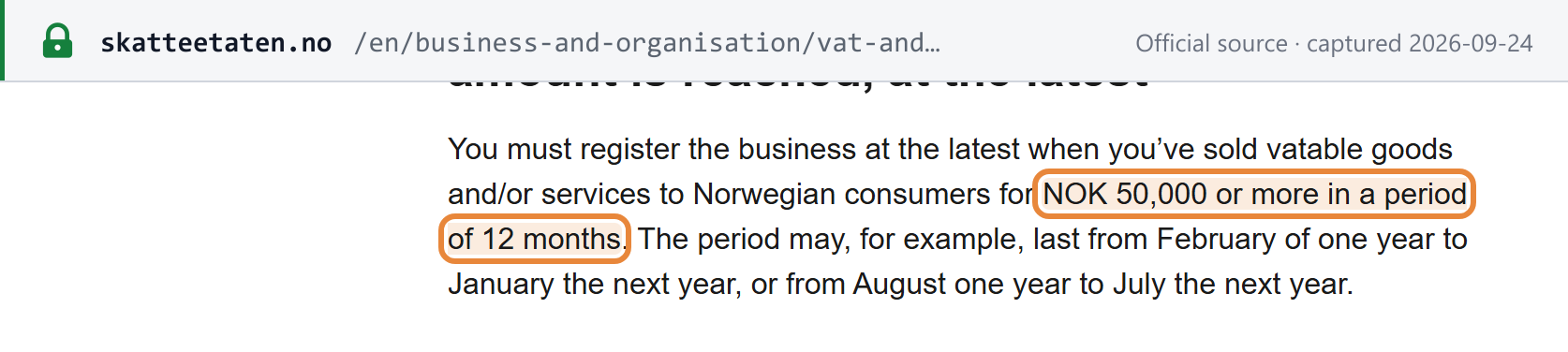
B2C — VOEC. "Foreign businesses selling goods with value below NOK 3,000 or remotely deliverable services to Norwegian consumers must collect and pay value added tax to Norway." The seller must register in the simplified VOEC (VAT on E-Commerce) register once its sales to Norwegian consumers exceed the NOK 50,000 limit in section 2-1 — Skatteetaten's guidance phrases it as "at the latest when you've sold vatable goods and/or services to Norwegian consumers for NOK 50,000 or more in a period of 12 months". [11]
- Who. Businesses without a Norwegian business address; no representative and no Enhetsregisteret registration are needed. A seller may register from its first sale. [11]
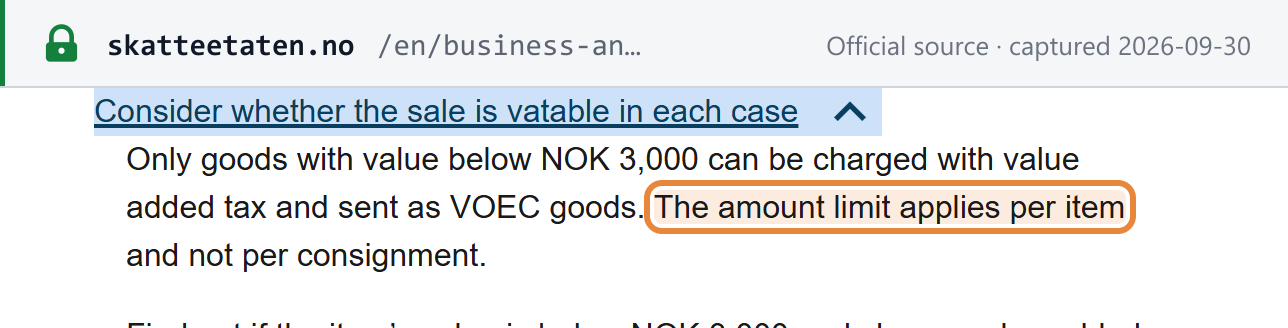
- Per item. "The amount limit applies per item and not per consignment", and "Do not include shipping and other extra costs when calculating the item's value" — although shipping is part of the VAT base. Items of NOK 3,000 or more are imported the ordinary way, with VAT at the border. Foodstuffs, excise goods and restricted goods are excluded. [11]
- Returns. Quarterly, due "the 20th of the month after the end of the quarter" — 20 January, 20 April, 20 July and 20 October (Tax Administration Regulation section 8-3-10(4)). The VOEC number is passed digitally with each consignment. [11] [21]
- No input VAT in the return. VOEC sellers reclaim Norwegian input VAT only through the refund scheme for foreign businesses (section 10-1(2)) — see Refunds. [1]
- Business buyers. A VOEC seller does not charge VAT to a Norwegian business customer, which reverse-charges instead; Skatteetaten's VOEC guidance says "You do not have to prove that the buyer is a business if they claim to be." [11]
For how Norway's scheme compares with others, see Lookuptax's explainer on VAT on digital services for non-resident suppliers and the general reverse charge explainer.
Marketplace / platform deemed-supplier liability
Yes, under VOEC. Where low-value goods or remote services reach Norwegian consumers through an intermediary, "anses formidleren som tilbyder" — the intermediary is treated as the supplier (section 2-1(3)) and registers and accounts for the VAT; the NOK 50,000 threshold applies to the intermediary. Electronic services sold through an intermediary are treated as supplied by both the seller and the intermediary (section 3-1(4)). See Lookuptax's marketplace deemed-supplier explainer. [1]
Place of supply
Norway does not use EU-style place-of-supply articles. The dividing line for services is whether the service is remotely deliverable (fjernleverbar). Skatteetaten: "it must be a type of service which can in principle be provided anywhere. In other words, it can be provided remotely." Remotely deliverable services — consultancy, accounting, electronic services, hire of labour — are taxed where the recipient is resident; services that by their nature must be carried out in Norway are domestic supplies by the foreign supplier. [10]
For goods, VAT applies to supplies inside the VAT area and on import; supplies out of the area are zero-rated exports. [1]
Invoice requirements
Norway's invoice rules are in the Bookkeeping Regulation (bokføringsforskriften, FOR-2004-12-01-1558) chapter 5, made under the Bookkeeping Act (bokføringsloven, LOV-2004-11-19-73), not in the VAT Act. The regulation calls the invoice a sales document (salgsdokument).
Mandatory content
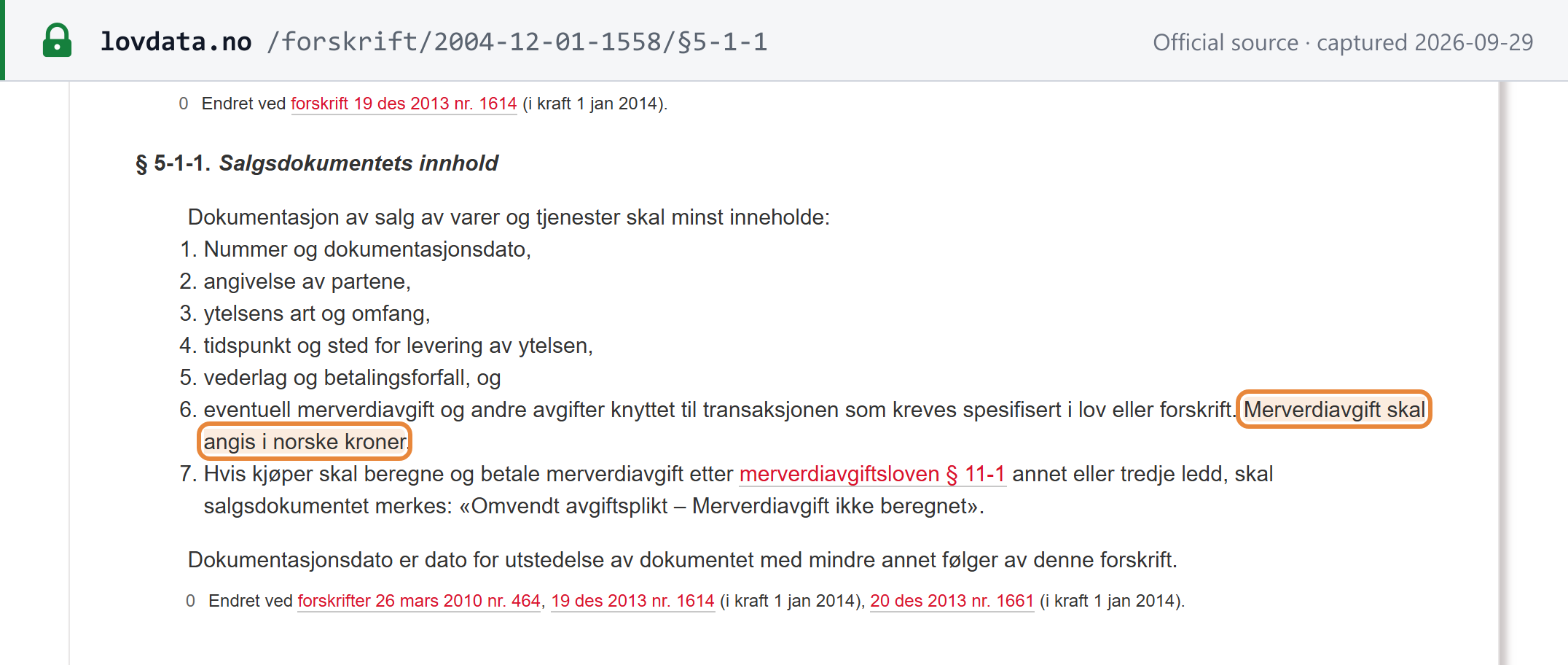
Section 5-1-1: "Dokumentasjon av salg av varer og tjenester skal minst inneholde" — documentation of a sale of goods or services must contain at least: [14]
| # | Particular | Detail |
|---|---|---|
| 1 | Number and document date | The date of issue, unless the regulation provides otherwise |
| 2 | The parties | See the seller and buyer rules below (section 5-1-2) |
| 3 | Nature and extent of the supply | Description and quantity |
| 4 | Time and place of delivery | The delivery date may be left off where goods go by carrier or mail order and the document travels with the consignment (section 5-1-4) |
| 5 | Consideration and payment due date | |
| 6 | VAT and other duties required by law | "Merverdiavgift skal angis i norske kroner" — VAT must be stated in NOK |
| 7 | Reverse-charge legend, where the buyer must account for the VAT under section 11-1(2) or (3) of the VAT Act (emission allowances; gold of at least 325/1000 fineness sold to businesses) | «Omvendt avgiftsplikt – Merverdiavgift ikke beregnet» |
Taxable, zero-rated, reverse-charged and exempt sales must be shown separately and totalled separately, and so must supplies at different VAT rates (section 5-1-5). [14]
Seller (section 5-1-2): [14]
- name and organisation number, followed by "MVA" if VAT-registered;
- if registered through a representative, the representative's name and address;
- for a limited company (AS, ASA) or a branch of a foreign company, the word «Foretaksregisteret» and the head-office address;
- if in liquidation, that fact.
Buyer (section 5-1-2): name, and address or organisation number; the organisation number is always required when the reverse-charge legend (item 7) applies, and a VAT-registered buyer's number is followed by "MVA". [14]
For a foreign supplier invoicing a Norwegian business for remote services, the supplier's own country's invoice rules govern the document; the Norwegian buyer self-assesses the VAT.
Issuance deadline
"Salgsdokument skal utstedes snarest mulig og senest en måned etter levering" — a sales document must be issued as soon as possible and no later than one month after delivery (section 5-2-2). [14]

- Monthly invoicing — deliveries invoiced monthly may be invoiced within 15 working days of the month after the delivery month (section 5-2-3).
- Continuous services — no later than one month after the end of the ordinary two-month VAT period (section 5-2-4); metered utilities may be invoiced for periods of up to a year (section 5-2-5).
- Annual VAT filers may not issue later than the calendar year of delivery.
- No VAT-inclusive invoice before delivery, except for passenger transport, catering, subscriptions, rent, fees and admissions, which may be invoiced up to a year ahead (section 5-2-6). [14]
Numbering and sequencing
Sales documents must be "forhåndsnummerert på trykte blanketter eller ved maskinelt tildelte nummer med en kontrollerbar sekvens" — pre-numbered on printed forms or given system-assigned numbers in a controllable sequence — or marked in another way that lets an auditor easily check that every invoiced sale has been recorded (section 5-1-3). A document issued within the first 15 working days of a month may carry the last date of the previous month as its document date, if the supply was made by then. [14]
Credit and debit notes
When a new sales document replaces one already sent, "skal det også utstedes en kreditnota som reverserer opprinnelig salgsdokument" — a credit note reversing the original must also be issued (section 5-2-7). [14]
VAT shown in error is owed. A business "skal betale beløp uriktig oppgitt som merverdiavgift i salgsdokumentasjon" — must pay any amount wrongly stated as VAT on a sales document, including VAT shown on an exempt or zero-rated supply, unless the error is corrected towards the buyer (VAT Act section 11-4). [1]
The regulation has no separate debit-note provision; an additional charge is made by issuing a further sales document.
Currency and language
- Language. Norwegian, Swedish, Danish or English (Bookkeeping Act section 12, applied by regulation section 5-1-1a). [15]
- Currency. The invoice may be in a foreign currency, but the VAT amount must be stated in NOK (section 5-1-1 no. 6). [14]
- FX rule. VAT amounts "skal fastsettes (låses) i norske kroner til kursen på fakturatidspunktet" — are fixed (locked) in NOK at the exchange rate on the invoice date (section 4-2). For imported services, a foreign-currency price is converted at the Customs rate on the delivery date (VAT Act section 4-12(2)). [14] [1]
Document types
Norway has no simplified invoice with a value threshold in the EU sense. The alternative document is the cash-register receipt (salgskvittering, section 5-3-12), which carries the same content as a sales document plus the time of sale, but in retail cash sales the buyer may be left off. That relief does not apply, and the buyer must be named, where: [14]
- the buyer has a bookkeeping duty and buys for resale or as a direct input to production or services, and the price is over NOK 1,000 including VAT — or the purchase is fuel for passenger or goods transport; or
- the price is NOK 40,000 or more including VAT and is paid in cash.
Self-billing
Permitted in listed cases. The seller issues the sales document "med mindre annet er bestemt i lov eller forskrift" (unless otherwise provided). A business with a bookkeeping duty buying from a seller without one may issue the document on the seller's behalf; so may farming and fishing cooperatives and craft outlets. The general case is a buyer that alone holds the data for calculating quantity, weight or quality as the basis of payment — on a written, signed agreement. The document must show that the buyer issued it (section 5-2-1). [14]
Retention and audit trail
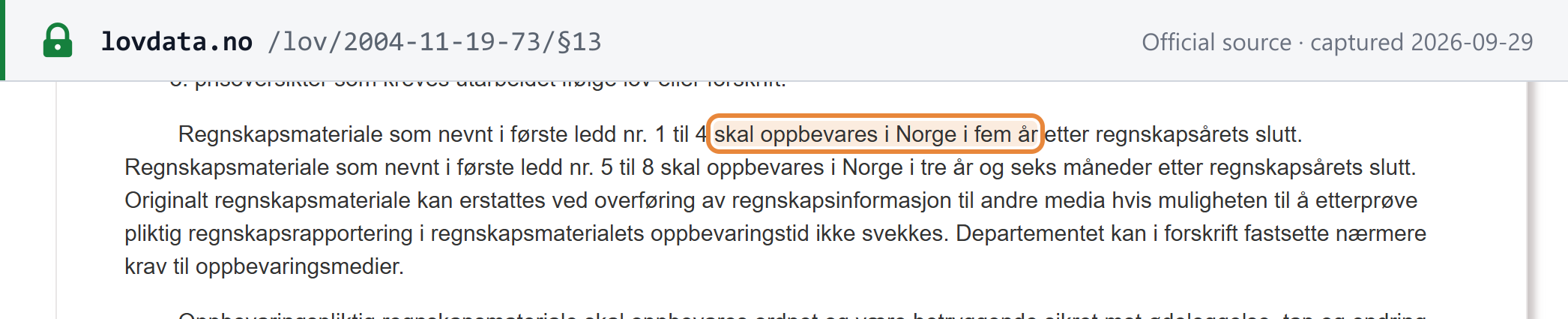
- Five years. Accounts, specifications and the documentation of booked entries — including invoices — "skal oppbevares i Norge i fem år etter regnskapsårets slutt" (kept in Norway for five years after the end of the financial year). Contracts, material correspondence, packing slips and price lists are kept for 3 years and 6 months (Bookkeeping Act section 13(2)). [15]
- Storage abroad. Electronic records may be kept in another EEA state, the UK or Switzerland if they can be read and printed from Norway and Skatteetaten is told in writing what is stored where (regulation section 7-5). [14]
- E-invoices in original format from 2027. From 1 January 2027, "Elektronisk faktura … skal likevel oppbevares i sitt opprinnelige format" — an electronic invoice must be kept in its original format (amended section 13). [16]
- Tamper evidence. Electronically issued sales documents must be in a file format that cannot easily be edited in common word-processing, spreadsheet or e-mail tools "uten at endringen fremgår direkte av salgsdokumentet" — without the change showing on the document (regulation section 5-2-9). Accounting periods must be closed so that booked entries are secured against change or deletion (section 7-6). [14]
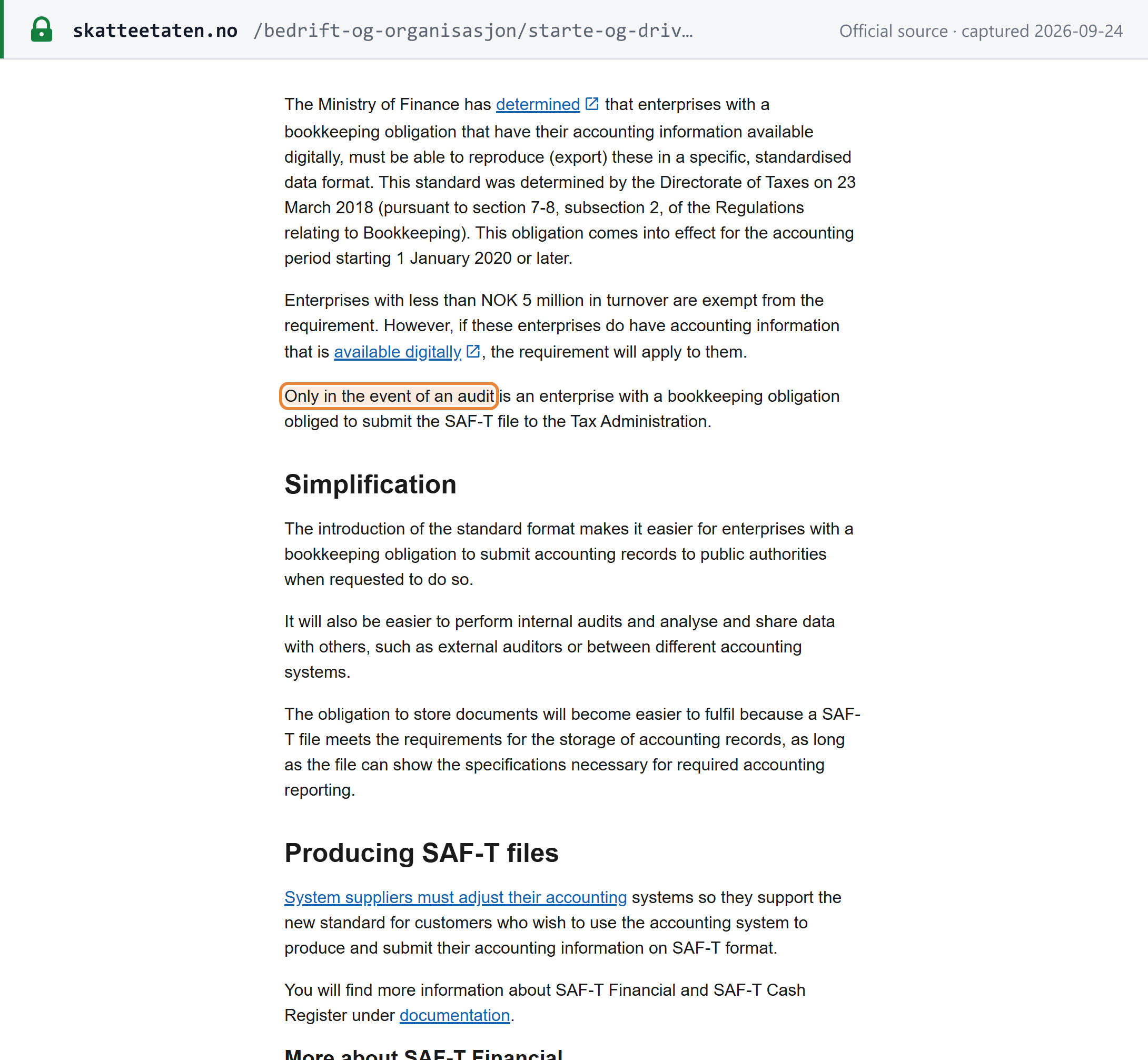
- What an auditor can demand. Access to systems and equipment (Bookkeeping Act section 14), and the accounts in SAF-T Financial format — which Skatteetaten receives only on request during a control, not routinely. See Lookuptax's SAF-T explainer. [15] [30]
A specimen of a compliant invoice
No official specimen invoice is published; the example below is ours — an illustration of the section 5-1-1 and 5-1-2 particulars for a domestic B2B supply with lines at three rates. Every name, number and amount in it is fictional; a real VAT number is nine digits followed by MVA, such as Brreg's worked example 123456785MVA.
Faktura — Invoice
| Description§ 5-1-1 no. 3 | Quantity§ 5-1-1 no. 3 | Unit price (excl. VAT) | VAT rate§ 5-1-5 | Value (excl. VAT) |
|---|---|---|---|---|
| IT consulting (hours) | 10 | NOK 1,200.00 | 25% | NOK 12,000.00 |
| Coffee beans, 1 kg bags (foodstuff) | 20 | NOK 150.00 | 15% | NOK 3,000.00 |
| Hotel room for workshop trainer (nights) | 2 | NOK 1,500.00 | 12% | NOK 3,000.00 |
- Basis at 25%§ 5-1-5
- NOK 12,000.00
- VAT at 25%§ 5-1-1 no. 6
- NOK 3,000.00
- Basis at 15%§ 5-1-5
- NOK 3,000.00
- VAT at 15%§ 5-1-1 no. 6
- NOK 450.00
- Basis at 12%§ 5-1-5
- NOK 3,000.00
- VAT at 12%§ 5-1-1 no. 6
- NOK 360.00
- Total including VAT§ 5-1-1 no. 5
- NOK 21,810.00
- VAT amounts must be stated in Norwegian kroner. On an invoice priced in EUR or another currency, the NOK VAT is fixed at the exchange rate on the invoice date — bokføringsforskriften § 4-2.
- A seller registered through a VAT representative adds the representative's name and address — § 5-1-2.
- For emission allowances, or gold of at least 325/1000 fineness sold to a business, where the buyer accounts for the VAT, the invoice carries «Omvendt avgiftsplikt – Merverdiavgift ikke beregnet» instead of charging it — § 5-1-1 no. 7.
- Norwegian invoices commonly carry a KID payment reference so the payment can be matched automatically; see the KID explainer.
- From 1 January 2027 a seller with a bookkeeping duty must issue an invoice like this one to a bookkeeping-liable buyer in a structured electronic format (EHF / Peppol BIS 3.0 or later, or until 2029 another structured format agreed with the buyer), not as a PDF — until 2030 in practice only where the buyer is registered in ELMA/Peppol; the buyer's duty to receive e-invoices starts on 1 January 2030 — bokføringsloven § 10 as amended by lov 19. juni 2026 nr. 39, bokføringsforskriften § 5-2-9.
For the KID payment reference printed on many Norwegian invoices, see Lookuptax's KID number explainer.
E-invoicing status
Status (as of 2026-10-08): B2G mandatory since 2 April 2019; B2B issuing mandatory from 1 January 2027 (in practice only toward buyers registered in ELMA/Peppol until 2030) and receiving from 1 January 2030; B2C none; no clearance (CTC) system. For Norway alongside other mandates, see Lookuptax's e-invoicing status and networks table and the Norway e-invoicing guide.
B2G — mandatory since 2 April 2019
The Regulation on electronic invoicing in public procurement (forskrift om elektronisk faktura i offentlige anskaffelser, FOR-2019-04-01-444), in force "2. april 2019", requires every contracting authority under the Public Procurement Act — not only central government — to demand e-invoices in an approved standard format in its contracts, to be able to receive them "gjennom PEPPOL-nettverket" (through the Peppol network), and allows it to withhold payment until a compliant e-invoice arrives. [18]
- Formats. "EHF (Elektronisk handelsformat) fakturering versjon 3.0 eller nyere og PEPPOL BIS … Billing v3.0 eller nyere" for contracts below the EEA thresholds; above them, other formats conforming to EN 16931 are also accepted (section 4). [18]
- Foreign suppliers. DFØ's procurement portal: "Fakturering til offentlig sektor skal gjøres elektronisk ved bruk av EHF-faktura. Fra utenlandske virksomheter benyttes Peppol BIS billing 3.0." (Invoicing to the public sector must be done electronically using EHF; foreign businesses use Peppol BIS Billing 3.0.) [19]

Network and authority
- Network: Peppol. Norwegian receivers are listed in ELMA (Elektronisk mottakerregister); "Det er aksesspunktet til ditt økonomisystem eller din bedriftsnettbank som registrerer deg i ELMA" — your accounting system's or business bank's access point registers you in ELMA. [19]
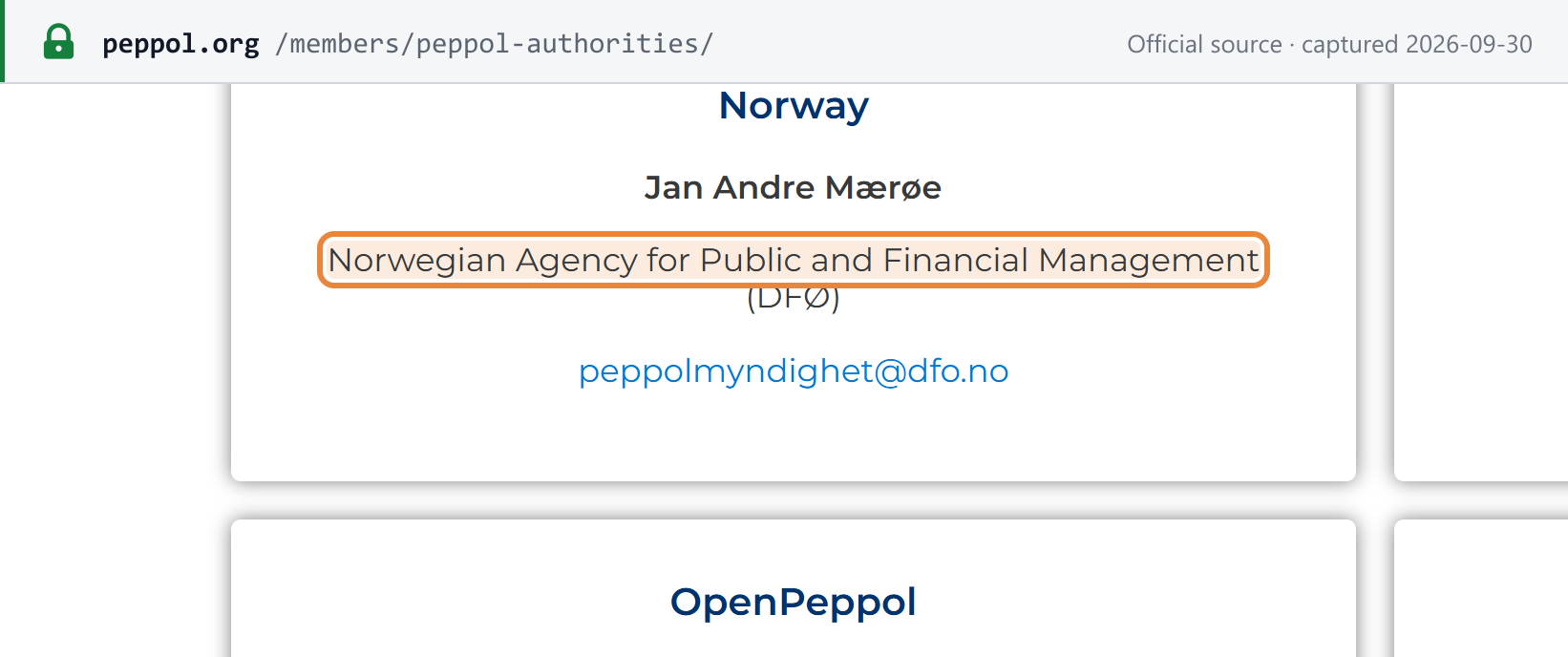
- Peppol Authority: the Norwegian Agency for Public and Financial Management (DFØ), per OpenPeppol's list of Peppol Authorities. [20]
B2B — issuing from 1 January 2027, receiving from 1 January 2030
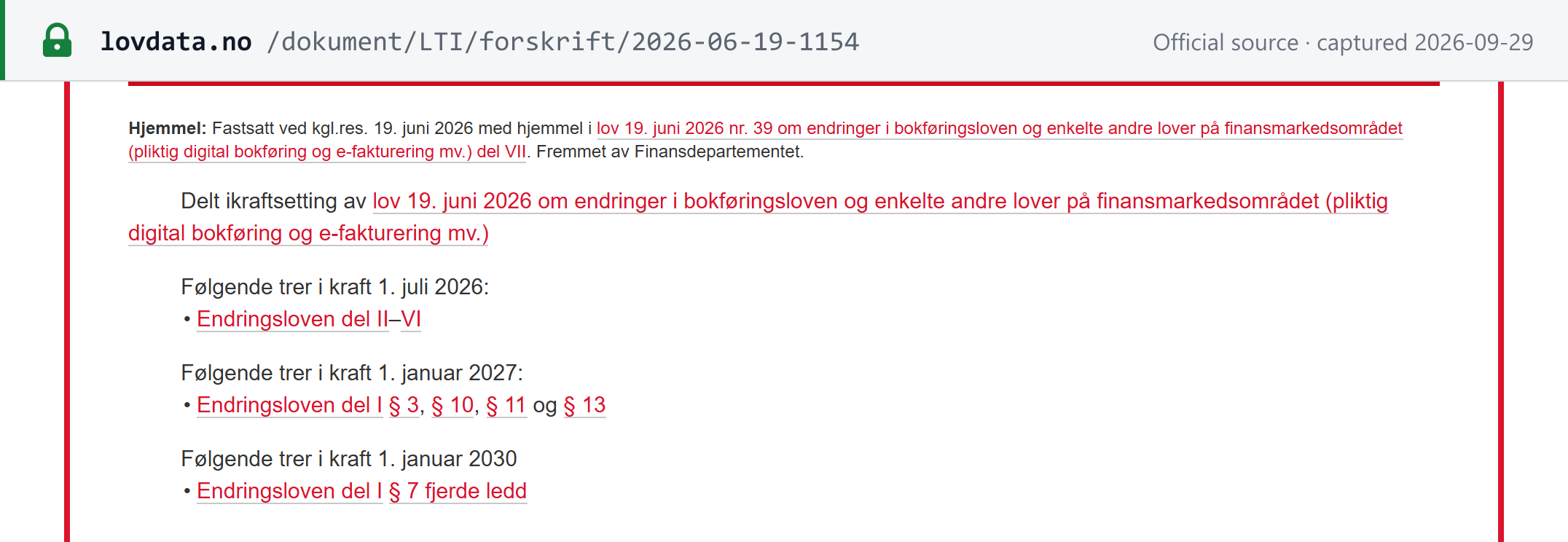
The Storting amended the Bookkeeping Act by lov 19. juni 2026 nr. 39, and royal resolution FOR-2026-06-19-1154 set its commencement: [16] [17]
| Provision | What it does | In force |
|---|---|---|
| § 3 (definitions), § 10, § 11, § 13 | Defines the e-invoice; requires sales documentation to other bookkeeping-liable parties to be issued in e-invoice format and purchase documentation from them to be received in that format; requires e-invoices to be kept in their original format | 1 January 2027 — but the duty to receive is deferred to 1 January 2030 by a Finance Ministry transitional regulation of 25 September 2026 |
| § 7 fourth paragraph | Bookkeeping must be done in an electronic accounting system | 1 January 2030 |
New section 10(2): "Dokumentasjon for salg av varer og tjenester til andre bokføringspliktige skal utstedes i elektronisk fakturaformat … Dokumentasjon for kjøp av varer og tjenester fra andre bokføringspliktige skal tilsvarende mottas i elektronisk fakturaformat." (Documentation of sales to other bookkeeping-liable parties shall be issued in electronic invoice format. Documentation of purchases from other bookkeeping-liable parties shall likewise be received in electronic invoice format.) [16]
What the Act and the September 2026 regulations say, as of 2026-10-08:
- Issuing from 2027, receiving from 2030. A transitional regulation adopted by the Finance Ministry (Finansdepartementet) on 25 September 2026 defers the duty to receive e-invoices to 1 January 2030; the duty to issue keeps its 1 January 2027 start. Skatteetaten says that until 2030 the issuing duty therefore applies in practice only where the buyer can receive e-invoices — that is, it is registered in ELMA/Peppol. From 1 January 2030 bookkeeping must also be done in an electronic accounting system (section 7). [41] [43]
- Formats. The Act itself names no format: section 3 no. 3 defines an elektronisk faktura as a sales document issued, sent and received "i et strukturert, elektronisk format, som er egnet for automatisert behandling i regnskapssystemet" (in a structured electronic format suitable for automated processing in the accounting system). The Bookkeeping Regulation, as amended by FOR-2026-09-29-1933 (adopted 29 September 2026), names the approved standards from 1 January 2027 in section 5-2-9: EHF Fakturering, Peppol BIS Billing, EHF Selvfakturering and Peppol BIS Self-Billing, version 3.0 or later. From 1 January 2027 to 31 December 2029 the parties may agree on another structured electronic format; Skatteetaten gives EDIFACT and E2B as examples. A PDF is not an e-invoice. [42] [43]
- A narrow NOK 50,000 exemption. New section 1-2 of the regulation exempts a bookkeeping-liable person with turnover up to NOK 50,000 in a calendar year from the duty to receive e-invoices. It does not apply to anyone with an accounting duty or a duty to file a VAT return, so no VAT-registered business can use it. [42]
- Buyer's organisation number from 2028. From 1 January 2028 an invoice to a bookkeeping-liable buyer must carry the buyer's organisation number, followed by "MVA" where the buyer is VAT-registered (section 5-1-2), and the sales document must always be sent to such a buyer (section 5-2-1). [42]
- Scope. The bookkeeping duty covers everyone with an accounting duty, everyone who files a business income-tax return and everyone who must file a VAT return — so a foreign business in the ordinary VAT Register is in scope. Sellers whose only Norwegian filing is the VOEC return are expressly excluded (Bookkeeping Act section 2). [15]
B2C and real-time reporting
No B2C e-invoice mandate and no clearance or real-time reporting system as of 2026-10-08. The B2B duty applies only between parties with a bookkeeping duty; invoices are not submitted to Skatteetaten, which receives data through the VAT return and, on request during a control, SAF-T Financial. SAF-T Financial schema version 1.40 becomes mandatory from 1 January 2027. [30] [35]
Filing and payment
Filing frequency
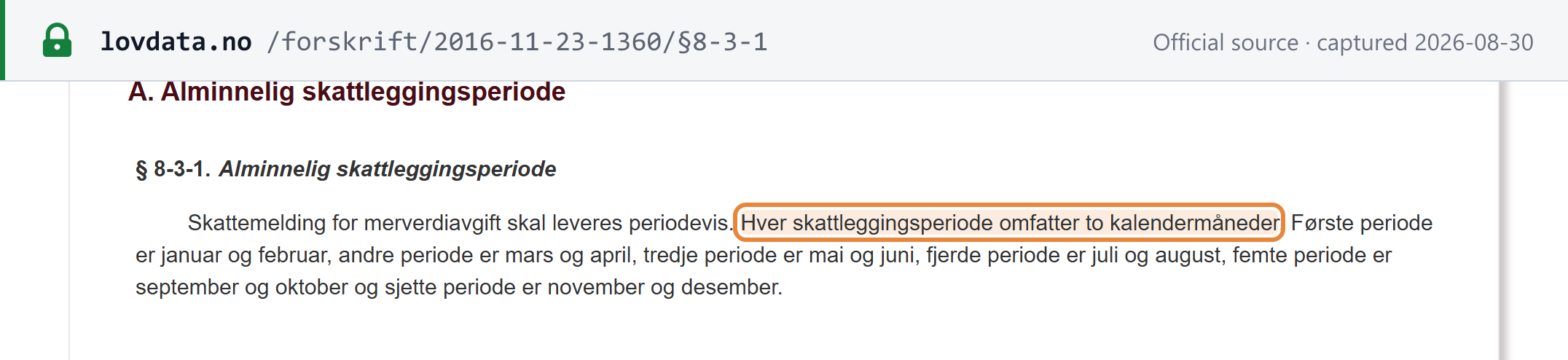
The VAT return (skattemelding for merverdiavgift, commonly "mva-melding") is filed per two-calendar-month period: "Første periode er januar og februar, andre periode er mars og april, tredje periode er mai og juni, fjerde periode er juli og august, femte periode er september og oktober og sjette periode er november og desember" (Tax Administration Regulation section 8-3-1). A return is due even if there was no taxable turnover in the period (Tax Administration Act section 8-3(2)). [21] [22]
What moves a business off the default:
| Period | Who | Rule |
|---|---|---|
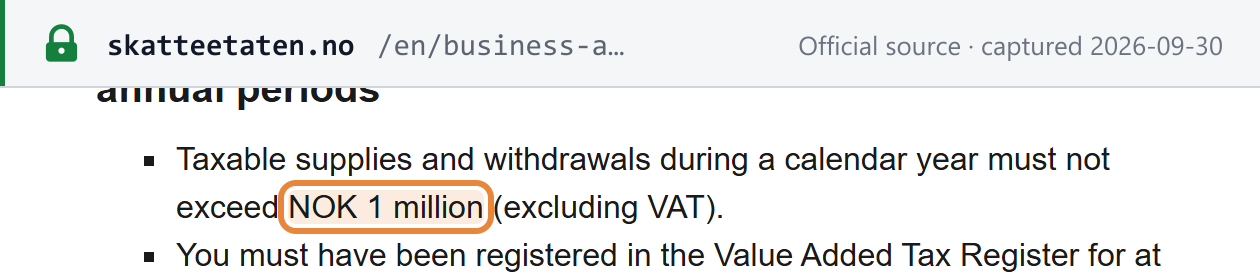
| Annual | Taxable turnover not above NOK 1 million (excl. VAT) in a calendar year, on application, after at least 12 months registered with timely filing and payment | Apply 10 December – 1 February; return due 10 March. Returning to two-month periods binds for at least two years (sections 8-3-3, 8-3-4) [21] [24] |
| Annual — primary industries | Agriculture, forestry, reindeer husbandry and fishing, regardless of turnover | Return due 10 April (sections 8-3-7 and 8-3-10(3)) [24] |
| Monthly | Input VAT regularly exceeds output VAT by at least 25%, with the tax office's consent; also imposed as a sanction after failures to report | 12 returns a year (sections 8-3-8(1), 8-3-2) [21] |
| Shorter than monthly | Input VAT regularly exceeds output VAT by at least 50% | Not shorter than one week (section 8-3-8(2)) [21] |
| Quarterly | Unregistered buyers who only reverse-charge imported services; VOEC sellers | Separate returns (section 8-3-9); VOEC due the 20th after the quarter [21] |
Return due date
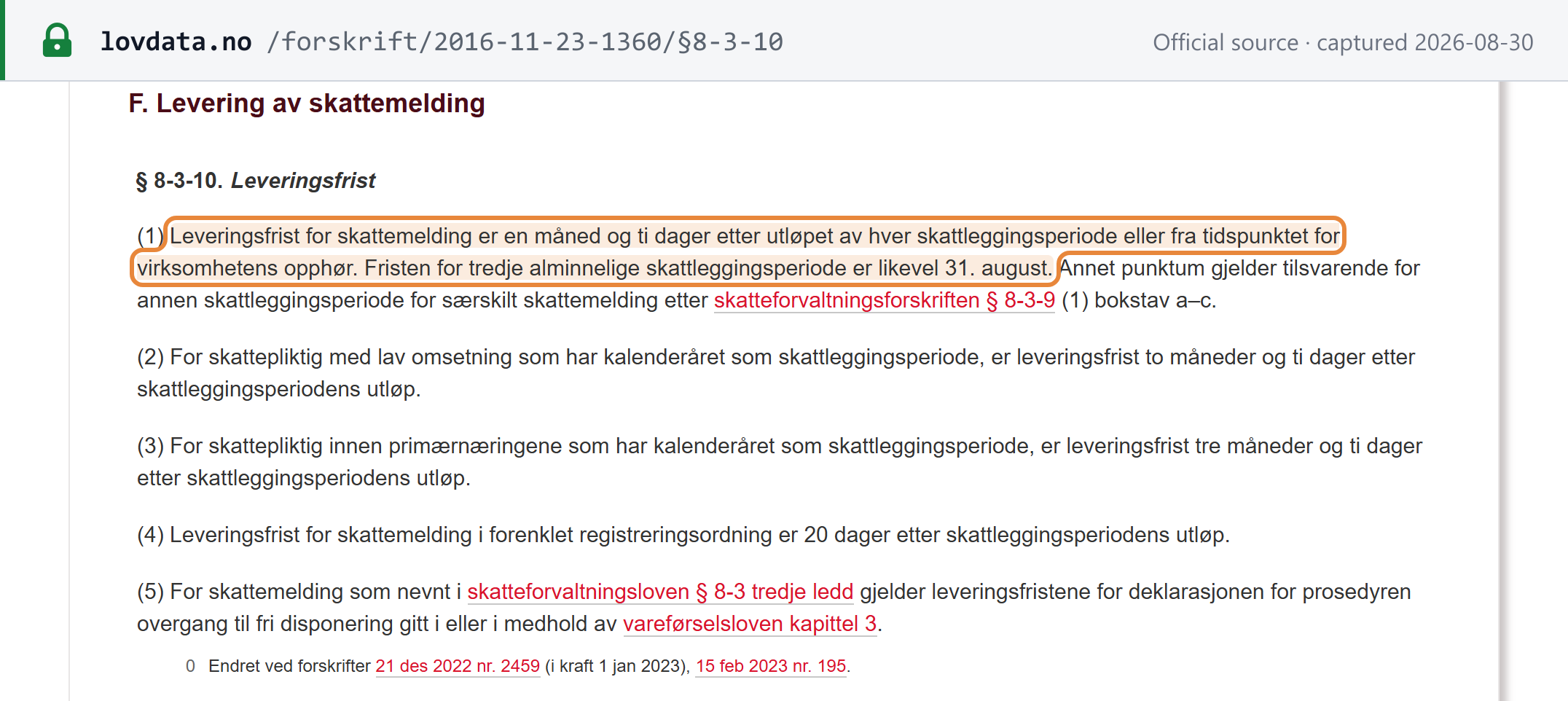
"Leveringsfrist for skattemelding er en måned og ti dager etter utløpet av hver skattleggingsperiode … Fristen for tredje alminnelige skattleggingsperiode er likevel 31. august." — the return is due one month and ten days after the end of each period, except that the May–June return is due on 31 August (Tax Administration Regulation section 8-3-10(1)). [21]
| Period | Due |
|---|---|
| January–February | 10 April |
| March–April | 10 June |
| May–June | 31 August |
| July–August | 10 October |
| September–October | 10 December |
| November–December | 10 February |
The 31 August exception also covers the quarterly reverse-charge returns, but not businesses on shorter-than-two-month periods, per Skatteetaten's Tax Administration Handbook. A deadline that ends on a Saturday, Sunday or public holiday moves to the next working day (Courts of Justice Act section 149). [36] [37]

Payment due date and method
"Merverdiavgift for en periode forfaller til betaling samme dag som det skal leveres skattemelding" — VAT for a period falls due for payment on the same day the return is due (Tax Payment Act section 10-30(1)). Pay by bank transfer to the account shown in Altinn, using the KID payment reference: "You can find the KID number and account number you need to pay VAT in Altinn", and Skatteetaten lets a business create a KID if none is available. [23] [24]
Additional listings
None beyond the VAT return. Norway has no EC Sales List, recapitulative statement or periodic invoice listing — it is outside the EU VAT area, and section 8-3 of the Tax Administration Act is the only periodic VAT reporting duty. Accounts in SAF-T Financial format go to Skatteetaten only on request during a control. The separate quarterly returns for reverse-charge-only buyers and VOEC sellers are described above. [22] [30]
Input-tax recovery and blocked items
A registered business deducts input VAT on purchases "som er til bruk i den registrerte virksomheten" — for use in the registered business (VAT Act section 8-1). Mixed-use purchases are apportioned; there is no deduction where taxable turnover is normally 5% or less of total turnover, and full deduction where exempt turnover is normally 5% or less (section 8-2). [1]
Blocked (section 8-3(1)): "Fradragsretten omfatter ikke inngående merverdiavgift på" — the deduction does not cover input VAT on: [1]
- catering and restaurant meals (servering), and hire of function rooms in connection with catering;
- art and antiques (unless traded);
- food and benefits in kind for the owner, management, staff and pensioners;
- entertainment (representasjon);
- gifts, unless of trivial value;
- building, maintaining, renting and running real property that covers housing or welfare needs.

- Passenger cars. "Fradragsretten omfatter ikke inngående merverdiavgift på anskaffelse, drift og vedlikehold av personkjøretøy" — purchase, running and maintenance of passenger cars are blocked, except for cars held as trading stock, rental cars and cars used for passenger transport such as taxis (section 8-4). [1]
- Cash payments of NOK 10,000 or more. A deduction is allowed only if payment goes through a bank or payment institution, unless the payment totals less than NOK 10,000 (section 8-8). [1]
- Pre-registration purchases made up to three years before registration are deductible (section 8-6). [1]
Refunds
Credit position. "Dersom inngående merverdiavgift overstiger utgående merverdiavgift i en termin, skal overskytende inngående merverdiavgift utbetales" — excess input VAT for a period is paid out, provided all earlier returns have been filed (VAT Act section 11-5(1)). The refund goes to the account registered with Skatteetaten. A business in a regular credit position can apply for monthly periods (see above). [1]
Non-resident refund scheme. A foreign business with no taxable supplies in Norway in the past 12 months reclaims Norwegian VAT on business purchases on paper form RF-1032, by post, with an original handwritten signature — "We do not accept applications by email." The claim covers at least three months within one calendar year; "The amount must be at least NOK 5,000, but if you wait and send the application until the end of the year, you can apply for amounts as low as NOK 500." Deadline: 30 September of the following year — claims for 2025 were due by 30 September 2026. There is no refund on food, drink or passenger cars, and reciprocity may be required (section 10-1). [13] [1]
Bad-debt relief. Output VAT may be corrected when a receivable "anses endelig konstatert tapt" — is finally established as lost because the debtor cannot pay (section 4-7(1)); one accepted case is a trade receivable still unpaid six months after the due date despite at least three reminders (VAT Regulation section 4-7-1). From 1 January 2026, the right lapses after 24 months where the receivable is owed by a related party (nærstående). [1] [31]
Exemptions
Exempt is not zero-rated
Norwegian uses two different words, and machine translation often swaps them:
| Exempt — unntatt (VAT Act ch. 3) | Zero-rated — fritatt (VAT Act ch. 6) | |
|---|---|---|
| Does the VAT Act apply? | No — "the rules in the VAT Act do not apply to the supply" | Yes, at 0% — "the rules in the VAT Act apply to the supply, but the VAT rate is 0 percent" |
| Input VAT on related purchases | Not deductible — "You do not have the right to deduct VAT on goods and services you purchase for the business." | Deductible once registered |
| Counts towards the NOK 50,000 threshold? | No | Yes — "the supply counts when you assess whether the threshold amount for registration in the VAT Register has been reached" |
Source: Skatteetaten, Difference between exemptions and exceptions from VAT. [25]

Exempt supplies
Chapter 3 of the VAT Act exempts (unntatt), among others: health services (3-2), social services (3-4), education (3-5 — Skatteetaten: "Teaching is generally exempt from VAT"), financial services (3-6), art and culture, including concert and theatre tickets (3-7), certain sports (3-8), exercise of public authority (3-9), services within the state (3-10), letting of real property (3-11 — with carve-outs such as hotel rooms and parking), low-value sales by charitable institutions (3-12) and non-profit associations (3-13), gaming (3-14), ceremonial services (3-15), board-member services (3-17), stamps, banknotes and coins (3-18). [1] [25]
Zero-rated supplies
Chapter 6 zero-rates (fritatt), among others: newspapers, including electronic newspapers (6-1), periodicals (6-3), books, including e-books, at the last sale (6-4), household electricity in Northern Norway (6-6), used registered vehicles (6-7), battery-electric passenger cars (6-8), vessels and aircraft (6-9, 6-10), supplies to embassies (6-12), transfer of a business as a going concern (6-14), funeral services (6-16), exports of goods and services (6-21, 6-22), customs warehouses (6-23), tourist sales (6-25) and international transport (6-28). [1]
Electric cars — cap cut to NOK 300,000 from 1 January 2026. The sale of a battery-electric passenger car "er fritatt for merverdiavgift for vederlag til og med 300 000 kroner" — is zero-rated for consideration up to and including NOK 300,000; VAT applies to the part of the price above that. The cap was set at this level by lov 22. desember 2025 nr. 121, in force 1 January 2026, with a transitional rule. [1]

Special regimes
- Margin scheme for second-hand goods, art, collectors' items and antiques (VAT Act sections 4-5 and 4-6, including a global per-period margin where goods are bought or sold collectively). [1]
- Customs warehouses — supplies are zero-rated (section 6-23); this is the nearest equivalent to a free zone.
- Svalbard and Jan Mayen are outside the VAT area (section 1-2).
- Small businesses. The VAT Act and the Tax Administration Regulation contain no cash-accounting scheme and no flat-rate scheme; the reliefs for small businesses are the NOK 50,000 registration threshold and the annual filing option.
- VAT compensation for municipalities and certain non-profit bodies is a separate scheme outside the VAT Act and is not covered in this guide.
Offences and penalties
Offences
| Offence | Conduct | Maximum sentence |
|---|---|---|
| Tax fraud (skattesvik, Penal Code section 378) | Giving incorrect or incomplete information to a public authority, or failing to give mandatory information, when one understands or should understand it can lead to a tax advantage | Fine or 2 years' imprisonment |
| Aggravated tax fraud (section 379) | Tax fraud involving a large amount, conduct that is hard to detect, repetition or organisation | 6 years |
| Grossly negligent tax fraud (section 380) | As section 378, through gross negligence | 1 year (6 years if aggravated) |
| Accounting offence (section 392, via Bookkeeping Act section 15) | Breaching the rules on bookkeeping, documentation — including invoicing — and retention | Fine or 2 years |
| Aggravated accounting offence (section 393) | 6 years |
Penal Code section 378: "Med bot eller fengsel inntil 2 år straffes den som gir uriktig eller ufullstendig opplysning til en offentlig myndighet, eller unnlater å gi pliktig opplysning, når han forstår eller bør forstå at det kan føre til skattemessige fordeler." [26] [15]

Failure to cooperate with a tax control is punishable by a fine or up to 2 years' imprisonment (Tax Administration Act section 14-14). [22]
Penalties
Late return — daily enforcement fine. A late VAT return triggers a tvangsmulkt of "et halvt rettsgebyr per dag" — half a court fee per day (Tax Administration Regulation section 14-1-1(1)), capped in total at 50 court fees (Tax Administration Act section 14-1(2)). The court fee is NOK 1,345 from 1 January 2026 (Norwegian Courts Administration), which makes the fine NOK 672.50 a day, up to NOK 67,250. Skatteetaten imposes it even when the return shows no turnover. [2] [21] [22] [27] [39]


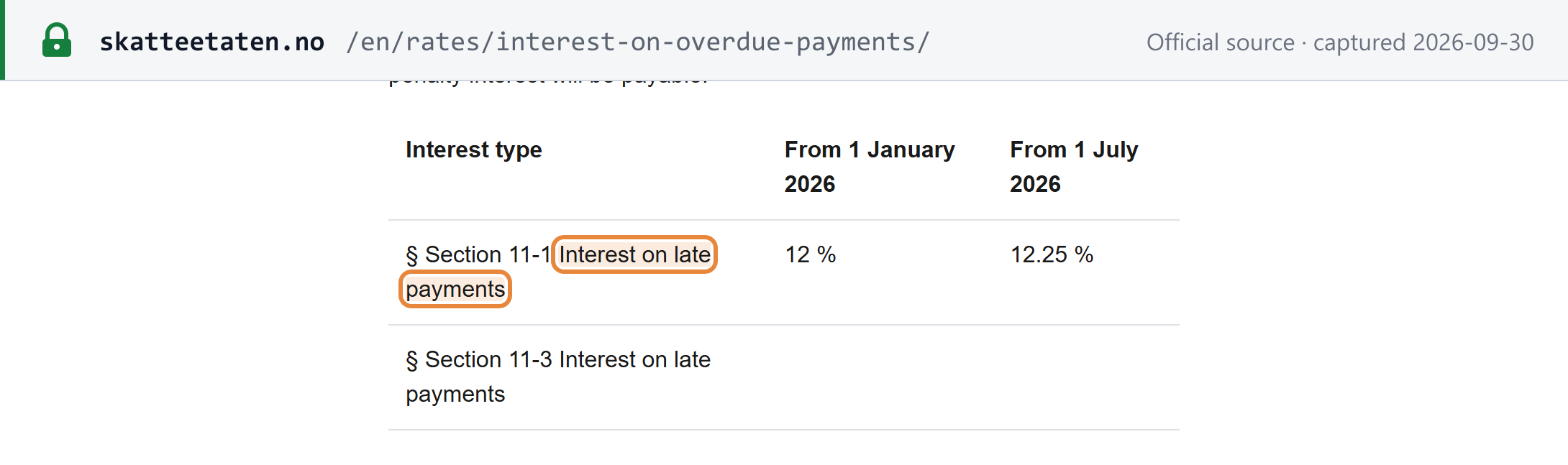
Late payment — penalty interest. Interest accrues from the due date until payment (Tax Payment Act section 11-1). The Ministry of Finance sets the rate every six months: 12% from 1 January 2026, 12.25% from 1 July 2026. [28]
Under-declaration — additional tax (tilleggsskatt). "Tilleggsskatt beregnes med 20 prosent av den skattemessige fordelen som er eller kunne ha vært oppnådd" — 20% of the tax advantage obtained or obtainable (Tax Administration Act section 14-5(1)). It is not imposed where the conduct is excusable (section 14-3(2)), nor for obvious calculation or typing errors, on voluntary correction before a control, where the seller failed to charge VAT on booked sales and the buyer had full deduction, or where it would be under NOK 1,000 (section 14-4). For intentional or grossly negligent conduct, aggravated additional tax of a further 20% or 40% is added on top (section 14-6). [22]

Infringement fines (overtredelsesgebyr). For breaching the duty to register and document cash sales (cash-register and receipt rules under Bookkeeping Act section 10 a): 10 court fees (NOK 13,450 in 2026), or 20 court fees (NOK 26,900) for a repeat within 12 months; for failing to cooperate with a tax control: up to 50 court fees (NOK 67,250) (Tax Administration Act section 14-7). [22]
Failure to issue a compliant invoice. Chapter 14 of the Tax Administration Act sets no specific monetary penalty for a defective invoice outside the cash-sale rules. The consequences are indirect: VAT shown in error is payable (VAT Act section 11-4); a buyer who receives a non-compliant document "må … kreve nytt salgsdokument" — must demand a new one (Bookkeeping Regulation section 5-5-1) — to support its deduction; under-declared VAT attracts additional tax; and an order to keep proper books is enforced by a fine of one court fee per day (Tax Administration Regulation section 14-1-1(2)). [14] [21]
Frequently asked questions
We are an EU company doing a two-day job in Norway worth more than NOK 50,000 — do we have to register for Norwegian VAT?
Yes. The NOK 50,000 threshold in section 2-1 of the VAT Act applies to foreign businesses exactly as it does to Norwegian ones, and it is measured over any 12-month period, so the length of the assignment does not matter: Altinn's own example is a two-day job worth more than NOK 50,000. The business first registers in the Central Coordinating Register for Legal Entities and then in the VAT Register. It must register through a Norwegian VAT representative, who is jointly and severally liable for the VAT, unless it is resident in the United Kingdom or one of the EEA states Skatteetaten lists — all 27 EU member states and Iceland. Liechtenstein is not on the list. [3] [2]
Our customer is a Norwegian business — do we charge Norwegian VAT on software or consulting we supply from abroad?
No. Consulting, software and other services that can be delivered remotely are taxed in Norway by reverse charge: the Norwegian business or public-body buyer calculates and pays the VAT itself (sections 3-30 and 11-3 of the VAT Act). A VAT-registered buyer reports it in its ordinary VAT return with no lower limit; a buyer that is not registered accounts for it only when its purchases in a quarterly period exceed NOK 2,000 excluding VAT. The foreign supplier does not register for these sales. This also applies to a legal person in the VAT Register buying for its non-economic activity, which must reverse-charge the VAT itself; the use of the service then affects its deduction right. If the customer is a consumer instead, the supplier falls under VOEC once its sales to Norwegian consumers exceed NOK 50,000 in 12 months. [1] [10]
Is VOEC's NOK 3,000 limit per order or per item?
Per item. Skatteetaten's VOEC guidance says the amount limit applies per item and not per consignment, and that shipping and other extra costs are left out when calculating the item's value, even though shipping is part of the VAT base. An item worth NOK 3,000 or more cannot be sold through VOEC; it is imported the ordinary way, with VAT charged at the border. Foodstuffs, excise goods and restricted goods are outside VOEC whatever their value. [11]
Can we invoice Norwegian customers in euros?
Yes, but the VAT amount must be stated in Norwegian kroner (bookkeeping regulation section 5-1-1 no. 6), and VAT amounts are fixed in NOK at the exchange rate on the invoice date (section 4-2). The invoice may be written in Norwegian, Swedish, Danish or English (Bookkeeping Act section 12). [14] [15]
Does Norway's 2027 B2B e-invoicing rule apply to a foreign company?
It applies to everyone with a bookkeeping duty, and that includes anyone who must file an ordinary Norwegian VAT return, so a foreign business in the VAT Register — for example through a representative — is in scope. Sellers whose only Norwegian filing is the VOEC return are carved out. From 1 January 2027, sales documentation to other bookkeeping-liable parties must be issued in e-invoice format (Bookkeeping Act section 10, as amended by lov 19. juni 2026 nr. 39); until 2030 this applies in practice only where the buyer is registered in ELMA/Peppol. A Finance Ministry transitional regulation of 25 September 2026 defers the duty to receive e-invoices to 1 January 2030. The approved formats from 1 January 2027 are EHF Fakturering, Peppol BIS Billing, EHF Selvfakturering and Peppol BIS Self-Billing, version 3.0 or later (Bookkeeping Regulation section 5-2-9, as amended by FOR-2026-09-29-1933); until 31 December 2029 the parties may agree on another structured format, such as EDIFACT or E2B. The NOK 50,000 exemption in the regulation lifts the duty to receive e-invoices, not the duty to issue them, and does not apply to anyone with an accounting duty or who must file a VAT return. [16] [17] [41] [42] [15]
When is the Norwegian VAT return for May and June due?
On 31 August, not 10 July. The ordinary deadline is one month and ten days after the end of each two-month period, but section 8-3-10 of the Tax Administration Regulation sets 31 August for the third period. Payment falls due on the same day as the return. A deadline that falls on a Saturday, Sunday or public holiday moves to the next working day. [21] [23] [37]
What happens if we file the Norwegian VAT return late?
Skatteetaten imposes a daily enforcement fine (tvangsmulkt) of half a court fee per day, capped in total at 50 court fees, and it applies even when there was no turnover in the period. With the court fee at NOK 1,345 from 1 January 2026, that is NOK 672.50 a day, up to NOK 67,250. Unpaid VAT also carries penalty interest from the due date, at 12.25% a year from 1 July 2026, and under-declared VAT can attract 20% additional tax. [21] [27] [39] [28]
Is selling books exempt from Norwegian VAT?
No — books are zero-rated, which is different. Norwegian law uses fritatt for zero-rated supplies: the VAT Act applies at 0%, input VAT is deductible, and the sale counts towards the registration threshold. It uses unntatt for exempt supplies: the Act does not apply and input VAT cannot be deducted. Books, including e-books, are zero-rated at the last sale under section 6-4 of the VAT Act. Machine translation often renders fritatt as exempt, which reverses the input-VAT consequence. [25] [1]
Important websites
| Site | Purpose |
|---|---|
| Brønnøysund Register Centre — register a business | Register the legal entity (including a NUF) in Enhetsregisteret — the step before VAT registration |
| Skatteetaten MVA portal | VAT registration, VAT returns and the VAT account (Altinn login, "Value added tax" access package) |
| Skatteetaten — register, change or delete | Who must register, representatives, deregistration |
| Skatteetaten — paying VAT | KID and account number, annual-period deadlines |
| VOEC portal | VOEC registration and quarterly returns for foreign B2C sellers |
| Enhetsregisteret search and open API | Check an organisation number and whether it is in the VAT Register (registrertIMvaregisteret) |
| Skatteetaten — VAT rates | Current and past rates |
| Skatteetaten — deadlines calendar | VAT filing and payment dates |
| Skatteetaten — refund for foreign businesses | Form RF-1032, by post, deadline 30 September |
| DFØ — invoicing and payment (anskaffelser.no) | EHF / Peppol BIS guidance and the ELMA receiver lookup |
| Norwegian Customs — exchange rates | Conversion rates for imports and VOEC |
| Lovdata — VAT Act | The legislation (Norwegian) |
Also see Lookuptax's own Norway MVA number validator, the Norway tax ID guide and the Norway e-invoicing guide.
Recent changes
- 2026-10-01 — The Tax Directorate (Skattedirektoratet) stated that a legal person in the VAT Register must itself calculate and pay VAT under the reverse-charge rules (VAT Act section 11-3, first paragraph) on remote services bought from a foreign supplier, including where the service is used in its non-economic activity; the foreign supplier charges no Norwegian VAT, and the use of the service affects the right of deduction. (Skatteetaten) — see event
- 2026-09-29 — FOR-2026-09-29-1933 amended the Bookkeeping Regulation: approved e-invoice standards from 1 January 2027 are EHF Fakturering, Peppol BIS Billing, EHF Selvfakturering and Peppol BIS Self-Billing, version 3.0 or later, with other structured formats by agreement until 31 December 2029; a NOK 50,000 turnover exemption from the duty to receive, not open to anyone with an accounting or VAT-return duty; the buyer's organisation number on invoices to bookkeeping-liable buyers from 1 January 2028. (Lovdata)
- 2026-09-25 — A Finance Ministry transitional regulation defers the duty to receive e-invoices from 1 January 2027 to 1 January 2030; issuing still starts on 1 January 2027, in practice only toward buyers registered in ELMA/Peppol until 2030. (Lovdata)
- 2026-07-01 — Remotely deliverable services used in Norway by the same legal entity that bought them abroad (multi-location entities) became subject to Norwegian VAT under section 3-30(2)–(3) of the VAT Act, enacted by lov 22. desember 2025 nr. 121 (part II); lov 23. juni 2026 nr. 70 reworded section 3-30(3) second sentence before commencement. (Lovdata) — see event
- 2026-07-01 — Penalty interest on late payment rose from 12% to 12.25%. (Skatteetaten)
- 2026-06-19 — Lov 19. juni 2026 nr. 39 amended the Bookkeeping Act to require e-invoices between bookkeeping-liable parties; commencement set by FOR-2026-06-19-1154. The Act names no format and leaves format requirements, exemptions and transitional rules to the Ministry; the 25 and 29 September 2026 regulations set them. (Lovdata) — see event, which corrects the earlier event
- 2026-01-01 — The zero rate for battery-electric cars was capped at NOK 300,000, and bad-debt relief on receivables from related parties was limited to 24 months (lov 22. desember 2025 nr. 121). (Lovdata)
- 2025-07-01 — Water and wastewater services moved from 25% to 15%. (Skatteetaten)
Ahead — scheduled changes that have not yet taken effect:
- 2027-01-01 — Bookkeeping Act section 10: sales documentation to other bookkeeping-liable parties issued in e-invoice format (EHF / Peppol BIS Billing or Self-Billing 3.0 or later, or another structured format by agreement until 2029), in practice only toward buyers registered in ELMA/Peppol until 2030; e-invoices kept in their original format. (Lovdata) — see event
- 2027-01-01 — SAF-T Financial version 1.40 is required (usable earlier); versions 1.20 and 1.30 can be used only for financial year 2026 and earlier. (Skatteetaten) — see event
- 2027-01-01 (proposed, not enacted) — The 2027 budget, Prop. 1 LS (2026–2027) presented on 7 October 2026, proposes cutting the zero-rate cap for battery-electric cars from NOK 300,000 to NOK 150,000, following the Storting's request in Innst. 2 S (2025–2026) to step it down to NOK 150,000 in 2027 and to zero in 2028. It needs the Storting's December vote and ESA approval; section 6-8 still shows the NOK 300,000 cap. (Regjeringen, Prop. 1 LS (2026–2027); Stortinget, Innst. 2 S (2025–2026))
- 2028-01-01 — Invoices to bookkeeping-liable buyers must carry the buyer's organisation number (Bookkeeping Regulation section 5-1-2 as amended by FOR-2026-09-29-1933). (Lovdata)
- 2030-01-01 — Bookkeeping-liable buyers must receive e-invoices (deferred from 2027 by the transitional regulation of 25 September 2026), and bookkeeping must be done in an electronic accounting system (Bookkeeping Act section 7 fourth paragraph). (Lovdata; Lovdata)
For the full chronology, see Norway tax changes on Lookuptax.
Reference links
- Lovdata — Value Added Tax Act (merverdiavgiftsloven, LOV-2009-06-19-58)
- Skatteetaten — Register, change or delete (VAT)
- Altinn — VAT: specific information for foreign companies
- Lovdata — Storting VAT resolution for 2026 (FOR-2025-12-18-2752)
- Skatteetaten — VAT rates
- Lovdata — Transitional regulation for the 2005 rate changes (FOR-2004-11-26-1524)
- Lovdata — Storting VAT resolution for 2018 (FOR-2017-12-12-2189)
- Skatteetaten — VAT rates for water and wastewater services
- Skatteetaten — Calculating and reporting VAT on goods imports
- Skatteetaten — VAT rates for purchases of services from abroad
- Skatteetaten — Registration in the VOEC Register
- Lovdata — Lov 23. juni 2026 nr. 70 (rewording VAT Act section 3-30(3))
- Skatteetaten — Refund of VAT to foreign businesses
- Lovdata — Bookkeeping Regulation (bokføringsforskriften, FOR-2004-12-01-1558)
- Lovdata — Bookkeeping Act (bokføringsloven, LOV-2004-11-19-73)
- Lovdata — Lov 19. juni 2026 nr. 39 amending the Bookkeeping Act (e-invoicing and digital bookkeeping)
- Lovdata — Commencement resolution FOR-2026-06-19-1154
- Lovdata — Regulation on electronic invoicing in public procurement (FOR-2019-04-01-444)
- DFØ (anskaffelser.no) — Invoicing and payment, EHF
- OpenPeppol — Peppol Authorities
- Lovdata — Tax Administration Regulation (skatteforvaltningsforskriften, FOR-2016-11-23-1360)
- Lovdata — Tax Administration Act (skatteforvaltningsloven, LOV-2016-05-27-14)
- Lovdata — Tax Payment Act (skattebetalingsloven, LOV-2005-06-17-67)
- Skatteetaten — Paying VAT
- Skatteetaten — Difference between exemptions and exceptions from VAT
- Lovdata — Penal Code (straffeloven, LOV-2005-05-20-28), section 378
- Norwegian Courts Administration — Court fee and costs
- Skatteetaten — Interest on overdue payments
- Brønnøysund Register Centre — About the organisation number
- Skatteetaten — SAF-T Financial
- Lovdata — VAT Regulation (merverdiavgiftsforskriften, FOR-2009-12-15-1540)
- Skatteetaten — VAT rates for remotely deliverable services purchased from abroad
- Skatteetaten — Value Added Tax (VAT) hub
- Lookuptax — Norway tax ID guide
- Skatteetaten — SAF-T Financial documentation (schema versions)
- Skatteetaten — Tax Administration Handbook, section 8-3 (31 August deadline)
- Lovdata — Courts of Justice Act (domstolloven), chapter 10, section 149
- Stortinget — Innst. 2 S (2025–2026), budget recommendation
- Lovdata — Court Fees Act (rettsgebyrloven), section 1
- Regjeringen — Prop. 1 LS (2026–2027), Skatter og avgifter 2027
- Lovdata — FOR-2026-09-25-1913, Finance Ministry transitional regulation of 25 September 2026 (duty to receive e-invoices from 1 January 2030)
- Lovdata — FOR-2026-09-29-1933 amending the Bookkeeping Regulation (e-invoice formats, exemptions)
- Skatteetaten — Regulations on digital bookkeeping and e-invoicing (statement)
Related Lookuptax pages: Norway e-invoicing guide · Peppol e-invoicing guide · SAF-T reporting explainer · KID number explainer · Sweden VAT guide · VAT registration thresholds worldwide · Worldwide tax rates