Cyprus VAT guidelines
| FACTSHEET | |
|---|---|
| Country code | CY |
| Tax name | Value Added Tax (VAT) — Φόρος Προστιθέμενης Αξίας (Φ.Π.Α.) |
| Tax Authority | Cyprus Tax Department (Τμήμα Φορολογίας) |
Overview
Cyprus levies Value Added Tax — Φόρος Προστιθέμενης Αξίας (Φ.Π.Α.) — under the Value Added Tax Law of 2000, N.95(I)/2000, as amended, which transposes Council Directive 2006/112/EC; Council Implementing Regulation 282/2011 applies directly. The Tax Department puts it plainly: VAT in Cyprus "follows and implements the European VAT Directive (and the implementing regulation) as a Member State of the European Union." [1]
VAT is administered by the Cyprus Tax Department (Τμήμα Φορολογίας) within the Ministry of Finance, headed by the Commissioner of Taxation (Έφορος Φορολογίας). [2]
Currency. All figures in this guide are in euro (EUR).
Tax period basis. Cyprus VAT does not run on a tax year. The operative unit is the tax period (φορολογική περίοδος), normally a calendar quarter — and which quarter cycle you are given depends on your business's NACE code, which is why Cypriot VAT deadlines fall in three staggered groups rather than all at once. See Filing and payment. [12]
Layering. Cyprus VAT is a single national tax. There is no state, provincial or municipal VAT layer, so every rate and threshold below applies uniformly across the Republic.
A note on what this guide covers. VAT applies in the areas under the effective control of the Republic of Cyprus. This guide describes that regime; it does not address the separate arrangements applying to the areas outside the Government's effective control.
Registration
Who should register
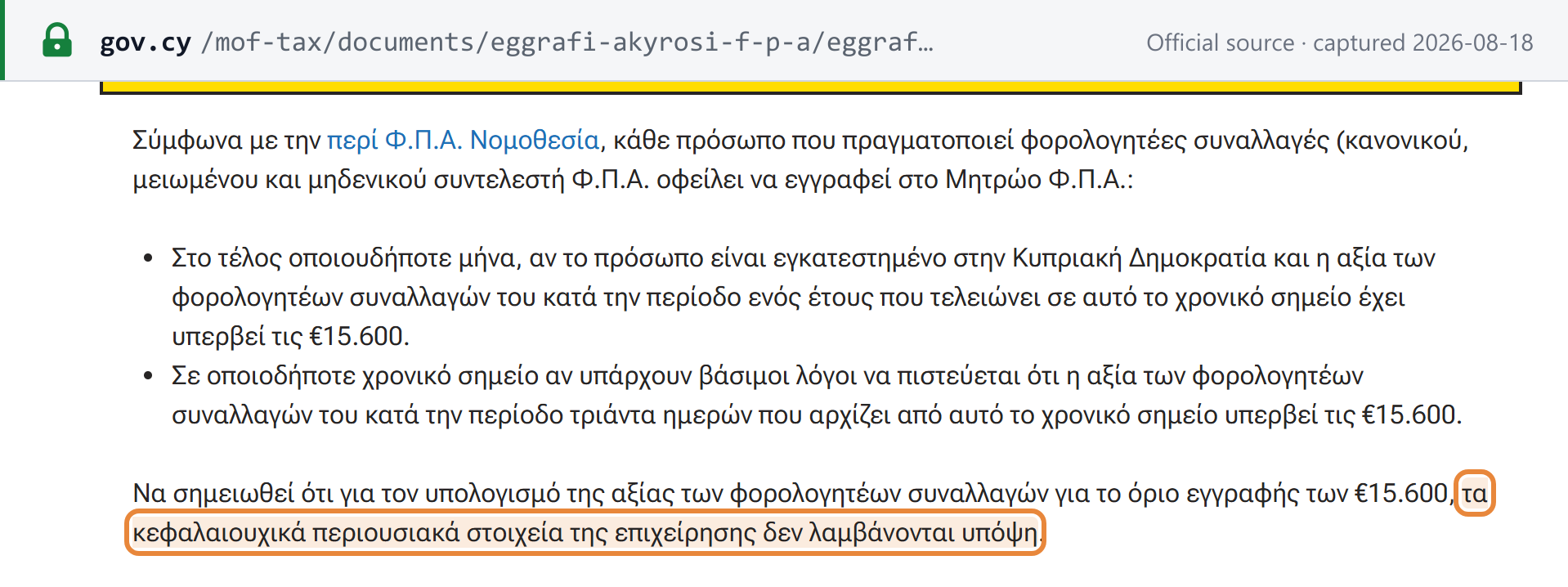
The liability rule, not just the number: any person making taxable transactions — at the standard, reduced or zero rate — must register when either limb is met: [3]
- Backward look — at the end of any month, if the person is established in the Republic and the value of its taxable transactions in the one-year period ending at that point has exceeded €15,600; or
- Forward look — at any point, if there are reasonable grounds to believe the value of its taxable transactions in the thirty days beginning at that point will exceed €15,600.
Capital assets of the business are excluded from the computation. Note what the rule does not count: exempt supplies are outside the threshold entirely, while zero-rated supplies are inside it — a business selling only zero-rated goods can be obliged to register.
Two things readers underestimate. First, liability exists whether or not you apply — the Commissioner may register you retroactively, and you must then account for VAT on all supplies from the date registration fell due. Second, late notification is charged at €85 for every month the failure continues. [3]
Notification deadlines. On the backward-look test, notify within 30 days of the end of the relevant month; registration takes effect from the end of the following month, or an earlier agreed date. On the forward-look test, notify before the end of that 30-day period; registration takes effect from the start of the period. [3]
Registration threshold
| Basis for registering | Threshold | Measurement period |
|---|---|---|
| Taxable transactions, person established in the Republic | €15,600 | rolling 12 months, or the next 30 days |
| Taxable transactions, person not established in the Republic | nil | from the first transaction, or on forming the intention |
| Intra-EU acquisitions of goods | €10,251.61 | year beginning 1 January, or the next 30 days |
| Services to taxable persons in other Member States on which the customer accounts for the VAT | nil | from the first transaction, whatever its value |
Non-resident threshold
There is no registration threshold for a person not established in the Republic, and this is the single most commonly mis-assumed rule on this page. The Tax Department states that such a person must register if it makes — or will within 30 days make — taxable transactions in the Republic in the course of its business and has no business or other fixed establishment here, "ανεξαρτήτου του ορίου εγγραφής στο Μητρώο Φ.Π.Α." ("irrespective of the VAT registration threshold"), and must register as soon as it forms the intention to make taxable transactions in the Republic. The statutory base is Part IA of the First Schedule to N.95(I)/2000. Its notification deadline is likewise 30 days. [3]
The practical effect is covered under Cross-border rules: most B2B services shift to the Cypriot customer by reverse charge and need no registration, but everything the reverse charge does not reach bites from the first euro.
Tax registration number
The Cyprus VAT number is the Tax Identification Code (ΑΦΤ / TIC) prefixed with CY. The TIC is 8 digits followed by one letter of the Latin alphabet (99999999L); the VAT identifier is officially the Αριθμός Εγγραφής Φ.Π.Α. An illustrative example — not a real registration — is CY12345678X. The CY prefix is a legal requirement on invoices to a person in another Member State under K.Δ.Π. 314/2001 reg. 12(1Α)(β). [4]
Verification is through the EU VIES service. For format detail, checksum discussion and the common failure modes, see the dedicated Cyprus tax ID guide and the Cyprus VAT number validator rather than duplicating it here.
How to register
Apply on Form T.F. 1101 (Τ.Φ. 1101), submitted in paper at a District Tax Office with supporting documents. Prerequisite: you must already be on the National Tax Register and hold a Tax Identification Code (ΑΦΤ); where the ΑΦΤ application was filed electronically through Tax For All but not yet issued, the T.F. 1101 may quote the electronic application reference (REGxxx). [7]
Documents: both sides of the identity card for natural persons; Registrar of Companies certificates for companies; and evidence of economic activity or of the obligation or right to register — issued invoices, agreements or correspondence.
Realistic timeline: unknown. The Tax Department publishes no processing-time service standard for VAT registration, so this guide does not state one. (Checked 2026-08-18.)
Voluntary registration
Available. A business making taxable supplies below the thresholds may apply to register voluntarily, and a person carrying on a business who intends to make taxable transactions may register as an "intending trader" (προτιθέμενος εμπορευόμενος) — useful where input VAT is being incurred before any output. Registration takes effect from the date of application or an earlier agreed date. Voluntary registration for acquisitions below €10,251.61 is also available, and any farmer may join the normal regime voluntarily regardless of turnover. [3]
Deregistration
Grounds for cancellation: [9]
- Cessation of business, or ceasing to make taxable transactions — notify within 60 days on Form ΦΠΑ 204 with its supplement; failure or delay attracts €85.
- Turnover test — taxable turnover in the next 12 months will not exceed €13,668.81.
- Ab initio — the person was not registrable on the day it was registered; cancellation runs from that original date.
- Death of a natural person.
- Transfer of the business as a going concern, or a change of legal form.
- The business joins a VAT group.
The Department issues a cancellation letter and a Final Tax Return (Τελική Φορολογική Δήλωση) through Tax For All and by post. Note that the retention obligation in Invoice requirements runs from the cancellation date, not from when you stopped trading. [9]
Group registration
Available, under Article 32(4)(a) of N.95(I)/2000: two or more legal persons may be treated as members of a group where they are closely bound by financial, economic and organisational links and each is incorporated in the Republic. Article 32(4)(b) defines each link: [8]
- financial — one of the legal persons controls each of the others; or one person, legal or natural, controls all of them; or two or more natural persons carrying on business as a partnership control them;
- economic — the members' principal economic activity is of the same kind, or their activities are complementary or interdependent, or one member acts wholly or substantially for the benefit of the others;
- organisational — there is a common management structure, even partially — in practice at least one common officer.
Say this out loud before planning a group: membership is confined to legal persons incorporated in Cyprus. A foreign company with a Cypriot fixed establishment cannot be a member.
Forms: ΦΠΑ 201 (application by the representative member), ΦΠΑ 202 (company joining or leaving), ΦΠΑ 203 (change of representative member), ΦΠΑ 204 (cancelling each member's own registration), and T.F. 2001 for the group's tax-register number on formation. An application may be refused to protect public revenue where members make exempt transactions without the right to deduct. The group registration date cannot be earlier than 90 days before the date the VAT Service holds all required information, and existing individual registrations stay in force — with all filing and payment obligations — until the Department replies in writing. [8]
Rates
| Rate | Statutory hook | Examples |
|---|---|---|
| 19% standard | s.17 | everything not otherwise listed |
| 9% reduced | s.18A, Twelfth Schedule | passenger transport by urban, intercity and rural taxi and by tourist, excursion and intercity bus; restaurant and catering; hotel and tourist accommodation; non-exempt supplies by old people's homes |
| 5% reduced | s.18(1), Fifth Schedule | food and drink other than alcoholic drinks, beer, wine and soft drinks; water; medicines and vaccines; medical equipment for the disabled; children's car seats; LPG in cylinders; fertilisers, animal feed and seeds; electricity on domestic tariffs (time-boxed — see below); passenger transport by urban and rural bus; admission to shows, concerts, museums, zoos, cinemas and sporting events; hairdressing; renovation of private dwellings, subject to conditions; purchase or construction of a main and permanent residence, on the Commissioner's approval |
| 3% reduced | s.18B, Fifteenth Schedule | books, newspapers and magazines including electronic form; talking books for the disabled; stairlifts, lifts and disabled hoists; wheelchairs; orthopaedic appliances and hearing aids; street cleaning, refuse collection and waste treatment other than by local authorities; sewage disposal; admission to the first performance only of theatrical, musical, dance or classical works |
| 0% zero | s.25, Sixth Schedule | exports of goods; supply, repair and hire of sea-going vessels and airline aircraft; three temporary zero-rate windows — specified meat, fish, cuttlefish, squid and octopus until 31 May 2027 (K.Δ.Π. 168/2026, extended by K.Δ.Π. 354/2026), bread, milk, coffee, sugar and baby food from 12 October 2026 to 31 May 2027 (K.Δ.Π. 354/2026), and infant milk, children's and adult nappies, feminine hygiene products and specified fresh fruit and vegetables until 31 December 2026 (K.Δ.Π. 337/2025) |
The 19% standard rate has applied since 13 January 2014 (18% from 14 January 2013; 17% before). [5] [6]
The 3% rate is newer than most guides record — it was inserted as section 18B by N.75(I)/2023 and has been in force since 21 July 2023. [5]
Two rates that are time-boxed — check the date before relying on them
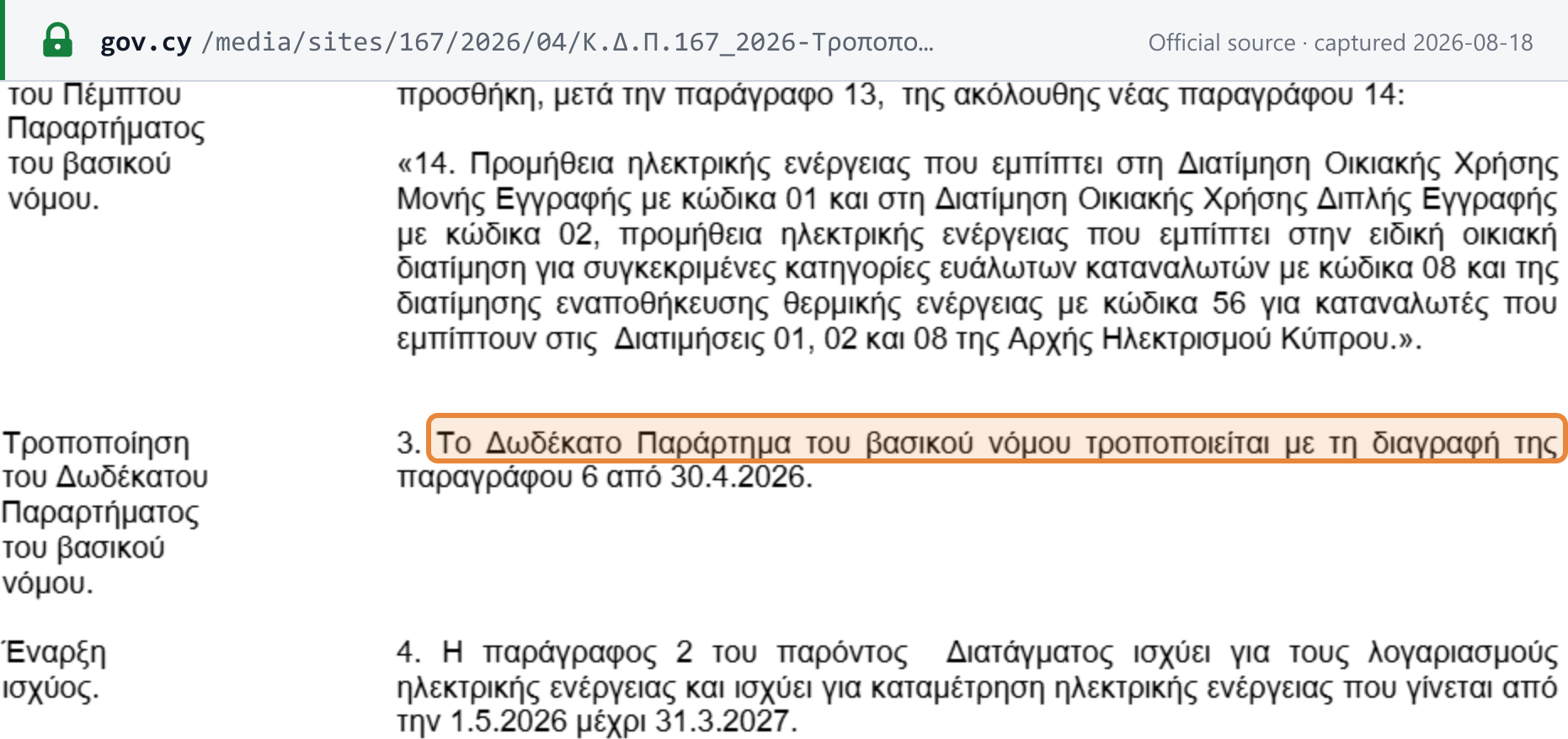
Electricity: 5%, for metering carried out from 1 May 2026 to 31 March 2027. The reduced rate covers supply on the Electricity Authority of Cyprus Single-Registration Domestic Use Tariff (code 01), the Double-Registration Domestic Use Tariff (code 02), the special domestic tariff for specified categories of vulnerable consumers (code 08), and the thermal-energy-storage tariff (code 56) for consumers within tariffs 01, 02 and 08. K.Δ.Π. 82/2026 first placed those tariffs in the Twelfth Schedule at 9% for metering from 1 April 2026; K.Δ.Π. 167/2026 then added them to Table A of the Fifth Schedule at 5% — inserted as a new paragraph 14 as gazetted, but renumbered 18 by the Correction (Διόρθωση) of 17 April 2026, which is the operative number — and deleted the Twelfth Schedule paragraph from 30 April 2026. So the movement was 9% → 5%, and the relief ends with metering on 31 March 2027 unless re-extended.
 [10] See Recent changes.
Meat, fish, bread, milk, coffee, sugar and baby food: 0%, to 31 May 2027. K.Δ.Π. 168/2026 moved specified fresh, chilled and frozen meats and fish out of the 5% Fifth Schedule and into paragraph 25 of the Sixth Schedule, by CN code, from 6 April 2026 to 30 September 2026. K.Δ.Π. 354/2026 (Official Gazette Annex III(I) No. 6050, 30 September 2026) continues that zero rate from 1 October 2026 to 31 May 2027 — bovine meat CN 0201/0202, pig meat CN 0203, sheep and goat meat CN 0204, edible offal CN ex 0206, poultry CN 0207, rabbit and hare CN ex 0208, fish CN 0302/0303/0304, and cuttlefish, squid and octopus CN ex 0307 — and adds bread, milk, coffee, sugar and baby food to the zero-rate list from 12 October 2026 to 31 May 2027. The order excludes these goods from the reduced-rate food paragraph of the Fifth Schedule while the zero rate applies. [29]
Check the end date. The zero rate ends on 31 May 2027 unless extended. The zero rate on meat and fish applied without a break across 30 September 2026 — there was no reversion to 5% on 1 October 2026. Do not confuse this with the companion relief below, which runs to 31 December 2026 — the temporary zero rates expire on different dates.
A companion relief runs on a different clock. K.Δ.Π. 337/2025 zero-rates infant milk, children's and adult nappies, feminine hygiene products and specified fresh fruit and vegetables from 1 January 2026 to 31 December 2026 — five months shorter than the meat, fish and staples relief, which now runs to 31 May 2027. The two decrees set different end dates; diary them separately. [11]
The 5% rate on a main and permanent residence
Table C of the Fifth Schedule applies 5% to the supply, transfer of possession or construction of a dwelling used as the main and permanent residence in the Republic, where it takes place before first installation in it. Since 16 June 2023 (N.42(I)/2023) the limits are: the first 130 m² of buildable area and up to a value of €350,000, provided the total transaction value does not exceed €475,000 and the total buildable area does not exceed 190 m². A person with a disability gets the first 190 m² regardless of the dwelling's total buildable area; for large families the total area increases by 15 m² for each additional child beyond three. A responsible declaration (υπεύθυνη δήλωση) must be filed on the prescribed form, and the planning-permission (or building-permit) application must have been filed after 1 May 2004. [6]
The ten-year condition. If the beneficiary ceases to use the dwelling as a residence before ten years elapse, they must notify the Commissioner within 30 days and pay the difference between the reduced and standard rate for the unexpired period. No clawback arises on death, or on transfer to an adult child who is itself a beneficiary at the time of transfer. [13]
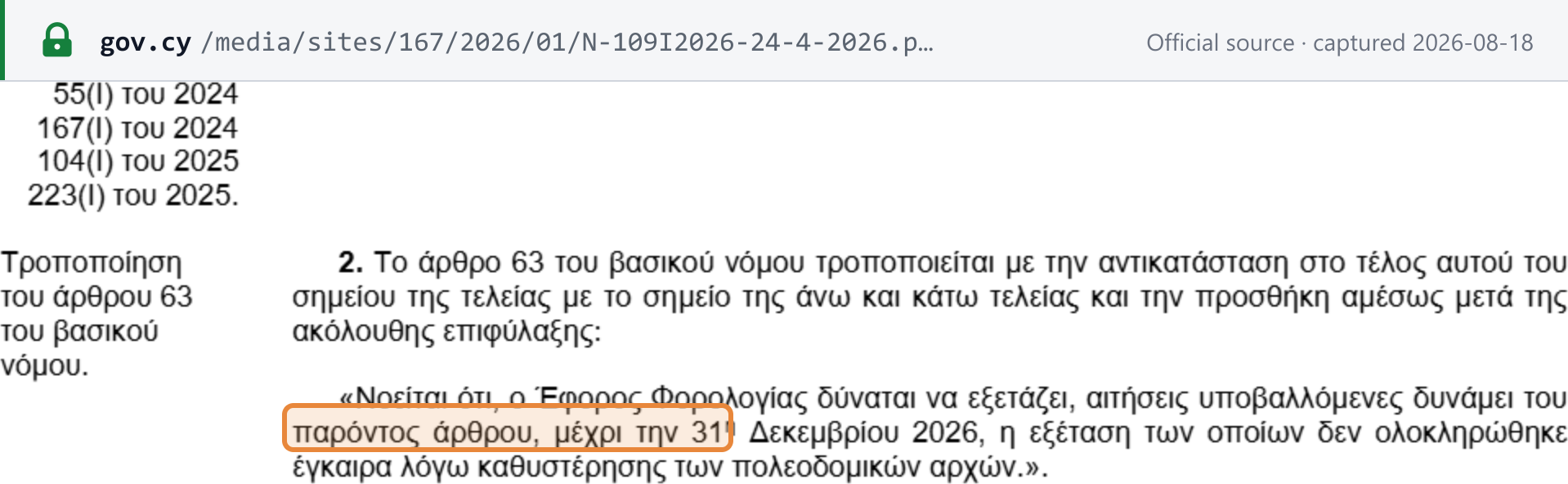
The "old rules" transitional regime, stated precisely. Article 63 preserves the pre-2023 limits — first 200 m² of a dwelling not exceeding 275 m² — for buildings whose planning permission was obtained, or application submitted, by 31 October 2023, and for which the responsible declaration is submitted within three years of N.42(I)/2023's entry into force on 16 June 2023. N.109(I)/2026 (24 April 2026) added a proviso allowing the Commissioner to examine applications already submitted under Article 63 until 31 December 2026 where their examination was not completed in time because of delay by the town-planning authorities. [14]
Read that carefully, because it is widely reported as a deadline extension and it is not one. It extends the Commissioner's power to examine applications that were already in. It does not move the three-year window for submitting the declaration.
Announced future rates
No change to the standard or reduced rates is announced. What does change, from 1 September 2026, is the test that decides whether a building transfer is taxable at 19% or exempt — see Recent changes. K.Δ.Π. 102/2026 and K.Δ.Π. 103/2026 replace the old "first installation" criteria in the Fifth and Eighth Schedules with a defined "first use" test: "«first installation» means the first use of the building after its delivery or construction, including owner-occupation, own use, leasing or any other use which continues on a systematic basis; «first use» means the use or exploitation of the building after its delivery or construction, which is carried out systematically for a period of at least eighteen (18) months." It affects sellers and buyers of new buildings, and anyone claiming the 5% renovation rate, whose qualifying definition K.Δ.Π. 102/2026 also re-cuts. [15]
Cross-border rules
Imports and exports
VAT is charged on the importation of goods from outside the Member States (s.17(β)), on acquisitions from other Member States (s.17(αΑ)), and on services received from abroad. Exports of goods are zero-rated under the Sixth Schedule, as are the supply, repair and hire of sea-going vessels and airline aircraft and services meeting the direct needs of sea-going vessels. Import VAT is collected by the Customs & Excise Department. [1]
De minimis. The low-value-consignment relief was abolished EU-wide from 1 July 2021; Cyprus transposed that package by K.Δ.Π. 500/2021 and K.Δ.Π. 502/2021, with IOSS available for consignments up to €150.
Digital products and services
Telecommunications, broadcasting and electronic services supplied to Cypriot consumers are taxed in Cyprus, and are declared either through the OSS Union or Non-Union scheme or by direct Cypriot registration. An EU-wide €10,000 annual micro-business threshold applies to intra-EU distance sales of goods and these services combined: while the total excluding VAT does not exceed €10,000 in the current calendar year and did not in the previous one, supply stays taxed in the supplier's Member State; once exceeded, taxation shifts to Cyprus from that moment. [16]
Foreign companies selling into Cyprus — B2B and B2C
This is the question non-resident readers arrive with, and the two halves have different answers.
B2B services (general rule). The place of supply is the customer's Member State, so the Cypriot business customer accounts for the VAT under the reverse charge. The foreign supplier does not register in Cyprus for these supplies. The invoice must bear «Αντίστροφη χρέωση» / "Reverse charge" (K.Δ.Π. 314/2001 reg. 12(1)(ξ)). [17]
B2C services (general rule). The place of supply is the supplier's Member State — except for telecommunications, broadcasting and electronic services, which are taxed in Cyprus as above.
Everything the reverse charge does not reach — register from the first euro. The Tax Department names, among others: supply-and-install of goods, services connected with land, and cultural, sporting, artistic and entertainment services supplied to non-taxable persons. For these there is no threshold at all for a non-established business. [3]
The cross-border SME scheme (SME-SS), in force from 1 January 2025 under N.104(I)/2025, lets a small enterprise established in another Member State use the Cypriot exemption where its annual EU-wide turnover does not exceed €100,000 and its annual turnover within the Republic does not exceed €15,600. Returns are quarterly, due within one month of the end of the calendar quarter. [18]
Marketplace and platform deemed-supplier liability
The e-commerce package is transposed by N.181(I)/2021 with K.Δ.Π. 499/2021 to 503/2021. K.Δ.Π. 501/2021 is the deemed-supplier instrument, covering "supplies of goods within the Republic made through electronic interfaces that facilitate those supplies." [16]
A deadline trap worth its own line: OSS Union and Non-Union returns are quarterly and IOSS returns monthly, and for these — unlike domestic VAT returns — "when the due date coincides with a weekend or public holiday, the deadline is NOT moved to the next working day." The same no-roll-over rule applies to SME-SS returns. [16]
Place of supply
Goods. Where the goods are at the time of supply: in the Republic at that time, the transaction takes place in the Republic; otherwise outside it. For intra-EU supplies the place is the customer's Member State (ss. 12A–12E).
Services. B2B — taxed in the Member State where the business customer is established. B2C — taxed in the supplier's Member State. Exceptions sit in the Thirteenth Schedule: immovable property; transport; hire of means of transport; cultural, artistic and educational services; admission to events; restaurant and catering, including on ships, aircraft and trains; hire of movable goods; and telecommunications, broadcasting and television services. [17]
Invoice requirements
When a VAT invoice must be issued
A registered person must deliver a VAT invoice where it makes a taxable transaction in the Republic to a taxable person; makes a non-exempt supply to a person in another Member State; receives a payment on account for such supplies; or makes supplies covered by regs 88A and 88B. Retailers need not issue one unless a taxable-person customer asks. [4]
Mandatory content
K.Δ.Π. 314/2001 reg. 12(1) — mappable to a schema: [4]
| Field | Requirement |
|---|---|
| Identifying number | Mandatory |
| Time of the transaction, or date the payment on account was made | Mandatory |
| Date of issue | Mandatory |
| Supplier's name, address and VAT registration number | Mandatory |
| Customer's name and address | Mandatory |
| Description sufficient to identify the goods or services | Mandatory, per line |
| Quantity or unit price or extent of services; VAT rate; net amount | Mandatory, per line |
| Gross total payable excluding VAT | Mandatory |
| Rate of any cash discount offered | Mandatory where offered |
| Total VAT chargeable, in euro (reg. 12(4)) | Mandatory |
| Reference to the travel-agents margin scheme | Where s.41 applies |
| Fiscal representative's name, address and VAT number | Where the Commissioner has directed appointment under s.37 |
| «Καθεστώς Ταμειακής Λογιστικής» (Cash Accounting Scheme) | Where VAT becomes payable under s.42E |
| «Αυτοτιμολόγηση» (Self-billing) | Where the customer issues the invoice |
| «Αντίστροφη χρέωση» (Reverse charge) | Where the recipient is liable for the tax |
For invoices to a person in another Member State (reg. 12(1Α)) add: the letters CY as a prefix to the supplier's registration number; the customer's registration number including its Member State code; the gross amount excluding VAT; and, for a new means of transport, a description sufficient to identify it as such.
Mixed-rate invoices (reg. 12(3)): exempt and zero-rated items must be separated on the face of the invoice, with the gross total stated separately for each transaction type and rate. A delivery or receipt note issued before the time of supply is not a VAT invoice provided it is endorsed "Αυτό δεν είναι τιμολόγιο Φ.Π.Α." ("This is not a VAT invoice").
Issuance deadline
Within 30 days of the time of supply (the tax point under s.9), or such longer period as the Commissioner allows in writing. For intra-EU supplies and services on which the recipient is liable for the tax, the invoice must be delivered no later than the 15th day of the month following the month in which the transaction is treated as taking place. Triangulation invoices by an intermediate supplier: no later than 15 days. [4]
Numbering and sequencing
Reg. 12(1)(α) requires an identifying number on every VAT invoice, and reg. 13A(1)(β) the same on every legal receipt. The General Regulations publish no sequential-numbering, gapless-series, annual-reset or prefix requirement. What they require instead is an audit trail: reg. 11A(1)(β) has each taxable person determine how it assures authenticity of origin, integrity of content and legibility, achievable "by any business controls which create a reliable audit trail between the invoices and the supply of goods and/or services." (Checked 2026-08-18.) [4]
Credit and debit notes
Two distinct mechanisms, and they are not interchangeable: [4]
- Rate-change credit note (reg. 13). On a change in the VAT rate, or in the descriptions of exempt or zero-rated transactions, where an invoice was issued before an election under s.55, the supplier must deliver within 14 days of the change a credit note headed «Πιστωτικό σημείωμα – αλλαγή συντελεστή του Φ.Π.Α.», carrying its own number and date, the parties' details, the number and date of the original invoice, a description of the goods or services, and the amount credited in respect of VAT.
- Adjustment for a change in consideration (reg. 27). Where consideration increases or decreases after the end of the tax period in which the original transaction took place, the supplier makes a positive or negative entry in its VAT account and a taxable-person recipient mirrors it. Reg. 27 does not apply to a change occurring more than 3 years after the end of that tax period.
Currency and language
Amounts may be expressed in any currency, provided the amount of VAT due is expressed in euro. Where an amount is in another currency it is converted using the exchange rate published by the European Central Bank for the relevant day. [4]
A trap, and it is in the legislation rather than the website. The consolidated regulation itself still carries the un-updated pre-euro wording at reg. 12(1)(i) — "the total amount of VAT chargeable, in pounds" — and the Tax Department's HTML summary faithfully reproduces it. The operative rule is a different provision, reg. 12(4), which requires the VAT due to be expressed in euro. Cite reg. 12(4), not reg. 12(1)(i).
Language. Where a VAT invoice, or part of one, is not in an official language of the Republic, the Commissioner may by written notice require a translation within 30 days (reg. 11B).
Document types
| Document | When | Value threshold |
|---|---|---|
| Full VAT invoice (τιμολόγιο Φ.Π.Α.) — reg. 12 particulars | B2B, and supplies to persons in other Member States | none |
| Legal receipt (νόμιμη απόδειξη) — reg. 13A | Taxable supply to a non-taxable person in the Republic, issued and delivered at the time of supply | none |
| Retailer's simplified invoice — reg. 14 | Retailer asked by a taxable-person customer | €85 and the transaction is not to a person in another Member State |
| Triangulation invoice — regs 14A, 14B, marked «Τριγωνική Συναλλαγή» | Triangular transactions | none |
The legal receipt must carry at least: date of issue; identifying number; the taxable person's name, address and registration number; a description sufficient to identify the goods or services; the total payable including VAT; for each rate, the total including VAT and the rate applied; and an indication of whether the transaction is cash, an advance payment, part of the consideration or otherwise. Where fiscal electronic devices (ΦΗΜ / ΦΗΜΣ) issue legal receipts, their approved specifications apply.
The simplified invoice may contain only the retailer's name, address and registration number, the date of issue, a description, the total including VAT, and for each rate the total including VAT and the rate. It must not refer to any exempt transaction, and may not be used at all where the supplier is not established in the Republic and the recipient is liable to account for the tax. [4]
Self-billing
Permitted, and — unusually — without prior approval. The conditions (reg. 11(3)–(3Ε)): a prior written agreement signed by both parties; the supplier must be a taxable person; the self-billed invoice carries all reg. 12(1) and 12(1Α) particulars and is marked «Αυτοτιμολόγηση»; the agreement runs for no more than 12 months or until the specific contract expires; it must record that the supplier will not itself issue VAT invoices for covered transactions, that it accepts every invoice the customer issues, and that it will notify the customer if it ceases to be a taxable person or its registration number changes; and the customer must submit the agreement to the Commissioner for information within 14 days of signature. The Department states plainly that "the Legislation does not provide for prior approval of the 'self-billing' agreement by the Commissioner of Taxation." [19]
The agreement terminates automatically on transfer of either business as a going concern, on the supplier ceasing to be registered, or on a new registration number being issued to the supplier. If the supplier is not a taxable person, self-billing is not available for that purchase.
Retention and audit trail
Retention: six years. Under s.43 and the Tenth Schedule, books and records must be preserved for at least six years after completion of the documents or transactions recorded in them, kept at the principal place of business. OSS records must be kept for ten years from the end of the year in which the supply was made. After deregistration, six years from the cancellation date. [20]
Electronic-only archiving is allowed, on conditions (reg. 11Γ): all invoices issued and received must be stored; you may choose the storage place but must make stored invoices available within five days of a request; a Cyprus-established person must notify the Commissioner immediately, and before storage, if the place is outside the Republic, and must store within the Republic unless storage is by electronic means giving full on-line access. Invoices must be stored in the original form in which they were transmitted or received. Reg. 11Δ forbids storage in a third country with which there is no mutual-assistance agreement, and reg. 11Ε gives the Commissioner the right to access, download and use invoices stored in another Member State. [4]
Audit trail and tamper evidence (reg. 11A) — a distinct obligation from retention, and one most guides skip. Authenticity of origin, integrity of content and legibility must be assured from the moment of issue until the end of the storage period. Each taxable person picks the method; business controls creating a reliable audit trail between invoices and supplies suffice. Two safe harbours are named: an advanced electronic signature based on a qualified certificate and created by a secure signature-creation device, and EDI where the interchange agreement guarantees authenticity and integrity. Use of an electronic invoice is subject to the recipient's acceptance. [4]
A specimen of a compliant invoice
The Tax Department publishes no official annotated specimen — checked against its invoice-issuance page, the 142-page General VAT Guide and its invoicing leaflet. The sheet below is therefore ours, built to show where the reg. 12 particulars sit on the page. All names, numbers and figures are fictional:
Τιμολόγιο Φ.Π.Α. — VAT invoice
| Description | Quantity | VAT rate | Amount (excl. VAT) |
|---|---|---|---|
| Vessel hull inspection and survey | 1 survey | Reverse charge | €4,200.00 |
| Replacement anodes, marine grade | 24 units | Reverse charge | €1,080.00 |
- Gross total payable excluding VATreg. 12(1)(η)
- €5,280.00
- Cash discount if settled within 14 daysreg. 12(1)(θ)
- 2%
- Total VAT chargeablereg. 12(1)(ι), in euro
- €0.00 — reverse charge
- Total
- €5,280.00
- Αντίστροφη χρέωση / Reverse charge — required wording where the recipient is liable to pay the tax (reg. 12(1)(ξ)).
- On a domestic invoice this block would instead show the VAT rate and the tax amount in euro; the VAT amount must be expressed in euro even where the rest of the invoice is in another currency (reg. 12(4)).
- Where the invoice mixes rates, exempt and zero-rated items must be separated on the face of the invoice with a gross total for each type and rate (reg. 12(3)).
- A retailer invoicing a taxable person for €85 or less may use the shortened form in reg. 14 instead — but not for a supply to a person in another Member State.
E-invoicing status
As at 18 August 2026 Cyprus has no continuous transaction control (CTC) system, no real-time VAT reporting mandate, no obligation on suppliers to send e-invoices, and no B2B or B2C mandate. There is one mandatory limb, on the receiving side of B2G, set out below. That is the answer, and it is worth stating explicitly because its absence is often mistaken for an oversight. [21]
What does exist:
- B2G, receive side — mandatory. Directive 2014/55/EU is transposed by the Law on the Issue of Electronic Invoices in the Context of Public Procurement of 2019, N.89(I)/2019. All central public sector bodies have had to receive and process EN 16931-compliant e-invoices since 18 April 2019, extended to sub-central entities from 18 April 2020.
- B2G, send side — voluntary. Suppliers may submit e-invoices to the Treasury of the Republic using the Jinius platform through the Central Government's existing Peppol Access Point, and via the gov.cy gateway. [22]
- Formats and standards. EN 16931, most commonly in Peppol BIS Billing 3.0. Cyprus applies no national CIUS and no extensions.
- Phase timeline by taxpayer size — none exists. There is no phased rollout and no turnover threshold moving businesses between phases, because there is no mandate.
- Scope, stated separately. B2G: receive-side mandatory for public bodies, send-side voluntary for suppliers. B2B: no mandate. B2C: no mandate.
What is coming, at EU level. The ViDA package was adopted on 11 March 2025 and published in the Official Journal on 25 March 2025; since its entry into force on 14 April 2025 Member States may introduce mandatory e-invoicing without a derogation. Digital Reporting Requirements for cross-border B2B transactions apply from 1 July 2030, and Member States with a domestic real-time reporting obligation must align with the EU model by 1 January 2035. The instruments are Directive (EU) 2025/516, Regulation (EU) 2025/517 and Implementing Regulation (EU) 2025/518. See the ViDA explainer.
No Cypriot domestic mandate has been announced. The Commission's country sheet records only that discussions are ongoing about introducing a mandatory e-invoicing requirement for suppliers, with attention to SME readiness — an intention, not a dated timeline. The Cyprus Tax Department's news feed and VAT legislation index publish no B2B e-invoicing decree, circular or consultation as at 2026-08-18.
Filing and payment
Filing frequency
VAT returns are normally for quarterly tax periods, and the quarter cycle you are assigned is determined at registration on the basis of your business's NACE economic-activity code. That is why Cypriot deadlines fall in three staggered groups (Dec–Feb, Jan–Mar, Feb–Apr, and so on) rather than on one national date — a detail that surprises anyone assuming a single calendar. Under conditions the Commissioner may set monthly or annual tax periods. All returns are filed electronically through Tax For All (TFA). [12]
Return due date
Stated as a rule rather than an example: both the VAT return and the payment are due by the 10th day after the end of the month following the end of the tax period — that is, the 10th day of the second month after the period ends. A quarter ending 31 March is due 10 May; a quarter ending 30 June is due 10 August. Where the due date falls on a weekend or public holiday it moves to the next working day. [23]
Payment due date and method
Same date as the return. Payment is made through the Tax For All taxpayer portal, which also handles VIES. [23]
Two extensions applied during 2026, and both were one-off responses to circumstances rather than changes to the rule above:
- The period ended 31 March 2026 moved from 10 May to 20 May 2026, and the April 2026 VIES statement from its own 15 May deadline to the same date, after Tax For All was shut for maintenance from 7 to 12 May.
- The period ended 30 June 2026 moved from 10 August to 20 August 2026 by decision of the Commissioner, because of the summer holiday period; the July 2026 VIES statement moved to the same date from its own 15 August deadline. The two obligations have different standing deadlines — the 10th for the return, the 15th for VIES — and the extension merely brought both to 20 August. [24]
Both appear in the Παράταση column of the Tax Department's deadlines table. Check that table before assuming a deadline; do not treat either date as the standing rule.
Additional listings
VIES recapitulative statements — monthly. A taxable person supplying goods or services to a person who is, or was, registered in another Member State must file by the 15th day after the end of the month in which the supplies were made, and must file even for a month with no such supplies. Corrections are due within one month of the end of the month the statement relates to. Statutory base: ss. 42Γ, 45Α, 45Β, 46. [13]
Developer note: the Tax Department publishes XSD schemas for VAT and VIES and an XML file-creation guide, which is the supported route if you are generating statements from your own system.
Intrastat — monthly, where you exceed the exemption threshold: [25]
| Year | Exemption — arrivals | Exemption — dispatches | Simplification — arrivals | Simplification — dispatches |
|---|---|---|---|---|
| 2026 | €380,000 | €75,000 | €2,700,000 | €5,800,000 |
| 2025 | €350,000 | €75,000 | €2,700,000 | €5,800,000 |
Due not later than the 10th day following the end of the reference month; corrections within two months of the end of the reference period. Electronic filing has been compulsory since 1 July 2012, through TAXISnet. An agent may be appointed but must be a customs agent under s.74 of the Customs Code Law of 2004, and appointing one does not relieve the trader of liability.
Input-tax recovery and blocked items
Input tax is deductible on the neutrality principle (s.19), subject to conditions. Blocked or non-deductible: [26]
- VAT on the purchase of a saloon (passenger) motor vehicle — excluding single-seaters, vehicles with more than ten seats, commercial and van-type vehicles, motor caravans, ambulances, vehicles over three tonnes, and vehicles built for a special purpose where passenger space is merely incidental;
- business entertainment expenses;
- VAT wrongly charged on works of art, antiques, collectors' items and second-hand goods sold under a margin scheme;
- VAT wrongly charged on assets of a business transferred to you as a going concern;
- input tax attributable to exempt supplies — partial recovery only where costs are partly attributable.
A useful corollary on disposal: a motor car or an asset used for business entertainment on which input tax was not deductible may be sold without accounting for VAT, because that supply is exempt.
Refunds
Resident credit position. A credit balance is repayable on claim. If repayment is delayed more than four months from the date the claim is submitted — through no fault of the claimant — the amount bears interest from the expiry of that four-month period, at the unified public default rate. Where the Commissioner carries out a tax audit in relation to the claim, the four months become eight. The Commissioner may suspend payment where the person has not filed earlier VAT returns, or an income tax return under s.5 of the Assessment and Collection of Taxes Law. [27]
Non-resident schemes. EU-established businesses claim through the EU VAT refund (8th Directive) portal; non-EU businesses claim on Form ΦΠΑ 109 under the 13th Directive.
Bad-debt relief sits in Part XI of K.Δ.Π. 314/2001 (regs 90–101), covering the claim to the Commissioner, notice to the purchaser, supporting evidence, required records, repayment and write-offs; Part XII (regs 102–104) makes the debtor repay the corresponding input tax when a Part XI claim is made.
Exemptions
Exempt supplies
Exempt transactions are listed in the Seventh Schedule, Table A (activities in the public interest) and Table B (other exemptions). Examples from the authority's own guidance: [28]
- Cyprus Post — services of the public postal operator and ancillary supply of goods such as postage and revenue stamps. This does not extend to private courier services.
- Medical and paramedical services.
- Associations of persons supplying their members — where the members make exempt or out-of-scope transactions, the services are directly necessary for their activities, and are supplied for a contribution to joint expenses; since 1 February 2002 only where there is no risk of distortion of competition.
- Social welfare and social security — by non-profit organisations, including old people's homes, covering accommodation, food and clothing as closely related supplies. Conditions: no distribution of profits, essentially unpaid management, and no competitive distortion. A for-profit company does not qualify, and where the exemption does not apply the Twelfth Schedule imposes 9%.
- Protection of children and young persons, and education.
Exempt is not zero-rated
The distinction decides whether you recover input VAT, and it is the single most common misunderstanding on this page. An exempt supply is outside VAT: you charge nothing and you cannot deduct the related input tax, with only partial recovery where costs are mixed. A zero-rated supply is taxable at 0%: you charge nothing but you keep full input-tax recovery.
The registration rule reinforces it — the obligation to register arises from taxable transactions at "standard, reduced and zero rate", with exempt supplies excluded from the threshold entirely. So a wholly zero-rated business may have to register, while a wholly exempt one does not. [3]
Special regimes
Retailers' schemes (K.Δ.Π. 35/2002); margin schemes for second-hand goods (s.40) and motor cars, and the Tour Operators' Margin Scheme (s.41); the Capital Goods Scheme; OSS / IOSS (ss. 42Β, 42ΣΤ, 42Η); the cross-border SME scheme (N.104(I)/2025); the investment-gold scheme (s.42Α); the Farmers' Special Scheme (s.42, annual return due by the end of April); the Urban Taxi Special Scheme (half-yearly return and payment by the 10th of the following month); the Cash Accounting Scheme (s.42Ε); and VAT warehousing under Part X of K.Δ.Π. 314/2001 with the Eleventh Schedule. [13]
Free zones and SEZs — not applicable. The Cyprus Tax Department's VAT special-regimes index publishes no free-zone or SEZ VAT scheme; the only warehousing relief is the customs/VAT warehousing regime in Part X of K.Δ.Π. 314/2001. (Checked 2026-08-18.)
Offences and penalties
These are different exposures and a reader planning compliance needs both.
Offences
- Fraudulent evasion of VAT (s.46(1)) — a criminal offence, punishable by a fine of up to three times the VAT due, or imprisonment up to three years, or both.
- Knowingly receiving supplies where VAT is being evaded — a criminal offence for any person who acquires goods or receives services having reason to believe the related VAT has been or will be evaded.
- Failure to issue a legal receipt to a consumer — unlawful, attracting an administrative charge of up to 20% of the transaction value, and further administrative or criminal sanctions including rejection of the books kept and assessment by estimate.
- Failure to keep proper books and records, or to comply with a requirement to provide information — leads to rejection of the books as unreliable, administrative fines and determination of the tax by estimate.
- Continuing failure to submit a VIES statement — criminal offence, fine up to €850.
- PSP failure to comply with the CESOP regulations (s.46(11Γ)) — fine up to €20,000, or imprisonment up to 12 months, or both.
- Intrastat — continued failure, refusal or delay is a criminal offence under s.15 of N.38(I)/2004, fine on conviction up to €2,562. [6]
Penalties
| Breach | Charge | Additional tax | Legal base |
|---|---|---|---|
| Failure to comply with registration obligations | €85 per completed month of delay | — | Art. 45(1) |
| Late submission of the VAT return | €100 | — | Art. 45(2) |
| Late payment of VAT | — | 10% plus interest | Art. 45(3)–(4) |
| VAT due arising from a Commissioner's assessment | — | 10% plus interest | Art. 45(3)–(4) |
| Non-compliance with specified obligations | €50 | — | Art. 45(5) |
| Non-compliance with a Tenth Schedule obligation | €200 | — | Art. 45(6) |
| Issuing an invoice showing VAT without being entitled to | €85 | — | Art. 45(7) |
| Non-compliance with ss. 11, 11Α–11Ε, 12Α | €200 per tax period, capped at €4,000 | — | Art. 45(7Β) |
| Failure to issue a legal receipt | 20% of the transaction value | — | Art. 45(9) |
| VIES — late or non-submission | €50 | — | Art. 45Β |
| VIES — late correction of inaccuracies | €15 | — | Art. 45Α |
| OSS/IOSS — late or non-submission | €100 per return | 10% on late payment | OSS rules |
| CESOP — PSP failure to submit records | €15,000 | — | Art. 45(7Γ) |
| Intrastat — failure, refusal or delay | €15 | — | Statistics of Trade Law |
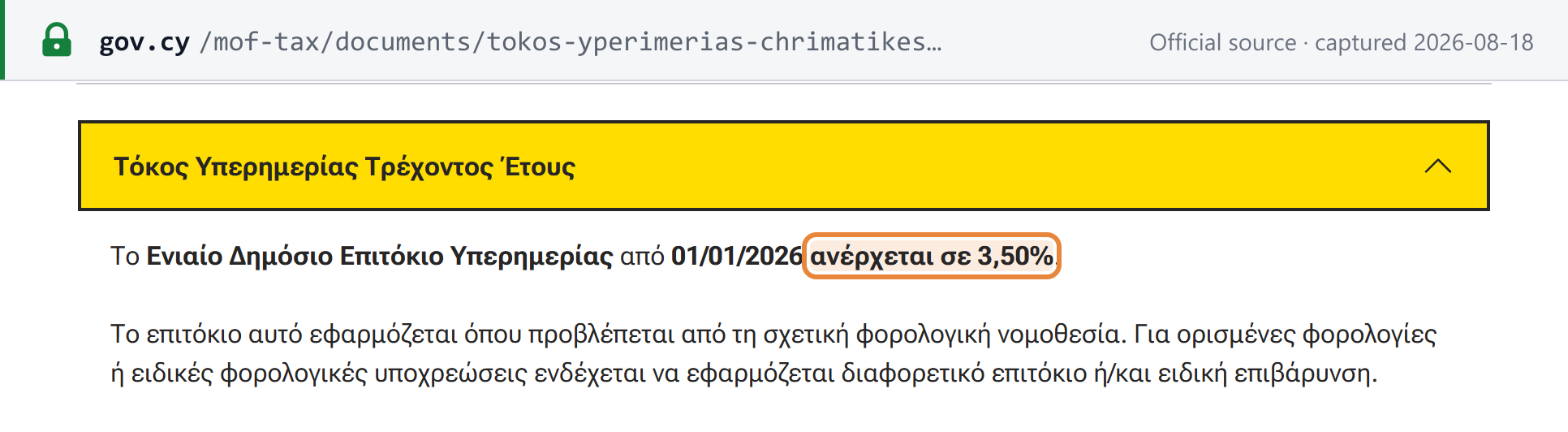
The interest rate to use. Late payment carries interest at the Unified Public Default Interest Rate (Ενιαίο Δημόσιο Επιτόκιο Υπερημερίας), which is 3.50% per annum from 1 January 2026. It is reset annually and it moves — 5.50% in 2025, 5.00% in 2024, 2.25% in 2023, 1.75% in 2020–2022.
Do not publish 9%. The consolidated VAT Law's own text of Article 45(4) still reads "τόκο προς εννέα τοις εκατόν ετησίως" — 9% per annum. That is the pre-2007 historic rate. Article 45(4) is read with the Unified Public Default Interest Rate Law, and the Tax Department's own page gives the operative rate as 3.50% for 2026.
Frequently asked questions
I am a non-EU SaaS company selling to Cyprus businesses — do I have to register for Cyprus VAT, or does the reverse charge cover me?
For general B2B services the place of supply is the customer's Member State, so a Cypriot business customer accounts for the VAT itself under the reverse charge and you do not register in Cyprus for those supplies. Your invoice must carry the words «Αντίστροφη χρέωση» / "Reverse charge" (K.Δ.Π. 314/2001, reg. 12(1)(ξ)).
The moment you make any B2C supply that is taxed in Cyprus, the position changes completely: there is no registration threshold for a person not established in the Republic. The Cyprus Tax Department states that a non-established person must register if it makes, or will within 30 days make, taxable transactions in the Republic in the course of its business, irrespective of the VAT registration threshold, and must register as soon as it forms the intention to do so.
For telecommunications, broadcasting and electronic services supplied to Cypriot consumers you can account for the Cyprus VAT through the OSS Union or Non-Union scheme instead of registering directly. An EU-wide €10,000 annual micro-business threshold applies to intra-EU distance sales of goods and these services combined — below it supply stays taxed in the supplier's Member State, and once exceeded taxation shifts to Cyprus from that moment.
Also watch the transactions the reverse charge does not reach: the Tax Department names supply-and-install of goods, services connected with land, and cultural, sporting, artistic and entertainment services supplied to non-taxable persons. For those you register from the first euro.
My Cypriot customer sent me their tax number but it fails VIES validation — which number do I actually need?
Cyprus issues a Tax Identification Code (ΑΦΤ/TIC) of 8 digits followed by one letter of the Latin alphabet, for example 12345678X. That is the tax number, and it is not what VIES validates. The VAT identifier — officially the Αριθμός Εγγραφής Φ.Π.Α. — is the same code with the country prefix CY in front of it, for example CY12345678X, and that prefix is a legal requirement on invoices to a person in another Member State under K.Δ.Π. 314/2001 reg. 12(1Α)(β). If your counterparty sends you the bare 8-digits-plus-letter, add the CY prefix before querying VIES.
A separate number you may also be given is the company's registration number from the Registrar of Companies, which is not a tax number at all and will never validate.
If a correctly formatted CY number still returns invalid, ask the supplier to confirm its registration status with the Cyprus Tax Department — VIES reflects each Member State's own database rather than a central register.
Tax For All was down when my VAT deadline fell — am I late, and what does being late actually cost?
When Tax For All is unavailable around a deadline the Commissioner extends the deadline by formal announcement rather than expecting you to file into a dead portal, and this happened twice in 2026. The return and payment for the period ended 31 March 2026 moved from 10 May to 20 May 2026 after TFA was shut for maintenance from 7 to 12 May, and the April 2026 VIES statement moved to the same date from its own 15 May deadline. The return and payment for the period ended 30 June 2026 moved from 10 August to 20 August 2026 by decision of the Commissioner because of the summer holiday period, with the July 2026 VIES statement moving there from 15 August. Note the two standing deadlines differ — the 10th for the return, the 15th for VIES. Both are published in the Παράταση column of the Tax Department's deadlines page. Check it before assuming you are late.
If you genuinely are late, the charges are separate and they stack: €100 for a late VAT return (Art. 45(2)); 10% additional tax on the VAT due plus interest (Art. 45(3)–(4)); and €50 for a late or missing VIES statement (Art. 45Β). The unified public default interest rate is 3.50% per annum from 1 January 2026.
I bought my Cyprus home at the 5% VAT rate — what happens if I rent it out or stop living in it?
The 5% rate under Table C of the Fifth Schedule is given for a dwelling used as your main and permanent residence, and it carries a ten-year condition. If you cease to use the dwelling as a residence before ten years have elapsed you must notify the Commissioner within 30 days and pay the difference between the reduced and the standard rate attributable to the unexpired part of the ten years. Renting the property out is a change of use, so continuing to own it does not preserve the relief.
Two carve-outs where no clawback arises: the death of the beneficiary, and transfer to an adult child who is itself a beneficiary at the time of transfer.
On the limits themselves, since 16 June 2023 the reduced rate applies to the first 130 m² of buildable area and up to a value of €350,000, provided the total transaction value does not exceed €475,000 and the total buildable area does not exceed 190 m². A person with a disability gets the first 190 m² regardless of the dwelling's total buildable area, and for large families the total area increases by 15 m² for each additional child beyond three.
I thought VIES statements were quarterly and missed several — how bad is that in Cyprus?
VIES in Cyprus is monthly, not quarterly. A taxable person supplying goods or services to a person who is, or was, registered in another Member State must file by the 15th day after the end of the month in which the supplies were made — and must file even for a month in which it made no such supplies, so a nil statement is still a statement. The obligation sits in sections 42Γ, 45Α, 45Β and 46 of N.95(I)/2000.
Late or non-submission attracts €50 per statement, and late correction of inaccuracies €15, with corrections due within one month of the end of the month the statement relates to. The part people underestimate is that continuing failure to submit is not just a charge but a criminal offence, punishable on conviction by a fine of up to €850.
Filing is through Tax For All, and the Tax Department publishes XSD schemas and an XML file-creation guide if you are generating statements from your own system.
The zero rate on meat and fish was supposed to end 30 September — has it, and what rate applies now?
No — it was extended and widened. K.Δ.Π. 354/2026 (Official Gazette Annex III(I) No. 6050, 30 September 2026) keeps specified fresh, chilled and frozen meat, fish, cuttlefish, squid and octopus at 0% from 1 October 2026 to 31 May 2027, and adds bread, milk, coffee, sugar and baby food at 0% from 12 October 2026 to 31 May 2027. The goods are excluded from the reduced-rate food paragraph of the Fifth Schedule, so they did not fall back to 5% on 1 October 2026. After 31 May 2027 the zero rate ends unless a further order extends it. Reconfigure POS and invoicing systems for the bread, milk, coffee, sugar and baby-food lines from 12 October 2026. Don't confuse this with the separate zero rate on infant milk, nappies, feminine hygiene products and specified fruit and vegetables under K.Δ.Π. 337/2025, which runs on its own clock to 31 December 2026. (Source: Cyprus Government Printing Office, K.Δ.Π. 354/2026; K.Δ.Π. 168/2026)
Important websites
| Site | Purpose |
|---|---|
| Tax For All (TFA) | VAT returns, VIES statements, payments and refund requests — the main filing and payment portal |
| Cyprus Tax Department | News, announcements and guidance |
| Deadlines calendar | Filing and payment dates, including the Παράταση (extension) column |
| VAT rates | The authority's own rate list |
| EU VIES VAT number validation | Checking a Cyprus (or any EU) VAT number |
| TAXISnet | Intrastat filing — mandatory electronic since 1 July 2012 |
| OSS / IOSS portal | One-Stop Shop registration and returns |
| SME cross-border scheme (SME-SS) | Registration and quarterly returns under N.104(I)/2025 |
| EU VAT refund (8th Directive) | Refund claims by EU-established businesses |
| CESOP portal | Payment service provider reporting |
| VAT legislation index | Laws, regulations, decrees and circulars |
| Registrar of Companies search | Company registry lookup |
VAT registration itself is not online: it is paper Form T.F. 1101 at a District Tax Office, though the Tax Identification Code that precedes it is obtained through Tax For All.
Also see Lookuptax's own Cyprus VAT number validator.
Recent changes
- 2026-10-01 — K.Δ.Π. 354/2026 (Official Gazette Annex III(I) No. 6050, 30 September 2026) continues the 0% rate on specified fresh, chilled and frozen meat, fish, cuttlefish, squid and octopus to 31 May 2027 (no reversion to 5% on 1 October 2026), and from 12 October 2026 to 31 May 2027 also zero-rates bread, milk, coffee, sugar and baby food (updated from: 0% expiring 30 September 2026). (Cyprus Government Printing Office) — see event record
- 2026-09-01 (scheduled) — K.Δ.Π. 102/2026 and K.Δ.Π. 103/2026 replace the "first installation" criteria in the Fifth and Eighth Schedules with a defined 18-month "first use" test, changing whether a new building's transfer is taxable at 19% or exempt, and re-cutting the qualifying definition for the 5% renovation rate. (Cyprus Government Printing Office) — see event record and issue
- 2026-08-20 — The Commissioner of Taxation extended the VAT return and payment deadline for the period ended 30 June 2026, and the July 2026 VIES statement, from 10 August to 20 August 2026, because of the summer holiday period. (Cyprus Tax Department) — see event record and issue
- 2026-05-20 — The VAT return and payment for the period ended 31 March 2026, and the April 2026 VIES statement, were extended to 20 May 2026 after Tax For All was shut for maintenance from 7 to 12 May 2026. (Cyprus Tax Department) — see event record and issue
- 2026-05-01 — VAT on electricity supplied on EAC domestic tariffs 01, 02, 08 and thermal-storage tariff 56 fell from 9% to 5% under K.Δ.Π. 167/2026, for metering carried out from 1 May 2026 to 31 March 2027. (Cyprus Government Printing Office) — see event record and issue
- 2026-04-24 — N.109(I)/2026 allows the Commissioner to examine Article 63 "old rules" 5% primary-residence applications until 31 December 2026 where examination was delayed by the town-planning authorities. It does not extend the deadline for submitting the declaration. (Cyprus Government Printing Office)
- 2026-04-06 — K.Δ.Π. 168/2026 applies a temporary 0% rate to specified fresh, chilled and frozen meat and fish, from 6 April 2026 to 30 September 2026. (Cyprus Government Printing Office)
- 2023-07-21 — A new 3% reduced rate was introduced as section 18B by N.75(I)/2023, with the Fifteenth Schedule.
- 2023-06-16 — N.42(I)/2023 substituted the limits for the 5% main-residence rate: first 130 m² and €350,000, capped at a €475,000 transaction value and 190 m² total buildable area.
Reference links
- Cyprus Tax Department — Value Added Tax Law N.95(I)/2000, consolidated to K.Δ.Π. 221/2026 (PDF)
- Cyprus Tax Department — VAT (General) Regulations K.Δ.Π. 314/2001, consolidated (PDF)
- Cyprus Tax Department — General information on VAT
- Cyprus Tax Department — VAT rates
- Cyprus Tax Department — Obligation and right to register in the VAT Register
- Cyprus Tax Department — VAT registration procedure
- Cyprus Tax Department — Groups of companies
- Cyprus Tax Department — Grounds for cancellation of registration
- Cyprus Tax Department — Rights and obligations
- Cyprus Tax Department — Issuing a VAT invoice
- Cyprus Tax Department — Self-billing
- Cyprus Tax Department — Keeping books and records for VAT
- Cyprus Tax Department — Filing and amending VAT returns
- Cyprus Tax Department — Deadlines
- Cyprus Tax Department — Exempt transactions
- Cyprus Tax Department — Place of supply of services
- Cyprus Tax Department — Intrastat general information
- Cyprus Tax Department — OSS / IOSS
- Cyprus Tax Department — SME cross-border special scheme
- Cyprus Tax Department — Interest, charges, administrative fines and additional tax (indirect taxes)
- Cyprus Tax Department — Unified Public Default Interest Rate (general information)
- Cyprus Tax Department — General VAT Guide (Ενημερωτικό Έντυπο 10, PDF)
- Treasury of the Republic — Electronic invoicing (N.89(I)/2019)
- European Commission — eInvoicing in Cyprus
- Cyprus Tax Department — VAT decrees index (K.D.P. instruments)
- Lookuptax — Cyprus TIN / TIC number guide
- Lookuptax — Official links to check VAT numbers worldwide
- Lookuptax — E-invoicing status and the networks worldwide