Bulgaria VAT guidelines
| FACTSHEET | |
|---|---|
| Country code | BG |
| Tax name | Value Added Tax (VAT) — данък върху добавената стойност (ДДС) |
| Tax Authority | National Revenue Agency (Национална агенция за приходите, НАП) |
Overview
Bulgaria levies value added tax — данък върху добавената стойност (ДДС) — under the Value Added Tax Act (Закон за данък върху добавената стойност, ЗДДС), promulgated in State Gazette No. 63 of 4 August 2006 and in force since 1 January 2007. [1]
Administering authority. The National Revenue Agency (Национална агенция за приходите, НАП / NRA). Registration applications are filed with "the competent territorial directorate of the National Revenue Agency" (VAT Act art. 101(1)), and returns and payments go to it too (arts 89 and 125). Customs collect the VAT on imported goods (art. 90). [1]
Currency. Bulgaria has used the euro since 1 January 2026, at the fixed and irrevocable conversion rate of EUR 1 = BGN 1.95583. [3] The VAT Act's thresholds were rewritten in euro from that date. Its penalty articles still state their amounts in leva (лв.). Under art. 11(2) of the Euro Introduction Act, amounts in leva in existing legal instruments "are deemed to be amounts in euro" at the official rate, converted and rounded to the cent under its arts 12–13. This guide therefore gives each penalty in BGN, as the Act states it, and labels any EUR figure as a conversion at the fixed rate. [4]
Tax period. VAT Act art. 87(2): "Данъчният период е едномесечен за всички регистрирани лица и съвпада с календарния месец освен в случаите по глава осемнадесета" — the tax period is one calendar month for all registered persons, except under the OSS/IOSS special schemes of chapter 18. See Filing and payment. [1]
Layering. VAT is a single national tax. The VAT Act is one national statute with no regional or municipal rate. [1]
Registration
Who should register
A taxable person established in Bulgaria — by seat and registered office or, failing that, by permanent address or habitual residence — must register when its annual turnover in the country exceeds the national threshold of EUR 51,130 (VAT Act art. 96(1), as rewritten by State Gazette No. 115/2025 from 1 January 2026): "е длъжно да се регистрира по този закон, когато годишният му оборот в страната, определен по реда на чл. 168в, надвиши националния праг от 51 130 евро". [2]

What counts, and over what period. "Annual turnover in the country" is measured over the calendar year, not a rolling 12 months. Art. 168в(1) defines it as the total taxable amounts of supplies "извършените през календарната година" (made during the calendar year) with a place of supply in Bulgaria. It counts: [2]
- taxable supplies, including intra-EU supplies of goods;
- supplies exempt with the right to deduct (zero-rated supplies);
- financial services (art. 46) and insurance services (art. 47);
- exempt supplies of immovable property.
Financial, insurance and property supplies are left out when they are ancillary, and so are sales of the business's own fixed assets (art. 168в(2)).
Registration threshold
| Trigger | Threshold | Measurement period | Source |
|---|---|---|---|
| Mandatory registration — established in Bulgaria | EUR 51,130 (since 1 January 2026; checked 2026-09-29) | Calendar year | Art. 96(1), State Gazette No. 115/2025 [2] |
| EU business using the EU SME scheme in Bulgaria | Bulgarian turnover above EUR 51,130, or EU turnover above EUR 100,000 | Calendar year | Art. 96(2) [2] |
| Other non-established sellers | None — register before the first taxable supply in Bulgaria | — | Art. 96(3)–(4); see Non-resident registration |
| Intra-EU acquisitions by non-registered legal persons | EUR 10,000 of acquisitions | Calendar year | Art. 99(2)–(3) [1] |
How the threshold got here. Art. 96(1) read BGN 166,000 until 31 March 2025. The 2025 State Budget Act (State Gazette No. 26 of 27 March 2025, § 24) replaced it with BGN 100,000 from 1 April 2025. State Gazette No. 115/2025 then restated it as EUR 51,130 from 1 January 2026; BGN 100,000 at the fixed rate is EUR 51,129.19, and the legislator set the figure at EUR 51,130. [5] [2]
| Period | Art. 96(1) threshold | Instrument |
|---|---|---|
| Until 31 March 2025 | BGN 166,000 | VAT Act before the 2025 amendment |
| 1 April – 31 December 2025 | BGN 100,000 | State Gazette No. 26/2025, § 24 |
| From 1 January 2026 | EUR 51,130 | State Gazette No. 115/2025 |
| From 1 January 2027 — proposed, not law | EUR 75,000 | Ministry of Finance draft of 23 September 2026 |
Proposed rise to EUR 75,000. The Ministry of Finance draft amending the VAT Act, published on 23 September 2026 for public consultation until 23 October 2026, would replace "51 130" with "75 000" in art. 96(1) and (2) from 1 January 2027 (draft § 24). This is a proposal: it still needs approval by the Council of Ministers and adoption by the National Assembly. [6] [7]
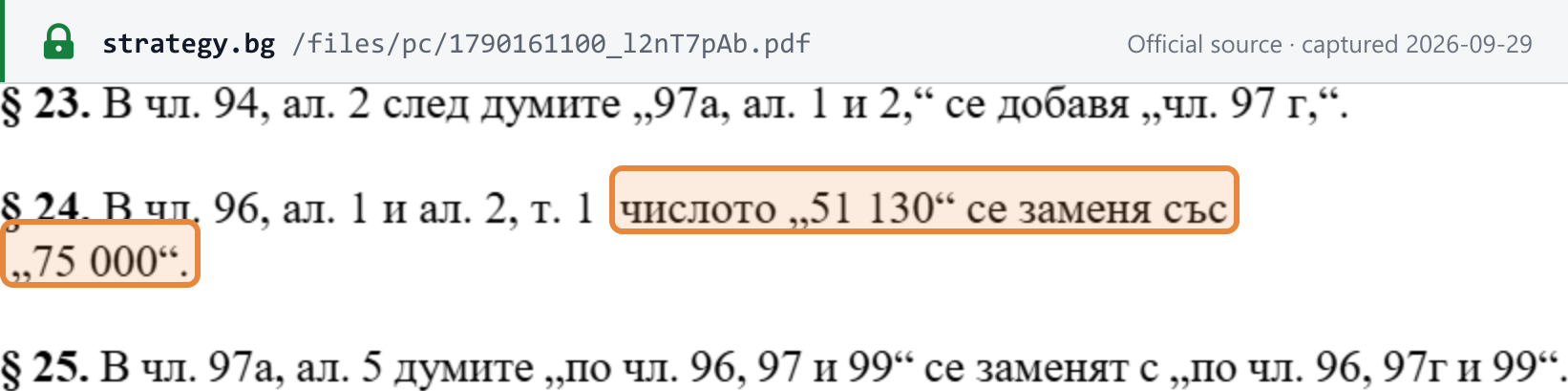
Proposed registration duty for new-building sales (art. 97g) — not law. The same draft would add an art. 97g: a taxable person making taxable supplies in Bulgaria in a calendar year of new buildings (or parts of them, adjoining land and rights in rem over them), or of ownership or building rights over a regulated plot of land, would have to register, with the application due at least 7 days before the VAT on the supply becomes chargeable. Individuals would be caught only when acting as taxable persons in an independent economic activity. A person registered only under art. 97g would be denied input-VAT credit on other supplies and could not show VAT on invoices for other supplies. Proposed entry into force 1 January 2027; the current registration rules above are unchanged. [6] [7]
Application deadline and date of registration
- Established persons apply "в 7-дневен срок от датата на надвишаване на националния праг" — within 7 days of the date the threshold is exceeded (art. 96(6)(1)).
- Non-established persons apply no later than 7 days before the VAT on their first taxable supply in Bulgaria becomes chargeable (art. 96(6)(2)).
- Date of registration. For threshold registration it is the day after the threshold was exceeded (art. 103(1)). VAT is therefore due from then, although the registration act is issued later.
- Invoices for the gap. For supplies made between the day after the threshold was exceeded and service of the registration act, invoices must be issued no later than 5 days after the act is served (art. 113(4), second sentence, new from 1 January 2026).
Non-resident registration
There is no turnover threshold for sellers not established in Bulgaria, other than EU businesses using the EU SME scheme there (see the table above). Two rules apply: [2]
- Established outside the EU (art. 96(4)): must register "преди датата, на която става изискуем данъкът за първата облагаема доставка с място на изпълнение на територията на страната" — before the date on which VAT on its first taxable supply in Bulgaria becomes chargeable.
- Established in another EU state without the EU SME scheme in Bulgaria (art. 96(3)): registers on the same basis, before its first taxable supply.
Neither rule applies to supplies declared under the Union or non-Union OSS scheme (or IOSS), or to supplies on which the customer is liable for the VAT.

Accredited representative. A foreign person not established in Bulgaria that must register does so "чрез акредитиран представител" — through an accredited representative (art. 133(2)). This does not apply to a person established in another EU member state, or in a third country with which the EU has a mutual-assistance agreement similar in scope to Directive 2010/24/EU and Regulation (EU) No 904/2010. Such a person registers under the general rules and may appoint a representative if it wants one (art. 133(6)). [1]
Tax identification number
On registration the National Revenue Agency assigns a VAT identification number preceded by the letters "BG" (art. 94(2), as rewritten by State Gazette No. 115/2025). [2] The VAT Act does not set out the digits that follow. For the structure of Bulgaria's identifiers, see Lookuptax's Bulgaria tax ID guide. To check a counterparty's number, see how to verify a VAT number in Bulgaria or use Lookuptax's Bulgaria VAT number validator.
How to register
File the registration application in the prescribed form with the competent territorial directorate of the National Revenue Agency (art. 101(1)). "Заявлението може да се подаде по електронен път" — the application may be filed electronically under the Tax and Social Insurance Procedure Code (art. 101(3)), through the NRA's e-services portal. The Agency checks the grounds and issues the registration act, or a reasoned refusal, "в срок 7 дни от подаване на заявлението" — within 7 days of the application (art. 101(6)). [1]
The documents to attach are set by the Act's Implementing Regulation (art. 101(4)) and are not covered in this guide.
Voluntary registration
Available. Art. 100(1): "Всяко данъчно задължено лице, за което не са налице условията за задължителна регистрация по чл. 96, ал. 1, има право да се регистрира по този закон" — every taxable person that does not meet the conditions for mandatory registration is entitled to register. A business might register voluntarily to recover input VAT. Legal persons may also opt to register for their intra-EU acquisitions (art. 100(2)). [1]
Deregistration
- Optional. A person registered under art. 96(1)–(3) may deregister when the ground for mandatory registration no longer applies (art. 108(1)(1)). But since 1 January 2026, a person that exceeded the threshold in the preceding year cannot deregister on that ground until the end of the current calendar year (art. 108(5)). [2]
- Non-EU registrants (art. 96(4)) may deregister when they made no taxable supplies in Bulgaria in the current and the preceding 12 tax periods (art. 108(1)(5)). [1]
- Mandatory. Art. 107 lists the grounds, among them death, striking-off from the register and the termination of a legal person. [1]
- Final return and assets on hand. Tax for the last period before deregistration is payable by the end of the month following the month in which that return was due (art. 89(2)).
- Late application. Failing to apply for deregistration on time is an offence under art. 178 — see Offences and penalties.
Group registration
Not available. No VAT grouping is available in Bulgaria: the VAT Act has no grouping provision. Art. 132, under which an unincorporated joint venture registers on the same basis as its registered partner, is not a grouping regime. [1]
Rates
| Rate | Applies to | Current wording in force |
|---|---|---|
| 20% (standard) | Taxable supplies with a place of supply in Bulgaria, imports of goods and taxable intra-EU acquisitions, unless a reduced or zero rate is expressly provided (VAT Act art. 66) | Art. 66 as amended by State Gazette No. 52/2022, from 1 July 2022 [1] |
| 9% (reduced) | Hotel and similar accommodation, including holiday accommodation and camping or caravan pitches; books (printed or electronic, including textbooks, children's picture and colouring books and sheet music) and newspapers and periodicals, other than advertising or mainly video or music content; food for babies and young children, baby nappies and similar baby-hygiene articles listed in Annex 4 (art. 66a) | 1 January 2023 (State Gazette No. 102/2022) [9] |
| 0% (exempt with the right to deduct) | Supplies in chapter three of the Act, such as exports of goods to third countries (art. 28) and international transport, plus intra-EU supplies of goods (art. 53) and the supplies in arts 64a, 140, 146 and 173 (art. 66b) | [1] |
| Exempt (no VAT, no input-tax recovery) | See Exemptions | — |
VAT Act art. 66(1): "Стандартната ставка на данъка е 20 на сто за облагаемите доставки с място на изпълнение на територията на страната" — the standard rate is 20 per cent for taxable supplies with a place of supply in Bulgaria. Art. 66a opens: "Ставката на данъка е 9 на сто за:" — the rate is 9 per cent for the three categories listed above. (Checked 2026-09-29.) The European Commission's VAT rates table also shows 20% standard and 9% reduced for Bulgaria, with no super-reduced or parking rate (page last checked by the Commission on 13 July 2026). [1] [10]
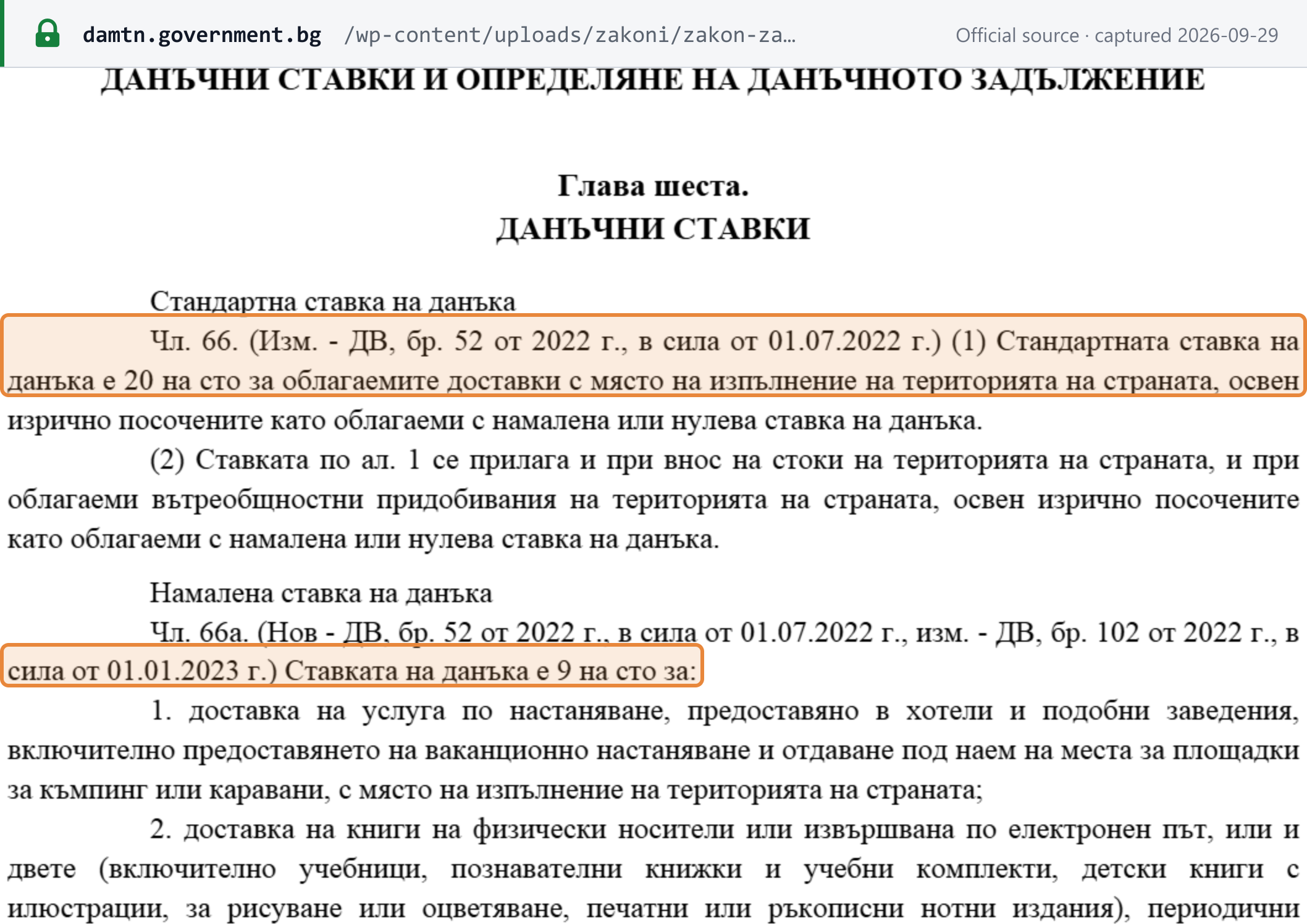
Restaurant and catering services are not on the 9% list in the current art. 66a, so they are taxed at 20%. [9]
Zero rate. The Act frames it as "освобождаване с право на приспадане на данъчен кредит чрез прилагане на нулева ставка" — exemption with the right to deduct input tax, by applying a zero rate (art. 66b). [1]
Super-reduced and parking rates. Not applicable — the Act has only arts 66 (20%), 66a (9%) and 66b (0%).
Announced future rates. None enacted. The Ministry of Finance draft of 23 September 2026 leaves arts 66–66b unchanged. It would add a zero rate for supplies exempt under art. 20 of Regulation (EU) 2025/1106 (defence procurement), in a new art. 173(16); that is a proposal, not law. [6]
For Bulgaria alongside other jurisdictions, see Lookuptax's worldwide tax rates table and VAT registration thresholds table.
Cross-border rules
Foreign companies selling into Bulgaria — B2B and B2C
State Gazette No. 115/2025 repealed art. 82(2)(2) of the VAT Act from 1 January 2026. That provision made a Bulgarian VAT-registered customer liable for the VAT on goods supplied to it, in Bulgaria, by a seller not established in Bulgaria. A foreign seller of goods located in Bulgaria — local stock sold to Bulgarian businesses, for example — must now register in Bulgaria and charge Bulgarian VAT itself. Business-to-business services are still reverse-charged.
Proposed, not law: § 17 of the Ministry of Finance draft of 23 September 2026 would add art. 82(2)(4), making the customer liable for supplies that non-established registered suppliers invoice under the new art. 113(18), from 1 January 2028 — which would largely restore the reverse charge on goods. [6] [2] [1]
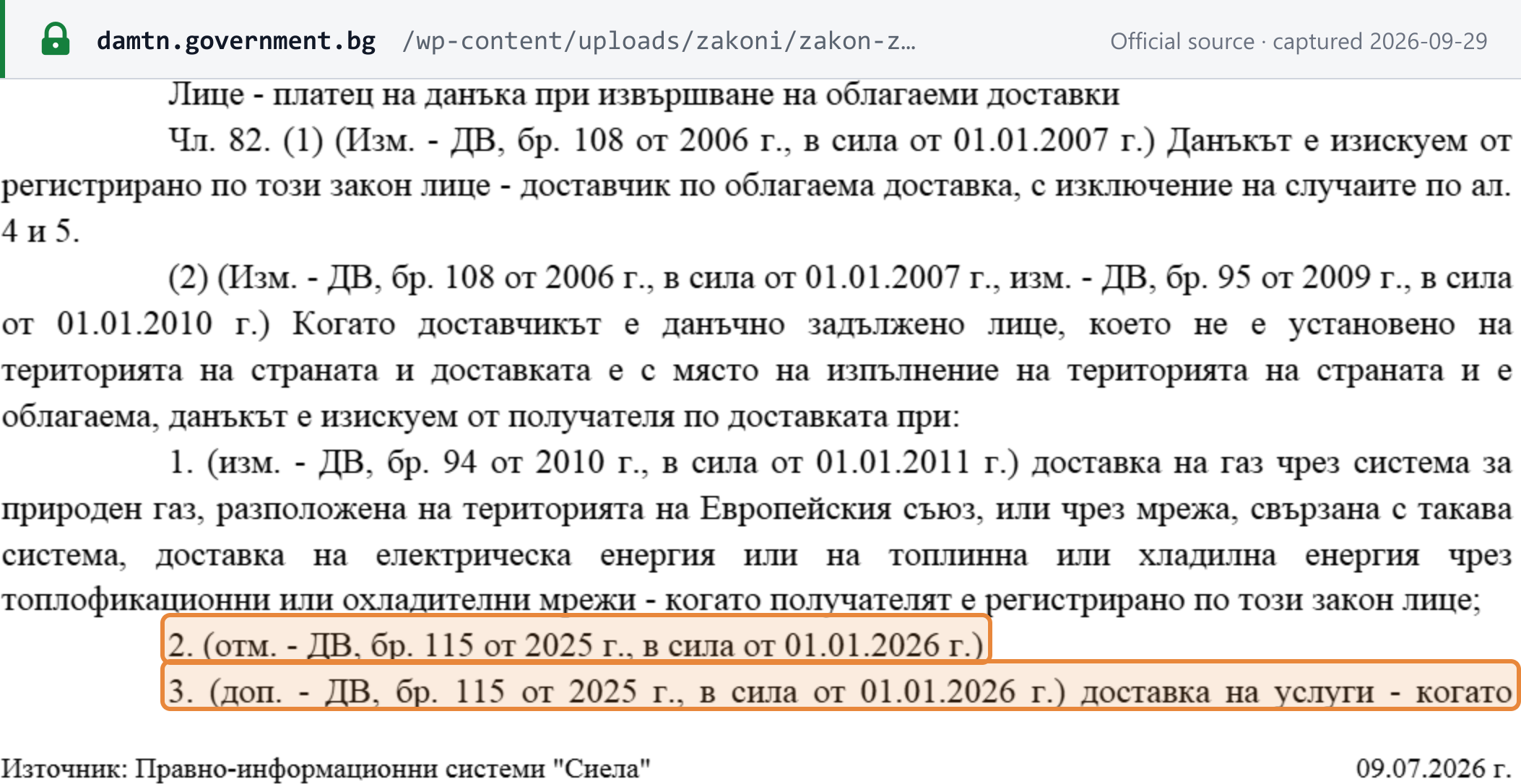
Art. 82(2) of the consolidated Act now reads, for a supplier not established in Bulgaria making a taxable supply with a place of supply in Bulgaria: [1]
- gas through the natural-gas system, electricity, and heating or cooling through the networks, to a registered customer — the customer is liable;
- "(отм. - ДВ, бр. 115 от 2025 г., в сила от 01.01.2026 г.)" — repealed by State Gazette No. 115/2025, in force 1 January 2026;
- "доставка на услуги - когато получателят е данъчно задължено лице" — services, where the customer is a taxable person — the customer is liable, except where the supplier is registered in Bulgaria for the EU SME scheme.
The answer depends on what is sold and to whom:
| Supply by a non-established seller | Who accounts for Bulgarian VAT | Seller registers in Bulgaria? |
|---|---|---|
| B2B services (place of supply in Bulgaria) | The Bulgarian business customer, by reverse charge (art. 82(2)(3)) | No, for these supplies |
| B2B goods located in Bulgaria | The seller — since 1 January 2026 | Yes, before the first supply (art. 96(3)–(4)) |
| B2C e-services and intra-EU distance sales by an EU seller | Home-country VAT up to EUR 10,000 EU-wide; Bulgarian VAT above that | Via the Union OSS, or a Bulgarian registration |
| B2C supplies by a non-EU seller | The seller | Yes, before the first supply — unless it uses the non-Union OSS or IOSS (art. 96(4)) |
A Bulgarian business that receives reverse-charged services must itself be registered: art. 97a(1) creates that duty, and art. 97a(4) requires the application no later than 7 days before the VAT on the supply becomes chargeable. [1] For the mechanism, see Lookuptax's reverse charge explainer.
Digital products and services
Telecommunications, broadcasting and electronically supplied services to consumers are taxed where the consumer is (art. 21(6)). An EU seller established in one member state keeps charging its home-country VAT on these services, and on intra-EU distance sales of goods, while their EU-wide total stays within EUR 10,000 in both the current and the previous calendar year. Art. 20b(1): "не надвишава през текущата календарна година и не е надвишавала през предходната календарна година 10 000 евро". The supply that crosses the threshold is taxed in Bulgaria (art. 20b(3)), and the seller declares it through the Union OSS or a Bulgarian registration. A non-EU seller has no threshold: it registers before its first supply unless it uses the non-Union OSS. [1]
See Lookuptax's guides to the One-Stop Shop, the Import One-Stop Shop and VAT on digital services for non-resident suppliers.
Marketplace / platform deemed-supplier liability
Applies. An operator of an electronic interface is deemed both supplier and recipient of the goods when it facilitates: [1]
- intra-EU distance sales of goods by a seller established outside the EU;
- distance sales of goods imported from third countries in consignments of an intrinsic value not exceeding EUR 150;
- domestic sales in Bulgaria by a seller established outside the EU to consumers.
Art. 14a(6): "се счита за доставчик и получател, като се приема, че са налице едновременно две доставки" — the operator is deemed supplier and recipient, with two supplies deemed to take place at the same time. See Lookuptax's marketplace deemed-supplier explainer.
Imports and exports
- Imports of goods. Import VAT, at 20% or 9%, is assessed by customs. The importer or its customs representative pays it into the account of the Customs Agency, and customs release the goods only "след заплащане или обезпечаване на начисления данък" — after the tax is paid or secured (art. 90(1), (3)). [1]
- Low-value consignments. The EU rules for consignments of up to EUR 150 apply, including IOSS (art. 14a(5)). The VAT Act sets no separate Bulgarian VAT de minimis; customs-duty rules are not covered in this guide.
- Exports. Goods dispatched or transported from Bulgaria to a third country by or on behalf of the supplier are zero-rated (art. 28). [1]
- Reverse charge on imported services. A Bulgarian business customer accounts for the VAT on services from a non-established supplier (art. 82(2)(3)) — see above.
- Intra-EU acquisitions. A non-registered legal person must register once its intra-EU acquisitions exceed EUR 10,000 in the calendar year (art. 99(2)–(3)). [1]
Place of supply
- Services — B2B (art. 21(2)): where the customer has established its business — "мястото, където получателят е установил независимата си икономическа дейност".
- Services — B2C (art. 21(1)): where the supplier has established its business. B2B services used exclusively for private purposes follow the B2C rule (art. 21(3)).
- Exceptions (arts 21(4)–(6)): immovable property, transport, events, and telecommunications, broadcasting and electronic services to consumers have their own rules.
- Goods. The place-of-supply rules for goods begin at art. 17 and are not covered in this guide.
Invoice requirements
The invoice rules are in VAT Act arts 113–122. State Gazette No. 115/2025 amended several of them from 1 January 2026, and the Euro Introduction Act switched the currency requirement from leva to euro on the same date. [2] [4]
Mandatory content
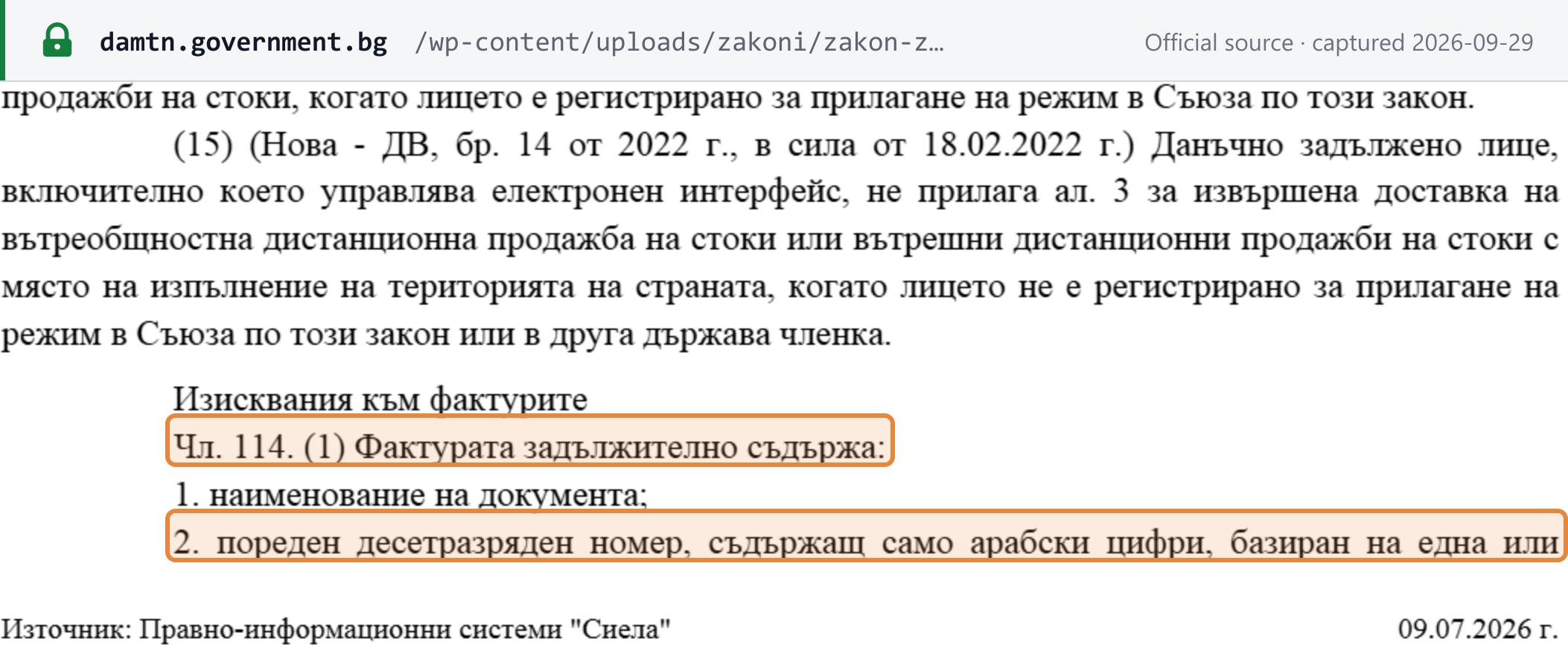
Art. 114(1): "Фактурата задължително съдържа:" — an invoice must contain the following. Item 6 was repealed in 2010. [1]
| # | Required field | Legal cite |
|---|---|---|
| 1 | Name of the document ("Фактура") | Art. 114(1)(1) |
| 2 | Sequential 10-digit number, Arabic digits only, on one or more series, identifying the invoice uniquely | Art. 114(1)(2) |
| 3 | Date of issue | Art. 114(1)(3) |
| 4 | Supplier's name and address | Art. 114(1)(4) |
| 5 | Supplier's VAT number (art. 94(2)), or its EU SME scheme "EX" number, or — if the supplier is not VAT-registered — its identifier under art. 84 of the Tax and Social Insurance Procedure Code | Art. 114(1)(5) |
| 7 | Customer's name and address | Art. 114(1)(7) |
| 8 | Customer's VAT number, EX number or procedure-code identifier; another member state's VAT number where the customer is registered there; or another identifier required by the customer's state | Art. 114(1)(8) |
| 9 | Quantity and type of goods, or type of service | Art. 114(1)(9) |
| 10 | Date of the chargeable event, or the date payment was received | Art. 114(1)(10) |
| 11 | Unit price excluding VAT and the taxable amount, plus trade discounts not included in the unit price | Art. 114(1)(11) |
| 12 | VAT rate — and, for a zero rate, the legal basis for it; the legal basis for not charging VAT | Art. 114(1)(12) |
| 13 | Amount of VAT | Art. 114(1)(13) |
| 14 | Amount payable, if it differs from the taxable amount plus VAT | Art. 114(1)(14) |
| 15 | For intra-EU supplies of new means of transport, the circumstances that make them new | Art. 114(1)(15) |
Where the customer is liable for the VAT, the invoice shows neither the VAT amount nor the rate. Art. 114(4): "във фактурата се вписва "обратно начисляване", както и основанието за това" — the invoice carries the words "обратно начисляване" (reverse charge) and the legal basis for it. [1]
Issuance deadline
- General rule — art. 113(4): "Фактурата се издава задължително не по-късно от 5 дни от датата на възникване на данъчното събитие за доставката" — no later than 5 days from the chargeable event. For an advance payment, no later than 5 days from receipt of the payment.
- Intra-EU supplies — by the 15th of the month following the month of the chargeable event (art. 113(5)).
- Summary invoices — two or more supplies whose VAT falls due in the same tax period may be covered by one invoice, issued no later than the last day of that month (art. 113(13)).
- After threshold registration — see Application deadline and date of registration.
Numbering and sequencing
Every invoice carries a ten-digit number made up only of Arabic digits — "пореден десетразряден номер, съдържащ само арабски цифри". Numbers may run on one or more series, "depending on the reporting needs" of the business, and must identify the invoice uniquely (art. 114(1)(2)). A number such as INV-2026-001 does not comply; 0000000123 does. The Act says nothing about gaps in the sequence. [1]
Credit and debit notes
When the taxable amount changes or an invoiced supply is cancelled, the supplier must issue a note to the invoice (art. 115(1)): [1]
- a debit note (дебитно известие) for an increase;
- a credit note (кредитно известие) for a decrease or a cancellation (art. 115(3)).
The note is issued no later than 5 days after the event (art. 115(2)). Besides the art. 114 particulars, it states the number and date of the invoice it relates to and the reason for issuing it (art. 115(4)).
Currency and language
- Currency. Art. 114(5): "Сумите по фактурата могат да бъдат посочени в която и да е валута, при условие че данъчната основа и размерът на данъка се посочат в евро" — amounts may be in any currency, provided the taxable amount and the VAT are stated in euro. Before 1 January 2026 the requirement was leva. [1] [4]
- Exchange rate. Foreign-currency values are converted at "the last exchange rate published by the European Central Bank at the time the tax becomes chargeable" (art. 26(6)). [1]
- Language. The VAT Act itself sets no language rule. The European Commission's OSS guidance on Bulgaria states: "If the supplier is established in Bulgaria, the invoice should be in Bulgarian. It can be issued in several languages provided that one of them is Bulgarian." That page is partly out of date — it still says amounts must be shown in BGN. [11]
Document types
| Document | When it is used | Cite |
|---|---|---|
| Invoice (фактура) | Default for every taxable supply to a business | Arts 113–114 |
| Simplified invoice | Taxable amount plus VAT up to EUR 100, or a supplier using an SME scheme. It may omit items 12, 14 and 15. Not available for supplies taxed in another member state, intra-EU supplies or distance sales. | Art. 114(7), State Gazette No. 115/2025 |
| Debit or credit note (известие) | Change in the taxable amount, or cancellation | Art. 115 |
| Protocol (протокол) | Self-assessment document, for example for reverse-charged supplies and intra-EU acquisitions | Art. 117 |
| Fiscal receipt | Retail sales, from a registered fiscal device | Art. 118 |
| Summary invoice | Several supplies whose VAT falls due in the same month | Art. 113(13) |
Art. 114(7)(2) as rewritten from 1 January 2026: "сумата на данъчната основа и данъкът не превишават 100 евро" — the taxable amount and the tax do not exceed EUR 100. An invoice need not be issued for supplies to non-taxable individuals (art. 113(3)(1)), unless the customer asks for one (art. 113(6)). [2] [1]
Bill of supply. Not applicable — the VAT Act defines no such document.
Self-billing
Permitted. Art. 113(11): the customer may issue invoices and notes in the supplier's name and for its account "ако има предварително споразумение между двете страни и при условие че е налице процедура за приемане на всяка фактура" — if there is a prior agreement between the parties and a procedure for the supplier to accept each invoice or note. A supplier may also authorise a third party in writing to issue its invoices (art. 113(7)). [1]
Retention and audit trail
- Retention. Art. 121(1): tax documents issued and received are kept "до 5 години след изтичане на давностния срок за погасяване на публичното задължение" — until 5 years after the limitation period for the tax liability they evidence expires, in their original form. That is not a flat 5 years: the limitation period itself is set by the Tax and Social Insurance Procedure Code and is not covered in this guide. [1]
- Electronic storage is allowed. The data proving authenticity and integrity must be kept with the documents (art. 121(2)). Where storage gives online access, the National Revenue Agency — and the authorities of other member states where VAT is due — must be given electronic access (art. 122). [1]
- Audit trail. The business ensures authenticity of origin, integrity of content and legibility from issue to the end of storage (art. 114(6)). It does so "чрез всякакъв контрол на стопанската дейност, който създава надеждна одитна следа" — through any business control that creates a reliable audit trail between the invoice and the supply (art. 114(10)). For e-invoices, a qualified electronic signature and EDI are the example technologies (art. 114(11)). [1]
- Electronic invoices. Allowed only if the customer accepts them "с писмено или мълчаливо съгласие" — by written or tacit consent (art. 114(9)). See E-invoicing status. [1]
A specimen of a compliant invoice
Neither the VAT Act nor the State Gazette publishes an annotated specimen invoice. The layout below is Lookuptax's own illustration of the art. 114(1) particulars. Every name, number and amount in it is fictional:
Фактура — Invoice
| Goods or serviceArt. 114(1)(9) | QuantityArt. 114(1)(9) | Unit price excl. VATArt. 114(1)(11) | Value excl. VAT |
|---|---|---|---|
| Office desks | 10 | EUR 250.00 | EUR 2,500.00 |
- Trade discount not in unit priceArt. 114(1)(11)
- EUR 0.00
- Taxable amount (in EUR)Art. 114(1)(11), 114(5)
- EUR 2,500.00
- VAT rateArt. 114(1)(12)
- 20%
- VAT (in EUR)Art. 114(1)(13), 114(5)
- EUR 500.00
- Amount payableArt. 114(1)(14)
- EUR 3,000.00
- The number must be exactly ten Arabic digits — no letters, prefixes or separators (Art. 114(1)(2)).
- The invoice is issued no later than 5 days after the chargeable event (Art. 113(4)).
- If the invoice is in another currency, the taxable amount and the VAT must still be shown in euro, converted at the last ECB rate published when the VAT became chargeable (Arts 114(5), 26(6)).
- For a zero-rated or reverse-charged supply, the invoice states the legal basis for the zero rate or for not charging VAT instead of a VAT amount (Art. 114(1)(12)).
- An electronic version may be sent only if the customer accepts e-invoices by written or tacit consent (Art. 114(9)).
E-invoicing status
Status (as of 2026-09-30): no B2B or B2C mandate; public buyers must accept EN 16931 e-invoices since 1 November 2019. A draft law proposes mandatory structured e-invoicing from 1 January 2028; it is in public consultation until 23 October 2026 and is not law.
Today. Bulgaria has no B2B or B2C e-invoicing mandate and no clearance or real-time reporting system in force. Electronic invoices are allowed where the customer accepts them by written or tacit consent (VAT Act art. 114(9)). [1] B2G, in force: since 1 November 2019 contracting authorities must accept and process e-invoices that meet EN 16931 (Public Procurement Act art. 115a, inserted by State Gazette 86/2018); suppliers are not obliged to send them. (Public Procurement Agency — consolidated ЗОП) For B2G channels, format and the draft in full, see Lookuptax's Bulgaria e-invoicing guide.
The draft — proposed, not law. On 23 September 2026 the Ministry of Finance published a draft law amending the VAT Act on the public-consultation portal (consultation 12733, open until 23 October 2026). It must still be approved by the Council of Ministers and adopted by the National Assembly, and any of the points below can change. [7] [6] As drafted:
- Who and what. A VAT-registered supplier established in Bulgaria must issue a structured e-invoice, and structured notes, for supplies with a place of supply in Bulgaria, including advance payments, when the customer is established in Bulgaria and is a taxable person, a non-taxable legal person, or the state or a state or local body (draft art. 113(16)). Unregistered established suppliers must also do so for supplies to public bodies (art. 113(17)).
- Out of scope. Intra-EU supplies and triangulation; suppliers that are registered but not established in Bulgaria, which keep issuing ordinary invoices (art. 113(18)); and sales documented by extended fiscal receipts (art. 118(24)).
- When. The e-invoicing provisions would enter into force on 1 January 2028 for everyone in scope — the draft has no phasing by size. The penalty for not issuing a structured e-invoice (new art. 182a) would apply from 1 July 2028 (draft § 105).
- Clearance model. A structured e-invoice must meet the European e-invoicing standard and syntax list under Directive 2014/55/EU (EN 16931). It must carry a unique compliance code from the National Revenue Agency's national information system for structured e-invoicing and digital reporting (НИССЕФ), and it is deemed issued only when that code is generated (draft art. 120a(1), (3)). Data sent from other software go to the Agency "незабавно в реално време" — immediately, in real time (art. 120g(1)) — and a rejected document must be corrected within 48 hours (art. 120g(3)). The customer's consent would no longer be needed (art. 120d(1)).
- Extra fields. The CN code for goods or the UN/CEFACT code for services, and the supplier's bank account(s) (draft art. 120a(2)).
- Prefilled returns. The Agency would prefill the monthly VAT return from e-invoice and customs data by the 2nd of the following month (draft art. 125(3), (15), (18)), and the sales and purchase ledgers would be abolished (draft § 44, repealing art. 124(1)–(6)).
- Consequences. A buyer would have no right to deduct input VAT on a supply for which the supplier was obliged to issue a structured e-invoice but did not (draft art. 70(7)), and a software producer whose code blocks data transmission to the national system would face fines of EUR 10,000–20,000 for individuals or EUR 50,000–100,000 for legal persons (draft art. 192b), both from 1 January 2028.
- Technical rules. Left to a Minister of Finance ordinance due within 6 months of promulgation, and a 6-month test window is intended before go-live, but its start date is not fixed because draft § 103 refers to a non-existent § 104, item 1 (draft §§ 103–104). The draft sets no fallback procedure for when the national system is unavailable.
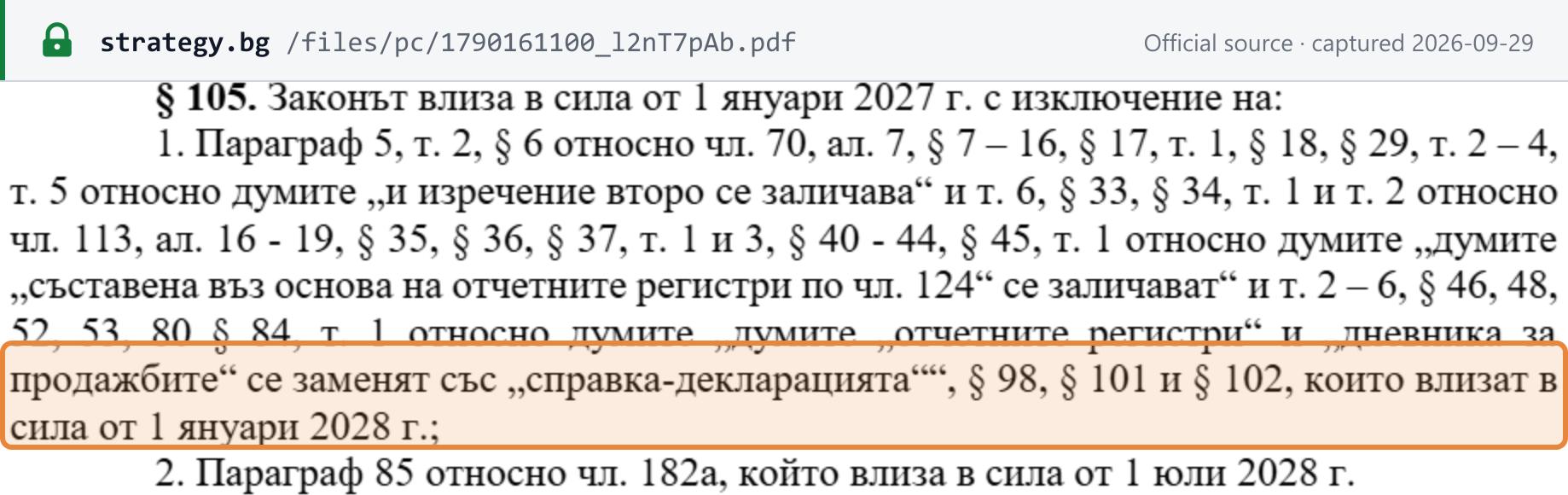
SAF-T is a separate obligation — and it is law. Do not confuse it with e-invoicing. State Gazette No. 26/2025 added a Standard Audit File for Tax to the Tax and Social Insurance Procedure Code (new chapter 8b, arts 71з–71к). It is filed monthly by the end of the following month — State Gazette No. 65/2025 (§ 17) replaced the original "14th" in art. 71к(1) with "the end" — with assets filed annually and inventories on request, and it is being phased in by enterprise size: [5] [12]
| From | Who must first file (per State Gazette No. 26/2025) |
|---|---|
| 1 January 2026 | Large enterprises with 2023 net sales above BGN 300,000,000 or tax receipts above BGN 3,500,000 |
| 1 January 2027 | Large, medium and small enterprises meeting the same thresholds for 2024 |
| 1 January 2028 | 2025 net sales above BGN 15,000,000 or receipts above BGN 1,500,000 |
| 1 January 2029 | All large, medium and small enterprises (status at 31 December 2026) |
| 1 January 2030 | Everyone else in scope |
These are the figures as enacted in 2025. See Lookuptax's SAF-T explainer.
For Bulgaria alongside other mandates, see Lookuptax's e-invoicing status and networks table and the ViDA guide.
Filing and payment
Filing frequency
Monthly for every registered person. The tax period is one calendar month (VAT Act art. 87(2)), whatever the business's size. The Act offers no quarterly or annual option; only the OSS and IOSS special schemes of chapter 18 have other periods. [1]
Return due date
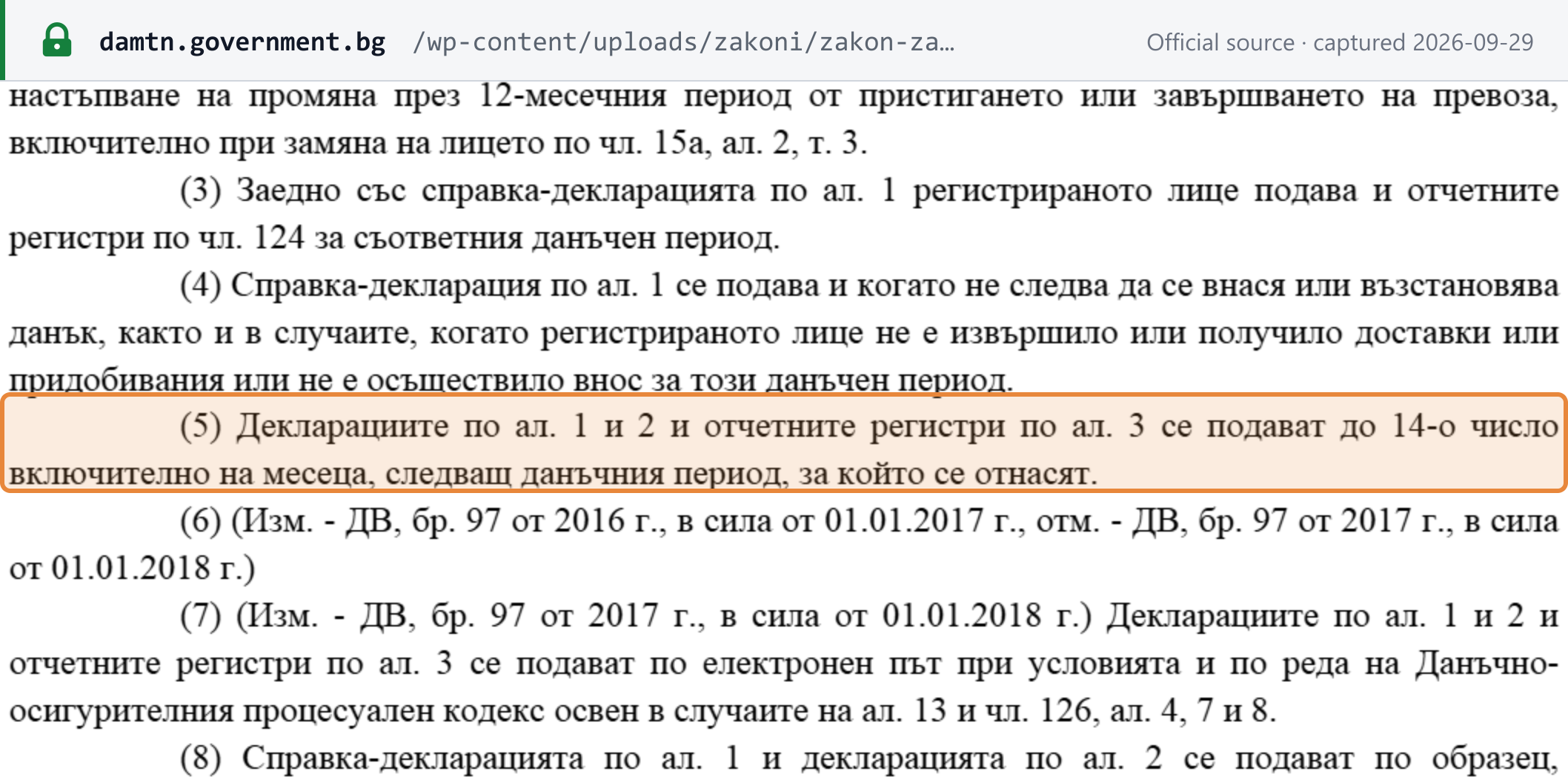
Art. 125(5): "Декларациите по ал. 1 и 2 и отчетните регистри по ал. 3 се подават до 14-о число включително на месеца, следващ данъчния период, за който се отнасят" — the VAT return, the VIES declaration and the ledgers are filed by the 14th (inclusive) of the month following the tax period. They are filed electronically (art. 125(7)). A return is due "even when no tax is payable or refundable" and for a month with no supplies, acquisitions or imports (art. 125(4)). [1]
Payment due date and method
VAT payable is paid into the account of the competent territorial directorate of the National Revenue Agency "в срока за подаване на справка-декларацията" — within the deadline for filing the return, so by the 14th (art. 89(1)). For the last tax period before deregistration, tax is due by the end of the month following the month in which that return was due (art. 89(2)). Late-payment interest is set by a separate statute and is not covered in this guide. [1]
Additional listings
- VIES declaration — monthly, by the 14th, for periods with intra-EU supplies of goods, triangulation, or B2B services taxed in another member state (art. 125(2), (5)).
- Sales and purchase ledgers — filed with each return (arts 124, 125(3)). The draft of 23 September 2026 would abolish them from 1 January 2028 (proposed).
- SAF-T — a separate monthly file under the Tax and Social Insurance Procedure Code, phased in from 2026 — see E-invoicing status.
- Annual VAT return — not applicable; the VAT Act provides none.
[1] For how EU listings work, see Lookuptax's VIES and Intrastat guide.
Input-tax recovery and blocked items
There is no right to deduct input tax where the goods or services are used for (art. 70(1)): [1]
- exempt supplies under chapter four of the Act;
- free supplies, or activities other than the person's economic activity;
- "представителни или развлекателни цели" — representation or entertainment;
- the acquisition or import of passenger cars and motorcycles, and their maintenance, repair, improvement and running costs, including spare parts, fuel and lubricants.
The car block does not apply where the vehicles are used exclusively for transport or security services, taxi services, rental, courier services or driving tuition, or are held for resale (art. 70(2)). Supplies made under the SME schemes carry no right to deduct either (art. 70(6)). [1] [2]
Refunds
- Residents — standard route. A VAT credit is first offset against other liabilities collected by the National Revenue Agency. The remainder is then deducted from the VAT payable in the next two consecutive tax periods, and whatever is left is offset or refunded within 30 days of filing the last of those returns (art. 92(1)).
- Residents — fast route. A refund within 30 days of the return is available in listed cases — for example where zero-rated supplies exceeded 30% of all taxable supplies in the preceding 12 months (art. 92(3)(1)).
- Non-residents. VAT paid in Bulgaria is refunded to businesses established and VAT-registered in another EU member state, and to businesses established outside the EU that are VAT-registered in their own country on a reciprocity basis (art. 81(1)).
- Bad-debt relief. Since 1 January 2023, a registered supplier may reduce the taxable amount and the VAT on an uncollectable receivable from a taxable supply in Bulgaria when all the conditions in art. 126a are met (State Gazette No. 102/2022).
Exemptions
Exempt supplies
Chapter four of the VAT Act exempts, among others: [1]
- healthcare by medical establishments (art. 39);
- social services and social insurance (art. 40);
- education (art. 41);
- certain cultural services (art. 42) and supplies by religious bodies (art. 43);
- fundraising by non-profit organisations (art. 44);
- land, buildings that are not new, and residential letting to individuals who are not traders (art. 45(1), (3), (4));
- financial services (art. 46) and insurance (art. 47);
- gambling — "Освободена доставка е организирането на хазартни игри по смисъла на Закона за хазарта" (art. 48);
- the universal postal service and postage stamps (art. 49).
The supplier may opt to tax supplies of land, old buildings and residential letting (art. 45(7)).
Exempt is not the same as zero-rated. A zero-rated supply is, in the Act's words, an "освобождаване с право на приспадане" — an exemption with the right to deduct input tax (art. 66b). The supplier charges 0% and recovers the VAT on its costs. A chapter-four exempt supply carries no VAT, and the input tax on costs used for it is not deductible (art. 70(1)(1)). [1]
Special regimes
-
Domestic small-enterprise scheme (from 1 January 2026). An established business whose Bulgarian turnover did not exceed the national threshold of EUR 51,130 in either the current or the previous calendar year charges no VAT on its supplies (art. 168d). Art. 168d(2): "Националният праг за годишния оборот в страната е в размер на 51 130 евро." No input VAT is deductible (art. 70(6)). [2]

-
EU SME scheme (Directive (EU) 2020/285, from 1 January 2026). A Bulgarian business may use the exemption in other member states, and an EU business may use it in Bulgaria, subject to the EUR 100,000 EU-turnover cap (arts 168e–168l). Invoices under the EU scheme carry the supplier's "EX" number (art. 114(13)–(14)). See Lookuptax's EU SME scheme explainer. [2]
-
Cash accounting. Registered persons whose Bulgarian annual turnover did not exceed EUR 500,000 in the current or the previous calendar year may account for VAT when payment is received, in proportion to the payment (art. 151a(1)–(2), State Gazette No. 115/2025). Conditions include no unpaid tax debts. [2]
-
Margin schemes and investment gold. The Act has a tour operators' margin scheme (chapter 16), a margin scheme for second-hand goods, works of art, collectors' items and antiques (chapter 17), and a special regime for investment gold (chapter 19). Their detail is outside the scope of this guide.
Offences and penalties
Offences
The VAT Act's chapter 26 makes the following conduct an administrative offence. The Act fines individuals who are not traders (глоба), and imposes a "property sanction" (имуществена санкция) on legal persons and sole traders. [1]
- failing to apply for registration or deregistration on time (art. 178);
- failing to file the VAT return or the VIES declaration, or filing it late (art. 179);
- failing to charge VAT on time, including because the person did not register on time (art. 180(1)–(2));
- failing to submit ledger data, or submitting data that differ from the ledgers (art. 181);
- failing to issue a tax document, or to record one issued or received, and so understating the tax payable or overstating a refund (art. 182);
- issuing a document that shows VAT while not registered (art. 183).
Criminal liability for tax evasion lies outside the VAT Act, in the Criminal Code, and is not covered in this guide.
Penalties
The Act states its penalties in leva. Under the Euro Introduction Act (art. 11(2)) they are read as euro amounts at the fixed rate of 1.95583. The EUR column is Lookuptax's conversion at that rate, rounded to the cent — it is not a figure printed in the Act. [1] [4]
| Art. | Default | Statutory amount (BGN) | ≈ EUR, converted at 1.95583 |
|---|---|---|---|
| 178(1) | Registration or deregistration application not filed on time | BGN 500 – 5,000 | EUR 255.65 – 2,556.46 |
| 179(1) | VAT return or VIES declaration not filed, or filed late | BGN 500 – 10,000 | EUR 255.65 – 5,112.92 |
| 180(1) | VAT not charged on time (also where unregistered, 180(2)) | The uncharged VAT, minimum BGN 500; repeat: twice the VAT, minimum BGN 1,000 | Minimum EUR 255.65; repeat minimum EUR 511.29 |
| 180(3) | … charged late, within 6 months | 5% of the VAT, minimum BGN 200 (repeat: BGN 400) | Minimum EUR 102.26 (EUR 204.52) |
| 180(4) | … charged late, after 6 but within 18 months | 10% of the VAT, minimum BGN 400 (repeat: BGN 800) | Minimum EUR 204.52 (EUR 409.03) |
| 181(1)–(2) | Ledger data not submitted, or different from the ledgers | BGN 500 – 10,000; repeat BGN 1,000 – 20,000 | EUR 255.65 – 5,112.92; repeat EUR 511.29 – 10,225.84 |
| 182(1) | Tax document not issued or not recorded, understating the tax | The VAT concerned, minimum BGN 1,000 | Minimum EUR 511.29 |
| 182(2) | … issued or recorded in the following period | 25% of the VAT, minimum BGN 250 | Minimum EUR 127.82 |
| 183(1)–(2) | Unregistered person showing VAT on a document | The VAT shown, minimum BGN 1,000; repeat: twice the VAT, minimum BGN 5,000 | Minimum EUR 511.29; repeat minimum EUR 2,556.46 |
Art. 178(1) sets the sanction "в размер от 500 до 5000 лв." (BGN 500 to 5,000), and art. 179(1) "в размер от 500 до 10 000 лв." (BGN 500 to 10,000). [1]
Late-payment interest. Not stated — see Payment due date and method.
Proposed EUR penalties — not law. The Ministry of Finance draft of 23 September 2026 would restate the penalties in euro, with separate ranges for individuals and for legal persons. Art. 178, for example, would become EUR 250–2,500 for individuals and EUR 500–5,000 for legal persons. It would also add art. 182a, from 1 July 2028: failing to issue a structured e-invoice would cost the uncharged VAT, at least EUR 750 for individuals or EUR 1,500 for legal persons and sole traders. These are proposals. [6]
Frequently asked questions
We hold stock in Bulgaria and sell it to Bulgarian VAT-registered businesses from abroad — can our customers still reverse-charge the VAT?
Not since 1 January 2026. State Gazette No. 115/2025 repealed article 82(2)(2) of the VAT Act, which made the Bulgarian customer liable for the VAT on goods supplied by a seller not established in Bulgaria. A foreign seller of goods with a place of supply in Bulgaria now charges Bulgarian VAT itself and must register before its first taxable supply: article 96(4) covers sellers established outside the EU, and article 96(3) covers EU sellers that do not use the EU SME scheme in Bulgaria. Business-to-business services are different: under article 82(2)(3), the Bulgarian business customer still accounts for the VAT, unless the supplier is registered in Bulgaria for the EU SME scheme. Supplies of gas and electricity through the networks to registered customers also stay reverse-charged (article 82(2)(1)). [2]
Our turnover crossed EUR 51,130 part-way through the year — from when do we charge Bulgarian VAT?
From the day after the threshold was exceeded. Article 96(1) of the VAT Act measures turnover in the calendar year, not over a rolling 12 months. You must apply to the National Revenue Agency within 7 days of the date the threshold is exceeded (article 96(6)), and the date of registration is the day after that date (article 103), even though the registration act is issued later; the Agency has 7 days from the application to issue it (article 101(6)). For supplies made between the day after the threshold was crossed and service of the registration act, invoices must be issued no later than 5 days after the act is served (article 113(4)). [2]
Our ERP numbers invoices like INV-2026-001 — is that valid in Bulgaria?
No. Article 114(1)(2) of the VAT Act requires a sequential ten-digit number containing only Arabic digits. The number may run on one or more series, depending on the business's reporting needs, and must identify the invoice uniquely. Letters, prefixes and separators are not allowed, so INV-2026-001 does not comply. The VAT Act itself says nothing about gaps in the sequence. [1]
Is e-invoicing mandatory in Bulgaria?
Not yet. As of 29 September 2026 there is no e-invoicing mandate and no clearance system: an electronic invoice may be used only if the recipient accepts it by written or tacit consent (VAT Act article 114(9)). On 23 September 2026 the Ministry of Finance published a draft law, open for public consultation until 23 October 2026, that would require VAT-registered suppliers established in Bulgaria to issue structured e-invoices, cleared through a National Revenue Agency system, for domestic supplies to Bulgarian businesses, non-taxable legal persons and public bodies from 1 January 2028. The draft still has to be approved by the Council of Ministers and adopted by the National Assembly, and its dates and scope may change. [7]
Can a small business file Bulgarian VAT returns quarterly?
No. Under article 87(2) of the VAT Act the tax period is one calendar month for every registered person; only the OSS and IOSS special schemes have different periods. The monthly VAT return, the VIES declaration where one is due, and the sales and purchase ledgers are filed electronically by the 14th of the following month (article 125), and any VAT payable is due by the same date (article 89). A return is due even for a month with no supplies. [1]
Can we invoice a Bulgarian customer in US dollars?
Yes. Article 114(5) of the VAT Act allows invoice amounts in any currency, provided the taxable amount and the VAT are also stated in euro. The euro value is set at the last exchange rate published by the European Central Bank at the time the VAT becomes chargeable (article 26(6)). Before 1 January 2026 these amounts had to be shown in leva. [1]
Important websites
| Site | Purpose |
|---|---|
| NRA e-services portal | VAT registration applications, returns, VIES declarations, ledgers, SAF-T upload and payments |
| National Revenue Agency | The Agency's main site, with guidance and forms |
| EU VIES VAT number check | Checking a Bulgarian or other EU VAT number |
| EU One-Stop Shop — Bulgaria | OSS and IOSS information for cross-border B2C sellers (partly out of date) |
| State Gazette | Official text of the VAT Act's amending acts |
| Public consultation 12733 | The Ministry of Finance draft on e-invoicing and the EUR 75,000 threshold; comments until 23 October 2026 |
| Customs Agency | Import VAT and customs declarations |
| Commercial Register | Looking up a company's EIK |
No e-invoicing portal exists yet: the draft's national system (НИССЕФ) has no published address. See the Bulgaria e-invoicing guide for the B2G platform CAIS EOP. Also see Lookuptax's own Bulgaria VAT number validator and EU VAT number verification guide.
Recent changes
- 2026-09-23 — Proposed, not law. The same draft would also tax at the zero rate supplies exempt under art. 20 of Regulation (EU) 2025/1106 (SAFE defence instrument), new art. 173(16), applying from 29 May 2025 until the law enters into force, and would create a registration duty (art. 97g) for taxable persons selling new buildings or building rights; both provisions would enter into force on 1 January 2027 (the draft's e-invoicing parts from 1 January 2028 and art. 182a from 1 July 2028). (Ministry of Finance) — see event: SAFE defence zero rate draft — see event: new-buildings registration draft
- 2026-09-23 — Proposed, not law. The Ministry of Finance published a draft law amending the VAT Act for public consultation until 23 October 2026. It would make structured e-invoicing, cleared by the National Revenue Agency, mandatory for Bulgaria-established VAT-registered suppliers from 1 January 2028 (penalty from 1 July 2028), and raise the registration threshold from EUR 51,130 to EUR 75,000 from 1 January 2027. (Ministry of Finance) — see event: e-invoicing draft — see event: EUR 75,000 threshold draft — see issue
- 2026-01-01 — Bulgaria adopted the euro (EUR 1 = BGN 1.95583), and State Gazette No. 115/2025 came into force. It restated the registration threshold as EUR 51,130 on a calendar-year test, set a 7-day application deadline, introduced the domestic and EU SME schemes, set the simplified-invoice limit at EUR 100 and the cash-accounting ceiling at EUR 500,000, and repealed the reverse charge on goods supplied by non-established sellers (art. 82(2)(2)). Invoice amounts must now also be stated in euro. (State Gazette)
- 2026-01-01 — SAF-T filing began for the first cohort of large enterprises, under State Gazette No. 26/2025. (State Gazette)
- 2025-04-01 — The registration threshold fell from BGN 166,000 to BGN 100,000 (State Gazette No. 26/2025, § 24). (State Gazette)
Ahead — scheduled changes that have not yet taken effect:
- 2027-01-01 — SAF-T extends to the second cohort (State Gazette No. 26/2025). The EUR 75,000 threshold and the art. 97g new-building registration duty would also start on this date if the draft is adopted, as would the art. 173(16) SAFE zero rate, which the draft applies back to 29 May 2025 (proposed).
- 2028-01-01 — Structured e-invoicing would start if the draft is adopted (proposed); SAF-T extends to the third cohort (law).
For the full chronology, see Bulgaria tax changes on Lookuptax.
Reference links
The consolidated text of the VAT Act is cited from the Ciela consolidation republished by damtn.government.bg; the amending State Gazette issue is cited as the law.
- ДАМТН — consolidated VAT Act (Закон за данък върху добавената стойност), Ciela consolidation of 9 July 2026, current to State Gazette No. 115/2025 (PDF, Bulgarian)
- State Gazette No. 115 of 30 December 2025 — act amending the VAT Act (Bulgarian)
- European Commission, Access2Markets — Bulgaria adopts the euro on 1 January 2026
- State Gazette — Euro Introduction Act (Закон за въвеждане на еврото в Република България) (Bulgarian)
- State Gazette No. 26 of 27 March 2025 — State Budget Act 2025: registration threshold and SAF-T (Bulgarian)
- State Gazette No. 65 of 8 August 2025 — act amending the Euro Introduction Act, § 17: SAF-T due by the end of the following month (Bulgarian)
- Ministry of Finance — draft act amending the VAT Act, 23 September 2026 (PDF, Bulgarian)
- Public consultation portal — consultation 12733 on the draft VAT Act amendments (Bulgarian)
- Ministry of Finance — explanatory memorandum to the draft (PDF, Bulgarian)
- State Gazette No. 102/2022 — reduced-rate amendment, art. 66a (Bulgarian)
- European Commission, Your Europe — VAT rates in EU countries
- European Commission — OSS national VAT rules: Bulgaria
- Lookuptax — Bulgaria tax ID guide
- Lookuptax — How to verify a VAT number in Bulgaria
- Lookuptax — EU SME scheme explainer
- Lookuptax — SAF-T explainer
- Lookuptax — ViDA guide
- Lookuptax — Bulgaria e-invoicing guide
- Lookuptax — E-invoicing status and networks worldwide
- Lookuptax — VAT registration thresholds worldwide
- Lookuptax — Worldwide tax rates