Iceland VAT guidelines
| FACTSHEET | |
|---|---|
| Country code | IS |
| Tax name | Virðisaukaskattur (VSK) — Value Added Tax (VAT) |
| Tax Authority | Skatturinn (Iceland Revenue and Customs) |
The 11% VAT rate on petrol and diesel expired on 31 August 2026 by the terms of the law that created it, with no extension enacted. Since 1 September 2026 those supplies are taxed again at the 24% standard rate — no further enactment was needed for that to happen. See Recent changes. [8]
Overview
Iceland levies virðisaukaskattur (VSK) — Value Added Tax — under Lög nr. 50/1988, um virðisaukaskatt (the Value Added Tax Act), administered by Skatturinn (Iceland Revenue and Customs, the authority formerly branded RSK; rsk.is addresses still resolve for some services, but skatturinn.is is the current site). VAT is an indirect consumption tax charged at every stage of domestic business transactions and on the import of goods and services; the charge reaches all goods and valuables, new and used, and all labour and services of whatever name, except what is directly exempted. [1] [2]
Currency. All figures in this guide are in Icelandic krónur (ISK), written "kr." on Skatturinn's own forms and pages.
Tax period basis. There is no annual "VAT year". The operative unit is the uppgjörstímabil (settlement period), which is two calendar months by default, with statutory alternatives running from one week to a full calendar year — see Filing and payment. [5]
Layering. Icelandic VAT is a single national tax. There is no state, regional or municipal VAT layer — Icelandic municipalities levy útsvar, a municipal income tax, not a sales tax, so every rate in this guide is the whole rate a customer pays. [3]
A note on Iceland's position in Europe. Iceland is a party to the EEA Agreement but is not an EU Member State, and EU acts reach Icelandic law only where they are separately incorporated into the EEA Agreement by a decision of the EEA Joint Committee — Reglugerð nr. 44/2019 spells out that mechanism on its face. Iceland is consequently outside the EU VAT area: no EU VAT Directive, no OSS/IOSS, no EC Sales Lists, no Intrastat. See Cross-border rules, which readers arriving from an EU implementation should read before anything else. [10]
A note on sources. The consolidated text of Lög nr. 50/1988 is published by Alþingi at althingi.is/lagas/nuna/1988050.html, and Skatturinn's own law library links there. That host sat behind a Cloudflare bot challenge throughout the research for this guide and could not be fetched (checked 2026-08-24). Every article number cited below therefore comes from Skatturinn's own published "Hvar finn ég reglurnar?" citations on the corresponding guidance page, and every figure comes from Skatturinn, from a regulation text on island.is/reglugerd.is, or from the gazette PDF at adverts.stjornartidindi.is — not from the unreachable consolidated Act.
Registration
Who should register
The liability rule, not the number, comes first. A person carrying on independent economic activity who sells taxable goods or services in the course of business ("í atvinnuskyni") is engaged in VAT-liable activity and must register. Skatturinn reads "í atvinnuskyni" as meaning the activity is run for profit and at some scale — revenue from taxable sales normally exceeding the cost of inputs — and "independent" as meaning the person is a business operator rather than an employee. The duty catches, among others: [2]
- individuals in self-employment and legal entities of any form (hf., ehf., co-operative, sole proprietorship, publicly owned trading enterprise);
- associations and institutions — even ones exempt from income tax under other legislation — to the extent they sell taxable goods or services in competition with commercial businesses, and even where they sell only to their own members;
- public energy and utility undertakings, municipally owned harbours with their own harbour board, and the State, municipalities and their institutions, to the extent they sell taxable goods or services in competition with business;
- auctioneers; and
- agents and other representatives acting for foreign parties that carry on taxable business in Iceland without residence or a registered place of business there — in that case the representative is itself taxable and registrable on the foreign party's behalf, and both are liable for payment of the tax to the Treasury.
Registration threshold
| Trigger | Threshold | Measurement period | Notes |
|---|---|---|---|
| Resident / established business | ISK 2,000,000 | Any 12-month period from the time the business starts | Below this the person is exempt from the registration duty (4. gr.) and must not show VAT on invoices. Was ISK 1,000,000 until 1 January 2017. [1] [2] |
| Foreign business making taxable supplies in Iceland | ISK 2,000,000 — the same figure, but a different obligation attaches | Any 12-month period | "Foreign taxable persons selling taxable goods and services in Iceland are liable for VAT according to the same rules and regulations as Icelandic companies." Registration carries the same rights and duties. Additionally, where there is no permanent establishment in Iceland, an Iceland-domiciled agent must be entrusted as representative — see Cross-border rules. [1] |
| Foreign supplier of electronic / telecom / broadcasting services to non-business customers (B2C) | ISK 2,000,000 | Any 12-month period | Below this, no Icelandic charge. Above it, the foreign seller must notify Skatturinn unprompted and may use the simplified VOES registration. [1] [6] |
| Foreign supplier of ordinary services from abroad to an Icelandic business (B2B) | No registration at any level | — | The Icelandic buyer accounts for the tax. There is nothing for the foreign seller to register. [6] [16] |
| Foreign business shipping goods from abroad to Icelandic recipients only | No registration | — | "Foreign companies that only supply goods and services from abroad to recipients in Iceland, excluding electronically supplied services, are not liable for VAT in Iceland." Import VAT is instead payable at importation by the owner of the goods. [1] |
The plain answer to the question readers usually ask: Iceland's non-resident threshold is not zero, and it is not automatically the same rule as the resident one. The ISK 2,000,000 figure recurs, but which activity it is measured on — and whether a threshold applies at all — depends entirely on which of the five rows above you are in.
Tax registration number
Iceland issues a VSK-númer on registration, and it is a distinct identifier from the kennitala — Skatturinn's own register search offers "Kennitala" and "VSK-númer" as separate keys, and the specimen invoice below carries a five-digit VSK-númer alongside a ten-digit kennitala. Businesses are nonetheless identified throughout the wider tax system by their kennitala — the 10-digit national identifier issued to entities by Skatturinn's company register (Fyrirtækjaskrá) and to individuals by Registers Iceland (Þjóðskrá). Iceland is outside the EU VAT-number system, so there is no EU-style "IS" prefixed VAT identification number to quote on cross-border invoices. For the digit-by-digit format, the modulo-11 check digit and worked examples, see Lookuptax's Iceland kennitala and VSK-nr guide rather than duplicating it here. [20] [4]
A registration can be checked online before you claim input tax on a supplier's invoice — see Important websites. This matters more in Iceland than in most places, because input tax is deductible only if the seller was on the VAT register at the moment of the transaction; VAT on an invoice issued after the seller's number was struck off is not deductible and not refundable, whether the seller deregistered voluntarily or Skatturinn ruled it off. [14]
How to register
- Notify before you start. VAT-liable business activity must be notified to Skatturinn no later than eight days before the activity begins. Activity is generally treated as beginning when costs start to arise, not when the first revenue does.
- File electronically on Skatturinn's service portal (þjónustuvefur), logging in with electronic ID (rafræn skilríki) or a web key (veflykill). The paper form is RSK 5.02, the joint notification to the payroll-withholding register and the VAT register; a signed copy is emailed to
[email protected]. - What the notification must contain: registration or change date; name, kennitala, legal domicile, telephone and email; a precise description of the taxable activity and of any exempt activity; the address of the place of business; when first revenue is expected; estimated revenue and costs for the first twelve months (if costs exceed revenue you must file a business plan showing when revenue will overtake them, and Skatturinn then assesses whether the registration conditions are met); the income-recording method chosen; and the reference class for calculated remuneration.
- What comes back: Skatturinn allocates the VSK-númer and sends confirmation of registration. Registering for VAT normally also means registering on the payroll-withholding register.
- After registration, changes — a new type of activity, a change of business-premises address, a sale or takeover of the business, a change in calculated remuneration — must be notified no later than eight days after the change. [4] [1]
Skatturinn publishes no fixed processing-time commitment for VAT registration.
Voluntary and special registrations
Iceland has four distinct routes beyond ordinary registration, and they are not interchangeable: [4]
- Fyrirfram skráning (advance registration) — for a business in a development or preparatory phase with substantial investment in fixed assets, property, cultivation or stock, where revenue will not arrive in the first settlement periods. Granted for twelve months, extendable by a further twelve, and where it is reasonable that revenue has still not arrived, for up to ten years in total, at most two years at a time. Substantial general running-cost VAT is expressly not enough. Applicants who fall short of the conditions may instead lodge an unconditional bank guarantee. (5. gr. laga nr. 50/1988; 4. og 5. gr. reglugerðar nr. 515/1996.)
- Frjáls skráning (voluntary registration for letting) — a person letting real property in the course of business may apply to register that letting, which is otherwise exempt, so that VAT is charged on the rent and input tax on the property becomes recoverable. It cannot cover premises used wholly or partly as residential housing, requires a written lease plus the tenant's registered (þinglýst) consent, and must run for at least two years. (6. gr. laga nr. 50/1988; reglugerð nr. 577/1989.)
- Sérstök skráning (special registration) — for constructing commercial premises for sale or letting to a VAT-registered party. Where the builder has no buyer or tenant yet, an unconditional bank guarantee for the estimated VAT on construction cost stands in. Only commercial premises qualify.
- Afturvirk skráning (retroactive registration) — available in defined cases, for example where registration was refused and the conditions are later shown to be met. Returns for the already-due periods must be filed first, on paper form RSK 10.01, because electronic filing is not open for past periods.
Deregistration
Cessation of activity must be notified to Skatturinn on form RSK 5.04, no later than eight days before the activity ends. Deregistration is not a clean exit: on cessation, stock, machinery, equipment and other operating assets must be brought into taxable turnover whether or not they have been sold, valued at market value in principle, and declared on the VAT return for the settlement period in which the activity ends. Where the business is sold or taken over, the notification must state the value of stock, real property and operating assets, the transferred input-tax adjustment obligation (leiðréttingarkvöð), and the transferee's name and kennitala, with the purchase agreement attached. A person on annual settlement who ceases mid-year files for the elapsed part of the year at the next two-month due date. Bankruptcy is separate again: the trustee must notify Skatturinn within eight days of the winding-up order, the bankrupt's VSK number is deregistered, and the estate is allocated a new VSK number under the same kennitala. [4]
Skatturinn can also rule a number off the register (a "vánúmer") where the taxpayer repeatedly fails to produce records on request, has been assessed by estimate for two or more settlement periods, or is in arrears. Re-registration can be refused, or conditioned on an unconditional bank guarantee; a re-registered taxpayer is put on special monthly settlement for at least two years. [14]
Group registration
Available. Skatturinn may permit two or more registrable hlutafélög / einkahlutafélög (public and private limited companies) to be samskráð — jointly registered — so that all VAT collected across the parent and subsidiaries is remitted in the parent's name instead of company by company. Conditions: [4]
- the parent must hold not less than 90% of the share capital of each participating subsidiary (or of other participating subsidiaries);
- all the companies must have the same financial year;
- the joint registration is in the parent's name and must last at least five years; and if it is dissolved, a fresh joint registration cannot be approved until five years after the dissolution;
- the application must reach Skatturinn no later than eight days before the start of the first financial year it is to cover, and changes in the underlying facts (such as changed ownership) must be notified within eight days.
The parent takes on all settlement, filing and assessment duties for every company in the group — but all the companies remain jointly and severally liable for the VAT.
Rates
| Rate | Applies to | In force since |
|---|---|---|
| 24% (standard) | Everything taxable under the Act unless the Act says otherwise | 1 January 2015 — Lög nr. 124/2014, 1. gr. i-liður replaced "25,5%" with "24%" in 1. mgr. 14. gr.; commencement set by 11. gr. b-liður [9] |
| 11% (reduced) | See the list below (2. mgr. 14. gr.) | 1 January 2015 — the same provision replaced "7%" with "11%" in 2. mgr. 14. gr. [9] |
| 11% (temporary, fuel) | Import and taxable sale of fuel under tariff numbers 2710.1221, 2710.1229, 2710.1930, 2710.2021, 2710.2029, 2710.2065 and 3826.0000 | 1 May 2026 to 31 August 2026 only — ákvæði til bráðabirgða XLIX, added by Lög nr. 34/2026 [8] |
| 0% (undanþegin velta) | Exports and the other supplies listed under 12. gr. — see Exemptions and Cross-border rules | — |
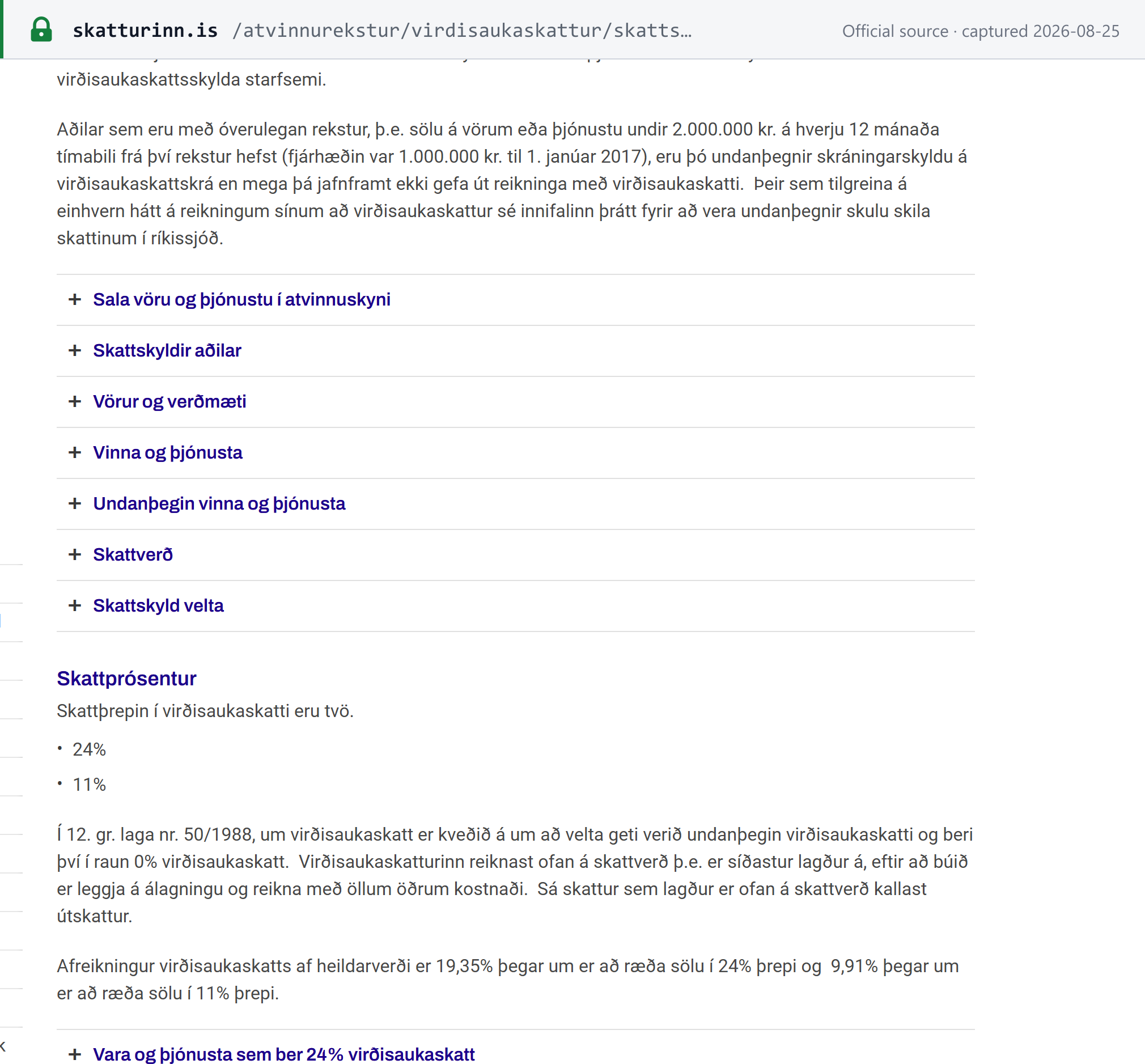
Skatturinn states the structure flatly: "Skattþrepin í virðisaukaskatti eru tvö. 24% [og] 11%." [2] The English site says the same: "Those who sell goods and services in Iceland must declare and pay VAT, 24% or 11%." [1]
 Source snapshot captured 2026-08-25 — original
VAT-inclusive fractions. Where a price includes VAT, the tax is 19.35% of the total at the 24% rate and 9.91% of the total at the 11% rate. Both figures are published on Skatturinn's key-rates page and on its rate guidance, and the 19.35% figure was substituted into the Act (in place of 20.32%) by the same 2014 law that cut the standard rate. [3] [2] [9]
What the 11% rate covers
Passenger transport that is not exempt public transport (including sightseeing, snowmobile, whale-watching, horse-riding and sea-angling trips, and the equipment the operator supplies for them); hotel and guest-room letting and other short-stay accommodation; campsites and pitches for caravans and mobile homes; travel agents', tour operators' and touring associations' intermediation of 11%-rated or exempt services; radio and television subscription charges; newspapers, magazines and district papers; books, including translations, sheet music, audio recordings of books read aloud, and electronic editions of such books; hot water, electricity and oil for heating buildings and pools; food and other goods for human consumption as defined in the Annex to the VAT Act, including alcohol; access to road structures such as tunnels; CDs, records and tapes carrying music without images, and electronic editions of music without images; condoms, reusable nappies and nappy liners; admission to bathhouses, bathing places, saunas and health spas not covered by the sports exemption; and tour-guiding. [2] [1]
Announced future rates
The temporary fuel rate has already reverted. The temporary 11% fuel rate ended 31 August 2026, and the 24% standard rate has applied to those supplies again from 1 September 2026. That was never a proposal or a pending bill: it was the expiry written into the temporary provision itself, so no further enactment was required for the rate to rise, and no extending or repealing law was published in Stjórnartíðindi A-deild before the expiry. See Recent changes. [8]
Two further changes are proposed, not enacted. Iceland's budget bill for 2027 (frumvarp til fjárlaga, presented to Althingi on 7 September 2026) proposes: (1) ending the reduced-rate treatment of steam baths and bathing lagoons (gufuböð og baðlón) — moving them from the 11% rate to the 24% standard rate, an estimated ISK 4 billion revenue gain; and (2) reducing the VAT refund on on-site labour for residential construction from 35% to 20%, an estimated ISK 3.6 billion revenue gain. The budget bill itself does not amend the VAT Act or set a commencement date — separate legislation would be required, and neither change is enacted or scheduled as at this update. [21]
No other rate change is enacted or scheduled.
Cross-border rules
Iceland is outside the EU VAT area
Take this first, because it governs everything below. Iceland is an EEA state, not an EU Member State. EU legal acts apply in Iceland only where they have been incorporated into the EEA Agreement by decision of the EEA Joint Committee — Reglugerð nr. 44/2019 recites exactly that route for the e-invoicing directive and for Regulation (EU) 1025/2012. Practically: [10]
- the EU VAT Directive does not govern Icelandic VAT — Lög nr. 50/1988 does;
- OSS and IOSS do not cover supplies to Iceland. Skatturinn's own simplified scheme for foreign B2C suppliers of electronic services is VOES, a purely national registration with its own threshold, its own two-month periods and its own portal; [1]
- there is no intra-Community acquisition, no EC Sales List and no Intrastat for Iceland. Movements of goods are ordinary exports and imports, cleared through customs;
- and there is no low-value import simplification. Skatturinn's customs guidance is explicit that every good brought into the country is subject to import charges regardless of value — "hvort sem verðmæti þeirra er $1 eða $1.000". [18]
Imports and exports
- Imports of goods — VAT is charged at importation, collected with the other import charges (aðflutningsgjöld: customs duty, excise, VAT, recycling fees) on the CIF customs value, being the price of the goods plus transport, insurance and all other costs incurred abroad and on the way to Iceland. The rate is 24% except for goods that carry 11% in their own right — books, papers, magazines and foodstuffs other than confectionery and beverages. VAT is payable by the owner of the goods at the time of importation, irrespective of whether that person is VAT-registered. [19] [18] [1]
- De minimis — no commercial low-value simplification. There is no IOSS-style relief for ordinary commercial consignments, so import charges apply regardless of value. Iceland does operate narrow value-based exemptions outside that: gifts up to ISK 13,500 and trade samples up to ISK 5,000. Iceland does not exempt low-value consignments from import charges.
- Exports of goods and services are zero-rated (12. gr.), as are international carriage of goods and passengers, domestic carriage forming part of an international carriage contract, work on goods at a foreign party's expense where the goods are exported on completion, design and planning work for property abroad, stores and fuel delivered for use aboard vessels and aircraft in genuine international transport, the sale and leasing of ships and aircraft (not boats under six metres, pleasure craft or private aircraft), shipbuilding and repair work, and services to foreign fishing vessels for landing or selling catch in Iceland. [2] [1]
- Services sold to parties with neither residence nor a place of operations in Iceland are outside taxable turnover where the service is wholly used abroad — and, for a listed set of services, even where it is not wholly used abroad, provided the buyer could have counted the VAT as input tax had its activity been registrable in Iceland. The listed set: transfer of copyright, patents, trade marks and designs and comparable rights; advertising; consultancy, engineering, legal, accountancy and other comparable specialist services (but not work on movable or immovable property in Iceland); data processing and supply of information; electronically supplied services; obligations and duties relating to business activity or the exploitation of those rights; employment-agency services; hire of movable property other than means of transport; telecommunications; and the services of agents acting in another's name and for another's account in relation to any of the above. A taxable service connected with cultural, artistic, sporting or educational activity taking place in Iceland is always deemed used in Iceland. [2] [1]
Reverse charge on services bought from abroad
Anyone who buys certain services from abroad for use wholly or partly in Iceland pays the VAT themselves. Ísland.is states the rule directly: the payment duty covers, among others, consultancy, engineering, legal and accountancy services and other comparable services, and it applies equally to services bought from a foreign party even where performed in Iceland, if that foreign party is not on the VAT register because it has neither a fixed place of business nor a special agent in Iceland. [16]
Skatturinn's guide sets out who actually pays: [6]
- Businesses carrying on exempt activity that buy taxable services from abroad — electronically supplied services, telecoms, broadcasting, advertising, specialist services and the like — must pay the VAT, with no offsetting deduction.
- VAT-liable businesses must likewise pay VAT on such purchases to the extent they cannot count it as input tax — so a fully taxable buyer's charge and deduction cancel out, and a partly exempt buyer pays on the blocked proportion.
- Non-business persons (private individuals, non-trading associations, institutions) must pay VAT on services bought from abroad other than electronic, telecom and broadcasting services where the value reaches ISK 10,000 or more in any two-month period. The duty falls away if the foreign party, or an agent acting for it, is itself registered for VAT in Iceland.
- Services supplied from abroad are always deemed used where the buyer resides or has its place of business.
Digital, telecom and broadcasting services (VOES)
A foreign seller with neither a place of business nor an agent in Iceland that supplies electronically supplied services, telecommunications services, or radio and television services to non-business customers in Iceland — individuals, non-trading associations, institutions — is liable to Icelandic VAT and must notify its activity to Skatturinn unprompted, electronically, in the form Skatturinn prescribes. Sellers of ISK 2,000,000 or less of those services in any twelve-month period are outside the charge. Skatturinn's examples of electronically supplied services: downloads of software including smartphone apps, books, computer games, music and films. [6]
The compliance route is VOES (VAT on Electronic Services) — a simplified registration open to foreign companies selling electronically supplied services, telecommunications, paper and magazine subscriptions, television and radio broadcasting, and (VAT-taxable) tourist services to non-taxable persons in Iceland. Its mechanics differ from ordinary registration and are easy to get wrong: [1]
- not available where a permanent establishment in Iceland makes the sales;
- pay-only: a VOES registrant cannot deduct input tax on its VAT return, and may instead use the reimbursement route if it has Icelandic input VAT — Skatturinn's wording is permissive, not mandatory;
- the VOES declaration period is two months, commencing 1 January, 1 March, 1 May, 1 July, 1 September and 1 November, with declaration and payment due one month and five days after the end of the two-month period (next working day if that falls on a weekend or Icelandic holiday);
- declarations are submitted in ISK, using the VAT foreign-currency rate on the due date.
Foreign companies selling into Iceland — B2B and B2C
| What you sell | B2B (Icelandic customer is a business) | B2C (Icelandic customer is not) |
|---|---|---|
| Goods shipped from abroad | No Icelandic registration for the seller. Import VAT is charged at the border and payable by the owner of the goods; there is no de-minimis. [1] [18] | Same: no seller registration, import VAT on the owner at the border. Nothing resembling IOSS exists. |
| Ordinary services supplied from abroad | Reverse charge. The Icelandic buyer pays, and a fully taxable buyer deducts the same amount, so nothing to register. An exempt-activity buyer pays with no deduction. [6] [16] | The buyer self-accounts where the value reaches ISK 10,000 or more in a two-month period — the seller does not register. [6] |
| Electronic / telecom / broadcasting services from abroad | No Icelandic registration is required where the buyer is a business that can account for the VAT itself as input tax; the B2C charge is expressly framed as sales "til annarra en atvinnufyrirtækja". [6] | The seller registers and charges Icelandic VAT above ISK 2,000,000 in any 12 months, normally through VOES, and cannot deduct input tax on that return. [1] [6] |
| Taxable supplies made inside Iceland (goods located there, services performed there) | Register on the same rules as an Icelandic company above ISK 2,000,000 — and, with no permanent establishment, appoint an Iceland-domiciled agent as representative. [1] | Identical. The obligation follows the supply, not the customer. |
The agent requirement, precisely. Where a foreign company selling taxable services in Iceland has no permanent establishment there, it "must entrust an agent domiciled in Iceland to serve as its representative", including notifying Skatturinn of the activity, collecting the VAT and remitting it to the Treasury. The foreign company and its representative are both responsible for collection and payment. Payment from the Icelandic customer need not go through the representative — it may be made directly to the foreign business. The representative must keep complete Icelandic VAT accounts of the foreign company's purchases and sales, and must keep those accounts, sales documents and vouchers in Iceland for at least seven years after the end of the accounting year concerned. [1]
Marketplace and platform deemed-supplier liability
None found. Neither Skatturinn's published VAT guidance nor the VAT-rate, registration, cross-border and invoicing pages reviewed for this guide contain a deemed-supplier rule making an online marketplace liable for VAT on sales it merely facilitates, on the EU or UK model. A platform selling into Iceland is treated as a supplier of its own services on the ordinary rules above. (Checked against Skatturinn's VAT section and RSK 11.19, 2026-08-24.) If Skatturinn has published such a rule elsewhere, this guide did not find it — treat this as "not located", not as a guarantee.
Place of supply
Lög nr. 50/1988 does not carry an EU-style place-of-supply Part. The tests are distributed:
- Goods — VAT is charged on supplies made in Iceland, and separately on importation into Iceland. Real property is not "goods" for the Act's purposes, so its sale bears no VAT; services connected with property, such as estate agency and construction, are taxable. [2]
- Services supplied from abroad — "Þjónusta sem veitt er erlendis frá telst ávallt nýtt þar sem kaupandi þjónustunnar hefur búsetu eða starfsstöð": always deemed used where the buyer resides or has its place of business. [6]
- Services sold to foreign parties — outside taxable turnover where wholly used abroad, and, for the listed categories above, even where not wholly used abroad if the buyer would have had a deduction. Services connected with cultural, artistic, sporting or educational activity taking place in Iceland are always deemed used in Iceland. [2]
Invoice requirements
Mandatory content
An invoice (sölureikningur) must be issued on every delivery of taxable goods or services. Reglugerð nr. 50/1993, 4. gr. sets the particulars, and 20. gr. laga nr. 50/1988 the formal conditions; Skatturinn's English page restates them for foreign readers. [7] [15] [1]
| Required field | Source | Notes |
|---|---|---|
| Seller's name, kennitala and VAT registration number | 4. gr. 1. mgr. reg. 50/1993 | Must be pre-printed on the whole stock of invoice forms before use |
| Invoice number, pre-numbered in a continuous sequence | 4. gr. 1. mgr. reg. 50/1993 | See Numbering |
| Date of issue | 4. gr. 2. mgr. 1. tölul. | — |
| Buyer's name and kennitala | 4. gr. 2. mgr. 2. tölul. | May be omitted by retail shops and service sellers under 8. gr. on cash sales to a final consumer |
| Type of sale — a description of what was sold | 4. gr. 2. mgr. 3. tölul. | On sales to a taxable person the description must be clear enough to show whether the transaction concerns that person's taxable activity |
| Quantity, unit price and total price, so far as applicable | 4. gr. 2. mgr. 4. tölul. | — |
| Whether VAT is included in the total, and the VAT amount stated separately | 4. gr. 2. mgr. 5. tölul.; 20. gr. VSKL | On sales to a final consumer it is enough to state that VAT is a percentage of the total price |
| Taxable and exempt items kept clearly apart, and taxable sales split by rate | 5. gr. reg. 50/1993 | The total price including VAT must be shown separately for each rate |
Two cautions. First, the text of Reglugerð nr. 50/1993 as published still carries the pre-2015 VAT-inclusive fractions ("19,68%" and "12,28%") in 4. gr. 2. mgr. 5. tölul.; the operative figures are the ones in the Act and on Skatturinn's rate page, 19.35% and 9.91%. [7] [2] Second, a person exempt from VAT may neither specify VAT on an invoice nor indicate in any other way that VAT is included — and anyone who does must pay that amount to the Treasury regardless. [1] [2]
Issuance deadline
There is no day-count grace period. The invoice must be issued at the same time as delivery takes place ("samtímis og afhending á sér stað"), whether the sale is for cash or on credit, and including deliveries to employees. Where delivery is split, an invoice is issued for each separate delivery if the parts have independent utility or a payment on account has been made. Two carve-outs: sellers of services (other than those under 8. gr.) may issue a single invoice at the end of each month for services performed during that month, and the same applies, following trade custom, to goods sold to buyers using them in their own business provided the buyer receives a delivery note (afgreiðsluseðill) showing type and quantity — such a note may not state VAT. Where payment is received in whole or part before delivery, the recipient must issue a receipt (kvittun), or may issue an invoice. [7] [6]
Numbering and sequencing
Invoice forms must be numbered in advance in a continuous numerical sequence and carry the seller's name, kennitala and registration number pre-printed on the entire stock before use. Receipts for payments on account are numbered in a sequence separate from that of sales invoices. Paper invoices are issued in at least three copies: the original always goes to the customer, one copy is kept in correct number order, and the third supports the sales entry in the books (replaceable by a sales-settlement sheet listing each invoice's number, date and amount). Where invoices are issued electronically, each issuing system must maintain its own organised number sequence, and where the issuer keeps books that number must always appear on the accounting voucher. [7] [11]
Credit and debit notes
Where goods are returned to the seller, a kreditreikningur (credit invoice) must be issued for the values received, referring back to the earlier invoice. The same applies to a discount granted after the invoice was issued, and to corrections of earlier invoices. A credit note is a distinct document class, and a business that records income by giro slip must hold separate credit-note forms. For electronic invoices the rule is stricter still: once issued, an electronic invoice may not be altered or deleted — any change or correction must be made by a new invoice and/or a credit invoice. [7] [6] [11]
Currency and language
The VAT return and payment are made in ISK, and VOES registrants likewise declare in ISK using the VAT foreign-currency rate on the due date, published by the Central Bank of Iceland. Skatturinn does not publish a general prohibition on issuing a foreign-currency invoice, but it publishes no FX-conversion rule for invoices either beyond the VOES rule just given — this guide could not source one and does not invent it. Language: Skatturinn's guidance and forms are in Icelandic, with an English section for foreign taxpayers; this guide found no published rule restricting the language of a VAT invoice, and records it as unconfirmed rather than asserting a permission or a prohibition. [1]
Document types
Iceland recognises several income-recording documents, and which one you may use is fixed by what you sell and to whom: [6] [7]
- Sölureikningur — the ordinary invoice. The default, required on every delivery.
- Sjóðvél (cash register) — retail shops and service sellers selling almost exclusively to final consumers may record each delivery in a cash register instead of issuing an invoice, splitting taxable sales by rate. They must still issue an invoice for sales to another taxable person. The activities that qualify are listed in an annex to Reglugerð nr. 50/1993.
- Gíróseðill (giro slip) — available to those permitted to invoice on the last day of the month for that month's account trading.
- Afreikningur (settlement note / innleggsnóta) — issued by the buyer (a processing or resale undertaking) for produce taken in from farmers, fishing operators and industrial producers. It replaces the seller's invoice, and must carry both the buyer's (issuer's) and the seller's registration numbers. This is Iceland's form of self-billing — see below.
- Kvittun — receipt for a payment on account before delivery.
- Afgreiðsluseðill (delivery note) — permitted in place of an invoice in the monthly-invoicing case; VAT may not be stated on it, and the seller must keep a copy with the related invoice.
- Annars konar tekjuskráning — in special circumstances Skatturinn may authorise another income-recording system.
This guide found no value-based "simplified invoice" threshold in Icelandic law. The simplification that exists is by counterparty, not by amount: on cash sales to a final consumer, retail shops and service sellers under 8. gr. may omit the buyer's name and kennitala, and it is enough to state that VAT is 19.35% (or 9.91%) of the total price rather than showing the tax as a separate line. [7]
Self-billing
Permitted, in a specific form. The afreikningur (innleggsnóta) is a buyer-issued document that stands in place of the seller's invoice where a co-operative, processing plant or industrial undertaking takes in the produce of farmers, fishing operators or manufacturers for processing or resale. The invoice-content and rate-separation rules (4. and 5. gr.) apply to it as far as applicable, and both the issuing buyer's registration number and the seller's registration number must appear on it at issue. There is no general open self-billing regime beyond this. (3. mgr. 21. gr. og 22. gr. laga nr. 50/1988; 6. gr. reglugerðar nr. 50/1993.) [7] [15]
Retention and audit trail
Seven years. Electronic accounts and their electronic vouchers must be kept on a data medium for seven years from the end of the financial year concerned, and the same applies to the database systems holding them; the medium must be stored securely so that it stays legible to the end of the retention period and entries can be found quickly. A foreign company's Icelandic representative must likewise keep the accounts, sales documents and vouchers in Iceland for at least seven years after the end of the accounting year. [11] [1]
Audit trail is a separate obligation and Iceland states it explicitly. Under Reglugerð nr. 505/2013, 8. gr., an electronic accounting system must ensure that the data trail through the system can be followed and that entries and electronic documents can be neither altered nor deleted; each individual entry must show who recorded it, the date and time of recording, and its voucher number; the system's own parameters — including those driving automatic calculations and splits between accounts — must be inspectable; and query tools must be able to retrieve data to answer the questions of users of the accounts. Article 16 adds that issued electronic invoices must be archived and viewable, and that each issuing system runs its own organised number series. Vendors of accounting and e-invoicing systems must supply detailed documentation of how the software works and what control features it offers. [11]
A specimen of a compliant invoice
Skatturinn publishes its own annotated specimen invoices in Leiðbeiningar um virðisaukaskatt (RSK 11.19, 19th edition, March 2022) — Dæmi 6 on page 12 labels each mandatory element on a worked invoice (pre-numbered invoice number, seller's name/kennitala/VSK number, date of issue, buyer's name and kennitala, type of sale, quantity and unit price, VAT rate, total excluding VAT, VAT amount, total including VAT), with Dæmi 7 showing the final-consumer variant that states VAT as 19.35% of the total, Dæmi 8 an 11%-rated hotel invoice, and Dæmi 9 taxable and exempt items split on one invoice. Where you can read Icelandic, go to that PDF — it is both specimen and proof. [6]
The sheet below follows that official layout for English-language readers, with the governing clause printed next to each field. Every name, kennitala, number and amount in it is fictional.
Sölureikningur — VAT invoice
| Tegund sölu / Description4. gr. 2. mgr. 3. tölul. | Magn / Qty4. gr. 2. mgr. 4. tölul. | Einingarverð / Unit price4. gr. 2. mgr. 4. tölul. | Fjárhæð / Amount |
|---|---|---|---|
| Uppsetning á tölvubúnaði — installation of computer equipment | 12 klst. | ISK 2.500 | ISK 30.000 |
- Samtals án VSK / Total excluding VAT4. gr. 2. mgr. 5. tölul.
- ISK 30.000
- Virðisaukaskattur 24% / VAT at 24%1. mgr. 14. gr. VSKL; amount shown separately, 20. gr. VSKL
- ISK 7.200
- Samtals með VSK / Total payable
- ISK 37.200
- The buyer block changes with who is buying: a business buyer gets name and kennitala as shown, while a retail shop or service seller under 8. gr. reglugerðar nr. 50/1993 may omit both on a cash sale to a final consumer.
- To a final consumer it is enough to state that VAT is 19.35% of the total price (9.91% at the 11% rate) instead of showing the tax as a separate line — see Skatturinn's Dæmi 7.
- Where one invoice carries both rates, or taxable and exempt items together, 5. gr. reglugerðar nr. 50/1993 requires them to be kept clearly apart, with the total including VAT shown separately for each rate.
- A person exempt from VAT may neither state VAT on the invoice nor indicate in any other way that VAT is included — and must pay it over to the Treasury if they do.
- Paper invoices are issued in at least three copies; the original always goes to the customer.
E-invoicing status
Status: mandatory for B2G only; no B2B or B2C mandate, and no clearance or CTC platform, as at 24 August 2026.
-
System and network — there is no central government invoicing platform of the Fatoora/SDI/MyInvois kind. The mandate is a format and receipt obligation on public buyers, with Fjársýsla ríkisins (the Financial Management Authority) receiving electronic invoices on behalf of most state institutions and message-service providers (skeytamiðlarar) carrying the documents. [17]
-
Legal basis — Reglugerð nr. 44/2019, um rafræna reikninga vegna opinberra samninga, made under 122. gr. laga nr. 120/2016 um opinber innkaup, which implements EU Directive 2014/55/EU as incorporated into the EEA Agreement by EEA Joint Committee decision no. 166/2015. Everything else about issuing, receiving and storing electronic invoices follows Reglugerð nr. 505/2013, in force since 1 June 2013. [10] [11]
-
Format and standard — the European standard EN 16931, as implemented for Icelandic law and business practice by the technical specification TS 236:2017 from Staðlaráð Íslands (the Icelandic Standards Council). An electronic invoice is defined as one issued, sent and received in a structured electronic format allowing automatic and electronic processing — and the Ministry's own announcement is explicit that a PDF is not an electronic invoice and will not be accepted. [10] [17]
-
Timeline — this mandate is already fully phased in:
Date Obligation 18 April 2019 State institutions must be able to receive and process EN 16931 / TS 236:2017 electronic invoices (8. gr. 2. mgr. reg. 44/2019) 18 April 2020 Municipalities, their institutions, public undertakings and other bodies operating under special or exclusive rights within the regulation's scope must do the same (8. gr. 3. mgr.) 1 January 2020 Ministry of Finance and Economic Affairs decision: all invoices for State purchases of goods and services must be electronic — PDFs refused -
Scope — B2G only. The regulation applies to invoices issued under public contracts falling within the public procurement act, the utilities procurement regulation, the concessions regulation and the defence and security procurement regulation, and it excludes contracts declared secret or requiring special security measures. There is no B2B or B2C e-invoicing mandate in Iceland — ordinary invoices may still be paper or electronic — and this guide found no announced plan for one (checked 2026-08-24). [10]
-
What applies when you do invoice electronically — Reglugerð nr. 505/2013: no alteration or deletion after issue, corrections by new invoice or credit note, electronic archive with the invoices viewable, organised number series per issuing system, seven-year retention, and the traceability and immutability requirements set out under Retention and audit trail. [11]
Filing and payment
Filing frequency
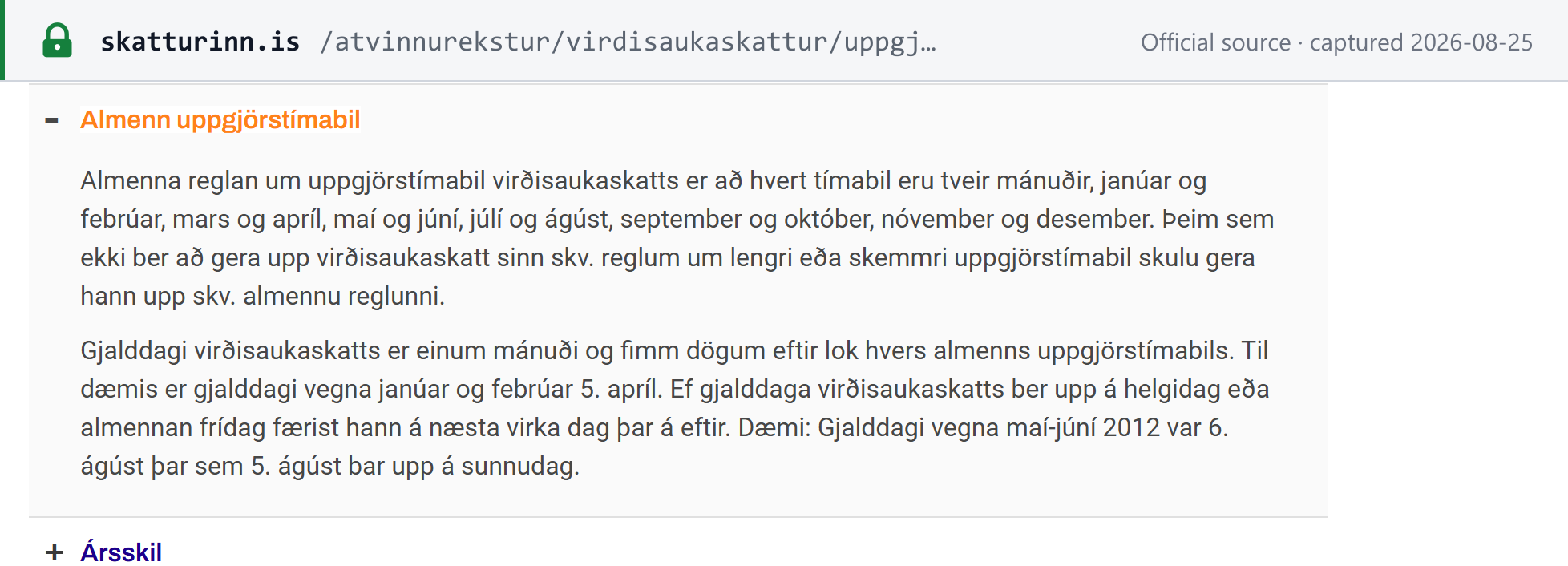
The default is two calendar months, and the alternatives are granted on application against defined turnover or activity tests — this is the first thing to configure and it is not one-size-fits-all: [5] [1]
| Period | Who | Due date |
|---|---|---|
| Two months (default) — Jan–Feb, Mar–Apr, May–Jun, Jul–Aug, Sep–Oct, Nov–Dec | Everyone not on another basis (24. gr. VSKL; 8. gr. reg. 667/1995) | One month and five days after the period ends (e.g. Jan–Feb falls due 5 April) |
| Calendar year (ársskil) | On application, where taxable sales were under ISK 4,000,000 in the whole preceding calendar year and the person was registered for that year. Not open to those on the agricultural register, agents of foreign parties, or holders of a frjáls/sérstök registration. Apply before 15 February of the year concerned | 5 February of the following year |
| One calendar month (shorter period) | On application, where output tax is habitually lower than input tax because a substantial part of sales is outside taxable turnover (typical for exporters), or where the business sells at 11% while the majority of its inputs bear 24%. Apply at least one month before the change takes effect; once granted the change binds for at least two years | One month and five days after the month ends (January falls due 5 March) |
| Special monthly settlement (sérstök mánaðarskil) | Imposed, not chosen: taxpayers struck off the register for repeated estimates, arrears, or failure to produce records, on re-registration — for at least two years (27. gr. A VSKL) | 15 days after the month ends (January falls due 15 February) |
| Six months — Jan–Jun and Jul–Dec | Agriculture only, including commercial forestry | 1 September and 1 March |
| Temporary period | Persons carrying on taxable activity only temporarily — political associations, sports clubs with one-off fundraising sales. Minimum one calendar month, maximum two | Set with the authorisation |
| Weekly interim return | Fish-processing undertakings, for input tax on raw material (Monday to Sunday); slaughterhouse licence holders may also file interim returns | Per the authorisation |
 Source snapshot captured 2026-08-25 — original
If the due date falls on a holiday or public non-working day, it moves to the next working day. There is no separate final-payment date: "gjalddagi og eindagi er einn og sami dagurinn" — the due date and the last day to pay are the same day. [5]
Filing and payment mechanics
- Electronic filing is mandatory, including nil returns for periods with no activity or no taxable turnover; otherwise Skatturinn will estimate the turnover and assess accordingly. Skatturinn may grant permission, one year at a time and for valid reasons, to file on paper.
- Returns go through the þjónustuvefur at
skattur.is, logging in with the VAT registration number and a password issued by Skatturinn, or with electronic ID. - What the return asks for: total value of goods and services sold excluding VAT at each rate, sales at the zero rate, and total output and input tax.
- Payment is made once the return is filed, through online banking. A person without Icelandic online banking may pay from a foreign bank account to the Financial Management Authority at the Central Bank of Iceland — IBAN IS48 0001 2602 5203 5402 6964 59, SWIFT SISLISRE — stating the VAT registration number, year and period in the reference field.
- Adequate compliance means the return reaches Skatturinn and payment reaches the collector of the Treasury by the due date. Posting a payment on the due date is not enough — it must have arrived. [1] [5]
Additional listings
Iceland has no EC Sales List and no Intrastat — it is outside the EU VAT area. What it does require is an annual reconciliation: everyone carrying on VAT-liable activity during the year files a comparison statement (samanburðarskýrsla, RSK 10.25) with that year's income-tax return, unless the operator's tax return RSK 1.04 is used for the income-tax settlement and the operator has only one VAT number. Where the comparison shows a difference between the VAT returns filed and the books and annual accounts, a correction statement (RSK 10.26) must be filed and any unpaid tax paid. Businesses with mixed activity apportioning input tax by turnover file a separate reconciliation sheet, RSK 10.27, with the year's tax return. [5]
Input-tax recovery and blocked items
General rules apply to input-tax deduction regardless of whether the parties are domestic or foreign. Input tax may be deducted on goods (both goods for supply and business assets) and services purchased for use in VAT-liable business activity. Two preconditions bite hard: VAT that cannot be evidenced by a sales invoice is not deductible, and the seller must have charged VAT and been registered for VAT on the date of the transaction. [1] [14]
VAT on the following may not be counted as input tax: [1]
- the canteen or dining room of the taxable person, and all food purchases except for resale;
- acquisition or operation of living quarters for the owner or staff;
- perquisites for the owner and staff;
- acquisition and operation of holiday homes, summer cottages, nurseries and similar for the owner and staff;
- entertainment costs and gifts; and
- acquisition, operation and rental of passenger cars — extending to estate cars, jeeps and delivery/goods vehicles with a permitted gross weight of 5,000 kg or less that do not meet the Minister's requirements in the input-tax regulation.
Refunds
-
Excess input tax. Where input tax exceeds output tax in a settlement period, the Treasury repays the difference — subject to the returns for earlier periods having reached Skatturinn. Unpaid VAT from earlier periods and other unpaid public charges are set off against the repayment. [13]
-
Foreign businesses (Iceland's equivalent of a 13th-Directive claim). A foreign undertaking — one carrying on business with neither residence, domicile nor a place of business in Iceland, and in some cases one with an Icelandic place of business whose activity does not itself trigger registration — may reclaim VAT paid in Iceland on purchases for its business or on imports. VOES registrants are expressly eligible. VAT on goods and services intended for resale or final consumption in Iceland is not refunded, nor is VAT on food, perquisites, entertainment and gifts, or passenger-car acquisition, hire and running. Conditions include that the foreign undertaking had no registered or registrable activity in Iceland during the period, that its activity would be registrable if carried on in Iceland, that the VAT is of a kind a registered Icelandic person could have counted as input tax, and that the seller was on the VAT register at the time of the transaction. [12]
Item Rule Application form RSK 10.29, emailed to [email protected]Minimum claim ISK 75,000 per two-month period; ISK 15,000 where the claim covers a whole calendar year or the remainder of one (figures indexed to the 2019 CPI of 473.3 points) Claim periods Two months — Jan–Feb, Mar–Apr, May–Jun, Jul–Aug, Sep–Oct, Nov–Dec; or a whole calendar year / the remainder of one Filing deadline 15th of the month following the end of the claim period (15 March, 15 May, 15 July, 15 September, 15 November, 15 January) Processing deadline 31 May, 31 July, 30 September, 30 November, 31 January and 31 March respectively Late applications Rolled into the next claim period's batch Long-stop The right to a refund lapses six years after it arose Documents Copies of sales invoices, other income-recording documents or customs payment documents showing the VAT paid, all meeting the form and content requirements of the bookkeeping regulation; plus a certificate from the competent authority in the applicant's home country describing the business carried on, valid one year from issue -
Bad-debt relief. This guide found no published bad-debt relief mechanism for Icelandic VAT in Skatturinn's guidance or in the regulations reviewed. It is recorded as unconfirmed, not as absent. (Checked 2026-08-24.)
Corrections and appeals
Differences between the books and returns already filed are corrected by filing a new, corrected return electronically, period by period. Once the income-tax return for the year concerned has been filed, corrections must go on paper: RSK 10.03 for a single period, RSK 10.26 for several at once — and taxpayers using the calendar month as their settlement period must always use RSK 10.03. Appeals run: to Skatturinn within 30 days of the assessment (a fresh return filed within the appeal window counts as an appeal); then to yfirskattanefnd (the Internal Revenue Board, Borgartún 21, 105 Reykjavík) within three months of the ruling, whose decision is final at administrative level on the amount; decisions on matters other than taxes, registration and refunds — exemption requests, for instance — go to the Ministry of Finance within three months; and disputes about liability and tax base may also be taken to the ordinary courts, within six months. [13] [1]
Exemptions
Exempt supplies
The following services are exempt from VAT — the supplier charges no VAT and gets no credit for input VAT on purchases for the exempt part of the business: [1] [2]
- Healthcare — hospitals, birth clinics, sanatoriums and comparable institutions, medical and dental services and other actual health services;
- Social services — day-care centres, nurseries, after-school care, juvenile facilities and similar;
- Schools and educational institutions, including driving, flying and dance instruction;
- Cultural activity — libraries, museums and similar, and admission to concerts, ballet, stage performances and theatres, provided the gathering is not associated with other gatherings or restaurant operations;
- Sport — sports activity, hire of sports facilities, admission to swimming pools, ski lifts, sporting events and exhibitions and health facilities, including admission to bathing facilities within sports structures;
- Public transport — scheduled services on a fixed domestic route by land, air or sea, plus taxis, medical transport and organised transport for disabled people, schoolchildren and the elderly, extending to passengers' luggage and directly related vehicles;
- Postal services;
- Letting of real property where let for more than one month on the general conditions of property rental, and the sale of real property. Letting of restaurant and function facilities is standard-rated. Sale of fishing permits — in rivers and lakes, for example — is exempt;
- Letting of parking spaces;
- Insurance; banking and financial services; lotteries and betting pools;
- Artists — sale of art under customs codes 9701.1000–9703.000 sold directly by the artist, and the activities of authors, composers and comparable artistic activity;
- Funeral services (and, per Skatturinn's Icelandic list, clerical services); and
- Persons with insubstantial turnover — sales of taxable goods and services of ISK 2,000,000 or less in each twelve-month period from the start of business.
Exempt is not zero-rated
This is the distinction that costs Icelandic businesses the most money, and the Act keeps the two in separate provisions.
- A zero-rated supply (undanþegin velta, 12. gr.) is inside the scope of the VAT Act. No output VAT is charged because the rate is zero, but the Act applies in full, including the input-tax deduction rules — Skatturinn's own wording: "A zero-rated supply falls within the scope of the VAT Act… The provisions of the VAT Act apply in full for such supplies, including the regulations relating to deductions for input VAT." An exporter therefore charges nothing and still recovers everything.
- An exempt supply (undanþegin þjónusta, 3. mgr. 2. gr.) is outside the charge. No VAT is charged, and input VAT on purchases for that part of the business is not recoverable — it becomes a cost. A business doing both must split its input tax; Skatturinn provides RSK 10.27 for the annual reconciliation of that apportionment. [1] [2] [5]
There is a further trap for exempt bodies: an entity carrying on exempt activity that buys taxable services from abroad must pay the VAT itself with no deduction, and entities providing exempt services must also account for VAT on certain own-account activities — in-house manufacture, maintenance and repair of machinery and equipment, running a laundry, print shop or canteen, cleaning above a stated annual cost, work requiring trade qualifications, and the services of engineers, architects, lawyers, certified auditors, computer scientists and other specialists generally serving business — to the extent they compete with commercial undertakings. [6]
Special regimes
Iceland has no free-zone VAT regime, no margin scheme and no cash-accounting scheme that this guide could source. What it does have: [4] [5]
- Frjáls skráning — voluntary registration bringing otherwise-exempt commercial letting into charge so that input tax on the property is recoverable; minimum two years, tenant's registered consent required, residential premises excluded.
- Sérstök skráning — special registration for the construction of commercial premises for sale or letting to a registered party.
- Ársskil — the small-business annual settlement regime (turnover under ISK 4,000,000).
- Agriculture — a statutory six-month settlement period, with an extra settlement available where a substantial refund arises on investment and operating purchases.
- Fish processing and slaughterhouses — weekly and other interim returns for input tax on raw material.
- Leiðréttingarkvöð — a running input-tax adjustment obligation on immovable property and capital assets that must be quantified and can be transferred, with registered consent, when the asset or business is sold.
- Other refund schemes exist alongside the VAT return — for international organisations and foreign forces (reg. 925/2017), for foreign diplomats and persons resident abroad, and, on Skatturinn's guidance, for the import and first sale of electric- or hydrogen-powered aircraft, engines and propellers from 1 January 2022 to 31 December 2027. [6]
Offences and penalties
Iceland keeps criminal offences and civil surcharges and interest in separate provisions, and both carry real figures.
Offences
| Exposure | Rule |
|---|---|
| Breaches of the VAT Act and its regulations | Punishable by fines or imprisonment of up to six years — "Brot gegn virðisaukaskattslögum og reglugerðum sem settar eru samkvæmt þeim varða sektum eða fangelsi allt að sex árum" (40. gr. laga nr. 50/1988) [6] |
| Failure to keep required books, or to use the required sales-recording system, or a seriously deficient one | Skatturinn or the Director of Tax Investigations issues an order to remedy. If it is not complied with within 15 days, the police can stop the business until adequate remedies are made. The same applies where the taxpayer has failed to notify its activity or filing duty, or has been assessed by estimate for two or more settlement periods in the preceding two years [6] |
| Being struck off the register (vánúmer) | Skatturinn may rule a taxpayer off the VAT register for repeated failure to produce records, assessment by estimate for two or more periods, or arrears — and may refuse re-registration unless an unconditional bank guarantee is lodged. A re-registered taxpayer goes onto special monthly settlement for at least two years. Downstream, the taxpayer's customers lose the input-tax deduction on any invoice issued after the number was struck off (5. og 24. gr. laga nr. 50/1988) [14] |
| Showing VAT when not entitled to | A person exempt from VAT who indicates in any way on an invoice that VAT is included must pay that tax to the Treasury [2] |
| Not passing the temporary fuel VAT cut through to the pump (1 May – 31 August 2026 only) | Samkeppniseftirlitið (the Competition Authority) supervises, and may impose administrative fines under 37. gr. samkeppnislaga nr. 44/2005 on undertakings that fail to ensure the reduction is fully reflected in the final retail price. The Minister may also, on the Authority's opinion, set a regulation imposing maximum prices or maximum mark-ups — measures that may not run beyond 31 August 2026 [8] |
Penalties, surcharge and interest
| Default | Charge |
|---|---|
| VAT not paid by the due date | Álag of 1% of the unpaid amount for each commenced day after the due date, capped at 10% (27. gr. laga nr. 50/1988). The same surcharge runs where no return was filed, or the return was deficient and the VAT was therefore estimated, and on any repayment that was too high [5] [1] |
| VAT still unpaid one month after the due date | Dráttarvextir — penalty interest as determined by the Central Bank of Iceland — on the amount fallen due, on top of the surcharge (28. gr. laga nr. 50/1988). The same applies to an over-refunded credit [5] [1] |
| Return filed only after an estimated assessment has been made | A special charge of ISK 5,000 for each VAT return not filed on time (27. gr. B laga nr. 50/1988) [5] |
Remission. The 1%/10% surcharge may be cancelled where the taxpayer presents valid reasons, which the tax authorities assess case by case — Skatturinn gives a bank-system failure or another external cause outside the taxpayer's sole responsibility as the paradigm. The ISK 5,000 late-filing charge may likewise be waived, but the request must reach Skatturinn within 90 days of the ruling that cancelled the estimate. [5] [1]
Frequently asked questions
Iceland's fuel VAT is 11% today — do I really have to switch it back to 24% on 1 September 2026?
Yes, unless Alþingi passes an extension first. The 11% rate on fuel is not a permanent entry in the rate article — it is a temporary provision (ákvæði til bráðabirgða XLIX) that Lög nr. 34/2026 added to the VAT Act nr. 50/1988, published in Stjórnartíðindi A-deild on 30 April 2026. Its own wording fixes both ends of the window: 11% VAT applies on the import and taxable sale of fuel falling under customs tariff numbers 2710.1221, 2710.1229, 2710.1930, 2710.2021, 2710.2029, 2710.2065 and 3826.0000 "á tímabilinu frá og með 1. maí 2026 til og með 31. ágúst 2026" — from 1 May 2026 to and including 31 August 2026. Nothing further has to be enacted for the rate to go back up: when 31 August 2026 passes, the temporary provision stops applying and the ordinary 24% standard rate in 1. mgr. 14. gr. governs again from 1 September 2026. Practically, that means repointing POS, tax-engine and ERP rate tables for exactly those tariff codes, and making sure the change lands on sales made on or after 1 September rather than on invoices merely issued then. Note also that the same law obliges fuel retailers to pass the full reduction through to the pump price while it lasts, and gives Samkeppniseftirlitið power to impose administrative fines on sellers that do not. [8] [2]
I am a foreign company selling into Iceland — do I have to register for VAT, and is the answer different for B2B and B2C?
Very different, and it turns on what you sell rather than on how big you are. Three tracks. First, if you make taxable supplies inside Iceland — selling goods located in Iceland, or performing services there — you are liable on the same rules as an Icelandic company and must register once you cross the ISK 2,000,000 twelve-month threshold; and if you have no permanent establishment in Iceland, Skatturinn requires you to entrust an agent domiciled in Iceland to act as your representative, with the foreign company and the representative both responsible for collecting and remitting the VAT. Second, if you supply ordinary services from abroad to an Icelandic business (B2B), you do not register at all — the Icelandic buyer self-accounts. Skatturinn's own guide puts the payment duty on the purchaser of taxable services bought from abroad, with a VAT-registered business paying only to the extent it could not have deducted the tax as input tax, so a fully taxable buyer nets to nil. Third, if you sell electronically supplied services, telecommunications, or radio and television services from abroad to non-business customers in Iceland (B2C) and have neither a place of business nor an agent there, you are taxable in Iceland and must notify Skatturinn yourself — but sellers of ISK 2,000,000 or less of those services in any twelve-month period are outside the charge. That B2C route runs through VOES, a simplified pay-only registration: you charge and remit, but you cannot deduct input tax, and you may apply for reimbursement through the foreign-business refund scheme instead — Skatturinn puts it permissively: "Sellers may apply for reimbursement of VAT." One more trap for goods: a foreign company that only ships goods from abroad to Icelandic recipients is not itself liable for Icelandic VAT — the import VAT falls on the owner of the goods at the border. [1] [6]
Iceland is in the EEA — can I just report Icelandic sales through my EU OSS or IOSS return?
No. This is the single most common wrong assumption about Iceland. Iceland is a party to the EEA Agreement but is not an EU Member State, and EU acts have effect in Iceland only where they are separately incorporated into the EEA Agreement by a decision of the EEA Joint Committee — Reglugerð nr. 44/2019 on e-invoicing is a worked example of that mechanism. Taxation is not part of what the EEA Agreement brings across: Iceland is outside the EU VAT area, so the EU VAT Directive does not govern Icelandic VAT, the One Stop Shop and Import One Stop Shop do not cover supplies to Iceland, there is no EU-style intra-Community acquisition, and there are no EC Sales Lists and no Intrastat declarations. Sales to Iceland are exports from the EU and imports into Iceland. Iceland's own equivalent of a simplified distance-selling registration is VOES, a purely national scheme run by Skatturinn on its own threshold, its own two-month periods and its own portal. Nor is there an IOSS-style low-value import simplification: Skatturinn's customs guidance states that all goods brought into the country are subject to import charges regardless of value — "hvort sem verðmæti þeirra er $1 eða $1.000". [10] [1] [18]
My Icelandic turnover is under ISK 2,000,000 — can I stay unregistered, and can I still put VAT on my invoices?
You can stay unregistered, and you must not put VAT on your invoices. Skatturinn's rule is that persons with insubstantial operations — sales of goods or services under ISK 2,000,000 in each twelve-month period from the time the business starts — are exempt from the duty to register on the VAT register. The figure was ISK 1,000,000 until 1 January 2017. But the same sentence carries the sting: those persons "mega þá jafnframt ekki gefa út reikninga með virðisaukaskatti" — they may not issue invoices showing VAT, and anyone who indicates in any way on an invoice that VAT is included, despite being exempt, must pay that tax over to the Treasury anyway. Two further points. The threshold is measured over any rolling twelve months from the start of business, not over a calendar year, so the duty bites the moment sales are likely to pass the line rather than at a year end. And the exemption is from the duty to register, not a bar on registering: you can register voluntarily, and a business still in an investment or development phase with substantial fixed-asset spending and no revenue yet can apply for advance registration (fyrirfram skráning), granted for twelve months at a time and extendable up to ten years. [2] [4]
Does Iceland have an e-invoicing mandate I need to build for?
Only for selling to the public sector, and it is a receipt-and-format mandate rather than a clearance system. Reglugerð nr. 44/2019, which implements EU Directive 2014/55/EU as incorporated into the EEA Agreement, requires public buyers to receive and process electronic invoices meeting the European standard EN 16931 as implemented by the Icelandic technical specification TS 236:2017 from Staðlaráð Íslands; state institutions had to be able to do so by 18 April 2019 and municipalities, their institutions and public undertakings by 18 April 2020. On top of that, the Ministry of Finance and Economic Affairs decided that from 1 January 2020 all invoices for State purchases of goods and services must be electronic, and its announcement is explicit that a PDF is not an electronic invoice — "reikningar á PDF formi flokkast því ekki sem rafrænir reikningar" — so PDFs are refused. There is no B2B or B2C e-invoicing mandate, no real-time clearance platform and no continuous transaction control system in Iceland as at 24 August 2026: ordinary invoices may be paper or electronic. Where you do invoice electronically, Reglugerð nr. 505/2013 governs: an issued electronic invoice may not be altered or deleted (corrections go through a new invoice or a credit note), issued invoices must be stored in an electronic archive, each issuing system must run its own organised number sequence, records must be kept seven years from the end of the financial year, and the accounting system must make the data trail traceable and prevent entries being changed or erased. [10] [11] [17]
Important websites
| Site | What it is for |
|---|---|
| Skatturinn service portal (þjónustuvefur) — skattur.is | Registering, filing the VAT return, and correcting earlier periods |
| VAT registration and change notification (RSK 5.02 route) | Notifying VAT-liable activity, changes and cessation (RSK 5.02 / RSK 5.04) |
| VOES portal — voes.rsk.is | Simplified registration and declarations for foreign B2C suppliers of electronic services |
| Fyrirtækjaskrá search — check whether a supplier is VAT-registered | Verifying a seller's VAT registration before claiming input tax |
| Skatturinn — VAT rates and liability (Skattskylda og skattprósentur) | Current 24% / 11% rate lists and the zero-rated categories |
| Skatturinn — Key rates and amounts 2026 | One-page confirmation of the rates and the VAT-inclusive fractions |
| Skatturinn — refunds to foreign businesses (RSK 10.29) | The foreign-business VAT refund claim, its minimums and deadlines |
| Central Bank of Iceland — official exchange rates | The FX rate used for VOES declarations on the due date |
| Reglugerðasafn — Icelandic regulations register | Authoritative text of Reglugerð nr. 44/2019, 505/2013 and the VAT regulations |
| Stjórnartíðindi — Icelandic official gazette | Enacted laws as published, including Lög nr. 34/2026 |
Also see Lookuptax's own Iceland VSK-nr validator.
Recent changes
- 2026-09-07 — Iceland's 2027 budget bill proposes moving steam baths and bathing lagoons from the 11% reduced rate to the 24% standard rate (est. ISK 4bn revenue gain), and cutting the VAT refund on residential-construction labour from 35% to 20% (est. ISK 3.6bn). Neither change amends the VAT Act yet or has a commencement date — separate legislation is required. (Fjármála- og efnahagsráðuneytið) — see events / residential refund and issue
- 2026-09-01 — The temporary 11% VAT rate on fuel expired, and the 24% standard rate applies again to the import and taxable sale of fuel under tariff numbers 2710.1221, 2710.1229, 2710.1930, 2710.2021, 2710.2029, 2710.2065 and 3826.0000. The reversion was written into the temporary provision itself (ákvæði til bráðabirgða XLIX, added by Lög nr. 34/2026), so no further enactment was needed; no extending or repealing law was published in Stjórnartíðindi A-deild before the expiry. POS, tax-engine and ERP rate tables needed repointing for those tariff codes. (Stjórnartíðindi A-deild, Lög nr. 34/2026) — see event record and issue
- 2026-05-01 — VAT on petrol and diesel cut from 24% to 11% for the period 1 May to 31 August 2026, by a temporary provision that Lög nr. 34/2026 ("um breytingu á lögum um virðisaukaskatt og samkeppnislögum (skatthlutfall eldsneytis)") added to Lög nr. 50/1988, published in Stjórnartíðindi A-deild on 30 April 2026. Fuel retailers are legally obliged to pass the reduction through in full to the final retail price, and the same law amends samkeppnislög nr. 44/2005 so that Samkeppniseftirlitið supervises and may impose administrative fines on sellers that do not. (Stjórnartíðindi A-deild, Lög nr. 34/2026) — see event record and issue
- 2020-01-01 — The Ministry of Finance and Economic Affairs required all invoices for State purchases of goods and services to be electronic; PDF invoices are expressly not accepted as electronic invoices. (Stjórnarráðið)
- 2019-04-18 / 2020-04-18 — Reglugerð nr. 44/2019 brought the EU e-invoicing directive into Icelandic law via the EEA Agreement: state institutions from 18 April 2019, and municipalities, their institutions and public undertakings from 18 April 2020, must receive and process EN 16931 / TS 236:2017 electronic invoices. (Reglugerðasafn)
- 2017-01-01 — The registration threshold rose from ISK 1,000,000 to ISK 2,000,000 of taxable sales in each twelve-month period. (Skatturinn)
- 2015-01-01 — The standard rate fell from 25.5% to 24% and the reduced rate rose from 7% to 11%, under Lög nr. 124/2014 (1. gr. i-liður, commencing under 11. gr. b-liður); the same provision reset the VAT-inclusive fraction from 20.32% to 19.35%. (Stjórnartíðindi A-deild, Lög nr. 124/2014)
- 2013-06-01 — Reglugerð nr. 505/2013 on electronic invoices, electronic accounting, message services, storage of electronic data and minimum requirements for electronic invoicing and accounting systems came into force, repealing Reglugerð nr. 598/1999. (Reglugerðasafn)
Reference links
- Skatturinn — Value Added Tax (VAT), English guidance for companies
- Skatturinn — Skattskylda og skattprósentur (liability and rates)
- Skatturinn — Key rates and amounts 2026
- Skatturinn — Skráning á virðisaukaskattsskrá (registration, group registration, deregistration)
- Skatturinn — Uppgjör og skil (settlement periods, due dates, surcharge and interest)
- Skatturinn — Leiðbeiningar um virðisaukaskatt, RSK 11.19 (19th ed., March 2022, PDF)
- Reglugerð nr. 50/1993, um bókhald og tekjuskráningu virðisaukaskattsskyldra aðila
- Stjórnartíðindi A-deild — Lög nr. 34/2026 um breytingu á lögum um virðisaukaskatt og samkeppnislögum (skatthlutfall eldsneytis), 30 April 2026 (PDF)
- Stjórnartíðindi A-deild — Lög nr. 124/2014 (kerfisbreyting á virðisaukaskatti), 22 December 2014 (PDF)
- Reglugerð nr. 44/2019, um rafræna reikninga vegna opinberra samninga
- Reglugerð nr. 505/2013, um rafræna reikninga, rafrænt bókhald, skeytamiðlun, skeytaþjónustu, geymslu rafrænna gagna og lágmarkskröfur til rafrænna reikninga- og bókhaldskerfa
- Skatturinn — Endurgreiðsla virðisaukaskatts til erlendra aðila (refunds to foreign businesses)
- Skatturinn — Leiðréttingar og kæruleiðir (corrections and appeals)
- Skatturinn — Vánúmer (numbers struck off the VAT register)
- Skatturinn — Skráning tekna (income recording and invoice form requirements)
- Ísland.is — Virðisaukaskattsskyld kaup þjónustu frá útlöndum (VAT on services bought from abroad)
- Stjórnarráðið — Nútímavætt viðskiptaumhverfi ríkisins með rafrænum reikningum (24 October 2019)
- Skatturinn — Almennt um sendingar (all imports dutiable regardless of value)
- Skatturinn — Gjöld við innflutning (import charges)
- Lookuptax — Iceland kennitala and VSK-nr guide
- Lookuptax — Official links to check VAT numbers worldwide
- Lookuptax — E-invoicing status and the networks worldwide
- Fjármála- og efnahagsráðuneytið — Frumvarp til fjárlaga fyrir árið 2027 (2027 budget bill)