Greece VAT guidelines
| FACTSHEET | |
|---|---|
| Country code | GR (VAT prefix EL) |
| Tax name | Value Added Tax — Φόρος Προστιθέμενης Αξίας (ΦΠΑ) |
| Tax Authority | Independent Authority for Public Revenue — Ανεξάρτητη Αρχή Δημοσίων Εσόδων (ΑΑΔΕ / AADE) |
Overview
Greece levies Value Added Tax — in Greek Φόρος Προστιθέμενης Αξίας (ΦΠΑ, transliterated FPA) — under the VAT Code (Κώδικας ΦΠΑ), Law 5144/2024 (ΦΕΚ Α΄ 162/11.10.2024), which recodified and replaced Law 2859/2000. AADE publishes a consolidated text of the Code current to 31 December 2024; it carries its own disclaimer that it has no legal force, and changes made since then — notably the island rates from 1 January 2026 — are covered below from the AADE circulars that implement them. [1] [3]
Authority. The tax is administered by the Independent Authority for Public Revenue (AADE) (Ανεξάρτητη Αρχή Δημοσίων Εσόδων), Piraeus 180, 17778 Tavros. Returns are filed with and tax paid to AADE (VAT Code arts. 41(3)(β) and 43); VAT on imports is declared to customs (art. 43(7)). Registration, interest, penalties and offences are governed by the Tax Procedure Code (Κώδικας Φορολογικής Διαδικασίας, KFD), Law 5104/2024 (ΦΕΚ Α΄ 58/19.04.2024), which replaced Law 4174/2013. Invoicing rules sit in a third statute, the Greek Accounting Standards law, Law 4308/2014. AADE's decisions and circulars are published, each with an ADA code, on the government transparency portal Diavgeia. [1] [2]
Currency and tax period. Amounts in this guide are in euros (EUR). The VAT tax period is a calendar month for businesses that keep double-entry books (and for the State), and a calendar quarter for businesses on single-entry books and persons not obliged to keep books (VAT Code art. 43(1)). [1]
Layering. VAT is a single national tax; the VAT Code provides no regional or municipal VAT layer. The only territorial variation is the 30% rate reduction on certain Aegean islands, described under Rates.
Registration
Who should register
Greece has no VAT registration threshold. Every person, natural or legal, that is about to carry on a business activity files a start-of-business declaration (δήλωση έναρξης) in the tax register before its first transaction; a legal person files it within 30 days of incorporation. The declaration states, among other things, the VAT regime the business falls under (KFD art. 11(1)–(3)). For each taxable person the VAT number is its unique tax registration number, the AFM (VAT Code art. 41(2)). [2] [1]
Small-business exemption — EUR 10,000
The EUR 10,000 figure is an optional exemption from filing and paying VAT, not a registration threshold. A business in the scheme still files a start declaration, registers, issues invoices and keeps books. The European Commission's Greece page, supplied by Greece: "The annual threshold in Greece is 10.000 Euro", and "Greece does not apply any transitional period in case the national annual threshold is exceeded during the current calendar year." [4]

The mechanics are in art. 44 of the VAT Code (as consolidated to 31 December 2024): [1]
- Threshold. Supplies of goods and services, excluding VAT, of up to EUR 10,000 in the previous tax year (the calendar year; annualised in the start-up year). Disposals of capital assets and exempt supplies without a right of deduction are not counted.
- Joining. A business opts in through a changes declaration filed within 30 days of the start of the year; the deadline is preclusive.
- Exceeding the threshold. The normal regime applies "αρχής γενομένης από την πράξη … με την οποία πραγματοποιείται η υπέρβαση του ορίου και για το σύνολο της αξίας της πράξης αυτής" — from the transaction that crosses the threshold, for its full value (art. 44(4)).
- Who is excluded. Taxable persons not established in Greece, farmers in the special farmers' scheme, and supplies of new means of transport (art. 44(2)).
- Invoices and deduction. Invoices carry the wording "χωρίς φόρο προστιθέμενης αξίας - απαλλαγή μικρών επιχειρήσεων" (without VAT – small-business exemption), and the business cannot deduct input VAT (art. 44(9)).
Greece also operates the EU cross-border SME scheme under arts. 44α–44γ of the Code, added after the consolidation date. For how the EU-wide scheme works, see the EU VAT SME scheme explainer.
Non-resident registration
A non-established business has a threshold of zero. Art. 44(2)(β) excludes taxable persons not established in Greece from the small-business exemption, so a foreign business that makes a supply taxable in Greece and is liable for the VAT must register from the first supply. [1]
An EU-established business that is liable for Greek VAT and does not use OSS or IOSS files a start declaration under art. 10 of Law 5104/2024 and Ministerial Decision POL.1113/2013. Where it does not appoint a tax representative, its VAT number is granted on the declaration in Annex I of POL.1113/2013, submitted through AADE's e-ticket application. The Union OSS requires no tax representative. [5]

Fiscal representative
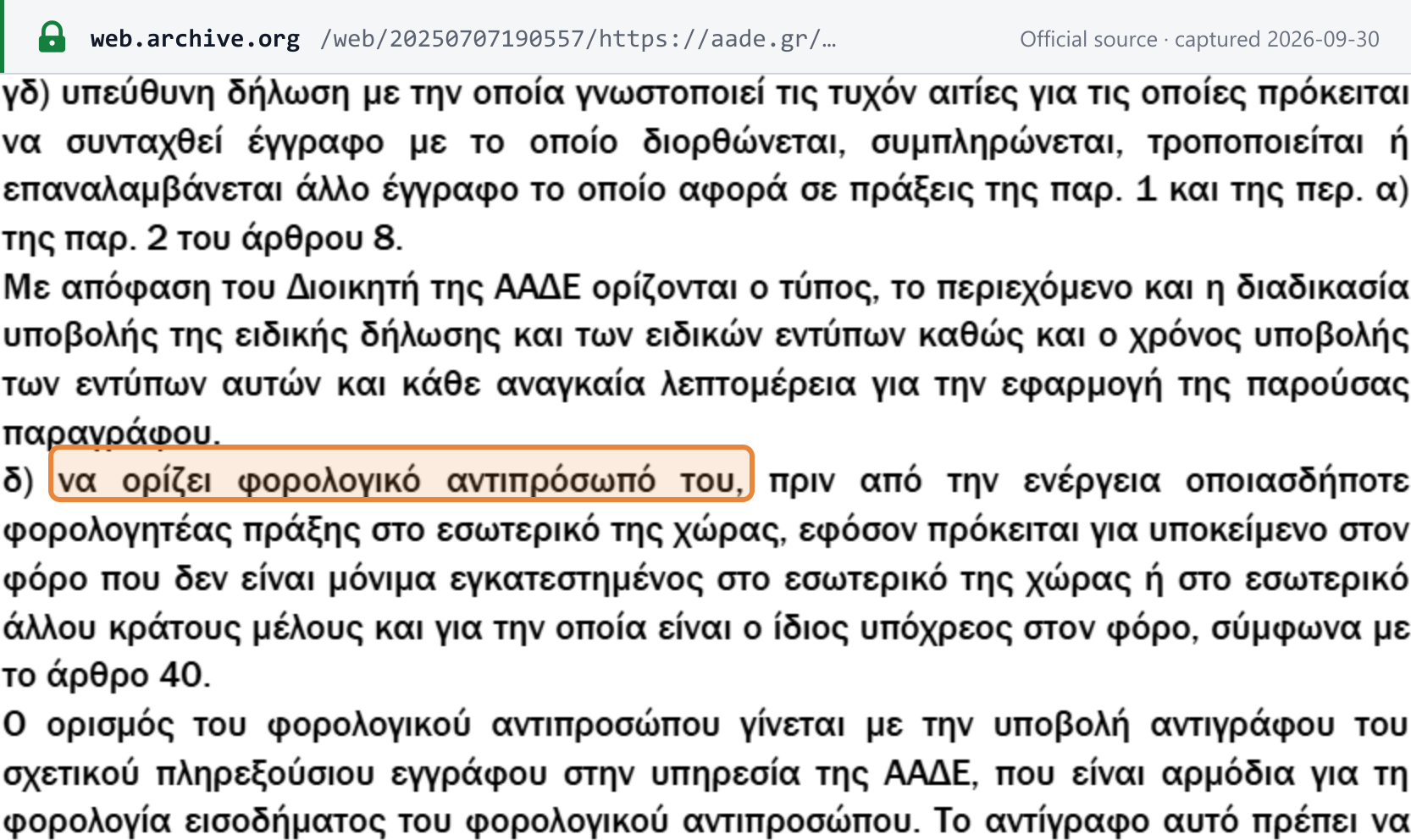
A taxable person established outside the EU must "ορίζει φορολογικό αντιπρόσωπό του, πριν από την ενέργεια οποιασδήποτε φορολογητέας πράξης στο εσωτερικό της χώρας" — appoint a fiscal representative before carrying out any taxable transaction in Greece (VAT Code art. 41(3)(δ)). The appointment is made by filing a copy of the power of attorney with the AADE office responsible for the representative's income tax; the copy must be certified by a Greek consular authority or carry an apostille under the Hague Convention of 5 October 1961. Businesses established in another EU Member State may appoint one but are not obliged to (art. 41(3)(ε)). [1]
Liability. The fiscal representative is the person liable for the VAT on the transactions of the business it represents (art. 40(1)(γ)). Where a non-established supplier has not appointed one, the Greek recipient is liable (art. 40(1)(ζ)). A fiscal representative for VAT is not the same as the general tax correspondent (φορολογικός εκπρόσωπος) under KFD art. 8, who receives correspondence and is expressly not liable for the taxpayer's obligations (art. 8(3)). [1] [2]
Tax identification number
The Greek VAT number is the 9-digit AFM (Αριθμός Φορολογικού Μητρώου). In intra-EU transactions it is quoted with the prefix "EL" — not "GR" — (VAT Code art. 41(4)(β)): "να χρησιμοποιεί για τις συναλλαγές αυτές τον ΑΦΜ του με το πρόθεμα «EL» πριν από αυτόν". A number written as EL followed by nine digits is the form VIES expects. [1]
The AFM's structure, check digit and how to obtain one as a non-resident are on Lookuptax's Greece tax identification number guide. To check a number, use the Greece VAT number validator, see how to verify an EU VAT number in VIES, or the list of official VAT-number lookups.
How to register
- Greek-established businesses file the start declaration in the tax register before the first transaction (legal persons within 30 days of incorporation), stating their VAT regime (KFD art. 11). [2]
- EU-established businesses outside OSS file the start declaration under POL.1113/2013 (Annex I where there is no representative) through AADE's e-ticket application. [5]
- OSS and IOSS. Registration is made in AADE's OSS application with TAXISnet credentials. Businesses not established in the EU registering for the non-Union scheme are first issued a VAT number with the prefix EU; IOSS registrants receive an IM number and intermediaries an IN number. [5]
- Non-EU businesses appoint a fiscal representative first (above).
Voluntary registration
Because there is no registration threshold, every business carrying on an economic activity registers; there is no separate voluntary-registration route. The choice a small Greek business does have is whether to opt into the art. 44 exemption or stay in the normal regime — staying in lets it charge VAT and deduct input VAT, which the exemption does not allow. [1]
Deregistration
- Changes and regime switch. Changes to registration data, including a change of VAT regime, are declared within 30 days (KFD art. 11(13)).
- Cessation. A cessation declaration (δήλωση διακοπής εργασιών) is filed within 30 days — for natural persons from the final cessation of activity; for legal persons from dissolution, the end of liquidation or deletion from the General Commercial Register (GEMI) (art. 11(15)–(16)). [2]
- Moving abroad. A business that ceases and moves its activity out of Greece must file all due VAT returns and pay the tax at the time of cessation, and AADE may require additional security (VAT Code art. 43(4)). [1]
Group registration
Not available — the consolidated VAT Code (Law 5144/2024) contains no VAT-grouping provision, and the European Commission's Greece VAT pages mention none (checked 2026-09-30). [1]
Rates
| Rate | Applies to | Island rate (from 1 January 2026) |
|---|---|---|
| 24% | Standard rate — all supplies not listed in Annex III | 17% |
| 13% | Goods and services in Annex III of the VAT Code | 9% |
| 6% | Specified Annex III items — pharmaceutical products, electricity and natural gas, district heating, fertilisers, printed books, newspapers and periodicals, e-books, theatre, concert and cinema tickets, certain aids for persons with disabilities | 4% |
| 4% | Specified Annex III items — services removing architectural barriers for persons with disabilities | 3% |
| 0% | COVID-19 vaccines only (art. 26(1)) | — |
The four rates in force. VAT Code art. 26(1): "Ο συντελεστής του ΦΠΑ ορίζεται σε είκοσι τέσσερα τοις εκατό (24%) στη φορολογητέα αξία" — the VAT rate is 24% of the taxable amount; goods and services in Annex III are taxed at 13%, and those Annex III items for which the Annex makes specific provision at 6% or 4%. The Annex III rates do not apply to electronically supplied services, with one exception listed in the Annex (Services item 8). AADE circular E.2113 of 31 December 2025 confirms the rates in force as 24%, 13%, 6% and 4% (as at 2026-09-30). [1] [3]
Origin of the standard rate. The 24% rate was introduced by Law 4389/2016, implemented by AADE circular ΠΟΛ.1061/2016.
The 30% island reduction
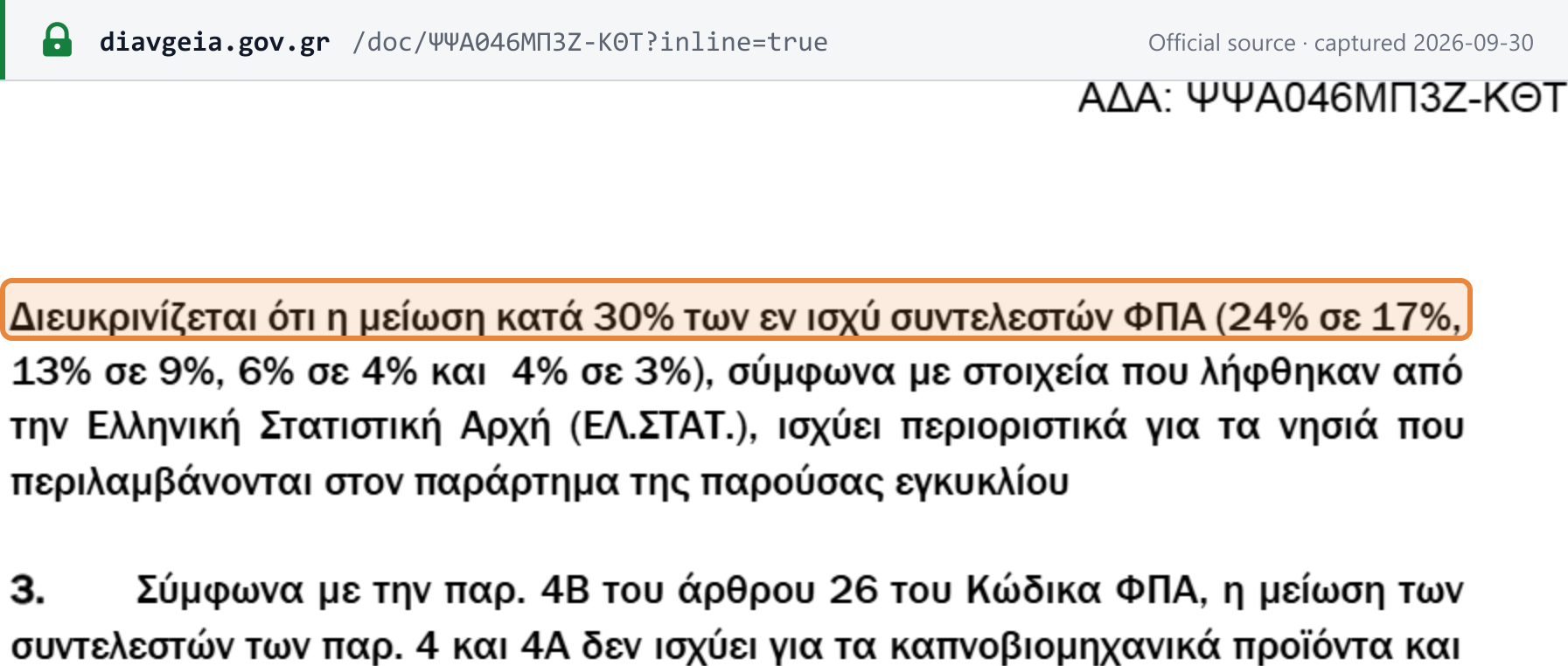
From 1 January 2026, Law 5246/2025 (ΦΕΚ Α΄ 198) art. 11 rewrote art. 26(4)–(5) of the VAT Code. On the islands it covers, every rate is cut by 30%: 24% → 17%, 13% → 9%, 6% → 4% and 4% → 3%. E.2113: "η μείωση κατά 30% των εν ισχύ συντελεστών ΦΠΑ (24% σε 17%, 13% σε 9%, 6% σε 4% και 4% σε 3%)". [3]
- Lesvos, Kos, Samos and Chios (art. 26(4)) — the reduction applies while migrant reception facilities operate on the island; ministerial decision A.1150/2021 (ΦΕΚ Β΄ 2828) continues to implement it. Lesvos, Chios and Samos are included.
- Art. 26(4Α) — all islands of the North Aegean Region, Samothraki (Evros) and the islands of the Dodecanese with a population of up to 20,000 at the latest census. Leros, previously in para. 4, now falls under para. 4Α.
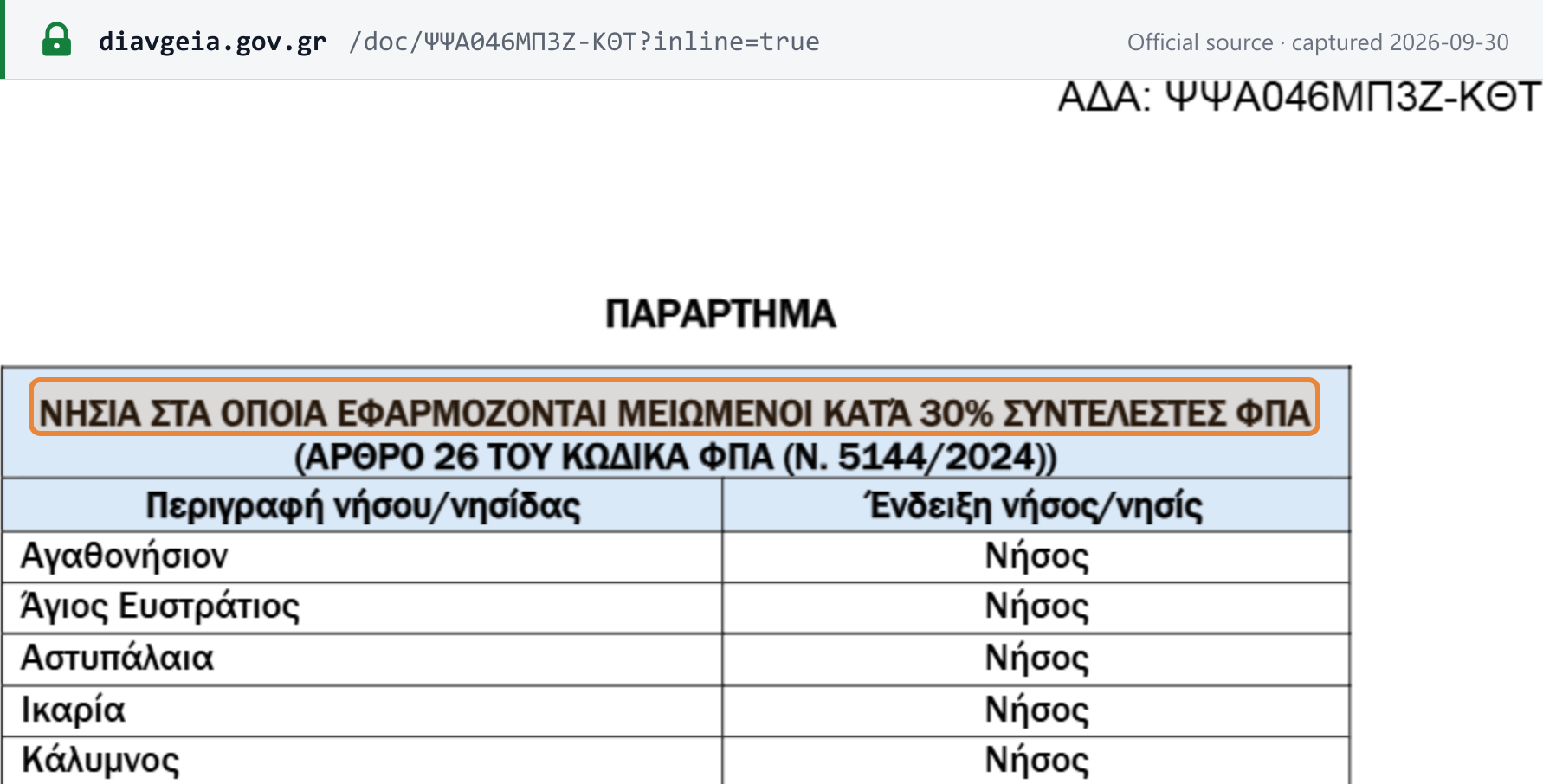
- The islands listed in the E.2113 annex: Agathonisi, Agios Efstratios, Astypalaia, Ikaria, Kalymnos, Karpathos, Kasos, Kos, Leipsoi, Leros, Lesvos, Limnos, Megisti, Nisyros, Oinousses, Patmos, Samothraki, Samos, Symi, Tilos, Fournoi, Chalki, Chios and Psara, together with named islets. Crete, Rhodes and the Cyclades are not on the list.
- Excluded goods. The reduction does not apply to tobacco products or means of transport (art. 26(4Β)).
- Which supplies qualify. For goods, the island rates apply where the goods are located on the island and supplied by a taxable person established there (a permanent branch counts); where goods are sold, from anywhere in Greece, to a taxable person or non-taxable legal person established on the island; to intra-EU acquisitions by such persons; and to imports cleared on the island (art. 26(4)(β)(ββ)–(βγ), applied by art. 26(4Α); E.2113, examples 4, 6, 7 and 13). A mainland seller shipping standard-rated goods to a business on Kos therefore charges 17%, but charges 24% to a consumer there (E.2113, example 6). Services qualify only when physically performed on the island by a taxable person established there (art. 26(5)).
Announced future rates
No VAT-rate change has been announced as of 30 September 2026.
Cross-border rules
Foreign companies selling into Greece — B2B and B2C
- B2B services. The place of supply of services to a taxable person is where the customer is established (VAT Code art. 18(2)(α)). When the supplier is not established in Greece, the Greek taxable customer — or a VAT-registered non-taxable legal person — accounts for the VAT (art. 40(1)(στ)). The foreign supplier does not register; its invoice carries "Αντίστροφη επιβάρυνση" (reverse charge). See reverse charge explained. [1]
- B2B goods located in Greece. The foreign supplier registers; a non-EU supplier must appoint a fiscal representative, and if none is appointed the Greek recipient is liable (art. 40(1)(ζ)).
- B2C. A non-established seller making domestic Greek supplies to consumers has no threshold, because it cannot use the art. 44 exemption. EU sellers of cross-border B2C services and distance sales above the EU-wide EUR 10,000 threshold, and all non-EU sellers, owe Greek VAT and normally declare it through OSS or IOSS (arts. 56–58).
Digital products and services
A Greek-established supplier keeps charging Greek VAT on cross-border B2C telecommunications, broadcasting and electronically supplied services, and on intra-EU distance sales of goods, only while its EU-wide total, excluding VAT, does not exceed EUR 10,000 in the current calendar year and did not exceed it in the previous one (art. 19(1)(γ)). The threshold applies only to EU-established suppliers; non-EU suppliers have no threshold. Electronically supplied services do not benefit from the Annex III reduced rates, save the one exception the Annex lists (art. 26(1)). [1]
OSS with Greece as Member State of identification. OSS returns are filed, and the tax paid, by the end of the month after the period; a deadline falling on a Saturday, Sunday or public holiday is not extended (Law 5104/2024 art. 7(1)). A late OSS return is fined EUR 100 (Tax Procedure Code art. 53(3))[2], and late payment carries interest. Bad-debt relief is not available for supplies reported in OSS or IOSS. Businesses not established in the EU claim Greek VAT refunds on form VAT 015, sent by post by 30 September of the year after the one the refund relates to. [5] [2]
Marketplace / platform deemed-supplier liability
A taxable person that facilitates, through an electronic interface such as a marketplace or platform, distance sales of goods imported in consignments of an intrinsic value of up to EUR 150, or supplies of goods within the EU by a non-EU seller to consumers, is treated as having received and supplied the goods itself (VAT Code art. 7). Platform records must be kept for 10 years from 31 December of the year of the transaction (art. 41(8)). See marketplace deemed-supplier rules. [1]
Imports and exports
- Imports. Import VAT is declared on the customs declaration at the office of import (art. 43(7)).
- Exports and international transport are exempt with a right of deduction (art. 29).
- Intra-EU supplies of goods are exempt with a right of deduction (art. 33). Intra-EU traders use their EL-prefixed number, file recapitulative statements and file a monthly Intrastat declaration (art. 41(4)); see VIES and Intrastat.
Place of supply
- Services. B2B: where the customer is established (art. 18(2)(α)). B2C telecommunications, broadcasting and electronic services supplied by an EU-established supplier over the EUR 10,000 threshold, or by a non-EU supplier: where the consumer is (art. 19).
- Goods. Imported and intra-EU distance sales follow the EU rules and the art. 7 platform rule above. For the island rates, what matters is where the goods are located and where the supplier is established (art. 26(5)).
Invoice requirements
Greek invoicing rules are not in the VAT Code but in Law 4308/2014 (Greek Accounting Standards, ΦΕΚ Α΄ 251/24.11.2014), arts. 8–15. The particulars, deadlines and retention rules below are those of the law as originally enacted; arts. 14 and 15 were later rewritten by Law 5222/2025 (arts. 239–240) to introduce mandatory e-invoicing, which is covered under E-invoicing status. [6]
Mandatory content
A full invoice must carry the following particulars (Law 4308/2014 art. 9(1)): [6]
| Lit. | Required field |
|---|---|
| α) | Date of issue |
| β) | Sequential number, in one or more series, that identifies the invoice uniquely |
| γ) | Supplier's tax registration number (AFM) |
| δ) | Customer's AFM |
| ε) | Full name and full address of the supplier and the customer |
| στ) | Quantity and nature of the goods, or extent and nature of the services |
| ζ) | Date of the supply, where it differs from the date of issue |
| η) | Taxable amount per VAT rate or exemption, unit price excluding VAT, and discounts |
| θ) | VAT rate applied |
| ι) | VAT amount payable |
| ια) | "Αυτο-τιμολόγηση", where the customer issues the invoice (self-billing) |
| ιβ) | Reference to the legal basis of an exemption |
| ιγ) | "Αντίστροφη επιβάρυνση", where the customer is liable for the VAT (reverse charge) |
| ιδ) | Data on new means of transport |
| ιε)–ιστ) | Margin-scheme wording (travel agents; second-hand goods, works of art, antiques) |
| ιζ) | Details and AFM of the fiscal representative, where there is one |
"Το τιμολόγιο δεν απαιτείται να φέρει υπογραφή" — no signature is required (art. 9(3)). A business in the small-business scheme adds "χωρίς φόρο προστιθέμενης αξίας - απαλλαγή μικρών επιχειρήσεων" (VAT Code art. 44(9)). An invoice issued through a certified e-invoicing provider carries further fields — see Retention and audit trail. [6] [1]
Issuance deadline
An invoice for a sale of goods or a supply of services is issued no later than the 15th day of the month after the delivery or dispatch of the goods or the completion of the service (Law 4308/2014 art. 11). For continuous supplies the same deadline runs from the month in which each part becomes due, and a summary invoice is issued by the 15th of the month after the first supply it covers. [6]
Numbering and sequencing
Each invoice carries a sequential number, in one or more series, that identifies it uniquely (art. 9(1)(β)). An invoice issued through a provider also carries the MARK returned by myDATA and a document identifier (below). [6]
Credit and debit notes
A credit invoice (πιστωτικό τιμολόγιο) is issued for any discount, return or other difference (art. 8(6)). Any document that specifically and unambiguously amends an earlier invoice is itself treated as an invoice (art. 8(3)). [6]
Currency and language
Invoice amounts may be expressed in any currency, but the VAT amount must also be stated in euros (art. 9(2)). The European Commission's Greece page, supplied by Greece, says retail receipts may be in any language, with a Greek translation provided promptly if the tax authorities ask for one. [6] [5]
Document types
- Invoice (τιμολόγιο) — the full invoice, with all art. 9 particulars.
- Simplified invoice (απλοποιημένο τιμολόγιο) — allowed where the invoice amount is up to EUR 100, or for a document amending an earlier invoice (art. 10). It shows at least the date, the seller, the goods or services and the VAT. AADE Decision A.1129/2026 (23 June 2026) sets required simplified-invoice content for certain categories of business.
- Summary invoice — allowed for several supplies (art. 10(3)).
- Retail receipt (στοιχείο λιανικής) — for sales to consumers, showing the date, serial number, the supplier's AFM, name and address, the VAT rate and the gross value (art. 12). It is issued on delivery of goods or completion of the service (art. 13).
Self-billing
Allowed by prior agreement: the seller may arrange for the customer to issue the invoice (αυτο-τιμολόγηση), and the seller remains responsible for it (art. 8(5)). The invoice carries the wording "Αυτο-τιμολόγηση" (art. 9(1)(ια)). [6]
Retention and audit trail
- Retention. Accounting records, invoices included, are kept for the longer of five years from the end of the reporting period and any period set by other legislation (Law 4308/2014 art. 7(1)). They may be kept in any form, provided there is a system to search, display and print them (art. 7(2)). For each invoice, the data that secure the authenticity and integrity of its content must also be kept (art. 7(3)). Platform records under the VAT Code are kept for 10 years (art. 41(8)). [6]
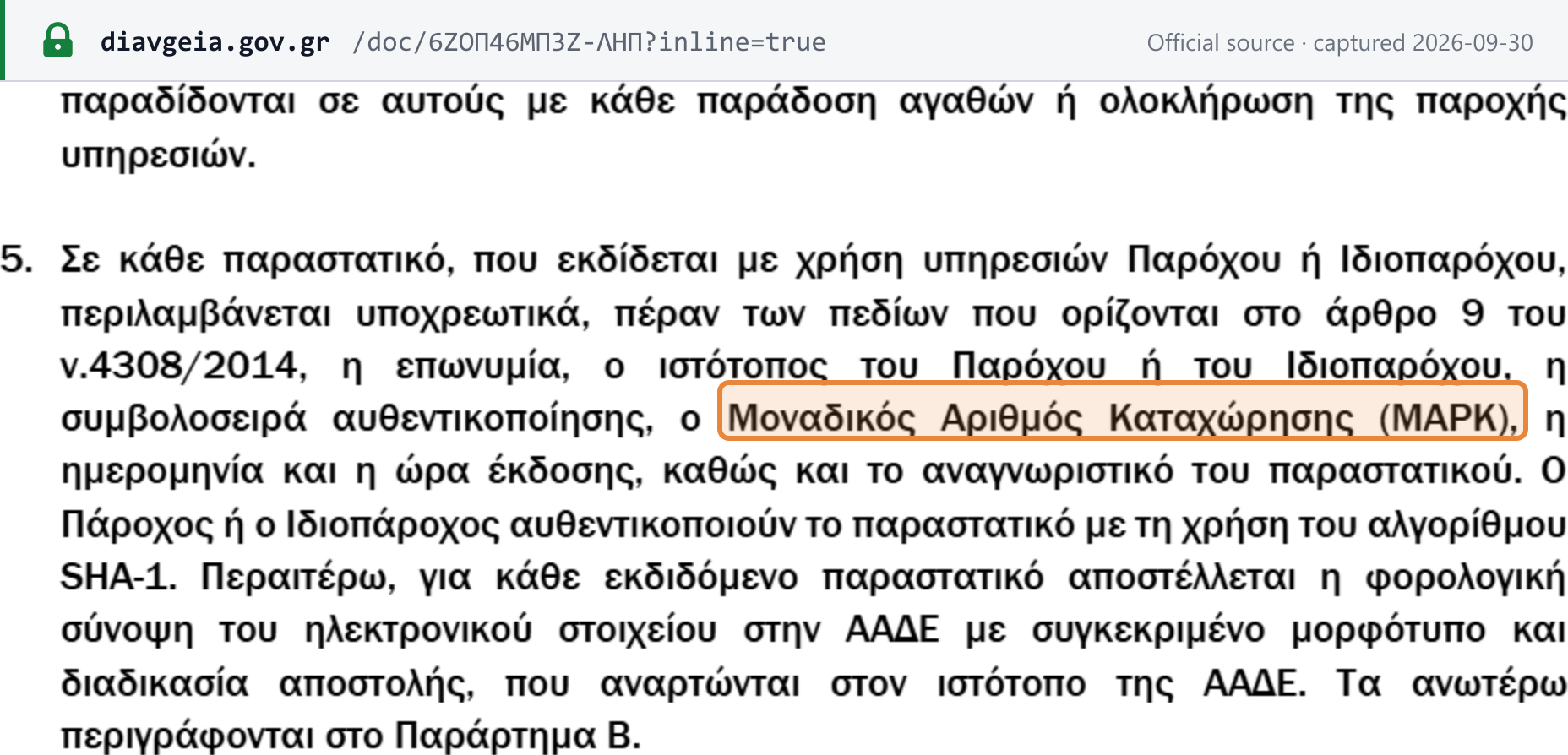
- Provider-issued documents. Under AADE Decision A.1112/2025 (ΦΕΚ Β΄ 4206/1.8.2025) art. 7(5)–(6), every document issued through a certified e-invoicing provider (Πάροχος) or a self-provider (Ιδιοπάροχος) must carry, on top of the art. 9 particulars: the provider's name and website; an authentication string; the MARK (Μοναδικός Αριθμός Καταχώρησης, unique registration number) returned by myDATA; the date and time of issue; and the document identifier. The provider authenticates the document with the SHA-1 algorithm, and the document carries a URL-type QR code built from the text myDATA returns on successful transmission, which includes the MARK. A printed provider-issued document also shows the number of the provider software's AADE suitability licence (art. 7(6)). [9]
- Providers. Provider software needs an AADE suitability licence. A self-provider must have a permanent establishment in Greece and gross revenue of at least EUR 50,000,000. A provider files a "Δήλωση Έναρξης Ηλεκτρονικής Έκδοσης Στοιχείων" in myAADE within 10 days of its contract with a client taking effect. If the provider's link to AADE fails, documents are relayed to myDATA and to the recipients within one day and marked as issued during a transmission failure (A.1112/2025). [9]
A specimen of a compliant invoice
No official annotated specimen invoice accompanies Law 4308/2014 or AADE's e-invoicing decisions (checked 2026-09-30). The layout below is Lookuptax's own illustration of the art. 9(1) particulars of Law 4308/2014 for a domestic B2B supply, issued through a certified provider, with the extra fields required by A.1112/2025. Every name, number, code and amount is fictional:
Τιμολόγιο Πώλησης — Sales invoice
| DescriptionArt. 9(1)(στ) | QuantityArt. 9(1)(στ) | Unit price (excl. VAT)Art. 9(1)(η) | VAT rateArt. 9(1)(θ) | Value (excl. VAT) |
|---|---|---|---|---|
| Software licence, annual | 1 | EUR 1,000.00 | 24% | EUR 1,000.00 |
| Printed user manuals | 10 | EUR 20.00 | 6% | EUR 200.00 |
- Taxable amount at 24%Art. 9(1)(η)
- EUR 1,000.00
- VAT at 24%Art. 9(1)(ι)
- EUR 240.00
- Taxable amount at 6%Art. 9(1)(η)
- EUR 200.00
- VAT at 6%Art. 9(1)(ι)
- EUR 12.00
- Total including VAT
- EUR 1,452.00
- Issued through: Example Provider S.A., www.example-provider.invalid — A.1112 art. 7(5).
- Authentication string (SHA-1): [placeholder] — A.1112 art. 7(5).
- [QR code placeholder — URL-type QR code built from the text myDATA returns, containing the MARK] — A.1112 art. 7(6).
- Where the customer accounts for the VAT, the invoice shows "Αντίστροφη επιβάρυνση" and no VAT — Art. 9(1)(ιγ); where the customer issues it, "Αυτο-τιμολόγηση" — Art. 9(1)(ια); under the small-business exemption, "χωρίς φόρο προστιθέμενης αξίας - απαλλαγή μικρών επιχειρήσεων" — VAT Code art. 44(9).
- No signature is required — Art. 9(3). If the invoice is in another currency, the VAT is also stated in euros — Art. 9(2).
E-invoicing status
Status (as of 2026-10-07): mandatory, phased and enacted — the second phase starts on 2 November 2026. Law 5222/2025 (arts. 239–240) amended arts. 14–15 of Law 4308/2014 so that, for the transactions in scope, invoices are issued exclusively electronically. The scope and timetable are set by Joint Decision A.1128/2025 (ΦΕΚ Β΄ 4937/16.9.2025) of the Deputy Minister of National Economy and Finance and the AADE Governor, as amended by Joint Decision A.1044/2026 (ΦΕΚ Β΄ 880/17.2.2026). Joint Decision A.1197/2026 (ΦΕΚ Β΄ 5905/30.09.2026), announced on 30 September 2026, moves the second phase from 1 October 2026 to 2 November 2026 (see the timeline below). For the full mandate, see the Greece e-invoicing guide. [12] [7] [8]
System and channels
Every e-invoice must be issued only through one of two channels (A.1128/2025 art. 1(2)): [7]
- a certified e-invoicing provider (Πάροχος Ηλεκτρονικής Έκδοσης Στοιχείων); or
- AADE's free web application for issuing and transmitting documents, timologio (Εφαρμογή Έκδοσης και Διαβίβασης Παραστατικών).
Provider-issued documents are transmitted to AADE's myDATA platform, which returns the MARK that the invoice and its QR code carry (A.1112/2025). Issuing from an ERP alone, by hand, or through the myDATA manual-entry route is no longer an allowed way to issue an in-scope invoice, except during the transitional windows below. [9]
Scope — B2B, B2G and B2C
An invoice is issued exclusively electronically in three cases (A.1128/2025 art. 1(1), as replaced by A.1044/2026): [8]
- Domestic B2B — to an entity in Greece subject to Law 4308/2014;
- B2B with non-EU countries — to a foreign entity in a country outside the EU, other than retail transactions;
- B2G — public contracts and other spending by General Government bodies, subject to the public-procurement invoicing rules.
Intra-EU B2B is not in the list, so invoices to business customers in other Member States are outside the mandate. B2C is not covered; the European Commission's Greece page states that "B2C supplies are not subject to mandatory electronic invoicing". [5]
Timeline
| Phase | Who | Mandatory from | Parallel use of other methods allowed | Instrument |
|---|---|---|---|---|
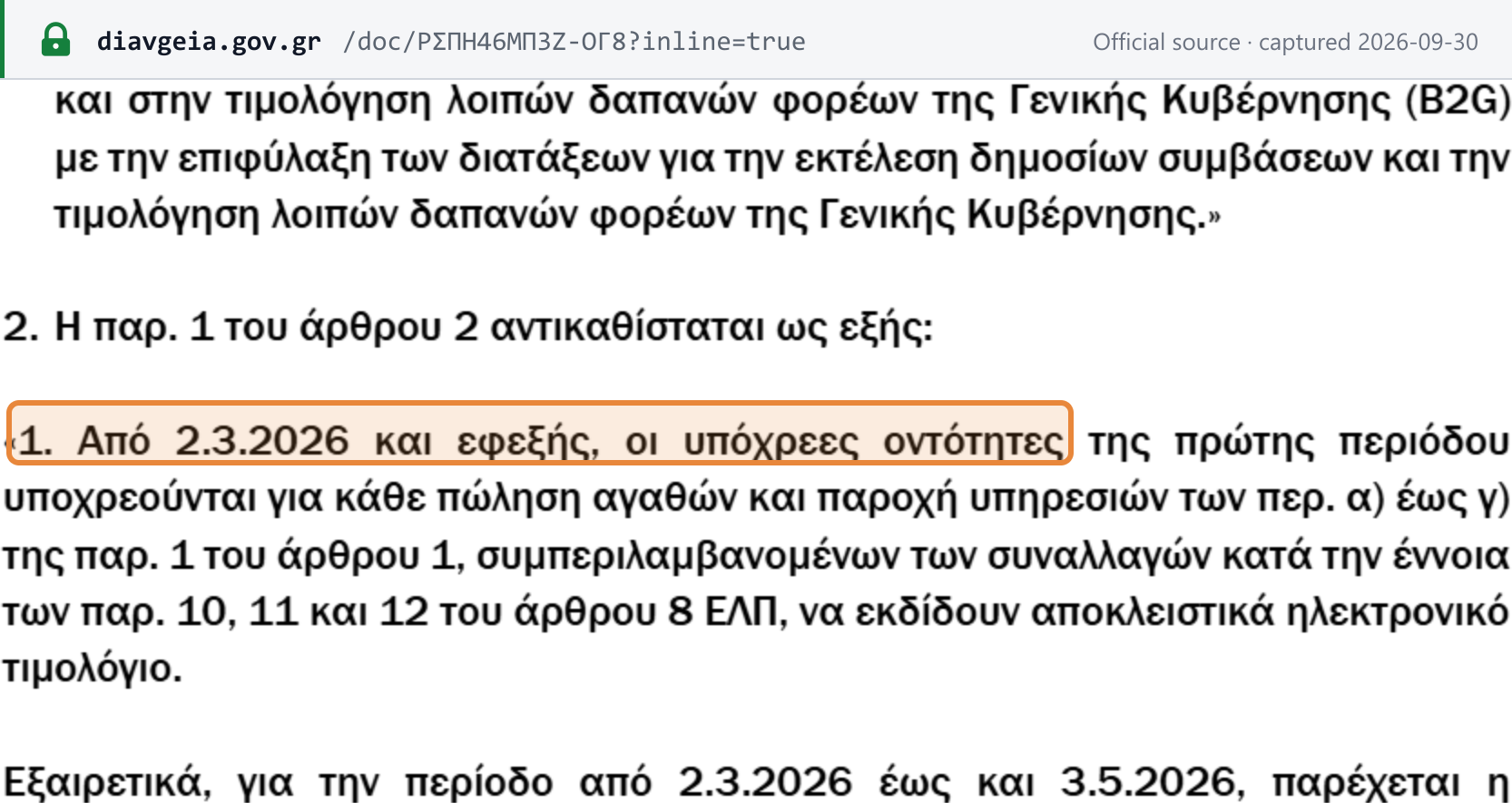
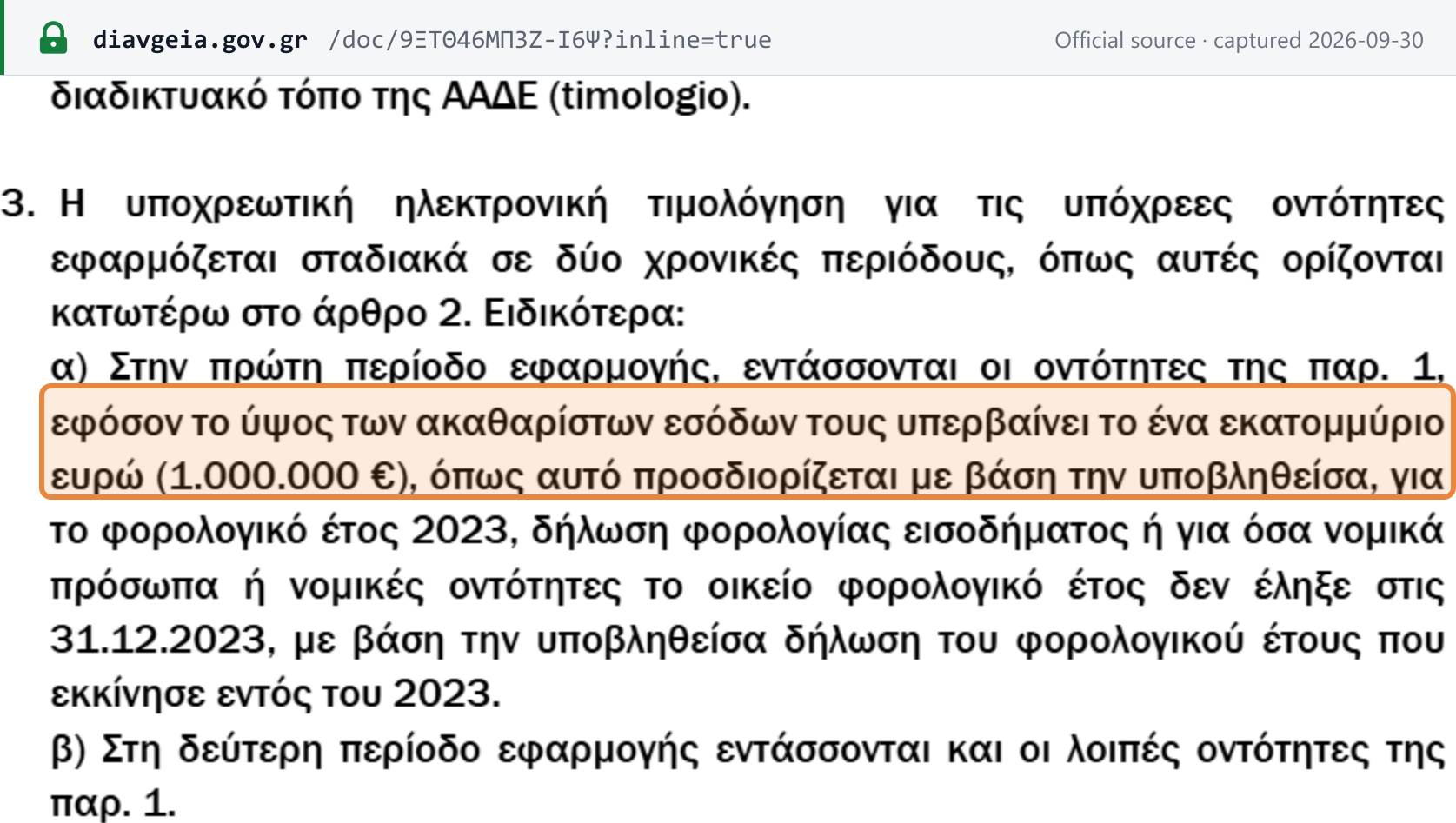
| First | Entities whose gross revenue in their 2023 income-tax return exceeded EUR 1,000,000 (for a tax year not ending 31 December 2023, the return for the year that began in 2023) | 2 March 2026 (moved from 2 February 2026) | 2 March – 3 May 2026 | A.1128/2025 art. 1(3)(α) and art. 2(1), as replaced by A.1044/2026 |
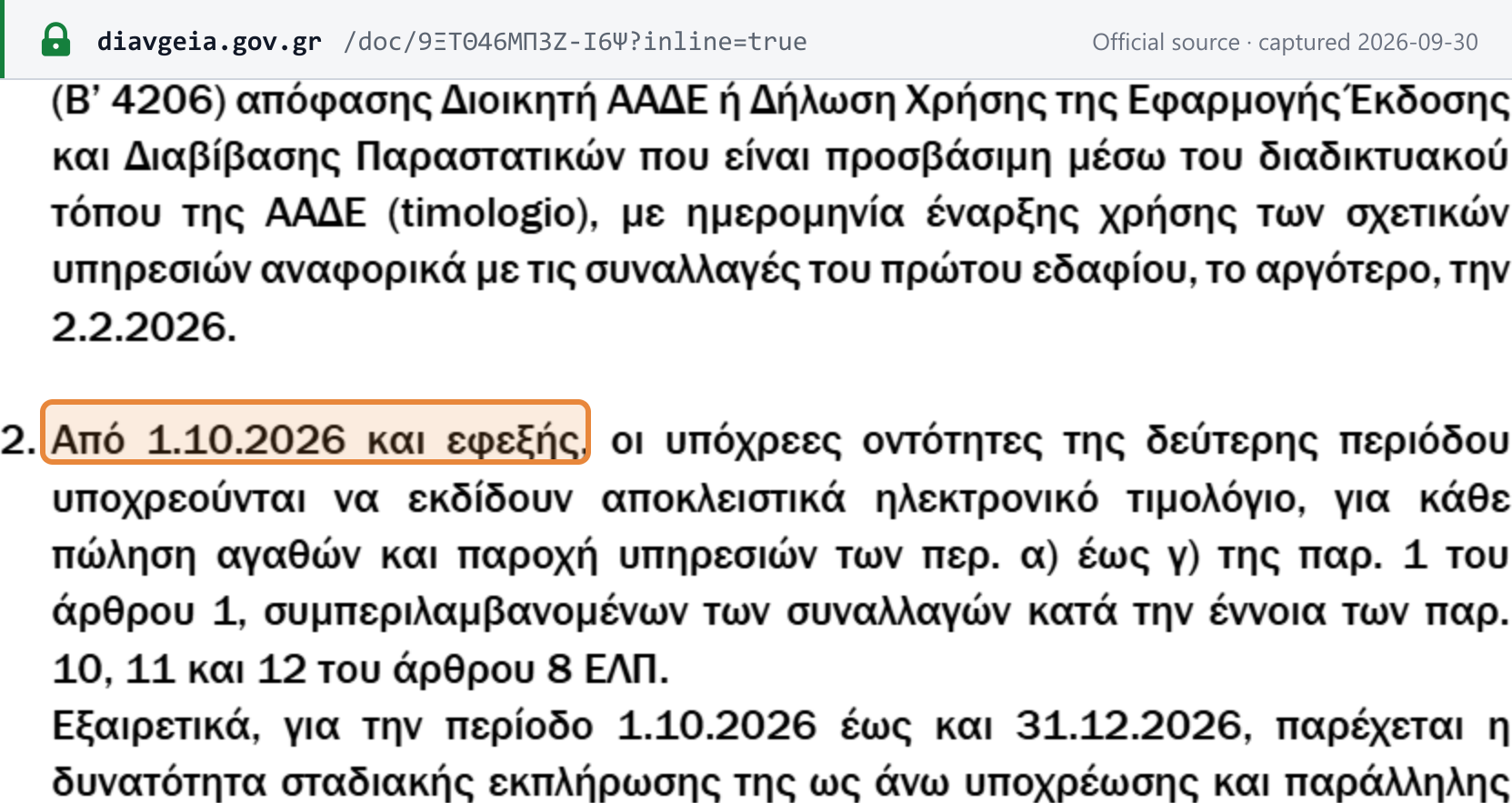
| Second | All other entities subject to Law 4308/2014 | 2 November 2026 (moved from 1 October 2026) | 2 November 2026 – 31 January 2027 | A.1128/2025 art. 2(2), as replaced by A.1197/2026 (ΦΕΚ Β΄ 5905/30.09.2026) |
| Recipients | Every entity subject to Law 4308/2014 must accept e-invoices for domestic B2B and B2G | 2 March 2026 | — | A.1128/2025 art. 2(3), as replaced by A.1044/2026 |
The parallel-use condition. During each transitional window, the other methods of issuing and transmitting invoices may be used alongside the new channels only if the business filed a timely declaration to start using a provider (Δήλωση Έναρξης Ηλεκτρονικής Έκδοσης Στοιχείων), with a start date no later than 2 March 2026 for the first phase or 2 November 2026 for the second (a provider user files the declaration with an effective date of 2 November 2026; a business issuing only through timologio or myDATAapp from that date need not file it). For the first phase the window ended on 3 May 2026; for the second it runs to 31 January 2027, and from 1 February 2027 domestic B2B, B2B with non-EU third-country customers and B2G e-invoices, and their transmission to myDATA, must go only through a provider or the AADE applications. [12] [13] [7] [8]
Formats and standards
The Decisions require a structured invoice issued through a certified provider or timologio and transmitted to myDATA, authenticated with SHA-1 and carrying the MARK and a QR code (A.1112/2025). Neither A.1128/2025, A.1044/2026 nor A.1112/2025 names a European semantic standard or Peppol for B2B; B2B invoices travel from provider to myDATA and to the buyer (or the buyer's provider), and only B2G invoices are routed through the GSIS National Interoperability Centre (ΚΕΔ) (A.1112/2025 art. 7(7)). The provider technical specifications are published by AADE on its myDATA pages. [9]
B2G invoices follow a separate format and network: the eInvoice XML must comply with EN 16931 and the Greek CIUS of PEPPOL BIS 3.0, and is sent through a Peppol-certified service provider to the single Peppol endpoint of all Greek contracting authorities, 9933:997001671, at the GSIS National Interoperability Centre (ΚΕΔ). [14] See the Greece e-invoicing guide for formats, onboarding and providers.
E-invoicing penalties
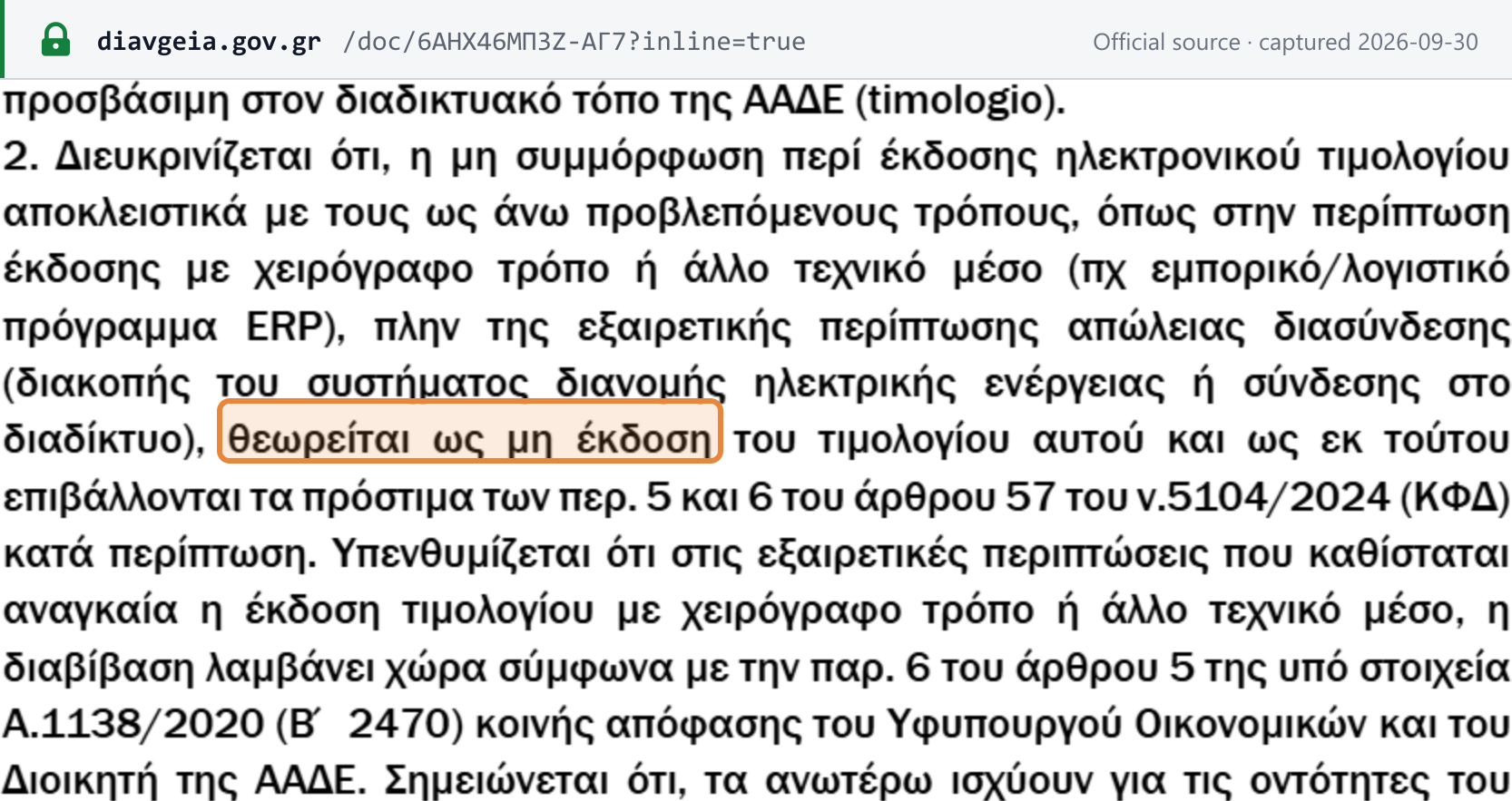
AADE circular E.2004/2026 (13 February 2026): failing to issue an in-scope e-invoice exclusively through the prescribed channels — for example issuing it by hand or with other software such as an ERP — "θεωρείται ως μη έκδοση του τιμολογίου αυτού", is treated as not issuing the invoice, except where the connection is lost because of a power or internet outage. The fines of art. 57(5) and (6) of the Tax Procedure Code (Law 5104/2024) then apply from each entity's start date under A.1128/2025, outside the transitional parallel-use window: [10] [2]
- Transaction subject to VAT: 50% of the VAT the unissued invoice would have shown, with a minimum, summed per tax audit, of EUR 250 for single-entry and EUR 500 for double-entry bookkeepers (art. 57(6)).
- Transaction not subject to VAT: EUR 500 (single-entry) or EUR 1,000 (double-entry) per tax audit (art. 57(5)).
- Not transmitting to myDATA is a separate infringement under art. 58 (see Penalties).
Filing and payment
Filing frequency
The bookkeeping system decides the frequency (VAT Code art. 43(1)): [1]
- Monthly — businesses on double-entry books, and the State;
- Quarterly — businesses on single-entry books, and persons not obliged to keep books or issue sales documents;
- Six-monthly — businesses in the flat-rate scheme of art. 47 (art. 43(2));
- None — businesses that declare themselves dormant or suspended, from the date of that declaration (art. 43(3)), and persons making only exempt supplies without a right of deduction (art. 41(3)(β)).
Return due date
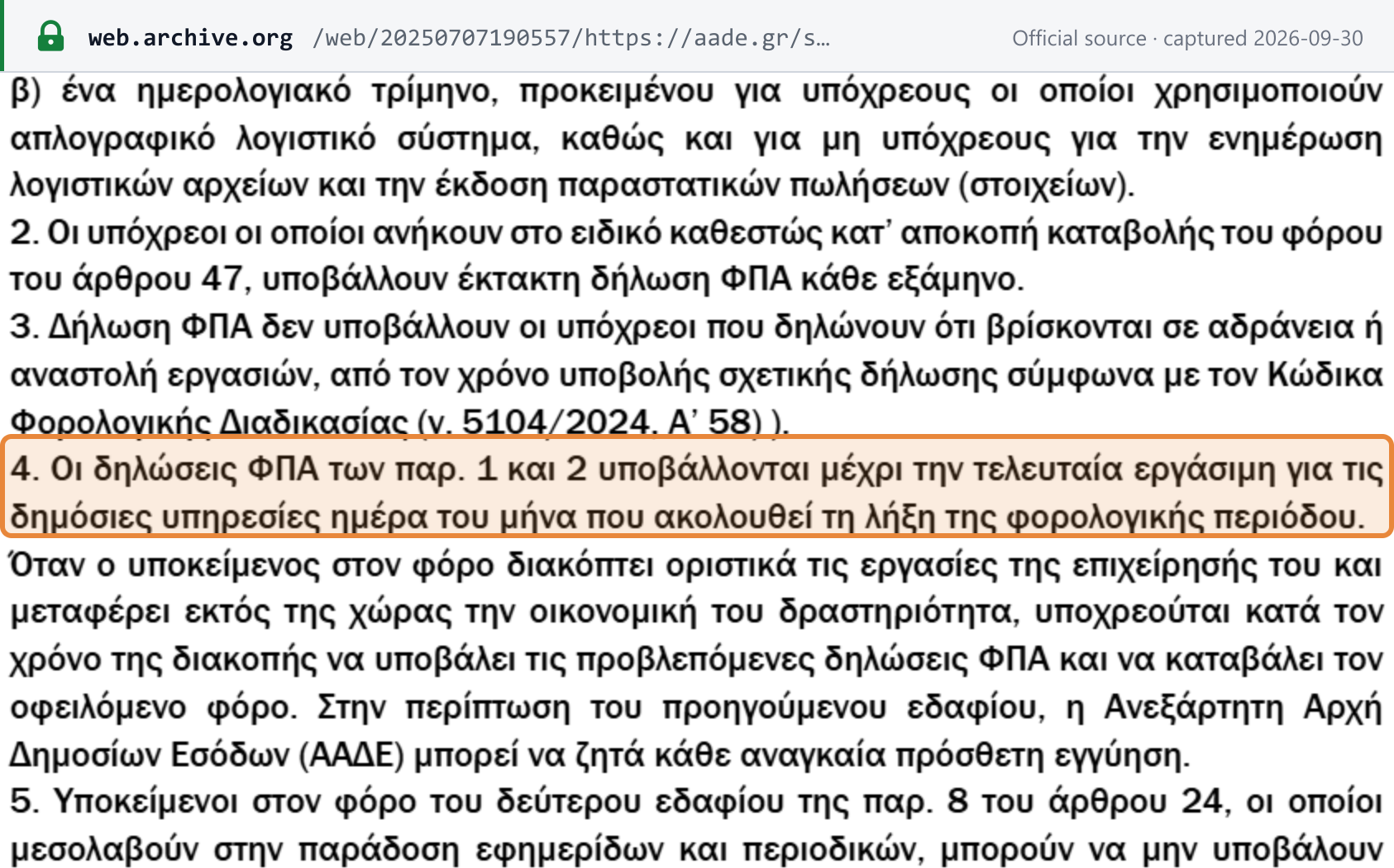
"Οι δηλώσεις ΦΠΑ … υποβάλλονται μέχρι την τελευταία εργάσιμη για τις δημόσιες υπηρεσίες ημέρα του μήνα που ακολουθεί τη λήξη της φορολογικής περιόδου" — VAT returns are filed by the last working day of the month following the end of the tax period (art. 43(4)). The VAT Code provides for no annual VAT return. [1]
Payment due date and method
- Due date. The tax is paid by the last working day of the month in which the filing deadline falls — the same day as the return (art. 43(6)).
- Small balances. A balance due of EUR 30 or less is carried forward to the next period; a credit is carried forward or refunded (art. 43(6)).
- Instalments. Where the return is filed on time and the tax due exceeds EUR 100, it may be paid in two equal interest-free instalments, the second by the last working day of the following month (art. 43(6)).
- OSS payments are made with a payment code, by card, or by SEPA or SWIFT transfer to the Bank of Greece. [5]
Additional listings
- Recapitulative statements (ανακεφαλαιωτικός πίνακας) are filed by intra-EU suppliers and acquirers of goods and by suppliers and recipients of cross-border B2B services (VAT Code art. 41(4)–(6)). Each transaction is entered in the calendar period in which the tax becomes chargeable (art. 41(7)). The filing deadline is set by ministerial decision (art. 41(12)). See VAT listings in the EU.
- Intrastat is filed monthly for intra-EU transactions (art. 41(4)(γ)).
- myDATA. Invoice data are transmitted to myDATA; not transmitting is penalised under KFD art. 58 (see Penalties).
Input-tax recovery and blocked items
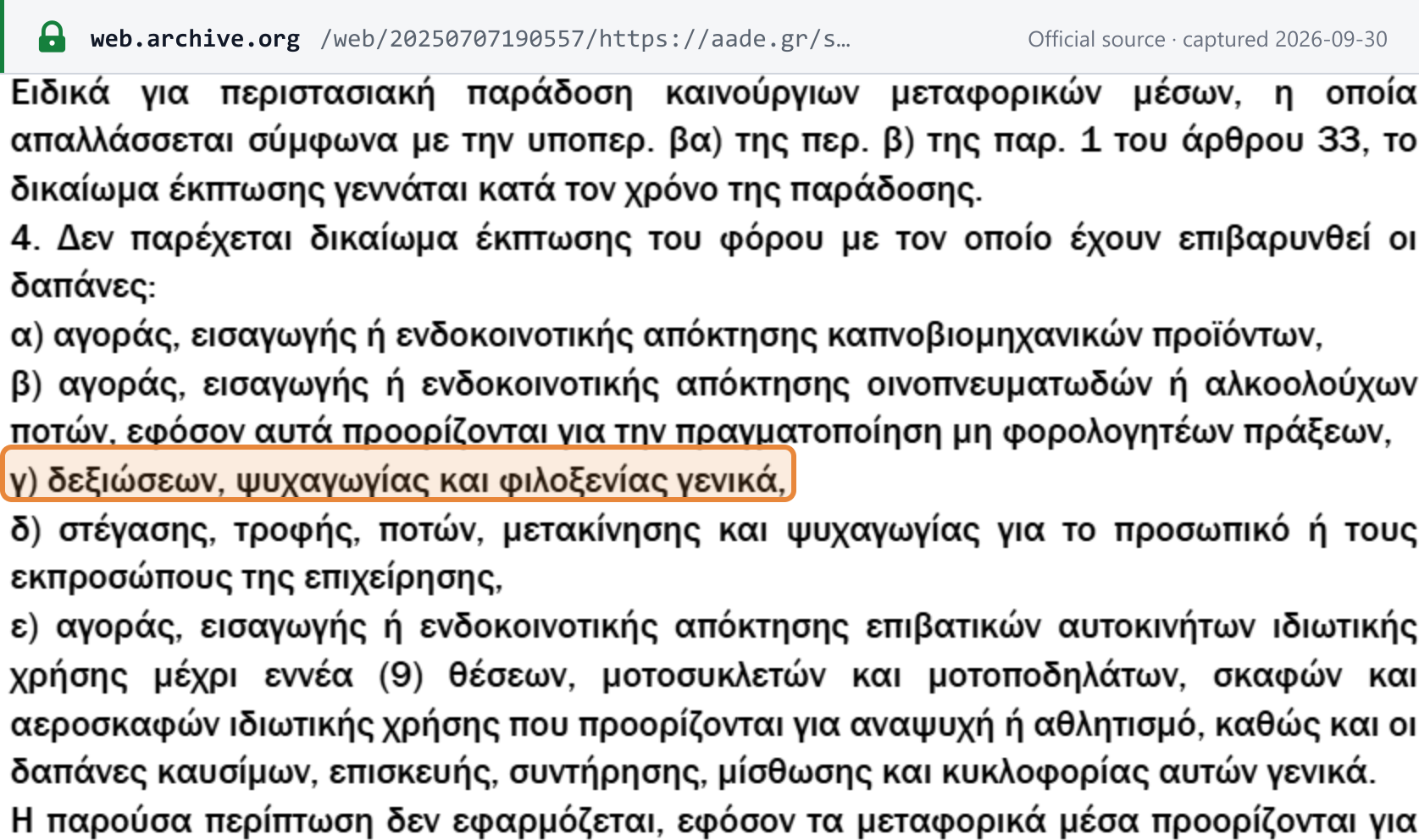
No deduction is allowed for VAT on (VAT Code art. 35(4)): [1]
- tobacco products;
- alcoholic drinks, unless used for taxable supplies;
- receptions, entertainment and hospitality generally;
- accommodation, food, drink, transport and entertainment for staff or representatives;
- private passenger cars of up to nine seats, motorcycles, and private pleasure boats and aircraft, with their fuel, repair, maintenance, rental and running costs — unless the vehicles are held for sale, rental or paid passenger transport.
Inputs used for both taxable and exempt supplies are deducted by a turnover percentage, rounded up to the next whole percent (art. 36(1)–(2)).
Refunds
- Resident credits are carried forward or refunded under art. 39 (art. 43(6)). The Tax Procedure Code pays interest to the taxpayer on a refund only if it is not completed within 90 days of AADE receiving the application (KFD art. 52(4)). [2]
- EU businesses claim Greek VAT electronically through their own Member State's portal; a claim covers a period of no less than three months and no more than one calendar year (VAT Code art. 39(5)). [1]
- Non-EU businesses apply directly to AADE by post on form VAT 015, by 30 September of the following year. [5]
- Bad-debt relief is not available for supplies reported in OSS or IOSS. [5]
Exemptions
Exempt supplies
Exempt without a right to deduct (VAT Code art. 27(1)) include: universal-service postal services; hospital and medical care provided by public-law bodies and equivalent non-profit organisations; foreign-exchange and securities transactions; rental of immovable property, other than accommodation-type services; and state lotteries and licensed gambling. Education, insurance and further items are in the same article. [1]
Exempt is not zero-rated. Exports and international transport (art. 29) and intra-EU supplies of goods (art. 33) are exempt with a right to deduct, so the supplier recovers its input VAT. For the art. 27 exemptions the input VAT is not deductible; mixed-use inputs are apportioned (art. 36(1)), and a business making only such supplies files no VAT return (art. 41(3)(β)). [1]
Special regimes
Chapter Θ of the VAT Code provides: [1] [4]
- Small businesses (art. 44, above) and the cross-border SME scheme (arts. 44α–44γ);
- Domestic reverse charge on specified supplies (art. 45);
- Cash accounting (art. 46) — the European Commission's Greece page confirms it can be opted for;
- Flat-rate scheme (art. 47) — named by the Commission for coastal fishing vessels up to 12 metres, vessels on Lake Ioannina and horse-drawn vehicle operators; returns are six-monthly;
- Farmers (art. 48) — a flat-rate refund of 6%;
- Travel agents (art. 50), manufactured tobacco (art. 51), second-hand goods, works of art and antiques (art. 52), auctions (art. 53) and investment gold (art. 54);
- OSS and IOSS (arts. 56–58).
Free zones. The Free Zone of the Port of Thessaloniki operates under the warehousing and international-movement exemptions of arts. 30–31; AADE Decision A.1191/2026 of 29 September 2026 amended its boundaries.
Offences and penalties
Offences
- Criminal VAT evasion. Intentional evasion is a crime where the unpaid VAT exceeds EUR 50,000 in a tax year, punishable by imprisonment of at least two years; above EUR 100,000 it is a felony punishable by κάθειρξη (KFD art. 79(2)–(3)). [2]
- Fictitious or forged invoices. Issuing or accepting fictitious invoices, or issuing or falsifying forged ones, is punishable by imprisonment of at least three months, whether or not tax is evaded, rising to at least one year where the fictitious invoices total more than EUR 75,000 (art. 79(4)). [2]
- Trading without registering — carrying on an activity without a start declaration (art. 53(10)); not registering in the tax register or not co-operating with an audit (art. 53(9)); and obstructing the tax administration (art. 70) are administrative offences.
- Not issuing an invoice, including an in-scope invoice not issued through a provider or timologio (art. 57; E.2004/2026), and charging VAT on invoices when not a VAT filer (art. 57(7)).
Penalties
Figures from the Tax Procedure Code (Law 5104/2024) as enacted in April 2024: [2]
| Failure | Penalty | KFD article |
|---|---|---|
| VAT return not filed, where tax would be due | 50% of the tax attributable to the unfiled return | 53(6) |
| VAT return filed late, incompletely or not at all, where no tax is due | EUR 100 per infringement | 53(1)(γ) |
| Inaccurate VAT return | 50% of the difference | 54(2) |
| Trading without a start declaration | 50% of the VAT due for the whole period of operation | 53(10) |
| Not registering in the tax register, or not co-operating with an audit | EUR 2,500 | 53(9) |
| Invoice not issued, or inaccurate, for a transaction subject to VAT (including an in-scope e-invoice not issued through a provider or timologio) | 50% of the VAT on the unissued document or on the difference; minimum per audit EUR 250 (single-entry) or EUR 500 (double-entry) | 57(6) |
| Invoice not issued, or inaccurate, for a transaction not subject to VAT | EUR 500 (single-entry) or EUR 1,000 (double-entry) per audit | 57(5) |
| VAT charged on invoices by a person who does not file VAT returns | 50% of the VAT shown and not remitted | 57(7) |
| Invoice data not transmitted to myDATA by the issuer | 10% of the net value of each untransmitted document, capped at EUR 250 a day; half that for late transmission | 58(3)(α), 58(5) |
| Repeat infringement within five years of notification of the earlier penalty act | Double the original fine; each further repeat, four times | 67, 3(ιβ) |
| Late payment | Interest of 0.73% a month (8.76% a year), simple, from the day after the deadline; no interest on interest | 52(1), 52(5) |
The interest rate is set by Minister of Finance Decision ΔΠΕΙΣ 1198598 ΕΞ/31.12.2013, as stated on the European Commission's Greece page (as at 2026-09-30). [5]

Frequently asked questions
We are a Greek business below EUR 1 million — must we e-invoice from 2 November 2026, and can we keep our ERP?
Yes. From 2 November 2026 (moved from 1 October 2026 by Joint Decision A.1197/2026, ΦΕΚ Β΄ 5905/30.09.2026) every remaining business subject to Law 4308/2014 falls in the second phase of mandatory e-invoicing: domestic B2B invoices, B2B invoices to customers outside the EU and B2G invoices must be issued through a certified e-invoicing provider or AADE's free timologio application (Joint Decision A.1128/2025, arts. 1 and 2, as amended). From 2 November 2026 to 31 January 2027 the other methods, such as an ERP or the special entry form with transmission to myDATA, may still be used in parallel. A business that uses a provider must file the start declaration with an effective date of 2 November 2026; a business that issues only through the AADE timologio or myDATAapp applications from 2 November 2026 need not file it. From 1 February 2027 e-invoices and their transmission to myDATA must go only through a provider or the AADE applications. Outside the transitional parallel-use window, an invoice issued any other way is treated as not issued (AADE circular E.2004/2026). (Source: AADE press release of 30 September 2026) [7] [10]
Do we have to e-invoice our business customers in other EU countries?
No. The mandate lists three cases: domestic B2B, B2B with entities in countries outside the EU (retail excluded), and B2G (A.1128/2025 art. 1(1), as replaced by A.1044/2026). Invoices to business customers in other EU Member States are not among them, and supplies to consumers are not covered either. Those invoices still follow the ordinary content rules of Law 4308/2014, quote the customer's VAT number, and are reported in the recapitulative statement. [8]
Must we accept an e-invoice from a Greek supplier?
Yes. Since 2 March 2026 every entity subject to Law 4308/2014 must accept e-invoices for domestic B2B and B2G transactions (A.1128/2025 art. 2(3), as replaced by A.1044/2026). The duty to accept started on the first-phase date, whether or not the recipient was itself in the first phase. [8]
What happens if we issue a paper or ERP invoice after our e-invoicing start date?
AADE treats it as not issued. Circular E.2004/2026 says that an invoice within the mandate that is issued by hand or with other software such as an ERP, instead of through a provider or timologio, counts as non-issuance, except where the connection is lost through a power or internet outage. The fines are those of art. 57(5) and (6) of the Tax Procedure Code (Law 5104/2024): for a transaction subject to VAT, 50% of the VAT that the invoice would have shown, at least EUR 250 per audit for single-entry and EUR 500 for double-entry bookkeepers; for a transaction not subject to VAT, EUR 500 or EUR 1,000 per audit. Repeat offences are fined more heavily (arts. 57(6) and 67). [10] [2]
Does the 17% island rate apply when we sell to a customer on Kos?
It depends on who the customer is. For goods, the reduced island rates apply where the goods are on the island and sold by a business established there, where they are shipped to a taxable person or non-taxable legal person (such as a public body) established on the island, or where they are imported and cleared there (VAT Code art. 26(4)(β), applied by art. 26(4Α); AADE circular E.2113/2025). A seller on the mainland shipping standard-rated goods to a business on Kos therefore charges 17%, but charges 24% to a consumer on Kos. Services qualify only when physically performed on the island by a business established there (art. 26(5)). The reduction never applies to tobacco products or means of transport. [3]
Can a non-EU company use Greece's EUR 10,000 small-business exemption?
No. The exemption in art. 44 of the VAT Code (Law 5144/2024) does not apply to taxable persons not established in Greece, so a foreign seller's threshold is zero. A seller established outside the EU that is liable for Greek VAT must also appoint a fiscal representative before its first taxable transaction in Greece (art. 41(3)(δ)); the representative is the person liable for the tax (art. 40(1)(γ)). B2C services and distance sales of goods to Greek consumers can be declared through the OSS or IOSS schemes. [1]
When is the Greek VAT return due, and what if the deadline falls on a weekend?
A domestic VAT return is due by the last working day of the month after the tax period — monthly for double-entry bookkeepers, quarterly for single-entry ones — and the tax is paid by the same day (VAT Code art. 43(1), (4) and (6)). Because the deadline is defined as a working day, it cannot fall on a weekend. The OSS return is different: it is due by the end of the month after the quarter, and a deadline falling on a Saturday, Sunday or public holiday is not extended (Law 5104/2024 art. 7(1)). [1] [5]
Can we deduct VAT on a company car or a client dinner?
Generally no. Art. 35(4) of the VAT Code blocks the deduction of VAT on receptions, entertainment and hospitality generally; on accommodation, food, drink, transport and entertainment for staff or representatives; and on private passenger cars of up to nine seats together with their fuel, repair, maintenance, rental and running costs. The car block does not apply to vehicles held for sale, rental or paid passenger transport. [1]
Important websites
| Site | Purpose |
|---|---|
| AADE | The tax authority's home page, with myAADE, myDATA and the timologio application |
| AADE — TAXISnet credentials | Obtain TAXISnet credentials, including for non-established persons |
| AADE — OSS / IOSS application | Register for OSS or IOSS, file OSS returns and pay |
| AADE — e-ticket application | Submit the POL.1113/2013 start declaration and VAT-number request (EU businesses outside OSS) |
| AADE — myDATA | Electronic books, invoice transmission and the MARK; provider information |
| Diavgeia — AADE decisions and circulars | Official texts of AADE decisions and circulars, searchable by ADA code |
| Government Gazette search | ΦΕΚ texts of laws and ministerial decisions |
| GEMI business portal | General Commercial Register of Greek companies |
| VIES | EU VAT-number check — use the EL prefix |
| European Commission — Greece VAT rules | Greece's own answers on registration, OSS returns, payment and refunds |
Also see Lookuptax's own Greece VAT number validator and Greece tax identification number guide.
Recent changes
- 2026-03-02 — Mandatory e-invoicing started for businesses with 2023 gross revenue above EUR 1 million, moved from 2 February 2026, with parallel use of other methods until 3 May 2026; all businesses must accept e-invoices from this date. (AADE, Joint Decision A.1044/2026) — see event
- 2026-02-13 — AADE circular E.2004/2026: an in-scope invoice not issued through a provider or timologio is treated as not issued and fined under KFD art. 57(5)–(6). (AADE)
- 2026-01-01 — The 30% island reduction (17%, 9%, 4%, 3%) was extended to the North Aegean islands, Samothraki and Dodecanese islands of up to 20,000 inhabitants, alongside Lesvos, Kos, Samos and Chios (Law 5246/2025 art. 11). (AADE, circular E.2113/2025)
- 2024-10-11 — The VAT Code was recodified as Law 5144/2024 (ΦΕΚ Α΄ 162), replacing Law 2859/2000. (AADE consolidation)
Ahead — scheduled changes that have not yet taken effect:
- 2026-11-02 — Mandatory B2B and B2G e-invoicing extends to all remaining businesses (second phase), moved from 1 October 2026; other methods may be used in parallel to 31 January 2027, and from 1 February 2027 e-invoices and their myDATA transmission must go only through a provider or the AADE applications. (Joint Decision A.1197/2026; AADE press release, 30 September 2026) — see event
For the full chronology, see Greece tax changes on Lookuptax.
Reference links
- AADE — VAT Code (Law 5144/2024), consolidated text to 31 December 2024 (Wayback Machine copy)
- National Printing House (search.et.gr) — Law 5104/2024, Tax Procedure Code (ΦΕΚ Α΄ 58/2024)
- AADE — Circular E.2113/31.12.2025, reduced VAT rates on islands from 1 January 2026 (Diavgeia)
- European Commission — SME VAT rules, Greece
- European Commission — National VAT rules, Greece (OSS)
- National Printing House (search.et.gr) — Law 4308/2014, Greek Accounting Standards (ΦΕΚ Α΄ 251/2014), as enacted
- AADE and Ministry of National Economy and Finance — Joint Decision A.1128/15.09.2025, mandatory e-invoicing (ΦΕΚ Β΄ 4937/2025, Diavgeia)
- AADE and Ministry of National Economy and Finance — Joint Decision A.1044/17.02.2026, first phase moved to 2 March 2026 (ΦΕΚ Β΄ 880/2026, Diavgeia)
- AADE — Decision A.1112/01.08.2025, obligations of e-invoicing providers (ΦΕΚ Β΄ 4206/2025, Diavgeia)
- AADE — Circular E.2004/13.02.2026, consequences of not issuing an e-invoice (Diavgeia)
- AADE — summary page for Decision A.1128/2025 (Wayback Machine copy)
- AADE and Ministry of National Economy and Finance — Joint Decision A.1197/30.09.2026, second phase moved to 2 November 2026 (ΦΕΚ Β΄ 5905/30.09.2026, Diavgeia)
- AADE and Ministry of National Economy and Finance — press release of 30 September 2026, new deadlines for second-period e-invoicing
- GSIS — instructions for foreign B2G providers, EN 16931 and the Greek CIUS of PEPPOL BIS 3.0 via Peppol (February 2026)
Related Lookuptax pages:
- Greece tax identification number guide
- Greece VAT number validator
- How to verify an EU VAT number in VIES
- EU VAT One Stop Shop (OSS)
- Import One Stop Shop (IOSS)
- EU VAT SME scheme
- VAT listings in the EU
- ViDA — VAT in the Digital Age
- Greece e-invoicing guide — myDATA, providers and B2G Peppol
- E-invoicing status and networks worldwide
- Worldwide tax rates
- VAT registration thresholds worldwide