Thailand VAT guidelines
| FACTSHEET | |
|---|---|
| Country code | TH |
| Tax name | Value Added Tax (VAT) |
| Tax Authority | The Revenue Department (กรมสรรพากร) |
Overview
Thailand levies Value Added Tax (VAT) (Thai: ภาษีมูลค่าเพิ่ม) under Chapter 4 of Title 2 of the Revenue Code (ประมวลรัษฎากร). It is administered by The Revenue Department (กรมสรรพากร) of the Ministry of Finance. The Revenue Department's overview states: "Value Added Tax (VAT) has been implemented in Thailand since 1992 replacing Business Tax (BT)." VAT is self-assessed — section 77: "Value added tax is an assessment tax." [1] [2]
Currency. All values in this guide are in Thai baht (THB). Tax invoices must be in Thai currency unless the Director-General approves otherwise — see Currency and language.
Tax period. VAT is accounted for by tax month, which section 77/1(23) defines as the calendar month, with exceptions for the first and last months of a business. The Revenue Department's overview: "VAT taxable period is a calendar month. VAT return therefore must be filed on a monthly basis." [2] [1]
Layering. VAT is a single national tax with a local-tax component inside the headline rate. The rate charged, 7%, is 6.3% VAT under section 80 (as reduced by Royal Decree) plus local tax; the Revenue Department describes it as «ร้อยละ ๗ (รวมภาษีท้องถิ่น)» — "7% (inclusive of local tax)". There is no separate provincial VAT. The Customs Department collects VAT on imports, and the Excise Department collects VAT on excisable supplies, both on behalf of the Revenue Department (section 83/10). Banks, insurers, real-estate sellers and certain other businesses pay Specific Business Tax instead of VAT on those activities — see Special regimes. [11] [4]
A note on sourcing: the Revenue Department's English translation of the Revenue Code is dated 7 January 2021 and predates Revenue Code Amendment Act (No. 53) B.E. 2564, which added the electronic-services and electronic-document rules. Where Act No. 53 changed a section, this guide cites the current Thai text on rd.go.th and gives an English gloss.
Registration
Who should register
Any business person selling goods or providing services in Thailand whose value of tax base exceeds the small-business ceiling set by Royal Decree must apply for VAT registration within 30 days of the date on which the ceiling is exceeded (Revenue Code section 85/1(1)). Businesses at or below the ceiling are exempt from VAT (section 81/1). Importers are liable to VAT on imports whether or not they are registered. [5] [1]
Registration threshold
| Trigger | Threshold | Measurement period | Source |
|---|---|---|---|
| Mandatory registration | Value of tax base above THB 1,800,000 | A year — the calendar year for individuals and non-juristic bodies, the accounting period for juristic persons | Royal Decree No. 432 B.E. 2548, ss.4–5 [9] |
| Deadline to apply | Within 30 days of exceeding the ceiling | — | Revenue Code s.85/1(1) [5] |
| Non-residents supplying in Thailand | No separate threshold — see below | — | Revenue Code ss.82/1, 85/2, 85/3 |
| Foreign electronic services to non-registered customers (VES) | Income above THB 1,800,000 a year | Per year | RD e-Service guide [23] |
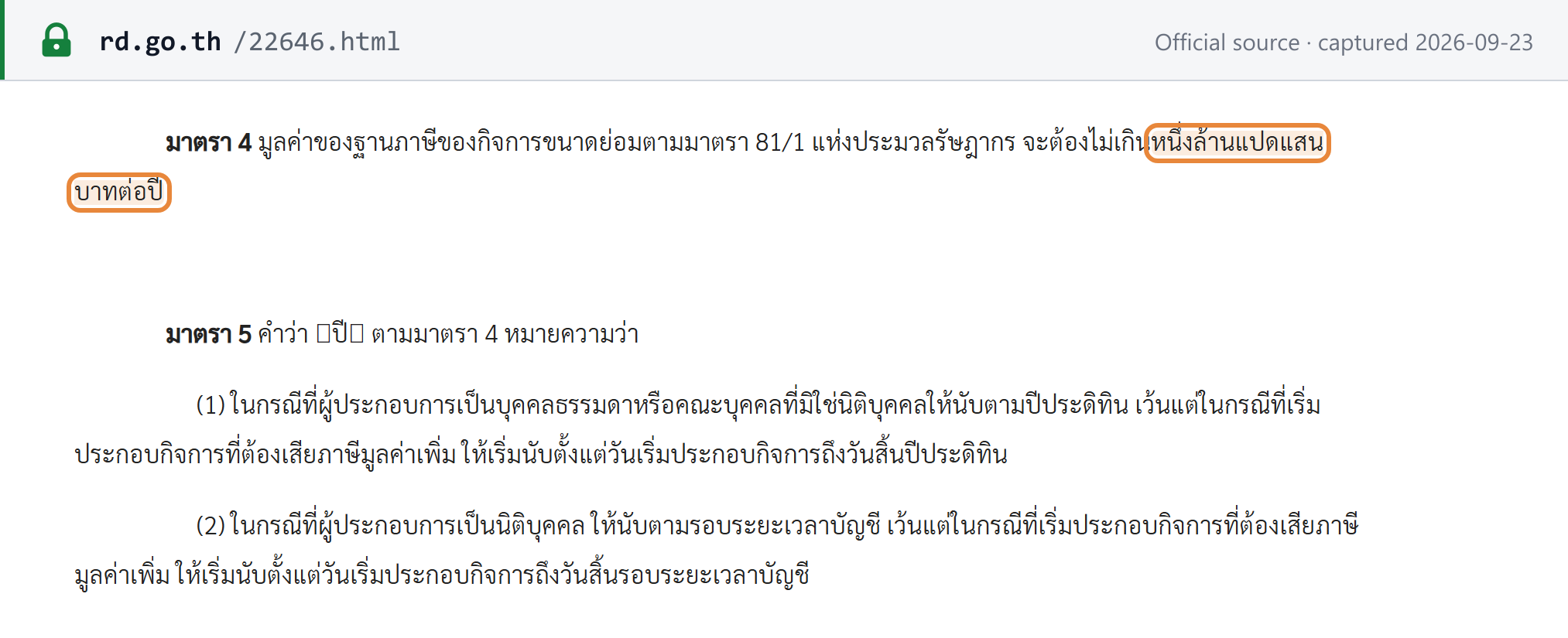
Royal Decree No. 432, section 4 (in force since 1 April 2005): «มูลค่าของฐานภาษีของกิจการขนาดย่อมตามมาตรา 81/1 แห่งประมวลรัษฎากร จะต้องไม่เกินหนึ่งล้านแปดแสนบาทต่อปี» — the value of tax base of a small business under section 81/1 must not exceed THB 1.8 million a year. The Revenue Department repeated the figure in a press release of 2 August 2026. [9] [12]
Non-resident registration
There is no distinct non-resident threshold for supplies made in Thailand; how the rules bite depends on how the non-resident operates: [5] [7]
- Selling habitually in Thailand through an agent. The agent is a taxable person and must register the non-resident — section 85/2: "Agent under Section 82/1(1) shall be responsible for value added tax registration of business person residing abroad."
- Entering Thailand temporarily to sell. Not required to register (section 85/3(1)); the Thai payer remits the VAT instead (section 83/6).
- Services supplied from abroad and used in Thailand. Section 85/3(2), as amended by Act No. 53, removes the registration duty for (ก) electronic services supplied to VAT registrants and (ข) all other services supplied from abroad. The Thai customer self-assesses on form PP.36 — see Imports and exports.
- Electronic services to customers who are not VAT-registered. Register on the VES system above THB 1.8 million a year — see Digital products and services.
Tax identification number
A Thai taxpayer identification number has 13 digits — see Lookuptax's Thailand tax ID guide for its format and how it is issued. For VAT, each place of business also carries a five-digit branch code, as shown on the VAT registration certificate (form ภ.พ.20, PP.20): 00000 for the head office and a branch number for each branch. Director-General Notification on VAT No. 199 lets the head office be identified by the word for head office (สำนักงานใหญ่), an abbreviation such as HO or HQ, or «ตัวเลขศูนย์จำนวนห้าหลัก (00000)» — the five-digit zero code. The code must appear on full tax invoices — see Mandatory content. [14]
How to register
The Revenue Department accepts applications through two channels: «ยื่นแบบคำขอผ่านทางอินเทอร์เน็ตที่ www.rd.go.th» (online at www.rd.go.th) or «ยื่นแบบคำขอด้วยกระดาษ ณ หน่วยจดทะเบียนที่ตั้งสถานประกอบการ» (on paper at the registration office where the place of business is located). [25]
- Forms. ภ.พ.01 (PP.01) is the application. ภ.พ.01.1 (PP.01.1) is the election to register by a business that would otherwise be exempt. The certificate issued is ภ.พ.20 (PP.20).
- Several places of business. Section 85: "If a business person has several places of business, value added tax registration application shall be made at local Amphur office where the headquarters is located." [5]
- Documents. The Revenue Department's checklist (VAT05) asks for proof of the premises (a lease or the owner's consent; a condominium manager's certificate for a condominium unit), a sketch map and photographs of the premises, and a stamped power of attorney where an agent applies. Foreign applicants add a passport copy and a copy of their business licence. A non-resident applying through a Thai agent adds a written appointment of the agent, certified by a Thai embassy or consulate or by a person the Director-General approves. [26]
- Timeline. The Revenue Department's registration pages state no processing time.
Voluntary registration
Available. A small business under the THB 1.8 million ceiling, and a seller of goods exempt under section 81(1)(a)–(f), may notify the Director-General and elect to register (section 81/3), then must register within 30 days of that notice (section 85/1(2)). Registration before trading starts is also allowed (section 85). The usual reasons to register voluntarily are to issue tax invoices that business customers can claim, and to recover input VAT. [3] [5]
Deregistration
- Voluntary cancellation. A registrant whose value of tax base has been below the small-business ceiling "for at least 3 consecutive years prior to the request for cancellation" may apply to cancel (section 85/10(1)). A business that elected in under section 81/3 may cancel after a period set by Ministerial Regulation, which must be at least 2 years (section 85/10(3)).
- Ceasing business. Section 85/15: a registrant ceasing business "shall notify such cessation … within 15 days as from the date of business cessation", and returns its PP.20. Liability continues until the Director-General removes the business from the register (sections 85/18–85/19). The last tax month ends on the removal date (section 77/1(23)).
- Final position. Goods and assets still held when the business ceases are treated as sold at market price (sections 77/1(8) and 79/3). Records must be kept for a further 2 years after cessation (section 87/3).
Group registration
Not available. The Revenue Code's VAT chapter contains no grouping provision. The nearest mechanism works within one business: a registrant with several places of business files per place of business, unless the Director-General approves joint filing at one office (section 83). [4]
Rates
| Rate | Applies to | Effective |
|---|---|---|
| 7% — 6.3% VAT plus local tax | Sales of goods, provision of services and imports | Where liability arises 1 October 2017 – 30 September 2027, under section 4 of Royal Decree No. 646 B.E. 2560 as last substituted by Royal Decree No. 807 B.E. 2569 (in force 1 October 2026) [10] |
| 10% — statutory rate | Sales of goods, provision of services and imports (section 80) | Applies to liability arising from 1 October 2027 unless another Royal Decree extends the reduction [3] |
| 0% (zero-rated) | Exports and the other supplies in section 80/1 — see below | — |
| Exempt (no VAT, no input-tax recovery) | See Exemptions | — |
The statutory rate is 10%. Section 80: "The tax rate of 10.00% shall be used in value added tax calculation for the following businesses … (1) sale of goods; (2) provision of services; (3) importation; the rate under paragraph 1 may be reduced by Royal Decree but the rate for each sale of goods, provision of services or importation shall be the same rate." [3]
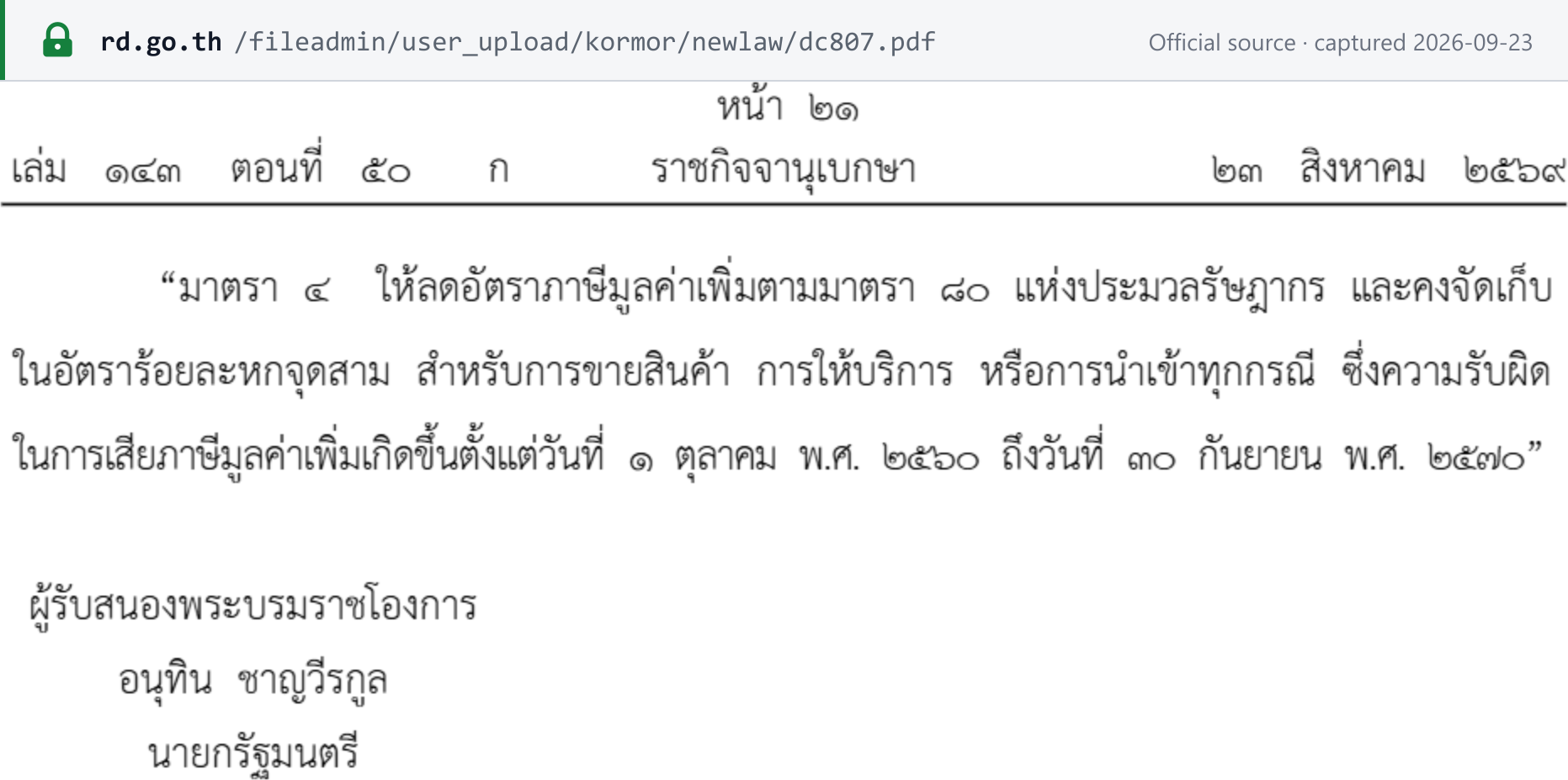
The rate charged is 7% until 30 September 2027. Royal Decree No. 807 B.E. 2569 was given on 20 August 2026 and published in the Royal Gazette (Vol. 143, Part 50 Kor) on 23 August 2026. It comes into force on 1 October 2026 (section 2) and substitutes a new section 4 in Royal Decree No. 646 B.E. 2560, which reads: «ให้ลดอัตราภาษีมูลค่าเพิ่มตามมาตรา ๘๐ แห่งประมวลรัษฎากร และคงจัดเก็บในอัตราร้อยละหกจุดสาม สำหรับการขายสินค้า การให้บริการ หรือการนำเข้าทุกกรณี ซึ่งความรับผิดในการเสียภาษีมูลค่าเพิ่มเกิดขึ้นตั้งแต่วันที่ ๑ ตุลาคม พ.ศ. ๒๕๖๐ ถึงวันที่ ๓๐ กันยายน พ.ศ. ๒๕๗๐» — the section 80 rate is reduced and kept at 6.3% for all sales of goods, services and imports where VAT liability arises from 1 October 2017 (B.E. 2560) to 30 September 2027 (B.E. 2570). With local tax, that is the 7% the Revenue Department announces: «ยังคงจัดเก็บในอัตราร้อยละ ๗ ต่อไป» ("continues to be collected at 7%"). [10] [12]
The reduction is renewed by decree, usually for a year at a time. The previous extension, Royal Decree No. 799 B.E. 2568 (given 13 September 2025, Royal Gazette 14 September 2025), ran from 1 October 2025 to 30 September 2026. [13]
Zero rate. Section 80/1 zero-rates: exports of goods not exempt under section 81(3); "provision of services performed in Thailand and used in a foreign country" under the Director-General's rules; international transport by aircraft or ship provided by a juristic person; supplies to government bodies under foreign-aid or loan programmes; supplies to United Nations agencies, embassies and consulates; and supplies between bonded-warehouse and customs-free-zone operators. [3]
Reduced rates. Not applicable — sections 80–80/2 of the Revenue Code provide one positive rate, the zero rate and exemptions, and no reduced rate for particular goods or services. The 2.5% in section 80/2 is not a reduced rate on goods: it is the rate for the simplified regime under section 82/16, whose registrants may not charge VAT to customers or issue tax invoices. [3]
Announced future rates. No rate change has been announced beyond 30 September 2027. Plan for either another extension or the 10% statutory rate from 1 October 2027.
For Thailand alongside other jurisdictions, see Lookuptax's worldwide tax rates table.
Cross-border rules
Imports and exports
- Imports of goods. "An importer is also subject to VAT in Thailand no matter whether one is a registered person or not. VAT will be collected by the Customs Department at the time goods are imported." The importer pays the VAT to Customs together with import duty (section 83/8). The tax base is the CIF value plus import duty, excise tax and other taxes and fees (section 79/2). The tax point is when duty is paid or secured, or when the goods pass the entry if they are duty-free (section 78/2). [1] [4] [2]
- Low-value imports. Customs Department Notification No. 219/2568, in force 1 January 2026, limits the customs-duty exemption for low-value items (category 12 of Part 4 of the Customs Tariff Decree B.E. 2530) to items valued at not more than THB 1: «ของที่นำเข้า ซึ่งแต่ละรายมีราคาไม่เกิน ๑ บาท ได้รับยกเว้นอากร» ("imported goods each valued at not more than 1 baht are exempt from duty"). It revokes the earlier Notification No. 191/2561. Section 81(2)(c) of the Revenue Code exempts from VAT imports of "goods classified into duty exemption category under the law on customs tariff", so the VAT exemption follows the duty category. According to the government's own statement, VAT was already being collected on these imports before the new notification: on 16 December 2025 the Government Public Relations Department relayed the Prime Minister's Office deputy spokesperson saying that until 31 December 2025 only 7% VAT was collected on them, with no import duty («ยังคงจัดเก็บเฉพาะ VAT 7% เท่านั้น โดยยังไม่เก็บอากรขาเข้า»), and that from 1 January 2026 both VAT and import duty are collected on every imported item valued at THB 1 or more («ภาษีมูลค่าเพิ่ม (VAT) และอากรขาเข้า สำหรับ สินค้านำเข้าทุกชิ้น ตั้งแต่มูลค่า 1 บาทขึ้นไป»). The change on 1 January 2026 is therefore the import duty. [24] [3] [31]
- Exports. Zero-rated (section 80/1(1)). The tax base is "the F.O.B. price plus excise tax … and other taxes and fees as prescribed by Royal Decree but excluding export duty" (section 79/1(1)). The tax point is when export duty is paid or secured, or when the export entry is passed (section 78(4)). [2]
- Reverse charge on imported services (PP.36). "Services utilized in Thailand supplied by service providers in other countries are also subject to VAT in Thailand. In such a case, service recipient in Thailand is obliged to file VAT return (Form VAT 36) and pay tax" (section 83/6). The deadline is 7 days after the end of the month in which the payment was made, extended to 15 days for returns filed online under the Ministry of Finance e-filing notification No. 7, for filings due between 1 February 2024 and 31 January 2027. A VAT-registered payer can claim the VAT it remits as input tax. [1] [4] [22]
Digital products and services
Since 1 September 2021, under Revenue Code Amendment Act No. 53, foreign providers of electronic services, and foreign electronic platforms, must register for VAT in Thailand once they sell enough to customers who are not VAT-registered. The Revenue Department's e-Service guide: [23]
"non-resident electronic service providers and electronic platforms, who receive income of more than 1.8 million baht per year from providing electronic services to non-VAT registered customers in Thailand, shall register for VAT, file VAT returns, and pay VAT. The amount of VAT payment is based on output tax without input tax deduction starting from 1 September 2021. The electronic service providers and electronic platforms are not allowed to issue a tax invoice and are not required to keep input tax report."
- Registration. Through the VES system, within 30 days of exceeding THB 1.8 million. Registering below the threshold is voluntary.
- Returns. Form ภ.พ.30.9 (PP.30.9), monthly: "VAT returns shall be filed from the 1st to 23rd of the following tax month".
- No tax invoices. A VES registrant may not issue Thai tax invoices — also section 86/1(1/1) of the current Thai Revenue Code. [7]
- B2B is outside VES. "Electronic services provided from abroad to customers who are VAT registrants in Thailand are subject to VAT and the reverse charge method is applied."
The e-Service guide cited here is the Second Edition of May 2022.
Foreign companies selling into Thailand — B2B and B2C
The answer depends on what is sold and to whom: [7] [4] [23]
- Services to businesses (B2B). The foreign supplier does not register (section 85/3(2), as amended). The Thai customer self-assesses the VAT on PP.36 (section 83/6).
- Electronic services to consumers (B2C). The foreign supplier registers on VES once its income from non-registered Thai customers exceeds THB 1.8 million a year, files PP.30.9 monthly by the 23rd, and may not issue tax invoices.
- Other services to consumers, performed abroad. Section 85/3(2)(ข) removes the registration duty, and the section 83/6 payer-remits mechanism applies in principle.
- Goods shipped in (B2B or B2C). Import VAT is paid at the border by the importer (sections 82 and 83/8). The low-value duty exemption is now THB 1 — see Imports and exports.
- Goods or services supplied inside Thailand by a non-resident. Taxable. A non-resident trading through an agent is registered by the agent (sections 82/1(1) and 85/2); a temporary operator need not register, but the Thai payer remits the VAT (sections 85/3(1) and 83/6(1)).
Marketplace / platform deemed-supplier liability
For electronic services only. A non-resident "electronic platform" that facilitates the electronic services of non-resident providers — with "a continuous process comprising offering service, receiving payment of service, and delivering service" — registers for VAT itself, in place of the providers. For goods marketplaces, neither the Revenue Code's VAT chapter nor the Revenue Department's e-Service guide sets a deemed-supplier rule. [23]
Place of supply
- Services (section 77/2). "Provision of services in Thailand means services performed in Thailand whether or not the services are used in a foreign country or in Thailand. Provision of services performed in a foreign country and used in Thailand shall be deemed services performed in Thailand."
- Goods. Taxable when sold in Thailand by a business person, or when imported (section 77/2). The VAT chapter has no separate place-of-supply code for goods beyond this and the import rules.
For regional context, see Lookuptax's Malaysia SST guide and Vietnam VAT guide.
Invoice requirements
Invoice rules sit in sections 86 to 86/15 of the Revenue Code, supplemented by notifications of the Director-General. The Revenue Department publishes its own annotated specimen tax invoice in its e-Tax Invoice brochure (the specimens are dated B.E. 2565, i.e. 2022), «ข้อควรรู้ ใบกำกับภาษีอิเล็กทรอนิกส์» ("what to know about electronic tax invoices"). Its callouts label each particular, and its footer cites «มาตรา 86/4 แห่งประมวลรัษฎากร และกฎกระทรวง ฉบับที่ 384 (พ.ศ. 2565)» — section 86/4 of the Revenue Code and Ministerial Regulation No. 384 (B.E. 2565). [18]
Mandatory content
A full tax invoice (ใบกำกับภาษีเต็มรูป) must carry the following particulars. Section 86/4 opens: "the tax invoice shall at least contain the following particulars". Director-General Notification on VAT No. 199 (26 December 2013) adds the place-of-business and buyer-ID fields, for invoices issued from 1 January 2015. [5] [14]
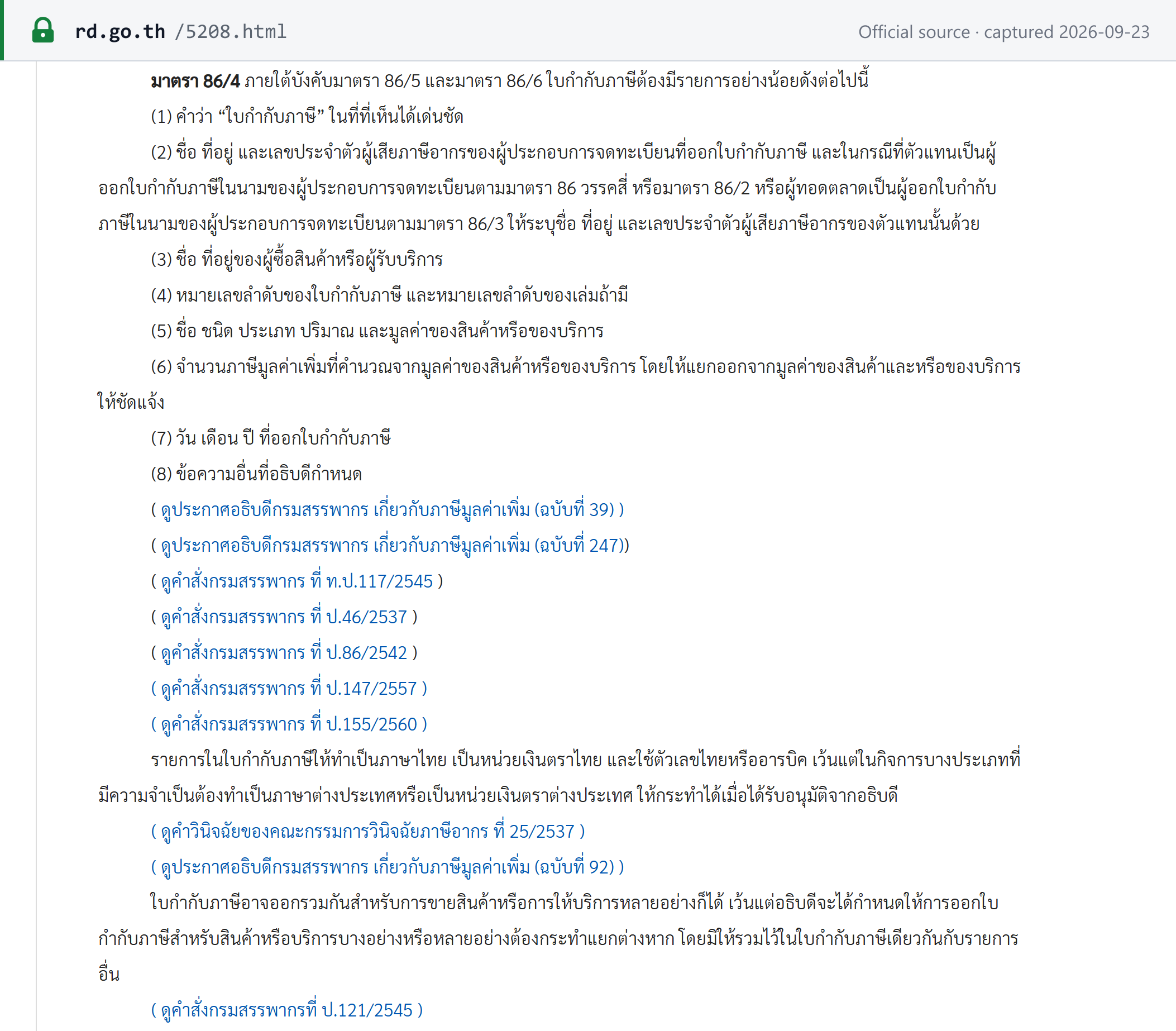
| # | Required field | Legal cite |
|---|---|---|
| 1 | The words "tax invoice" (ใบกำกับภาษี) in a prominent place | s.86/4(1) |
| 2 | Seller's name, address and 13-digit taxpayer identification number (and the agent's, where an agent issues the invoice) | s.86/4(2) |
| 3 | Seller's place of business: head office (สำนักงานใหญ่, HO, HQ or 00000) or branch number | DG VAT No. 199, cl.8 |
| 4 | Buyer's name and address | s.86/4(3) |
| 5 | Buyer's taxpayer identification number, where the buyer is a VAT registrant | DG VAT No. 199, cl.7 |
| 6 | Buyer's head office or branch, as on the buyer's PP.20, where the buyer is a VAT registrant | DG VAT No. 199, cl.9 |
| 7 | Serial number of the invoice, and of the book if books are used | s.86/4(4) |
| 8 | Description, type, category, quantity and value of the goods or services | s.86/4(5) |
| 9 | VAT amount, shown separately from the value of the goods or services | s.86/4(6) |
| 10 | Date of issue | s.86/4(7) |
| 11 | Any other particulars prescribed by the Director-General | s.86/4(8) |
Clause 7 of Notification No. 199: «ผู้ประกอบการจดทะเบียนจะต้องระบุเลขประจำตัวผู้เสียภาษีอากรของผู้ซื้อสินค้าหรือผู้รับบริการซึ่งเป็นผู้ประกอบการจดทะเบียน ไว้ในใบกำกับภาษีนั้น» — the registrant must state on the tax invoice the tax identification number of a buyer who is a VAT registrant. Several supplies may share one invoice unless the Director-General requires separate invoices (section 86/4). [14] [5]
Extra wording on e-tax invoices. Director-General Notification on VAT No. 247 (6 January 2023, Royal Gazette 17 February 2023), made under section 86/4(8), adds two statements for electronic tax invoices. A full e-tax invoice issued at the buyer's request in place of an abbreviated e-tax invoice must state that it cancels abbreviated e-tax invoice no. … dated … and is issued in its place. A full tax invoice signed with an electronic certificate but delivered to the buyer as a printout must state «เอกสารนี้ได้จัดทำและส่งข้อมูลให้แก่กรมสรรพากรด้วยวิธีการทางอิเล็กทรอนิกส์» — "this document was prepared, and its data sent to the Revenue Department, electronically". [30]
Issuance deadline
Immediately, at the tax point. Section 86: "a VAT registrant shall immediately issue tax invoice and its copy for every sale of goods or provision of service at the time the tax liability taking place as well as provide such tax invoice to the purchaser of goods and service". Each place of business issues its own invoices unless the Director-General prescribes otherwise. [5]
The tax point for goods is the earliest of delivery, transfer of ownership, receipt of payment or issue of the invoice (section 78(1)). For services it is the earliest of receipt of payment, issue of the invoice or use of the service (section 78/1(1)). [2]
Numbering and sequencing
Each invoice carries a serial number, and a book number if books are used (section 86/4(4)). The Revenue Code states no separate gap-free-sequence rule. A replacement for a lost or damaged invoice repeats the original particulars "with the word in a prominent place stating that it is a substitute for which tax invoice, debit note or credit note" (section 86/12). [5]
Credit and debit notes
- Debit note (ใบเพิ่มหนี้, section 86/9) — for a price increase after the invoice.
- Credit note (ใบลดหนี้, section 86/10) — for a price reduction, returned goods, or termination of a service contract.
- Content. The words "debit note" or "credit note"; the issuer's name, address and tax identification number; the buyer's name and address; the date; "the serial number of the original tax invoice and, if any, of book, the value of goods or service shown in the tax invoice, the correct value of goods or service, the difference between the two, and the amount of value added tax being credited"; and a "brief reason in issuing credit note" (section 86/10(5)–(6); section 86/9 mirrors it).
- Timing and effect. Notes are issued in the tax month in which the event occurs. Both count as tax invoices (section 77/1(22)). The seller adjusts its output tax, and the buyer its input tax, in the month the note is issued or received (sections 82/9 and 82/10).
Currency and language
- Language and currency. Section 86/4: "Particulars in tax invoice shall be in Thai language, Thai currency and Thai or Arabic numeral. However, in some category of business which tax invoice is required to be in foreign language or currency, the VAT registrant shall be issue such tax invoice upon approval from the Director-General." The same applies to abbreviated tax invoices (section 86/6). [5]
- Foreign-currency transactions (section 79/4). If the foreign currency is sold for baht in the month the tax liability arises, the tax base is the baht received. Otherwise the rate is "the average selling rate of commercial banks which calculated on the last working day of the month the tax liability taking place by the Bank of Thailand". Imports use the rate Customs applies for duty. [2]
- VES registrants use a different rate — "the average (transfer) buying rate of commercial banks which the Bank of Thailand calculates on the last business day of the month in which the VAT liability arises." [23]
Document types
| Document | When it is used | Cite |
|---|---|---|
| Full tax invoice (ใบกำกับภาษีเต็มรูป) | Default for every sale by a VAT registrant; the document a buyer needs to claim input tax | s.86/4 |
| Abbreviated tax invoice (ใบกำกับภาษีอย่างย่อ) | Retail businesses only; the price is shown VAT-inclusive and the buyer is not named | s.86/6; DG VAT No. 32 |
| No invoice, sales of THB 1,000 or less | Certain small-amount retail operators, unless the buyer asks for an invoice | s.86/8; DG VAT No. 154 |
| Debit note / credit note | Price adjustments; deemed tax invoices | ss.86/9–86/10, 77/1(22) |
| Receipts for VAT paid | Government auction receipts and Revenue, Customs or Excise receipts for VAT; deemed tax invoices | ss.77/1(22), 86/14 |
- Abbreviated tax invoices. Only "retail" businesses, as defined in Director-General Notification on VAT No. 32 (8 April 1992), may issue them — businesses selling direct to consumers in consumer quantities, such as stalls, grocery shops, pharmacies, fuel stations and department stores, and services provided to many people, such as restaurants, hotels, repairs and cinemas. A non-retail business needs the Director-General's approval (section 86/7), as does issuing abbreviated invoices from a cash register. A retailer must still issue a full tax invoice when the buyer asks for one. Section 86/6 requires at least: the words "tax invoice"; the issuer's name or abbreviated name and tax identification number; the serial number; the description, type, category, quantity and value of the goods or services; "the price of goods or services which clearly shown that value added tax is included"; and the date of issue. Neither the Revenue Code nor Notification No. 32 sets a value ceiling on abbreviated invoices. [5] [17]
- The buyer cannot claim input VAT on an abbreviated invoice. Director-General Notification on VAT No. 42 lists «ภาษีซื้อตามใบกำกับภาษีอย่างย่อตามมาตรา 86/6 และมาตรา 86/7 แห่งประมวลรัษฎากร» — input tax on abbreviated tax invoices under sections 86/6 and 86/7 — among input tax that cannot be credited. [15]
- Small sales. Under Director-General Notification on VAT No. 154 (2 June 2003), registrants whose monthly tax base has never reached THB 300,000, and certain operators such as carts and stalls, admissions to shows and sports events, public telephones, expressway tolls, airport services, and public services connected with mass transit (such as parking or toilets for rail passengers), «ไม่จำต้องออกใบกำกับภาษีสำหรับการขายสินค้าหรือการให้บริการที่มีมูลค่าครั้งหนึ่งไม่เกิน 1,000 บาท เว้นแต่ผู้ซื้อสินค้าหรือผู้รับบริการจะเรียกร้องใบกำกับภาษี» — need not issue a tax invoice for a sale of not more than THB 1,000 unless the buyer asks for one. [16]
Self-billing
Not provided for. The Revenue Code allows invoices to be issued by the registrant, by an agent on its behalf under the Director-General's rules (section 86), and by an approved agent of a non-resident registrant (section 86/2). Anyone else is barred — section 86/13: "It is prohibited for a person who is not a VAT registrant or an authorized person in issuing tax invoices under this Chapter to issue tax invoice, debit note or credit note." Doing so is a criminal offence (section 90/4(3)). The VAT chapter has no provision for buyer-issued invoices. [5] [6]
Retention and audit trail
- Retention. Tax invoices, copies, reports and supporting documents are kept at the place of business "for at least 5 years as from the date of tax return filing or report making". The Director-General may require up to 7 years, and records are kept for a further 2 years after the business ceases (section 87/3). [6] [8]
- Reports. Each place of business keeps an output-tax report, an input-tax report and, for sellers of goods, a goods and raw-material report (section 87), with purchase invoices filed in the order of the input-tax report (section 87/3). [6]
- Electronic archiving is allowed for electronic tax invoices. Clause 12 of Ministerial Regulation No. 384 requires a security system that can prove an invoice is accurate and complete as when it was made, sent or received, and that can detect changes to it. Clause 4 of Director-General General Notification No. 48 requires e-invoices to be kept by a reliable method — unchanged, in their original format, with the data identifying their origin, destination and time of sending and receipt. [19] [20]
Technical format
Not applicable — Thailand mandates no structured e-invoice format; see E-invoicing status for the voluntary e-Tax Invoice system.
A specimen of a compliant invoice
The Revenue Department's own annotated specimen is on page 1 of its e-Tax Invoice brochure (in Thai). It shows "(สำนักงานใหญ่)" after the company names but has no callout for the Notification No. 199 place-of-business code. The layout below is Lookuptax's own illustration of the section 86/4 and Notification No. 199 particulars, with English labels. Every name, number and amount in it is fictional:
Tax Invoice — ใบกำกับภาษี
| Description and types.86/4(5) | Quantitys.86/4(5) | Unit price (excl. VAT) | Value (excl. VAT)s.86/4(5) |
|---|---|---|---|
| Office desks | 20 | THB 2,500.00 | THB 50,000.00 |
- Value of goods (excl. VAT)s.86/4(5)
- THB 50,000.00
- VAT 7%s.86/4(6)
- THB 3,500.00
- Total including VAT
- THB 53,500.00
- The words "tax invoice" (ใบกำกับภาษี) must appear in a prominent place — s.86/4(1).
- The VAT amount must be shown separately from the value of the goods or services — s.86/4(6).
- The buyer's tax ID and branch are required because the buyer is a VAT registrant; for a buyer who is not, name and address are enough — DG VAT No. 199, cl.7 and cl.9.
- Issued immediately at the tax point, by the place of business that made the sale — s.86.
- 7% is 6.3% VAT plus local tax, under Royal Decree No. 807, for liability arising up to 30 September 2027.
E-invoicing status
Status (as of 2026-09-23): voluntary. There is no B2B, B2G or B2C e-invoicing mandate; a registrant may choose to issue tax invoices electronically.
The legal basis. Revenue Code Amendment Act No. 53 (2021) amended section 3 โสฬส (3 soḷasa) of the Revenue Code, which Ministerial Regulation No. 384 (B.E. 2565) implements. The Regulation was published in the Royal Gazette on 20 July 2022 and came into force 30 days after publication. [19]
- Clause 12 is permissive. Registrants on the Director-General's list «อาจจัดทำ ส่ง หรือเก็บรักษาใบกำกับภาษีหรือใบรับโดยวิธีการทางอิเล็กทรอนิกส์ได้» — may make, send or keep tax invoices or receipts electronically, directly or through a service provider.
- Clause 13 — authentication. An electronic tax invoice carries an electronic signature with a certificate from a certification authority accredited by the National Root CA, or is instead certified by the Electronic Transactions Development Agency (ETDA) or another listed body.
Director-General General Notification No. 48 (Royal Gazette 17 February 2023, effective 19 August 2022) sets the operating rules: the format is as published on the Revenue Department's website; the invoice is delivered to the buyer electronically; and «ให้ผู้ประกอบการจดทะเบียนหรือผู้มีหน้าที่ออกใบรับ แจ้งข้อมูลใบกำกับภาษีหรือใบรับ … ผ่านระบบอิเล็กทรอนิกส์ของกรมสรรพากร» — the issuer reports the invoice data through the Revenue Department's electronic system. The earlier Director-General General Notification No. 15 (2019) is marked on rd.go.th as «สิ้นผลใช้บังคับ» — no longer in force — since Act No. 53 amended section 3 โสฬส. [20] [21]
Reporting deadline. Clause 16 of Ministerial Regulation No. 384 requires the issuer to report the data of each electronic tax invoice, debit note, credit note or receipt «ให้แก่กรมสรรพากรโดยผ่านระบบอิเล็กทรอนิกส์ของกรมสรรพากร ภายในวันที่สิบห้าของเดือนถัดไป» — to the Revenue Department through its electronic system by the 15th of the following month. The reporting duty «ไม่ใช้บังคับกับใบกำกับภาษีอย่างย่อ» — does not apply to abbreviated tax invoices. [19]
Systems. The Revenue Department's e-Tax Invoice brochure describes two channels: [18]
- e-Tax Invoice & e-Receipt — digitally signed invoices whose data is reported to the Revenue Department, through the e-Tax Invoice portal.
- e-Tax Invoice by Email — the seller emails the draft invoice to the buyer and copies an ETDA system, which applies a time stamp («ประทับรับรองเวลา (Time Stamp) โดย ETDA»). The buyer can check the signature or time stamp by uploading the file at validation.teda.th.
Formats. Notification No. 48 does not set a file format itself; it refers to the format the Revenue Department publishes on its website. The lapsed Notification No. 15 had required invoice data to follow ETDA recommendation ขมธอ. 3-2560. There is no Peppol network and no clearance or continuous-transaction-control system.
Phases, thresholds and scope. Not applicable — with no mandate there are no phases or size thresholds, and B2B, B2G and B2C are all voluntary.
Filing and payment
Filing frequency
Monthly for every registrant, per place of business unless joint filing is approved (section 83). Returns are due for every tax month, including months with no sales. A Royal Decree may put individuals on periods of up to 3 months (section 83/1). [4] [1]
Return due date
| Return | Paper | Online |
|---|---|---|
| ภ.พ.30 (PP.30) — monthly VAT return | 15th of the following month (s.83) | 23rd of the following month |
| ภ.พ.36 (PP.36) — reverse charge on payments abroad | 7 days after the end of the month of payment | 15 days after the end of the month of payment |
| ภ.พ.30.9 (PP.30.9) — VES return | — | 23rd of the following month (VES system only) |
Section 83: "Tax return filing and payment of tax for any tax month shall be made within the 15 day of the following month except the Director-General may prescribe otherwise." The online extension comes from the Ministry of Finance notification on extending internet filing, No. 7 (12 January 2024), as amended by Nos. 8 and 9, for filings due between 1 February 2024 and 31 January 2027 — item 1.6: «ภ.พ.๓๐ ซึ่งผู้ประกอบการจะต้องยื่นแบบแสดงรายการภาษีภายในวันที่ ๑๕ ของเดือนถัดไป ให้ขยายกำหนดเวลาดังกล่าวออกไปเป็นภายในวันที่ ๒๓ ของเดือนถัดไป» — the PP.30 deadline of the 15th of the following month is extended to the 23rd. Clause 2 of the notification limits the extension where the same return is filed twice: if it is filed on paper first and then online, the online filing gets no extension; if it is filed online on time and then on paper, only the paper filing loses it. The online window ends on 31 January 2027 unless it is extended again. [4] [22] [23]
Payment due date and method
Payment is due with the return, on the same deadline. The Revenue Department describes filing and paying PP.30 and PP.36 online at www.rd.go.th in five steps: register as a user, file the return, pay, check the result, and print. [27]
Additional listings
- No annual VAT return and no sales or purchase listing is filed with the return. Instead, the registrant keeps output-tax, input-tax and inventory reports (section 87).
- E-tax-invoice issuers report invoice data through the Revenue Department's system (DG General Notification No. 48).
- Contracts. Government bodies and persons the Director-General specifies lodge copies of contracts of THB 500,000 or more by the 15th of the following month (section 77/4).
- Changes. Changes to registered particulars are notified on form ภ.พ.09 (PP.09) within 15 days (sections 85/6–85/8).
Input-tax recovery and blocked items
Input tax is credited against output tax month by month (section 82/3). Input tax missed in its month for a reason the Director-General recognises may be claimed later, "but not exceeding 3 years as from the date of issuance of tax invoice". Input tax on mixed-use purchases is apportioned (section 82/6). [3]
Blocked input tax (section 82/5 and Director-General Notification on VAT No. 42): [3] [15]
- no tax invoice, or an invoice missing required particulars;
- expenses not directly related to the business;
- "expenses on guest-entertaining or similar activity";
- invoices issued by someone not entitled to issue them;
- passenger cars and passenger vehicles with up to 10 seats — purchase, hire-purchase, lease or transfer: «รถยนต์นั่งและรถยนต์โดยสารที่มีที่นั่งไม่เกิน 10 คน» (car dealers and car-rental businesses are carved out);
- abbreviated tax invoices;
- inputs used for exempt businesses.
The Revenue Department notes that input VAT that cannot be credited may be deducted as an expense for corporate income tax. [1]
Refunds
- Excess credit. Carried forward, or claimed as a cash refund on the return (section 84): "a VAT registrant shall be entitled to carry it for the value added tax payment … or to claim for refund at the time of filing of tax return". A refund not claimed on the return can be requested "within 3 years as from the day after the last day on which the tax return is required to be filed" (section 84/1). Refunds carry interest (section 84/3). Zero-rated suppliers are structurally in a refund position: "in case of zero-rated, taxpayer will always be entitled to VAT refund." [4] [1]
- A note on the RD overview. The Revenue Department's English overview, last updated in 2020, says unused input tax "may be creditable against output tax within the next 6 months". The Revenue Code (sections 82/3 and 84) sets the limits above; rely on the Code.
- Bad-debt relief. Output VAT on qualifying bad debts written off is deducted in the month of write-off, and amounts later recovered are added back (section 82/11). [3]
- Non-residents. Apart from refunds to VES registrants through the VES system, the Revenue Code provides no VAT refund scheme for foreign businesses.
- Tourists. Section 84/4 provides for VAT refunds to tourists; this guide does not cover the conditions.
Exemptions
Exempt supplies
Section 81 exempts, among others: [3]
- unprocessed agricultural products, and animals and animal products, fresh or simply preserved;
- fertiliser, fish meal and animal feed, and agricultural chemicals;
- "sale of newspaper, magazine or school books";
- education by public and licensed private institutions;
- medical, auditing, legal and other regulated professional services, and healthcare institutions;
- research and academic services, libraries, museums and zoos;
- art and cultural services on the Director-General's list, and amateur sport;
- "(p) provision of domestic transport; (q) provision of international transport excluding transport by aircraft or ship; (r) rental of immovable property";
- religious and charitable supplies, and non-commercial services of local authorities;
- imports of the exempt goods above, and imports in a customs duty-exemption category (section 81(2)(c)).
Small businesses at or below THB 1.8 million are exempt under section 81/1. Financial services and real-estate sales are outside VAT and subject to Specific Business Tax (section 77/3) — see Special regimes. [3]
Exempt is not zero-rated
An exempt supply carries no output VAT, and the input VAT on it cannot be credited — Director-General Notification on VAT No. 42 blocks «ภาษีซื้อที่เกิดจากการซื้อทรัพย์สินเพื่อใช้หรือจะใช้ในกิจการประเภทที่ไม่ต้องเสียภาษีมูลค่าเพิ่ม» (input tax on assets used in a VAT-exempt business). A zero-rated supply is taxed at 0%, and the supplier keeps full input credit and can claim refunds. A seller of exempt goods or a small business can elect into VAT under section 81/3 to regain input credit. [15] [1]
Special regimes
- Specific Business Tax (SBT) replaces VAT for banking, finance, securities and credit foncier businesses (3.0%), life insurance (2.5%), pawnbroking (2.5%), businesses similar to commercial banking (3.0%), commercial real-estate sales and certain sales of securities. "Local tax at the rate of 10 % is imposed on top of SBT." Returns (form ภ.ธ.40) are monthly, due by the 15th, or the 23rd online. A business subject to SBT registers on form ภ.ธ.01 "within 30 days of its first day of operation". These rates are from the Revenue Department's English SBT page, last updated in 2020. [28] [22]
- Customs free zones, export processing zones and bonded warehouses. Supplies between zone and warehouse operators are zero-rated (section 80/1), and certain duty-exempt imports into zones are VAT-exempt (section 81(2)). [3]
- Small-business exemption at or below THB 1.8 million a year — see Registration threshold.
- Margin scheme and cash accounting. Not applicable — the VAT chapter provides neither. Services already have a payment-based tax point (section 78/1).
Offences and penalties
Offences
Criminal offences under the Revenue Code are separate from the civil penalties below, and apply on top of them: [6] [8]
| Section | Examples of the conduct | Punishment |
|---|---|---|
| s.90 | Failure to file a return; failure to notify changes; invoices missing required particulars (s.90(12)) | Fine up to THB 2,000 |
| s.90/1 | Failure to display the PP.20; failure to notify the opening or closing of a branch; an agent's failure to register a non-resident | Fine up to THB 5,000 |
| s.90/2 | Trading while liable but unregistered; failure to issue or deliver a tax invoice, including when the buyer asks under s.86/8; cash-register breaches | Up to 1 month in prison and/or a fine up to THB 5,000 |
| s.90/3 | Using an unapproved cash register; failure to keep reports; obstructing officials | Up to 6 months in prison and/or a fine up to THB 10,000 |
| s.90/4 | Evading tax through false or unauthorised invoices; issuing tax invoices without the right to do so; false reports; fraudulent refund claims; using false invoices to claim input tax | 3 months to 7 years in prison and a fine of THB 2,000–200,000 |
| s.90/5 | Offence by a juristic person | A director, manager or any person responsible for its operations is also punished where the offence resulted from their instruction or act, or from their failure to instruct or act when it was their duty to do so: «ถ้าการกระทำความผิดของนิติบุคคลนั้นเกิดจากการสั่งการหรือการกระทำของกรรมการหรือผู้จัดการ … ผู้นั้นต้องรับโทษ» (current Thai text) [8] |
Section 90/4: "The following persons failing to comply with the provisions stated below shall be sentenced from 3 months up to 7 years and fined 2,000 up to 200,000 Baht". The Revenue Department is enforcing this now: in a press release of 17 August 2026 it announced a joint operation with the Economic Crime Suppression Division ("Operation Anti Ghost Bill") against false tax invoices, citing section 90/4(3) (issuing invoices without the right) and section 90/4(7) (using unlawful invoices to claim tax credit). [6] [29]
Penalties
Civil fines (เบี้ยปรับ) under section 89, and the surcharge (เงินเพิ่ม) under section 89/1: [6] [8]
| Default | Penalty | Source |
|---|---|---|
| Trading without VAT registration | 2× the tax due for each month of non-compliance, or THB 1,000 per month, whichever is greater | s.89(1) |
| Late filing or non-filing | 2× the tax due for the month | s.89(2) |
| Incorrect return that understates tax | 1× the shortfall | s.89(3)–(4) |
| Failure to issue or deliver a tax invoice | 2× the tax on the invoice | s.89(5) |
| Issuing invoices without authority, or using a false invoice | 2× the tax | s.89(6)–(7) |
| Failure to keep copies of output invoices or input invoices | 2% of the tax on them | s.89(8)–(9) |
| Failure to keep reports, or an unexplained inventory shortage | 2× the tax on the unreported base | s.89(10) |
| Late payment | Surcharge of 1.5% per month or part of a month on the unpaid tax, excluding fines, capped at the tax amount; 0.75% a month within an approved extension | s.89/1 |
Section 89/1 (current Thai text): «บุคคลใดไม่ชำระภาษีหรือนำส่งภาษีให้ครบถ้วนภายในกำหนดเวลาตามบทบัญญัติในหมวดนี้ ให้เสียเงินเพิ่มอีกร้อยละ 1.5 ต่อเดือน หรือเศษของเดือนของเงินภาษีที่ต้องชำระหรือนำส่งโดยไม่รวมเบี้ยปรับ» — anyone who does not pay or remit tax in full on time pays a surcharge of 1.5% per month or part of a month on the tax due, excluding fines. Fines can be waived or reduced under the Director-General's regulations (section 89). [8]
Time limits for assessment. Generally 2 years from the filing deadline; 10 years where no return was filed or the tax base was under-declared by more than 25%; up to 5 years with the Director-General's approval where there is reasonable suspicion (section 88/6). [6]
Frequently asked questions
Is Thai VAT 7% or 10%, and what happens after 30 September 2027?
Both figures are real. Section 80 of the Revenue Code sets VAT at 10%, but allows the rate to be reduced by Royal Decree. Royal Decree No. 807 B.E. 2569, published in the Royal Gazette on 23 August 2026 and in force from 1 October 2026, keeps the reduced rate of 6.3% for sales of goods, services and imports where the tax liability arises up to 30 September 2027. With local tax added, the rate charged is 7%, which is how the Revenue Department describes it. Unless another Royal Decree is issued, the statutory 10% applies to liability arising from 1 October 2027, so keep the rate configurable in your systems. [3] [10] [12]
We sell software subscriptions from abroad to Thai customers. Do we have to register for Thai VAT?
It depends on the customer. If your customers are Thai VAT registrants, you do not register: section 85/3 of the Revenue Code, as amended by Revenue Code Amendment Act No. 53, removes the registration duty for electronic services supplied from abroad to VAT registrants, and the Thai customer self-assesses the VAT on form PP.36 under the reverse charge. If you sell to customers who are not VAT-registered, such as consumers, you must register through the Revenue Department's VES system within 30 days once your income from those sales exceeds THB 1.8 million a year. You then file form PP.30.9 monthly by the 23rd of the following month and pay VAT on your sales with no input-tax deduction, and you may not issue Thai tax invoices. This regime has applied since 1 September 2021. [7] [23]
Can we claim input VAT on an abbreviated tax invoice?
No. Director-General Notification on VAT No. 42 lists input tax shown on an abbreviated tax invoice under sections 86/6 and 86/7 of the Revenue Code as input tax that cannot be credited. For an ordinary purchase, ask the seller for a full tax invoice under section 86/4, which names the buyer. Abbreviated invoices may only be issued by retail businesses as defined in Director-General Notification on VAT No. 32, and a retailer must issue a full tax invoice if the buyer asks for one. [15] [17]
Does a Thai tax invoice have to show the buyer's tax ID and branch number?
Yes, when the buyer is a VAT registrant. Director-General Notification on VAT No. 199 requires a full tax invoice to show the tax identification number of a buyer who is a VAT registrant (clause 7), and the buyer's head office or branch as it appears on the buyer's VAT registration certificate, form PP.20 (clause 9). The seller must also identify its own place of business: head office by the words for head office, an abbreviation such as HO or HQ, or the five-digit code 00000, and a branch by its branch number (clause 8). [14]
When is the monthly PP.30 VAT return due if we file online?
By the 23rd of the following month. Section 83 of the Revenue Code sets the deadline for filing and paying at the 15th of the following month. A Ministry of Finance notification extends it to the 23rd for returns filed over the internet, for filings due between 1 February 2024 and 31 January 2027. If the same return is filed on paper first and then online, the online filing gets no extension; if it is filed online on time and then on paper, only the paper filing loses the extension. Check for a further extension before February 2027. [4] [22]
Is e-invoicing mandatory in Thailand?
No, as of 23 September 2026. Ministerial Regulation No. 384 (B.E. 2565), published in the Royal Gazette on 20 July 2022, says that VAT registrants on the Director-General's list may make, send and keep tax invoices electronically. There is no B2B, B2G or B2C mandate. Businesses that opt in use one of the Revenue Department's two channels, e-Tax Invoice & e-Receipt or e-Tax Invoice by Email, and under Director-General General Notification No. 48 they report the invoice data through the Revenue Department's electronic system. [19] [20] [18]
Important websites
Checked live 2026-09-23 unless noted.
| Site | Purpose |
|---|---|
| Revenue Department — home and tax calendar | News, new laws and filing deadlines (in Thai) |
| VAT registration instructions | How to apply for VAT registration online or on paper (in Thai) |
| RD e-Filing | Filing and paying PP.30 and PP.36 online |
| VES — VAT for electronic services | Registration and PP.30.9 filing for foreign electronic-service providers and platforms |
| e-Tax Invoice & e-Receipt portal | Applying for and operating the voluntary e-Tax Invoice system |
| validation.teda.th | ETDA's checker for e-Tax Invoice signatures and time stamps (named in the RD brochure; not checked) |
| RD English VAT overview | The Revenue Department's English summary of VAT (last updated 2020) |
| Customs Department | Import VAT and customs notifications (not re-checked on 2026-09-23) |
For the Thai taxpayer identification number itself, see Lookuptax's Thailand tax ID guide. For registration in general, see how to register for VAT, sales tax or GST.
Recent changes
- 2026-08-23 — Royal Decree No. 807 B.E. 2569 published in the Royal Gazette. In force from 1 October 2026, it keeps VAT at 6.3% (7% with local tax) for liability arising up to 30 September 2027; without it the statutory 10% would have applied from 1 October 2026. (Revenue Department / Royal Gazette) — see issue and the earlier issue
- 2026-01-01 — Customs Notification No. 219/2568 limits the customs-duty exemption for low-value imports to items worth THB 1 or less, revoking Notification No. 191/2561. The government's statement says VAT (already collected at 7%) and, from this date, import duty apply to every imported item from THB 1. (Customs Department; Government Public Relations Department)
- 2025-10-01 — Royal Decree No. 799 B.E. 2568 (Royal Gazette 14 September 2025) extended the 7% rate to 30 September 2026. (Revenue Department / Royal Gazette)
- 2024-02-01 — The Ministry of Finance extended online filing deadlines — PP.30 to the 23rd, PP.36 to 15 days after month-end — for filings due up to 31 January 2027 (notification No. 7, amended by Nos. 8 and 9). (Revenue Department)
- 2022-08-19 — Director-General General Notification No. 48 took effect, setting the current rules for voluntary e-Tax Invoices under Ministerial Regulation No. 384. (Revenue Department)
- 2021-09-01 — VAT on electronic services from abroad (VES) took effect under Revenue Code Amendment Act No. 53: foreign providers and platforms register once sales to non-registered Thai customers exceed THB 1.8 million a year. (Revenue Department)
Ahead — 31 January 2027, the end of the online-filing extension window; 30 September 2027, the end of the 7% rate under Royal Decree No. 807. For the full chronology, see Thailand tax changes on Lookuptax.
Reference links
- Revenue Department — VAT overview (English)
- Revenue Code, Chapter 4 VAT — index (English translation, updated 7 January 2021)
- Revenue Code ss.77–79/7 (English)
- Revenue Code ss.80–82/18 (English)
- Revenue Code ss.83–84/5 (English)
- Revenue Code ss.85–86/15 (English)
- Revenue Code ss.87–90/5 (English)
- Revenue Code, Chapter 4 VAT — current Thai text (index)
- Revenue Code ss.85–86 — current Thai text
- Revenue Code ss.87–90 — current Thai text
- Royal Decree No. 807 B.E. 2569 on the reduction of the VAT rate (Royal Gazette, PDF)
- Royal Decree No. 799 B.E. 2568 on the reduction of the VAT rate (Royal Gazette, PDF)
- Royal Decree No. 432 B.E. 2548 — small-business ceiling of THB 1.8 million
- Revenue Department press release 18/2569 — Cabinet approves extending the 7% rate (PDF)
- Revenue Department press release 19/2569 — VAT stays at 7% (PDF)
- Revenue Department press release 20/2569 — false tax invoice enforcement (PDF)
- Director-General Notification on VAT No. 199 — invoice ID and branch particulars
- Director-General Notification on VAT No. 42 — non-creditable input tax
- Director-General Notification on VAT No. 154 — small sales without tax invoices
- Director-General Notification on VAT No. 32 — retail businesses and abbreviated invoices
- Revenue Department — types of tax invoice
- Director-General Notification on VAT No. 247 — additional wording on e-tax invoices (Royal Gazette, PDF)
- Ministerial Regulation No. 384 (B.E. 2565) — electronic tax invoices (PDF)
- Director-General General Notification No. 48 — e-Tax Invoice rules (PDF)
- Revenue Department — list of general notifications, showing No. 15 as lapsed
- Revenue Department — e-Tax Invoice & e-Receipt brochure with annotated specimen (PDF, Thai)
- Ministry of Finance notification No. 7 on extending internet filing, as amended (PDF)
- Revenue Department — A Guide on VAT on Electronic Service, 2nd edition, May 2022 (PDF)
- Revenue Department — VAT registration
- Revenue Department — VAT registration document checklist VAT05 (PDF)
- Revenue Department — filing and paying VAT online
- Revenue Department — Specific Business Tax (English)
- Government Public Relations Department — VAT and import duty on imports from THB 1 (16 December 2025, Thai)
- Customs Department — Notification No. 219/2568 on low-value duty exemption (PDF, Thai)
- Lookuptax — Thailand tax ID guide
- Lookuptax — How to register for VAT, sales tax or GST
- Lookuptax — Worldwide tax rates