Vietnam VAT guidelines
| FACTSHEET | |
|---|---|
| Country code | VN |
| Tax name | Value Added Tax (VAT) — Thuế giá trị gia tăng (GTGT) |
| Tax Authority | Tax Department (Cục Thuế), Ministry of Finance — renamed from the General Department of Taxation in March 2025 |
| Standard rate | 10% (temporarily 8% for most goods/services, 1 Jul 2025 – 31 Dec 2026) |
Overview
Vietnam levies Value Added Tax (VAT) — known locally as thuế giá trị gia tăng, abbreviated GTGT — under VAT Law No. 48/2024/QH15, passed by the National Assembly on 26 November 2024 and in force from 1 July 2025, which repealed the previous VAT Law No. 13/2008/QH12 (as amended). [1] VAT is charged on the value added to goods and services as they move from production, through circulation, to consumption, and applies to goods and services used for production, business and consumption in Vietnam — a consumption-based scope that is Vietnam's working equivalent of a "place of supply" rule, and the basis on which exports qualify for the 0% rate below. [1]
VAT is administered by the Tax Department (Cục Thuế) under the Ministry of Finance. The Ministry renamed the former General Department of Taxation (Tổng cục Thuế) to Cục Thuế with effect from 1 March 2025. The organisational tiers below it were restructured at the same time; instruments in force now name Chi cục Thuế units and Thuế cơ sở offices rather than the earlier regional structure, and this guide does not restate a tier count it could not source. [2] Currency throughout this guide is the Vietnamese Dong (VND), and the tax year runs on the calendar year, with the VAT period itself set monthly or quarterly (see Filing and payment). [3]
Layering. Not applicable — Vietnamese VAT is a single national tax administered centrally by the Ministry of Finance. There is no provincial, state or municipal VAT layer; provinces and cities collect other local revenues, but not a VAT surcharge. (Checked 2026-08-10, against VAT Law No. 48/2024/QH15 and Decree No. 181/2025/ND-CP, neither of which provides for sub-national VAT.)
Two other laws reshape Vietnam's indirect-tax administration around this VAT Law. Tax Administration Law No. 108/2025/QH15, passed 10 December 2025, takes effect from 1 July 2026 (its Article 13, and e-invoicing for household/individual businesses under Article 26, took effect earlier, from 1 January 2026) and rebuilds tax registration, e-invoicing, and cross-border/e-commerce tax administration around risk-based, data-driven management. [4] And Decree No. 254/2026/ND-CP, detailing that Law's e-invoice and e-document provisions, took effect 1 July 2026 — see Recent changes. [5] Underneath that Decree sits Circular No. 91/2026/TT-BTC (signed 30 June 2026, effective the same date as the Decree, 1 July 2026), which details the implementing rules and replaces the prior Circular No. 32/2025/TT-BTC — see E-invoicing status. [6]
To check a Vietnamese tax code, use our Vietnam MST validator. For the MST format itself — the 10-digit and 13-digit structures, province prefix and checksum digit — see our Vietnam MST number guide.
Registration
Who should register. VAT registration in Vietnam is not a separate opt-in step for most businesses — it follows business registration. Decree No. 181/2025/ND-CP, Article 3(1), confirms that organisations established and registered under the Enterprise Law, the Cooperative Law and other specialist laws, economic units of political/social organisations, foreign-invested enterprises, export-processing enterprises, and business households and individuals are all VAT taxpayers by virtue of Article 4(1) of VAT Law No. 48/2024/QH15. [1] In practice, the two thresholds that matter are not "must I register" but "am I exempt at all" and "which computation method do I use" — see below.
- Genuine exemption threshold (household/individual businesses only) — VND 1,000,000,000. The figure has moved three times and the VAT Act no longer carries it. Law No. 149/2025/QH15 raised the Article 5(25) figure to VND 500 million; Law No. 09/2026/QH16 (24 April 2026, retroactive to 1 January 2026) then deleted the figure from Article 5(25) altogether and delegated it to the Government, which set VND 1 billion in Decree No. 68/2026/ND-CP as amended by Decree No. 141/2026/ND-CP. Anything still quoting VND 200 million is citing a figure that never took effect. Below the threshold the supplies sit outside the charge entirely — no registration, no method, no VAT. [15]
- Deduction-method vs. direct-method threshold (VND 1 billion). Article 21 of Decree No. 181/2025/ND-CP applies the input-output deduction method to businesses with annual revenue from goods/services of VND 1 billion or more, tested on a trailing 12-month VAT-return basis and locked in for two years once determined; businesses below that line use the direct method (a flat percentage of revenue — see Rates) unless they voluntarily opt into the deduction method and keep full accounting/invoice records. [2] This is a computation-method threshold, not a registration threshold — direct-method businesses are still VAT taxpayers and still file.
- Non-resident threshold — zero. A foreign supplier without a permanent establishment in Vietnam conducting e-commerce or digital-platform business with Vietnamese customers is itself a taxpayer under VAT Law Article 4(4), with no revenue floor stated in the Law before that obligation attaches — unlike the VND 1 billion thresholds that apply to domestic businesses — the exemption threshold for hộ/cá nhân kinh doanh, and separately the deduction-method threshold for everyone else. [1] See Cross-border rules for how this interacts with marketplace withholding.
- Tax registration number (MST). Vietnam's tax code — Mã số thuế (MST) — is 10 digits for a parent organisation or individual, or 13 digits for a subsidiary (the first 10 matching the parent, plus a 3-digit suffix). Since 1 July 2025, an individual's or household business's MST is their 12-digit national identity number (CCCD) rather than a separately issued code. A brief overview only — see our dedicated Vietnam MST number guide for the full format, checksum and worked examples.
- How to register. A company obtains its MST automatically on business registration through the National Business Registration Portal; a household/individual business or an organisation without a separate legal-entity registration registers tax directly with the Tax Department. Under Tax Administration Law No. 108/2025/QH15, tax registration covers first-time registration, changes to registered information, notice of temporary business suspension, tax-code termination and tax-code restoration as parts of one continuous scope. [4]
- Voluntary registration — and who is shut out of it. Decree No. 181/2025/ND-CP Article 21(2) lets an operating enterprise, cooperative or union below the VND 1 billion deduction-method threshold elect that method, provided it keeps books, invoices and documents as required. It is not open to everyone: Article 21(1) and 21(2) both carry the words "trừ hộ, cá nhân sản xuất, kinh doanh", and VAT Law Article 11(2)(a) and (b) agree — a household or individual business cannot use the deduction method at all, neither compulsorily nor by election. It computes VAT as a percentage of revenue under Article 12(2)(a2), which carries no revenue test, so a household business stays on the percentage method however large it grows. [15]
- Deregistration. Tax Administration Law No. 108/2025/QH15 places "chấm dứt hiệu lực mã số thuế" (termination of tax-code validity) and "khôi phục mã số thuế" (tax-code restoration) within the same registration chapter as first-time registration, and separately sets out when a taxpayer's obligation to complete outstanding tax duties is triggered — dissolution, bankruptcy, cessation of operation, not operating at the registered address, reorganisation, the taxpayer's death or incapacity, a change of managing tax office, or before departing Vietnam. [4] This guide could not obtain the implementing decree's step-by-step deregistration procedure or filing deadlines from an official source within its research window, so treat the outline above as the scope, not the full mechanics.
- Group registration. Not available. Neither VAT Law No. 48/2024/QH15 nor Decree No. 181/2025/ND-CP contains a VAT-group or fiscal-unity provision — each legal entity is its own taxpayer. The closest mechanism is narrower: under Decree No. 181/2025/ND-CP Article 21(4), a newly established branch of a company already on the deduction method automatically takes its parent's computation method if it is required to file VAT separately — a filing-method inheritance rule for a single legal entity's branch, not a combined multi-entity group return. (Checked 2026-08-10.)
Rates
| Rate | Legal basis | Applies to |
|---|---|---|
| 10% (standard) | VAT Law Art. 9(3) | Goods and services not listed at 0% or 5%, including — expressly — digital services supplied by a foreign supplier without a permanent establishment in Vietnam to organisations/individuals in Vietnam via e-commerce channels or digital platforms. [1] |
| 8% (temporary cut) | Resolution 204/2025/QH15 | A 2-point cut from the 10% rate, 1 July 2025 – 31 December 2026, for everything that would otherwise sit at 10% under Art. 9(3) — except telecommunications; financial, banking, securities and insurance activities; real-estate business; metal products; mined/extracted products (except coal); and goods/services subject to special consumption tax (except petrol), which stay at 10%. [2] |
| 5% (reduced) | VAT Law Art. 9(2) | Clean water for production/daily life (excluding bottled/canned water); fertilisers, ore for fertiliser production, pesticides; irrigation/agricultural-support services; unprocessed crop, forestry, livestock and aquaculture products beyond the 0%-non-taxable list; medical equipment, preventive/curative medicines and pharmaceutical materials; teaching aids; traditional/folk performing arts; children's toys; books (other than those already non-taxable); science-and-technology services; and sale, lease and hire-purchase of social housing. [1] |
| 0% | VAT Law Art. 9(1) | Exported goods and services consumed outside Vietnam (or sold to and consumed within a free-trade zone for export production), international transport, aviation/maritime services for international transport, and duty-free/quarantine-area sales to departing travellers — subject to the export-documentation conditions in Cross-border rules. Certain categories are expressly carved out of 0% even though exported: technology/IP transfer abroad, reinsurance abroad, credit-granting services, capital transfer, derivatives, postal/telecom services, unprocessed exported minerals, tobacco/alcohol/beer imported then re-exported, and fuel or cars sold to a free-trade-zone business. [1] |
| 1% / 2% / 3% / 5% (direct method, on revenue) | VAT Law Art. 12(2) | Businesses below the VND 1 billion deduction-method threshold (see Registration) pay a flat percentage of revenue instead of computing output-minus-input VAT: 1% for distribution/supply of goods; 5% for services and construction not including materials; 3% for production, transport and services tied to goods, and construction including materials; 2% for other business activities. [1] |
A rate cut layered on top of a statutory rate is genuinely two different numbers for the same item, both current. A restaurant's food sales, for example, sit at the Article 9(3) statutory 10% but are actually charged at 8% today because Resolution 204/2025/QH15's exclusion list does not mention food and beverage service; a bank's account-management fee, by contrast, is excluded from the cut and stays at the full 10%.
Announced future rates. The temporary 8% cut in Resolution 204/2025/QH15 has effect from 1 July 2025 to 31 December 2026. No resolution, decree or official proposal extending the 8% rate beyond 31 December 2026 was found as of 5 October 2026, so the 10% rate would apply again from 1 January 2027 absent a new instrument. [1]
Cross-border rules
Imports. The importer is the taxpayer (VAT Law Art. 4(2)). [1] The VAT base for imported goods is the customs import value, plus import duty, plus any supplementary import duty, plus special consumption tax (if any), plus environmental protection tax (if any) — VAT is layered on top of the other import taxes, not calculated independently of them (VAT Law Art. 7(1)(b)). [1]
Exports. Zero-rated under Article 9(1) (see Rates), but only if the exporter can support the claim. Decree No. 181/2025/ND-CP, Article 27 (reflecting VAT Law Art. 14(2)), requires — beyond the general invoice and non-cash-payment conditions — a contract with the foreign party, a sales/service invoice, a non-cash payment document, and the customs declaration for exported goods, plus packing list, bill of lading and insurance documents where they exist. [2]
Reverse charge on imported services. A Vietnamese business or individual purchasing services (including services bundled with goods) from a foreign organisation with no permanent establishment in Vietnam, or from a non-resident foreign individual, is itself the taxpayer under VAT Law Article 4(3) — a standard self-assessed reverse charge — except where the narrower e-commerce/platform rules in Article 4(4)–(5) apply instead (below). [1]
Digital services and the e-commerce channel. VAT Law Article 9(3) expressly taxes, at 10% (temporarily 8% where the Resolution 204/2025/QH15 cut applies), "services provided by foreign suppliers without a permanent establishment in Vietnam to organisations and individuals in Vietnam via e-commerce channels and digital platforms." [1]
Foreign sellers — B2B and B2C, answered separately.
- B2C (foreign supplier to a Vietnamese individual consumer). The foreign supplier ("nhà cung cấp nước ngoài") is itself the taxpayer under VAT Law Article 4(4), registering and filing directly in Vietnam — or, where the seller trades through a foreign platform, that foreign platform manager withholds under the same Article 4(4) — not Article 4(5), which is for hộ kinh doanh and cá nhân kinh doanh selling on a platform. Where the seller trades through an e-commerce trading floor or a payment-enabled digital platform, that platform operator withholds, declares and pays the tax on the seller's behalf under Article 4(5). [1]
- B2B (foreign supplier to a Vietnamese business). The general rule is the Article 4(3) reverse charge described above — the Vietnamese buyer self-assesses as principal. But where the Vietnamese buyer applies the deduction method and the purchase runs through an e-commerce channel or digital platform, Article 4(4)'s last sentence instead makes the buyer withhold and pay the tax on the foreign supplier's behalf — a mechanically different obligation from self-assessment, even though the buyer is still the one remitting the money. [1]
Marketplace / platform deemed-supplier liability. Beyond the foreign-seller case above, VAT Law Article 4(5) puts the same withhold-declare-remit duty on domestic e-commerce trading-floor managers and payment-enabled digital-platform managers, for the household and individual businesses that sell on their platforms. [1] Decree No. 181/2025/ND-CP points this specific case to its own dedicated implementing decree, Decree No. 117/2025/ND-CP (9 June 2025), on tax management for e-commerce and digital-platform business by households and individuals. [2]
Place of supply. Vietnam does not use "place of supply" as a defined legal term, but VAT Law Article 3 achieves the same effect: goods and services are subject to VAT where they are "used for production, business and consumption in Vietnam." [1] Exports are zero-rated precisely because they are consumed outside Vietnam (Art. 9(1)(a)–(b)); conversely, a service a foreign supplier delivers into Vietnam is taxable here regardless of where the supplier itself is established (Art. 9(3)). For goods, the operative marker is the import/export declaration; for services, it is where consumption occurs.
Foreign-traveller VAT refunds. Vietnam operates an outbound tax-free shopping scheme distinct from ordinary export zero-rating: VAT Law Article 15(5) entitles foreigners and overseas Vietnamese carrying a passport or international travel document to a refund on goods bought in Vietnam and carried out on departure. Circular No. 84/2026/TT-BTC (signed 30 June 2026, Công Báo No. 436 of 25 July 2026), effective 1 July 2026, replaces the previous Circulars No. 72/2014/TT-BTC and No. 92/2019/TT-BTC and establishes an electronic refund system for this route, except as set out in its Article 17. [3]
Invoice requirements
Invoices are governed by Decree No. 254/2026/ND-CP and Circular No. 91/2026/TT-BTC, both in force from 1 July 2026. They replaced Decree No. 123/2020/ND-CP and Decree No. 70/2025/ND-CP, which no longer have effect — see E-invoicing status. [14]
Document types
Article 8 of Decree 254/2026 sets out seven limbs, not the four of the old regime.
| Type | Who uses it |
|---|---|
| Hóa đơn giá trị gia tăng (VAT invoice) | Economic organisations on the deduction method — domestic supply, international transport, supply into a non-tariff zone and deemed-export cases, and export |
| Hóa đơn bán hàng (sales invoice) | Organisations, household and individual businesses on the direct method, across the same activity limbs; and organisations or individuals inside a non-tariff zone |
| Hóa đơn thương mại điện tử (commercial e-invoice) | Exporters that transmit commercial-invoice data electronically to the tax authority — it must meet the Article 10 content rules |
| Hóa đơn điện tử bán tài sản công | Sale or transfer of public assets |
| Hóa đơn điện tử bán hàng dự trữ quốc gia | Sale of national-reserve goods by state-reserve bodies |
| Other invoices | Stamps, tickets and cards (tem, vé, thẻ) in the standard data format; air-freight charge receipts, international transport charge documents and bank service-charge documents |
| Documents used and managed as invoices | Phiếu xuất kho kiêm vận chuyển nội bộ (internal-transfer despatch note) and phiếu xuất kho hàng gửi bán đại lý (consignment despatch note) |
A cash-register e-invoice is a creation method rather than a separate type. Under Article 8(9) it must be identifiable as printed from a register connected to the tax authority, and it is expressly not required to carry a digital signature.
Mandatory content
Article 10(1) of Decree 254/2026 sets the field spine, and the Decree's Annex expands each item. The line-level requirement is the one most often got wrong: name, unit, quantity and unit price; the amount before VAT; the VAT rate; the total VAT for each rate band; the total VAT; and the total payable including VAT.
Signatures are not symmetrical. The seller signs; an electronic invoice does not necessarily require the buyer's signature, and Annex item 9 lists fourteen further cases in which a field may be dropped altogether — among them supermarket, shopping-centre and cinema sales to an individual who does not give their name, address or personal identification number, and fuel sales to an individual on the same footing.
Article 10(4) sets a reduced field set for cash-register invoices.
Issuance timing
Article 9(1) fixes the general rule: the invoice is issued at the transfer of ownership or right of use of the goods, or on completion of the service, whether or not payment has been received. There is no "or at the point of invoicing" alternative in Decree 254 — that phrasing belongs to the VAT Law's charging point, which is a different question.
Article 9(4) then carries seventeen sector carve-outs. Two worth naming because they are commonly misstated:
- Casinos and prize-electronic-games — the revenue-determination day runs 06:00:00 to 05:59:59 the following day, not midnight to midnight (Article 9(4)(q)).
- Large-volume, high-frequency sellers needing reconciliation time — electricity, water, telecommunications, banking and similar — issue on the cycle their own limb prescribes rather than per transaction.
Delegated invoicing (self-billing analogue)
Vietnam's nearest equivalent to self-billing is ủy nhiệm lập hóa đơn, under Article 19 of Decree 254/2026 and Article 9 of Circular 91/2026. [16]
- The delegate may be any third party that is itself eligible to use e-invoices — it need not be a related party.
- The delegation must be in writing, as a contract or agreement, and must be notified to the tax authority.
- The delegated invoice may be coded, non-coded or a cash-register invoice, and must show both parties' name, address and tax code.
- Both parties must publish the delegation — on their website, storefront interface or platform system, or by public announcement — so that buyers know the invoice is being issued under delegation.
Currency and language
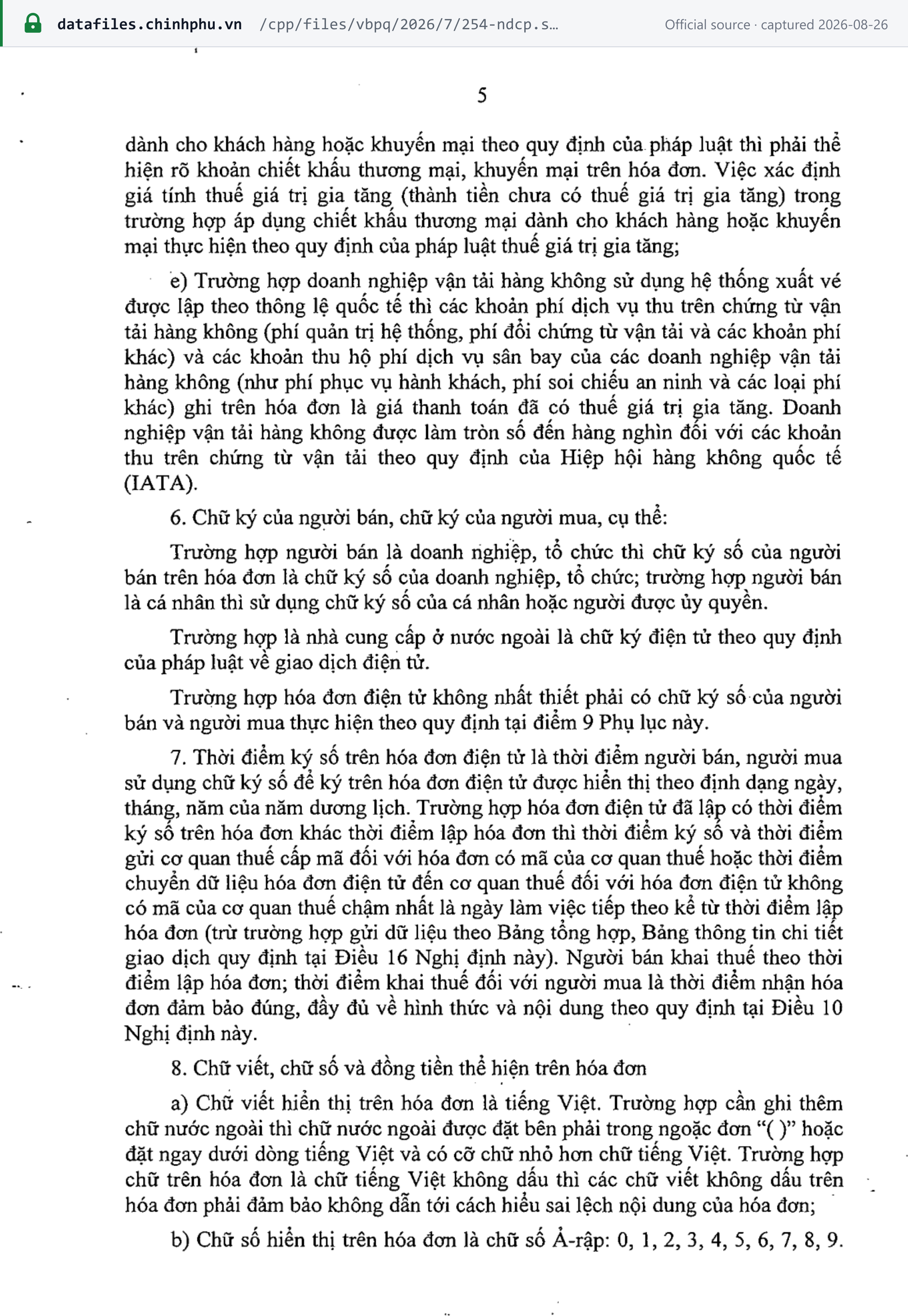
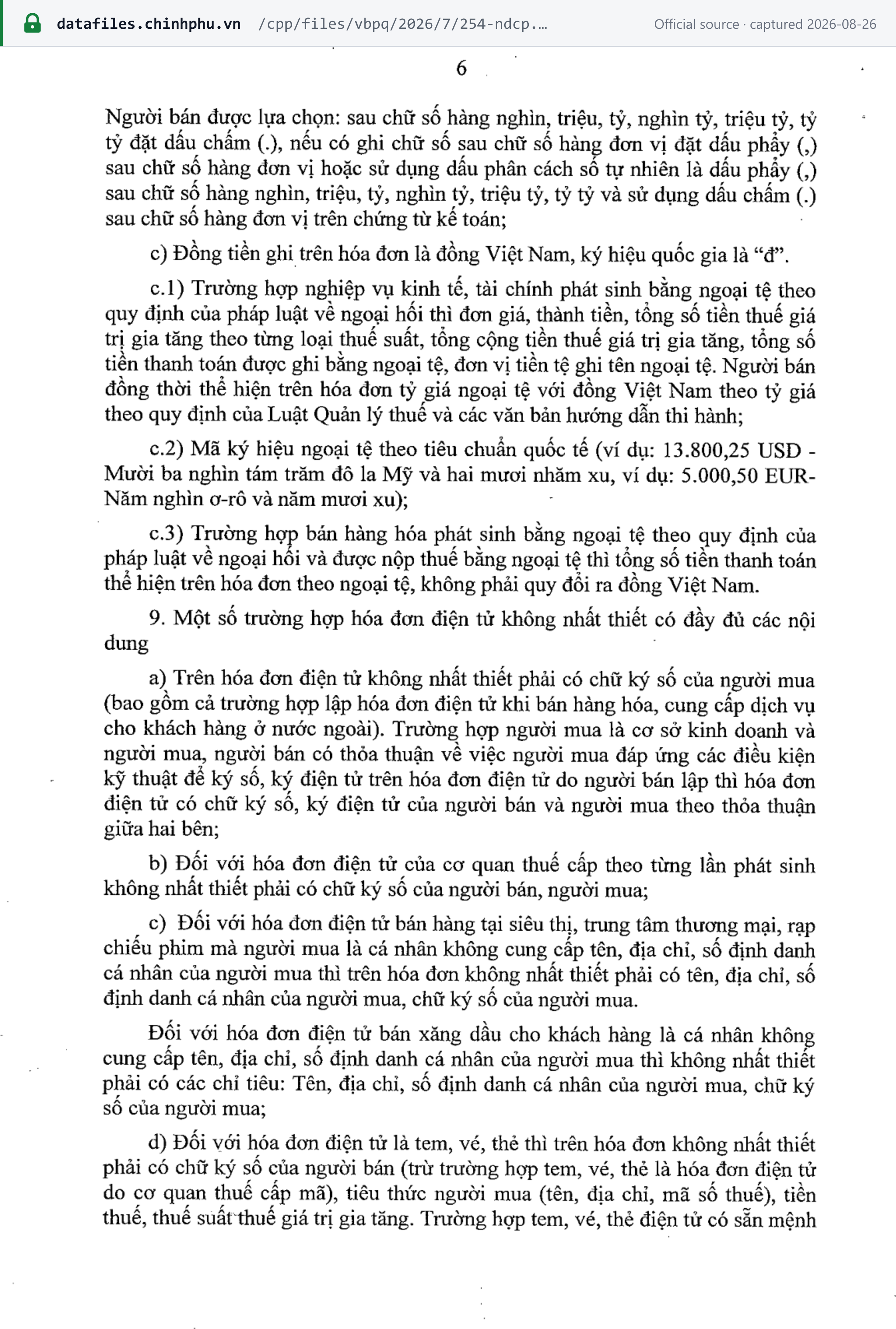
Decree No. 254/2026/ND-CP settles both, in item 8 of its Annex ("Chữ viết, chữ số và đồng tiền thể hiện trên hóa đơn"). [14]
- Language. Invoice text is Vietnamese. Foreign text is permitted, placed either in parentheses to the right or directly beneath the Vietnamese line, and in a smaller type size than the Vietnamese.
 Source snapshot captured 2026-08-26 — original
- Currency. The invoice is denominated in Vietnamese dong, with the national symbol "đ".
- Foreign-currency transactions (item 8 c.1). Where the transaction arises in a foreign currency under foreign-exchange law, the unit price, line amounts, VAT by rate band, total VAT and total payable are written in that foreign currency, and the seller must also show the exchange rate against the dong on the invoice.
- No conversion where the tax is paid in foreign currency (item 8 c.3). Where the sale is in a foreign currency and the tax is itself paid in that currency, the total payable is shown in that currency and is not converted to dong.
 Source snapshot captured 2026-08-26 — original
Retention and audit trail
Electronic invoices are archived by electronic means under Decree No. 254/2026/ND-CP Article 5, which requires that they be retrievable in their original form and legible for the whole retention period. The period itself is 10 years under the Accounting Law.
Decree 254/2026 states no period of its own: it defers to "pháp luật kế toán". The ten years comes from the Accounting Law No. 88/2015/QH13, Article 41(5)(b). That Law was consolidated on 31 March 2026 as 41/VBHN-VPQH, incorporating amendments made by Law No. 108/2025/QH15 which commence on the same day as Decree 254. We could not obtain that consolidation from an official source, so we cannot confirm the figure survived unchanged — verify against the consolidated Accounting Law before relying on it.
Illustrative specimen
No official annotated specimen invoice was located from a Vietnamese authority within this guide's research window. The sheet below is an illustration built by LookupTax, placing the mandatory particulars described above where they appear on an issued invoice. Do not treat any name, number or code below as real.
Hóa đơn giá trị gia tăng — VAT invoice
| Line item | Quantity | Amount before VAT |
|---|---|---|
| Dịch vụ tư vấn (Consulting service) | 1 gói (package) | 100,000,000 VND |
- Amount before VAT
- 100,000,000 VND
- VAT rate
- 8%
- VAT amount
- 8,000,000 VND
- Total payable
- 108,000,000 VND
- Two fields on a real invoice are not typed by the issuer and so carry no sample value here: the tax-authority code (mã của cơ quan thuế), which the platform generates on submission for a coded invoice, and the digital signature and lookup QR, which the e-invoice solution applies on validation.
- A buyer that is an individual may be identified by personal identification number instead of a tax code, and food-and-beverage, transport and platform-delivery invoices each carry extra mandatory lines — see the mandatory-content rules above.
E-invoicing status
Mandatory, and the governing instruments changed on 1 July 2026. For the full regime — coded and non-coded invoices, cash-register e-invoices, invoice symbols, registration, providers and penalties — see our Vietnam e-invoicing guide.
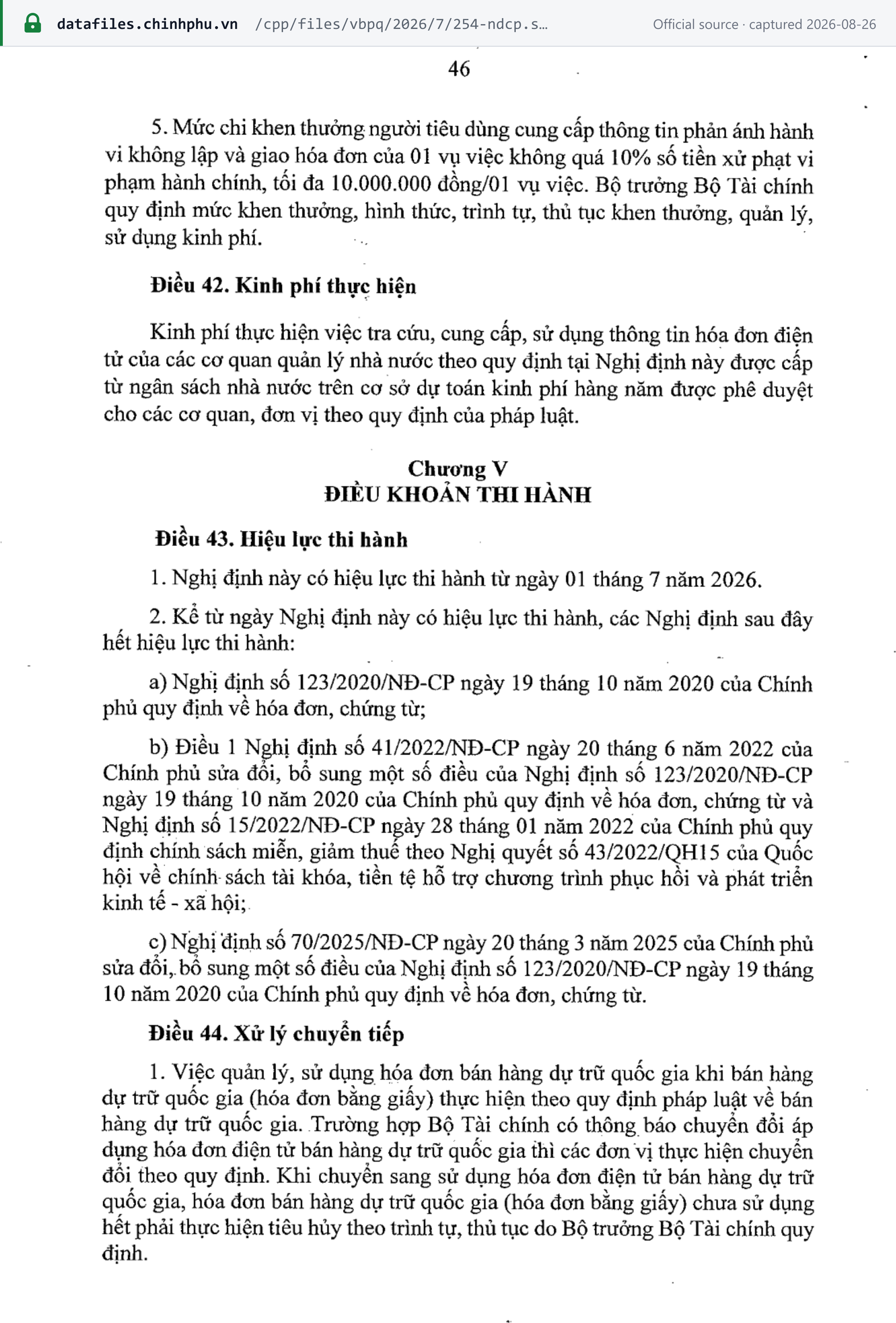
Decree No. 254/2026/ND-CP Article 43(2) repealed Decree No. 123/2020/ND-CP, Decree No. 70/2025/ND-CP and Article 1 of Decree No. 41/2022/ND-CP with effect from 1 July 2026. Circular No. 91/2026/TT-BTC Article 25(2) repealed Circular No. 32/2025/TT-BTC on the same date. Guidance, software documentation or advice still citing Decree 123/2020 or Decree 70/2025 is describing law that no longer exists. [14]
 Source snapshot captured 2026-08-26 — original
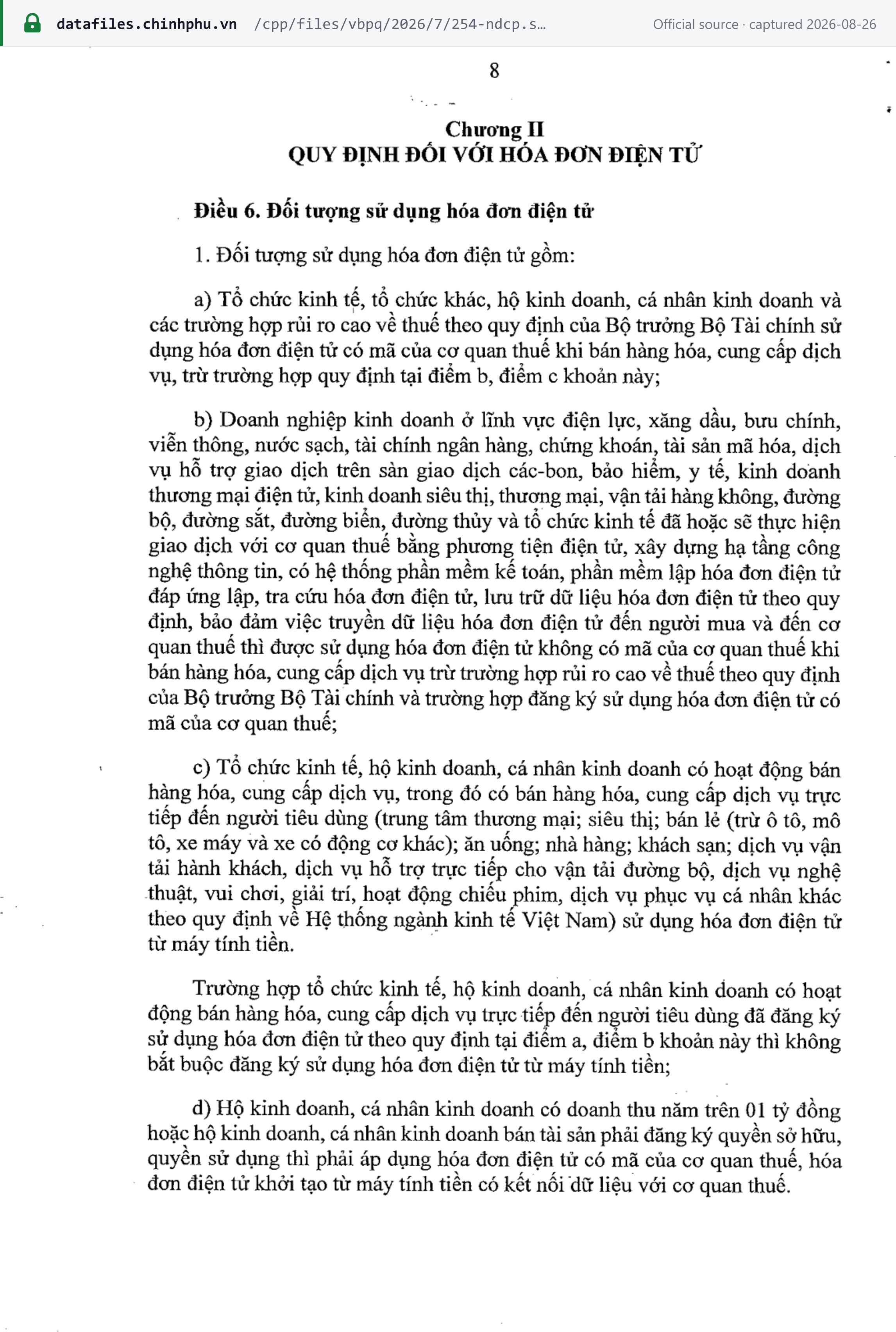
Who gets a coded invoice, and who does not. Article 6(1) of Decree 254/2026 splits the population: some taxpayers issue invoices carrying a tax-authority code, others issue non-coded invoices, and a third group is put on cash-register invoices connected to the tax authority.
The cash-register threshold is strictly above VND 1 billion. Article 6(1)(d) reads "trên 01 tỷ đồng" — above one billion dong of annual revenue, not "one billion or more". A business at exactly VND 1 billion is outside it.
Do not read the neighbouring exception as applying to this threshold. The paragraph closing Article 6(1)(c) relieves a direct-to-consumer business already registered under điểm a or điểm b from điểm c's cash-register requirement. It sits inside điểm c and stops there. Điểm d is free-standing: a household or individual business above VND 1 billion is caught by it on its own terms, and the Decree grants it no equivalent exception.
 Source snapshot captured 2026-08-26 — original
Issuance timing. Article 9 sets the general rule — the invoice is issued at the time of transfer of ownership or completion of the service, whether or not payment has been received — plus seventeen sector carve-outs. Two points where summaries commonly go wrong: Article 9(1) contains no "or at the point of invoicing" alternative, and for casinos and prize-electronic-games the revenue-determination day under Article 9(4)(q) runs 06:00:00 to 05:59:59 the following day, not midnight to midnight.
When the system is unavailable. Article 14 sets out five incident scenarios, but only two carry a deadline for the taxpayer: khoản 4 gives 2 working days from the tax authority's all-clear notice to transmit the held invoices, and khoản 5 gives 3 working days from a force-majeure event being resolved to issue and send. Khoản 1 to 3 impose no taxpayer deadline, and Article 14 places the notification duties on the Tax Department and the service provider rather than requiring the taxpayer to register the failure — the old Decree 123/2020 form 01/TB-SSĐĐT notice has no successor here.
Reporting a seller who fails to issue an invoice. Article 41 of Decree 254/2026 — not the Circular — creates the consumer reward and caps it: "không quá 10% số tiền xử phạt… tối đa 10.000.000 đồng/01 vụ việc", that is no more than 10% of the fine imposed and at most VND 10,000,000 per case. Circular 91/2026 Articles 13 and 14 set the reward levels, the procedure, and the separate lucky-invoice programme with its VND 150 billion annual ceiling.
Format. Circular 91/2026 Article 3 fixes the XML structure and the direct-connection specification for taxpayers transmitting without an intermediary.
Adjust or replace, not credit notes. Vietnam has no credit-note instrument. Circular 91/2026 Article 10 provides adjustment (điều chỉnh) and replacement (thay thế). What the error is decides which paragraph applies, not which route: a cosmetic error under Article 10(1)(a) needs neither, only a notification on form 04/SS-HĐĐT; for the main category under Article 10(1)(b) — tax code, description, quantity, rate, tax or other mandatory content — the seller may choose either route; and Article 10(1)(c) mandates replacement for cash-register invoices and sales of registrable assets.
Filing and payment
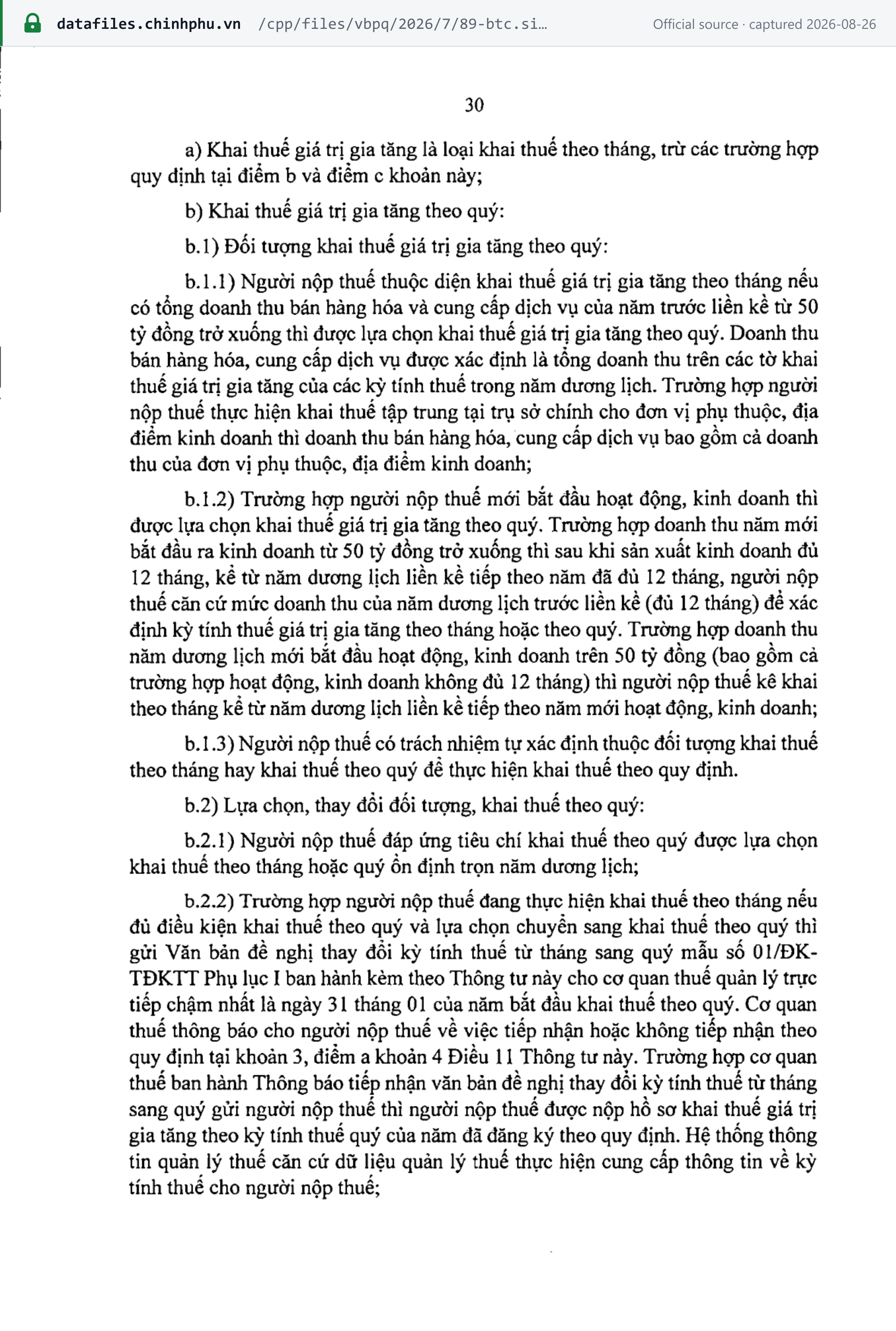
Filing frequency — and the step that is new. VAT is a monthly return by default. Quarterly filing is available where total revenue from goods and services in the immediately preceding year was VND 50 billion or less — "từ 50 tỷ đồng trở xuống".
That test no longer sits where most guidance looks for it. Decree No. 252/2026/ND-CP replaced Decree No. 126/2020/ND-CP on 1 July 2026, and it defines what a tax period is (Article 9) and when a return is due (Article 10) — it does not assign anyone a cadence. The criterion is in Circular No. 89/2026/TT-BTC Article 19(1)(b.1.1).
Self-assessment survives: Article 19(1)(b.1.3) makes the taxpayer responsible for determining for itself whether it is a monthly or quarterly filer, and b.2.1 lets an eligible taxpayer settle on monthly or quarterly stably for the whole calendar year.
The form is required in one specific case. Under Article 19(1)(b.2.2), a taxpayer already filing monthly that qualifies for quarterly and wants to switch must send form 01/ĐK-TĐKTT (Annex I) to its managing tax office no later than 31 January of the year quarterly filing is to start. The tax office then notifies acceptance or refusal, and only on acceptance may the quarterly return be filed.
 Source snapshot captured 2026-08-26 — original
Return and payment due dates. Decree 252/2026 Article 10 sets them: the 20th day of the following month for a monthly return, and the last day of the month following the quarter for a quarterly return. Vietnam sets no separate payment date for VAT — under Tax Administration Law No. 108/2025/QH15 Article 14(1)(a) the tax is due on the last day of the filing deadline, so filing and payment share one date. For a supplementary return, the payment date is the deadline of the original period, not of the correction. Deadlines falling on a rest day move forward to the next working day.
Late payment. 0.03% per day on the overdue amount, under Tax Administration Law No. 108/2025/QH15 Article 16(2)(a) — the same rate whether the tax office or customs administers the collection. Article 16(6) now lets the Government adjust the rate by decree, so the figure is no longer fixed in primary law alone. Decree 252/2026 Article 26 adds the running period (both endpoints exclusive) and the cases in which no charge accrues.
Input-tax deduction. A purchase of VND 5 million or more including VAT requires a non-cash payment document, and multiple purchases from one supplier on the same day are aggregated against that threshold (Decree No. 181/2025/ND-CP Article 26). Decree No. 144/2026/ND-CP rewrote point (g) of Article 26(2) with effect from 20 June 2026, adding a right to re-claim after a reversal.
Refunds. VAT Law Article 15 sets out several routes rather than one mechanism:
- Export refund — undeducted input VAT of VND 300 million or more in a month or quarter with export activity, capped at 10% of that period's export revenue; any excess carries forward.
- Investment-project refund — input VAT accumulated during construction, undeducted after offsetting against ongoing operations, once it reaches VND 300 million.
- 5%-rate businesses — VND 300 million or more of undeducted input VAT after 12 consecutive months or 4 consecutive quarters.
- Dissolution or bankruptcy, foreign-traveller purchases (see Cross-border rules), ODA and humanitarian-aid projects, diplomatic-exemption purchases, and the cases delegated to the Government.
Law No. 149/2025/QH15 Article 1(3) reads "Bãi bỏ khoản 3 Điều 12 và điểm c khoản 9 Điều 15." From 1 January 2026 a buyer claiming a refund no longer has to show that the seller declared and paid the tax. The VAT Law's published gazette text still carries the repealed point on its face, so a reader checking the Act alone will find a condition that no longer applies.
Vietnam has no recapitulative statement and no annual VAT return. It is not true, though, that the periodic return is the whole obligation: Article 16(3) of Decree No. 254/2026/ND-CP requires a periodic Bảng tổng hợp dữ liệu hóa đơn điện tử (aggregated e-invoice data table), and a Bảng thông tin chi tiết giao dịch for named sectors, filed alongside it.
Foreign suppliers: monthly, or per occurrence. Decree No. 252/2026/ND-CP Article 40(2)(a) splits them. A foreign supplier trading regularly files and pays monthly (a.1). One trading irregularly files per occurrence on its Vietnam-source revenue (a.2). Neither arm is quarterly.
Exemptions
VAT Law Article 5 lists 26 categories of goods and services that are outside the scope of VAT (its 28 khoản include khoản 27, the no-input-credit consequence, and khoản 28, the delegation to the Government) (đối tượng không chịu thuế), including: unprocessed or only-preliminarily-processed crop, forestry, livestock and aquaculture products sold by their own producer; breeding stock and planting material; animal feed and aquafeed; sea salt and refined/iodised salt; public housing sold by the State to its sitting tenants; irrigation and agricultural land-preparation services; transfer of land-use rights; life, health, student/educational and other person-related insurance, plus livestock, crop and other agricultural insurance; credit, securities-trading, capital-transfer, debt-sale, foreign-exchange and derivative financial services; medical and veterinary services; funeral services; teaching and vocational training; state-budget-funded broadcasting; publishing of political/legal/scientific books and newspapers; public bus/tram/inland-waterway passenger transport; scientific-research equipment and oil-and-gas-exploration equipment not yet producible domestically; national-defence and security products; humanitarian and non-refundable aid imports; goods in transit, temporary import-export, and trade between/with free-trade zones; technology and IP transfer, and software; unwrought precious metals; certain unprocessed mineral/resource exports; artificial body-part and disability-aid products; household/individual-business goods and services with annual revenue up to the Government-set threshold, currently VND 1 billion (Decree 68/2026 as amended by Decree 141/2026 — see Registration); and a further list of specific import categories (gifts within duty-free limits, luggage allowance, disaster-relief goods, border-resident trade, and antiquities). [1]
Exempt is not zero-rated — VAT Law Article 5(27) states the consequence explicitly. A business selling only the goods/services listed in Article 5 cannot deduct or reclaim the input VAT it paid on its own purchases, except where the 0% rate under Article 9(1) separately applies. [1] A 0%-rated exporter, by contrast, keeps full input-VAT recovery. This is the single most consequential distinction in the Law for anyone pricing a Vietnamese supply chain, and it is easy to conflate the two categories because both show "0" tax on an invoice.
Special regimes.
- Fuel VAT exemption, 16 April – 30 June 2026. National Assembly Resolution No. 19/2026/QH16 (adopted 12 April 2026) exempted gasoline, diesel, kerosene, mazut and aviation fuel from VAT declaration and payment at the sale and import stages for this window, while keeping input VAT creditable. [2] This has now expired.
- Direct-method / small-business regime. Businesses below the VND 1 billion deduction-method threshold pay VAT as a flat percentage of revenue rather than the standard credit-invoice method — see Rates and Registration.
- Free-trade-zone (khu phi thuế quan) treatment. Article 5(20) puts goods and services traded between a foreign country and a free-trade zone, and between free-trade zones, outside the scope of VAT. It does not cover supplies from Vietnam's domestic market into a free-trade zone — those are treated as exports under Article 9(1). Under Article 5(20), and goods/services sold to a free-trade-zone business for direct use in export production can qualify for the 0% rate under Article 9(1)(a)–(b) — two different regimes depending on the transaction, not a single blanket rule. [1]
- Gold, silver and gemstones. Buying, selling and processing of gold, silver and gemstones is carved out of both the deduction and direct-on-revenue methods into its own direct-on-value-added calculation (VAT Law Art. 12(1)), with negative value-added in a period carried forward within the same calendar year only, not into the next year. [1]
This guide did not identify a separate cash-accounting scheme for VAT in the sources reviewed — treat that point as unconfirmed.
Offences and penalties
Vietnam keeps administrative and criminal exposure genuinely distinct, and both carry real figures.
Article 5(5) of Decree No. 125/2020/ND-CP fixes the ratio: "Đối với cùng một hành vi vi phạm hành chính về thuế, hóa đơn thì mức phạt tiền đối với tổ chức bằng 02 lần mức phạt tiền đối với cá nhân, trừ mức phạt tiền đối với hành vi quy định tại Điều 16, Điều 17 và Điều 18 Nghị định này" — the doubling does not reach under-declaration (Article 16), tax evasion (Article 17) or the bank-transfer offence (Article 18). It does reach Article 24, so the tables below halve correctly for an individual or a household business — an organisation pays twice what an individual pays for the same conduct. Article 7(4)(a) then confirms that the amounts printed in Article 24 and in Chapter III are the organisation amounts, and that a household or family business is charged as an individual. So a hộ kinh doanh reading the tables below should halve every figure. [11]
Administrative penalties — invoicing
Decree No. 125/2020/ND-CP Article 24, as rewritten by Decree No. 310/2025/ND-CP (2 December 2025, in force 16 January 2026). Decree 310/2025 replaced khoản 2, khoản 3 and khoản 6 with scales graduated by the number of invoices, and repealed khoản 5 outright. [12]
Failing to issue an invoice at all (khoản 3). Each band covers two limbs in one sentence: the internal/gift limb (promotional, advertising and sample goods; gifts and exchanges; goods paid as wages; internal consumption; lending, borrowing and returning goods) and the sale limb (an ordinary sale of goods or services).
| Fine (VND) | Internal / gift limb | Sale limb |
|---|---|---|
| Warning only (cảnh cáo) | 1 invoice | — |
| 1,000,000 – 2,000,000 | 2 to under 10 | 1 invoice |
| 2,000,000 – 10,000,000 | 10 to under 50 | 2 to under 10 |
| 10,000,000 – 30,000,000 | 50 to under 100 | 10 to under 20 |
| 30,000,000 – 50,000,000 | 100 or more | 20 to under 50 |
| 60,000,000 – 80,000,000 | — | 50 or more |
Issuing an invoice at the wrong time (khoản 2) is graded the same way, from a warning for a single invoice up to VND 50,000,000 – 70,000,000 at 100 invoices or more.
The remedy is no longer buyer-triggered. Khoản 6 as rewritten reads "Buộc lập hóa đơn theo quy định đối với hành vi quy định tại khoản 3, điểm d khoản 4 Điều này" — it now attaches to the whole of khoản 3, and the pre-2026 condition khi người mua có yêu cầu ("when the buyer so requests") has been deleted.
It was never khoản 3. As enacted in 2020, that flat fine for failing to issue an invoice on a sale sat in khoản 5, which Decree 310/2025 Article 2(2) repealed along with điểm a khoản 1 and điểm a khoản 4. The old khoản 3 was a different offence — VND 3,000,000 – 5,000,000 for wrong-time invoicing that did not delay the tax. The rewrite re-used the khoản 3 slot, so the number and the provision moved independently of each other.
Administrative penalties — registration and filing
Decree 310/2025 left the money bands in Articles 10 and 13 untouched; it amended Article 10's structure and Article 13(5)'s trigger only. Late filing runs on a scale of its own, reaching VND 15,000,000 – 25,000,000 at the top band.
Offences (criminal)
Tax evasion is an offence under Article 200 of the Penal Code No. 100/2015/QH13, amended by Law No. 12/2017/QH14. The consolidated text (135/VBHN-VPQH, 2025) records two later amending laws — Law No. 59/2024/QH15 and Law No. 86/2025/QH15 — but neither touches Article 200 itself: its only footnotes cite Law 12/2017. [13]
The fine and the prison term are alternatives, not cumulative. Every tier reads thì bị phạt tiền từ X đến Y hoặc phạt tù từ A đến B — a court imposes one or the other.
| Amount evaded (individual) | Fine or imprisonment |
|---|---|
| VND 100 million – under 300 million (or under 100 million with a prior sanction or conviction) | VND 100–500 million or 3 months – 1 year |
| VND 300 million – under 1 billion, or organised / repeat / abuse-of-position offending | VND 500 million – 1.5 billion or 1 – 3 years |
| VND 1 billion or more | VND 1.5 – 4.5 billion or 2 – 7 years |
An additional fine of VND 20–100 million, a 1–5 year ban from holding certain positions or practising certain trades, or partial or total asset confiscation may also apply.
A commercial legal entity is sentenced under Article 200(5), on its own scale starting at VND 300 million – 1 billion — and on a lower entry threshold than an individual: the company tier opens at VND 200 million evaded.
Interest on late payment. 0.03% per day on the overdue amount — see Filing and payment.
Frequently asked questions
Is Vietnam's VAT rate 10% or 8%? Every invoice I see looks different.
Both are correct, for different goods. The statutory standard rate under Article 9(3) of VAT Law No. 48/2024/QH15 is 10%. But National Assembly Resolution No. 204/2025/QH15 (17 June 2025) cuts that rate by 2 points — to 8% — for the period 1 July 2025 to 31 December 2026, for every good or service that would otherwise sit at 10%. Six categories are carved out of the cut and stay at 10%: telecommunications; financial, banking, securities and insurance activities; real-estate business; metal products; mined/extracted products (except coal); and goods/services subject to special consumption tax (except petrol). No instrument extending the 8% rate beyond 31 December 2026 had been found as of 5 October 2026, so the 10% rate would apply again from 1 January 2027 absent a new instrument. [1]
My household business has VND 900 million in annual revenue. Do I register for VAT, and do I use the same invoice as a big company?
Neither, at VND 900 million. The exemption threshold for a household or individual business is VND 1 billion, so at VND 900 million your supplies fall outside the VAT charge altogether — you do not register for VAT, and no calculation method applies to them. The VND 200 million figure still in circulation never came into force; see Registration for how it became VND 1 billion.
Cross the threshold and you still do not use a company's regime. VAT Law Article 11(2) and Article 21 of Decree No. 181/2025/ND-CP both exclude hộ, cá nhân sản xuất, kinh doanh from the deduction method — compulsorily and voluntarily. You compute VAT as a percentage of revenue under Article 12(2)(a2), and that is not a threshold rule: a household business stays on the percentage method however large it grows. Do not apply to be moved onto the deduction method — the application cannot be granted.
On invoicing, from 1 July 2026 Article 6(1) of Decree No. 254/2026/ND-CP may put you on cash-register e-invoices connected to the tax authority. The trigger is annual revenue above VND 1 billion ("trên 01 tỷ đồng") — strictly above. The exception that closes Article 6(1)(c) applies to that paragraph only, so do not read it as excusing a household business caught by điểm d.
I'm a Vietnamese company buying software from a foreign SaaS vendor with no office here. Who pays the VAT — them or me?
It depends on the channel and your own tax method. By default, you (the Vietnamese buyer) are the taxpayer under VAT Law Article 4(3) — a self-assessed reverse charge. But if you apply the deduction method and the purchase runs through an e-commerce channel or digital platform, Article 4(4) instead has you withhold and pay the VAT on the foreign supplier's behalf. The foreign supplier may also be directly registered in Vietnam and self-file, in which case a foreign platform or payment-enabled marketplace operator may be the one withholding under Article 4(4). Article 4(5) is a different limb — it makes platform managers withhold for hộ kinh doanh and cá nhân kinh doanh selling on the platform, not for foreign suppliers. Either way, the applicable rate is 10% (temporarily 8%) under Article 9(3). [2]
A supplier gave me a sales receipt instead of a VAT invoice for a VND 6 million purchase, paid in cash. Can I still deduct the input VAT?
No, on both counts. A "hóa đơn bán hàng" (sales invoice) — what direct-method and household-business suppliers issue — does not carry deductible input VAT the way a "hóa đơn giá trị gia tăng" (VAT invoice) does. Separately, Article 26 of Decree No. 181/2025/ND-CP requires a non-cash payment document for any purchase of VND 5 million or more (VAT-inclusive) before input VAT can be deducted, and treats several same-day cash purchases from the same seller as one combined value for that test. [4]
What actually changes for e-invoicing on 1 July 2026, and does it replace the rules I follow today?
The Government issued Decree No. 254/2026/ND-CP detailing certain articles and implementation measures of Tax Administration Law No. 108/2025/QH15 on electronic invoices and electronic documents, effective from 1 July 2026 — the same date most of that Law takes effect. It sets out the principles for creating, managing and using e-invoices and e-documents. A third instrument completes the chain: Circular No. 91/2026/TT-BTC (signed 30 June 2026, effective 1 July 2026) sets the detailed implementing rules under the Decree and the Law — e-invoice registration, format and high-risk-taxpayer criteria among them — and replaces the prior Circular No. 32/2025/TT-BTC. The consumer-reward scheme for reporting a seller who fails to issue and deliver an e-invoice is created and capped by Article 41 of the Decree — not more than 10% of the fine and at most VND 10,000,000 per case — while Circular 91 Articles 13 and 14 set the reward levels, the procedure and the fund's management. Article 43(2) repeals Decree No. 123/2020/ND-CP, Decree No. 70/2025/ND-CP and Article 1 of Decree No. 41/2022/ND-CP from the same date, and Circular 91 Article 25(2) repeals Circular No. 32/2025/TT-BTC. An e-invoicing configuration built to Decree 123/2020 is built to repealed law. [5] [6]
Important websites
| Purpose | Website |
|---|---|
| Business registration (triggers automatic tax registration for companies) | National Business Registration Portal |
| Tax registration, e-filing and e-payment (household/individual and direct tax registration) | Cục Thuế (Tax Department, formerly the GDT) e-tax portal, thuedientu.gdt.gov.vn |
| E-invoicing platform | Cục Thuế e-invoice portal, hoadondientu.gdt.gov.vn |
| Tax-authority policy texts, decrees and circulars | Ministry of Finance, mof.gov.vn |
| Legal-instrument full text and gazette publication | Government document database, vanban.chinhphu.vn and Official Gazette, congbao.chinhphu.vn |
| Import VAT and customs declarations | General Department of Vietnam Customs |
| Tax-code (MST) validation on LookupTax | Vietnam MST validator |
The Tax Department's portals (gdt.gov.vn and the sub-portals above) did not respond when checked on 2026-09-24; if a link fails, try again later.
Recent changes
- 2026-07-16 — Decree No. 254/2026/ND-CP, signed on 30 June 2026 and published in the Công Báo (Official Gazette) on 16 July 2026, details certain articles and implementation measures of Tax Administration Law No. 108/2025/QH15 on electronic invoices and electronic documents, effective 1 July 2026. (Công Báo) — see issue
- 2026-06-30 — Circular No. 91/2026/TT-BTC, signed the same day and effective 1 July 2026, replaced Circular No. 32/2025/TT-BTC, detailing e-invoice and e-document provisions of Decree No. 254/2026/ND-CP and Tax Administration Law No. 108/2025/QH15, and adding a consumer-reward mechanism for reporting sellers that fail to issue and deliver e-invoices. (Cổng thông tin điện tử Chính phủ) — see issue
- 2026-06-30 — Circular No. 84/2026/TT-BTC established an electronic VAT-refund system for goods carried out of Vietnam by foreign and overseas-Vietnamese travellers, replacing Circulars No. 72/2014/TT-BTC and No. 92/2019/TT-BTC, effective 1 July 2026. (Công Báo No. 436)
- 2026-05-05 — Decree No. 144/2026/ND-CP amended Decree No. 181/2025/ND-CP (itself already amended by Decree No. 359/2025/ND-CP): it adds person-related insurance (life, health, student/educational, agricultural) to the VAT-exempt category, restricts input-VAT deduction on goods/services used for both taxable and non-taxable activities to the taxable portion only, and adds debt/receivable sales and certificates of deposit to the exempt financial-services list — effective 20 June 2026. (vanban.chinhphu.vn)
- 2026-04-12 — National Assembly Resolution No. 19/2026/QH16 exempted gasoline, diesel, kerosene, mazut and aviation fuel from VAT at the sale and import stages, 16 April – 30 June 2026, with input VAT remaining creditable. (Cục Thuế cơ sở 14, Hồ Chí Minh City)
- 2025-12-10 — The National Assembly passed Tax Administration Law No. 108/2025/QH15, effective 1 July 2026 (Article 13 and household/individual e-invoicing under Article 26 effective 1 January 2026), rebuilding tax registration, e-invoicing and e-commerce/cross-border tax administration. (Chinhphu.vn)
- 2025-03-20 — Decree No. 70/2025/ND-CP amended 40 of the 61 articles of Decree No. 123/2020/ND-CP on invoices and documents, effective 1 June 2025 — new POS-generated e-invoice mandate, commercial e-invoices for exporters, and voluntary e-invoice registration for foreign digital suppliers. (Chinhphu.vn)
- 2025-06-17 — National Assembly Resolution No. 204/2025/QH15 cut VAT from 10% to 8% for most goods and services, 1 July 2025 – 31 December 2026. (Chinhphu.vn)
- 2025-07-01 — Decree No. 181/2025/ND-CP took effect, detailing the registration, rate, deduction and refund provisions of VAT Law No. 48/2024/QH15. (Công Báo)
- 2024-11-26 — The National Assembly passed VAT Law No. 48/2024/QH15, effective 1 July 2025 (its household-business exemption threshold was superseded before it ever operated — see Registration), repealing VAT Law No. 13/2008/QH12. (Công Báo)
Ahead — scheduled changes that have not yet taken effect:
- 2027-01-01 (scheduled) — The temporary 8% VAT rate under Resolution 204/2025/QH15 has effect only until 31 December 2026; no resolution, decree or official proposal extending it was found as of 5 October 2026, so the 10% rate would apply again from 1 January 2027 absent a new instrument. See Rates. (Government Office, Bao Chinh phu) — see event
Reference links
- VAT Law No. 48/2024/QH15 — Official Gazette
- Decree No. 181/2025/ND-CP — Official Gazette
- Decree No. 252/2026/ND-CP (replaced Decree No. 126/2020/ND-CP from 1 July 2026) — Official Gazette
- Circular No. 89/2026/TT-BTC (carries the quarterly-filing election, Article 19) — Bộ Tài chính
- Decree No. 125/2020/ND-CP — Official Gazette
- Decree No. 310/2025/ND-CP (rewrote Decree 125/2020 Article 24 penalties) — Official Gazette
- Resolution No. 204/2025/QH15 (VAT rate cut) — Chinhphu.vn
- Decree No. 70/2025/ND-CP summary (repealed 1 July 2026, historical only) — Chinhphu.vn
- Decree No. 254/2026/ND-CP (e-invoicing; repeals Decrees 123/2020 and 70/2025) — Official Gazette
- Circular No. 91/2026/TT-BTC (e-invoice detail; repeals Circular 32/2025) — Official Gazette
- Tax Administration Law No. 108/2025/QH15 summary — Chinhphu.vn
- Circular No. 84/2026/TT-BTC — Công Báo No. 436
- Decree No. 144/2026/ND-CP — vanban.chinhphu.vn
- Decree No. 68/2026/ND-CP as amended by Decree No. 141/2026/ND-CP (the VND 1 billion household-business threshold) — Official Gazette
- Resolution No. 19/2026/QH16 (fuel VAT exemption) — Cục Thuế cơ sở 14, Hồ Chí Minh City
- Penal Code No. 100/2015/QH13, consolidated with Law No. 12/2017/QH14 — Chinhphu.vn
- Accounting Law No. 88/2015/QH13 — Official Gazette