Saudi Arabia VAT guidelines
| FACTSHEET | |
|---|---|
| Country code | SA |
| Tax name | Value Added Tax (VAT) — ضريبة القيمة المضافة |
| Tax Authority | Zakat, Tax and Customs Authority (ZATCA) |
Overview
Saudi Arabia levies Value Added Tax (VAT) — ضريبة القيمة المضافة — and has done so since 1 January 2018. ZATCA describes the VAT Law: "It came into effect on January 1, 2018, with its original version published on 4 Dhul-Qi'dah 1438 AH and later amended on 24 Shawwal 1441 AH." [2]
Legal basis. VAT rests on three layers: [1]
- the GCC Unified VAT Agreement, approved by Royal Decree No. M/51 of 31 January 2017;
- the VAT Law, issued by Royal Decree No. M/113 of 2 Dhu al-Qi'dah 1438H (25 July 2017);
- the Implementing Regulations of the VAT Law, issued under Board Resolution No. 3839 and amended since.
Which text is current. ZATCA publishes the VAT Law in Arabic only, and the current Implementing Regulations are the Arabic tenth edition (April 2025), which includes the amendments of Board Resolution No. 01-06-24 of 19 November 2024. [5] ZATCA's English translation dates from November 2021; the 2024 amendments are explained in English in a separate ZATCA guideline. [4] [6]
Authority. VAT is administered by the Zakat, Tax and Customs Authority (ZATCA) (هيئة الزكاة والضريبة والجمارك). ZATCA was formed under Cabinet Resolution No. 570 of 4 May 2021, which merged the General Authority of Zakat and Tax (GAZT) with the General Customs Authority; older documents say "GAZT". [1]
Currency. Amounts are in Saudi riyals (SAR). The VAT amount on a tax invoice must be shown in SAR (see Currency and language).
Tax period. Monthly or quarterly, depending on turnover (see Filing frequency). There is no annual VAT return.
Layering. None. VAT is a single national tax; there is no regional or municipal VAT.
Not VAT. Real estate transaction tax (RETT) is a separate tax on real-estate disposals, which are themselves exempt from VAT (see Exemptions).
For neighbouring GCC systems, see the United Arab Emirates, Oman and Qatar guides.
Registration
Who should register
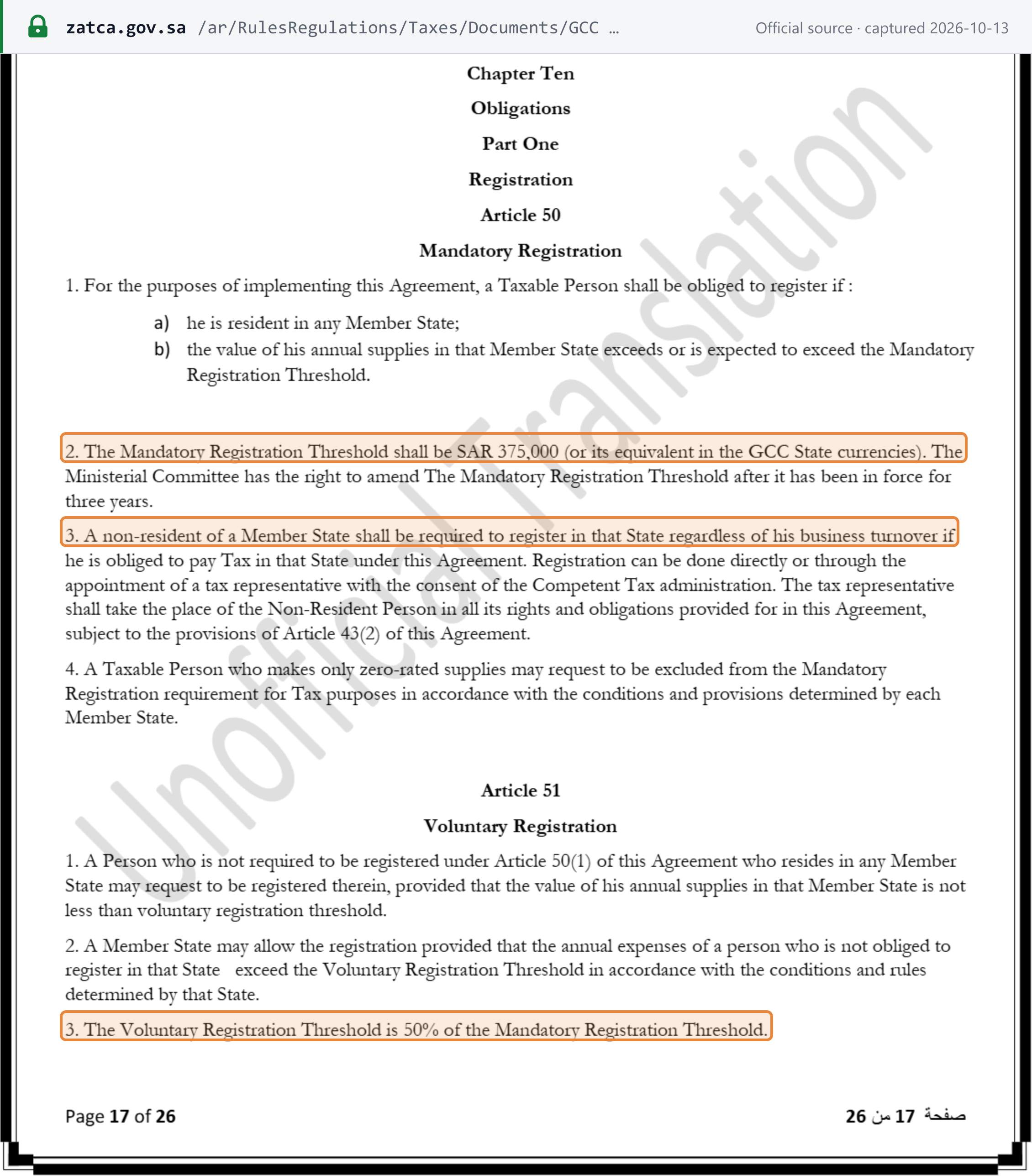
A person resident in Saudi Arabia must register when the value of its taxable supplies in the Kingdom over the past 12 months exceeds SAR 375,000, or is expected to exceed it over the next 12 months. [7] [4]
- Backward test (Art 3). At the end of each month, total the supplies of the 12 months then ended. If the threshold is exceeded, "the Person must apply to the Authority to register within thirty (30) days of the end of that month". Registration takes effect from the start of the month after the application.
- Forward test (Art 4). At the end of each month, estimate the supplies for the next 12 months. If they are expected to exceed the threshold, apply within 30 days of the end of that month. Registration "takes effect from the start of the first month in which its annual Supplies made in the Kingdom were expected to exceed the Mandatory Registration Threshold" (Art 4(2)).
- What counts. Exempt supplies, out-of-scope supplies and sales of capital assets do not count toward the threshold. [1]
- Zero-rated only. A person that makes only zero-rated supplies may ask to be excluded from mandatory registration (GCC Agreement Art 50(4); Implementing Regulations Art 9(1)).
Registration threshold
| Threshold | Amount | Basis |
|---|---|---|
| Mandatory | More than SAR 375,000 of taxable supplies | Past 12 months or next 12 months (GCC Agreement Art 50(2)) |
| Voluntary | SAR 187,500 or more of taxable supplies or taxable expenses | 50% of the mandatory threshold (GCC Agreement Art 51(3); Implementing Regulations Art 7) |
| Non-residents | None | Register from the first supply on which tax is due (GCC Agreement Art 50(3)) |
"The Mandatory Registration Threshold shall be SAR 375,000 (or its equivalent in the GCC State currencies)." "The Voluntary Registration Threshold is 50% of the Mandatory Registration Threshold." [7]
Non-resident registration
There is no threshold for non-residents. "A non-resident of a Member State shall be required to register in that State regardless of his business turnover if he is obliged to pay Tax in that State under this Agreement." [7]
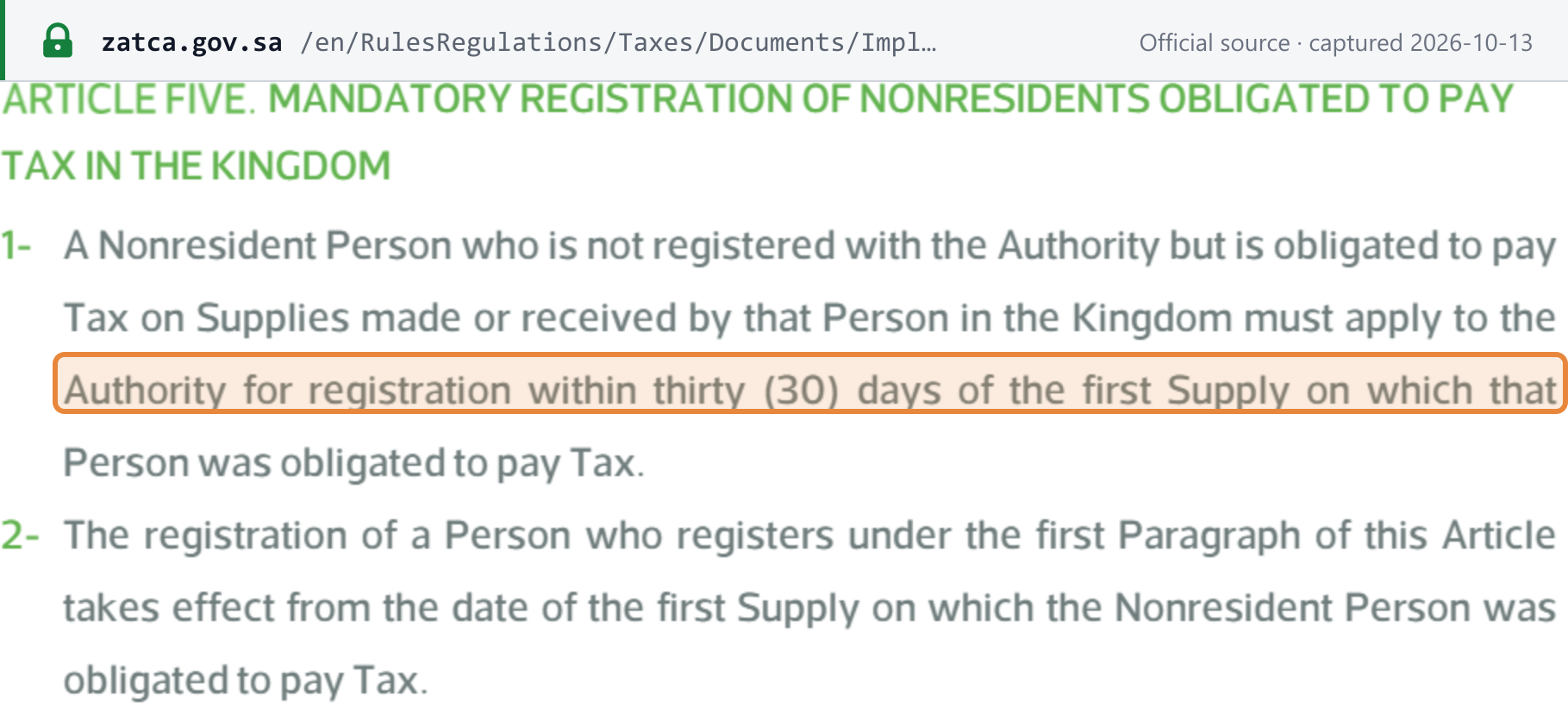
A non-resident that is liable to pay tax "must apply to the Authority for registration within thirty (30) days of the first Supply on which that Person was obligated to pay Tax", and the registration takes effect from the date of that first supply (Implementing Regulations Art 5). [4] This applies mainly to sales to consumers; supplies to Saudi VAT-registered businesses are reverse-charged instead (see Foreign companies selling into Saudi Arabia).
Tax representative. Implementing Regulations Art 9(3) lets a non-resident register by itself or through a tax representative. ZATCA's operational rule is stricter: "All Non-Resident taxable persons must have one Tax Representative. The Tax Representative will be jointly liable for payment of tax due by the taxable person until such date the Tax Representative is confirmed by ZATCA as ceasing to act for that taxable person." Members of SOCPA or established law firms are accepted without further requirements; any other representative must be resident in Saudi Arabia, commercially active for at least 5 years, and under contract with the taxable person. [8]

Tax identification number
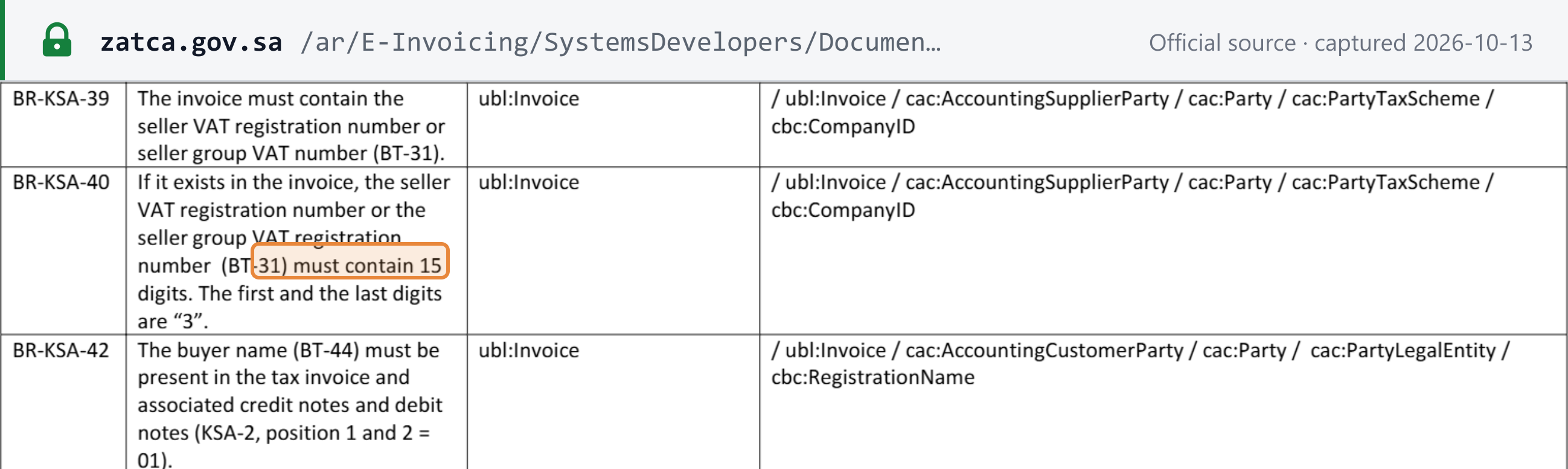
The VAT registration number is 15 digits, and its first and last digits are 3. ZATCA's e-invoicing rule BR-KSA-40 states that the seller VAT registration number "must contain 15 digits. The first and the last digits are "3"." [9] The number must appear on tax invoices (Implementing Regulations Art 57), and members of a VAT group use the group's number. [1]
For the format in detail and the other Saudi tax numbers, see the Saudi Arabia tax ID guide. To check a number, see how to verify a Saudi VAT number, how to verify a Saudi TIN, or use the Saudi Arabia TIN validator. ZATCA runs a public VAT registration verification service. [16]
How to register
Register online through ZATCA's e-services at zatca.gov.sa. The application must give at least: the official name, physical address, email address, existing electronic identification number, commercial registration number (if any), the value of annual supplies or annual expenses, and the effective date of registration (Implementing Regulations Art 8(2)). [4]
- ZATCA may ask for supporting documents and must allow at least 20 days to provide them (Art 8(3)).
- Changes to registration details must be notified within 20 days (Art 8(7)).
- Residents must display the registration certificate at their main place of business and at branches (Art 8(8)).
ZATCA does not publish a standard processing time.
Voluntary registration
Available. "A person resident in the Kingdom of Saudi Arabia whose taxable supplies or taxable expenses exceed SAR 187,500 (the "voluntary registration threshold") during a period of twelve months may register voluntarily for VAT purposes." [1] The Regulations set the test as supplies or expenses of "not less than" the threshold (Art 7(1)), so SAR 187,500 itself qualifies. [4] Registering lets a business deduct input tax, and it is a condition of joining a VAT group (see Group registration).
Deregistration
Article 13 of the Implementing Regulations, in its current Arabic text: [5]
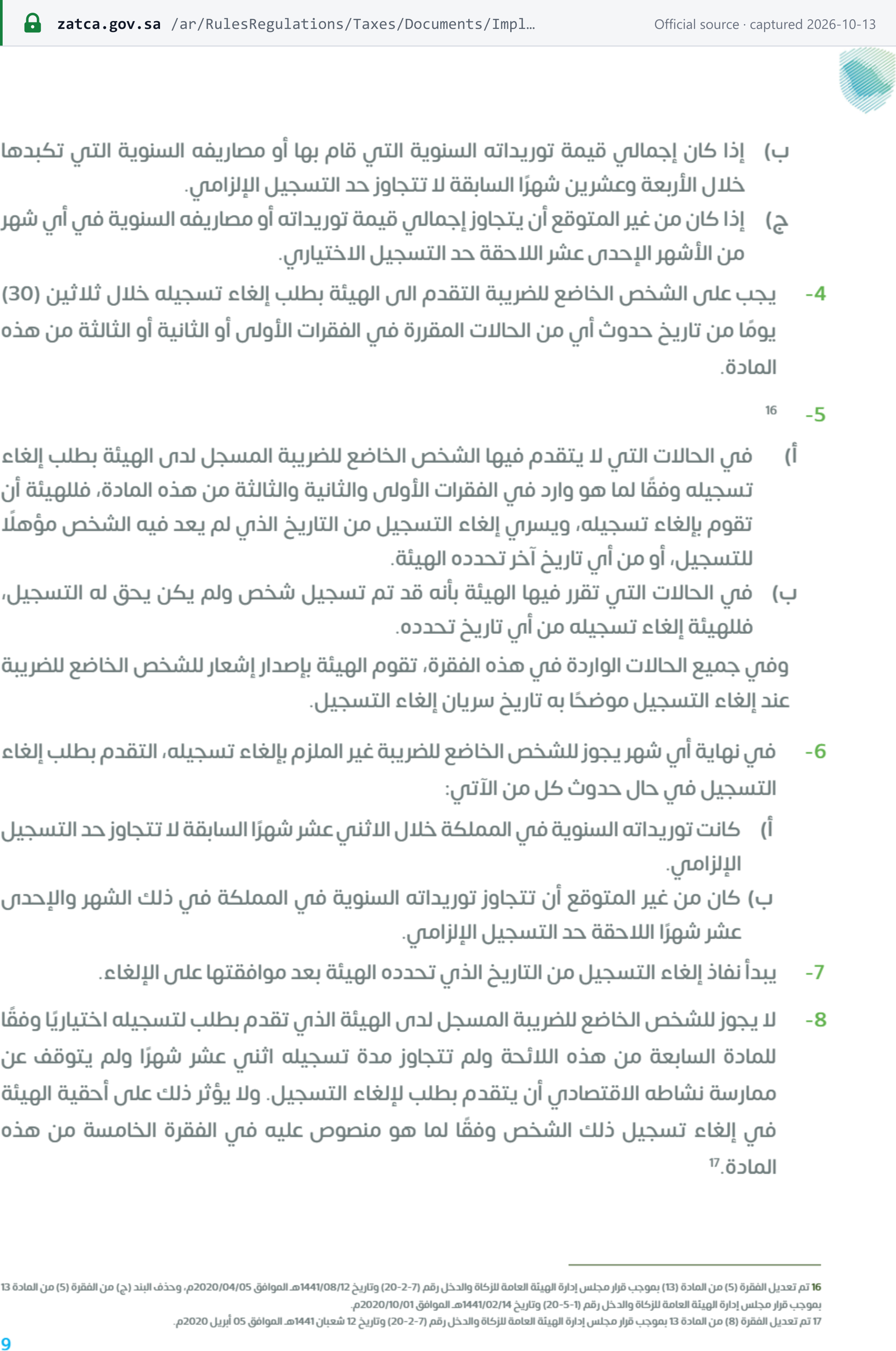
- Mandatory. A taxable person must deregister if it stops its economic activity; if it is a non-resident that made no taxable supplies in the last 12 months; or if it is a resident whose supplies or expenses over the last 12 months did not exceed the voluntary threshold, whose supplies over the last 24 months did not exceed the mandatory threshold, and whose supplies are not expected to exceed the voluntary threshold over the next 12 months. Apply within 30 days of the event (Art 13(4)).
- Optional. A person not required to deregister may apply where its supplies over the last 12 months, and its expected supplies over the next 12 months, each do not exceed SAR 375,000 (Art 13(6)).
- Voluntary registrants cannot deregister within 12 months of registering, unless they stop their economic activity (Art 13(8)).
- Transfer of the business. Since the 2024 amendments, transferring an economic activity so that it ceases entirely is a valid reason to deregister; the transferee must notify ZATCA within 30 days of the transfer unless the transferor has already applied. [6]
Deregistration takes effect from the date ZATCA sets. ZATCA publishes no separate final-return rule; all outstanding returns and tax must be settled before deregistration is approved, and invoices and records must still be kept for the periods in Article 66. [6]
Group registration
Available. Two or more legal persons resident in Saudi Arabia can register as one VAT group with a single tax number (Art 10, as amended by Resolution 01-06-24). [6]
- Residence and eligibility. Every member must be resident in Saudi Arabia, and "each member must be eligible for VAT registration; all members must meet the voluntary registration threshold".
- Ownership or control. "50% or more of the capital, voting rights, or market value of each legal entity in the tax group must be owned-directly or indirectly-by: the same legal entity, the same legal entities or a legal entity (inside or outside the tax group) that exercises control and authority over the other group members."
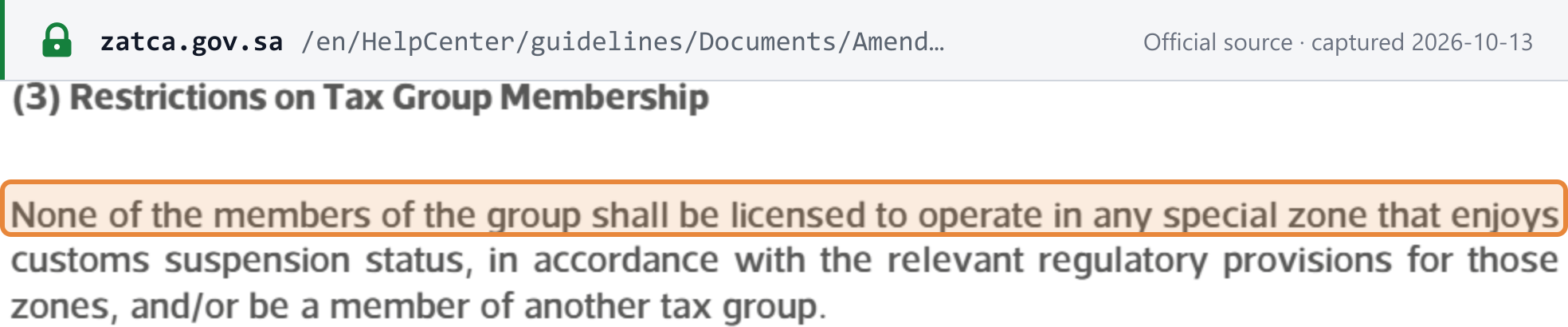
- Exclusions added in 2024. No member may be licensed in a special zone with customs-suspension status, or be a member of another group. No member may be eligible for a refund under Article 70, except licensed real-estate developers selling only to their employees and donors to public-benefit projects.
- Representative and liability. The group representative files the group's returns; every member remains jointly and severally liable. Members' individual numbers are suspended for VAT while they are in the group.
- Intra-group supplies are outside the scope of VAT.
Existing groups had 180 days from publication of the amendments to bring their membership into line. [6] For how grouping works generally, see VAT grouping explained.
Rates
| Rate | Applies to |
|---|---|
| 15% | Standard rate on supplies and imports, for supplies made from 1 July 2020 (5% from 1 January 2018 to 30 June 2020) |
| 0% (zero-rated) | Exports, qualifying services to non-GCC residents, international transport, qualifying medicines and medical goods, investment gold, silver and platinum, and others listed below |
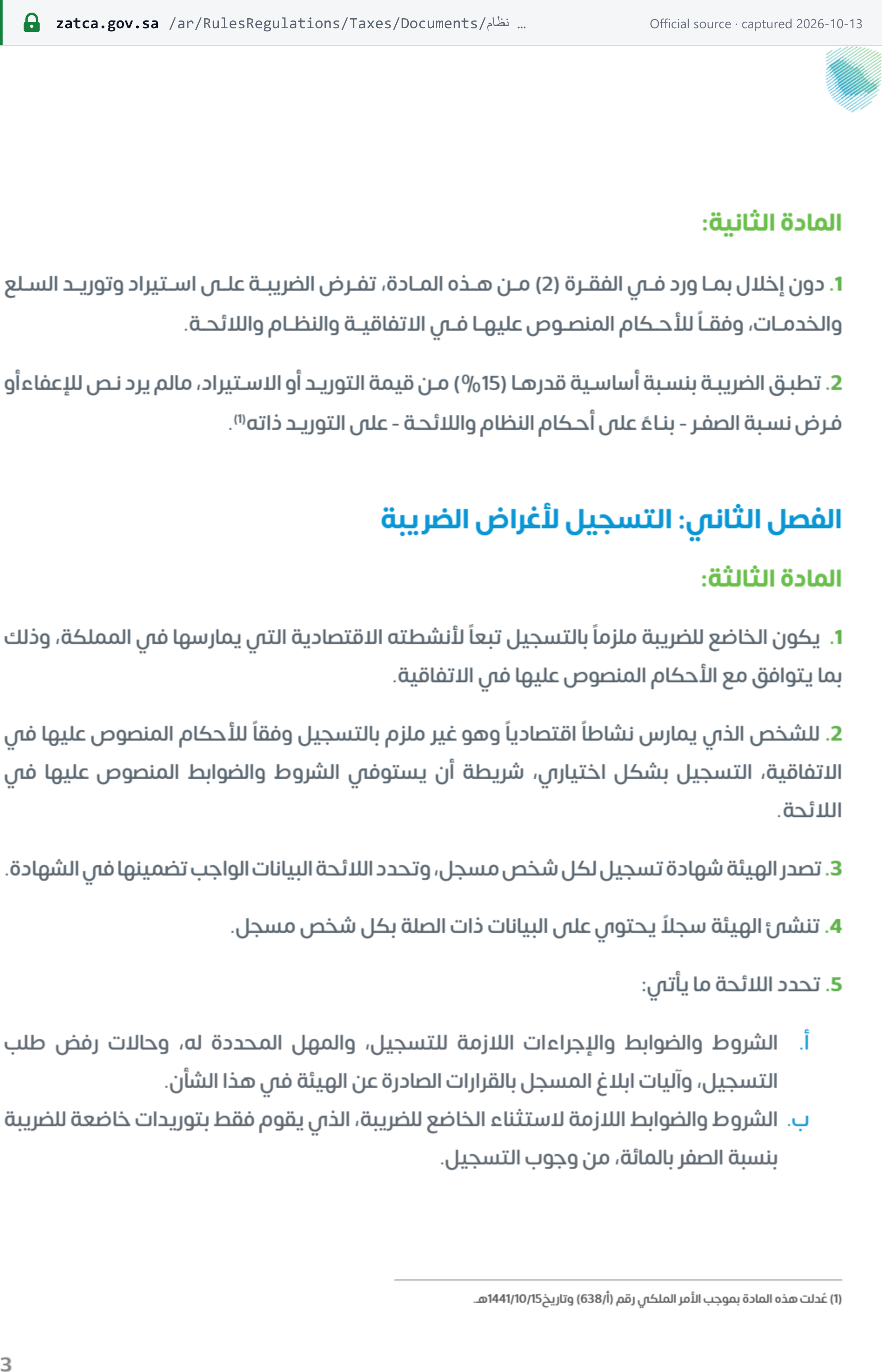
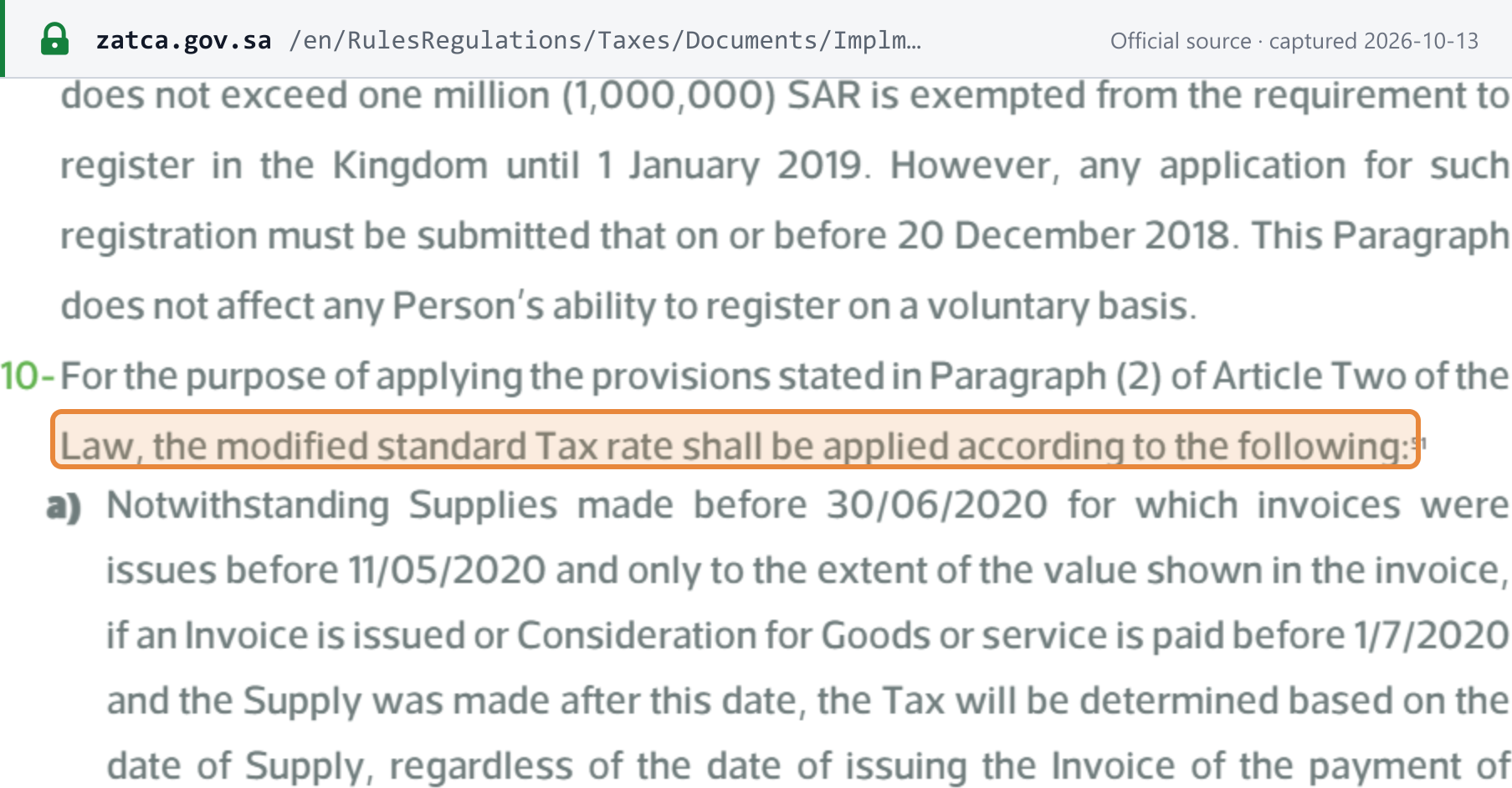
Standard rate. VAT Law Art 2(2), as amended by Royal Order No. A/638 of 15/10/1441H: «تطبق الضريبة بنسبة أساسية قدرها (15%) من قيمة التوريد أو الاستيراد» — tax applies at a basic rate of 15% of the value of the supply or import, unless the supply is exempt or zero-rated. [3] The Implementing Regulations' transitional rules apply the modified rate by reference to 1 July 2020: where an invoice was issued or payment made before 1/7/2020 for a supply made after that date, the tax is set by the date of supply (Art 79(10)). [4] VAT was introduced in 2018 at a standard rate of 5%. [17]
No reduced rate, and no 5% VAT. The VAT Law has only the 15% standard rate and the zero rate. The 5% rate ended on 30 June 2020. Basic food is not zero-rated in Saudi Arabia.
Zero-rated supplies (Implementing Regulations, Chapter Six): [4] [6]
- exports of goods outside the GCC, with export evidence obtained within 90 days (Art 32);
- goods under customs-suspension arrangements (Art 32(7)), and supplies connected with special zones under Art 32 bis, added in 2024;
- services to customers not resident in the GCC (Art 33). Since the 2024 amendments, "The Customer or any related person must not directly benefit from the supplied service while present in a GCC member state. The service must not be physically performed on tangible goods located in a GCC member state";
- international transport of goods and passengers, and qualifying means of transport (Art 34);
- "the Supply of any Qualifying Medicines or Qualifying Medical Goods" (Art 35);
- investment gold, silver and platinum of a purity "not less than ninety-nine percent (99%)" (Art 36).
Announced future rates. None, as of 13 October 2026.
Cross-border rules
Imports and exports
Imports. VAT on imported goods is due on the import date and is collected by Saudi Customs; a taxable importer gives its tax number to Customs: "Upon importation of Goods, a Taxable Person must provide his Tax Identification Number to the Customs Department … Saudi Customs shall be responsible for collecting such Tax" (Art 43). A taxable person can apply to pay import VAT through its VAT return instead, if it files monthly, intends to import at least monthly, and has filed and paid all returns on time (Art 44). [4]
Low-value imports. The VAT Implementing Regulations set no low-value relief for import VAT.
Exports of goods outside the GCC are zero-rated (see Rates). A tax invoice is required for exports and intra-GCC supplies (see Document types).
Reverse charge on supplies from non-residents
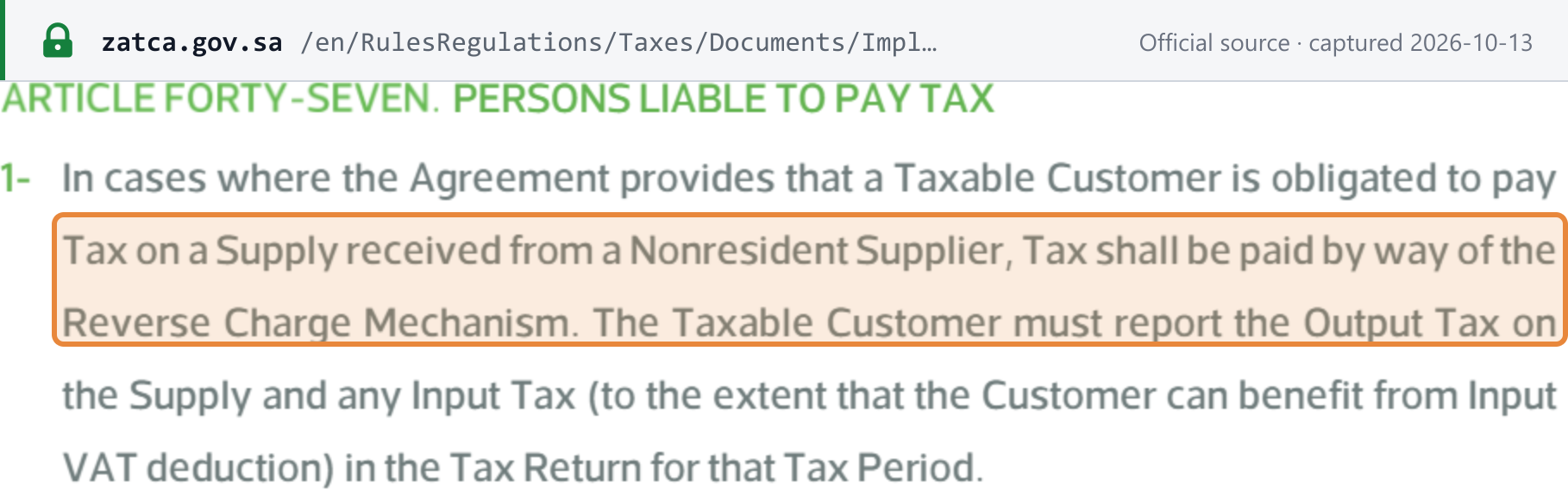
A Saudi taxable customer that receives a supply from a non-resident supplier accounts for the VAT itself: "In cases where the Agreement provides that a Taxable Customer is obligated to pay Tax on a Supply received from a Nonresident Supplier, Tax shall be paid by way of the Reverse Charge Mechanism. The Taxable Customer must report the Output Tax on the Supply and any Input Tax (to the extent that the Customer can benefit from Input VAT deduction) in the Tax Return for that Tax Period." (Art 47(1)) [5] [4] See reverse charge explained.
Digital products and services
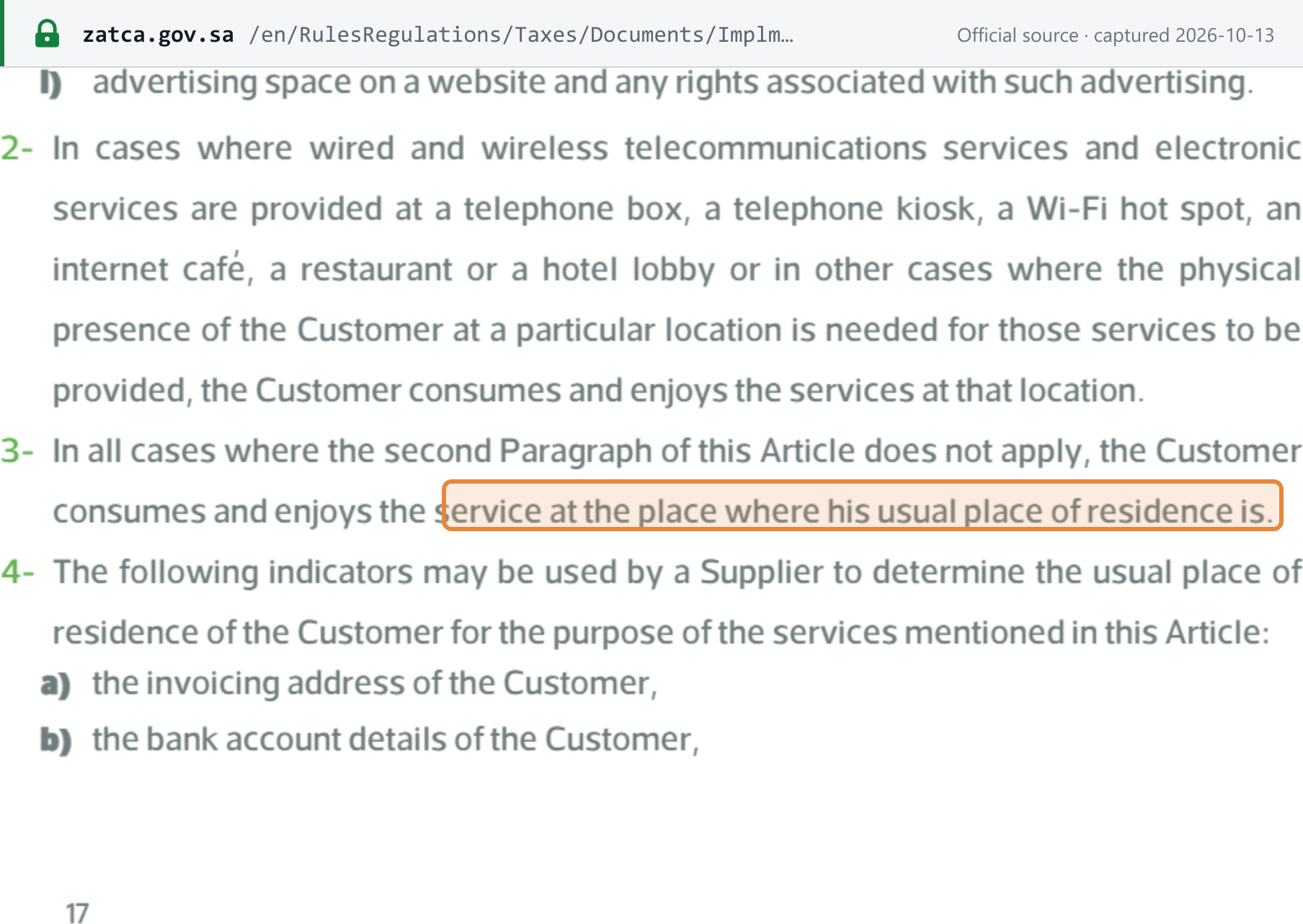
Electronic services are taxed where the customer usually lives: "the Customer consumes and enjoys the service at the place where his usual place of residence is." A supplier may use indicators such as "the invoicing address of the Customer", "the bank account details of the Customer", "the Internet Protocol address" and "the country code of the SIM card" (Art 24(3)–(4)). [4] There is no threshold: a non-resident supplying electronic services to Saudi consumers registers from the first supply (see Non-resident registration). See VAT on digital services by non-resident suppliers.
Foreign companies selling into Saudi Arabia — B2B and B2C
- Selling to businesses (B2B). A non-resident supplying a Saudi VAT-registered customer does not register for those supplies: the customer reverse-charges the VAT (Art 47(1)). Where a tax invoice is issued, it shows the customer's tax number and a statement that the customer must account for the tax (Art 53(5)(d)). [4]
- Selling to consumers (B2C). A non-resident supplying Saudi customers who are not registered must register from the first supply, with no threshold, within 30 days, and must appoint a tax representative (see Non-resident registration). It charges 15%, unless a marketplace is the deemed supplier (below).
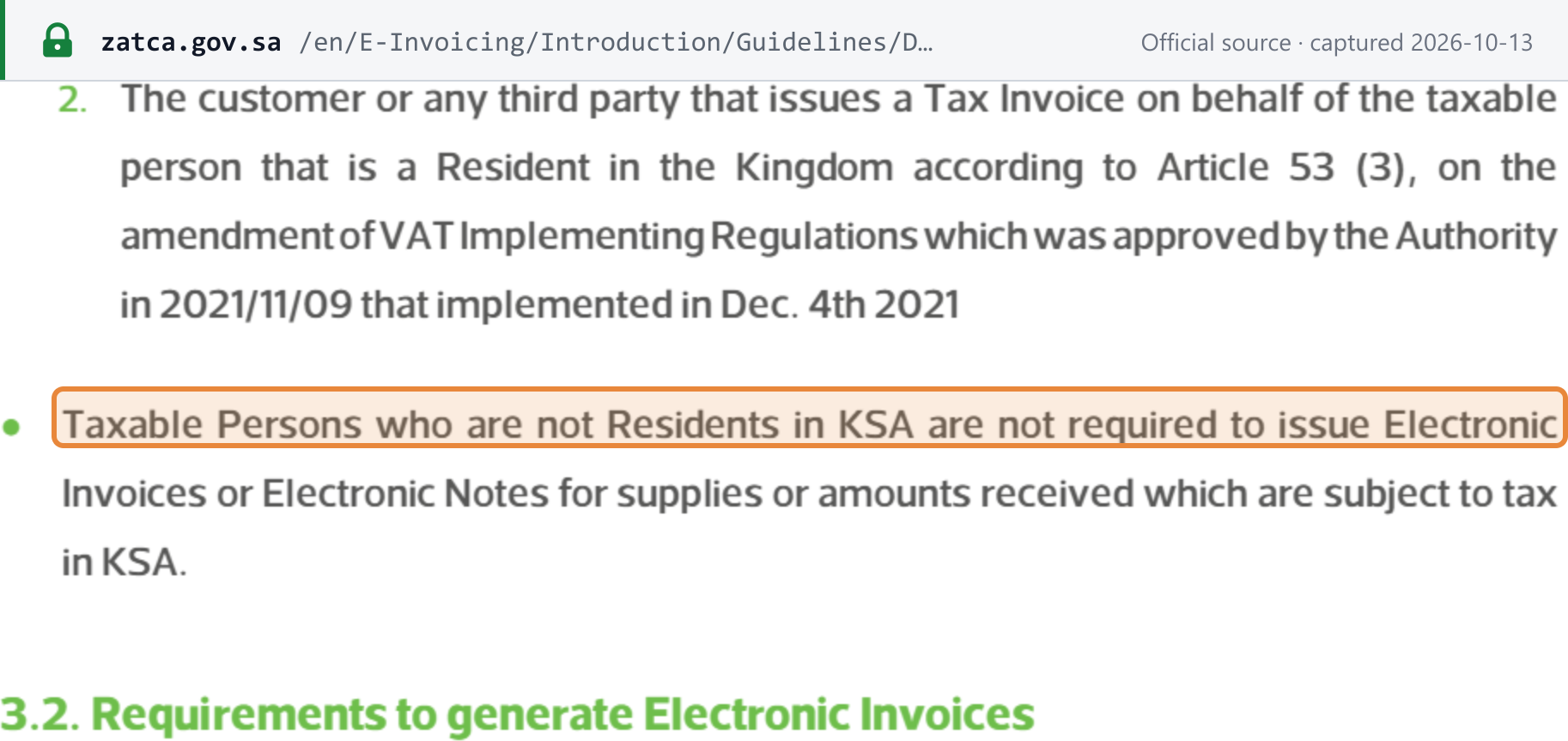
- E-invoicing. "Taxable Persons who are not Residents in KSA are not required to issue Electronic Invoices or Electronic Notes for supplies or amounts received which are subject to tax in KSA." [10]
Marketplace / platform deemed-supplier liability
Article 47(2) and (3), as amended by Resolution 01-06-24, make an electronic marketplace the deemed supplier in two cases: [5] [6]
- Services from non-resident suppliers (Art 47(2)). "In cases where an electronic marketplace facilitates the supply of services as an intermediary for one or more non-resident suppliers, the market is considered to have purchased the services from the non-resident suppliers for its own account and to have resupplied them under its own name to the final customer." The marketplace collects and remits the VAT. A non-resident marketplace selling to customers who are not registered "must register for VAT purposes, regardless of the value of its supplies in the Kingdom".
- Unregistered resident suppliers (Art 47(3)). "Starting from January 2026, amendments to Paragraph (3) of Article (47) of the Regulations will regulate situations where an electronic marketplace facilitates the supply of goods or services in the Kingdom as an intermediary for one or more resident suppliers who are not VAT-registered." The marketplace is treated as buying and reselling those goods or services.
When the rule does not apply. [6]
- Art 47(2), non-resident suppliers — only where both conditions are met: the contracts, tax invoice and receipt state that the non-resident supplier is the actual supplier; and the marketplace does not set the terms or the price, charge or collect payment from customers, handle complaints, or give promotions or compensation.
- Art 47(3), unregistered resident suppliers — only where all three conditions are met: the contracts and the tax invoice or receipt identify the resident supplier as the actual supplier; "There exists a direct and independent contractual relationship between the non-registered resident supplier(s) and the final customer, compliant with applicable VAT regulations in the Kingdom, and the supplier(s) set all terms and conditions of the supply"; and the marketplace does not set terms or prices, charge or collect payment, handle complaints, or give promotions or compensation.
What counts as a marketplace. "A digital or electronic platform, or its equivalent, whose primary or secondary purpose is to enable suppliers to showcase, offer, provide, or contract for their products-whether goods or services-with benefiting customers." Platforms that only process payments, advertise, or redirect customers to another marketplace are not covered (Art 47(4)).


See marketplace deemed-supplier rules for how other countries compare.
Place of supply
Place-of-supply rules are in the GCC Agreement and Implementing Regulations Arts 21–28. In general, services are supplied where the supplier resides; services received by a Saudi business from abroad are reverse-charged (Art 47(1)); and special rules apply to real estate, transport, telecommunications, electronic services, and events. [4] The place-of-supply rules for goods are set out in the GCC Agreement.
Invoice requirements
Mandatory content
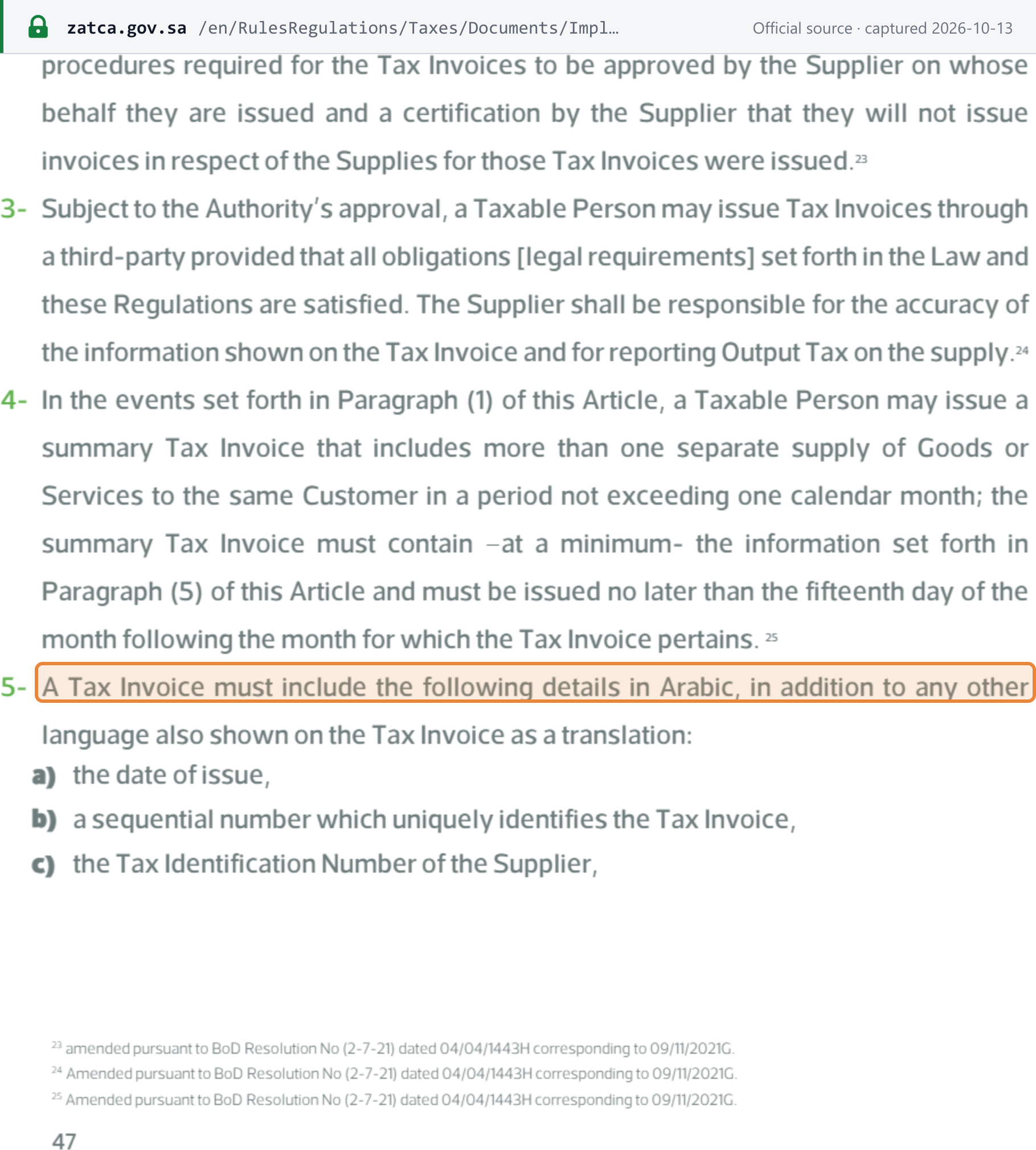
A full tax invoice must show the following "in Arabic, in addition to any other language also shown on the Tax Invoice as a translation" (Implementing Regulations Art 53(5)): [4]
| Ref | Field |
|---|---|
| 53(5)(a) | Date of issue |
| 53(5)(b) | Sequential number that uniquely identifies the invoice |
| 53(5)(c) | Supplier's tax identification number |
| 53(5)(d) | Where the customer self-accounts: the customer's tax number and a statement that the customer must account for the tax |
| 53(5)(e) | Name and address of the supplier and of the customer |
| 53(5)(f) | Quantity and nature of the goods, or scope and nature of the services |
| 53(5)(g) | Date of supply, where different from the date of issue |
| 53(5)(h) | Taxable amount per rate or exemption, unit price excluding VAT, and any discounts not included in the unit price |
| 53(5)(i) | VAT rate applied |
| 53(5)(j) | VAT amount, in SAR |
| 53(5)(k) | Where VAT is not charged at the basic rate, a note explaining the tax treatment |
| 53(5)(l) | Where the profit-margin scheme for eligible used goods applies, a reference to it |
E-invoices carry further fields, such as a unique identifier and a QR code (required on simplified invoices from Phase 1 and extended to 9 tags in Phase 2); see the ZATCA e-invoicing guide.
Issuance deadline
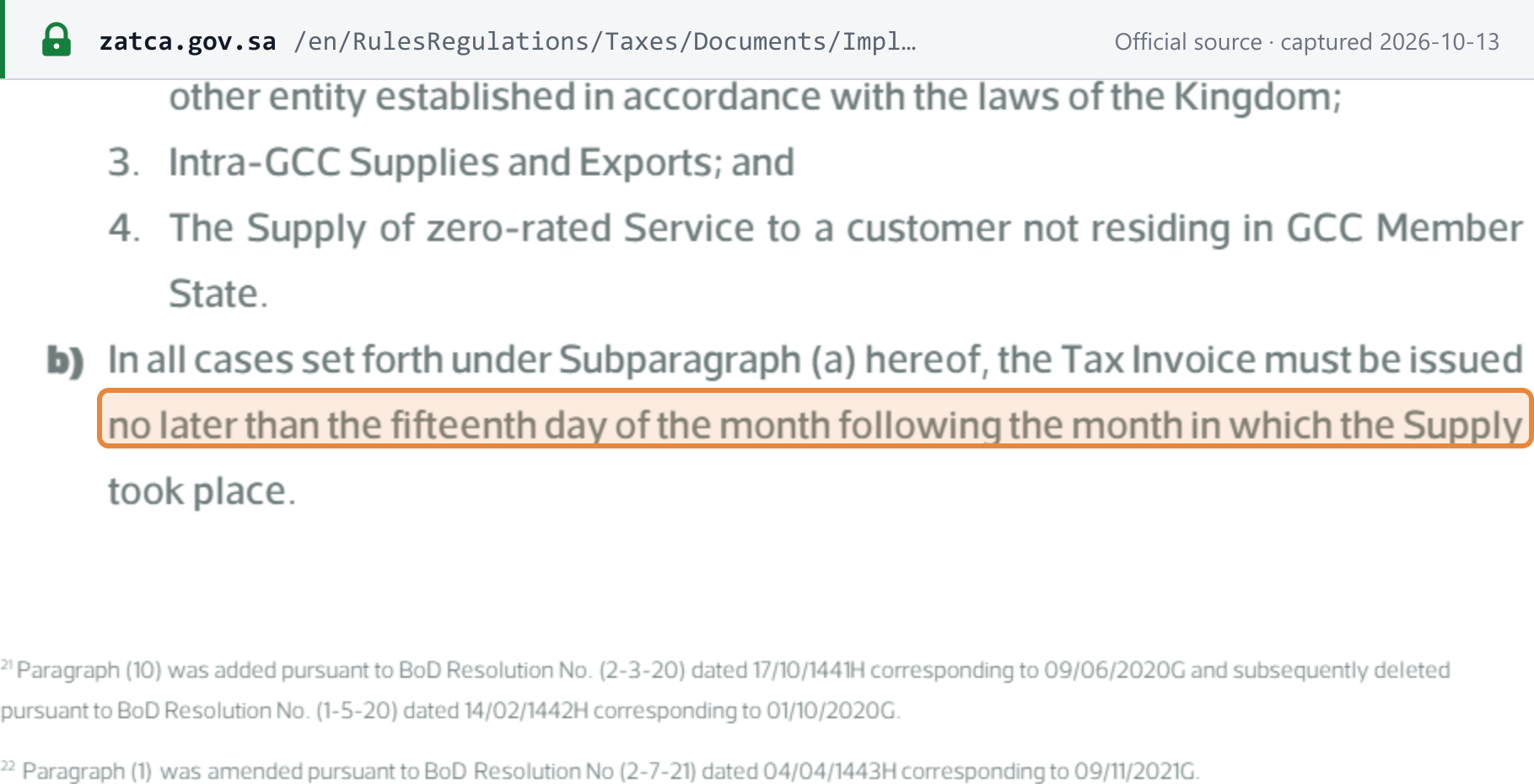
- Tax invoice: "the Tax Invoice must be issued no later than the fifteenth day of the month following the month in which the Supply took place" (Art 53(1)(b)). [5]
- Simplified tax invoice: "on the earliest of the date of the supply and the date of receipt of Consideration -in whole or in part-" (Art 53(7)(b)). [4]
- Summary tax invoice: one invoice for several supplies to the same customer over no more than one calendar month, issued by the 15th of the following month (Art 53(4)).
Numbering and sequencing
"Invoice numbers may be specified using numerals only, or by using a combination of numerals and letters (Roman or Arabic), provided that the number is sequential and uniquely identifies the invoice." [1] VAT is rounded to the nearest halala.
Credit and debit notes
A credit note is issued when the VAT charged was too high and a debit note when it was too low (Art 54). Each "must contain all information required to be included in the corresponding Tax Invoice" plus a reference to "the sequential number of the Tax Invoice issued in respect of the initial Supply", and states its type ("Credit Note" or "Debit Note"). Since the 2024 amendments, notes must be issued "within 15 days following the end of the month in which the event necessitating their issuance occurred". [6] [4] [1] Under e-invoicing, notes go through the same clearance or reporting as invoices.
Currency and language
- Language. "All fields of the tax invoice must be completed in the Arabic language. The information stated in Arabic shall be considered the approved and conclusive information, and any other language shall be treated as a translation only." Records must also be kept in Arabic (Art 66(2)). [1]
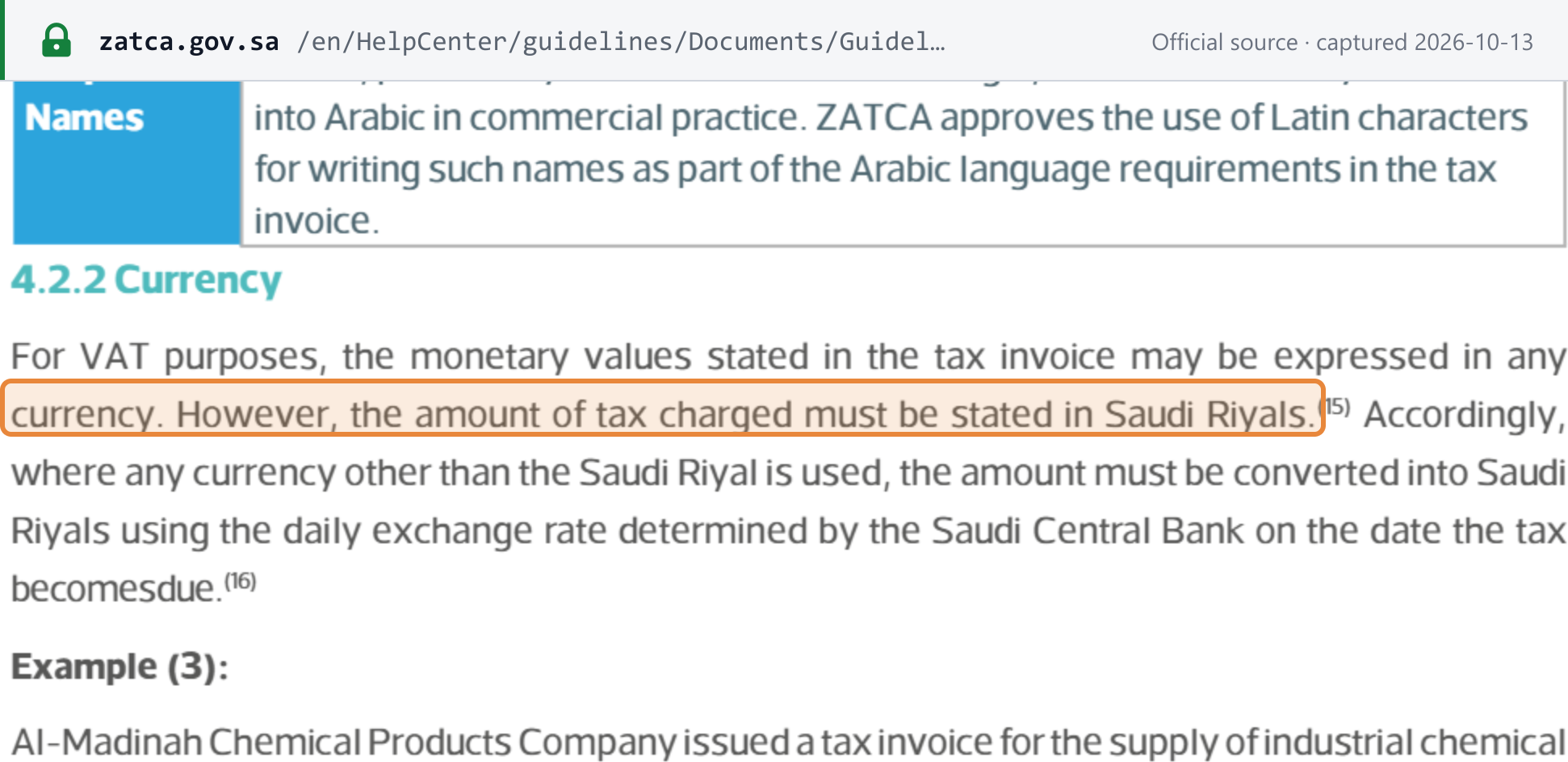
- Currency and FX. "For VAT purposes, the monetary values stated in the tax invoice may be expressed in any currency. However, the amount of tax charged must be stated in Saudi Riyals." Convert using "the daily exchange rate determined by the Saudi Central Bank on the date the tax becomes due" (guideline §4.2.2, referring to Art 61). [1]
Document types
| Document | When it is used |
|---|---|
| Tax invoice (full) | Supplies to businesses, government bodies, non-taxable legal persons, sole proprietorships and other entities in Saudi Arabia; advance payments from them; intra-GCC supplies and exports; zero-rated services to non-GCC customers (Art 53(1)(a)) |
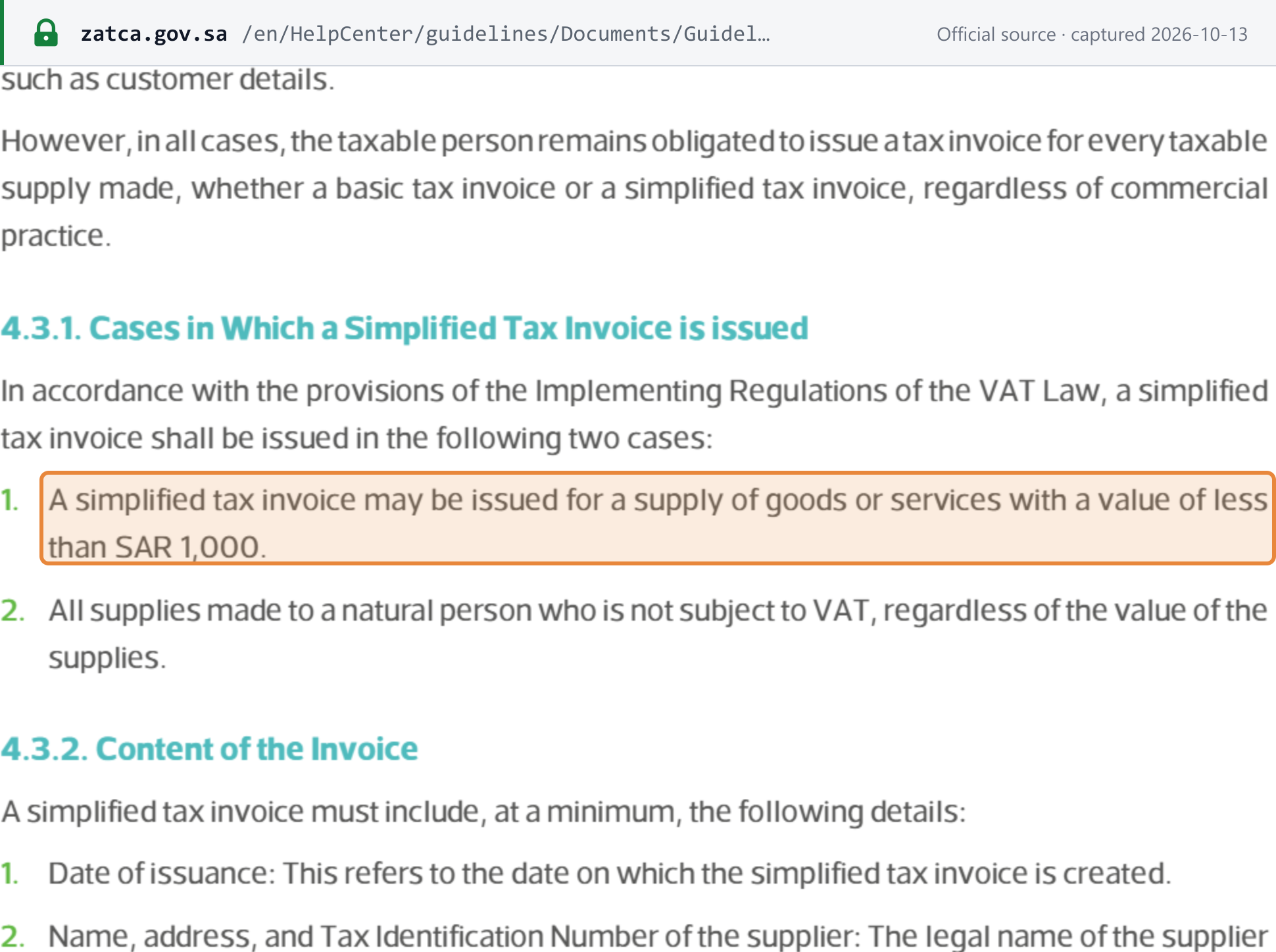
| Simplified tax invoice | Supplies in the first row worth less than SAR 1,000; and all supplies to persons outside the first row, such as consumers, at any value (Art 53(1)(c), 53(7)) |
| Summary tax invoice | Several supplies to one customer over at most one calendar month (Art 53(4)) |
ZATCA's guideline summarises the simplified invoice: "A simplified tax invoice may be issued for a supply of goods or services with a value of less than SAR 1,000" and for "All supplies made to a natural person who is not subject to VAT, regardless of the value of the supplies." [1] The Arabic text of Art 53(1)(c) calls this a «فاتورة ضريبية مبسطة» (simplified tax invoice). [5]
A simplified tax invoice must show the date of issue; the supplier's name, address and tax identification number; a description of the goods or services; the consideration; and the tax payable or a statement that the price includes tax (Art 53(8)). The supplier's tax number is required whatever the invoice value. [4]
Self-billing
Permitted with ZATCA's approval: "Subject to the Authority's approval, a Taxable Customer may issue Tax Invoices on behalf of a Supply made by a Taxable Supplier provided that a prior agreement between such Supplier and Customer has been made to this effect; that the Tax Invoice state that it was issued by the Customer on behalf of the Supplier; and that the Supplier and Customer are registered with the Authority for VAT purposes." (Art 53(2)) The agreement must set out how the supplier approves the invoices, and the supplier must certify that it will not issue its own invoices for those supplies. Invoices may also be issued through a third party with ZATCA's approval; the supplier remains responsible for their accuracy (Art 53(3)). [4]
Retention and audit trail
- 6 years from the end of the tax period for invoices, books, records and accounting documents (Art 66(1)). [4]
- Capital assets: the adjustment period plus 5 years — 11 years for movable assets (6-year adjustment period) and 15 years for immovable assets (10-year adjustment period) (Arts 52(2), 66(1)).
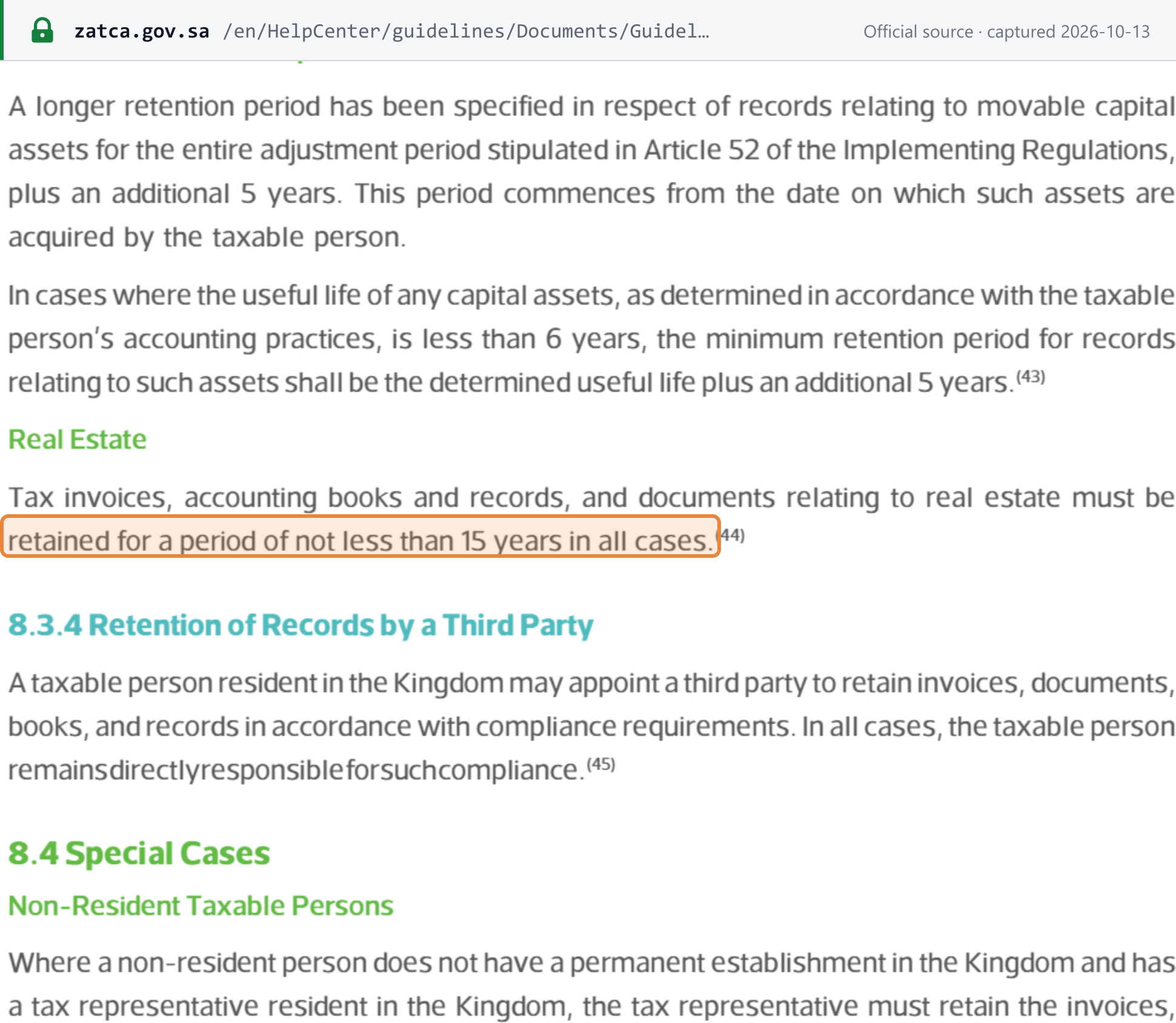
- Real estate: "Tax invoices, accounting books and records, and documents relating to real estate must be retained for a period of not less than 15 years in all cases." [1]
- Electronic storage and audit trail. Records may be kept electronically, but the taxable person must "take the necessary security measures and adequate controls that can be reviewed and examined to prevent tampering with invoices, documents, and electronic records", and ZATCA "may conduct a review of systems and programs used by the Taxable Person to electronically prepare their records" (Art 66(3)(f)–(g)). [4]
A specimen of a compliant invoice
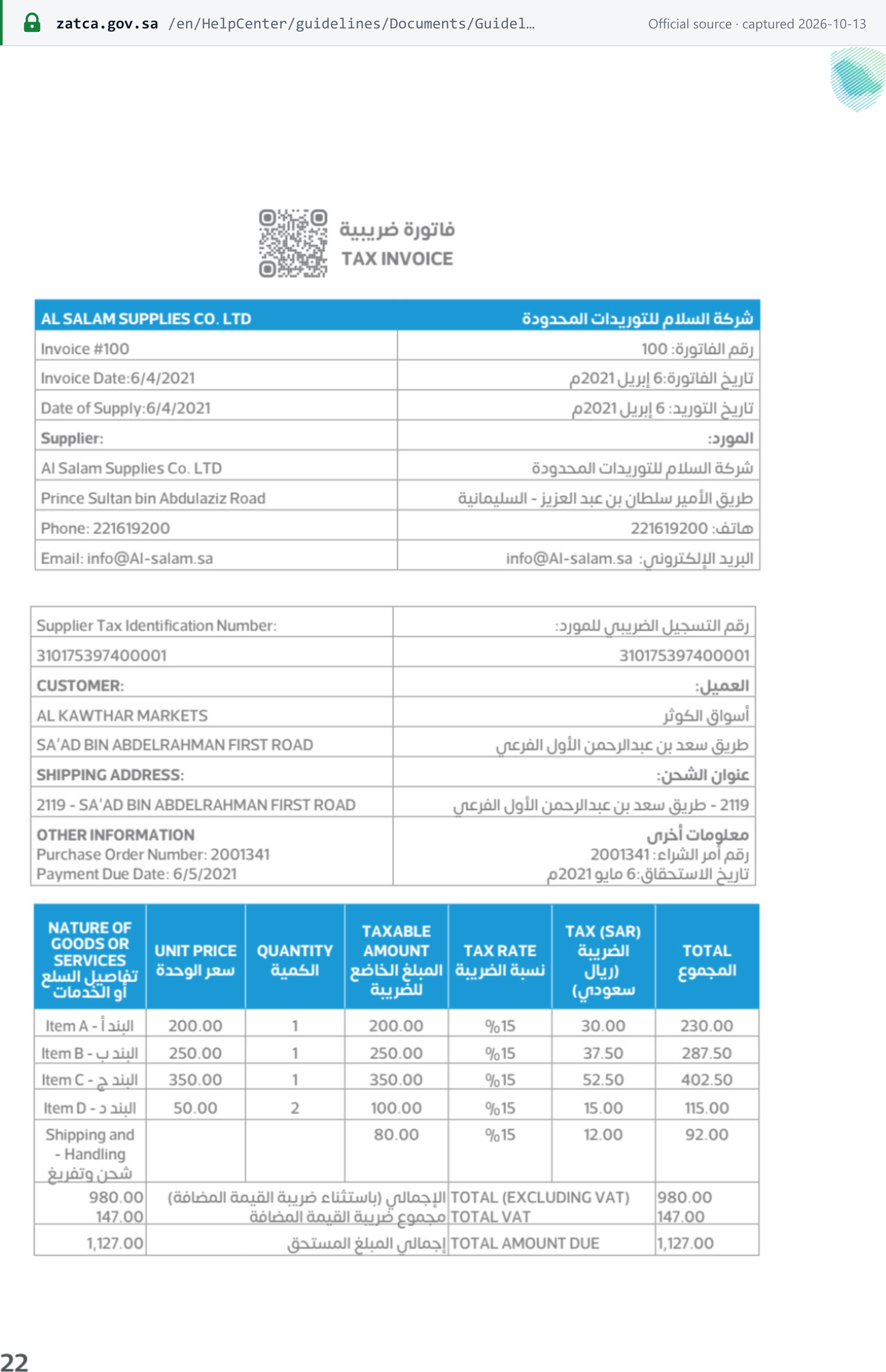
ZATCA publishes an official bilingual specimen tax invoice in its Guideline for Tax Invoicing and Records under VAT Provisions (version 3, May 2026, §4.2.6, p.22), reproduced below. It is a full tax invoice for a supply of goods with shipping and handling, from the fictional "Al Salam Supplies Co. Ltd" to "Al Kawthar Markets": invoice number 100, dated 6 April 2021, with the date of supply, the supplier's tax number, a purchase-order reference, and five lines at 15%. The totals are SAR 980.00 excluding VAT, SAR 147.00 VAT and SAR 1,127.00 due. Every label appears in Arabic with an English translation, and a QR code sits at the top. ZATCA notes that "it is not mandatory to use the same template shown in the following example." [1] The supplier number printed on the specimen is a sample and does not follow the first-and-last-digit-3 format of a real VAT number. The guideline's annex has further examples, including a simplified invoice, a foreign-currency invoice, a summary invoice and an invoice with lines not at the standard rate.
E-invoicing status
Status (as of 13 October 2026): mandatory for resident taxpayers, with Phase 2 integration rolled out in waves. The system is FATOORA, run by ZATCA. [11]
- Phase 1 (Generation). "Phase 1 is enforceable as of December 4th, 2021, for all taxpayers (excluding non-resident taxpayers), and any other parties issuing tax invoices on behalf of suppliers subject to VAT."
- Phase 2 (Integration). Enforceable from 1 January 2023 in waves; ZATCA notifies each wave at least six months before its integration date.
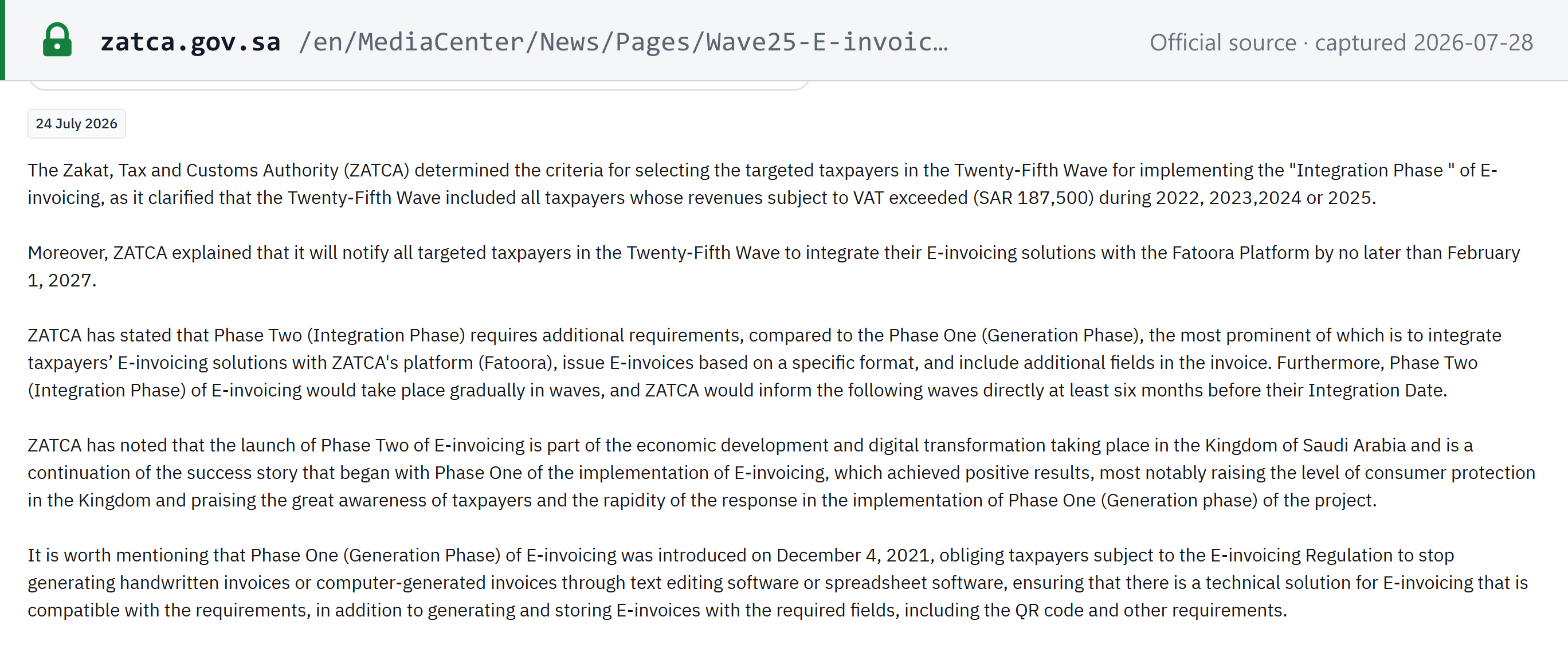
- Latest wave. Wave 25 covers "all taxpayers whose revenues subject to VAT exceeded (SAR 187,500) during 2022, 2023,2024 or 2025", who must integrate with FATOORA "by no later than February 1, 2027." [12] Wave 24 (revenue above SAR 375,000) had a deadline of 30 June 2026. No later wave had been announced as of 13 October 2026; ZATCA's roll-out page says additional waves are to be announced. [11]
Scope.
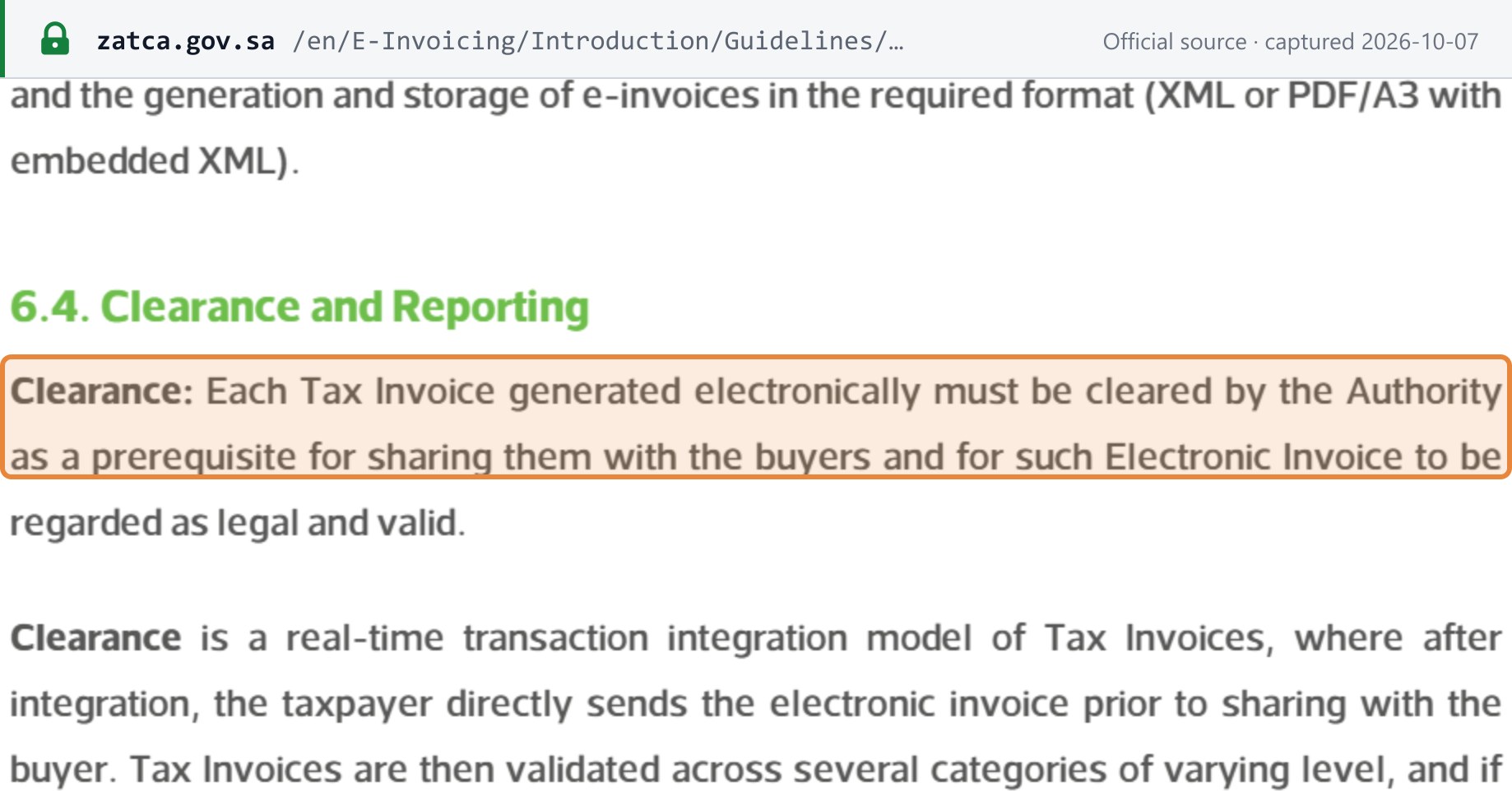
- B2B and B2G — clearance. "Each Tax Invoice generated electronically must be cleared by the Authority as a prerequisite for sharing them with the buyers". [10]
- B2C — reporting. Simplified tax invoices are reported to FATOORA "within 24 hours of generation".
- Exports need an e-invoice. Non-residents are outside e-invoicing (see Foreign companies selling into Saudi Arabia).
Formats. In Phase 2, invoices are generated and stored as XML, or as PDF/A-3 with embedded XML, but are submitted for clearance or reporting as XML. The XML follows UBL 2.1 and is validated against a customised subset of EN 16931 rules. Each invoice carries a cryptographic stamp and a QR code with "9 tags in TLV base64 format". [10] [9]
For the full wave table and technical detail, see the ZATCA FATOORA e-invoicing guide. For clearance and reporting models generally, see CTC e-invoicing models.
Filing and payment
Filing frequency
| Frequency | Who |
|---|---|
| Monthly | Taxable persons whose taxable supplies exceeded SAR 40,000,000 in the previous 12 months |
| Quarterly | All other taxable persons |
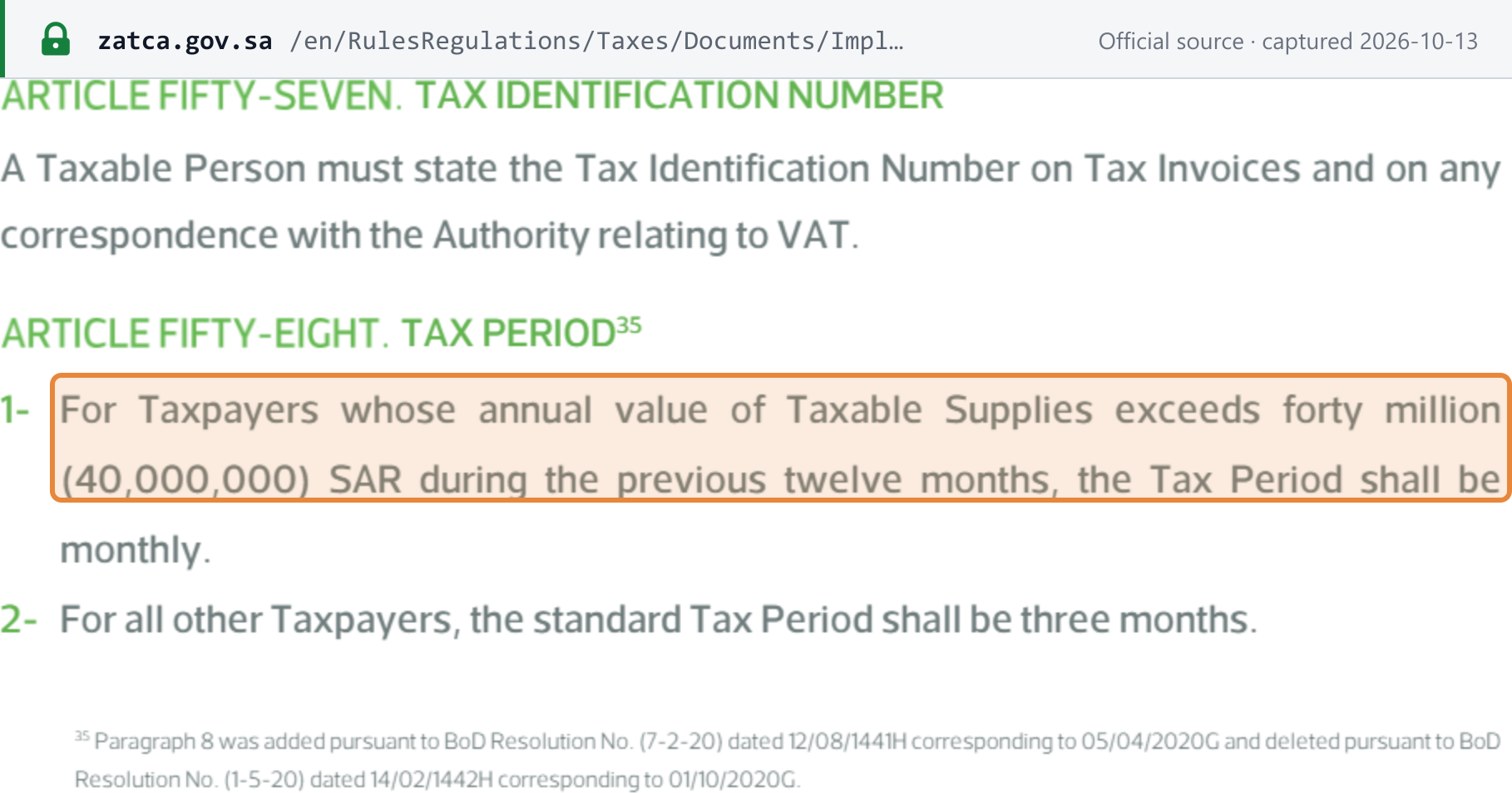
"For Taxpayers whose annual value of Taxable Supplies exceeds forty million (40,000,000) SAR during the previous twelve months, the Tax Period shall be monthly. 2- For all other Taxpayers, the standard Tax Period shall be three months." (Art 58(1)–(2)) [4] [5] A quarterly filer may choose to file monthly; a monthly filer under SAR 40 million may return to quarterly after two years.
Cash accounting. Available where annual supplies do "not exceed five million (5,000,000) SAR" (Art 46(1)), but not to a taxable person notified of a VAT violation in the last 12 months (Art 46(2)). [4]
Return due date
"The Tax Return … must be filed … for each Tax Period with the Authority no later than the last day in the month following the end of the Tax Period to which the Tax Return relates." (Art 62(1)) [4] For example, ZATCA asked businesses above SAR 40 million to file their March 2026 return, and all others their first-quarter 2026 return, by 30 April 2026. [15]

Payment due date and method
The same date: "Payment of Tax due by a Taxable Person in respect of a Tax Period must be made at the latest by the last day of the month following the end of that Tax Period" (Art 59(1)), to ZATCA's designated bank account (Art 59(3)). [4] Returns are filed and paid through zatca.gov.sa or ZATCA's app. [15] ZATCA may allow payment in instalments over no more than 12 months (Art 60(5)).
Additional listings
None. There is no annual VAT return, sales or purchase listing, or EC-sales-list equivalent; transaction-level data reaches ZATCA through FATOORA e-invoicing.
Input-tax recovery and blocked items
Input tax on goods and services used for taxable supplies is deductible; where costs relate to both taxable and exempt supplies, deduction is proportional (Art 51). [4]
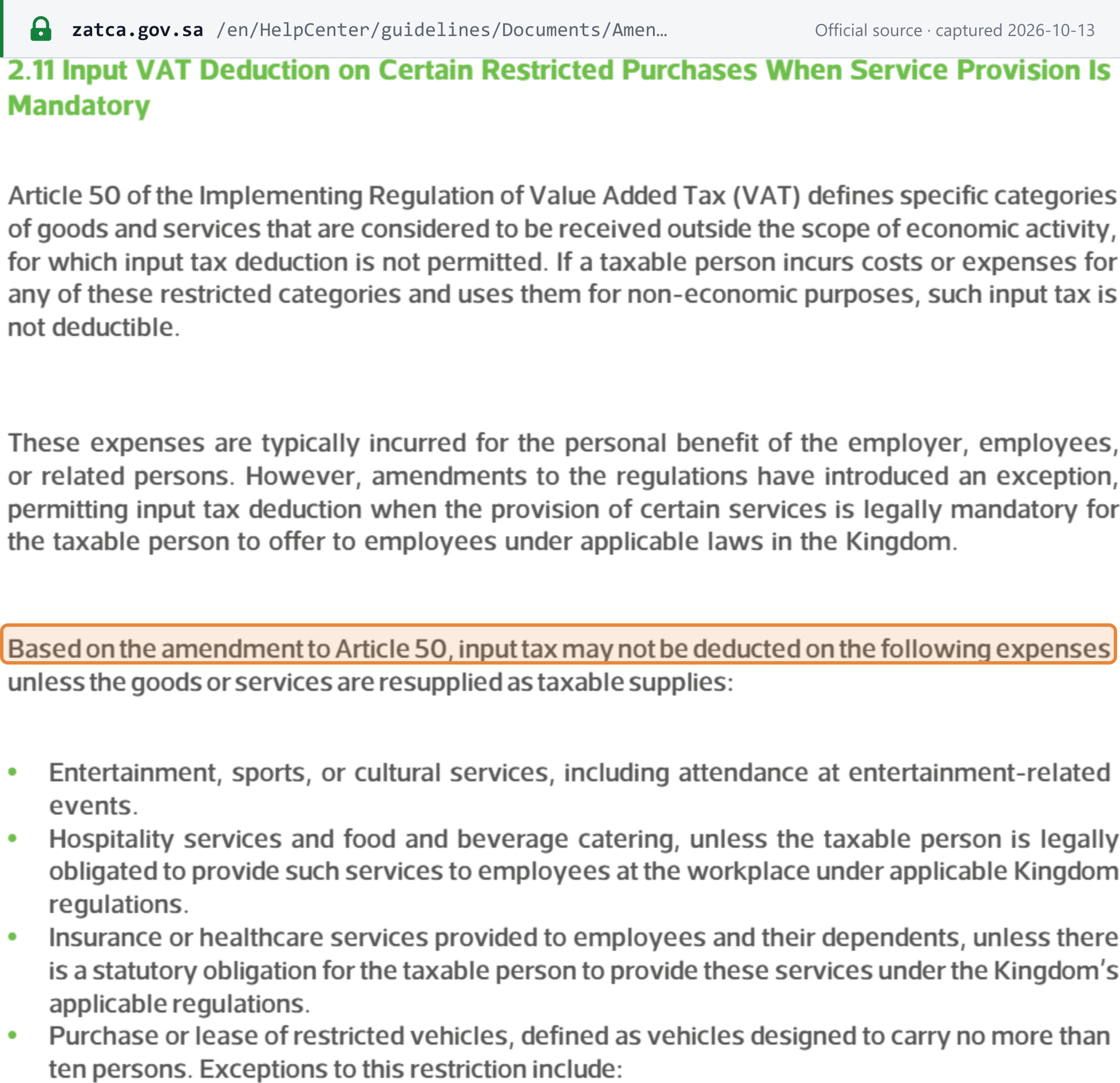
Blocked items (Art 50, as amended by Resolution 01-06-24). Input tax is not deductible on the following, unless the goods or services are resupplied as taxable supplies: [6]
- entertainment, sports or cultural services;
- hospitality and food and beverage catering, unless the law requires the business to provide them to employees at the workplace;
- insurance or healthcare for employees and their dependants, unless the business is legally required to provide it;
- buying or leasing restricted vehicles (designed to carry no more than ten people), with exceptions for heavy machinery and vehicles used only for the business, vehicles bought for resale or leasing, and emergency vehicles;
- insurance, repairs, maintenance and fuel for restricted vehicles;
- any goods or services for personal use or unrelated to the economic activity.
Refunds
- Residents. A refund of excess input tax can be requested with the return, "or at any other time within five (5) years following the end of the calendar year" concerned; ZATCA must "initiate payment within sixty (60) days from the date of approval of the request". Credits can otherwise be carried forward or offset (Art 69). [4]
- Businesses outside the GCC. A business carrying on economic activity outside the GCC may apply to be treated as an eligible person and reclaim Saudi VAT "in the following cases" (Art 72(1)): (a) it is established in a country with a VAT-like tax and is registered for that tax; or (b) it is established in such a country and that country allows a similar refund mechanism for Saudi residents. Applications follow the Article 70 process (Art 72(2)), and claims may be made "in respect of a calendar year basis only" (Art 72(3)). [4] The 2024 amendments to Article 70 require claims within six months of the end of the refund period, a minimum claim of SAR 5,000, and payment within 30 business days of approval; ZATCA has not said explicitly whether these apply to claimants under Article 72. [6]
- Bad-debt relief. A supplier can adjust output tax on an unpaid debt where the tax was paid, the customer is not related, "a period of at least twelve months has passed from the date of the Taxable Supply", a certified accountant certifies the write-off, and, for unpaid amounts over SAR 100,000, "formal legal procedures have been taken" (Art 40(7)). [4]
Exemptions
Exempt supplies
- Financial services charged by an implicit margin: "Supplies of Financial Services listed within this Article are exempt from VAT, except in cases where the Consideration payable in respect of the service is by way of an explicit fee, commission or commercial discount." Life insurance and reinsurance are also exempt (Art 29).
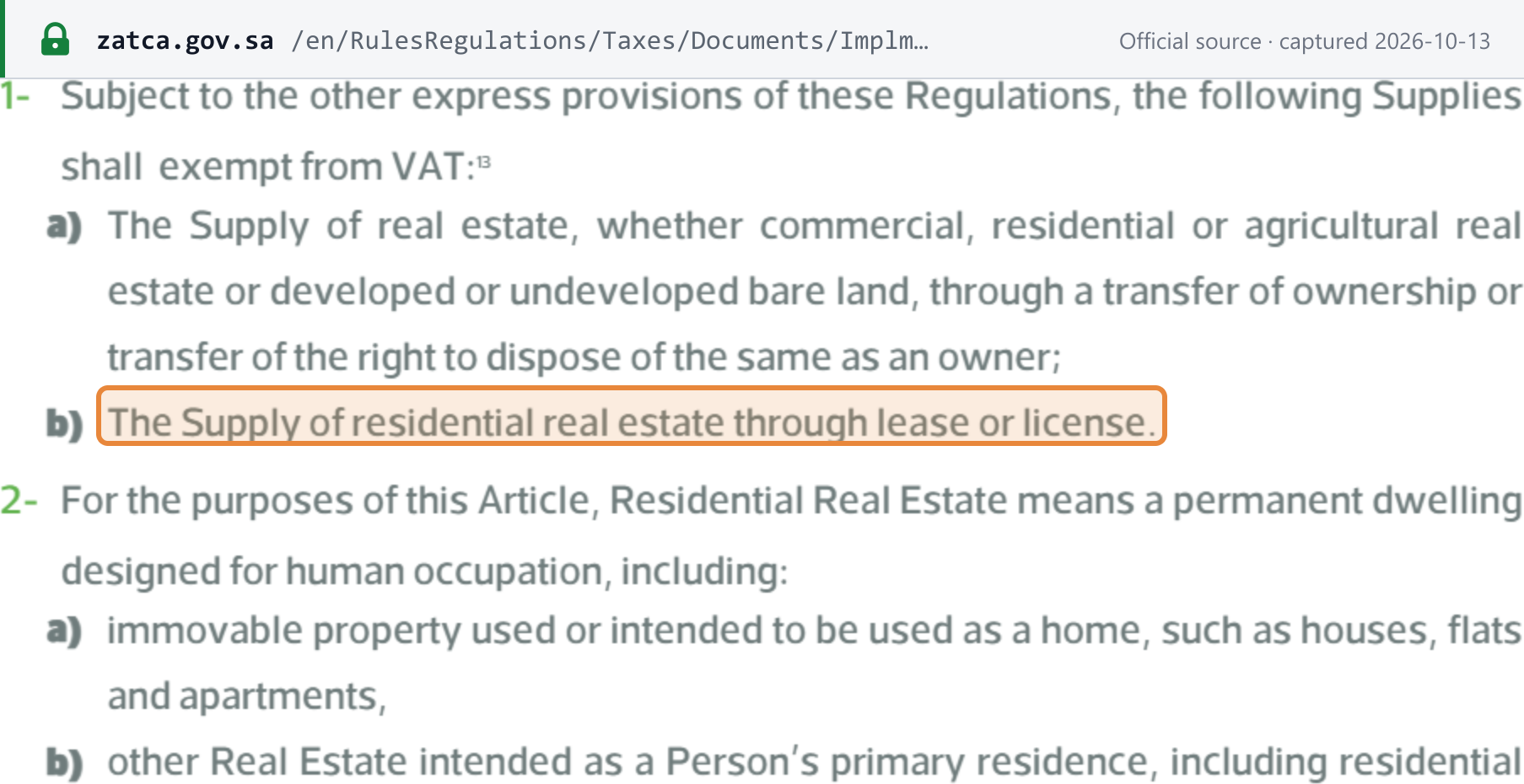
- Real estate: "The Supply of real estate, whether commercial, residential or agricultural real estate or developed or undeveloped bare land, through a transfer of ownership" and "The Supply of residential real estate through lease or license" (Art 30(1)). Hotels, inns, guest houses, motels and serviced accommodation are not residential real estate (Art 30(3)), so they are taxable. [4]
Exempt is not zero-rated. A zero-rated supply is a taxable supply: it is charged at 0% and the input tax on its costs is deductible. An exempt supply carries no VAT and no right to deduct the input tax on its costs; a business making both apportions its input tax (Art 51). [1] Where a supply qualifies as both, "A Supply of Goods or services which constitutes both an Exempt Supply … and a zero-rated Supply … is treated as a zero-rated Supply." (Art 31(2)) [4]
Special regimes
- Profit-margin scheme for eligible used goods (Art 48).
- Cash accounting for annual supplies up to SAR 5 million (see Filing frequency).
- Customs suspension and special zones: zero rate under Art 32(7) and Art 32 bis (see Rates); members licensed in such zones cannot join a VAT group.
- Flat-rate or small-business schemes: none beyond the registration threshold.
Offences and penalties
Offences
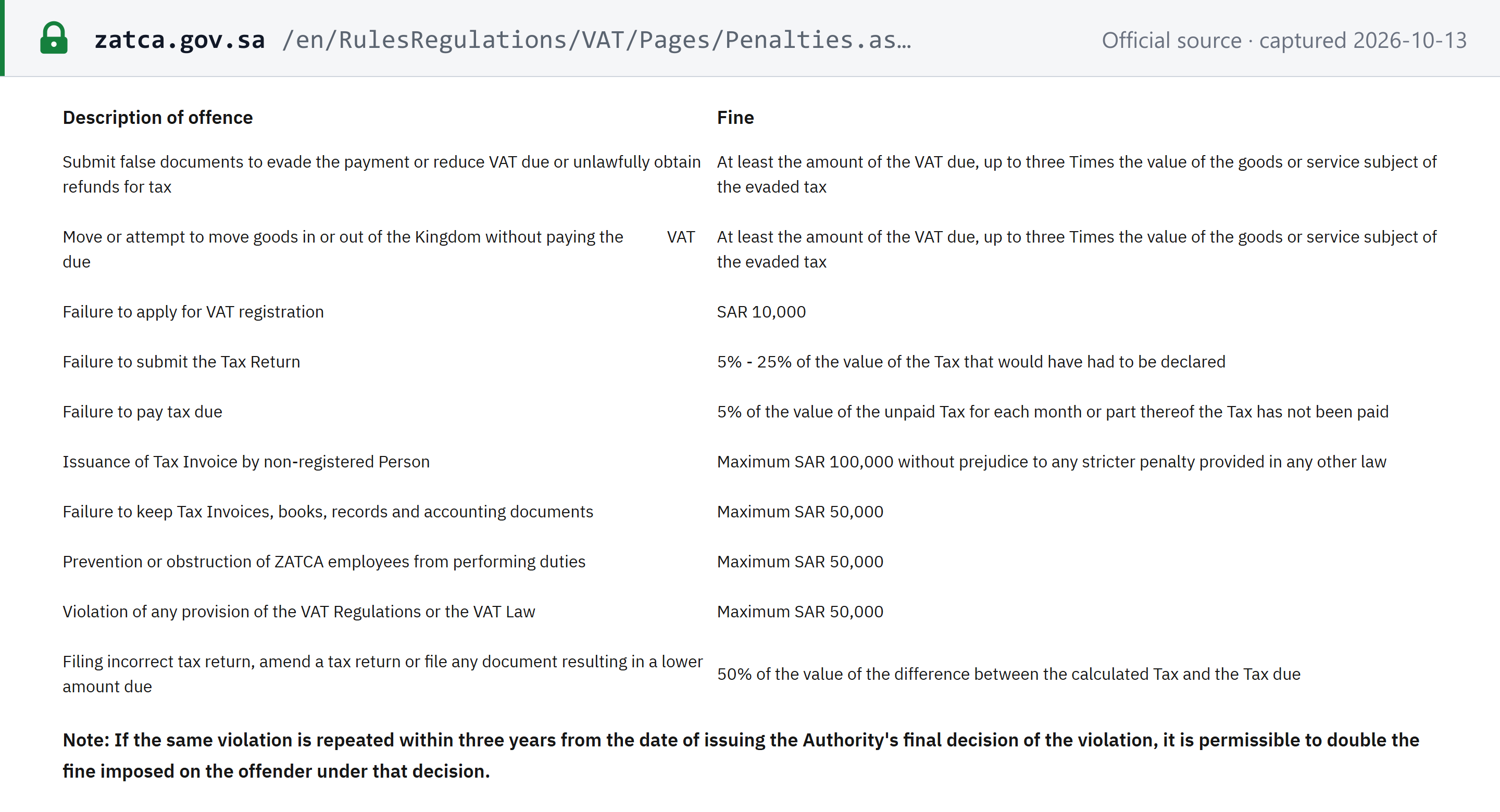
The VAT Law treats as tax evasion (Art 39): [3]
- submitting incorrect, forged or fabricated documents, returns, records or information to evade or reduce tax, or to obtain a refund without right;
- bringing goods into the Kingdom or taking them out, or attempting to, without paying the tax in full.
Other unlawful conduct penalised by the Law includes failing to register on time, issuing a tax invoice while not registered, failing to keep invoices and records, obstructing ZATCA employees, and breaching any other provision of the Law or Regulations. [13]
Criminal exposure. The VAT Law sets fines only; it does not provide for imprisonment. Its penalties apply without prejudice to any harsher penalty in another law (Art 46).
Penalties
| Violation | Fine | VAT Law |
|---|---|---|
| Tax evasion | At least the VAT due, up to three times the value of the goods or services | Art 40 |
| Failure to apply for registration | SAR 10,000 | Art 41 |
| Incorrect return, or a document that lowers the tax due | 50% of the difference between the calculated and the due tax | Art 42(1) |
| Failure to submit the return | 5%–25% of the tax that should have been declared | Art 42(3) |
| Failure to pay tax due | 5% of the unpaid tax for each month or part month | Art 43 |
| Tax invoice issued by an unregistered person | Up to SAR 100,000 | Art 44 |
| Failure to keep invoices and records; obstructing ZATCA; any other breach | Up to SAR 50,000 | Art 45 |
| Same violation repeated within three years | Fine may be doubled | Art 47 |
Sources: ZATCA penalties page and the VAT Law, Arts 40–47. [13] [3]
Interest. The VAT Law sets a late-payment penalty of 5% of the unpaid tax for each month or part month, and contains no separate interest provision.
Incorrect returns in practice. The Law lets ZATCA's Board reduce the incorrect-return penalty (Art 42(2)). ZATCA's invoicing guideline sets the working rule at 25% of the difference, which ZATCA "may increase … up to a maximum of 50% or reduce it down to 0%". Reductions include 15 percentage points for micro-enterprises (revenue up to SAR 3 million) and 10 points for paying within 30 days. No penalty applies where the difference is under SAR 5,000, or where the return is corrected before an audit notice. [1]
Field violations. "All field violations commence, upon commission, with notifying the violator and providing awareness thereof, and granting an appropriate time period ranging from 30 to 60 days to rectify them". [1] The fine schedule for e-invoicing violations is set out in a separate ZATCA guideline on the classification of VAT violations.
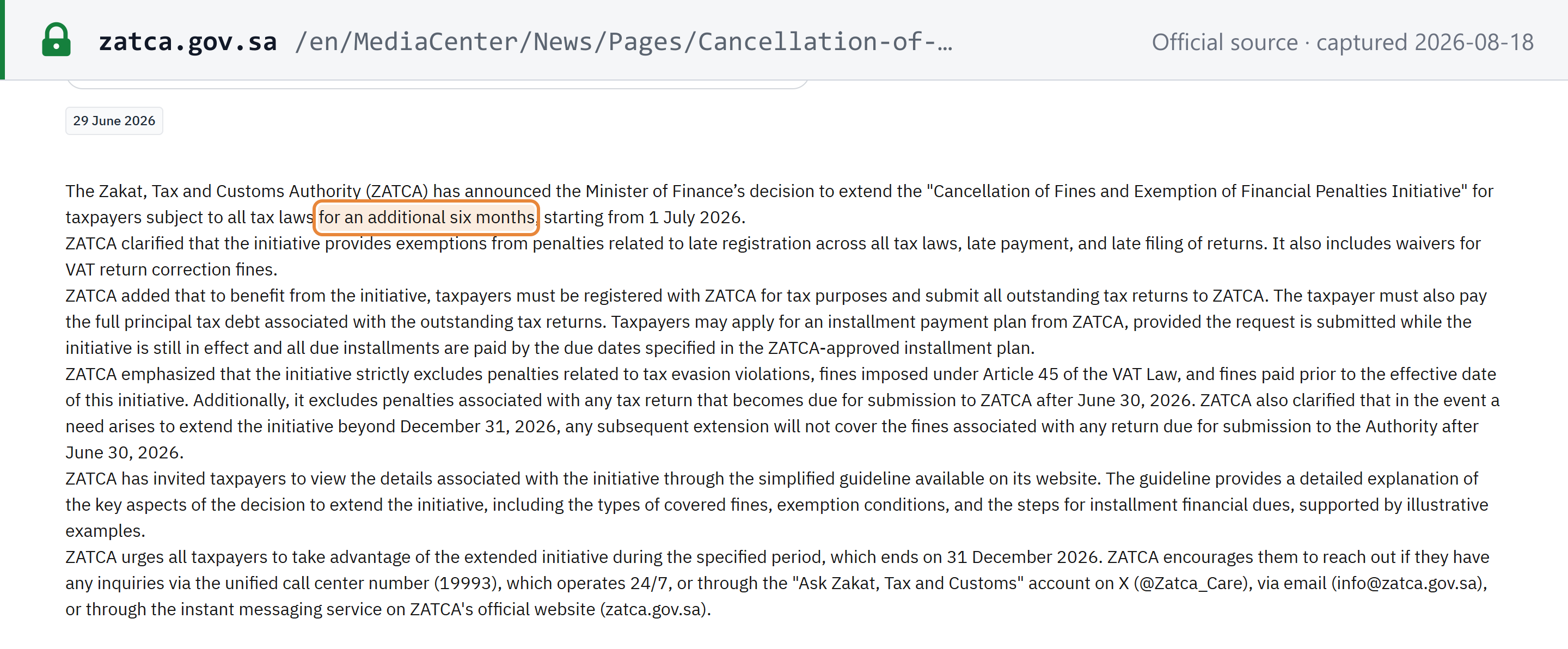
Fines amnesty to 31 December 2026. The "Cancellation of Fines and Exemption of Financial Penalties Initiative" was extended for six months from 1 July 2026 and ends on 31 December 2026. It waives fines for late registration, late payment and late filing, and VAT return-correction fines. To qualify, a taxpayer must be registered, file all outstanding returns and pay the principal tax (an instalment plan is possible). It excludes evasion fines, fines under Article 45 of the VAT Law, fines already paid, and fines on returns due after 30 June 2026. [14]
Frequently asked questions
We are a foreign SaaS company selling to consumers in Saudi Arabia. Is there a threshold before we have to register for VAT?
No. A non-resident that is liable to pay Saudi VAT must register regardless of its turnover. Apply within 30 days of the first supply on which you are liable; the registration takes effect from that supply. Charge VAT at 15%, and decide where a customer usually lives using indicators such as the invoicing address, bank details, IP address and SIM card country code. ZATCA requires every non-resident taxable person to have one tax representative, who is jointly liable for the tax due.
We sell only to VAT-registered businesses in Saudi Arabia. Do we need to register?
Not for those supplies. A Saudi taxable customer that receives a supply from a non-resident supplier accounts for the VAT itself under the reverse charge mechanism (Implementing Regulations, Article 47(1)). A tax invoice for such a supply shows the customer's VAT number and a statement that the customer must account for the tax. Any sales to consumers fall under the non-resident registration rule instead, with no threshold.
We sell through an app store or online marketplace. Who charges Saudi VAT?
Where an electronic marketplace facilitates services for non-resident suppliers, the marketplace is treated as buying the services and resupplying them in its own name, and it collects and remits the VAT (Article 47(2)). From January 2026 the same treatment covers goods or services sold through a marketplace by Saudi resident suppliers that are not VAT-registered (Article 47(3)). For non-resident suppliers, the rule does not apply only where the contracts, invoice and receipt name you as the actual supplier and the marketplace does not set terms or prices, charge or collect payment, handle complaints, or offer promotions or compensation. For unregistered resident suppliers there is a third condition: the supplier must also have a direct and independent contract with the customer and set all the terms of the supply.
As a non-resident VAT registrant, do we have to integrate with FATOORA e-invoicing?
No. ZATCA's detailed e-invoicing guideline says taxable persons that are not resident in Saudi Arabia are not required to issue electronic invoices or electronic notes for supplies subject to Saudi VAT. Phase 1 of e-invoicing also excluded non-resident taxpayers.
Can our Saudi tax invoice be in English and in US dollars?
Only alongside Arabic. Every required detail on a tax invoice must be in Arabic, and any other language counts only as a translation. Amounts may be shown in any currency, but the VAT amount must be stated in Saudi riyals, converted at the Saudi Central Bank's daily exchange rate on the date the tax becomes due.
We paid Saudi VAT on costs but are not registered in Saudi Arabia. Can we get it back?
Only in limited cases. A business established outside the GCC, in a country with a VAT-like tax, can apply to be treated as an eligible person and claim a refund in either of two cases: it is registered for that tax, or its country refunds tax to Saudi residents in a similar way (Implementing Regulations, Article 72). Claims are made on a calendar-year basis only and follow the Article 70 refund process. The 2024 amendments to Article 70 set a six-month claim window and a SAR 5,000 minimum claim; ZATCA has not said explicitly whether these apply to claimants from outside the GCC.
Important websites
| Site | Purpose |
|---|---|
| ZATCA | E-services: VAT registration, returns and payment (also through ZATCA's app) |
| ZATCA — VAT | VAT rules, guidance and the "Goods and services subject to VAT" lookup |
| VAT registration verification | Check whether a business is registered for VAT |
| Tax agents and representatives | Requirements for non-residents' tax representatives |
| FATOORA portal | E-invoicing portal (login required) |
| E-invoicing roll-out phases | Phase 2 waves and integration deadlines |
| ZATCA — VAT penalties | Fines for VAT violations |
| ZATCA call centre: 19993 | Telephone help |
Recent changes
- 2026-07-24 — ZATCA set the criteria for e-invoicing Wave 25: taxpayers with VAT-taxable revenue above SAR 187,500 in 2022, 2023, 2024 or 2025 must integrate with FATOORA by 1 February 2027. (ZATCA) — see event record
- 2026-07-01 — The fines-cancellation initiative was extended to 31 December 2026, excluding fines on returns due after 30 June 2026 (announced 29 June 2026). (ZATCA) — see event record
- 2026-06-30 — Integration deadline for e-invoicing Wave 24 (VAT-taxable revenue above SAR 375,000). (ZATCA) — see event record
- 2026-01 — Marketplaces became the deemed supplier for goods and services sold through them by unregistered Saudi resident suppliers (Implementing Regulations Art 47(3)). (ZATCA)
- 2025-04 — ZATCA issued its guideline on Board Resolution 01-06-24 of 19 November 2024, which amended the Implementing Regulations on VAT groups, deregistration, zero-rated services to non-GCC residents, marketplaces, blocked input tax and refunds. (ZATCA)
For the full chronology, see Saudi Arabia tax changes on Lookuptax.
Reference links
- ZATCA — Guideline for Tax Invoicing and Records under VAT Provisions (version 3, May 2026, PDF)
- ZATCA — VAT Law page
- VAT Law (Arabic, PDF)
- Implementing Regulations of the VAT Law (English translation, 8th edition, November 2021, PDF)
- Implementing Regulations of the VAT Law (Arabic, 10th edition, April 2025, PDF)
- ZATCA — Guideline for Amendments to the Implementing Regulation of VAT (Issue 1, April 2025, PDF)
- GCC Unified VAT Agreement (unofficial English translation hosted by ZATCA, PDF)
- ZATCA — Tax agents and representatives
- ZATCA — Electronic Invoice XML Implementation Standard (PDF)
- ZATCA — E-Invoicing Detailed Guideline (version 2, PDF)
- ZATCA — E-invoicing roll-out phases
- ZATCA — Wave 25 of e-invoicing integration (24 July 2026)
- ZATCA — VAT penalties
- ZATCA — Extension of the fines-cancellation initiative to December 2026 (29 June 2026)
- ZATCA — Reminder to submit VAT returns for March 2026 and Q1 2026
- ZATCA — VAT registration verification service (Arabic)
- ZATCA — About VAT
Related on Lookuptax:
- Saudi Arabia tax ID guide
- How to verify a Saudi VAT number
- How to verify a Saudi TIN
- Saudi Arabia TIN validator
- ZATCA FATOORA e-invoicing guide
- VAT registration thresholds worldwide
- Worldwide tax rates
- E-invoicing status and networks worldwide
- Marketplace deemed-supplier rules
- VAT on digital services by non-resident suppliers
- Reverse charge explained
- VAT grouping explained