Uganda VAT guidelines
| FACTSHEET | |
|---|---|
| Country code | UG |
| Tax name | Value Added Tax (VAT) |
| Tax Authority | Uganda Revenue Authority (URA) |
Overview
Uganda levies Value Added Tax under the Value Added Tax Act, Cap. 344 (previously cited as Cap. 349). The procedural rules, including e-invoicing, sit in the Tax Procedures Code Act, Cap. 343. The legislation is in English, and URA uses no separate local-language name for the tax. URA: "In Uganda, VAT is charged on the supply of goods and services and imports other than those exempted from paying VAT." [1]
A note on statute citations. Quotes marked "(compendium)" come from URA's compendium of domestic tax laws consolidated to July 2021, which uses the old Cap. 349 section numbers; later amendments are cited separately. [2]
What is charged. Section 4 (compendium): "A tax, to be known as a value added tax, shall be charged in accordance with this Act on — (a) every taxable supply made by a taxable person; (b) every import of goods other than an exempt import; and (c) the supply of imported services, other than an exempt service, by any person." [2]
Authority. The tax is administered by the Uganda Revenue Authority (URA), Plot M193/M194, Nakawa Industrial Area, P.O. Box 7279, Kampala. [1]
Currency. All amounts are in Uganda shillings (UGX). Section 73 (compendium): "(1) For the purposes of this Act, all amounts of money are to be expressed in Uganda shillings. (2) Where an amount is expressed in a currency other than Uganda shillings, the amount shall be converted into the Uganda shillings using the weighted selling rates of the previous month for the currency concerned." [2]
Tax period. "the calendar month" (s.1(w), compendium). [2]
Layering. VAT is a single national tax. URA's VAT and EFRIS pages describe no regional or district VAT (checked 2026-10-06). [1]
For neighbouring East African systems, see Lookuptax's Kenya VAT guide and Tanzania VAT guide.
Registration
Who should register
A person who carries on, or intends to carry on, a business activity must apply for VAT registration once taxable turnover exceeds — or is expected to exceed — the quarterly threshold below. A national, regional, local or public authority or body carrying on business activities registers "regardless of the turnover". [1]
Registration threshold
UGX 300,000,000 in any twelve months, applied as UGX 75,000,000 in any three consecutive calendar months — from 1 July 2026 (as at 2026-10-06). URA: [1]
"A person who carries on, or intends to carry on a business activity is required to apply for VAT registration if their turnover from taxable exceeds, or is expected to exceed UGX 75,000,000 in any period of three consecutive calendar months being one quarter of the annual registration threshold of UGX 300,000,000 in any period of twelve months)."

- Measurement. Turnover from taxable supplies, exclusive of VAT, over any three consecutive calendar months — a rolling quarterly test, not a calendar-year one. [1]
- When to apply. "If during the past three consecutive calendar months, one has made taxable supplies whose gross value exclusive of VAT exceeds UGX 75,000,000 that person is required to apply for VAT registration within 20 days from the end of the period in which the obligation to register arose." A person who expects to exceed UGX 75,000,000 in a coming three-month period applies at the start of it. [1]
- How it changed. The threshold sits in section 7(2) of the Act. The VAT (Amendment) Bill, 2026, passed by Parliament on 21 April 2026 with commencement on 1 July 2026, raised it: "Parliament passed the Value Added Tax (Amendment) Bill, 2026, increasing the VAT registration threshold from Shs150 million to Shs300 million in a move aimed at easing compliance pressure on small businesses." The Bill as introduced and the Finance Committee's report proposed a lower figure; the House set it at Shs300 million. URA's VAT page applies UGX 300,000,000. [3] [10] [1]

The Minister of Finance's Budget Speech for FY2026/27 records the same measure among the VAT measures Parliament approved: [4]
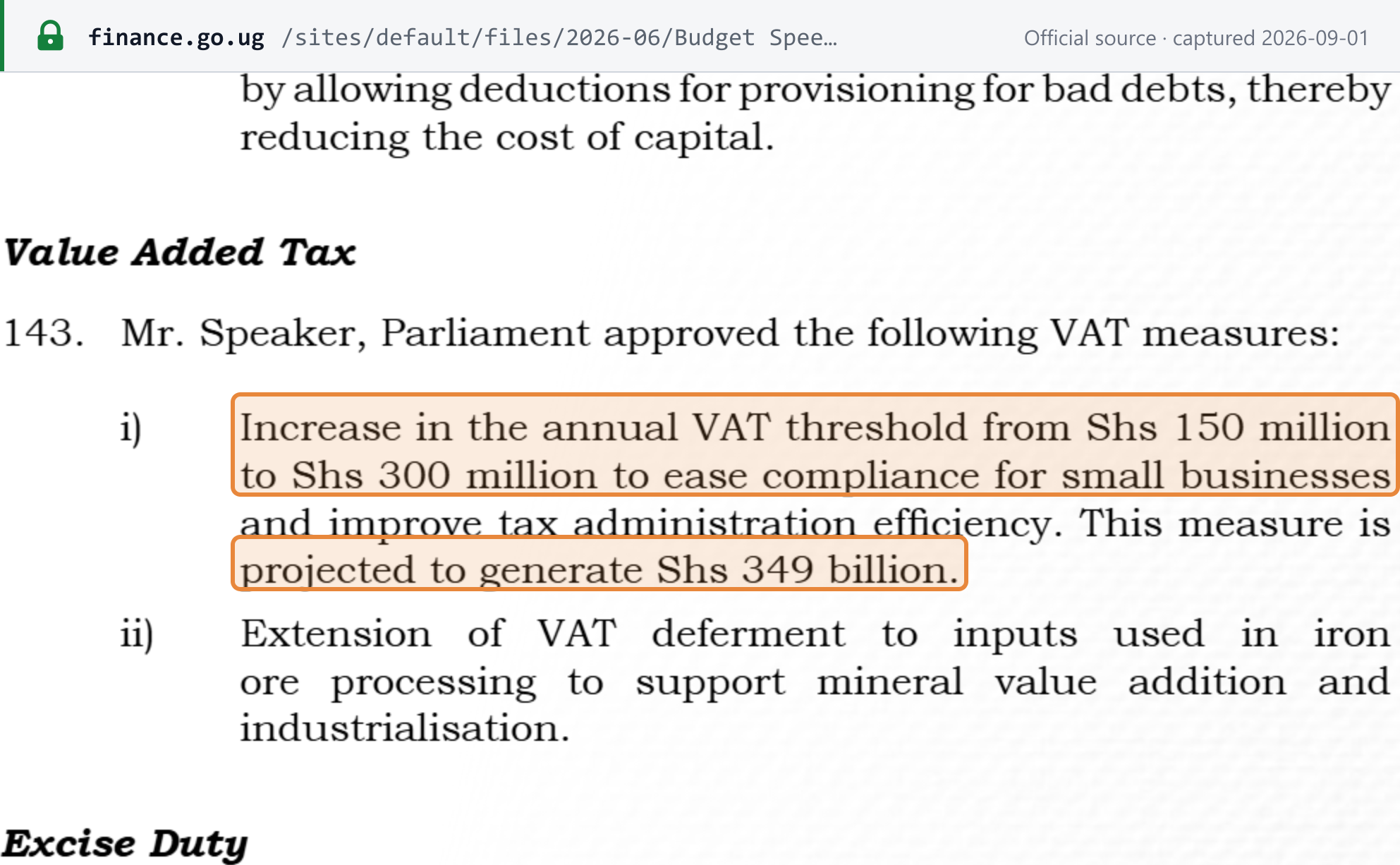
The assented Act had not been published on official channels as at 2026-10-07; the figure above rests on URA's VAT page, the Parliament record and the Budget Speech.
Non-resident registration
- B2C electronic services. A non-resident supplying electronic services to recipients in Uganda who are not taxable persons is within Ugandan VAT (see Cross-border rules) and registers through URA's dedicated Non-Resident Digital Service Providers Registration route. URA publishes a list of non-resident providers of digital services registered with it. [16] [17]
- Threshold for non-residents. URA's VAT and EFRIS pages do not say whether the section 7(2) threshold applies to these suppliers (checked 2026-10-07).
- B2B. A non-resident selling services to a VAT-registered Ugandan business does not need to register for those supplies: the recipient accounts for the VAT under the reverse charge. [2]
Tax identification number
"A TIN is a 10-digit unique number allocated and issued free of charge by URA to identify a person as a registered taxpayer." Citizens apply with their National ID, non-citizens with a passport, and companies with the certificate of incorporation and Company Form 20; individuals can get an Instant TIN through the National ID. A TIN is required to register for EFRIS. URA publishes no check-digit algorithm for the TIN (checked 2026-10-06). [7] [5]
| Identifier | Format |
|---|---|
| Taxpayer Identification Number (TIN) | 10 digits |
How to register
- Where. Get a TIN through URA's TIN application page, which offers "Instant TIN Application · TIN Registration – Individual · TIN Registration – Non Individual · Non Resident Digital Service Providers Registration · Group TIN Registration". VAT registration is then an application to the Commissioner General. [7]
- Refusal. The Commissioner General must notify a refusal of registration within one month of the application (s.8(7), compendium). URA's VAT page lists no document checklist for VAT registration (checked 2026-10-07). [2]
- After registration. URA lists registering for and using EFRIS among a VAT-registered person's obligations. [1]
Voluntary registration
Available, at the Commissioner General's discretion. URA: "A person whose sales do not exceed UGX 75,000,000 for three consecutive calendar months may apply for voluntary VAT registration. However, the applicant must satisfy the Commissioner General that they: • Have a fixed [place] of business and are able to maintain proper business records: and • Are a fit and proper person to be registered for VAT. Note : Approval for voluntary registration is at the discretion of the Commissioner General." [1]
Section 7(4a) (compendium) also lets a licensee undertaking mining or petroleum operations, a person constructing a petroleum refinery or pipeline, a person engaged in commercial farming, or a person undertaking midstream operations apply to be registered. [2]
Deregistration
- Ceasing business. A registered person that ceases to make taxable supplies applies to have its registration cancelled. [2]
- Falling below the threshold. Section 9(2) (compendium): "a taxable person may apply in writing to have his or her registration cancelled if, with respect to the most recent period of three calendar months, the value of his or her taxable supplies exclusive of tax does not exceed one-quarter of the annual registration threshold specified under section 7(2) and if the value of his or her taxable supplies exclusive of tax for the previous twelve calendar months does not exceed 75 percent of the annual registration threshold." At the UGX 300,000,000 threshold, one-quarter is UGX 75,000,000 and 75 percent is UGX 225,000,000. [2]
- Voluntary registrants may apply only "after the expiration of two years from the date of registration" (s.9(3)). [2]
- Goods on hand. On cancellation, the person "shall be regarded as having made a taxable supply of all goods on hand (including capital goods) and shall be liable for output tax … on all goods in respect of which he or she received input tax credit" (s.9(9)). [2]
Group registration
Not available. The VAT Act in URA's consolidated text has no VAT grouping provision; URA's "Group TIN Registration" facility is a TIN service, not VAT grouping (checked 2026-10-07). [2] [7]
Rates
| Rate | Applies to | Effective |
|---|---|---|
| 18% (standard) | Taxable supplies, imports of goods and imported services not zero-rated or exempt | 1 July 2005 (VAT (Rate of Tax) Order, 2005, S.I. No. 51 of 2005) |
| 0% | Exports; drugs and medicines manufactured in Uganda; cereals grown and milled in Uganda; other Fourth Schedule supplies | Fourth Schedule, Cap. 344 |
| Exempt | Livestock and unprocessed food and agricultural products; health and life insurance; education; passenger transport (other than tour and travel operators); other Third Schedule supplies | Third Schedule, Cap. 344 |
Standard rate — 18% (as at 2026-10-06). URA: "These are supplies where VAT charged is 18%. These Include all supplies excluding those specifically shown in the third and fourth schedule Of the VAT Act Cap 344." [1]

The rate was set by the VAT (Rate of Tax) Order, 2005 (S.I. No. 51 of 2005), paragraph 3: "The rate of tax for— (a) every taxable supply made in Uganda by a taxable person; (b) every import of goods other than an exempt import; and (c) the supply of any imported services by any person, is 18% of the taxable value as defined in sections 21 and 23 of the Act." Paragraph 2: "This Order shall come into force on 1st July, 2005." (compendium) [2]
Zero rate. URA: "These are supplies where VAT is charged at a rate Of 0% Such supplies are listed in the fourth schedule to the VAT Act Cap.344. They among others include all exports, drugs and medicines manufactured in Uganda, and cereals where such cereals are grown and milled in Uganda." [1]
Reduced rates. None. URA's VAT page lists only the 18% standard rate, the 0% rate and exempt supplies (checked 2026-10-06). [1]
Announced future rates. No change to the 18% rate is announced on URA's VAT page (checked 2026-10-06).
For Uganda alongside other jurisdictions, see Lookuptax's worldwide tax rates table and VAT registration thresholds table.
Cross-border rules
Imports and exports
- Imports of goods. VAT on an import is paid by the importer (s.5(1)(b), compendium). An import is exempt if the goods "are exempt from customs duty under the Fifth Schedule of the East African Community Customs Management Act, except compact fluorescent bulbs … and lamps and bulbs made from light emitting Diodes (LED) technology …; or would be exempt had they been supplied in Uganda." [1] [2]
- De minimis. No low-value import relief for VAT appears on URA's VAT page or in the compendium (checked 2026-10-06).
- Exports. Zero-rated. [1]
Reverse charge on imported services
VAT on imported services "is to be paid by the person receiving the supply" (s.5(1)(c), compendium). Under the VAT Regulations (compendium), reg. 13(1): "A registered taxpayer who receives a supply of services from a foreign supplier shall account for the tax due on the supply, and the taxpayer shall account for that tax when performance of the service is completed, or when payment for the service is made, or when the invoice is received from the foreign supplier, whichever is the earliest." The credit is available only with a self-billed tax invoice — reg. 13(3): "Tax accounted for on imported services may be claimed as a credit under section 28 of the Act, provided the recipient of the service prepares a self-billed tax invoice to account for tax due on the supply". The VAT (Amendment) Act, 2023 also provides "for declaration of value added tax on imported services by large un-registered persons and un registered government entities" (long title). See Lookuptax's reverse charge explainer. [2] [8]
Digital products and services
- VAT on B2C electronic services. Section 16(2) (compendium): "Notwithstanding subsection (1), a supply of services shall take place in Uganda if the recipient of the supply is not a taxable person and— … (d) the services are electronic services delivered to a person in Uganda at the time of supply;". The VAT (Amendment) Act, 2023 (in force 1 July 2023) defines electronic services as services supplied through an online or digital network by a supplier outside Uganda to a recipient in Uganda, listing among others websites and web-hosting, software, databases, music, films and games, broadcasts, advertising platforms, streaming and subscription-based services, cab-hailing, cloud storage and data warehousing. [2] [8]
- Returns and currency. Section 31A(1a) (compendium): such a supplier "shall lodge a tax return with the Commissioner General within fifteen days after the end of three consecutive calendar months." The 2023 Act added s.73(3), under which the supplier "may file a return and may pay the tax in the return in United States dollars." [2] [8]
- No input credit. The 2023 Act blocks input credit on goods or services incurred by a taxable person in respect of s.16(2) supplies. [8]
- Digital service tax is separate — and is income tax. Non-resident digital service providers also pay a 5% digital service tax, an income tax reported quarterly on URA's form DT-DST, which covers "Sales to business entities in Uganda (B2B) · Sales to final consumers in Uganda (B2C)". URA: "All non-resident digital service providers who are required to pay digital service tax, are not mandated to use EFRIS." [9] [5]
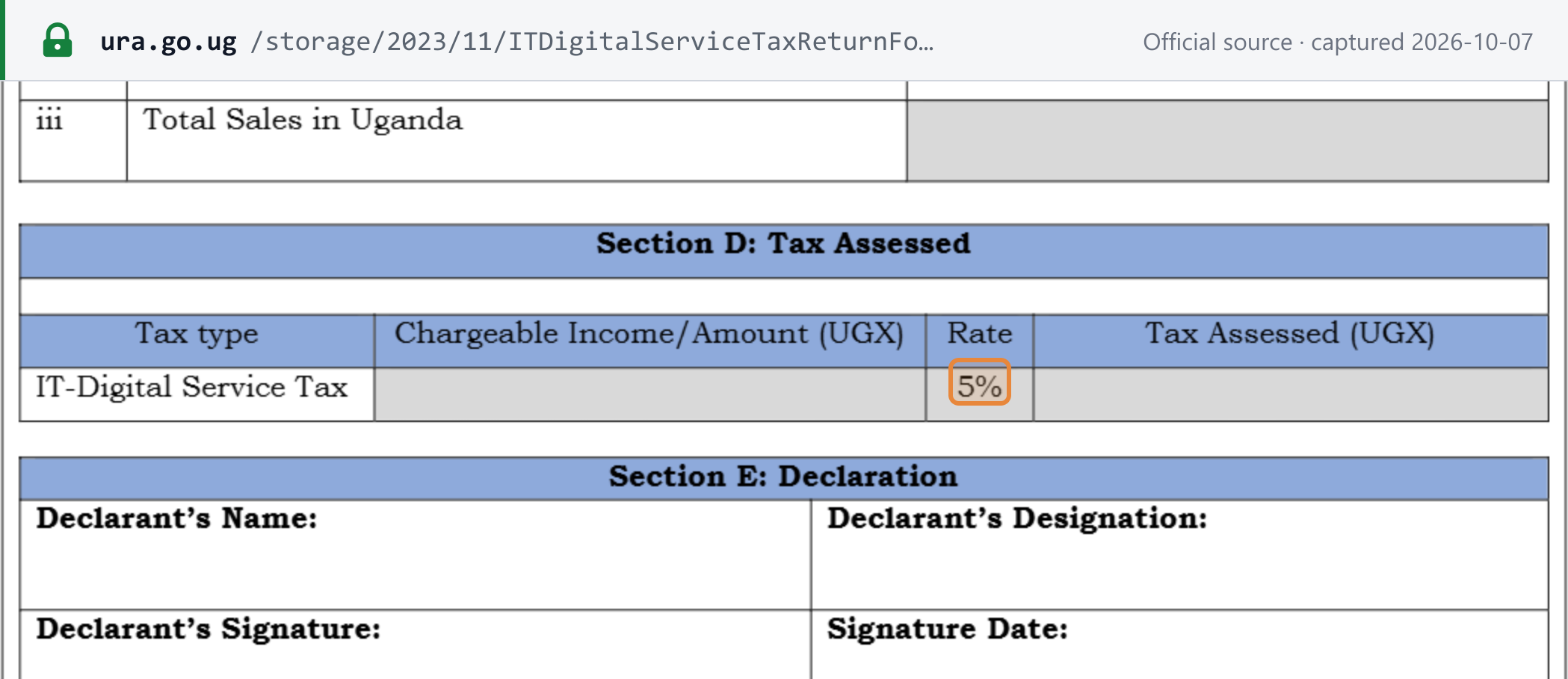
See Lookuptax's VAT on digital services by non-resident suppliers.
Foreign companies selling into Uganda — B2B and B2C
- B2B — the customer pays. Services from a foreign supplier to a VAT-registered Ugandan business are imported services: the recipient accounts for the VAT and claims the credit on a self-billed tax invoice (s.5(1)(c); reg. 13). Section 16(2) does not apply because the recipient is a taxable person. [2]
- B2C — the seller is liable. A non-resident supplying electronic services to a recipient in Uganda who is not a taxable person makes a supply in Uganda (s.16(2)(d)), registers with URA, files quarterly and may pay in US dollars. The 2023 Act also widened s.16(2) to certain other recipients, including unregistered government entities. [2] [8]
- Goods. A foreign business selling goods located in Uganda makes a supply in Uganda (s.15) and follows the ordinary registration rules. [2]
Marketplace / platform deemed-supplier liability
None in the Act. The VAT Act in URA's consolidated text and the VAT (Amendment) Act, 2023 have no platform deemed-supplier provision, and URA's VAT and EFRIS pages describe none (checked 2026-10-07). For how such rules work elsewhere, see Lookuptax's marketplace deemed-supplier explainer.
Place of supply
- Goods. Section 15 (compendium): "A supply of goods shall take place in Uganda if the goods are delivered or made available in Uganda by the supplier, or if the delivery or making available involves transportation, the goods are in Uganda when the transportation commences." [2]
- Services. Section 16(1) (compendium): "A supply of services shall take place in Uganda if the business of the supplier from which the services are supplied is in Uganda", subject to the s.16(2) overrides for recipients who are not taxable persons, including electronic services. [2]
Invoice requirements
The invoicing rules sit in ss.29–30 of the VAT Act and its invoice-particulars schedule (the Fourth Schedule in the compendium's Cap. 349 numbering). In practice almost every invoice is issued through EFRIS — see E-invoicing status. [2]
Mandatory content
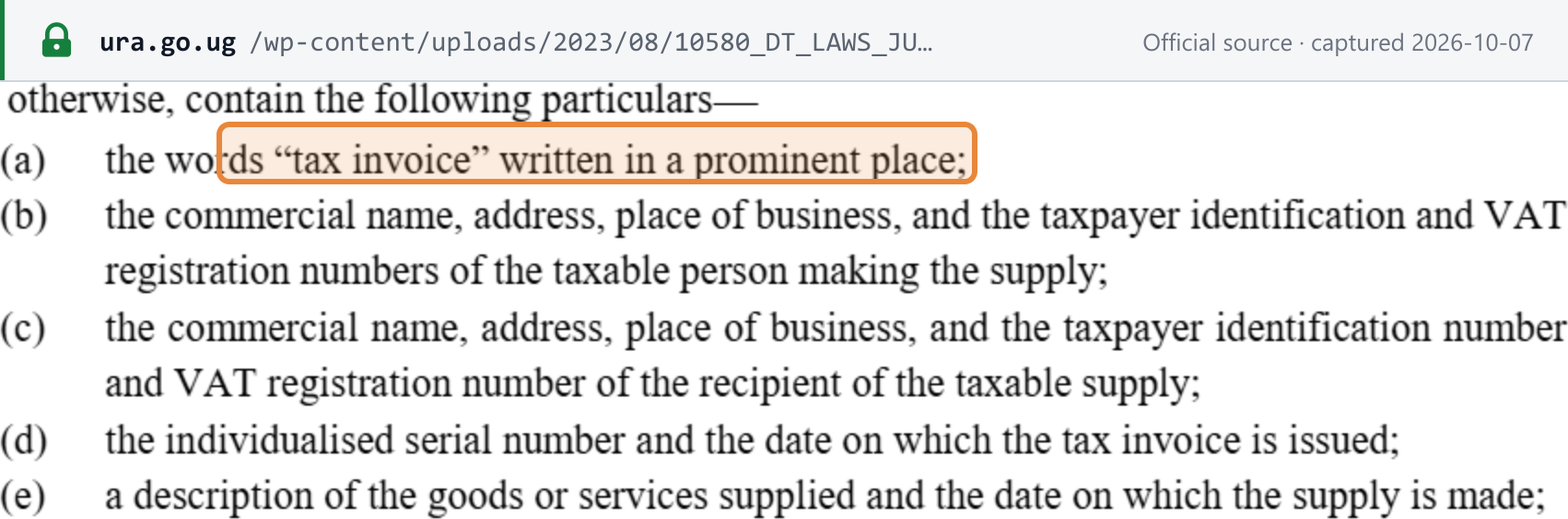
Fourth Schedule, paragraph 2 (compendium): "A tax invoice as required by section 29 shall, unless the Commissioner General provides otherwise, contain the following particulars—" [2]
| # | Required field | Cite (Cap. 349 numbering) |
|---|---|---|
| 1 | The words "tax invoice", written in a prominent place | Sch. 4 para 2(a) |
| 2 | Supplier's commercial name, address, place of business, TIN and VAT registration number | para 2(b) |
| 3 | Recipient's commercial name, address, place of business, TIN and VAT registration number | para 2(c) |
| 4 | Individualised serial number and the date of issue | para 2(d) |
| 5 | Description of the goods or services and the date of supply | para 2(e) |
| 6 | Quantity or volume supplied | para 2(f) |
| 7 | Rate of tax for each category of goods and services | para 2(g) |
| 8 | Total tax, consideration excluding tax and consideration including tax — or, for tax-inclusive pricing, the consideration, a statement that it includes tax, and the rate | para 2(h) |
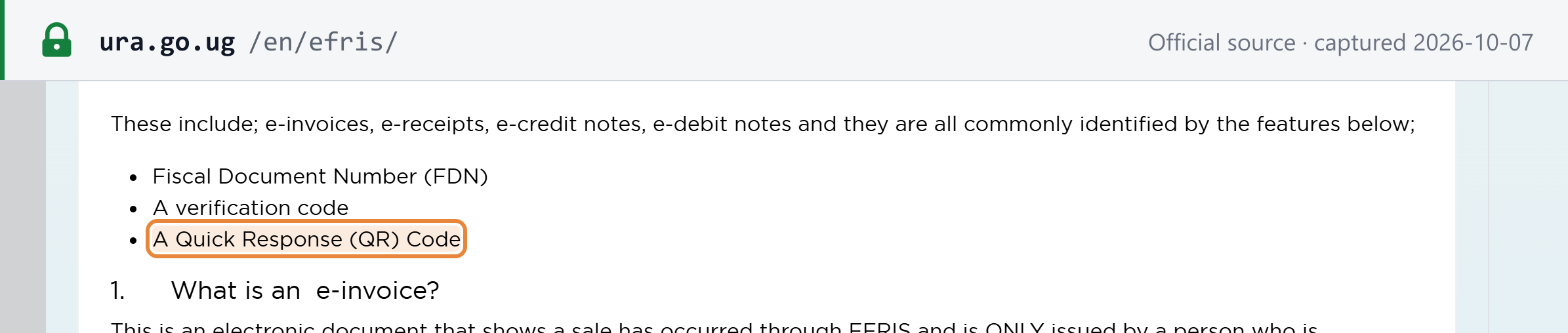
EFRIS adds its own fiscal elements to every document it issues: a Fiscal Document Number (FDN), a verification code and a QR code (below). [5]
Issuance deadline
- At the time of supply. Section 29(1) (compendium): "A taxable person making a taxable supply to any person shall provide that other person, at the time of supply, with an original tax invoice for the supply." The supplier keeps a copy, and a duplicate is marked "COPY" (s.29(2)–(3)). [2]
- On request. A buyer may ask for a tax invoice within 30 days of the supply, and the supplier must provide it within 14 days of the request (s.29(5)–(7)). [2]
- Manual fallback. A manual or unfiscalised invoice is allowed only where EFRIS, the taxpayer's system or the device is down, or for another justifiable reason; "you are required to upload it onto the System within twenty-four (24) hours." [13]
Numbering and sequencing
Each tax invoice carries an "individualised serial number" (para 2(d)). EFRIS also assigns each transaction a Fiscal Document Number — "The Fiscal Document Number (FDN) is an 12-20 digit number given by URA to a transaction for tax purposes." [2] [14]
Credit and debit notes
- Statute. Where the tax shown on an invoice is too high, the supplier issues a credit note; where it is too low, a debit note (s.30, compendium) — "the taxable person making the supply shall provide the recipient of the supply with a credit note containing the particulars specified in Section 3 of the Fourth Schedule." The note carries the words "credit note" or "debit note", both parties' names, addresses, TINs and VAT numbers, the date, the rate, the original and correct values, the difference and the tax on the difference (Sch. 4 paras 3–4). [2]
- EFRIS. Corrections go through an e-credit note or e-debit note; URA describes a credit note as a document that "allows the seller to amend an invoice without having to delete it." URA's credit-note page describes a debit note as issued by a buyer, while s.30 and URA's main EFRIS FAQ treat it as a supplier document; this page follows the statute. [15]
Currency and language
- Currency. Amounts are expressed in UGX; foreign-currency amounts are converted at "the weighted selling rates of the previous month" (s.73, compendium). URA's EFRIS FAQ: "Yes, you can transact in foreign currency using EFRIS. However, for tax purposes, URA uses its set exchange rate to convert the amount into Ugandan shillings." [2] [5]
- Language. Records are kept in English (Tax Procedures Code s.15(1)(a), compendium). [2]
- Prices. "Any price advertised or quoted for a taxable supply shall include tax and the advertisement or quotation shall state that the price includes the tax" (s.74, compendium). [2]
Document types
| Document | Issued by | Source |
|---|---|---|
| e-invoice | VAT-registered persons only — "ONLY issued by a person who is registered for VAT" | URA EFRIS |
| e-receipt | EFRIS users not registered for VAT (for example businesses in the 12 designated sectors) | URA EFRIS |
| e-credit note / e-debit note | Corrections to an e-invoice or e-receipt | URA EFRIS |
| Self-billed tax invoice | A registered recipient of imported services, to support its credit | VAT Regulations reg. 13(3) |
| Simplified tax invoice | A registered person with taxable turnover below UGX 100,000,000 a year, to another registered person, where no item exceeds UGX 50,000 and the invoice total does not exceed UGX 100,000; not for zero-rated or exempt supplies | VAT Regulations reg. 9 (compendium) |
Sources: URA EFRIS for the e-documents; the VAT Regulations in the compendium for the self-billed and simplified invoices. [5] [2]
Self-billing
Only for imported services. The VAT Regulations require the recipient of imported services to prepare a self-billed tax invoice to claim the credit (reg. 13(3), compendium). The VAT Act and Regulations in the compendium provide no general self-billing regime. [2]
Retention and audit trail
- Retention — two rules, both as written. The Tax Procedures Code s.15(1) (compendium, TPC Act 2014): "every taxpayer shall … (a) maintain, in the English language, records including in electronic format … (c) retain the record for five years after the end of the tax period to which it relates or other period as specified in the tax law." The VAT Regulations reg. 8(4) (compendium): "All records shall be kept by the taxpayer for six years". The two retention periods are five years (Tax Procedures Code) and six years (VAT Regulations); keep VAT records for six years. [2]
- Electronic records. Allowed — the TPC provision expressly covers records "in electronic format". [2]
- Audit trail. EFRIS fiscalises each transaction as it is issued, giving it an FDN, a verification code and a QR code, and URA lets anyone validate a document by its FDN. [5] [14]
URA: "These include; e-invoices, e-receipts, e-credit notes, e-debit notes and they are all commonly identified by the features below; Fiscal Document Number (FDN) A verification code A Quick Response (QR) Code". [5]
A specimen of a compliant invoice
URA publishes no annotated specimen tax invoice on its VAT or EFRIS pages (checked 2026-10-06); the example below is ours — Lookuptax's illustration of the invoice-particulars schedule for a domestic B2B supply issued through EFRIS. Every name, number and amount in it is fictional:
Tax invoice
| Descriptionpara 2(e) | Quantitypara 2(f) | Unit price (excl. VAT) | VAT ratepara 2(g) | Value (excl. VAT) |
|---|---|---|---|---|
| Office cleaning services | 1 month | UGX 1,000,000 | 18% | UGX 1,000,000 |
| Printing paper, A4 | 20 reams | UGX 25,000 | 18% | UGX 500,000 |
- Total excluding VATpara 2(h)
- UGX 1,500,000
- VAT at 18%para 2(h)
- UGX 270,000
- Total including VATpara 2(h)
- UGX 1,770,000
- The recipient's TIN and VAT registration number are mandatory on a tax invoice — para 2(c). An e-invoice is issued only by a VAT-registered supplier; a non-VAT EFRIS user issues an e-receipt instead.
- EFRIS prints the Fiscal Document Number, the verification code and a QR code on the document; the issuer does not choose them. A real FDN is 12 to 20 digits and can be validated on URA's FDN validation page.
- Amounts are in UGX; a foreign-currency amount is converted at the previous month's weighted selling rate (s.73).
- A correction is made by an e-credit note or e-debit note referring to this invoice, never by deleting it.
E-invoicing status
Status (as of 2026-10-06): mandatory. All VAT-registered businesses must issue e-invoices through EFRIS, and — under a URA notice first published on 10 August 2026 that states an effective date of 1 July 2025 — so must non-VAT businesses in 12 designated sectors, which issue e-receipts. For Uganda alongside other jurisdictions, see Lookuptax's e-invoicing status and networks table.
System. The Electronic Fiscal Receipting and Invoicing Solution (EFRIS), URA's national system, which fiscalises each invoice or receipt in real time. URA: "All VAT-registered businesses and other businesses which operate in specific designated sectors (( Whether VAT registered or not ) are required to use the Electronic Fiscal Receipting and Invoicing Solution (EFRIS)." [5]

Legal basis. URA: "Is EFRIS supported by the law? Yes, Sections 92 and 93 of the Tax Procedures Code Act Cap 343." Section 92 lets the Commissioner specify, by notice in the Gazette, the taxpayers for whom e-invoices or e-receipts are mandatory; a specified taxpayer "shall issue electronic invoices or e- receipts or employ an electronic fiscal device in all business transactions" (s.73A(2)–(3) in the 2014 numbering, compendium). [5] [2]
Who must use EFRIS
| Group | Obligation | Source |
|---|---|---|
| All VAT-registered taxpayers | Mandatory; issue e-invoices | URA EFRIS |
| Non-VAT businesses in 12 designated sectors | Mandatory, stated as effective 1 July 2025; issue e-receipts | URA notice, first published 10 August 2026 |
| Everyone else | Voluntary | URA EFRIS |
The 12 sectors in URA's notice are: manufacturing; mining and quarrying; water supply, sewerage, waste management and remediation; electricity, gas, steam and air conditioning supply; construction; transportation and storage; accommodation and food service; information technology and communication; real estate; professional, scientific and technical activities; arts, entertainment and recreation; and wholesale and retail of fuel. [6]

Carve-outs. The notice leaves out: "a) Small businesses in the above listed sectors with sales value (turnover) of less than UGX 10,000,000 per year; b) Taxpayers earning rental income less than UGX 2,820,000 annually"; providers of passenger land transport; and non-resident digital service providers liable to digital service tax. Those excluded may use EFRIS voluntarily. The notice itself cites no legal instrument. [6]
Scope — B2B, B2C, B2G. One regime covers all of them: the obligation extends to "all business transactions", and URA describes no separate B2G network. [2]
Buyer-side consequences — the input-credit denial. URA: "The following are rejected by URA; Entering a purchase expense from a supplier designated to use e-invoices or e-receipts as an allowable deduction but there is no support for such e-invoices or e-receipts. Claiming a VAT credit by a taxable person on purchases not supported by e-invoices." The sector notice adds: "No income tax deduction shall be allowed for any expense not supported by an e-invoice or an e-receipt provided the supplier is required to use EFRIS, in accordance with Section 22(3)(m) of the Income Tax Act". [5] [6]

Issuance channels. URA lists the EFRIS mobile app, a desktop client, the web portal, an electronic fiscal device (EFD), system-to-system integration, and an EDC for fuel stations. The web portal "is only available for clients who do not have a billing system, with less than 100 daily transactions, and annual sales below UGX 2 billion." "EFDs are provided by Rank Consult at a cost of Ugx 1.1 m." URA publishes a list of accredited EFRIS software integrators. Offline issuing is possible for up to 5 days, but not on the web portal. [5]
Formats. URA's EFRIS pages publish no UBL, Peppol or other open invoice-format requirement; integration is to URA's own system-to-system interface (checked 2026-10-06). [5]
Changes in the 2026 Bill. The VAT (Amendment) Bill, 2026, passed by Parliament on 21 April 2026 with commencement on 1 July 2026, (a) adds s.5(7) so that VAT withholding by designated agents "shall not apply to a designated person under subsection (2) where the designated person pays for taxable supplies and is issued with an e-invoice or e-receipt in accordance with section 92 of the Tax Procedures Code Act", and (b) lowers, in s.38, the value of electronic receipts or invoices a non-taxable buyer must collect within 30 consecutive days to qualify for a 5% refund of the tax, from "five million" to "two million" shillings. The assented Act had not been published on official channels as at 2026-10-07. URA's VAT and EFRIS pages do not apply either change (checked 2026-10-07). [10] [11]
Filing and payment
Filing frequency
Monthly for resident taxable persons: the tax period is "the calendar month" (s.1(w), compendium), and URA's VAT page describes no turnover-based alternative (checked 2026-10-06). Non-resident suppliers of B2C electronic services file quarterly (s.31A(1a)). [2] [1]
Return due date
By the 15th day after the end of each month. Section 31A(1) (compendium): "A taxable person shall lodge a tax return with the Commissioner General for each tax period within fifteen days after the end of the tax period." URA: "File a VAT return within 15 Days after the end of the month. EFRIS supports pre- filled returns and the person is only required to crosscheck if the facts in the return are true". [2] [1]

Payment due date and method
The same day: "Pay VAT that arises in their return within 15 days after the end Of the month … Currently when the return is filed, the pay slip is automatically generated". [1]
Additional listings
URA's VAT page describes no annual VAT return or separate sales or purchase listing (checked 2026-10-06). EFRIS transaction data feeds the pre-filled monthly return. [1]
Input-tax recovery and blocked items
- Recovery. Input VAT is credited only on inputs used to make taxable supplies (s.28, compendium), and a credit claimed on purchases not supported by an EFRIS e-invoice is rejected (see E-invoicing status). Imported services need a self-billed tax invoice. [2] [5]
- Blocked by the 2023 Act. Entertainment payments for "membership of a person in a club, association or society of a sporting, social or recreational nature", and goods or services incurred in respect of s.16(2) supplies (which denies foreign B2C e-service suppliers any input credit). [8]
Refunds
- Excess credit. URA (as at 2026-10-07): "[Input] VAT is greater than the output VAT, the difference is VAT claimable and this can be utilized through an offset or a cash refund if the amount exceeds 10 million shillings." The 2021 consolidated text (s.42(2), compendium) set the cash-refund floor at UGX 5,000,000. [1] [2]
- Refund interest. The VAT (Amendment) Bill, 2026, passed by Parliament on 21 April 2026, replaces in s.36(3) the "fifty thousand shillings" variance that forfeits interest on a late refund with "five percent of the total amount of the tax refund claimed"; the assented Act had not been published on official channels as at 2026-10-07. [10]
Exemptions
Exempt supplies
The Third Schedule to the VAT Act Cap. 344 lists exempt supplies. URA's examples include "Supply Of livestock, unprocessed foodstuffs and unprocessed agricultural products Supply of Health insurance and life insurance services • Educational services Passenger transportation services (other than tour and travel operators), among others." [1]

Exempt is not zero-rated. An exempt supply carries no VAT, and the input VAT on costs of making it is not recoverable, because s.28 credits only inputs used for taxable supplies. A zero-rated supply — exports, Ugandan-made medicines, locally grown and milled cereals — is a taxable supply at 0%, so its input VAT is recoverable. URA: "NOTE: A person dealing only in exempt supplies is not expected to register for VAT while one dealing in zero rated and standard rated supplies is required to register in case they meet the registration requirements." [1] [2]
Special regimes
- Sector registration routes for mining and petroleum, refinery and pipeline construction, commercial farming and midstream operations (s.7(4a)) — see Voluntary registration. [2]
- Free zones. Governed by the Free Zones Act 2014, listed on URA's Laws and Acts page.
- Cash accounting. A taxable person whose annual taxable supplies do not exceed UGX 500,000,000 may elect in writing, by the due date of its first return, to account for VAT on a cash basis (s.26, compendium). [2]
- Flat-rate and margin schemes. The VAT Act in URA's consolidated text has neither (checked 2026-10-07).
Offences and penalties
Offences
| Offence | Conduct | Sanction | Source |
|---|---|---|---|
| Unauthorised EFD | Acquiring or attempting to acquire an unauthorised electronic fiscal device | "On conviction, a fine of not exceeding 300 currency points or imprisonment for a period not exceeding 3 years , or both" — 300 currency points is UGX 6,000,000 at UGX 20,000 each | URA EFRIS |
Penalties
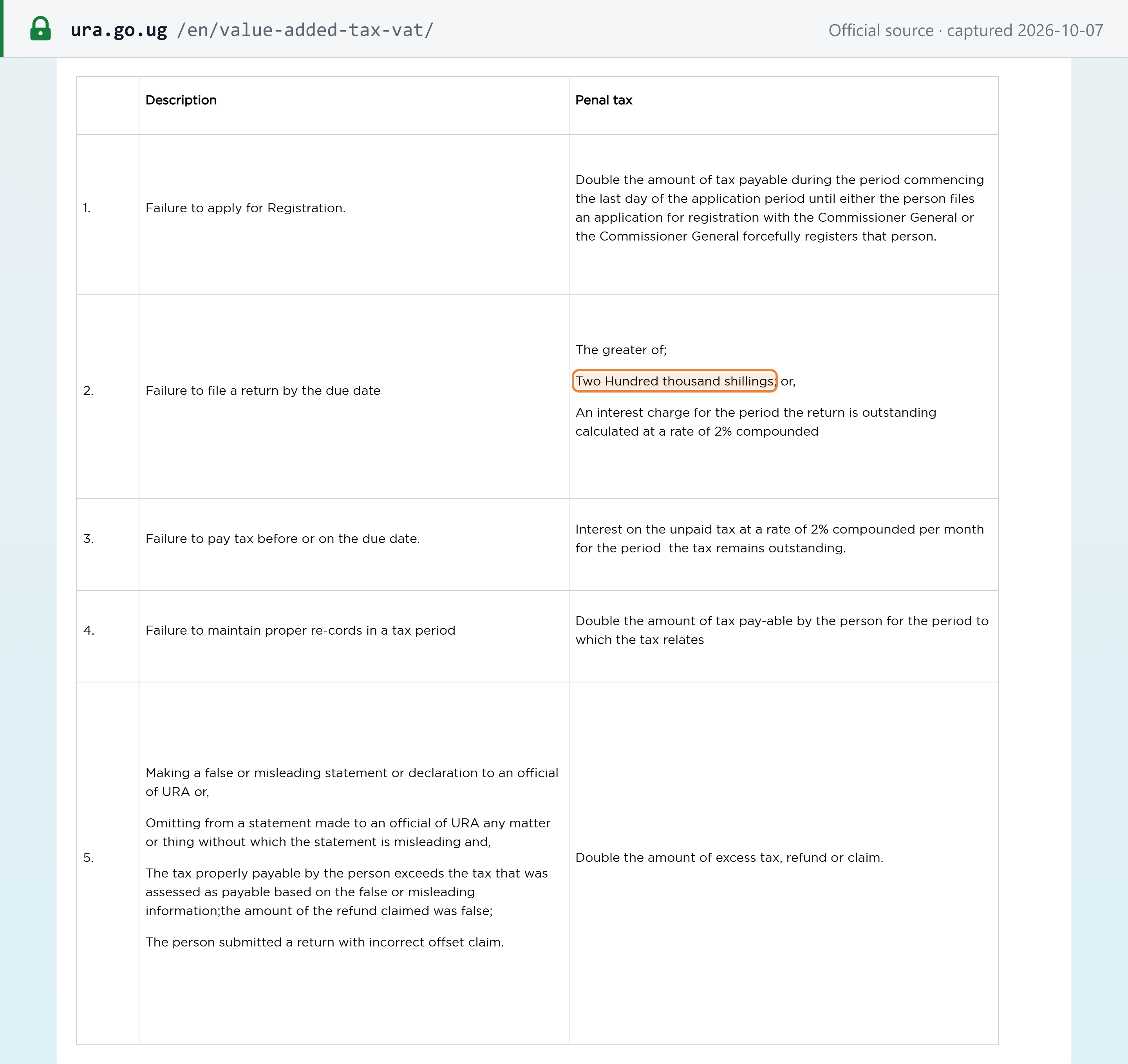
VAT penal tax (URA VAT page, checked 2026-10-06): [1]
| Failure | Penal tax (URA wording) |
|---|---|
| Failure to apply for registration | "Double the amount of tax payable during the period commencing the last day of the application period until either the person files an application for registration with the Commissioner General or the Commissioner General forcefully registers that person." |
| Late return | "The greater of; Two Hundred thousand shillings; or, An interest charge for the period the return is outstanding calculated at a rate of 2% compounded" |
| Late payment | "Interest on the unpaid tax at a rate of 2% compounded per month for the period the tax remains outstanding." |
| Failure to keep proper records | "Double the amount of tax pay-able by the person for the period to which the tax relates" |
| False or misleading statement, false refund claim or incorrect offset | "Double the amount of excess tax, refund or claim." |
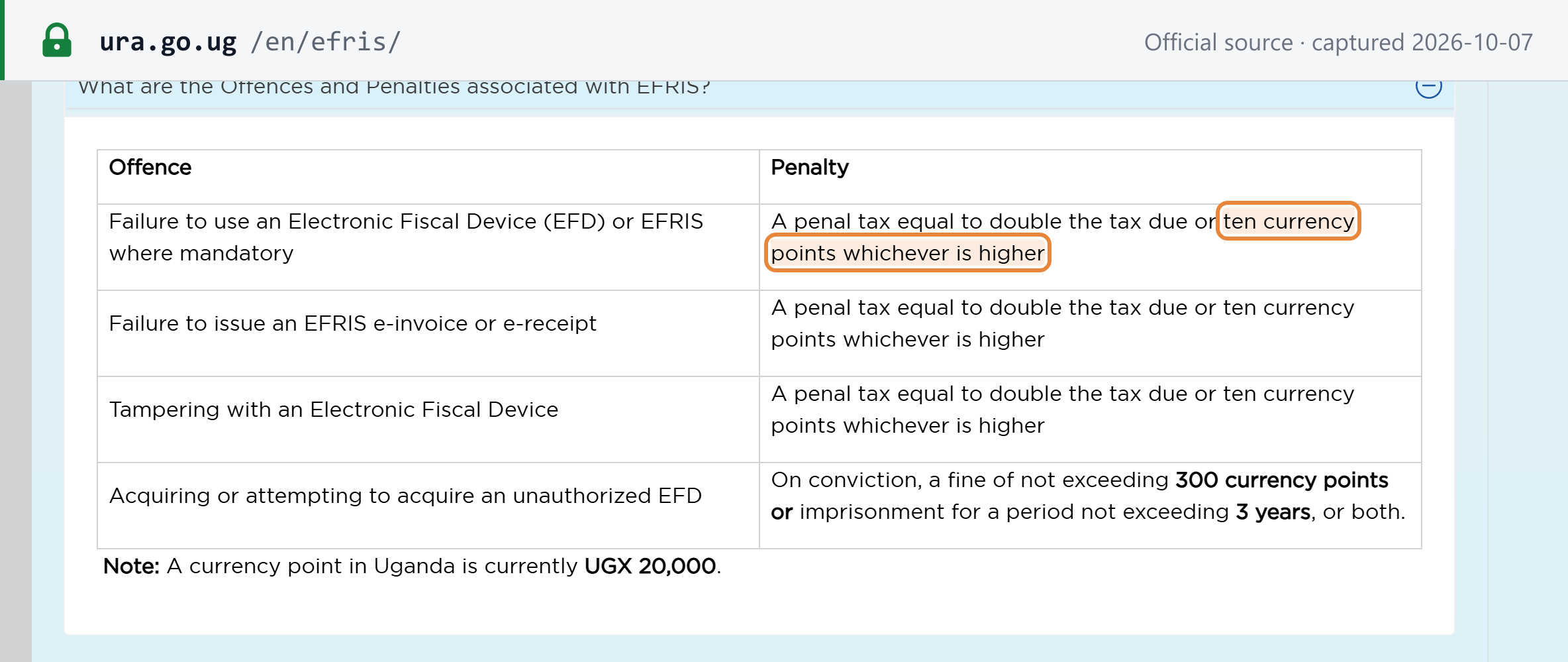
EFRIS penal tax (Tax Procedures Code Cap. 343 s.93; URA EFRIS page, checked 2026-10-06): [5]
| Failure | Penal tax |
|---|---|
| Failure to use an EFD or EFRIS where mandatory | "A penal tax equal to double the tax due or ten currency points whichever is higher" |
| Failure to issue an EFRIS e-invoice or e-receipt | Same |
| Tampering with an electronic fiscal device | Same |
"A currency point in Uganda is currently UGX 20,000", so the floor of 10 currency points is UGX 200,000 (as at 2026-10-06). URA applies these figures on its EFRIS page; they come from the Tax Procedures Code (Amendment) Bill, 2026, passed by Parliament on 21 April 2026 with commencement on 1 July 2026, which rewrites s.93; under the 2014 text (s.73B, compendium) the penalties were the tax due or 400 currency points for non-use, and the tax due or 300 currency points for non-issue or tampering. [5] [12] [2]
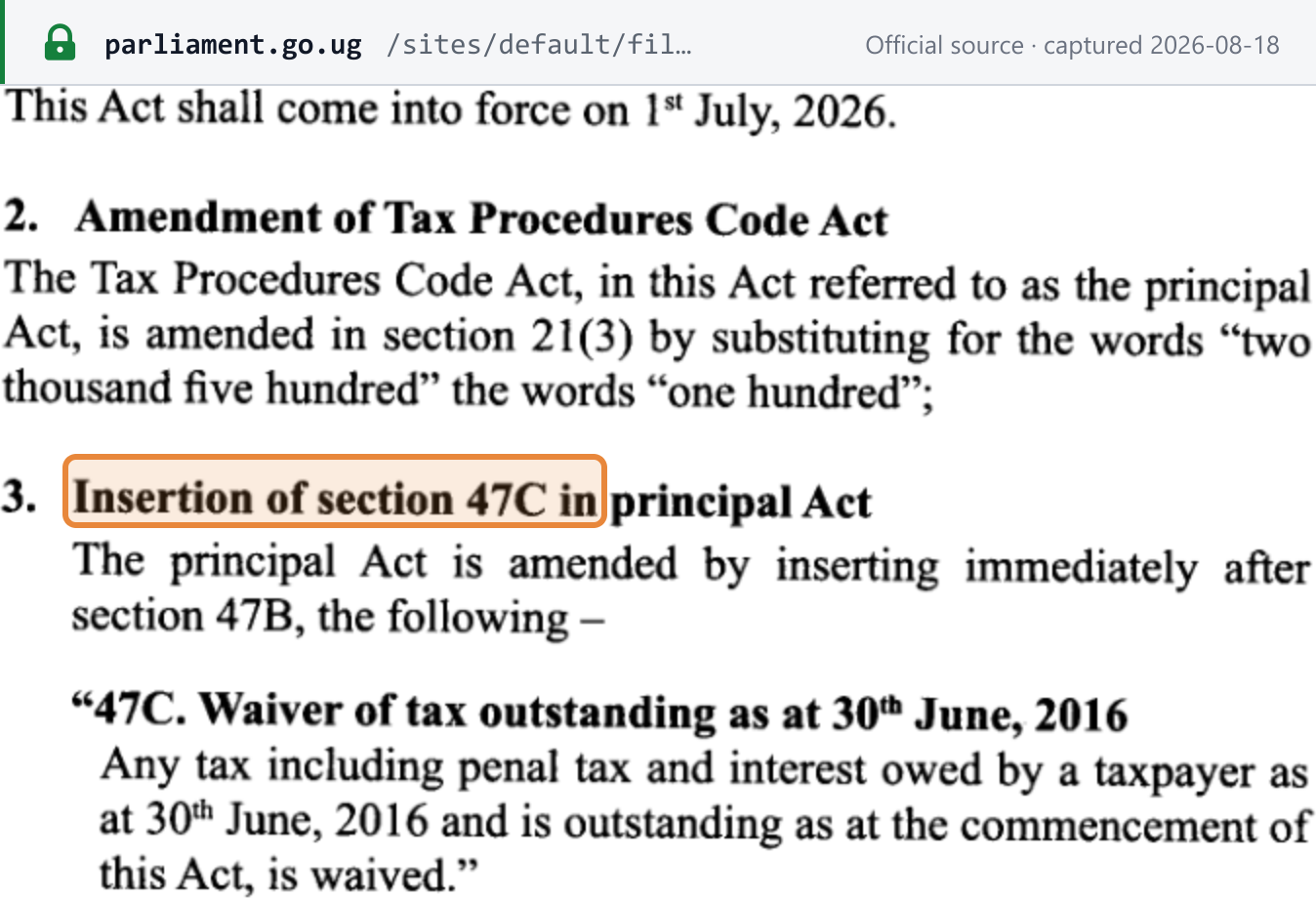
Waiver of old arrears — passed, not yet published as law. The Tax Procedures Code (Amendment) Bill, 2026, passed by Parliament on 21 April 2026, inserts s.47C: "Any tax including penal tax and interest owed by a taxpayer as at 30th June, 2016 and is outstanding as at the commencement of this Act, is waived." The assented Act had not been published on official channels as at 2026-10-07. [12]
Frequently asked questions
What is Uganda's VAT registration threshold in 2026?
UGX 300,000,000 a year from 1 July 2026, applied as UGX 75,000,000 in any period of three consecutive calendar months. Parliament raised the threshold to this figure when it passed the Value Added Tax (Amendment) Bill, 2026 on 21 April 2026; the Bill as introduced and the Finance Committee had proposed a lower figure, so some secondary sources still quote it. The Uganda Revenue Authority's VAT page states UGX 300,000,000 (checked 2026-10-06). [1] [3]
We are not VAT-registered — do we still have to use EFRIS?
Yes, if the business operates in one of the 12 sectors in URA's notice on additional taxpayers required to use EFRIS, which states an effective date of 1 July 2025. A non-VAT business issues e-receipts rather than e-invoices. The notice leaves out businesses in those sectors with turnover below UGX 10,000,000 a year, taxpayers with rental income below UGX 2,820,000 a year, providers of passenger land transport, and non-resident digital service providers who pay digital service tax. [6]
Can we claim input VAT on a supplier invoice that was not issued through EFRIS?
No. URA's EFRIS guidance says it rejects a VAT credit claimed on purchases not supported by e-invoices. It also rejects an income tax deduction for an expense not supported by an e-invoice or e-receipt where the supplier is required to use EFRIS (Income Tax Act section 22(3)(m)). [5] [6]
What happens if EFRIS is down when we need to invoice?
URA allows a manual invoice or receipt only where EFRIS, the taxpayer's own system or the device is down, or for another justifiable reason, and the manual document must be uploaded to EFRIS within 24 hours. EFRIS also has an offline mode for up to 5 days, which is not available on the web portal. [13] [5]
Does a foreign streaming or SaaS company selling to Ugandan consumers pay VAT or digital service tax?
They are separate taxes and both can apply. VAT applies to electronic services supplied by a non-resident to a recipient in Uganda who is not a taxable person; the supplier files VAT returns quarterly within 15 days of each quarter's end and may file and pay in US dollars. Digital service tax is a 5% income tax reported quarterly on URA's form DT-DST, covering both B2B and B2C sales. A VAT-registered Ugandan business buying the same service accounts for the VAT itself under the reverse charge. [2] [8] [9]
Can we deregister now that the threshold has gone up?
Only if both tests in the VAT Act's cancellation provision are met: taxable supplies in the most recent three calendar months of no more than one-quarter of the annual threshold, and supplies in the previous twelve months of no more than 75 percent of it. A business that registered voluntarily must wait two years from registration. On cancellation, output VAT is due on goods on hand, including capital goods, on which input credit was received. [2]
Important websites
| Site | Purpose |
|---|---|
| URA portal | Log in to e-services: VAT registration, returns and payment registration slips |
| URA — TIN application | Get a TIN (Instant, Individual, Non-Individual), search a TIN |
| URA — Non-resident digital service providers registration | Registration route for foreign suppliers of electronic services |
| URA — Value Added Tax | Threshold, rates, obligations, penalties |
| URA — EFRIS | E-invoicing hub: who must use it, channels, penalties |
| URA — EFRIS registration | Register for EFRIS |
| URA — FDN validation | Check an e-invoice or e-receipt by its Fiscal Document Number |
| URA — Accredited EFRIS integrators | System-to-system integration providers |
| URA — Return forms | Downloadable return forms, including DT-DST |
| URA — Laws and Acts | Statute texts published by URA |
URA contacts: toll-free 0800 117 000 / 0800 217 000, [email protected]. Lookuptax does not yet offer a Uganda TIN validator.
Recent changes
- 2026-08-10 — URA notice: non-VAT businesses in 12 designated sectors must use EFRIS, stated as effective 1 July 2025. (URA) — see event
- 2026-07-01 — VAT registration threshold raised to UGX 300,000,000 a year (UGX 75,000,000 a quarter) under the VAT (Amendment) Bill, 2026, passed by Parliament on 21 April 2026 and applied by URA. (URA) — see event
- 2026-07-01 — EFRIS penal tax of double the tax due or 10 currency points, whichever is higher, applied by URA; the Tax Procedures Code (Amendment) Bill, 2026, passed by Parliament on 21 April 2026, also waives tax owed as at 30 June 2016 (assented Act not yet published as at 2026-10-07). (URA) — see event
- 2023-07-01 — VAT on electronic services widened to advertising, streaming, cab-hailing, cloud storage and data warehousing; non-resident B2C suppliers may file and pay in US dollars (VAT (Amendment) Act, 2023). (Parliament of Uganda)
For the full chronology, see Uganda tax changes on Lookuptax.
Reference links
- URA — Value Added Tax
- URA — Compendium of domestic tax laws as of July 2021 (VAT Act Cap. 349 numbering, VAT Regulations, Tax Procedures Code Act 2014)
- Parliament of Uganda — news, sitting of 21 April 2026: Parliament raises VAT threshold to Shs300m
- Ministry of Finance, Planning and Economic Development — Budget Speech FY2026/27
- URA — EFRIS
- URA — Additional taxpayers required to use EFRIS
- URA — TIN application
- Parliament of Uganda — Value Added Tax (Amendment) Act, 2023
- URA — Digital Service Tax return form for non-resident service providers (DT-DST)
- Parliament of Uganda — Value Added Tax (Amendment) Bill, 2026
- Parliament of Uganda — Finance Committee report on the VAT (Amendment) Bill, 2026
- Parliament of Uganda — Tax Procedures Code (Amendment) Bill, 2026
- URA — EFRIS invoice and receipt issuance
- URA — FDN validation
- URA — EFRIS credit notes and debit notes
- URA — Non-resident digital service providers registration
- URA — List of non-resident providers of digital services registered with URA
- Lookuptax — VAT registration thresholds worldwide
- Lookuptax — Worldwide tax rates
- Lookuptax — E-invoicing status and networks worldwide