Japan consumption tax guidelines
| FACTSHEET | |
|---|---|
| Country code | JP |
| Tax name | Consumption tax — 消費税 (shōhizei), with local consumption tax — 地方消費税 |
| Tax Authority | National Tax Agency — 国税庁 (NTA); Japan Customs for imports |
Overview
Japan levies consumption tax — 消費税 (shōhizei) — under the Consumption Tax Act (消費税法, Act No. 108 of 1988), together with local consumption tax (地方消費税, chihō shōhizei). Both are filed and paid together to the National Tax Agency (国税庁, NTA): taxable businesses file the final return with the district director of the tax office for their place of tax payment, and pay the tax (Tax Answer 6601). Consumption tax on imports is declared and paid to Japan Customs. [1] [2]
Invoice regime. Since 1 October 2023 input credit has depended on the qualified-invoice-based method — officially 適格請求書等保存方式, commonly インボイス制度 ("the invoice system"). The NTA's pamphlet describes it as "the input-tax-credit method adapted to multiple rates". [3]
Layering. The headline rates combine a national and a local portion: the standard 10% is 7.8% consumption tax + 2.2% local consumption tax, and the reduced 8% is 6.24% + 1.76%. The local portion is 22/78 of the national tax. There is one return and one payment, to the NTA. Figures that the law states as tax amounts — such as the JPY 480,000 that triggers interim returns — are measured on the national portion only. [4] [5]
Currency and tax period. Amounts are in Japanese yen (JPY); a qualified invoice must state its consumption-tax amount in yen. The taxable period (課税期間) is the calendar year for individuals and the business year for corporations. Either may elect to shorten it to three-month or one-month periods; the election is held for at least two years. [2] [6]
Registration
Who should register
Japan does not register businesses for consumption tax as such; liability arises from a sales test, and registration as a qualified invoice issuer is a separate step. A business is exempt for a taxable period if its taxable sales in the base period (基準期間) were JPY 10,000,000 or less — "1,000万円以下である場合には、原則として、納税義務が免除されます" (Tax Answer 6501). The base period is the year before last for individuals, and the business year before last for corporations with one-year business years. [7]

The exemption is lost even below that figure in these cases (Tax Answers 6501 and 6503): [7] [8]
- Specified-period test. Taxable sales in the specified period (特定期間) exceed JPY 10 million — for individuals, 1 January to 30 June of the prior year; for corporations, the first six months of the prior business year. Salaries paid may be used in place of sales for this test, but not by foreign businesses for taxable periods beginning on or after 1 October 2024.
- Registered invoice issuers are taxable regardless of sales.
- Taxable-business election. The business has filed an election to be taxable.
- New corporations with capital of JPY 10 million or more at the start of the year, and specified new corporations (特定新規設立法人). From periods beginning on or after 1 October 2024, the latter include a new corporation controlled by a group whose total revenues — counting revenue outside Japan — exceed JPY 5 billion.
- Foreign corporations entering Japan. A foreign corporation in its third or later year that starts business in Japan is treated as having no base period, so the capital test applies to its first two Japanese years.
- Certain successions, mergers and acquisitions of high-value assets.
A business whose base-period sales cross JPY 10 million files a taxable-business notification (消費税課税事業者届出書) "速やかに" — promptly (Tax Answer 6629). [9]
Non-resident registration
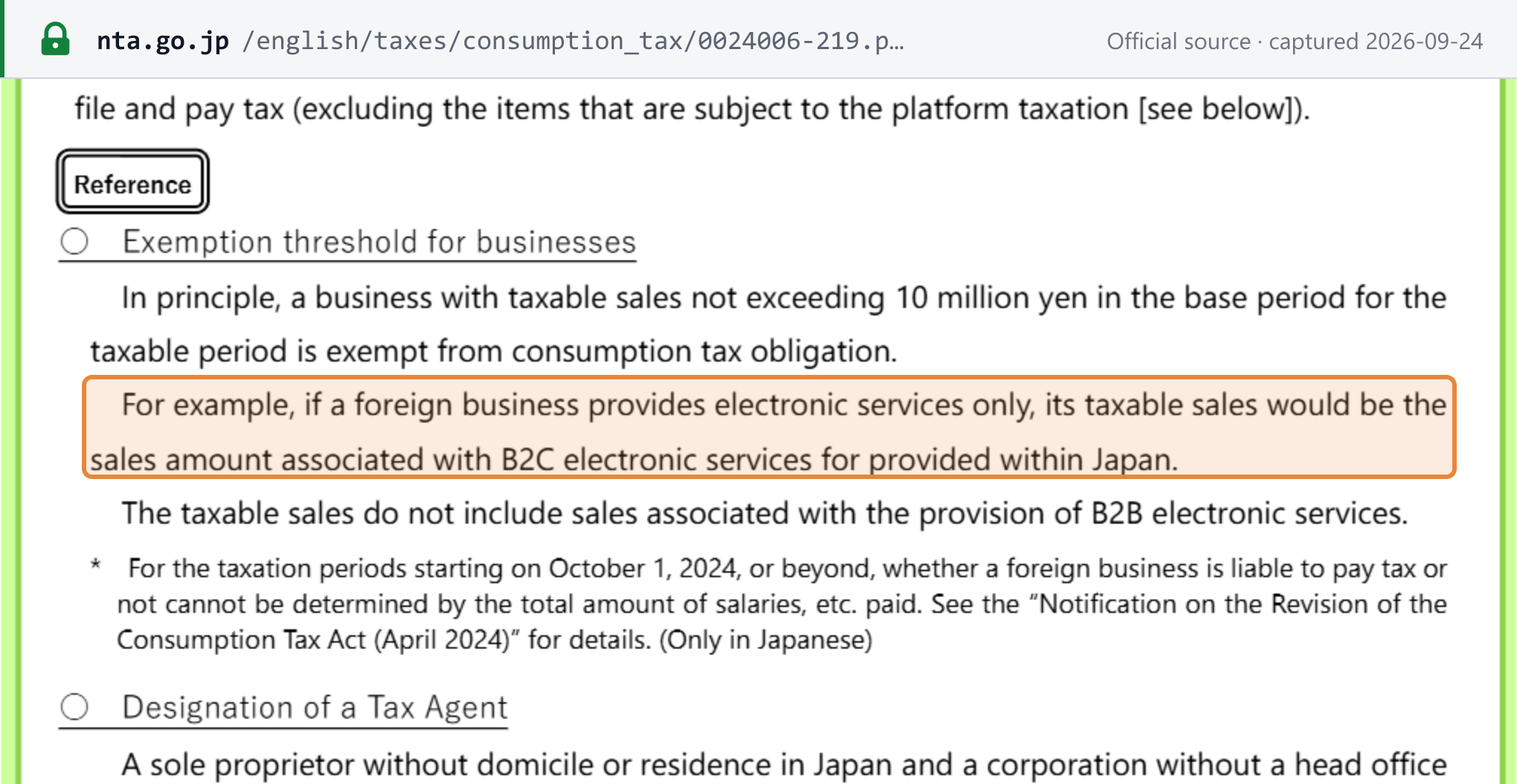
There is no zero threshold for non-residents. The same JPY 10 million base-period test applies. A foreign business that supplies electronic services only counts its B2C electronic-service sales in Japan; B2B electronic services are reverse-charged and excluded (NTA English guidance for foreign businesses). [10]
-
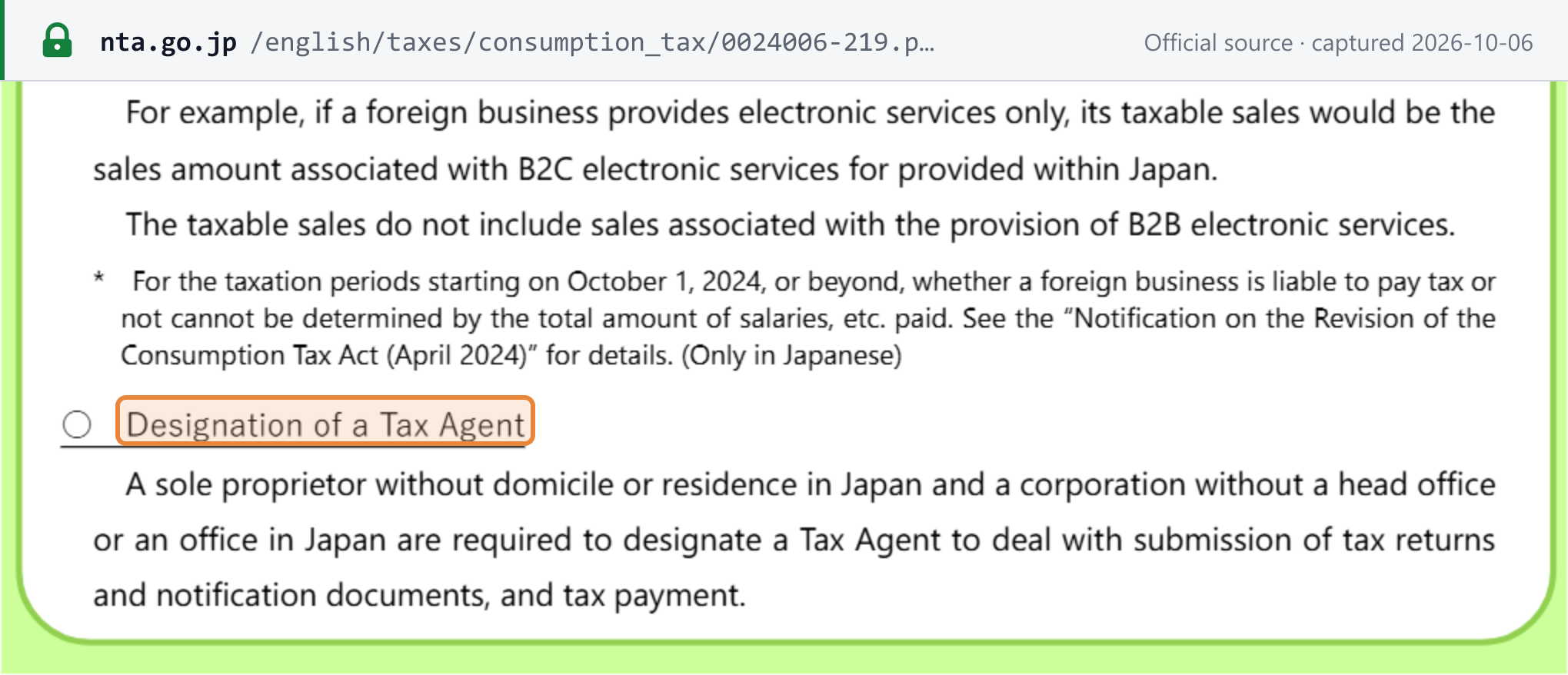
Tax Agent. "A sole proprietor without domicile or residence in Japan and a corporation without a head office or an office in Japan are required to designate a Tax Agent" (納税管理人) "to deal with submission of tax returns and notification documents, and tax payment" (NTA English). [10]
-
Registering as an invoice issuer makes a foreign business taxable "irrespective of the taxable sales amount of its reference period". Foreign businesses use a separate form (国外事業者用). [10] [11]
-
No permanent establishment. For periods beginning on or after 1 October 2024, a foreign business with no PE in Japan on the first day of the period cannot use the simplified scheme or the 2-wari and 3-wari specials (see Filing and payment). [3]
Tax identification number
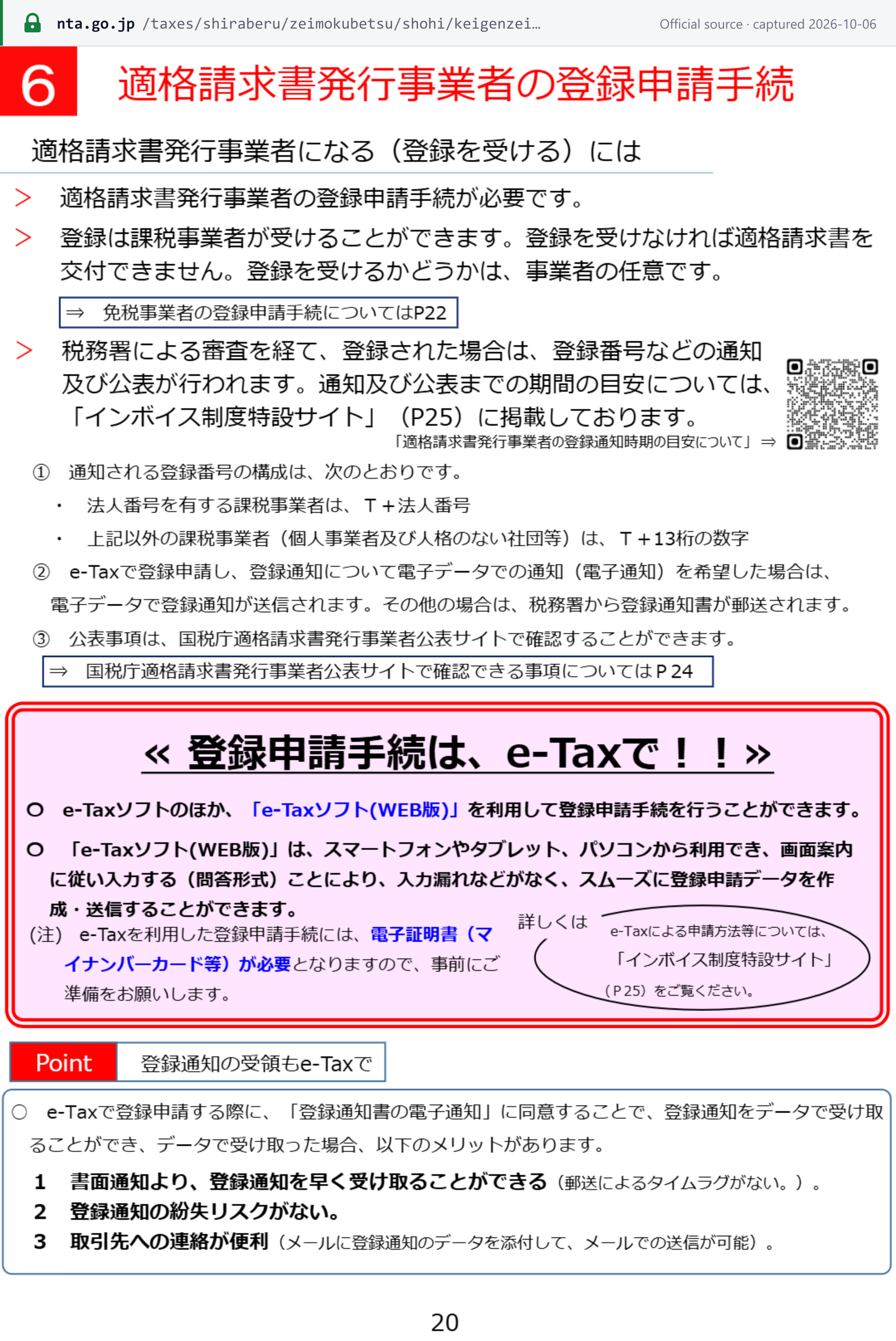
The registration number (登録番号) of a qualified invoice issuer is: [3]
- "T" + the 13-digit Corporate Number (法人番号) for a business that has a Corporate Number; and
- "T" + 13 digits for other businesses (individuals and unincorporated associations). These digits are not the individual's My Number, and do not duplicate any Corporate Number. [37]
The NTA's own specimens use the placeholder T1234567890123. Registrations are published on the NTA's Qualified Invoice Issuer Publication Site, which shows the name, the head-office address (corporations only), the number, the registration date and any cancellation or lapse date; it offers search by number, a Web-API and bulk download. The Corporate Number's check digit, the My Number, and how the numbers relate are covered in Lookuptax's Japan tax identification number guide. To check a Corporate Number, use the Japan Corporate Number validator. [3]
How to register
- Application. File the 適格請求書発行事業者の登録申請書 by e-Tax (the e-Tax software or the browser-based e-Tax WEB version, both needing an electronic certificate such as the My Number card) or by post to the regional Invoice Registration Centre (インボイス登録センター). There are separate forms for domestic and foreign businesses. [11]
- Notification. After review by the tax office, the number is notified electronically (where requested through e-Tax) or by post, and published. [3]
- Timeline. The NTA's indicative estimate published on 18 September 2026 is about one month for an e-Tax application and about 1.5 months on paper; it says the figures are standard periods and not guaranteed. [12]
- Non-residents appoint a Tax Agent and use the foreign-business form.
For the general steps in other jurisdictions, see how to register for VAT, GST and sales tax.
Voluntary registration
Available. An exempt business may file a taxable-business election (消費税課税事業者選択届出書), normally effective from the next period and held for at least two years. Registering as an invoice issuer is itself optional, but it makes the business taxable. [7]
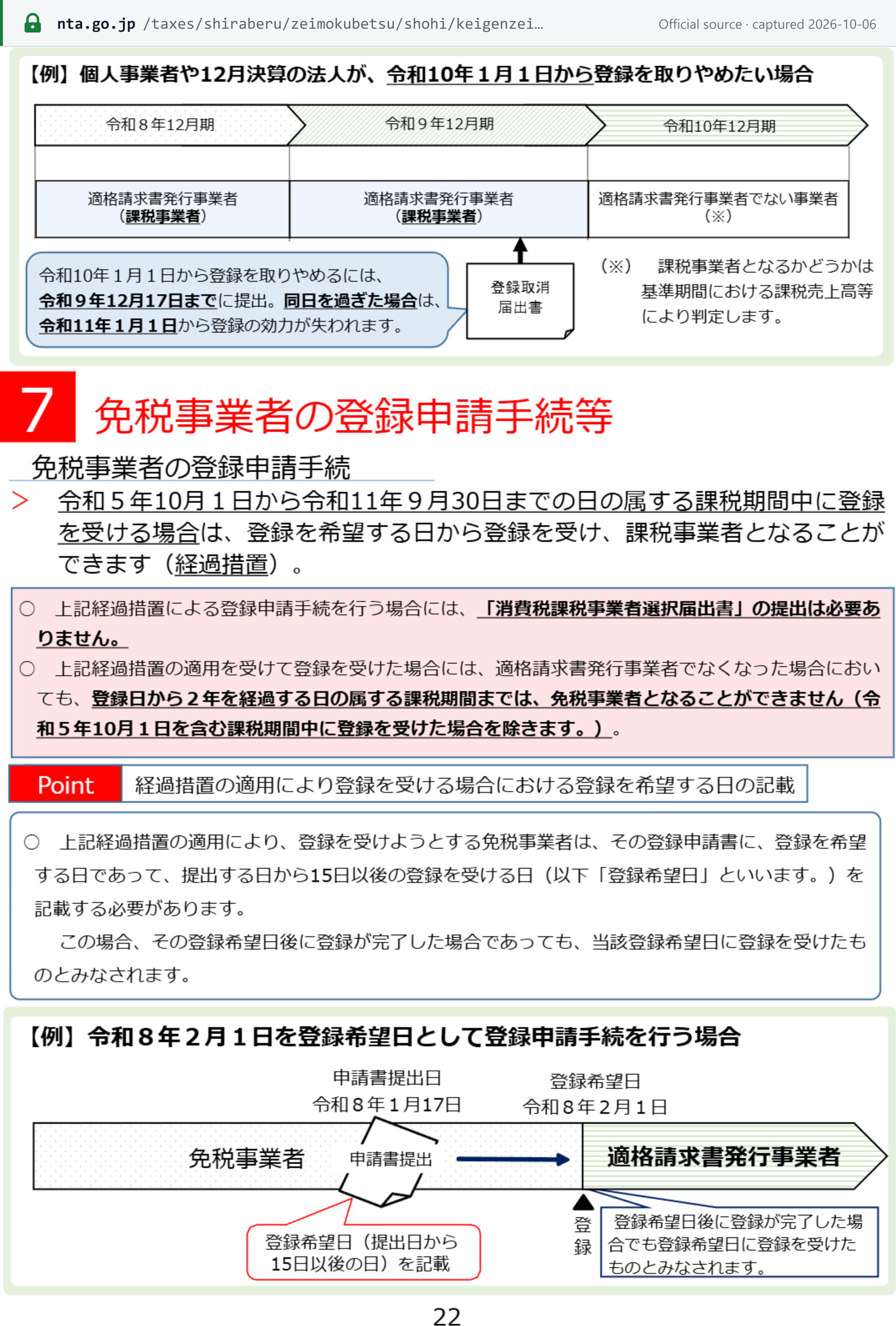
Mid-period registration (transitional measure). An exempt business registering during a taxable period that includes any day from 1 October 2023 to 30 September 2029 can be registered from a chosen date — at least 15 days after it files — and is taxable from that date without filing the election form. A business registered this way cannot become exempt again until the taxable period that includes the day two years after registration, except where it registered during the taxable period that included 1 October 2023 (NTA pamphlet, p.22). [3]
The commercial reason to register is the buyer's credit: a Japanese business customer can credit tax on its purchases only if it holds a qualified invoice, apart from the transitional measure described below.
Deregistration
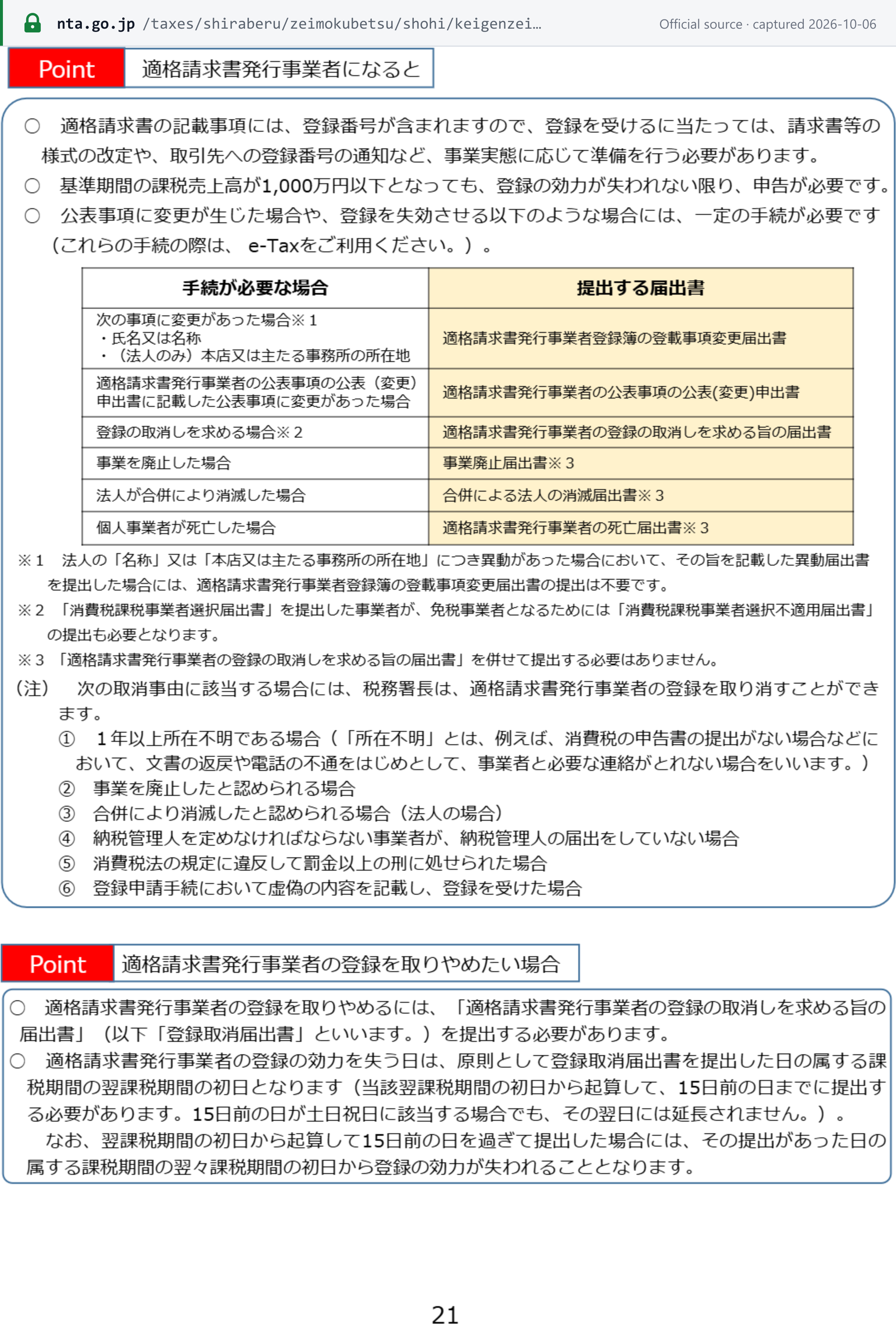
- Cancelling invoice registration. File the cancellation notice (登録取消届出書). It takes effect from the first day of the next taxable period if filed at least 15 days before that day; the deadline is not extended for weekends or holidays, and a late filing defers the effect by a further period. The NTA's example: to stop being registered from 1 January 2028, file by 17 December 2027. [3]
- Withdrawing a taxable-business election. A business that had filed the taxable-business election must also file the withdrawal notice (消費税課税事業者選択不適用届出書) to become exempt; the election cannot be withdrawn within two years of becoming taxable (pamphlet p.21; Tax Answer 6501). [3] [7]
- Leaving liability. When base-period sales fall to JPY 10 million or less, file the notification that the business is no longer liable promptly (Tax Answer 6629). A registered issuer must keep filing while its registration is in force, whatever its sales. [9] [3]
- Revocation by the tax office is possible where the business has been untraceable for a year or more, has ceased business, has not notified a required Tax Agent, has been fined or worse under the Consumption Tax Act, or registered on false information. [3]
Group registration
Not available. The NTA's consumption-tax guidance (Tax Answers 6501, 6503, 6601 and 6629, and the invoice-system pamphlet) treats liability, registration and filing per business and provides for no group registration or consolidated consumption-tax return; each entity registers and files on its own.
Rates
Rates as at 2026-10-07 (NTA Tax Answer 6303, law as at 1 April 2026): [4]
| Standard rate | Reduced rate | |
|---|---|---|
| Consumption tax (national) | 7.8% | 6.24% |
| Local consumption tax | 2.2% (22/78 of the national tax) | 1.76% (22/78 of the national tax) |
| Total | 10% | 8% |

- Standard rate — 10%, since 1 October 2019, when it rose from 8% and the reduced-rate system began (Tax Answer 6102). [13]
- Reduced rate — 8%, for: [13]
- food and beverages as defined in the Food Labelling Act, excluding alcohol, and excluding dining-in (外食) and catering (ケータリング);
- integrated goods (一体資産), such as sweets sold with a toy, but only where the price excluding tax is JPY 10,000 or less and the food makes up at least two-thirds of the value;
- newspapers issued at least twice a week, sold by subscription.
- Zero rate. There is no domestic zero rate. Exports and international services are exempt with credit (see Imports and exports).
Announced future rates
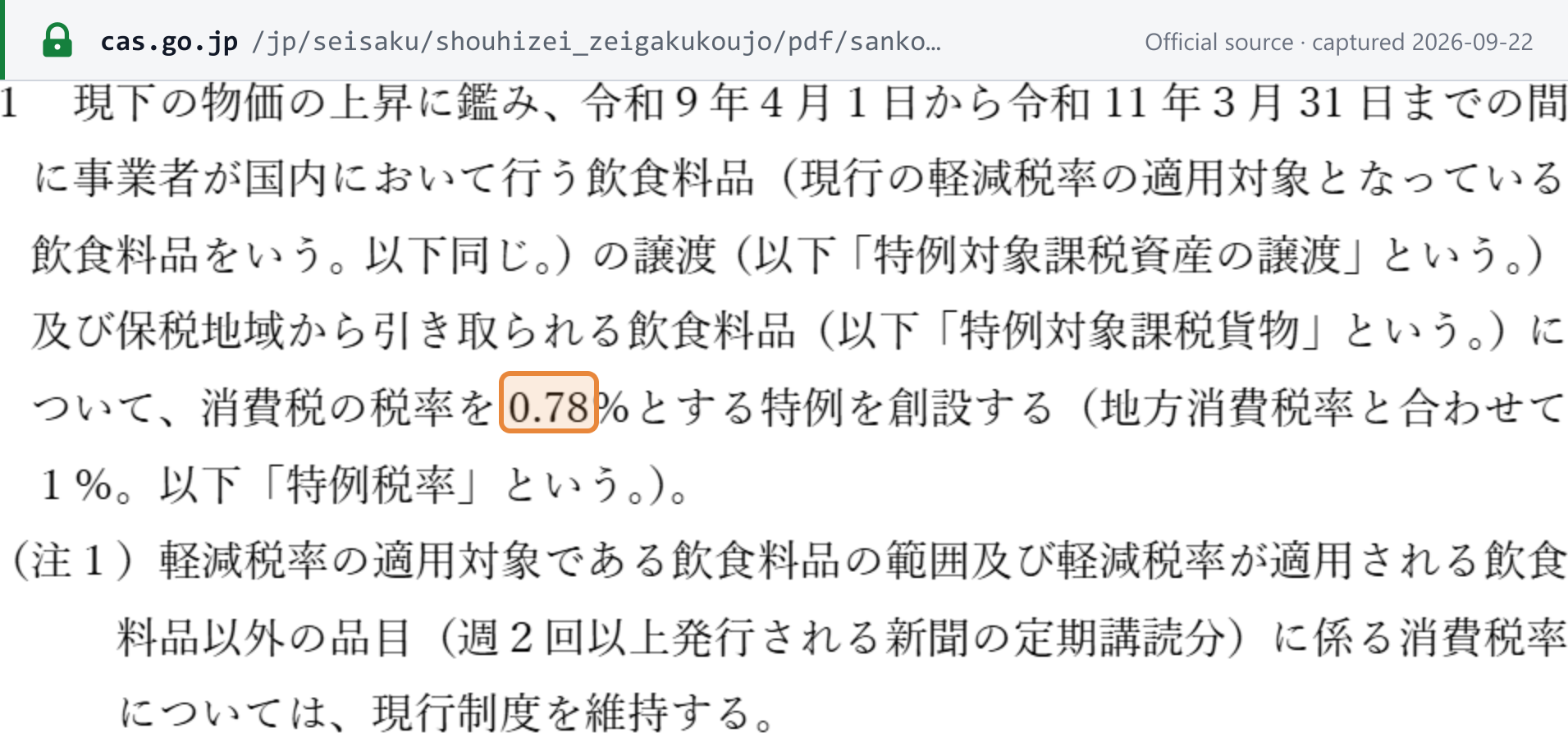
Proposed, not enacted. A Cabinet outline of 15 September 2026 proposes cutting the rate on food and beverages (the current 8% scope) to 1% combined for two years, 1 April 2027 to 31 March 2029, with newspapers staying at 8% and everything else at 10%. The NTA and Ministry of Finance special site says its content applies only "if a bill is in future submitted to the Diet and, after deliberation, passed and enacted" (法案が国会に提出され、審議を経た上で可決・成立した場合). As at 2026-10-06 the House of Representatives bill index for the 222nd session listed no Cabinet consumption-tax bill. NTA pages announcing the cut link to the same conditional site. Until a law is passed, the reduced rate remains 8%. See the event record. [14] [15]
Cross-border rules
Foreign companies selling into Japan — B2B and B2C
-
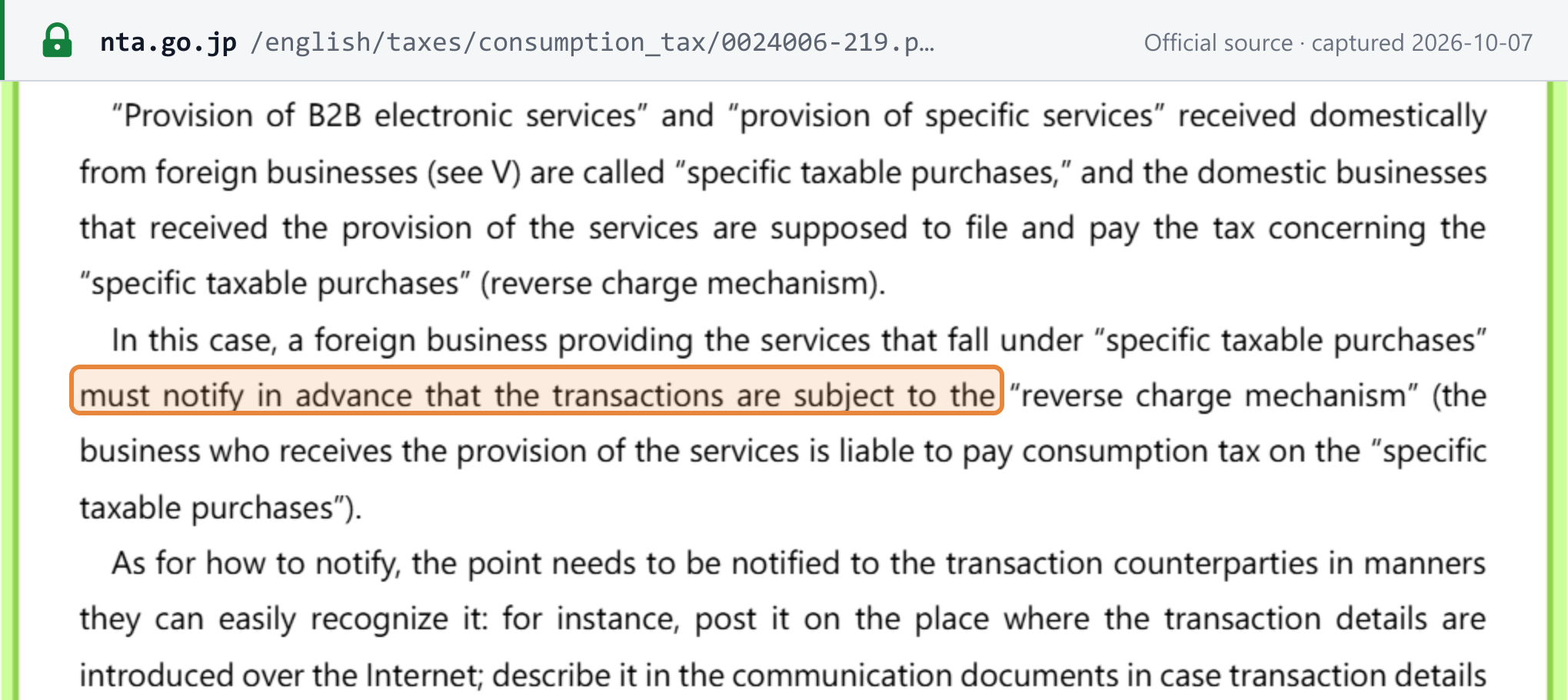
B2B electronic services (services that by their nature or terms go only to businesses, such as online advertising): the Japanese business customer self-assesses the tax as a specified taxable purchase (特定課税仕入れ) under the reverse charge. The foreign supplier must notify the customer in advance that the reverse charge applies. A customer on general taxation with a taxable-sales ratio of 95% or more, or using the simplified scheme or the 2-wari/3-wari specials, treats the purchase as not made and does not self-assess. Foreign performers and athletes supplying businesses ("specific services") are also reverse-charged. [16] [10]
-
B2C electronic services: the foreign supplier files and pays, subject to the JPY 10 million threshold and to platform taxation (below). A Japanese business buying B2C electronic services needs the supplier's qualified invoice to claim credit. [10]
-
Goods imported by the customer are taxed at import (below). From 1 April 2028, mail-order (通信販売) sales of low-value goods sent into Japan shift to the seller (see Imports and exports).
For how other countries treat the same supplies, see VAT on digital services by non-resident suppliers and reverse charge.
Digital products and services
"Electronic services" (電気通信利用役務の提供) — e-books, music, apps, cloud services, online advertising and similar — are supplied in Japan where the recipient's domicile or head office is in Japan, whether they are provided from inside or outside Japan (Tax Answer 6118). [16] The NTA's English guidance says the supplier decides this on objective evidence, such as the customer's stated address checked against the card's country of issue. [10]
Marketplace / platform deemed-supplier liability
Platform taxation for electronic services (since 1 April 2025). Where a foreign business supplies B2C electronic services through a digital platform and the price is collected through a specified platform business (特定プラットフォーム事業者) designated by the NTA Commissioner, the platform is deemed to make the supply and files and pays the tax (Tax Answer 6568). A platform is designated where such consideration collected through it exceeds JPY 5 billion in a taxable period. The foreign seller need not issue qualified invoices for those sales. Sales by domestic sellers, direct sales, and sales where payment bypasses the platform are outside the rule. [17] [18]
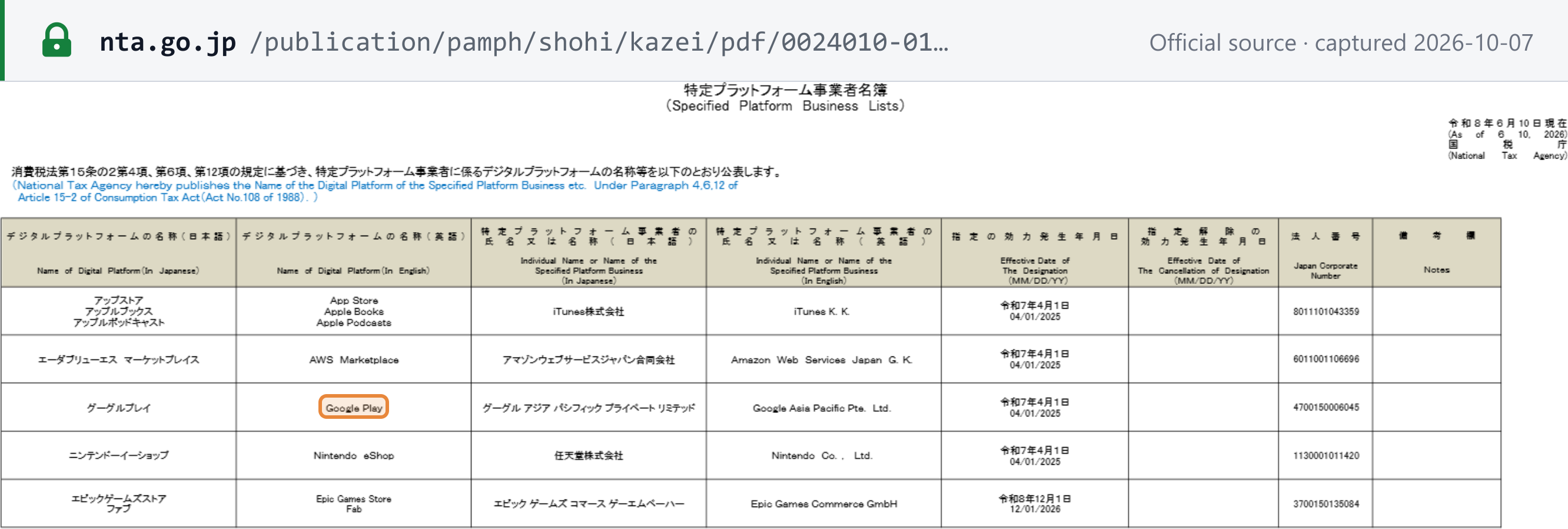
Designated platforms, as at 10 June 2026 (NTA list of specified platform businesses): [19]
| Platform(s) | Specified platform business | Effective |
|---|---|---|
| App Store / Apple Books / Apple Podcasts | iTunes K.K. | 1 April 2025 |
| AWS Marketplace | Amazon Web Services Japan G.K. | 1 April 2025 |
| Google Play | Google Asia Pacific Pte. Ltd. | 1 April 2025 |
| Nintendo eShop | Nintendo Co., Ltd. | 1 April 2025 |
| Epic Games Store / Fab | Epic Games Commerce GmbH | 1 December 2026 |
Goods marketplaces from 1 April 2028 (enacted). The FY2026 reform makes a marketplace designated as a Type 2 platform business (第二種プラットフォーム事業者) the deemed supplier of (i) sales of goods in Japan by foreign businesses and (ii) low-value cross-border mail-order sales, where the price is collected through the platform. A marketplace is designated where (i) plus (ii) exceeds JPY 5 billion. For the first designation, the test is January–March 2027 sales multiplied by four, the designation notification is due by 30 June 2027, and the designation takes effect on 1 April 2028. [20] For the model across countries, see marketplace deemed-supplier rules.
Imports and exports
- Imports. Import consumption tax is declared and paid to Customs by the time the goods leave the bonded area; payment can be deferred for up to three months against security. The importer's credit is evidenced by the Customs import permit (輸入許可書), not by a qualified invoice. [2] [21]
- De minimis. Consignments with a total customs value of JPY 10,000 or less are relieved from customs duty and consumption tax; other excise taxes such as liquor and tobacco tax still apply, and some listed goods (for example leather bags, knitwear and leather shoes) are excluded (Customs Answer 1006). [22]
- Low-value imports from 1 April 2028 (enacted). Mail-order (通信販売) sales of goods sent into Japan for JPY 10,000 or less per item, excluding tax (特定少額資産の譲渡), become domestic supplies, and the seller files and pays, whether domestic or foreign (exempt businesses excepted). A voluntary "specified low-value asset seller" registration opens for applications on 1 October 2027; a registered seller's parcels get import-stage relief when its number is quoted on the import declaration. [20]
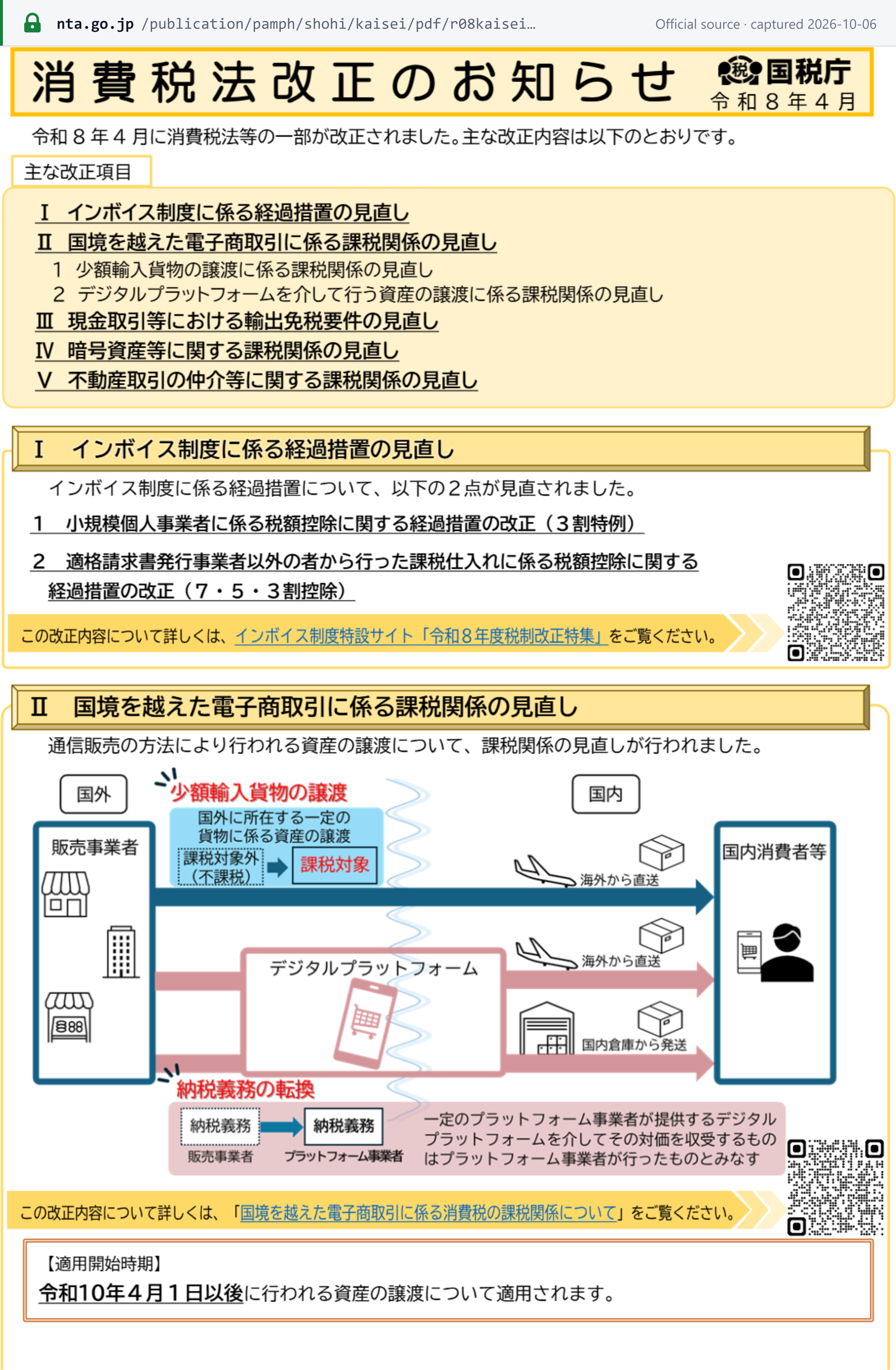
- Exports of goods, international transport and communications, intangibles supplied to non-residents, and services to non-residents are exempt with input credit (輸出免税). Services that a non-resident enjoys directly in Japan — transport or storage of goods in Japan, meals, lodging and similar — remain taxable. The export permit or contract documents are kept for seven years (Tax Answer 6551). [23]
- From 1 October 2026, an export paid in cash, or by a method not clearly coming from the customer, also needs a document proving import at the destination, such as the destination country's import permit; and brokerage or agency services for Japanese real estate supplied to non-residents become taxable (except under contracts concluded by 31 March 2026). [23] [20]
- Tourist tax-free shopping at export-goods shops (輸出物品販売場) moves from point-of-sale exemption to a refund method (リファンド方式) from 1 November 2026, under the FY2025 reform. [24]
Place of supply
- Imported goods are taxed when removed from the bonded area (Tax Answer 6601).
- Electronic services follow the recipient's domicile or head office (Tax Answer 6118), as above.
- Other services to non-residents are exempt exports unless the non-resident enjoys them directly in Japan (Tax Answer 6551). [16] [23]
Invoice requirements
The rules are in art. 57-4 of the Consumption Tax Act. The duty is to issue a qualified invoice when a taxable business customer requests one (交付を求められたときは). Only a registered issuer may issue one. [1]
Mandatory content
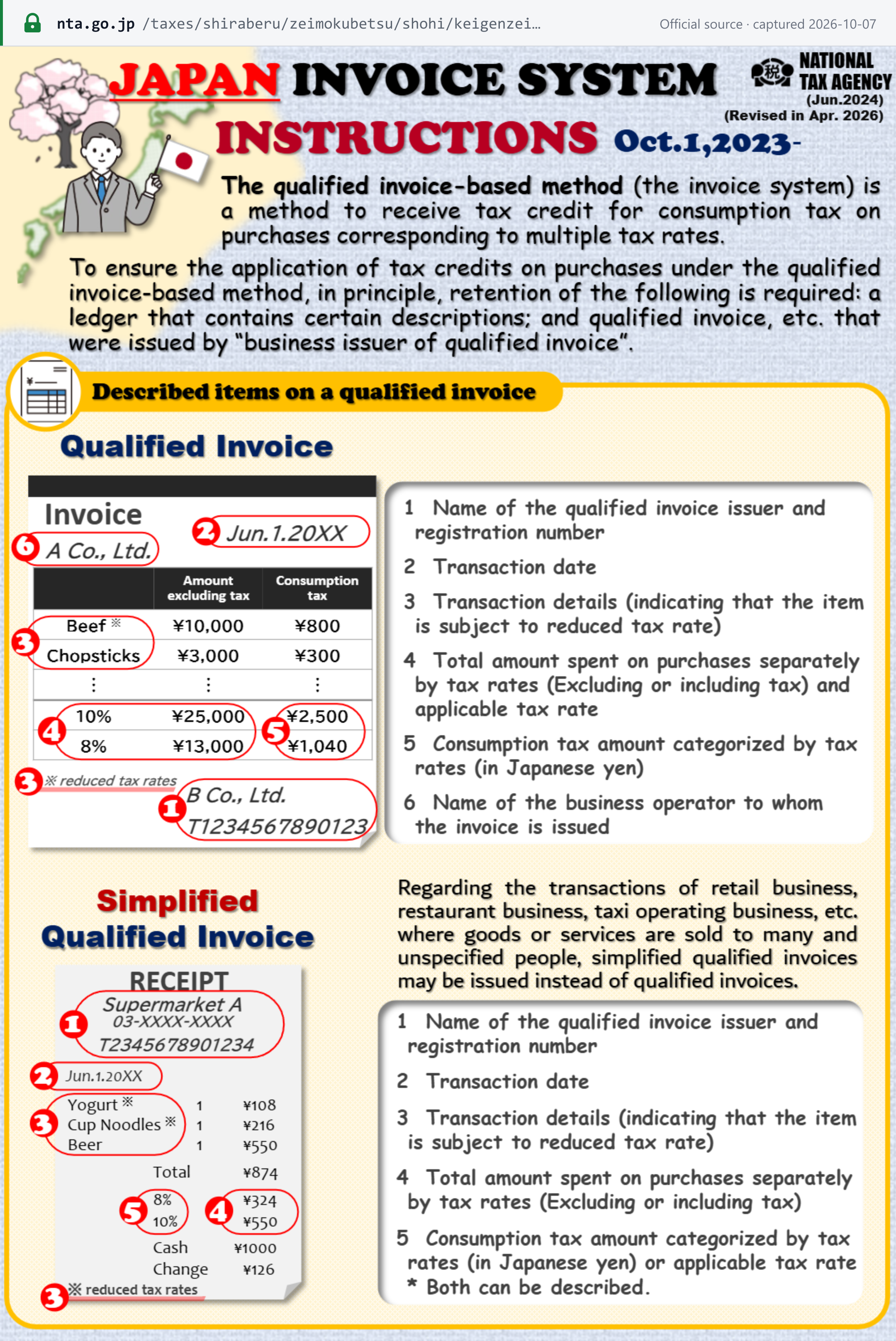
A qualified invoice (適格請求書) carries six particulars (CTA art. 57-4(1); NTA English leaflet): [1] [6]
| No. | Required field |
|---|---|
| ① | Issuer's name and registration number (T-number) |
| ② | Transaction date — or the period, for an invoice summarising supplies over a period |
| ③ | Description of the goods or services, marking reduced-rate items |
| ④ | Consideration totalled per tax rate (tax-exclusive or tax-inclusive) and the applicable rate |
| ⑤ | Consumption tax amount per rate, in yen |
| ⑥ | Recipient's name |
- Rounding. Where the tax for a rate has a fraction of a yen, round once per rate per invoice — up, down or to the nearest yen, at the issuer's choice. Calculating and rounding the tax on each line and stating the sum is not permitted (pamphlet p.7). [3]
- Form. No form is prescribed: any title works (invoice, delivery note, receipt), and handwriting is allowed. Several clearly linked documents may together make one qualified invoice, and a customer code shared with the buyer may stand in for the issuer's name and number. [3]
Issuance deadline
The particulars in art. 57-4 include no issuance deadline in days; the obligation is to issue on the customer's request. [1]
Numbering and sequencing
Art. 57-4(1) contains no invoice-number or sequential-numbering particular. Numbering is therefore a matter of the business's own bookkeeping, not a qualified-invoice requirement. [1]
Credit and debit notes
- Return invoice (適格返還請求書): required for returns, discounts and rebates — unless the refund is under JPY 10,000 including tax. The NTA's example: a JPY 440 bank-transfer fee that the buyer deducted needs no return invoice. [3]
- Corrected invoice (修正した適格請求書): required when an issued qualified invoice, simplified invoice or return invoice was wrong. [3]
- Debit notes. The Act provides no separate debit-note document type.
Currency and language
The consumption-tax amount must be stated in yen (particular ⑤). The Act prescribes no invoice language. [1] [6]
Document types
- Qualified invoice (適格請求書) — all six particulars.
- Simplified qualified invoice (適格簡易請求書) — for retail, restaurants, taxis, parking and similar businesses selling to many unspecified customers (CTA art. 57-4(2)). The recipient's name may be omitted, and either the tax amount or the rate may be shown. There is no value ceiling: eligibility turns on the type of business, not the amount.
- Return invoice and corrected invoice — above.
- No invoice required for public transport by boat, bus or rail under JPY 30,000; wholesale fresh-produce markets; pooled sales through agricultural co-operatives; vending machines and automatic service machines under JPY 30,000; and postal services paid with stamps. For public transport, vending machines and stamp-paid post the buyer credits on the ledger alone; for wholesale-market and co-operative sales the buyer keeps the invoice issued by the wholesaler or co-operative, which carries its registration number. [1] [3]
Self-billing
Permitted in effect. A purchase statement prepared by the buyer (仕入明細書等) supports credit in place of the seller's invoice if it carries the seller's registration number and the particulars, and the seller has confirmed its content (Tax Answer 6625). [21]
Retention and audit trail
- E-invoices. An issuer may supply the particulars as electronic data instead of a paper invoice (CTA art. 57-4(5)); delivery may be by EDI, e-mail, portal or media. [1]
- Seller. Copies of issued qualified invoices are kept for seven years from the day two months after the end of the taxable period in which they were issued. [3]
- Buyer. The ledger and the invoices are kept for seven years from the day two months after the end of the taxable period (three months for a corporation with the filing extension); in years six and seven only one of the two need be kept (Tax Answer 6625). [21]
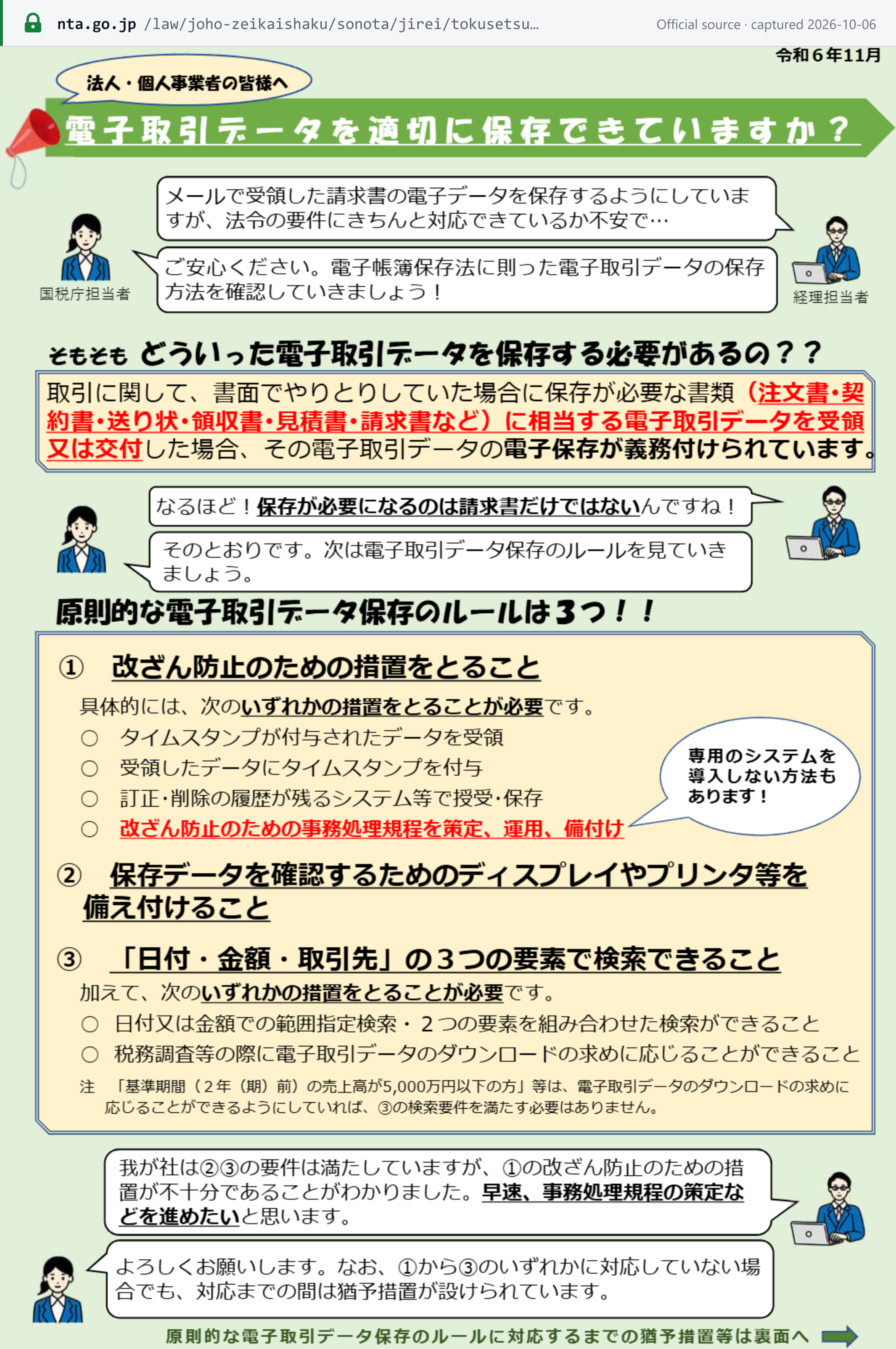
- Electronic transaction data — Electronic Bookkeeping Act (電子帳簿保存法). Data for transactions conducted electronically — orders, contracts, invoices, receipts and similar — must be kept electronically; printing it out stopped being acceptable on 1 January 2024. The data must be kept with: (1) a tamper-prevention measure — receiving it with a timestamp, adding a timestamp, using a system that records corrections and deletions, or adopting written internal anti-tamper rules; (2) a display and printer; and (3) search by date, amount and counterparty. A grace measure applies where the tax office accepts that there are reasonable grounds and the data and printouts can be produced on request. The duty is imposed by art. 7 of the Electronic Bookkeeping Act on persons required to keep records for income tax or corporate tax (所得税…及び法人税に係る保存義務者); it is not a rule of the Consumption Tax Act itself. [36] [25] [26]
A specimen of a compliant invoice
The NTA publishes an official annotated specimen in English, reproduced below from its leaflet Japan Invoice System Instructions (page 1). The upper panel is a qualified invoice issued by "B Co., Ltd." with registration number T1234567890123 to "A Co., Ltd.", with each of the six particulars numbered: the beef line is marked ※ as a reduced-rate item, and the totals block shows 10% ¥25,000 / tax ¥2,500 and 8% ¥13,000 / tax ¥1,040. The lower panel is a simplified qualified invoice — a supermarket receipt with no customer name, showing the per-rate split of 8% ¥324 and 10% ¥550. Both are the NTA's own fictional examples. [6]
A Japanese-language version with the same circled ①–⑥ callouts is on page 4 of the NTA's invoice-system pamphlet. [3]
E-invoicing status
No mandate, as at 2026-10-07. The Consumption Tax Act allows e-invoices but prescribes no format, network or clearance (art. 57-4(5)), and neither the NTA's invoice-system special site nor the Digital Agency's e-invoicing page announces a mandate. The qualified invoice system is a set of content rules, not an e-invoicing network. [1] [27]
- Scope. B2B, B2G and B2C: none mandated. A voluntary B2G channel exists: the Digital Agency publishes material on Peppol invoicing to the government e-procurement system (GEPS). [27]
- Phase timeline. Not applicable — no phases have been announced.
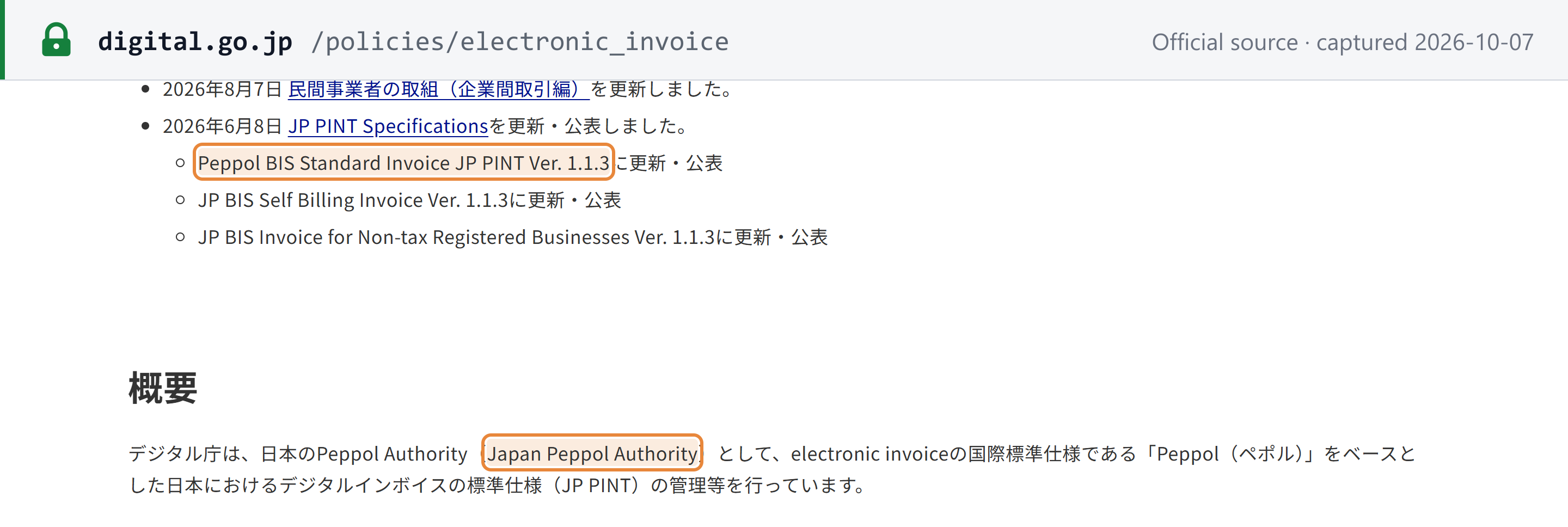
- System and network. The voluntary network is Peppol. The Digital Agency (デジタル庁) acts as the Japan Peppol Authority — it has been an OpenPeppol member since September 2021 — and maintains Japan's standard specification, JP PINT. [27]
- Formats. On 8 June 2026 the Digital Agency published Ver. 1.1.3 of Peppol BIS Standard Invoice JP PINT, JP BIS Self Billing Invoice, and JP BIS Invoice for Non-tax Registered Businesses. The older Peppol BIS Billing JP has been replaced by JP PINT. Since 1 October 2024 Japanese Peppol service providers must use the "peppol-doctype-wildcard" document-type identifier scheme. [27]
For background on the network, see Peppol and country requirements for Peppol; for other countries, see e-invoicing status and networks worldwide.
Filing and payment
Filing frequency
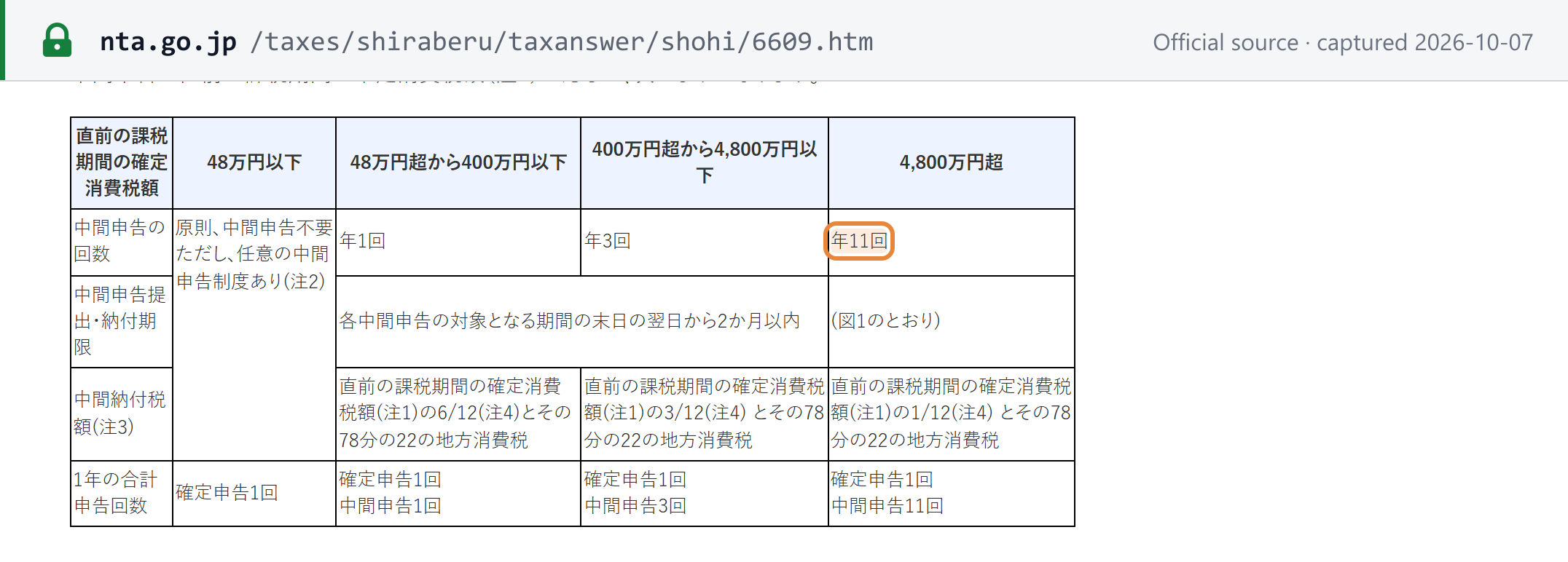
The final return is filed once per taxable period — annually, unless the business has elected three-month or one-month periods. Interim returns depend on the previous period's national consumption tax, excluding local tax (Tax Answer 6609): [5]
| Previous period's national tax | Interim returns a year | Each payment |
|---|---|---|
| JPY 480,000 or less | None required (an optional interim regime exists) | — |
| Over JPY 480,000 up to JPY 4 million | 1 | 6/12 of last year's tax |
| Over JPY 4 million up to JPY 48 million | 3 | 3/12 |
| Over JPY 48 million | 11 | 1/12 |
Local consumption tax of 22/78 of the national amount is added to each payment. An interim may instead be computed on provisional accounts, but it cannot produce a refund; a business that misses an interim is deemed to have filed on the prior-year basis. [5]
Return due date
The final return and payment are due within two months after the end of the taxable period. For individuals, the calendar-year return is due on 31 March of the following year. A corporation with the corporate-tax filing extension gets one more month for the period that ends with its business year. Each interim return is due two months after its interim period ends. No return is needed for a period with no taxable sales and no tax due, though a refund return may be filed (Tax Answer 6601). [2]

Payment due date and method
Payment is due on the same date as the return. The NTA's payment guide lists the methods. Import consumption tax is paid to Customs on removal of the goods, with up to three months' deferral against security. [2]
Additional listings
Not applicable — consumption tax has no sales or purchase listing, recapitulative statement or separate annual information return; the final and interim returns are the only periodic returns.
Input-tax recovery
- Evidence. Credit requires both a ledger with the prescribed entries and retained qualified invoices or equivalents (import permits, buyer-prepared statements). [21]
- Full credit only where taxable sales in the period are JPY 500 million or less and the taxable-sales ratio is 95% or more. Otherwise input tax is apportioned, itemised (個別対応方式) or pro rata (一括比例配分方式) (Tax Answer 6401). [28]
- Ledger-only credit (no invoice needed): public transport under JPY 30,000; vending machines; admission tickets collected on use; second-hand dealers, pawnbrokers and real-estate dealers buying from non-issuers; recyclables; employee travel and commuting allowances; and, from 1 September 2026, licensed scrap-metal buyers. [3]
- Small-amount special (少額特例): a business with base-period sales of JPY 100 million or less (or specified-period sales of JPY 50 million or less) may credit purchases of under JPY 10,000 including tax per transaction on the ledger alone, for purchases from 1 October 2023 to 30 September 2029. [3]
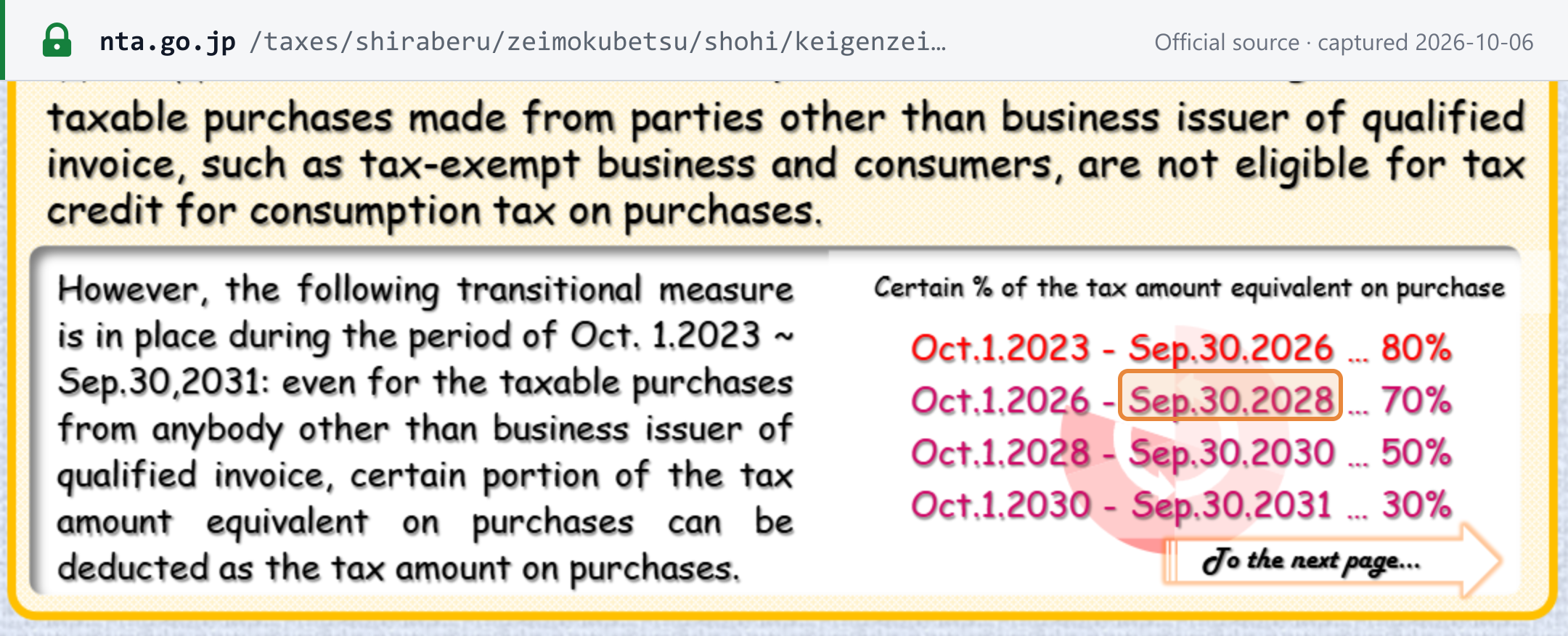
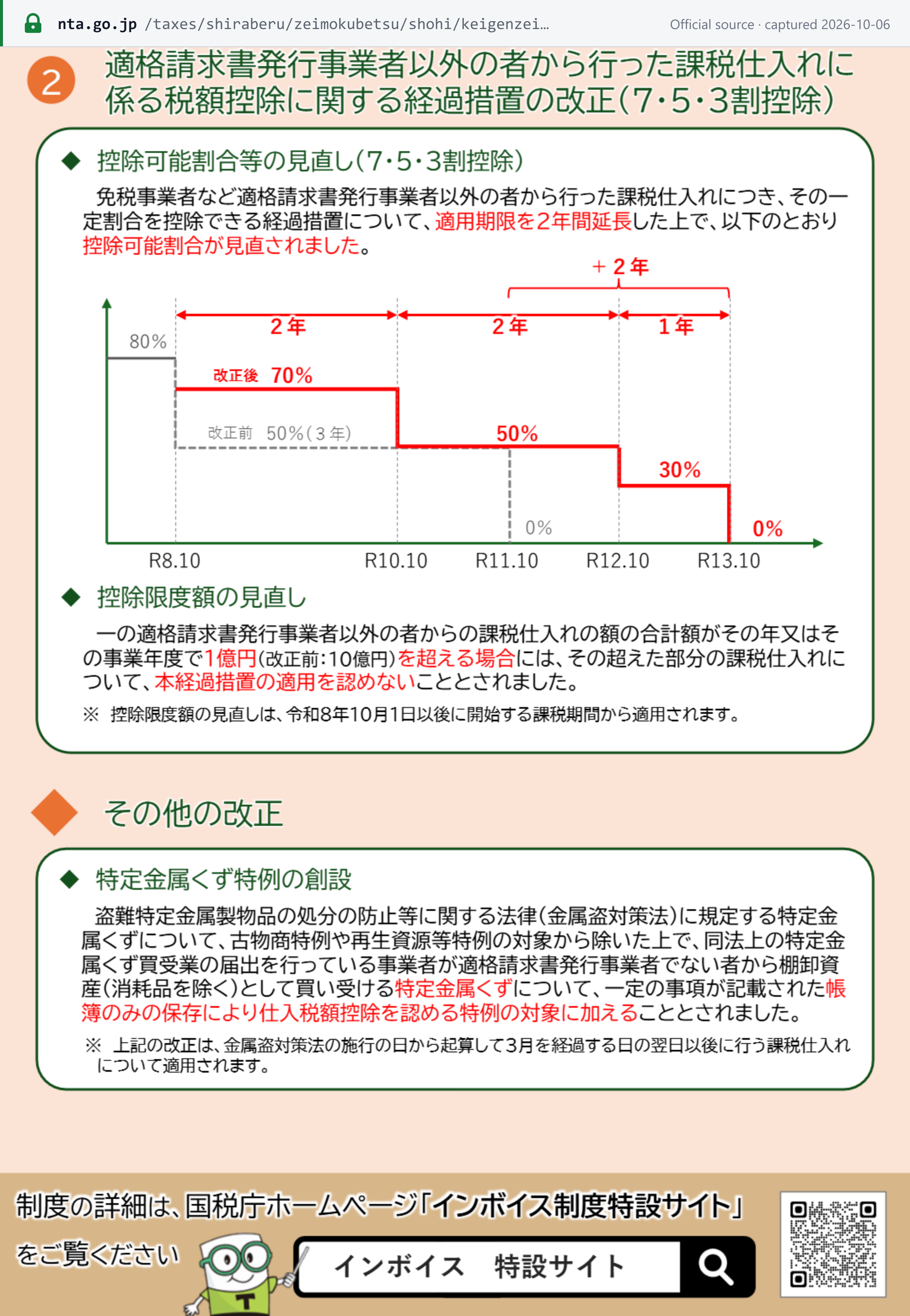
Purchases from non-registered suppliers — transitional credit. Tax on purchases from businesses that are not registered issuers (exempt businesses, consumers) is in principle not creditable. The FY2026 reform extended the transitional measure by two years and stepped the percentages down: [6] [29]
| Purchases made | Share of the tax-equivalent amount creditable |
|---|---|
| 1 October 2023 – 30 September 2026 | 80% |
| 1 October 2026 – 30 September 2028 | 70% |
| 1 October 2028 – 30 September 2030 | 50% |
| 1 October 2030 – 30 September 2031 | 30% |
| From 1 October 2031 | Nothing |
- Per-supplier cap. For taxable periods beginning on or after 1 October 2026, purchases from one non-registered supplier above JPY 100 million (tax-inclusive) in a year or business year get no transitional credit on the excess. The cap replaces the earlier JPY 1 billion cap, which applied to periods beginning from 1 October 2024 to 30 September 2026. A December year-end business first meets the new cap in its period starting 1 January 2027. [29] [3]
- Conditions. Keep an invoice with the old itemised (区分記載請求書) particulars and a ledger entry noting that the transitional deduction applies; a missing reduced-rate marker or per-rate total may be added by the buyer. [3]
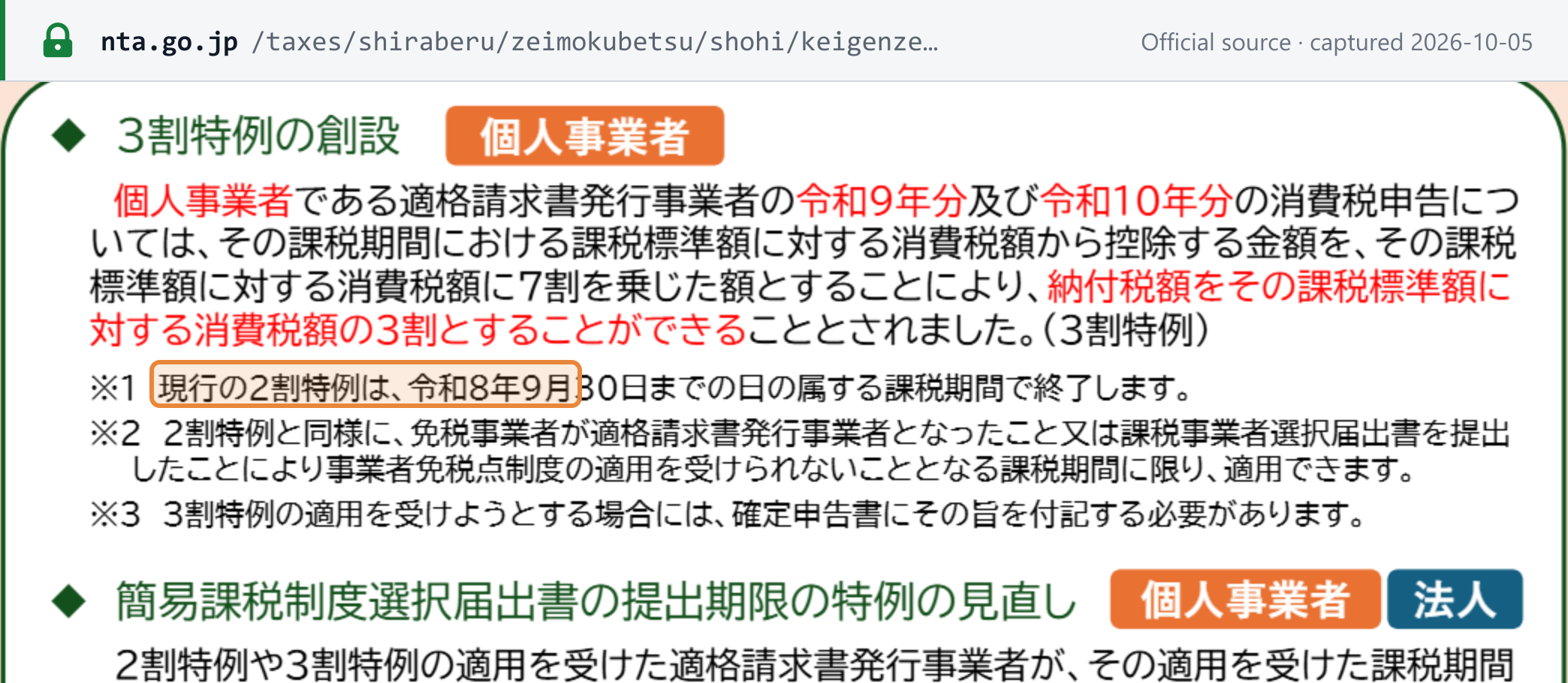
The 2-wari and 3-wari specials. A business that became taxable only because it registered as an invoice issuer (or elected to be taxable) may pay 20% of its output tax (the 2割特例) for each taxable period that includes any day from 1 October 2023 to 30 September 2026 — individuals and corporations alike. The 2-wari special ends with the taxable period that includes 30 September 2026. Individuals only may then pay 30% of output tax (the 3割特例) for calendar 2027 and 2028; corporations cannot. Either special is claimed by a note on the return, with no advance election. Excluded are foreign businesses without a PE, businesses taxable for other reasons (base-period sales over JPY 10 million, new companies with capital of JPY 10 million or more, high-value assets), and businesses using shortened periods. The NTA's example: on annual sales of JPY 7 million (tax JPY 700,000), the payable tax is JPY 140,000 under the 20% special and JPY 210,000 under the 30% special. See the event record. [29] [3]
A business that used either special may elect the simplified scheme for the next period by that period's return due date, where the next period ends on or after 1 October 2026. [29]
Refunds
- Resident refund. Where input tax plus interim payments exceed output tax, a refund return may be filed — even for a period with no taxable sales, provided the business is taxable. Exempt businesses cannot obtain refunds, which is why exporters and others with excess credits elect to be taxable (Tax Answer 6601). [2]
- Bad debts. Output tax on a written-off receivable is deducted in the period of the write-off, for qualifying write-offs such as a court-approved plan, hopeless insolvency or a creditors' agreement (Tax Answer 6367). [30]
Exemptions
Exempt supplies
Non-taxable (非課税) supplies (Tax Answer 6201) include: [31]
- Land — sale or lease of land, except leases under one month and land used with parking or other facilities;
- Financial — securities, means of payment (including crypto-assets and electronic payment instruments), interest, insurance premiums and foreign-exchange services;
- Stamps and vouchers — postage and revenue stamps, gift vouchers and prepaid cards;
- Government fees;
- Health and welfare — public medical care, long-term care, social welfare, midwifery, burial and cremation, and aids for people with disabilities;
- Education — school tuition and textbooks;
- Housing — residential leases, except those under one month.
The FY2026 reform makes the lending of crypto-assets and electronic payment instruments non-taxable and puts 5% of crypto-asset sale proceeds into the taxable-sales-ratio denominator, from a date set by Cabinet Order No. 96 of 2026. [20]
Exempt is not zero-rated. Non-taxable sales carry no input credit and lower the taxable-sales ratio, which triggers apportionment once it falls below 95%. Exports are the opposite: exempt with credit — Tax Answer 6551 states that input tax may be credited even on export transactions. [23] [28]
Special regimes
- Simplified taxation (簡易課税): for businesses with base-period taxable sales of JPY 50 million or less, elected normally by the day before the period starts and held for two years. Input tax equals output tax times a deemed rate — wholesale 90%; retail, and agriculture, forestry and fisheries selling food 80%; other primary industries, mining, construction, manufacturing and utilities 70%; other businesses, including restaurants 60%; transport and communications, finance and insurance, and services 50%; real estate 40%. No qualified invoices are needed for input credit under this scheme. Foreign businesses without a PE cannot use it. [3] [32]
- 2-wari / 3-wari specials and the small-amount special — see Filing and payment.
- Tax-free shops — see Imports and exports.
Offences and penalties
Offences
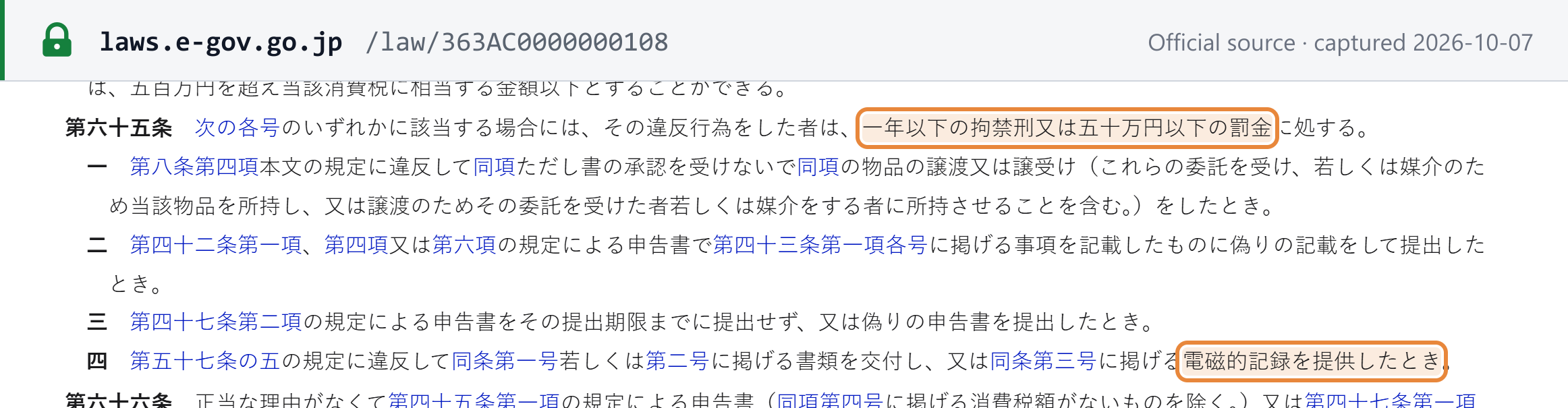
Under the Consumption Tax Act (text in force from 1 October 2026): [1]
- Evasion or fraudulent refunds (art. 64(1)): up to 10 years' imprisonment (拘禁刑) and/or a fine of up to JPY 10 million; where the evaded amount exceeds JPY 10 million, the fine may rise to that amount.
- Evasion by not filing the final return (art. 64(5)): up to 5 years and/or JPY 5 million.
- Not filing the final return without good reason (art. 66): up to 1 year or JPY 500,000; the penalty may be remitted.
- Invoice offences (arts. 57-5 and 65(4)): up to 1 year's imprisonment or a JPY 500,000 fine for issuing a document that could be mistaken for a qualified invoice when not registered, for issuing a false qualified or simplified invoice, or for supplying the electronic equivalent of either.
- A fine or heavier sentence under the Act is also a ground for revoking invoice registration.
Penalties
Administrative penalties come from the Act on General Rules for National Taxes (国税通則法) and apply to national taxes generally, including consumption tax:
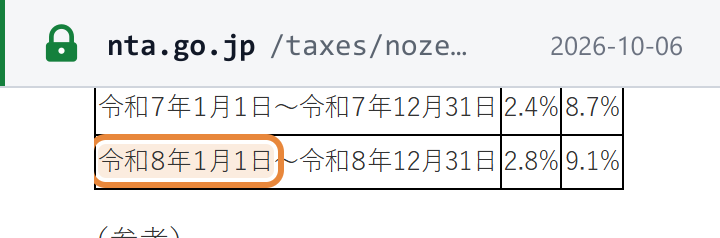
- Late-payment interest (延滞税) for 2026 (as at 2026-10-07): 2.8% a year until two months after the due date, and 9.1% a year after that. The rates are the lower of 7.3% and the base rate + 1% for the first two months, and the lower of 14.6% and the base rate + 7.3% thereafter, and reset each January. [33] [34]
- Non-filing surcharge (無申告加算税): the national-tax rule, as described by the NTA, for returns due on or after 1 January 2024: [35]
| When the late return is filed | Tax up to JPY 500,000 | JPY 500,000 – 3 million | Over JPY 3 million |
|---|---|---|---|
| Voluntarily, before any audit notice | 5% | 5% | 5% |
| After an audit notice, before an assessment is foreseen | 10% | 15% | 25% |
| After an audit or assessment | 15% | 20% | 30% |
A further 10% applies to repeat non-filers, and a further 10% or 5% where books are not produced or under-record sales. No surcharge applies to a return filed voluntarily within one month of the due date where the tax was paid on time, and no non-filing or fraud surcharge (重加算税) was imposed, and this exemption was not used, in the previous five years.
- Non-compliant invoices. Apart from the art. 65 criminal provision, the Act sets no specific monetary penalty for an invoice that lacks a particular; the practical exposure is the buyer's lost input credit.
Frequently asked questions
We are a foreign SaaS or app seller with Japanese customers — do we need a T-number?
Only if you are a taxable business, or choose to register. A foreign business that supplies electronic services only counts its B2C electronic-service sales in Japan towards the JPY 10 million base-period threshold; B2B electronic services are reverse-charged and do not count. There is a commercial reason to register below the threshold: a Japanese business that buys B2C electronic services from you needs your qualified invoice to claim input credit. Sales made through a designated platform, such as the App Store or Google Play, are taxed on the platform, and you need not issue qualified invoices for them. [10] [18]
Do we need a Tax Agent in Japan?
Yes, if you have no domicile, residence, head office or office in Japan. The NTA says such a business must designate a Tax Agent (納税管理人) to deal with returns, notifications and payment. A registered invoice issuer that is required to have a Tax Agent and has not notified one can have its registration revoked. [10] [3]
Our ERP rounds the tax on each line — is that acceptable on a qualified invoice?
No. Where the tax for a rate has a fraction of a yen, you round once per rate per qualified invoice, up, down or to the nearest yen as you choose. The NTA states that calculating and rounding the tax for each item and stating the sum as the tax per rate is not permitted. [3]
Our supplier is not a registered invoice issuer — how much input tax can we still credit?
A set share of the tax-equivalent amount, under a transitional measure that the FY2026 tax reform extended: 80% for purchases from 1 October 2023 to 30 September 2026, 70% from 1 October 2026 to 30 September 2028, 50% from 1 October 2028 to 30 September 2030, and 30% from 1 October 2030 to 30 September 2031. Nothing is creditable after that. For taxable periods beginning on or after 1 October 2026, purchases from one non-registered supplier above JPY 100 million (tax-inclusive) in a year or business year get no transitional credit on the excess; the earlier cap was JPY 1 billion. [6] [29]
I registered as an invoice issuer in 2023 — can I cancel and become exempt again?
Yes, if your base-period sales are JPY 10 million or less. File the cancellation notice (登録取消届出書) at least 15 days before the first day of the next taxable period; the deadline is not extended when that day falls on a weekend or holiday, and a late filing pushes the effect back a further period. For a calendar-year business, cancelling from 1 January 2028 means filing by 17 December 2027. The two-year lock-in that normally applies to exempt businesses registering under the transitional measure does not apply to a registration made during the taxable period that included 1 October 2023. If you had also filed the taxable-business election, you must file the withdrawal notice (消費税課税事業者選択不適用届出書) as well, and the election cannot be withdrawn within two years of becoming taxable. [3]
Is a receipt without the customer's name a valid invoice?
Yes, as a simplified qualified invoice (適格簡易請求書), if the business is one the law allows to issue it: retail, restaurants, taxis, parking and similar businesses selling to many unspecified customers. The recipient's name may be left out, and either the tax amount or the rate may be shown. Eligibility depends on the type of business, not on the amount. [1] [6]
We receive PDF invoices by e-mail — can we just print and file them?
No. Since 1 January 2024 transaction data received electronically must be kept electronically under the Electronic Bookkeeping Act, with a tamper-prevention measure, a display and printer, and search by date, amount and counterparty. The NTA frames this as a duty of businesses that keep records for income tax or corporate tax. [25] [26]
Is the consumption tax on food going down to 1%?
Not yet — it is a proposal. A Cabinet outline of 15 September 2026 proposes a 1% combined rate on food and beverages from 1 April 2027 to 31 March 2029, with newspapers staying at 8% and everything else at 10%. The NTA's special site says the content applies only if a bill is submitted to the Diet and passed. As at 6 October 2026 the House of Representatives bill index showed no Cabinet consumption-tax bill. Until it is enacted, the reduced rate is 8%. [14] [15]
Important websites
| Site | Purpose |
|---|---|
| NTA — invoice system special site | Guidance, Q&A and notices on the qualified invoice system |
| NTA — invoice registration forms | Registration application (domestic and foreign-business forms) and the e-Tax route |
| NTA — Qualified Invoice Issuer Publication Site | Check a T-number; Web-API and bulk download |
| NTA — Corporate Number Publication Site | Look up a company's 13-digit Corporate Number |
| NTA — return preparation corner | Prepare consumption-tax returns and file through e-Tax |
| NTA — tax payment guide | Payment methods |
| NTA — Tax Answer 6303 (rates) | The current consumption-tax rates |
| NTA — consumption tax for foreign businesses (English) | Cross-border services, platform taxation and registration for foreign businesses |
| NTA — designated platform list | Specified platform businesses under platform taxation |
| Digital Agency — e-invoicing (JP PINT) | Japan Peppol Authority; JP PINT specifications |
| Japan Customs | Import declarations and import consumption tax |
| NTA — food rate-cut special site | The proposed food rate cut (not enacted) |
Also see Lookuptax's own Japan Corporate Number validator and Japan tax identification number guide.
Recent changes
- 2026-10-01 — The transitional credit for purchases from non-registered suppliers stepped down from 80% to 70% (then 50% from 1 October 2028 and 30% from 1 October 2030 to 30 September 2031); a JPY 100 million per-supplier cap applies to taxable periods beginning on or after this date. (NTA) — see event
- 2026-10-01 — The 2-wari special ends with the taxable period that includes 30 September 2026; individuals move to a 3-wari (30%) special for 2027 and 2028. (NTA) — see event
- 2026-10-01 — Exports paid in cash need proof of import at the destination; brokerage of Japanese real estate for non-residents becomes taxable. (NTA)
- 2026-09-15 — A Cabinet outline proposes a 1% combined rate on food and beverages from 1 April 2027 to 31 March 2029; not enacted as at 2026-10-06. (NTA and MoF) — see event
- 2025-04-01 — Platform taxation began: specified platform businesses are deemed suppliers of B2C electronic services by foreign businesses. (NTA)
Ahead — scheduled changes that have not yet taken effect:
- 2026-11-01 — Tax-free shopping for visitors moves to a refund method. (NTA)
- 2028-04-01 — Low-value mail-order imports (JPY 10,000 or less per item) become taxable at the seller, and Type 2 platform businesses become deemed suppliers of goods. (NTA)
For the full chronology, see Japan tax changes on Lookuptax.
Reference links
- e-Gov — Consumption Tax Act (消費税法, Act No. 108 of 1988)
- NTA — Tax Answer 6601, returns and payment
- NTA — 適格請求書等保存方式の概要, invoice-system pamphlet (May 2026)
- NTA — Tax Answer 6303, consumption tax rates
- NTA — Tax Answer 6609, interim returns
- NTA — Japan Invoice System Instructions (English leaflet, rev. April 2026)
- NTA — Tax Answer 6501, exemption of small businesses
- NTA — Tax Answer 6503, new corporations
- NTA — Tax Answer 6629, notifications
- NTA — Consumption tax implication for cross-border supplies of services (for foreign businesses), July 2024
- NTA — invoice registration application forms
- NTA — indicative registration notification periods (18 September 2026)
- NTA — Tax Answer 6102, reduced-rate system
- NTA and Ministry of Finance — special site on the proposed food rate cut
- House of Representatives — bill index, 222nd Diet session
- NTA — Tax Answer 6118, cross-border electronic services
- NTA — Tax Answer 6568, platform taxation
- NTA — Platform taxation (English, April 2024)
- NTA — list of specified platform businesses (as at 10 June 2026)
- NTA — 消費税法改正のお知らせ, FY2026 amendments notice (April 2026)
- NTA — Tax Answer 6625, records and invoices required for input credit
- Japan Customs — Customs Answer 1006, low-value imports
- NTA — Tax Answer 6551, export exemption
- NTA — export-goods shop system (refund method from 1 November 2026)
- NTA — leaflet on keeping electronic transaction data (November 2024)
- NTA — Electronic Bookkeeping Act special site
- Digital Agency — electronic invoices (Peppol, JP PINT)
- NTA — Tax Answer 6401, input-tax credit
- NTA — インボイス制度に関する令和8年度税制改正について, FY2026 invoice-system reform (April 2026)
- NTA — Tax Answer 6367, bad debts
- NTA — Tax Answer 6201, non-taxable transactions
- NTA — Tax Answer 6505, simplified taxation
- NTA — late-payment interest rates
- NTA — calculating late-payment interest
- NTA — Tax Answer 2024, non-filing surcharge (the national-tax rule, described on an income-tax page)
- e-Gov — Electronic Bookkeeping Act (電子計算機を使用して作成する国税関係帳簿書類の保存方法等の特例に関する法律), art. 7
- NTA — Qualified Invoice Issuer Publication Site, about registration numbers
Related Lookuptax pages:
- Japan tax identification number guide
- Japan Corporate Number validator
- VAT on digital services by non-resident suppliers
- Marketplace deemed-supplier rules
- Reverse charge
- Peppol
- How to register for VAT, GST and sales tax
- E-invoicing status and networks worldwide
- Worldwide tax rates
- VAT registration thresholds worldwide