VAT on digital services supplied by non-residents
VAT on digital services supplied by non-residents is the rule — set out in the OECD International VAT/GST Guidelines and adopted in national law — that electronically supplied services are taxed where the customer is: a business customer generally accounts for the tax itself by reverse charge, while on sales to consumers the foreign supplier registers and collects it, usually under a simplified regime. The same rule travels under many local names: the EU's non-Union One Stop Shop, Norway's VOEC, India's OIDAR, Singapore's overseas vendor registration, Malaysia's service tax on digital services, Chile's IVA Digital.
The concept is owned by the OECD. Its International VAT/GST Guidelines were published on 12 April 2017; the OECD records that they "were adopted as a Recommendation by the Council of the OECD in September 2016" (OECD publication page, checked 2026-09-24). The Guidelines are soft law: each country writes its own rules, which is why the thresholds, rates and registration models in the table below differ so much.
How it works
The destination principle
The starting point is Guideline 3.1: "For consumption tax purposes internationally traded services and intangibles should be taxed according to the rules of the jurisdiction of consumption." The Guidelines then split the taxing right by customer type (OECD International VAT/GST Guidelines, PDF, checked 2026-09-24):
- Business customers (B2B) — Guideline 3.2: "the jurisdiction in which the customer is located has the taxing rights".
- Consumers (B2C) — Guideline 3.6: "the jurisdiction in which the customer has its usual residence has the taxing rights" (on-the-spot supplies such as a concert ticket follow a separate rule, Guideline 3.5).
B2B: the customer self-accounts by reverse charge
For business customers the OECD recommends that "the customer be liable to account for any tax due", through the reverse charge, and that "the supplier should then not be required to be identified for VAT or account for tax in the customer’s jurisdiction" (OECD Guidelines ¶3.47). In practice the foreign supplier's job on a B2B sale is to establish that the customer is a business — typically by obtaining its VAT or GST number — and to invoice without local tax. The customer then reports the tax on its own return. How each country implements the self-accounting leg is covered in the reverse charge explainer.
The carve-outs are not uniform, and the differences matter:
- Canada — no GST/HST to charge once you "obtain the GST/HST registration number of your customer" registered under the normal regime (CRA, checked 2026-09-24).
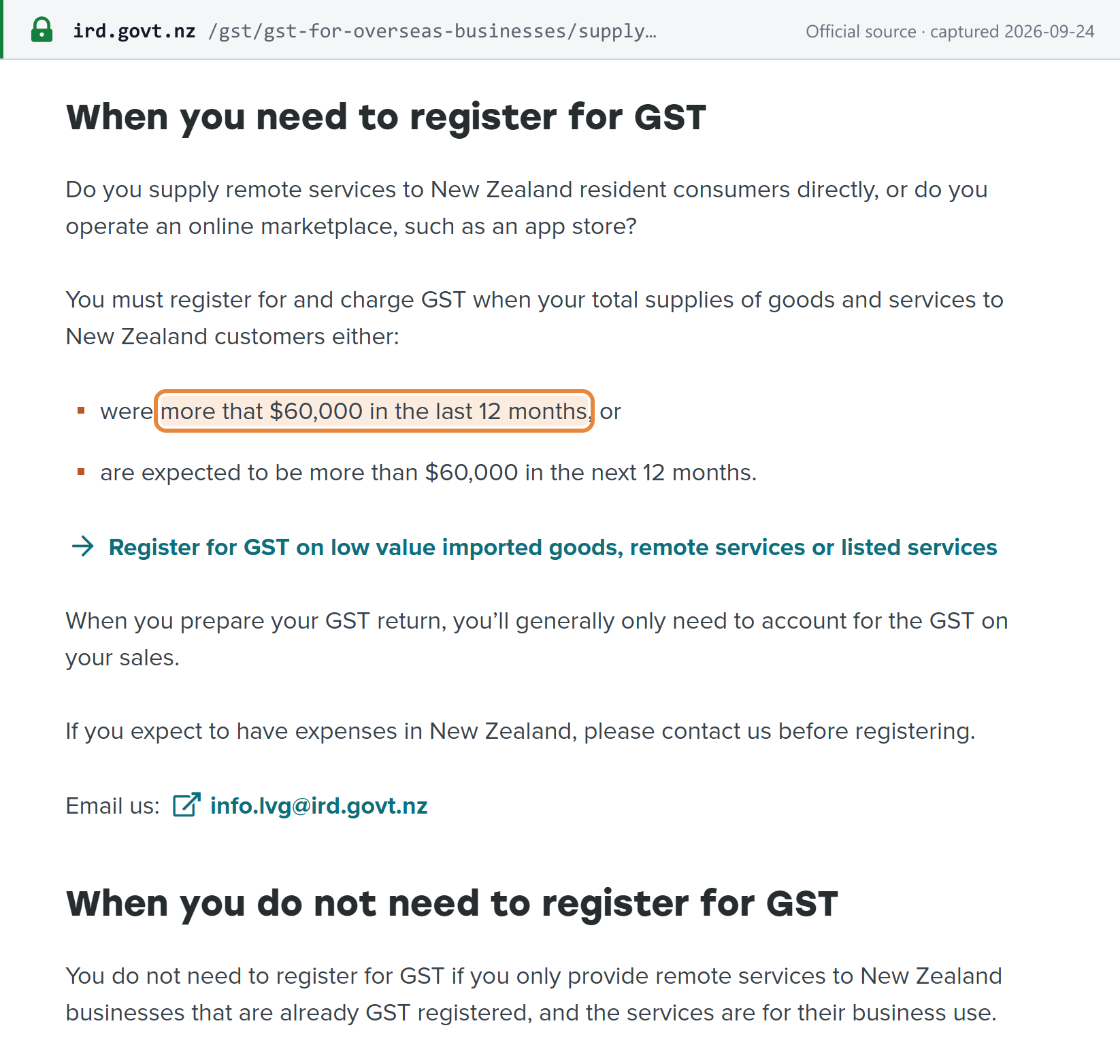
- New Zealand — no registration at all if you "only provide remote services to New Zealand businesses that are already GST registered, and the services are for their business use" (Inland Revenue, checked 2026-09-24).
- Singapore — the reverse charge applies only to GST-registered businesses "which are not entitled to full input tax claims"; a fully taxable recipient has nothing to account for (IRAS, checked 2026-09-24).
- Japan — for "B2B electronic services" (online advertising, for example) the Japanese business recipient files and pays (National Tax Agency, checked 2026-09-24).
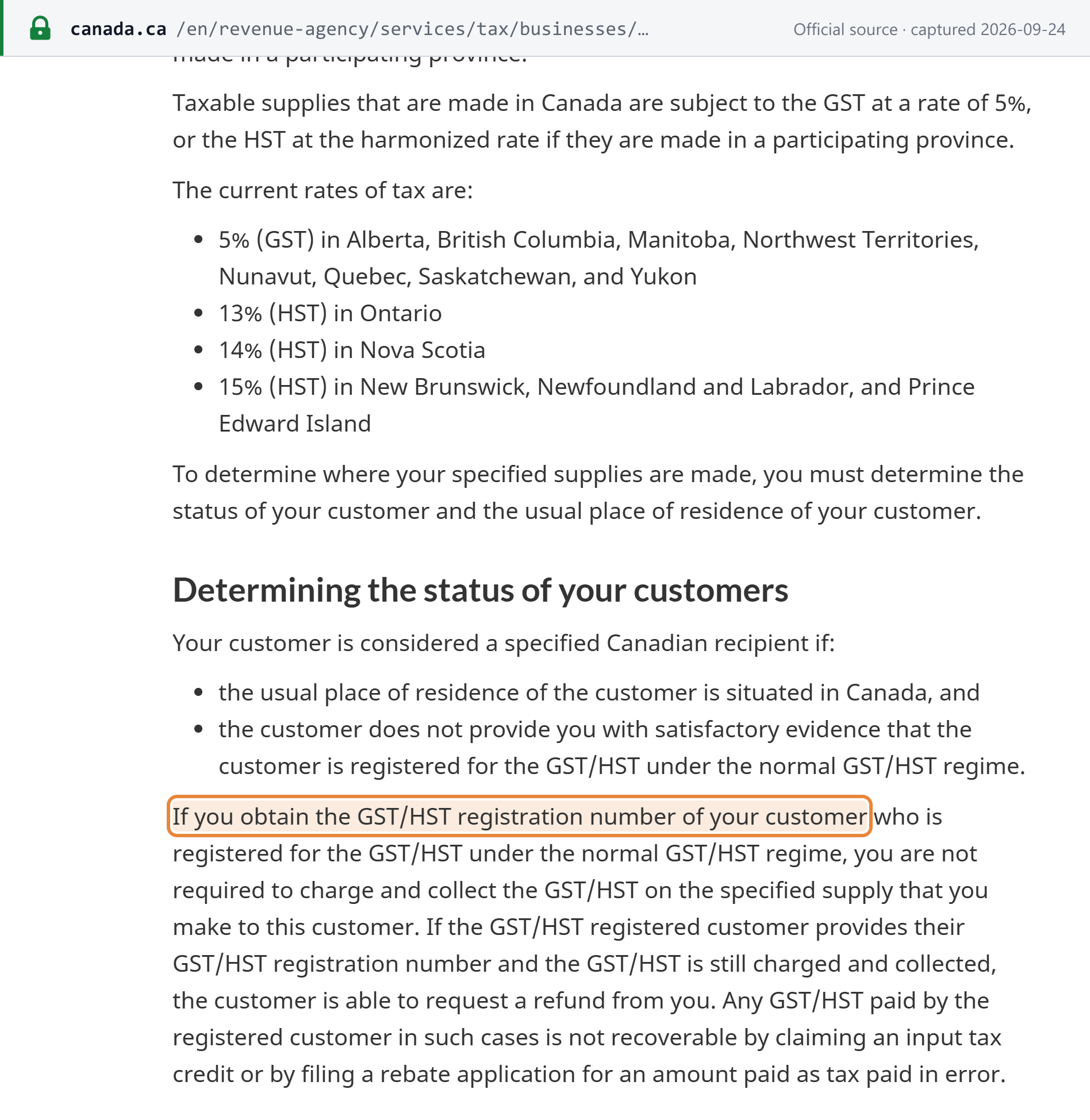 Source snapshot captured 2026-09-24 — original
B2C: the foreign supplier registers and collects
A reverse charge does not work for consumers: the OECD notes that "private consumers have little incentive to declare and pay the tax due" (¶3.130). Its recommendation is therefore "to require the non-resident supplier to register and account for the VAT in the jurisdiction of taxation" (¶3.131), and that jurisdictions "consider establishing a simplified registration and compliance regime to facilitate compliance for non-resident suppliers" (¶3.132) (OECD Guidelines, PDF, checked 2026-09-24).
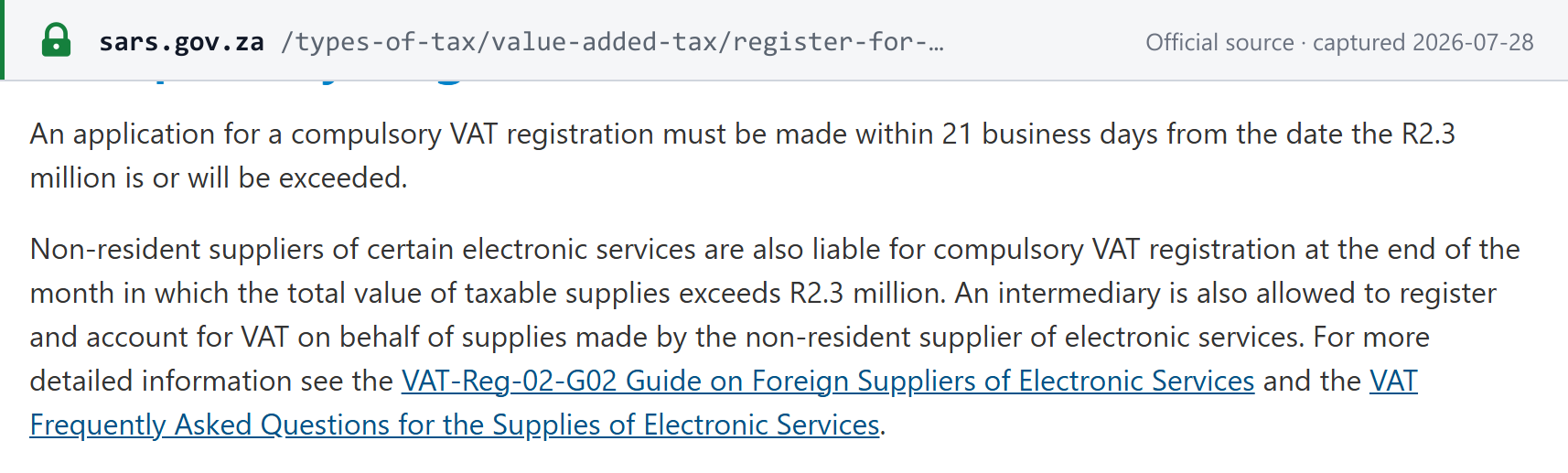
A simplified (often "pay-only") regime lets the supplier register, file and pay online without a local representative, usually in exchange for giving up local input-tax recovery. Singapore's wording is typical: "Input tax claims are not a feature of the simplified registration regime" (IRAS, checked 2026-09-24). Not every country offers one. Switzerland requires a Swiss tax representative, Japan a Tax Agent, and the UK's guidance describes ordinary non-established taxable person (NETP) registration, with no separate simplified route. South Africa has required foreign suppliers of electronic services to appoint a representative vendor, local or foreign, "With effect from 1 April 2025" (SARS, VAT-REG-02-G02, checked 2026-09-24).
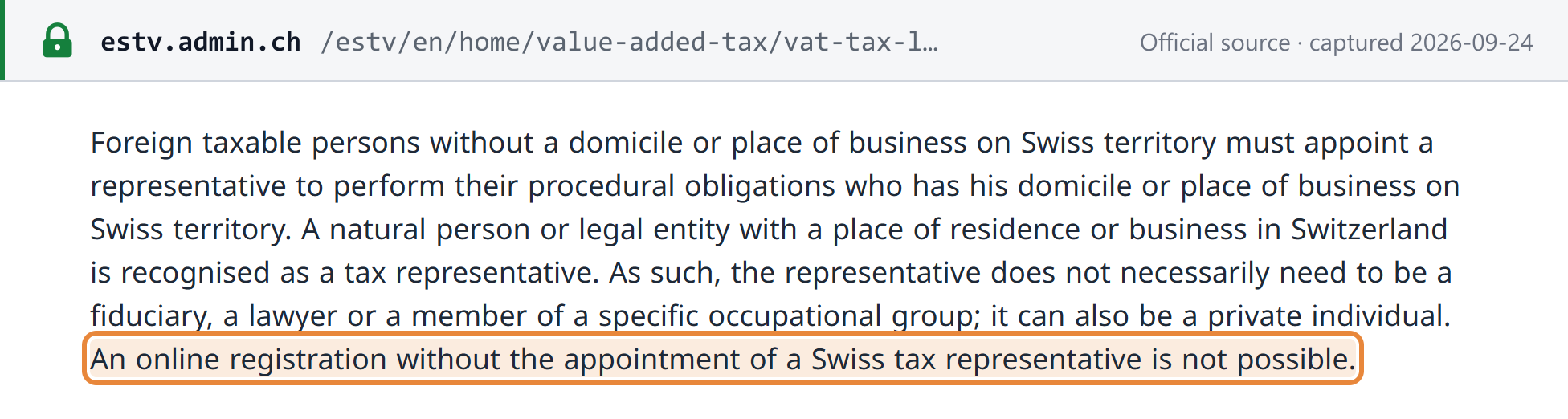 Source snapshot captured 2026-09-24 — original
Worked example
A software company established only in the United States sells a subscription to three customers:
- A private individual living in New Zealand. The company's supplies to New Zealand customers were more than NZD 60,000 in the last 12 months, so it is registered and charges GST at 15% (Inland Revenue; GST rate, checked 2026-09-24). On an NZD 100 subscription it collects NZD 15 and pays it to Inland Revenue.
- A GST-registered Canadian company that gives its normal-regime GST/HST number. The company charges no GST/HST; the Canadian customer deals with any tax on its side (CRA, above).
- A consumer in Ireland. There is no EU threshold for a supplier established outside the EU (see the next section), so the company charges Irish VAT from the first sale and declares it quarterly through the non-Union OSS in its single EU Member State of identification (European Commission, checked 2026-09-24).
Marketplaces and app stores
When a digital service is sold through an app store or online marketplace, many countries make the platform the deemed supplier, liable for the tax instead of the underlying seller — for example the UK ("the digital platform is responsible for accounting for VAT on the supply instead of you"), New Zealand, Canada, Australia (GST Act s.84-55), South Korea (VAT Act Art 53-2(2)), Japan (for NTA-designated platforms since 1 April 2025) and Brazil under its CBS/IBS reform. The mechanics are covered in the marketplace deemed-supplier rules explainer.
Who it affects
Any business with no establishment in the taxing country that sells electronically supplied or remotely delivered services there — streaming, software and SaaS, apps, e-books, online games, cloud services, online advertising — and the platforms that intermediate those sales. Whether it must register depends on who its customers are (consumers or businesses) and on the country's threshold model.
Three threshold models
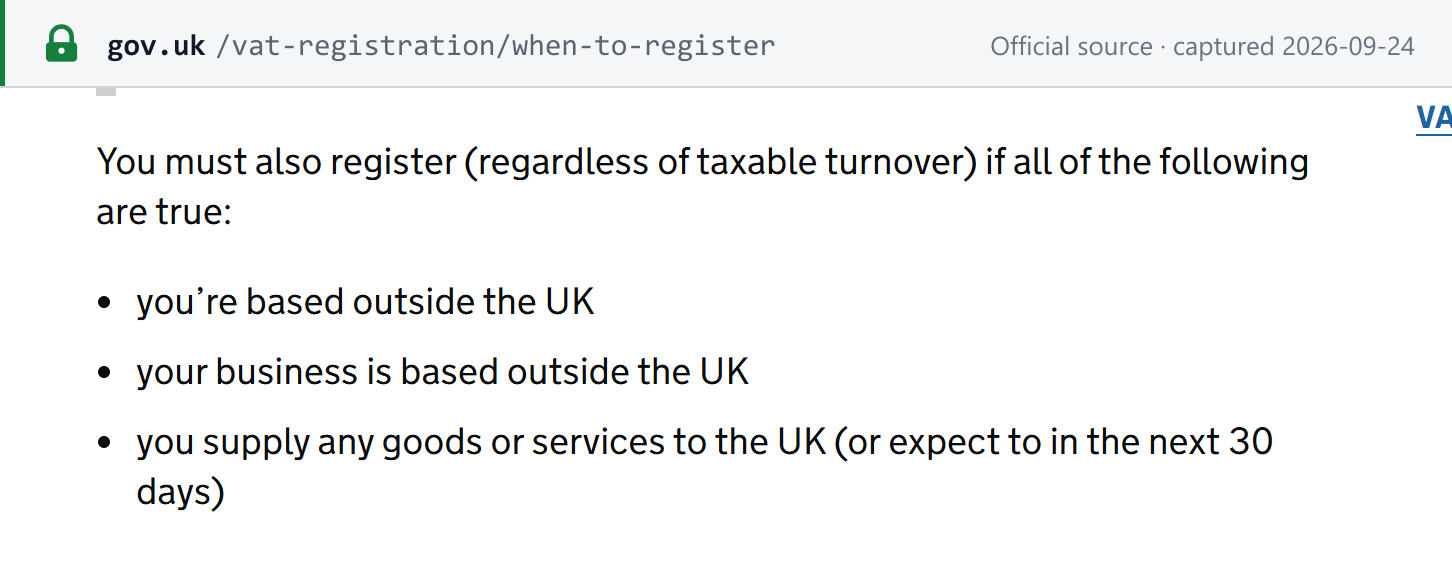
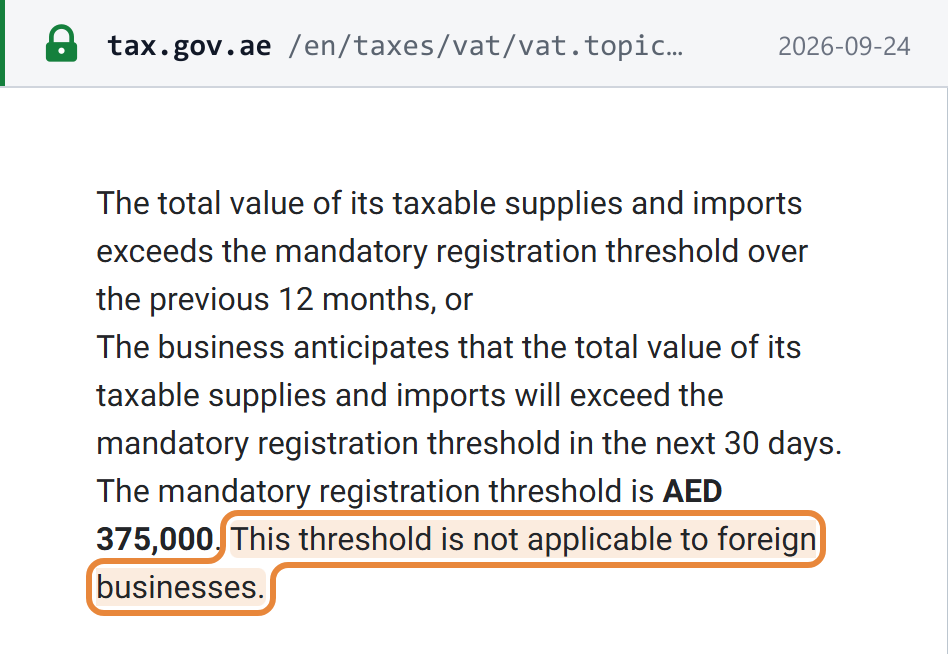
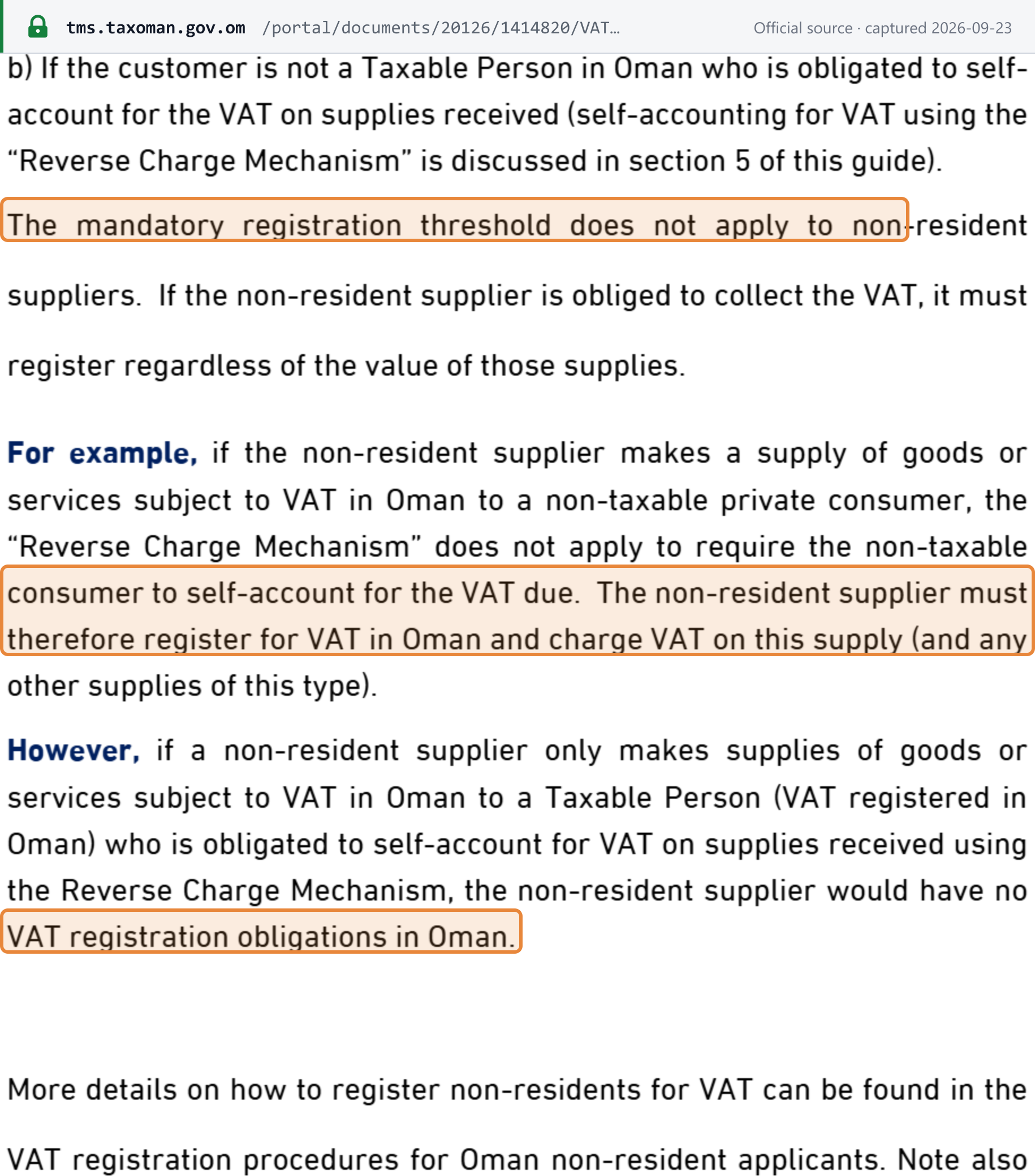
1. No threshold — register from the first taxable sale. The EU for suppliers established outside it; the UK ("You must also register (regardless of taxable turnover)" if your business is based outside the UK and you supply goods or services to the UK — GOV.UK, checked 2026-09-24); South Korea (simplified business registration "within 20 days after commencing the business"); the UAE ("This threshold is not applicable to foreign businesses"); Saudi Arabia (within 30 days of the first supply); Kenya ("whether or not the taxable supplies meet the annual turnover threshold of KES 5 million"); Oman for non-resident suppliers; Zanzibar ("Registration is required regardless of turnover" — ZRA, checked 2026-09-24); Morocco, from the first dirham (DGI Q&A, checked 2026-09-24); and Malawi under its published VAT (Amendment) Bill. India's IGST Act s.14 and Chile's SII FAQ set out no threshold for their regimes.
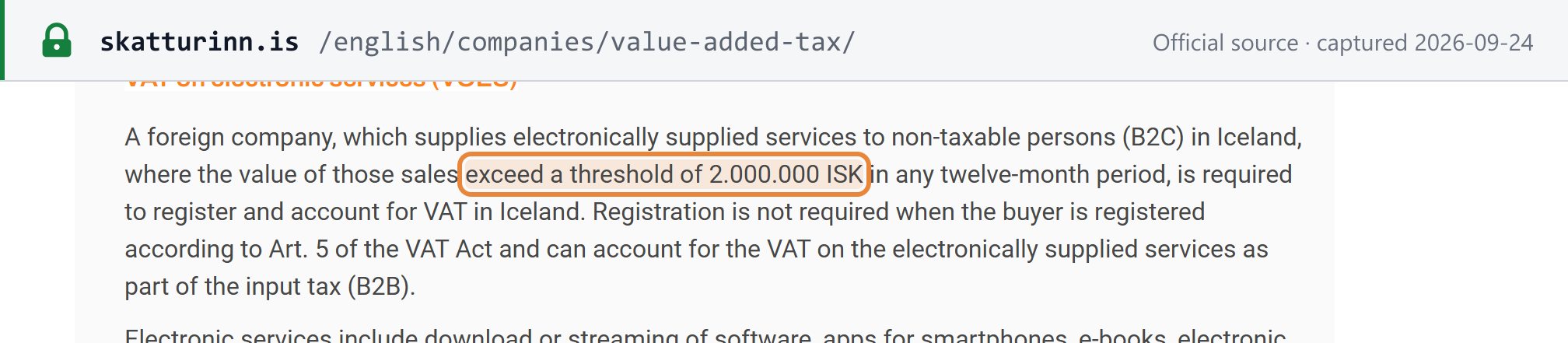
2. A local-sales threshold — counted on sales into that country only. Norway NOK 50,000 in 12 months; New Zealand NZD 60,000; Canada CAD 30,000; Malaysia RM500,000; South Africa R2.3 million; Iceland ISK 2,000,000; Sri Lanka LKR 60 million a year or LKR 15 million a quarter; Azerbaijan USD 10,000; Zimbabwe USD 25,000; Botswana P500,000 in 12 months (VAT Act 2026 s.13(2) and Schedule 5 para 3 — BURS, checked 2026-09-24). Sources and dates are in the table below.
Japan also counts local sales: JPY 10 million of taxable sales in Japan in the base period — for a foreign business supplying only electronic services, its B2C electronic-service sales in Japan, with B2B electronic services excluded (NTA, checked 2026-09-24).
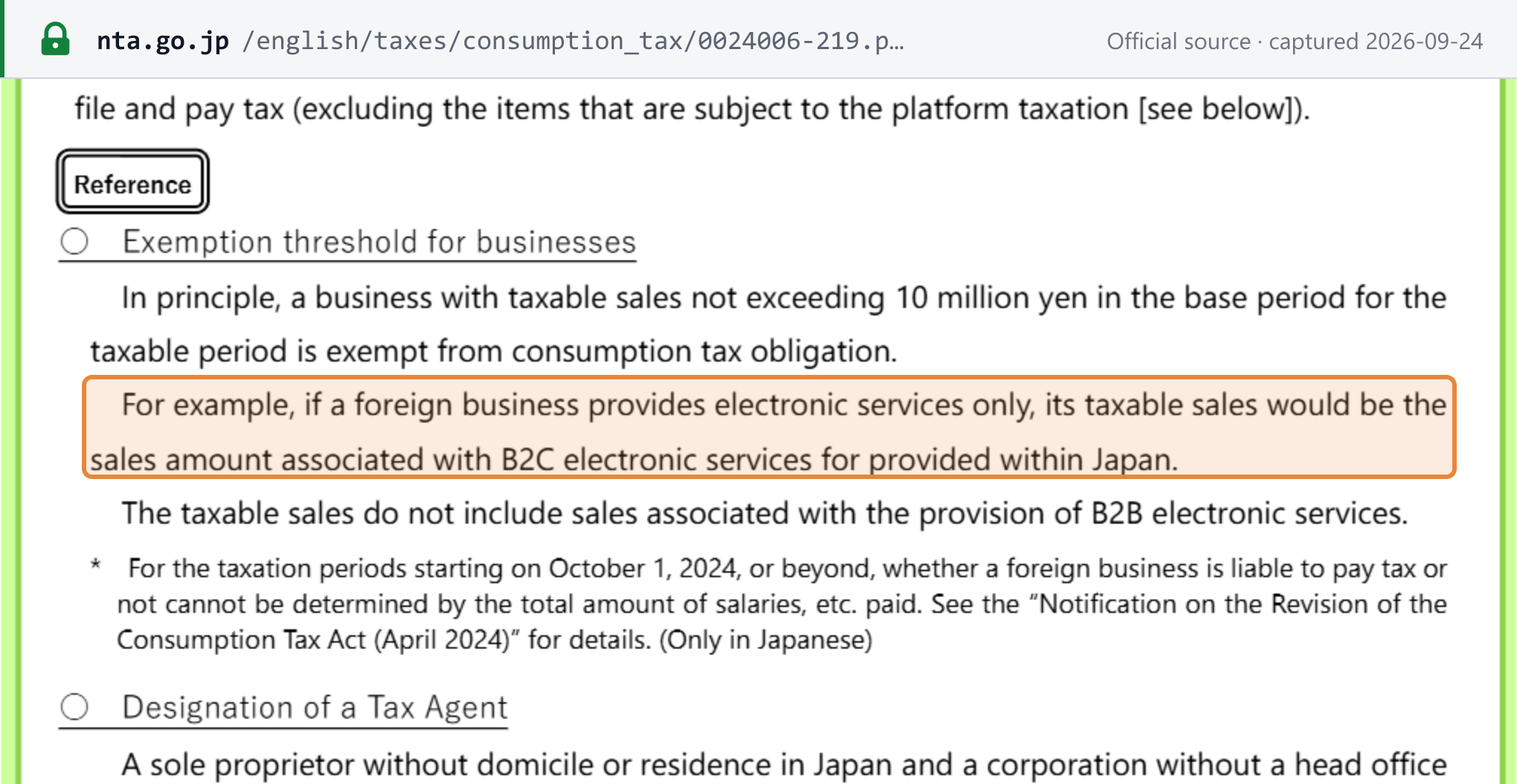 Source snapshot captured 2026-09-24 — original
3. A worldwide-turnover test — the foreign supplier's total business counts.
- Switzerland: a foreign business is liable if it supplies in Switzerland and "its worldwide taxable turnover is CHF 100,000 or more"; electronic services to non-taxable recipients do not qualify for the foreign-business exemption (ESTV, VAT Info 22, checked 2026-09-24).
- Singapore: both tests at once — "annual global turnover exceeding S$1 million" and B2C supplies to Singapore "exceeding S$100,000 annually" (IRAS, checked 2026-09-24).
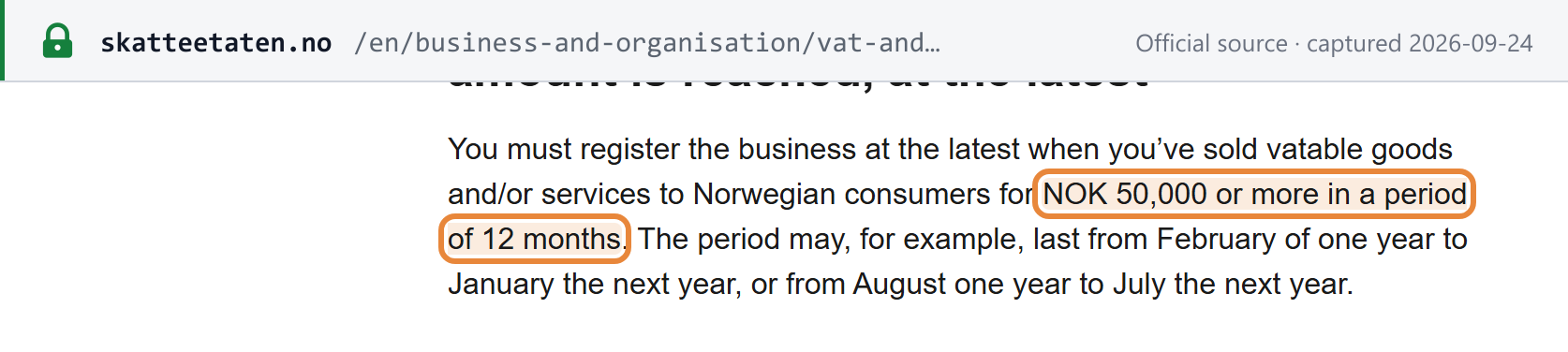 Source snapshot captured 2026-09-24 — original
The EU's EUR 10,000 figure is not a threshold for non-EU suppliers
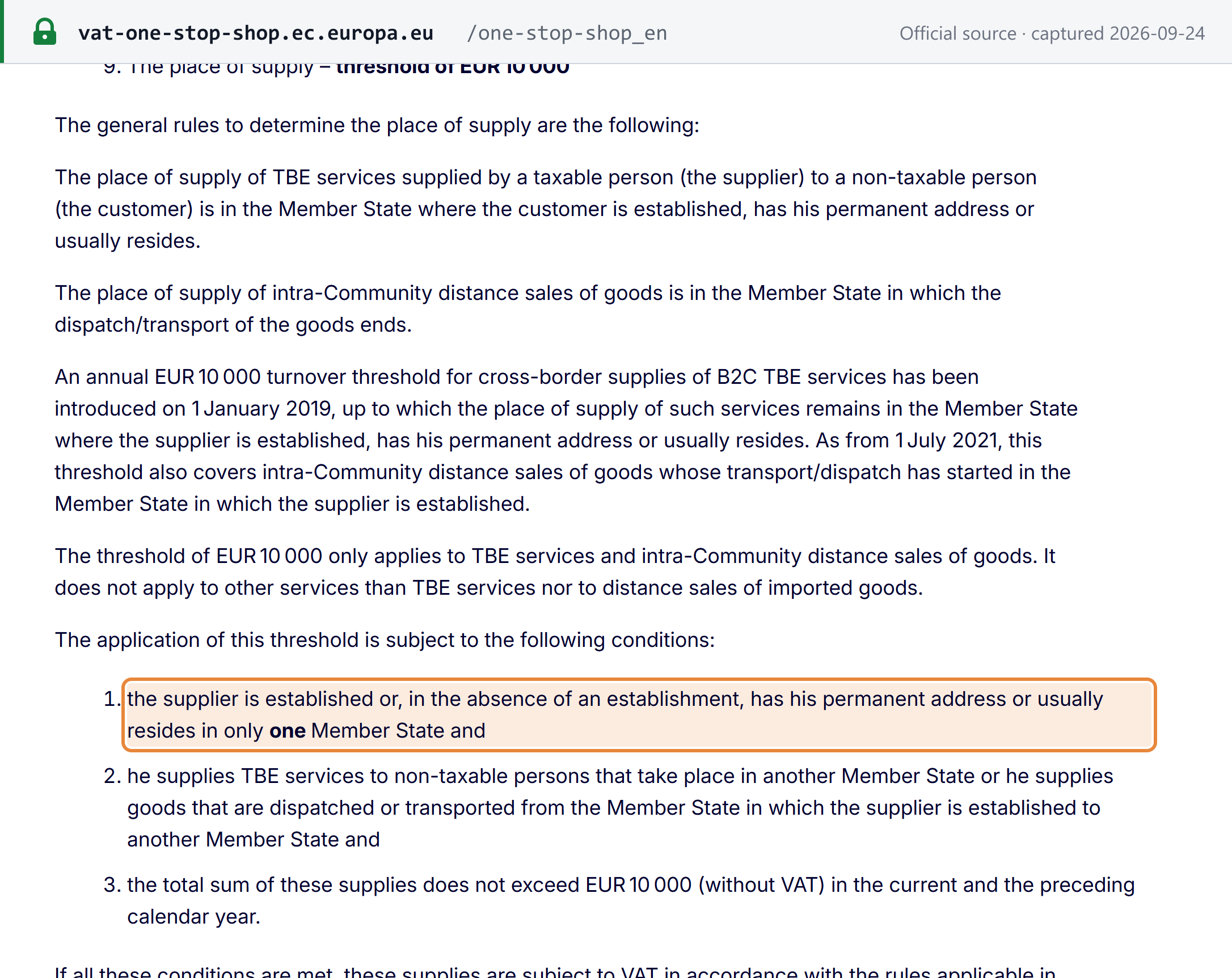
The Commission's EUR 10,000 rule keeps small cross-border B2C sales of telecom, broadcasting and electronic (TBE) services taxed in the supplier's own Member State. Its first condition is that "the supplier is established or, in the absence of an establishment, has his permanent address or usually resides in only one Member State"; the Commission adds that suppliers established outside the EU with fixed establishments in it "cannot make use of the threshold" (European Commission, VAT e-Commerce — One Stop Shop, checked 2026-09-24). The Commission's condition for the EUR 10,000 exception is establishment in exactly one Member State, so a supplier established only outside the EU has no EU threshold: its B2C supplies are taxed in the customer's Member State from the first euro, declared through the non-Union OSS if it opts in ("The schemes are optional").
 Source snapshot captured 2026-09-24 — original
 Source snapshot captured 2026-09-24 — original
The non-Union scheme covers "supplies of services to non-taxable persons taking place in any Member State of the EU, including the Member State of identification", with a quarterly return. It grew out of the mini One Stop Shop (MOSS) of 1 January 2015, which "has been extended to become a One Stop Shop (OSS) as from 1 July 2021" (European Commission, checked 2026-09-24). See the OSS explainer for returns and payment.
Current status and dates
As at 2026-09-24, most rows below are in force. Three kinds of entries need care: rules enacted but starting later, regimes phasing in over several years, and South Africa's threshold, which SARS applies while the amending bill is still a draft.
| Date | What happened | Status (as at 2026-09-24) | Source |
|---|---|---|---|
| Sep 2016 / 12 Apr 2017 | OECD Council Recommendation; International VAT/GST Guidelines published | In force (soft law) | OECD |
| 1 Jan 2015 → 1 Jul 2021 | EU mini One Stop Shop (MOSS) extended into the One Stop Shop; non-Union scheme covers B2C services taking place in any Member State | In force | European Commission |
| 1 Jan 2019 | EU EUR 10,000 TBE threshold introduced — for suppliers established in a single Member State only | In force | European Commission |
| 2020 | Singapore overseas vendor registration introduced (scope expanded in 2023) | In force | IRAS |
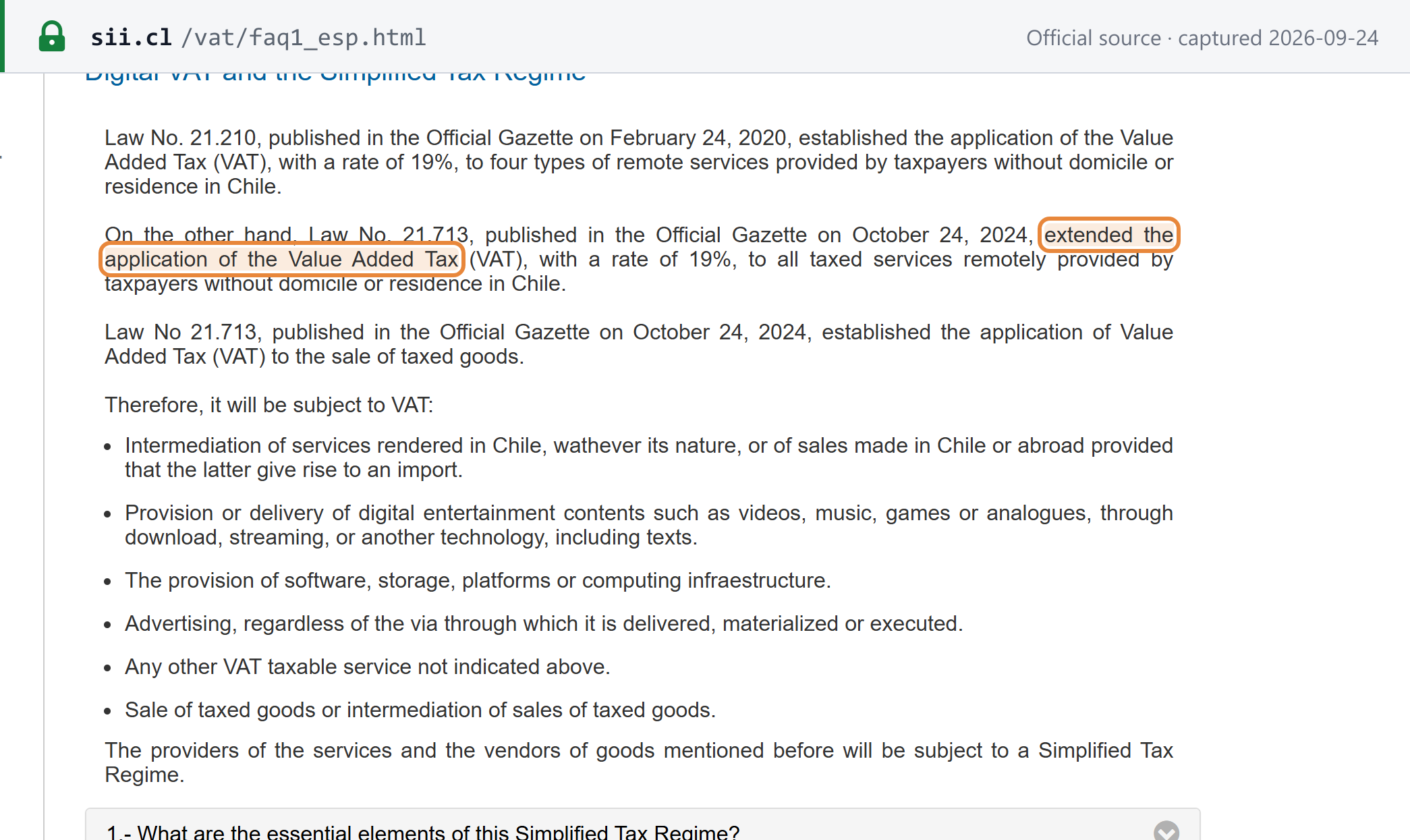
| 24 Feb 2020 → 24 Oct 2024 (Diario Oficial) | Chile: Ley 21.210 taxes four types of remote services at 19%; Ley 21.713 extends IVA to all remotely provided services | In force | SII |
| 1 Jul 2021 | Canada: digital-economy GST/HST measures and the simplified regime | In force | CRA |
| 1 Oct 2023 | India: "non-taxable online recipient" redefined as any unregistered person | In force | CBIC |
| 1 Mar 2024 | Malaysia: digital-services service tax rate 6% → 8% | In force | RMCD |
| 1 Apr 2025 | Japan: designated platforms deemed suppliers of foreign B2C electronic services | In force | NTA |
| 1 Jan 2026 | Zimbabwe s.13A withholding; Sierra Leone Finance Act 2026 digital-services limbs | In force | ZIMRA; NRA |
| 1 Apr 2026 | South Africa: non-resident electronic-services threshold R1 million → R2.3 million | Applied by SARS; the amending clause is still in the draft 2026 Rates Bill (Standing Committee on Finance public hearings 30 Sep 2026) | SARS |
| 29 Apr / 11 Jun 2026 | Rwanda and Morocco regimes start | In force | see table below |
| 1 Jul 2026 | Sri Lanka VAT on non-resident digital services; Botswana's S.I. 94 of 2026 replaces the revoked S.I. 74; Vietnam foreign suppliers move to monthly filing | In force | see table below |
| Sep 2026 | Azerbaijan: mandatory electronic registration above USD 10,000 | In force | State Tax Service |
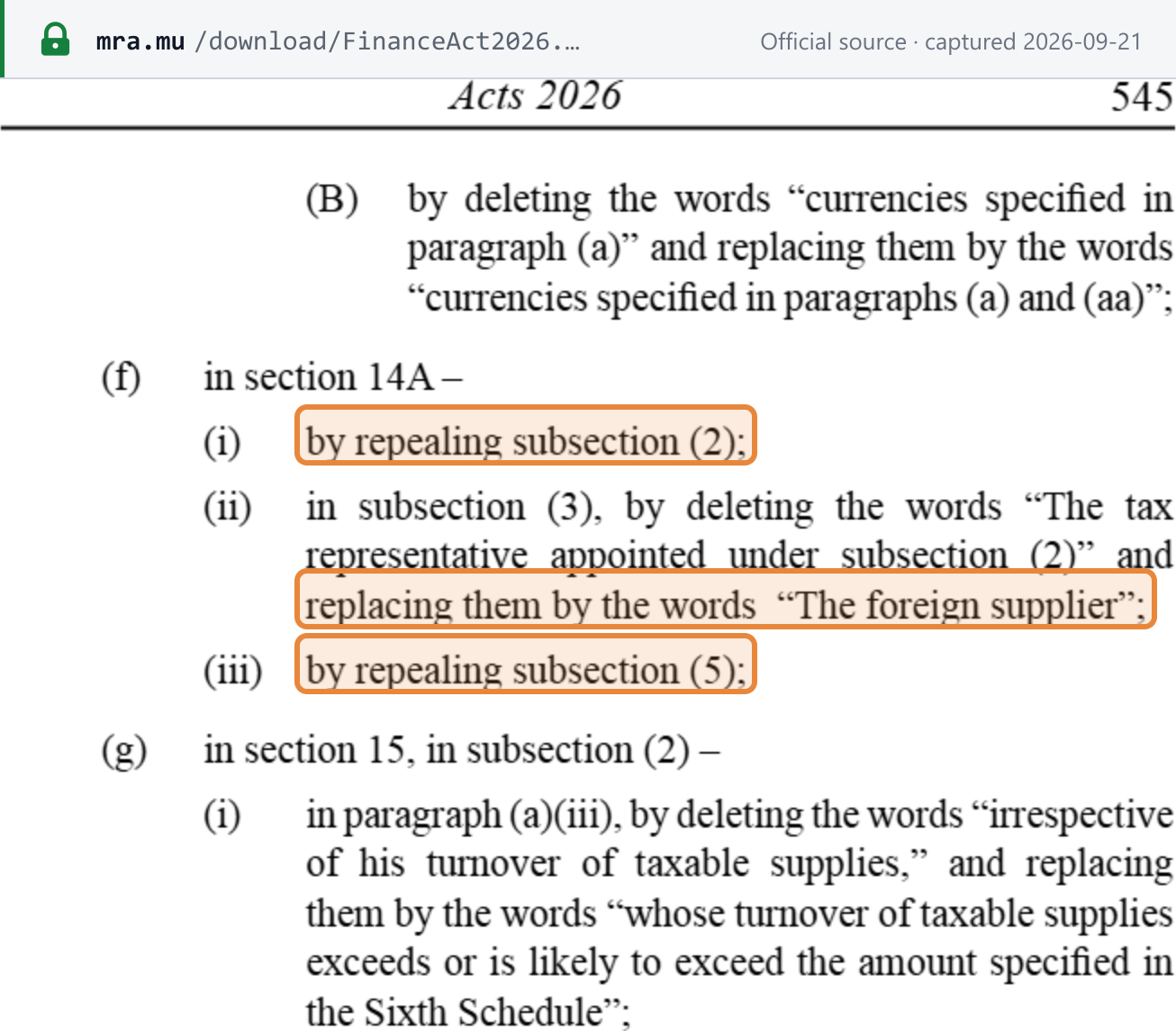
| 1 Oct 2026 | Mauritius: foreign suppliers register only above the Sixth Schedule turnover, instead of "irrespective of his turnover" | Enacted, starts 1 Oct 2026 | Finance Act 2026 |
| 1 Jan 2027 | Zanzibar: non-resident suppliers must start collecting 18% VAT | In force; register now, collection from 1 Jan 2027 | ZRA |
| 2026 test year onward | Brazil: CBS/IBS registration of foreign suppliers and liability of platforms (LC 214/2025) | Enacted, phasing in | Planalto |
Jurisdiction table
"Not stated" means the official source cited for that row does not state the figure; it is not a claim that none exists. "Last confirmed" is the date the official source was read. Rates are the rate charged on these supplies; the EU row uses each Member State's own rate.
Established regimes
| Jurisdiction | Regime | Rate | Non-resident threshold | B2B supplies | Last confirmed | Source |
|---|---|---|---|---|---|---|
| European Union (27) | Non-Union OSS (optional), one Member State of identification, quarterly return | Customer's Member State rate | None for suppliers established outside the EU (the EUR 10,000 rule needs establishment in one Member State) | Customer accounts (reverse charge) | 2026-09-24 | European Commission |
| United Kingdom | NETP registration; platforms account for sales made through them | 20% | None ("regardless of taxable turnover") | Not stated in the source cited | 2026-09-24 | GOV.UK; HMRC; rates |
| Norway | VOEC simplified scheme (B2C only), quarterly, due the 20th after the quarter | 25% (normal rate) | NOK 50,000 of sales to Norwegian consumers in 12 months | Outside VOEC; the buyer is liable | 2026-09-24 | Skatteetaten; rates |
| Iceland | VOES optional simplified registration, two-month periods | 24% | ISK 2,000,000 in any 12-month period | Icelandic buyer accounts (see Iceland guide) | 2026-09-24 | Skatturinn |
| Switzerland | Ordinary registration with a mandatory Swiss tax representative | 8.1% | CHF 100,000 worldwide taxable turnover | Recipient's reverse charge | 2026-09-24 | ESTV; VAT Info 22; rates |
| Australia | GST on "inbound intangible consumer supplies"; electronic distribution platforms treated as supplier (s.84-55) | 10% (s.9-70) | Registration turnover threshold per s.23-15: "$50,000; or such higher amount as the regulations specify" — the operative figure is the higher amount set by the regulations (GST Regulations 2019, reg 23-15.01) | A registered recipient acquiring for its enterprise is not an "Australian consumer" | 2026-09-24 | GST Act, Compilation No. 96 |
| New Zealand | GST on remote services; marketplaces may be liable instead | 15% | NZD 60,000 of supplies to NZ customers in 12 months (past or expected) | No registration if supplying only GST-registered businesses for business use | 2026-09-24 | Inland Revenue; rate |
| Canada | Simplified GST/HST regime; distribution platforms charge on facilitated supplies | 5% GST, or HST at the participating province's rate | CAD 30,000 | No GST/HST to charge once the customer gives a normal-regime GST/HST number | 2026-09-24 | CRA register; CRA charge |
| India | OIDAR: overseas supplier pays IGST under a single registration in the Simplified Registration Scheme (IGST Act s.14) | Not stated | None set out in s.14 | Not stated in the source cited | 2026-09-24 | CBIC s.2; CBIC s.14 |
| Japan | Foreign business files and pays on B2C electronic services; must designate a Tax Agent; designated platforms deemed suppliers since 1 Apr 2025 | Not stated | JPY 10 million of taxable sales in Japan in the base period (for a supplier of electronic services only, its B2C electronic-service sales in Japan; B2B excluded) | "B2B electronic services" reverse-charged to the Japanese business | 2026-09-24 | NTA; NTA platform |
| South Korea | Simplified business registration within 20 days of starting (VAT Act Art 53-2); intermediaries deemed suppliers | 10% (Art 30) | None in Art 53-2(1) | Supplies for the business of a registered entrepreneur excluded | 2026-09-24 (KLRI English text current to Act No. 19931, 31 Dec 2023) | KLRI |
| Singapore | Overseas vendor registration (OVR), simplified pay-only; marketplaces may be deemed supplier | Not stated | Global turnover above S$1 million and B2C supplies to Singapore above S$100,000 a year | Reverse charge only for GST-registered recipients not entitled to full input tax | 2026-09-24 | IRAS |
| Malaysia | Service tax (SST, not VAT) on digital services by foreign registered persons; quarterly | 8% since 1 Mar 2024 | RM500,000 of digital services to Malaysian consumers in 12 months (s.56B STA) | Not stated in the source cited | 2026-09-24 | RMCD MySToDS; transitional guide |
| Saudi Arabia | Ordinary non-resident registration (directly or through a tax representative); e-services taxed at the customer's usual residence | Not stated | None — apply within 30 days of the first taxable supply | Not stated in the source cited | 2026-09-24 | ZATCA Implementing Regulations |
| United Arab Emirates | Ordinary registration | 5% | None — AED 375,000 threshold "not applicable to foreign businesses" | Not stated in the source cited | 2026-09-24 | FTA |
| Oman | Ordinary registration; B2C supplier must register | Not stated | None for non-resident suppliers | B2B-only supplier (customer self-accounts) has no registration obligation | 2026-09-23 | Oman Tax Authority e-commerce guide |
| South Africa | Registration of foreign electronic-services suppliers; intermediaries may register instead | Not stated | R2.3 million in 12 months from 1 Apr 2026 — applied by SARS; amending bill still a draft (see timeline) | Services supplied solely to SA-registered vendors excluded from "electronic services" | 2026-09-24 | SARS; VAT-REG-02-G02 |
| Kenya | Registration for digital marketplace supplies | 16% | None — register whether or not the KES 5 million threshold is met | Not stated in the source cited | 2026-09-24 | KRA |
| Chile | IVA Digital simplified regime (D.L. 825 Arts 35 A–G): no input credit, no tax documents, monthly by the 20th | 19% | None set out in the SII FAQ | Not stated in the source cited | 2026-09-24 | SII |
| Brazil | CBS/IBS (LC 214/2025): foreign suppliers register if operating in Brazil; platforms, including foreign ones, liable; FX institution collects if neither registers | 2026 test year: 0.9% CBS + 0.1% IBS | Registration duty if carrying out operations in Brazil | Not stated in the source cited | 2026-09-24 | Planalto, LC 214 |
| Mexico | Non-resident digital-platform operators file the monthly IVA digital-services return (LIVA art. 18-D) | 16% | None (liability from the first taxable act) | Not stated in the source cited | 2026-09-23 | LIVA; DOF, RMF rule 12.1.9 |
| Turkey | Special electronic-service-provider KDV liability registered with the Large Taxpayers Office (Büyük Mükellefler Vergi Dairesi Başkanlığı) | 20% (general rate raised from 18% by Presidential Decision 7346) | Not stated in the source cited | Not stated in the source cited | 2026-09-24 | Resmî Gazete, 31 Jan 2018; Decision 7346, Resmî Gazete 7 Jul 2023 |
Recent adopters (2026 and later)
Each row cites the official source that carries it; "Last confirmed" is the date that source was read.
| Jurisdiction | Regime | Rate | Non-resident threshold | B2B supplies | Last confirmed | Source |
|---|---|---|---|---|---|---|
| Sri Lanka | VAT on digital services by non-residents via electronic platforms from 1 Jul 2026 (VAT (Amendment) Act No. 14 of 2026, s.25L) | Not stated | LKR 60 million in 12 months, or LKR 15 million in a calendar quarter | Supplies to VAT-registered recipients carved out (s.25N) | 2026-07-20 | IRD, Act No. 14 of 2026 |
| Azerbaijan | Mandatory electronic registration from Sep 2026; supplier self-assesses and remits | Not stated | USD 10,000 annual turnover in Azerbaijan | Not stated in the source cited | 2026-08-18 | State Tax Service |
| Malawi | VAT (Amendment) Bill, 2026 (B. No. 5), as published by Parliament: B2C non-resident suppliers, including marketplaces, register; no input VAT | Not stated | None — applies regardless of the MWK 50 million threshold | B2C only | 2026-06-18 | VAT (Amendment) Bill, 2026 |
| Rwanda | VAT on cross-border online supplies to customers in Rwanda (Ministerial Order No 004/26/10/TC, 29 Apr 2026); register or appoint a representative; financial institutions withhold if unregistered | Not stated | Not stated | Not stated in the source cited | 2026-06-18 | RRA |
| Morocco | Registration on the DGI digital-services platform (operational 11 Jun 2026); quarterly returns (Decree 2-25-862; CGI arts 88, 115 bis) | Not stated | None — from the first dirham (DGI Q&A) | Applies to non-VAT-liable customers only | 2026-09-24 | DGI; DGI Q&A |
| Botswana | Remote-services registration by online lodgement under S.I. 94 of 2026, which revoked S.I. 74 from 1 Jul 2026 | 14% standard | P500,000 in 12 months (VAT Act 2026 s.13(2), Schedule 5 para 3) | Supplier making only reverse-charged supplies need not register (reg. 15(2)) | 2026-09-24 | BURS, VAT Act and Regulations 2026; rate |
| Mauritius | Finance Act 2026: tax representative repealed from the Act's publication in the Government Gazette; threshold-based registration from 1 Oct 2026 | Not stated | From 1 Oct 2026: the Sixth Schedule turnover amount (previously "irrespective of his turnover") | From 1 Oct 2026, no registration where supplies are exclusively to VAT-registered persons | 2026-09-12 | MRA, Finance Act 2026 |
| Zimbabwe | Financial intermediaries withhold on payments to unregistered non-resident digital suppliers (s.13A, from 1 Jan 2026) | 15.5% withheld (3/23 tax fraction if registered) | USD 25,000 in 12 months | Not stated in the source cited | 2026-07-27 | ZIMRA Public Notice 05 of 2026 |
| Sierra Leone | Finance Act 2026 (from 1 Jan 2026): registration liability (s.15(4)); local representative (s.100); no input tax for suppliers without presence (s.28(2)(h)) | Not stated | Not stated | Applies to supplies to consumers | 2026-09-12 | NRA, Finance Act 2026 |
| Mauritania | 2026 amending finance law (LFR 2026) text published by the Ministry of Finance: Art 221 para 5 and Art 221-bis; platforms liable in defined cases; simplified regime, modalities by later order | Not stated | Not stated | Not stated in the source cited | 2026-08-18 | Ministère des Finances |
| Tanzania — Zanzibar | VAT on e-services by non-residents to non-registered persons (VAT Act No. 4 of 1998 ss.4A–4B); collection from 1 Jan 2027 | 18% | None — registration regardless of turnover | Applies to non-VAT-registered persons | 2026-09-24 | ZRA |
| Tanzania — Mainland | Digital marketplace operator deemed supplier of e-services to unregistered persons (VAT Act CAP 148 s.51(2), Finance Act 2026) | Not stated | Not stated | Applies to unregistered persons | 2026-07-20 | Finance Act 2026 |
| Philippines | BIR RMC 59-2026 (2 June 2026), under RA 12023 and RR 3-2025: non-resident digital service providers register and file VAT returns even where supplies are VAT-exempt | 12% | Not stated | In a cross-border cost-sharing arrangement the Philippine subsidiary withholds and remits the 12% VAT by reverse charge | 2026-09-24 | BIR, RMC No. 59-2026 |
| Vietnam | Foreign suppliers trading regularly file and pay monthly since 1 Jul 2026 (Decree 252/2026/ND-CP Art 40(2)(a.1)) | Not stated | Not stated | Not stated in the source cited | 2026-08-24 | Công Báo |
Botswana: S.I. 74 of 2026 is no longer law
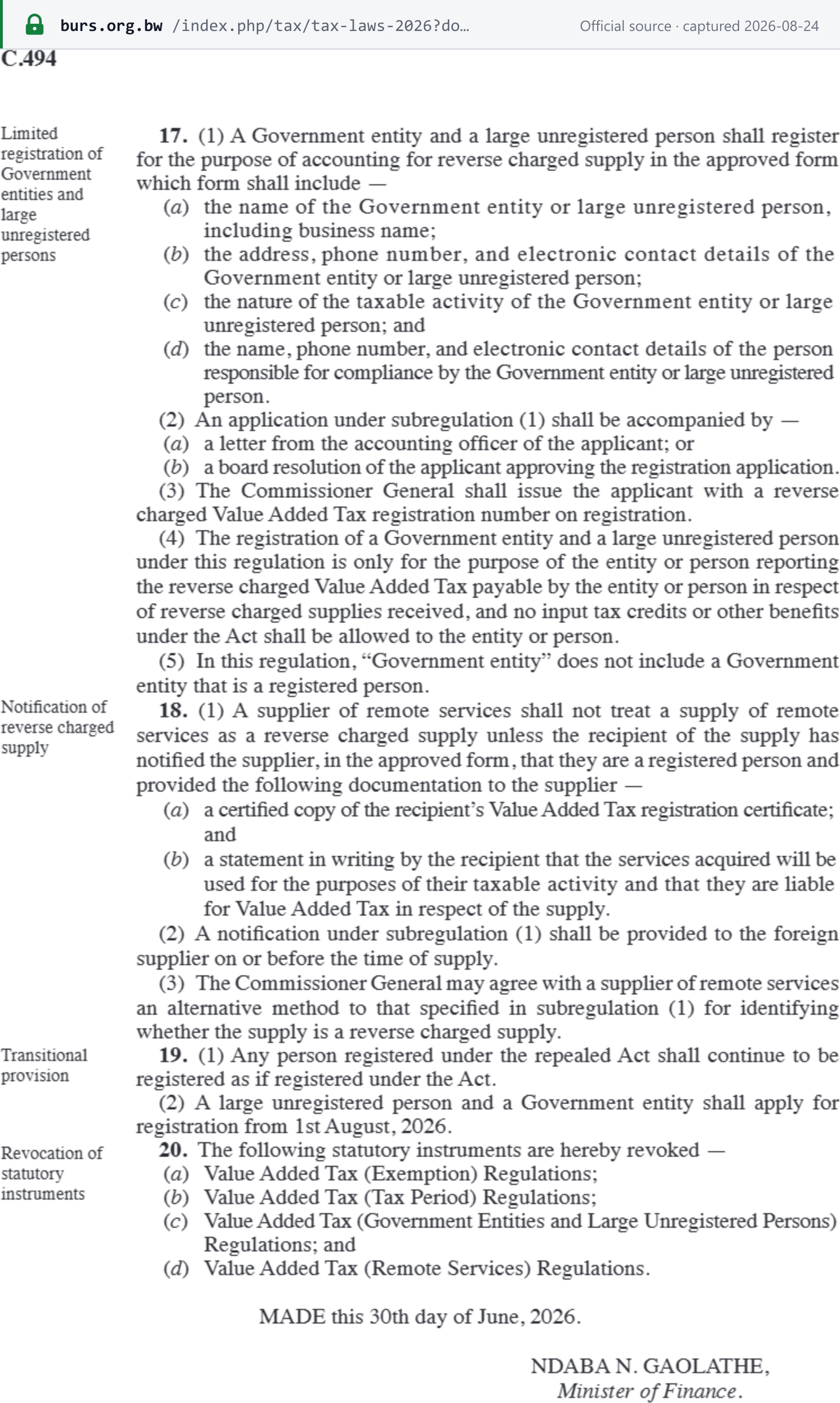
Botswana's first set of remote-services rules, the Value Added Tax (Remote Services) Regulations, 2026 (S.I. No. 74 of 2026, published 29 May 2026), was revoked from 1 July 2026 by regulation 20 of the Value Added Tax Regulations, 2026 (S.I. No. 94 of 2026), made on 30 June 2026. Rules that appeared only in S.I. 74 — among them a return date on the 25th of the following month — have no counterpart in S.I. 94. Under S.I. 94 a remote-services supplier registers by online lodgement, a supplier making only reverse-charged supplies is not required to register (reg. 15(2)), and a supplier may treat a supply as reverse-charged only once the recipient has notified it, with a certified copy of its VAT registration certificate, that it is a registered person (reg. 18(1)) (BURS, checked 2026-08-24). Details are in the Botswana VAT guide.
 Source snapshot captured 2026-08-24 — original
Source snapshots for the table
 Source snapshot captured 2026-09-24 — original
 Source snapshot captured 2026-09-24 — original
 Source snapshot captured 2026-09-24 — original
 Source snapshot captured 2026-09-24 — original
 Source snapshot captured 2026-09-24 — original
 Source snapshot captured 2026-09-24 — original
 Source snapshot captured 2026-09-24 — original
 Source snapshot captured 2026-09-23 — original
 Source snapshot captured 2026-07-28 — original
 Source snapshot captured 2026-09-24 — original
 Source snapshot captured 2026-09-24 — original
 Source snapshot captured 2026-09-24 — original
 Source snapshot captured 2026-09-21 — original
Related changes from the feed
Changes to non-resident digital-services rules tracked in the LookupTax tax-change feed, newest first. Every jurisdiction's full history is on its tax-change chronology.
- 2026-09-10 — Uzbekistan's Law No. ZRU-1173 brings foreign legal entities selling goods to individuals through electronic trading platforms into the same regime as foreign suppliers of electronic services: registration within thirty calendar days of starting; in force 12 December 2026. (lex.uz) — see event
- 2026-09-01 — Azerbaijan: electronic registration mandatory from September 2026 for non-resident digital service providers with annual in-country turnover above USD 10,000; registered providers self-calculate, declare and remit VAT. (State Tax Service) — see event
- 2026-08-18 — Zanzibar Revenue Authority notice (date of capture): 18% VAT on e-services by non-residents to non-registered persons; unregistered suppliers must register now and start collecting from 1 January 2027. (ZRA) — see event
- 2026-08-18 — Mauritania's 2026 amending finance law, as published by the Ministry of Finance, requires non-resident digital-service suppliers and platforms to register, file and keep records, under a simplified regime whose modalities await a ministerial order. (Ministère des Finances) — see event
- 2026-08-13 — Mauritius Finance Act 2026 (Act No. 14 of 2026) repeals the requirement for a foreign digital-services supplier to appoint a local tax representative; the foreign supplier now files and pays directly. (MRA) — see event
- 2026-08-13 — The same Act moves foreign suppliers from registration "irrespective of his turnover" to the Sixth Schedule threshold, and exempts suppliers dealing exclusively with VAT-registered persons, from 1 October 2026. (National Assembly of Mauritius) — see event
- 2026-08-13 — Mauritius adds online-marketplace commission to the definition of digitally or electronically supplied services and removes electronic books from it. (National Assembly of Mauritius) — see event
- 2026-07-09 — Mexico's first amendment to the 2026 Resolución Miscelánea Fiscal (DOF 9 July 2026) renamed the IEPS return referred to in rule 12.1.9; it did not merge the monthly IVA digital-services return and the IEPS return into a single filing, as first reported. (DOF) — see event
- 2026-07-01 — Sri Lanka: VAT on digital services supplied by non-residents through electronic platforms; registration above LKR 60 million in 12 months or LKR 15 million in a quarter (Act No. 14 of 2026, s.25L) from 1 July 2026. This corrects an earlier report of the bill's LKR 36 million / LKR 9 million figures. (IRD) — see event
- 2026-07-01 — Tanzania (Mainland): digital marketplace operators become the deemed supplier of electronic services to unregistered persons (VAT Act s.51, Finance Act 2026). (Finance Act 2026) — see event
- 2026-07-01 — Norway: remotely deliverable services acquired by a foreign establishment of a multi-location entity and used in Norway become subject to Norwegian VAT by reverse charge (a B2B change, outside VOEC). (regjeringen.no) — see event
- 2026-07-01 — Vietnam's Law on Tax Administration No. 108/2025/QH15 extends e-invoicing to non-resident e-commerce and digital-platform sellers without a permanent establishment. (Vietnam.vn) — see event
- 2026-06-18 — Malawi's VAT (Amendment) Bill, 2026 (B. No. 5), as published by Parliament (captured 2026-06-18): non-resident B2C digital suppliers, including marketplaces, register regardless of the MWK 50 million threshold, with no input VAT. (Parliament of Malawi) — see event
- 2026-06-11 — Morocco's DGI platform for non-resident providers of dematerialised services to non-VAT-liable customers becomes operational: registration and quarterly returns. (DGI) — see event
- 2026-06-02 — Philippines RMC No. 59-2026: non-resident digital service providers register and file VAT returns even where supplies are VAT-exempt; in a cross-border cost-sharing arrangement the Philippine subsidiary withholds and remits the 12% VAT by reverse charge. (BIR) — see event
- 2026-06-02 — Chile's SII Resolución Exenta N° 69 lets non-resident online betting and casino platforms register and pay IVA Digital, including for the preceding 36 tax periods. (SII) — see event
- 2026-06-01 — Botswana: BURS begins implementing VAT on remote services supplied by non-residents under the VAT (Amendment) Act, 2025. (BURS) — see event
- 2026-05-29 — Superseded: Botswana's Value Added Tax (Remote Services) Regulations, 2026 (S.I. No. 74 of 2026) were published; they were revoked from 1 July 2026 by regulation 20 of S.I. No. 94 of 2026, so their 25th-day return date and other S.I. 74-only rules no longer apply. (BURS) — see event
- 2026-04-29 — Rwanda: VAT on cross-border online supplies by non-residents to customers in Rwanda (Ministerial Order No 004/26/10/TC); register or appoint a representative, otherwise financial institutions withhold. (RRA) — see event
- 2026-04-01 — South Africa: SARS applies R2.3 million (up from R1 million) as the non-resident electronic-services threshold; the amending clause is still in the draft 2026 Rates Bill. (SARS) — see event
- 2026-01-01 — Zimbabwe: financial intermediaries withhold 15.5% on payments to unregistered non-resident digital suppliers (3/23 if registered); registration above USD 25,000 in 12 months. (ZIMRA) — see event
- 2026-01-01 — Sierra Leone's Finance Act, 2026 adds registration liability for digital services to consumers, requires a local representative, and denies input tax to suppliers without a presence. (NRA) — see events on registration, representative and input tax
Frequently asked questions
We are a US SaaS company with no EU entity. Is there a EUR 10,000 threshold before we charge EU VAT?
No. The EUR 10,000 rule applies only where the supplier is established, or has its permanent address or usual residence, in only one Member State. A supplier established only outside the EU has no EU threshold: its sales of electronic services to EU consumers are taxed in each customer's Member State from the first sale. It can declare them through the non-Union OSS, registering in a single Member State and filing one quarterly return. (European Commission, VAT e-Commerce — One Stop Shop; checked 2026-09-24)
Do I charge VAT or GST when my customer is a business?
Generally no: the OECD recommends that the business customer account for the tax by reverse charge and that the foreign supplier not be required to register (OECD Guidelines paragraph 3.47). Keep evidence that the customer is a business, such as its VAT or GST number. Country rules differ: in Canada you charge no GST/HST once the customer gives a normal-regime GST/HST number; in New Zealand you need not register if you only supply GST-registered businesses for business use; in South Korea supplies for a registered entrepreneur's business are excluded; in South Africa services supplied solely to SA-registered vendors are excluded; in Japan B2B electronic services are reverse-charged to the Japanese business; in Singapore only GST-registered recipients not entitled to full input tax claims account for the tax. (Checked 2026-09-24)
Which countries count worldwide turnover rather than local sales?
Switzerland: a foreign business is liable once its worldwide taxable turnover is CHF 100,000 or more. Singapore: overseas vendor registration applies when global turnover exceeds S$1 million and B2C supplies to Singapore exceed S$100,000 a year. (ESTV, IRAS; checked 2026-09-24)
If I sell through an app store or marketplace, who owes the tax?
In many countries the platform does, as the deemed supplier: for example the United Kingdom, New Zealand, Canada, Australia (GST Act s.84-55), South Korea (VAT Act Art 53-2(2)), Japan (designated platforms since 1 April 2025) and Brazil under LC 214/2025. Check whether the platform is collecting before registering yourself. (Checked 2026-09-24)
Can I reclaim local input VAT under a simplified regime?
Usually not. Singapore states that input tax claims are not a feature of the simplified registration regime; Chile's IVA Digital simplified regime gives no input credit; Sierra Leone denies input deduction to suppliers without a presence, and Malawi's published VAT (Amendment) Bill does the same for non-resident digital suppliers. A supplier with real local costs may need ordinary registration instead, where the country allows it. (IRAS, SII; checked 2026-09-24)
Related resources
- One Stop Shop (OSS) — the EU non-Union and Union schemes
- Import One Stop Shop (IOSS) — the low-value goods counterpart
- OIDAR services and GST in India — India's regime in depth
- Reverse charge — the B2B self-accounting leg
- Marketplace deemed-supplier rules — when the platform owes the tax
- ViDA — VAT in the Digital Age — the EU's platform and OSS extensions from 2027 to 2030
- DAC7 — EU platform reporting
- VAT registration thresholds worldwide — general domestic thresholds
- Country guides with non-resident digital-services sections: United Kingdom, Canada, Australia, India, Singapore, Malaysia, South Africa, United Arab Emirates, Kenya, Iceland, Oman, Turkey, Mexico, Brazil, Botswana, Mauritius, Sri Lanka, Tanzania, Zimbabwe, Vietnam
- Tax-change chronology — every tracked change, by jurisdiction
Reference links
- OECD — International VAT/GST Guidelines (publication page) and full text (PDF) — Guidelines 3.1, 3.2, 3.6; paragraphs 3.47 and 3.130 to 3.132
- European Commission — VAT e-Commerce One Stop Shop
- Skatteetaten — VOEC registration
- IRAS — GST for overseas businesses
- CRA — digital economy GST/HST
- National Tax Agency (Japan) — consumption tax for foreign businesses