Call-off stock — moving goods to a customer's stock abroad without registering there
Call-off stock is an EU VAT simplification (Article 17a of the VAT Directive) for goods a supplier sends to a stock in another Member State for a known customer, who is VAT-identified there and may take the goods out when it chooses. The movement is not taxed as a transfer; the supplier makes an exempt intra-Community supply when the customer takes the goods, if that happens within 12 months. The supplier therefore does not need to register for VAT in the destination country. The regime is being phased out: under the ViDA package, goods must be dispatched on or before 30 June 2028 to qualify, and Article 17a ceases to apply on 30 June 2029 (as at 2026-10-08; see Current status).
The European Commission describes the situation as one where "a taxable person dispatches or transports goods to a stock in another Member State for an intended acquirer whose identity and VAT identification number are known at the time of the transport or dispatch and who has the right to take goods out of this stock at his own discretion, at which time the property on the goods is transferred." (European Commission, Explanatory Notes on the 2020 Quick Fixes, §2.2). Those notes, published by the Directorate-General for Taxation and Customs Union (DG TAXUD) in December 2019, say of themselves that they "are not legally binding and only contain practical and informal guidance". This page cites them for the Commission's reading where the Directive is silent.
The legal instrument. Article 17a was inserted into the VAT Directive (Council Directive 2006/112/EC) by Council Directive (EU) 2018/1910 of 4 December 2018 (OJ L 311, 7.12.2018), one of the "2020 Quick Fixes". Member States had to adopt their laws by 31 December 2019 and "apply those provisions from 1 January 2020." The rule is set by the Council of the EU; the matching register rules sit in Council Implementing Regulation (EU) 2018/1912, which inserted Article 54a into Implementing Regulation 282/2011. (Directive (EU) 2018/1910, EUR-Lex; Implementing Regulation (EU) 2018/1912, EUR-Lex)
Why it exists. Recital 5 of Directive 2018/1910 explains that, without the simplification, the movement "gives rise to a deemed supply (in the Member State of departure of the goods) and a deemed intra-Community acquisition (in the Member State of arrival of the goods), followed by a 'domestic' supply in the Member State of arrival, and requires the supplier to be identified for VAT purposes in that Member State." Article 17a replaces that with "one exempt supply in the Member State of departure and one intra-Community acquisition in the Member State of arrival."
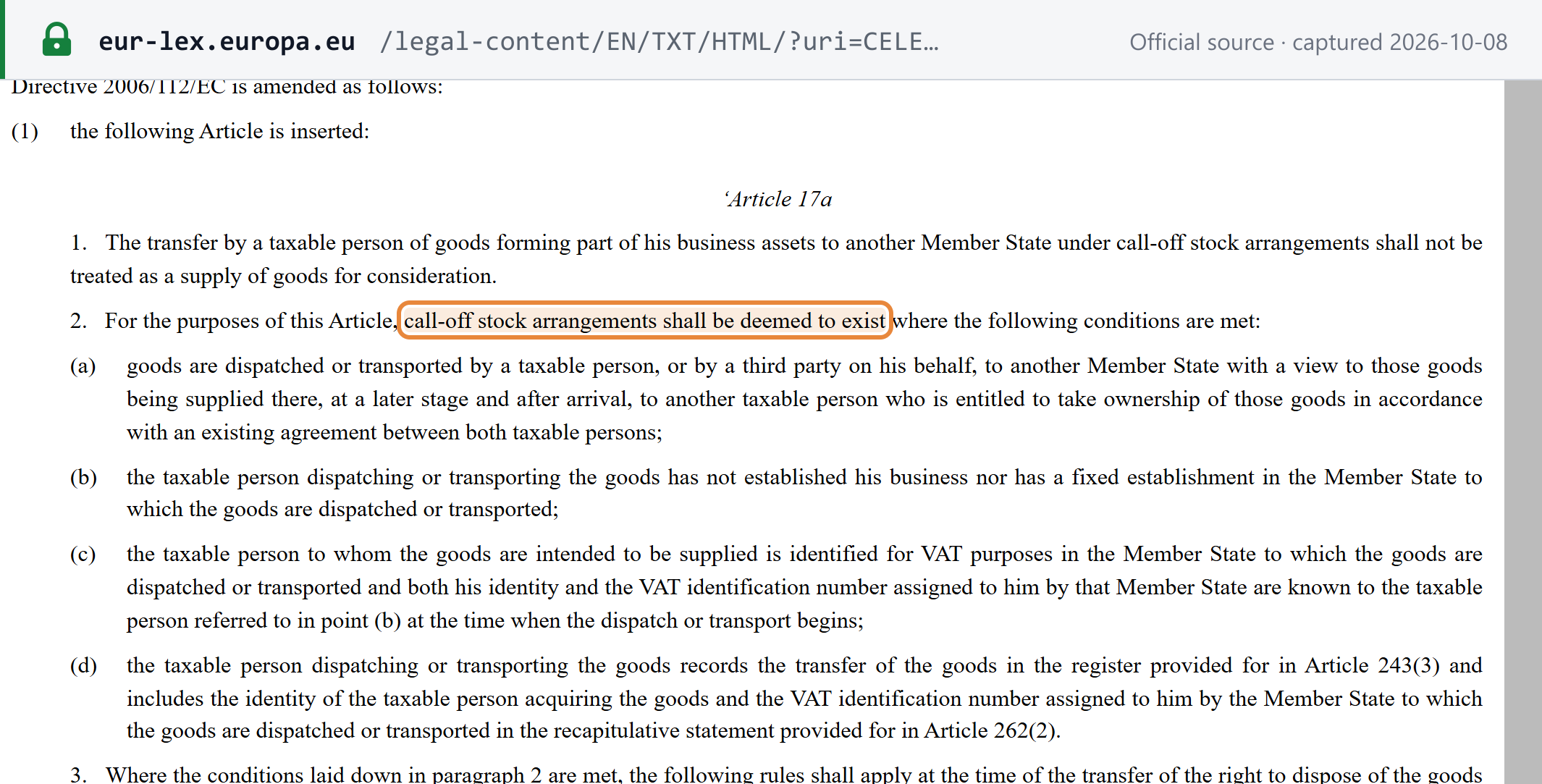 Source snapshot captured 2026-10-08 — original (EUR-Lex, Directive (EU) 2018/1910)
Call-off stock is not consignment stock
The simplification needs a customer who is known before the goods leave. The Commission is explicit: it "does not cover the situation whereby a business transfers goods from one Member State to another without knowing yet the intended acquirer in that latter Member State." Classic consignment stock, sold to whoever buys it, is a transfer of own goods under Article 17(1): an exempt deemed intra-Community supply in the departure country, a deemed intra-Community acquisition in the destination country, and a later domestic sale there, so the supplier has to register in the destination country (Explanatory Notes §2.2). The Commission adds (§2.5.4) that even where the acquisition is exempt because the onward sale is reverse-charged, the business "will have to be registered for VAT purposes in the Member State where the intra-Community acquisition has taken place". That is why reverse charge alone never removed the registration duty.
Watch the labels: Spain's statutory name for the Article 17a regime is ventas de bienes en consigna (literally "consignment sales"), and Germany's is Konsignationslagerregelung ("consignment stock rule"). Both are call-off stock in the Article 17a sense, not classic consignment stock (see the national rules table).
Pre-2020 national simplifications are gone
Before 2020 some Member States ran their own call-off or consignment simplifications. Since 1 January 2020 Article 17a is the only one permitted. In the Commission's words, "all other possible national arrangements regarding call-off stock and which deviate from Articles 17 and 17a VD are not in conformity with EU Law", and Member States may not keep them "even if those national rules are broader or more flexible for businesses" (Explanatory Notes §2.4).
How it works
The four conditions (Article 17a(2))
Article 17a(1) provides that the transfer of business goods to another Member State "under call-off stock arrangements shall not be treated as a supply of goods for consideration." Call-off stock arrangements exist only where all four conditions of Article 17a(2) are met:
- (a) Movement for a later supply under an existing agreement. The goods are dispatched or transported by the supplier, or a third party on its behalf, to another Member State "with a view to those goods being supplied there, at a later stage and after arrival, to another taxable person who is entitled to take ownership of those goods in accordance with an existing agreement between both taxable persons." From 1 January 2027 this point also requires dispatch "on or before 30 June 2028" (see Current status).
- (b) No establishment in the destination country. The supplier "has not established his business nor has a fixed establishment" in the Member State of arrival.
- (c) A known, VAT-identified customer. The intended acquirer is VAT-identified in the destination Member State, and "both his identity and the VAT identification number assigned to him by that Member State are known" to the supplier "at the time when the dispatch or transport begins."
- (d) Register and recapitulative statement. The supplier records the transfer in the register provided for in Article 243(3) and includes the acquirer's identity and VAT number in the recapitulative statement under Article 262(2).
(Directive (EU) 2018/1910, Art 1 inserting Art 17a)
The Commission distinguishes these substantive conditions from side obligations. Missing a condition means an ordinary Article 17 transfer. The intended acquirer's own register, by contrast, "is not a condition for the application of the simplification"; failing to keep it "does not impede the application of the call-off stock arrangements", although "national penalties may be applicable" (Explanatory Notes §2.5.6). The regime is also optional in practice: a business "may choose to apply or not the call-off stock simplification by fulfilling or not the necessary conditions" (§2.5.2).
What happens when the customer takes the goods (Article 17a(3))
When ownership passes to the intended acquirer within the 12-month limit:
- the supplier makes an exempt intra-Community supply under Article 138(1) in the departure Member State; and
- the customer makes an intra-Community acquisition in the destination Member State.
The supplier never makes a taxable domestic supply in the destination country and does not need a VAT number there for this flow. For how the exempt supply and the acquisition work in general, see the intra-community supply explainer.
The 12-month rule (Article 17a(4))
If, "within 12 months after the arrival of the goods" in the destination Member State, the goods have not been supplied to the intended acquirer (or a substitute) and none of the ending events below has occurred, "a transfer within the meaning of Article 17 shall be deemed to take place on the day following the expiry of the 12-month period." That deemed transfer is an exempt deemed supply in the departure country plus a deemed intra-Community acquisition by the supplier itself in the destination country.
How to count. The Commission reads "arrival" as arrival "in the warehouse where they are stored", and counts under Regulation 1182/71: the period starts the day after arrival and ends at 24:00 on the same date one year later. Its example: goods arriving on Monday 6 January 2020 have a period that "starts at Tuesday 7 January 2020 (00:00) and expires at the end of Thursday 7 January 2021 (24:00)". For bulk goods, "the FIFO method would be the most appropriate", applied per intended acquirer (Explanatory Notes §§2.5.16 to 2.5.17). National statutes word the start point their own way (Germany and Poland run the 12 months from the end of transport or entry into the warehouse; see the national rules table), so treat the exact day as the Commission's method, not EU-uniform law.
Returns, substitution of the customer, and the ending events
- Returns keep the simplification (Article 17a(5)). No transfer arises if ownership has not passed and the goods return to the departure Member State within the 12 months, provided the supplier records the return in its register.
- The customer can be replaced (Article 17a(6)). A substitute acquirer may take over within the 12 months without triggering a transfer, if all other Article 17a(2) conditions are met and the supplier records the substitution. In the Commission's view "the period of 12 months … does not restart at the time of substitution", the new contract must be concluded "before or at the same time as the contract with the previous intended acquirer comes to an end", and partial substitution "is indeed possible" (Explanatory Notes §2.3.2, §§2.5.12 to 2.5.13).
- Ending events (Article 17a(7)). If any condition stops being met within the 12 months, an
Article 17 transfer is deemed at that moment. The Directive fixes three timings:
- a supply to someone other than the intended acquirer or substitute: "immediately before such supply";
- dispatch to a country other than the departure Member State (another Member State or a third country): "immediately before such dispatch or transport starts";
- destruction, loss or theft: on "the date that the goods were actually removed or destroyed, or, if it is impossible to determine that date, the date on which the goods were found to be destroyed or missing."
The Commission reads "immediately before" as "being on the same day as the day of the supply" (Explanatory Notes §2.3.3). Once the simplification lapses, "the supplier is obliged to register for VAT purposes without delay" in the destination country (§2.5.5), declare the intra-Community acquisition there, and list itself, under its destination-country VAT number, with the taxable amount on its recapitulative statement in the departure country (§2.3.3).
Small losses. The VAT Committee agreed "almost unanimously" that small losses arising from the nature of the goods, unforeseeable circumstances or an instruction by the authorities do not trigger a transfer, and "at large majority" that "small losses" means losses "below 5% in terms of value or quantity of the total stock" on the date of removal or destruction (113th meeting, 3 June 2019, reproduced in Explanatory Notes §2.5.1). VAT Committee guidelines are not legally binding.
The warehouse and the fixed-establishment test
The VAT Committee guidelines reproduced in the Explanatory Notes (§2.5.1) unanimously confirm that the simplification applies "regardless of whether or not" the supplier is VAT-identified in the destination Member State, but does not apply where the supplier "has established his business or has a fixed establishment" there. A warehouse "owned and run by a person or persons other than the supplier" is not the supplier's fixed establishment. By a large majority, a warehouse owned or rented and run by the supplier with its own means present there is a fixed establishment.
The registers (Article 243(3) and Implementing Regulation Article 54a)
Both parties keep a register. Under Article 243(3), the supplier's register must permit "the tax authorities to verify the correct application" of Article 17a, and the customer "shall keep a register of those goods." The contents are fixed by Article 54a of Implementing Regulation 282/2011, applicable since 1 January 2020.
| Supplier's register, Art 54a(1) | Customer's register, Art 54a(2) |
|---|---|
| (a) Departure Member State and date of dispatch | (a) Supplier's VAT number |
| (b) Intended acquirer's VAT number in the destination Member State | (b) Description and quantity of the goods intended for it |
| (c) Destination Member State, warehouse keeper's VAT number, warehouse address, date of arrival in the warehouse | (c) Date of arrival in the warehouse |
| (d) Value, description and quantity of the goods that arrived | (d) Taxable amount, description, quantity and date of each intra-Community acquisition |
| (e) VAT number of any substitute acquirer | (e) Goods removed from the warehouse on the supplier's order, with date |
| (f) Taxable amount, description, quantity and date of each call-off supply, and the buyer's VAT number | (f) Goods destroyed or missing, with date |
| (g) Taxable amount, description, quantity, date and ground of any Art 17a(7) event | — |
| (h) Value, description, quantity and date of returned goods | — |
Where the goods go to a warehouse keeper other than the customer, the customer's register "does not need to contain the information referred to in points (c), (e) and (f)." (Implementing Regulation (EU) 2018/1912, Art 1 inserting Art 54a). The Commission adds that there is no prescribed format, electronic registers should be accepted, one register may cover several warehouses, and a third party may keep the register while the taxable persons remain accountable (Explanatory Notes §2.5.18, §2.5.30).
The recapitulative statement (Article 262(2))
On top of the usual lines, the supplier reports "the VAT identification number of the taxable persons for whom goods, dispatched or transported under call-off stock arrangements … are intended and about any change in the submitted information." The Commission's guidance on how the lines look:
| Event | What the supplier reports | Value? |
|---|---|---|
| Dispatch to the stock | The intended acquirer's VAT number, in the period in which transport begins | No |
| Substitution of the customer | The old and the new acquirer's VAT numbers on one line | No |
| Return to the departure country | The acquirer's VAT number with a "return" flag | No |
| Call-off by the customer | A normal intra-Community supply line (Art 262(1)(a)) | Yes |
| Simplification lapses | The supplier's own destination-country VAT number | Yes (Art 76 taxable amount) |
The supplier mentions the acquirer's VAT number "only that, not the value of the goods" at dispatch; "change in the submitted information" is limited to substitution and return; and the identity requirement is met when the acquirer's VAT number is mentioned (Explanatory Notes §2.2, §§2.5.20 to 2.5.23, §2.5.31). For how the recapitulative statement works generally, see VIES and Intrastat and VAT listings explained.
Worked example 1: the 12-month clock under current law
Example. The dates are illustrative; the 12-month dates follow the Commission's counting method.
A GmbH, established only in Germany, ships 1,000 units to a third-party warehouse in France for B SAS, whose French VAT number A holds under a call-off contract.
- Dispatch and arrival. Dispatch Tuesday 2 March 2027; arrival in the warehouse Thursday 4 March 2027. A records the dispatch in its register (Art 54a(1)(a) to (d)) and lists B's French VAT number, without a value, on its German recapitulative statement for March 2027, the month transport began.
- The window. Counting from the day after arrival, the 12 months start on 5 March 2027 and expire at the end of 5 March 2028.
- Call-off. On 15 June 2027 B takes 400 units. A makes an exempt intra-Community supply in Germany and B makes an intra-Community acquisition in France (Art 17a(3)). Under Articles 67 and 69 the tax becomes chargeable no later than 15 July 2027. A reports a normal value line for B.
- Return. On 10 September 2027, 100 units go back to Germany. No transfer arises, provided A records the return (Art 17a(5)); A lists B with a "return" flag and no value.
- The window closes. 500 units are never called off. On 6 March 2028, the day after the window expires, A is deemed to transfer them (Art 17a(4)). A must register for VAT in France, declare an intra-Community acquisition there, and list its own French VAT number with the Article 76 value on its German recapitulative statement. Tax becomes chargeable no later than 15 April 2028.
Who it affects
- B2B only. Both the supplier and the intended acquirer must be taxable persons (Explanatory Notes §2.2).
- Suppliers with no establishment in the destination country. A business or fixed establishment there rules the simplification out; a VAT registration there alone does not ("the VAT registration of the supplier in the Member State of the stock is not sufficient, on its own, to exclude the application of the simplification", §2.5.7).
- Customers VAT-identified in the destination country, not necessarily established there: "VAT identification is sufficient" (§2.5.8).
- Non-EU suppliers. "There is no other condition regarding the establishment of the supplier, who can be established in another Member State or otherwise." However, goods imported straight into call-off stock cannot use the Article 143(1)(d) import exemption ("CP42"), "since at the time of importation there is not yet certainty about any supply to any acquirer" (§2.5.25).
- Intra-EU movements only. The goods must travel "from one Member State to another, thus excluding imports, exports and supplies within a single Member State" (§2.2).
- No size limits. Article 17a and Implementing Regulation Article 54a set no value or volume threshold and no sector limit. The only figure is the 12-month time limit, plus the non-binding 5% small-loss tolerance.
- Typical users: manufacturers and distributors that keep a stock at or near a customer's plant in another Member State (spare parts, components, raw materials) and invoice only on consumption. For the related multi-party flows, see chain transactions and triangulation.
Current status and dates
As at 2026-10-08, Article 17a, Article 243(3), Article 262(2) and Implementing Regulation Article 54a have applied EU-wide since 1 January 2020 (national transposition dates varied; see the national rules table). Council Directive (EU) 2025/516 of 11 March 2025, the VAT in the Digital Age (ViDA) Directive, has enacted the phase-out. All the dates below are adopted EU law, not proposals.
Why ViDA phases call-off stock out
Recital 43 of Directive 2025/516 explains that the new One-Stop Shop scheme for transfers of own goods "is comprehensive and encompasses cross-border movements of goods that are currently covered by call-off stock arrangements". It sets "an end date of 30 June 2028, after which it will no longer be possible to effect any new call-off stock arrangements", keeps "the relevant conditions, including the 12-month time limit" for arrangements commencing on or before that date, and provides "that those arrangements cease to apply on 30 June 2029". (Directive (EU) 2025/516, EUR-Lex)
The cut-off is a dispatch date, from 1 January 2027
Article 2 of Directive 2025/516 ("Amendments to Directive 2006/112/EC with effect from 1 January 2027") makes two changes to Article 17a:
- Article 17a(2)(a) now requires the goods to be "dispatched or transported by a taxable person, or by a third party on their behalf, on or before 30 June 2028". The test is the dispatch date, not the date an "arrangement" starts and not the arrival date. Goods dispatched on 1 July 2028 or later cannot be call-off stock.
- New Article 17a(8): "This Article shall cease to apply on 30 June 2029."
Member States must adopt these measures by 31 December 2026 and apply them from 1 January 2027 (Art 6(2)).
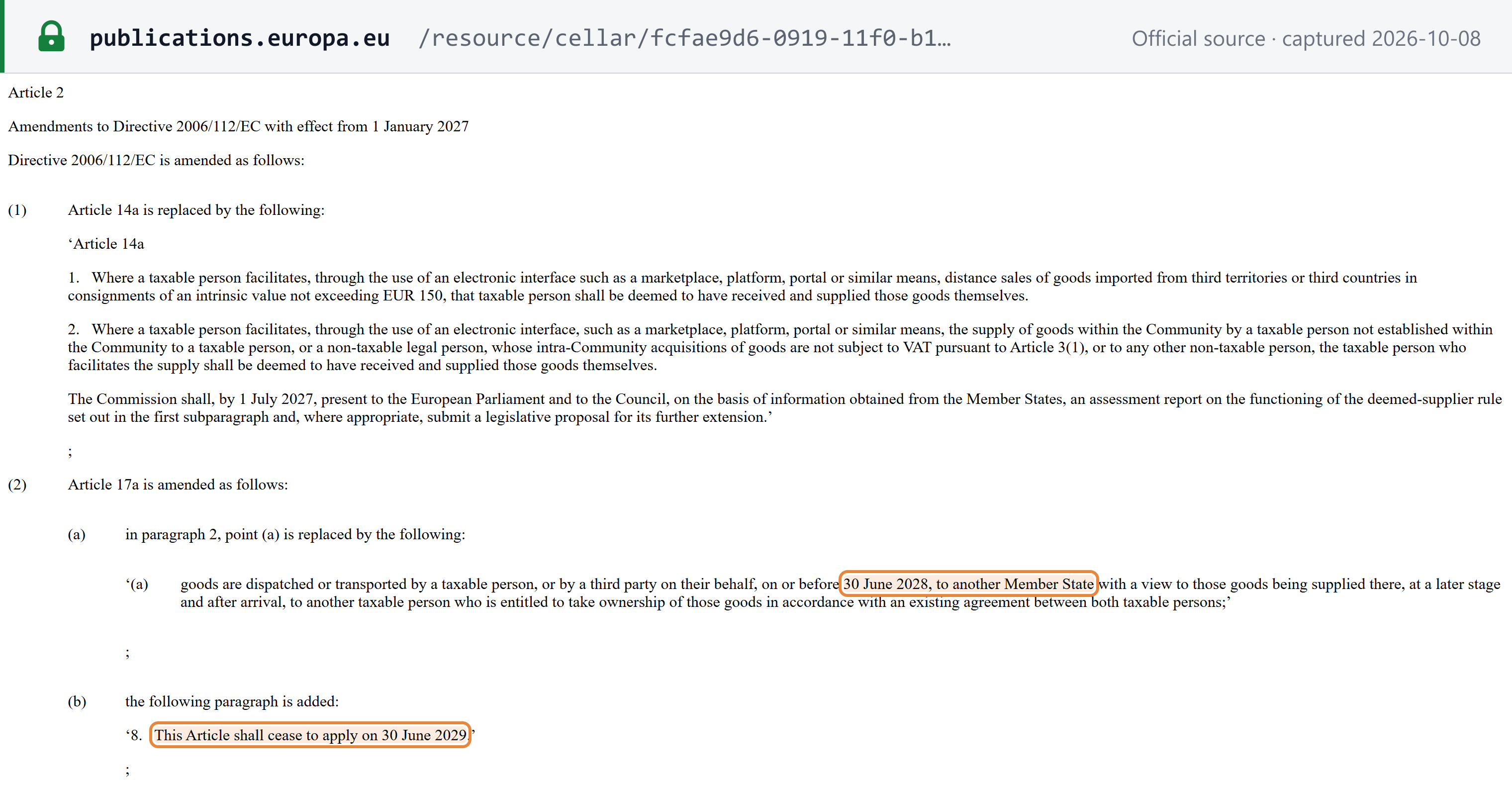 Source snapshot captured 2026-10-08 — original (EU Publications Office (Official Journal text), Directive (EU) 2025/516)
Goods in transit on 30 June 2028. For the 1 January 2020 start date, the Commission held that what counts is when transport starts: "if the transport starts before 1 January 2020, the call-off stock simplification … cannot be applied, even when the arrival of the goods in the Member State of destination takes place after that date" (Explanatory Notes §2.5.24). The 2028 wording uses the same "dispatched or transported … on or before" construction, which points to the dispatch date deciding eligibility. That is an inference by analogy.
The register, the reporting line and the implementing rules go too
- Register and recapitulative-statement line deleted from 1 July 2029. Article 4 of Directive 2025/516 deletes Article 243(3) and Article 262(2) with effect from 1 July 2029 (applicable under Art 6(4)).
- Implementing rules sunset. Council Implementing Regulation (EU) 2025/518 adds a paragraph 3 to Article 54a of Implementing Regulation 282/2011: "This Section shall cease to apply on 30 June 2029." That amendment applies from 1 July 2028, the Regulation's general application date. Its recital says the call-off implementing provisions "are no longer required and should therefore be deleted". (Implementing Regulation (EU) 2025/518, EUR-Lex)
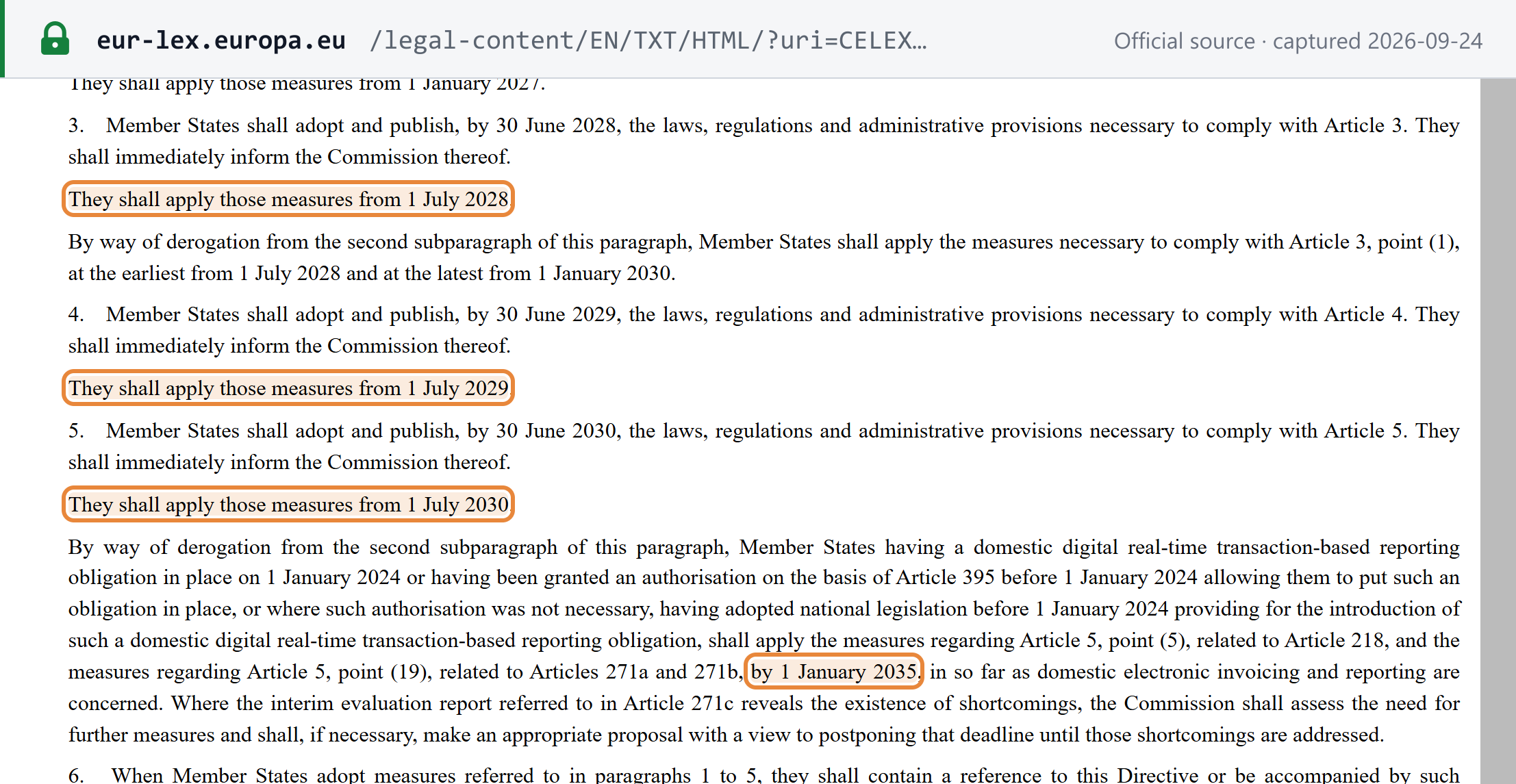 Source snapshot captured 2026-09-24 — original (EUR-Lex, Directive (EU) 2025/516)
What replaces it from 1 July 2028
ViDA does not copy call-off stock. It replaces it with two separate tools, both applicable from 1 July 2028 (Art 3 of Directive 2025/516, Art 6(3)).
1. The OSS special scheme for transfers of own goods (new Articles 369xa to 369xk). Any taxable person moving its own goods to another Member State under Article 17(1) may join a new One-Stop Shop scheme:
- Scope. A "transfer of own goods" excludes "transfers of goods in relation to which there is no full right of deduction" in the destination Member State (Art 369xa(1)(a)).
- All or nothing. "This special scheme shall apply to all transfers of own goods carried out by a taxable person registered for this special scheme" (Art 369xb).
- Identification in the Member State of identification only, under the existing domestic VAT number (Art 369xd).
- Monthly returns. An electronic VAT return "for each month, regardless of whether the transfers of goods covered by this special scheme have been carried out", due "by the end of the month following the end of the tax period" (Art 369xf), with values per destination and departure Member State (Art 369xg).
- No registration in the destination country. The intra-Community acquisition there is exempt and "shall not give rise to a registration obligation in accordance with Article 214(1)" (Art 369xi).
- Input VAT is not deducted in the scheme return. As a general rule it is recovered under the refund directives; where the supplier is registered in a Member State for other activities, it deducts that state's input VAT in its normal return there (Art 369xj). Records are kept for 10 years (Art 369xk).
The shape is different from call-off stock. Call-off stock defers the transfer until the customer takes the goods. The own-goods scheme keeps the transfer but exempts the acquisition and removes the registration duty, at the price of a monthly OSS return. Because it does not need a known customer, it also covers classic consignment stock, which call-off stock never did. The Commission's Implementing Regulation (EU) 2026/1869 of 27 July 2026 has already set the registration and return data for the scheme, applying from 1 July 2028 (EUR-Lex). See the OSS explainer.
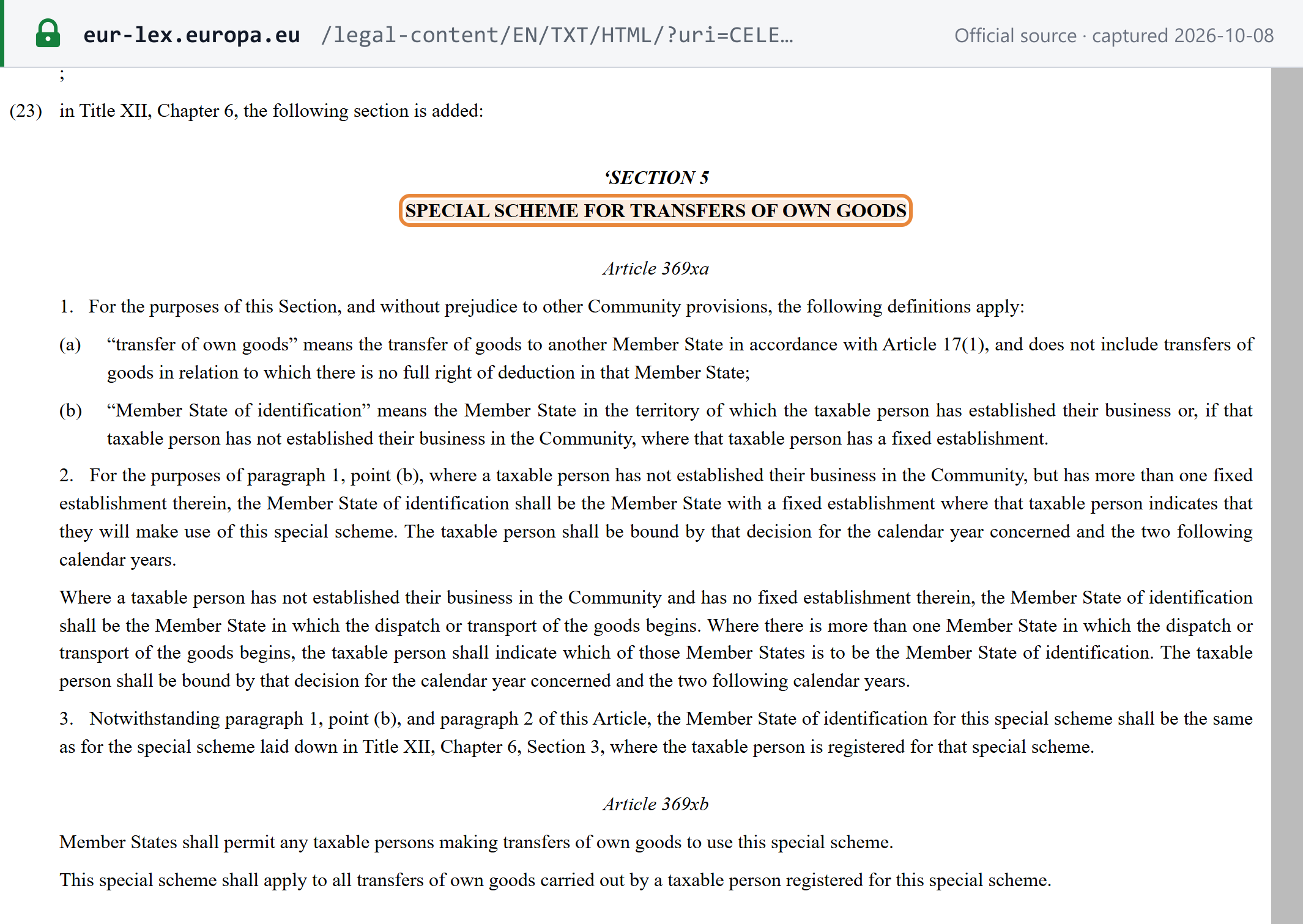 Source snapshot captured 2026-10-08 — original (EUR-Lex, Directive (EU) 2025/516)
2. The mandatory Article 194 reverse charge for the onward B2B sale. Where a supplier "who is not established, and is not identified for VAT purposes by means of an individual VAT identification number as referred to in Article 214" in the Member State where VAT is due sells to a customer "already identified for VAT purposes in that Member State", the customer is liable for the VAT. This is mandatory from 1 July 2028, and it covers the sale out of the destination-country stock that call-off stock used to turn into an intra-Community supply. See the reverse charge explainer.
The onward B2B sale is in neither OSS return. The Union OSS return (Art 369g(1)(e), (2)(d)) carries the deemed supplies under Articles 16, 18 and 26 that follow a scheme transfer; the own-goods scheme return (Art 369xg) carries only the transfer values. The ordinary onward B2B sale is reverse-charged to the customer under Article 194 and is not reported in either OSS return; an onward B2C sale by a non-established supplier falls in the extended Union OSS (Art 369g(1)(d)). The B2B sale is reported elsewhere: from 1 July 2028 the recast Article 262(1)(c) requires the supplier to list Article 194 supplies to VAT-identified customers on its recapitulative statement.
 Source snapshot captured 2026-09-24 — original (EUR-Lex, Directive (EU) 2025/516)
Later reporting relief. From 1 July 2028, the recast Article 262(1)(a) carves the own-goods line out of the recapitulative statement "except where use is made of the special scheme". From 1 July 2030, recast Article 262(3) provides that scheme users "shall not submit data on transfers of own goods or on the transactions treated as intra-Community acquisitions" for the same goods (Art 5 of Directive 2025/516). See the ViDA explainer.
What the Directive does not say: stock still uncalled on 30 June 2029
Recital 43 keeps "the 12-month time limit" for arrangements that commenced on or before 30 June 2028, but Article 17a(8) ends the Article on 30 June 2029. Goods dispatched at the end of June 2028 that arrive in early July 2028 would have a Commission-counted window running into early July 2029, a few days past 30 June 2029. The Directive does not address what happens to such stock (the 2019 Explanatory Notes predate ViDA). Check national transposing law and any later Commission guidance before relying on either reading.
Worked example 2: the ViDA cut-off
Example. Same parties as Worked example 1, in 2028.
- Goods dispatched on 29 June 2028 qualify: they are dispatched "on or before 30 June 2028". If they arrive on 1 July 2028, the Commission-counted window runs to the end of 2 July 2029, which is past the 30 June 2029 end of Article 17a. That overlap is the open point described above.
- Goods dispatched on 3 July 2028 do not qualify. A has two options: register in France and account for an ordinary Article 17 transfer, or join the OSS scheme for transfers of own goods (open from 1 July 2028). Under the scheme the French intra-Community acquisition is exempt with no French registration (Art 369xi), and A files monthly scheme returns in Germany (Art 369xf).
- The later sale to B, which is VAT-identified in France, is reverse-charged to B under the mandatory Article 194 (from 1 July 2028). It goes in neither OSS return; A lists it on its recapitulative statement under the recast Article 262(1)(c).
- From 30 June 2029 Article 17a "shall cease to apply"; from 1 July 2029 the call-off register (Art 243(3)) and recapitulative-statement line (Art 262(2)) no longer exist.
Timeline
| Date | What happens | Status (as at 2026-10-08) | Source |
|---|---|---|---|
| 7 Dec 2018 | Directive 2018/1910 and Implementing Regulation 2018/1912 published (OJ L 311) | Enacted | Dir 2018/1910, Reg 2018/1912 |
| 1 Jan 2020 | Article 17a, Article 243(3), Article 262(2) and Implementing Regulation Article 54a apply | In force | Dir 2018/1910 Art 2(1); Reg 2018/1912 Art 2 |
| 14 Apr 2025 | ViDA Directive 2025/516 enters into force | In force | Dir 2025/516 Art 7 |
| 31 Dec 2026 | Deadline for Member States to transpose the call-off cut-off (Art 2) | Enacted, future | Dir 2025/516 Art 6(2) |
| 1 Jan 2027 | Amended Article 17a(2)(a) ("on or before 30 June 2028") and new Article 17a(8) apply | Enacted, future | Dir 2025/516 Art 2(2), Art 6(2) |
| 30 Jun 2028 | Last day goods can be dispatched under call-off stock | Enacted, future | Art 17a(2)(a) as amended; recital 43 |
| 1 Jul 2028 | OSS scheme for transfers of own goods opens; Article 194 reverse charge becomes mandatory; Implementing Regulation 2025/518 (including the Art 54a sunset clause) and Implementing Regulation 2026/1869 Arts 1 and 3 apply | Enacted, future | Dir 2025/516 Art 3, Art 6(3); Reg 2025/518 Art 2; Reg 2026/1869 |
| 30 Jun 2029 | Article 17a "shall cease to apply"; the Implementing Regulation Article 54a section ceases | Enacted, future | Art 17a(8); Implementing Regulation 282/2011 Art 54a(3) |
| 1 Jul 2029 | Article 243(3) register and Article 262(2) recapitulative-statement line deleted | Enacted, future | Dir 2025/516 Art 4, Art 6(4) |
| 1 Jul 2030 | Recapitulative statements replaced by per-transaction digital reporting; own-goods scheme users exempt from reporting the transfers (context) | Enacted, future | Dir 2025/516 Art 5, Art 6(5) |
National rules: how Member States transposed Article 17a
Article 17a applies in every Member State, but the national statutes name it differently and some add conditions or obligations. Selected Member States:
| Member State | National name and basis | Points to note | Last confirmed | Source |
|---|---|---|---|---|
| Germany | Konsignationslagerregelung, § 6b UStG; supplier records § 22(4f); ZM (recapitulative statement) content § 18a(7) Nr. 2a | Extra conditions on customer details and ZM filing; earlier timing for some ending events (see note). Germany guide | 2026-10-08 | gesetze-im-internet.de, § 6b UStG |
| France | Régime des stocks sous contrat de dépôt, CGI art. 256 III bis; registers under CGI art. 286 quater I-2 and annex IV art. 41 bis A | Both parties keep a register mirroring Implementing Regulation Article 54a. France guide | 2026-10-08 | BOFiP, BOI-TVA-DECLA-20-30-30 (version of 23 June 2021) |
| Netherlands | Voorraad op afroep; ICP declaration (opgaaf ICP) | Declared per customer in the period transport began; returns and changes of customer in section 5 ("5a Retourzending", "5b Afnemer wijzigen"). Netherlands guide | 2026-10-08 | Belastingdienst, ICP declaration notes 2024 |
| Italy | Arts 38-ter (inbound) and 41-bis (outbound) DL 331/1993; register art. 50 c. 5-bis; Intrastat summary list art. 50 c. 6 | Transposed late (D.Lgs. 192/2021, in force 1 December 2021); supplier and recipient each keep a register. Italy guide | 2026-10-08 | Normattiva, D.Lgs. 192/2021 |
| Spain | Acuerdo de ventas de bienes en consigna, Ley 37/1992 art. 9 bis; modelo 349 | In force 1 March 2020; full customer name known at dispatch; modelo 349 keys R, D, C (see note). Spain guide | 2026-10-08 | BOE, Ley 37/1992 art. 9 bis; AEAT, modelo 349 |
| Poland | Procedura magazynu typu call-off stock, VAT Act arts 13a to 13g (inbound) and 13h to 13l (outbound) | 12 months from entry into the warehouse; 14-day warehouse notification (see note). Poland guide | 2026-10-08 | Sejm, consolidated VAT Act (Dz.U. 2026 poz. 1263) |
Germany. The supplier must know the customer's "vollständiger Name und … vollständige Anschrift" when transport begins, and filing the ZM "rechtzeitig, richtig und vollständig" is itself a condition. A sale to another buyer ends the regime "an dem Tag vor der Lieferung" (the day before the supply, where the Commission reads "immediately before" as the same day); destruction, loss or theft takes effect on the day it is "festgestellt" (discovered).
Spain. Art. 9 bis was added by Real Decreto-ley 3/2020. The customer's NIF and "nombre y apellidos, razón o denominación social completa" must be known at dispatch, and both parties keep a register. Modelo 349 uses key R for transfers, D for returns and C for substitution. Despite the name, this is the Article 17a regime, not classic consignment stock.
Poland. The 12 months run "od dnia wprowadzenia towarów do magazynu" (from entry into the warehouse), and the customer must be registered as a podatnik VAT UE. Whoever runs the warehouse must file an electronic notification of operating a call-off stock warehouse within 14 days of the first entry of goods (art. 13f); a warehouse keeper other than the customer keeps a register at the warehouse (art. 109 ust. 11d).
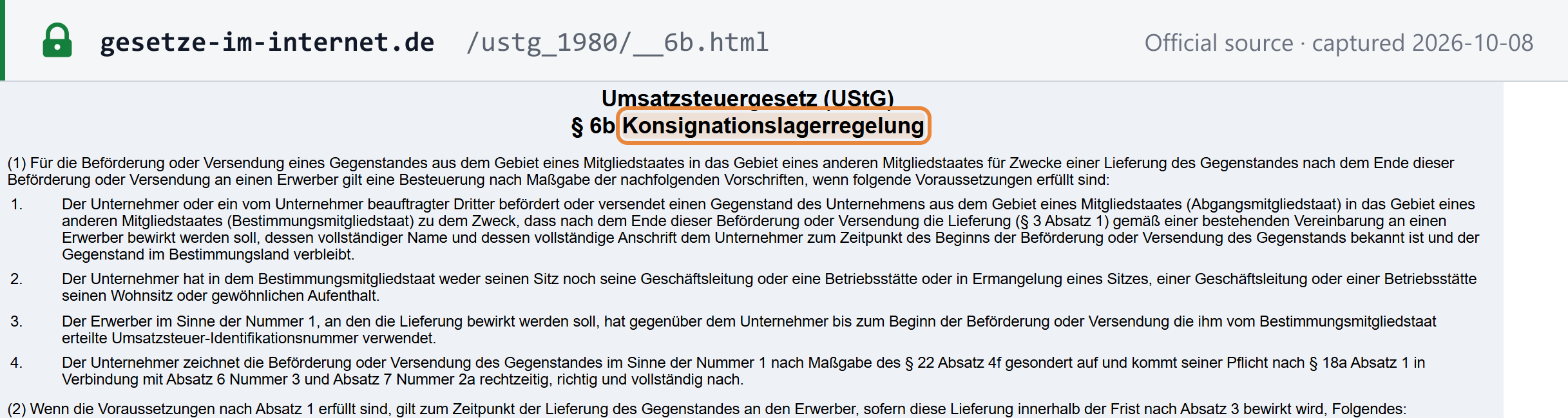 Source snapshot captured 2026-10-08 — original (Bundesministerium der Justiz, Gesetze im Internet)
ViDA phase-out: national transposition status
Member States must transpose the 30 June 2028 dispatch cut-off by 31 December 2026. Status as at 2026-10-08:
| Member State | Instrument | Status | Call-off provision | Last confirmed | Source / event |
|---|---|---|---|---|---|
| Malta | Act III of 2026 (assented 10 Mar 2026) | Enacted, from 1 Jan 2027 | Call-off stock limited to goods dispatched on or before 30 June 2028; item 17A ceases to apply on 30 June 2029. Malta guide | 2026-09-19 | legislation.mt; event |
| Finland | Law 597/2026 | Enacted, in force 1 Jan 2027 | Call-off stock rule (AVL § 18 c) limited to goods moved by 30 June 2028; also amends § 26 h (acquirer side). Finland guide | 2026-10-05 | Finlex; event |
| Lithuania | Act No. XV-1036 of 18 June 2026 | Enacted | Rewrites the call-off article (Art. 4²) so the taxable person "iki 2028 m. birželio 30 d. išgabena" (dispatches by 30 June 2028) the goods to another Member State: a dispatch cut-off, as in the Directive. Also repeals Art. 4² entirely from 1 July 2029. Lithuania guide | 2026-10-08 | e-seimas, Act XV-1036 |
| Netherlands | Bill 36 920 | Passed both chambers (Senate, 6 Oct 2026); no Staatsblad number listed | The call-off stock scheme is phased out and replaced by a new transfer arrangement integrated into the OSS; the act enters into force 1 Jan 2027 | 2026-10-08 | Eerste Kamer; event: Tweede Kamer passage |
| Belgium | DOC 56 1718 | Bill (text adopted in committee, report 56K1718/002) | Transfers after 30 June 2028 no longer qualify; transitional rules end 30 June 2029. Belgium guide | 2026-10-05 | La Chambre; event |
| Czech Republic | Print 218 | Bill (second reading proposed from 13 Oct 2026) | § 18 call-off scheme repealed from 1 July 2028, with transitional use to 30 June 2029. Czech Republic guide | 2026-10-05 | Chamber of Deputies; event |
| Slovakia | ČPT 1454 | Bill in first reading (delivered 27 Aug 2026) | See the event record. Slovakia guide | 2026-10-05 | NR SR; event |
| Estonia | Bill 992 SE | Bill (amendments deadline 12 Oct 2026) | Call-off stock provisions apply until 30 June 2028; goods sent by then stay under the old rules. Estonia guide | 2026-10-05 | Riigikogu; event |
| Poland | Sejm print 3074 | Bill: committee report 6 Oct 2026 (print 3171); second reading 7 Oct 2026, third-reading vote pending (as at 2026-10-08) | Proposes repealing the call-off stock procedure from 1 July 2028 | 2026-10-08 | Sejm; event |
| Germany | — | No enacted change as at 2026-10-08 | § 6b UStG carries no 2028 cut-off (last amended 2020) | 2026-10-08 | gesetze-im-internet.de, § 6b UStG |
| Spain | — | No change in the consolidated text | BOE consolidated art. 9 bis still carries the 2020 text (as at 2026-10-08) | 2026-10-08 | BOE, Ley 37/1992 art. 9 bis |
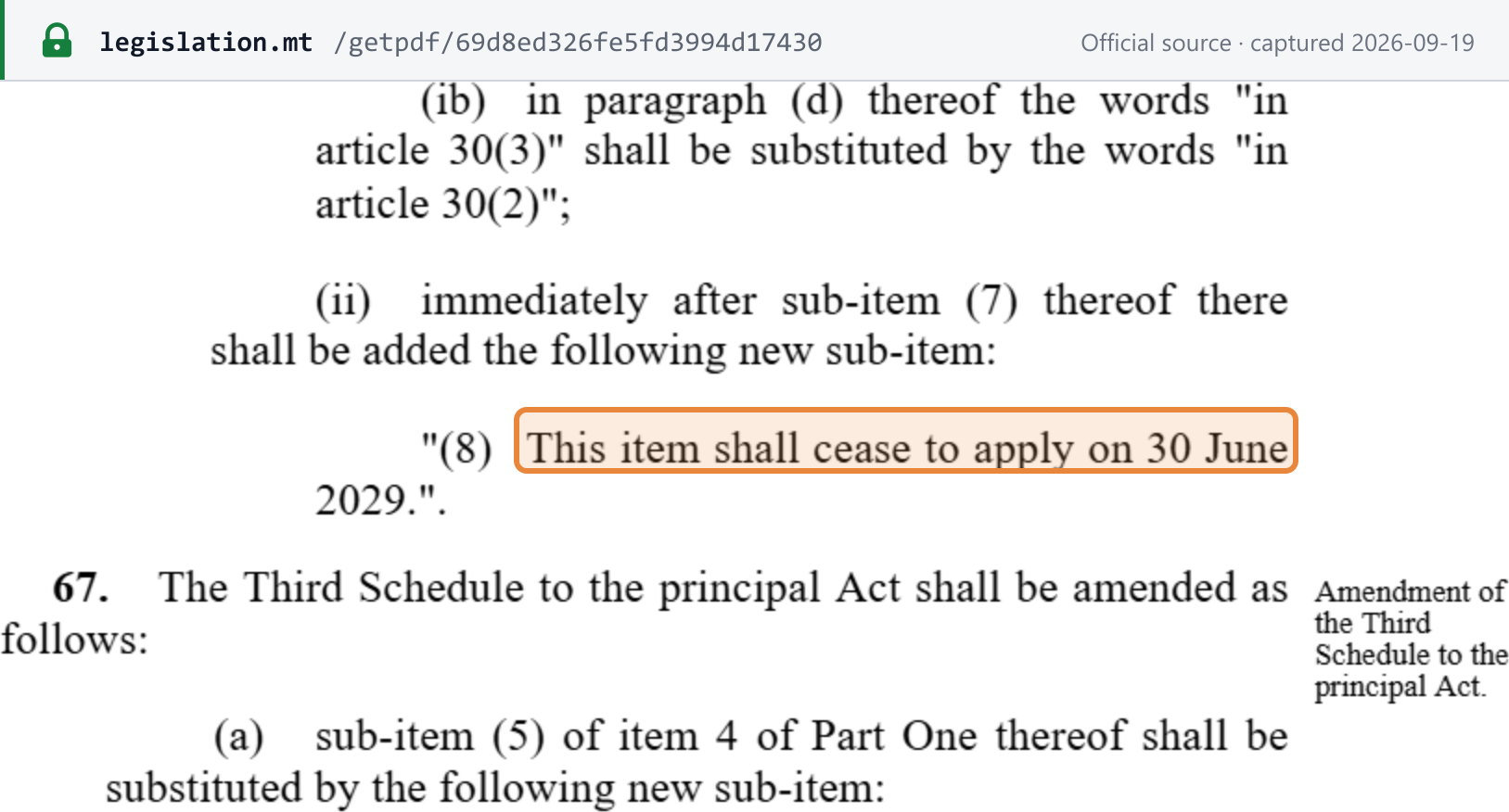 Source snapshot captured 2026-09-19 — original (legislation.mt, Act III of 2026)
Bills can change before they are passed; check each country's event record and guide for the latest stage.
Related changes
- 2026-10-07 — Poland: second reading of the ViDA bill in the Sejm. (Sejm) — see event
- 2026-10-06 — Netherlands: the Eerste Kamer (Senate) passed bill 36 920 as a hamerstuk. (Eerste Kamer) — see event: Tweede Kamer passage
- 2026-10-02 — Belgium: the committee text of bill DOC 56 1718 was published. (La Chambre) — see event
- 2026-09-28 — Estonia: bill 992 SE passed its first reading. (Riigikogu) — see event
- 2026-08-27 — Slovakia: bill ČPT 1454 delivered to the National Council. (NR SR) — see event
Frequently asked questions
Can I still start a call-off stock arrangement?
Yes, for goods dispatched on or before 30 June 2028. From 1 January 2027, Article 17a(2)(a) of the VAT Directive, as amended by Directive (EU) 2025/516, requires the goods to be dispatched or transported on or before 30 June 2028; goods dispatched on 1 July 2028 or later cannot be call-off stock. Article 17a itself ceases to apply on 30 June 2029. (Directive (EU) 2025/516, Art 2 and recital 43, checked 2026-10-08)
What replaces call-off stock?
From 1 July 2028, two separate rules. The movement of goods can be reported under the new One-Stop Shop special scheme for transfers of own goods (Articles 369xa to 369xk): the acquisition in the destination country is exempt and needs no registration there, in exchange for a monthly OSS return covering all the business's transfers of own goods. The onward sale to a customer already VAT-identified in that country is reverse-charged to the customer under the mandatory Article 194, which applies where the supplier is neither established nor VAT-identified there; that sale is not reported in either OSS return, but from 1 July 2028 the supplier lists it on its recapitulative statement under the recast Article 262(1)(c). (Directive (EU) 2025/516, Art 3 and Art 6(3), checked 2026-10-08)
What happens if the customer does not take the goods within 12 months?
A transfer of own goods under Article 17 is deemed to take place on the day after the 12-month period expires (Article 17a(4)). The supplier makes an exempt deemed intra-Community supply in the departure country and a deemed intra-Community acquisition in the destination country, so it must register for VAT there and declare the acquisition. The European Commission counts the 12 months from the day after the goods arrive in the warehouse. (Directive (EU) 2018/1910, Art 17a(4); Commission Explanatory Notes §2.3.5 and §2.5.16, checked 2026-10-08)
Can I switch the goods to a different customer?
Yes, within the 12 months, if the new customer meets all the Article 17a(2) conditions and the supplier records the substitution in its register (Article 17a(6)) and reports both VAT numbers on its recapitulative statement. In the European Commission's view the 12-month period does not restart at the substitution, and the new contract must be in place no later than the moment the old one ends. (Directive (EU) 2018/1910, Art 17a(6); Commission Explanatory Notes §2.3.2, checked 2026-10-08)
Is call-off stock the same as consignment stock?
No. Call-off stock under Article 17a requires the customer's identity and VAT number to be known when the goods are dispatched. Consignment stock moved without a known customer is a transfer of own goods under Article 17, which requires VAT registration in the destination country. National labels can mislead: Spain calls its Article 17a regime "ventas de bienes en consigna" and Germany calls its regime "Konsignationslagerregelung", but both are call-off stock. From 1 July 2028 the OSS scheme for transfers of own goods covers both situations. (Commission Explanatory Notes §2.2; Ley 37/1992 art. 9 bis; § 6b UStG, checked 2026-10-08)
What goes on the EC Sales List for call-off stock?
At dispatch, the supplier reports the intended customer's VAT number with no value, in the period in which transport begins (Article 262(2)). A substitution is reported with the old and new VAT numbers and no value, and a return with the customer's VAT number, a return flag and no value. Only when the customer takes the goods does the supplier report a normal intra-Community supply line with the value. The Article 262(2) line is deleted from 1 July 2029. (Directive (EU) 2018/1910, Art 262(2); Commission Explanatory Notes §§2.5.20 to 2.5.22; Directive (EU) 2025/516, Art 4, checked 2026-10-08)
Related resources
- Intra-community supply — the exempt supply that call-off creates at the moment the customer takes the goods
- Chain transactions and triangulation — the other 2020 Quick Fixes flows
- VIES and Intrastat and VAT listings explained — the recapitulative-statement line and its removal on 1 July 2029
- ViDA — VAT in the Digital Age — the full phase-out timeline and national transposition
- OSS explainer — the scheme for transfers of own goods from 1 July 2028
- Reverse charge — mandatory Article 194 from 1 July 2028
- Register for VAT in Germany — what a supplier faces when the simplification lapses and it must register in the destination country
- VAT registration thresholds — the global table
- Country guides: Germany, France, Netherlands, Italy, Spain, Poland, Malta, Finland, Lithuania, Belgium, Czech Republic, Slovakia, Estonia
- Tax-change chronologies: Malta, Finland, Netherlands, Belgium, Czech Republic, Slovakia, Estonia, Poland
Reference links
- Council Directive (EU) 2018/1910 — Article 17a, Article 243(3), Article 262(2) (EUR-Lex)
- Council Implementing Regulation (EU) 2018/1912 — Article 54a registers (EUR-Lex)
- Council Directive (EU) 2025/516 (ViDA) — recital 43, Articles 2, 3, 4 and 6 (EUR-Lex)
- Council Implementing Regulation (EU) 2025/518 and Commission Implementing Regulation (EU) 2026/1869 (EUR-Lex)
- European Commission, Explanatory Notes on the 2020 Quick Fixes — non-binding guidance (DG TAXUD)
- National texts: § 6b UStG (Germany), BOFiP BOI-TVA-DECLA-20-30-30 (France), Belastingdienst ICP notes 2024 (Netherlands), D.Lgs. 192/2021 (Italy), Ley 37/1992 art. 9 bis (Spain), Dz.U. 2026 poz. 1263 (Poland)