EU VAT rate rules — what the VAT Directive lets Member States charge
EU VAT rate rules are the limits the VAT Directive (Council Directive 2006/112/EC) puts on the rates each Member State sets. The standard rate must be at least 15%, with no maximum. A Member State may add up to two reduced rates of at least 5% for supplies listed in Annex III, and one super-reduced rate below 5% plus a zero rate for up to seven Annex III points. Older rates that fall outside these limits survive only where Article 105a grandfathers them.
In the European Commission's words: "In the EU, the VAT Directive sets the general framework for VAT rates. Within this framework, it is up to each Member State to set the number and level of its VAT rates and the categories of supplies to which each rate applies." (European Commission, VAT rates)
The current rules come from Council Directive (EU) 2022/542 of 5 April 2022, published in the Official Journal (OJ L 107) and in force on 6 April 2022 (Art 5). The Commission calls it "the first major reform of VAT rates in the EU since the early 1990s". (Directive (EU) 2022/542, EUR-Lex; COM(2025) 585, EUR-Lex)
The five kinds of rate
The Directive itself never says "super-reduced", "zero rate" or "parking rate". The Commission's 2025 report on rate derogations uses these working names:
| Term | Commission definition (COM(2025) 585, Glossary) | Where it sits in the Directive |
|---|---|---|
| Standard rate | One rate, the same for goods and services | Arts 96–97: at least 15% |
| Reduced rate | "VAT rate not lower than the minimum of 5%" | Art 98(1): at most two, Annex III only |
| Super-reduced rate | "Reduced rate lower than the minimum of 5%" | Art 98(2) and Art 105a(1) |
| Zero rate | "Exemption with deductibility of VAT paid at the preceding stage" | Art 98(2) and Art 105a(1) |
| Parking rate | "Reduced rate not lower than 12%" | Art 105a(3): supplies outside Annex III |
How it works
The standard rate: at least 15%, no maximum (Arts 96–97)
Article 96 requires one standard rate, "the same for the supply of goods and for the supply of services". Article 97 reads: "The standard rate shall not be lower than 15 %." That wording comes from Council Directive (EU) 2018/912 of 22 June 2018, which decided "to maintain the current minimum standard rate at 15 %, and to make it permanent" (recital 3); before 2018 the floor applied only for a fixed period. There is no EU ceiling: the Commission says the standard rate "must be no less than 15%, but there is no maximum". (VAT Directive, consolidated 14.04.2025; Directive (EU) 2018/912)
Standard rates therefore move independently. Recent examples, as at 2026-10-08: Finland 25.5% since 1 September 2024 (Vero); Estonia 24% since 1 July 2025 (EMTA); Romania 21%, with a single 11% reduced rate, from 1 August 2025 (Law 141/2025) (ANAF); and Slovakia 23%, with reduced rates of 19% and 5%, from 1 January 2025 (Finančná správa). Current standard rates for all 27 Member States are in the worldwide tax rates table.
Reduced rates: two rates of at least 5%, on up to 24 Annex III points (Art 98(1))
Article 98, as replaced by Directive 2022/542, is the core of the system:
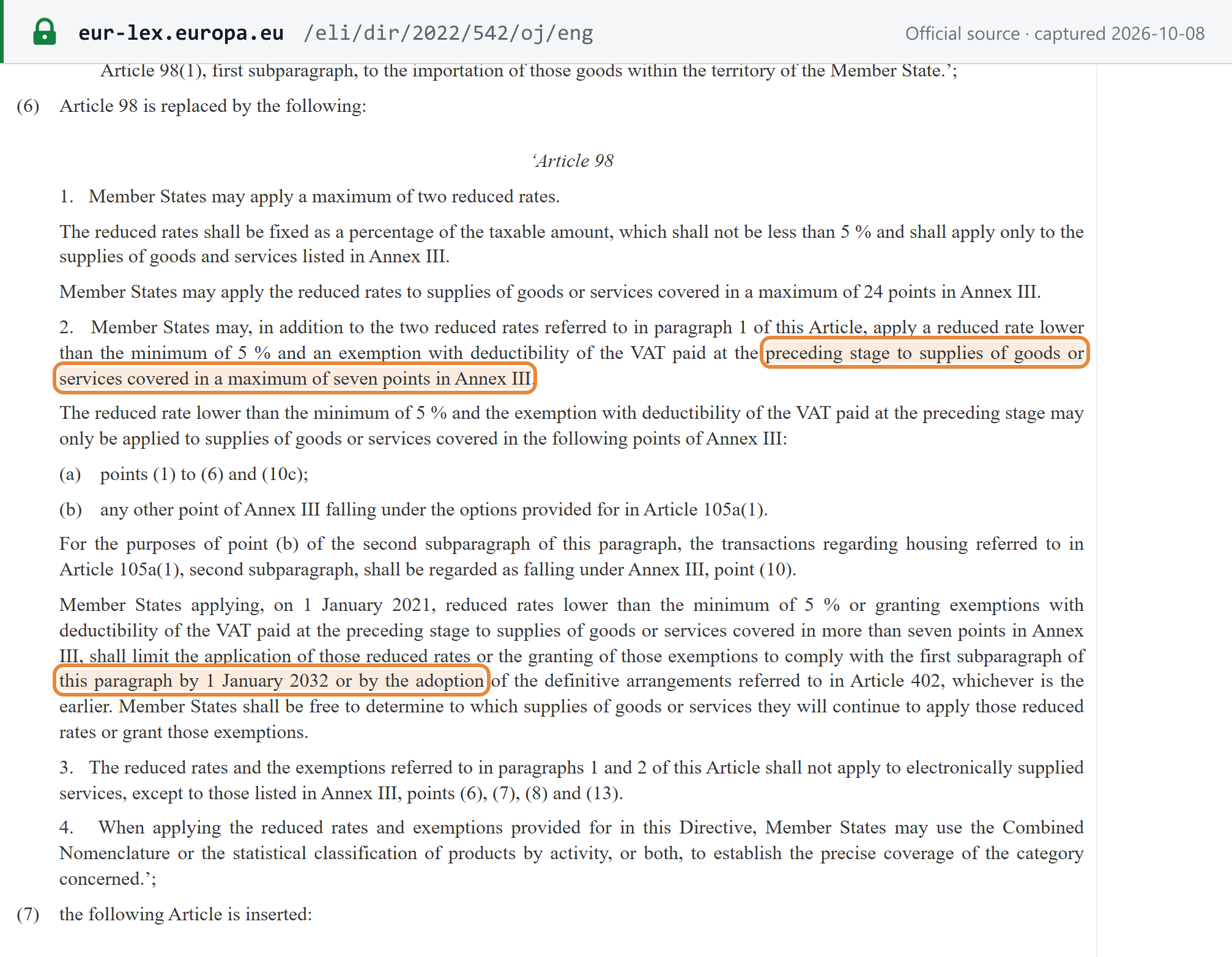
"1. Member States may apply a maximum of two reduced rates. The reduced rates shall be fixed as a percentage of the taxable amount, which shall not be less than 5 % and shall apply only to the supplies of goods and services listed in Annex III. Member States may apply the reduced rates to supplies of goods or services covered in a maximum of 24 points in Annex III."
A grandfathered parking rate (Art 105a(3)) counts as one of these two reduced rates, even though it applies to supplies outside Annex III and uses none of the 24 points.
Super-reduced and zero rates: up to seven Annex III points (Art 98(2))
Article 98(2) also allows "a reduced rate lower than the minimum of 5 % and an exemption with deductibility of the VAT paid at the preceding stage to supplies of goods or services covered in a maximum of seven points in Annex III". They may be used only on:
- (a) Annex III points (1) to (6) and (10c): foodstuffs, water, pharmaceutical products, medical equipment, passenger transport, books, newspapers and periodicals, and solar panels; or
- (b) other Annex III points covered by the grandfathering in Article 105a(1).
So a Member State has one rate below 5% and one zero rate, together reaching at most seven Annex III points. Super-reduced and zero rates kept under Article 105a(1) are part of that one rate and count toward the seven points.
A Member State that on 1 January 2021 applied such rates to more than seven points must cut back "by 1 January 2032 or by the adoption of the definitive arrangements referred to in Article 402, whichever is the earlier", and is free to choose which supplies keep them (Art 98(2), last subparagraph).
 Source snapshot captured 2026-10-08 — original (EUR-Lex, Directive (EU) 2022/542)
Exclusions: e-services and margin-scheme goods (Arts 98(3)–(4), 98a)
- Electronically supplied services cannot take reduced or zero rates, "except to those listed in Annex III, points (6), (7), (8) and (13)": e-books and e-press, live-streamed admissions, broadcasting, webcasting and internet access, and live-streamed sport (Art 98(3)).
- Member States may use the Combined Nomenclature or the statistical classification of products by activity to define a category's exact scope (Art 98(4)).
- Reduced and zero rates do not apply to works of art, collectors' items and antiques sold under the margin scheme (Art 98a).
(Directive (EU) 2022/542, Art 1 points (6)–(7))
Annex III: the supplies that can take a reduced rate
Annex III lists the "supplies of goods and services to which the reduced rates and the exemption with deductibility of VAT referred to in Article 98 may be applied". Directive 2022/542 rewrote it:
- Long-standing points include (1) foodstuffs, (2) water, (12) hotel accommodation, (12a) restaurant and catering and (17) medical and dental care not otherwise exempt.
- Rewritten or extended: (3) pharmaceuticals, including sanitary hygiene products; (6) books and press "either on physical means of support or supplied electronically, or both"; (8) broadcasting, plus internet access; (10) social housing, residential letting and renovation of private dwellings; (10a) now "construction and renovation of public and other buildings used for activities in the public interest".
- New points include (10c) solar panels on and near dwellings and public-interest buildings; (22) electricity, district heating and cooling, biogas and efficient low-emission heating systems; (23) live plants and cut flowers; (24) children's clothing, footwear and car seats; (25) bicycles, including e-bikes; and (26) works of art.
- Time-limited: chemical pesticides and fertilisers in point (11), and natural gas and firewood in point (22); see Article 105a(4) below.
- Deleted: point (14).
The Commission must report on the scope of Annex III "By 31 December 2028 and every five years thereafter" (Art 100), the next dated EU milestone on rates. (VAT Directive, consolidated 14.04.2025, Annex III and Art 100)
Zero rate is not the same as exemption
A zero rate is an exemption with deduction: the supplier charges 0% and still recovers the VAT on its costs. An exemption without deduction (Arts 132 and following, such as most financial and medical services) carries no VAT, but the input VAT on related costs is not recoverable. Finland's tax administration, for example, states that zero-rated activity is not the same as VAT-exempt activity. (Vero)
Grandfathered rates: Article 105a and 105b
Directive 2022/542 keeps many pre-existing national rates alive, using 1 January 2021 as the reference date. A rate qualifies only if the Member State was applying it "in accordance with Union law" on that date:
| Provision | What it keeps | How it fits the limits | How long |
|---|---|---|---|
| Art 105a(1) | Rates below 5% and zero rates on Annex III points other than (1)–(6) and (10c) | Continues "in accordance with Article 98(2)": part of the one rate below 5%, counted in the seven points | Permanent |
| Art 105a(2) | Rates below 12% (including below 5% and zero) on supplies not in Annex III | Continues "in accordance with Article 98(1) and (2)", but on supplies outside Annex III; temporary | Until 1 January 2032, or the definitive VAT arrangements if earlier |
| Art 105a(3) | Parking rates of at least 12% on supplies not in Annex III | Continues "in accordance with Article 98(1), first subparagraph": one of the two reduced rates, outside Annex III and the 24-point cap | Permanent |
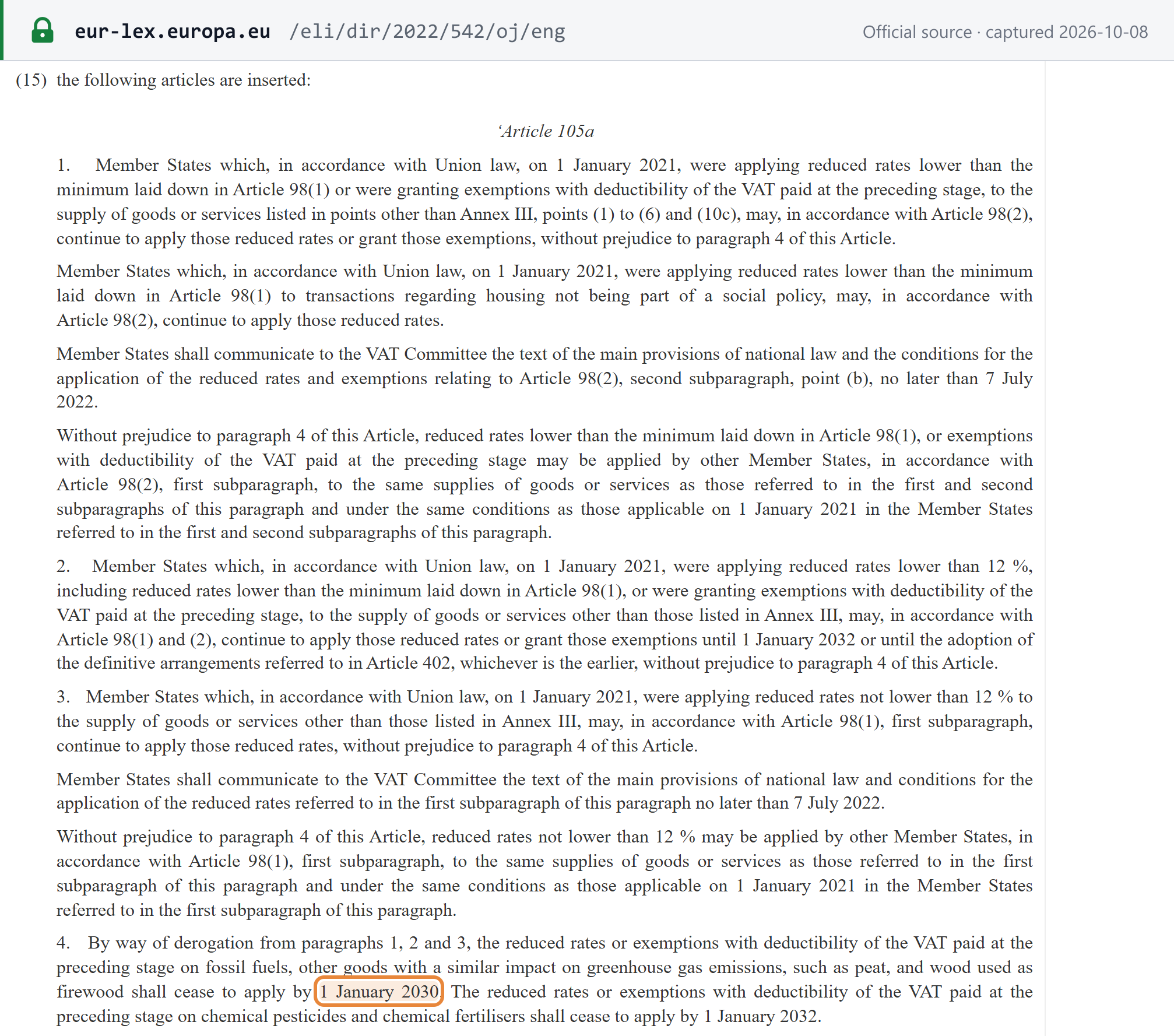
| Art 105a(4) | Overrides (1)–(3) for environmentally harmful goods | — | Fossil fuels, peat-like goods and firewood: end by 1 January 2030. Chemical pesticides and fertilisers: end by 1 January 2032 |
| Art 105b | Reduced rates of at least 5% on housing outside social policy | Counts toward the two-rate limit, like Art 105a(3) | Continue, but must be at least 12% from 1 January 2042 |
Two groups are not permanent: the Art 105a(2) rates on supplies outside Annex III, and the Art 98(2) overrun above seven points. Both end by 1 January 2032. The Commission confirms that Art 105a(1) rates can continue "even after the adoption of definitive arrangements set out in Article 402".
Other Member States could copy an Article 105a(1) or 105a(3) derogation already used elsewhere, on the same supplies and conditions, adopting the detailed rules by 7 October 2023 (Art 105a(5)). (Directive (EU) 2022/542, Arts 105a–105b; COM(2025) 585, §3)
 Source snapshot captured 2026-10-08 — original (EUR-Lex, Directive (EU) 2022/542)
"Transitional" rates: what 2022/542 replaced
Before 2022, most super-reduced, zero and parking rates rested on derogations meant to last only until the EU adopted a definitive VAT system. As the Commission puts it, these "should have been temporary, pending the introduction of a definitive VAT system, but they persisted for decades". Directive 2022/542 deleted those provisions and replaced them with the Article 105a/105b grandfathering keyed on 1 January 2021. (COM(2025) 585, §2)
The "definitive arrangements" that could bring the 2032 date forward are those in Article 402, which would base intra-EU trade "in principle on the taxation in the Member State of origin". As at 2026-10-08 none has been adopted, so 1 January 2032 is the operative date. The intra-Community supply explainer covers the current transitional regime for B2B goods.
Island and regional rates: Article 104
Directive 2022/542 gathered every geographic rate derogation into one Article 104 and deleted Article 105, which had held Portugal's. Under Article 104, Austria may apply a lower second standard rate, not below 15%, in Jungholz and Mittelberg; Greece may apply rates "up to 30 % lower" than mainland rates on listed islands; Portugal may apply lower rates in the Azores and Madeira; and Portugal may apply one of its reduced rates to tolls on the Lisbon-area bridges. (Directive (EU) 2022/542, Art 1 point (13))
National use:
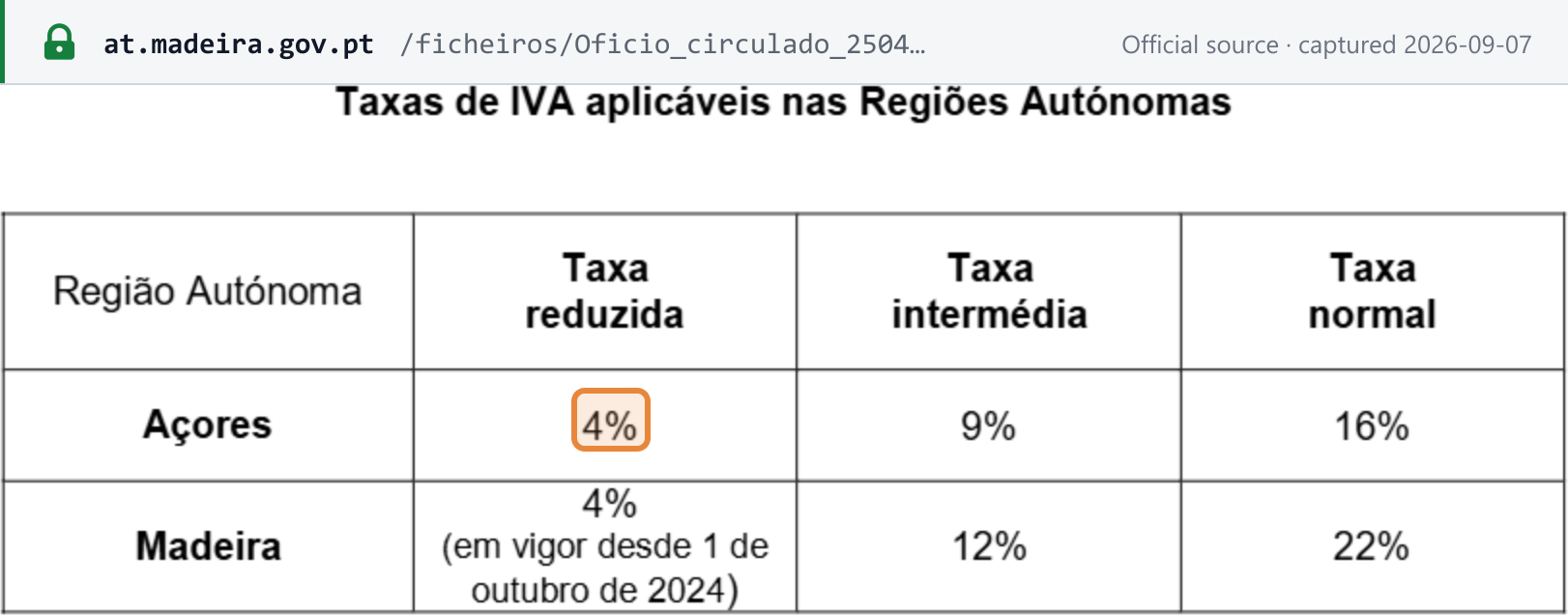
- Portugal: Azores 4%, 9% and 16%; Madeira 4%, 12% and 22%, per the AT circular of 6 December 2024. (AT Madeira, Ofício circulado 25045/2024)
 Source snapshot captured 2026-09-07 — original
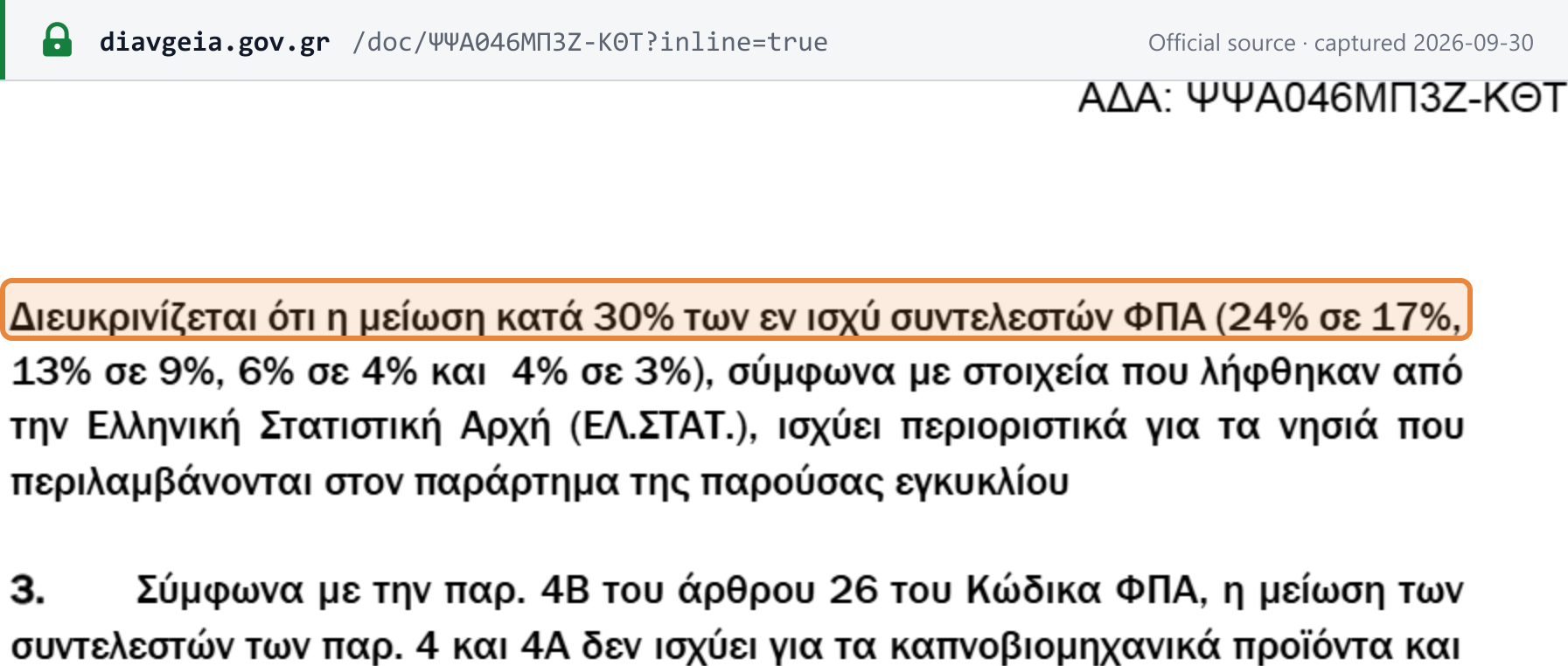
- Greece: from 1 January 2026, rates are cut by 30% on North Aegean, Samothraki and Dodecanese islands of up to 20,000 inhabitants: 24% to 17%, 13% to 9%, 6% to 4% and 4% to 3% (Law 5246/2025 art. 11; AADE circular E.2113/2025). (Diavgeia, E.2113/2025)
 Source snapshot captured 2026-09-30 — original
Imports, intra-EU acquisitions and disaster relief
Imports and intra-Community acquisitions bear the rate "applied to the supply of like goods within the territory of the Member State" (Art 94(1)–(2)); Article 94(3) allows a reduced rate on imported works of art, collectors' items and antiques. Article 101a, new in 2022/542, allows a zero rate on goods for disaster victims where the Commission has authorised an import exemption for them. (VAT Directive, consolidated 14.04.2025)
Worked example: mapping Austria's and Luxembourg's rates (as at 2026-10-08)
Austria's tax administration lists a general rate of 20% and reduced rates of 4.9%, 10% and 13%. (USP, Steuersätze der Umsatzsteuer, last updated 1 July 2026) Each fits a different part of the Directive:
| Austrian rate | Scope (examples) | Directive tier |
|---|---|---|
| 20% | Everything not reduced | Standard rate, Arts 96–97 |
| 10% | Residential letting, accommodation, books, newspapers, food | First Art 98(1) reduced rate |
| 13% | Live animals, live plants, firewood, artists, sports admissions | Second Art 98(1) reduced rate |
| 13% on wine supplied by the producer | Wine sold by the producer | Art 105a(3) parking rate (COM(2025) 585, Annex 1), sharing the second reduced rate |
| 4.9% | Selected staple foods, such as bread, butter, eggs and milk, since 1 July 2026 (BGBl. I Nr. 37/2026) | Rate below 5% on Annex III point (1) under the ordinary Art 98(2) route |
Two things follow. First, one percentage can sit in two tiers: Austria's 13% is an ordinary reduced rate for Annex III items and, for producers' wine, a parking rate outside Annex III. Second, the 2030 deadline reaches Austria's 13% list: the USP page lists firewood at 13%, and under Art 105a(4) reduced rates on firewood must end by 1 January 2030.
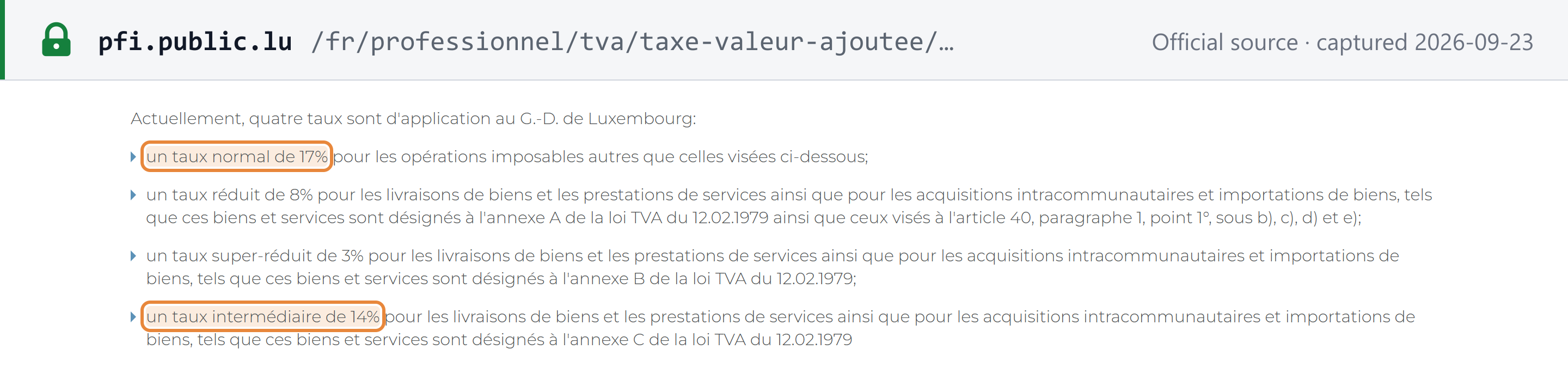
Luxembourg has four rates: 17% standard; two reduced rates, 8% and 14%; and a 3% super-reduced rate. The 14% rate ("taux intermédiaire") is an Art 105a(3) parking rate on six items. The 3% rate is its Art 98(2) rate below 5%, covering the 15 items kept under Art 105a(1). (Luxembourg AED, national rates; COM(2025) 585, Annex 1)
 Source snapshot captured 2026-09-23 — original
Who it affects
The Directive is addressed to Member States, which write the rates into national law. Businesses feel it as follows:
- Every VAT-registered supplier charges the rate of the Member State where the supply is taxed, on B2B sales as well as to consumers: a reduced rate "would normally be applicable along the entire commercial chain" (recital 3 of 2022/542).
- Distance sellers and e-service suppliers using the One-Stop Shop or IOSS charge the customer's Member State rate, so they must map each product to up to 27 national rate schedules. Under this destination principle, "suppliers derive no significant benefit from being established in a Member State with a lower VAT rate" (recital 2), which is why the EU loosened the rate rules. Digital services face the exclusion above; see VAT on digital services.
- Small businesses: Article 2 of Directive 2022/542 rewrote the turnover definition used by the SME scheme (Art 288), and zero-rated supplies under Art 98(2) and 105a count toward the threshold. See the EU VAT SME scheme.
(Directive (EU) 2022/542, recitals 2–3 and Art 2)
Current status and dates
As at 2026-10-08, the rate rules are those of Directive (EU) 2022/542, which "took effect on 6 April 2022" in the Commission's words; the margin-scheme points in Arts 94 and 98a applied from 1 January 2025 (Art 3(1)). The consolidated VAT Directive of 14 April 2025 shows no later amendment to Arts 96–105b, and ViDA (Directive (EU) 2025/516) does not change rates; see the ViDA explainer. (COM(2025) 585, §2; Directive (EU) 2022/542, Art 3)
The Commission's "VAT rates applied in the Member States of the European Union" ended with the 1 January 2021 edition. Use it only as the 2021 baseline; for current rates use the Taxes in Europe Database (TEDB) or national sources.
Timeline
| Date | What happens | Status (as at 2026-10-08) | Source |
|---|---|---|---|
| 17 Jul 2018 | Directive (EU) 2018/912 (adopted 22 June 2018) enters into force, making the 15% minimum standard rate permanent | In force | EUR-Lex |
| 1 Jan 2021 | Reference date for the Art 98(2) seven-point cut-back and the Art 105a/105b grandfathering | Fixed reference | Directive 2022/542 |
| 5–6 Apr 2022 | Directive (EU) 2022/542 adopted (5 April), published and in force (6 April) | In force | Directive 2022/542 |
| 7 Oct 2023 | Deadline for detailed rules where a Member State copies another's derogation (Art 105a(5)) | Passed | Directive 2022/542 |
| 1 Jan 2025 | Art 3(1) points apply, including the Art 94/98a margin-scheme rules | In force | Directive 2022/542 |
| 2 Oct 2025 | Commission report COM(2025) 585 lists 64 permanent derogations | Published | COM(2025) 585 |
| 31 Dec 2028 | Commission report on the scope of Annex III due (Art 100) | Scheduled | VAT Directive, Art 100 |
| 1 Jan 2030 | Reduced and zero rates on fossil fuels, peat-like goods and firewood end (Art 105a(4)) | Enacted, future | Directive 2022/542 |
| 1 Jan 2032 | Reduced and zero rates on chemical pesticides and fertilisers end (Art 105a(4)). Rates below 5% and zero rates above the seven-point cap (Art 98(2)) and rates below 12% outside Annex III (Art 105a(2)) end, earlier if the definitive VAT arrangements come first | Enacted, future | Directive 2022/542 |
| 1 Jan 2042 | Art 105b non-social housing rates must be at least 12% (Italy is the only user) | Enacted, future | Directive 2022/542; COM(2025) 585, §3.4 |
National rate changes, recent and scheduled
National choices within these limits change often. Newest first, as at 2026-10-08:
- 1 January 2028 (proposal, not law): the Netherlands would move cut flowers, plants and bulbs from 9% to 21%. See event.
- 1 January 2027 (bill, not law): Poland, Sejm print 3135, would move certain juice drinks, energy drinks and non-alcoholic beer to 23%. See event.
- 1 January 2027 (enacted): Hungary's 5% rate on new homes ends (Act LV of 2024), though it continues to 31 December 2030 for homes whose building permit became final by 31 December 2026. See event.
- 1 October 2026: Cyprus zero-rates fresh meat and fish from 1 October 2026, and bread, milk, baby food, coffee and sugar from 12 October 2026, both until 31 May 2027 (K.D.P. 354/2026, para 4). (Cyprus Government Gazette; event)
- 15 September 2026: Hungary cuts VAT on firewood and compressed wood fuels from 27% to 5% (Act XLVIII of 2026), subject to the 2030 firewood deadline. (Magyar Közlöny; event)
- 1 September 2026: Hungary zero-rates prescription-only medicines (Act XL of 2026). (Magyar Közlöny; event)
- 1 July 2026: Austria introduces a 4.9% rate on staple foods (BGBl. I Nr. 37/2026). (RIS; event)
- 1 April 2026: Sweden temporarily cuts food VAT from 12% to 6% until 31 December 2027. (Riksdagen; event)
- 1 March 2026: Belgium moves plant-protection products from 12% to 21% (royal decree of 14 February 2026), ahead of the 2032 pesticides deadline. (FPS Finance, Fisconet; event)
- 1 January 2026: Lithuania abolishes its 9% rate; supplies move to 12%, 5% or the standard rate (Law XV-287). See event.
- 29 July 2025: Belgium abolishes its 12% rate on coal and solid fuels (Law of 18 July 2025, art. 54), ahead of the 2030 fossil-fuel deadline. (FPS Finance, Fisconet; event)
Where it applies: jurisdiction tables
Table A — permanent derogations, per the Commission (COM(2025) 585)
The Commission's report of 2 October 2025 is the official list of derogations under Articles 105a(1), 105a(3) and 105b. It counts 64 derogations in 10 Member States: Luxembourg 21, Ireland 16, Italy 11, Malta 4, Cyprus 3, France 2, Greece 2, Portugal 2, Spain 2 and Austria 1. "Out of a total of 64 derogations, Luxembourg, Ireland and Italy alone cover 75% of them." By type, there are 31 super-reduced rates and 28 parking rates, plus Italy's three housing derogations (Art 105b) and Ireland's two zero-rate derogations. Super-reduced rates under Art 105a(1) run from 2.1% to 4%, and parking rates from 12% to 14%. Cyprus, Greece and Malta made nine choices copied from other Member States' derogations.
 Source snapshot captured 2026-10-08 — original (EUR-Lex, COM(2025) 585)
The report covers only Arts 105a(1), 105a(3) and 105b. Rates below 5% and zero rates applied through the ordinary Art 98(2) route (food, medicines, books and so on) are not in it, and it expressly excludes the temporary Art 105a(2) derogations; Table B fills part of that gap. The report notes that its details "are based exclusively on information received from Member States".
Source: COM(2025) 585, 2 October 2025, Annex 1 "Simplified list of derogations".
| Member State | Super-reduced (Art 105a(1)) | Zero (Art 105a(1)) | Parking, at least 12% (Art 105a(3)) | Other |
|---|---|---|---|---|
| Austria | — | — | 13%: wine supplied by the producer | — |
| Cyprus | 3%: first theatrical performances; waste collection and treatment, sewage | — | — | — |
| France | 2.1%: first theatrical performances; public broadcasting contribution | — | — | — |
| Greece | 4%: removal of architectural barriers | — | 13%: agricultural tools and equipment | — |
| Ireland | — | 0%: children's clothing and footwear; lightships, lighthouses and lifeboats | 13.5% on 14 items, such as immovable property, repairs and veterinary services | — |
| Italy | 4% on 8 items, such as non-luxury housing and canteen food and drinks | — | — | 10% on non-social housing (Art 105b) |
| Luxembourg | 3% on 15 items, such as restaurant and catering, accommodation and new dwellings | — | 14% on 6 items, such as wine and heating | — |
| Malta | — | — | 12%: short-term hire of transport, body care, custody of securities, credit management | — |
| Portugal | — | — | 13%: table wines; agricultural tools and equipment | — |
| Spain | 4%: housing under public protection; dependency care | — | — | — |
| Other 17 Member States | None communicated | None | None | — |
Table B — rates below 5% and domestic zero rates from national sources
This table adds rates below 5% and zero rates that national authorities publish, including those under the ordinary Art 98(2) route. It is not a complete list, and it leaves out the zero rate on exports and intra-EU supplies, which every Member State applies.
| Member State | Rate(s) below 5% | Zero rate on domestic supplies (examples) | Checked | Source |
|---|---|---|---|---|
| Austria | 4.9% on staple foods, since 1 Jul 2026 | — | 2026-10-08 | USP |
| Spain | 4% on basic foods, books and press, medicines, social housing and more | 0% on certain donations to mecenazgo entities | 2026-10-08 | AEAT, Tipos IVA 2026 |
| France | 2.1%, including reimbursable medicines, plus Table A items | — | 2026-10-08 | service-public.gouv.fr, F23567 |
| Italy | 4% on listed food, drinks and agricultural products, plus Table A items | — | 2026-10-08 | Agenzia delle Entrate |
| Luxembourg | 3% | — | 2026-09-23 | AED, national rates |
| Ireland | 4.8% on livestock | 0%, including the Table A items | 2026-09-23 | Revenue, current VAT rates |
| Cyprus | See Table A | 0% on fresh meat and fish (1 Oct 2026 to 31 May 2027) and on bread, milk, baby food, coffee and sugar (12 Oct 2026 to 31 May 2027) | 2026-10-05 | Cyprus Government Gazette |
| Greece | 4% (Table A item); on listed islands, 4% (from 6%) and 3% (from 4%) | — | 2026-09-30 | Diavgeia, AADE E.2113/2025 |
| Malta | — | 0% (MTCA rate list) | 2026-08-24 | MTCA, VAT rates |
| Hungary | — | 0% on prescription-only medicines, from 1 Sep 2026 | 2026-09-07 | Magyar Közlöny |
| Belgium | — | 0% on qualifying printed and digital news periodicals | 2026-09-24 | FPS Finance, Fisconet |
| Croatia | — | 0% on supply and installation of solar panels, from 1 Oct 2022 | 2026-09-29 | Porezna uprava |
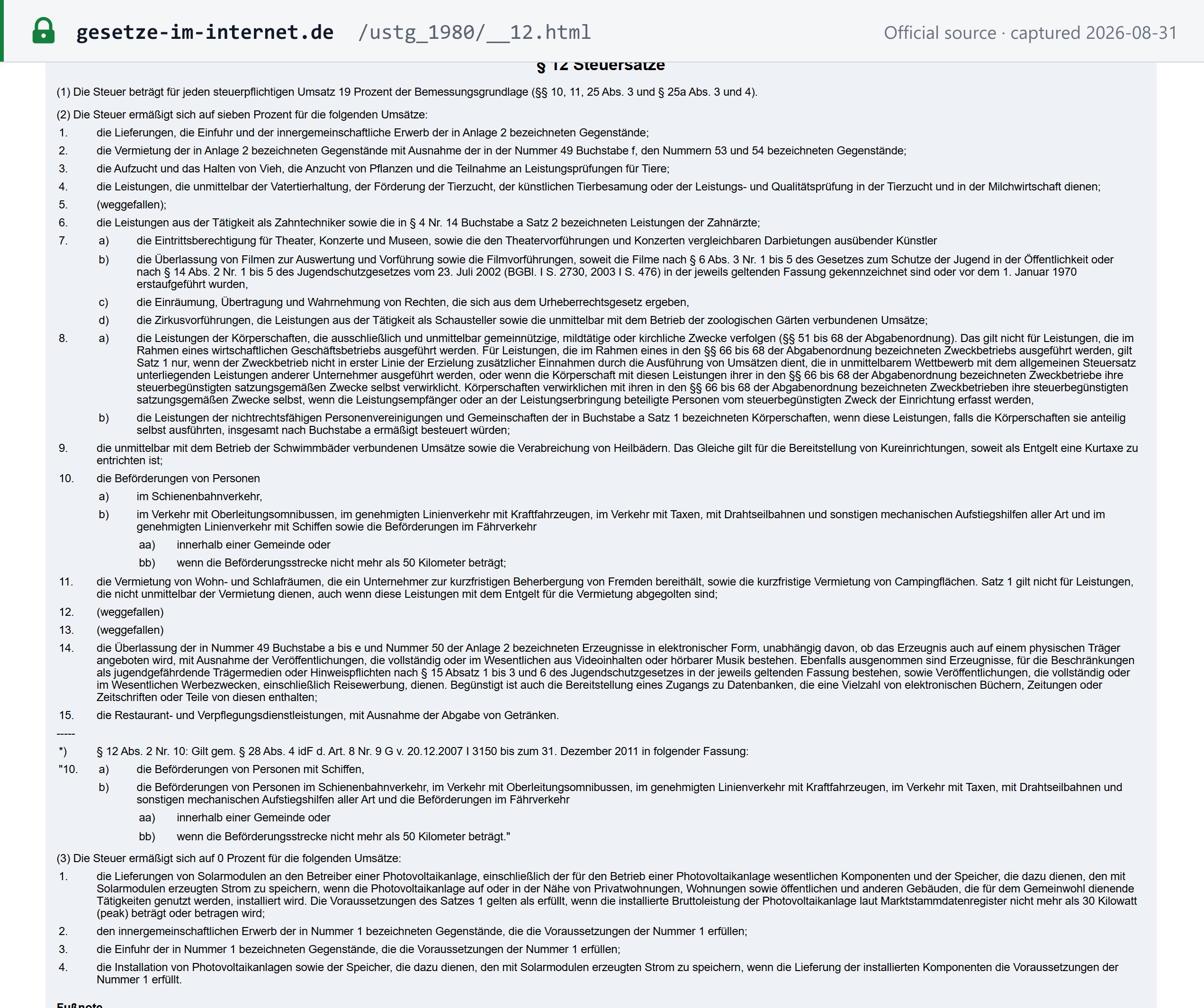
| Germany | — | 0% on solar modules supplied to the operator of a photovoltaic installation (§ 12(3) UStG) | 2026-08-31 | § 12 UStG |
| Czech Republic | — | Books exempt with a right to deduct since 1 Jan 2024 (§ 71i), which works like a zero rate | 2026-09-29 | Financial Administration (GFŘ) |
Germany's solar zero rate is an example of an Art 98(2) zero rate on Annex III point (10c):
 Source snapshot captured 2026-08-31 — original
Frequently asked questions
What is the minimum VAT rate in the EU?
The standard rate must be at least 15% under Article 97 of the VAT Directive, a floor made permanent by Directive (EU) 2018/912. There is no maximum. Reduced rates must be at least 5% (Article 98(1)). A rate below 5%, or a zero rate, is allowed only on at most seven Annex III points (Article 98(2)). Until 1 January 2032, rates above the seven-point cap and temporary Article 105a(2) rates below 12% on supplies outside Annex III may also continue. (VAT Directive; Directive (EU) 2018/912; Directive (EU) 2022/542, checked 2026-10-08)
How many reduced VAT rates can an EU Member State have?
Two reduced rates of at least 5%, on up to 24 Annex III points. A grandfathered parking rate of at least 12% under Article 105a(3) counts as one of those two rates, although it applies outside Annex III and outside the 24-point cap. In addition, one rate below 5% and a zero rate may cover up to seven Annex III points, and super-reduced and zero rates kept under Article 105a(1) count within that rate and that cap. The temporary Article 105a(2) rates, which apply to supplies outside Annex III, and rates above the seven-point cap are not permanent: they must end by 1 January 2032. (Directive (EU) 2022/542, Arts 98 and 105a, checked 2026-10-08)
What is a parking rate?
A parking rate is a reduced rate of at least 12% on supplies that are not listed in Annex III, kept because the Member State was applying it on 1 January 2021 (Article 105a(3)). It is permanent and counts as one of the Member State's two reduced rates. According to the Commission's report COM(2025) 585 of 2 October 2025, parking rates are applied by Ireland (13.5%), Luxembourg (14%), Austria, Greece and Portugal (13%) and Malta (12%). (COM(2025) 585, checked 2026-10-08)
What changes for EU VAT rates in 2030 and 2032?
By 1 January 2030, reduced and zero rates on fossil fuels, other goods with a similar greenhouse-gas impact such as peat, and firewood must end. By 1 January 2032, reduced and zero rates on chemical pesticides and chemical fertilisers must end. Also by 1 January 2032, rates below 12% on supplies outside Annex III, and rates below 5% or zero rates above the seven-point cap, must end, or earlier if the definitive VAT arrangements are adopted first. Super-reduced and zero rates kept under Article 105a(1), and parking rates, are permanent. (Directive (EU) 2022/542, Arts 98(2) and 105a, checked 2026-10-08)
Is a zero VAT rate the same as a VAT exemption?
No. In the VAT Directive a zero rate is an exemption with deductibility of the VAT paid at the preceding stage: the supplier charges 0% and can still recover the VAT on its costs. An exemption without deduction, such as most financial or medical services, carries no VAT, but the input VAT on related costs cannot be recovered. (Directive (EU) 2022/542, Art 98(2), checked 2026-10-08; Vero)
Which VAT rate does an online seller charge EU consumers?
For distance sales of goods and for electronic services to consumers, the seller generally charges the VAT rate of the customer's Member State and can declare it through the One-Stop Shop. Electronically supplied services cannot take reduced rates unless they fall within Annex III points (6), (7), (8) or (13), such as e-books, e-newspapers, broadcasting and live-streamed events. (Directive (EU) 2022/542, Art 98(3), checked 2026-10-08)
Related resources
- Worldwide tax rates — current standard and reduced rates for all 27 Member States
- VAT registration thresholds
- Sibling explainers: Intra-Community supply, EU VAT SME scheme, One-Stop Shop (OSS), Import One-Stop Shop (IOSS), ViDA — VAT in the Digital Age, VAT on digital services, Reverse charge
- Country guides: Austria, Belgium, Croatia, Cyprus, Czech Republic, Estonia, Finland, France, Germany, Greece, Hungary, Ireland, Italy, Lithuania, Luxembourg, Malta, Netherlands, Poland, Portugal, Romania, Slovakia, Spain, Sweden
- Tax-change chronologies: Austria, Belgium, Cyprus, Hungary, Lithuania, Sweden
Reference links
- Council Directive (EU) 2022/542 of 5 April 2022 — rates of VAT (EUR-Lex)
- VAT Directive 2006/112/EC, consolidated version of 14.04.2025 — Arts 94–105b and Annex III (EUR-Lex)
- Council Directive (EU) 2018/912 — permanent 15% minimum standard rate (EUR-Lex)
- Report COM(2025) 585 of 2 October 2025 — VAT rate derogations applied by Member States (EUR-Lex)
- European Commission, VAT rates and Taxes in Europe Database (TEDB)