VAT withholding regimes — withholding agents and split payment
VAT withholding moves the payment of VAT, not the liability for it. The supplier still charges VAT on its invoice and stays the taxpayer. Under withholding, a designated payer (a public body, a large company, a bank, a card issuer or a platform) pays some or all of that VAT straight to the tax authority, and the supplier credits it in its own return. Under split payment, the EU variant, the buyer pays the VAT itself: to the Treasury in Italy, into the supplier's blocked VAT account in Poland.
There is no single owner of the concept. Each country designs its own regime in national law. Inside the EU, a member state needs a Council authorisation under Article 395 of the VAT Directive (Directive 2006/112/EC), because the Directive makes the supplier pay the VAT it charges (Article 206). Italy and Poland hold such authorisations; Romania's split VAT had none and was repealed from 1 February 2020.
Two neighbouring regimes are often confused with withholding:
- Reverse charge. The customer becomes liable for the VAT and self-assesses it. The supplier's invoice carries no VAT.
- Marketplace deemed supplier. The platform becomes the supplier for VAT purposes and charges the VAT itself.
Under withholding, the supplier charges the VAT and remains liable for it. Only the cash flow moves.
How it works — four families
Every regime below shares one structure: the supplier invoices VAT, the payer diverts some or all of it at the moment of payment, and the supplier's return reconciles the difference. What differs is who diverts it, how much, and where the money goes.
| Family | Who diverts the VAT | Where it goes | Examples |
|---|---|---|---|
| 1. Split payment | The buyer | The VAT to the Treasury (Italy), or all or part of it into the supplier's own blocked VAT account (Poland) | Italy, Poland |
| 2. Withholding agents | Designated buyers (large companies, banks, insurers) | A share of the VAT to the tax authority; the supplier gets a certificate | Kenya, Tanzania, Morocco, Peru, Mexico, China |
| 3. Government-body withholding | Public bodies paying their suppliers | A share of the VAT to the tax authority | Philippines (Italy's split payment is the EU analogue) |
| 4. Payment-intermediary collection on cross-border digital services | Banks, card issuers, payment institutions | The VAT on a foreign digital seller's sale, deducted before the seller is paid | Argentina, Chile, Colombia, Indonesia, Zimbabwe |
1. Split payment
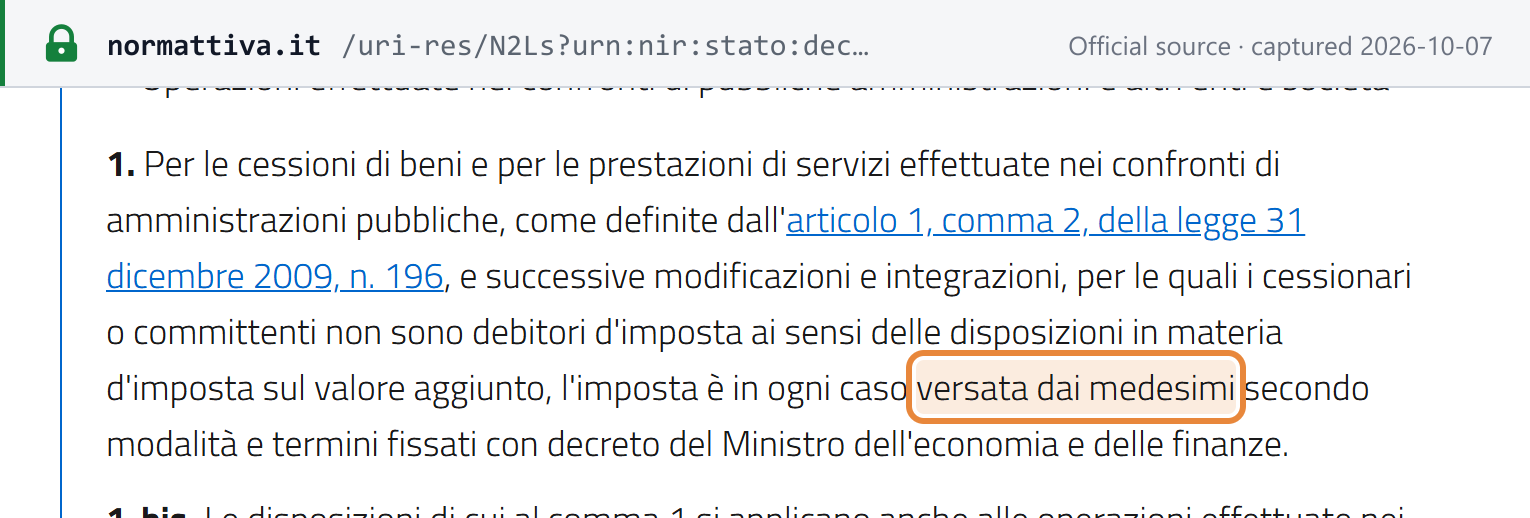
Italy — scissione dei pagamenti (DPR 633/1972, article 17-ter). For supplies of goods and services to public administrations, the VAT "è in ogni caso versata dai medesimi" — in every case paid by the buyer, under terms set by ministerial decree. The supplier invoices VAT, receives the net amount, and the public buyer pays the VAT to the Treasury. Comma 1-bis extends the regime to public economic entities, foundations whose endowment fund is at least 70% held by public bodies, companies controlled by the Presidency of the Council or by ministries, and companies controlled by public bodies or at least 70% publicly owned. Comma 1-sexies excludes services whose fees bear income-tax withholding. (Normattiva, DPR 633/1972 art. 17-ter, checked 2026-10-07)
 Source snapshot captured 2026-10-07 — original
Listed companies have been outside Italian split payment since 1 July 2025. Letter d) of comma 1-bis, which covered companies in the FTSE MIB index, was suppressed by D.L. 17 June 2025 n. 84 for invoices issued from 1 July 2025. Implementing Decision (EU) 2023/1552 had already deleted the listed-company indent from the EU authorisation from the same date. Comma 1-ter ties the whole article to the life of the EU derogation.
 Source snapshot captured 2026-10-07 — original
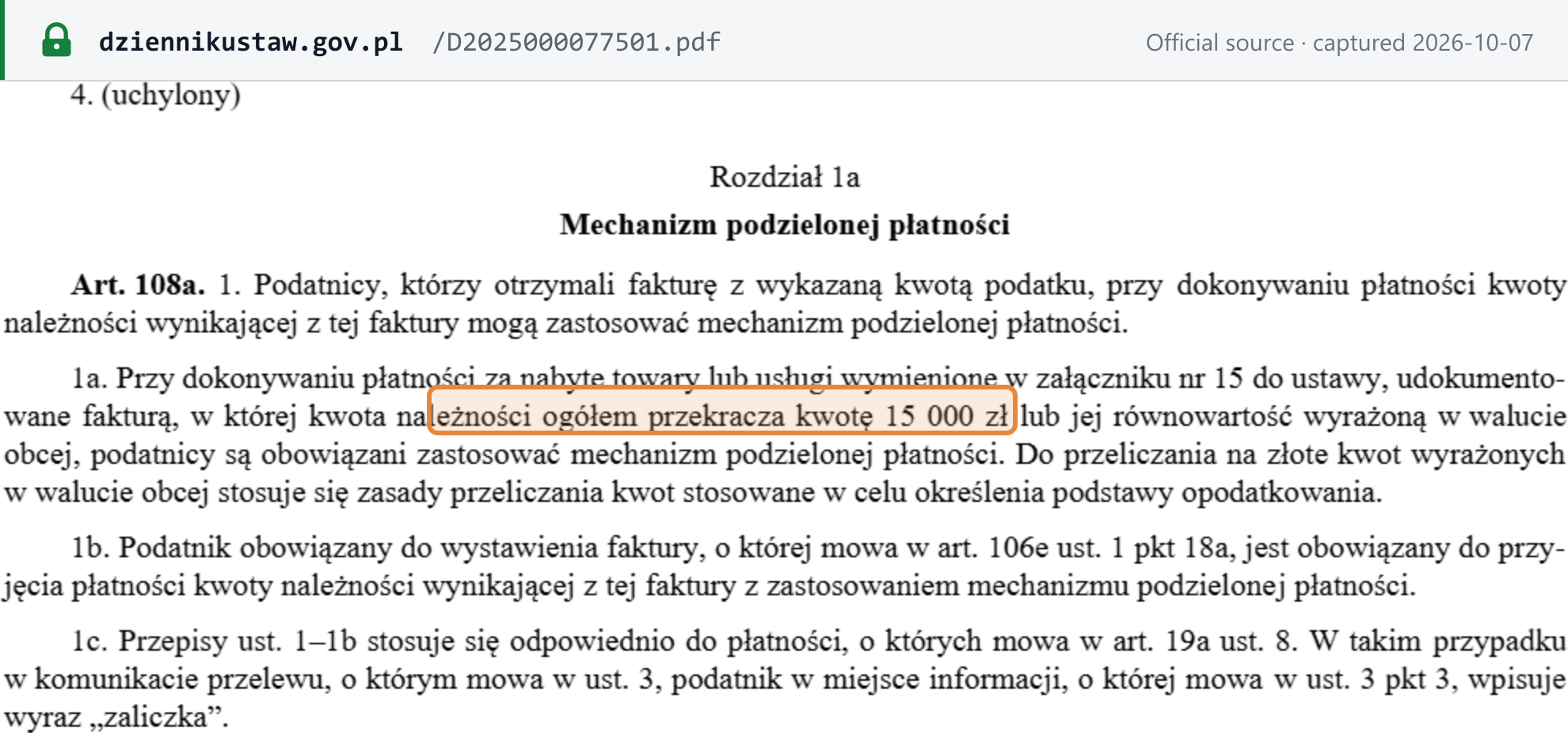
Poland — mechanizm podzielonej płatności (VAT Act, article 108a). A taxpayer that receives an invoice showing VAT may pay it by split payment (ust. 1). It must do so when paying for goods or services listed in Annex 15 to the Act on an invoice whose total exceeds PLN 15,000 or its foreign-currency equivalent (ust. 1a). On invoices that must carry the "mechanizm podzielonej płatności" annotation (art. 106e ust. 1 pkt 18a), the supplier must accept such a payment (ust. 1b). Under the mechanism the buyer pays all or part of the VAT amount shown on the invoice into the supplier's dedicated, blocked VAT account (rachunek VAT) and the rest to its ordinary account (ust. 2). (Dziennik Ustaw 2025 poz. 775, consolidated VAT Act, art. 108a, checked 2026-10-07)
 Source snapshot captured 2026-10-07 — original
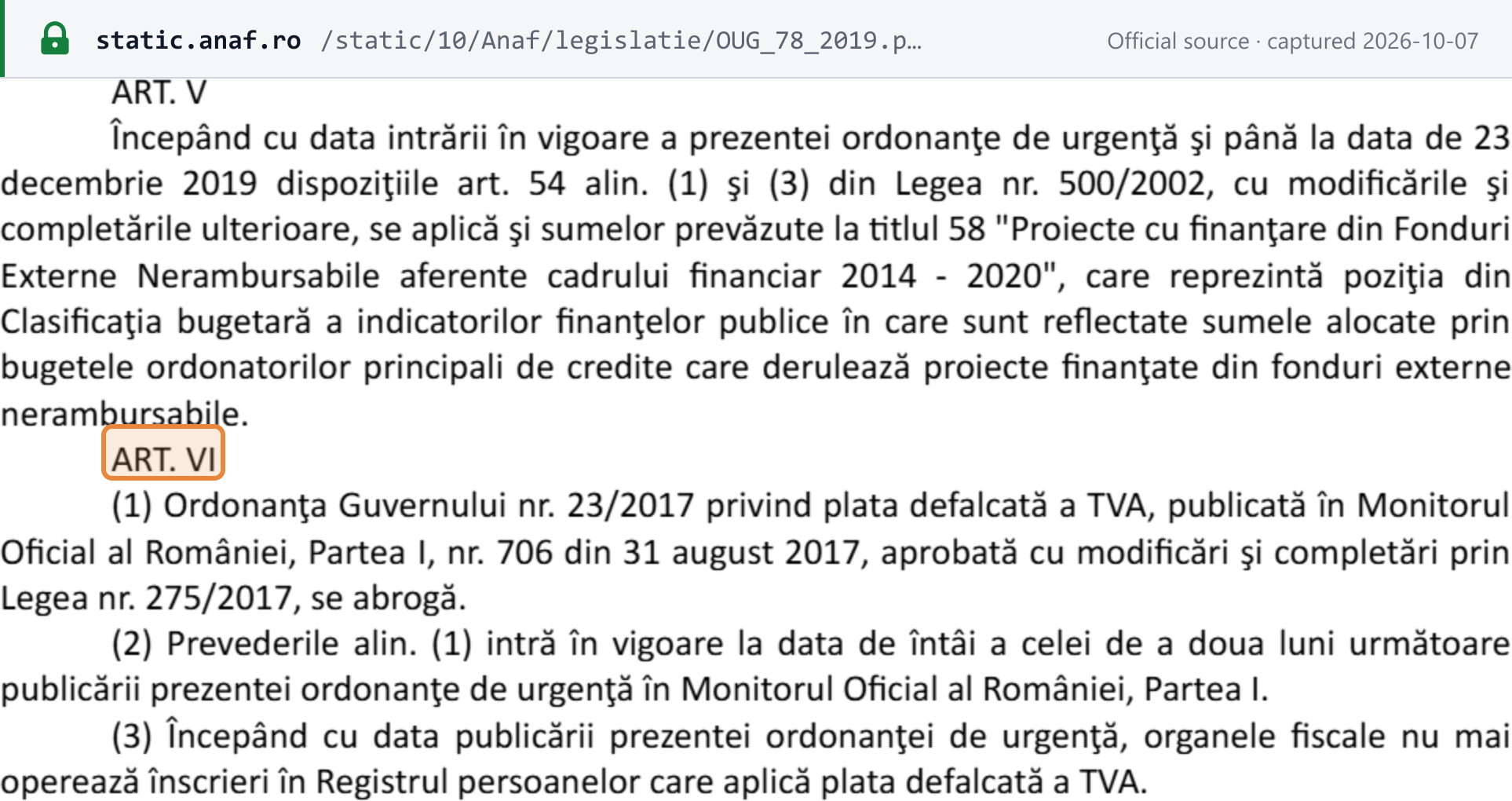
Romania — split VAT, repealed. Ordinance OG 23/2017 on split VAT payment was repealed by emergency ordinance OUG 78/2019 (Monitorul Oficial nr. 1031, 23 December 2019), article VI, with effect from the first day of the second month after publication: 1 February 2020. The ordinance's recitals refer to the European Commission's letter of formal notice in infringement case 2017/2180 on the system's compatibility with EU law. (ANAF, OUG 78/2019, checked 2026-10-07)
 Source snapshot captured 2026-10-07 — original
2. Withholding agents
The tax authority appoints buyers — usually large taxpayers, banks or insurers — as withholding agents. When the agent pays a supplier's invoice it keeps back a share of the VAT, pays that share to the tax authority and gives the supplier a certificate. The supplier still declares the full output VAT and treats the withheld amount as VAT already paid.
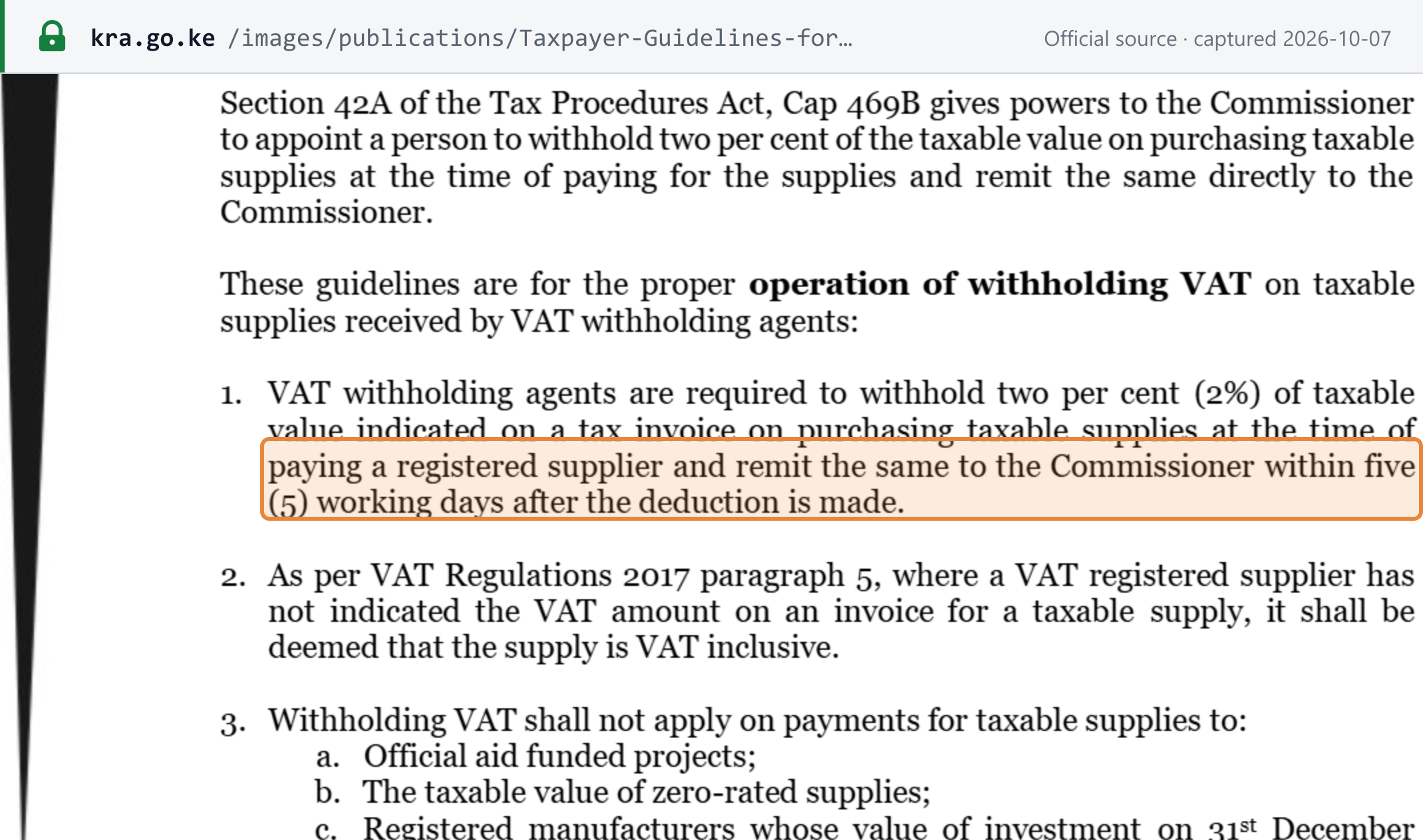
- Kenya. Withholding VAT is charged at 2% of the value of taxable supplies with effect from 7 November 2019, and no VAT is withheld on exempt or zero-rated supplies; the supplier must still file its VAT return and account for the balance. (Kenya Revenue Authority, checked 2026-10-07) Appointed agents withhold 2% of the taxable value shown on the tax invoice when paying a registered supplier and remit it to the Commissioner within five working days after the deduction (Tax Procedures Act s 42A(4B)). (KRA, Taxpayer Guidelines for WHVAT, checked 2026-10-07)
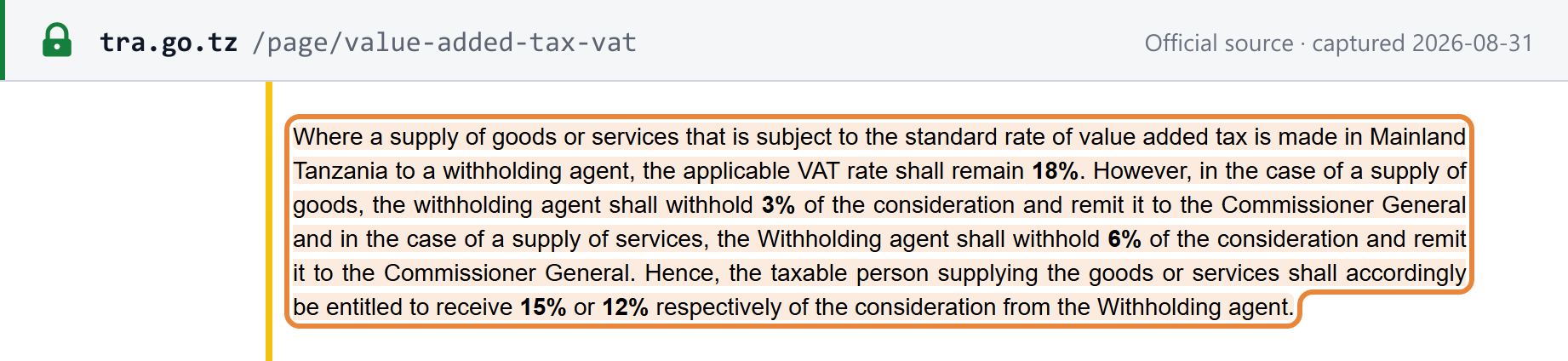
- Tanzania. The VAT rate on a standard-rated supply to a withholding agent stays 18%. The agent withholds 3% of the consideration on goods and 6% on services and remits it to the Commissioner General; the supplier receives the remaining 15 or 12 percentage points of VAT. From 1 July 2026 the agent also files a monthly withholding VAT statement within ten days after the end of each tax period (Finance Act 2026). (Tanzania Revenue Authority, checked 2026-08-31)
- Morocco. Payers in three groups withhold 75% of the VAT at source on certain services and pay it to the tax administration themselves (CGI art. 117-V). Since 1 July 2024 the State, local authorities, public bodies and public enterprises and their subsidiaries withhold on services from VAT-registered providers, and VAT-registered private companies, and VAT-registered individuals taxed on actual or simplified net profit, withhold on services from VAT-registered natural persons (Finance Law 55-23). From 1 July 2026, credit institutions, insurers and reinsurers, and companies with turnover of at least MAD 500 million, also withhold on services from VAT-registered legal persons. The turnover band drops to MAD 350 million on 1 January 2027 and MAD 200 million on 1 January 2028 (Finance Law 50-25). The two private-sector groups withhold 100% instead where the provider has no tax-compliance certificate; public bodies withhold 75% with no certificate test. (Code Général des Impôts 2026, art. 117-V; Bulletin Officiel 7465-bis, checked 2026-10-14)
- Peru. Persons that SUNAT designates as withholding agents (agentes de retención) withhold part of the IGV owed to their suppliers and pay it to the Treasury. The rate is 3% of the transaction amount, IGV included, since 1 March 2014 under Resolución de Superintendencia 033-2014/SUNAT; it was 6% before. The supplier deducts the amount withheld from its own IGV. (SUNAT, checked 2026-10-07)
- Mexico. Digital platforms withhold IVA from individual sellers that use them, under rules in force since 1 June 2020 (LIVA art. 1o.-A BIS; SAT communiqué 015/2020). See the Mexico guide for the wider retention rules.
- China. From 1 November 2026, a domestic entity paying a resident individual for research and development, software, design, consulting, programme production, cultural or education services becomes the VAT withholding agent and withholds at the time of payment (MOF/STA Announcement No. 28 of 2026). (State Taxation Administration, checked 2026-09-21)
 Source snapshot captured 2026-10-07 — original
 Source snapshot captured 2026-10-07 — original
 Source snapshot captured 2026-08-31 — original
3. Government-body withholding
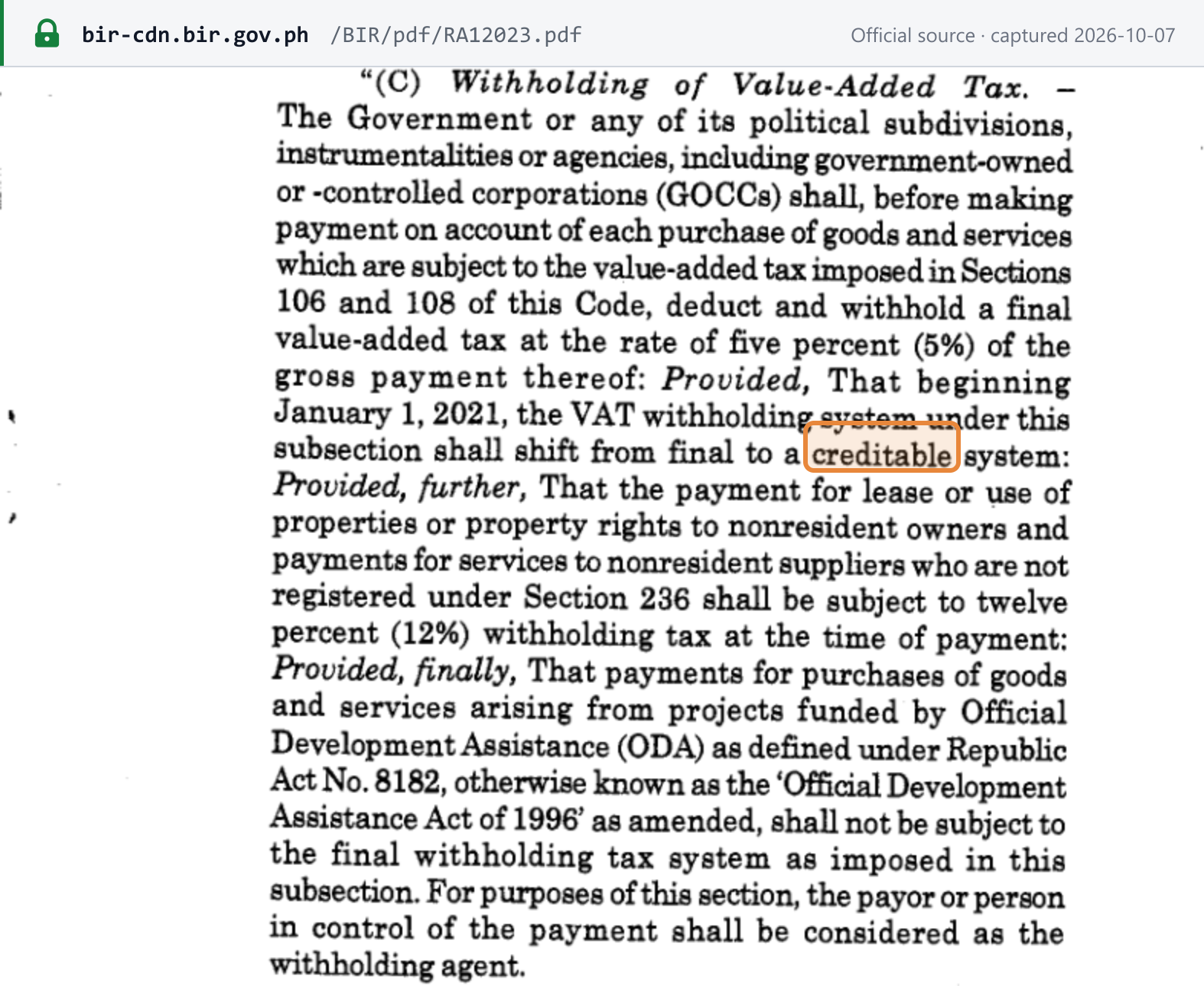
Philippines — NIRC section 114(C), as amended by RA 12023. The government, its political subdivisions, instrumentalities and agencies, including government-owned or -controlled corporations (GOCCs), deduct and withhold VAT at 5% of the gross payment before paying for VATable goods and services. Since 1 January 2021 the system is creditable, not final: the supplier credits the 5% against its own VAT liability. Lease payments to non-resident owners, and payments for services to non-resident suppliers not registered under section 236, bear 12% withholding at the time of payment. Purchases under projects funded by Official Development Assistance are excluded from the final withholding system. The payor is the withholding agent. (BIR, Republic Act No. 12023, section 114(C), checked 2026-10-07)
 Source snapshot captured 2026-10-07 — original
Italy's split payment does the same job inside the EU: it targets public buyers first, but it diverts the whole VAT rather than a share, and it needs an EU derogation.
4. Payment-intermediary collection on cross-border digital services
Several countries make the local bank or card issuer collect the VAT when a consumer pays a foreign digital-services seller. The foreign seller receives the price net of VAT. These rules usually bite only where the seller has not registered and charged the VAT itself; see VAT on digital services by non-resident suppliers for the registration route.
- Argentina — RG 4240. When digital services are paid to non-residents through Argentine entities that facilitate or administer payments abroad, those entities act as collection and settlement agents for the IVA. (ARCA, checked 2026-09-30)
- Chile — Res. Ex. SII 46/2022. Bank and non-bank issuers of payment methods are VAT withholding agents for services from foreign digital providers that must register, file and pay but do not. (SII, 1 August 2022, checked 2026-09-24)
- Colombia — DIAN Resolución 000049 of 2019. Card issuers, prepaid-card sellers and cash collectors withhold IVA on payments to foreign digital providers that opt into the alternative payment system (Estatuto Tributario art. 437-2 num. 8). (DIAN, checked 2026-09-24)
- Indonesia — PMK 49/2026 (SPP-TDLN), from 25 September 2026. Appointed issuers (banks and non-bank payment institutions) collect VAT of 11/111 of the VAT-inclusive price on qualifying purchases of foreign digital goods and services. It creates no new tax or rate, and it does not apply where a foreign seller appointed as a PMSE VAT collector already collects the VAT. (DJP, PENG-6/PJ/2026; PMK 49/2026, checked 2026-10-07)
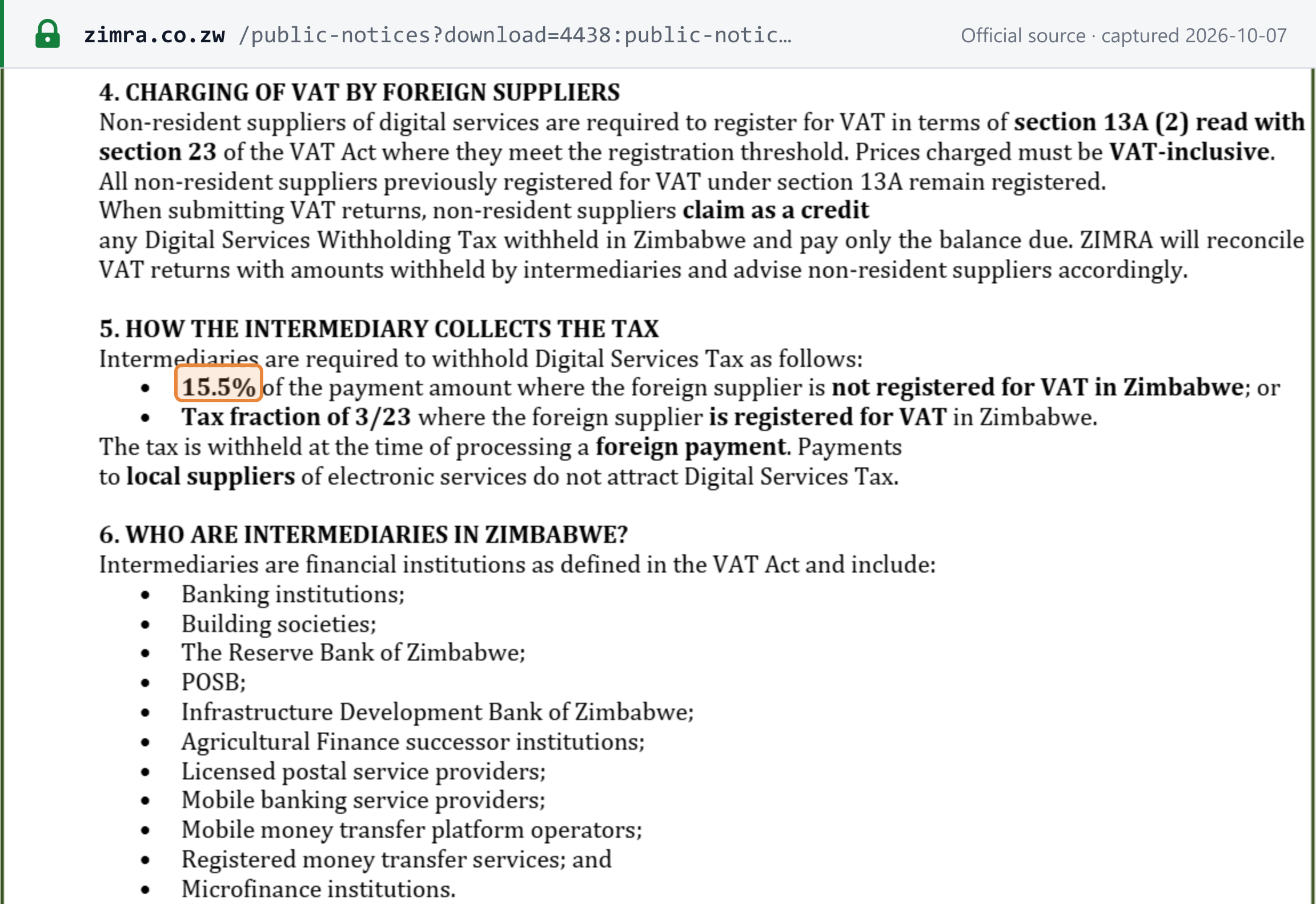
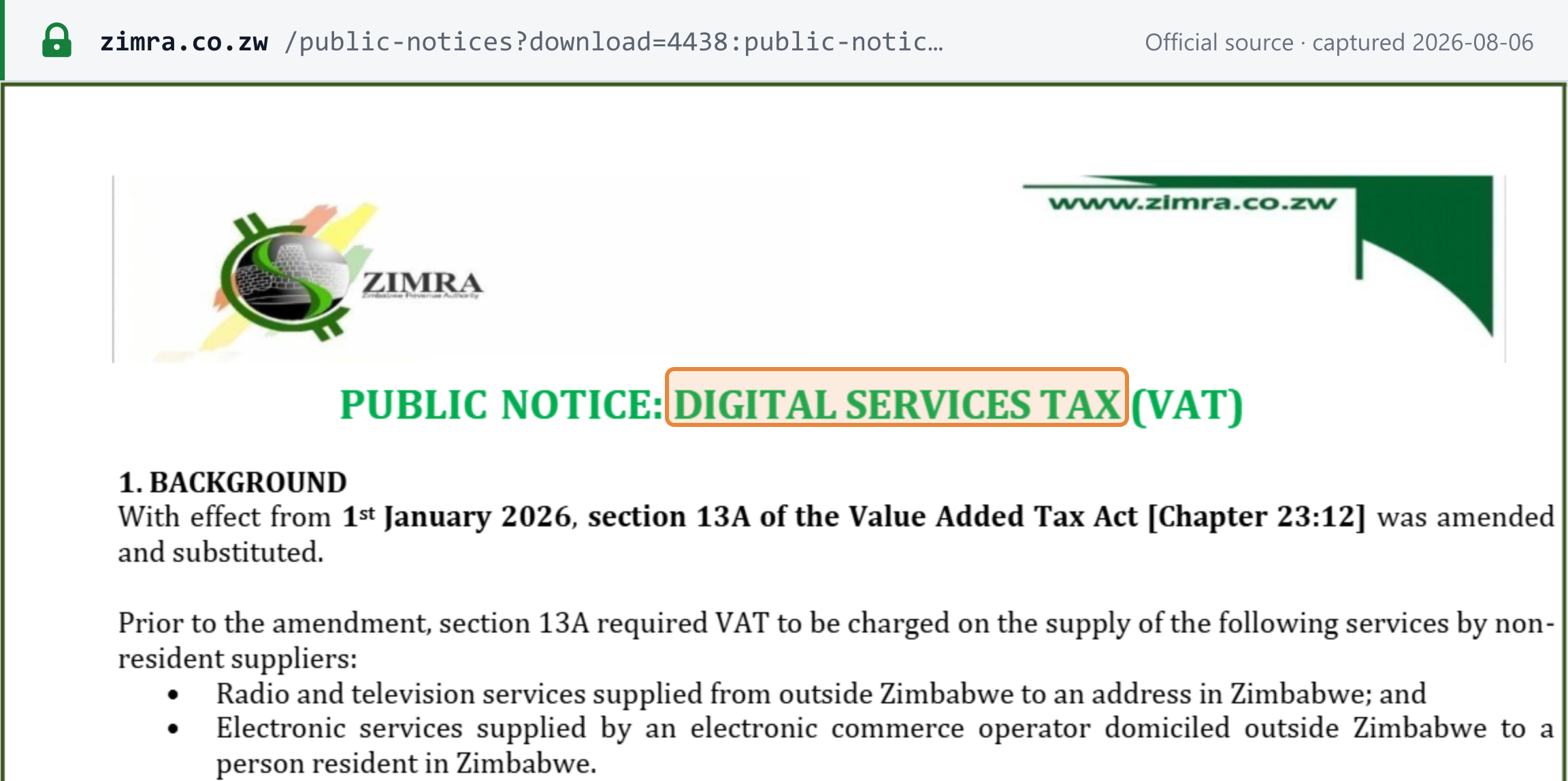
- Zimbabwe — VAT Act section 13A, from 1 January 2026. Banks, building societies, mobile-money operators and other licensed financial institutions withhold 15.5% of payments to non-resident digital-services suppliers that are not registered for VAT in Zimbabwe, or the tax fraction 3/23 where the supplier is registered. Withholding is added to registration, not in place of it: non-resident suppliers that meet the threshold must still register under section 13A(2), and registered suppliers claim the tax withheld as a credit in their VAT returns. (ZIMRA Public Notice 05 of 2026, checked 2026-10-07)
 Source snapshot captured 2026-10-07 — original
 Source snapshot captured 2026-10-05 — original
 Source snapshot captured 2026-09-30 — original
Peru works differently. Legislative Decree 1623, published on 4 August 2024, makes the non-domiciled supplier of digital services and intangibles to individuals who do not carry on a business the IGV withholding or collection agent (agente de retención o percepción) from 1 December 2024: a compliant supplier registers in the RUC and files and pays SUNAT itself. Payment facilitators (banks, electronic-money issuers, Banco de la Nación when paying by card, e-money or wallet, and telecom operators) are named only as a backstop under the new article 49-B: they would collect the IGV where a supplier that SUNAT lists has failed to register, or to file and pay, for two months. That backstop is enacted but not yet in force. DL 1623 brings article 49-B into force only when its own implementing regulation takes effect, and SUNAT says the residual mechanism "se implementará con la norma que lo reglamente a futuro" (will be implemented with the regulation that governs it in future). As at 2026-10-13, no Peruvian bank or card issuer collects IGV under it. (SUNAT, IGV servicios digitales, checked 2026-10-13; DL 1623, El Peruano)
 Source snapshot captured 2026-10-07 — original
Worked example — one invoice, four regimes
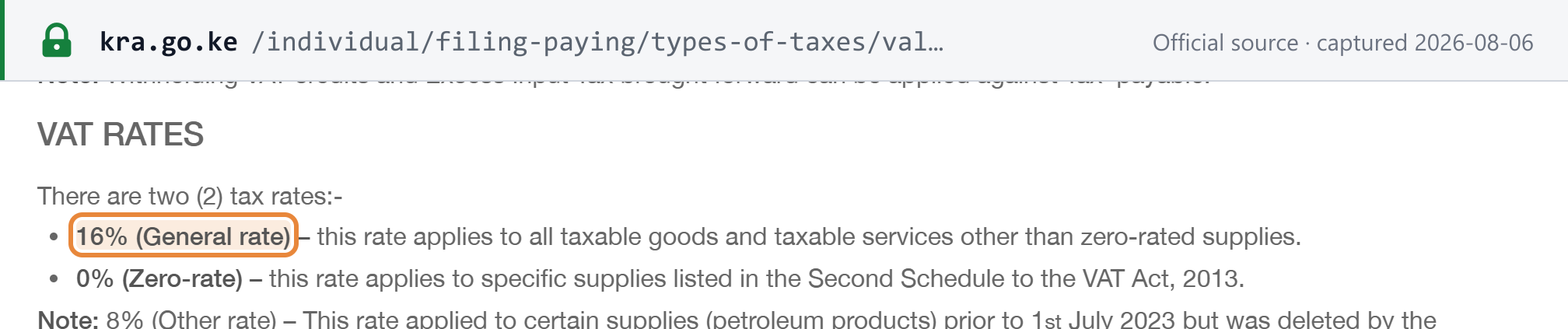
A VAT-registered supplier in Kenya invoices an appointed withholding agent KES 100,000 + 16% VAT = KES 116,000. Kenya's general VAT rate is 16% and withholding VAT is 2% of the taxable value.
| Step | Amount |
|---|---|
| Invoice total | KES 116,000 (net KES 100,000 + VAT KES 16,000) |
| Withheld by the agent and remitted to KRA within five working days after the deduction (2% × KES 100,000) | KES 2,000 |
| Paid to the supplier | KES 114,000 |
| Supplier's return | Declares KES 16,000 output VAT, deducts its input VAT, and sets the KES 2,000 withholding credit against the balance |
Illustration built by LookupTax; figures fictitious.
 Source snapshot captured 2026-08-06 — original
The same KES 100,000 net invoice under the other families:
- Italian split payment. The public buyer pays the net amount to the supplier and pays the VAT itself to the Treasury. The supplier receives no VAT at all.
- Polish split payment. The buyer pays all or part of the VAT amount into the supplier's own blocked VAT account and the rest of the invoice to its ordinary account.
- Tanzanian withholding. The agent keeps 3% (goods) or 6% (services) of the consideration and remits it; the supplier receives the rest.
- Reverse charge, for contrast. The supplier's invoice shows no VAT. The customer self-assesses it, and nothing is withheld because nothing was charged.
Who it affects
- Suppliers to public bodies. Italy (article 17-ter), Morocco (since 1 July 2024) and the Philippines (section 114(C)).
- Suppliers to designated large taxpayers and agents. Kenya, Tanzania, Morocco (the MAD 500 million band from 1 July 2026) and Peru.
- B2B buyers and sellers of fraud-prone goods and services in Poland. Annex 15 supplies on invoices above PLN 15,000.
- Individuals and their domestic payers in China, from 1 November 2026, for the listed services.
- Non-resident digital sellers paid with local cards or banks. Argentina, Chile, Colombia, Indonesia and Zimbabwe. A seller that registers and charges VAT itself is generally outside the intermediary rule (Indonesia excludes PMSE VAT collectors). Zimbabwe is the exception: it withholds from registered sellers too, at the 3/23 tax fraction, and they credit the amount in their returns.
- Non-resident digital sellers in Peru collect the IGV themselves. Payment facilitators would step in only where a listed supplier fails to register or to file and pay, and only once article 49-B is regulated; as at 2026-10-13 that backstop is not yet in force.
The cash-flow cost falls on suppliers. A supplier that charges VAT but does not receive it still pays input VAT on its own purchases. The Council said so when it authorised Italy's regime: suppliers "are not able to offset the input VAT against the output VAT. They may be consistently in a credit position, and may need to ask the tax administration for VAT refunds." (Implementing Decision (EU) 2017/784, recital 6)
Current status and dates
As at 2026-10-07.
EU split-payment authorisations (Article 395)
| Date | What changes | Status | Source |
|---|---|---|---|
| 2015 | Italy authorised to apply split payment to public authorities, to 31 Dec 2017 | Expired; replaced | Implementing Decision (EU) 2015/1401 |
| 1 Jul 2017 | Italy's scope widened to controlled companies and FTSE MIB listed companies; applies to 30 Jun 2020 | Replaced by later extensions | Implementing Decision (EU) 2017/784 |
| 1 Mar 2019 | Poland authorised to require the blocked-VAT-account statement on invoices for Annex goods and services paid by bank transfer; to 28 Feb 2022 | Extended | Implementing Decision (EU) 2019/310 |
| 1 Feb 2020 | Romania's split VAT (OG 23/2017) repealed | In force | OUG 78/2019, art. VI |
| 1 Jul 2020 | Italy extended to 30 Jun 2023 | Extended again | Implementing Decision (EU) 2020/1105 |
| 1 Mar 2022 | Poland extended to 28 Feb 2025 | Extended again | Implementing Decision (EU) 2022/559 |
| 1 Jul 2025 | Listed companies leave Italian split payment | In force | Implementing Decision (EU) 2023/1552, Art 1(1); D.L. 84/2025 |
| to 29 Feb 2028 | Poland's mandatory split payment authorised until this date | In force | Implementing Decision (EU) 2025/373 |
| to 30 Jun 2029 | Italy's split payment authorised until this date; Italy reports to the Commission by 30 Sep 2027 | Implementing Decision (EU) 2026/1728 of 10 July 2026, effective on notification | Implementing Decision (EU) 2026/1728 |
 Source snapshot captured 2026-10-07 — original
The extension for Italy keeps the post-2025 scope. Implementing Decision (EU) 2026/1728 records that listed companies "were excluded from the scope of the special measure from 1 July 2025", and the extension does not bring them back.
 Source snapshot captured 2026-10-07 — original
Poland's 2025 extension also simplified the annex of covered goods and services. Its recital describes the mechanism as applying to supplies "susceptible to fraud and which are generally covered by a reverse charge mechanism and by joint and several liability in Poland".
Other recent and scheduled changes
| Date | Jurisdiction | What changes | Status |
|---|---|---|---|
| 1 Dec 2024 | Peru | Non-domiciled digital suppliers start acting as IGV withholding or collection agents; the payment-facilitator backstop (art. 49-B) is enacted but awaits its regulation (DL 1623) | In force (supplier collection); backstop not yet in force |
| 1 Jan 2026 | Zimbabwe | Section 13A intermediary withholding added alongside non-resident registration | In force |
| 1 Jul 2026 | Morocco | Withholding at source on services extended to credit institutions, insurers and the MAD 500 million band (public bodies, and businesses paying natural-person providers, since 1 Jul 2024) | In force |
| 1 Jul 2026 | Tanzania | Monthly withholding VAT statement; supplier keeps the remaining 15 (goods) or 12 (services) percentage points written into VAT Act s 5(5) | In force |
| 16 Sep 2026 | Dominican Republic | ITBIS withholding under Norma General 02-05 stops on payments to authorised e-CF issuers | In force |
| 25 Sep 2026 | Indonesia | SPP-TDLN payment-intermediary collection starts | In force |
| 1 Nov 2026 | China | Domestic payers withhold VAT on listed services from resident individuals | Enacted |
| 1 Jan 2027 | Morocco | Withholding band drops to MAD 350 million | Enacted |
| 1 Jan 2028 | Morocco | Withholding band drops to MAD 200 million | Enacted |
Jurisdiction table
Every row cites an official source; Last confirmed is the date that source was read. The table lists the regimes covered on this page; other countries run withholding schemes too, and their country guides carry the detail.
| Jurisdiction | Mechanism | Rate / share | Who withholds | Legal basis | Last confirmed | Source |
|---|---|---|---|---|---|---|
| Italy | Split payment to the Treasury | The VAT on the invoice | Public administrations and controlled entities (listed companies out since 1 Jul 2025) | DPR 633/1972 art. 17-ter; Dec. 2017/784 as amended by 2026/1728 (to 30 Jun 2029) | 2026-10-07 | Normattiva; EUR-Lex |
| Poland | Split payment to the supplier's VAT account | All or part of the VAT; mandatory for Annex 15 supplies on invoices above PLN 15,000 | B2B buyer | VAT Act art. 108a; Dec. 2019/310 as amended by 2025/373 (to 29 Feb 2028) | 2026-10-07 | Dziennik Ustaw; EUR-Lex |
| Romania | Split VAT — repealed | — | — | OUG 78/2019 art. VI (from 1 Feb 2020) | 2026-10-07 | ANAF |
| Kenya | Withholding agent | 2% of taxable value; remitted within five working days | Appointed agents | Tax Procedures Act s 42A (since 7 Nov 2019) | 2026-10-07 | KRA |
| Tanzania | Withholding agent | 3% of consideration (goods) / 6% (services) | Withholding agents | VAT Act ss 5, 71 (Finance Act 2026) | 2026-08-31 | TRA |
| Morocco | Withholding at source on services | 75% of the VAT; 100% where a private-sector payer's provider has no compliance certificate (no certificate test for public bodies) | State and public bodies (since 1 Jul 2024); private companies and individuals on actual or simplified net profit, paying natural-person providers (since 1 Jul 2024); credit institutions, insurers and companies with turnover of at least MAD 500 million from 1 Jul 2026 (MAD 350 million from 1 Jan 2027; MAD 200 million from 1 Jan 2028) | CGI art. 117-V (Finance Laws 55-23 and 50-25) | 2026-10-14 | DGI; SGG |
| Philippines | Government withholding (creditable since 1 Jan 2021) | 5% of gross payment; 12% on payments to non-resident owners and unregistered non-resident suppliers | Government bodies and GOCCs | NIRC s 114(C), as amended by RA 12023 | 2026-10-07 | BIR |
| Peru | Withholding agents (domestic) | 3% of the transaction amount | SUNAT-designated agents | RS 033-2014/SUNAT (rate since 1 Mar 2014) | 2026-10-07 | SUNAT |
| Peru | Foreign supplier as withholding or collection agent (digital services); payment facilitators as backstop (enacted, not yet in force pending its regulation) | IGV on the sale | Non-domiciled supplier; once art. 49-B is regulated, banks, e-money issuers and telecom operators where a listed supplier does not comply | DL 1623 (supplier collection from 1 Dec 2024; art. 49-B in force only with its regulation) | 2026-10-13 | SUNAT |
| Argentina | Intermediary collection on digital services | IVA on the payment | Local entities that facilitate or administer payments abroad | RG 4240 | 2026-09-30 | ARCA |
| Chile | Payment-method issuers withhold | IVA on the payment | Bank and non-bank issuers | Res. Ex. SII 46/2022 | 2026-09-24 | SII |
| Colombia | Card issuers withhold (supplier opts in) | IVA on the payment | Card issuers, prepaid-card sellers, cash collectors | ET art. 437-2 num. 8; DIAN Res. 000049/2019 | 2026-09-24 | DIAN |
| Indonesia | Payment-intermediary collection on cross-border digital purchases | 11/111 of the VAT-inclusive price | Appointed banks and payment institutions | PMK 49/2026 (from 25 Sep 2026) | 2026-10-07 | DJP |
| Zimbabwe | Intermediary withholding on non-resident digital services | 15.5% (unregistered supplier); 3/23 tax fraction (registered) | Banks, mobile-money operators, financial institutions | VAT Act s 13A (from 1 Jan 2026) | 2026-10-07 | ZIMRA |
| Mexico | Platform withholding | Share of the IVA set by law | Digital platforms | LIVA art. 1o.-A BIS (from 1 Jun 2020) | 2026-09-24 | SAT |
| China | Payer withholds on payments to resident individuals | Sales amount × levy rate | Domestic entities | MOF/STA Announcement No. 28 of 2026 (from 1 Nov 2026) | 2026-09-21 | STA |
 Source snapshot captured 2026-08-06 — original
Related changes from the feed
- 2026-09-25 — Indonesia began collecting VAT on cross-border digital purchases through designated payment intermediaries (SPP-TDLN) under PMK 49/2026, at 11/111 of the VAT-inclusive price, except where a PMSE VAT collector already collects it. (Directorate General of Taxes) — see event
- 2026-09-16 — The Dominican Republic's DGII stopped ITBIS withholding under Norma General 02-05 on payments to legal persons authorised as electronic issuers where the transaction is invoiced with an e-CF (Norma General 02-2026). (DGII) — see event
- 2026-09-03 — China's MOF and STA published Announcement No. 28 of 2026: from 1 November 2026 domestic entities withhold VAT when paying resident individuals for listed services. (State Taxation Administration) — see event
- 2026-08-31 — Brazil's NF-e portal published Nota Técnica 2026.006, adding layout group YC to link the fiscal document to the payment transaction ahead of IBS and CBS split payment; production implementation is scheduled for 3 November 2026. (Portal Nacional da NF-e) — see event
- 2026-08-27 — Uruguay's DGI reset its VAT collection-at-source (percepción) regime for fresh meat, applied by slaughterhouses and importers, from 1 September 2026 (Resolutions 1983/2026 and 1984/2026). (DGI / IMPO) — see event
- 2026-07-10 — Council Implementing Decision (EU) 2026/1728 of 10 July 2026, effective on notification, extends Italy's split-payment derogation to 30 June 2029 for public authorities and public-authority-controlled companies. (Publications Office of the EU) — see event
- 2026-06-30 — Tanzania's withholding agents withhold 3% of the consideration on goods and 6% on services from 1 July 2026; the VAT rate stays 18%. (Tanzania Revenue Authority) — see event
- 2026-06-30 — Tanzania's Finance Act 2026 requires withholding agents to file a monthly withholding VAT statement within ten days after the end of each tax period, from 1 July 2026. (Government Printer / OSG e-Library) — see event
- 2026-06-23 — Chile's SII opened a voluntary full VAT withholding regime for agricultural services, under which eligible buyers withhold 100% of the IVA on a purchase invoice (Res. Ex. SII 83). (SII) — see event
- 2026-06-18 — Dominican Republic Law 30-26 created an ITBIS perception on imports by informal importers, applied by customs on the taxable base plus 30% gross added value. (DGII) — see event
- 2026-01-19 — ZIMRA announced that, from 1 January 2026, financial institutions withhold VAT on payments to non-resident digital-services suppliers under the substituted section 13A. (ZIMRA) — see event
- 2025-12-16 — Morocco's Finance Law 50-25 extended VAT withholding at source on services, from 1 July 2026, to credit institutions, insurers and companies with turnover of at least MAD 500 million, withholding 75% of the VAT, or 100% where the provider has no tax-compliance certificate. (Secrétariat Général du Gouvernement) — see event
Frequently asked questions
My Italian public-sector customer paid me net of VAT. Is that correct?
Yes, if the customer is inside the scope of split payment (scissione dei pagamenti) under article 17-ter of DPR 633/1972. You still issue an invoice showing VAT, but the public administration pays the VAT directly to the Treasury and pays you only the net amount. Listed companies have been outside the regime since 1 July 2025. The EU authorisation runs to 30 June 2029 (Council Implementing Decision (EU) 2026/1728).
What is the difference between split payment and reverse charge?
Under split payment the supplier still charges VAT and remains liable for it; only the payment of the VAT is redirected, to the Treasury (Italy) or to the supplier's own blocked VAT account (Poland). Under reverse charge the supplier charges no VAT and the customer becomes liable for it and self-assesses it.
When is split payment mandatory in Poland?
When paying for goods or services listed in Annex 15 to the VAT Act on an invoice whose total exceeds PLN 15,000 or its foreign-currency equivalent (VAT Act article 108a ust. 1a). Below that, or for other supplies, split payment is optional for the buyer. The supplier must accept a split payment only on invoices that must carry the split-payment annotation (article 106e ust. 1 pkt 18a; article 108a ust. 1b). The EU authorisation runs to 29 February 2028 (Council Implementing Decision (EU) 2025/373).
A Kenyan customer deducted 2% from my invoice. Can I recover it?
Yes. Withholding VAT in Kenya is 2% of the value of taxable supplies, and the amount withheld is credited against the VAT you owe in your own return, which you must still file. No VAT should be withheld on exempt or zero-rated supplies; VAT withheld on them is refundable (Kenya Revenue Authority).
Why did an Indonesian bank deduct VAT from my digital sales?
Since 25 September 2026, under PMK 49/2026 (SPP-TDLN), appointed banks and payment institutions collect VAT of 11/111 of the VAT-inclusive price on qualifying purchases of foreign digital goods and services by Indonesian consumers. It does not apply to transactions on which you already collect VAT as an appointed PMSE VAT collector (Directorate General of Taxes).
Does Romania still use split VAT?
No. Romania's split VAT system under OG 23/2017 was repealed by emergency ordinance OUG 78/2019, article VI, with effect from 1 February 2020 (ANAF).
Related resources
- Reverse charge — when the customer, not the supplier, is liable for the VAT
- Marketplace deemed supplier rules — when the platform becomes the supplier
- VAT on digital services by non-resident suppliers — the registration route that payment-intermediary collection backs up
- Worldwide VAT and GST rates
- Country guides: Italy, Poland, Romania, Kenya, Tanzania, Philippines, Argentina, Mexico, Zimbabwe, China, Brazil, Turkey (partial VAT withholding, tevkifat), Bangladesh, South Korea, Vietnam
- Tax-change chronologies: Italy, Poland, Tanzania, Morocco, Indonesia, Zimbabwe, China, Chile, Dominican Republic, Brazil
Reference links
- DPR 633/1972, article 17-ter (Normattiva) — Italian split payment
- Council Implementing Decision (EU) 2017/784, 2023/1552 and 2026/1728 — Italy's Article 395 derogation
- Polish VAT Act, consolidated text (Dz.U. 2025 poz. 775) — article 108a
- Council Implementing Decision (EU) 2025/373 — Poland's derogation to 29 February 2028
- OUG 78/2019 (ANAF) — repeal of Romania's split VAT
- Republic Act No. 12023 (BIR) — Philippine NIRC section 114(C)
- SUNAT — Régimen de Retenciones del IGV
- Kenya Revenue Authority — Value Added Tax
- DJP — SPP-TDLN announcement