How to Register for VAT in Germany
Germany runs VAT registration as two separate steps, run by two separate authorities, in a fixed order: the Steuernummer first, from the Finanzamt assigned to you by law, and the USt-IdNr second, from the Bundeszentralamt für Steuern (BZSt). This page covers the mechanics of getting both. For VAT rates, invoice rules, and the Kleinunternehmer exemption, see the Germany VAT guide; for the exact number formats, see the Germany Tax ID guide.
Who must register
Germany has no VAT registration threshold, for anyone. Under §2 UStG, any Unternehmer that starts a VAT-taxable activity in Germany must notify the tax authorities, whatever the turnover:
"Unternehmer im Sinne des § 21 Absatz 1 Satz 2 haben die Aufnahme einer im Geltungsbereich des Gesetzes umsatzsteuerbaren Tätigkeit dem nach der Umsatzsteuer-Zuständigkeitsverordnung zuständigen Finanzamt anzuzeigen, es sei denn, diese Unternehmer erbringen in Deutschland ausschließlich steuerbare und steuerpflichtige Umsätze, die in den besonderen Besteuerungsverfahren nach den §§ 18i bis 18k des Umsatzsteuergesetzes zu erklären sind." (AO §138 Abs. 1 Satz 5) [1]
Two points follow directly from that text:
- The §19 UStG Kleinunternehmer rule is an exemption from charging VAT, not a threshold for registering. The full mechanics — the €25,000/€100,000 figures and the §19(3) waiver of the exemption — are on the Germany VAT guide's Registration and Exemptions section; this page does not restate them.
- The OSS/IOSS carve-out ("es sei denn") is the one exception to "notify." A non-established business whose only taxable-and-liable German turnover is declared under the special OSS/IOSS procedures (§§18i–18k UStG) does not separately notify a German Finanzamt under this rule. The moment the business has any other German-taxable activity — local warehousing, a German establishment, B2B supplies outside OSS's scope — the notification duty re-attaches and it must register with its assigned Finanzamt regardless of OSS enrolment elsewhere.
Deadline: notifications under AO §138 Abs. 1 must be filed within one month of the event that triggers the duty (AO §138 Abs. 4). [1]
Non-established businesses and the Kleinunternehmer rule. §19(1) UStG's exemption is textually limited to turnover by a business established in Germany or in the §1(3) free-port territories. §19(4)/(5) extends an analogous scheme only to businesses established elsewhere in the EU, subject to a €100,000 EU-wide turnover cap and a Kleinunternehmer-Identifikationsnummer issued by their own member state. A business established outside the EU/EEA — the US, the UK since Brexit, Switzerland — has neither route open: not §19(1) (not domestically established) and not §19(4) (not EU-established). It registers and charges German VAT from its first taxable supply. [2]
Fiscal representation is narrower than most readers assume — see Prerequisites and documents below.
Where to register
Where you register depends on whether your business is established in Germany.
Domestic founders file the Fragebogen zur steuerlichen Erfassung electronically through the Mein ELSTER portal. Electronic transmission has been mandatory for business-opening notifications since 1 January 2021, following the Bürokratieentlastungsgesetz III of 22 November 2019; paper is available only on a hardship waiver granted by the Finanzamt. [1] [3]
Non-established businesses do not use that electronic mandate. AO §138 Abs. 1b's mandatory-electronic clause is scoped to "Steuerpflichtige gemäß Absatz 1 Satz 1 bis 3" — the domestic business-opening notifications only. The foreign-entrepreneur VAT notification duty sits in Absatz 1 Satz 4, which that clause does not cross-reference. In practice, non-established businesses use the paper form Fragebogen zur umsatzsteuerlichen Erfassung von im Ausland ansässigen Unternehmern (form code FsEAusUN), sent by post to the Finanzamt the law assigns them — not filed through Mein ELSTER as a first step. (The Voranmeldungen that follow registration are electronic — see After you're registered.) [1]
The Zentrale Zuständigkeit table — which Finanzamt is yours
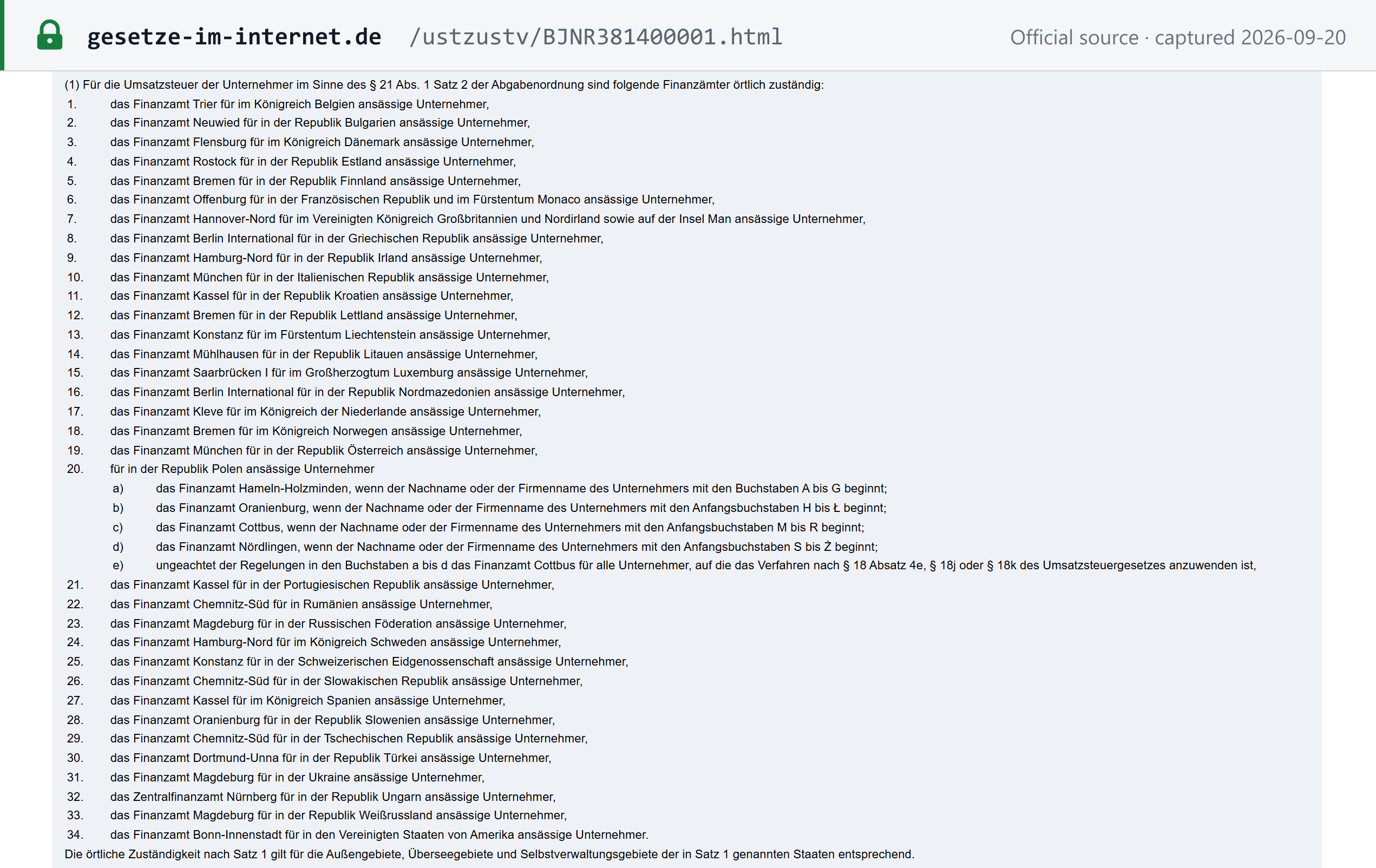
For a business with no domicile, seat, or management in Germany, the competent Finanzamt is fixed by the Umsatzsteuerzuständigkeitsverordnung (UStZustV), keyed to country of establishment — it is not a matter of choice. The table below is the current version, last amended 19 December 2025 (BGBl. 2025 I Nr. 372): [4]
| Country of establishment | Competent Finanzamt |
|---|---|
| Belgium | Finanzamt Trier |
| Bulgaria | Finanzamt Neuwied |
| Denmark | Finanzamt Flensburg |
| Estonia | Finanzamt Rostock |
| Finland | Finanzamt Bremen |
| France + Monaco | Finanzamt Offenburg |
| UK + Northern Ireland + Isle of Man | Finanzamt Hannover-Nord |
| Greece | Finanzamt Berlin International |
| Ireland | Finanzamt Hamburg-Nord |
| Italy | Finanzamt München |
| Croatia | Finanzamt Kassel |
| Latvia | Finanzamt Bremen |
| Liechtenstein | Finanzamt Konstanz |
| Lithuania | Finanzamt Mühlhausen |
| Luxembourg | Finanzamt Saarbrücken I |
| North Macedonia | Finanzamt Berlin International |
| Netherlands | Finanzamt Kleve |
| Norway | Finanzamt Bremen |
| Austria | Finanzamt München |
| Poland — surname/company name A–G | Finanzamt Hameln-Holzminden |
| Poland — H–Ł | Finanzamt Oranienburg |
| Poland — M–R | Finanzamt Cottbus |
| Poland — S–Ż | Finanzamt Nördlingen |
| Poland — any entrepreneur using the OSS/IOSS procedures (§18 Abs. 4e, §18j or §18k UStG) | Finanzamt Cottbus, regardless of the A–Ż letter split |
| Portugal | Finanzamt Kassel |
| Romania | Finanzamt Chemnitz-Süd |
| Russia | Finanzamt Magdeburg |
| Sweden | Finanzamt Hamburg-Nord |
| Switzerland | Finanzamt Konstanz |
| Slovakia | Finanzamt Chemnitz-Süd |
| Spain | Finanzamt Kassel |
| Slovenia | Finanzamt Oranienburg |
| Czech Republic | Finanzamt Chemnitz-Süd |
| Turkey | Finanzamt Dortmund-Unna |
| Ukraine | Finanzamt Magdeburg |
| Hungary | Zentralfinanzamt Nürnberg |
| Belarus | Finanzamt Magdeburg |
| United States | Finanzamt Bonn-Innenstadt |
| Any other country | Finanzamt Berlin International (catch-all, §1 Abs. 2 UStZustV) |
Three refinements sit outside the main table:
- The assignment also extends to each listed state's outlying, overseas, and self-governing territories (§1 Abs. 1 Satz 2 UStZustV).
- Businesses using the non-Union OSS scheme for third-country digital services (§18 Abs. 4c UStG) are assigned to the BZSt itself, not a Finanzamt (§1 Abs. 2a UStZustV).
- A third-country business already enrolled in another EU member state's IOSS scheme (§18j UStG) is treated as established in that other member state for IOSS purposes and is not routed through this table at all (§1 Abs. 2b UStZustV).
The BZSt publishes the identical allocation as its own two-page overview, confirming the statute is being applied as published. [5]
Prerequisites and documents
The non-established-business intake questionnaire (FsEAusUN) asks for, among other things: [6]
- Company or individual identification, the foreign seat address, and — if different — the place of management.
- For corporations and partnerships, an attached Einlageblatt Körperschaften und Gesellschaften (FsEEBlKoeGes) plus an extract from the foreign commercial register.
- Optional tax-advisor details, and a Vollmacht (power of attorney) or Empfangsvollmacht (power to receive correspondence) if a representative signs.
- Bank details — domestic or foreign IBAN — for refunds and SEPA direct debit.
- The expected start and end date of the German activity.
- The business's own tax registration abroad — home Finanzamt or tax office, and tax number. EU entrepreneurs additionally provide a residency certificate or their home-state USt-IdNr; third-country (Drittland) entrepreneurs must provide a residency certificate (Ansässigkeitsbescheinigung) from their home tax authority — this is stated as required, not optional.
- Estimated German turnover for the year of business opening and for the following year — this is the figure that decides your filing frequency; see After you're registered.
- Estimated net VAT payable or refund position for the current year.
- An election between Soll-Versteuerung (accrual) and Ist-Versteuerung (cash accounting). Ist-Versteuerung is available where annualised turnover for the founding year is not expected to exceed the current statutory ceiling of €800,000 under §20 UStG. [7] The FsEAusUN form itself prints €600,000 for this figure — that printed threshold is out of date; use €800,000. A current edition exists. BMF-Schreiben of 16 July 2026 (GZ III C 3 – S 7532/00030/011/043) replaces the 2021 and 2023 letters and prints the correct €800,000. It is published on bundesfinanzministerium.de rather than bzst.de, which is why the state-portal mirrors still circulate the stale figure. [BMF]
- A checkbox to request a USt-IdNr in the same submission, for intra-Community trade.
The copies of this form available on state finance-ministry portals are watermarked with a 2021 revision. The data fields and process logic described above are unlikely to have changed even where printed figures have — verify any printed threshold on the form itself against the current statute before relying on it.
Scoped to marketplace sellers. The administrative guidance UStAE 22f.2 states the duty applies to businesses intending to make supplies through an electronic interface that are taxable in Germany — so an ordinary non-resident registrant who does not sell via a marketplace does not need to name an Empfangsbevollmächtigter. (Sourced via a UStAE reproduction; the BMF's own HTML for this passage is bot-walled.)
"Unternehmer ohne Wohnsitz oder gewöhnlichen Aufenthalt, Sitz oder Geschäftsleitung im Inland, in einem anderen Mitgliedstaat der Europäischen Union oder in einem Staat, auf den das Abkommen über den Europäischen Wirtschaftsraum anwendbar ist, haben mit der Antragstellung auf steuerliche Erfassung einen Empfangsbevollmächtigten im Inland zu benennen." (§22f(1) UStG) [8]
The sentence sits inside a provision titled "special duties of electronic-marketplace operators," and the preceding sentence is expressly scoped to marketplace-facilitated sales. Whether this duty binds every third-country VAT applicant or only those selling through an in-scope electronic marketplace is not settled by the statute's bare text — treat it as an open question to raise with your Finanzamt or adviser rather than a confirmed universal requirement.
Fiscal representation is narrower than most readers assume. German law does not offer a general-purpose fiscal representative to any non-established business. §22a UStG permits a Fiskalvertreter only for a business that has no domicile, seat, management, or branch in Germany or the §1(3) territories, and makes exclusively tax-exempt supplies in Germany, and cannot deduct input tax:
"Ein Unternehmer, der weder im Inland noch in einem der in § 1 Abs. 3 genannten Gebiete seinen Wohnsitz, seinen Sitz, seine Geschäftsleitung oder eine Zweigniederlassung hat und im Inland ausschließlich steuerfreie Umsätze ausführt und keine Vorsteuerbeträge abziehen kann, kann sich im Inland durch einen Fiskalvertreter vertreten lassen." (§22a(1) UStG) [9]
An ordinary non-resident business making ordinary taxable supplies in Germany — the common cross-border e-commerce or goods case — cannot appoint a Fiskalvertreter at all; it registers and files itself, optionally using a tax advisor as an agent, which is a different, non-statutory relationship from Fiskalvertretung. Eligible representatives are limited to Steuerberater and certain authorised freight forwarders/customs agents established in Germany, who must themselves not use the Kleinunternehmer rule, and who need a power of attorney from the foreign business. [9]

The registration process, step by step
- Identify your competent Finanzamt. Non-established businesses use the Zentrale Zuständigkeit table above; domestic founders use the Finanzamt covering their business address.
- File the intake questionnaire with supporting documents. Domestic founders file the Fragebogen electronically via Mein ELSTER. Non-established businesses file the paper FsEAusUN by post, with the documents listed above, and can tick the box to request a USt-IdNr in the same submission.
- Receive your Steuernummer from the assigned Finanzamt.
- Apply for your USt-IdNr from the BZSt, if not already requested. BZSt's guidance states plainly: "Foreign businesses must be registered in Germany before applying for a German VAT number… You can request the VAT number directly while registering at the tax office," or afterwards via BZSt's online application form if already registered. Written applications go to Bundeszentralamt für Steuern, Dienstsitz Saarlouis, 66738 Saarlouis, stating the company's name and address, its German Finanzamt, and its Steuernummer. The VAT number is sent by post only — "Notification via e-mail or telephone is not possible for legal reasons." [10]
- Register for an ELSTER certificate so you can file Umsatzsteuer-Voranmeldungen. Registration "can take up to two weeks (excluding postal transit)." [6]
- Register separately for OSS, if you sell cross-border B2C in the EU — see After you're registered.
Processing time. Neither BZSt's USt-IdNr guidance nor the FsEAusUN materials publish a standard processing time for the Steuernummer or the USt-IdNr (checked 2026-09-20) — treat any specific week-count you see elsewhere as indicative only. The one figure that is officially stated is the ELSTER certificate step above: up to two weeks, excluding postal transit.
Fees. Neither the Fragebogen nor BZSt's VAT-ID guidance states a registration fee, in either direction (checked 2026-09-20).
After you're registered
Filing frequency. The default advance-return period is the calendar quarter; a business whose prior-year VAT exceeded €9,000 files monthly, and the Finanzamt may waive filing entirely at €2,000 or less — see the Germany VAT guide for those figures. Voranmeldungen are due by the 10th day after the period ends. [11]
New registrants — a suspended rule that is due to expire. The statute's baseline (§18(2) Satz 4 UStG) makes filing automatically monthly, with no turnover test, for a business's year of commencing activity and the following year. A later sentence in the same paragraph currently overrides that:
"Für die Besteuerungszeiträume 2021 bis 2026 ist abweichend von Satz 4 in den Fällen, in denen der Unternehmer seine gewerbliche oder berufliche Tätigkeit nur in einem Teil des vorangegangenen Kalenderjahres ausgeübt hat, die tatsächliche Steuer in eine Jahressteuer umzurechnen und in den Fällen, in denen der Unternehmer seine gewerbliche oder berufliche Tätigkeit im laufenden Kalenderjahr aufnimmt, die voraussichtliche Steuer des laufenden Kalenderjahres maßgebend." (§18(2) Satz 6 UStG) [11]
In plain terms: for tax periods 2021 through 2026, a new registrant's filing frequency is decided the ordinary way — from an annualised prior-year figure, or from the turnover estimate the registrant supplies on the Fragebogen/FsEAusUN — tested against the ordinary €9,000/€2,000 thresholds, not by an automatic two-year monthly mandate. This suspension expires at the end of 2026. No extension has been confirmed as of this page's last update (2026-09-20); do not assume either that the automatic monthly rule reverts on 1 January 2027 or that the suspension is extended — check this section again once 2027 rules are published.
Extending the filing deadline. A one-month extension (Dauerfristverlängerung) is available on application. [12] For a monthly filer, the extension is conditional on paying a Sondervorauszahlung (special advance payment) equal to 1/11 of the prior year's total advance payments. A new registrant without a full prior year instead calculates this from the annualised prior-year-fraction figure, or — for a business starting in the current year — from its own expected advance payments for that year:
"Die Sondervorauszahlung beträgt ein Elftel der Summe der Vorauszahlungen für das vorangegangene Kalenderjahr." (§47(1) UStDV) "Hat der Unternehmer seine gewerbliche oder berufliche Tätigkeit im laufenden Kalenderjahr begonnen, so ist die Sondervorauszahlung auf der Grundlage der zu erwartenden Vorauszahlungen dieses Kalenderjahres zu berechnen." (§47(3) UStDV) [13]
The extension application itself is submitted electronically via ELSTER, by the due date of the first Voranmeldung the extension should apply to (§48 UStDV).
Annual return. The Umsatzsteuererklärung is due 31 July of the following year if self-prepared, or the last day of February of the second following year if prepared by a tax advisor — already covered on the Germany VAT guide.
OSS registration. If you sell cross-border B2C goods or digital services in the EU, OSS registration requires you to already hold a German USt-IdNr, which you enter on the OSS application — confirming the sequencing again: Steuernummer → USt-IdNr → OSS, never the reverse. Applications go through the BZSt Online-Portal; participation is EU-wide and can only be registered in one member state; registration generally takes effect from the first day of the calendar quarter following the application. OSS covers only the cross-border B2C supplies declared under the scheme — it does not substitute for a full German VAT registration where the business has a genuine German establishment, local stock, or other German-taxable activity outside OSS's scope. [14]
Display and e-invoicing. The Steuernummer or USt-IdNr must appear on domestic B2B invoices and in a business website's Impressum; the W-IdNr becomes mandatory on invoices from 1 January 2027. Germany's B2B e-invoicing mandate is fully covered on the Germany e-invoicing guide — this page does not restate the rollout timeline.
Proposed, not law: two Jahressteuergesetz 2026 changes to watch
The Federal Government's draft Jahressteuergesetz 2026 (Bundesrat-Drucksache 447/26, sent to the Bundesrat on 14 August 2026) contains two VAT changes that bear on registration. As of 23 September 2026 the Bundesrat's committees have issued recommendations but the Bundesrat has not yet debated the bill (it is scheduled for the Bundesrat's 1068th session on 25 September 2026), and the Bundestag has not passed it. Neither change is law: the dates below are the ones the draft proposes, and they may change in the legislative process. [16]
- VAT groups (Organschaft) by declaration — proposed from 2030. A new §2c UStG would keep the existing financial, economic and organisational integration test, but the group's legal effects would arise only once the controlling company (Organträger) files a declaration with its tax office, with effect for the future. The same applies when further members join, and the declaration could be revoked prospectively for the whole group or for individual members. Partnerships could also be group members. Under the draft, §2c would enter into force on 1 July 2029 and first apply from 1 January 2030. Declarations could be filed from 1 July 2029, taking effect on 1 January 2030, and the current §2(2) no. 2 rule would keep applying until 31 December 2029. [17]
- Marketplace deemed-supplier rule extended to "Schwellenerwerber" — proposed from 1 January 2027. §3(3a) UStG currently treats an electronic interface as the deemed supplier of intra-EU goods sales by non-EU-established sellers only where the customer is a non-taxable person. The draft would extend this to sales to so-called Schwellenerwerber — certain businesses and legal entities whose intra-Community acquisitions follow special rules — transposing the amended Article 14a of the VAT Directive. [17]
Penalties for late registration
No specific fine attaches to a late VAT/business-opening notification itself. AO §379(2) Nr. 1 makes it an Ordnungswidrigkeit (administrative offense, fine up to €25,000 under §379(7)) to fail, incompletely, or not-timely comply with a notification duty — but the cross-reference is specifically to "§138 Absatz 2 Satz 1", which is the different duty for resident taxpayers to report foreign investments and subsidiary holdings:
"Ordnungswidrig handelt, wer vorsätzlich oder leichtfertig … 1. der Mitteilungspflicht nach § 138 Absatz 2 Satz 1 nicht, nicht vollständig oder nicht rechtzeitig nachkommt …" (§379(2) Nr. 1 AO) [15]
It is not a cross-reference to §138 Absatz 1, the business-opening and foreign-entrepreneur VAT notification duty this page is about. No AO or UStG provision found imposes a specific fine for a late §138(1) registration notification. General consequences instead flow from the tax that goes unpaid or unreported once due: an estimated assessment (Schätzung, §162 AO) if returns are not filed, a late-payment surcharge and statutory interest on any back-assessed VAT — already covered with the exact rates on the Germany VAT guide's reverse-charge FAQ — and, where the delay is used to evade tax rather than merely occur, potential exposure under §370 AO (Steuerhinterziehung), a separate and materially more serious matter this page only flags in passing.
Frequently asked questions
Is there a minimum turnover before I must register for German VAT?
No. Germany has no VAT registration threshold for anyone, domestic or foreign. Every Unternehmer within §2 UStG must notify the tax authorities of starting a VAT-taxable activity regardless of turnover. [1] The §19 UStG Kleinunternehmer rule is an exemption from charging VAT once registered, not a threshold that excuses registration, and it is available only to businesses established in Germany or, within a €100,000 EU-wide cap, elsewhere in the EU/EEA — not to third-country businesses. [2] See the Germany VAT guide for the exact Kleinunternehmer figures.
I'm a non-EU company — which Finanzamt handles my registration?
It is assigned by your country of establishment under the Umsatzsteuerzuständigkeitsverordnung, not chosen by you. US-established businesses go to Finanzamt Bonn-Innenstadt; UK-established businesses to Finanzamt Hannover-Nord; Switzerland to Finanzamt Konstanz. A country not listed in the regulation defaults to Finanzamt Berlin International. Businesses using the non-Union OSS scheme for third-country digital services go to the BZSt itself, not a Finanzamt. See the full table above. [4]
Do I receive my Steuernummer and USt-IdNr at the same time?
No. The Steuernummer comes first, from your assigned Finanzamt, as part of registration itself. The USt-IdNr is issued separately by the BZSt — you can request it in the same intake submission or apply afterwards once the Steuernummer already exists. BZSt states plainly that a business must be registered in Germany before applying for a German VAT number, and that it sends the number by post only. [10]
Can I file my German VAT registration through the online ELSTER portal if my business isn't established in Germany?
No, not for the initial registration. AO §138 Abs. 1b's mandatory-electronic clause is scoped to the domestic business-opening notifications (Absatz 1 Satz 1 bis 3); the foreign-entrepreneur VAT notification sits in Satz 4, which that clause does not reach. Non-established businesses file the paper FsEAusUN form by post. Once registered, the Voranmeldungen that follow are filed electronically through ELSTER. [1]
Can I appoint a fiscal representative to handle my German VAT registration?
Only in a narrow case, and probably not yours. §22a UStG permits a Fiskalvertreter only for a non-established business that makes exclusively tax-exempt supplies in Germany and cannot deduct input tax. An ordinary non-resident business making ordinary taxable supplies — the common cross-border goods or services case — cannot appoint one at all under German law; it registers and files itself, optionally using a tax advisor as an agent. [9]
Will I be forced to file monthly VAT returns for my first two years after registering?
Not currently. The baseline rule (§18(2) Satz 4 UStG) makes filing automatically monthly for a new business's first two years, but §18(2) Satz 6 suspends exactly that rule for tax periods 2021 through 2026 — filing frequency instead follows the turnover estimate given at registration, tested against the ordinary €9,000/€2,000 thresholds. [11] This suspension expires at the end of 2026; no extension has been confirmed as of this page's last update (2026-09-20).
What happens if I register for German VAT later than the one-month deadline?
No specific fine attaches to the late notification itself. AO §379(2) Nr. 1's administrative-offense fine is scoped to the separate §138 Absatz 2 Satz 1 duty — resident taxpayers reporting foreign holdings — not to the §138 Absatz 1 duty this page covers. [15] General consequences instead flow from the tax itself once due: an estimated assessment, a late-payment surcharge, and statutory interest on any back-assessed VAT.
Related resources
- Germany VAT guide — rates, invoice rules, Kleinunternehmer thresholds, and filing deadlines.
- Germany Tax ID guide — Steuernummer, USt-IdNr, IdNr, and W-IdNr formats.
- EU VAT verification guide — how to verify a German USt-IdNr once issued, via VIES.
- Germany e-invoicing guide — XRechnung/ZUGFeRD rollout dates.
- Germany tax-change chronology — dated, sourced updates to German tax rules.