Qatar indirect tax guidelines (excise, customs and withholding)
Qatar has no value added tax. As of 29 September 2026, no Qatari VAT law is in force: the General Tax Authority's laws page lists the GCC VAT Agreement only as a regional text that member states must transpose, and none of the GTA's or the Dhareeba portal's tax listings includes VAT. The indirect taxes that do apply are excise tax on tobacco, energy drinks, special-category goods and, since 6 July 2026, sweetened drinks, and customs duty under the GCC unified tariff. For a foreign business selling services into Qatar, the charge it actually meets is the 5% withholding tax that a Qatari customer deducts from the fee. [1] [2] [3]
Overview
No VAT law in force
Qatar has no VAT law in force (as of 29 September 2026). The GCC VAT Agreement has not been implemented in domestic law: the GTA's laws page and its "Taxes in Qatar" page list no Qatari VAT law and no VAT section. [1] [2]
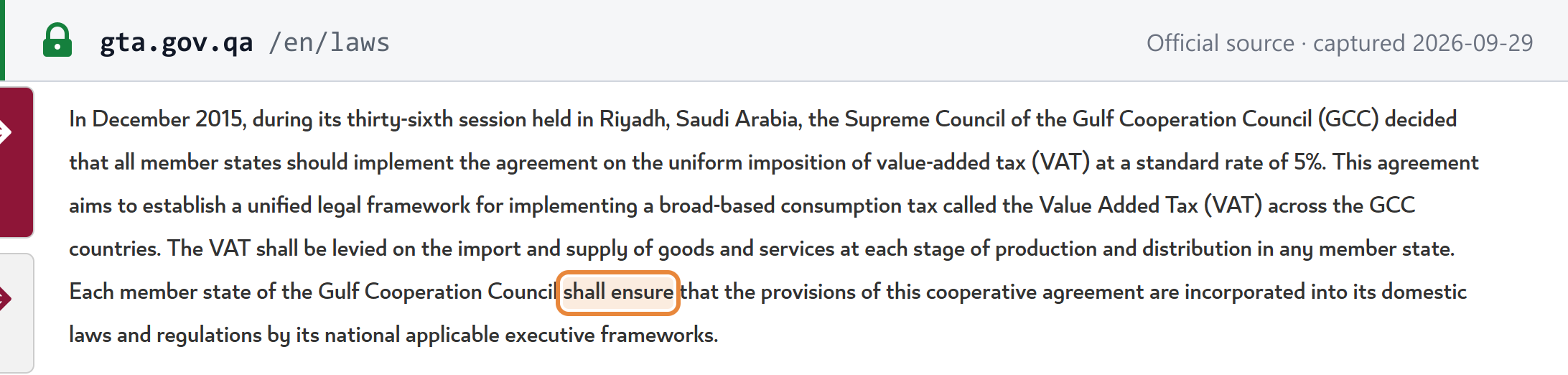
The laws page describes the Agreement this way: "Each member state of the Gulf Cooperation Council shall ensure that the provisions of this cooperative agreement are incorporated into its domestic laws and regulations by its national applicable executive frameworks." [1]
No VAT law or start date has been published. Any VAT figure you see quoted for Qatar is the GCC Agreement's rate, not a Qatari rate.
Excise tax
Excise tax (Arabic: الضريبة الانتقائية) is levied under Law No. 25 of 2018. [24] The GTA states: "The Excise tax was implemented in the State in accordance with Law No. 25 of the year 2018 and took effect in January of 2019." The Law's preamble cites the Unified GCC Excise Tax Agreement, ratified by Decree No. 59 of 2018. [2] [4]
Law No. 2 of 2026 amended the Law. It is dated 24 March 2026 and was published in Official Gazette issue 6 on 7 April 2026. Its Art. 5 makes it effective three months after publication, and the GTA gives the start date as 6 July 2026. It replaced the goods schedule and added a per-litre tax on sweetened drinks. See Rates. [5] [6]
Customs duty
Customs duty is charged under Customs Law No. 40 of 2002 and Decree No. 43 of 2022, whose Art. 1 provides that "The unified customs tariff attached to this decree shall apply." That tariff is the GCC common tariff. [9]
Authority, currency, tax period and layering
- Authority. The General Tax Authority (الهيئة العامة للضرائب, GTA) administers excise tax and income tax, including withholding tax. It was established by Emiri Resolution No. 77 of 2018. The General Authority of Customs collects excise on imports: "The General Authority of Customs shall collect the tax and remit it to the Authority as specified by the executive regulations of this law" (Excise Law Art. 27). [21] [4]
- Currency. Qatari riyals (QAR) throughout this guide.
- Excise tax period. Quarterly. Executive Regulations Art. 13: "The tax period shall be based on each quarter of the calendar year." [4]
- Layering. National only. Neither the Excise Law nor the Customs decree creates a sub-national tax. The Qatar Financial Centre (QFC) runs a separate regime for corporate income tax only: "At present, the QFC only has corporate income tax". [15]
For Qatar's GCC neighbours, which do levy VAT, see Lookuptax's UAE VAT guide and Oman VAT guide.
Registration
VAT registration
Not applicable. There is no VAT law in Qatar (see Overview), so there is no VAT registration, VAT threshold or non-resident VAT threshold.
Who must register for excise tax
Registration is triggered by the activity, not by turnover. Excise Law Art. 6: "Any person engaged in activities involving the production or importation of excise goods, or who is licensed to operate a tax warehouse, must apply for tax registration with the Authority, and a certificate will be issued accordingly." [4]
- When. Apply "within thirty days before starting the activities requiring registration" (Executive Regulations Art. 6).
- Decision. Regs Art. 7: "The Authority shall decide on the registration application within thirty days … If this period expires without a response, the application shall be deemed implicitly rejected." An approved registrant receives a document "which includes a unique tax number".
- Application contents (Regs Art. 6): name and legal form; tax and customs numbers; the date the registration requirements were met; any earlier cancellation; the type of activity; address or trade name; earlier imports; a declaration that the data is accurate; and a signature.
Threshold
None for excise. The GTA's sweetened-drinks guide states: "There is no registration threshold for Excise Tax under the Tiered Volumetric Model on Sweetened Drinks". [7]
Non-resident registration
Excise liability on imports falls on the importer. The Excise Law and its Executive Regulations do not provide for a foreign seller to register for excise in place of the Qatari importer of record.
Registering sweetened-drink products
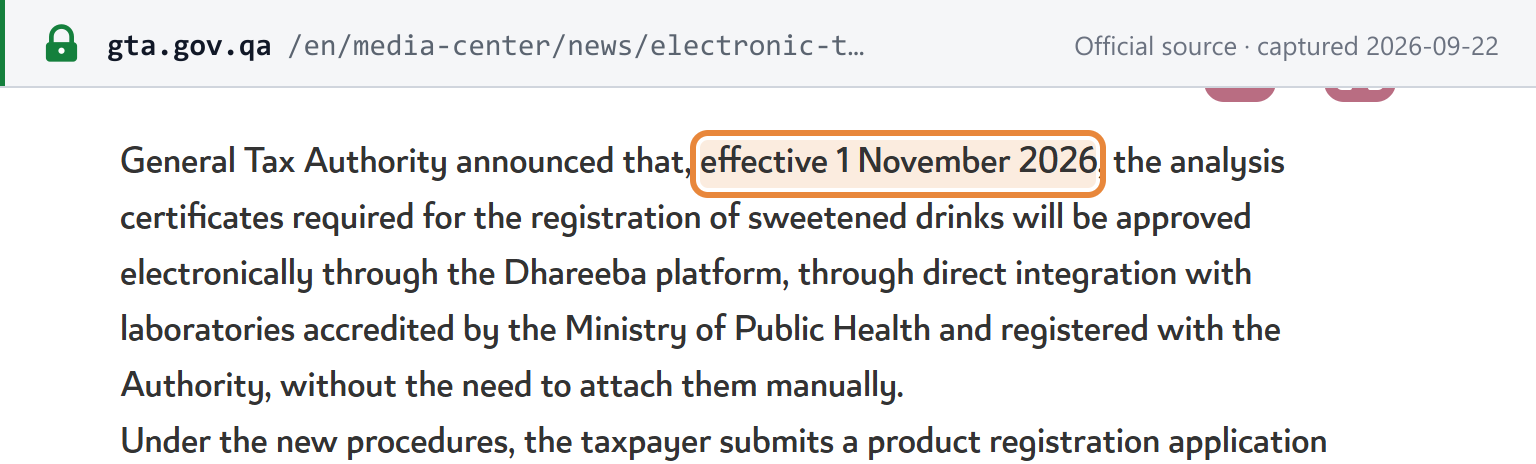
Each sweetened drink must also be registered as a product with its laboratory analysis certificate. From 1 November 2026, the GTA states, "the analysis certificates required for the registration of sweetened drinks will be approved electronically through the Dhareeba platform, through direct integration with laboratories accredited by the Ministry of Public Health and registered with the Authority, without the need to attach them manually." The public list of registered products is on Dhareeba's excise products page. [19]
Income-tax registration and the tax card
A business earning taxable income in Qatar registers with the GTA for income tax, which is where its tax number comes from. Income Tax Law Art. 10: "All taxpayers engaging in any form of business activity or earning taxable income must: 1. Register with the Authority. … 3. Apply to the Authority to obtain a unique tax number." Under Executive Regulations Art. 25(1), as amended by Cabinet Decision No. 3 of 2023, registration is due "within sixty (60) days from the date of obtaining approval from the competent authority to start the activity, registration in the commercial register, or from the first day of income generation, whichever comes first". The tax card shows "The tax number" (Regs Art. 26). [8]
The tax card matters for withholding tax: payments to holders of a tax card are not subject to withholding (see Cross-border rules). But Regs Art. 26(2) provides that "The Authority shall not issue a tax card for income tax purposes to non-resident taxpayers with a permanent establishment in the state." [8]
Tax identification number
According to the information Qatar supplied to the OECD, the GTA tax identification number (TIN) "consists of 10 digits. It begins with the number 5 which refers to the State of Qatar as a member of the … (GCC). The following 9 digits are generated by an algorithm. They include a check digit." The shape is therefore 5XXXXXXXXX. The check-digit algorithm is not published, and the GTA does not publish the structure on its own sites. QFC entities have a separate number: "The TIN structure is T00000 – where the 0s represent the QFC License Number". [15]
For more detail, see Lookuptax's Qatar TIN guide. To check a Qatari counterparty, see how to verify a Qatar commercial registration and how to verify a QCCI membership, or use Lookuptax's Qatar TIN validator. GTA-issued certificates carry a QR code that can be checked on Dhareeba's certificate validation service.
How to register
Excise and income-tax registration are both made on the GTA's Dhareeba portal. For excise, the application falls within the 30 days before the activity starts (Regs Art. 6), and the GTA then has up to 30 days to decide (Regs Art. 7). [4]
Voluntary registration
Not available for excise. Registration follows the activity under Law Art. 6, and Regs Arts. 6–12 provide no voluntary route. [4]
Deregistration
- When. Regs Art. 9: a registrant must "request to cancel their registration within sixty (60) days from the date the registration requirements are no longer met."
- What to submit. The documents listed in Regs Art. 10 include "An inventory report of the warehouse and a final clearance."
- Decision and final returns. The GTA decides "within thirty days", and "The registrant who submits a cancellation request must continue to submit the tax return until the Authority notifies them of the final deregistration" (Regs Art. 11).
The request is made through Dhareeba's cancellation of registration service. [4]
Group registration
Not available. Neither Law No. 25 of 2018 nor its Executive Regulations contains a grouping provision. [4]
Rates
VAT rates
Not applicable. Qatar has no VAT law, so it has no standard, reduced or zero VAT rate.
Excise tax rates (since 6 July 2026)
Law No. 2 of 2026 sets two schedules: Schedule 1 taxes goods as a percentage of price, and Schedule 2 taxes sweetened drinks per litre «حسب محتوى السكر الإجمالي (الطبيعي والمضاف) والمحليات الأخرى» ("according to total sugar content, natural and added, and other sweeteners"). The figures below are the GTA's. The law's schedule tables are not reproduced on the Al Meezan legislation portal. [5] [2]
| Excise good | Rate (as at 2026-09-29) | Basis |
|---|---|---|
| Tobacco products | 100% | Of the higher of the standard price or the retail selling price before tax |
| Energy drinks | 100% | Same basis |
| Special-category goods | 100% | Same basis |
| Sweetened drinks, under 5 g of sugar per 100 ml (low sugar) | Exempt | Per litre, by total sugar content |
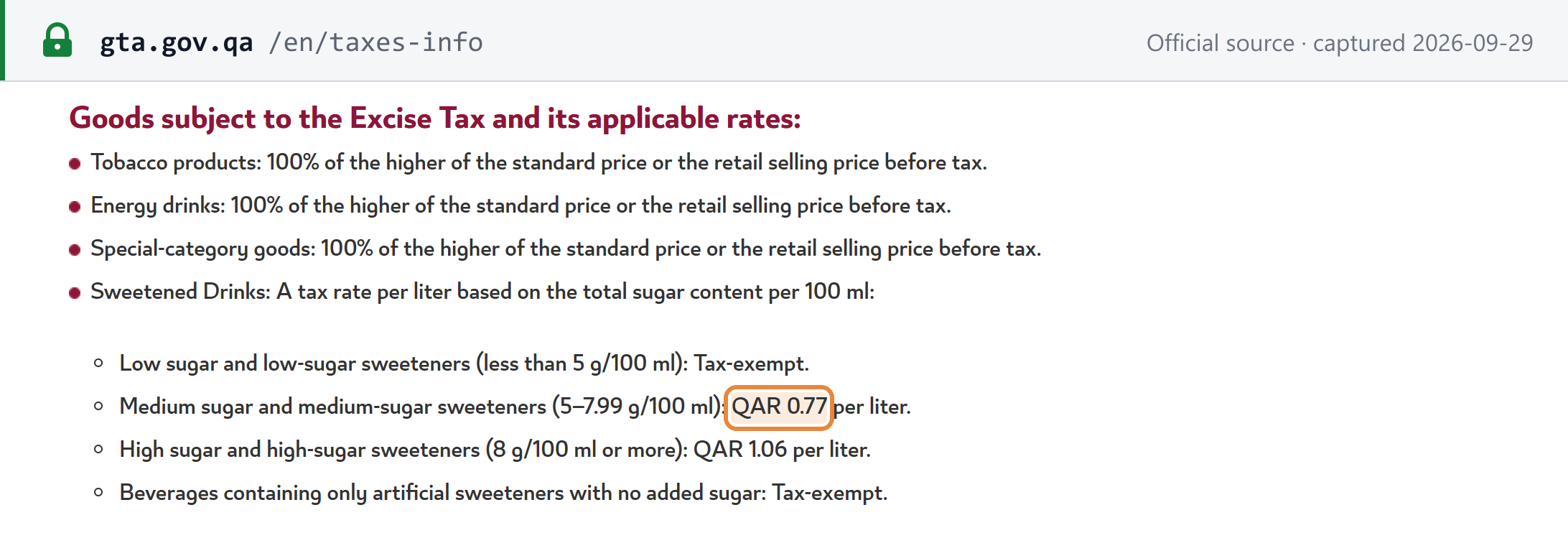
| Sweetened drinks, 5–7.99 g per 100 ml (medium sugar) | QAR 0.77 per litre | Per litre, by total sugar content |
| Sweetened drinks, 8 g or more per 100 ml (high sugar) | QAR 1.06 per litre | Per litre, by total sugar content |
| Drinks with only artificial sweeteners and no added sugar | Exempt | — |
The GTA's rates page reads: "Tobacco products: 100% of the higher of the standard price or the retail selling price before tax. … Medium sugar and medium-sugar sweeteners (5–7.99 g/100 ml): QAR 0.77 per liter. High sugar and high-sugar sweeteners (8 g/100 ml or more): QAR 1.06 per liter." [2]
How sugar content is measured. The GTA's sweetened-drinks guide gives the rule. "For drinks containing added sugar or other sweeteners: Total sugar content = (natural sugar + added sugar + other sweeteners)." A drink containing only natural sugar is not a sweetened drink, and artificial sweeteners are left out of the count. Concentrates and powders are taxed on the drink made up according to the label's dilution instructions. Energy drinks and goods of a special nature stay at 100% even if they are sweetened. [7]
The GTA's worked example (guide pp.12–13): 15,000 cans of 500 ml carbonated drink with 9.25 g of sugar per 100 ml fall in the high tier at QAR 1.06 per litre. That is QAR 0.53 per can and QAR 7,950 in total. [7]
Earmark. Law No. 2 of 2026 allocates 1% of the sweetened-drinks excise revenue to the Ministry of Public Health's budget for health awareness. [5]
Special-category goods. The GTA does not publish the list of sub-categories and HS codes that fall in this category.
History: the carbonated-drinks category (2019 to 5 July 2026)
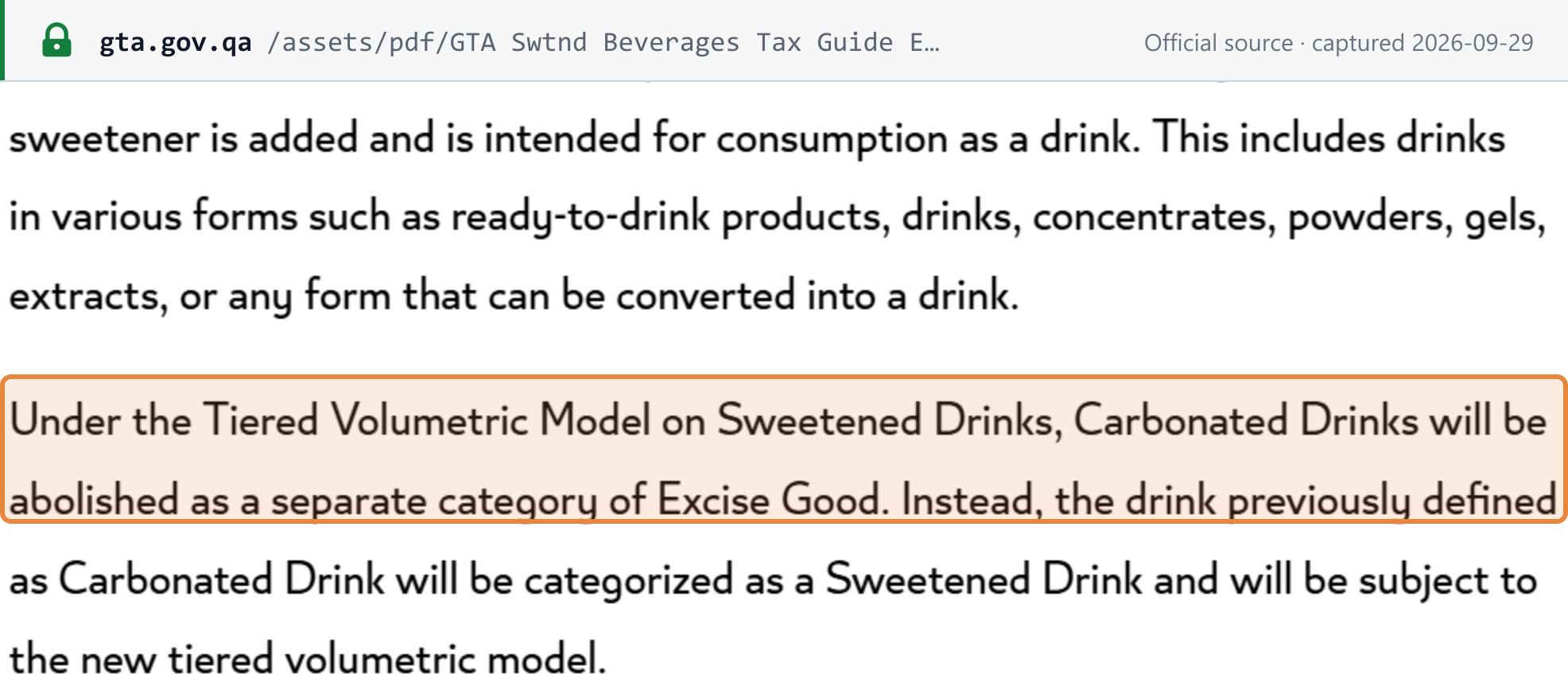
From 1 January 2019 the original Art. 2 of the Excise Law taxed "Tobacco and its derivatives 100% / Carbonated drinks 50% / Energy drinks 100% / Goods of a special nature 100%". Law No. 2 of 2026 abolished the 50% carbonated-drinks category. The GTA's guide explains: "Under the Tiered Volumetric Model on Sweetened Drinks, Carbonated Drinks will be abolished as a separate category of Excise Good. Instead, the drink previously defined as Carbonated Drink will be categorized as a Sweetened Drink and will be subject to the new tiered volumetric model." [4] [22] [7]
Two official pages still show the old 50% rate and are out of date: the GTA's consolidated "Excise Tax Law EN 2024" PDF and the Dhareeba excise information page (last updated 5 December 2023). Use the current GTA rates page instead.
Customs duty rates
In Qatar Customs' GCC Integrated Customs Tariff 2026, most tariff lines carry 5% of value and a smaller number carry 0%. Cigarettes (line 24 02 20) carry 100%, with a specific minimum of QAR 200 per 1,000 cigarettes (tariff p.74), and some lines are marked prohibited. The customs valuation basis is not published on the Qatar Customs pages. [10]
Announced future rates
None. The GTA news index, the GTA laws page and Al Meezan announce no new excise rate and no VAT. For Qatar alongside other jurisdictions, see Lookuptax's worldwide tax rates table.
Cross-border rules
Imports and exports of goods
- Imports. Importing excise goods releases them for consumption unless they are under a suspension: "Importation of excise goods unless they are under suspended tax status" (Excise Law Art. 3(4)). The guide explains that "the Excise Tax becomes due when customs duties are imposed, and should be paid simultaneously with the payment of customs duties." Customs duty is charged under the GCC tariff (see Rates). [4] [7]
- Importer returns. Law Art. 7: "The President may decide to exempt importers from submitting a tax return and defer the tax payment on imported excise goods". [4]
- Exports and GCC transfers. Law Art. 12 permits a refund "in the cases of export and re-export for business purposes outside the Council Territory", and when goods are transferred to another member state and the tax is paid there. Goods can also move under suspension "From a tax warehouse to a tax warehouse in another Member State" (Art. 11(2)(b)). [4]
- De minimis. For personal shipments only: "Incoming parcels and personal mailings whose value does not exceed (1000) riyals are exempted from customs duties". Qatar Customs publishes no de minimis for commercial consignments. [11]
- Reverse charge on imported services. Not applicable. There is no VAT, so there is no reverse charge. Withholding tax applies instead, as below.
Services from abroad: the 5% withholding tax
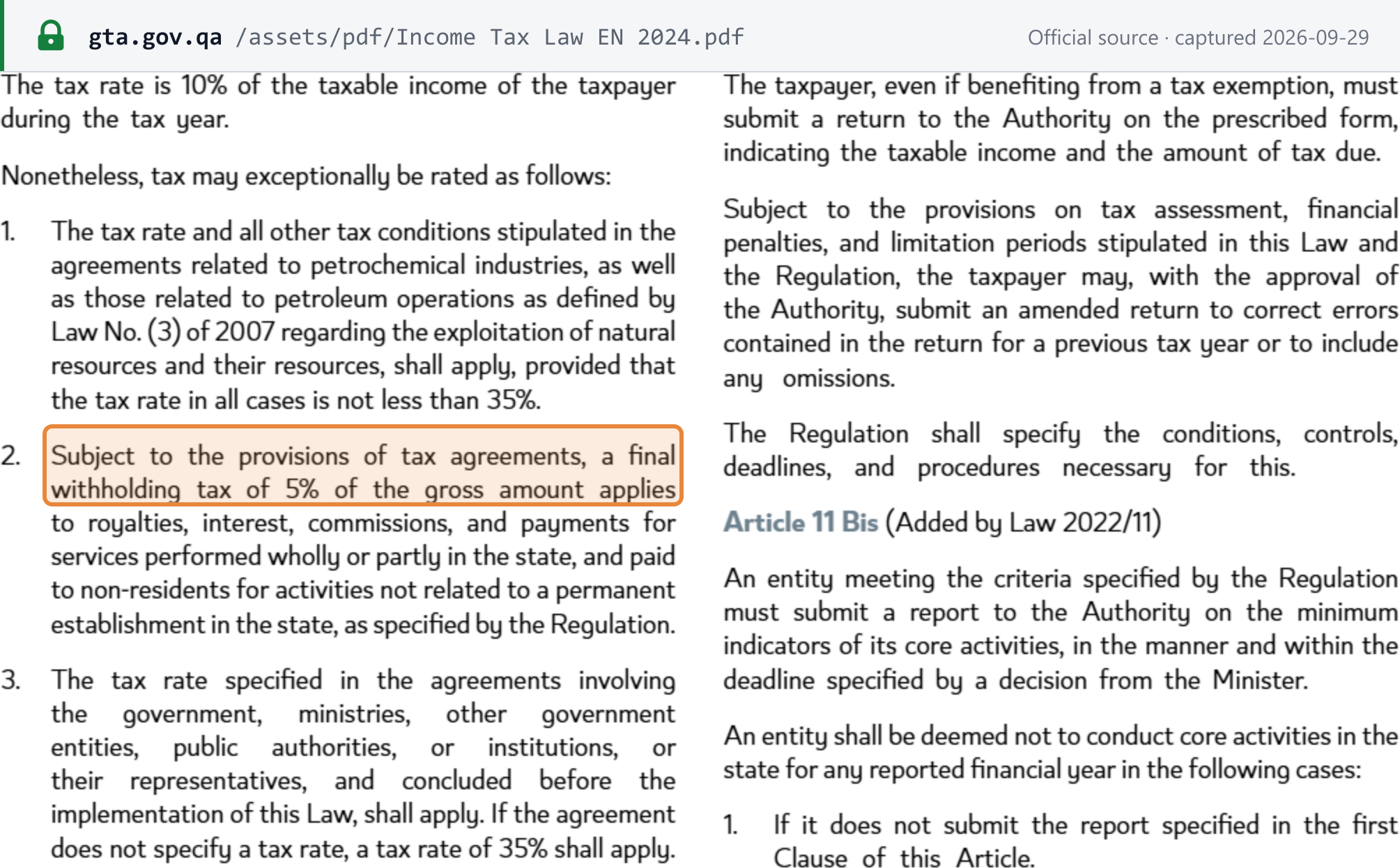
This is the tax a foreign service provider actually meets in Qatar. Income Tax Law Art. 9(2): "Subject to the provisions of tax agreements, a final withholding tax of 5% of the gross amount applies to royalties, interest, commissions, and payments for services performed wholly or partly in the state, and paid to non-residents for activities not related to a permanent establishment in the state". It is a single 5% rate (as at 2026-09-29). [8]
- Who withholds (Executive Regulations Art. 21(1)): payments "paid by natural persons practicing an activity in the State, legal persons residing in the State, including ministries, other government agencies, public authorities and institutions, and permanent establishments in the State owned by non-residents".
- Basis. "five percent (5%) withholding tax on the total amount, without any cost deductions" (Art. 21(2)).
- Where a service is performed. "A service is considered performed wholly or partly in the State if any work necessary for its completion is done within the State". And: "Services are considered performed in the State if they are used, consumed, or benefited from in the State, even if performed wholly or partly outside the State." (Art. 21(2).)
- Exclusions. Reinsurance, shipping and ticket sales, and maritime transport of oil (Art. 21(3)). Listed bank interest and State-bond interest (Art. 21(4)). And under Art. 23: "No tax is withheld on amounts paid to persons who have been issued a tax card … or persons registered with the Qatar Financial Centre."
- Remittance. "before the sixteenth day of the month following the month in which the withholding occurred". The payer gives the non-resident a certificate (Art. 24).
Treaty relief. A non-resident entitled to a lower treaty rate can claim a refund (Regs Art. 22). Cabinet Decision No. 4 of 2026, published in Official Gazette issue 5 on 15 March 2026, amended Art. 22. Dhareeba's Trusted Entity service now "enables using reduced WHT rates or applying a WHT exemption … before cross border payments are made". [18] [17]
Digital products and services
No VAT regime for non-resident digital suppliers exists, because there is no VAT. A payment from a Qatari business for software, a licence or an online service can still fall under the 5% withholding tax, either as a royalty or as a service used or benefited from in Qatar (ITL Art. 9(2); Regs Art. 21(2)). [8]
Foreign companies selling into Qatar — B2B and B2C
- B2B. There is no VAT registration and no reverse charge. When a Qatari business pays you fees for services, royalties, interest or commissions, it withholds 5% of the gross amount and remits it to the GTA (ITL Art. 9(2); Regs Art. 21). The exception is where you hold a Qatari tax card or are registered with the QFC (Regs Art. 23). If you sell excise goods, the excise liability falls on the importer (Excise Law Art. 5(5)). [8] [4]
- B2C. There is no VAT, so a foreign seller has no Qatari registration or collection obligation for sales to consumers. The withholding obligation in Regs Art. 21(1) is placed on persons practising an activity, resident legal persons, government bodies and permanent establishments. It does not name private individuals who do not practise an activity. On that reading, a payment from a private consumer carries no withholding. This is Lookuptax's reading of the text; the GTA publishes no statement on it. Goods you ship to consumers still pay customs duty on import, and excise if they are excise goods. [8]
Marketplace / platform deemed-supplier liability
Not applicable. There is no VAT law, and neither the Excise Law nor the Income Tax Law makes a platform liable as a deemed supplier.
Place of supply
Not applicable to VAT, since there is none. For withholding tax, the closest rule is the one in Regs Art. 21(2) above: a service is treated as performed in Qatar if any work for it is done there, or if it is used, consumed or benefited from there. [8]
Invoice requirements
There is no tax invoice in Qatar. Neither the Excise Law and its Executive Regulations nor the Income Tax Law and its Regulations prescribe invoice particulars, an issuance deadline, numbering, credit or debit notes, simplified invoices or self-billing. The excise rules only require registrants to keep "Copies of invoices issued concerning excise goods" and import and export records, including "invoices, payment notices" (Excise Regs Art. 25). [4]
The invoice rules that do exist come from consumer protection law and apply to sales to consumers. Under Consumer Protection Law No. 8 of 2008, Art. 8, the consumer is entitled to a dated invoice showing the type, price and quantity of the goods, and any other data set by the executive regulations: «وللمستهلك الحق في الحصول على فاتورة مؤرخة تتضمن تحديد نوع السلعة وسعرها وكميتها». [13]
Mandatory content (consumer invoices)
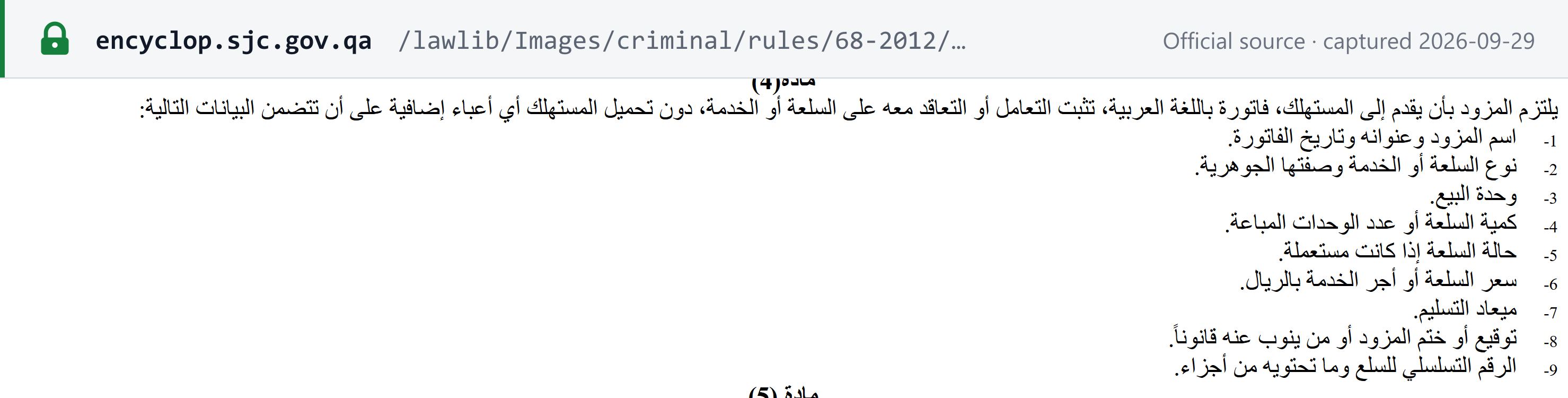
Ministerial Decision No. 68 of 2012, Art. 4, requires the supplier to give the consumer an invoice in Arabic, at no extra cost, carrying these particulars: [14]
| # | Required field | Arabic text | Legal cite |
|---|---|---|---|
| 1 | Supplier's name and address, and the invoice date | اسم المزود وعنوانه وتاريخ الفاتورة | MD 68/2012 Art. 4(1) |
| 2 | Type of goods or service and its essential description | نوع السلعة أو الخدمة وصفتها الجوهرية | Art. 4(2) |
| 3 | Unit of sale | وحدة البيع | Art. 4(3) |
| 4 | Quantity of goods or number of units sold | كمية السلعة أو عدد الوحدات المباعة | Art. 4(4) |
| 5 | Condition of the goods, if used | حالة السلعة إذا كانت مستعملة | Art. 4(5) |
| 6 | Price of the goods or fee for the service, in riyals | سعر السلعة أو أجر الخدمة بالريال | Art. 4(6) |
| 7 | Delivery date | ميعاد التسليم | Art. 4(7) |
| 8 | Signature or stamp of the supplier or its legal representative | توقيع أو ختم المزود أو من ينوب عنه قانوناً | Art. 4(8) |
| 9 | Serial number of the goods and their component parts | الرقم التسلسلي للسلع وما تحتويه من أجزاء | Art. 4(9) |
For sales on instalments, Art. 5 adds further particulars, including the total instalment amount, the actual annual rate of return, the number and value of instalments, and the penalties for late payment. There is no tax registration number field and no tax line: no Qatari law requires either on an invoice. [14]
Issuance deadline
Not prescribed by tax law. Consumer protection law requires an invoice for the transaction but sets no time limit.
Numbering and sequencing
No tax-law numbering rule. For goods, the consumer invoice must carry the serial number of the goods themselves (MD 68/2012 Art. 4(9)). That is a product serial number, not an invoice sequence. [14]
Credit and debit notes
Not applicable. No Qatari tax law regulates credit or debit notes.
Currency and language
- Language. Arabic. MD 68/2012 Art. 4 requires the consumer invoice «باللغة العربية» (in Arabic). Consumer Protection Law Art. 17 allows other languages alongside it: «ويجوز استخدام لغات أخرى إلى جانب اللغة العربية». Excise accounting records "must be kept in Arabic or English" (Excise Regs Art. 29). [14] [13] [4]
- Currency. The consumer invoice states the price «بالريال» (in riyals) (MD 68/2012 Art. 4(6)). No foreign-currency conversion rule applies for tax purposes. [14]
Document types
There is only one kind of document: the consumer invoice under MD 68/2012, plus the instalment particulars of Art. 5 where they apply. Tax law defines no full tax invoice, simplified invoice, bill of supply or receipt.
Self-billing
Not applicable. No Qatari tax law provides for self-billing.
Retention and audit trail
- Retention. The two tax laws set different periods:
- Excise records: 5 years. "Accounting records and their supporting documents must be kept for five years from the end of the year to which these records and documents pertain" (Excise Regs Art. 27). [4]
- Income-tax records: 10 years. Records are kept for "ten (10) years following the year to which these books, records, and documents pertain" (ITL Regs Art. 36(1)). [8]
- A business under both regimes will in practice keep its invoices for 10 years.
- Electronic records and audit trail. Excise Regs Art. 26 requires that "The system used must provide sufficient security to prevent tampering with the entered data or outputs". The records must be accessible and readable at any time, and the system must "allow the extraction of entered records and accounts upon request by the Authority". Art. 28 allows storage to be outsourced. [4]
A specimen of a compliant invoice
No Qatari authority publishes an annotated specimen invoice. The layout below is Lookuptax's own illustration of a consumer invoice carrying the nine particulars of MD 68/2012 Art. 4. Every name, number and amount in it is fictional:
فاتورة — Invoice
| Goods or service and essential descriptionArt. 4(2) | Serial numberArt. 4(9) | ConditionArt. 4(5) | Unit of saleArt. 4(3) | QuantityArt. 4(4) | Price (QAR)Art. 4(6) |
|---|---|---|---|---|---|
| Washing machine, 8 kg front-loading | SPECIMEN-SN-0001 (drum SPECIMEN-SN-0001-A) | New | Piece | 1 | QAR 1,899 |
| Installation service | — | — | Service | 1 | QAR 150 |
- Total payableArt. 4(6)
- QAR 2,049
- The invoice is issued in Arabic, and other languages may be added alongside it — MD 68/2012 Art. 4; Consumer Protection Law Art. 17.
- Signature or stamp of the supplier or its legal representative — MD 68/2012 Art. 4(8).
- Condition is stated because the rule requires it for used goods; here the goods are new — Art. 4(5).
- If the sale is on instalments, the particulars in Art. 5 are added (total instalment amount, annual rate of return, number and value of instalments, late-payment penalties and more).
- No tax registration number and no VAT line: Qatar has no VAT law, and no tax law prescribes invoice particulars.
E-invoicing status
Status (as of 2026-09-29): proposed. A draft law exists, but no law has been issued and there is no mandate.
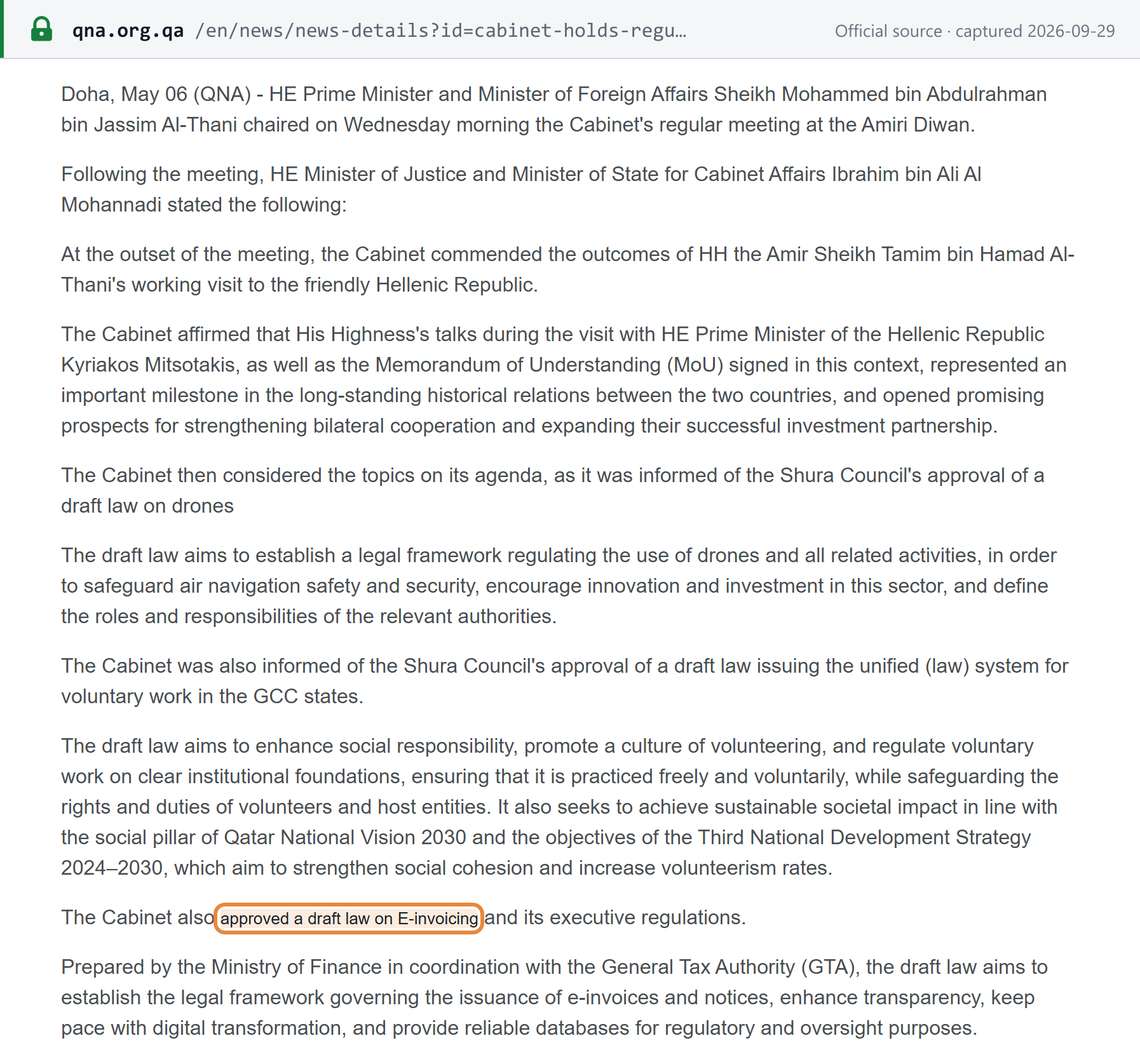
On 6 May 2026 the Cabinet approved a draft e-invoicing law and its executive regulations. The Qatar News Agency reported: "The Cabinet also approved a draft law on E-invoicing and its executive regulations. Prepared by the Ministry of Finance in coordination with the General Tax Authority (GTA), the draft law aims to establish the legal framework governing the issuance of e-invoices and notices, enhance transparency, keep pace with digital transformation, and provide reliable databases for regulatory and oversight purposes." [12]
Not yet enacted. No e-invoicing law has been issued: the GTA's laws, decisions and circulars pages list none. The GTA mentioned "the e-invoicing project" publicly in June 2025. [1] [23]
- System and network name: not yet published.
- Phase timeline and thresholds: not yet published. No official start date exists.
- Formats and standards: not yet published.
- Scope (B2B, B2G, B2C): not yet published.
Dates, formats and phases that circulate in advisory material are not in any GTA or Ministry of Finance document. For Qatar alongside other mandates, see Lookuptax's e-invoicing status and networks table.
Filing and payment
Filing frequency
- Excise tax: quarterly for every registrant (Excise Regs Art. 13). [4]
- Withholding tax: monthly, for each month in which tax is withheld (ITL Regs Art. 24). [8]
Return due date and payment
- Excise. Law Art. 7: a registrant "must submit a tax return for the due tax for each tax period and pay it on the same day the return is submitted, within fifteen days after the end of the tax period." The return and the payment are both due within 15 days of the end of the quarter. Regs Art. 14 lists the return's contents. On imports, excise is paid together with customs duty at the time of import. [4] [7]
- Withholding tax. Remit "before the sixteenth day of the month following the month in which the withholding occurred" (ITL Regs Art. 24). [8]
Returns and payments are made through Dhareeba.
Transitional stock declaration (sweetened drinks)
Law No. 2 of 2026, Art. 4, requires a person holding stock of newly taxed goods to file an audited statement of that stock with the GTA within 90 days of 6 July 2026, the date the law took effect, and to pay the tax or claim a refund within 30 days of filing: «بأن يقدم خلال التسعين يومًا التالية، بيانًا مدققًا إلى الهيئة بالرصيد … ويتعين سدادها أو طلب استردادها خلال ثلاثين يومًا على الأكثر من تاريخ تقديم البيان». The GTA's guide ties the declaration to stock held on 5 July 2026 and requires it where that stock is "equal to or exceeds the threshold of 200,000 liters of Sweetened Drinks". [5] [7]
Additional listings
None for excise. The Excise Law and Regulations require only the quarterly return. [4]
Input-tax recovery and blocked items
Not applicable. Excise is a single-stage tax with no input-tax mechanism, and there is no VAT.
Refunds
- Excise refunds. Available on export, on re-export, for goods used to produce other excise goods, and on transfer to another GCC state where the tax is paid there (Law Art. 12). [4]
- Overpaid tax. A claim must be made "within five years from the date of the payment". The GTA decides within 60 days, and silence counts as rejection (Excise Regs Art. 24). [4]
- Withholding tax. Treaty refunds under ITL Regs Art. 22, or relief at source through the Trusted Entity route (see Cross-border rules).
- VAT refunds, non-resident VAT refunds and bad-debt relief: not applicable, since there is no VAT.
Exemptions
Exempt goods and persons
- Excise Law Art. 13. Exempts diplomatic and consular bodies and international organisations (on reciprocity); goods carried by travellers for non-commercial use within the customs allowance; and other goods the Cabinet specifies. [4]
- Cabinet Resolution No. 16 of 2020. Listed on the GTA's decisions page. It adds exemptions for goods for therapeutic use by licensed health institutions, departure duty-free sales, and international passenger transport. [21]
- Drinks outside the sweetened-drinks tax (GTA guide pp.8–9): [7]
- 100% natural juices without added sugar;
- drinks that are at least 75% milk or plant milk;
- infant formula;
- special medical or dietary drinks;
- drinks served unsealed in restaurants for immediate consumption.
Exempt versus zero-rated
Not applicable in the VAT sense. The distinction matters under VAT because it decides whether input tax can be recovered, and excise has no input-tax recovery. The terms differ between official sources: the GTA guide labels drinks under 5 g per 100 ml "Zero Rated (0 QAR)", while the GTA's rates page calls them "Tax-exempt". Either way, no excise is due. [7] [2]
Special regimes
- Tax warehouses suspend excise until goods are released (Law Arts. 10–11). "any licensed customs warehouse under the provisions of the referred Customs Law shall be considered a tax warehouse for imported excise goods". [4]
- Qatar Financial Centre. A separate regime for corporate income tax only. It has no indirect-tax regime of its own. Payments to QFC-registered persons are outside withholding tax (ITL Regs Art. 23). [15] [8]
- Margin, cash-accounting, flat-rate and small-business schemes: not applicable, since there is no VAT.
Offences and penalties
Offences
| Offence | Conduct | Punishment | Source |
|---|---|---|---|
| Excise tax evasion (Excise Law Art. 18) | Includes failing to register for more than 90 days after the deadline, failing to file for more than a year, smuggling, and false documents or markings | "imprisonment for a period not exceeding one year and a fine not exceeding three times the amount of due tax, or by either of these penalties", plus confiscation of the goods; doubled for a repeat within 5 years | [4] |
| Breach of confidentiality (Art. 19) | Disclosing taxpayer information | Up to 6 months and/or up to QAR 50,000 | [4] |
| Income-tax offences (ITL Art. 26) | Forged books, fraud, and when a person "Deliberately fails to register" | Up to 1 year and/or a fine of up to 3 times the tax | [8] |
| Consumer-invoice breach (Consumer Protection Law Art. 18) | Breaching Chapter 3 (Arts. 5–17), which includes the Art. 8 invoice right | Up to 2 years' imprisonment and/or a fine of QAR 3,000–1,000,000 | [13] |
- Personal liability. Managers are personally liable for excise offences (Excise Law Art. 21).
- Settlement. An excise offence can be settled "in return for payment of half the maximum fine and the due tax and related financial penalties" (Art. 23).
- Limitation. Under Law No. 2 of 2026, criminal action for excise evasion lapses only five years after the end of the year in which the tax fell due (new Art. 22).
- Tax stamps. Tobacco products must carry digital tax stamps. The GTA enforced them at customs from 13 October 2022 for cigarettes and 3 November 2022 for other tobacco products, and in local markets from 11 January 2023 and 1 February 2023 respectively.
Penalties
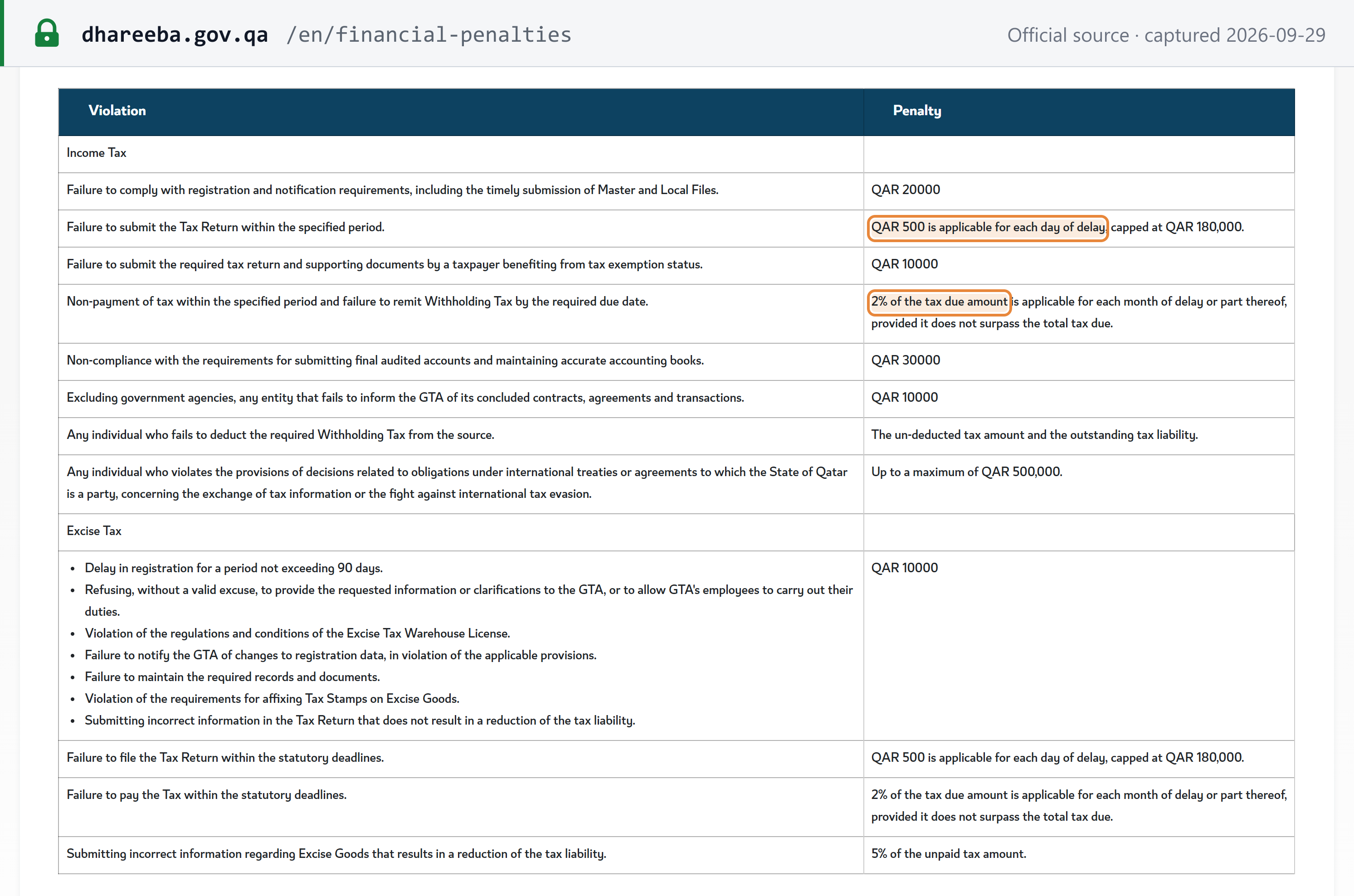
Figures as published in the GTA's Dhareeba penalties table. [16]
| Default | Penalty | Source |
|---|---|---|
| Excise: late registration of up to 90 days; refusing information; breaching a warehouse licence; failing to notify changes; failing to keep records; breaching tax-stamp rules; incorrect return data that does not reduce the tax | QAR 10,000 | Excise Law Art. 16(1) |
| Excise: late return | QAR 500 per day, capped at QAR 180,000 | Excise Law Art. 16(2) |
| Excise: late payment | 2% of the tax due per month or part of a month, capped at the tax due | Excise Law Art. 16(3) |
| Excise: incorrect information that reduces the tax | 5% of the unpaid tax. The penalty is relieved if the return is amended within 30 days and the shortfall is no more than 10%. | Excise Law Art. 16(4) |
| Withholding tax: failing to withhold | An amount equal to the tax not withheld, on top of the tax itself | ITL Art. 24 |
| Withholding tax: late remittance; income tax paid late | 2% per month, capped at the tax due | ITL Art. 24 |
| Income tax: late return | QAR 500 per day, capped at QAR 180,000 | ITL Art. 24 |
| Income tax: registration or notification failures | QAR 20,000 | ITL Art. 24 |
The GTA's President can waive excise penalties up to QAR 500,000, and the Minister can waive larger amounts (Excise Law Art. 17). [4] [8]
Frequently asked questions
Do I charge VAT on invoices to customers in Qatar?
No. As of 29 September 2026, Qatar has no VAT law in force. The General Tax Authority's laws page lists the GCC VAT Agreement only as a regional text that member states must incorporate into their own law, and no Qatari VAT law or start date has been published. Do not add a VAT line or a VAT registration number to invoices for Qatari customers. What can apply instead is excise tax on excise goods, customs duty on imported goods, and the 5% withholding tax that a Qatari business customer deducts from payments for services. [1] [2]
Why did my Qatari client deduct 5% from my invoice?
Because Article 9(2) of Qatar's Income Tax Law imposes a final withholding tax of 5% of the gross amount on royalties, interest, commissions and payments for services performed wholly or partly in Qatar that are paid to non-residents for activities not related to a permanent establishment there. A service counts as performed in Qatar if any work for it is done in Qatar, or if it is used, consumed or benefited from in Qatar, even if it was performed abroad (Executive Regulations Art. 21(2)). The payer must remit the tax before the 16th day of the following month and give you a withholding certificate (Art. 24). There is one rate, 5%. A lower treaty rate can be claimed as a refund or, through the GTA's Trusted Entity service, applied before payment. [8] [17]
I sell to private consumers in Qatar from abroad — do I have to register or collect any tax?
Not for VAT, because Qatar has no VAT. The withholding tax obligation in Executive Regulations Art. 21(1) falls on persons practising an activity in Qatar, resident legal persons, government bodies and permanent establishments. It does not name private individuals who do not practise an activity, so on Lookuptax's reading of the text a payment from a private consumer carries no withholding; the GTA publishes no statement on this point. Goods you ship to consumers still pay customs duty on import, and excise tax if they are excise goods. Personal parcels worth up to QAR 1,000 are exempt from customs duty. [8] [11]
Do I need a Qatari tax card to stop my client withholding tax?
Under Executive Regulations Art. 23, no tax is withheld on amounts paid to persons who hold a Qatari tax card or are registered with the Qatar Financial Centre. A tax card comes with income-tax registration in Qatar, and the GTA does not issue one to non-residents with a permanent establishment in Qatar (Regs Art. 26(2)). A foreign company with no presence in Qatar does not register there, so this route is not open to it. It can rely on a tax treaty instead, either by claiming a refund (Regs Art. 22) or by using the Trusted Entity service on Dhareeba to apply the reduced rate or exemption before payment. [8] [17]
How is excise tax on a sweetened drink calculated since 6 July 2026?
By sugar content and volume. Under Law No. 2 of 2026, sweetened drinks are taxed per litre according to their total sugar content per 100 ml, counting natural sugar, added sugar and other sweeteners. Under 5 g is exempt, 5 to 7.99 g is QAR 0.77 per litre, and 8 g or more is QAR 1.06 per litre. Drinks with only artificial sweeteners and no added sugar are exempt. In the GTA's own example, 15,000 cans of 500 ml at 9.25 g per 100 ml fall in the high tier: QAR 0.53 per can, QAR 7,950 in total. The old 50% rate on carbonated drinks no longer exists, because carbonated drinks are now taxed as sweetened drinks. Energy drinks stay at 100%. [2] [7]
When does e-invoicing start in Qatar?
No start date has been set. On 6 May 2026 the Cabinet approved a draft e-invoicing law and its executive regulations, prepared by the Ministry of Finance with the General Tax Authority. As of 29 September 2026 no e-invoicing law had been issued, and the GTA had published no system name, format, phase timeline or scope. Dates that circulate in advisory material do not come from a GTA or Ministry of Finance document. [12]
Important websites
| Site | Purpose |
|---|---|
| Dhareeba tax portal | Excise and income-tax registration, returns, payments and sweetened-drink product registration |
| Dhareeba certificate validation | Checking that a GTA-issued certificate is authentic |
| Registered excise products | Looking up products registered for excise, by category |
| Trusted Entity registration | Applying treaty-reduced withholding rates before payment |
| Dhareeba financial penalties | The GTA's current penalty table |
| GTA "Taxes in Qatar" | Current excise rates and the taxes in force |
| GTA laws and regulations | Tax laws, executive regulations and the GCC agreements |
| Al Nadeeb customs e-services | Customs declarations |
| Qatar Customs tariff | Customs duty rates by tariff line |
| Al Meezan | Official Qatari legislation portal |
| E-invoicing portal | None yet |
Also see Lookuptax's own Qatar TIN validator.
Recent changes
- 2026-07-06 — Law No. 2 of 2026 took effect. It replaced the excise schedule: 100% on tobacco, energy drinks and special-category goods, and a per-litre tax on sweetened drinks by sugar content (exempt, QAR 0.77 or QAR 1.06 per litre). The 50% carbonated-drinks category was abolished. The law is dated 24 March 2026 and was published in Official Gazette issue 6 on 7 April 2026. (General Tax Authority; Al Meezan) — see event
- 2026-05-06 — The Cabinet approved a draft e-invoicing law and its executive regulations, prepared by the Ministry of Finance with the GTA. No law has been issued yet. (Qatar News Agency) — see event
- 2026-03-15 — Cabinet Decision No. 4 of 2026, amending Art. 22 of the Income Tax Law's Executive Regulations, was published in Official Gazette issue 5. It underpins the Trusted Entity route for applying treaty-reduced withholding rates before payment. (Al Meezan)
- 2019-01-01 — Excise tax took effect under Law No. 25 of 2018. (General Tax Authority)
Ahead — scheduled changes that have not yet taken effect:
- 2026-11-01 (scheduled) — Laboratory analysis certificates for registering sweetened drinks will be approved electronically in Dhareeba, through direct integration with accredited laboratories. (General Tax Authority) — see event
For the full chronology, see Qatar tax changes on Lookuptax.
Reference links
- General Tax Authority — Laws and Regulations
- General Tax Authority — Taxes in Qatar (excise rates)
- Dhareeba — Tax calculators
- General Tax Authority — Excise Tax Law No. 25 of 2018 and Executive Regulations, consolidated English text (PDF; predates Law No. 2 of 2026 — not a source for current rates)
- Al Meezan — Law No. 2 of 2026 amending the Excise Tax Law (Arabic)
- General Tax Authority — State of Qatar introduces new excise tax mechanism on sweetened drinks (8 April 2026)
- General Tax Authority — Excise Tax User Guide: Tiered Volumetric Model on Sweetened Drinks (PDF)
- General Tax Authority — Income Tax Law No. 24 of 2018 and Executive Regulations, consolidated English text (PDF)
- Qatar Customs — Decree No. 43 of 2022 (unified customs tariff) (PDF)
- Qatar Customs — GCC Integrated Customs Tariff 2026 (PDF)
- Qatar Customs — Individuals' exemptions (QAR 1,000 personal parcels)
- Qatar News Agency — Cabinet holds regular meeting (6 May 2026)
- Al Meezan — Consumer Protection Law No. 8 of 2008 (Arabic)
- Supreme Judicial Council legal library — Ministerial Decision No. 68 of 2012 (Arabic)
- OECD — Qatar TIN information sheet (content supplied by the State of Qatar) (PDF)
- Dhareeba — Financial penalties
- Dhareeba — Register as a Trusted Entity
- Al Meezan — Cabinet Decision No. 4 of 2026 (Arabic)
- General Tax Authority — Electronic testing procedures for sweetened drinks via Dhareeba from 1 November 2026
- General Tax Authority — Launch of the digital tax stamp system (12 October 2022)
- General Tax Authority — Decisions
- General Tax Authority — Excise tax news (8 January 2019)
- General Tax Authority — Qatari-Russian cooperation on digitalization and e-invoicing (25 June 2025)
- Al Meezan — Excise Tax Law No. 25 of 2018 (Arabic)
Related Lookuptax pages: