Serbia VAT (PDV) guidelines
| FACTSHEET | |
|---|---|
| Country code | RS |
| Tax name | Value added tax (VAT) — porez na dodatu vrednost (PDV / ПДВ) |
| Tax Authority | Poreska uprava (Tax Administration), part of the Ministry of Finance |
Overview
Serbia's value added tax is the porez na dodatu vrednost (PDV, ПДВ). The Tax Administration describes it as "општи порез на потрошњу" (a general consumption tax) charged on supplies of goods and services at every stage of production and trade, and on imports of goods. [1]
Authority. VAT is administered by the Poreska uprava (Tax Administration), a body within the Ministry of Finance. The e-invoicing system SEF is run by the Ministry of Finance itself (see E-invoicing status).
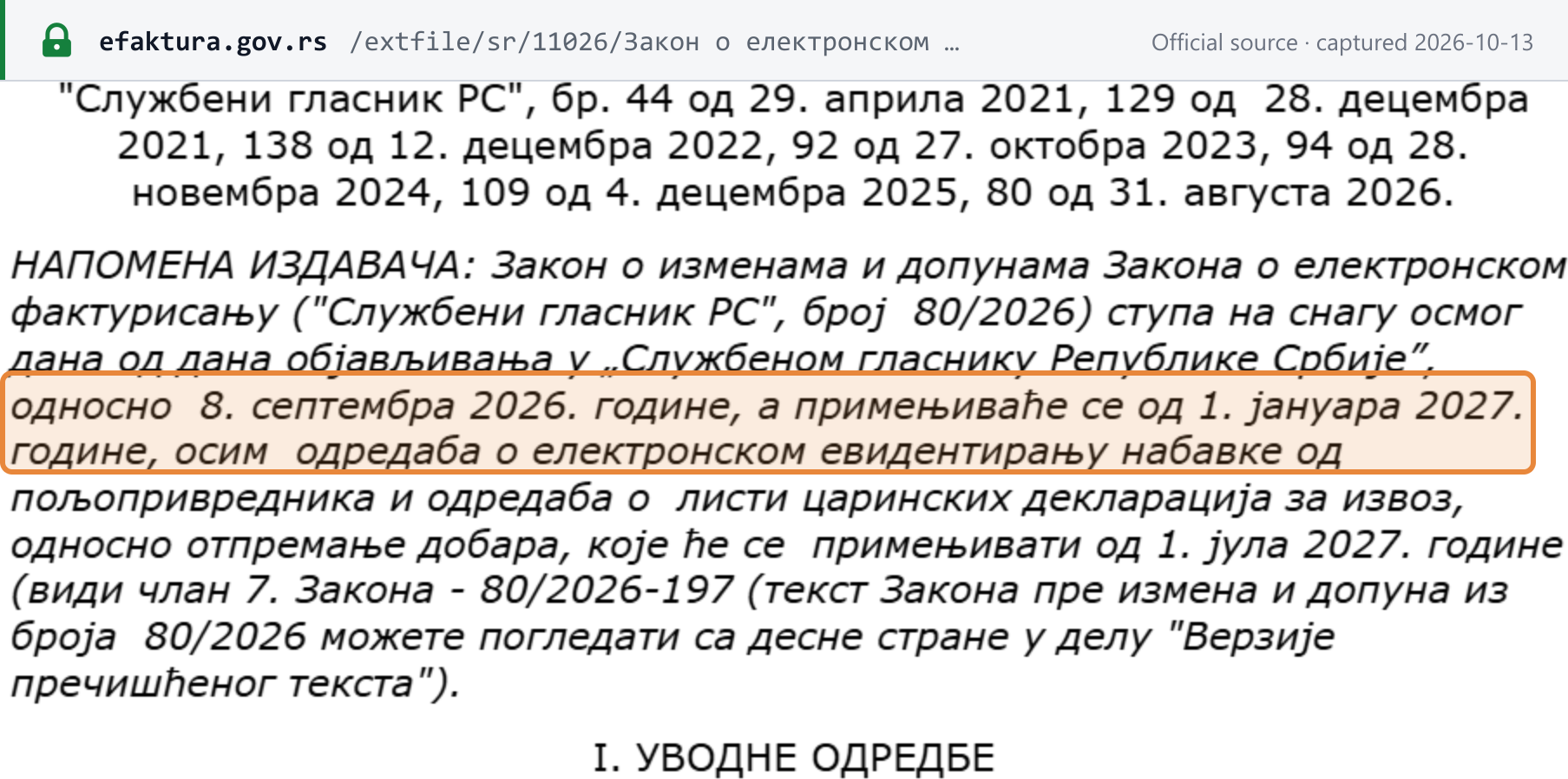
Statute. The Law on Value Added Tax (Zakon o porezu na dodatu vrednost, Službeni glasnik RS 84/2004), last amended by Službeni glasnik 80/2026 of 31 August 2026, which entered into force on 8 September 2026 and mostly applies from 1 January 2027. Procedure, interest and penalties are in the Law on Tax Procedure and Tax Administration. [2] [3]
Layering. One national tax, with no regional or municipal layer. VAT revenue "припада буџету Републике Србије" (belongs to the budget of the Republic of Serbia). [1]
Currency. Serbian dinar (RSD). Consideration in a foreign currency is converted at the National Bank of Serbia middle rate, or the contracted rate, on the day the tax liability arises (VAT Law Art 22). [2]
Tax period. The calendar month or the calendar quarter, depending on turnover (see Filing and payment).
This guide states the law as at 14 October 2026, including the amendments that apply from 1 January 2027.
For neighbouring systems, see the Croatia VAT guide and the Bulgaria VAT guide.
Registration
Who should register
A business must register for VAT once its total turnover in the previous 12 months exceeds RSD 8,000,000. Below that it is a small taxpayer (мали обвезник), as is a business starting up that estimates it will not exceed RSD 8 million in its next 12 months. A small taxpayer "не обрачунава ПДВ" (does not charge VAT), may not show VAT on its invoices and cannot deduct input tax. [2]
Registration threshold
- Amount and period: more than RSD 8,000,000 of total turnover in the previous 12 months, a rolling test (VAT Law Art 38(1)).
- Deadline: the registration application (евиденциона пријава) is due "у року од пет дана" — within five days of the day the turnover was reached.
- What counts: taxable supplies plus supplies exempt with the right to deduct (exports and similar), but not sales of the business's own equipment and premises.
- Late registration: a business that registers late, or that the Tax Administration registers ex officio, can deduct input tax only from the date of the application.

Non-resident registration
The threshold for a foreign business is nil, but whether it registers at all depends on who its customers are.
- Supplies only to Serbian VAT payers (B2B): a foreign business that supplies only Serbian VAT payers (and the public bodies listed in VAT Law Art 9(1)) does not appoint a tax representative or register. The Serbian customer accounts for the VAT under the reverse charge (VAT Law Art 10a(2); see Foreign companies selling into Serbia). The same applies to goods supplied under customs warehousing and to bus passenger transport taxed per journey.
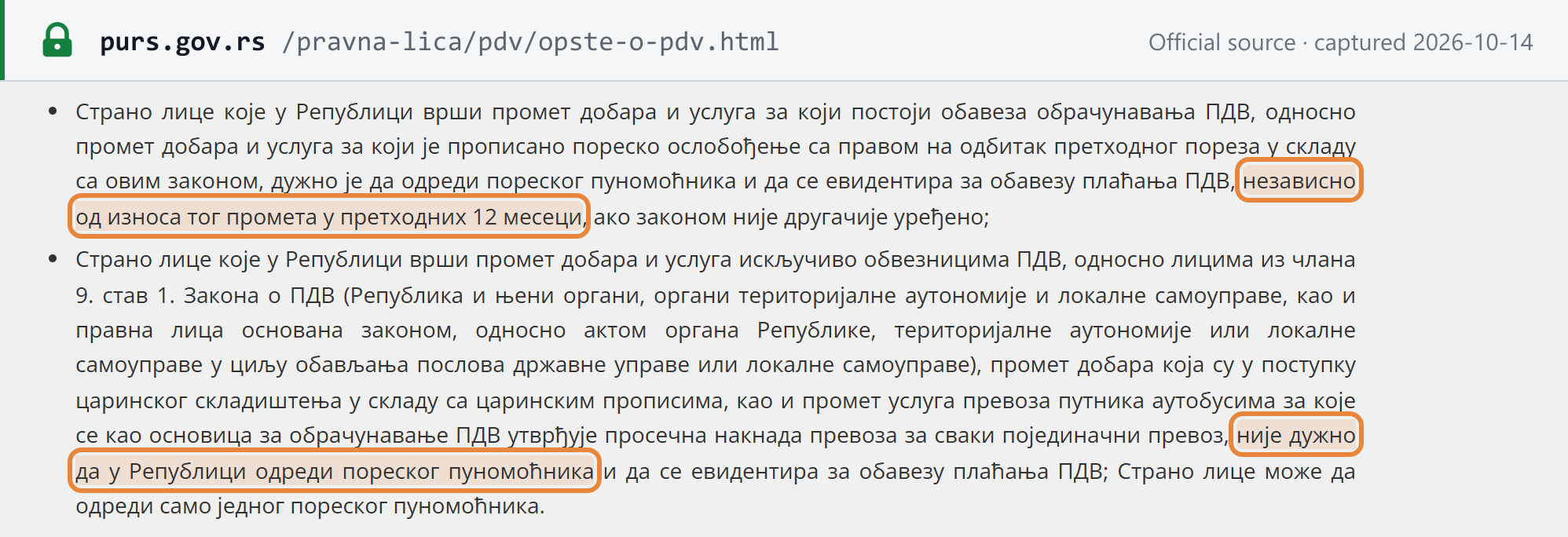
- Any other taxable supplies (including B2C): a foreign business "дужно је да одреди пореског пуномоћника и да се евидентира за обавезу плаћања ПДВ, независно од износа тог промета у претходних 12 месеци" — it must appoint a tax representative (порески пуномоћник) and register for VAT, whatever its turnover in the previous 12 months (Art 10a(1)).
The tax representative must be resident in Serbia, VAT-registered for at least 12 months, free of overdue tax debts, and approved by a decision of the Tax Administration. It cannot be the foreign business's own permanent establishment. "Страно лице може да одреди само једног пореског пуномоћника" (a foreign person may appoint only one tax representative), and the representative is jointly and severally liable for all the foreign person's VAT obligations. [1]
Tax identification number
Every VAT payer is identified by its PIB (порески идентификациони број), which the Tax Administration assigns; for businesses registered with the Business Registers Agency (APR), it is assigned through APR as part of the registration filing (Law on Tax Procedure Art 26). The PIB must appear on every document required by the VAT Law. [3] [2]
For the PIB's format and the personal JMBG number, see the Serbia tax ID guide, or check a number with the Serbia PIB validator.
How to register
File the registration application with the Tax Administration, which issues a "потврду о извршеном евидентирању за ПДВ" (certificate of VAT registration) and keeps a register of VAT payers. [2] Returns and other filings go through the Tax Administration's ePorezi portal. Anyone can look a VAT payer up by PIB in the public register of VAT payers. [12]
Voluntary registration
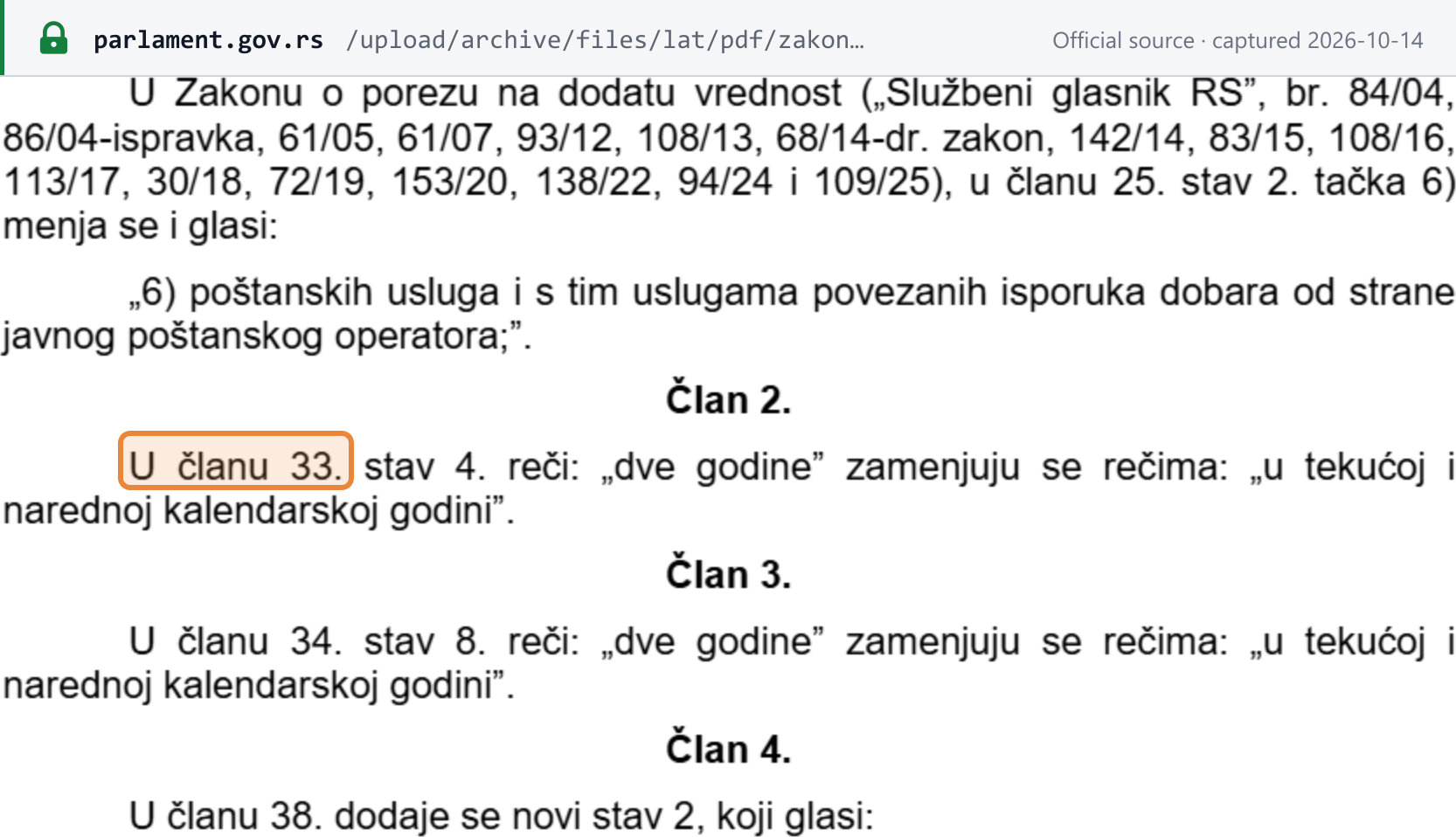
A small taxpayer (turnover up to RSD 8 million) "може да се определи за обавезу плаћања ПДВ" (may opt in to VAT) by filing a registration application, which gives it the right to deduct input tax (Art 33(3)). [2]
How long the registration lasts:
- Until 31 December 2026: a voluntary registration binds for two years.
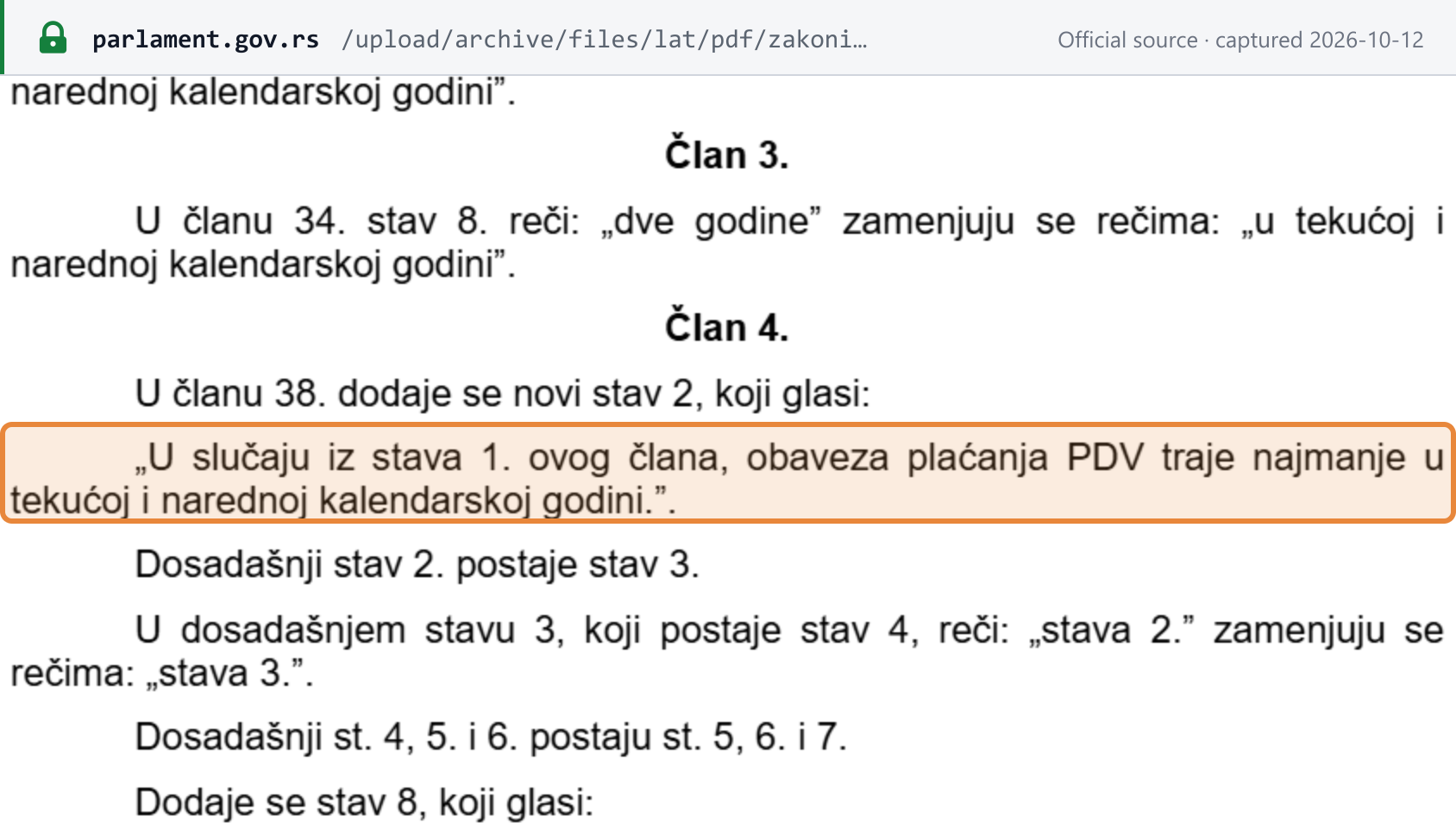
- From 1 January 2027 (Službeni glasnik 80/2026): every registration, voluntary (Art 33(4)) or mandatory (new Art 38(2)), lasts at least the current and the following calendar year.
After that period the taxpayer may apply to deregister. [2]
Deregistration
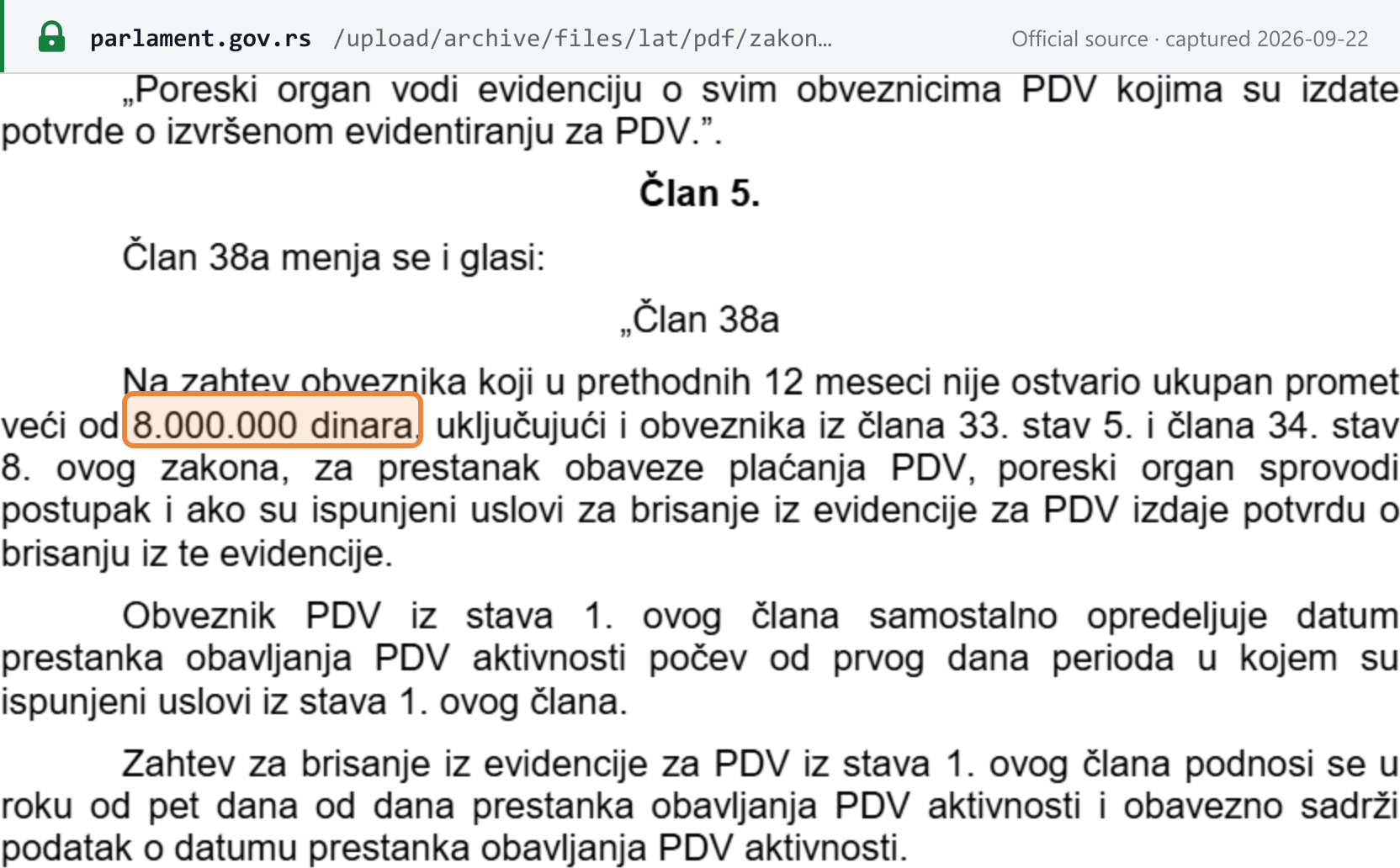
From 1 January 2027, new Article 38a governs deregistration: [2]
- On request: a VAT payer whose total turnover in the previous 12 months was not more than RSD 8,000,000 may ask to be removed from the VAT register. It chooses the date VAT activity ends, from the first day of the period in which it meets the condition, and files the request within five days of that date. The Tax Administration issues a deregistration certificate.
- Closing the business: a business that closes files the same request within five days. The business registry cannot strike off an entity without the deregistration certificate.
- Stock and asset adjustment (Art 40): on the day VAT activity ends, take an inventory of the goods, equipment and premises on which input tax was deducted, and adjust that input tax in the final return.
- Final return: due within 15 days of the end of VAT activity (Art 50). If activity ends in January 2027, the return is filed between 1 and 15 February 2027.
Group registration
Not available. The VAT Law, as consolidated through 80/2026, contains no provision for VAT groups: each taxable person registers on its own. See VAT grouping for how grouping works where it exists.
Rates
| Rate | Applies to |
|---|---|
| 20% (general rate, "општа стопа") | All taxable supplies and imports not listed for the special rate |
| 10% (special rate, "посебна стопа") | Basic food, medicines, textbooks and daily newspapers, firewood and pellets, hotel accommodation, cultural and sports tickets, natural gas and heating, the first transfer of residential buildings, drinking water, passenger transport, waste and funeral services |
| Exempt with the right to deduct | Exports, international transport, free-zone and customs-warehouse supplies, and the other supplies in Art 24 |
| Exempt without the right to deduct | Financial services, insurance, residential lettings, health, education and the other supplies in Art 25 |
General rate 20%. "Општа стопа ПДВ за опорезиви промет добара и услуга или увоз добара износи 20%" (VAT Law Art 23(1)).
Special rate 10% (Art 23(2)). Examples:
- Food: bread and bakery products, milk and dairy products, flour, sugar, edible oils, honey, eggs, and fresh, chilled or frozen fruit, vegetables, meat and fish.
- Health and education: medicines; textbooks and daily newspapers.
- Energy and utilities: firewood and pellets; natural gas and heating; drinking water (not bottled).
- Services: hotel and similar accommodation; tickets for cinemas, theatres, concerts, sports events, museums and zoos; passenger transport; waste management and funeral services.
- Property: the first transfer of residential buildings.
The Tax Administration also publishes a list of goods by rate.
No zero rate. Serbia has no zero rate as such. Exports and international transport are exempt with the right to deduct (Art 24), which has the same effect: no VAT on the sale, full recovery of input VAT (see Exemptions). The 8% compensation paid to farmers under the flat-rate scheme (Art 34) is not a VAT rate.
Announced changes. None. The 80/2026 amendments leave both rates unchanged.

Cross-border rules
Imports and exports
Imports of goods. VAT is due on goods brought into Serbia's customs territory. The importer is the tax debtor, the place of import is where the goods enter the customs territory, and the tax point is when the customs debt arises. Article 26 lists the import exemptions (returned goods, temporary admission, transit and others). A VAT payer deducts import VAT "у пореском периоду у којем је плаћен" (in the tax period in which it was paid; Art 49(5)). [2]
Exports of goods. Goods that the supplier, or the foreign buyer, sends or transports abroad are exempt with the right to deduct (Art 24(1) pts 2–3). [2]
Goods taken abroad by travellers. Goods a non-resident traveller takes out of Serbia in personal luggage are exempt if their total value is at least RSD 6,000 including VAT, they leave within three calendar months after the month of sale, and there is proof of export (Art 24(1) pt 4). [2]
Services from abroad. A Serbian business buying services from a foreign supplier that is not registered in Serbia accounts for the VAT itself (see below).
Digital products and services
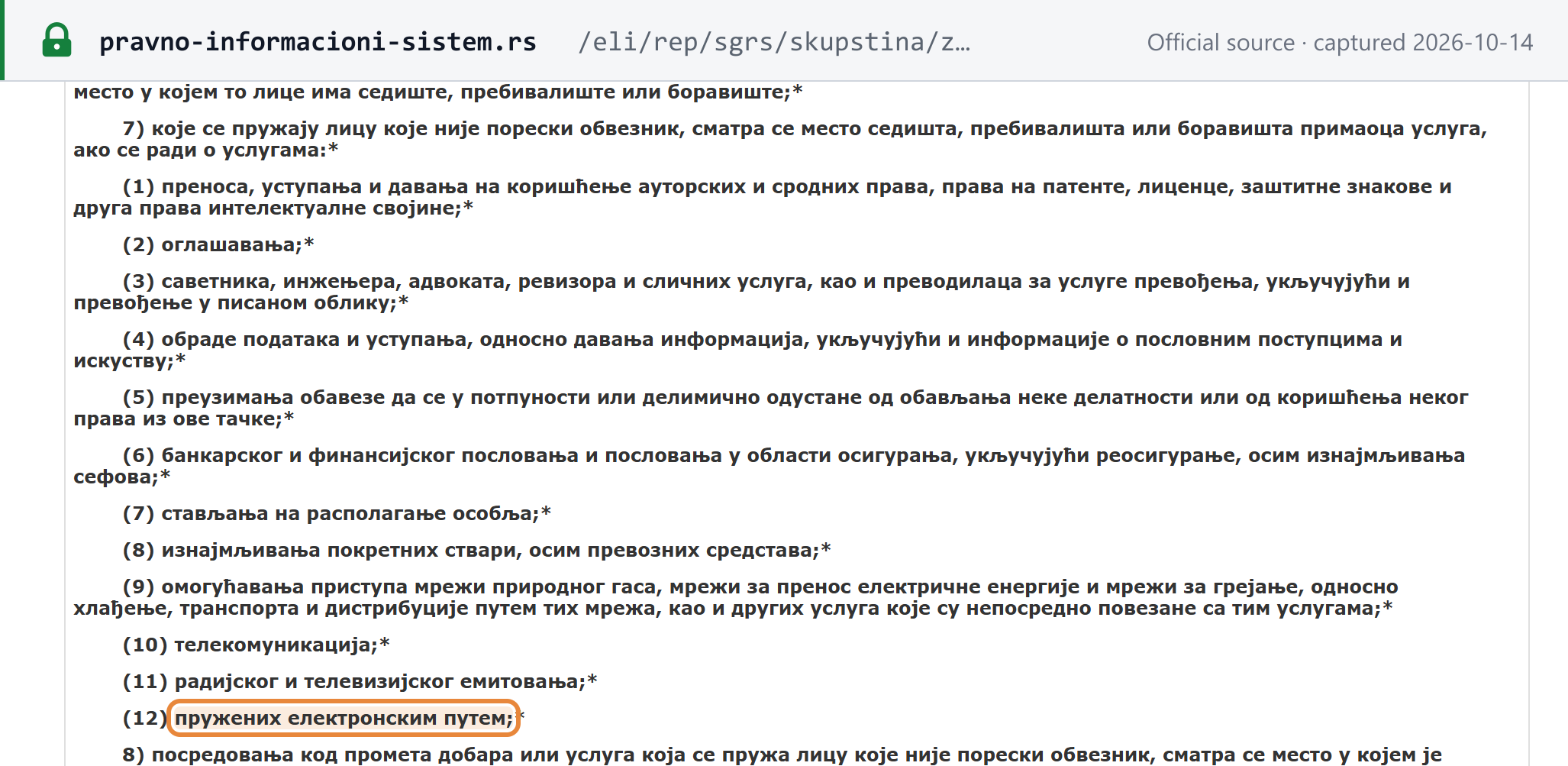
Electronically supplied services, telecoms and broadcasting supplied to someone who is not a taxable person are taxed where the customer has its seat, permanent address or residence (VAT Law Art 12(6) pt 7). The same rule covers, for consumers, intellectual property rights, advertising, the services of consultants, engineers, lawyers and auditors, data processing, banking and insurance services, staff hire and the hire of movable goods other than means of transport. A ministerial rulebook sets the criteria for locating the customer of telecoms, broadcasting and e-services (Art 12(13)–(14)). [2]
No threshold and no simplified scheme. A foreign supplier of digital services to Serbian consumers is caught from its first sale. The VAT Law has no simplified or "non-resident" registration: the only route is a tax representative and full VAT registration under Article 10a(1). Failing to appoint one and register is an offence (see Offences and penalties).
See VAT on digital services by non-resident suppliers.
Foreign companies selling into Serbia — B2B and B2C
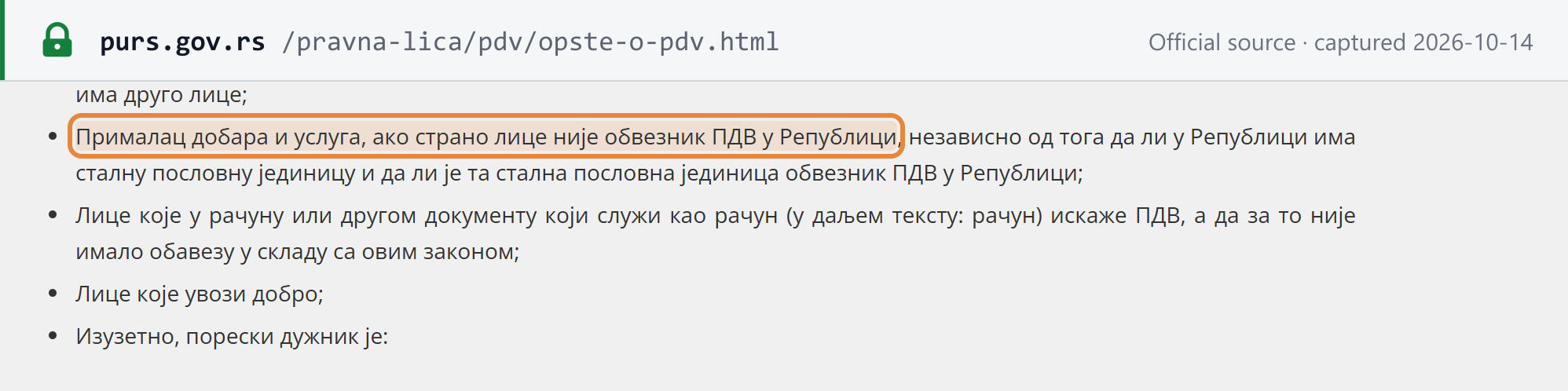
- Selling to Serbian VAT payers (B2B). Where a foreign business that is not registered for Serbian VAT makes a supply whose place of supply is Serbia, the Serbian customer is the tax debtor: "Прималац добара и услуга, ако страно лице није обвезник ПДВ у Републици" (the recipient, if the foreign person is not a VAT payer in Serbia), whether or not the foreign person has a permanent establishment in Serbia (Art 10(1) pt 3). The foreign business does not register (Art 10a(2)). A customer that uses SEF documents the purchase with an internal invoice (интерни рачун) created in SEF, for tax periods from April 2026 (Art 42(10)–(11)). A customer that is a tax debtor but not itself a VAT payer files a monthly return within 10 days of the period. [1] [2]
- Selling to consumers (B2C), including digital services. Appoint a tax representative and register from the first sale, with no threshold. The tax representative issues e-invoices through SEF for the foreign business's transactions with Serbian businesses and public bodies. [2] [4]
- Selling goods from abroad. VAT is collected from the importer at the border.
Marketplace / platform deemed-supplier liability
Serbia has no general marketplace deemed-supplier rule. The closest provision is Article 10(4): where a foreign person supplies goods or services in Serbia to someone who is not a VAT payer, and a Serbian VAT payer collects the payment in the foreign person's name and for its account, "порески дужник за тај промет је обвезник ПДВ који наплаћује накнаду" (the tax debtor for that supply is the VAT payer collecting the payment). [2]
Domestic reverse charge
Between registered VAT payers, the customer is the tax debtor for: secondary raw materials and related services; buildings where the contract opts for VAT; construction services worth more than RSD 500,000 excluding VAT (a public body listed in Art 9(1) that receives such services is also the tax debtor); electricity and gas bought for resale; investment gold; and sales in enforcement proceedings (mortgage, pledge, execution) (Art 10(2)–(3)). [2]
Place of supply
- Goods (Art 11): where the goods are when dispatch or transport to the customer begins; where they are installed or assembled; or where they are when supplied without transport.
- Services, general rule (Art 12(4)–(5)): B2B — where the customer is established; B2C — where the supplier is established.
- Exceptions: services connected with immovable property (where the property is), passenger transport and events (where performed), short-term hire of means of transport, and the consumer services in Art 12(6) pt 7 (where the customer lives).
- Who counts as a business customer: for a foreign supplier not registered in Serbia, any business or legal entity counts as a taxable customer (Art 12(3)).
Invoice requirements
"Обвезник је дужан да изда рачун за сваки промет добара и услуга" — a VAT payer must issue an invoice for every supply (Art 42(1)), and for advance payments; the final invoice deducts the advances. [2]
Document types
A VAT payer issues one of these (Art 42(6)–(8)): [2]
| Document | When it is used |
|---|---|
| E-invoice under the Law on Electronic Invoicing | Mandatory for B2B and B2G supplies (see E-invoicing status) |
| Fiscal receipt under the Law on Fiscalization | Retail sales, including all sales to private individuals |
| Paper invoice, in at least two copies | Where neither of the above applies |
| Other electronic invoice | Where neither of the above applies and the customer consents |
| Internal invoice (интерни рачун) | Made by a customer that is the tax debtor under the reverse charge; SEF users create it in SEF |
Periodic invoices for continuous supplies may cover up to one year (Art 42(2)–(3)). A ministerial rulebook under Article 45 sets the cases in which no invoice, or a simplified one, is needed.
Mandatory content
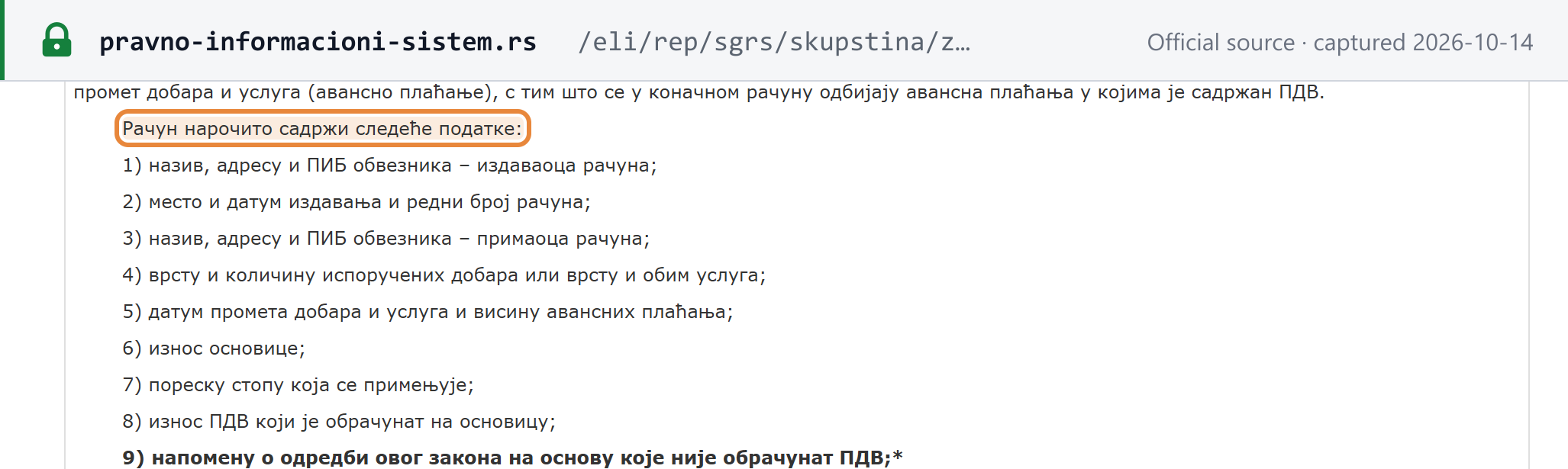
"Рачун нарочито садржи следеће податке" — an invoice must contain in particular (Art 42(5)): [2]
| Art 42(5) | Field |
|---|---|
| pt 1 | Supplier's name, address and PIB |
| pt 2 | Place and date of issue, and the invoice's sequential number |
| pt 3 | Customer's name, address and PIB |
| pt 4 | Type and quantity of goods supplied, or type and scope of services |
| pt 5 | Date of supply, and the amount of any advance payments |
| pt 6 | Taxable amount |
| pt 7 | VAT rate applied |
| pt 8 | Amount of VAT charged on the taxable amount |
| pt 9 | Where no VAT is charged, a note citing the provision of the VAT Law that applies (exemption, reverse charge) |
| pt 10 | Where the cash-accounting scheme applies, a note saying so |
Numbering and sequencing
Each invoice carries a sequential number (редни број рачуна) alongside its place and date of issue (Art 42(5) pt 2). [2]
Credit notes and cancellations
- Cancelling an invoice (Art 44(2)). A VAT payer that cancels (сторнира) an invoice can reduce the taxable amount and VAT in the same period only if it cancels before filing that period's return, and no later than the 10th of the following month, and it has either issued a new invoice or holds a notice from the VAT-payer customer that the VAT was not deducted. This rule applies to tax periods from April 2026.
- Later price reductions and returns reduce the taxable amount under Article 21.
- VAT shown in error. "Лице које искаже ПДВ у рачуну, а није обвезник ПДВ, дужно је да исказани ПДВ плати" — anyone who shows VAT on an invoice without being a VAT payer must pay it (Art 44(4)). A person who shows VAT on an invoice without being liable for it is the tax debtor for that amount (Art 10(1) pt 4). A person who is not a VAT payer "нема право да исправи исказани износ ПДВ" — may not correct the VAT shown (Art 44(5)).
Currency
Consideration in a foreign currency is converted into dinars at the National Bank of Serbia middle rate, or the contracted rate, valid on the day the tax liability arises (Art 22). [2]
Self-billing
Permitted (Art 43) where the customer is entitled to show VAT, the two parties agree that the customer will draw up the document, the document is delivered to the supplier, and the supplier agrees with it in writing. [2]
Retention and audit trail
- VAT records and supporting documents are kept "до истека рока застарелости за утврђивање и наплату ПДВ" — until the limitation period for assessing and collecting VAT expires (Art 47). That period is five years, counted from 1 January of the year after the year in which the tax should have been assessed (Law on Tax Procedure Art 114). Records on premises and investments subject to input-tax adjustment are kept for at least 10 years. [2] [3]
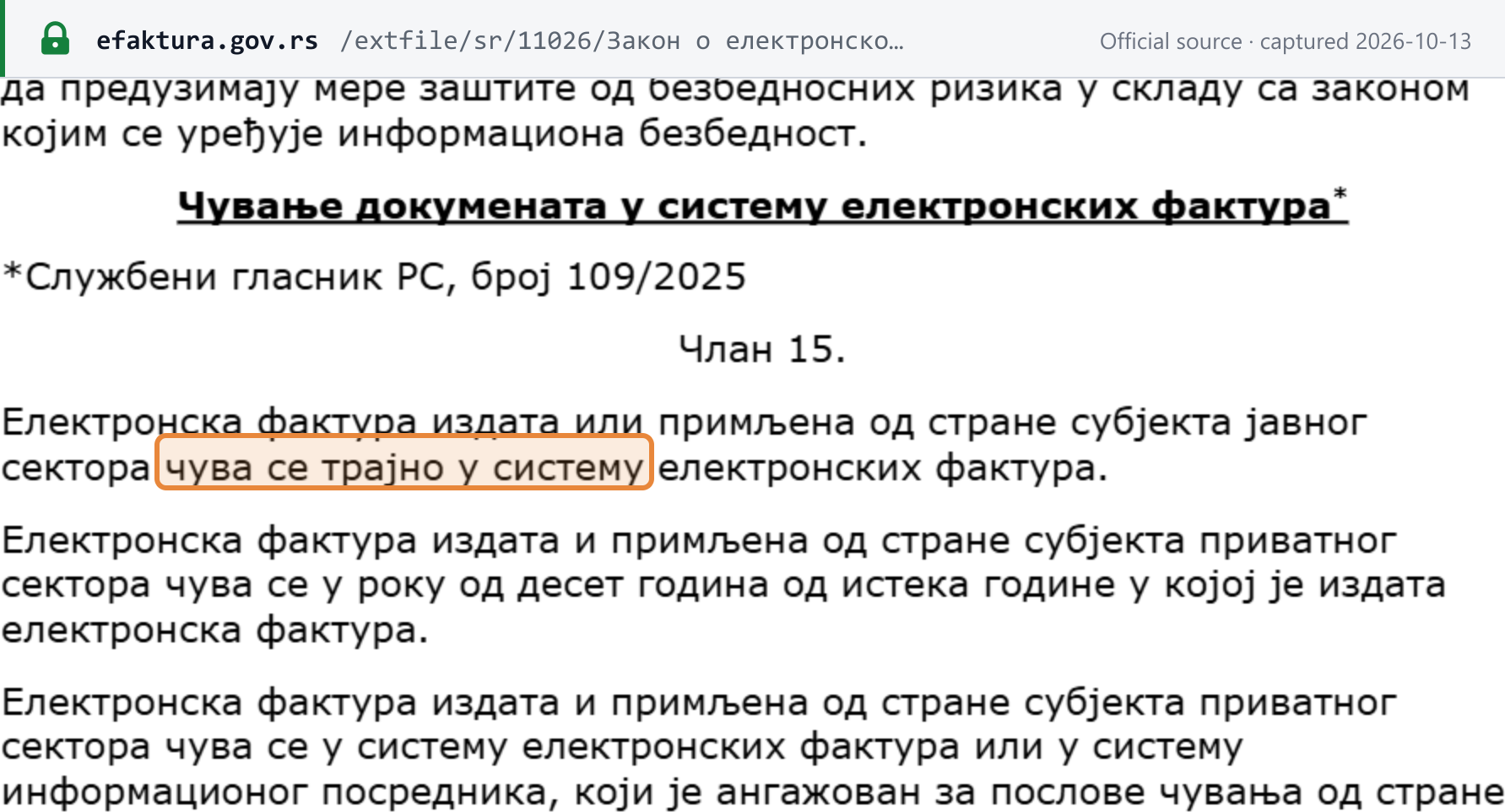
- E-invoices issued and received by private-sector businesses are kept for 10 years from the end of the year of issue, in SEF or with the business's information intermediary; public-sector e-invoices are kept permanently in SEF (Law on Electronic Invoicing Art 15). [4]
- Audit trail. An e-invoice is a valid document only if it was sent through SEF (Art 8 of that law), and the recipient accepts or rejects it within 15 days, so every B2B invoice has a central, time-stamped record. Retail sales are recorded through electronic fiscal devices, and each fiscal receipt carries a QR code that leads to the Tax Administration's portal (see E-invoicing status).
A specimen of a compliant invoice
Neither the Tax Administration nor the Ministry of Finance publishes an annotated specimen invoice. Below, Lookuptax lays out the Article 42(5) particulars for a domestic B2B supply of services in 2026. Every name, number and amount is fictional:
INVOICE
| DescriptionArt 42(5) pt 4 | Qty | Taxable amount (RSD)Art 42(5) pt 6 | RateArt 42(5) pt 7 | VAT (RSD)Art 42(5) pt 8 |
|---|---|---|---|---|
| IT consulting services, September 2026 | 1 | 100,000.00 | 20% | 20,000.00 |
- Taxable amountArt 42(5) pt 6
- RSD 100,000.00
- VAT 20%Art 42(5) pt 8
- RSD 20,000.00
- Advance payments receivedArt 42(5) pt 5
- RSD 0.00
- Total
- RSD 120,000.00
- Between two Serbian VAT payers this invoice must be issued as an e-invoice through SEF (UBL 2.1, SRBDT specification); the customer accepts or rejects it in SEF within 15 days.
- If no VAT were charged (for example an export), the invoice would cite the VAT Law provision that applies instead of a rate (Art 42(5) pt 9).
- A supplier using the cash-accounting scheme adds a note saying so (Art 42(5) pt 10).
- Kept for 10 years from the end of the year of issue (Law on Electronic Invoicing Art 15).
E-invoicing status
Status: mandatory and live for B2G and B2B. Serbia runs a central government platform, the SEF — Sistem elektronskih faktura ("eFaktura"), operated by a unit of the Ministry of Finance. [4]
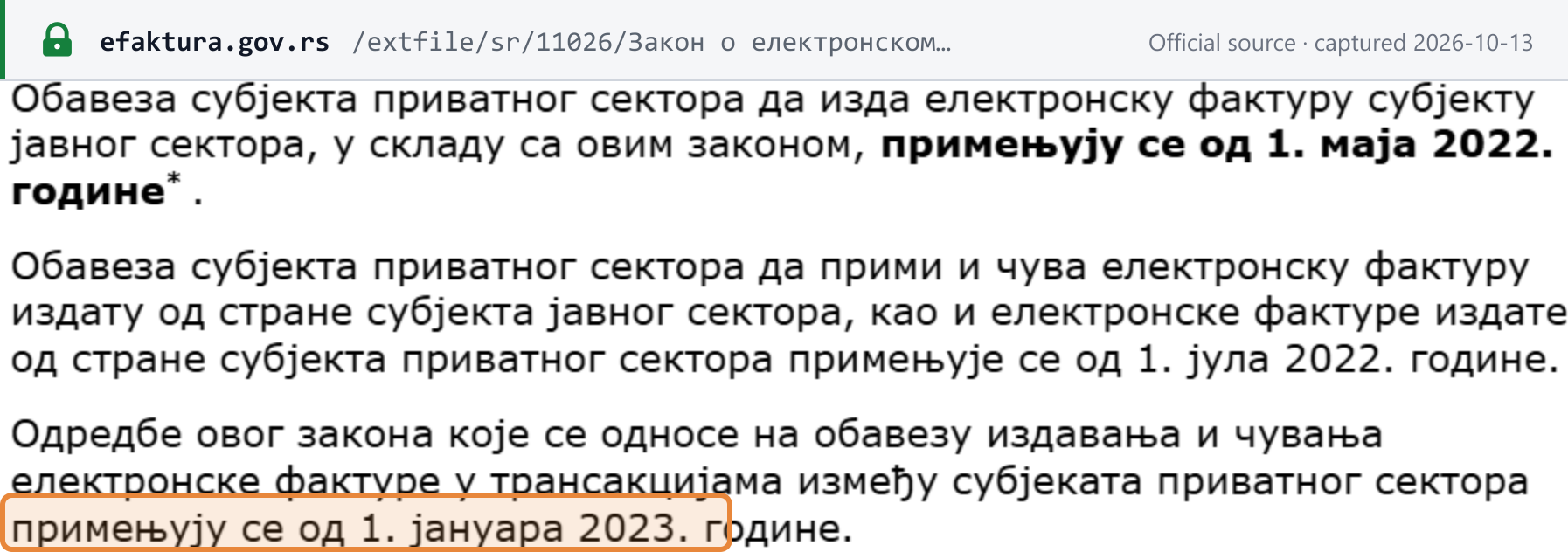
| Phase | What became mandatory | Date |
|---|---|---|
| B2G | Public sector receives e-invoices; private businesses issue e-invoices to the public sector | 1 May 2022 |
| G2B and receipt | Public sector issues e-invoices to businesses; private businesses receive and store e-invoices | 1 July 2022 |
| B2B | Private businesses issue and store e-invoices to each other | 1 January 2023 |
- Format. UBL 2.1 to the Serbian standard SRPS EN 16931-1, with the national SRBDT specification (current version dated 18 December 2025). [7]
- B2C is outside the e-invoicing law and is covered by e-fiscalisation (below). For tax periods beginning after 31 March 2026, two retail sales must nonetheless be e-invoiced: sales to a holder of a corporate card, and sales to a public body that asks for an e-invoice within seven days.
- Electronic VAT recording. Output VAT not covered by an e-invoice, and input VAT, are recorded in SEF by the 12th of the month after the tax period (Law on Electronic Invoicing Arts 4 and 4a).
- Input tax. Where a supply had to be e-invoiced, "право на одбитак претходног пореза … може да се оствари искључиво на основу прихваћене електронске фактуре" — input VAT can be deducted only on an accepted e-invoice (VAT Law Art 28). [2]
- Fines (Law on Electronic Invoicing Art 18): RSD 200,000–2,000,000 for a legal entity, RSD 50,000–500,000 for an entrepreneur, and RSD 50,000–150,000 for the responsible person. [4]

Dated changes.
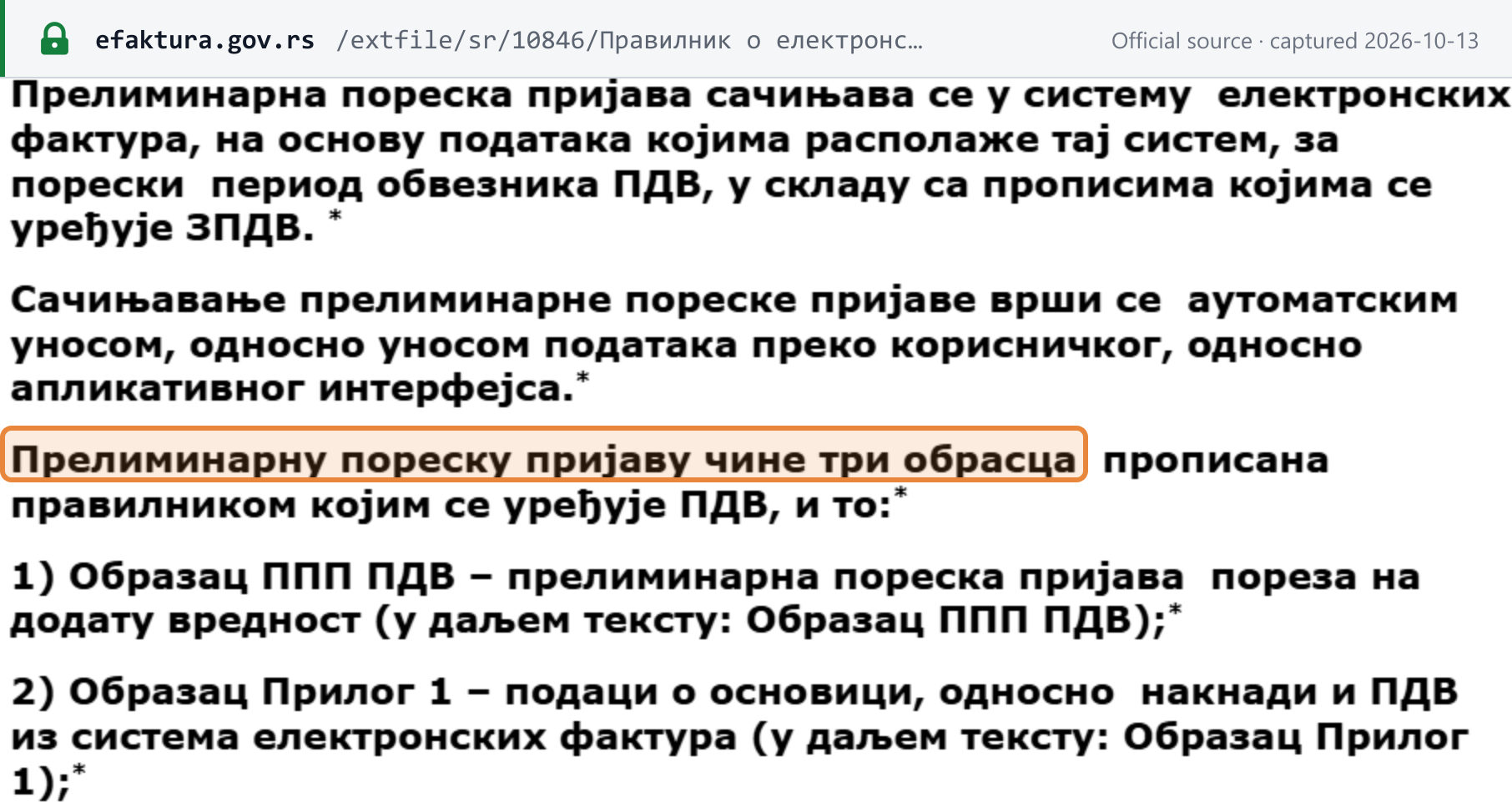
- Tax periods beginning after 31 December 2026: SEF compiles a preliminary VAT return (PPP PDV) from e-invoices and VAT records (Rulebook on electronic invoicing as amended by 71/2026, Art 29). It is made up of three forms: PPP PDV itself, Prilog 1 (filled automatically from SEF) and Prilog 2 (equipment and premises, entered by the taxpayer). [6]
- 1 January 2027: the Law on Electronic Invoicing amendments in Službeni glasnik 80/2026 (in force since 8 September 2026) apply.
- 1 July 2027: VAT payers must e-record in SEF their purchases from farmers who are not VAT-registered (new Art 4b), and the export customs-declaration list applies (Art 4v). [5]
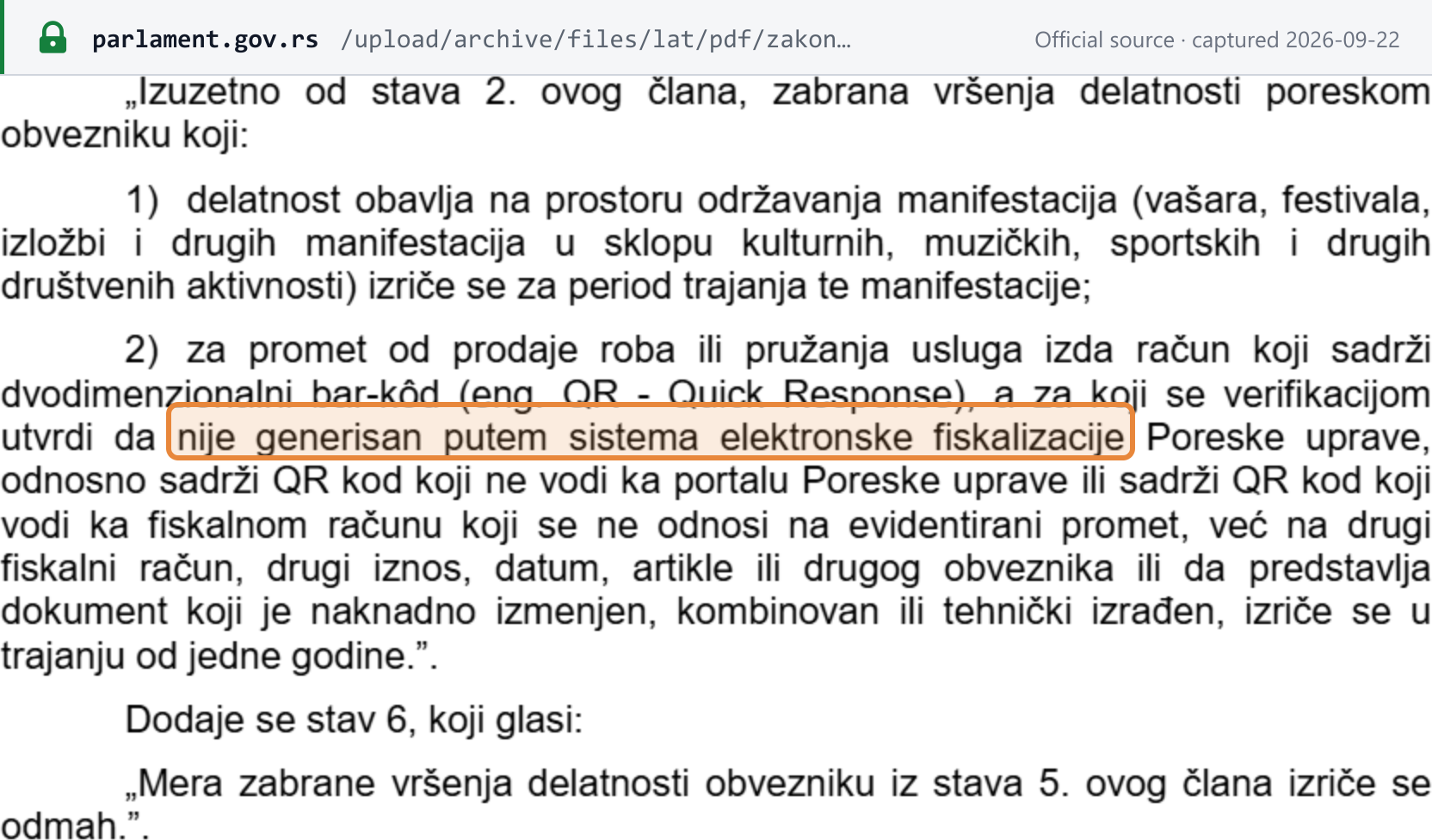
B2C: e-fiscalisation. Under the Law on Fiscalization (Službeni glasnik 153/2020, last amended 80/2026), applying from 1 November 2021, every retail sale and retail advance — all supplies to private individuals, and any sale made in retail premises — is recorded through an electronic fiscal device connected to the Tax Administration's system. Each fiscal receipt carries a QR code that can be checked on the Tax Administration's portal. From 8 September 2026, issuing a receipt whose QR code fails that check (not generated through the e-fiscalisation system, or leading to a different receipt, amount, date, items or taxpayer) brings an immediate one-year ban on carrying on the business (Art 12(5)–(6)). [8]

For onboarding, formats, acceptance rules and the API, see the Serbia e-invoicing guide; for retail devices, fiscal devices and certified cash registers; and for Serbia alongside other countries, the e-invoicing status and networks table.
Filing and payment
Filing frequency
| Tax period | Who |
|---|---|
| Calendar month | Total turnover in the previous 12 months above RSD 50,000,000; users of the cash-accounting scheme; new VAT payers, for the calendar year in which they register and the following year |
| Calendar quarter | Total turnover in the previous 12 months below RSD 50,000,000 |
- Changing band: a move between monthly and quarterly takes effect from the month after the calendar quarter in which the threshold was crossed.
- Opting for monthly: a quarterly filer may ask for monthly periods. Requests are made "почев од 20. децембра закључно са 31. децембром" (from 20 to 31 December) for the next calendar year. Under the 80/2026 amendments, applying from 15 December 2026, an approved change lasts until the end of the year after the year in which the taxpayer asks to end it.
- Tax debtors that are not VAT payers (for example an unregistered Serbian business reverse-charging a foreign service) have monthly periods.

Return due date
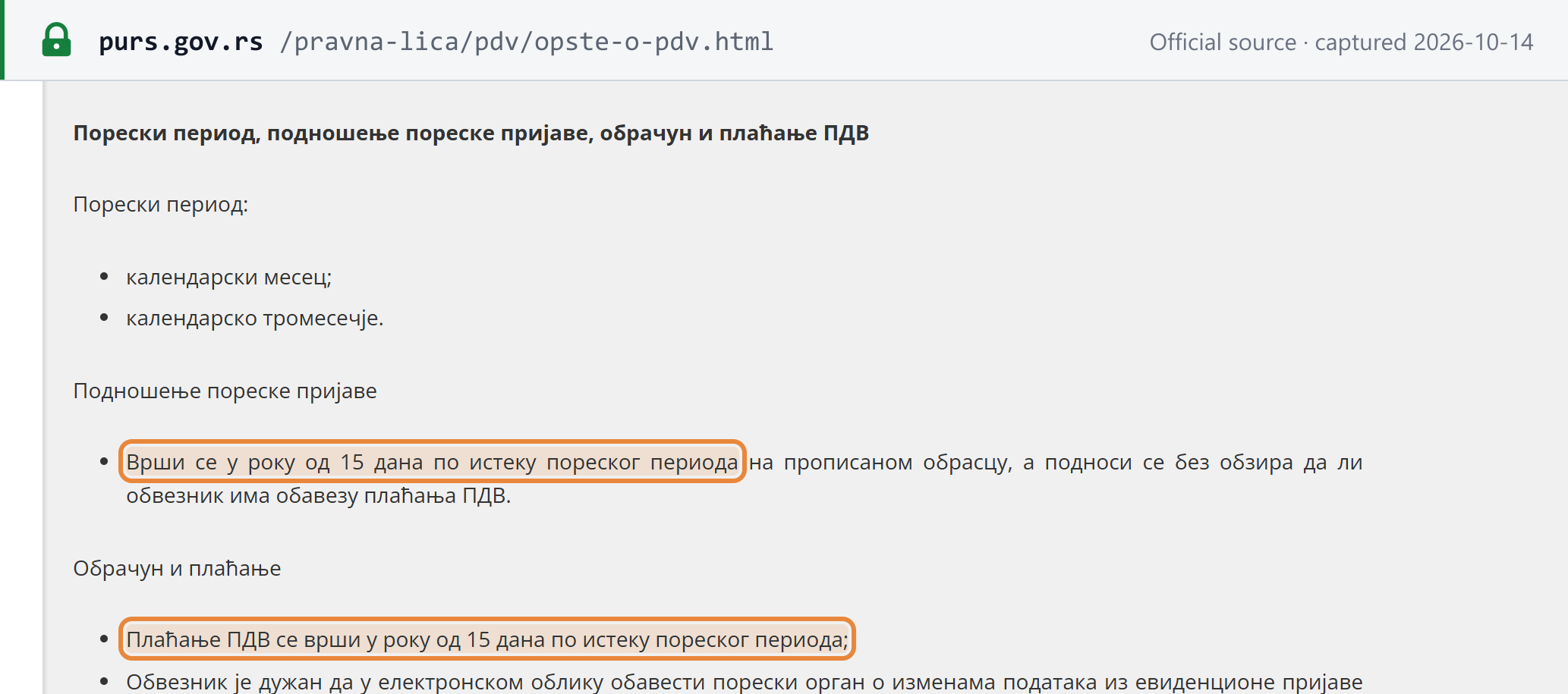
The VAT return (form PPPDV) "врши се у року од 15 дана по истеку пореског периода" — it is filed within 15 days after the end of the tax period, and it is filed even if no VAT is payable. Returns are filed electronically through ePorezi. [1]
- Tax debtors that are not VAT payers file within 10 days after the period in which the liability arose (Art 50). [2]
- From tax periods beginning after 31 December 2026: the return is filed together with the SEF-compiled preliminary return (PPP PDV) as an annex (Art 50a). No preliminary return is compiled for the first or the last period of VAT activity (Art 49a(3)). From January 2027 periods, if a return is not filed on time, the Tax Administration files one ex officio on the basis of the preliminary return (Art 50). [2]
Payment due date
VAT is paid by the same deadline as the return: "Плаћање ПДВ се врши у року од 15 дана по истеку пореског периода" (Art 51). [1]
Additional listings
- No annual VAT return and no EC-style sales list. The VAT Law has no annual return.
- Electronic VAT recording in SEF by the 12th of the following month (see E-invoicing status).
- Year-end notices: for the last tax period of the calendar year, notify the Tax Administration of purchases of secondary raw materials from persons who are not VAT payers, and of farm produce bought from farmers who are not VAT payers (Art 51a(2)). Until the end of 2026 the notice is filed with that period's return; from 1 January 2027 (Službeni glasnik 80/2026) it is given to the Tax Administration separately, no longer with the return. From 1 July 2027, farmer purchases are also e-recorded in SEF.
Input-tax recovery and blocked items
Input VAT is deductible on purchases used for taxable supplies, for supplies exempt with the right to deduct (Art 24), and for supplies made abroad that would carry the deduction if made in Serbia. The deduction needs a VAT invoice or import document — and, where the supply had to be e-invoiced, an e-invoice accepted by the day before the return is filed and no later than the 10th of the following month (Art 28). A business with both taxable and exempt supplies deducts pro rata by turnover, from 1 January to the end of the period (Art 30). [2]
- passenger cars, motorcycles, yachts, boats and aircraft, and their fuel, parts, hire and maintenance;
- entertainment ("издатака за репрезентацију");
- employee commuting and staff meals, except meals in the business's own catering premises where it charges for them.
Refunds
- Residents. Where input tax exceeds output tax, the taxpayer chooses a refund or a tax credit to carry forward; if it does not choose a refund, "разлика се признаје као порески кредит" (the difference is recognised as a tax credit). A refund is paid within 45 days of the filing deadline, or within 15 days for taxpayers that mainly export goods, provided the return was filed on time (Art 52). [2]
- Bad debts. The taxable amount can be reduced for unpaid consideration only on a final court decision closing bankruptcy proceedings, or on a certified court settlement (Art 21). [2]
- Foreign businesses (refaction). A foreign business that makes no supplies in Serbia (other than exempt transport, bus transport taxed per journey, or reverse-charged supplies) can reclaim Serbian VAT shown on paid invoices if the claim is more than EUR 200 (converted into dinars at the National Bank of Serbia middle rate), the VAT would be deductible for a Serbian VAT payer, and its home country grants reciprocity (Art 53). The forms are on the Tax Administration's refaction page. [2] [10]

Exemptions
Exempt supplies
Exempt with the right to deduct (Art 24) — effectively zero-rated: exports of goods, international transport, supplies into free zones and under customs warehousing, aircraft and ships in international traffic, goods taken abroad by non-resident travellers, and the other supplies listed. [2]
Exempt without the right to deduct (Art 25): [2]
- financial services (money, securities, credit, guarantees, deposits, payments, fund management), and transfers and exchange of virtual currencies;
- insurance;
- land and the lease of land;
- buildings, other than the first transfer of new buildings — the parties may opt by contract to tax a later transfer;
- residential lettings ("услуга закупа станова");
- health, dental and social care; education; non-profit cultural, scientific and sports services;
- religious services, non-commercial public broadcasting and gambling;
- postal services of the public postal operator, exempt since 8 September 2026 (80/2026).
Exempt is not zero-rated. A supply under Article 25 carries no VAT, and the input VAT on purchases used to make it cannot be deducted: Article 28 allows a deduction only for taxable supplies and for Article 24 supplies. An Article 24 supply (an export, for example) also carries no VAT, but keeps the full input-tax deduction. The Tax Administration's own summary splits exemptions the same way: "Са правом на одбитак претходног пореза (чл. 24.)" and "Без права на одбитак претходног пореза (чл. 25.)". [1] [2]

Special regimes
[2]- Small taxpayers with turnover up to RSD 8 million: outside VAT unless they opt in (Art 33).
- Farmers' flat-rate scheme: non-registered farmers receive an 8% compensation from VAT-registered buyers (Art 34).
- Travel agents (Art 35) and second-hand goods, works of art and antiques (Art 36): margin schemes.
- Cash accounting: on request, for a VAT payer with turnover up to RSD 50 million that has been registered throughout the previous 12 months (Art 36a). Users file monthly and note the scheme on their invoices.
- Investment gold (Art 36b), with the domestic reverse charge between VAT payers.
- Free zones: supplies into free zones are exempt with the right to deduct (Art 24(1) pts 5–5a).
Offences and penalties
Offences
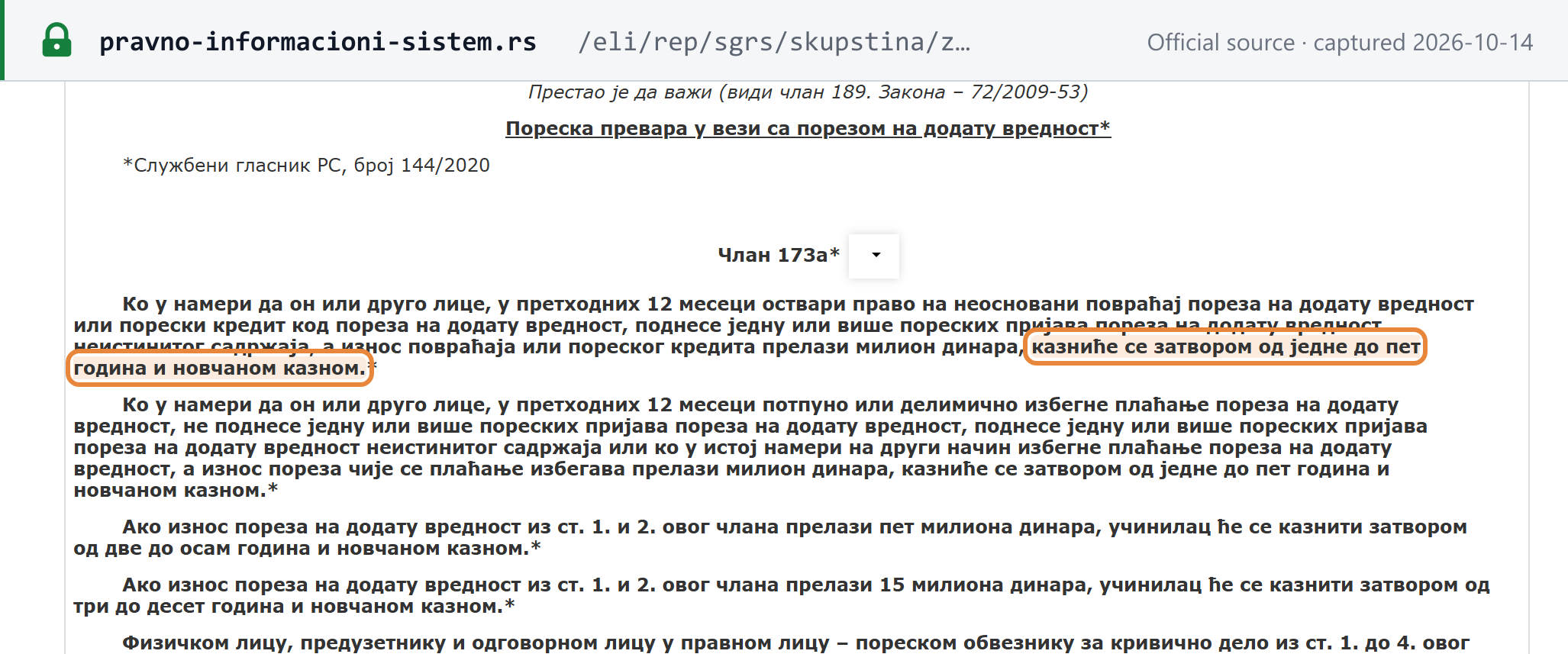
- VAT fraud (Law on Tax Procedure Art 173a). Filing false VAT returns to obtain an unfounded refund or credit, or failing to file, filing false returns or otherwise evading VAT, within a 12-month period, is a criminal offence. Where the VAT involved exceeds RSD 1 million, the offender "казниће се затвором од једне до пет година и новчаном казном" (is punished by one to five years' imprisonment and a fine); over RSD 5 million, two to eight years; over RSD 15 million, three to ten years. A ban on carrying on the activity for one to five years can be added. [3]
- Other criminal offences in the same law include illegal trade in fiscalisation equipment (Art 175a) and unlawful storage of goods (Art 176a).
- Misdemeanours: failing to register or deregister, failing to file or pay, understating tax, showing VAT on an invoice contrary to the law, failing to keep records, and — for a foreign business — failing to appoint a tax representative and register. The fines are below.
Penalties
Fines under the Law on Tax Procedure and Tax Administration, in RSD: [3]
| Breach | Legal entity | Entrepreneur | Article |
|---|---|---|---|
| Not filing, not calculating and not paying tax | 30%–100% of the tax, at least 500,000 | 30%–100% of the tax, at least 100,000 | 177(1) |
| Return filed on time, tax not paid | 10%–50% of the tax, at least 250,000 | 10%–50% of the tax, at least 50,000 | 177(4) |
| Return not filed, tax paid on time | 100,000–2,000,000 | 50,000–500,000 | 177(5) |
| Late return and late payment | 25,000 to 300,000, by band of tax | 15,000 to 150,000, by band of tax | 177(8) |
| Late return, tax paid on time | 100,000 | 40,000 | 177(9), (11) |
| Return on time, late payment | 20,000 to 250,000, by band of tax | 10,000 to 140,000, by band of tax | 177(10) |
| Understated tax or false data in a return | 30%–40% of the difference, at least 200,000 (100,000 if the difference is 5% or less) | at least 100,000 (50,000 if 5% or less) | 178 |
| Not filing the VAT registration or deregistration application | 100,000–2,000,000 | 50,000–500,000 | 178a(1) pt 2 |
| Showing tax on an invoice contrary to the law | 100,000–2,000,000 | 50,000–500,000 | 178b(5) |
| Not keeping the prescribed records | 100,000–2,000,000 | 50,000–500,000 | 178b(1)–(2) |
| Foreign business that does not appoint a tax representative and register | 100,000–2,000,000 | 50,000 (individual) | 180b |
The responsible person in a legal entity is also fined (for example RSD 10,000–100,000 for a missing registration application). E-invoicing breaches carry their own fines (see E-invoicing status).
 Late-payment interest. Interest on unpaid tax is charged at the National Bank of Serbia's annual reference rate increased by ten percentage points ("стопи Народне банке Србије, увећаној за десет процентних поена"), as simple interest (Law on Tax Procedure Art 75). [3] The current reference rate is published on the National Bank of Serbia homepage. [9]
Frequently asked questions
We are a foreign SaaS company selling to Serbian businesses. Do we have to register for Serbian VAT?
No, as long as you supply only Serbian VAT payers (and the public bodies listed in Article 9(1) of the VAT Law). Article 10a(2) releases a foreign business in that position from appointing a tax representative and registering. The Serbian customer is the tax debtor: it accounts for the VAT under the reverse charge and, if it uses the e-invoicing system SEF, records the purchase with an internal invoice created in SEF.
And if we sell digital services to Serbian consumers?
Electronically supplied services to someone who is not a taxable person are taxed where the customer lives, so sales to consumers in Serbia are subject to Serbian VAT. There is no turnover threshold for foreign sellers and no simplified registration scheme: you must appoint a Serbian tax representative and register for VAT from your first such sale. A foreign legal entity that fails to do so can be fined RSD 100,000 to 2,000,000.
Is the RSD 8 million threshold measured by calendar year or on a rolling basis?
On a rolling basis: it is your total turnover in the previous 12 months. You must file the registration application within five days of the day your turnover went over RSD 8,000,000.
Do I file VAT returns monthly or quarterly?
Quarterly if your total turnover in the previous 12 months was below RSD 50 million, and monthly if it was above. New VAT payers file monthly for the calendar year in which they register and the following year, and cash-accounting users always file monthly. The return and the payment are both due within 15 days after the end of the tax period.
Can I deduct input VAT on a supplier e-invoice I have not yet accepted in SEF?
No. Where the supply had to be e-invoiced, input VAT can be deducted only on an accepted e-invoice. It must be accepted by the day before you file the return for that period, and no later than the 10th of the following month.
What changes on 1 January 2027?
Under the VAT and e-invoicing amendments in Službeni glasnik 80/2026: a VAT payer whose turnover in the previous 12 months was no more than RSD 8 million can ask to be deregistered; a registration lasts at least the current and the following calendar year; and for tax periods beginning after 31 December 2026 the e-invoicing system SEF compiles a preliminary VAT return that is filed as an annex to your return, with the Tax Administration filing a return ex officio from it if you do not file. Electronic recording of purchases from farmers who are not VAT-registered follows on 1 July 2027.
Can a foreign company get Serbian VAT back without registering?
Yes, through a refund called refaction, if it makes no supplies in Serbia (apart from a few listed ones such as reverse-charged supplies), the claim is more than EUR 200, the VAT would be deductible for a Serbian VAT payer, and its home country gives Serbian businesses the same treatment (reciprocity).
Important websites
| Site | Purpose |
|---|---|
| Poreska uprava — general VAT page | The Tax Administration's overview of VAT: rates, tax debtors, tax representatives, returns, refunds |
| ePorezi | File the VAT return (PPPDV) and other tax filings online |
| Register of VAT payers | Look up whether a business is VAT-registered, by PIB |
| Register of tax representatives | Tax representatives approved for foreign businesses |
| Refaction for foreign businesses | Forms for reclaiming Serbian VAT without registering |
| SEF (eFaktura) production | Issue, receive and accept e-invoices; record VAT; preliminary VAT return |
| eFaktura information portal | Ministry of Finance rules, specifications, API documentation and news for SEF |
| Serbia PIB validator | Check a PIB's format with Lookuptax |
| National Bank of Serbia | Middle exchange rates for VAT conversion and the reference rate behind late-payment interest |
| Legal information system | Official consolidated texts of the VAT, tax procedure, e-invoicing and fiscalisation laws |
Recent changes
- 2026-10-02 — SEF version 4.2.0 went into production. (Ministry of Finance)
- 2026-09-08 — Fiscalisation: a receipt whose QR code fails verification now brings an immediate one-year business ban (Službeni glasnik 80/2026). (Službeni glasnik / PIS) — see events: penalty, gazette correction
- 2026-08-31 — VAT Law amendments published in Službeni glasnik 80/2026 (in force 8 September 2026, mostly applying from 1 January 2027): deregistration on request up to RSD 8 million, a minimum registration of the current and following year, a 15-day final return, ex officio returns from the preliminary return, and the postal-services exemption from 8 September 2026. (Službeni glasnik / PIS) — see events: deregistration, postal exemption and period rules
- 2026-08-31 — Law on Electronic Invoicing amendments in the same gazette: apply from 1 January 2027, with farmer-purchase recording and the export customs list from 1 July 2027. (Službeni glasnik / PIS) — see event
- 2026-07-31 — Rulebook on electronic invoicing amended (Službeni glasnik 71/2026, from 1 August 2026): SEF compiles the preliminary VAT return for tax periods beginning after 31 December 2026. (Ministry of Finance) — see event
- 2026-04-01 — VAT Law amendments of Službeni glasnik 109/2025 apply from the April 2026 (or April–June 2026) tax period: internal invoices in SEF for reverse-charged purchases, new invoice-cancellation rules, and the reverse charge on investment gold. (Službeni glasnik / PIS)
For the full chronology, see Serbia tax changes on Lookuptax.
Reference links
- Poreska uprava — Опште о ПДВ (general VAT page)
- Law on Value Added Tax, consolidated through Službeni glasnik 80/2026 (legal information system)
- Law on Tax Procedure and Tax Administration, consolidated through Službeni glasnik 80/2026 (legal information system)
- Ministry of Finance — Law on Electronic Invoicing, consolidated through 80/2026 (PDF)
- Law on Electronic Invoicing, consolidated through Službeni glasnik 80/2026 (legal information system)
- Ministry of Finance — Rulebook on electronic invoicing, consolidated through 71/2026 (PDF)
- Ministry of Finance — SRBDT specification of the Serbian e-invoicing standard, version 18.12.2025 (PDF)
- Law on Fiscalization, consolidated through Službeni glasnik 80/2026 (legal information system)
- National Bank of Serbia — homepage (reference rate)
- Poreska uprava — Refaction of VAT to foreign taxpayers
- Ministry of Finance — SEF update 4.2.0 available in production
- Poreska uprava — Register of VAT payers
Related on Lookuptax: