Serbia's VAT amendment act 2585-26 exempts public postal services and sets registration-retention and tax-period rules from 2027
- Jurisdiction
- Serbia
- Tax
- VAT
- Change type
- Compliance
- Status
- Enacted
- Impact
- Plan ahead
- Announced
- 31 August 2026
- Effective
- 1 January 2027
- Authority
- Narodna skupština Republike Srbije (National Assembly of Serbia)
- Systems
- Tax engine, Reporting, ERP
- Verified
- Fetched from official source · high confidence
Serbian VAT taxpayers, in particular those registered under Article 38, those deregistering from the VAT register, taxpayers changing their tax period, and the public postal operator.
Review Serbian VAT registration-retention, deregistration final-return (15-day) and tax-period-change timing ahead of 1 January 2027; note the postal-services exemption.
Tax engineReportingERP
Serbia's Law on Amendments and Supplements to the Law on Value Added Tax (act no. 2585-26; Sluzbeni glasnik RS br. 80/2026 of 31 August 2026) contains further operative provisions beyond the Article 38a deregistration route: services of the public postal operator and related supplies of goods are added to the VAT exemptions in Article 25(2)(6); a taxpayer registered under Article 38 remains liable for VAT at least for the current and the following calendar year; a taxpayer deregistered from the VAT register (or the legal successor after a status change) files the final VAT return within 15 days of ceasing VAT activity (1-15 February 2027 where activity ceases in January 2027); the tax authority files a return ex officio, based on the preliminary return, where a taxpayer does not file on time; the Article 33(4)/34(8) 'two years' period becomes the current and the following calendar year; an approved change of tax period lasts until the end of the calendar year following the year of the request to end it, with such requests submitted 20-31 December (from 15 December 2026). The law enters into force on the eighth day after publication and applies generally from 1 January 2027 (Article 1 from entry into force; Article 7 from 15 December 2026; Article 8(3)-(4) from the January 2027 / January-March 2027 tax period).
What changed in detail
Serbia’s Law on Amendments and Supplements to the Law on Value Added Tax (act no. 2585-26; Službeni glasnik RS br. 80/2026 of 31 August 2026) contains further operative provisions beyond the Article 38a deregistration route covered in rs-vat-deregistration-threshold-2026:
- services of the public postal operator and related supplies of goods are added to the VAT exemptions in Article 25(2)(6);
- a taxpayer registered under Article 38 remains liable for VAT at least for the current and the following calendar year;
- a taxpayer deregistered from the VAT register (or the legal successor after a status change) files the final VAT return within 15 days of ceasing VAT activity (1 to 15 February 2027 where activity ceases in January 2027);
- the tax authority files a return ex officio, based on the preliminary return, where a taxpayer does not file on time;
- the ‘two years’ period in Articles 33(4) and 34(8) becomes the current and the following calendar year;
- an approved change of tax period lasts until the end of the calendar year following the year of the request to end it, with such requests submitted 20 to 31 December (from 15 December 2026).
The law enters into force on the eighth day after publication and applies generally from 1 January 2027 (Article 1 from entry into force; Article 7 from 15 December 2026; Article 8(3)-(4) from the January 2027 / January-March 2027 tax period).
What it means
Most of these rules shorten or fix periods that were previously counted in years, so timing is where businesses can go wrong: the registration-retention rule runs to the end of the following calendar year, and the final return after deregistration is due within 15 days.
Review registration-retention, the 15-day deregistration return and tax-period-change timing ahead of 1 January 2027. The postal exemption matters mainly to the postal operator and its customers’ invoicing.
Proof
U slučaju iz stava 1. ovog člana, obaveza plaćanja PDV traje najmanje u tekućoj i narednoj kalendarskoj godini.In the case referred to in paragraph 1 of this article, the obligation to pay VAT lasts at least for the current and the following calendar year.
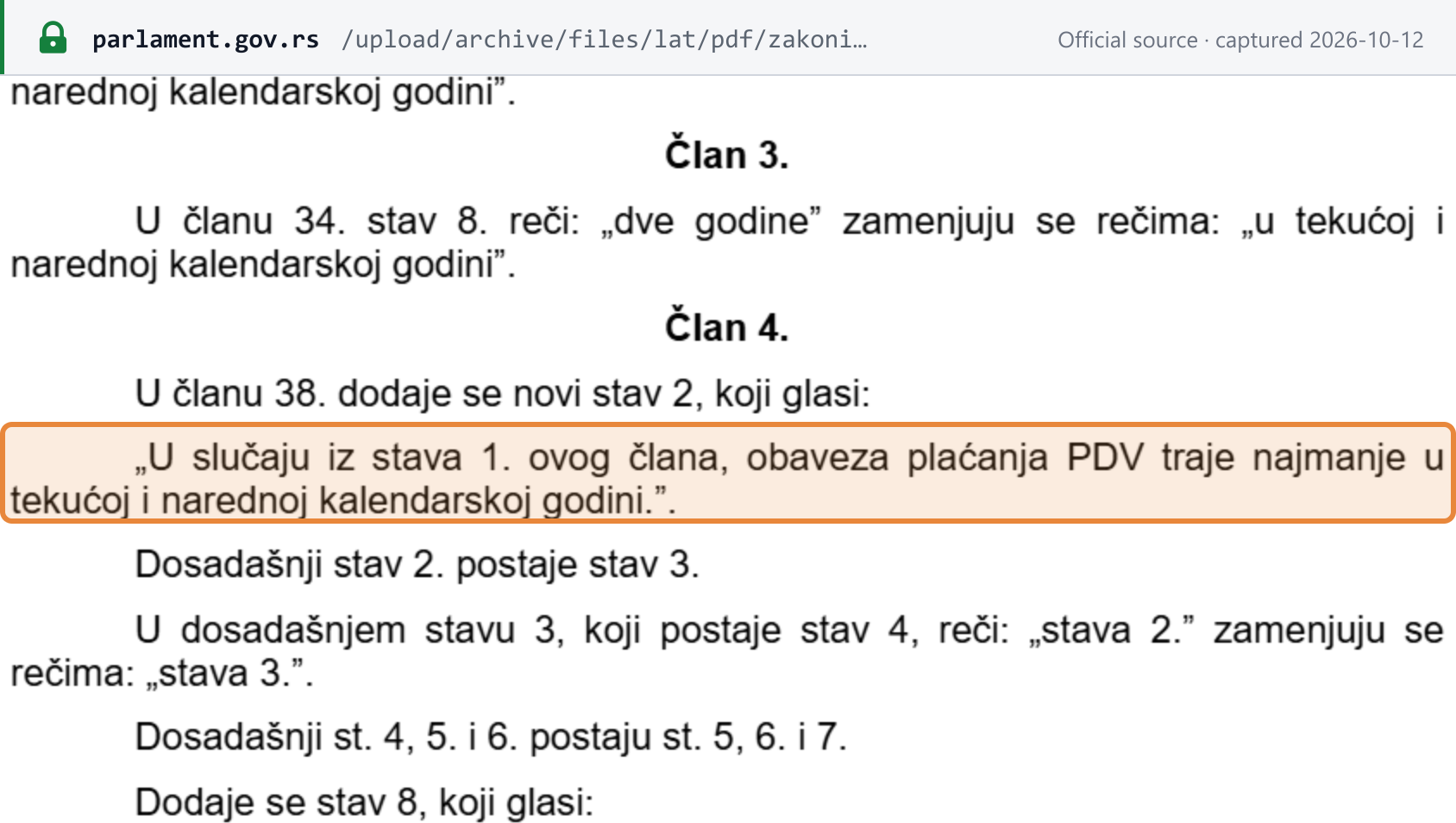 Source snapshot of the official page. Open full size ↗