Ecuador IVA guidelines
| FACTSHEET | |
|---|---|
| Country code | EC |
| Tax name | Value added tax (IVA) — Impuesto al Valor Agregado |
| Tax Authority | SRI (Servicio de Rentas Internas) |
Overview
Ecuador's value-added tax is the Impuesto al Valor Agregado (IVA). Under article 52 of the Ley de Régimen Tributario Interno (LRTI) it taxes the transfer and import of movable goods "en todas sus etapas de comercialización" (at every stage of marketing), copyright and industrial-property rights, and services. [1] This guide reflects the rules as at 15 October 2026.
Authority. The IVA is administered by the Servicio de Rentas Internas (SRI). Article 62 of the LRTI: "El sujeto activo del impuesto al valor agregado es el Estado. Lo administrará el Servicio de Rentas Internas" (the State is the creditor of the tax; the SRI administers it). [1]
Statute. The LRTI, Title Two (arts. 52–74), in SRI's consolidated text, and its implementing regulation, the Reglamento para la Aplicación de la LRTI (RLRTI, Executive Decree 374). [1] [7]
Currency. Ecuador uses the US dollar as legal tender, so every amount in this guide is in USD and domestic transactions need no exchange-rate conversion.
Tax period. The calendar month. Some taxpayers file every six months (see Filing and payment).
Layering. One national tax, with no provincial or municipal layer. A separate national excise, the Impuesto a los Consumos Especiales (ICE), applies to certain goods and services alongside IVA and is shown separately on the invoice. [9]
For the taxpayer number itself, see the Ecuador tax ID guide (RUC). For neighbouring systems, see the Colombia VAT guide, the Chile VAT guide and the Bolivia VAT guide.
Registration
Who should register
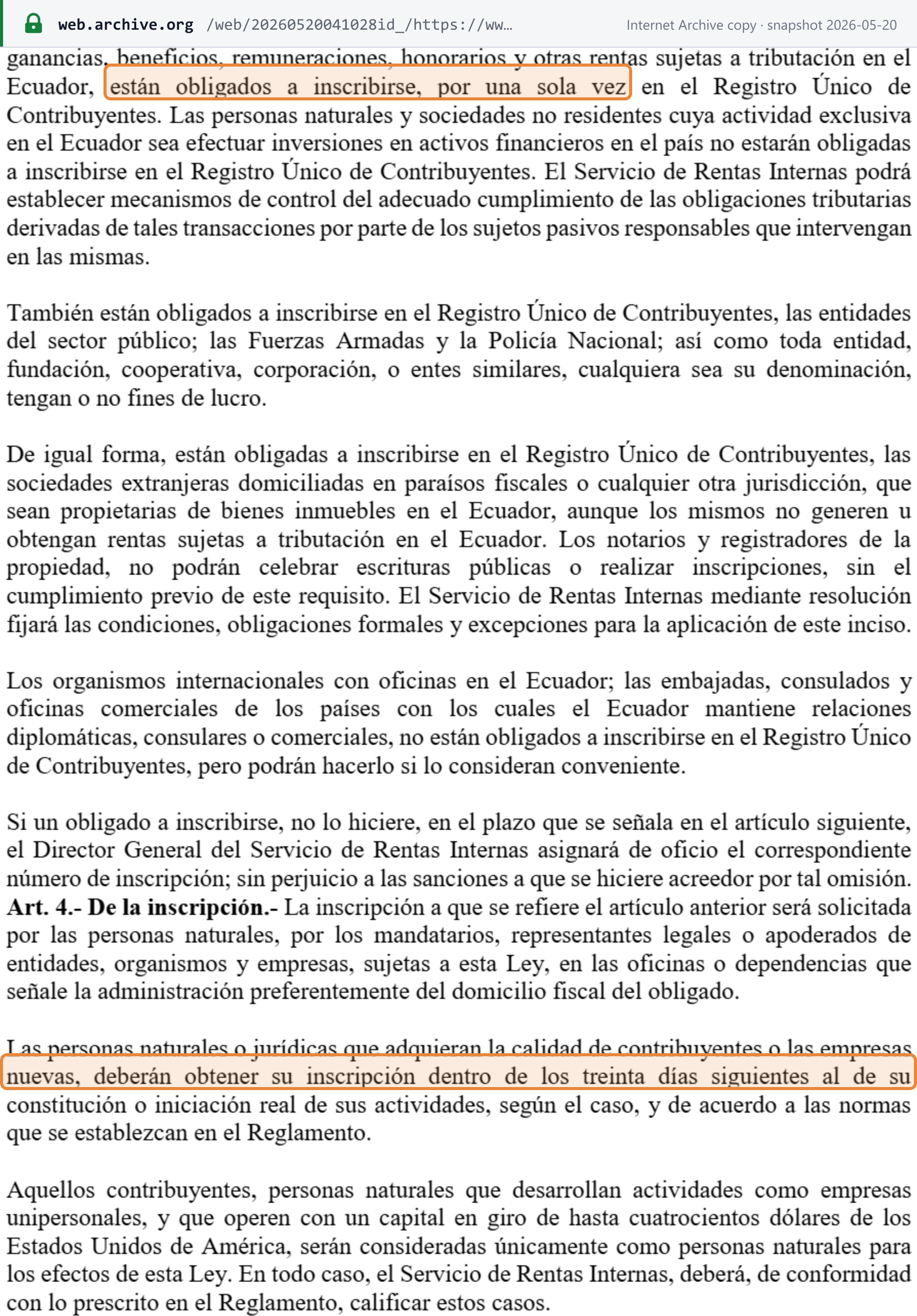
Every individual or legal person, national or foreign, that starts or carries on economic activity in Ecuador, "en forma permanente u ocasional" (permanently or occasionally), must register once in the Registro Único de Contribuyentes (RUC). The deadline is 30 days from incorporation or from the real start of activity. Non-residents whose only activity in Ecuador is investing in financial assets do not register. [2]
Anyone who habitually sells taxable goods or services is an IVA collection agent (agente de percepción) and must charge IVA on those sales (LRTI art. 63). [1]
Registration threshold
None. There is no turnover threshold for IVA: the duty to register attaches to economic activity itself, and registration is due within 30 days of starting. [2]
Non-resident registration
- Non-residents doing business in Ecuador fall under the same rule as residents: economic activity in the country, even occasional, requires a RUC. [2]
- Non-resident suppliers of digital services may register, but do not have to. If they do not, the IVA is collected by the payment intermediary or, if there is none, by the buyer (see Foreign companies selling into Ecuador — B2B and B2C).
Tax identification number
The RUC is a 13-digit number. For individuals it is built on the national identity card (cédula) number: Ley del RUC article 5 says that for individuals "el número de identificación tributaria estará dado por el número de la cédula de identidad". [2] [13]
SRI states that RUCs it issues to private companies, public bodies and foreign individuals without a cédula "no tienen una validación con un algoritmo específico" (have no validation with a specific algorithm), so a format check cannot confirm that such a RUC is genuine. [3] For the format by taxpayer type, see the Ecuador tax ID guide; to check a number, use the Ecuador RUC validator.
How to register
Registration is made with SRI, through SRI en Línea (srienlinea.sri.gob.ec) or at the offices SRI designates, preferably those for the taxpayer's tax domicile (Ley del RUC art. 4). Under article 7 of the Ley del RUC "A la presentación de la solicitud se otorgará el número de inscripción": the number is issued when the application is filed. [2]
A non-resident digital supplier registers by e-mail to [email protected], sending PDFs of the RUC application form for agents (in Spanish), an agreement to use electronic means, a tax-residence certificate, and its incorporation documents and the appointment and ID of its representative, translated into Spanish. It starts acting as collection agent on the first day of the month after SRI's next quarterly update of its register (1 February, 1 May, 1 August or 1 November). [8]
Voluntary registration
For businesses in Ecuador the question does not arise: any economic activity requires a RUC, whatever its size. Voluntary registration matters for non-resident digital suppliers, for whom registering is optional. A registered supplier charges the IVA itself instead of having its customers' card payments subject to 100% withholding (see Digital products and services). [8]
Deregistration
A taxpayer that ends its economic activity must return its registration certificate "en el plazo de treinta días de cesada la actividad" (within 30 days of ceasing activity) so that the RUC is cancelled. Other changes, such as a change of activity or address, must also be reported to SRI within 30 days. [2]
Group registration
The Ley del RUC provides no group registration. What it does provide (art. 6) is that a company with branches, agencies or other permanent establishments in Ecuador registers them when it registers the head office, and registers any new ones as they open. [2]
Simplified regime (RIMPE)
The Régimen Simplificado para Emprendedores y Negocios Populares (RIMPE) covers individuals and companies with gross annual income of up to USD 300,000. Professionals, transport other than taxis, agriculture, leasing and several other activities are excluded. [1]
| Category | Who | IVA |
|---|---|---|
| Negocio popular | Individuals with gross annual income up to USD 20,000 | Their sales are taxed at 0%, and they file no IVA returns |
| Emprendedor | Everyone else in RIMPE | Charge IVA normally, but file and pay it every six months |
Article 97.9 of the LRTI: "Los negocios populares no presentarán declaraciones de IVA" (negocios populares do not file IVA returns). SRI: RIMPE Emprendedores "presentarán las declaraciones y efectuarán el pago correspondiente del impuesto al valor agregado (IVA) en forma semestral" (file and pay IVA every six months). [1] [4] [5]
Rates
| Rate | Applies to | In force since |
|---|---|---|
| 15% | General rate | 1 April 2024 |
| 5% | Local sales of construction materials on SRI's list | 1 April 2024 |
| 8% | Tourist services on public holidays named by executive decree | Holiday by holiday |
| 0% | Listed basic goods and services, and exports | — |
Standard rate: 15%
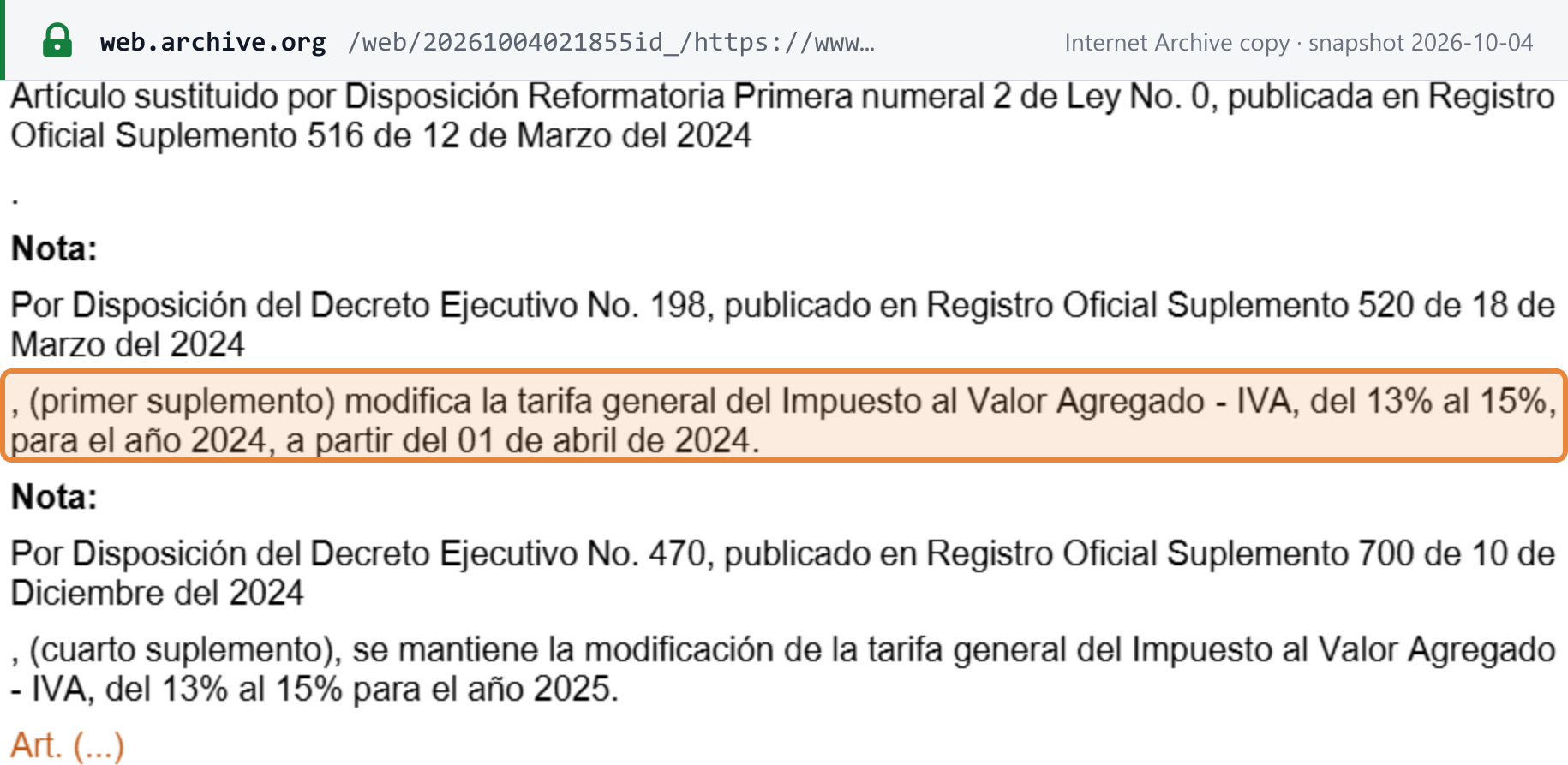
Article 65 of the LRTI sets the rate at 13% and lets the President change it within a band: "En ningún caso la tarifa podrá ser inferior al 13% ni mayor al 15%" (in no case may the rate be below 13% or above 15%). The band was introduced by the Ley Orgánica para Enfrentar el Conflicto Armado Interno (Registro Oficial 516-S, 12 March 2024). [1]
- Executive Decree 198 (Registro Oficial 520-S, 18 March 2024) raised the general rate "del 13% al 15%, para el año 2024, a partir del 01 de abril de 2024".
- Executive Decree 470 (Registro Oficial 700-S, 10 December 2024) kept 15% for 2025. [1]
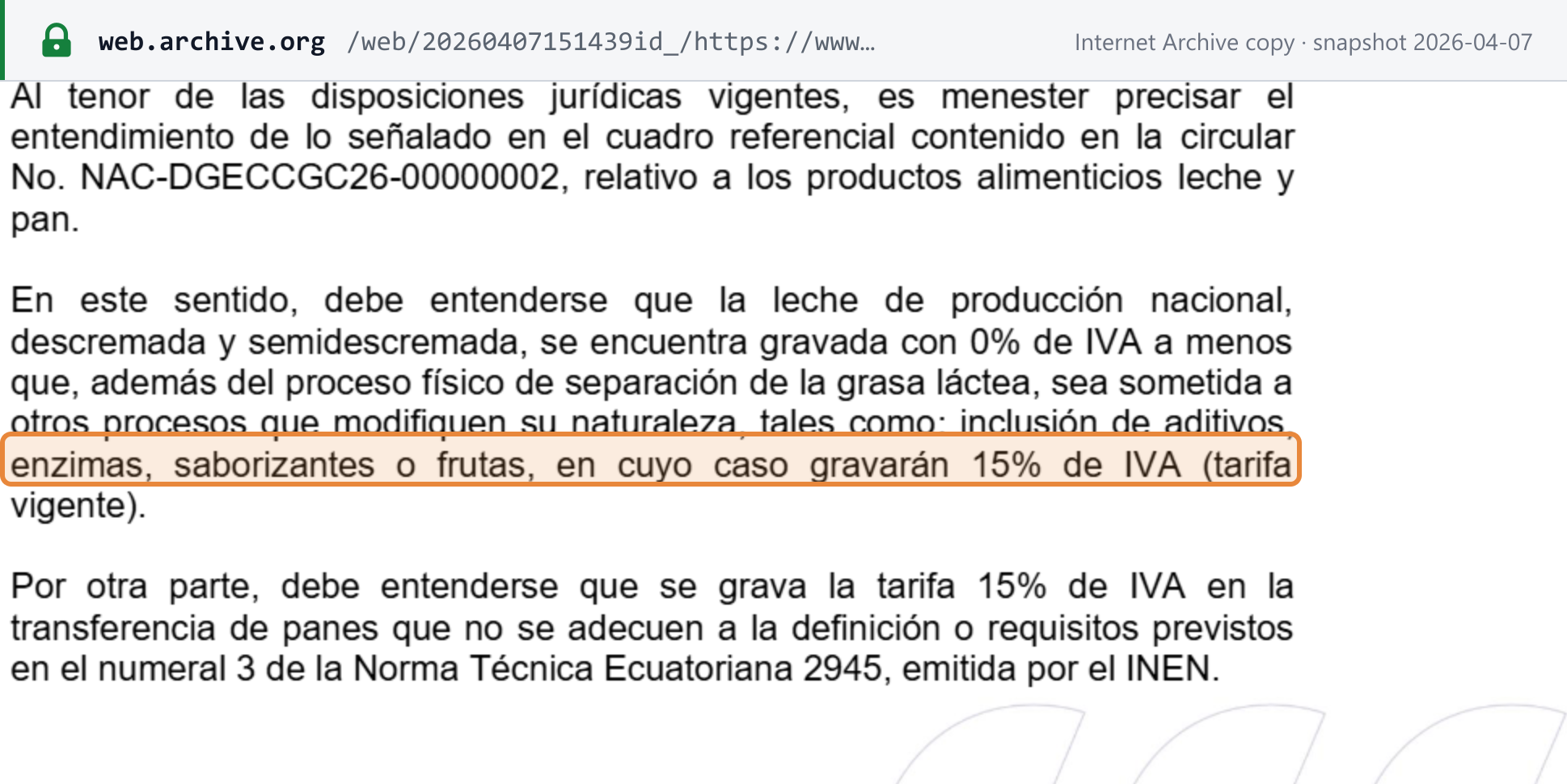
- 2026: SRI Circular NAC-DGECCGC26-00000005, of 2 April 2026, applies "15% de IVA (tarifa vigente)", the rate in force. [6]
The previous rate, until 31 March 2024, was 12%.
Reduced rates: 5% and 8%
- 5%: "La tarifa del Impuesto al Valor Agregado será del 5% en las transferencias locales de materiales de construcción" (local sales of construction materials). The materials are those on SRI's list. IVA paid on purchases for these sales that cannot be credited is deductible only for income tax. [1] [4]
- 8%: the President "podrá reducir al 8% la tarifa general" for tourist services under article 5 of the Ley de Turismo during national or local public holidays and the weekends next to them. The rate applies only to holidays named in a decree, so check the decree for the dates concerned. On an e-invoice this rate uses SRI's code for IVA diferenciado. [1] [13]
Zero rate (tarifa 0%)
"Tendrán tarifa cero las transferencias e importaciones de los siguientes bienes" — article 55 of the LRTI lists the goods taxed at 0%, and article 56 lists the services. Examples: [1]
- Goods: unprocessed farm and fishery food; milk, cheese and yoghurt; bread, sugar, salt, pasta and flour; farm inputs and machinery; human medicines on the official list; paper, newspapers and books; electricity; electric vehicles, their batteries and chargers; solar equipment; sanitary products; exported goods.
- Services: domestic passenger and cargo transport; health; residential rent; public utilities; education; childcare and elderly care; funerals; public administrative services; health and life insurance; tolls; lodging for foreign tourists; inbound tourism packages; exported services.
SRI Circular NAC-DGECCGC26-00000005 narrows two food items: milk processed with additives, enzymes, flavourings or fruit, and bread that does not meet Ecuadorian technical standard INEN NTE 2945, are taxed at 15%. [6]
A 0% rate does not give input credit except on exports and sales to exporters. See Exemptions.
Announced changes
None. SRI's consolidated LRTI, last amended on 1 April 2026, records no decree setting a general rate other than 15%. [1]
Cross-border rules
Imports and exports
- Imports of goods. "En el caso de importaciones, la liquidación del IVA se efectuará en la declaración de importación y su pago se realizará previo al despacho de los bienes": IVA is assessed on the customs declaration and paid before the goods are released. The base is the customs value plus duties, taxes, fees, surcharges and other charges on the declaration (art. 59). [1]
- Low-value parcels. Postal and courier items for non-commercial use are taxed at 0% up to a value of 5% of the basic exempt band of personal income tax. [1]
- Exports. Exported goods are taxed at 0%. A service counts as exported only if all four conditions in article 56(14) are met: the exporter is resident in Ecuador; the customer is not; the service is used or exploited entirely abroad; and the payment is not charged as a cost by anyone doing business in Ecuador. Exporters may recover the IVA on their purchases (see Refunds). [1]
Imported services: the buyer pays the IVA
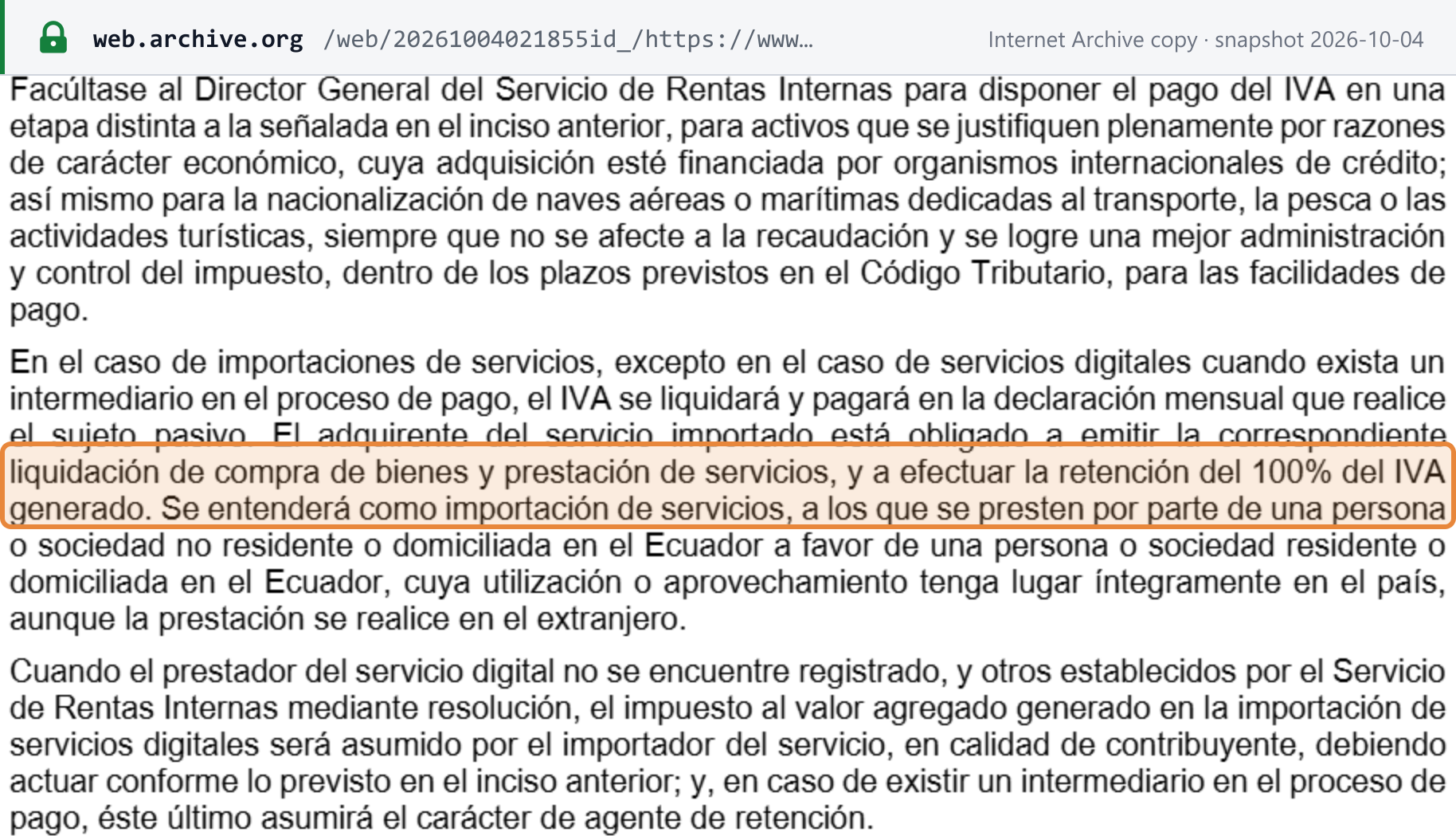
Ecuador has no reverse charge in the EU sense. Instead, when a resident business buys a service from a non-resident, it is the taxpayer and must withhold the full IVA, except for digital services paid through a payment intermediary (see Digital products and services). Article 70 of the LRTI: "El adquirente del servicio importado está obligado a emitir la correspondiente liquidación de compra de bienes y prestación de servicios, y a efectuar la retención del 100% del IVA generado." The buyer issues a liquidación de compra (a purchase document the buyer issues itself), withholds 100% of the IVA and declares it on its monthly return. [1]
Digital products and services
IVA has applied to digital services imported by Ecuadorian residents since 2020. The tax arises when the resident pays. Digital services are services delivered over the internet with minimal human intervention; the RLRTI's list includes hosting, software as a service, downloads and streaming, online advertising, databases, dating services, online press, internet access and automated e-learning. [1] [7]
There is no threshold. How the IVA is collected depends on whether the foreign supplier has registered:
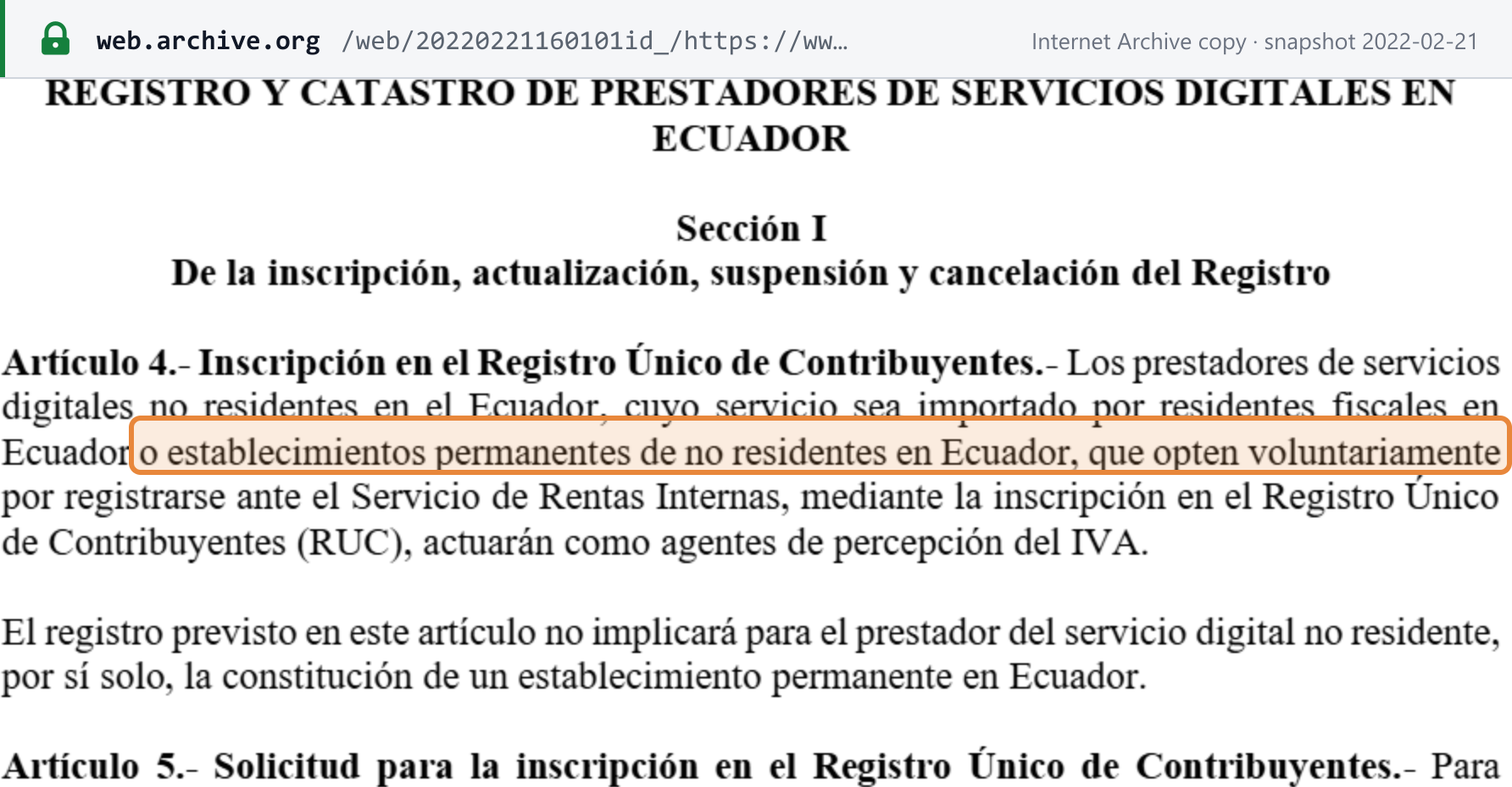
- Registered supplier. A non-resident is an IVA collection agent "siempre y cuando se registren en la forma establecida por el Servicio de Rentas Internas" (provided it registers as SRI establishes; LRTI art. 63). Under SRI Resolution NAC-DGERCGC20-00000055, suppliers "que opten voluntariamente por registrarse" (that choose to register) act as collection agents, and registering does not by itself create a permanent establishment in Ecuador. [1] [8]
- Unregistered supplier. How the IVA is collected depends on the payment route, not on whether the customer is a business or a consumer:
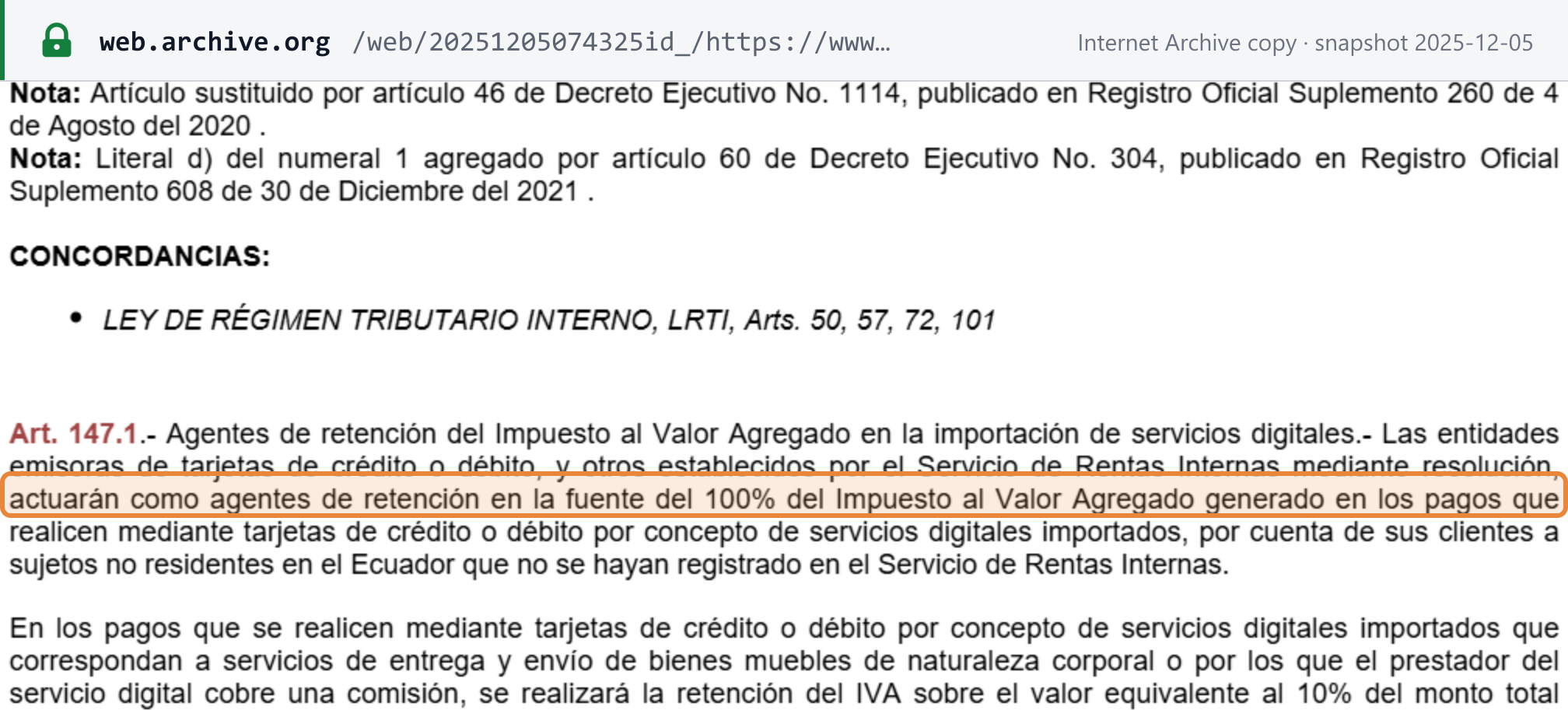
- Paid by card or through another payment intermediary. Credit and debit card issuers "actuarán como agentes de retención en la fuente del 100% del Impuesto al Valor Agregado" on card payments for imported digital services to non-residents not registered with SRI. SRI's withholding resolution applies this to card issuers and payment intermediaries "en todos los casos" (in all cases), so business customers are covered too. The card issuer's statement of account is the withholding receipt. [1] [7] [16]
- Paid directly, with no intermediary. The Ecuadorian buyer is the taxpayer: it issues a liquidación de compra and withholds 100% of the IVA. [1] [7]
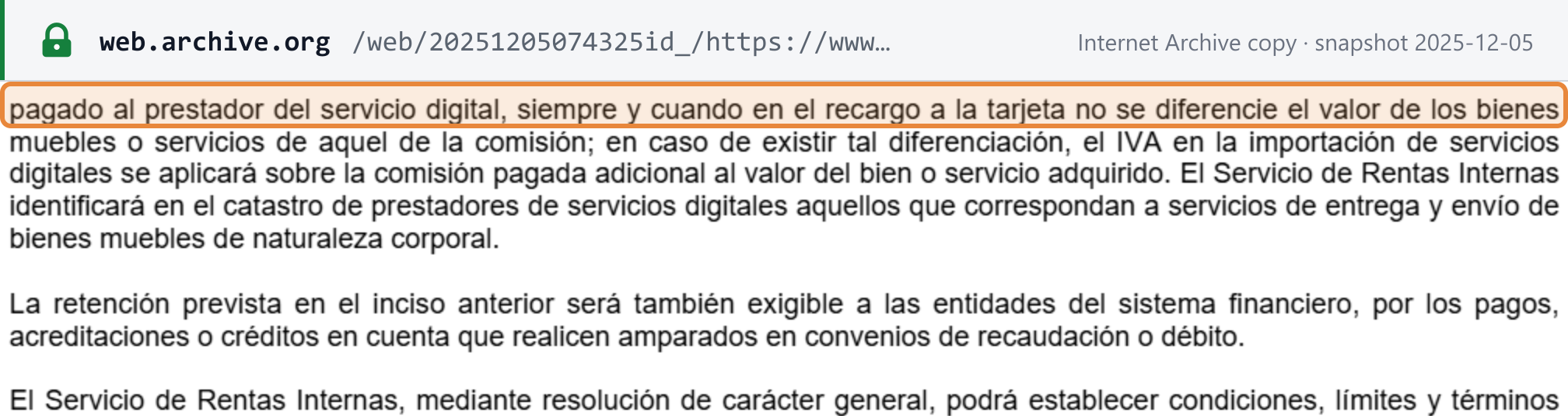
Where the digital service is delivery of goods, or the supplier charges a commission, card withholding applies to 10% of the total paid, provided the card charge does not separate the value of the goods or services from the commission; where it does, the IVA applies to the commission. Whatever the route, an Ecuadorian buyer of imported digital services issues a liquidación de compra stating the value of the service and the IVA, to support its income-tax costs and IVA credit (RLRTI art. 146.1). SRI publishes a register (catastro) of digital suppliers every quarter, by the 15th of January, April, July and October, showing which suppliers are registered. [7] [8]
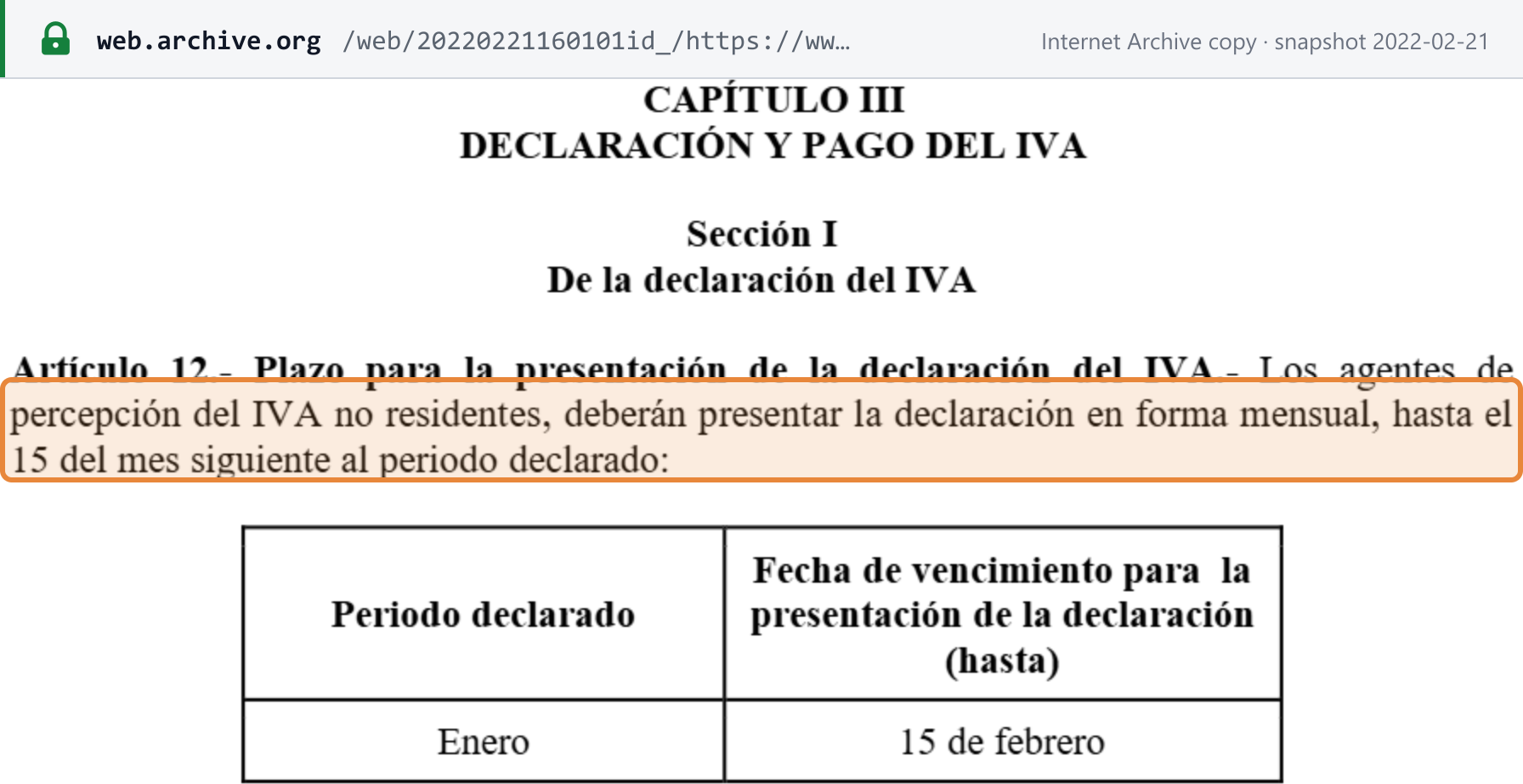
Returns for registered suppliers. "Los agentes de percepción del IVA no residentes, deberán presentar la declaración en forma mensual, hasta el 15 del mes siguiente al periodo declarado": a monthly return by the 15th of the following month, nil returns included, with payment by the same date. The base is the total paid by Ecuadorian residents, and amounts are declared in US dollars whatever the invoicing currency. An agent that fails to file one or more returns within the quarter covered by an update of SRI's register can have its RUC suspended or cancelled (art. 19). SRI may also suspend or cancel the RUC of an agent that does not pay the tax in full on time and does not comply within 10 business days of being required to (art. 26). [8]
Foreign companies selling into Ecuador — B2B and B2C
- Selling to consumers (B2C). A foreign supplier of digital services does not have to register. If it registers, it charges 15% IVA and files monthly by the 15th. If it does not, a customer who pays by card or through another payment intermediary has 100% of the IVA withheld by that intermediary. A foreign business with any other economic activity in Ecuador needs a RUC like any resident.
- Selling to businesses (B2B). A registered digital supplier charges the IVA on its own invoice, because its role as collection agent is not limited to consumer sales. For an unregistered digital supplier the payment route decides: if the business pays by card or through another payment intermediary, the intermediary withholds 100% of the IVA, as for a consumer; if it pays directly, the business is the taxpayer and withholds 100% of the IVA itself. Either way the business issues a liquidación de compra to support its costs and IVA credit. For imported services that are not digital services, the business always issues a liquidación de compra and withholds 100% of the IVA (LRTI art. 70). [1] [7] [16]
Marketplace / platform deemed-supplier liability
Not applicable. The LRTI and RLRTI contain no rule making a goods marketplace liable for its sellers' IVA. Delivery and intermediation platforms are taxed only on their commission. [1] [7]
Place of supply
- Goods: taxed where they are transferred in Ecuador or imported into it.
- Services: an imported service is one supplied by a non-resident to a resident "cuya utilización o aprovechamiento tenga lugar íntegramente en el país, aunque la prestación se realice en el extranjero" (whose use takes place entirely in Ecuador, even if performed abroad). An exported service must be used entirely abroad (see the four conditions above). [1]
Invoice requirements
Sales documents (comprobantes de venta) are governed by the Reglamento de Comprobantes de Venta, Retención y Documentos Complementarios (Executive Decree 430). Article 64 of the LRTI makes issuing them compulsory "aun cuando la venta o prestación de servicios no se encuentren gravados o tengan tarifa cero" (even when the sale is untaxed or zero-rated). [9] [1] In practice almost all of them are electronic (see E-invoicing status).
Document types
| Document | Use |
|---|---|
| Factura | The standard invoice. Companies, and individuals who keep accounts, must issue one for every transaction, whatever the amount |
| Nota de venta RIMPE | Sales receipt for negocios populares only |
| Liquidación de compra | Issued by the buyer for purchases from non-registered or non-resident suppliers |
| Tiquete de máquina registradora, event tickets, others authorised by SRI | Retail and specific sectors |
| Nota de crédito / nota de débito | Adjust an earlier document |
| Guía de remisión | Covers goods in transit |
| Comprobante de retención | Issued by a withholding agent for IVA it withholds |
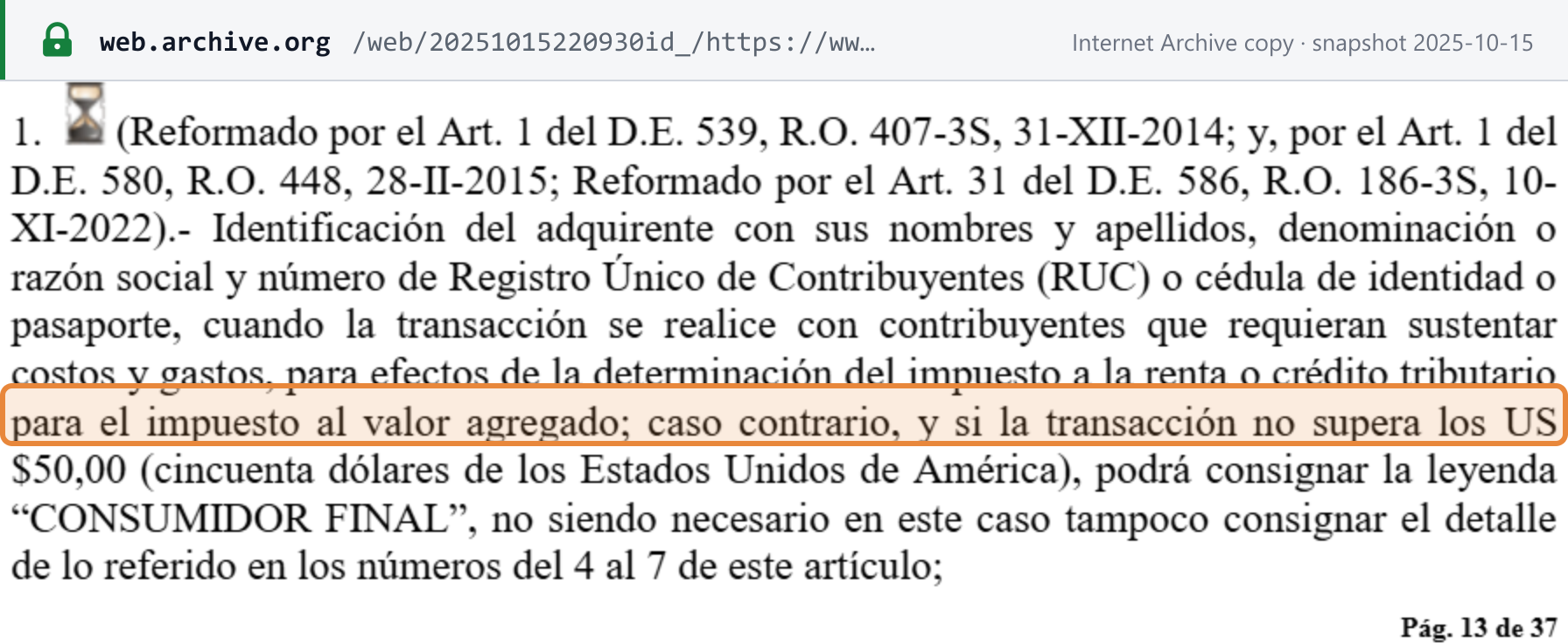
Final-consumer invoices. A factura must identify the buyer by name and RUC, cédula or passport when the buyer needs it to support costs or IVA credit. Otherwise, "si la transacción no supera los US $50,00", the invoice may carry the legend "CONSUMIDOR FINAL" instead of the buyer's details. [9] Since 1 January 2026 an electronic invoice with that legend cannot be cancelled once it has been issued and sent to SRI, and no credit note may be issued against it. [10] [11]
Mandatory content
The particulars of a factura under articles 18 and 19 of the Reglamento de Comprobantes de Venta. On an electronic invoice the issuer's details are fields of the XML file rather than pre-printed text. [9]
| Ref. | Field |
|---|---|
| 18 | Issuer's RUC and legal or trade name |
| 18 | Document name: "FACTURA" |
| 18.5 | 15-digit number EEE-PPP-SSSSSSSSS: establishment, emission point, 9-digit sequence |
| 18 | Address of the head office and of the issuing establishment |
| 19.1 | Buyer's name and RUC, cédula or passport (or "CONSUMIDOR FINAL" up to USD 50) |
| 19.2 | Description, quantity and unit; serial or engine number for identifiable goods |
| 19.3 | Unit price |
| 19.4 | Subtotal before taxes |
| 19.5 | Discounts |
| 19.6 | "Impuesto al valor agregado, señalando la tarifa respectiva" (IVA, with its rate) |
| 19.7 | 10% service charge (hotels and restaurants) |
| 19.9 | ICE, shown separately |
| 19.10 | Total |
| 19.11 | Currency sign and name, only if not US dollars |
| 19.12 | Issue date |
| 19.13 | Number of the guía de remisión, where applicable |
The paper-only items — printer details, print authorisation and expiry, and the buyer's signature — do not apply to electronic invoices. An electronic document also carries a 49-digit access key (clave de acceso) and an XAdES-BES electronic signature (see E-invoicing status). Showing IVA separately is what lets the buyer claim it as credit. [9] [13]
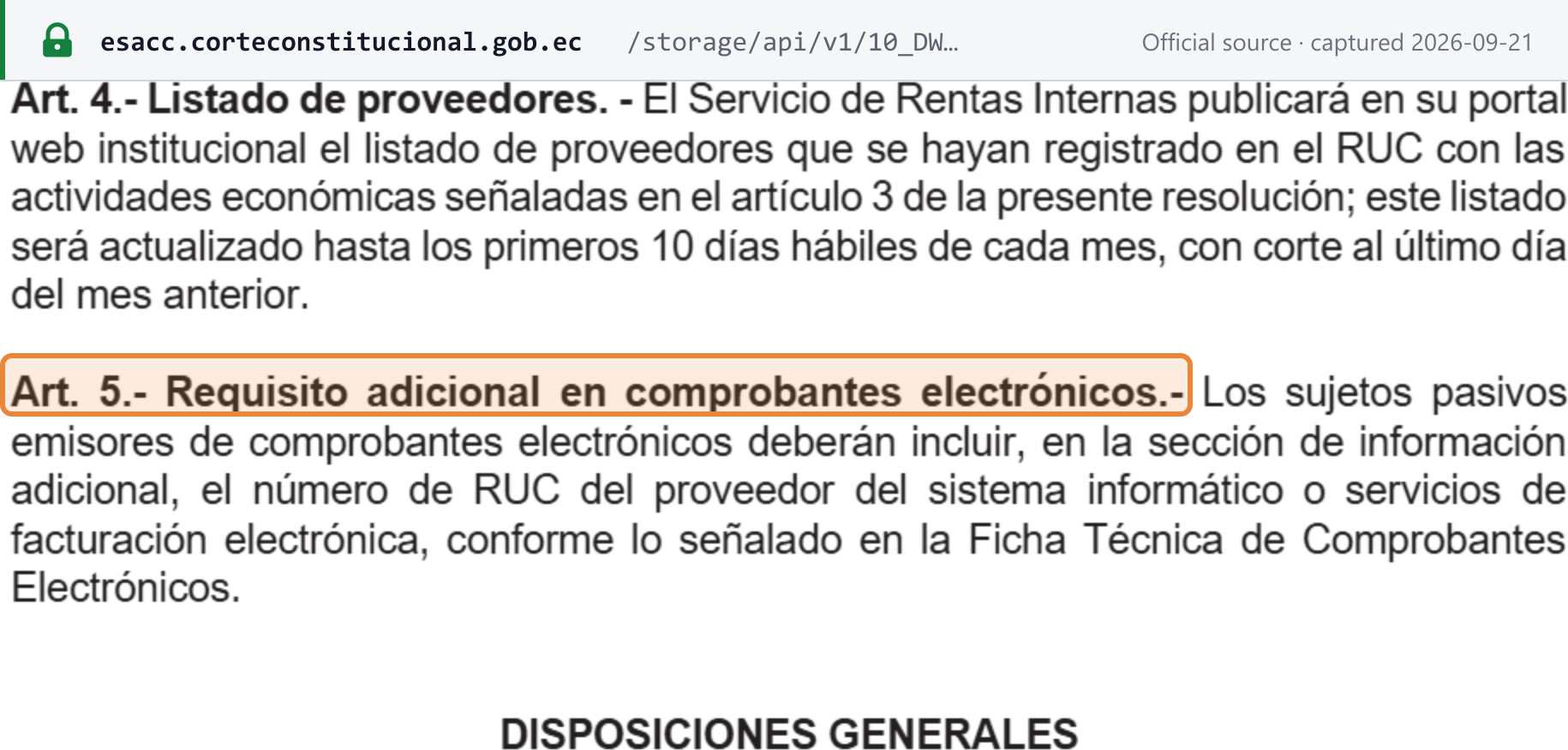
Provider RUC. Since 26 September 2026, issuers of electronic documents must put the RUC of their e-invoicing system or service provider in the additional-information field of every document (SRI Resolution NAC-DGERCGC26-00000027, art. 5). [17]
Issuance deadline
- Goods: IVA arises on delivery or on payment (in full or in part), whichever comes first, and the invoice is issued then (LRTI art. 61). [1]
- Services: on performance or on payment, at the taxpayer's choice, applied consistently. [1]
- General rule: the document is issued and delivered when the transaction takes place (Reglamento de Comprobantes art. 17). [9]
- Transmission to SRI: at the moment the electronic document is generated (see E-invoicing status).
Numbering and sequencing
The 15-digit number runs establishment (3 digits) – emission point (3 digits) – sequence (9 digits): "Los tres primeros dígitos corresponden al número del establecimiento conforme consta en el registro único de contribuyentes". [9] SRI's e-invoicing specification requires issuing systems to keep documents "en orden cronológico y secuencial", with no duplicate sequence numbers or access keys. [13]
Credit and debit notes and cancellation
- Credit notes cover cancellations, returns, discounts and bonuses, and cite the series and number of the original invoice. Since Resolution NAC-DGERCGC25-00000017 there is no 12-month time limit, but "Las notas de crédito deberán emitirse únicamente en los casos señalados en el Reglamento" (only in the cases the regulation lists). [9] [11]
- Debit notes cover late-payment interest and costs recharged to the buyer. [9]
- Online cancellation (anulación): electronic documents issued from 1 August 2025 can be cancelled online until the 7th of the month after issue. After that, a sales document can be corrected only by credit note. "Consumidor final" invoices cannot be cancelled at all from 1 January 2026, and neither can invoices that support a refund claim or negotiable commercial invoices. [10] [11]
Currency and language
- Currency. The US dollar. An invoice states a currency only "en los casos en que se utilice una moneda diferente a la de curso legal" (where a currency other than legal tender is used). Because the economy is dollarised, there is no exchange-rate rule for domestic IVA. Non-resident digital suppliers declare in US dollars whatever currency they invoice in. [9] [8]
- Language. Books and records must be kept "en idioma castellano" (in Spanish), with transactions recorded in legal tender (Código Tributario art. 96). [12]
Self-billing
Ecuador's form of self-billing is the liquidación de compra: the buyer issues it for purchases from suppliers who are not registered or are not resident, and withholds the IVA (see Imported services). [1] [9]
Retention and audit trail
- Retention. "Los documentos sustentatorios de la contabilidad deberán conservarse durante el plazo mínimo de siete años" (supporting documents must be kept for at least seven years; RLRTI art. 37). Electronic storage meets the duty. [7]
- Limitation periods. SRI can assess for 4 years from filing, or 6 years if no return was filed; collection is time-barred after 5 years (Código Tributario arts. 94 and 55). [12]
- Audit trail. Each electronic document carries a unique 49-digit access key ending in a modulo-11 check digit; it is signed XAdES-BES, sent to SRI as it is generated, and valid only once SRI authorises it. Before claiming credit, buyers must check on SRI's systems that the document is valid (LRTI art. 103). [13] [1]
A specimen of a compliant invoice
SRI publishes its own model of a printed electronic invoice, the RIDE (representación impresa del documento electrónico), in Annex 2 of its e-invoicing technical specification. SRI says the RIDE has tax and legal validity and that the annexed models show "las posiciones de los requisitos" (where each requisite sits). The model uses SRI's own test data. [13]
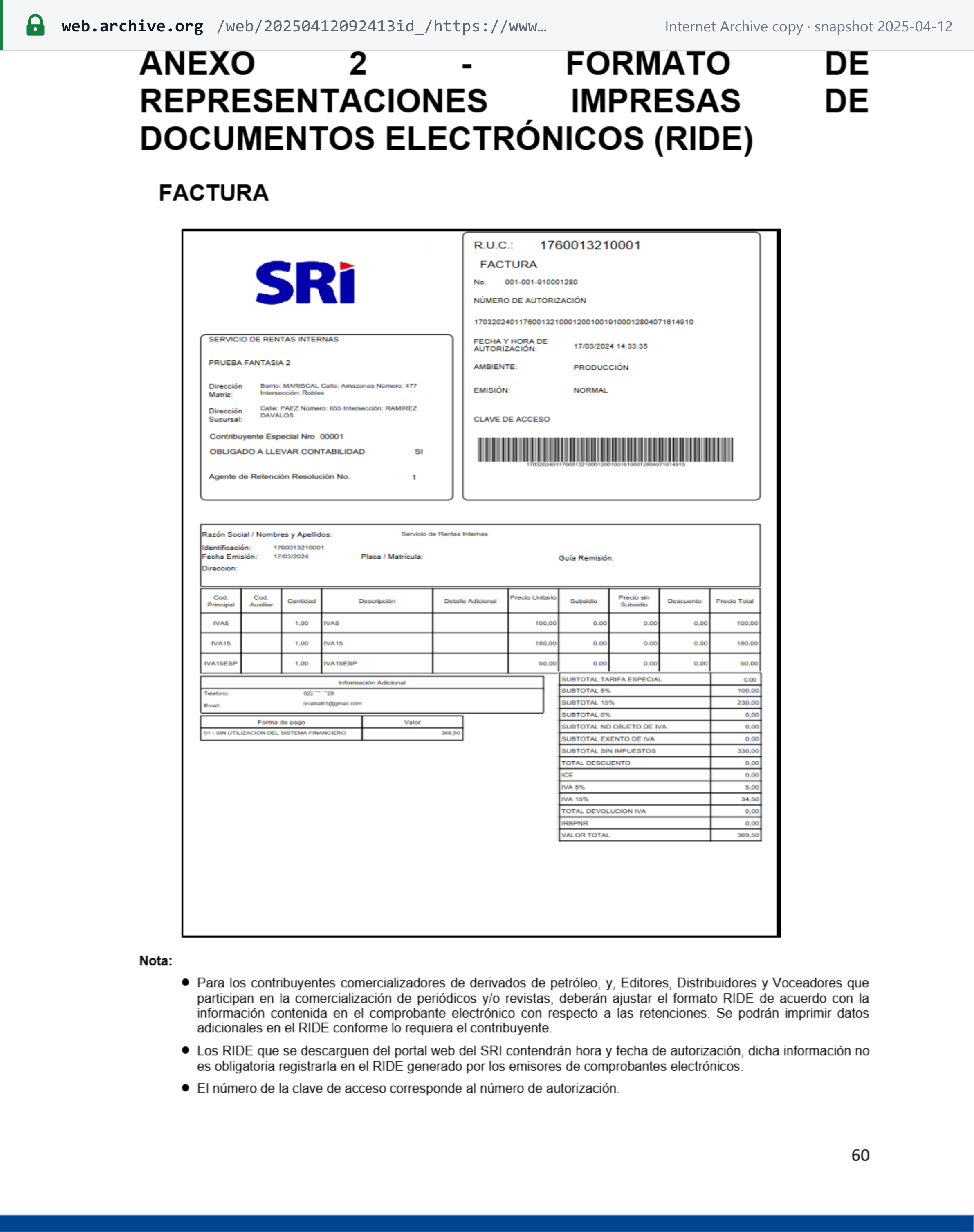
Reading SRI's model from top to bottom:
- Top right: the issuer's RUC, the word FACTURA, the 15-digit number, the número de autorización (which is the 49-digit access key), the environment (production) and the access key printed as a barcode.
- Top left: the issuer's name, head-office and branch addresses, and its status as special taxpayer, obliged to keep accounts or withholding agent.
- Buyer block: name, identification number, issue date and the guía de remisión number.
- Lines: product codes, quantity, description, unit price, discount and line total.
- Totals: subtotals at each rate (5%, 15% and 0%), not-subject and exempt subtotals, discount, ICE, IVA at each rate and the total.
- Bottom left: additional information and the payment method.
The IVA rate codes used in the electronic file, as set out in version 2.31 of SRI's specification; SRI has since published version 2.34 (July 2026), so check the current version before building to it: [3] [13]
| Code | Rate |
|---|---|
| 0 | 0% |
| 2 | 12% |
| 3 | 14% |
| 4 | 15% |
| 5 | 5% |
| 6 | Not subject (no objeto) |
| 7 | Exempt (exento) |
| 8 | IVA diferenciado (the 8% holiday rate) |
| 10 | 13% |
E-invoicing status
Status (as at 2026-10-15): mandatory, with real-time transmission to SRI.
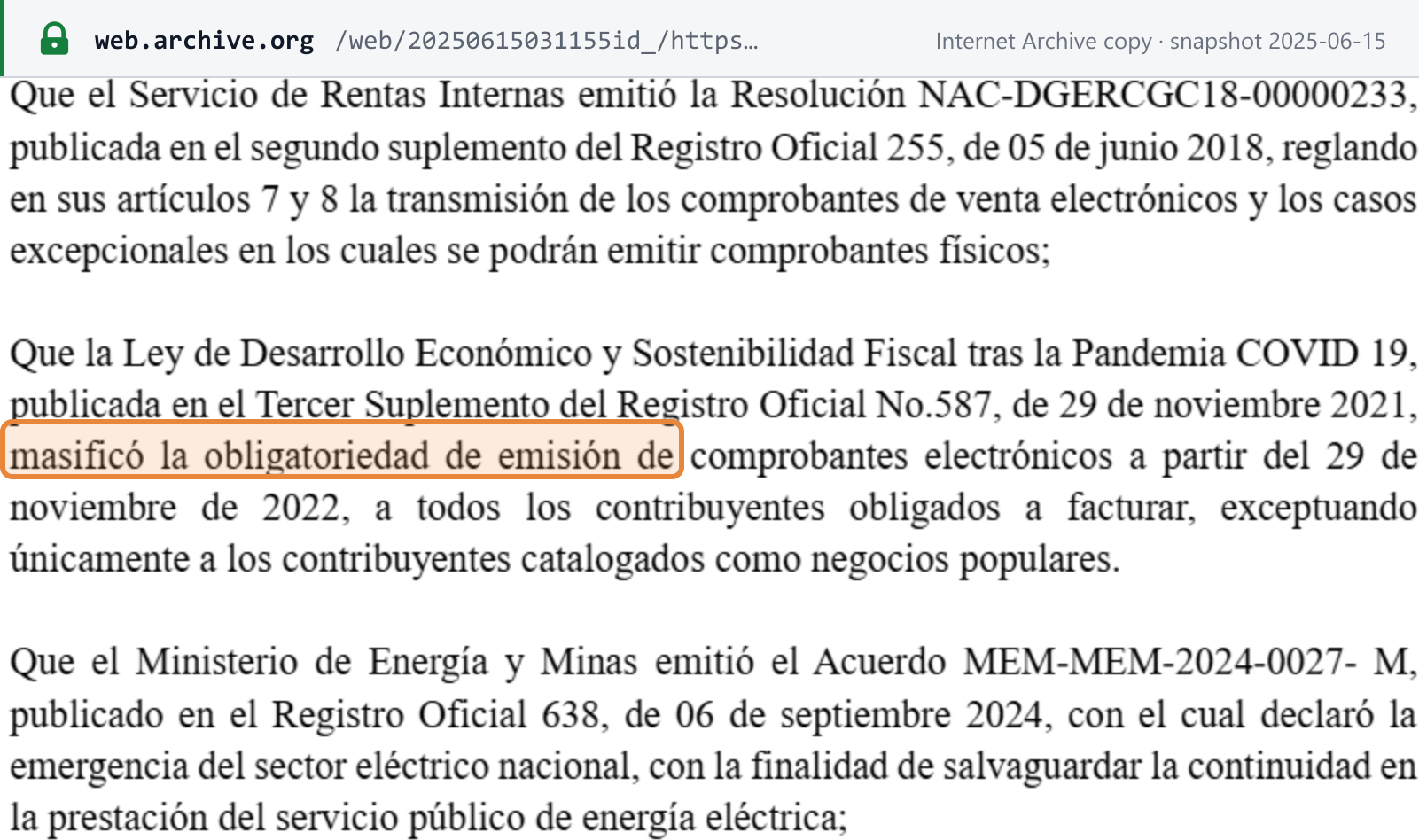
- Who. The Ley de Desarrollo Económico y Sostenibilidad Fiscal (Registro Oficial 587-3S, 29 November 2021) made electronic issuance compulsory "a partir del 29 de noviembre de 2022, a todos los contribuyentes obligados a facturar, exceptuando únicamente a los contribuyentes catalogados como negocios populares": from 29 November 2022, for every taxpayer that must invoice, except negocios populares. [14] SRI authorises issuers automatically: "No es necesario solicitar la autorización al SRI para emitir comprobantes electrónicos". [3]
- System. SRI's national system, in what SRI calls its off-line scheme. The issuer generates the XML document with its 49-digit access key, signs it (XAdES-BES), gives it to the buyer and sends it to SRI's web services. SRI answers AUTORIZADO or NO AUTORIZADO, and the document has tax validity only once authorised. It is not a Peppol network. [3] [13]
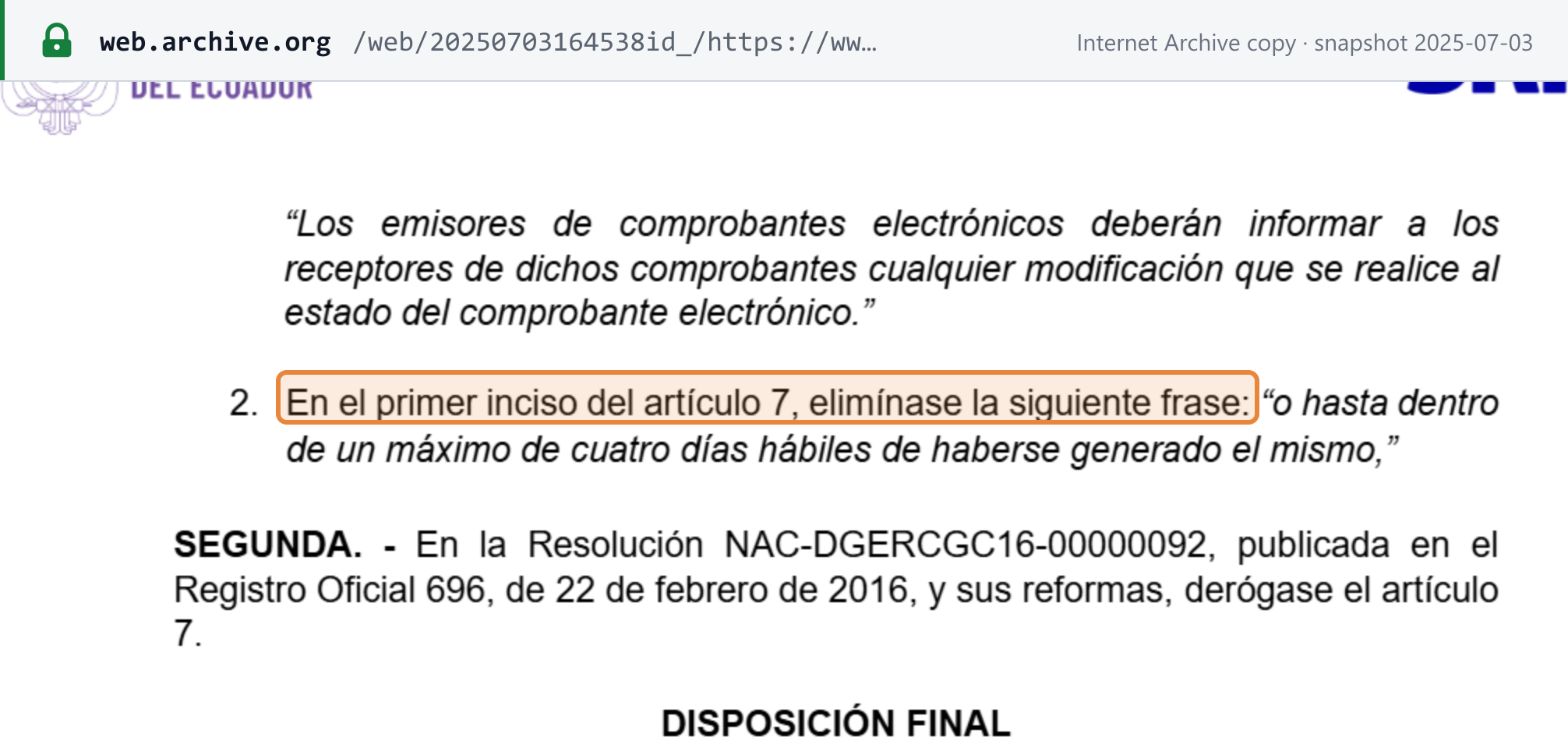
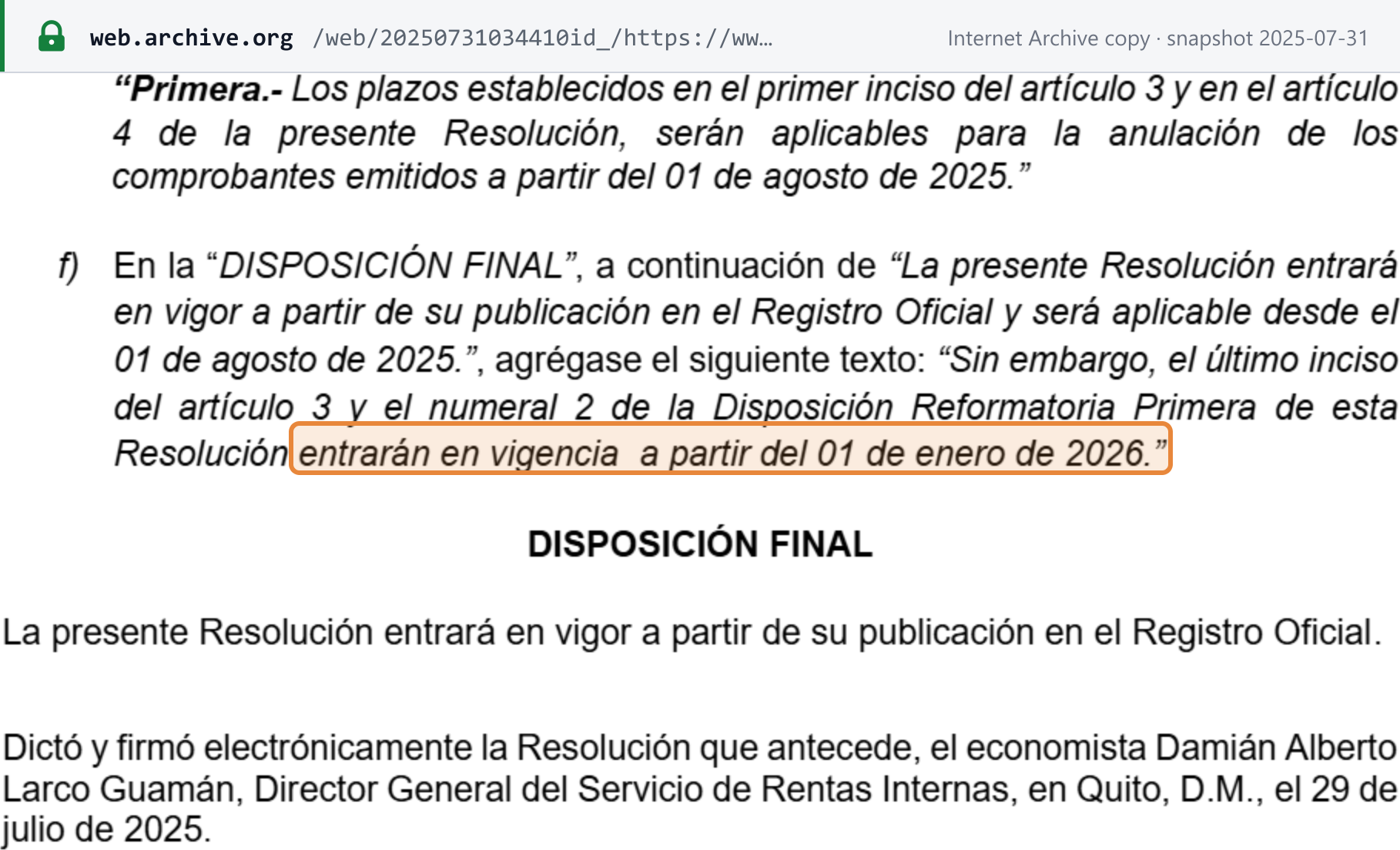
- Real-time transmission from 1 January 2026. Resolution NAC-DGERCGC24-00000035 required transmission "en el momento mismo de realizarse la generación del comprobante electrónico, o hasta dentro de un máximo de cuatro días hábiles". Resolution NAC-DGERCGC25-00000014 deleted the four-day window, and Resolution NAC-DGERCGC25-00000017 made that deletion effective from 1 January 2026. Documents must now reach SRI as they are generated. [14] [10] [11]
- Format. XML under SRI's schemas.
- Scope. B2B, B2C and B2G alike. Covered documents: facturas, liquidaciones de compra, credit and debit notes, withholding receipts and guías de remisión. [13]
- Free tools. SRI offers an online "Facturador SRI", which large taxpayers may not use. Its free offline tool can be downloaded only until 31 December 2026. [3]
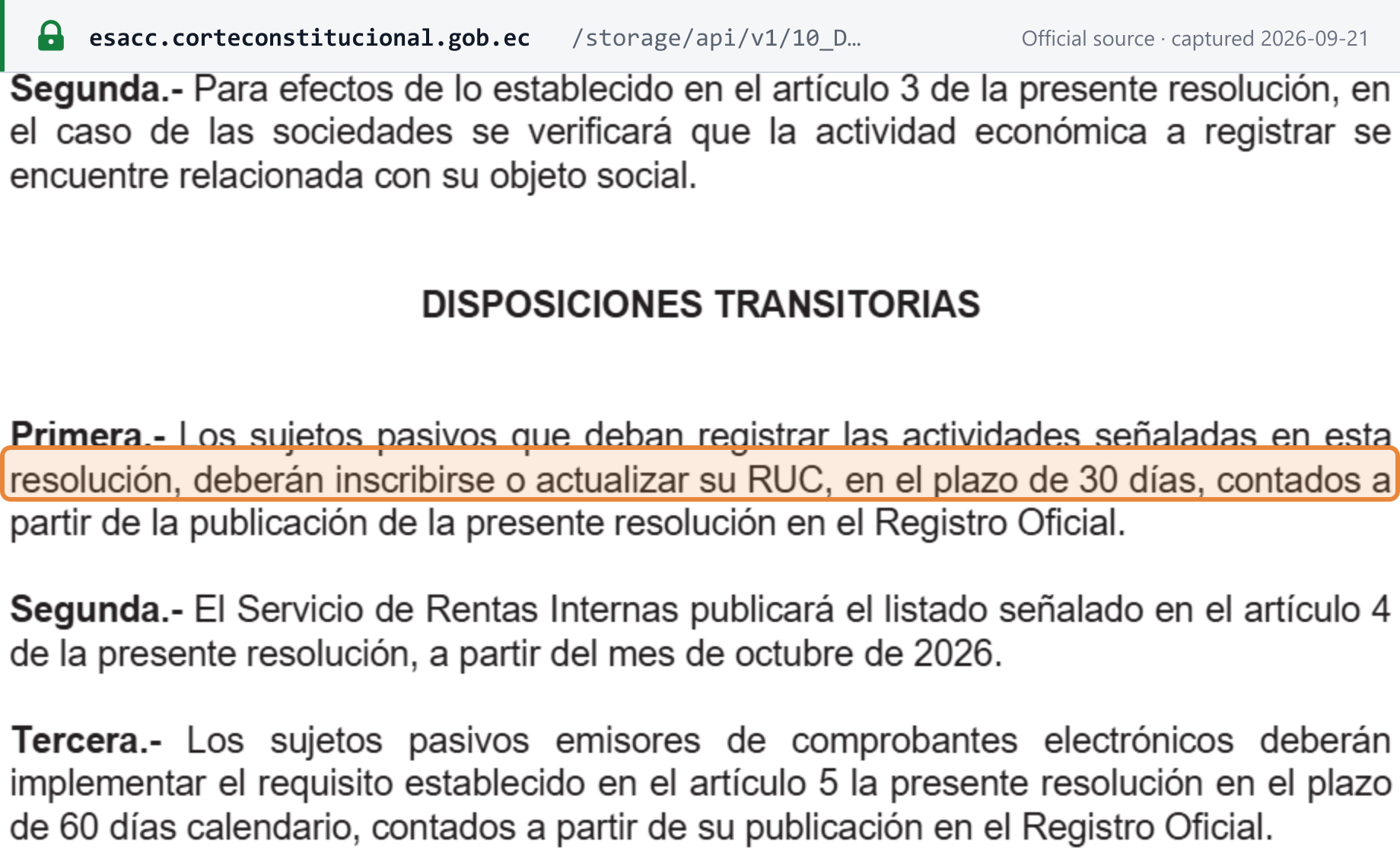
- Software providers. Under Resolution NAC-DGERCGC26-00000027, e-invoicing software developers and resellers in Ecuador had to register the activity in their RUC (codes J62021002 and J62021003) by 27 August 2026, and from 26 September 2026 every electronic document carries the RUC of the issuer's e-invoicing system or service provider. [17]
For how e-invoicing systems are classified, see CTC e-invoicing models.
Filing and payment
Filing frequency
- Monthly: anyone making taxable sales (at a rate above 0%) or acting as an IVA withholding agent.
- Every six months: businesses that sell only 0%-rated or untaxed goods or services, and businesses whose IVA is fully withheld by their buyers. "Si tales sujetos pasivos deben actuar también como agentes de retención del IVA, obligatoriamente sus declaraciones serán mensuales": if they also act as IVA withholding agents, they must file monthly (RLRTI art. 158). [7]
- RIMPE Emprendedores: every six months. They are not IVA withholding agents, except in the cases of article 147(2) of the RLRTI, and any IVA they do withhold is also declared and paid every six months (RLRTI arts. 236–237). [7] [4]
- No returns: negocios populares (see Simplified regime (RIMPE)).
- Non-resident digital suppliers: monthly, by the 15th (see Digital products and services).
Nil returns are required.
Return due date
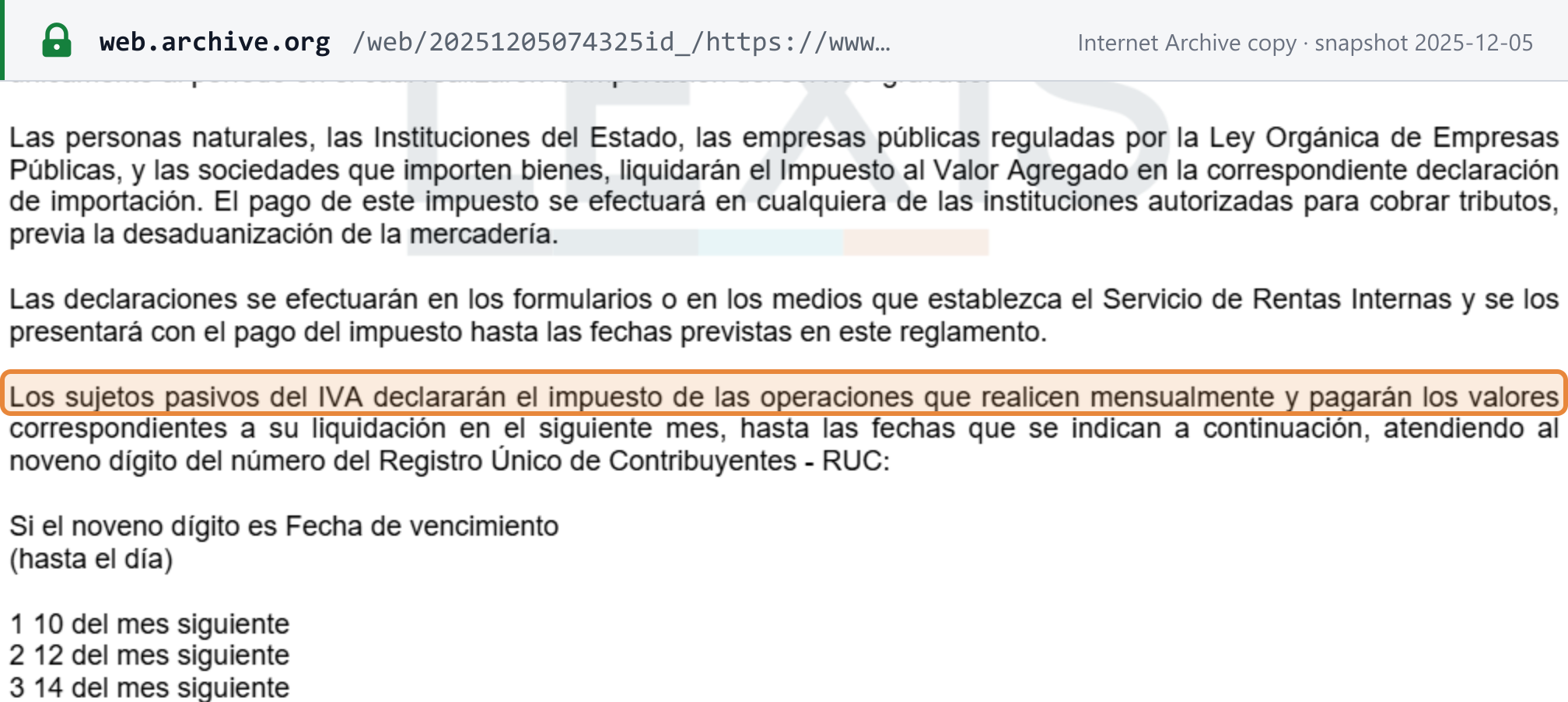
Returns are filed on SRI en Línea in the month after the period, on a day set by the ninth digit of the RUC (RLRTI art. 158): [7] [4]
| 9th digit of the RUC | 1 | 2 | 3 | 4 | 5 | 6 | 7 | 8 | 9 | 0 |
|---|---|---|---|---|---|---|---|---|---|---|
| Due by (following month) | 10th | 12th | 14th | 16th | 18th | 20th | 22nd | 24th | 26th | 28th |
- Six-monthly filers use the same day in July (for January to June) and January (for July to December).
- Taxpayers domiciled in Galápagos file by the 28th, and State bodies by the 20th.
- A due date that falls on a weekend or public holiday moves to the next business day, or back to the last business day of the month if moving it would cross into the next month.
- Sales on credit of one month or more may be declared "en el mes subsiguiente de realizadas" (in the month after next; LRTI art. 67). [1]
Payment due date and method
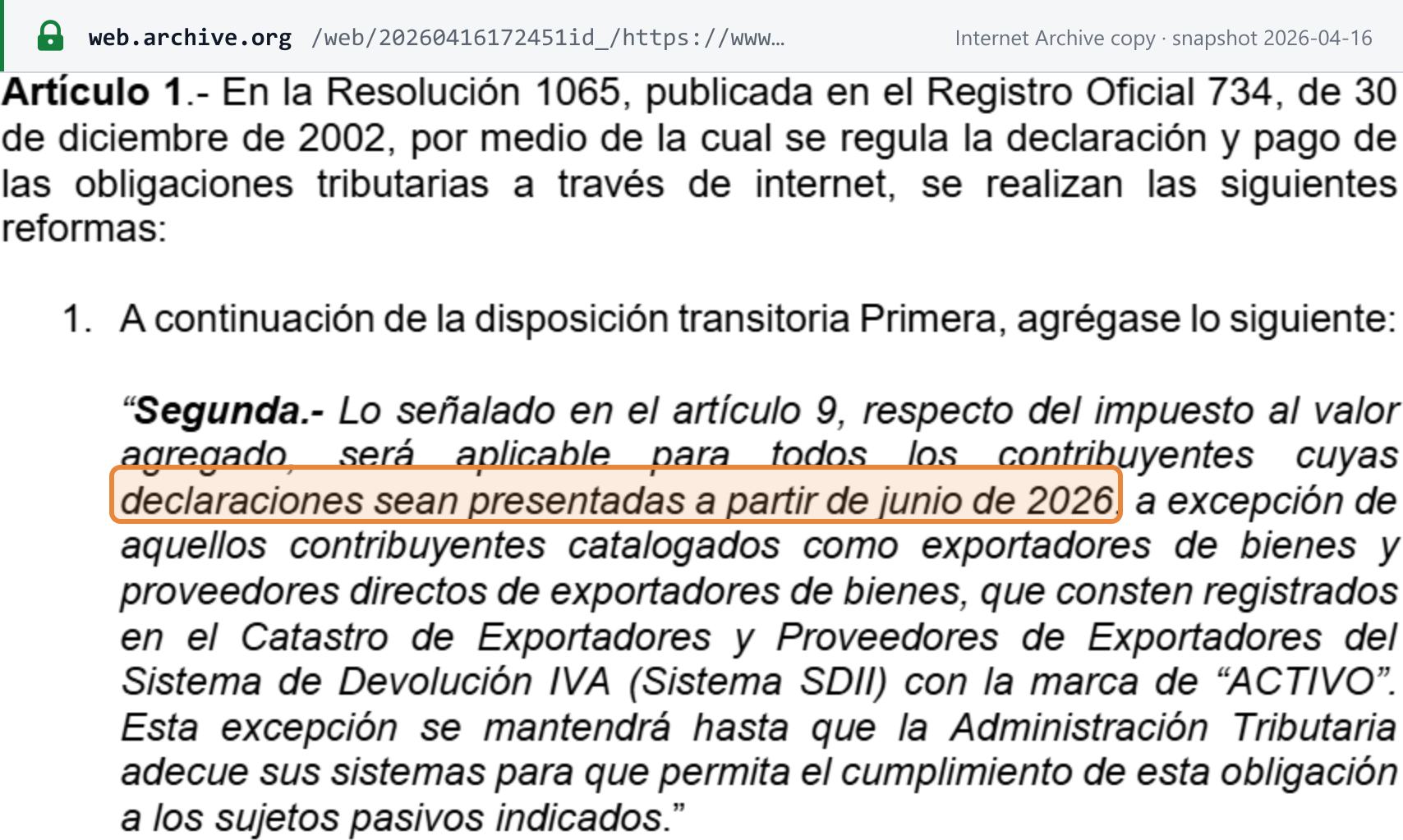
IVA is paid by the same date as the return (LRTI art. 69). [1] For returns filed from June 2026, the return and the payment must go in together. SRI Resolution NAC-DGERCGC26-00000016, signed on 15 April 2026, extends the joint declare-and-pay rule of Resolution 1065 to IVA "para todos los contribuyentes cuyas declaraciones sean presentadas a partir de junio de 2026". [15]
The only exception is for exporters of goods and direct suppliers of exporters of goods registered with the status "ACTIVO" in SRI's register of exporters for the IVA refund system (Sistema SDII). It lasts until SRI adapts its systems for them. [15]
Payment is made online through banks that have collection agreements with SRI. Registered non-resident digital suppliers pay by the 15th of the following month by transfer to SRI's account no. 01331739 at the Banco Central del Ecuador; the only alternative is to pay with SRI credit notes held in their name (Resolution NAC-DGERCGC20-00000055, art. 21). [1] [8]
IVA withholding by buyers
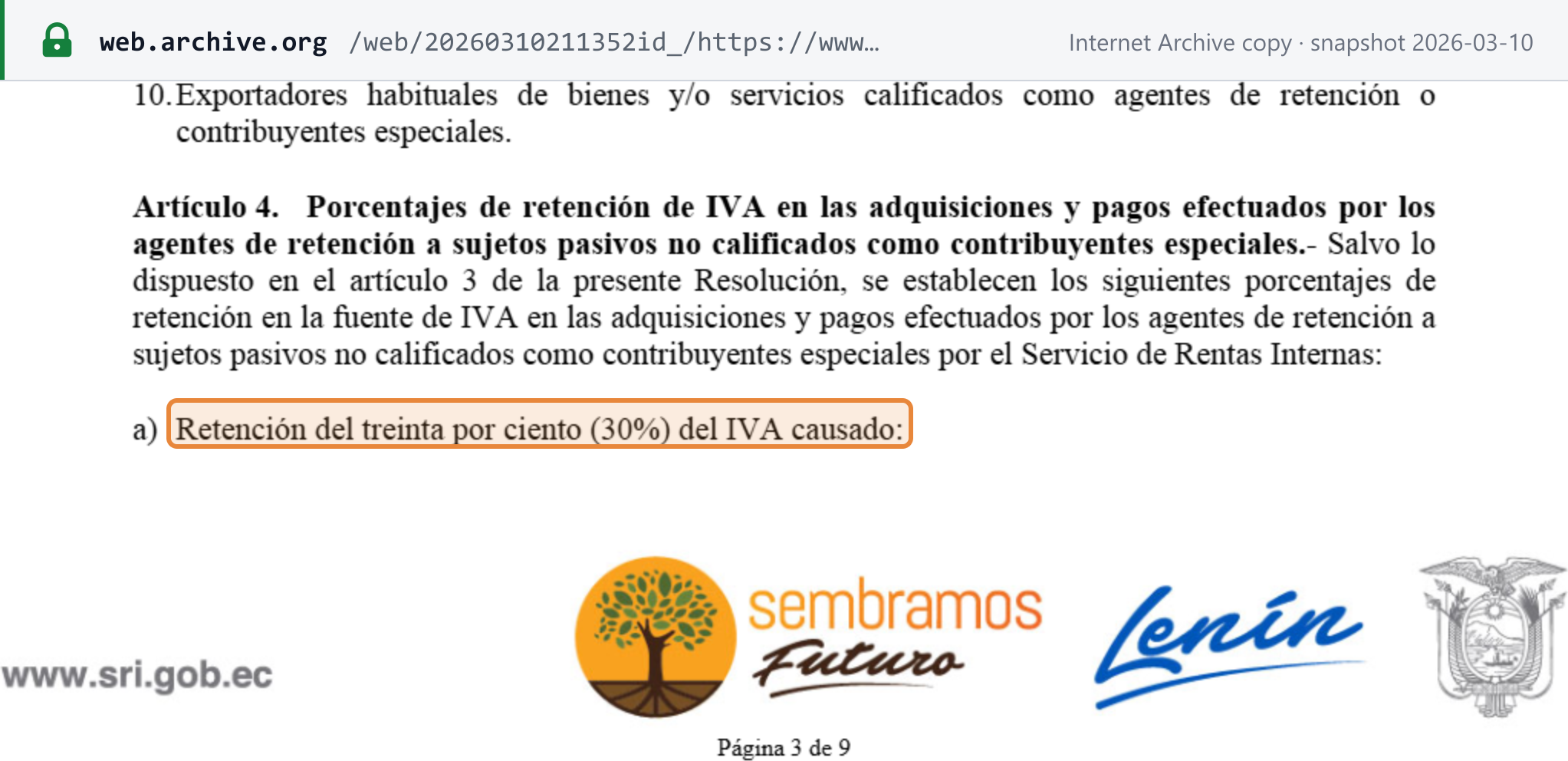
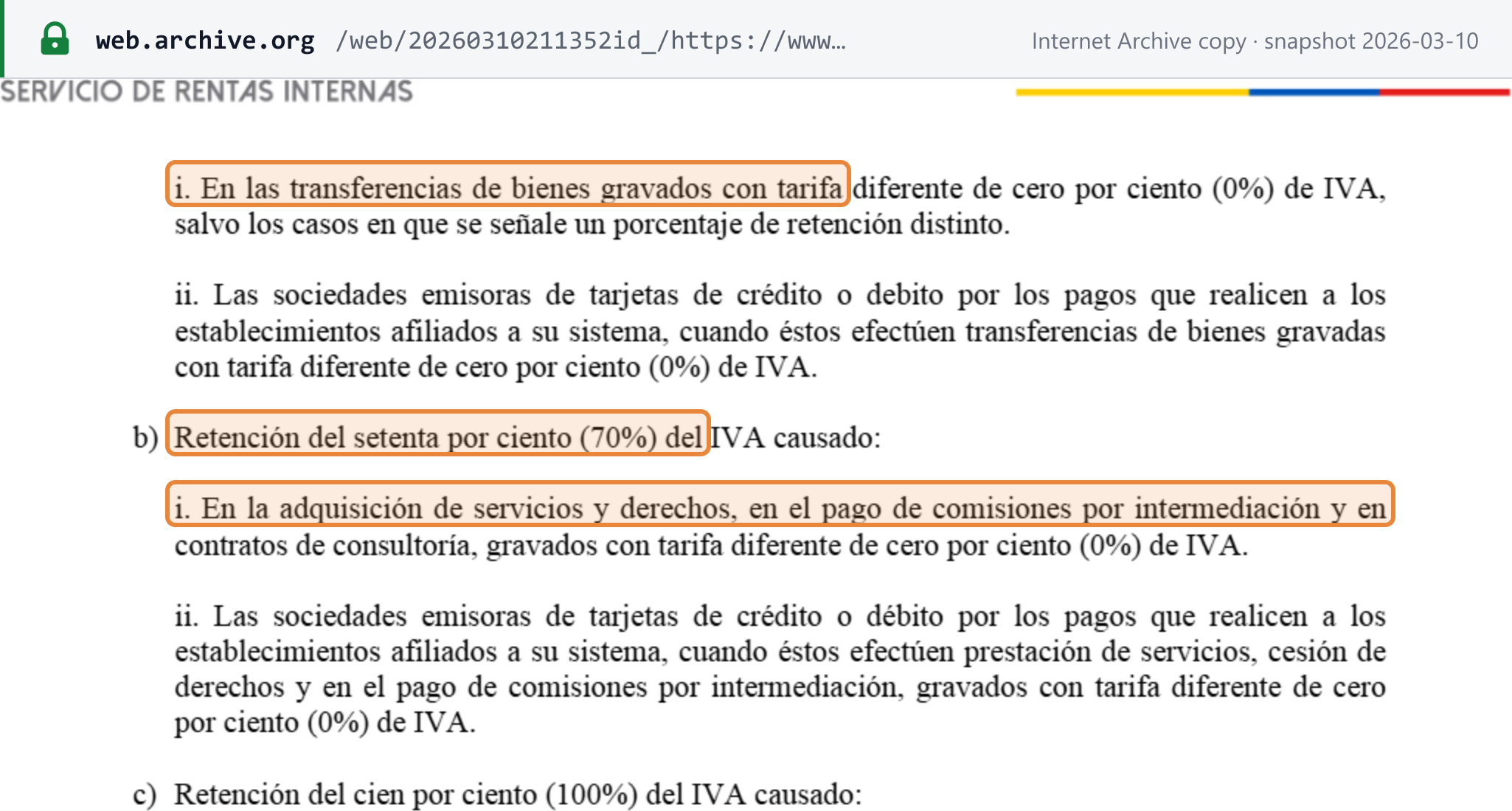
Many Ecuadorian buyers must withhold part of the IVA on their purchases and pay it to SRI. Withholding agents include SRI-designated agents and special taxpayers (contribuyentes especiales), card issuers, insurers, banks under collection agreements, and anyone importing services or issuing a liquidación de compra. The percentages under SRI Resolution NAC-DGERCGC20-00000061: [16]
| Supplier | Goods | Services | Other |
|---|---|---|---|
| Not a special taxpayer | 30% of the IVA | 70% of the IVA (services, rights, commissions, consultancy) | 100% on professional fees paid to graduate individuals, rent paid to individuals who do not keep accounts, liquidaciones de compra, board fees and other listed cases |
| Special taxpayer, buyer also a special taxpayer | 10% | 20% | — |
No IVA is withheld from State bodies, airlines or, apart from the case above, special taxpayers. The withholding receipt must be issued when the payment is made or credited and be available within 5 business days of the invoice. The supplier treats the amount withheld as credit against its own IVA. [16] [9] For how Ecuador's system compares with others, see VAT withholding regimes.
Additional listings
SRI's informative annexes and other reporting obligations are outside the scope of this guide. SRI en Línea lists the obligations attached to each RUC.
Input-tax recovery and blocked items
IVA paid on purchases and imports is creditable "siempre que tales bienes y servicios se destinen únicamente a la producción y comercialización de otros bienes y servicios gravados con este impuesto", and can be used for up to five years (LRTI art. 66). [1]
- Full credit: taxed sales, exports, inbound tourism packages sold to non-residents, and 0%-rated sales made directly to exporters.
- Proportional credit: businesses with both taxed and 0%-rated sales.
- No credit: businesses whose sales are entirely 0%-rated, and certain public bodies.
- Payments over USD 500: the credit requires the payment to go through the financial system (LRTI art. 103).
- Invoice: the IVA must be shown separately on a valid document.
Refunds
- Excess credit is carried forward to the next month. Credit arising from IVA withheld by buyers may be refunded or offset if it cannot be used within six months, with a claim made within five years. [1]
- Exporters are refunded "sin intereses, en un tiempo no mayor a noventa (90) días" (without interest, within 90 days), after registering in SRI's exporter register. [1] [7]
- Foreign tourists can recover IVA on Ecuadorian-made goods, provided each invoice is at least USD 50 (RLRTI art. 182). [7]
- Other schemes cover persons with disabilities, older adults, real-estate projects and audiovisual production. [1]
Exemptions
0% is not zero-rating
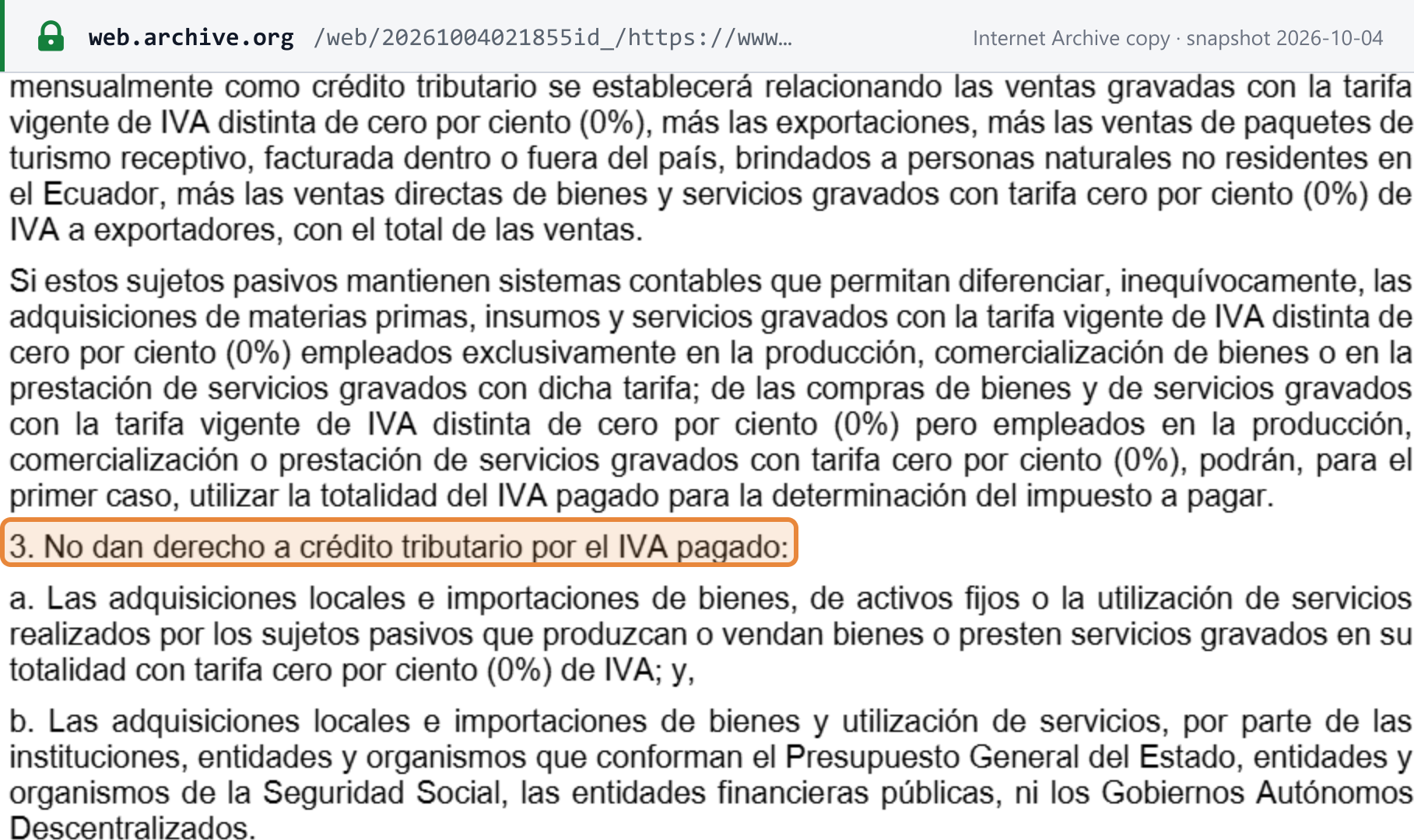
Most IVA relief in Ecuador takes the form of the 0% rate (see Zero rate). Unlike EU zero-rating, a 0% rate does not give input credit: article 66 of the LRTI says that purchases by taxpayers who sell goods or services "gravados en su totalidad con tarifa cero por ciento (0%) de IVA" give no right to credit. Only exports and direct sales to exporters keep full credit. [1]
Not subject and exempt supplies
- Not subject (no objeto, art. 54): contributions in kind to companies, inheritances, transfers of a business, mergers, donations to the public sector and non-profit bodies, transfers of shares, and condominium fees. [1]
- Exempt (exento): a separate category from 0%. For example, SRI says supplies to beneficiaries of the status-of-forces agreement with the United States are exempt and must not be charged IVA "ni registrarlo como tarifa 0%, sino como exento" (nor recorded as 0%, but as exempt). IVA on purchases used for exempt supplies is deductible only for income tax. [4]
Special regimes
- RIMPE: negocios populares sell at 0% and file no IVA returns; Emprendedores file every six months (see Simplified regime (RIMPE)).
- Construction materials: 5% rate, with unrecoverable input IVA deductible for income tax.
- Special development zones (ZEDE) and free zones, inbound tourism and artisans have their own rules in the LRTI. [1]
Offences and penalties
Offences
- Failing to register in the RUC within 30 days, using another person's RUC, or concealing establishments (Ley del RUC art. 19). An establishment found unregistered gets three days to register, "caso contrario se le impondrá la clausura, física o electrónica" (otherwise it is closed, physically or electronically). [2]
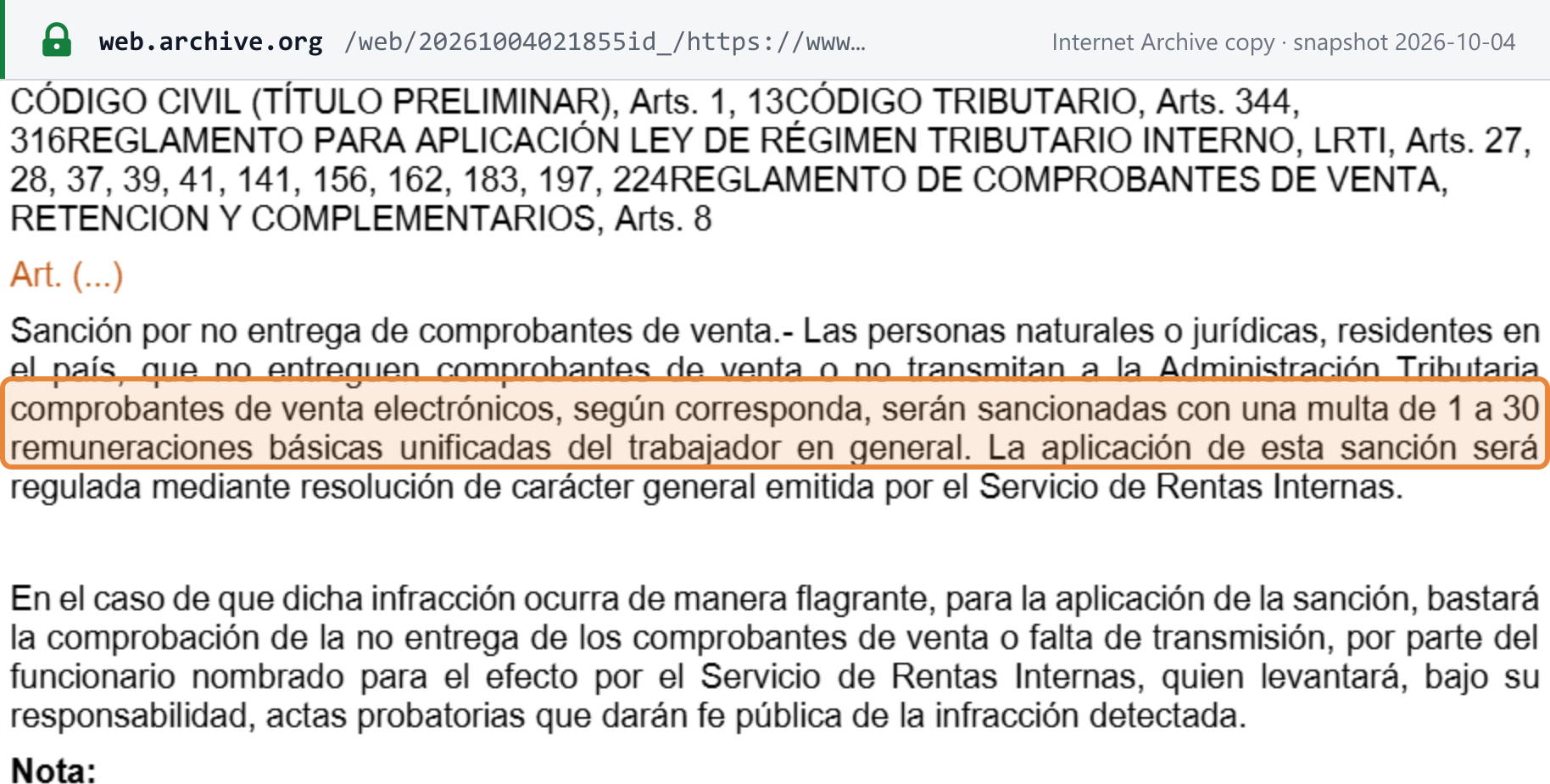
- Failing to issue or deliver a sales document, or to transmit an electronic one to SRI. [1]
- Filing a return late, or not filing it. [1]
The Código Tributario's sanctions include fines, closure of the establishment and suspension of activities (art. 323). [12]
Penalties
| Failure | Penalty |
|---|---|
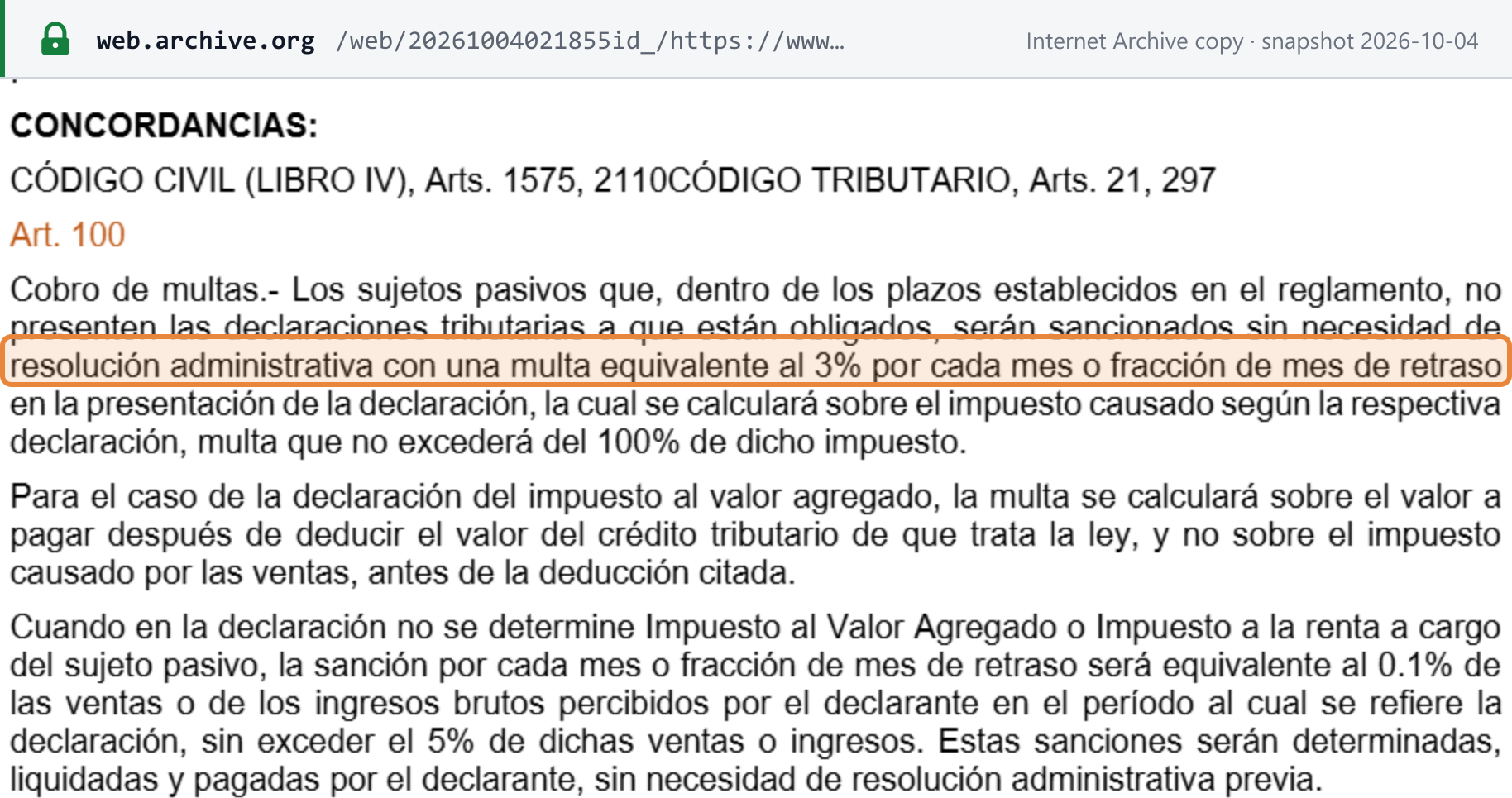
| Late return, with tax due | 3% of the tax per month or part-month, capped at 100% of the tax; for IVA, calculated on the amount payable after input credit (LRTI art. 100) |
| Late return, no tax due | 0.1% of sales per month or part-month, capped at 5% of sales |
| Late-filing fine collected by SRI rather than self-assessed | Plus 20% |
| Return not filed, found on audit | 5% of the tax per month (LRTI art. 105) |
| Sales document not issued or delivered, or e-document not transmitted | 1 to 30 unified basic salaries (remuneraciones básicas unificadas), on a scale SRI sets by resolution |
| Exporter refund obtained by fraud | Fine of double the amount |
| Other breaches (contraventions), such as late RUC registration | USD 30 to 1,500 (Código Tributario art. 349) |
| Breaches of regulations (faltas reglamentarias) | USD 30 to 1,000 |
The 3% late-filing charge is a fine, self-assessed on the return. Late-payment interest is separate: it runs from the due date until payment at an annual rate equal to the Banco Central del Ecuador's 90-day active reference rate, applied for each month of delay, with a part-month counted as a whole month (Código Tributario art. 21). [12]
Frequently asked questions
Is Ecuador's VAT rate 12% or 15%?
15%. The IVA law sets a base rate of 13% and lets the President move the general rate anywhere between 13% and 15% by executive decree. Executive Decree 198 raised it to 15% from 1 April 2024, Executive Decree 470 kept 15% for 2025, and in 2026 SRI applies 15% as the rate in force (tarifa vigente). Before April 2024 the rate was 12%, which is why older tables still show it. A reduced 5% rate applies to listed construction materials, and many basic goods and services are taxed at 0%.
We are a foreign SaaS company selling into Ecuador. Do we have to register for IVA?
No. Registration is voluntary for non-resident suppliers of digital services, but the IVA is collected either way. If you register in SRI's taxpayer register (RUC), you charge 15% IVA on your sales, file a monthly return by the 15th of the following month and pay in US dollars; registering does not by itself create a permanent establishment. If you do not register, how the IVA is collected depends on how your customer pays, not on whether the customer is a business or a consumer. When the payment goes through a card issuer or another payment intermediary, the intermediary withholds 100% of the IVA, and its account statement serves as the withholding receipt. When an Ecuadorian buyer pays you directly, with no intermediary, the buyer is the taxpayer: it issues a liquidación de compra (a buyer-issued purchase document) and withholds 100% of the IVA. Ecuadorian businesses also issue a liquidación de compra for imported digital services when you are registered, to support their costs and IVA credit.
Why did my Ecuadorian client pay only part of the IVA on my invoice?
Because buyers that act as IVA withholding agents keep back part of the IVA and pay it to SRI themselves. Under SRI Resolution NAC-DGERCGC20-00000061 the usual percentages are 30% of the IVA on goods, 70% on services and 100% on certain payments, such as professional fees paid to individuals and purchases documented with a liquidación de compra. Between two special taxpayers (contribuyentes especiales) the percentages are 10% on goods and 20% on services. The buyer must give you a withholding receipt (comprobante de retención), and the amount withheld is credit against your own IVA.
When is my monthly IVA return due?
In the month after the tax period, on a day set by the ninth digit of your RUC: 1 = 10th, 2 = 12th, 3 = 14th, 4 = 16th, 5 = 18th, 6 = 20th, 7 = 22nd, 8 = 24th, 9 = 26th and 0 = 28th. Businesses that sell only 0%-rated goods or services, and businesses whose IVA is fully withheld by their buyers, file every six months instead, on the same day in July and January, unless they also act as IVA withholding agents. RIMPE Emprendedores also file every six months. Registered non-resident digital suppliers file monthly by the 15th.
Do I have to pay the IVA when I file the return?
Yes, for returns filed from June 2026. SRI Resolution NAC-DGERCGC26-00000016, signed on 15 April 2026, applies the joint declare-and-pay rule to IVA for all taxpayers, so the return and the payment go in together. The only exception is for exporters of goods and direct suppliers of exporters marked ACTIVO in SRI's register for the IVA refund system (SDII), until SRI adapts its systems for them.
Can I still send my e-invoices to SRI a few days after issuing them?
No. Until the end of 2025 an issuer could transmit an electronic document up to four business days after generating it. SRI Resolution NAC-DGERCGC25-00000014 deleted that window, and Resolution NAC-DGERCGC25-00000017 made the deletion effective from 1 January 2026. Each document must now be sent to SRI at the moment it is generated, and it has tax validity only once SRI authorises it.
Does selling at 0% give me input credit?
Generally no. Most IVA relief in Ecuador takes the form of a 0% rate, and a business whose sales are all 0%-rated cannot claim credit for the IVA it pays on its purchases. Full credit is available for taxed sales, exports, inbound tourism packages sold to non-residents and 0%-rated sales made directly to exporters. A business with both taxed and 0%-rated sales recovers a proportion. Outside exports, Ecuador's 0% therefore works like an EU exemption rather than EU zero-rating.
Important websites
| Site | Purpose |
|---|---|
| Servicio de Rentas Internas (SRI) | Ecuador's tax authority: guidance, forms and the legal library |
| SRI en Línea | Register or update a RUC, file IVA returns and pay |
| SRI — Electronic invoicing | E-invoicing rules, technical specifications and SRI's free invoicing tools |
| SRI — IVA | Rates by decree, filing dates by RUC digit and IVA guidance |
| SRI — RIMPE | Rules for emprendedores and negocios populares |
| [email protected] | Registration of non-resident digital service suppliers |
| Ecuador RUC validator | Check a RUC's format with Lookuptax |
| Registro Oficial | Ecuador's official gazette, where decrees and SRI resolutions are published |
Recent changes
- 2026-09-26 — Issuers of electronic documents must show the RUC of their e-invoicing system or service provider on every document; providers had to register their activity in the RUC by 27 August 2026 (Resolution NAC-DGERCGC26-00000027). (Registro Oficial) — see event
- 2026-06-01 — IVA returns filed from June 2026 must be filed and paid together, except by exporters of goods and their direct suppliers marked ACTIVO in the SDII register (Resolution NAC-DGERCGC26-00000016, signed 15 April 2026). (SRI) — see event
- 2026-04-02 — SRI Circular NAC-DGECCGC26-00000005 limited the 0% rate on milk and bread and applied 15% as the rate in force. (SRI)
- 2026-01-01 — Electronic documents must be sent to SRI as they are generated, and "consumidor final" invoices can no longer be cancelled (Resolutions NAC-DGERCGC25-00000014 and NAC-DGERCGC25-00000017). (SRI)
- 2025-08-01 — Online cancellation of electronic documents limited to the 7th of the month after issue (Resolution NAC-DGERCGC25-00000017). (SRI)
- 2024-12-10 — Executive Decree 470 kept the 15% general rate for 2025. (SRI)
- 2024-04-01 — The general rate rose from 12% to 15% (Executive Decree 198), and a 5% rate began for construction materials. (SRI)
For the full chronology, see Ecuador tax changes on Lookuptax.
Reference links
- SRI — Ley de Régimen Tributario Interno, consolidated (PDF)
- SRI — Ley del Registro Único de Contribuyentes, consolidated (PDF)
- SRI — Facturación electrónica
- SRI — Impuesto al Valor Agregado (IVA)
- SRI — RIMPE
- SRI — Circular NAC-DGECCGC26-00000005 (PDF)
- SRI — Reglamento para la Aplicación de la LRTI (PDF)
- SRI — Resolution NAC-DGERCGC20-00000055, non-resident digital service suppliers (PDF)
- SRI — Reglamento de Comprobantes de Venta, Retención y Documentos Complementarios (PDF)
- SRI — Resolution NAC-DGERCGC25-00000014 (PDF)
- SRI — Resolution NAC-DGERCGC25-00000017 (PDF)
- SRI — Código Tributario, consolidated (PDF)
- SRI — Ficha técnica de comprobantes electrónicos, esquema off-line, version 2.31 (PDF)
- SRI — Resolution NAC-DGERCGC24-00000035 (PDF)
- SRI — Resolution NAC-DGERCGC26-00000016 (PDF)
- SRI — Resolution NAC-DGERCGC20-00000061, IVA withholding percentages (PDF)
- Registro Oficial (via Corte Constitucional e-SACC) — Resolution NAC-DGERCGC26-00000027 (PDF)
Related on Lookuptax: