Peru IGV guidelines
| FACTSHEET | |
|---|---|
| Country code | PE |
| Tax name | General sales tax (IGV) — Impuesto General a las Ventas, with the Impuesto de Promoción Municipal (IPM) |
| Tax Authority | SUNAT (Superintendencia Nacional de Aduanas y de Administración Tributaria) |
Overview
Peru's value-added tax is the Impuesto General a las Ventas (IGV), the general sales tax. SUNAT describes it as a tax on "todas las fases del ciclo de producción y distribución" (every stage of production and distribution) that is meant to be borne by the final consumer. It is non-cumulative: each business pays tax on its sales and deducts the tax charged on its purchases. [1]
Authority. The IGV is administered by SUNAT (Superintendencia Nacional de Aduanas y de Administración Tributaria), which also collects IGV on imports through its customs arm.
Statute. The consolidated text (TUO) of the IGV and Excise Tax Law, approved by Supreme Decree 055-99-EF, with its regulation in Supreme Decree 029-94-EF. [1]
What is taxed. Under article 1 of the TUO: the sale of movable goods in Peru; services supplied or used in Peru; construction contracts; the first sale of real estate by its builder; and imports of goods. [2]
Currency. Amounts are in soles (PEN, S/). Non-domiciled digital suppliers may file and pay in US dollars (see Digital products and services).
Tax period. The calendar month. [20]
Layering. One national tax in two parts. The IGV is levied together with the Impuesto de Promoción Municipal (IPM), a municipal-promotion surcharge under article 76 of Legislative Decree 776. SUNAT collects both on the same return, and together they make the 18% rate (see Rates). There is no regional or local sales tax. [1]
For neighbouring systems, see the Chile VAT guide and the Bolivia VAT guide.
Registration
Who should register
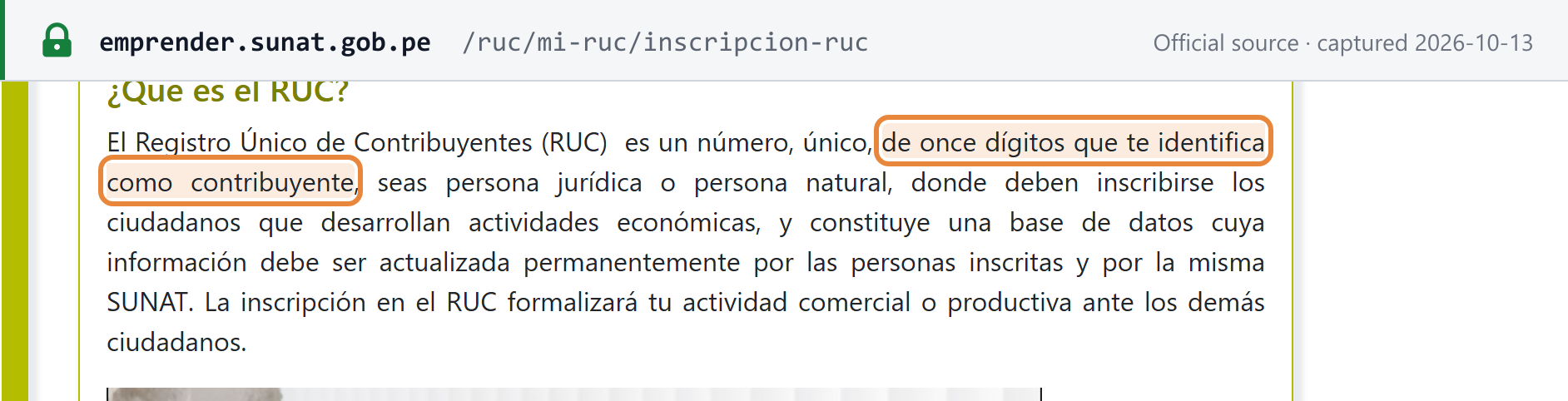
Anyone carrying on an economic activity in Peru registers in the RUC (Registro Único de Contribuyentes), SUNAT's taxpayer register. SUNAT describes the RUC as "un número, único, de once dígitos que te identifica como contribuyente" (a unique 11-digit number that identifies you as a taxpayer), in which "deben inscribirse los ciudadanos que desarrollan actividades económicas". SUNAT can register a person ex officio if they fail to do so. [3]
The IGV obligation attaches to each taxable operation listed in article 1 of the TUO, so a business is liable from its first taxable sale. [2]
Registration threshold
None for IGV. IGV applies from the first taxable operation, with no turnover threshold. SUNAT's RUC page separately lists asset-based triggers that oblige individuals to register even without a business, such as owning five or more properties worth together more than 126 UIT. [3]
Non-resident registration
- Business-to-business sales: a foreign company selling services to Peruvian businesses does not register; the Peruvian customer pays the IGV itself (see Reverse charge on services from non-residents).
- Digital services and intangibles to consumers: a non-domiciled supplier of digital services, or of intangible goods downloaded over the internet, to individuals resident in Peru who do not carry on a business must register in the RUC as an IGV collection or withholding agent. There is no threshold: Legislative Decree 1623 sets no minimum value. [4] [5]
How a non-domiciled digital supplier registers: [4]
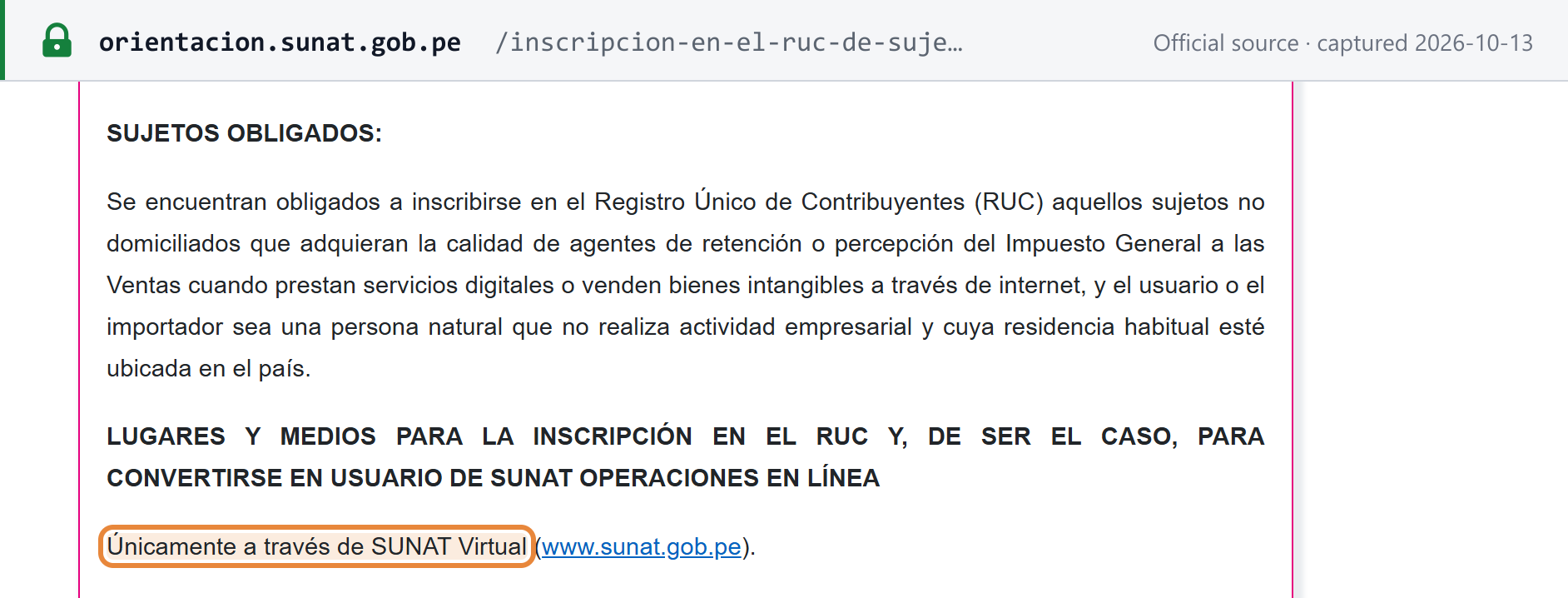
- Apply online only: "Únicamente a través de SUNAT Virtual". There is no in-person route.
- Give the country of residence, the home-country tax number, the website URL, the date you start acting as an agent, and identity documents for a legal representative and a contact person. Neither needs a Peruvian domicile.
- SUNAT staff review the application and email the result. You then generate a Clave SOL (SUNAT's online password) to file and pay.
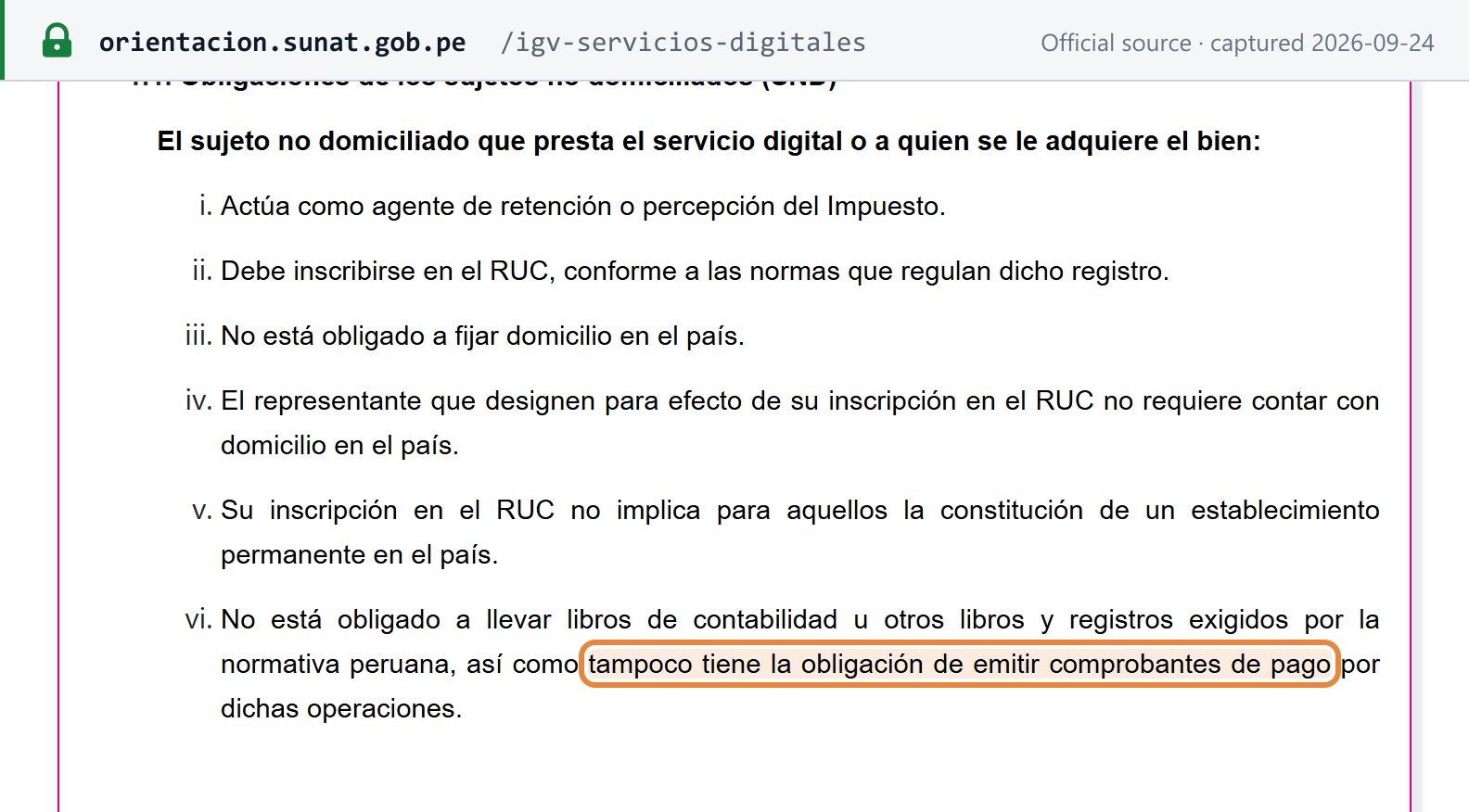
Registration "no implica … la constitución de un establecimiento permanente en el país" (does not create a permanent establishment in Peru). The supplier need not keep Peruvian accounting books or issue comprobantes de pago for these sales. [5] [11]
Tax identification number
The RUC has 11 digits and is used for every procedure with SUNAT. [3] For the format and how to look a RUC up, see the Peru tax ID guide, check one with the Peru RUC validator, or use SUNAT's RUC search.
How to register
- Companies. Incorporate at the public registry (SUNARP) through its SID-Sunarp system, which records an inactive RUC on the incorporation record. Then activate it online in SUNAT Operaciones en Línea (SOL) with a Clave SOL: "debes activar tu RUC de persona jurídica virtualmente". [3]
- Other entities (for example associations and consortia) register in person. Bring Form 2119, Form 2054 for legal representatives, proof of the tax domicile, and a certified registry extract no more than 30 days old. [3]
- Individuals with a business can register digitally or in person. [3]
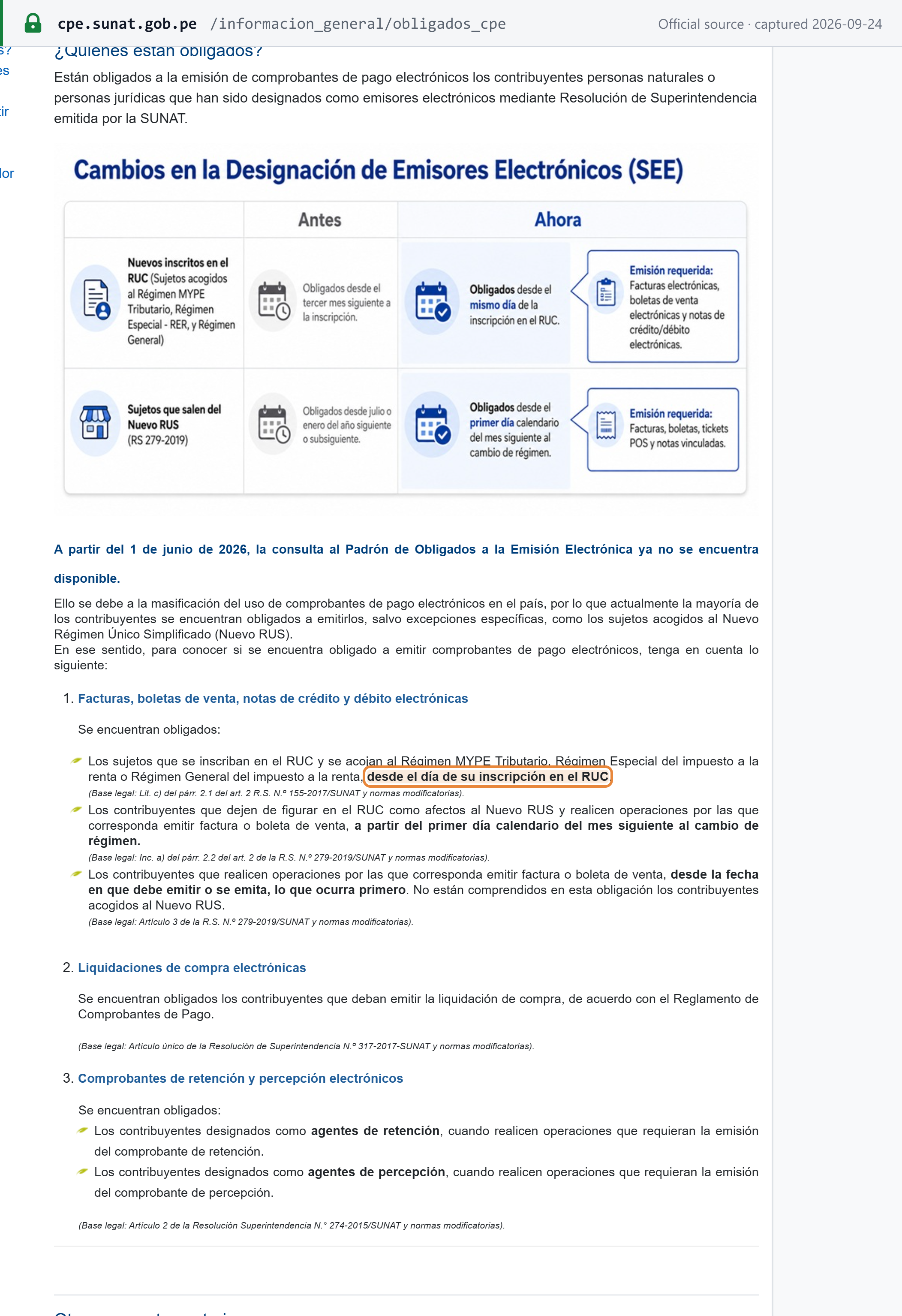
A taxpayer that registers from 1 June 2026 under the MYPE Tributario, Especial or General income-tax regime is an electronic issuer from the day of registration (see E-invoicing status). [31]
Voluntary registration
Not applicable as a separate option. With no threshold, every business that makes taxable operations is already within the IGV, so there is nothing to opt into below a threshold.
Deregistration
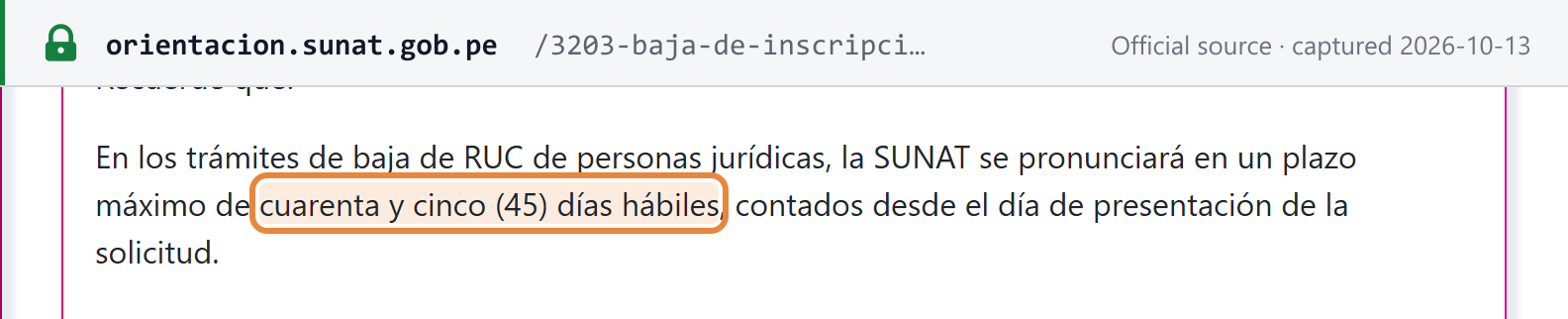
A company deregisters its RUC (baja de inscripción) on extinction, dissolution or reorganisation, supported by the public-registry record of the extinction. It must first withdraw its authorised comprobante series on Form 855. SUNAT decides "en un plazo máximo de cuarenta y cinco (45) días hábiles" (within 45 working days at most). Deregistration does not cancel tax debts already incurred. [6]
Group registration
Not available: the IGV law has no provision for registering a group as a single taxpayer. Each company holds its own RUC. Members of a consortium that keeps no separate accounts attribute its operations to themselves through a special document described in the Peru e-invoicing guide.
Rates
| Rate | Applies to |
|---|---|
| 18% (IGV 15.5% + IPM 2.5% in 2026) | Standard rate on taxable sales, services, construction and imports |
| 10.5% in 2026 (special IGV 8% + IPM 2.5%) | Micro and small restaurants, hotels and tourist lodgings that meet SUNAT's conditions (Law 32219) |
| Not subject (with refund of input IGV) | Exports of goods and services |
| Exempt | Goods and services in Appendices I and II of the TUO, until 31 December 2028 |
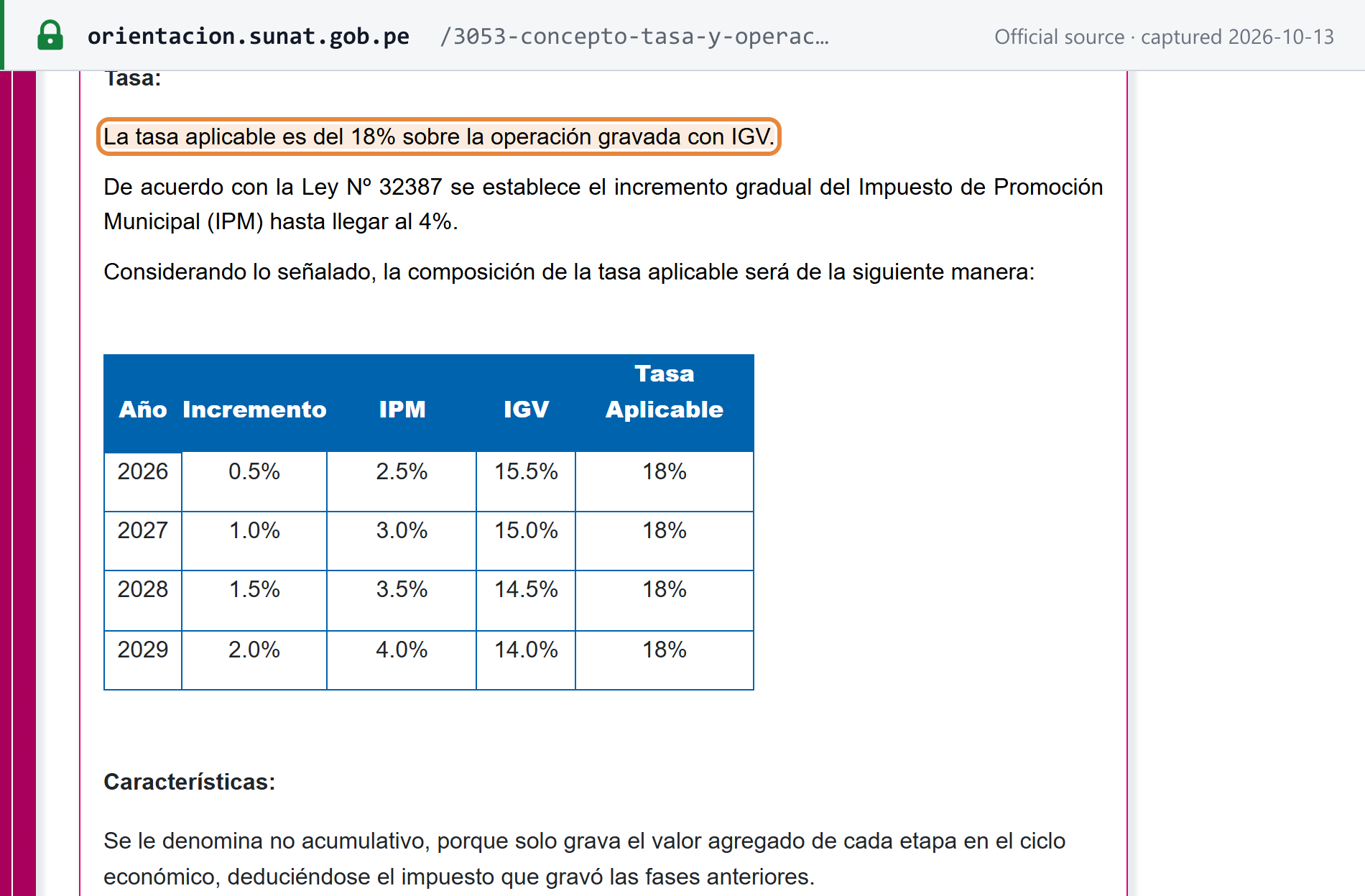
Standard rate: 18% in total. SUNAT: "La tasa aplicable es del 18% sobre la operación gravada con IGV." Under Law 32387 (published 16 June 2025) the IPM rises by 0.5 point each year from 2026 and the IGV falls by the same amount, so the total stays at 18%: [1] [7]
| Year | IPM | IGV | Total |
|---|---|---|---|
| 2025 and earlier (IGV 16% since 1 March 2011) | 2% | 16% | 18% |
| 2026 | 2.5% | 15.5% | 18% |
| 2027 | 3.0% | 15.0% | 18% |
| 2028 | 3.5% | 14.5% | 18% |
| 2029 | 4.0% | 14.0% | 18% |
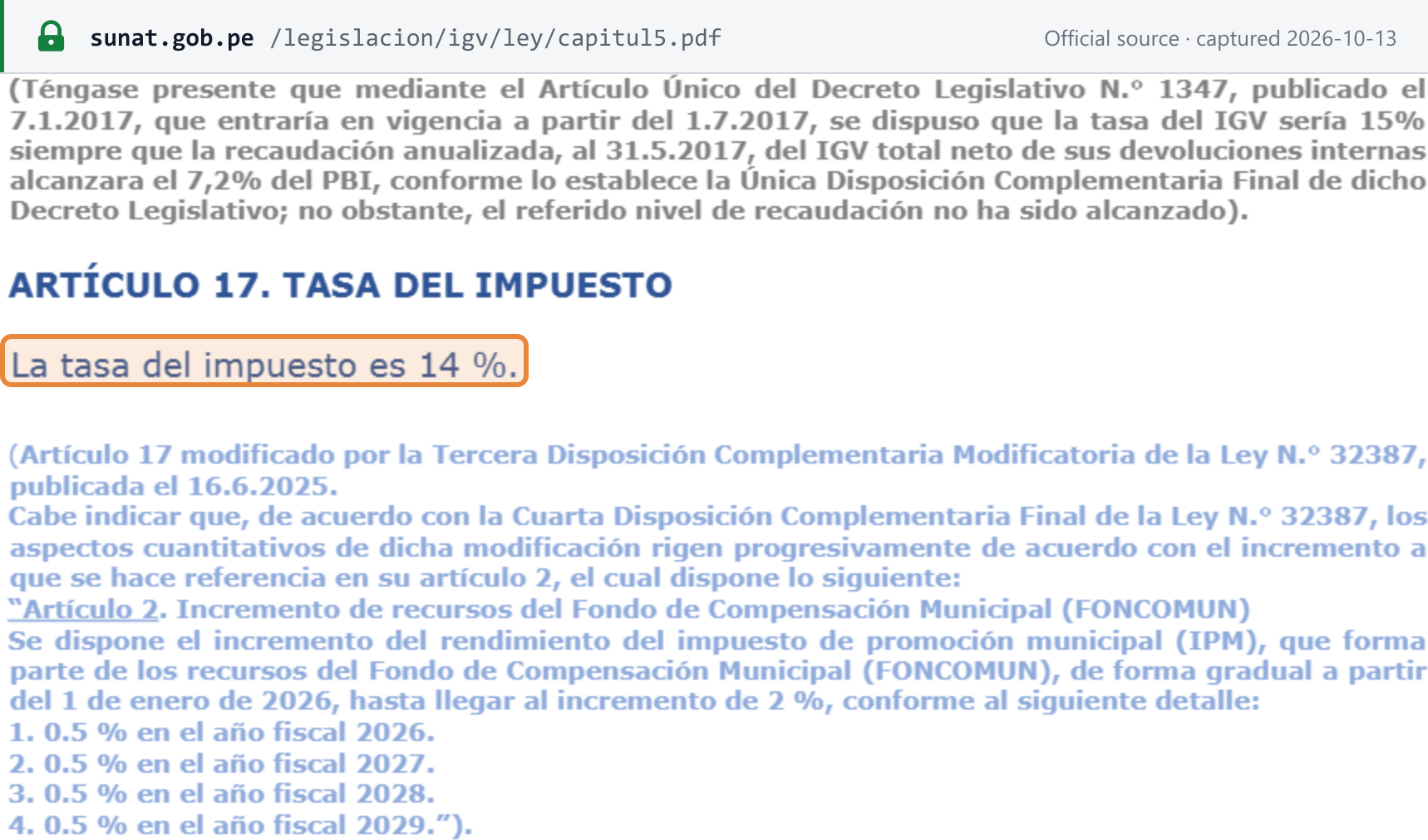
SUNAT's consolidated article 17 of the TUO already reads "La tasa del impuesto es 14 %", with a note that Law 32387 reaches that figure in four steps of 0.5 point from fiscal year 2026 to 2029. [7]
Reduced rate for small restaurants, hotels and tourist lodgings. Law 31556, as amended by Law 32219 (published 29 December 2024), sets a special temporary IGV rate of 8% for fiscal years 2025 and 2026 and 12% for 2027. The IPM is charged on top, so SUNAT's table gives 10.5% in 2026 (8% + 2.5%) and 15% in 2027 (12% + 3%). The law states no special rate after 2027. [8] [9] To qualify, a business must:
- be a micro or small business (MYPE) with annual sales of no more than 1,700 UIT;
- earn at least 70% of its income from restaurants, hotels or tourist lodgings;
- have no economic links to other businesses that would breach those limits.
A business that breaks the limits charges 18% from the month after next. [8]


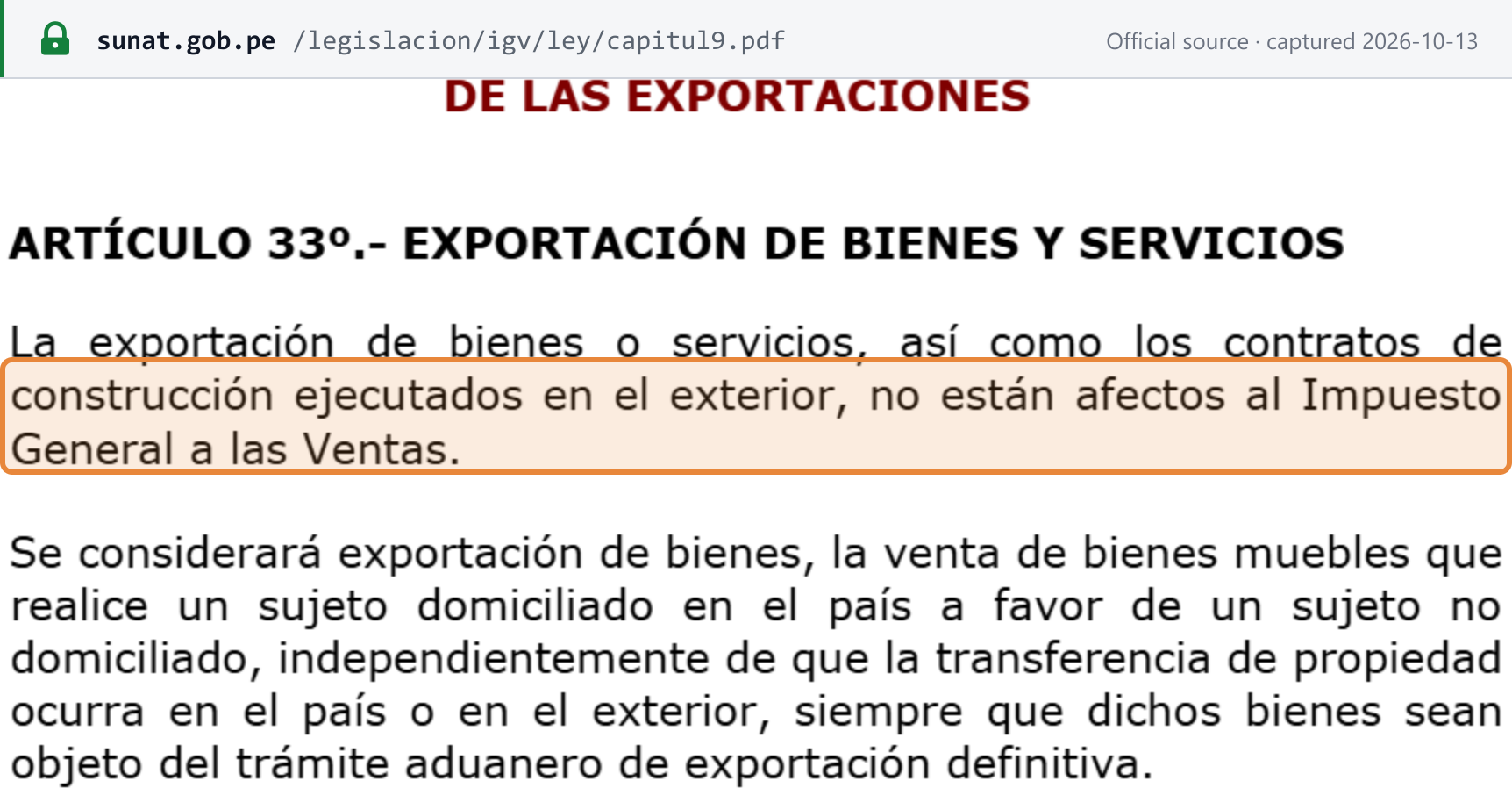
Exports. "La exportación de bienes o servicios, así como los contratos de construcción ejecutados en el exterior, no están afectos al Impuesto General a las Ventas." Exports are not taxed, but the exporter recovers the IGV on its purchases (see Imports and exports). [10]
Announced changes.
- 1 January 2027, 2028 and 2029: the IPM rises to 3%, 3.5% and 4%, and the IGV falls to 15%, 14.5% and 14%. The total stays at 18% (Law 32387). [1]
- 1 January 2027: the special IGV rate for qualifying restaurants and hotels rises from 8% to 12% (Law 32219). [9]
Cross-border rules
Imports and exports
Imports of goods. IGV and IPM are due on every import of goods. The base is the customs value plus the duties and taxes on the import, excluding the IGV itself. SUNAT collects the tax at customs, and a registered importer deducts it as input tax. [7] [14]
Exports of goods. Not subject to IGV. Where ownership passes in Peru before shipment, the goods must leave within 60 days of the invoice to count as exported. [10]
Exports of services. A service counts as exported only if all of these hold: [10]
- it is supplied for consideration from Peru to abroad;
- the supplier is domiciled in Peru;
- the customer is not domiciled in Peru;
- the service is used abroad;
- the supplier is registered beforehand in SUNAT's Registro de Exportadores de Servicios.
Exporter's refund. The IGV paid on purchases for exports becomes the saldo a favor del exportador. It is set first against the exporter's own IGV, then against income tax, then other Treasury taxes; "en el caso que no fuera posible lo señalado anteriormente, procederá la devolución" (if that is not possible, it is refunded). [10]
Reverse charge on services from non-residents
When a Peruvian business uses a service supplied by a non-domiciled supplier, the Peruvian customer is the taxpayer and pays the IGV and IPM itself. The foreign supplier does not register or charge IGV. [2] [13]
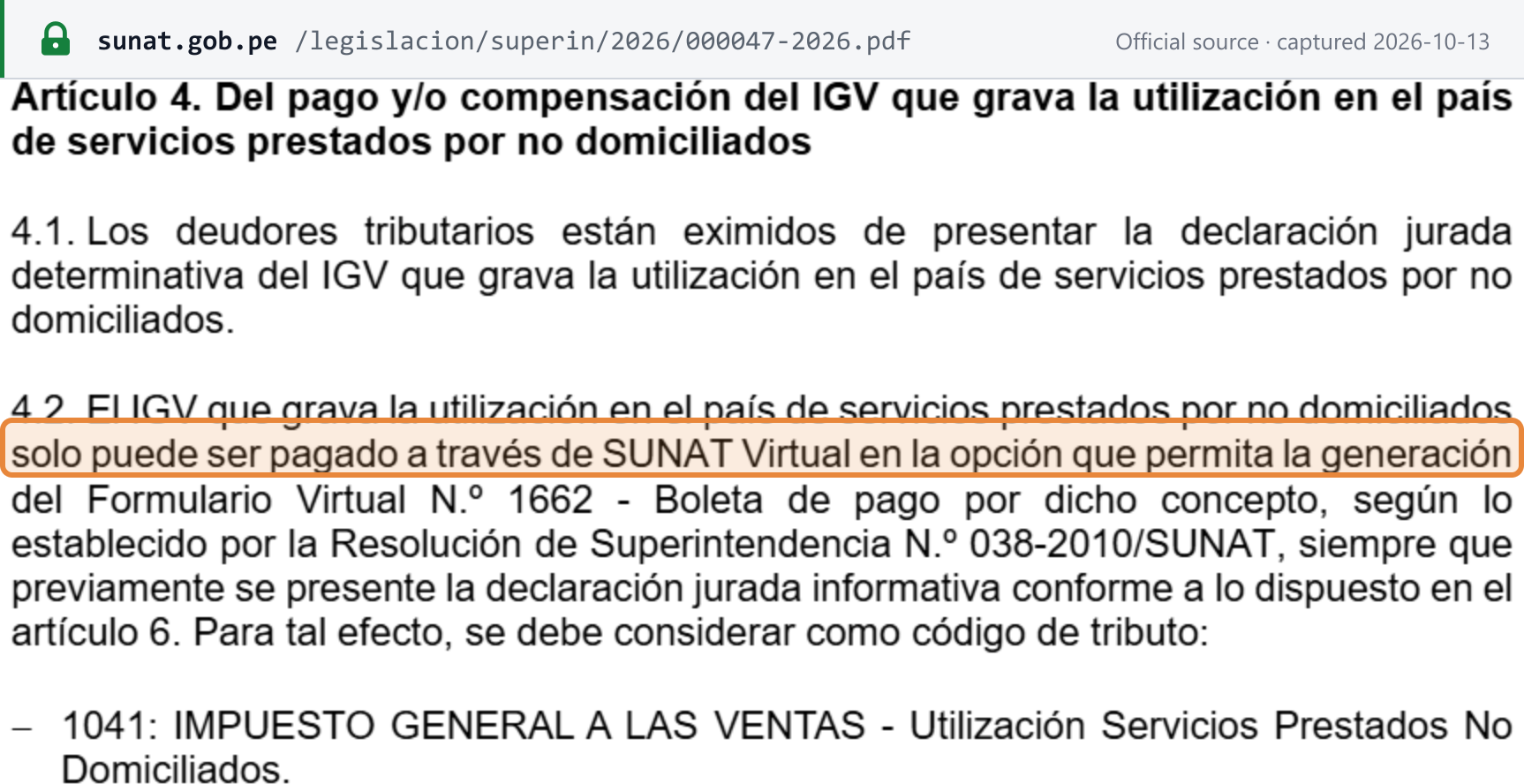
- How the customer pays. Through SUNAT Virtual on Formulario Virtual 1662 (boleta de pago).
- From 1 July 2026 (Resolution 000047-2026/SUNAT), the customer can pay only after filing an informative declaration that links the payment to the foreign supplier's invoice. No separate determinative return is needed.
- Input credit. The customer deducts the IGV paid "a partir del período al que corresponda dicho pago y/o compensación" (from the period of the payment or set-off). [13]
See reverse charge explained and the event record.
Digital products and services
Since 1 December 2024, non-domiciled suppliers of digital services and of intangibles downloaded over the internet collect IGV on sales to individuals resident in Peru who do not carry on a business (Legislative Decree 1623). Legislative Decree 1623 was published on 4 August 2024 and set collection to start on 1 October 2024. SUNAT states that suppliers already trading, or starting by 30 November 2024, began collecting on 1 December 2024. The decree itself has been in force since 25 August 2024, the day after its regulation, Supreme Decree 157-2024-EF, was published. [11] [5] [29]

How it works. [11]
- Selling directly: the supplier collects (percibe) IGV at the applicable rate on the full price.
- Intermediation platforms: the platform collects from the buyer and withholds (retiene) from the underlying seller.
- Free services are not taxed.
Who counts as a Peruvian consumer. A service is treated as used in Peru when the customer's habitual residence is in Peru. Any one of the following indicates it: [11]
- a Peruvian IP address or geolocation;
- a SIM card with Peru's country code;
- payment with a card, e-money or other product of the Peruvian financial system;
- a Peruvian address registered with the supplier.
The supplier relies on the platform registration to tell business customers from consumers. If the platform cannot distinguish them, the customer is treated as a consumer.
- When: monthly, "dentro de los primeros diez (10) días hábiles del mes siguiente" (within the first ten working days of the following month). The usual schedule by last RUC digit does not apply.
- Where: SUNAT's "Declaración y pago para no domiciliados" platform, a virtual form approved by Resolution 294-2024/SUNAT, in force from 1 January 2025, using tax codes 1042 (IGV withholdings, digital economy) and 1043 (IGV collections, digital economy).
- Currency: soles or US dollars. You choose in the January return, and the choice holds for the year. Deadlines run on Peru time (GMT-5).

Card-issuer backstop: enacted, not yet in force. Article 49-B, added by Legislative Decree 1623, would make banks, e-money issuers, Banco de la Nación and telecom operators collect the IGV where a supplier on an official list has failed to register, failed to file or pay for two months, or failed to file the annual information return. Card issuers would charge the IGV on the customer's credit card. Article 49-B "entra en vigencia en la misma fecha de entrada en vigencia de la norma que lo reglamente" (enters into force when the regulation implementing it does). SUNAT says the mechanism "se implementará con la norma que lo reglamente a futuro". As at 13 October 2026 no such regulation has been issued, and no bank or card issuer collects IGV under it. [5] [11] [30]

See VAT on digital services by non-resident suppliers and VAT withholding regimes.
Foreign companies selling into Peru — B2B and B2C
- Selling digital services to consumers (B2C): register in the RUC online, with no threshold. Collect IGV on each sale and file and pay monthly within ten working days, in soles or US dollars. Issue no Peruvian invoices. [4] [11]
- Selling services to businesses (B2B): do not register and do not charge IGV. The Peruvian business pays the IGV itself on Formulario Virtual 1662, after filing the informative declaration, and deducts it. An individual customer carrying on a business (persona natural que realice actividad empresarial) who was charged IGV by a registered digital supplier can use it as input credit once the supplier has paid it to the Treasury and the usual credit requirements are met. [13] [5]
- Income tax on the fee (B2B and B2C): a Peruvian payer of Peruvian-source income to a non-domiciled supplier must withhold income tax and pay it to SUNAT as a final tax. Services carried out in Peru, and digital services and technical assistance used in Peru, are Peruvian-source income. The rate is 30% for most services and royalties and 15% for technical assistance; for technical assistance worth more than 140 UIT under one contract, the Peruvian user must also obtain an auditor's report certifying the service was performed. [34] [33] [35]
- Selling goods: IGV is collected from the importer at customs. [7]
Marketplace / platform deemed-supplier liability
For digital services, an intermediation platform that sells to Peruvian consumers is caught by Legislative Decree 1623: it collects IGV from the buyer and withholds it from the underlying seller. [11] The IGV law has no general rule making a marketplace liable for IGV on physical goods sold through it. See marketplace deemed-supplier rules.
Place of supply
- Goods are taxed when sold in Peru or imported into Peru. [2]
- Services are taxed when supplied or used in Peru. A service supplied by a Peruvian-domiciled supplier is supplied in Peru. A service from abroad is taxed where it is used in Peru, which is why the Peruvian business customer pays IGV on imported services. [1]
- Digital services to consumers are used in Peru "si el usuario del servicio tiene su residencia habitual en el país" (if the user's habitual residence is in Peru), tested by the indicators above. [11]
Invoice requirements
Peru's invoices are comprobantes de pago, governed by the Reglamento de Comprobantes de Pago (Resolution 007-99/SUNAT, consolidated). In practice almost every factura and boleta is now issued electronically (see E-invoicing status).
Document types
| Document | Issued to | IGV credit for the buyer |
|---|---|---|
| Factura | Buyers with a RUC (and for exports) | Yes — supports the IGV credit and income-tax costs |
| Boleta de venta | Final consumers | No |
| Nota de crédito / nota de débito | Same buyer as the original factura or boleta | Adjusts the original |
The choice depends on who the buyer is, not on the value. SUNAT: the factura "se emite a favor del adquiriente que cuente con número de RUC"; the boleta "se emite a consumidores finales". There is no simplified invoice in the EU sense. [15]
A boleta must identify the buyer by name and identity document when the buyer asks, or when its total "supere la suma de setecientos soles (S/ 700.00)" (exceeds S/ 700). [16]

Mandatory content
The particulars of a factura under article 8, numeral 1, of the Reglamento de Comprobantes de Pago: [16]
| Ref. | Field |
|---|---|
| 1.1 | Issuer's name or business name, trade name where used, and the address of the tax domicile or issuing point |
| 1.1(c) | Issuer's RUC |
| 1.2 | Document name: "FACTURA" |
| 1.3 | Series and correlative number |
| 1.7 | Buyer's name or business name |
| 1.8 | Buyer's RUC (except on exports) |
| 1.9 | Description, quantity and unit of measure; serial or engine number where the goods are identifiable |
| 1.10 | Unit prices |
| 1.11 | Sale value, excluding taxes |
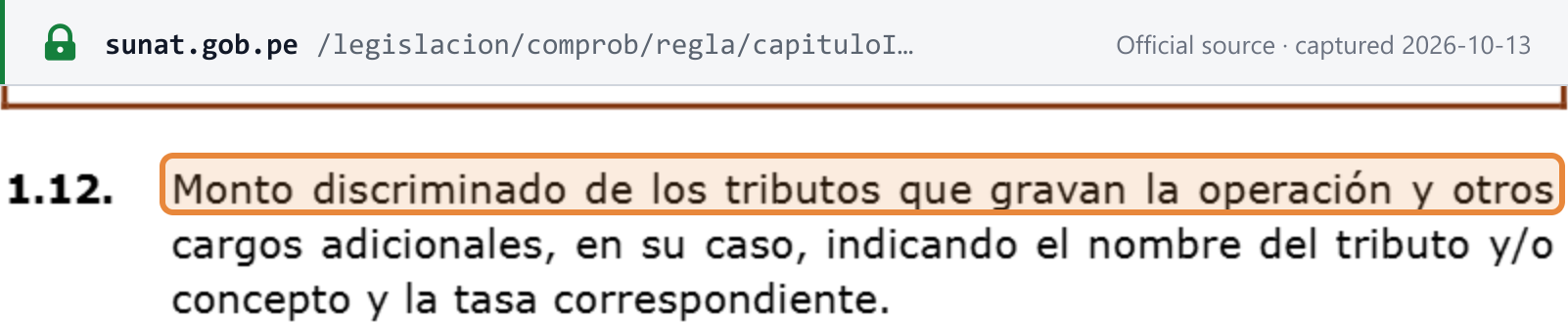
| 1.12 | Each tax itemised, "indicando el nombre del tributo … y la tasa correspondiente" (with its name and rate) |
| 1.13 | Total, in figures and in words |
| 1.14 | Numbers of related shipping guides (guías de remisión), where applicable |
| 1.15 | Issue date |
Items 1.4 and 1.5 (printer details and the print authorisation number) and 1.6 (who receives the original and each copy) apply to paper invoices. An electronic factura must also follow SUNAT's XML (UBL 2.1) specification, carry a digital signature and, when printed, a QR code; see the Peru e-invoicing guide.
Issuance deadline
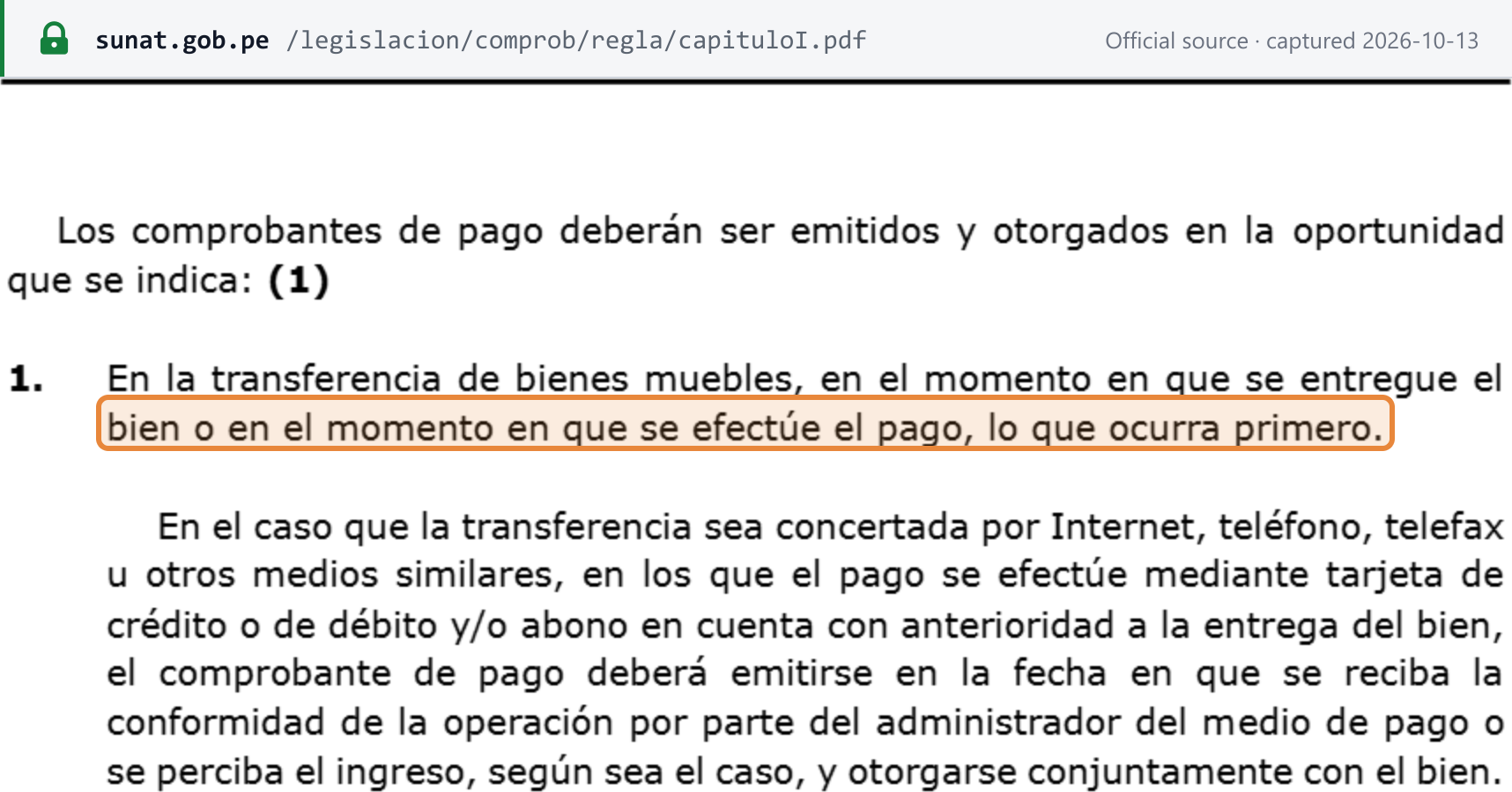
- Goods: "en el momento en que se entregue el bien o en el momento en que se efectúe el pago, lo que ocurra primero" (on delivery or payment, whichever comes first). [17]
- Services: on whichever comes first: completion of the service, receipt of payment (for the amount received), or each agreed due date. [17]
- Sending an e-factura to SUNAT: within 3 calendar days of issue; see the Peru e-invoicing guide.
Numbering and sequencing
Each electronic document "tiene una serie alfanumérica, numeración correlativa y se genera a través de cualquiera de los sistemas de emisión electrónica" (has an alphanumeric series and correlative number generated by the issuing system). [15]
Credit and debit notes
A credit note is used "para acreditar anulaciones, descuentos, bonificaciones, devoluciones y otros" (for cancellations, discounts, bonuses, returns and similar) on a factura or boleta issued earlier to the same buyer. An electronic credit note can only refer to a factura that SUNAT or an OSE has accepted. [15]
Currency and language
- Language. Export facturas carry their particulars in Spanish and may add a translation in the same document. [16]
- Currency. Non-domiciled digital suppliers may file and pay in US dollars (see Digital products and services).
Self-billing
Not applicable: the Reglamento de Comprobantes de Pago has no general self-billing arrangement for facturas.
Retention and audit trail
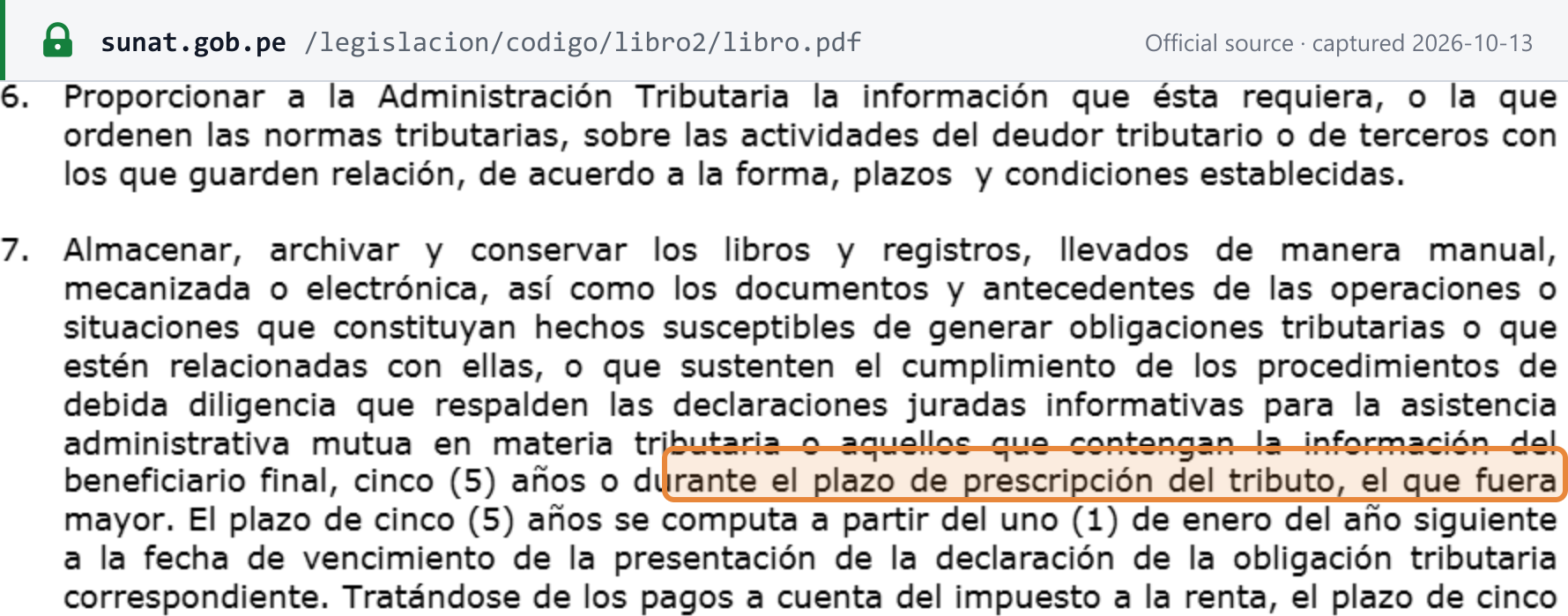
- Retention. Keep books, registers and supporting documents, whether manual, mechanised or electronic, for "cinco (5) años o durante el plazo de prescripción del tributo, el que fuera mayor" (five years or the limitation period, whichever is longer). The five years run from 1 January after the return's due date. [18]
- Limitation periods. 4 years; 6 years if no return was filed; 10 years where a withholding or collection agent did not pay over tax it withheld or collected. [19]
- Audit trail. Every electronic factura is digitally signed and validated by SUNAT or an accredited operator (OSE), which issues a receipt (CDR). Sales and purchase registers are kept electronically in SIRE. See the Peru e-invoicing guide.
A specimen of a compliant invoice
SUNAT publishes no annotated specimen invoice. Below, Lookuptax lays out the article 8 particulars for a domestic B2B factura for services in 2026. Every name, number and amount is fictional:
FACTURA ELECTRÓNICA
| Descriptionart. 8, 1.9 | Qty | Unit | Unit priceart. 8, 1.10 | Sale value (S/) |
|---|---|---|---|---|
| IT consulting services, September 2026 | 1 | Service | 10,000.00 | 10,000.00 |
- Sale value (excl. taxes)art. 8, 1.11
- S/ 10,000.00
- IGV 18%art. 8, 1.12
- S/ 1,800.00
- Totalart. 8, 1.13
- S/ 11,800.00
- Total in words (art. 8, 1.13): ONCE MIL OCHOCIENTOS CON 00/100 SOLES.
- The 18% shown is the combined rate SUNAT states; in 2026 it is made up of IGV 15.5% and IPM 2.5%. Check SUNAT's XML specification for how the tax must be coded in the electronic file.
- An electronic factura is digitally signed, sent to SUNAT or an OSE within 3 calendar days, and printed with a QR code where a printed version is given.
- If the service falls under the detracciones system, the buyer deposits the detracción into the supplier's Banco de la Nación account (see Filing and payment).
- Keep for five years or the limitation period, whichever is longer.
E-invoicing status
Status (as at 2026-10-13): mandatory. Peru runs a national clearance system, the Sistema de Emisión Electrónica (SEE). In summary: [31]
- Who issues. Every taxpayer that must issue facturas or boletas is an electronic issuer, except those in the Nuevo RUS simplified regime. Since 1 June 2026, new RUC registrants are electronic issuers from the day they register. [37]
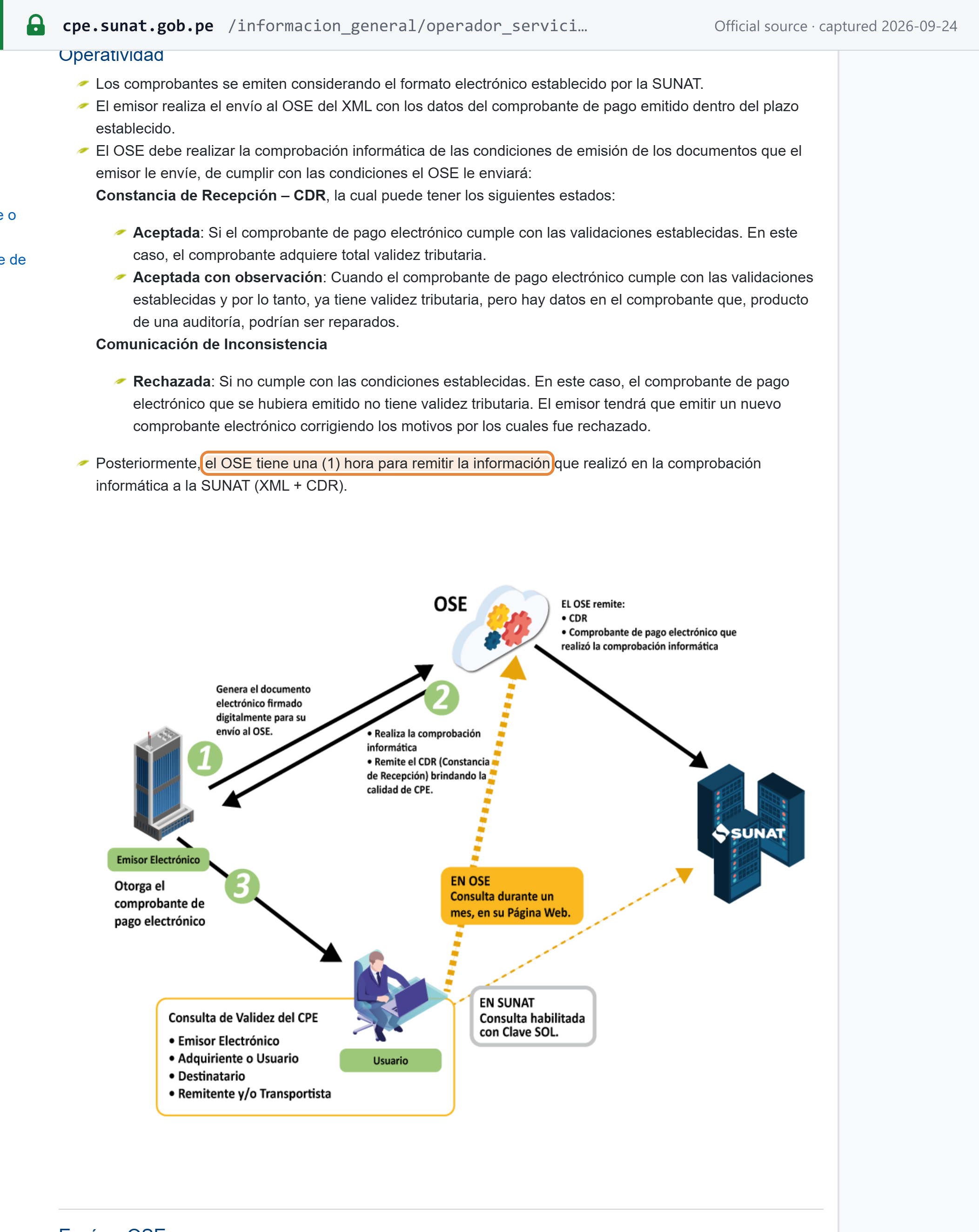
- How. Documents go directly to SUNAT or through an accredited OSE (Operador de Servicios Electrónicos), which validates each one and returns a receipt (CDR); the OSE then has one hour to send the document and CDR to SUNAT. [38]
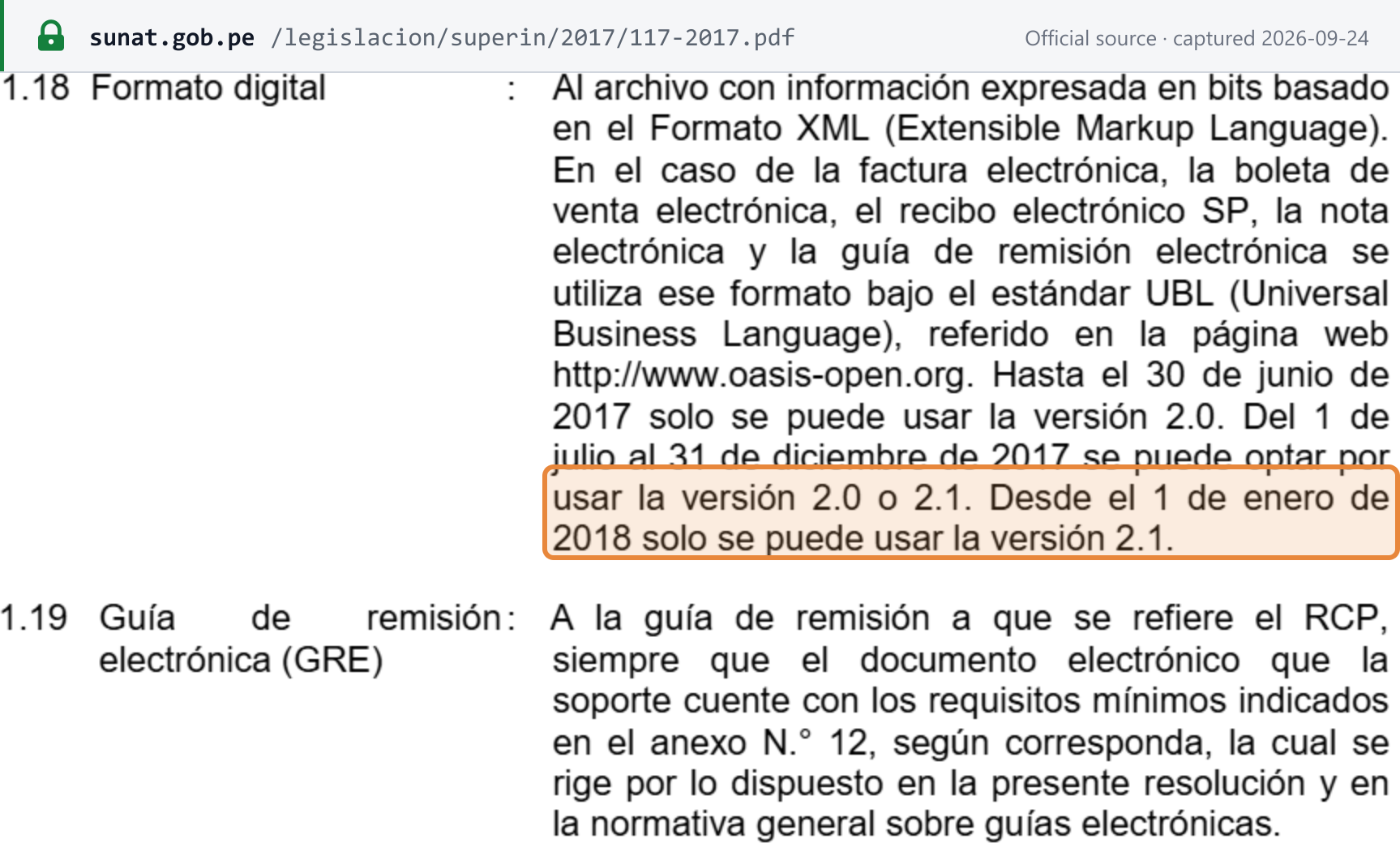
- Format. XML under the UBL standard; since 1 January 2018 only UBL version 2.1 may be used. [36]
- Scope. B2B, B2G and B2C documents are all in scope.
- Foreign digital suppliers registered under Legislative Decree 1623 issue no Peruvian e-invoices.
- Next change. Resolution 000048-2026/SUNAT, which adds two further document types, takes effect on 1 January 2027, with its designations from 1 April 2027.
For the full timeline, the OSE and SEE channels, the XML rules, waybills and penalties, see the Peru e-invoicing guide, and for Peru alongside other countries, the e-invoicing status and networks table.
Filing and payment
Filing frequency
Monthly for every IGV taxpayer. The tax period is the calendar month, and there is no quarterly or annual option for the IGV. [20]
Return due date
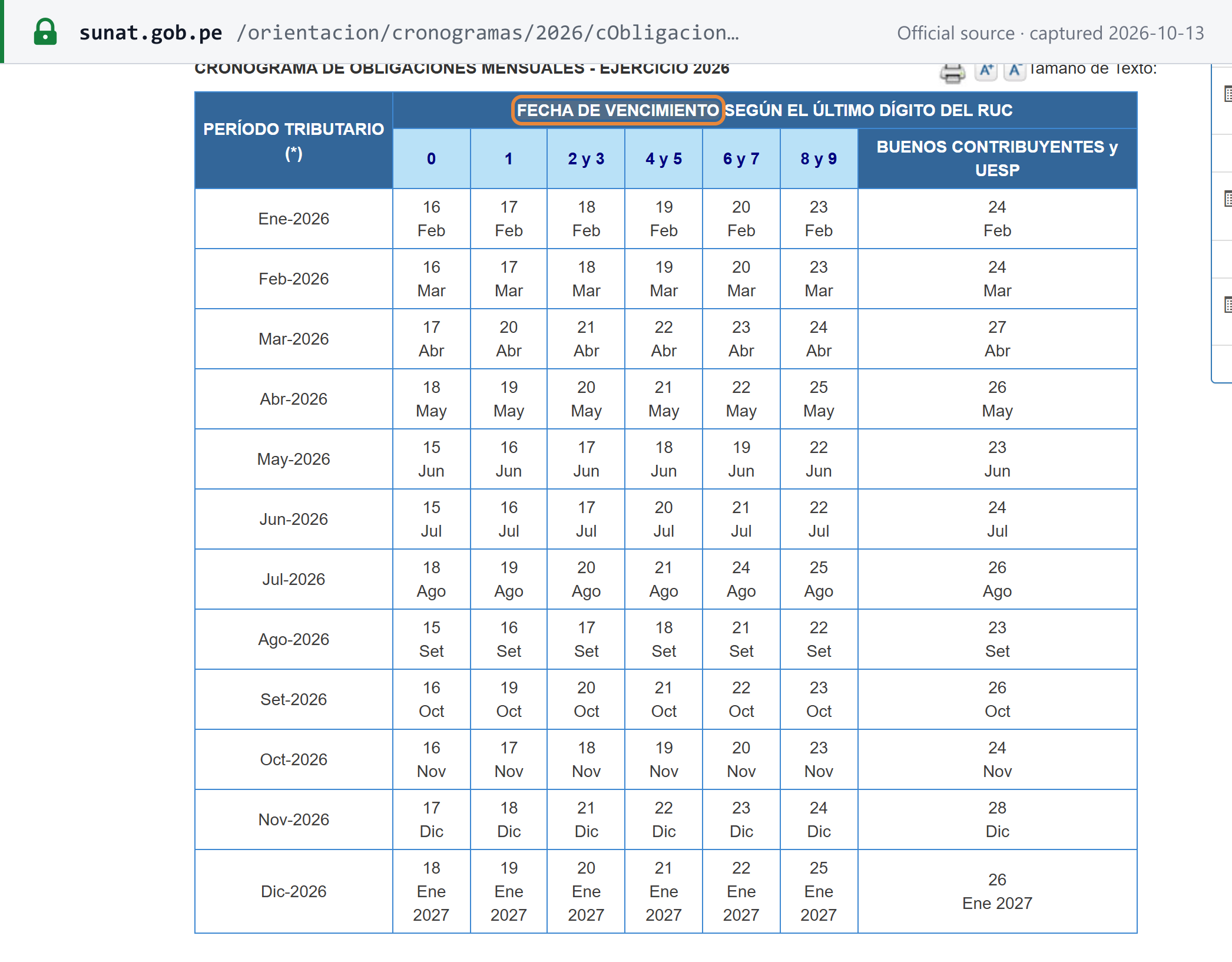
"La declaración y el pago del Impuesto deberán efectuarse conjuntamente … dentro del mes calendario siguiente al período tributario" (the return and payment are made together within the calendar month after the period). The exact day depends on the last digit of the RUC, under the multi-year schedule in Annex I of Resolution 281-2022/SUNAT. The return is SUNAT's Formulario Virtual 621. [20] [21] [8]
For 2026 periods, the due dates fall between the 15th and the 28th of the following month. SUNAT's 2026 schedule, by last digit of the RUC: [21]
| Period (2026) | 0 | 1 | 2–3 | 4–5 | 6–7 | 8–9 | Good taxpayers and UESP |
|---|---|---|---|---|---|---|---|
| January | 16 Feb | 17 Feb | 18 Feb | 19 Feb | 20 Feb | 23 Feb | 24 Feb |
| February | 16 Mar | 17 Mar | 18 Mar | 19 Mar | 20 Mar | 23 Mar | 24 Mar |
| March | 17 Apr | 20 Apr | 21 Apr | 22 Apr | 23 Apr | 24 Apr | 27 Apr |
| April | 18 May | 19 May | 20 May | 21 May | 22 May | 25 May | 26 May |
| May | 15 Jun | 16 Jun | 17 Jun | 18 Jun | 19 Jun | 22 Jun | 23 Jun |
| June | 15 Jul | 16 Jul | 17 Jul | 20 Jul | 21 Jul | 22 Jul | 24 Jul |
| July | 18 Aug | 19 Aug | 20 Aug | 21 Aug | 24 Aug | 25 Aug | 26 Aug |
| August | 15 Sep | 16 Sep | 17 Sep | 18 Sep | 21 Sep | 22 Sep | 23 Sep |
| September | 16 Oct | 19 Oct | 20 Oct | 21 Oct | 22 Oct | 23 Oct | 26 Oct |
| October | 16 Nov | 17 Nov | 18 Nov | 19 Nov | 20 Nov | 23 Nov | 24 Nov |
| November | 17 Dec | 18 Dec | 21 Dec | 22 Dec | 23 Dec | 24 Dec | 28 Dec |
| December | 18 Jan 2027 | 19 Jan 2027 | 20 Jan 2027 | 21 Jan 2027 | 22 Jan 2027 | 25 Jan 2027 | 26 Jan 2027 |
Non-domiciled digital suppliers follow their own deadline: the first ten working days of the following month (see Digital products and services).
Payment due date and method
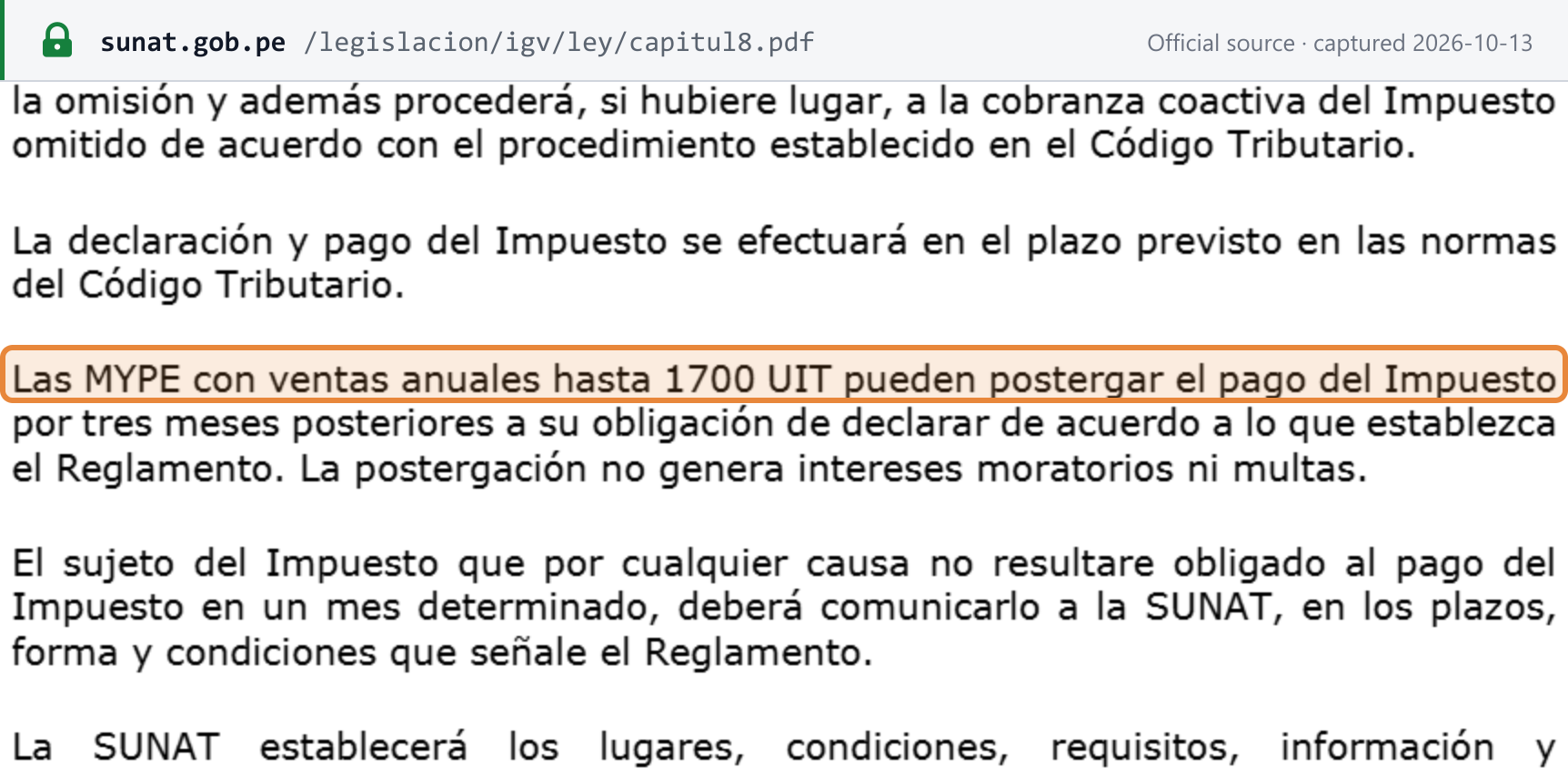
Payment is due on the same day as the return. Micro and small businesses (MYPE) with annual sales of up to 1,700 UIT can postpone payment — not filing — by three months, on the conditions set by the IGV regulation (Reglamento): "La postergación no genera intereses moratorios ni multas" (the postponement carries no late-payment interest or fines). [20]
Advance-payment systems: detracciones, retenciones and percepciones
Peru collects part of the IGV in advance through three systems. In each, the amount is credited against the supplier's or buyer's own taxes.
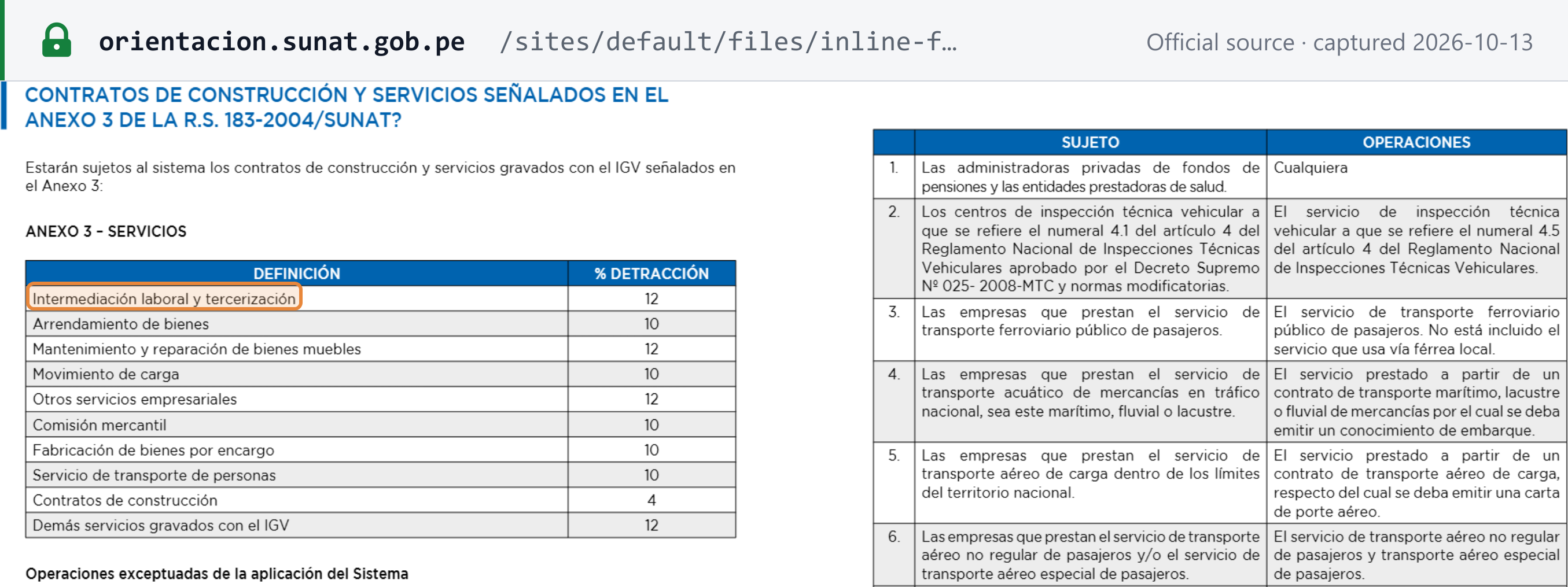
- Detracciones (SPOT). For listed goods and services, the buyer deposits a percentage of the price into the supplier's account at Banco de la Nación, and the supplier can use the funds only to pay taxes. SUNAT's detracciones leaflet lists, for services: 12% for labour intermediation and outsourcing, maintenance and repair of movable goods, other business services, and other IGV-taxed services; 10% for leasing of goods, cargo handling, commission agency, manufacturing to order and passenger transport; and 4% for construction contracts. It does not apply where the amount is S/ 700 or less or the customer is non-domiciled. [22]
- Retenciones (withholding). A buyer that SUNAT designates as a withholding agent keeps back 3% of the transaction amount and pays it to SUNAT; the rate has applied since 1 March 2014 (Resolution 033-2014/SUNAT). [23]
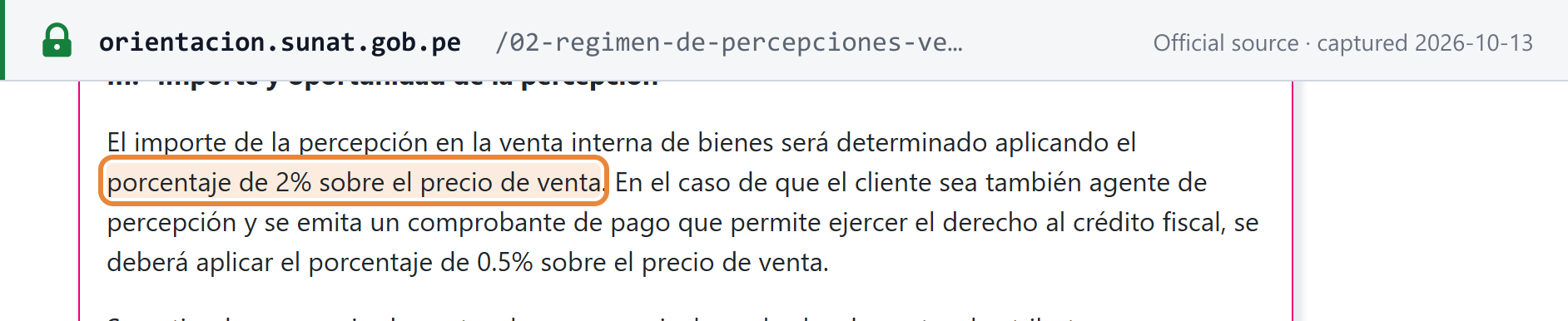
- Percepciones (collection). On domestic sales of listed goods, a seller designated as a collection agent charges the buyer 2% of the sale price on top, or 0.5% where the buyer is also a collection agent and receives a factura that gives an IGV credit. Buyers that are withholding agents, or on SUNAT's exempted list, are excluded when they receive a credit-bearing document. [24]

See VAT withholding regimes for how Peru's withholding compares with other countries.
Additional listings
- Electronic registers. Sales and purchase registers (RVIE and RCE) are kept electronically in SUNAT's SIRE system. SUNAT has extended its discretion not to penalise certain SIRE register infringements; see the Peru e-invoicing guide and the event record.
- Annual return. There is no separate annual IGV return. Legislative Decree 1623 lets SUNAT require an annual information return from non-domiciled digital suppliers. [5]
Input-tax recovery and blocked items
Input IGV is the IGV "consignado separadamente en el comprobante de pago" (shown separately on the comprobante), or paid on an import or on a service from a non-domiciled supplier. A purchase gives a credit only if: [14]
- it is deductible as a cost or expense for income tax; and
- it is used for operations on which IGV is payable.
Blocked items follow from the income-tax test: a cost that is not deductible for income tax carries no IGV credit.
Refunds
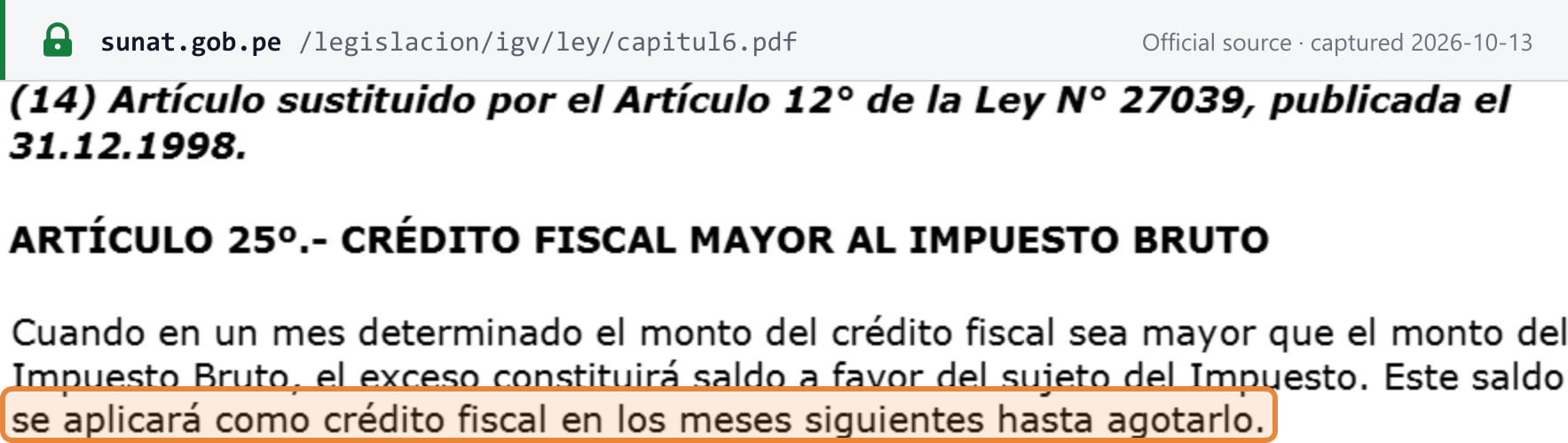
- Residents. Excess input IGV is carried forward: "Este saldo se aplicará como crédito fiscal en los meses siguientes hasta agotarlo" (it is applied in the following months until used up). There is no general cash refund for domestic businesses. [14]
- Exporters recover input IGV through the saldo a favor del exportador (see Imports and exports). [10]
- Withholdings and perceptions that cannot be used for at least three consecutive periods can be refunded on request. [20]
- Non-residents. The IGV law has no refund scheme for unregistered foreign businesses.
Exemptions
Exempt supplies
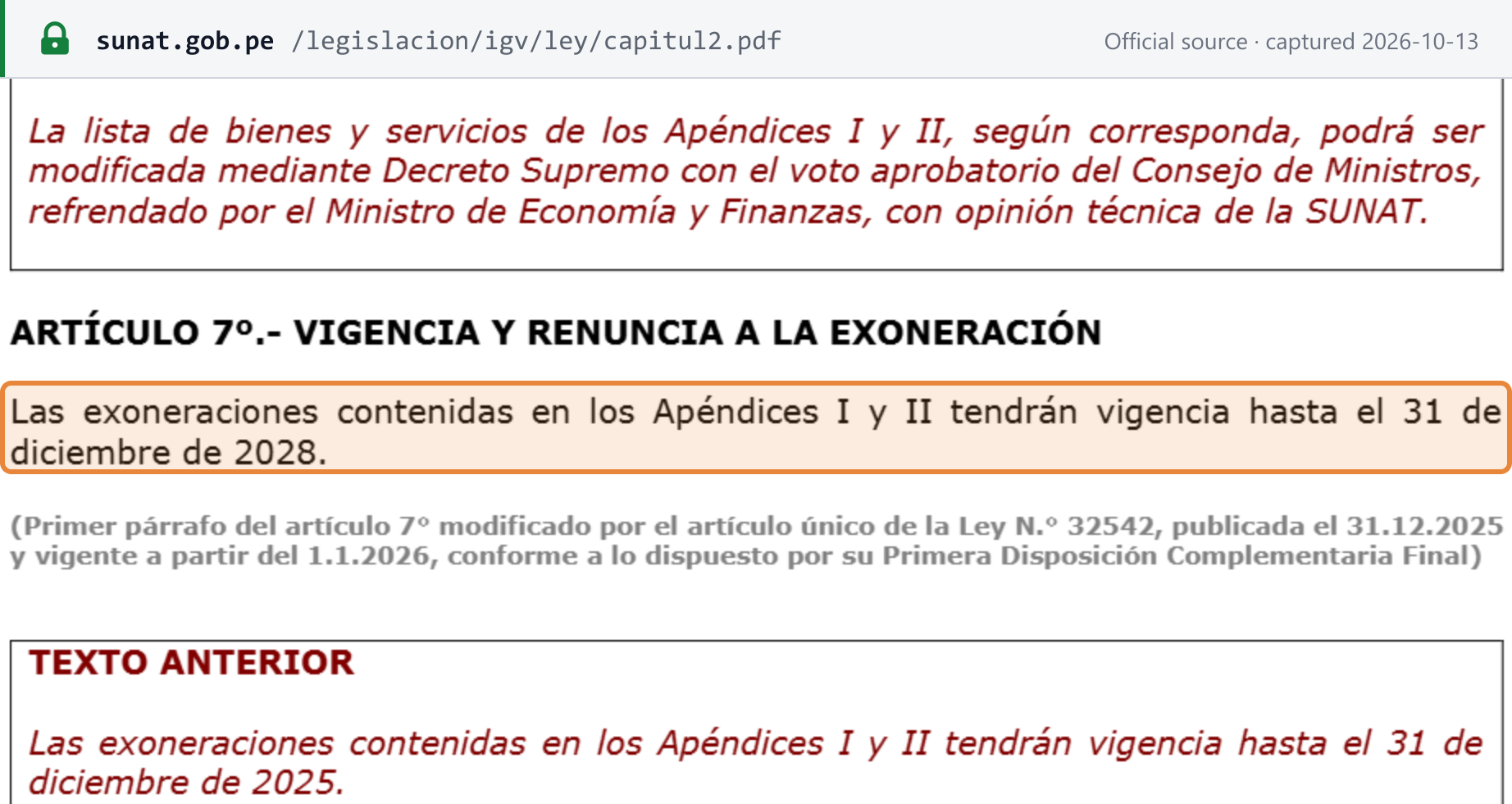
"Están exoneradas del Impuesto General a las Ventas las operaciones contenidas en los Apéndices I y II." Appendix I lists goods and Appendix II lists services. Article 6 describes the goods as including live animals, farm inputs and primary food products. Under Law 32542 (published 31 December 2025), these exemptions apply until 31 December 2028. [25]
Exempt is not zero-rated. An exempt sale carries no IGV, and the IGV on purchases used to make it cannot be deducted, because a credit is allowed only for purchases used in taxed operations. An export is also outside the IGV, but the exporter can recover its input IGV through the saldo a favor del exportador. [14] [10]
Special regimes
- Small restaurants and hotels: a special IGV rate of 8% plus IPM in 2026 (see Rates).
- MYPE payment postponement: three months, with no interest (see Payment due date and method).
- Nuevo RUS: a simplified regime for small businesses that is outside the e-invoicing mandate (see E-invoicing status).
Offences and penalties
Penalties are set in UIT (tax units). The UIT for 2026 is S/ 5,500 (Supreme Decree 301-2025-EF). The figures below are from Table I of the Tax Code, which applies to businesses taxed under the General and MYPE Tributario regimes; the S/ amounts are our arithmetic at the 2026 UIT. [26] [32]

Offences
Administrative infringements under the Tax Code include: [26]
- Failing to register in SUNAT's registers (article 173, numeral 1).
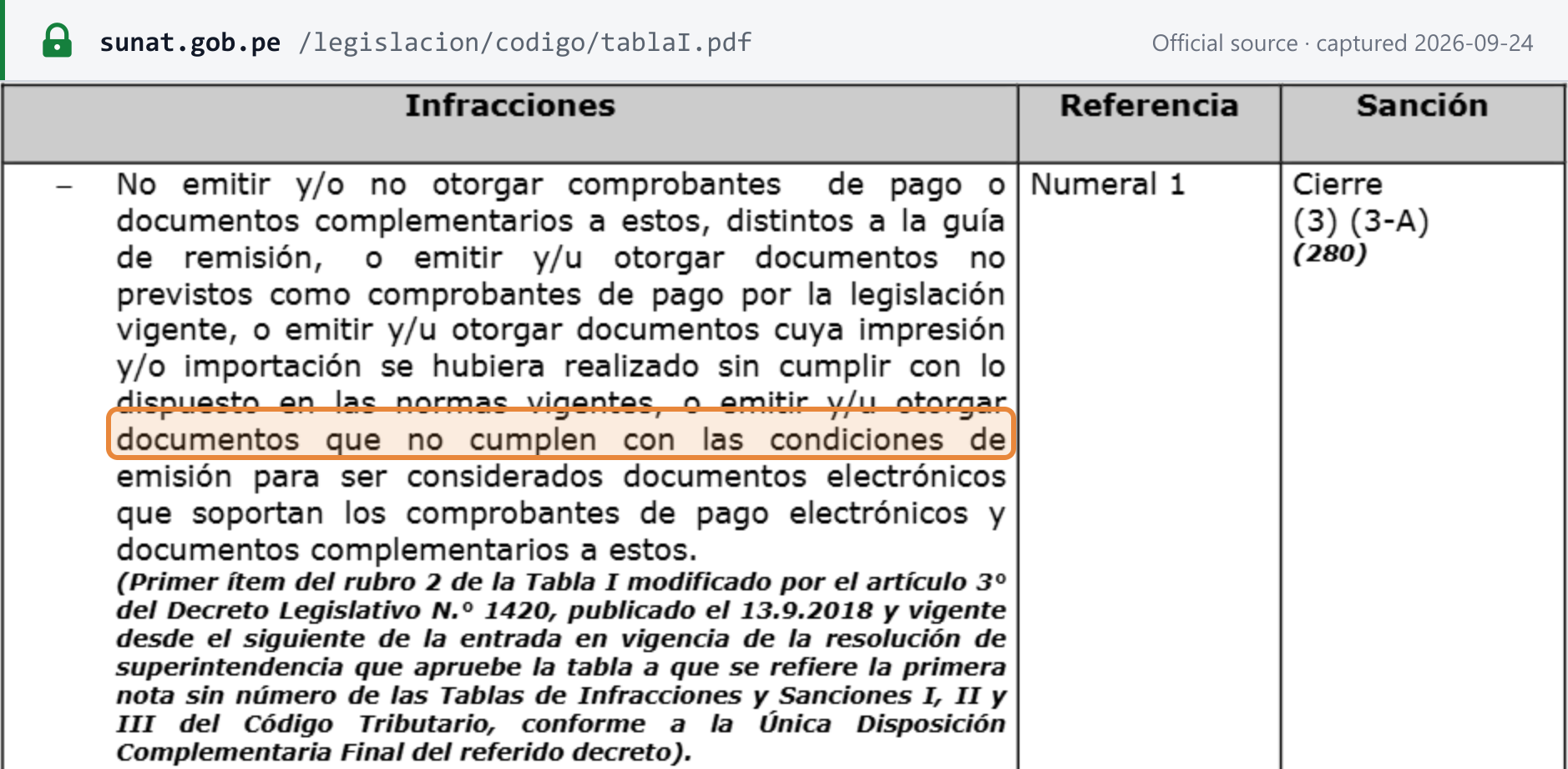
- Not issuing comprobantes de pago, or issuing documents that do not meet the conditions for electronic documents (article 174, numeral 1). The sanction is closure of the business premises; see the Peru e-invoicing guide.
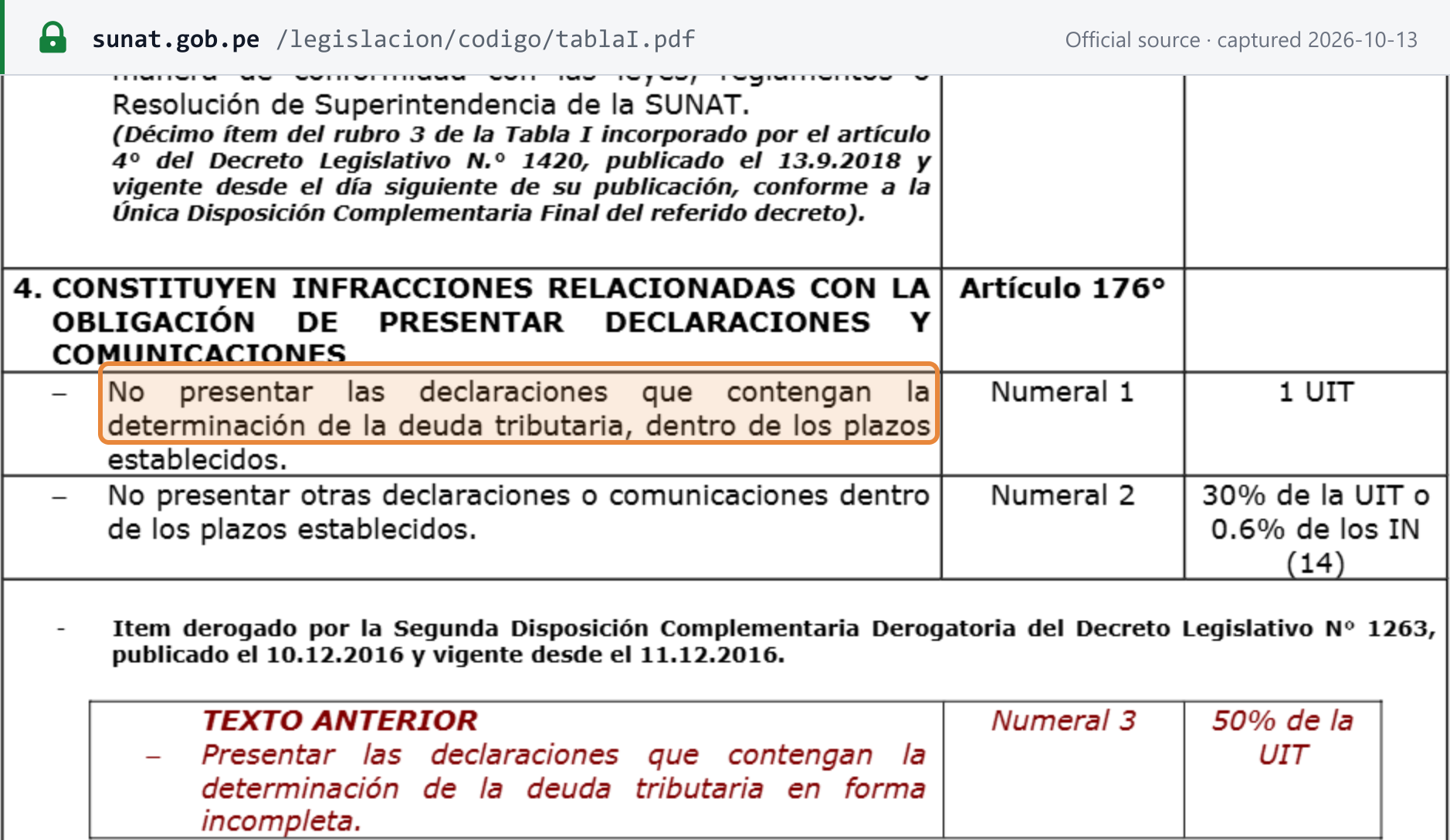
- Not filing a return that determines the tax due within the deadline (article 176, numeral 1).
- Declaring false figures or omitting income, which reduces the tax due (article 178, numeral 1).
Penalties
| Infringement | Tax Code | Penalty | At the 2026 UIT |
|---|---|---|---|
| Failure to register | Art. 173, num. 1 | 1 UIT, or confiscation or temporary impounding of a vehicle | S/ 5,500 |
| Late filing of a return that determines the tax | Art. 176, num. 1 | 1 UIT | S/ 5,500 |
| Late filing of other returns | Art. 176, num. 2 | 30% of the UIT or 0.6% of net revenue (ingresos netos) | — |
| Under-declaring or false figures | Art. 178, num. 1 | 50% of the tax omitted | — |
| Not issuing comprobantes | Art. 174, num. 1 | Closure | — |
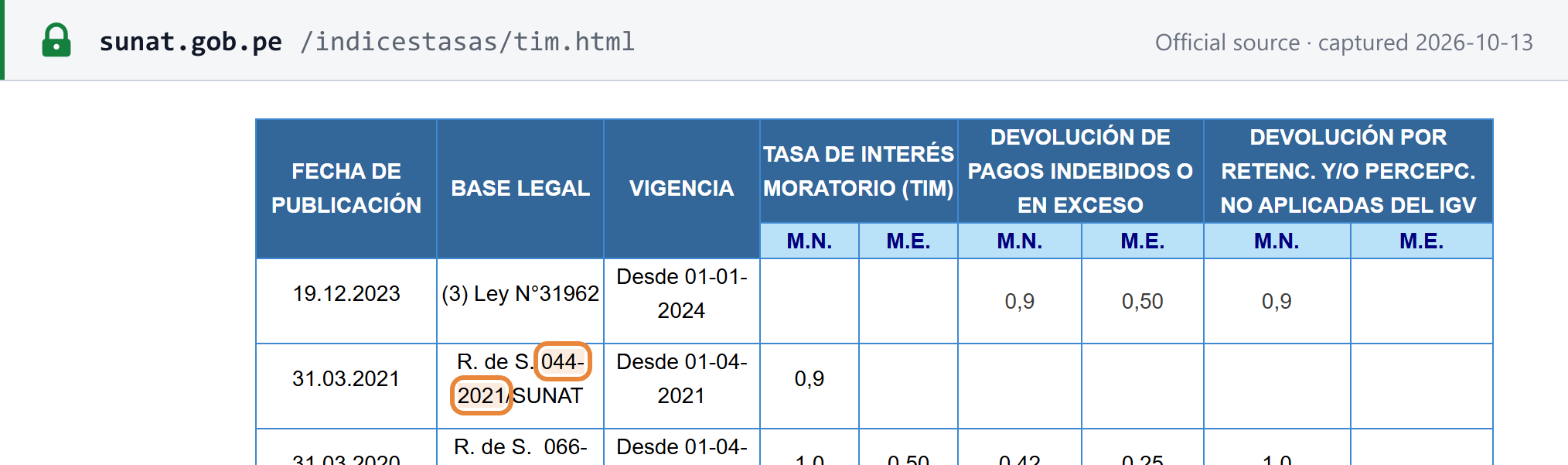
Late-payment interest. The Tasa de Interés Moratorio (TIM) on debts in soles is 0.90% a month from 1 April 2021 (Resolution 044-2021/SUNAT). It accrues daily at one-thirtieth of the monthly rate. Since 1 January 2024 the TIM no longer applies to fines (multas): they carry the legal interest rate under article 1244 of the Civil Code instead (Law 31962, article 2). [27] [28] [19]
Frequently asked questions
Is Peru's VAT rate 18% or 16%?
The rate you charge is 18%. It is made up of two parts that SUNAT collects together: the IGV itself and the municipal-promotion tax (IPM). Until the end of 2025 the split was IGV 16% plus IPM 2%. Under Law 32387 the IPM rises by 0.5 point a year and the IGV falls by the same amount, so in 2026 the split is IGV 15.5% plus IPM 2.5%, and it reaches IGV 14% plus IPM 4% in 2029. The 18% total does not change. Sources that still show 16% plus 2% describe the split before 2026.
We are a foreign SaaS company selling to Peruvian businesses. Do we have to register for IGV?
No, not for sales to businesses. The registration rule for foreign digital suppliers (Legislative Decree 1623) covers only sales to individuals in Peru who do not carry on a business. When a Peruvian business buys your service, the business pays the IGV on the imported service itself, using SUNAT's Formulario Virtual 1662; from 1 July 2026 it must first file an informative declaration linking the payment to your invoice. If you also sell to consumers in Peru, you must register for those sales, with no minimum threshold. Separately, the Peruvian customer must withhold Peruvian income tax from your fee where the income is Peruvian-source: 30% for most services and 15% for technical assistance.
Do we have to issue Peruvian e-invoices after registering as a foreign digital supplier?
No. SUNAT states that a non-domiciled supplier registered under Legislative Decree 1623 is not required to keep Peruvian accounting books or to issue comprobantes de pago (facturas or boletas) for those sales. It registers in the RUC online, collects the IGV and files and pays monthly, within the first ten working days of the following month, in soles or US dollars.
Will Peruvian banks or card issuers withhold IGV from card payments to us?
Not at present. Legislative Decree 1623 added a backstop (article 49-B) under which banks, e-money issuers, Banco de la Nación and telecom operators would collect the IGV when a listed foreign supplier fails to register, or fails to file or pay for two months. That article enters into force only with its own implementing regulation, and SUNAT says the mechanism will be implemented with that regulation in future. As at 13 October 2026 it is enacted but not operating.
When is my monthly IGV return due?
In the month after the tax period, on a date that depends on the last digit of your RUC. SUNAT publishes the dates each year; for 2026 periods they fall between the 15th and the 28th of the following month. You file and pay together. Non-domiciled digital suppliers do not follow this schedule: they file and pay within the first ten working days of the following month.
Why did my Peruvian client pay only part of my invoice?
It depends on where you are based. If you are a foreign supplier, the usual reason is Peruvian income tax withheld at source: a Peruvian business that pays a non-domiciled supplier Peruvian-source income must withhold the tax and pay it to SUNAT as a final tax. Services carried out in Peru, and digital services and technical assistance used in Peru, are Peruvian-source income. The rate is 30% for most services and 15% for technical assistance. If you are a Peruvian IGV taxpayer, the cause is usually one of SUNAT's IGV advance-payment systems. Under the detracciones system the buyer deposits a percentage of the price into your account at Banco de la Nación; SUNAT's leaflet lists 12% for most business services. A buyer that SUNAT has designated as a withholding agent keeps back 3% of the transaction amount as an IGV retención. Both amounts are credited against your own taxes.
Important websites
| Site | Purpose |
|---|---|
| SUNAT Operaciones en Línea (SOL) | Activate a company RUC, file Formulario Virtual 621 and pay |
| SUNAT Emprender — RUC registration | How to register in the RUC, digital and in person |
| RUC registration for non-domiciled persons | Online registration for foreign digital-service suppliers |
| SUNAT — IGV on digital services | Rules, filing and payment for non-domiciled digital suppliers |
| SUNAT RUC search | Look up a RUC and its status |
| Peru RUC validator | Check a RUC's format with Lookuptax |
| SUNAT 2026 due-date schedule | Monthly due dates by last digit of the RUC |
| SUNAT CPE portal | Electronic invoicing rules, OSE list and document types |
| SUNAT — IGV rate | Current rate and the IGV/IPM split by year |
Recent changes
- 2026-08-31 — SUNAT extended its discretion not to penalise certain SIRE electronic-register infringements. (SUNAT) — see event
- 2026-07-29 — Resolution 000143-2026/SUNAT, dated 29 July 2026, postponed Resolution 000048-2026 (new electronic document types) from 1 August 2026 to 1 January 2027, with designations moved to 1 April 2027. (SUNAT) — see events: deferral, correction
- 2026-07-01 — Resolution 000047-2026/SUNAT in force: IGV on services from non-domiciled suppliers is paid on Formulario Virtual 1662 only after an informative declaration. (SUNAT) — see event
- 2026-06-01 — Resolution 000075-2026/SUNAT in force: new RUC registrants are electronic issuers from the day they register. (SUNAT) — see event
- 2026-01-01 — Law 32387: the IPM rose to 2.5% and the IGV fell to 15.5%; the total stays 18%. Law 32542 extended the Appendix I and II exemptions to 31 December 2028. (SUNAT)
- 2024-12-01 — Non-domiciled suppliers of digital services to consumers began collecting IGV (Legislative Decree 1623). (SUNAT)
For the full chronology, see Peru tax changes on Lookuptax.
Reference links
- SUNAT — IGV: concept, rate and taxed operations
- SUNAT — TUO of the IGV Law, chapter I (PDF)
- SUNAT Emprender — RUC registration
- SUNAT — RUC registration for non-domiciled persons
- El Peruano — Legislative Decree 1623 (4 August 2024)
- SUNAT — RUC deregistration for companies
- SUNAT — TUO of the IGV Law, chapter V (PDF)
- SUNAT — IGV reduction for restaurants, hotels and tourist lodgings
- El Peruano — Law 32219 (29 December 2024)
- SUNAT — TUO of the IGV Law, chapter IX (PDF)
- SUNAT — IGV on digital services
- SUNAT — Resolution 000294-2024/SUNAT (PDF)
- SUNAT — Resolution 000047-2026/SUNAT (PDF)
- SUNAT — TUO of the IGV Law, chapter VI (PDF)
- SUNAT CPE — Factura
- SUNAT — Reglamento de Comprobantes de Pago, chapter III (PDF)
- SUNAT — Reglamento de Comprobantes de Pago, chapter I (PDF)
- SUNAT — Tax Code, Book II (PDF)
- SUNAT — Tax Code, Book I (PDF)
- SUNAT — TUO of the IGV Law, chapter VIII (PDF)
- SUNAT — Schedule of monthly obligations 2026
- SUNAT — Detracciones leaflet (PDF)
- SUNAT — Withholding regime: transaction amount and rate
- SUNAT — Perception regime on domestic sales
- SUNAT — TUO of the IGV Law, chapter II (PDF)
- SUNAT — Tax Code, Table I of infringements and sanctions (PDF)
- SUNAT — Resolution 044-2021/SUNAT (PDF)
- SUNAT — Late-payment interest rates (TIM)
- El Peruano / SUNAT — Supreme Decree 157-2024-EF (PDF)
- SUNAT — TUO of the IGV Law, chapter XII (PDF)
- SUNAT — Resolution 000075-2026/SUNAT (PDF)
- El Peruano — Supreme Decree 301-2025-EF (UIT 2026)
- SUNAT — Income Tax Law, chapter VII, article 56 (PDF)
- SUNAT — Income Tax Law, chapter II, article 9 (PDF)
- SUNAT — Income Tax Law, chapter X, article 76 (PDF)
- SUNAT — Resolution 117-2017/SUNAT (PDF)
- SUNAT CPE — Who must issue electronic documents
- SUNAT CPE — Electronic services operator (OSE)
Related on Lookuptax: