E-invoicing in Romania: the RO e-Factura clearance system
Overview
Romania runs one of the EU's longest-standing clearance e-invoicing systems. RO e-Factura (sistemul național privind factura electronică RO e-Factura) has been mandatory for sales to public buyers since 1 July 2022, for B2B invoices between Romania-established taxable persons since 1 July 2024, and for reporting B2C invoices since 1 January 2025. Between two Romania-established businesses, only an invoice that has passed through the system counts as an invoice: Codul fiscal art. 319(1^1) says "sunt considerate facturi numai facturile care îndeplinesc condițiile prevăzute de Ordonanța de urgență a Guvernului nr. 120/2021" (in English: only invoices that meet the conditions of Emergency Ordinance 120/2021 are considered invoices). (ANAF — consolidated Fiscal Code)
The legal basis is Emergency Ordinance (OUG) 120/2021 of 4 October 2021, published in Monitorul Oficial no. 960 of 7 October 2021 and approved with amendments by Law 139/2022. Under its art. 3(1), the Ministry of Finance (Ministerul Finanțelor, MF) builds and administers the system through the National Centre for Financial Information (Centrul Național pentru Informații Financiare, CNIF). Taxpayers reach it through the National Agency for Fiscal Administration (ANAF): through ANAF's Spațiul Privat Virtual (SPV, the "virtual private space") or through ANAF's web-service API. ANAF also keeps the RO e-Factura registers and imposes the fines. (OUG 120/2021, ANAF copy; MF — RO e-Factura)
All sources cited on this page were checked on 2026-09-29.
The model is centralised clearance. The issuer uploads the XML invoice; the system validates it, applies the Ministry of Finance's electronic seal, and only then makes it available to the buyer. An invoice that fails validation never reaches the buyer. RO e-Factura is not Peppol-based.
| Romania (as at 2026-09-30) | |
|---|---|
| System | RO e-Factura (sistemul național privind factura electronică) |
| B2G | Mandatory since 1 July 2022 for Romania-established suppliers; optional for non-established suppliers |
| B2B | Reporting from 1 January 2024, then clearance mandatory from 1 July 2024 between Romania-established taxable persons |
| B2C | Reporting mandatory since 1 January 2025; fines for B2C breaches from 1 July 2025 |
| Non-residents | VAT-registered non-established businesses report their Romanian B2B invoices (since 1 January 2024) unless they opt into full use; Romanian suppliers report invoices issued to them (since 1 January 2026) |
| Model | Centralised clearance with a Ministry of Finance electronic seal; not Peppol |
| Format | XML on EN 16931-1 + the national CIUS (RO_CIUS); syntax UBL 2.1 or UN/CEFACT CII 16B; validation artefacts v1.0.9 |
| Upload deadline | 5 working days from the invoice date (since 1 January 2026) |
| Penalties | 15% of the invoice total for issuer and recipient of a B2B invoice sent outside the system; RON 1,000–10,000 per month for late transmission, by taxpayer size |
| Authority | Ministry of Finance (through CNIF) with ANAF (SPV, API, registers, enforcement) |
| Legislation | OUG 120/2021; Law 139/2022; Law 296/2023; OUG 115/2023; OUG 69/2024; OUG 138/2024; OUG 89/2025; OG 6/2026; Law 88/2026; OMF 1366/2021; OPANAF 3788/2024 and 3789/2024 (as amended) |
Mandate status & timeline
All the main milestones have passed. The Ministry of Finance's RO e-Factura homepage states the three that define the system today: B2B transmission to the system (reporting) became mandatory on 1 January 2024, B2B transmission through the system (invoicing) on 1 July 2024, and B2C transmission to the system (reporting) on 1 January 2025. The difference between the two words matters. In reporting mode (raportare) the XML goes to the system but the customer still receives the invoice in the ordinary way under Fiscal Code art. 319. In invoicing mode (facturare) the copy that passes through the system is the invoice. (MF — RO e-Factura)
 Source snapshot captured 2026-09-29 — original
| Phase | Who / what | Mode | Date | Legal basis |
|---|---|---|---|---|
| High-fiscal-risk products (historical) | B2B supplies of products on ANAF's high-fiscal-risk list | Transmission to the system | Voluntary 1 April 2022; mandatory 1 July 2022; repealed from 1 January 2024 (passed) | OUG 130/2021 art. XXXVII; repealed by Law 296/2023 art. LXVI [1] |
| B2G | Romania-established suppliers selling to contracting authorities | Issue and send through the system | 1 July 2022 (passed) | Law 139/2022 art. II [2] |
| B2B — step 1 | Romania-established taxable persons (VAT-registered or not), domestic B2B supplies and supplies to public institutions outside B2G | Reporting within 5 working days; customer still receives the invoice under art. 319 | 1 January – 30 June 2024 (passed); late transmission not sanctioned 1 January – 31 March 2024 | Law 296/2023 art. LIX [3] |
| Non-established, VAT-registered | Their B2B supplies with a Romanian place of supply | Reporting | From 1 January 2024 (open-ended; see Scope) | Law 296/2023 art. LIX(3) [3] |
| B2B — step 2 | B2B supplies between persons established in Romania | Clearance: only the system invoice counts | 1 July 2024 (passed) | OUG 120/2021 art. 10(1), as substituted by Law 296/2023 [3] |
| B2C — voluntary | Romania-established taxable persons, sales to individuals | Reporting | 1 July – 31 December 2024 (passed) | OUG 69/2024 art. 10^1 [5] |
| B2C | Romania-established taxable persons, VAT-registered or not | Reporting; customer still receives the invoice under art. 319 | 1 January 2025 (passed); fines from 1 July 2025 | OUG 69/2024 art. 10^1 and 13^2(1)(d) [5] |
| Non-profits (non-VAT) | Associations, foundations, other non-profits, political parties and religious bodies with economic activity | Full use; mandatory register | 1 July 2025 (passed), after an exemption for invoices issued 1 July 2024 – 30 June 2025 | OUG 69/2024 art. 10^6 [6] |
| Invoices to non-established customers | Romania-established suppliers invoicing non-established, VAT-registered customers | Reporting | 1 January 2026 (passed) | OUG 120/2021 art. 10(1^1), inserted by OUG 89/2025 [7] |
| Deadline change | All transmissions under art. 10(7) | 5 working days (5 calendar days from 1 July 2024 to 31 December 2025) | 1 January 2026 (passed) | OUG 89/2025 art. X pt 2–3 [7] |
| CNP-identified suppliers | Individuals invoicing on their personal numeric code | Obligation cancelled; opt-in only | 1 June 2026 (see Postponements) | Law 88/2026 art. III pt 8 [8] |
| Register clean-up | Non-VAT non-profits still in the optional register moved to the mandatory one; optional users can deregister | Administrative | 3 September 2026 | OPANAF 1021/2026 (MO 743, 3 September 2026) [9] |
Latest phase
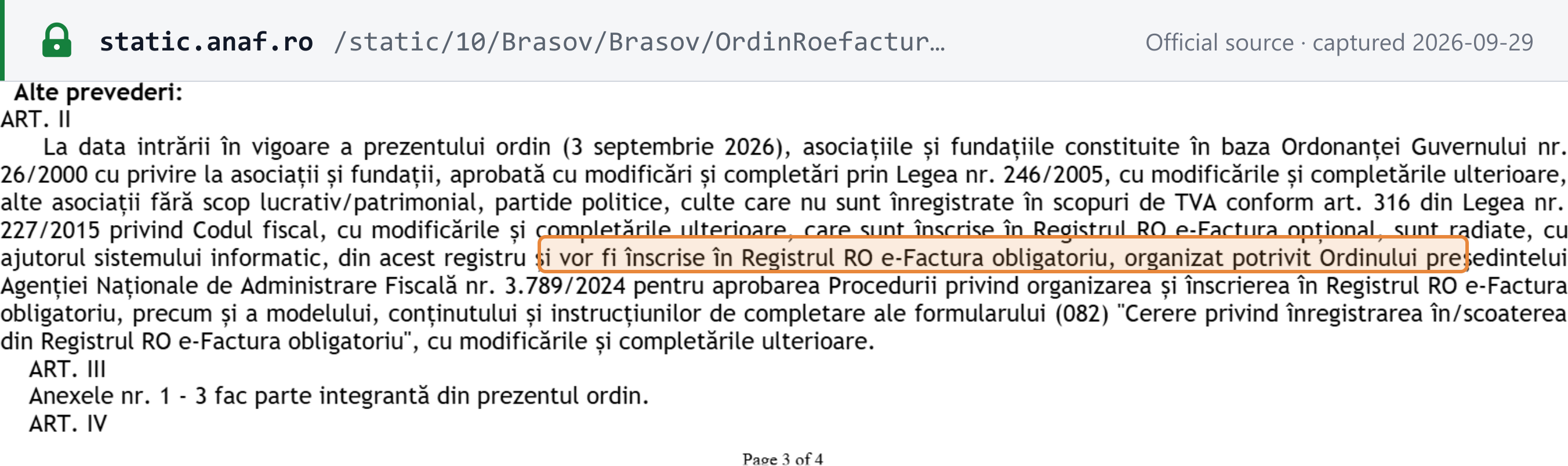
The latest change in force is OPANAF 1021/2026, published in Monitorul Oficial no. 743 and in force on 3 September 2026. It amends the optional-register procedure (OPANAF 3788/2024) in three ways. Form 081 becomes the request to register in, or be removed from, the optional register, with removal taking effect on the 1st of the month after filing. The list of optional users is rewritten to match Law 88/2026. And on 3 September 2026 ANAF's system automatically moved every non-VAT-registered association, foundation, other non-profit, political party and religious body still in the optional register into the mandatory register (form 082). (ANAF DGRFP Brașov note on OPANAF 1021/2026, dated 8 September 2026)
 Source snapshot captured 2026-09-29 — original
Neither the Ministry of Finance nor ANAF has announced a further phase. The Ministry of Finance's RO e-Factura site publishes no plan for adapting the system to the EU's ViDA digital reporting requirements; see the ViDA explainer for the EU timetable.
Postponements
Only one group has seen its start date moved: suppliers identified for tax purposes by their CNP (cod numeric personal, the personal numeric code), such as individuals letting rooms or earning income from intellectual property. The chain matters to anyone who registered in early 2026, because the obligation was postponed and then cancelled on the day it was due to begin.
| Step | Instrument | Effect |
|---|---|---|
| 1 | OUG 89/2025 (MO 1203, 24 December 2025), art. X pt 5 and art. XI | CNP-identified suppliers bound by the e-Factura rules had to join the mandatory register; those already active had to apply before 15 January 2026 and were enrolled from that date. In force 15 January 2026 [7] |
| 2 | OG 6/2026 (MO 77, 30 January 2026), art. IX | By derogation, CNP-identified suppliers were not obliged to use RO e-Factura until 1 June 2026. Those already enrolled could ask to be removed [10] |
| 3 | OPANAF 378/2026 (MO 250, 31 March 2026) | Registration procedure for the 1 June 2026 start: those already active had to file form 082 by 26 May 2026 [11] |
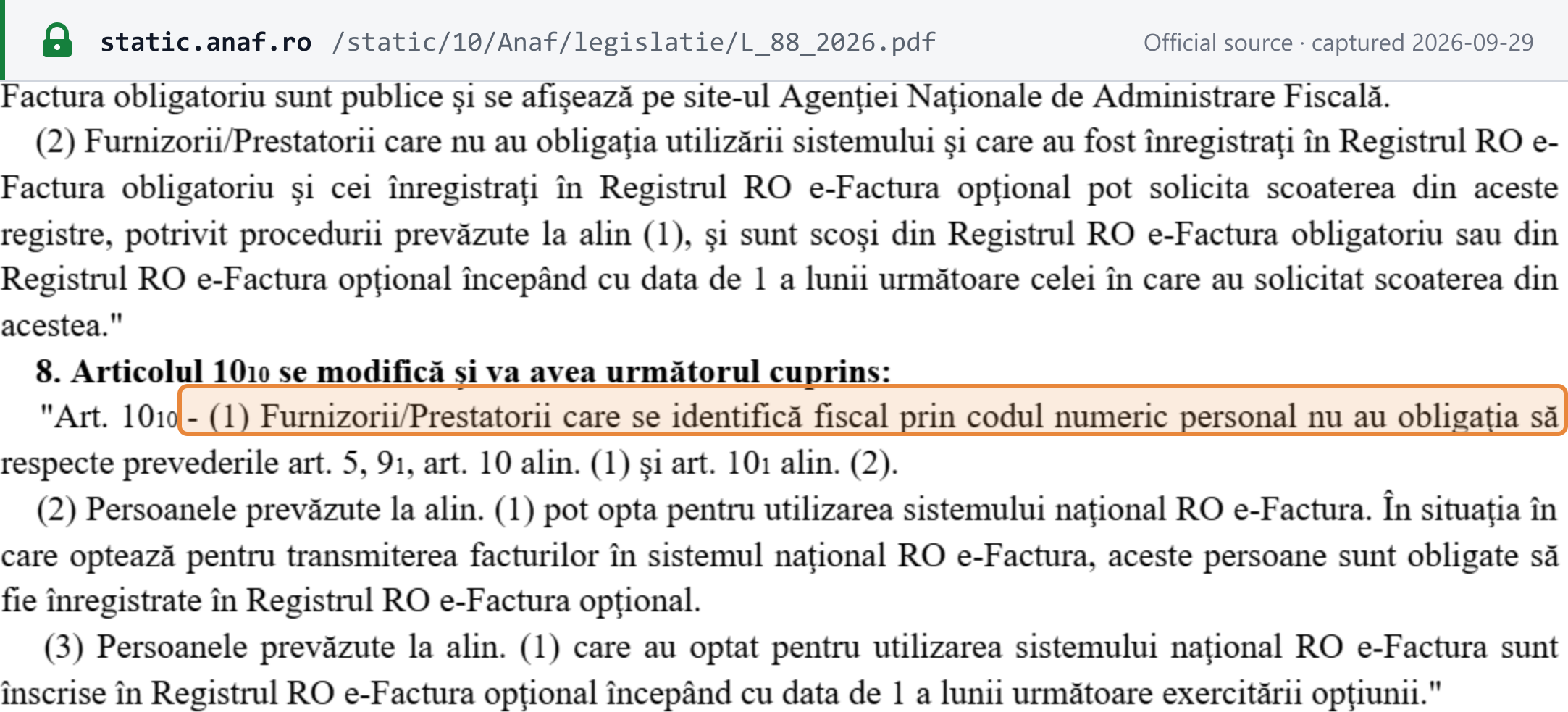
| 4 | Law 88/2026 (MO 459, 29 May 2026), art. III pt 8 | Replaces art. 10^10: CNP-identified suppliers are not obliged to use the system at all, but may opt in through the optional register. In force 1 June 2026 (art. IV(1)) [8] |
The result: the CNP obligation never took effect. The 1 June 2026 start set by OG 6/2026 and organised by OPANAF 378/2026 was cancelled by Law 88/2026 on the same date. Anyone enrolled under the earlier rules who does not want to stay in the system can ask to be removed; removal takes effect on the 1st of the following month (art. 10^8(2), as amended by Law 88/2026).
 Source snapshot captured 2026-09-29 — original
Legal basis
- OUG 120/2021 of 4 October 2021 on the administration, operation and implementation of the national RO e-Factura system (Monitorul Oficial no. 960, 7 October 2021), approved with amendments by Law 139/2022 of 17 May 2022. It is the framework law; every later instrument below amends it. [12]
- Law 139/2022, art. II — B2G e-invoicing for Romania-established operators from 1 July 2022. [2]
- Law 296/2023 of 26 October 2023 (Monitorul Oficial no. 977, 27 October 2023), art. LIX and LXV — the 2024 reporting phase with its 5-working-day limit, the B2B clearance obligation from 1 July 2024, the non-resident reporting duty and the first version of the art. 13^2 fines. [3]
- OUG 115/2023, art. LXVII–LXXI — the 15% fine and the size-banded late-transmission fines (from 1 July 2024), the 5-calendar-day deadline for art. 10(1) invoices, the amended exceptions to the 2024 reporting phase, and the 24-hour outage rule. [13]
- OUG 69/2024 of 21 June 2024 (Monitorul Oficial no. 582, 21 June 2024; in force 1 July 2024) — B2C reporting (art. 10^1), enforcement bodies (art. 10^2), self-billing (art. 10^4), the optional categories (art. 10^5–10^7), the registers, the B2C fines, and the art. 10(7) calendar-day deadline as replaced from 1 July 2024. [5]
- OUG 138/2024 of 4 December 2024 (Monitorul Oficial no. 1222, 5 December 2024) — current wording of art. 10(1) and its exceptions, and CPV codes on B2G invoices, from 1 January 2025; and the 13-zero code for B2C customers with no tax code (art. 10^1(3)), from publication. [4]
- OUG 89/2025 (Monitorul Oficial no. 1203, 24 December 2025), art. X — the 5-working-day deadline and the reporting of invoices to non-established customers, both from 1 January 2026. [7]
- OG 6/2026 (Monitorul Oficial no. 77, 30 January 2026), art. IX — the CNP postponement. [10]
- Law 88/2026 (Monitorul Oficial no. 459, 29 May 2026), art. III — the CNP, farmer and cultural-institute carve-outs, the current wording of the B2C definition (art. 10^1(3)) and the public registers, in force 1 June 2026. [8]
- OMF 1366/2021 of 5 November 2021 — the national CIUS (RO_CIUS) and the accepted syntaxes, amended by OMF 4092/2022 (Monitorul Oficial no. 1148, 29 November 2022). Binding: OUG 120/2021 art. 4(1) makes RO_CIUS part of the legal definition of the invoice structure. [14]
- OPANAF 3788/2024 (optional register, form 081), as amended by OPANAF 1021/2026; and OPANAF 3789/2024 (mandatory register, form 082), as amended by OPANAF 378/2026 and 1020/2026. [15] [16]
- Codul fiscal (Law 227/2015), art. 319 — the general invoicing rules the e-Factura law builds on, including art. 319(1^1) (only RO e-Factura invoices count between Romania-established taxable persons) and art. 319(33)–(34) (storage). [17]
Because the B2B mandate derogates from the EU VAT Directive's invoicing rules, it rests on Council Implementing Decision (EU) 2023/1553 of 25 July 2023, which, in ANAF's words, allows Romania "începând cu data de 1 ianuarie 2024, să instituie facturarea electronică obligatorie pentru toate tranzacțiile efectuate între persoanele impozabile stabilite pe teritoriul României" (from 1 January 2024, to introduce mandatory e-invoicing for all transactions between taxable persons established in Romania). (ANAF — RO e-Factura guide)
Scope
B2B: invoices between Romania-established taxable persons
Since 1 July 2024, the issuer of an invoice for a supply of goods or services between persons established in Romania (Fiscal Code art. 266(2)), with a Romanian place of supply under the VAT title, must send it to the recipient through RO e-Factura. The current wording of art. 10(1) of OUG 120/2021 reads: "emitentul facturii electronice are obligația de transmitere a acesteia către destinatar utilizând sistemul național privind factura electronică RO e-Factura" (the issuer of the electronic invoice must transmit it to the recipient using RO e-Factura). (OUG 138/2024, art. I pt 2)
- Excepted since 1 January 2025: cash-register fiscal receipts (bonuri fiscale) that qualify as simplified invoices under Fiscal Code art. 319(12), (13) and (21), and intra-Community supplies where the Romania-established customer gives a VAT code from another Member State.
- The 2024 reporting phase (Law 296/2023 art. LIX(4), as amended by OUG 115/2023 art. LXVIII pt 13) excepted exports and intra-Community supplies, supplies to persons neither established nor VAT-registered in Romania, simplified invoices, and services outside the Romanian invoicing rules.
- Self-billing: self-invoices issued under art. 319(8) are treated as B2B invoices and go through the system (art. 10^4, OUG 69/2024).
- Out-of-scope documents: invoices for operations outside the scope of VAT, or for amounts outside the VAT base, need not go through the system where art. 319 requires no invoice (art. 10^3, OUG 69/2024). (ANAF DGRFP Brașov — OUG 69/2024 comparison table)
- Enforcement bodies (bailiffs, the asset-recovery agency ANABI) that invoice in the name of a Romania-established supplier must use the system too, and the invoice is also sent to the supplier through the system. They register in a dedicated register (form 079) (art. 10^2, OUG 69/2024).
B2G
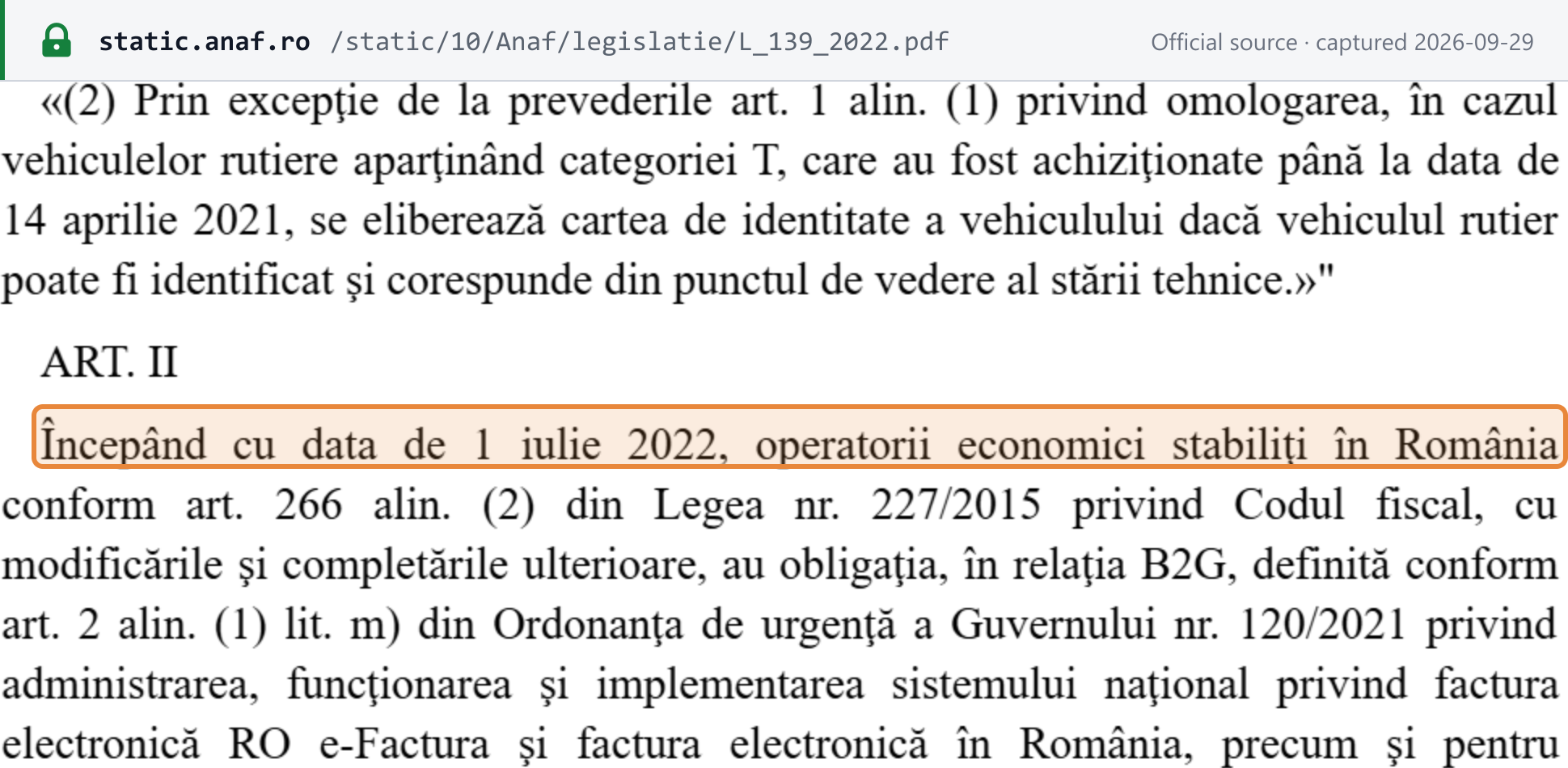
Since 1 July 2022, operators established in Romania must issue e-invoices for sales to contracting authorities and send them through RO e-Factura. Law 139/2022 art. II: "Începând cu data de 1 iulie 2022, operatorii economici stabiliţi în România […] au obligaţia, în relaţia B2G […] să emită facturi electronice şi să le transmită prin sistemul naţional privind factura electronică RO e-Factura." (From 1 July 2022, economic operators established in Romania are obliged, in the B2G relationship, to issue electronic invoices and transmit them through RO e-Factura.) Non-established suppliers may opt in for B2G. Since 1 January 2025, public-procurement invoices must carry CPV codes (art. 4(2^1), OUG 138/2024). (Law 139/2022)
 Source snapshot captured 2026-09-29 — original
The public buyer is also exposed: a contracting authority that pays from its budget when the B2G rule was not respected commits a contravention (art. 13^1, added by Law 296/2023). See Penalties.
B2C
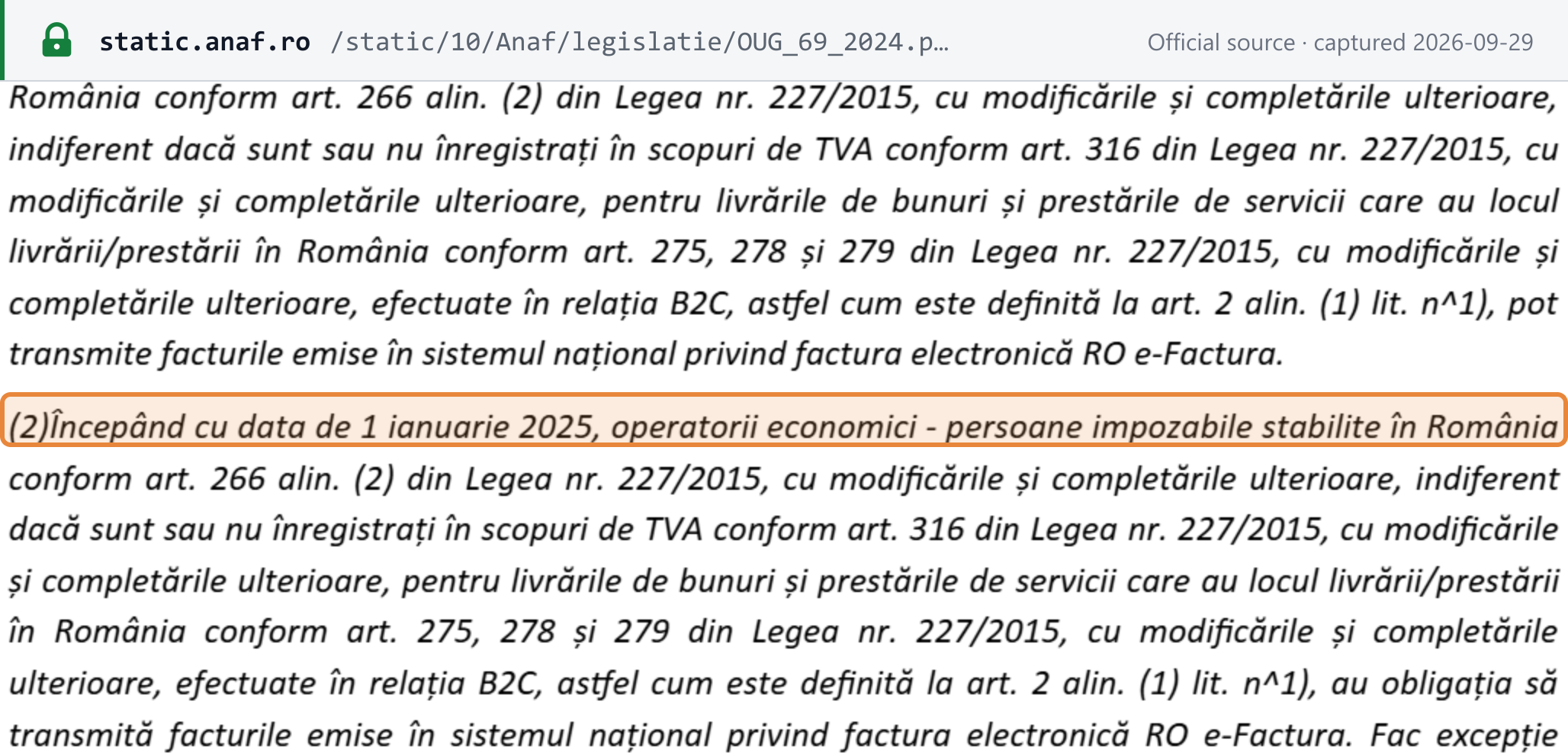
Since 1 January 2025, Romania-established taxable persons, whether or not VAT-registered, must report their B2C invoices to RO e-Factura (art. 10^1(2), inserted by OUG 69/2024). It is reporting, not clearance: the customer still receives the invoice under Fiscal Code art. 319 (art. 10^1(4)), except where the customer is listed in the optional RO e-Factura register (art. 10^1(4), as amended by Law 88/2026). Cash-register fiscal receipts that qualify as simplified invoices are excepted. (OUG 69/2024)
 Source snapshot captured 2026-09-29 — original
A customer counts as B2C when they are an individual who gives no tax code, or who chooses to be identified by CNP, unless they are listed in the optional register (art. 10^1(3), current wording from Law 88/2026). With no code at all, the invoice carries 13 zeros in the customer tax-code field, a rule first inserted by OUG 138/2024 (in force on publication, 5 December 2024; the Ministry of Finance's production platform accepted the code from 16 December 2024) and re-enacted by OUG 89/2025 and Law 88/2026: "facturile se emit utilizând un cod format din 13 cifre de zero în locul codului de identificare fiscală al beneficiarului" (invoices are issued using a code of 13 zeros in place of the customer's tax identification code). (Law 88/2026, art. III pt 1) B2C invoices use a dedicated upload endpoint, mandatory since 31 March 2025 (see Onboarding).
Non-established businesses
Non-established businesses are in scope in three distinct ways. None of them is the B2B clearance obligation that applies between Romania-established persons.
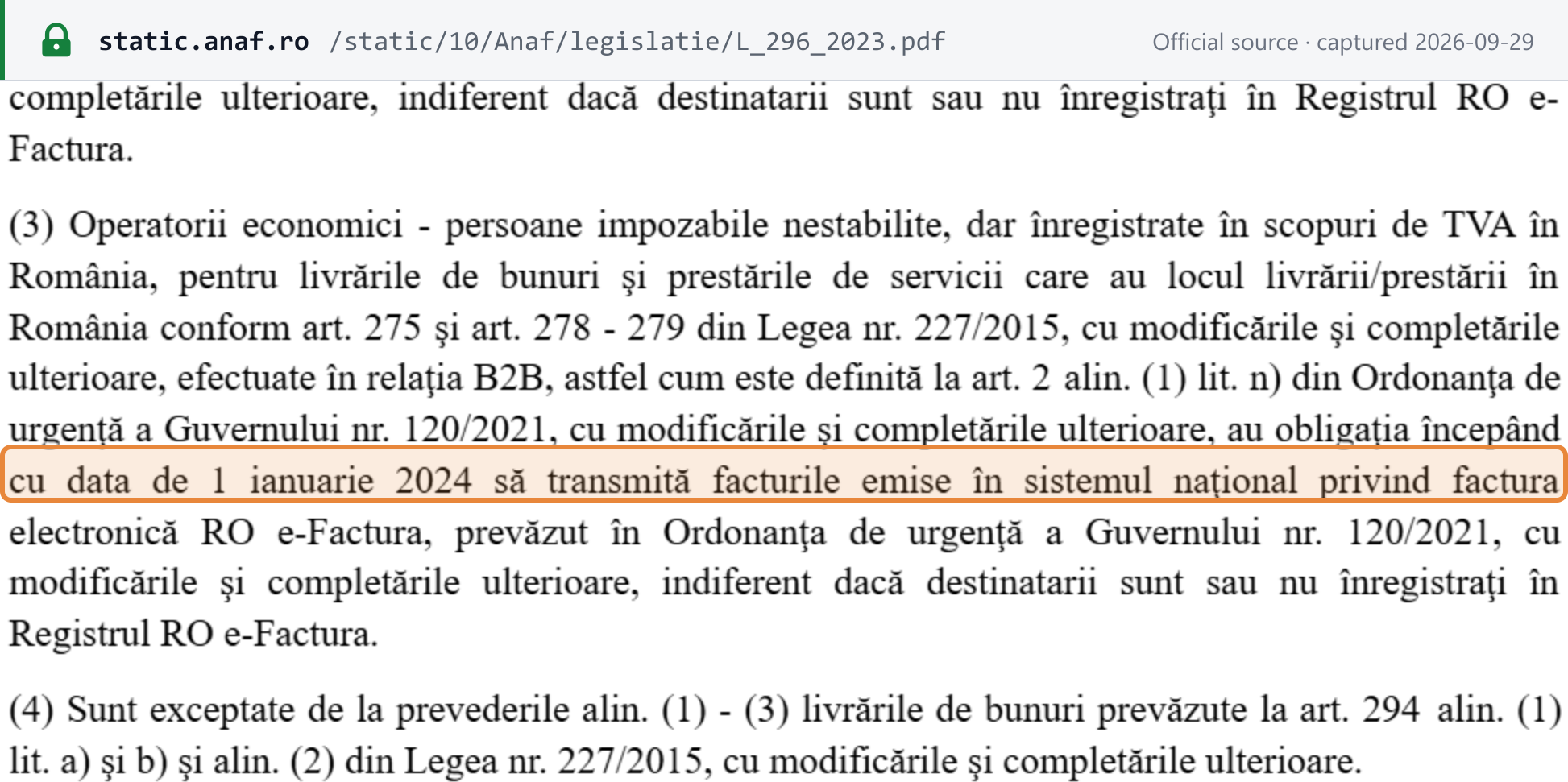
- Invoices they issue (reporting). Non-established taxable persons that are registered for VAT in Romania must transmit their B2B invoices with a Romanian place of supply to RO e-Factura from 1 January 2024, within 5 working days (Law 296/2023 art. LIX(3) and (6)). The customer still receives the invoice under art. 319, except where both the supplier and the customer are registered in the RO e-Factura register (art. LIX(5)). From 1 July 2024 this reporting duty does not apply if the business has opted into use of the system (art. LIX(3^1), inserted by OUG 69/2024). (Law 296/2023)
- Opt-in. Non-established operators may opt into RO e-Factura for B2B, B2G or both (art. 13) by filing form 081 for the optional register. The non-resident tax unit of DGRFP București assigns a registration number (număr de evidență), which "nu reprezintă cod de identificare fiscală" (is not a tax identification code). Enrolment runs from the 1st of the following month. (OPANAF 3788/2024, chapter IV)
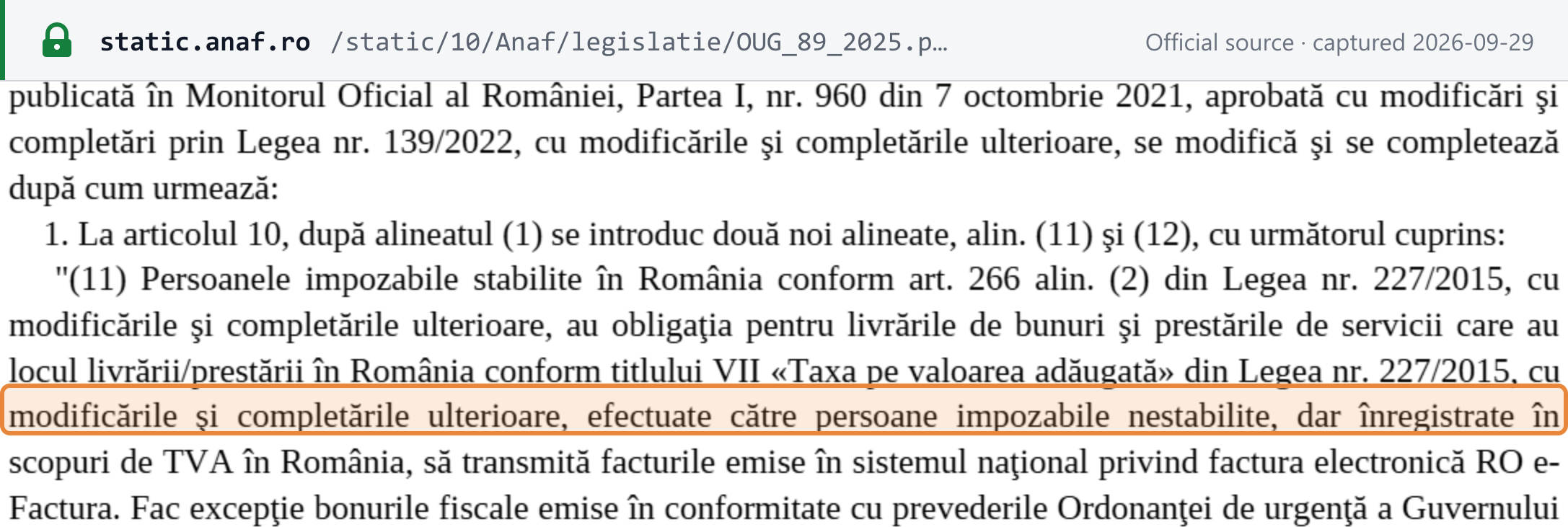
- Invoices they receive (reporting by the Romanian supplier). Since 1 January 2026, Romania-established suppliers must transmit to RO e-Factura the invoices they issue to non-established, VAT-registered customers (art. 10(1^1), inserted by OUG 89/2025). The customer still receives the invoice under art. 319 (art. 10(1^2)). Fiscal receipts that qualify as simplified invoices, and intra-Community supplies where the customer gives another Member State's VAT code, are excepted. (OUG 89/2025, art. X pt 1)
 Source snapshot captured 2026-09-29 — original
 Source snapshot captured 2026-09-29 — original
The 15% fine in art. 13^2(1)(a)–(b) is addressed to an issuer or recipient established in Romania under art. 266(2). It does not reach non-established VAT registrants, whose obligation is the reporting duty above. Non-established businesses registered in Romania for VAT only also have a separate SAF-T (D406) filing obligation; see Format & network.
Who is not obliged (optional users)
As at 2026-09-30 the following may opt in but are not obliged to use RO e-Factura:
- persons listed in Fiscal Code art. 294(1)(j)–(n) (art. 10^5(1), OUG 69/2024);
- cultural institutes and centres of other states operating in Romania under intergovernmental agreements (art. 10^5(2), as amended by Law 88/2026; before that, the exemption ran only until 1 October 2025);
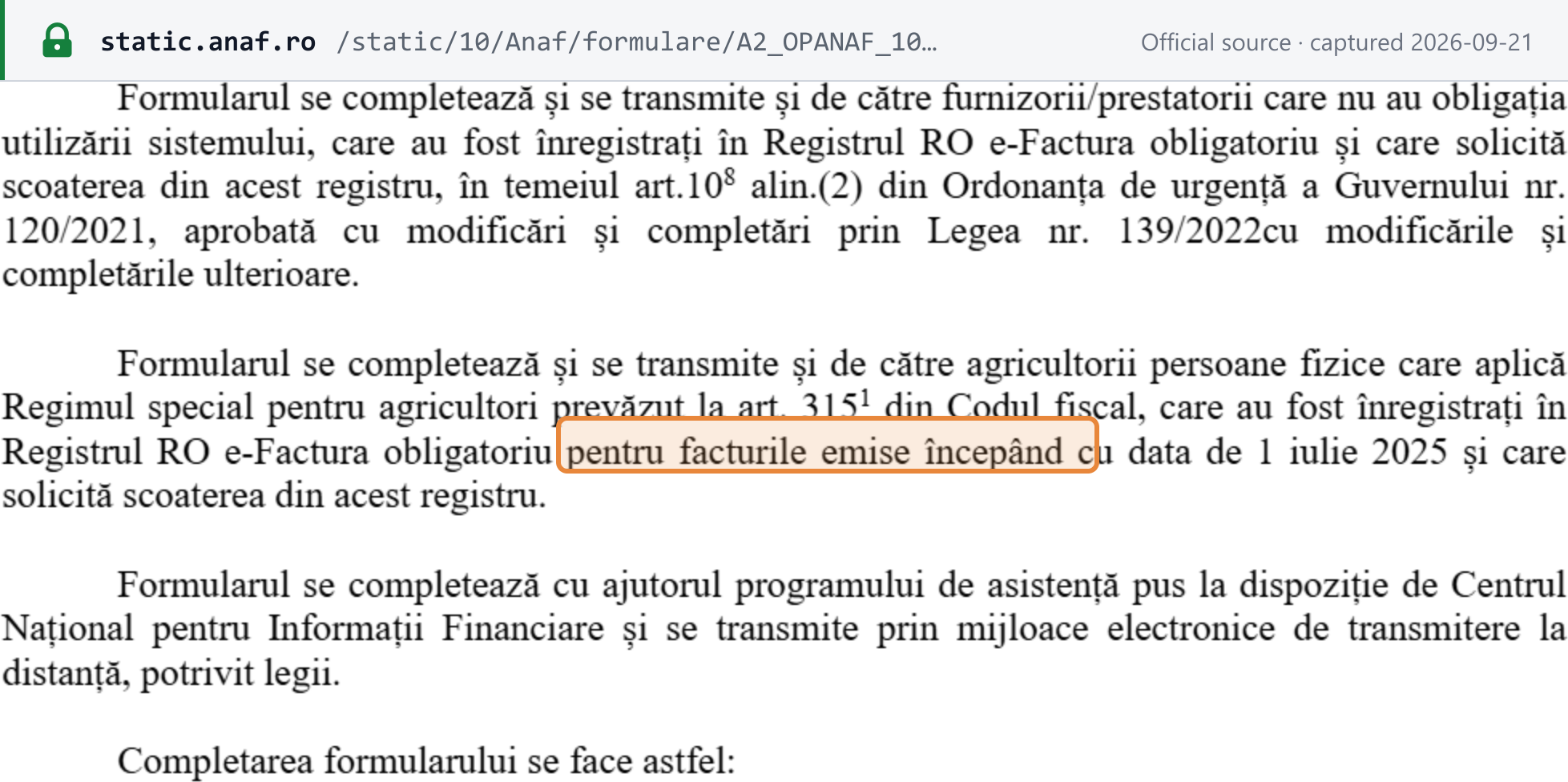
- individual farmers on the special farmers' regime of Fiscal Code art. 315^1 (art. 10^7(1), as amended by Law 88/2026; before that, also only until 1 October 2025);
- suppliers identified for tax purposes by CNP (art. 10^10, Law 88/2026; see Postponements);
- non-established operators, for B2B or B2G (art. 13).
A supplier selling to one of these persons need not use the system unless the customer has opted in (art. 10^5(6) and 10^7(5)). ANAF's form 082 instructions, as amended by OPANAF 1020/2026, tell special-regime farmers how to be removed from the mandatory register.
 Source snapshot captured 2026-09-21 — original
By contrast, non-VAT-registered associations, foundations, other non-profits, political parties and religious bodies that carry on economic activity are in scope. Their exemption covered only invoices issued from 1 July 2024 to 30 June 2025 (art. 10^6, OUG 69/2024). Since 1 July 2025 they must be in the mandatory register; a new body must apply before it starts its activity and is enrolled within 3 working days. (ANAF DGRFP Brașov — OUG 69/2024 comparison table)
Format & network
CTC model: clearance with a Ministry of Finance seal
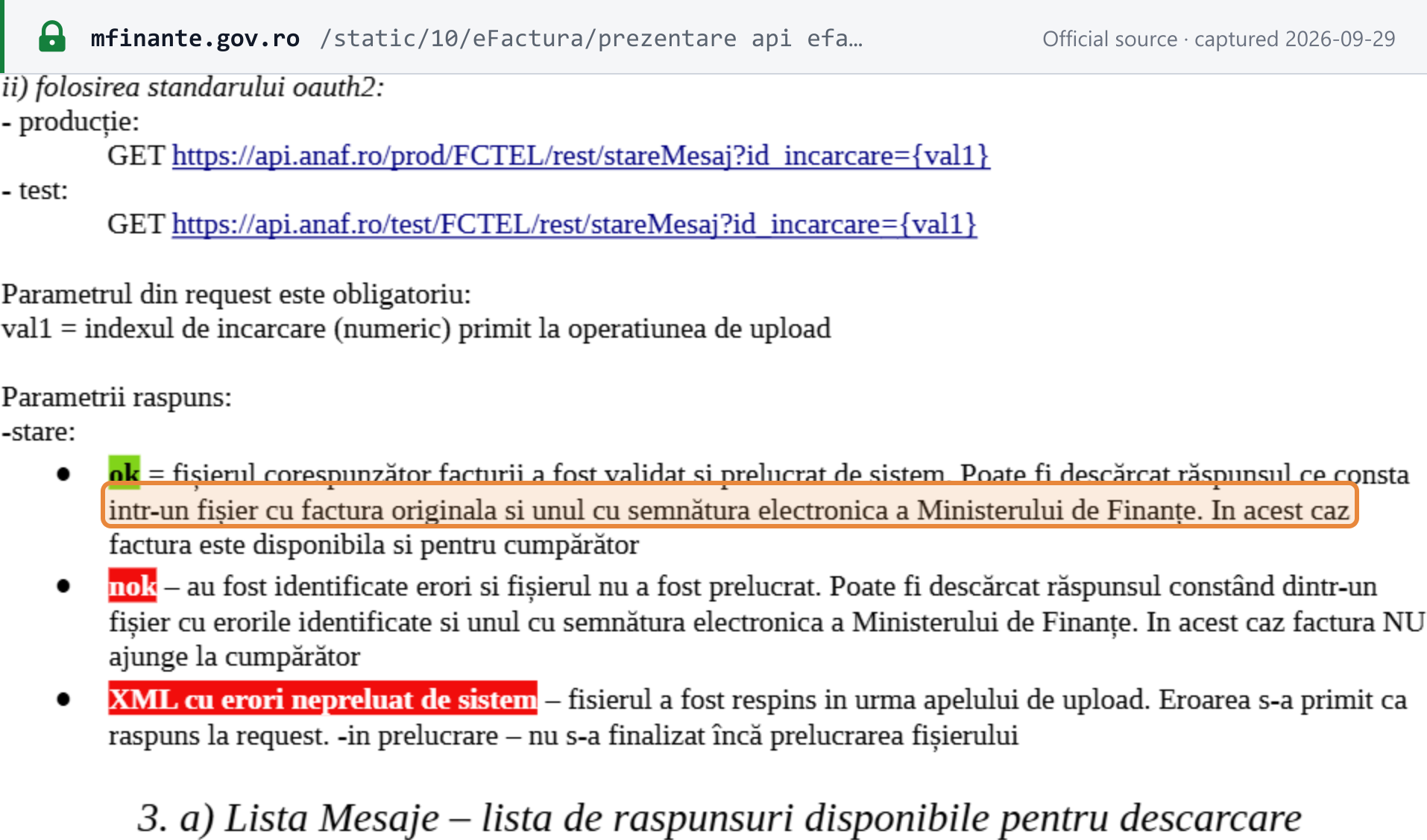
RO e-Factura is a centralised clearance model: taxpayer, then the MF/ANAF platform, then the buyer. Each upload returns an upload index (index de încărcare). The status call then returns one of four states:
| Status | Meaning | Reaches the buyer? |
|---|---|---|
ok | Validated and processed. The seller can download the original invoice plus a file carrying the Ministry of Finance's electronic signature | Yes |
nok | Errors found. An error file with the Ministry of Finance signature is returned | No |
XML cu erori nepreluat de sistem | Rejected at upload | No |
in prelucrare | Still processing | Not yet |
The Ministry of Finance's web-service documentation says of nok: "In acest caz factura NU ajunge la
cumpărător" (in this case the invoice does NOT reach the buyer).
(MF — RO e-Factura web services presentation)
 Source snapshot captured 2026-09-29 — original
Two legal consequences follow. The original of the invoice is the XML file accompanied by the Ministry of Finance's electronic seal. The invoice is communicated to the recipient on the date it becomes available for download in the system. (ANAF — RO e-Factura guide, §II.1 and §III.5) The recipient's acceptance of the electronic form is not required for domestic B2B invoices that meet the conditions of OUG 120/2021 (ANAF guide). Deemed acceptance on communication in the system (art. 11, as replaced by OUG 69/2024 art. II pt 3) concerns issuers that have opted into the system.
Integrity mechanics
The integrity mechanism is the Ministry of Finance electronic seal on the system's response. The Ministry of Finance publishes a signature-verification application on its technical page (listed as updated 13 March 2026). Neither that page nor ANAF's RO e-Factura guide publishes a QR-code or hash-chaining requirement for e-Factura XML. (MF — technical information)
Format: EN 16931 + RO_CIUS, UBL 2.1 or CII 16B
-
Structure: OUG 120/2021 art. 4(1) requires the invoice to follow the European standard SR EN 16931-1, the national specification RO_CIUS with its national operational rules, and the CEN/TS 16931-2 syntaxes. (OUG 120/2021)
-
RO_CIUS is set by OMF 1366/2021, amended by OMF 4092/2022 (Monitorul Oficial no. 1148, 29 November 2022). Since 29 December 2022 the specification identifier in field BT-24 is CIUS-RO:1.0.1, in full
urn:cen.eu:en16931:2017#compliant#urn:efactura.mfinante.ro:CIUS-RO:1.0.1. (ANAF — note on the CIUS-RO change)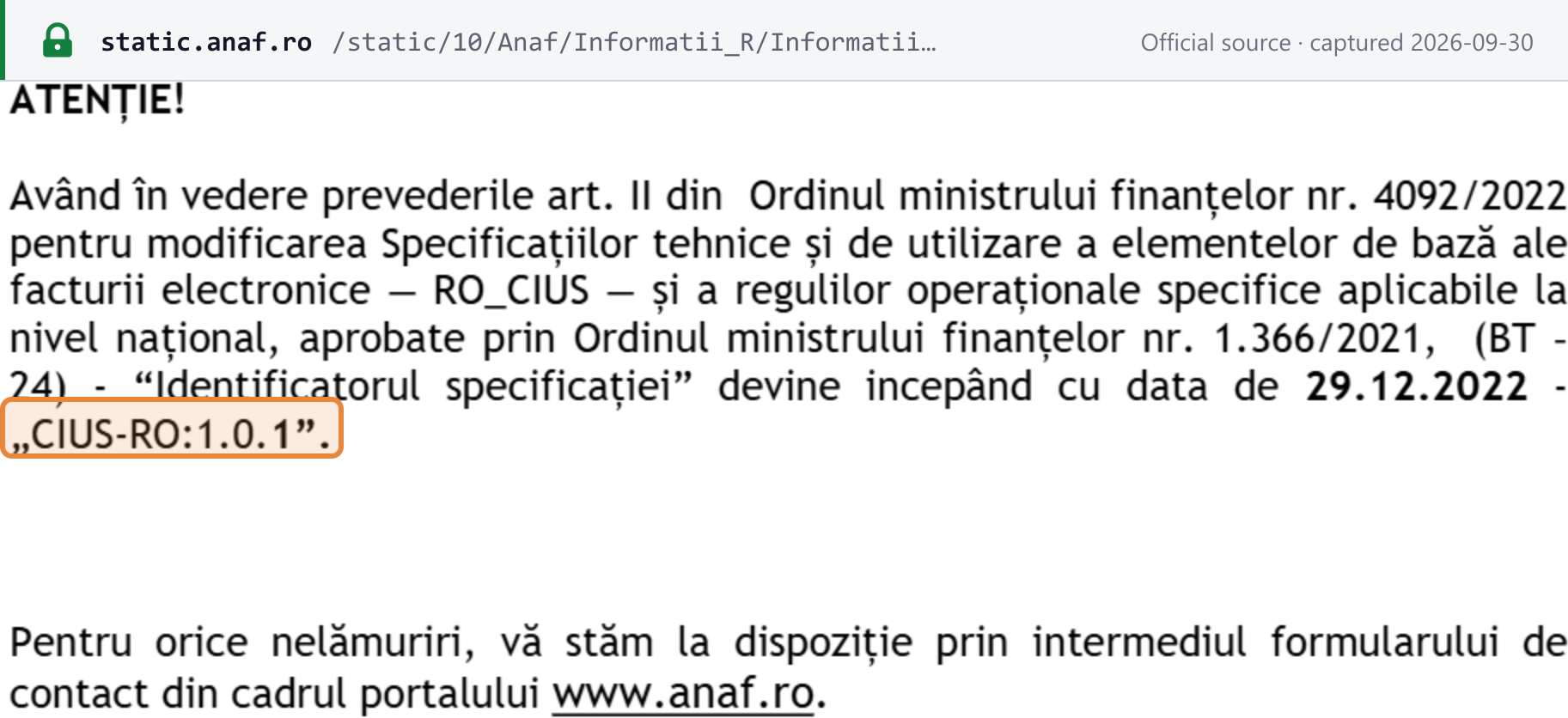 Source snapshot captured 2026-09-30 — original
 -
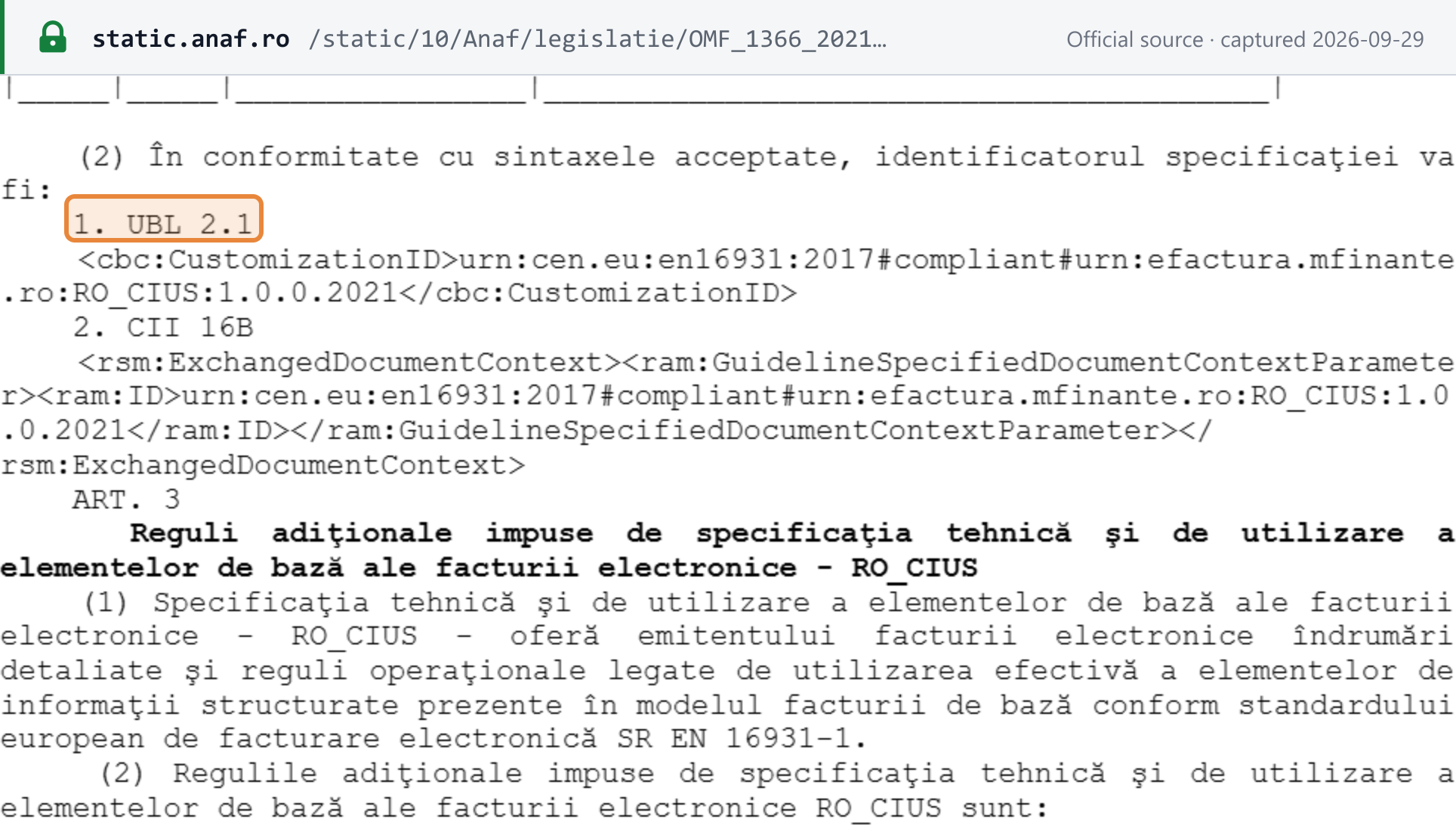
Syntaxes (OMF 1366/2021 art. 2(2)): UBL 2.1 and UN/CEFACT CII 16B. The upload service accepts four document types: UBL invoice, CN (credit note), CII, and RASP (a message from the buyer to the seller). (OMF 1366/2021)
-
Validation artefacts: the current Schematron release is ro16931-ubl-1.0.9. The Ministry of Finance's technical page states "Versiunea 1.0.9 este valabilă incepând cu 05.06.2024" (version 1.0.9 is valid from 05.06.2024); its predecessor, 1.0.8, was valid from 29 December 2022. (MF — technical information)
-
Codes: ANAF publishes a guide to invoice-type codes (380 and others) and VAT-category codes (Ghid cod facturi, v2.9).
 Source snapshot captured 2026-09-29 — original
Network: not Peppol
RO e-Factura is not Peppol-based. The Ministry of Finance's RO e-Factura technical page publishes only ANAF's web services and the SPV portal as exchange channels, with no Peppol access point, SMP or profile. Invoices reach the buyer only through the system: the buyer downloads them from SPV or through the API.
Transmission deadline
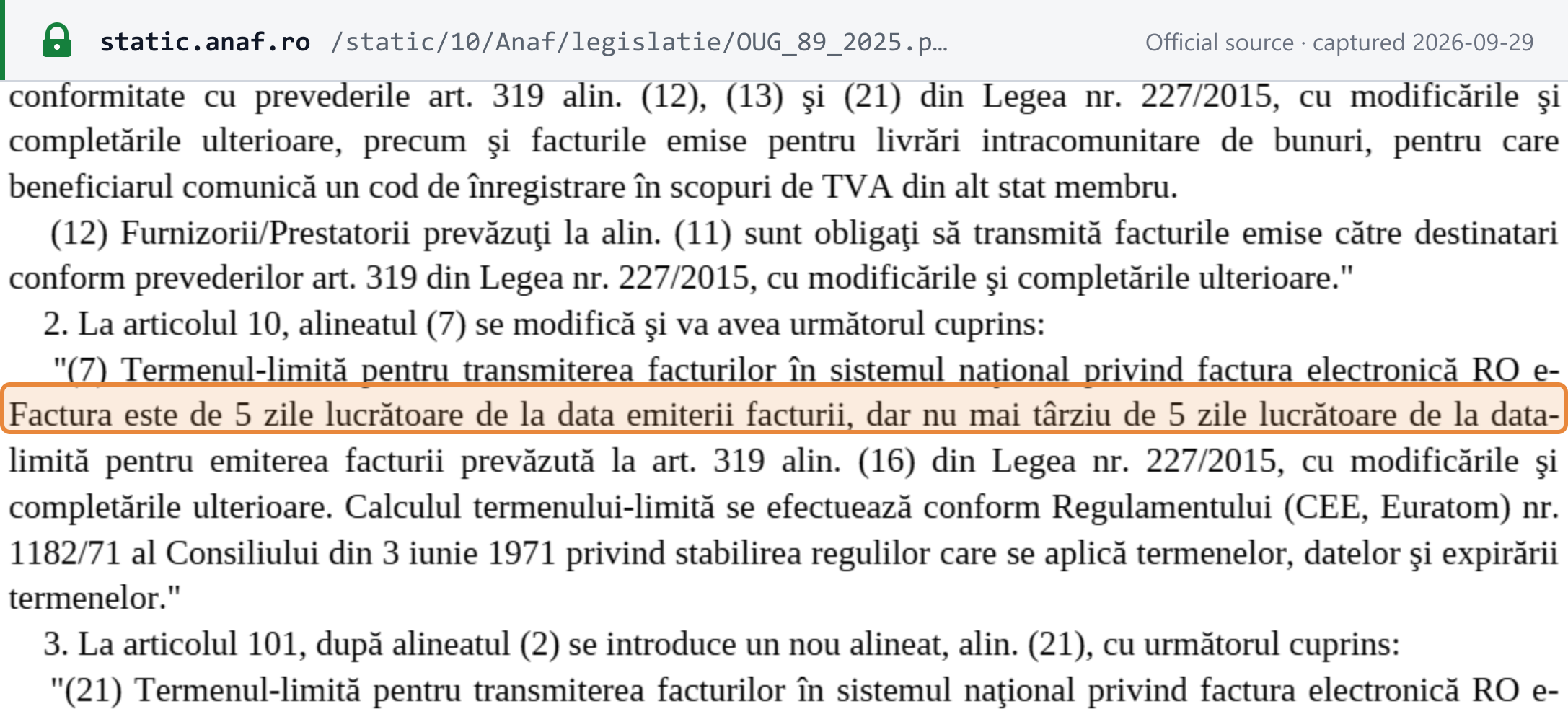
Since 1 January 2026, invoices must be transmitted within 5 working days of the invoice date, and in any case no later than 5 working days after the legal issue deadline in Fiscal Code art. 319(16) (art. 10(7), as replaced by OUG 89/2025). The same limit applies to B2C (art. 10^1(2^1)). The period is counted under Regulation (EEC, Euratom) 1182/71: the issue day itself is excluded, counting starts at the first hour of the next day, and it ends at the last hour of the last day. (OUG 89/2025, art. X pt 2–3 and art. XIV(1); ANAF DGRFP Brașov — 2026 fiscal changes, p. 15)
Earlier invoices were measured against the rules then in force:
| Period | Limit | Source |
|---|---|---|
| 1 January – 30 June 2024 (reporting phase; non-established reporting under LIX(3) stays at 5 working days from 1 January 2024) | 5 working days | Law 296/2023 art. LIX(6) |
| 1 July 2024 – 31 December 2025 (art. 10(7)) | 5 calendar days | Introduced for art. 10(1) invoices by OUG 115/2023 art. LXVII; art. 10(7) replaced from 1 July 2024 by OUG 69/2024 art. I pt 4 |
| From 1 January 2026 (art. 10(7)) | 5 working days | OUG 89/2025 art. X pt 2 |
(Law 296/2023; OUG 115/2023; OUG 69/2024)
 Source snapshot captured 2026-09-29 — original
System outages
If RO e-Factura is not functional for at least 24 hours, the obligation to transmit through it (art. 10(1) and the B2G rule) is suspended until the system is restored. Invoices are then issued under Fiscal Code art. 319 and must be transmitted to RO e-Factura afterwards. ANAF and the Ministry of Finance publish outage periods on their websites (OUG 115/2023 art. LXXI). (OUG 115/2023)
Archiving
The system keeps XML files and error messages available for download for 60 days from publication. After that they are archived electronically and released on request, quoting the upload index if known, together with the document's details. (ANAF — RO e-Factura guide, §III.5–6) The system is not a long-term store, so download the sealed XML within that window.
Storage is governed by the Fiscal Code. A taxable person with its seat of economic activity in Romania must store issued and received invoices in Romania (art. 319(33)), except electronic invoices stored with guaranteed online access for the tax authorities; any storage place outside Romania must be notified (art. 319(34)). (ANAF — consolidated Fiscal Code) How long invoices must be kept is set by Romanian accounting law; see the Romania country guide.
E-reporting alongside e-Factura
- RO e-TVA. The pre-filled VAT return (decontul precompletat RO e-TVA) is built from data taxpayers have already sent to Ministry of Finance and ANAF systems. OUG 70/2024 art. 2(1) lists RO e-Factura first, followed by RO e-Transport, RO e-Sigiliu, SAF-T (D406) and the fiscal cash-register registry, so e-Factura uploads feed the pre-filled return directly. (OUG 70/2024)
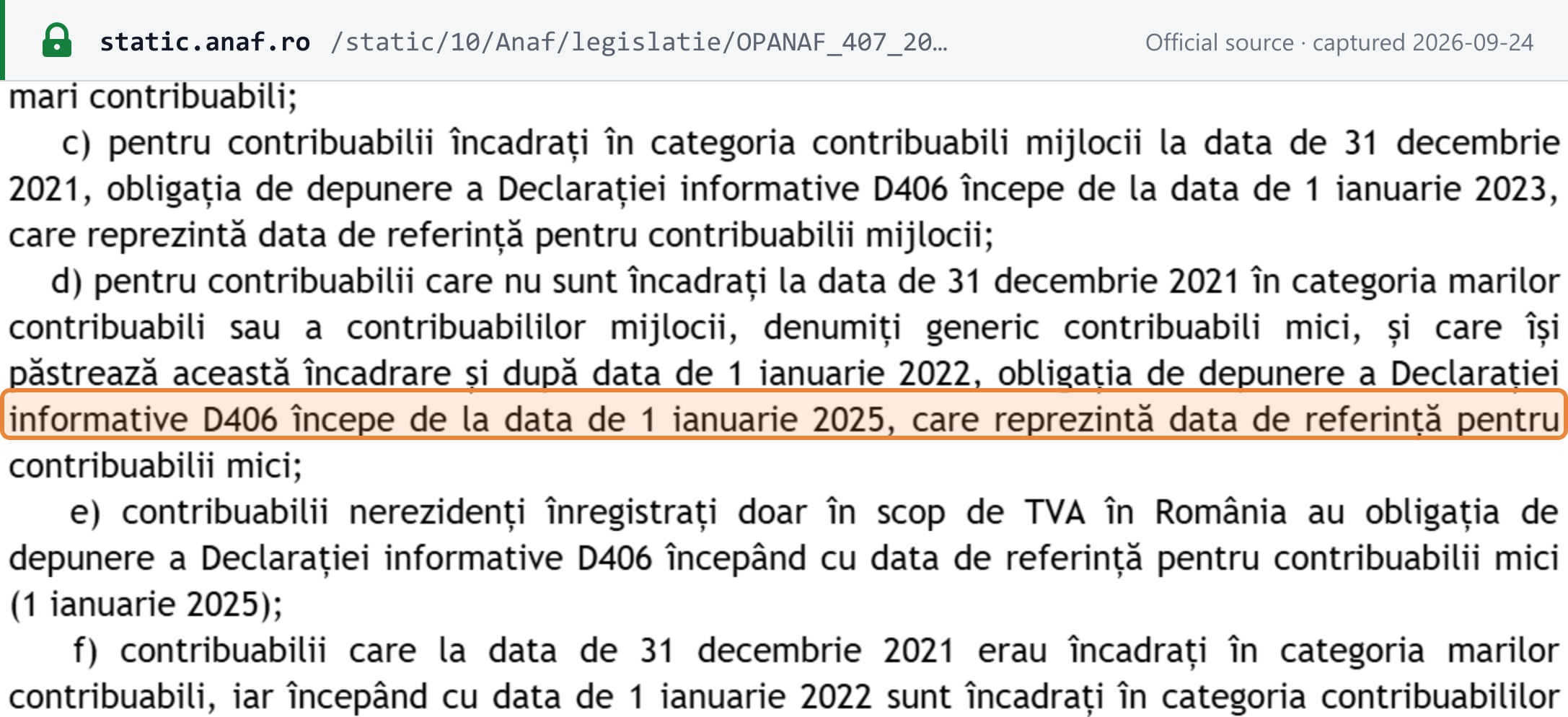
- SAF-T (D406) is a separate periodic filing. It does not replace e-Factura, and e-Factura does not replace it. Non-residents registered only for VAT have filed D406 since 1 January 2025. See the SAF-T explainer.
- RO e-Transport is a separate obligation for road transport of goods, not an invoice channel.
 Source snapshot captured 2026-09-24 — original
Onboarding: how to comply
Register in SPV first
Every route into RO e-Factura, portal or API, runs through ANAF's Spațiul Privat Virtual. The ANAF guide is explicit: "Pentru utilizarea și accesarea sistemului RO e-Factura, operatorii economici trebuie să fie înregistrați în Spațiul Privat Virtual (SPV)" (to use and access RO e-Factura, economic operators must be registered in SPV). Enrolment is done on ANAF's SPV registration page. (ANAF — RO e-Factura guide, §II.2)
-
Enrol the company in SPV with a qualified digital certificate.
-
Check whether you also need a register. Romania-established VAT-registered businesses need none: the obligation follows from the law. Two registers exist for everyone else:
- the optional register (form 081; OPANAF 3788/2024 as amended by OPANAF 1021/2026) for those who opt in, including non-established businesses. Enrolment runs from the 1st of the following month, and removal likewise takes effect on the 1st of the month after filing;
- the mandatory register (form 082; OPANAF 3789/2024 as amended by OPANAF 378/2026 and 1020/2026) for those the law obliges without a VAT registration, chiefly non-VAT non-profits. Enrolment takes effect within 3 working days of the application.
Both registers are public on ANAF's website (art. 10^8(1), Law 88/2026). Enforcement bodies use a third register (form 079).
-
Send invoices. In the portal, sign in with the certificate ("Autentificare cu certificat"), open the Factura electronică menu and choose Trimitere factură; each upload returns an upload index. Or connect software through the API (below).
-
Download what you receive. Received invoices sit in SPV and the API. If you opt in, SPV e-mails an alert when a document has not been downloaded within 24 hours of publication.
Free tools from the Ministry of Finance
Small users do not need commercial software. The Ministry of Finance and ANAF provide a web form for creating invoices, validators for UBL and CII files, an XML-to-PDF converter and a signature verifier, all linked from the RO e-Factura technical page.
Connection modes: portal or API
| Mode | Who it suits | How |
|---|---|---|
| SPV portal | Low volumes; businesses using the free web form | Certificate sign-in, manual upload and download |
| ANAF REST API, certificate | Software that presents the qualified certificate on each call | webserviceapl.anaf.ro/{test|prod}/FCTEL/rest/... |
| ANAF REST API, OAuth2 | ERP and invoicing platforms acting for many taxpayers | api.anaf.ro/{test|prod}/FCTEL/rest/... |
The Ministry of Finance's web-service presentation documents these services:
- upload for B2B and B2G, with
standard= UBL, CN, CII or RASP, andcif= the tax code that receives the error message if the seller cannot be identified (the caller needs SPV rights for it). Optional flags:extern=DAfor a buyer outside Romania with no Romanian tax code,autofactura=DAfor self-billing, andexecutare=DAfor enforcement bodies; - uploadb2c for B2C invoices, mandatory since 31 March 2025;
- stareMesaj for the status of an upload index;
- listaMesajeFactura, which lists messages for the last 1 to 60 days, filterable by errors, sent, received and buyer messages;
- descarcare (download), plus validation and XML-to-PDF services.
(MF — web services presentation)
The caller must hold SPV rights for the tax code it uploads for. There is no accreditation regime for software providers: they connect as API clients under the taxpayer's SPV rights, and neither the Ministry of Finance nor ANAF publishes a list of accredited providers.
Rate limits as published by the Ministry of Finance on 2026-09-29, which it says may change: 1,000 calls per minute across all methods; no limit on invoice uploads, but 1,000 RASP files per day per tax code; 100 status queries per message per day; 1,500 simple list calls per day per tax code (100,000 for the paginated list); and 10 downloads per message per day. (MF — API call limits)
Testing
The test environment uses the /test/ path on the same hosts as production (for example
https://api.anaf.ro/test/FCTEL/rest/upload). Swagger pages for each service are linked from the
technical page. Validate files
against the v1.0.9 artefacts before switching to /prod/.
Penalties
The fines sit in art. 13^2 of OUG 120/2021, inserted by Law 296/2023, recast by OUG 115/2023 (in force 1 July 2024) and extended by OUG 69/2024. They are split by obligation:
| Infringement (art. 13^2(1)) | Who is fined | Fine | Applies from |
|---|---|---|---|
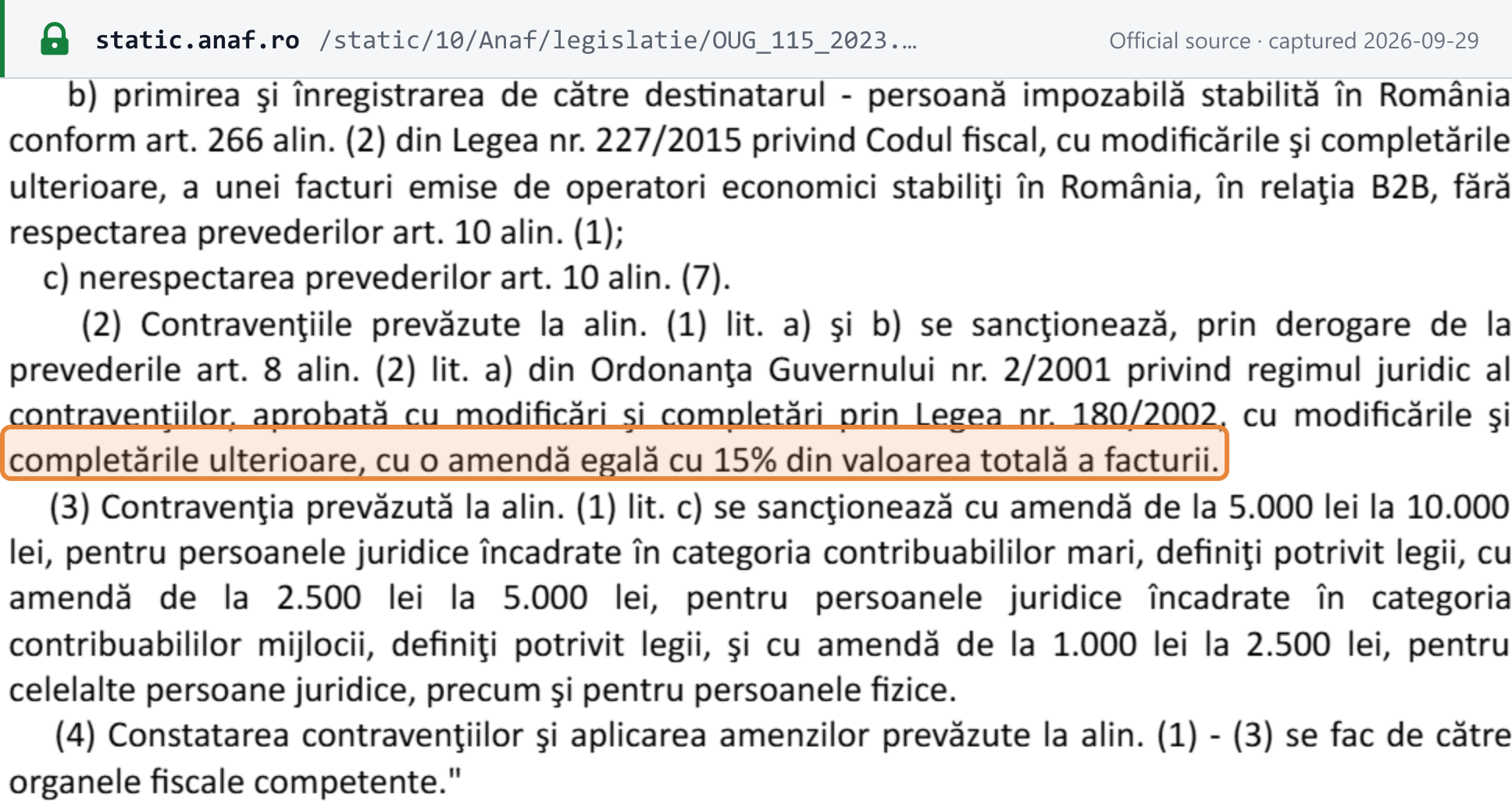
| (a) Issuing a B2B invoice outside RO e-Factura (breach of art. 10(1)) | Issuer established in Romania | 15% of the total invoice value | 1 July 2024 |
| (b) Receiving and recording a B2B invoice from a Romania-established supplier that did not come through the system | Recipient established in Romania | 15% of the total invoice value | 1 July 2024 |
| (c) Late transmission (art. 10(7)); one fine per calendar month in which one or more deadlines fall | Issuer | Large taxpayers RON 5,000–10,000; medium RON 2,500–5,000; other legal persons and individuals RON 1,000–2,500 | 1 July 2024 in this form |
| (d) B2C transmission breach (art. 10^1(2)); per calendar month | Romania-established operator | Same size bands as (c) | 1 July 2025 |
| Enforcement bodies breaching art. 10(1) or 10^1(2) (art. 13^2(3^1)) | Enforcement body | RON 5,000–10,000 per invoice | 1 July 2024 (B2C part from 1 July 2025) |
(OUG 115/2023, art. LXVIII pts 14–15 and art. LXX; OUG 69/2024)
The 15% fines apply "prin derogare de la prevederile art. 8 alin. (2) lit. a) din Ordonanţa Guvernului nr. 2/2001" (by derogation from art. 8(2)(a) of Government Ordinance 2/2001), the general cap on contravention fines, so they scale with the invoice. Offenders fined under these rules cannot pay half the minimum fine within 15 days, an option that is normally available for contraventions (Law 296/2023 art. LVIII). (ANAF DGRFP Brașov — Law 296/2023 table, p. 5)
 Source snapshot captured 2026-09-29 — original
- The recipient fine never applied in its first form. Law 296/2023 legislated a recipient fine equal to the VAT shown on the invoice from 1 July 2024; OUG 115/2023 art. LXVIII pt 15 replaced it with the 15% fine before it took effect (art. LXX(1)).
- B2G: a public buyer that pays from its own budget when the B2G rule was not respected is fined RON 500–1,000 (art. 13^1, added by Law 296/2023). (ANAF DGRFP Brașov — Law 296/2023 table)
- Non-established businesses are not addressees of the 15% fines, which name an issuer or recipient established in Romania.
- Enforcement posture: the only grace period granted was for late transmission from 1 January to 31 March 2024. ANAF and the Ministry of Finance publish no current tolerance for e-Factura fines .
Frequently asked questions
Can we send Romanian invoices through our Peppol access point?
No. RO e-Factura is a central clearance system, not a Peppol network. The Ministry of Finance publishes no Peppol access point, SMP or profile for it; invoices are uploaded to the ANAF platform through SPV or ANAF's API, validated, sealed by the Ministry of Finance, and only then made available to the buyer. Software can upload for you through the API, provided it acts under your SPV rights. (MF RO e-Factura technical page)
We are a foreign company registered for VAT in Romania. Do we have to use RO e-Factura?
Not for full clearance, but you are not outside the system. Since 1 January 2024 you must report your Romanian B2B invoices to RO e-Factura while the customer still receives the invoice in the ordinary way (Law 296/2023 art. LIX(3)); since 1 July 2024 that duty falls away if you opt into using the system through the optional register (form 081). Separately, since 1 January 2026 your Romanian suppliers must report the invoices they issue to you (art. 10(1^1), OUG 89/2025). The 15% fine applies only to issuers and recipients established in Romania.
Is the upload deadline 5 calendar days or 5 working days?
5 working days from the invoice date, since 1 January 2026, and no later than 5 working days after the legal issue deadline in Fiscal Code art. 319(16) (art. 10(7), as replaced by OUG 89/2025). The issue day is not counted. From 1 July 2024 to 31 December 2025 the art. 10(7) limit was 5 calendar days; in the reporting phase of 1 January – 30 June 2024 it was 5 working days. The same 5-working-day limit applies to B2C invoices.
What is the penalty if a B2B invoice is not sent through RO e-Factura?
15% of the total invoice value, and it can hit both sides: the issuer (art. 13^2(1)(a)) and the recipient that receives and records the invoice (art. 13^2(1)(b)), in each case where established in Romania. The fine applies by derogation from the general cap in Government Ordinance 2/2001, in force since 1 July 2024 (OUG 115/2023). Late transmission is fined separately, once per calendar month: RON 5,000–10,000 for large taxpayers, RON 2,500–5,000 for medium taxpayers and RON 1,000–2,500 for others.
I invoice as an individual using my CNP. Do I have to use RO e-Factura?
No. Since 1 June 2026, Law 88/2026 (art. III pt 8, new art. 10^10 of OUG 120/2021) says suppliers identified for tax purposes by CNP are not obliged to use the system, although they may opt in through the optional register. This replaces the 1 June 2026 start date set by OG 6/2026 and OPANAF 378/2026, which never took effect. If you were enrolled under the earlier rules, you can ask to be removed; removal takes effect on the 1st of the following month.
How do we report a B2C invoice when the customer gives no tax code?
Put a code of 13 zeros in the customer tax-code field (art. 10^1(3), in force since December 2024) and upload it through the dedicated B2C endpoint, mandatory since 31 March 2025. B2C is reporting: the customer still receives the invoice in the ordinary way. Fiscal receipts that qualify as simplified invoices are not reported.
What happens if RO e-Factura is down?
If the system is not functional for at least 24 hours, the obligation to transmit through it is suspended until it is restored. Issue invoices under Fiscal Code art. 319 in the meantime and transmit them to RO e-Factura afterwards. ANAF and the Ministry of Finance publish outage periods on their websites (OUG 115/2023 art. LXXI).
How long can we download invoices from the system?
60 days from publication. After that the XML files and error messages are archived electronically and released only on request, quoting the upload index if known together with the document’s details. Download the sealed XML, which is the original invoice, and keep it in your own archive (ANAF RO e-Factura guide).
Recent changes
- 2026-09-03 — OPANAF 1021/2026 (MO 743) moved non-VAT-registered associations, foundations and other non-profits from the optional into the mandatory RO e-Factura Register, and lets optional-register users ask to be removed from the 1st of the following month. (ANAF) — see event
- 2026-06-01 — Law 88/2026 took suppliers identified by CNP, special-regime farmers and foreign cultural institutes out of mandatory RO e-Factura (opt-in only), cancelling the 1 June 2026 CNP start that OPANAF 378/2026 had organised, and restated who counts as a B2C customer. (ANAF) — see event · issue
- 2026-01-01 — Upload deadline became 5 working days from the invoice date (previously 5 calendar days), and Romanian suppliers must now report invoices issued to non-established, VAT-registered customers (OUG 89/2025). (ANAF)
- 2025-07-01 — Fines for B2C transmission breaches apply, and the mandatory RO e-Factura Register became operational for non-VAT non-profits (OUG 69/2024). (ANAF)
- 2025-01-01 — B2C reporting to RO e-Factura mandatory for Romania-established taxable persons. (Ministry of Finance)
Related resources
- Romania VAT guide — rates, registration, invoicing and filing rules
- Romania tax identification numbers (CUI/CIF, CNP) — the codes RO e-Factura uses to identify issuer and buyer
- E-invoicing status and networks worldwide — Romania's row in global context
- Romania tax-change chronology — every tracked Romanian change, dated and sourced, including the OPANAF 378/2026 and OPANAF 1020/2026 register changes
- SAF-T explainer — Romania's D406, filed alongside e-Factura
- VAT listings explained — Romania's D394 informative declaration
- ViDA — VAT in the Digital Age — the EU framework national systems will have to fit
- Other clearance and CTC mandates for comparison: Poland (KSeF), Croatia
Important websites
- Ministry of Finance — RO e-Factura — legislation, mandate dates, web apps
- Ministry of Finance — technical information — validation artefacts, Swagger, validators, signature verifier
- ANAF SPV enrolment — register for the virtual private space
- ANAF invoice web form — free tool to create an e-Factura XML
- ANAF RO e-Factura guide (PDF) — SPV, upload and download mechanics
- Invoice-type and VAT-code guide (PDF)
- Ministry of Finance — web services presentation (PDF) — API endpoints, parameters and statuses