E-Invoicing in Ireland — B2G on Peppol and Revenue's VAT Modernisation from 2028
Overview
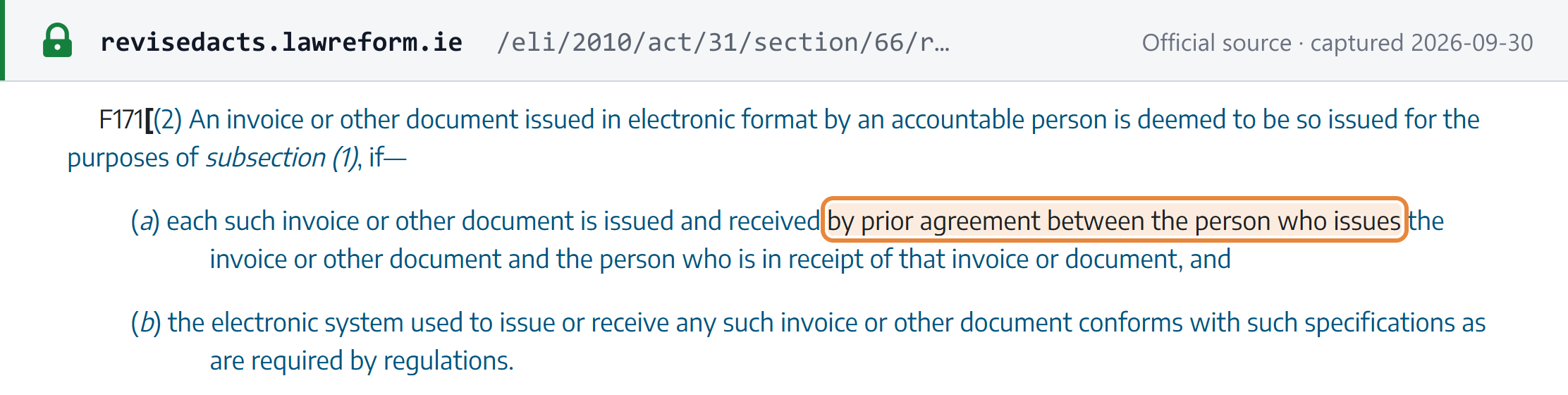
As at 30 September 2026, no Irish law requires a business to issue or receive e-invoices. Electronic invoicing is voluntary. Under the VAT Consolidation Act 2010 (VATCA), an invoice in electronic format counts only if it "is issued and received by prior agreement" between the two parties and the system used meets the conditions in the VAT Regulations. There is no clearance platform and no transaction reporting to Revenue. [1]
 Source snapshot captured 2026-09-30 — original
Two e-invoicing regimes sit on top of that voluntary baseline:
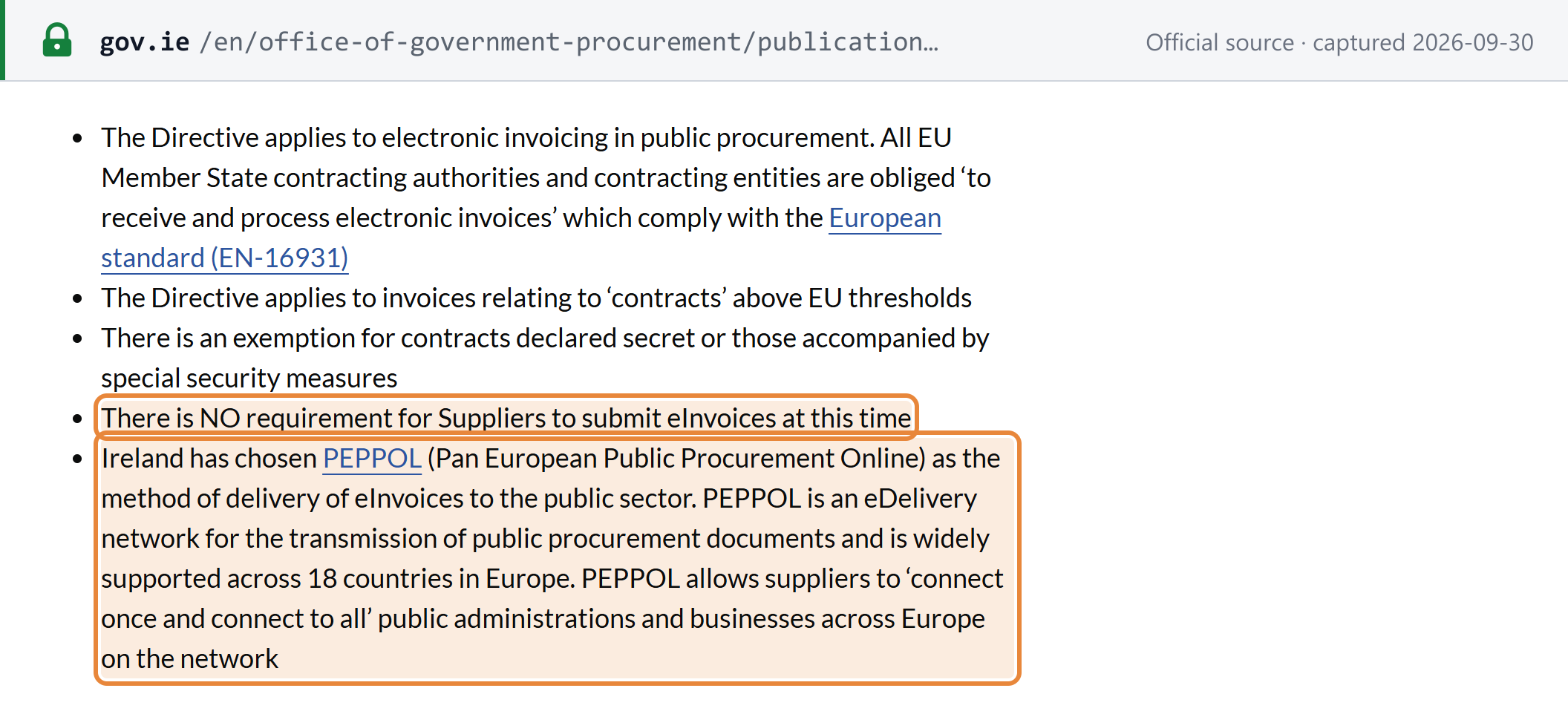
- Business-to-government (B2G) is law, but it binds public bodies, not suppliers. S.I. No. 258 of 2019 requires contracting authorities and entities to receive and process e-invoices that comply with the European standard (EN 16931). The Office of Government Procurement (OGP) runs B2G through its eInvoicing Ireland programme, and Ireland chose Peppol as the delivery network. OGP states that there is no requirement for suppliers to submit e-invoices. [2] [3]
- Business-to-business (B2B) is announced, not legislated. Revenue's VAT Modernisation programme plans e-invoicing plus real-time reporting of invoice data in three phases, starting on 1 November 2028 for large corporates. From that date all businesses in Ireland must be able to receive structured e-invoices. Revenue says it is still working on the legislative changes. [5] [7]
The legal basis in one line: VATCA 2010 s.66(2) and (2A) with reg. 21 of the VAT Regulations 2010 (voluntary e-invoicing today), and S.I. No. 258 of 2019 transposing Directive 2014/55/EU (B2G). No Irish instrument implements the B2B phases yet.
| Ireland | |
|---|---|
| B2G | Public bodies must receive and process EN 16931 e-invoices: central government from 2019 (S.I. No. 258 of 2019, signed 12 June 2019), sub-central bodies from 18 April 2020. Suppliers are not obliged to send them |
| B2B (domestic) | Announced, not law. Phase 1 from 1 November 2028: large corporates issue and report; all businesses must be able to receive. Phase 2 November 2029; Phase 3 July 2030 |
| B2C | No obligation, and none announced |
| Non-residents | Phase 1 issuing is limited to businesses established, or with a fixed establishment, in Ireland. How receiving and later phases apply to non-established businesses is not yet specified |
| Format | EN 16931. For B2B, Revenue excludes PDF and scanned paper. No national CIUS or Peppol profile is published |
| Network | B2G: Peppol, by government choice. B2B: not yet specified; Revenue says existing infrastructures "including" Peppol |
| CTC model | Today: none. Announced: e-invoicing plus real-time reporting of a data subset to Revenue; architecture not yet specified |
| Authority | Revenue Commissioners (VAT, B2B programme); OGP (B2G, Peppol Authority since 18 January 2018) |
| Legislation | VATCA 2010 s.66; VAT Regulations 2010 reg. 21 as amended by S.I. No. 458 of 2012; S.I. No. 258 of 2019; no B2B instrument yet |
Mandate status & timeline
B2G: in force since 2019–2020
| Step | Who / what | Date | Status | Legal basis |
|---|---|---|---|---|
| Peppol Authority | OGP becomes Peppol Authority on behalf of the Irish Government | 18 January 2018 | passed | OGP [4] |
| Buyer framework | OGP framework for Peppol networking and eInvoicing services made available to public bodies | 25 March 2019 | passed | OGP [3] |
| Buyers receive — central | Contracting authorities and entities must receive and process EN 16931 e-invoices. The Directive's date for central government was 18 April 2019; the Irish Regulations were signed on 12 June 2019 | 2019 | passed | S.I. No. 258 of 2019, reg. 4 [2] |
| Buyers receive — sub-central | Sub-central contracting authorities and contracting entities brought in | 18 April 2020 | passed | S.I. No. 258 of 2019, reg. 3(6) [2] |
| Suppliers | No obligation to issue e-invoices to public bodies | — | none announced | OGP [3] |
 Source snapshot captured 2026-09-30 — original
B2B: Revenue's announced phases (not yet law)
Every row below is a Revenue announcement. No Irish enactment gives these dates legal effect yet, and they can change when the legislation is drafted.
| Phase | Who | What becomes mandatory | Date | Source |
|---|---|---|---|---|
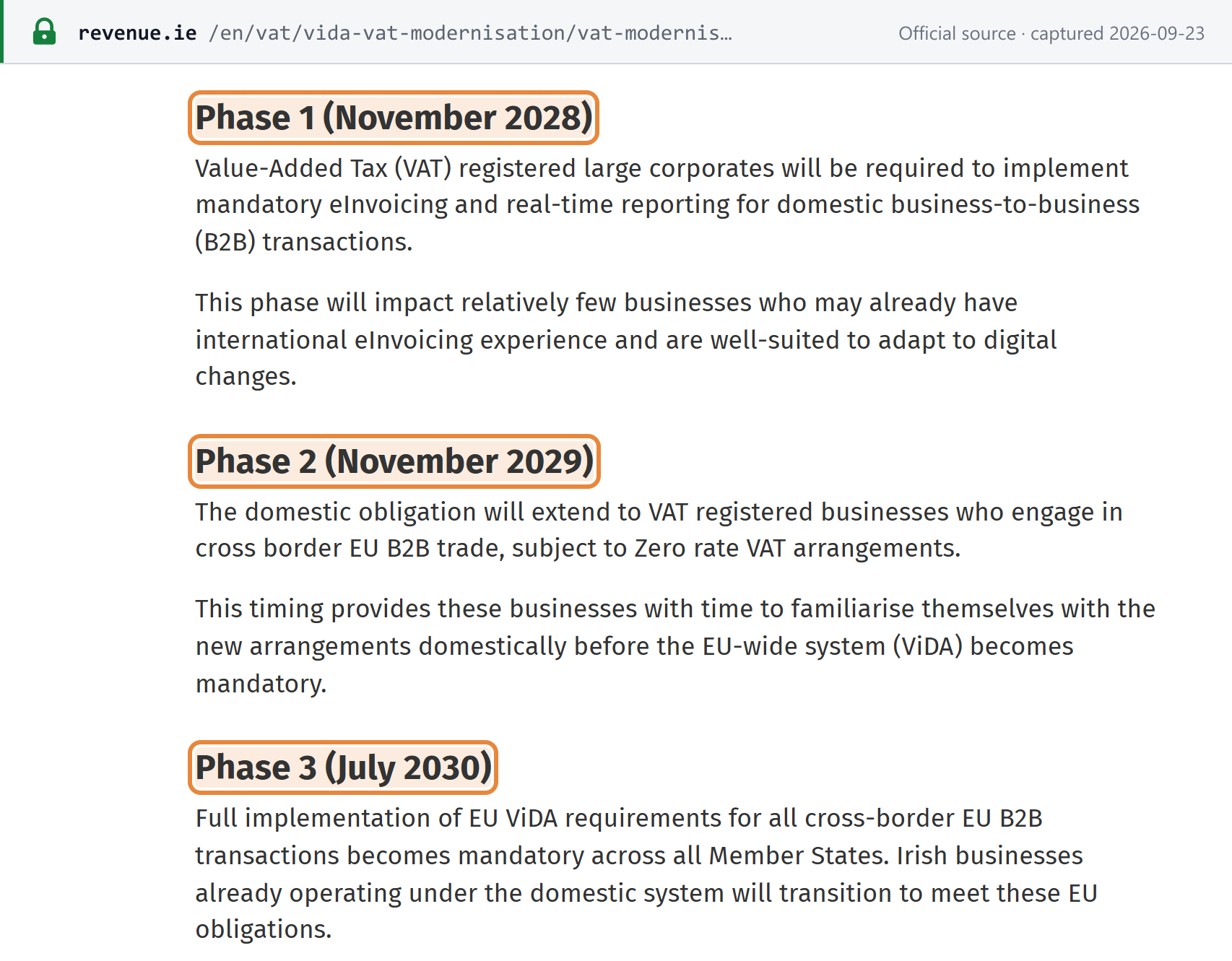
| All phases | All businesses in Ireland | Be able to receive structured e-invoices from any supplier mandated to issue them | from 1 November 2028 | Revenue timeline and Phase One pages [5] [6] |
| Phase 1 | VAT-registered large corporates: tax affairs managed by Revenue's Large Corporates Division, and established or with a fixed establishment in Ireland | Issue e-invoices for domestic B2B and report a subset of the invoice data to Revenue | 1 November 2028 | Revenue Phase One page [6] |
| Phase 2 | VAT-registered businesses that trade cross-border with EU businesses under the zero-rate (intra-Community) arrangements | The domestic obligation extends to them | November 2029 (month only; no day announced) | Revenue timeline [5] |
| Phase 3 | All cross-border EU B2B transactions | Full ViDA requirements: e-invoicing and digital reporting, across all Member States | July 2030 (Revenue's paper: "From 1 July 2030") | Revenue timeline; Revenue paper [5] [7] |
Revenue's timeline page (published 20 July 2026) says: "For all phases businesses must ensure they can receive and process eInvoices from any supplier mandated to issue them." [5]
 Source snapshot captured 2026-09-23 — original
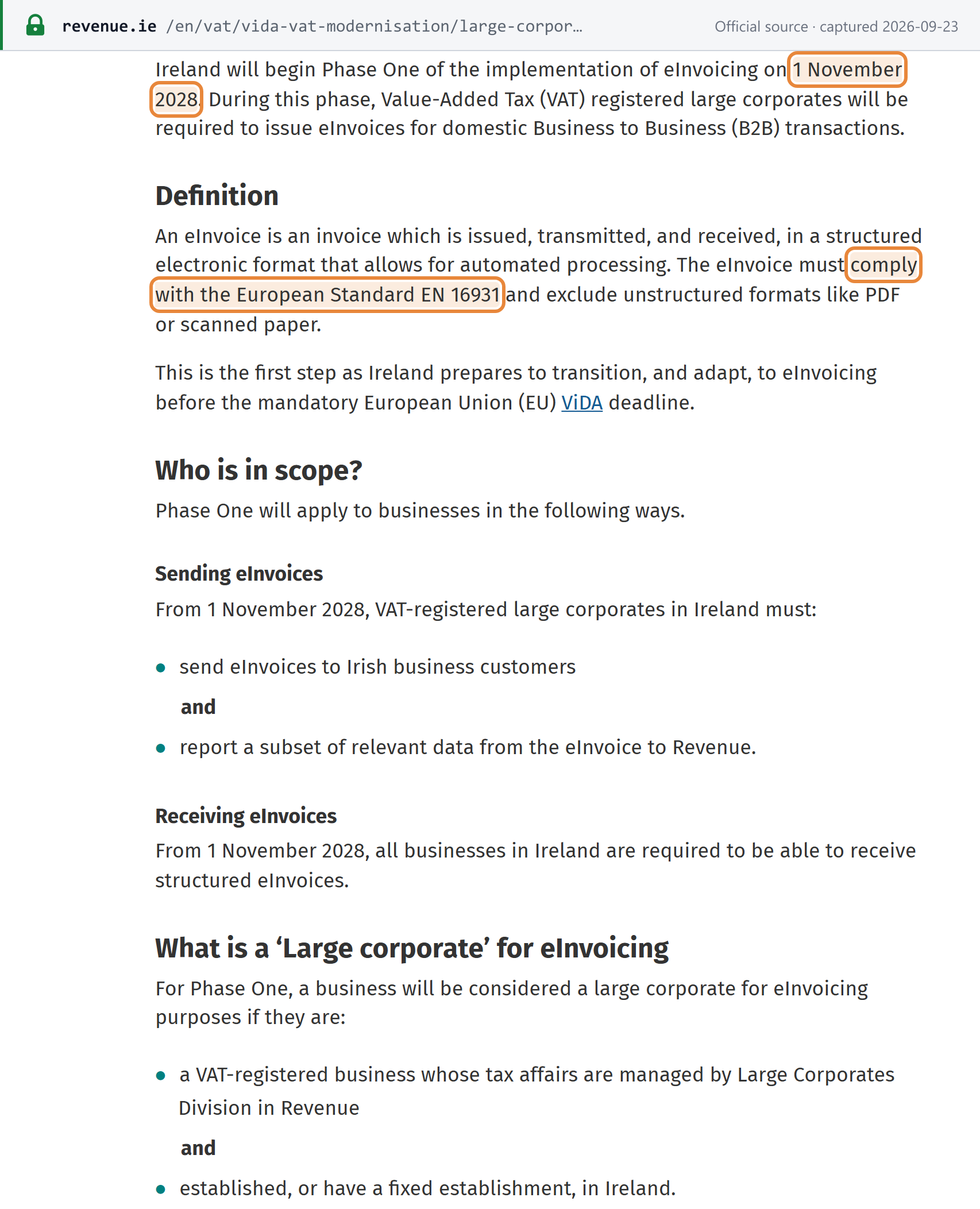
Phase 1 is the latest detail Revenue has published. Its Phase One page, also published on 20 July 2026, gives the day: "Ireland will begin Phase One of the implementation of eInvoicing on 1 November 2028." Revenue "will write to large corporates to notify them of their inclusion in Phase One", and says it will publish guidance, technical specifications and support materials "over the coming months". None had been published by 30 September 2026. [6]
 Source snapshot captured 2026-09-23 — original
Phase 2 wording differs between Revenue's two documents. The timeline page (20 July 2026) covers businesses that "engage in cross border EU B2B trade, subject to Zero rate VAT arrangements". Revenue's programme paper (8 October 2025) says "all VAT-registered businesses engaged in cross-border EU B2B trade, who benefit from the 0% VAT arrangements for such trade". Neither sets a turnover threshold, and neither gives a day in November 2029. [5] [7]
Domestic-only businesses. Revenue says the requirements will start with large corporates and "eventually" cover all VAT-registered businesses. No phase or date yet covers a business that is not a large corporate and does not trade within the EU; until one is announced, such a business only has the receiving requirement from 1 November 2028. [8]
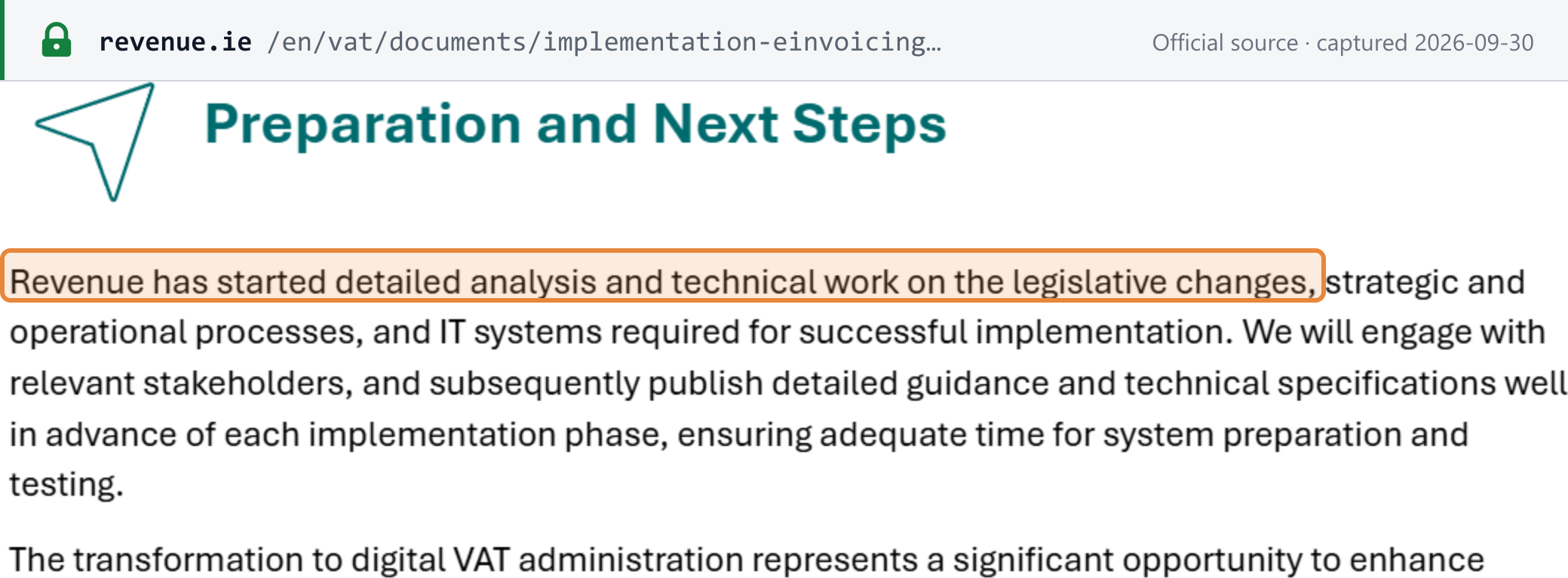
Not yet law. Revenue's programme paper says it "has started detailed analysis and technical work on the legislative changes, strategic and operational processes, and IT systems required for successful implementation". Finance Act 2025 (No. 18 of 2025) contains no e-invoicing provision, and Finance Act 2026 (No. 24 of 2026, enacted 15 July 2026) deals only with excise (checked 2026-09-30). Budget 2027 is on 6 October 2026; the Finance Bill that follows it is the first likely vehicle for primary legislation, but no such bill had been published on 30 September 2026. [7] [9]
 Source snapshot captured 2026-09-30 — original
Background. Revenue consulted on modernising VAT invoicing and reporting from 13 October 2023 to 31 January 2024 and published its report on 27 June 2024. It announced the programme on 8 October 2025, in line with the Budget 2026 speech, noting that Ireland had been "one of very few EU Member States not yet operating or rolling out mandatory eInvoicing". [10] [7]
Pilot or voluntary phase. Not announced. Revenue publishes no pilot, voluntary window or test period (checked 2026-09-30).
Postponements. None. The three phase dates are unchanged since the 8 October 2025 announcement.
Consolidated timeline
| Date | Event | Status |
|---|---|---|
| 18 Jan 2018 | OGP becomes Ireland's Peppol Authority | passed |
| 25 Mar 2019 | OGP Peppol and eInvoicing framework made available to public bodies | passed |
| 12 Jun 2019 | S.I. No. 258 of 2019 signed: public bodies must receive and process EN 16931 e-invoices | in force |
| 18 Apr 2020 | Sub-central contracting authorities and entities brought in | passed |
| 13 Oct 2023 – 31 Jan 2024 | Revenue public consultation on VAT modernisation | closed |
| 11 Mar 2025 | ViDA Directive (EU) 2025/516 adopted | EU law |
| 14 Apr 2025 | Member States may require domestic e-invoicing without recipient acceptance | option; not exercised by Irish law |
| 8 Oct 2025 | Revenue announces VAT Modernisation | announcement |
| 10 Feb 2026 | Revenue confirms which large corporates are in scope for Phase One | announcement |
| 20 Jul 2026 | Revenue timeline and Phase One pages published in their current form | announcement |
| 6 Oct 2026 | Budget 2027 | upcoming |
| 1 Nov 2028 | Phase 1: large corporates issue and report; all businesses must be able to receive | announced, not law |
| Nov 2029 | Phase 2: businesses in zero-rated intra-EU B2B trade | announced, not law |
| 30 Jun 2030 | EU deadline to transpose ViDA's e-invoicing and digital-reporting rules | EU law |
| 1 Jul 2030 | Phase 3 / ViDA: e-invoicing and digital reporting for intra-EU B2B | EU law; Irish transposition pending |
Legal basis
In force:
- VAT Consolidation Act 2010 (No. 31 of 2010), s.66(2) and (2A). An electronic invoice counts as issued only if it is issued and received by prior agreement and the system conforms with the Regulations. The issuer and recipient must apply business controls that ensure "the authenticity of the origin", "the integrity of the content" and "a reliable audit trail". Both subsections are in their current form from 1 January 2013. [1]
- Value-Added Tax Regulations 2010 (S.I. No. 639 of 2010), reg. 21, as amended by the Value-Added Tax (Amendment) Regulations 2012 (S.I. No. 458 of 2012), which substituted paragraphs (2) and (3) from 1 January 2013. The system must be capable of producing, retaining and storing electronic records and messages and making them available to Revenue; of reproducing them in paper or electronic format; and of retrieving them by issuer or recipient name, date or unique message number. The pre-2013 requirements for an advanced electronic signature or EDI were deleted. [11]
- European Union (Electronic Invoicing in Public Procurement) Regulations 2019 (S.I. No. 258 of 2019), made under the European Communities Act 1972 and signed on 12 June 2019. They transpose Directive 2014/55/EU. Reg. 4: a contracting authority or contracting entity shall "receive and process the electronic invoice" where it complies with the European standard. Reg. 3(6): not applicable to sub-central bodies until 18 April 2020. Reg. 5 lists the core invoice elements. The Regulations name no delivery network. [2]
 Source snapshot captured 2026-09-30 — original
EU law not yet transposed:
- Council Directive (EU) 2025/516 of 11 March 2025 (ViDA). Since 14 April 2025 Member States may require established businesses to issue e-invoices for domestic supplies, without the recipient's acceptance. From 1 July 2030, an EN 16931 e-invoice "shall not be subject to acceptance by the recipient", and intra-EU invoices must be issued "no later than 10 days following the chargeable event". Member States must transpose these rules by 30 June 2030. No Irish instrument has yet exercised the domestic option; Revenue's phases 1 and 2 would do so once legislated. [12]
Proposed (B2B): no draft legislation has been published. Revenue's pages and its 8 October 2025 paper are administrative announcements and bind no one until enacted. [7]
Technical standards. EN 16931 binds for B2G through S.I. No. 258 of 2019 and is the format Revenue has announced for B2B. No Irish technical specification for B2B has been published.
Scope
B2B
Nothing is in force. Under Revenue's announced programme:
- Issuing, Phase 1 (1 November 2028): a large corporate is "a VAT-registered business whose tax affairs are managed by Large Corporates Division in Revenue" that is also "established, or have a fixed establishment, in Ireland". There is no turnover test: membership depends on Revenue's case management, and Revenue will write to the businesses concerned. They must send e-invoices to Irish business customers and report a subset of the invoice data to Revenue.
- Receiving (from 1 November 2028): "all businesses in Ireland are required to be able to receive structured eInvoices."
- Issuing, Phase 2 (November 2029): VAT-registered businesses in cross-border EU B2B trade under the zero-rate arrangements (see the timeline for the wording difference). [6] [5]
B2G
In force for public bodies, receive-only. Contracting authorities and entities must receive and process EN 16931 e-invoices for invoices under public contracts covered by the EU procurement regulations (defence and security 2012, public authorities 2016, utilities 2016, concessions 2017), with those regulations' exclusions. The Regulations' explanatory note describes the duty as receiving invoices "where they are presented electronically by another party". Suppliers are not obliged to send e-invoices; OGP's 2018 FAQ said mandating suppliers "isn’t being proposed at this time". [2] [3] [22]
B2C
Not applicable. There is no B2C e-invoicing obligation and none is announced. Revenue's ViDA timeline notes only that Member States have the option to introduce e-invoicing for domestic B2B and B2C transactions; every Irish phase is described as B2B (checked 2026-09-30). [14]
Non-established businesses
- Phase 1 issuing: outside scope by Revenue's definition, which requires establishment or a fixed establishment in Ireland.
- Receiving and later phases: not yet specified. Revenue states the receiving requirement for "all businesses in Ireland" and has not said whether a non-established business registered for Irish VAT is caught, or how Phases 2 and 3 treat non-established businesses (checked 2026-09-30).
- B2G: S.I. No. 258 of 2019 places no obligation on any supplier, resident or not. [6]
Excluded transactions and simplified invoices
- Excluded transactions (B2B): not yet specified. Revenue has published no list of transactions outside the announced mandate, such as exempt supplies or imports (checked 2026-09-30).
- Simplified invoices. Today VATCA s.66(1)(b) allows a simplified invoice of €100 or less in the cases it lists; Revenue confirms it cannot be used for intra-Community supplies. How simplified invoices will fit the mandate has not been announced. [1] [13]
For the particulars every Irish VAT invoice must carry, electronic or paper, see the Ireland VAT guide.
Format & network
CTC model
- Today: none. Electronic invoices pass directly between the parties by agreement; Revenue does not validate, clear or receive them.
- Announced (B2B): e-invoicing plus real-time reporting. Revenue defines real-time reporting as "sending a subset of relevant data from the eInvoice to the tax authority". It has not said whether reporting will run through a Peppol five-corner model, a Revenue platform or another route, and it will "consult with industry experts to evaluate the mechanisms for effective eInvoicing and reporting". [7]
Conditions for a valid e-invoice today
Revenue: "The issue of invoices or other documents in electronic format is subject to agreement between both parties." The system must meet reg. 21(2) as substituted from 1 January 2013 (produce, store and make available the records; reproduce them on paper or electronically; retrieve them by name, date or message number), and the parties must apply the s.66(2A) controls for authenticity, integrity and a reliable audit trail. A PDF invoice sent by agreement meets these rules until a mandate applies to the business. [13] [11]
 Source snapshot captured 2026-09-30 — original
Format
- B2G: an e-invoice complying with EN 16931. OGP defines an eInvoice under the national approach as one compliant with the European standard that "is sent via the PEPPOL eDelivery network". [21]
- B2B (announced): "The eInvoice must comply with the European Standard EN 16931 and exclude unstructured formats like PDF or scanned paper." [6]
- Not published: no Irish official source names a Peppol profile such as Peppol BIS Billing 3.0, a national CIUS, or an Irish Peppol participant-identifier scheme (checked 2026-09-30).
Network
- B2G: Peppol. "Ireland has chosen PEPPOL for the transmission of eInvoices to support compliance with the eInvoicing Directive." This is a government policy choice; the Regulations name no network. Public bodies connect through access points run by shared-services and co-ordinating bodies, and OGP's 2018 FAQ said there were "no plans to establish a single central portal". [4] [22]
- B2B: not yet specified. Revenue says the new system "will utilise various existing technical infrastructures, including" Peppol, and that it is working with OGP, "Ireland's PEPPOL authority", on the expected expansion in network use. Peppol is not named as the only channel. [7]
 Source snapshot captured 2026-09-30 — original
Integrity mechanics
Not applicable today, and not yet specified for B2B. No QR code, cryptographic stamp or hash is required; today's integrity rule is the s.66(2A) business-controls test.
E-reporting
- Phase 1 onward (announced): issuers report "a subset of relevant data from the eInvoice to Revenue".
- Under ViDA (from July 2030): e-invoices for intra-Community transactions "will need to issue within 10 days of providing goods or services", with the data reported immediately instead of in periodic sales reports. Revenue says the new system "will eliminate the reporting requirement of the monthly VIES returns".
- Unchanged: Revenue says "Tax rates, payment requirements, and liability calculations remain unchanged." It has not announced any change to the VAT3 return. [6] [15] [7]
Archiving
- Six years from the date of the latest transaction to which the records relate, under VATCA s.84(3), "notwithstanding any other law". Longer periods apply where a claim, appeal or Revenue inquiry is open ("six years or until the matter at issue is finalised"), and for some property records.
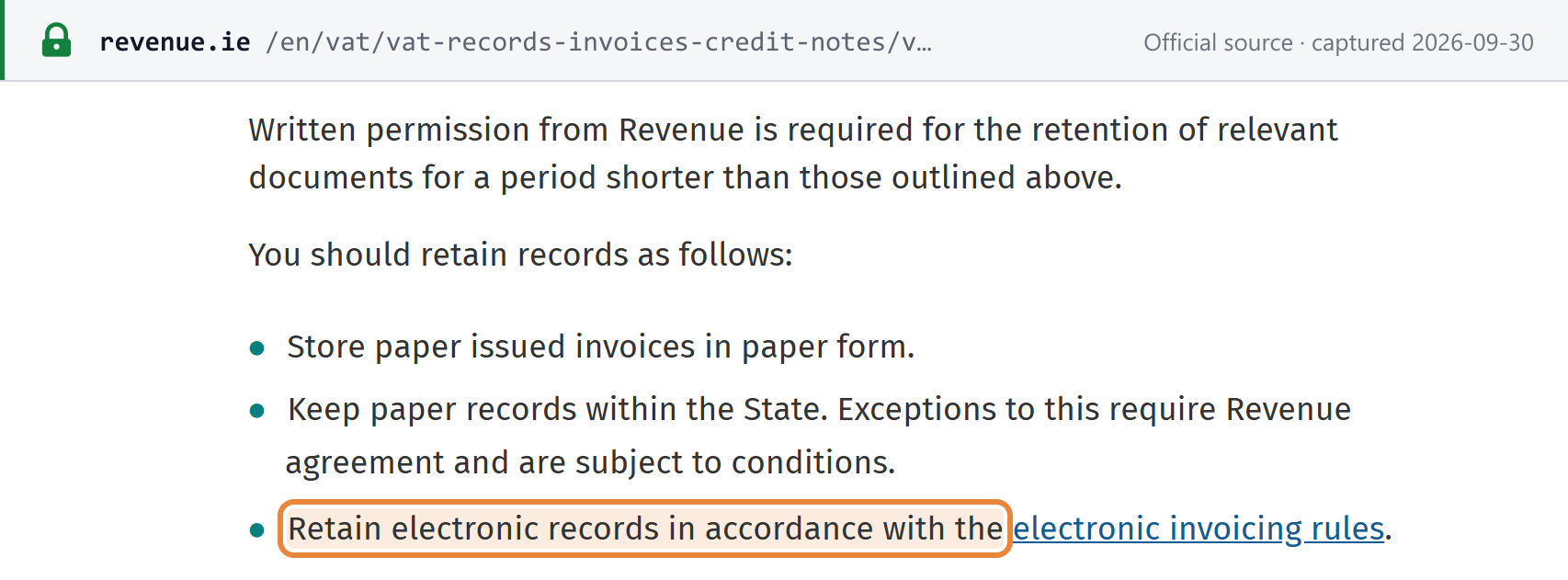
- Format and place: store paper issued invoices in paper form; keep paper records in the State unless Revenue agrees otherwise; retain electronic records under the electronic invoicing rules (reg. 21). Keeping records for a shorter period needs Revenue's written permission.
- Mandate-era archiving: not yet specified. [18] [19]
 Source snapshot captured 2026-09-30 — original
 Source snapshot captured 2026-09-30 — original
Onboarding: how to comply
B2B: what exists today
As at 30 September 2026 Revenue has published no portal, registration step, test environment, provider accreditation or technical specification for the B2B programme. It says it will publish guidance and technical specifications "well in advance of each implementation phase", and all updates on its VAT Modernisation pages. [7] [20]
Revenue's suggested preparation:
- reviewing your current invoicing, accounting, or ERP systems;
- ensuring that you have all relevant data required for the businesses in your supply chain;
- engaging with your software provider to confirm technical readiness;
- ensuring that your internal teams and departments understand the new requirements;
- planning for any necessary updates or upgrades.
Enquiries: [email protected]. [6]
B2G: sending an e-invoice to a public body
A supplier that wants to e-invoice an Irish public body sends an EN 16931 invoice over Peppol through a Peppol access point. OGP runs a multi-supplier framework through which public bodies buy Peppol networking and eInvoicing services; that is a buyer-side route, not a supplier certification. OGP contact: [email protected]. [3] [4]
Accreditation of providers
Not applicable beyond Peppol. There is no Irish accreditation scheme for e-invoicing providers, and no Irish national list of access points is published. OpenPeppol lists OGP as Ireland's Peppol Authority; certified access points are those on OpenPeppol's register. [23]
Testing
Not applicable yet. No Revenue sandbox or test environment exists for B2B (checked 2026-09-30).
Penalties
No e-invoicing-specific penalty exists. Revenue has published no sanction, grace period or tolerance for the announced e-invoicing or real-time-reporting duties (checked 2026-09-30).
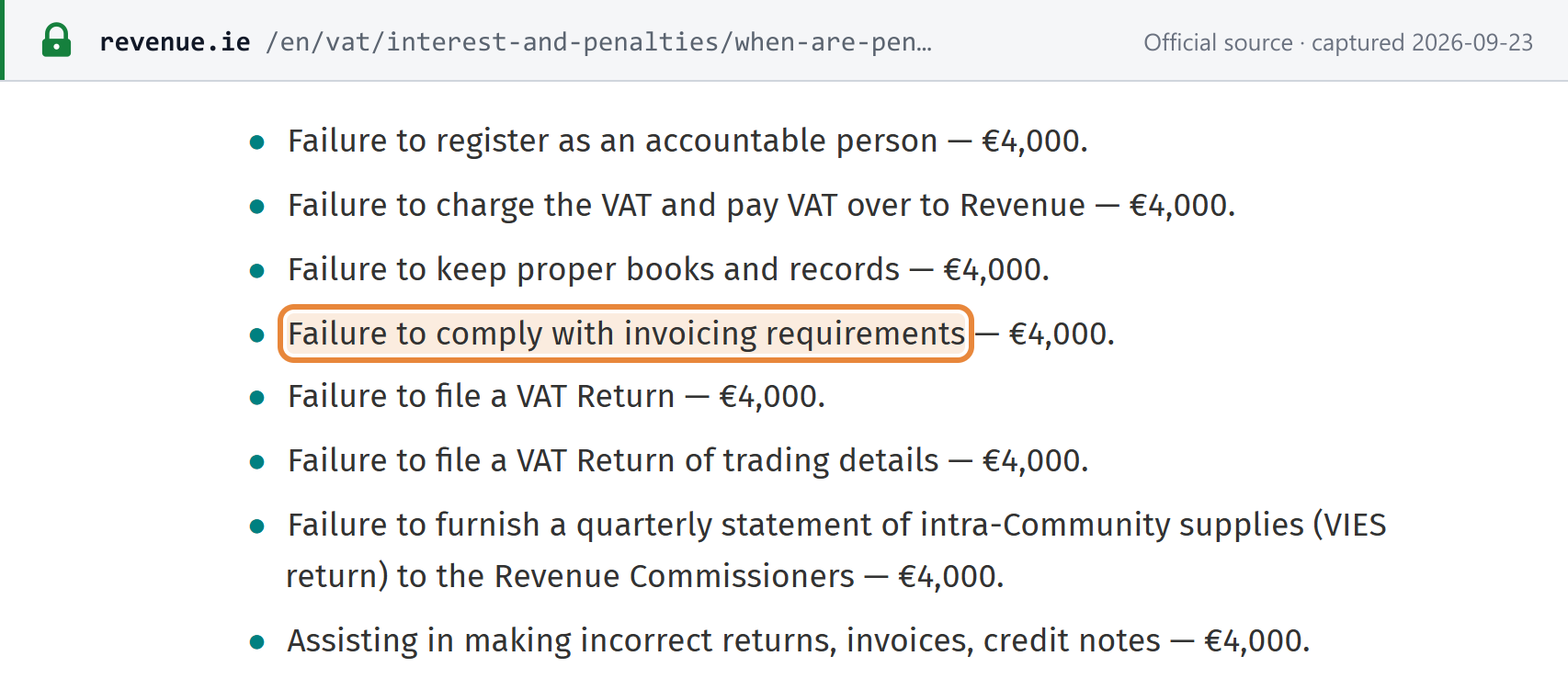
Today's rules. VATCA 2010 s.115(1)(a) imposes a penalty of €4,000 on a person who fails to comply with Chapter 2 of Part 9 (invoices, from s.66) or Chapter 7 (records, s.84), "or any provision of regulations in regard to any matter to which those sections or Chapters relate", which includes the reg. 21 electronic-invoice conditions. Revenue's fixed-penalty schedule lists "Failure to comply with invoicing requirements" and "Failure to keep proper books and records" at €4,000 each. [16] [17]
 Source snapshot captured 2026-09-23 — original
B2G. S.I. No. 258 of 2019 sets no penalty; it places no duty on suppliers.
Frequently asked questions
Do we have to send e-invoices in Ireland now?
No. As at 30 September 2026 no Irish law requires a business to issue or receive e-invoices. Electronic invoicing is voluntary: under VATCA 2010 s.66(2) an electronic invoice counts only if it is issued and received by prior agreement and the system meets the conditions in reg. 21 of the VAT Regulations 2010.
We are not in Revenue's Large Corporates Division. Does 1 November 2028 affect us?
Yes, for receiving. Revenue has announced that from 1 November 2028 all businesses in Ireland must be able to receive structured e-invoices. Under the announced Phase 2, issuing extends in November 2029 to businesses in zero-rated intra-EU B2B trade; no issuing date has been announced for businesses that trade only domestically.
How do we know if we are a large corporate for Phase 1?
There is no turnover test. A large corporate is a VAT-registered business whose tax affairs are managed by Revenue's Large Corporates Division and that is established, or has a fixed establishment, in Ireland. Revenue says it will write to the businesses included in Phase 1.
Is the 1 November 2028 start date law?
Not yet. The dates come from Revenue announcements, and Revenue says it is still working on the legislative changes. Finance Act 2025 (No. 18 of 2025) and Finance Act 2026 (No. 24 of 2026) contain no e-invoicing provision. Budget 2027 is on 6 October 2026, and the Finance Bill that follows it is the first likely vehicle.
Must we send e-invoices to Irish public bodies?
No. S.I. No. 258 of 2019 obliges public bodies to receive and process EN 16931 e-invoices, and the Office of Government Procurement states that there is no requirement for suppliers to submit e-invoices. A supplier that chooses to e-invoice a public body sends the invoice over Peppol.
Will Ireland use Peppol for B2B e-invoicing?
It has not been decided. B2G already runs on Peppol, and the Office of Government Procurement has been Ireland's Peppol Authority since 18 January 2018. For B2B, Revenue says the new system will use existing infrastructures including Peppol, but it has not published the reporting model or the technical specifications.
Can we keep sending PDF invoices after November 2028?
Not once the mandate applies to you: Revenue says the e-invoice must comply with EN 16931 and excludes unstructured formats like PDF or scanned paper. Until then, a PDF invoice sent by agreement between the parties satisfies s.66(2) and reg. 21.
We are a non-established business registered for Irish VAT. Are we in scope?
Not for Phase 1 issuing, which is limited to businesses established or with a fixed establishment in Ireland. Revenue has not said how the receiving requirement or the later phases apply to non-established businesses.
Does real-time reporting replace the VAT3 return?
Not announced. Revenue says the new system will remove the monthly VIES returns and that tax rates, payment requirements and liability calculations are unchanged. It has not announced any change to the VAT3 return.
How long must e-invoices be kept?
Six years from the date of the latest transaction they relate to, under VATCA 2010 s.84(3), and longer while a claim, appeal or Revenue inquiry is open. Electronic records must be kept under the electronic invoicing rules in reg. 21, so they can be retrieved and reproduced on request.
What is the penalty for getting e-invoicing wrong?
There is no e-invoicing-specific penalty. Failing to meet the invoicing and record-keeping rules, including the reg. 21 electronic-invoice conditions, carries a fixed penalty of €4,000 under VATCA 2010 s.115(1)(a).
Recent changes
- 2026-07-20 — Revenue published its VAT Modernisation timeline and Phase One page: from 1 November 2028 large corporates issue domestic B2B e-invoices and report data, and all businesses must be able to receive them; Phase 2 follows in November 2029 and Phase 3 in July 2030. Announced, not yet law. (Revenue) — see event
- 2026-02-10 — Revenue confirmed the Phase One scope: VAT-registered businesses whose tax affairs are managed by its Large Corporates Division and that are established, or have a fixed establishment, in Ireland. Revenue said it would write to the businesses concerned. (Revenue)
- 2025-10-08 — Revenue announced VAT Modernisation alongside Budget 2026 and said it had started work on the legislative changes. (Revenue)
For the full chronology, see Ireland tax changes on Lookuptax.
Related resources
- Ireland VAT guide — rates, registration, invoice particulars under reg. 20, filing and penalties
- Ireland tax identification numbers — the IE VAT number format that goes on every invoice
- Validate an Irish VAT number
- Ireland tax-change chronology — every tracked Irish change, dated and sourced
- E-invoicing status and networks worldwide — Ireland's row in global context
- Peppol network explainer and Peppol requirements by country
- ViDA — VAT in the Digital Age — the directive behind Revenue's phases and the 2030 reporting
- How to verify an EU VAT number (VIES)
- Other EU mandates: Belgium, France
Important websites
- Revenue — ViDA and VAT Modernisation — where Revenue publishes updates
- Revenue — VAT Modernisation timeline — the three phases
- Revenue — Phase One (large corporates) — who issues from 1 November 2028
- Revenue — Implementation of eInvoicing in Ireland (PDF, 8 October 2025) — the programme paper
- Revenue — electronic invoicing today — conditions for voluntary e-invoices
- OGP — Public bodies and eInvoicing — the B2G national approach
- OGP — Irish Peppol Authority — contact [email protected]
- OpenPeppol — Peppol Authorities and Peppol-certified service providers
- Revenue enquiries on VAT Modernisation: [email protected]
Reference links
- [1] Law Reform Commission — VAT Consolidation Act 2010, s.66 (revised)
- [2] Irish Statute Book — S.I. No. 258 of 2019, European Union (Electronic Invoicing in Public Procurement) Regulations 2019
- [3] OGP — Public bodies and eInvoicing (31 May 2021)
- [4] OGP — Irish Peppol Authority (2 December 2021)
- [5] Revenue — VAT Modernisation timeline (20 July 2026)
- [6] Revenue — Phase One: large corporates (20 July 2026)
- [7] Revenue — VAT Modernisation: Implementation of eInvoicing in Ireland (8 October 2025, PDF)
- [8] Revenue — What is VAT Modernisation (8 October 2025)
- [9] Irish Statute Book — Finance Act 2026 (No. 24 of 2026)
- [10] Revenue — ViDA and VAT Modernisation (10 July 2025)
- [11] Irish Statute Book — S.I. No. 458 of 2012, Value-Added Tax (Amendment) Regulations 2012
- [12] EUR-Lex — Council Directive (EU) 2025/516 of 11 March 2025 (ViDA)
- [13] Revenue — Other types of VAT invoices (16 March 2026)
- [14] Revenue — ViDA implementation timeline (10 July 2025)
- [15] Revenue — VAT in the Digital Age (20 July 2026)
- [16] Law Reform Commission — VAT Consolidation Act 2010, s.115 (revised)
- [17] Revenue — Fixed penalties (20 April 2026)
- [18] Law Reform Commission — VAT Consolidation Act 2010, s.84 (revised)
- [19] Revenue — How long do you keep records for? (27 April 2026)
- [20] Revenue — Next steps for VAT Modernisation and ViDA (20 July 2026)
- [21] OGP — What an eInvoice (electronic invoice) is
- [22] eInvoicing Ireland — Questions answered (19 October 2018, PDF)
- [23] OpenPeppol — Peppol Authorities