E-invoicing in Malta: B2G Peppol, fiscal receipts and ViDA status
Overview
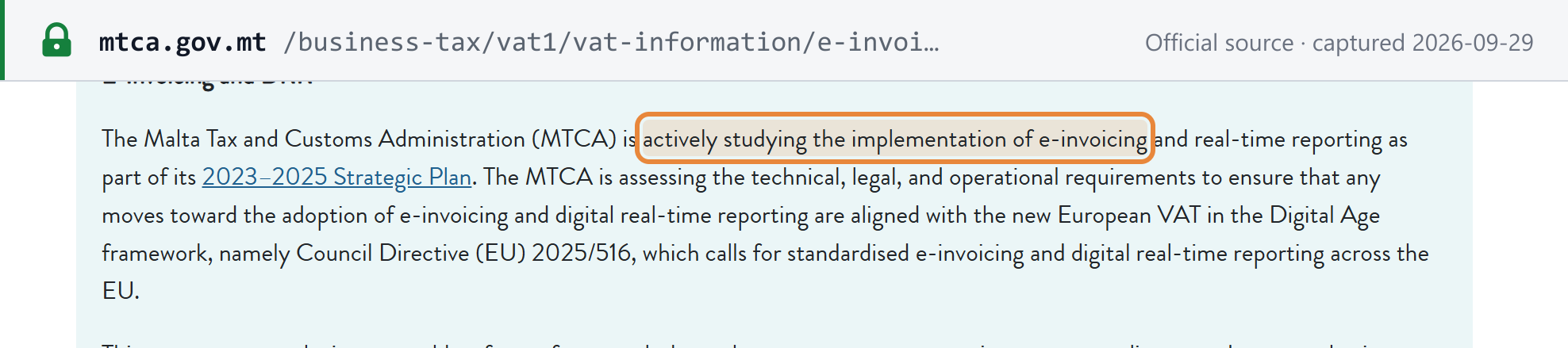
Malta has no e-invoicing mandate for businesses (as at 30 September 2026). No Maltese law requires a supplier to issue a structured e-invoice to another business, to a consumer or to a public body, and no clearance or real-time reporting system exists. The Malta Tax and Customs Administration (MTCA), which administers VAT, publishes only a preparatory position: it "is actively studying the implementation of e-invoicing and real-time reporting as part of its 2023–2025 Strategic Plan", and is assessing the technical, legal and operational requirements so that any move aligns with Council Directive (EU) 2025/516 (ViDA). No instrument, start date, scope or threshold has been published. [1]
 Source snapshot captured 2026-09-29 — original
What Malta does have is three narrower regimes, and this guide covers each:
- A B2G receiving duty on the buyer, not the supplier. Under the Electronic Invoicing in Public Procurement Regulations (Subsidiary Legislation 601.10, originally Legal Notice 404 of 2018), contracting authorities and entities must receive and process e-invoices that comply with the European standard EN 16931 on contracts above the EU procurement thresholds. Suppliers keep the right to send paper instead. [2]
- Peppol as the government's receiving channel. The Ministry for Finance chose the Peppol network and contracted Pagero as the government's Peppol service provider. There is no national platform and no branded national system. [4]
- The VAT Act's invoicing rules. E-invoices are allowed between businesses, but only with the recipient's acceptance. Consumer sales are covered by fiscal receipts, usually printed by an approved fiscal cash register that keeps its data on the device and sends nothing to MTCA. [7]
| Malta (as at 30 September 2026) | |
|---|---|
| B2G | Buyer-side receiving duty only. Public buyers must receive and process EN 16931 e-invoices on above-EU-threshold contracts: central bodies by 18 April 2019, sub-central bodies by 18 April 2020 (both passed). No supplier obligation; paper is still allowed (S.L. 601.10 reg 5(2)) |
| B2B | No mandate. E-invoices are voluntary and need the recipient's acceptance (VAT Act, Twelfth Schedule item 6(2)) |
| B2C | No e-invoice. Fiscal receipts under the VAT Act's Thirteenth Schedule, by fiscal cash register for retailers and food caterers. No transmission of receipt data to MTCA |
| Non-residents | No e-invoicing obligation applies to any taxpayer class, resident or not (MTCA) |
| Format | EN 16931-1:2017. For B2G via Peppol: Peppol BIS Billing 3.0 (UBL), no national CIUS or extensions |
| Network | Peppol (4-corner) for B2G, with Pagero as the government's service provider. No national Peppol Authority; OpenPeppol acts as the authority |
| Real-time reporting | None in law. MTCA is studying it (see Mandate status & timeline) |
| Authority | MTCA (VAT, fiscal receipts); Ministry for Finance (B2G e-invoicing) |
| Legislation | S.L. 601.10 (L.N. 404 of 2018); Value Added Tax Act, Cap. 406 (Twelfth and Thirteenth Schedules); Act III of 2026, art 73 |
Mandate status & timeline
| Date | Who / what | Status | Legal basis |
|---|---|---|---|
| 27 November 2018 | Electronic Invoicing in Public Procurement Regulations in force, transposing Directive 2014/55/EU | passed | L.N. 404 of 2018, reg 1 [3] |
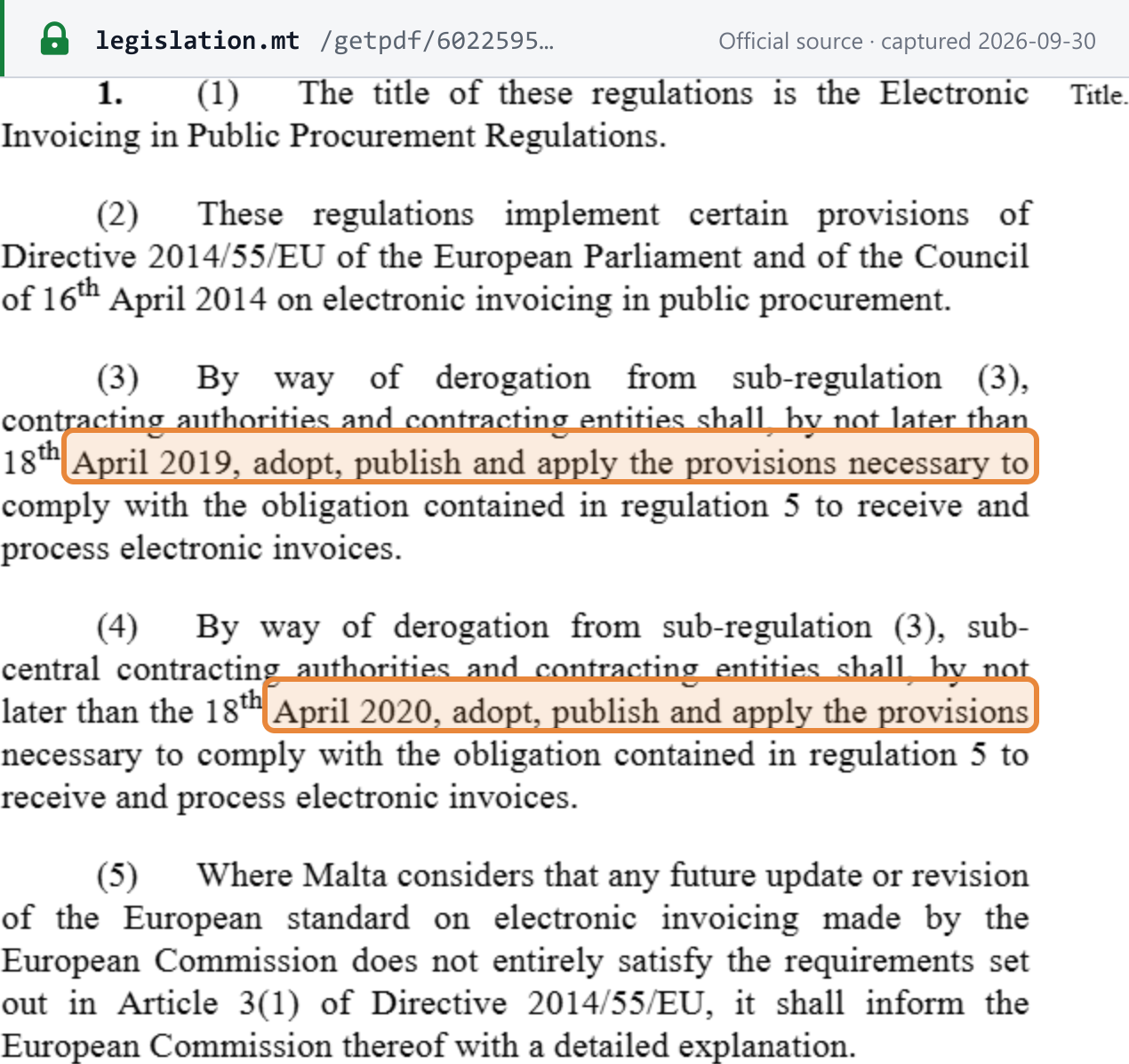
| 18 April 2019 | Contracting authorities and contracting entities must receive and process EN 16931 e-invoices | passed | S.L. 601.10, reg 1(3) [2] |
| 18 April 2020 | Sub-central contracting authorities and entities must receive and process EN 16931 e-invoices | passed | S.L. 601.10, reg 1(4) [2] |
| 10 March 2026 | Fiscal cash registers may keep an electronic journal; "printing" of the receipt becomes "issuance" | in force | Act III of 2026, art 73 [8] |
| 13 July 2026 | Article 11 exempt SMEs' fiscal-cash-register receipts carry "EXP" before the VAT registration number | in force | MTCA guideline [11] |
| 1 July 2030 (EU) | ViDA: e-invoicing becomes mandatory for intra-Community B2B supplies, with digital reporting, across the EU | EU law; Maltese transposition not yet published | Directive (EU) 2025/516, arts 5 and 6(5) [13] |
 Source snapshot captured 2026-09-30 — original
No supplier-side B2G obligation has ever been legislated, and no B2B or B2C obligation exists. Both B2G deadlines were for receiving and processing only.
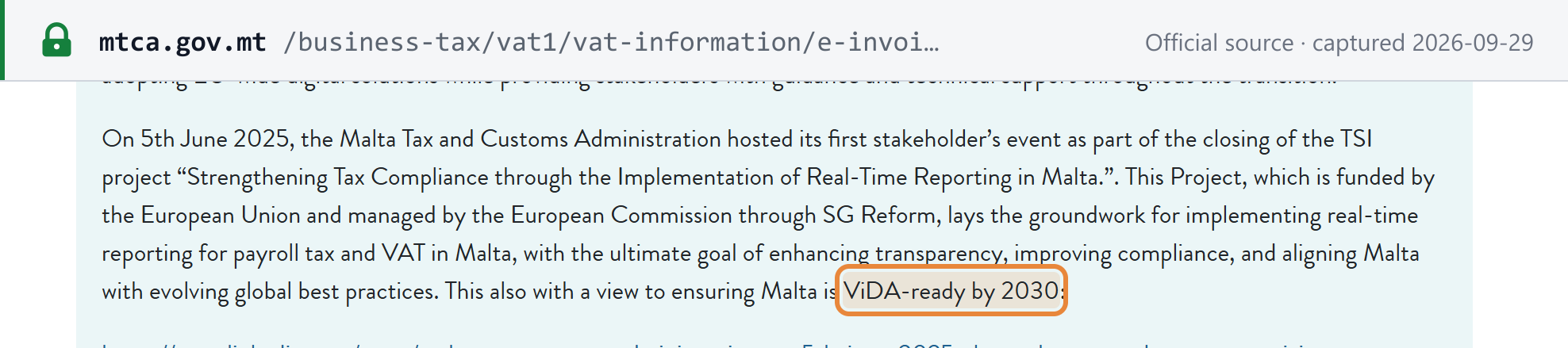
What MTCA has announced (not law). On 5 June 2025, MTCA hosted its first stakeholder event, closing the Technical Support Instrument project "Strengthening Tax Compliance through the Implementation of Real-Time Reporting in Malta". The project is EU-funded and managed by the European Commission through SG Reform. MTCA says it "lays the groundwork for implementing real-time reporting for payroll tax and VAT in Malta", with a view to ensuring Malta is "ViDA-ready by 2030". That is a readiness aim, not a legal deadline: no Maltese instrument, date, taxpayer class or threshold for e-invoicing or real-time reporting has been published, and the Budget Speech 2026 (27 October 2025) announces no such measure. [1] [17]
 Source snapshot captured 2026-09-29 — original
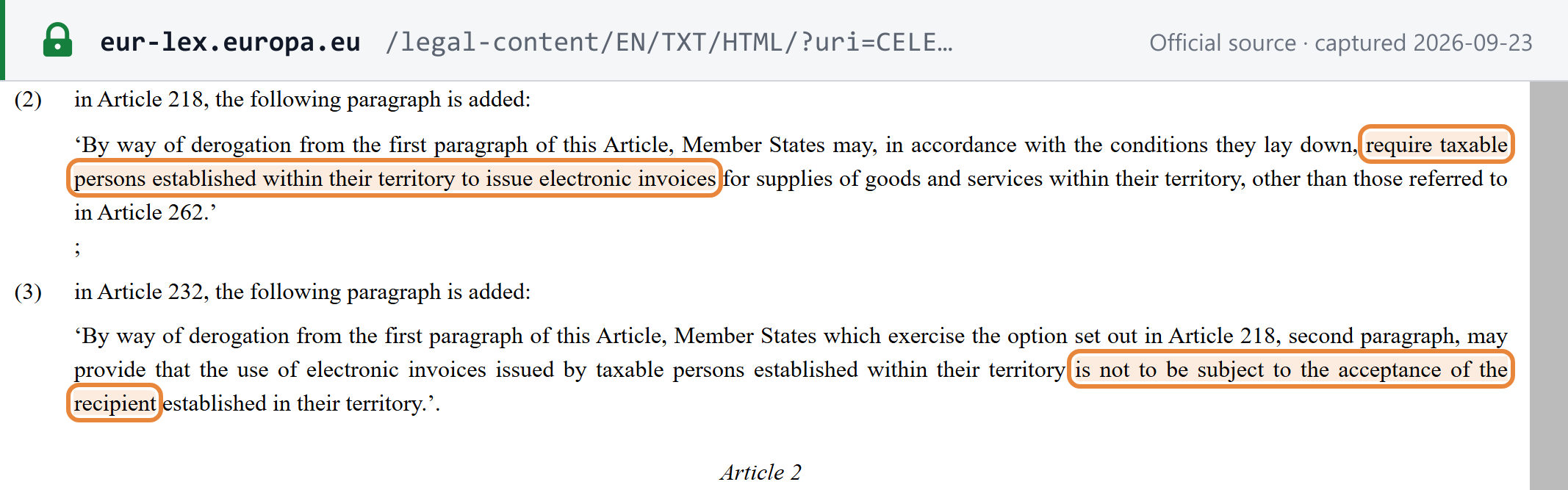
The EU option Malta has not used. Since 14 April 2025, ViDA has let any Member State require established businesses to issue domestic e-invoices (new second paragraph of Article 218 of the VAT Directive) and drop the recipient-acceptance rule for them (new second paragraph of Article 232). Malta has not exercised this option (as at 30 September 2026): the VAT Act still makes an e-invoice "subject to acceptance by the recipient" (Twelfth Schedule item 6(2)). [13] [7]
 Source snapshot captured 2026-09-23 — original
 Source snapshot captured 2026-09-29 — original
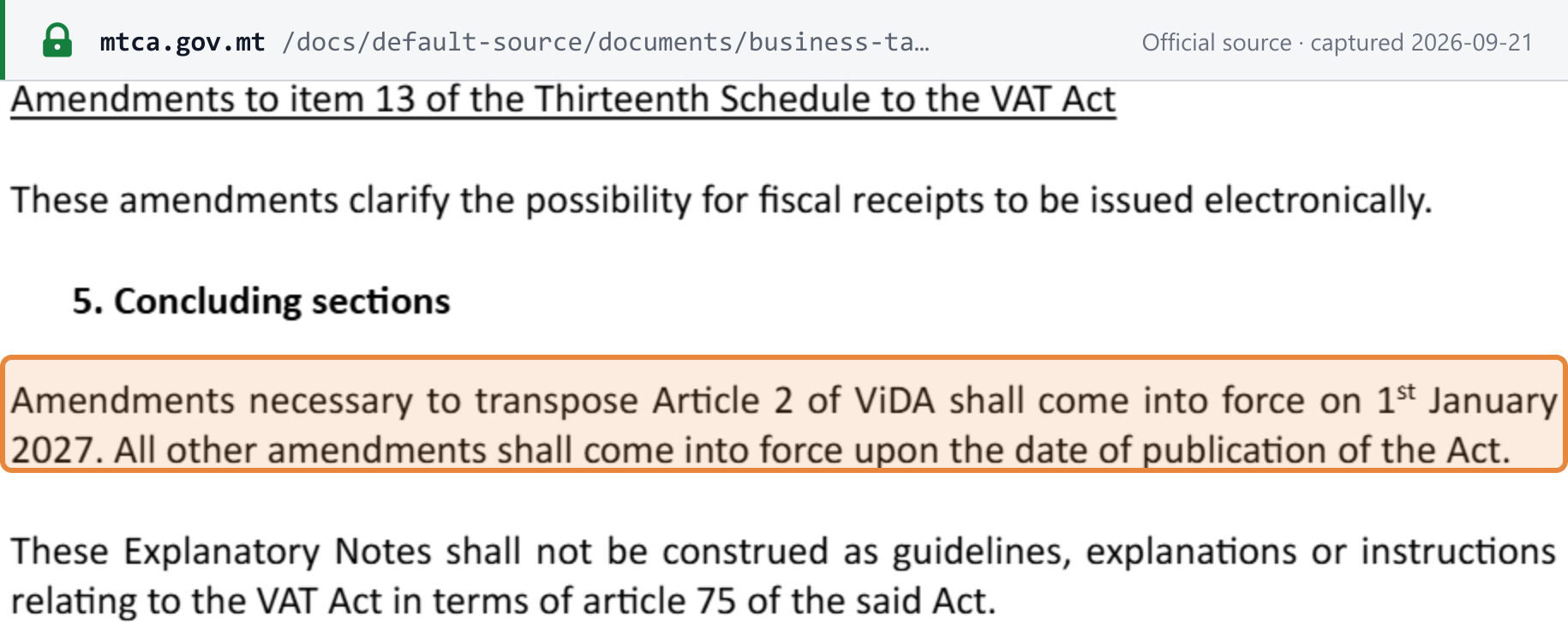
Act III of 2026 is not an e-invoicing law. Malta's ViDA transposition so far, in the Budget Measures Implementation Act, 2026 (Act III of 2026), covers Article 2 of Directive 2025/516 only: the platform deemed-supplier rule, call-off stock and the One Stop Shop, from 1 January 2027. MTCA's explanatory notes list every VAT Act amendment in the Act, and none concerns e-invoicing or real-time reporting. The one invoicing-adjacent change, to fiscal cash registers (art 73), came into force on publication, 10 March 2026. [9]
 Source snapshot captured 2026-09-21 — original
Legal basis
-
Subsidiary Legislation 601.10, Electronic Invoicing in Public Procurement Regulations (consolidated), originally Legal Notice 404 of 2018, published in Government Gazette of Malta No. 20,096 on 30 November 2018 and in force on 27 November 2018. Made by the Minister for Finance under article 4 of the Financial Administration and Audit Act (Cap. 174), it implements Directive 2014/55/EU. Regulation 7 states that it is "without prejudice to the provisions of the Value Added Tax Act". The 27 November 2018 commencement date is in regulation 1 of L.N. 404 of 2018 as published. [2] [3]
-
Legal Notice 403 of 2018 (same Gazette, 30 November 2018) amends the Local Councils (Financial) Regulations (S.L. 363.01) so that "invoice" includes an electronic invoice regulated by the 2018 Regulations. Its commencement is left to a ministerial notice in the Gazette. [16]
-
Value Added Tax Act, Cap. 406:
- arts 50–51 decide whether a supply needs a tax invoice or a fiscal receipt;
- art 48(4) and the Eleventh Schedule set retention;
- the Twelfth Schedule sets tax-invoice content, the "electronic invoice" definition and the recipient-acceptance rule (item 6);
- the Thirteenth Schedule sets the fiscal-receipt and fiscal-cash-register regime;
- arts 76–78 set the offences.
The consolidated text includes amendments up to Act III of 2026 and Legal Notice 75 of 2026. [7]
-
Act III of 2026 (Budget Measures Implementation Act, 2026; Government Gazette No. 21,599, 10 March 2026), art 73, amends items 11 and 13 of the Thirteenth Schedule. It came into force on publication. [8]
-
Technical standard: EN 16931-1:2017, the semantic data model published through Commission Implementing Decision (EU) 2017/1870 of 16 October 2017. It binds B2G receipt through S.L. 601.10 reg 2 and reg 5. [2]
Scope
B2G: public buyers must receive, suppliers may still send paper
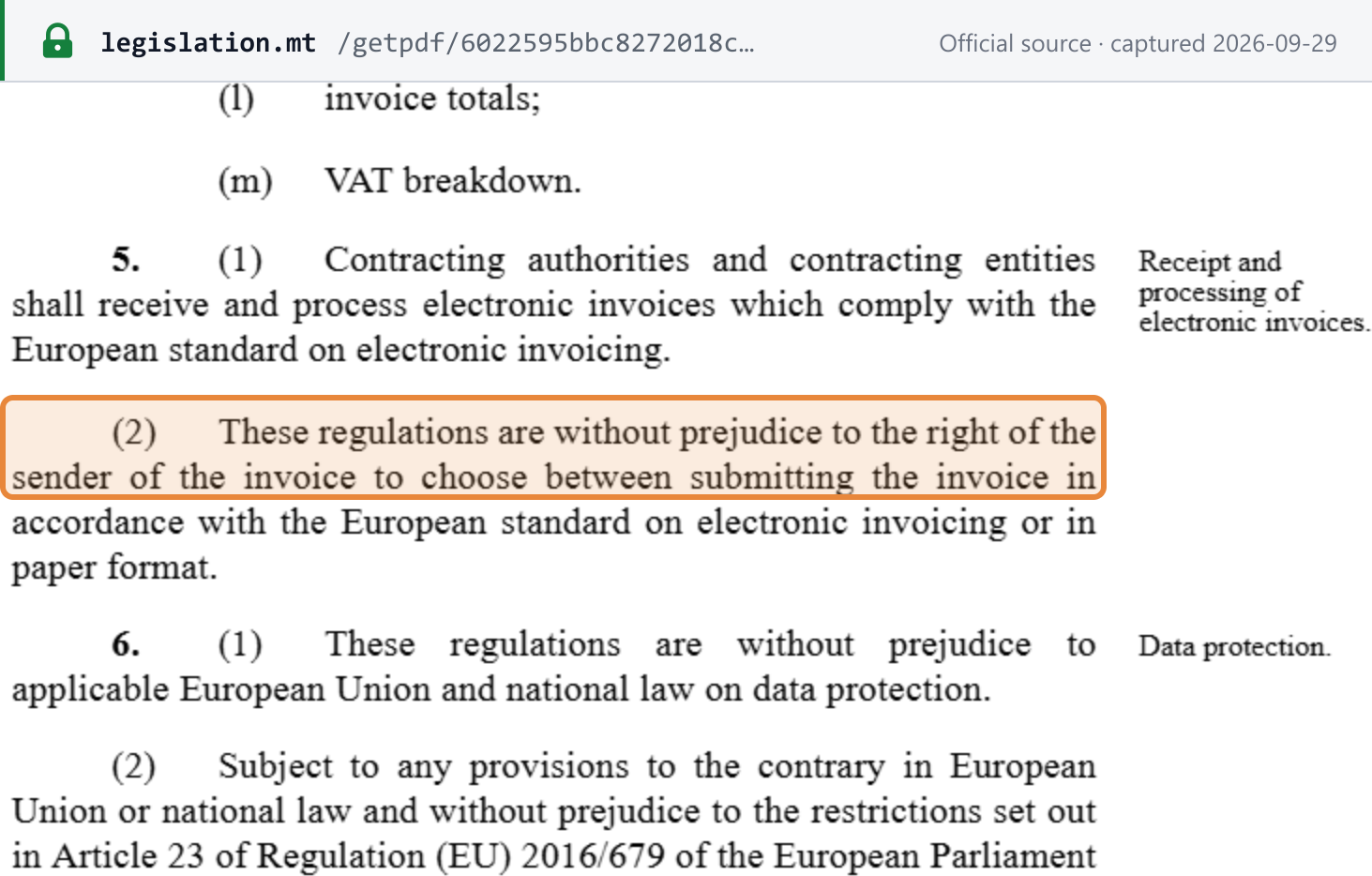
Regulation 5(1) of S.L. 601.10 puts the duty on the buyer: "Contracting authorities and contracting entities shall receive and process electronic invoices which comply with the European standard on electronic invoicing." Regulation 5(2) preserves the supplier's choice: the regulations are "without prejudice to the right of the sender of the invoice to choose between submitting the invoice in accordance with the European standard on electronic invoicing or in paper format." [2]
 Source snapshot captured 2026-09-29 — original
The Ministry for Finance says the same in plain terms: "There is no legal requirement for suppliers to submit invoices in electronic format to Maltese public bodies at this point in time." [4]
 Source snapshot captured 2026-09-29 — original
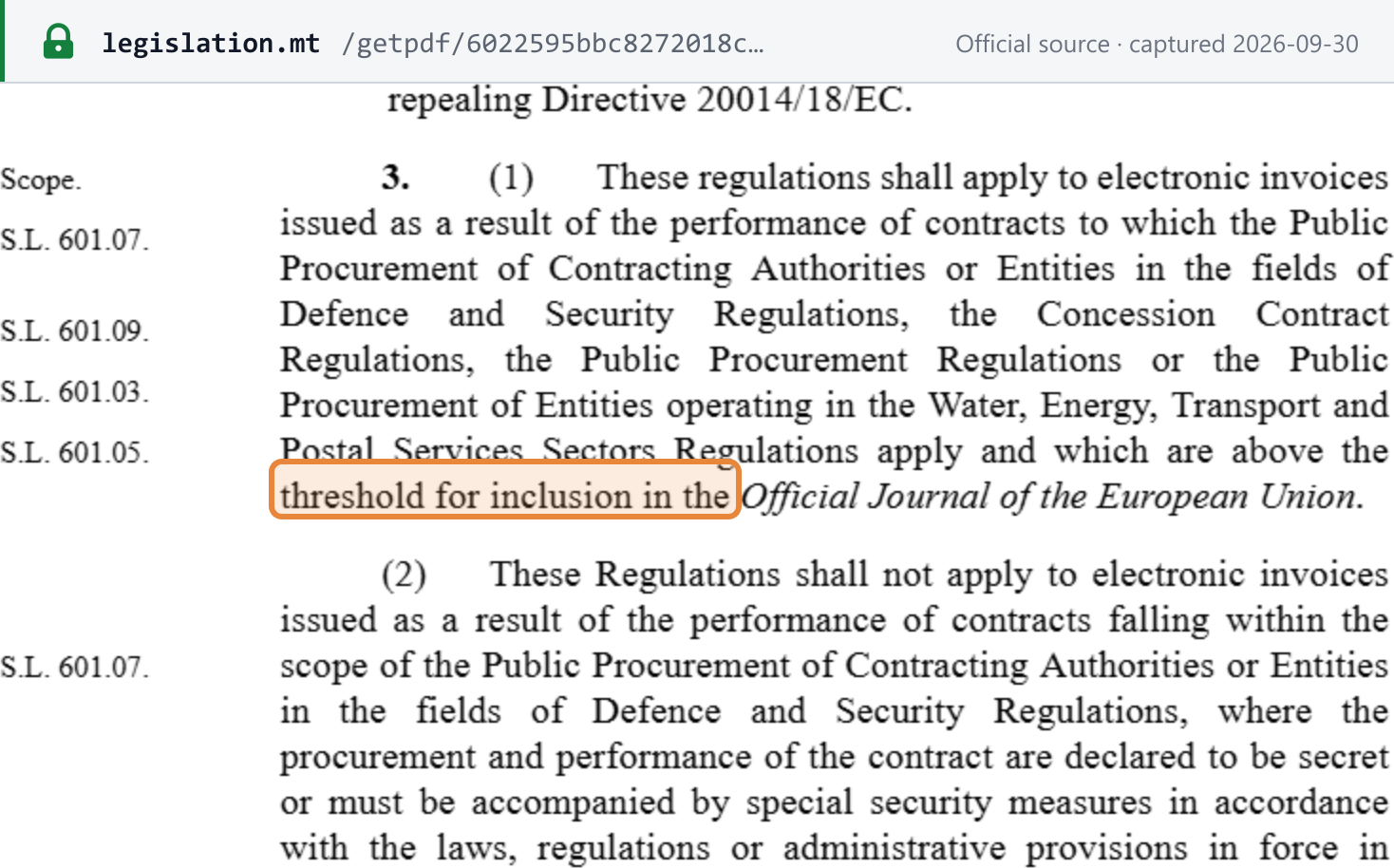
Which contracts are covered. Regulation 3(1) limits the receiving duty to invoices under contracts that are above the threshold for publication in the Official Journal of the European Union and fall under one of four sets of procurement rules: defence and security procurement, concession contracts, the Public Procurement Regulations, or the utilities (water, energy, transport and postal) regulations. Regulation 3(2) excludes secret or special-security defence contracts. The regulation's wording ("above the threshold") governs, so below-threshold contracts fall outside it; the Ministry's FAQ says "within the EU Procurement thresholds". [2]
 Source snapshot captured 2026-09-30 — original
The European Commission's 2025 country sheet states: "There is no Business-to-Government (B2G) mandate in Malta", meaning none for suppliers. [6]
B2B: voluntary, with the recipient's acceptance
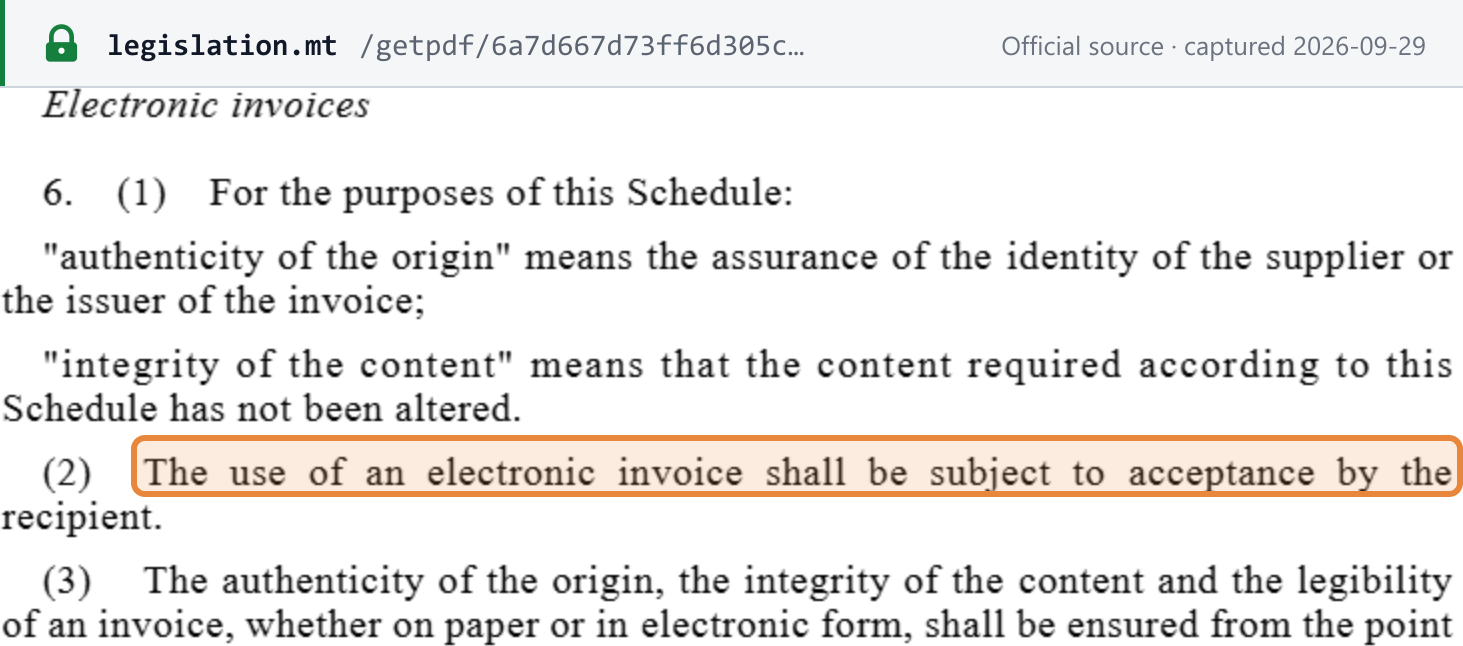
For VAT purposes, the Twelfth Schedule defines an "electronic invoice" as an invoice with the required content "issued and received in any electronic format". The definition does not depend on format, so a PDF sent by email counts as an electronic invoice for VAT. That differs from the structured-format definition in S.L. 601.10, which applies to B2G only. Item 6(2) adds: "The use of an electronic invoice shall be subject to acceptance by the recipient." A Maltese business can therefore send e-invoices to another business only if the customer agrees, and it has no duty to send them at all. [7]
 Source snapshot captured 2026-09-29 — original
Tax invoice or fiscal receipt: which document applies
The VAT Act chooses the document by registration type and by whether the customer gives a VAT number:
- Tax invoice (Twelfth Schedule): an article 10 registrant supplying, other than an exempt-without-credit supply, to a customer who identifies with a VAT identification number (art 50(1)).
- Fiscal receipt (Thirteenth Schedule): every other supply (art 51(1)). Exempt-without-credit supplies need no fiscal receipt, except those of article 11 small enterprises (art 51(2)).
MTCA's FAQ adds two practical rules. If the customer's VAT number cannot be validated on VIES, issue a fiscal receipt, not a tax invoice. An article 11 registered person "must issue a fiscal receipt for each and every supply of goods and services taking place in Malta" to both businesses and consumers. The fiscal receipt is therefore not only a B2C document. The FAQ says it is not a guideline under article 75 of the VAT Act, so rely on the Act for the rule and on the FAQ for practice. [7] [10] To check a customer's number first, see how to verify an EU VAT number on VIES.
B2C: fiscal receipts and fiscal cash registers
A "fiscal receipt" (Thirteenth Schedule item 1) takes one of three forms:
- a receipt or invoice on a form supplied or approved by the Commissioner, or issued in an approved manner;
- a receipt from a fiscal cash register;
- a receipt from a fiscal taxi meter (item 14; approved by Transport Malta).
It must be issued immediately after payment (item 2). Retailers and food caterers must use a fiscal cash register (item 3(1)). If the register is out of action for a reasonable cause, they use a Commissioner-approved form instead. Not owning a register, running out of stationery and leaving a defect unrepaired are not reasonable causes (item 3(3)). The customer must keep the receipt for 24 hours and show it to an officer on request (item 12). [7]
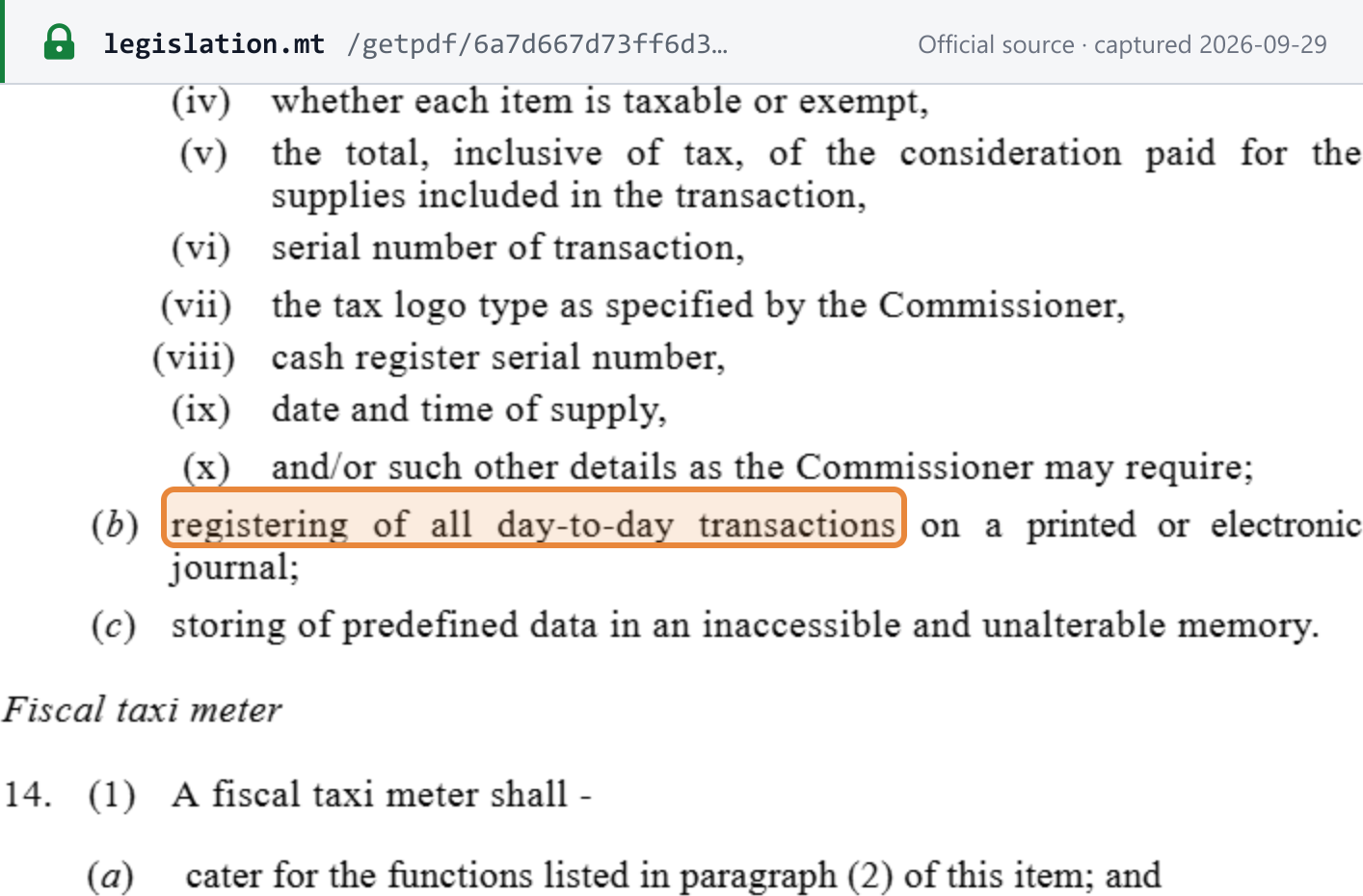
The register must be of a type approved by notice in the Gazette and on a designated web portal (item 13(1)(b)). It must provide (item 13(2)):
- an itemised receipt showing the supplier's name, address and VAT registration number, the goods and quantity, whether each item is taxable or exempt, the tax-inclusive total, the transaction serial number, the tax logo, the cash register serial number, and the date and time of supply;
- "registering of all day-to-day transactions on a printed or electronic journal";
- "storing of predefined data in an inaccessible and unalterable memory".
 Source snapshot captured 2026-09-29 — original
This is a device regime, not real-time fiscalisation. Nothing in the Thirteenth Schedule requires receipt data to be transmitted to MTCA, online or in real time. The controls are the approved device, its unalterable memory, and the customer's duty to keep the receipt. This differs from the online receipt fiscalisation used in Croatia. [7]
Electronic issuance since 10 March 2026. Art 73 of Act III of 2026 made three changes to the Thirteenth Schedule:
- in item 13(2)(a), the register's "printing" of the receipt became its "issuance";
- in item 13(2)(b), the journal became "printed or electronic";
- register types may now also be approved under the Act itself, and the Commissioner's exemptions under item 11 are made by written notice to a person, or by notice in the Gazette and on a web portal for a class of persons.
MTCA's explanatory notes say these amendments "clarify the possibility for fiscal receipts to be issued electronically". The Act does not create an e-receipt transmission system or a new device standard. [8] [9]
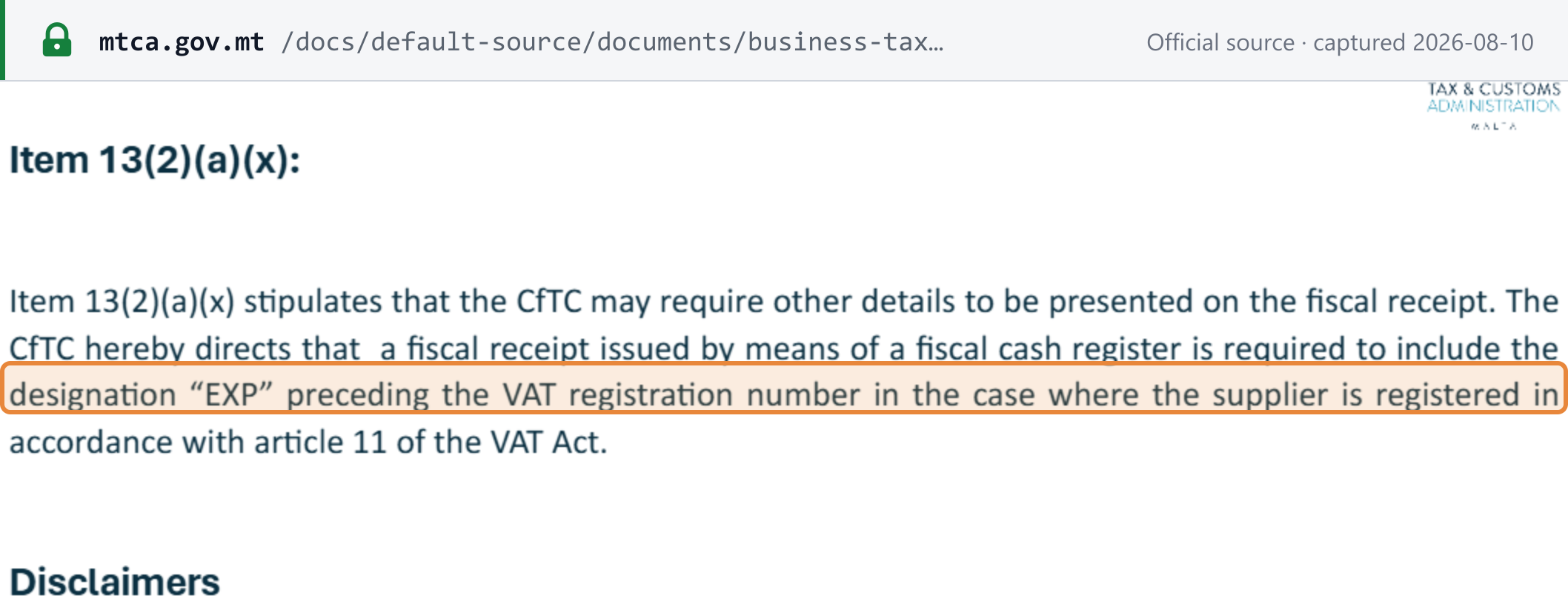
Article 11 small enterprises (since 13 July 2026). An MTCA guideline directs that "a fiscal receipt issued by means of a fiscal cash register is required to include the designation "EXP" preceding the VAT registration number in the case where the supplier is registered in accordance with article 11 of the VAT Act". Exempt-without-credit lines are marked "E" or "Exempt". An article 11 number has no MT prefix and is not a VAT identification number; see the Malta tax ID guide. [11]
 Source snapshot captured 2026-08-10 — original
Non-established businesses
No e-invoicing obligation applies. MTCA publishes no e-invoicing obligation for any taxpayer class, resident or non-resident. A non-established supplier to a Maltese public body may send an EN 16931 e-invoice over Peppol, or paper, on the same terms as a Maltese supplier. [1] [2]
Supplies that need no fiscal receipt
No fiscal receipt is needed for:
- exempt-without-credit supplies, other than article 11 small-enterprise supplies (item 2, proviso);
- supplies under the One Stop Shop or Import One Stop Shop (item 2A);
- supplies that take place outside Malta under the Third Schedule (item 2B).
One daily receipt may replace individual receipts for door-to-door or public-road sales of gas, milk or bread (item 4), for bread sold from the bakery with written authorisation (item 5), for non-automated fuel pumps (item 6), and for authorised work or study canteens, with one receipt for food and one for beverages (item 7). Vending, coin and card or token machines have their own accounting rules (items 8–9). [7]
The simplified invoice (Twelfth Schedule item 1(3)(a) and item 5: permitted where the total is €100 or less including VAT, and in the other cases item 1(3) lists) is an invoice-content rule, not an e-invoicing regime; see the Malta country guide's invoice requirements.
Format & network
CTC model: none
Malta has no continuous transaction control: no clearance, no real-time or near-real-time invoice reporting, and no post-audit e-invoicing regime. No government platform validates, stamps or returns an invoice. For B2G, invoices travel over Peppol between the supplier's service provider and the government's. [1]
Format: EN 16931, Peppol BIS Billing 3.0, no national CIUS
- Legal standard (B2G). S.L. 601.10 defines an "electronic invoice" as one "issued, transmitted and received in a structured electronic format which allows for its automatic and electronic processing", and the standard as EN 16931-1:2017 under Implementing Decision (EU) 2017/1870. Regulation 4 lists the core elements an invoice must contain, among them process and invoice identifiers, invoice period, seller, buyer, payee, the seller's tax representative, contract reference, delivery details, payment instructions, allowances and charges, line items, invoice totals and VAT breakdown. [2]
- What does not qualify. The Ministry for Finance says scanned images, PDFs sent by email and proprietary ERP or national formats "do not meet the requirements of the European Directive". This applies to the B2G receiving duty; a PDF can still be a valid VAT invoice between businesses that accept it. [4]
- Profile and syntax. The European Commission's 2025 country sheet records that Malta uses Peppol BIS Billing 3.0 and its CIUS, in UBL syntax, and "does not foresee any separate national CIUS or additional extensions beyond the European standard". It also states: "There is no ad-hoc or national CIUS in use or foreseen in Malta." [6]
Network: Peppol for B2G, with Pagero as the government's service provider
The Government "has chosen the Peppol network and infrastructure" so that the public administration can receive e-invoices from its suppliers. After a public tender, the Ministry of Finance contracted Pagero, a Certified Peppol Service Provider, for Peppol networking and e-invoicing services for all government departments, entities, regional authorities and local councils. The service came out of the EU-funded "eInvoicing4Islands" project (June 2019 to Q3 2021). [4]
 Source snapshot captured 2026-09-29 — original
The model is Peppol's 4-corner exchange. The supplier's own certified Peppol service provider (corner 2) converts the invoice to Peppol BIS and sends it to the government's provider (corner 3). The Ministry's explainer notes that "Peppol is not an actual platform for invoice exchange, but rather a set of technical specifications". The EC sheet's "no eInvoicing platform" is consistent with this: Pagero is the government's access point, not a clearance platform. [5] [6]
- Peppol Authority. OpenPeppol's list of Peppol Authorities names none for Malta. Where no national authority exists, the Peppol Coordinating Authority (OpenPeppol) acts as the Peppol Authority. [14]
- Participant identifier. The Peppol Electronic Address Scheme code for a Maltese VAT number is 9943 ("Malta VAT number"). [15]
- B2B. No network is prescribed. Businesses that agree to exchange e-invoices may use Peppol or any other channel. [7]
Integrity: business controls, not a QR code or stamp
Item 6(3) of the Twelfth Schedule requires the authenticity of origin, integrity of content and legibility of every invoice, paper or electronic, to be ensured from issue to the end of storage. "Each taxable person shall determine the way" to do this, and the default is "any business controls which create a reliable audit trail between an invoice and a supply of goods or services". Item 6(4) names the Article 233 VAT Directive technologies (advanced electronic signature, EDI) as examples. Neither the VAT Act nor MTCA's pages publish any QR-code, hash, cryptographic-stamp or invoice-registration requirement for tax invoices. [7]
E-reporting alongside invoicing
None. Malta has no transaction-level e-reporting, and MTCA's VAT menu has no SAF-T item. The recapitulative statement for intra-EU supplies is a periodic return, covered in the Malta country guide. [1]
Archiving
- Period: at least six years from the end of the year to which the records relate. For a late return or a correction, the period runs from filing or correction (art 48(4)). Records of electronic-interface facilitators are kept for ten years (Eleventh Schedule item 8(2)(b)). MTCA adds that intra-Community distance sellers of goods keep records electronically for 10 years. [7] [12]
- Form: "Invoices shall be stored in the original form in which they were sent or made available, whether paper or electronic." For electronically stored invoices, the Commissioner may require the authenticity and integrity data to be stored electronically too (Eleventh Schedule item 1(2); item 10(2) extends the rule to fiscal receipts for article 11 and 11A registrants).
- Access: anyone storing invoices or fiscal receipts electronically must ensure the Commissioner can access, download and use the data online (item 1(3)).
- Location: no in-Malta or in-EU storage restriction appears in Cap. 406.
 Source snapshot captured 2026-09-29 — original
Onboarding / how to comply
B2G suppliers. There is no government registration step. To send an e-invoice to a Maltese public body, connect through any certified Peppol service provider and send a Peppol BIS Billing 3.0 invoice to the buyer. The European Commission notes that businesses "can send and receive electronic invoices using any software compatible with Peppol". Paper remains an option under S.L. 601.10 reg 5(2). [6] [2]
- Accreditation of providers: not applicable nationally. There is no Maltese accreditation scheme; Peppol service providers are certified by OpenPeppol under its own rules.
- Testing environment: not applicable. There is no national platform and no sandbox (EC country sheet: "no eInvoicing platform").
- Connection modes: a Peppol access point, through your ERP, invoicing software or a service provider. No official page describes a free web-entry route for suppliers.
B2B. Agree the format and channel with each customer; its acceptance is what makes an e-invoice usable (Twelfth Schedule item 6(2)).
B2C (fiscal receipts). MTCA's FAQ lists four ways to issue a valid fiscal receipt:
- an approved fiscal cash register. If it is out of order, use the MTCA manual receipt book for every supply and have the register repaired within a reasonable time;
- MTCA-supplied manual fiscal receipt books;
- a computerised, electronic or point-of-sale system, "provided that prior approval has been obtained from the MTCA and the exemption number [EXO Number] issued by the MTCA is printed on the receipt". A power failure again means manual books;
- approved admission tickets.
MTCA's public pages do not publish the approval procedure, the application form or the list of approved register types and POS systems. Apply to MTCA directly. [10]
Penalties
No e-invoicing penalty exists, because no one is required to e-invoice. S.L. 601.10 imposes no sanction, and suppliers may send paper to public bodies. The exposure that does exist sits in the VAT Act's invoice, fiscal-receipt and record-keeping offences (Part X of Cap. 406): [7]
| Provision | Conduct | On conviction |
|---|---|---|
| Art 77(e) | Failing to provide a tax or other invoice or document required by arts 50, 51 or 52 (including a fiscal receipt), providing one that is incorrect or misleading in a material respect, or failing to hand MTCA used or unused manual fiscal receipts on request | Fine (multa) of €700 to €3,500. Where more than €100 of tax is endangered, also a fine of twice the endangered tax (never less than €1,000), or imprisonment up to 6 months, or both. On the prosecution's request, the court shall order compliance within one month, then €5 a day |
| Art 77(o) | Supplying, offering or putting goods up for sale without a fiscal cash register or manual fiscal receipt books at the place of supply | Same as art 77(e) |
| Art 76(b) | Failing to keep or store records, documents and accounts | Fine (multa) of €700 to €3,500 |
| Art 78 | A second conviction under art 76 or 77 within 6 months; four convictions within 24 months | Minimum €1,200 for the repeat; on the fourth, not less than €2,500 plus suspension of licences and permits for one week to one month |
A fiscal receipt that is not accounted for as the Thirteenth Schedule requires is presumed, unless the contrary is proved, to be an unaccounted taxable supply (item 10(4)). The full offences table is in the Malta country guide. [7]
Frequently asked questions
Do I have to send e-invoices to Maltese public bodies?
No. Public buyers must be able to receive and process EN 16931 e-invoices on contracts above the EU procurement thresholds, but regulation 5(2) of S.L. 601.10 keeps the supplier's right to send an EN-standard e-invoice or a paper invoice. The Ministry for Finance confirms there is no legal requirement for suppliers to submit invoices electronically. If you do send electronically, use Peppol BIS Billing 3.0. (S.L. 601.10; Ministry for Finance)
Can my Maltese customer refuse my PDF or e-invoice and ask for paper?
Yes. Under item 6(2) of the Twelfth Schedule to the VAT Act, "the use of an electronic invoice shall be subject to acceptance by the recipient". Malta has not used the ViDA option (available since 14 April 2025) to remove that acceptance rule. (Value Added Tax Act, Cap. 406)
Is a PDF an electronic invoice in Malta?
For VAT between businesses, yes: the Twelfth Schedule defines an electronic invoice as one "issued and received in any electronic format", provided the customer accepts it. For invoices to public bodies under S.L. 601.10, no: that regime needs a structured EN 16931 invoice, and the Ministry for Finance says PDFs by email and scanned images do not meet the Directive's requirements. (Cap. 406; S.L. 601.10; Ministry for Finance)
Do fiscal cash registers send my sales to MTCA in real time?
No. The Thirteenth Schedule requires an approved register with an itemised receipt, a printed or electronic journal and an inaccessible, unalterable memory, but no transmission of receipt data to MTCA. Since 10 March 2026, Act III of 2026 allows the register to keep an electronic journal, and MTCA says the change clarifies that fiscal receipts may be issued electronically. (Cap. 406; Act III of 2026, art 73; MTCA explanatory notes)
Has Malta set a date for an e-invoicing mandate?
No date has been set. As at 30 September 2026, MTCA says it is "actively studying" e-invoicing and real-time reporting and aims for Malta to be "ViDA-ready by 2030", but it has published no law, start date, taxpayer class or threshold. Act III of 2026 transposes only Article 2 of ViDA (platforms, call-off stock, OSS). What is fixed is EU law: from 1 July 2030, ViDA makes e-invoicing mandatory for intra-Community B2B supplies across the EU. (MTCA E-Invoicing and DRR; Directive (EU) 2025/516)
Recent changes
- 2026-07-13 — MTCA guideline: article 11 exempt SMEs' fiscal-cash-register receipts must show "EXP" before the VAT registration number, and exempt-without-credit lines "E" or "Exempt". (MTCA) — see event · issue
- 2026-03-10 — Act III of 2026 published. Art 73 took effect on publication: fiscal cash registers may keep a printed or electronic journal, the register's "printing" of receipts becomes "issuance", and class exemptions are made by notice in the Gazette and on a web portal. The same Act's ViDA Article 2 amendments (platform deemed supplier, call-off stock, OSS) apply from 1 January 2027 and do not introduce e-invoicing or real-time reporting. (Legislation Malta; MTCA explanatory notes) — see event · issue
- 2025-06-05 — MTCA closed the EU-funded TSI project on real-time reporting for payroll tax and VAT, with the aim that Malta be "ViDA-ready by 2030" (an announcement, not law). (MTCA)
- 2020-04-18 — Deadline for sub-central contracting authorities and entities to receive and process EN 16931 e-invoices (S.L. 601.10 reg 1(4)); central bodies' deadline was 18 April 2019. (Legislation Malta)
Related resources
- Malta VAT guidelines — registration types, tax-invoice content, filing and the full offences table
- Malta tax identification numbers — why an article 11 number is not a VAT ID, and the "EXP" prefix on fiscal receipts
- Validate a Maltese VAT number
- How to verify an EU VAT number (VIES) — the VIES result decides tax invoice or fiscal receipt
- Malta tax-change chronology — every tracked Maltese change, dated and sourced
- E-invoicing status and networks worldwide
- Peppol network explainer and country requirements for Peppol — the B2G channel in context
- ViDA — VAT in the Digital Age — the EU framework behind MTCA's 2030 readiness aim
- Other EU e-invoicing guides for comparison: Belgium, Croatia
Important websites
- MTCA — E-Invoicing and DRR — MTCA's official position and project updates
- Ministry for Finance — eInvoicing and the Government of Malta — B2G receiving, Peppol and the FAQ; with the explainer Peppol: How it works (PDF)
- MTCA — Fiscal Receipts, Invoices and Credit Notes — links the fiscal-receipt FAQ
- S.L. 601.10 — Electronic Invoicing in Public Procurement Regulations and Value Added Tax Act, Cap. 406 — consolidated texts
- European Commission — Malta eInvoicing Country Sheet 2025
- Peppol-certified service providers — OpenPeppol register
Reference links
- MTCA — E-Invoicing and DRR
- Legislation Malta — S.L. 601.10, Electronic Invoicing in Public Procurement Regulations (consolidated)
- Legislation Malta — L.N. 404 of 2018, Electronic Invoicing in Public Procurement Regulations, 2018
- Ministry for Finance (Malta) — eInvoicing and the Government of Malta
- Ministry for Finance (Malta) — Peppol: How it works (PDF)
- European Commission — 2025 Malta eInvoicing Country Sheet
- Legislation Malta — Value Added Tax Act, Cap. 406 (consolidated)
- Legislation Malta — Act III of 2026, Budget Measures Implementation Act, 2026
- MTCA — Explanatory Notes: 2026 Budget changes to the VAT Act (PDF)
- MTCA — Tax Invoices and Fiscal Receipts FAQs (13 June 2025, PDF)
- MTCA — Guidelines on Issuing a Fiscal Receipt using a Fiscal Cash Register as an Article 11 Exempt SME (13 July 2026, PDF)
- MTCA — VAT Records
- EUR-Lex — Council Directive (EU) 2025/516 (ViDA)
- OpenPeppol — Peppol Authorities
- OpenPeppol — Peppol BIS Billing 3.0, Electronic Address Scheme code list
- Legislation Malta — L.N. 403 of 2018, amending the Local Councils (Financial) Regulations (S.L. 363.01)
- Ministry for Finance (Malta) — Budget Speech 2026 (27 October 2025, PDF)