E-invoicing in the United Arab Emirates: the PINT AE 5-corner mandate
Overview
The UAE is rolling out a national Electronic Invoicing System in which every in-scope business exchanges structured XML invoices through a Ministry-accredited service provider (ASP) over the Peppol network, while invoice data is reported to the Federal Tax Authority (FTA) in parallel. The Ministry of Finance (MoF) defines an eInvoice as "a structured form of an invoice data that is issued and exchanged electronically between a supplier and a buyer and reported electronically to the UAE Federal Tax Authority", and adds that "unstructured invoice formats such as pdf, word document, images, scanned copies and emails are not eInvoices." (MoF eInvoicing hub, checked 2026-09-24)
The system has run in pilot and voluntary mode since 1 July 2026. It becomes mandatory on 1 January 2027 for businesses with revenue of AED 50 million or more, which must first appoint an Accredited Service Provider by 30 October 2026. That 30 October date is the ASP-appointment deadline, not the go-live date. [1]
| United Arab Emirates | |
|---|---|
| System | Electronic Invoicing System — MoF calls the model "Decentralized Continuous Transaction Control and Exchange" (DCTCE), a Peppol-based 5-corner model |
| B2B | Mandatory by phase: revenue of AED 50m or more — appoint an ASP by 30 Oct 2026, go live 1 Jan 2027; revenue under AED 50m — appoint by 31 Mar 2027, go live 1 Jul 2027 |
| B2G | In scope from the supplier's own phase date. Government entities as participants appoint by 31 Mar 2027 and go live 1 Oct 2027 |
| B2C | Out of scope until the Minister issues a decision; none issued as at 2026-09-24 |
| Non-residents | In scope — the MoF Guidelines apply e-invoicing "regardless of whether they are established in the UAE" |
| Pilot / voluntary | Pilot (Taxpayer Working Group, by written consent) and voluntary adoption for anyone since 1 Jul 2026 |
| Format | XML to the PINT AE specification (Peppol International model, UBL syntax); no QR code or barcode |
| Network | Peppol, via MoF-Accredited Service Providers only; participant ID = scheme 0235 + 10-digit TIN |
| Authority | Ministry of Finance (rules, standards, ASP accreditation); Federal Tax Authority (Corner 5, onboarding via EmaraTax) |
| Legislation | Federal Decree-Laws No. 16 and 17 of 2024; Ministerial Decisions No. 64, 243 and 244 of 2025; Cabinet Decision No. 106 of 2025; Ministerial Decisions No. 56 and 66 of 2026 |
Who runs what. The MoF sets the regulatory framework and standards, and accredits service providers. The MoF Guidelines list among its roles: "Accreditation of Service Providers: Review and process applications, and grant/remove accreditation to qualified UAE Service Providers." The FTA is Corner 5: it receives the tax data, issues TINs, and runs onboarding. The same Guidelines describe that role as "Facilitate onboarding: Enable Persons and Government Entities to onboard with ASPs via EmaraTax." (MoF — UAE Electronic Invoicing Guidelines V1.1, 1 June 2026, §15, checked 2026-09-24)
Legal basis in one line. Federal Decree-Law No. 17 of 2024 (Tax Procedures) created the Electronic Invoicing System and empowers the Minister of Finance to implement it. Federal Decree-Law No. 16 of 2024 (VAT) makes electronic invoices and credit notes the tax invoice and tax credit note. Ministerial Decisions No. 243 and 244 of 2025 set scope and timeline. The full list is under Legal basis. (MoF news, 29 October 2024, checked 2026-09-24)
The MoF also states that "At this time the only official source of information related to the introduction of eInvoicing in the UAE is this portal" — its eInvoicing hub. (MoF eInvoicing hub, checked 2026-09-24)
Mandate status & timeline
| Phase | Who / what | Date | Status (at 2026-09-24) | Legal basis |
|---|---|---|---|---|
| Optional 4-corner exchange | Businesses may pick an ASP in EmaraTax and exchange eInvoices Corner 1 → Corner 4, without tax reporting | 21 Apr 2026 | Passed | MoF announcement [2] |
| Pilot Programme | Taxpayer Working Group chosen and notified by the MoF; a business joins only by written agreement | 1 Jul 2026 | Passed — running | MD 244 of 2025, Art. 3 [3] |
| Voluntary adoption | Any person, whatever its revenue; all technical rules apply, but penalties do not apply before its mandatory date | from 1 Jul 2026 | Open | MD 244 of 2025, Art. 4 [3] |
| Wave 1 — ASP deadline | Revenue equal to or more than AED 50,000,000: appoint an Accredited Service Provider | 30 Oct 2026 (hard deadline; originally 31 Jul 2026) | Upcoming | MD 244 Art. 5(1)(a), as replaced by MD 66 of 2026 [1] |
| Wave 1 — go-live | Same businesses: implement the Electronic Invoicing System | 1 Jan 2027 | Upcoming | MD 244 Art. 5(1)(a), as replaced by MD 66 of 2026 [1] |
| Wave 2 | Revenue less than AED 50,000,000: appoint an ASP by 31 Mar 2027, implement by 1 Jul 2027 | 31 Mar 2027 / 1 Jul 2027 | Upcoming | MD 244 Art. 5(1)(b) [3] |
| Wave 3 | Government Entities: appoint an ASP by 31 Mar 2027, implement by 1 Oct 2027 | 31 Mar 2027 / 1 Oct 2027 | Upcoming | MD 244 Art. 5(1)(c) [3] |
| VAT-group grace | Transactions between members of the same VAT group: a 24-month grace period starting 1 Jan 2027. It changes timing only; the transactions stay in scope | from 1 Jan 2027 | Announced in guidance | MoF Guidelines V1.1 §6.3.2.1 [4] |
| B2C | Business-to-consumer transactions stay outside the system until the Minister decides otherwise | not set | No decision issued | MD 244 Art. 5(2) [3] |
Revenue is "The gross income earned by a Person during the most recent Accounting Period, based on the financial statements prepared in accordance with applicable legislation in the State or, if such financial statements are not available, based on other documentation acceptable to the Authority." (MD 244 Art. 1 [3], checked 2026-09-24). The threshold is "equal to or exceeds AED 50,000,000". The MoF press release says revenues that "exceed AED 50 million", but the Decision's wording governs: AED 50 million or more.
The operative text, as replaced by MD 66 of 2026 (identical in the FTA's consolidated MD 244), reads: "(a) A Person subject to the Electronic Invoicing System and whose Revenue is equal to or exceeds AED 50,000,000 shall appoint an Accredited Service Provider by 30 October 2026 and shall implement the Electronic Invoicing System by 1 January 2027." [1]
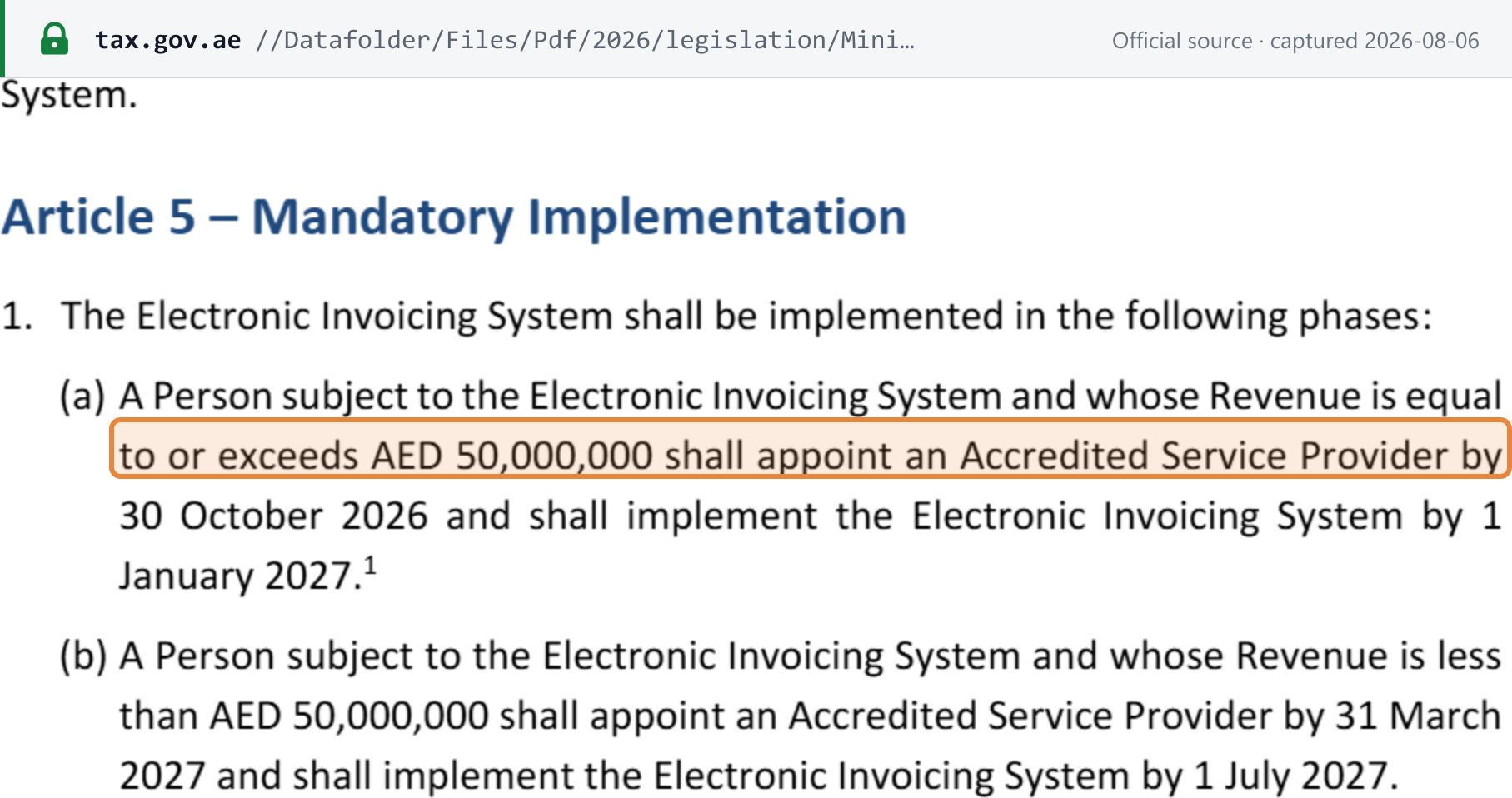 Source snapshot captured 2026-08-06 — original
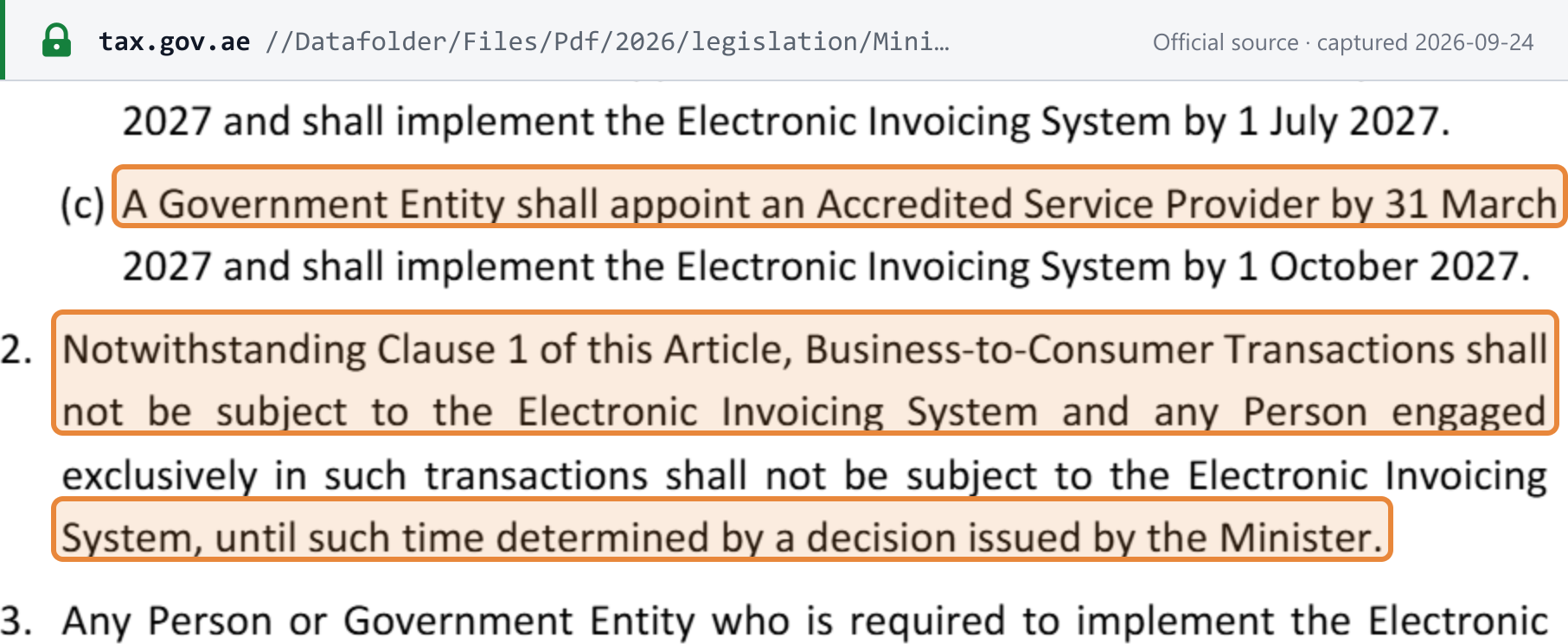 Source snapshot captured 2026-09-24 — original
Postponement: the Wave 1 ASP deadline moved from 31 July to 30 October 2026
The original MD 244 of 2025 required businesses with revenue of AED 50 million or more to appoint an ASP "by 31 July 2026". Ministerial Decision No. 66 of 2026 replaced Art. 5(1)(a). The FTA consolidation dates it "Issued 6 May 2026", and the MoF announced it on 10 May 2026 as "an extension of the deadline for the appointment of an Accredited Service Provider (ASP) from 31 July 2026 to 30 October 2026." (MoF news, 10 May 2026, checked 2026-09-24)
What survives for readers who planned against the old calendar: everything except the Wave 1 ASP date. The 1 January 2027 go-live and every Wave 2, Wave 3 and B2C rule are unchanged. In the same 10 May announcement the MoF said "32 Service Providers have already been approved". Its 30 June 2026 programme deck describes the change as final: "The Ministry emphasizes that this is a targeted and final adjustment." (MoF — UAE eInvoicing Programme, 30 June 2026, p.18, checked 2026-09-24)
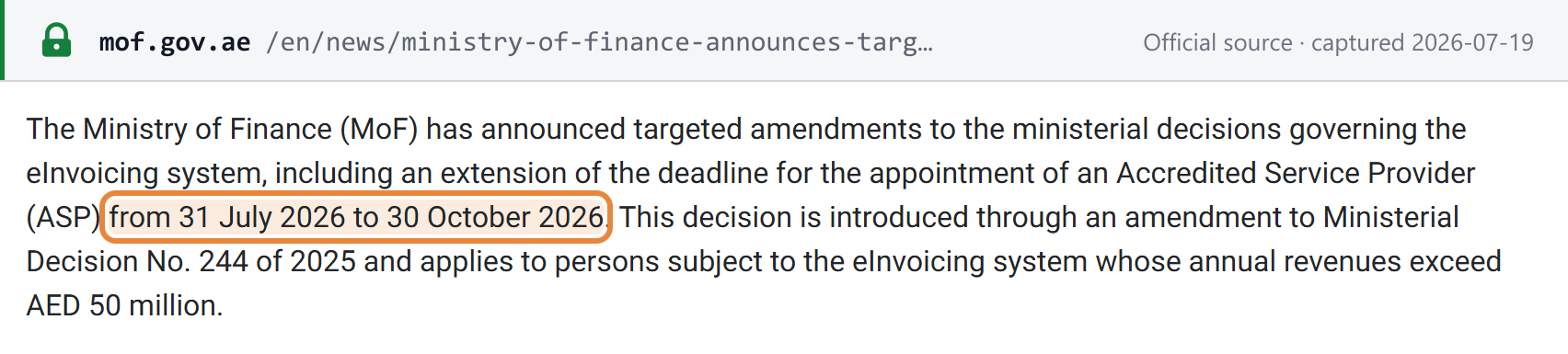 Source snapshot captured 2026-07-19 — original
The MoF hub's timeline graphic still shows "31st July" as the Wave 1 ASP date. The table in the MoF Guidelines V1.1 (1 June 2026, §8.3) also shows 31 July 2026. Neither reflects MD 66 of 2026. The Decision prevails: the ASP-appointment deadline is 30 October 2026. (Checked 2026-09-24.)
Pilot and voluntary phase (since 1 July 2026)
MD 244 Art. 3 sets up the pilot. "A Person shall be included in the Taxpayer Working Group only upon that Person's written agreement to participate", and "The Pilot Programme shall commence on 1 July 2026." Separately, "Any Person may implement the Electronic Invoicing System on a voluntary basis as from 1 July 2026" (Art. 4). [5] The MoF launched the pilot at an awareness event in Sharjah. Its news item of 26 June 2026 says the event "witnessed the launch of the pilot phase of the Electronic Invoicing’s 5-Corner Model". (MoF news, 26 June 2026, checked 2026-09-24) Voluntary users carry no penalty risk yet. The Guidelines state: "Any administrative penalties shall only be applicable from the date that Person is required to mandatorily implement Electronic Invoicing." (Guidelines V1.1 §8.2 [4])
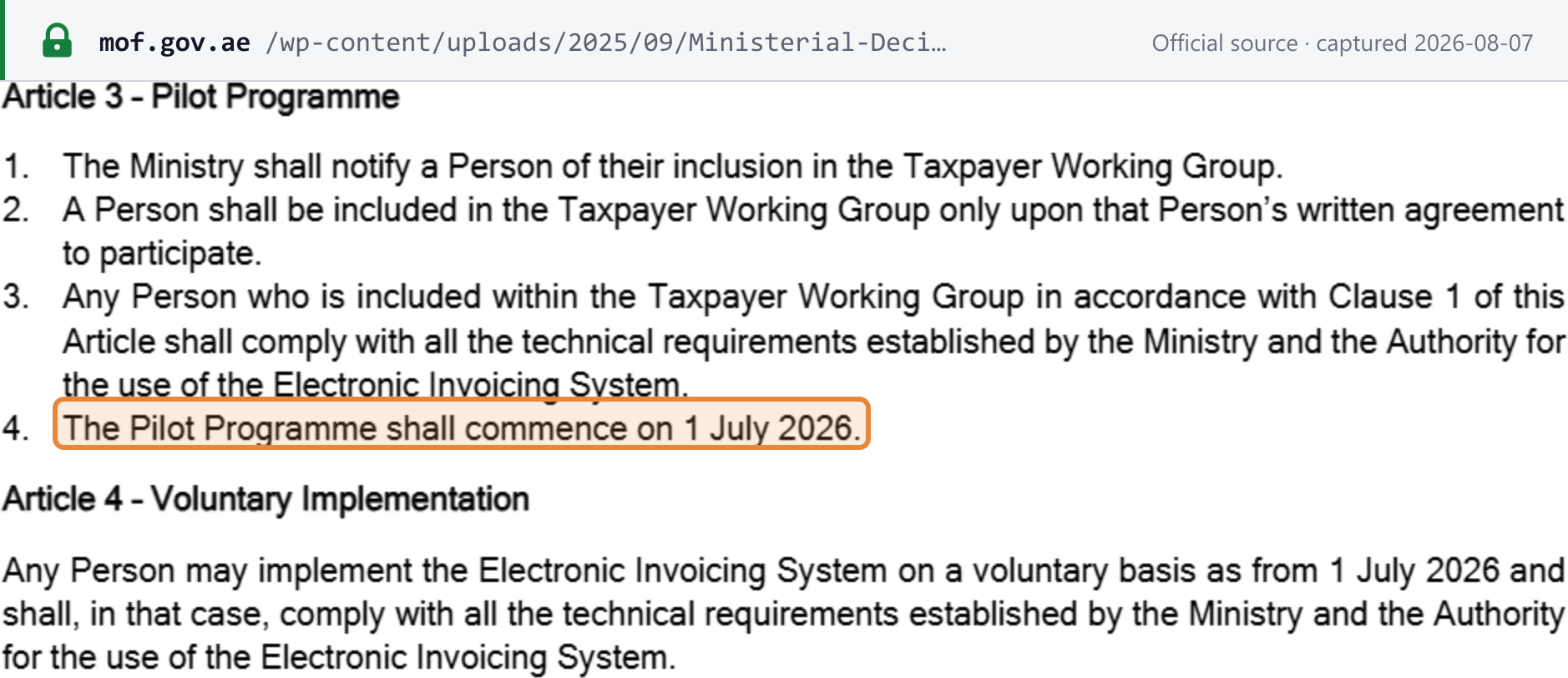 Source snapshot captured 2026-08-07 — original
Before the pilot, on 21 April 2026, the MoF opened an optional 4-corner exchange. "Businesses can now access the Federal Tax Authority’s EmaraTax system to select their preferred Accredited Service Provider (ASP)" and exchange eInvoices between Corner 1 and Corner 4 without tax reporting. The reporting leg (Corner 5) was scheduled "to go live ahead of the July pilot phase". [2]
 Source snapshot captured 2026-08-07 — original
More phases. The only future phase still open is B2C. MD 244 Art. 5(2) leaves it to "a decision issued by the Minister", and no such decision had been published as at 2026-09-24. MD 243 Art. 4(2) also says a Minister's decision will define the category of Excluded Persons. That decision has not been issued either.
Legal basis
The MoF eInvoicing hub lists six instruments under "Legislative Documents" as at 2026-09-24: MD 66/2026, MD 56/2026, Cabinet Decision 106/2025, MD 244/2025, MD 243/2025 and MD 64/2025. The two Federal Decree-Laws of 2024 sit above them. No later e-invoicing decision has been published on the MoF hub, the MoF Financial Legislation list or the FTA legislation portal (checked 2026-09-24).
- Federal Decree-Law No. 17 of 2024 amending the Tax Procedures Law (FDL 28/2022). Issued 30 September 2024, effective 30 October 2024. It inserts the definition of the Electronic Invoicing System and Art. 4(bis): "1. The Minister shall issue the necessary decisions to implement the Electronic Invoicing System and determine its effective dates, requirements and provisions required to implement the controls, rules and procedures related thereto." and "2. Any Person determined by the Minister, shall be subject to the Electronic Invoicing System." [6] (The later FDL 17 of 2025, effective 1 January 2026, deals with refunds and limitation periods. It is not e-invoicing law.)
- Federal Decree-Law No. 16 of 2024 amending the VAT Law (FDL 8/2017). Issued 30 September 2024, effective 30 October 2024. Under Art. 65(5), "the Registrant subject to the Electronic Invoicing System must issue and transmit Tax Invoices in the form of an Electronic Invoice, in accordance with the Electronic Invoicing System." Art. 70(4) applies the same rule to tax credit notes. Art. 55 makes input-tax recovery depend on retaining the tax invoice in accordance with the system. [7]
- Ministerial Decision No. 64 of 2025 on ASP eligibility and accreditation. Issued 13 March 2025, effective 29 March 2025; the MoF announced it on 20 March 2025. Under Art. 3(1), "A Service Provider shall only provide Electronic Invoicing Services in the State, where the Service Provider has obtained Accreditation in accordance with this Decision." Art. 7(4) binds ASP products to PINT AE (see Format & network). [8]
- Ministerial Decision No. 243 of 2025 on the Electronic Invoicing System covers scope (Art. 3), exclusions (Art. 4), ASP appointment (Art. 5), exchange and reporting (Art. 6), data fields (Art. 7), self-billing (Art. 9), storage (Art. 11) and system-failure notice (Art. 12). It comes into force on publication in the Official Gazette (Art. 15). The MoF announced it on 29 September 2025. The English PDF leaves the "Issued by us: On:" line blank, so its issue and Gazette dates are not published in the English text. [9]
- Ministerial Decision No. 244 of 2025 on the implementation of the Electronic Invoicing System covers the pilot, voluntary adoption and phases. The FTA consolidation dates it "Issued 17 Sep 2025"; the MoF announced it on 29 September 2025. [3] (MoF news, 29 September 2025)
- Cabinet Decision No. 106 of 2025 on violations and administrative penalties. Issued 9 October 2025, effective 15 October 2025 (FTA republication); the MoF announced it on 8 December 2025. The figures are under Penalties. [10]
- Ministerial Decision No. 56 of 2026 amends MD 64: a service provider may build on a third-party ("white-label") PSP product while keeping full responsibility. Issued 29 April 2026, effective 1 May 2026. [11]
- Ministerial Decision No. 66 of 2026 amends MD 244 Art. 5(1)(a) and moves the Wave 1 ASP deadline to 30 October 2026. Issued 6 May 2026 and announced 10 May 2026. It "shall come into force from the day following its publication" in the Official Gazette; the MoF has not published that Gazette date. [1]
Technical standards. PINT AE and the MoF Data Dictionary bind ASPs through MD 64 Art. 7(4): "The Accredited Service Provider's PSP Product complies with all the requirements of the PINT AE and related or equivalent specifications, as published by OpenPeppol following the requirements contained in the Data Dictionary." They bind taxpayers through MD 243 Art. 7: "The Electronic Invoice and Electronic Credit Note shall contain all the data fields and particulars, as prescribed by the Ministry." [12] [9]
Decisions still to come (as at 2026-09-24). Three decisions that the published instruments refer to have not been issued:
- the Excluded Persons decision (MD 243 Art. 4(2));
- the reporting timeline (MD 243 Art. 6(6): report "within the timeline prescribed by the Minister");
- the B2C decision (MD 244 Art. 5(2)).
Translation. The Arabic texts are authoritative. The FTA's consolidated English versions state that they are not an official translation. The MoF's English PDFs carry no statement either way.
Scope
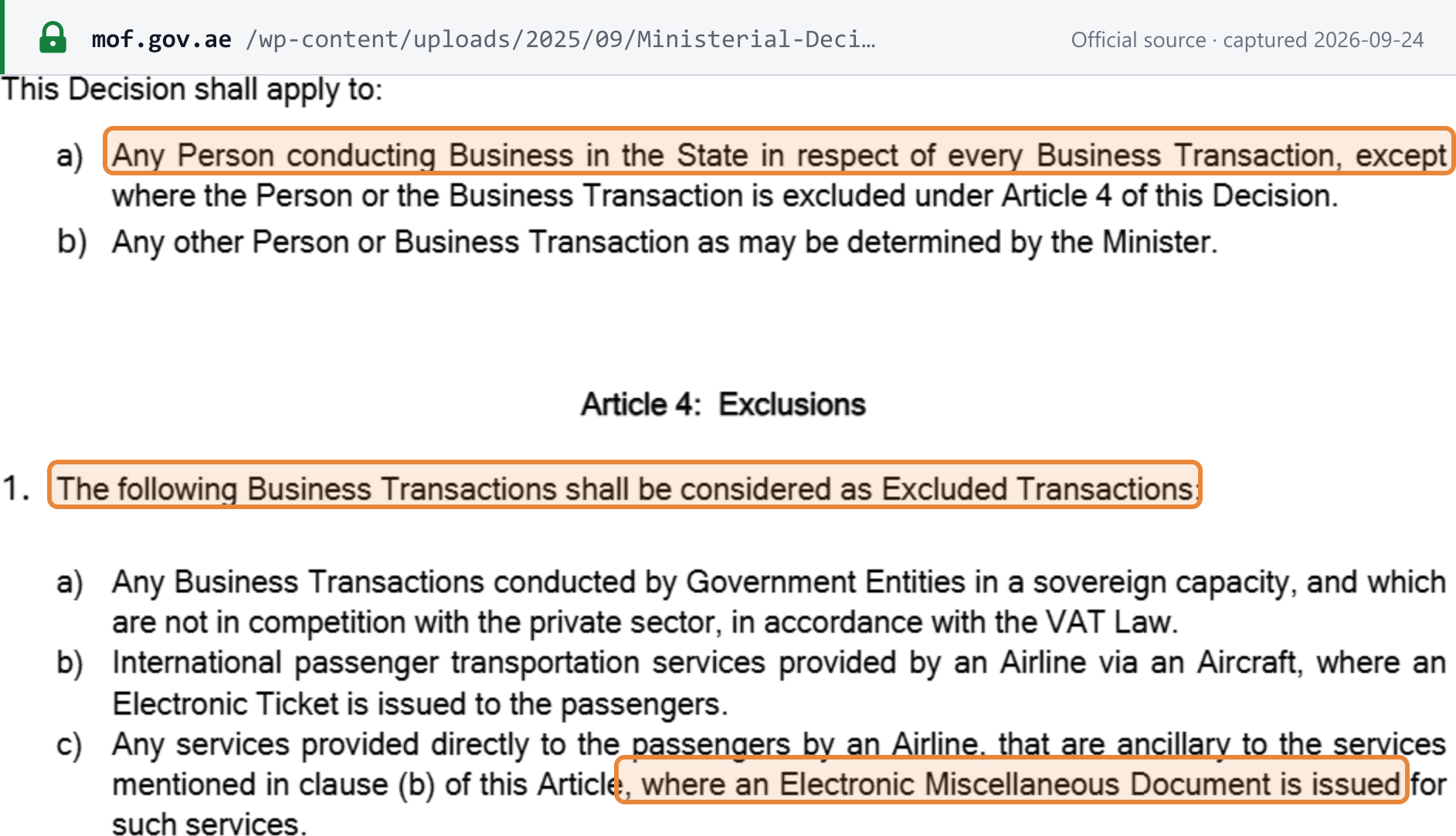
Who is in scope. Any business active in the UAE, not only VAT registrants. MD 243 Art. 3 applies the system to "Any Person conducting Business in the State in respect of every Business Transaction, except where the Person or the Business Transaction is excluded under Article 4 of this Decision." [9] The Guidelines confirm that e-invoicing "is mandatory for any Person conducting Business in the UAE, regardless of their VAT registration status". Out-of-scope, exempt and unregistered businesses therefore issue electronic Commercial Invoices. "A Person that is within the scope of Electronic Invoicing but is not required to register for any Tax type, must register with the FTA to obtain their TIN." (Guidelines V1.1 [4], checked 2026-09-24)
 Source snapshot captured 2026-09-24 — original
B2B, B2G and B2C, separately:
- B2B: in scope from the supplier's phase date (Wave 1 or Wave 2 above).
- B2G: in scope from the supplier's own phase date, not the government's 1 October 2027 date. The Guidelines note: "goods and services supplied to Government Entities (e.g. through contracts tendered in the UAE Government procurement portals) are subject to Electronic Invoicing." Invoices issued by government entities (G2B and G2G) follow Wave 3: an ASP by 31 March 2027 and go-live on 1 October 2027.
- B2C: out of scope. "Business-to-Consumer Transactions shall not be subject to the Electronic Invoicing System and any Person engaged exclusively in such transactions shall not be subject to the Electronic Invoicing System, until such time determined by a decision issued by the Minister." (MD 244 Art. 5(2) [3]) The Guidelines add: "There is no obligation for the supplier or the agent to issue an Electronic Invoice in relation to a supply that is made to a consumer."
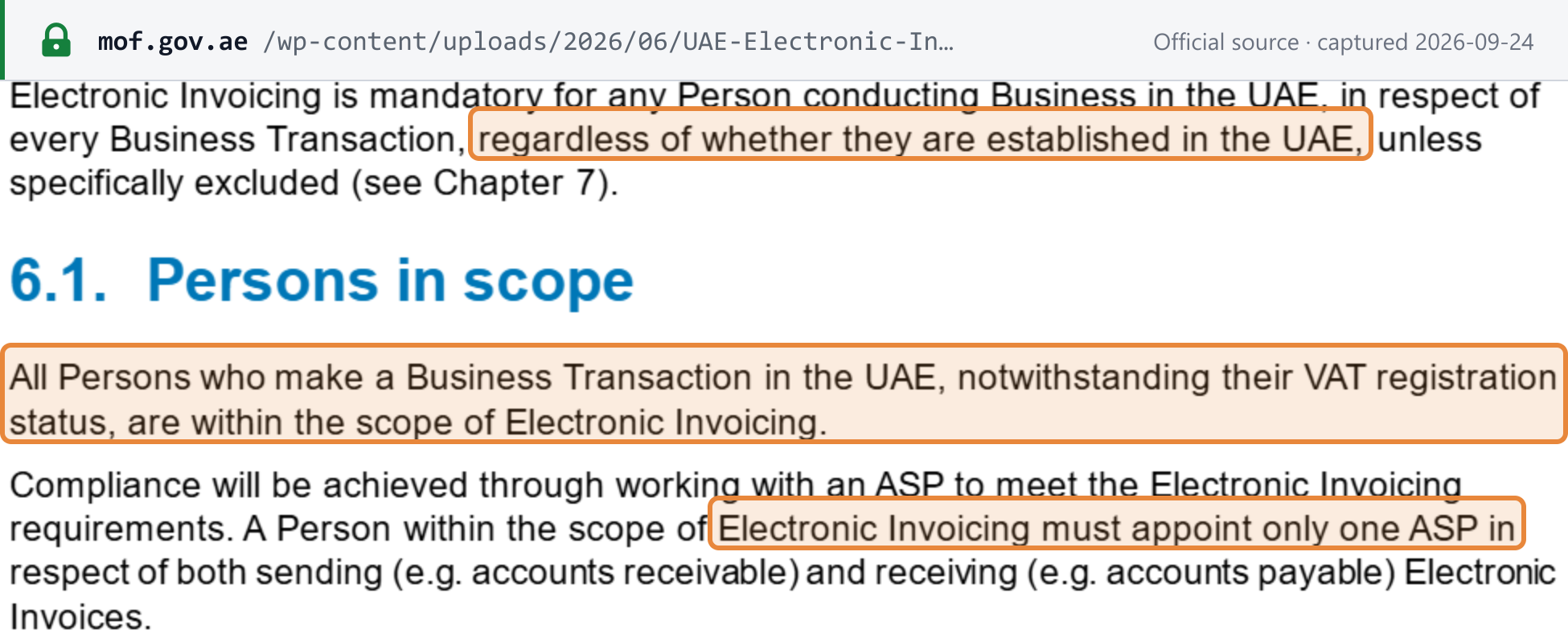
Non-established businesses: in scope. "Electronic Invoicing is mandatory for any Person conducting Business in the UAE, in respect of every Business Transaction, regardless of whether they are established in the UAE, unless specifically excluded (see Chapter 7)." A non-resident required to issue VAT tax invoices must issue them as Electronic Invoices (Guidelines V1.1 §6.3.3). [4] Two points are not addressed by the MoF (checked 2026-09-24):
- which revenue wave a non-resident without UAE financial statements falls into, beyond "other documentation acceptable to the Authority". (The MoF's eInvoicing timeline, note 3, says a newly established company uses projected revenue for the ongoing financial year; it says nothing specific about non-residents.)
- whether a non-resident that is not VAT-registered must obtain a TIN.
 Source snapshot captured 2026-09-24 — original
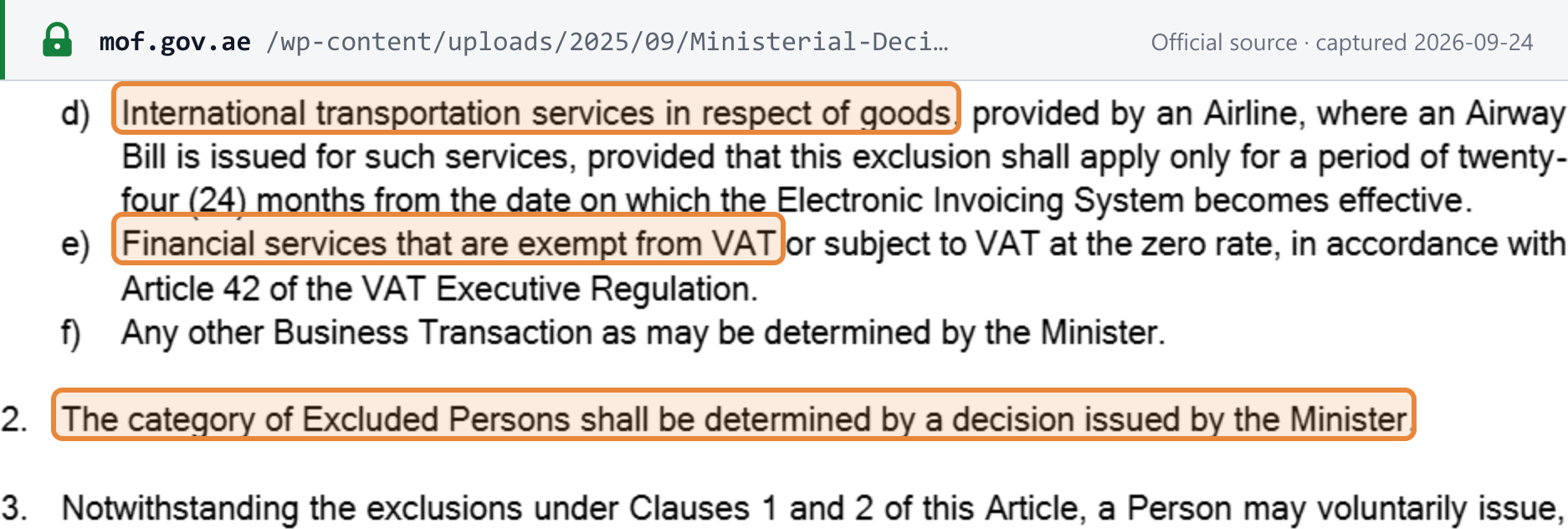
Excluded transactions (MD 243 Art. 4(1)): [9]
- transactions of Government Entities "in a sovereign capacity, and which are not in competition with the private sector";
- international passenger air transport where an Electronic Ticket is issued;
- airline services ancillary to passenger transport where an Electronic Miscellaneous Document is issued;
- international air cargo where an Airway Bill is issued, but only for 24 months "from the date on which the Electronic Invoicing System becomes effective". The MoF has not published a start or end date for this window;
- "Financial services that are exempt from VAT or subject to VAT at the zero rate, in accordance with Article 42 of the VAT Executive Regulation";
- any other transaction the Minister determines.
Anyone excluded may still opt in. If it does, the rules apply in full except the penalty decisions (Art. 4(3)).
 Source snapshot captured 2026-09-24 — original
Read these exclusions narrowly (Guidelines V1.1, ch. 7 and §10.5.1 [4]):
- Financial services: "financial services that are standard rated if supplied to resident customers are not excluded from Electronic Invoicing even where they qualify as zero-rated exports of services under Article 31 of the VAT Executive Regulation."
- Imports under reverse charge: "The import of Concerned Services and Concerned Goods is not subject to any Electronic Invoicing requirements."
- Domestic reverse charge: supplies of electronic devices, precious metals and stones, crude and refined oil, natural gas, hydrocarbons and metal scrap are in scope. They use the reverse-charge tax category.
- FTA invoice concessions: "administrative exceptions provided by the FTA in accordance with the VAT Executive Regulation in respect of Tax Invoices and Tax Credit Notes do not apply to Electronic Invoices and/or Electronic Credit Notes."
- VAT groups: each member uses its own TIN. Transactions between members get the 24-month timing grace from 1 January 2027 noted above. "The grace period affects the timing of compliance only."
- Holding companies: a holding company that only earns passive income and makes no Business Transactions is out of scope. Any recharge brings it in.
Simplified invoices: no e-invoice equivalent. The Guidelines list "6 categories of Electronic Invoices". They are the electronic Tax Invoice, electronic Tax Credit Note, self-billed electronic Tax Invoice, self-billed electronic Tax Credit Note, Commercial Invoice and Electronic Credit Note. MD 243, MD 244 and the Guidelines V1.1 contain no simplified-invoice category and no value threshold for one (checked 2026-09-24). The VAT-law simplified tax invoice stays a VAT concept, and B2C, its main use, is out of scope. Provisional invoices get no category of their own either: "Every provisional invoice issued should be an Electronic Invoice."
Core obligations once in scope (MD 243 [9]; Guidelines V1.1 [4]):
- 14-day rule. An eInvoice or eCredit Note "must be issued and transmitted by the Issuer through the Electronic Invoicing System within 14 days from the Date of Business Transaction". VAT registrants follow the VAT-law timeline instead.
- Credit notes. An eCredit Note is required on cancellation, a price reduction, a refund, or an administrative or numerical error (Art. 6(2)).
- One ASP for both directions. A business "must appoint only one ASP in respect of both sending (e.g. accounts receivable) and receiving (e.g. accounts payable) Electronic Invoices." Recipients must process eInvoices through the system.
- Data changes. Tell your ASP in writing of changes to your FTA-registered data within 5 Business Days (Art. 5(3)).
- System failure. "Every Issuer and Recipient shall notify the Authority of a System Failure within 2 Business Days from the date of occurrence of the System Failure" (Art. 12).
- Storage. eInvoices and associated data must be stored "within the State" (Art. 11). The Guidelines read this as retrievable for the FTA "irrespective of the geographic location of the servers, databases, or cloud-based solutions used to store them."
Format & network
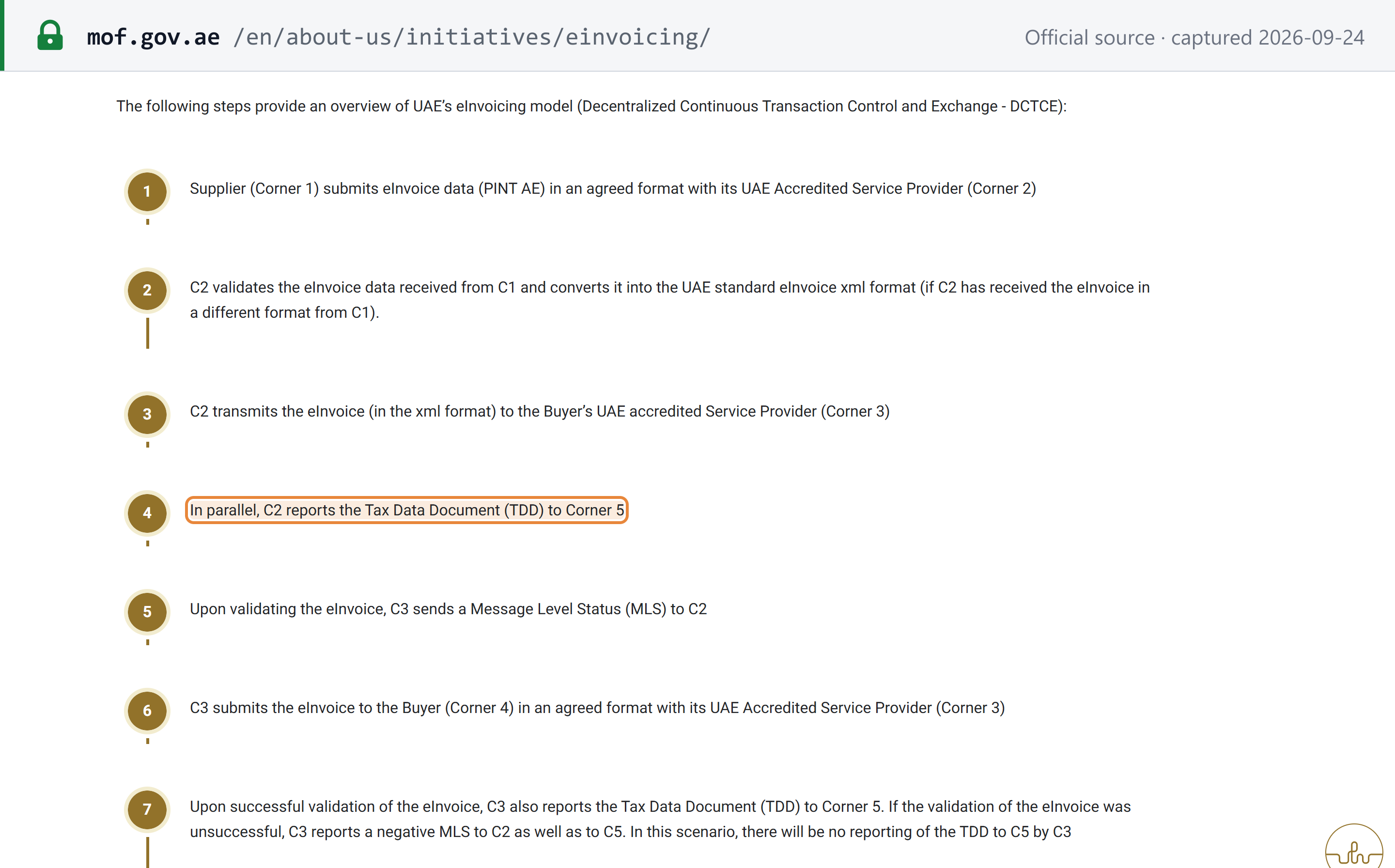
CTC model: decentralised exchange with parallel tax reporting (DCTCE), not clearance. The MoF hub describes "UAE’s eInvoicing model (Decentralized Continuous Transaction Control and Exchange - DCTCE)" in ten steps:
- The supplier (Corner 1) sends invoice data to its ASP (Corner 2).
- Corner 2 validates the data, converts it to the UAE XML and sends it to the buyer's ASP (Corner 3) over Peppol.
- At the same time, "C2 reports the Tax Data Document (TDD) to Corner 5", which is the FTA.
- Corner 3 validates the invoice, returns a Message Level Status (MLS) to Corner 2, delivers the invoice to the buyer (Corner 4) and also reports the TDD to Corner 5.
- If validation fails, Corner 3 sends a negative MLS to Corner 2 and Corner 5 and reports nothing. Corner 5 confirms receipt to both ASPs.
(MoF eInvoicing hub, checked 2026-09-24)
In the published flow the FTA is not in the exchange path, and there is no step where it approves or stamps an invoice before delivery (MoF hub and Guidelines V1.1 §5.1, checked 2026-09-24). Both sides report. Under MD 243 Art. 6(6), "The Issuer and the Recipient must report Electronic Invoices and Electronic Credit Notes issued under Clauses 1, 2 and 3 of this Article to the Authority within the timeline prescribed by the Minister." [9] The Minister had not published that reporting timeline as at 2026-09-24.
 Source snapshot captured 2026-09-24 — original
XML only: no QR code, no barcode. "Electronic Invoices are issued, transmitted and received in XML format and will not feature a Quick Response Code ("QR code") or barcode." (Guidelines V1.1 §5.3 [4]) Apart from Peppol transport security (ASP PKI certificates and encryption under MD 64), none of the published instruments (MD 243, MD 244, MD 64, the Guidelines V1.1, the mandatory-fields document) requires an invoice-level cryptographic stamp or hash chain (checked 2026-09-24). This differs from Saudi Arabia's ZATCA model, which uses QR codes and cryptographic stamps.
 Source snapshot captured 2026-09-24 — original
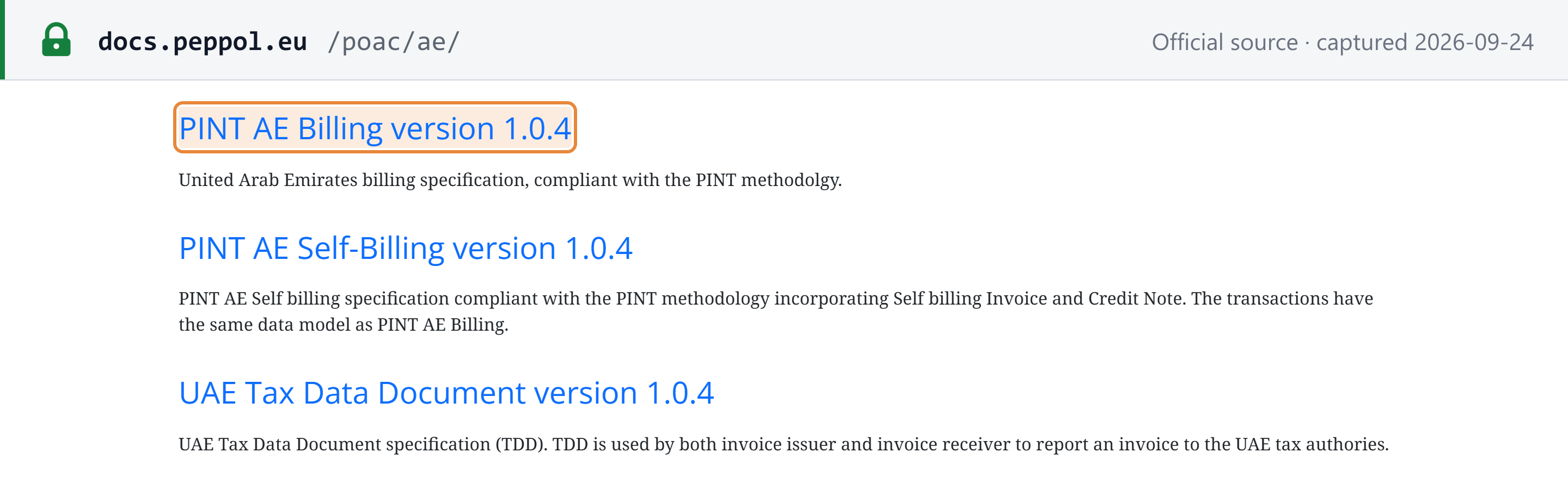
XML standard: PINT AE (Peppol International model, UBL syntax). The UAE's national CIUS is PINT AE. The MoF names it, and MD 64 binds ASPs to it "as published by OpenPeppol". Version numbers come from OpenPeppol's documentation site (docs.peppol.eu), not from a UAE government source. OpenPeppol is the publisher MD 64 designates, and it publishes these specifications on behalf of the UAE Peppol Authority. As listed on 2026-09-24:
- PINT AE Billing 1.0.4 (release notes dated 2026-06-02);
- PINT AE Self-Billing 1.0.4;
- UAE Tax Data Document (TDD) 1.0.4;
- PDK 1.4.4, released 29 July 2026.
The Billing CustomizationID is urn:peppol:pint:billing-1@ae-1 and the ProfileID is
urn:peppol:bis:billing (self-billing: urn:peppol:bis:selfbilling).
(OpenPeppol — UAE specifications;
PINT AE release notes, checked 2026-09-24)
 Source snapshot captured 2026-09-24 — original
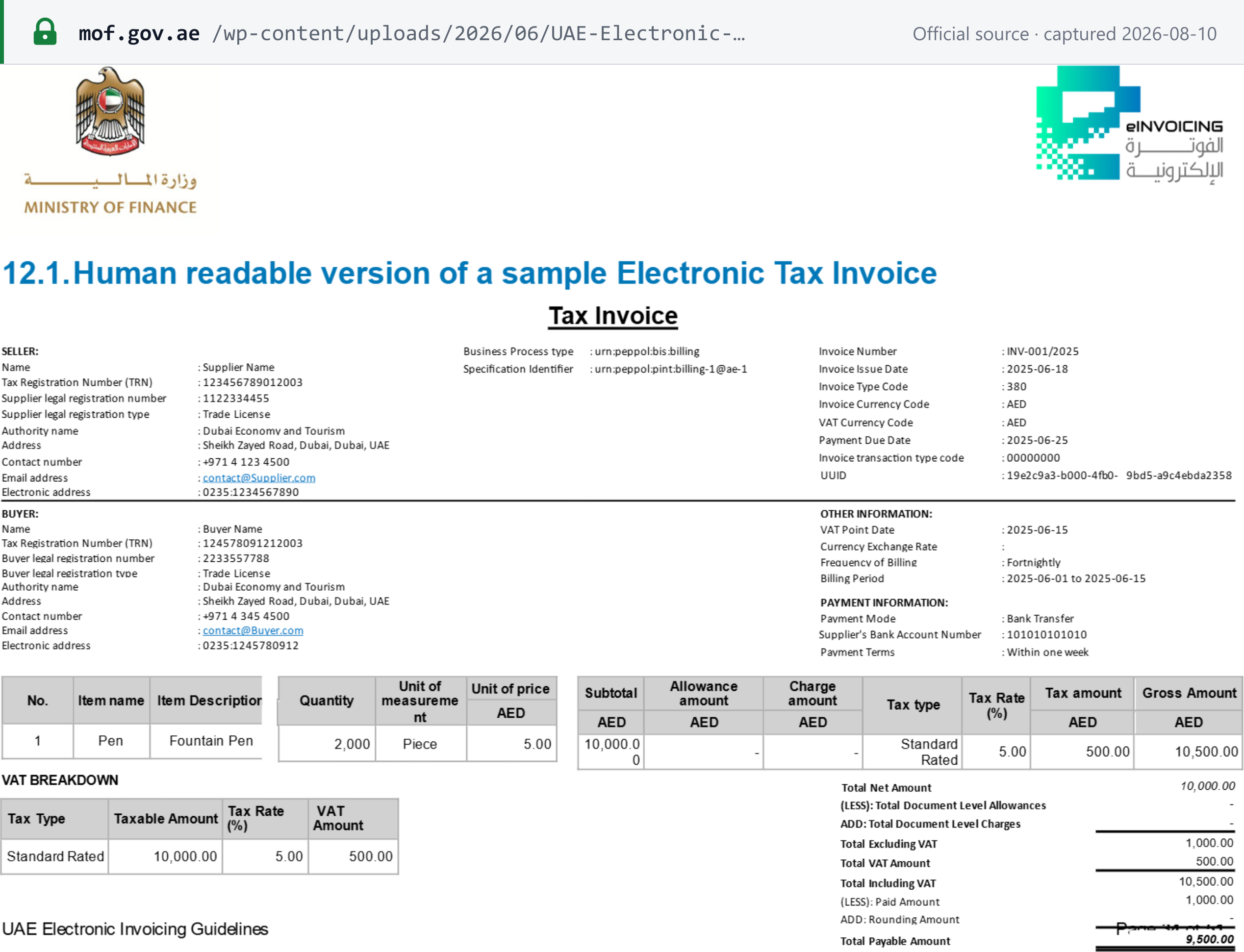
Mandatory fields. The MoF document "UAE Electronic Invoice Mandatory Fields" (V1.0, 23 February 2026) lists 51 mandatory fields for an electronic Tax Invoice (§4.1) and 49 for a commercial eInvoice (§4.2). (MoF — Mandatory fields V1.0, checked 2026-09-24)
- Transaction-type code. The tax-invoice list includes an 8-flag "Invoice transaction type code": Free Zone, Deemed Supply, Margin Scheme, Summary Invoice, Continuous Supply, Disclosed Agent Billing, Supply through e-commerce, Exports.
- AED amounts. It also includes AED-denominated line amounts.
- Seller identifier. The seller's legal registration identifier is one of TL (trade licence), EID (Emirates ID), PAS (passport) or CD (Cabinet Decision).
The Guidelines add three clarifications:
- "Persons and Government Entities will not be allowed to add additional optional fields of their own into PINT-AE."
- "HSN codes are currently optional." The date they become mandatory is to be announced.
- "There are no constraints on the number of lines that can be included in an Electronic Invoice for the UAE."
(Guidelines V1.1 §12 [4])
 Source snapshot captured 2026-08-10 — original
Peppol participant ID. The ID "is 0235 followed by the 10-digit TIN of the Person or Government Entity". The TIN is the first 10 digits of the 15-digit TRN. Each VAT-group member uses its own TIN. Three reserved endpoints cover buyers without a Peppol ID (Guidelines V1.1 [4]):
| Endpoint | Use |
|---|---|
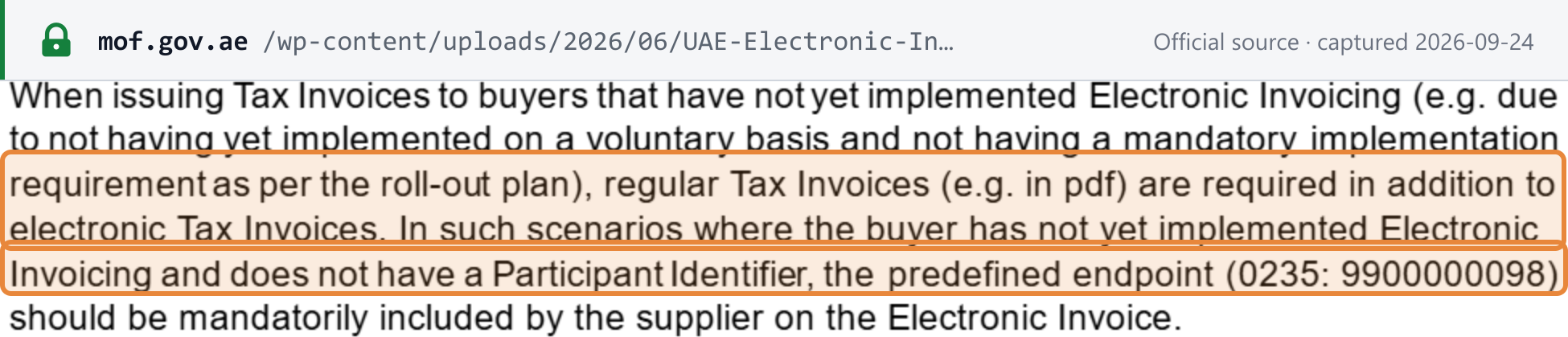
0235: 9900000098 | Buyer has not yet implemented e-invoicing and has no Participant Identifier. A regular tax invoice (e.g. PDF) is still required as well (§10.2.2) |
0235: 9900000097 | Deemed supplies, always (§10.4) |
0235: 9900000099 | Exports where the buyer has no Peppol ID |
The eInvoice is the VAT tax invoice. The Guidelines say "Electronic Invoicing does not remove a Taxable Person's obligation to issue a Tax Invoice or a Tax Credit Note". The revised VAT law makes the eInvoice that tax invoice. A separate PDF is only needed for buyers who are not yet on the system: "regular Tax Invoices (e.g. in pdf) are required in addition to electronic Tax Invoices." Self-billing "will require the buyer to be on the Electronic Invoicing System."
E-reporting. There is no separate e-reporting return. Reporting is the TDD that Corners 2 and 3 send to the FTA. The MoF expects the data to "facilitate the automatic pre-population of certain fields in VAT returns". That is a stated benefit, not a dated obligation.
 Source snapshot captured 2026-09-24 — original
Onboarding: how to comply
You cannot comply without an Accredited Service Provider. There is no government portal for typing in invoices, unlike ZATCA's or MyInvois's portals (MoF and FTA material, checked 2026-09-24). How data moves from your ERP to your ASP (API, file upload or the ASP's own portal) is agreed with the ASP. The Guidelines' first flow step: "Supplier (Corner 1) submits Electronic Invoice data in an agreed format with its ASP (Corner 2)."
- Work out your phase. Take Revenue from your most recent financial statements (a newly established company uses projected revenue for the ongoing financial year, per the MoF timeline). AED 50 million or more means an ASP by 30 October 2026 and go-live on 1 January 2027. Below that, the dates are 31 March 2027 and 1 July 2027.
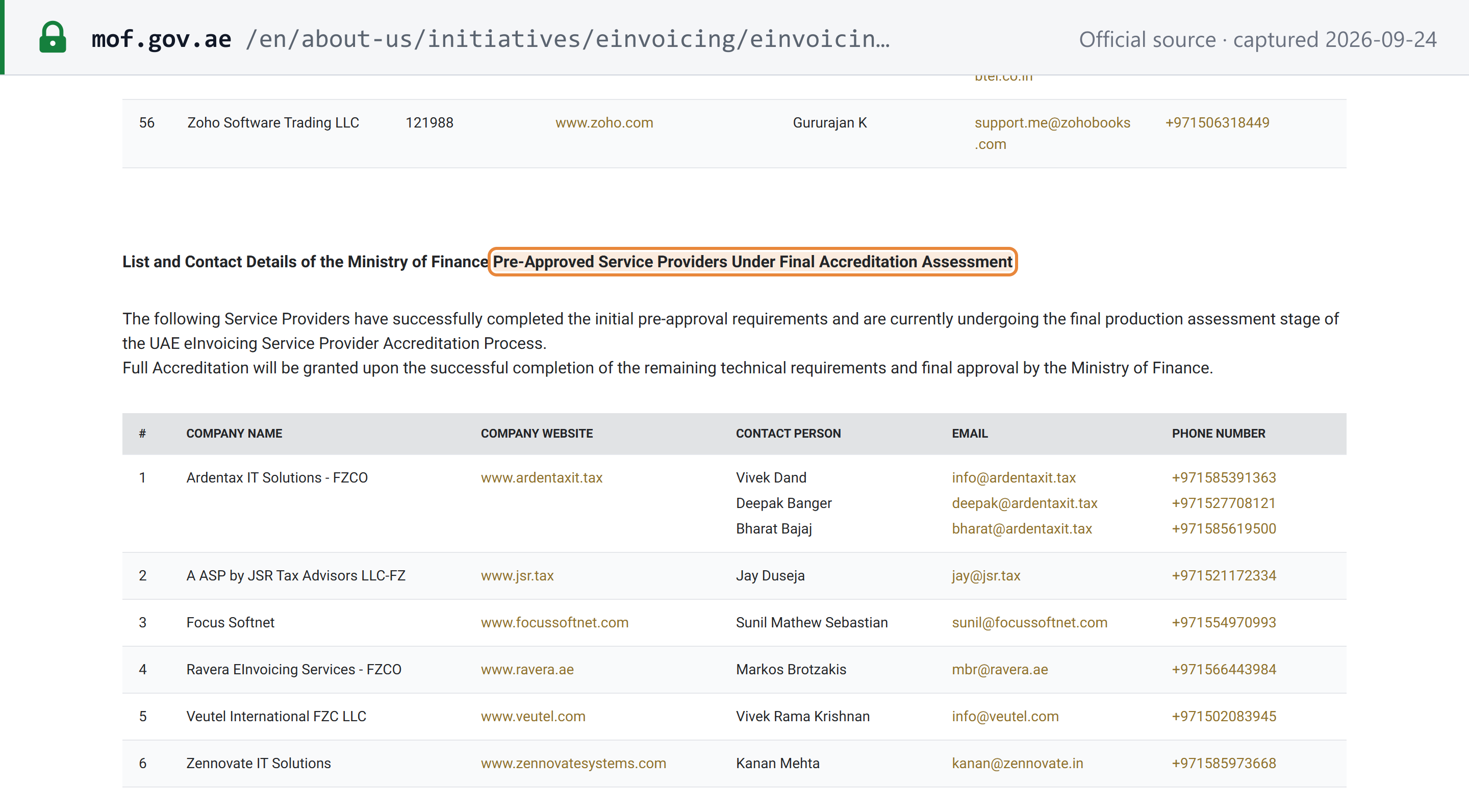
- Choose an ASP from the MoF's official list. On 2026-09-24 the MoF ASP page listed 56 accredited ASPs and 6 pre-approved providers in final accreditation assessment. The count moves: the MoF reported 32 approved on 10 May 2026, and its 30 June 2026 deck cited "41 Pre-Approved Service Providers". Check the live list rather than a copied one.
- Sign a commercial contract with the ASP.
- Onboard through EmaraTax. "The process of onboarding with an ASP should be initiated by the Person or Government Entity (not the ASP) via EmaraTax, which can be accessed through the FTA's website." The account admin clicks the E-INVOICING tile, selects the ASP and clicks "Proceed to ASP", then continues on the ASP's portal. Update your EmaraTax company details (trade licence, address, contacts) first. Each Tax Group member onboards separately: "Each of the group members may onboard with a different ASP."
- Get your Peppol Participant Identifier (0235 plus your TIN) from the ASP.
- Test. The Guidelines' readiness steps are: "a. Agree on approach to transmit invoice data. b. Ensure system readiness to transmit invoice data to the ASP. c. Test end-to-end exchange and reporting of Electronic Invoices." Neither the MoF nor the FTA publishes a sandbox for taxpayers (checked 2026-09-24). Testing runs through your ASP. Since 21 April 2026 the optional 4-corner channel, and since 1 July 2026 the voluntary and pilot phase, have been the official ways to rehearse live.
- Keep it current. VAT registration, joining or leaving a Tax Group, deregistration and closure all go through EmaraTax "reverification/offboarding".
(Guidelines V1.1 §§9, 13 [4], checked 2026-09-24)
 Source snapshot captured 2026-09-24 — original
How ASP accreditation works (MD 64 of 2025 as amended by MD 56 of 2026 [12] [11]):
- Who can apply: a Peppol-certified provider that has passed the OpenPeppol conformance tests, with 2 years' product experience, a UAE incorporation or licence, and paid-up capital of at least AED 50,000.
- Certifications: ISO 22301 and ISO/IEC 27001.
- Tax registration: Corporate Tax, and VAT where required.
- Insurance: professional indemnity of at least AED 2,500,000, and crime and cyber-fraud cover of at least AED 5,000,000 each.
- Free service commitment: each ASP commits to "providing per annum (100) hundred free eInvoice exchange and reporting services commencing from the date of the signature of the End-User agreement".
- Path to accreditation: Pre-Approval comes after interoperability and FTA verification testing. Full Accreditation comes after tax-data reporting tests and a production trial.
- Validity: "The Accreditation status of the Accredited Service Provider shall be valid for (2) two years from the date of granting of the Accreditation." Renewal must be filed at least 70 Business Days before expiry.
- Losing accreditation: the provider is delisted from the Central Register within 5 Business Days and must notify its end users within 5 Business Days. The Decision sets no transition period for affected businesses to move to another ASP (checked 2026-09-24).
Penalties
Cabinet Decision No. 106 of 2025 sets six e-invoicing penalties [13]:
| # | Violation | Who | Penalty |
|---|---|---|---|
| 1 | Failure to implement the system, including failure to appoint an ASP within the timeline | Issuer | AED 5,000 for each month of delay or part month |
| 2 | Failure to issue and transmit an Electronic Invoice on time | Issuer | AED 100 per eInvoice, capped at AED 5,000 per calendar month |
| 3 | Failure to issue and transmit an Electronic Credit Note on time | Issuer | AED 100 per eCredit Note, capped at AED 5,000 per calendar month |
| 4 | Failure to notify the FTA of a System Failure on time | Issuer | AED 1,000 for each day of delay or part day |
| 5 | Failure to notify the FTA of a System Failure on time | Recipient | AED 1,000 for each day of delay or part day |
| 6 | Failure to notify the ASP of changes to FTA-registered data on time | Issuer or Recipient | AED 1,000 for each day of delay or part day |
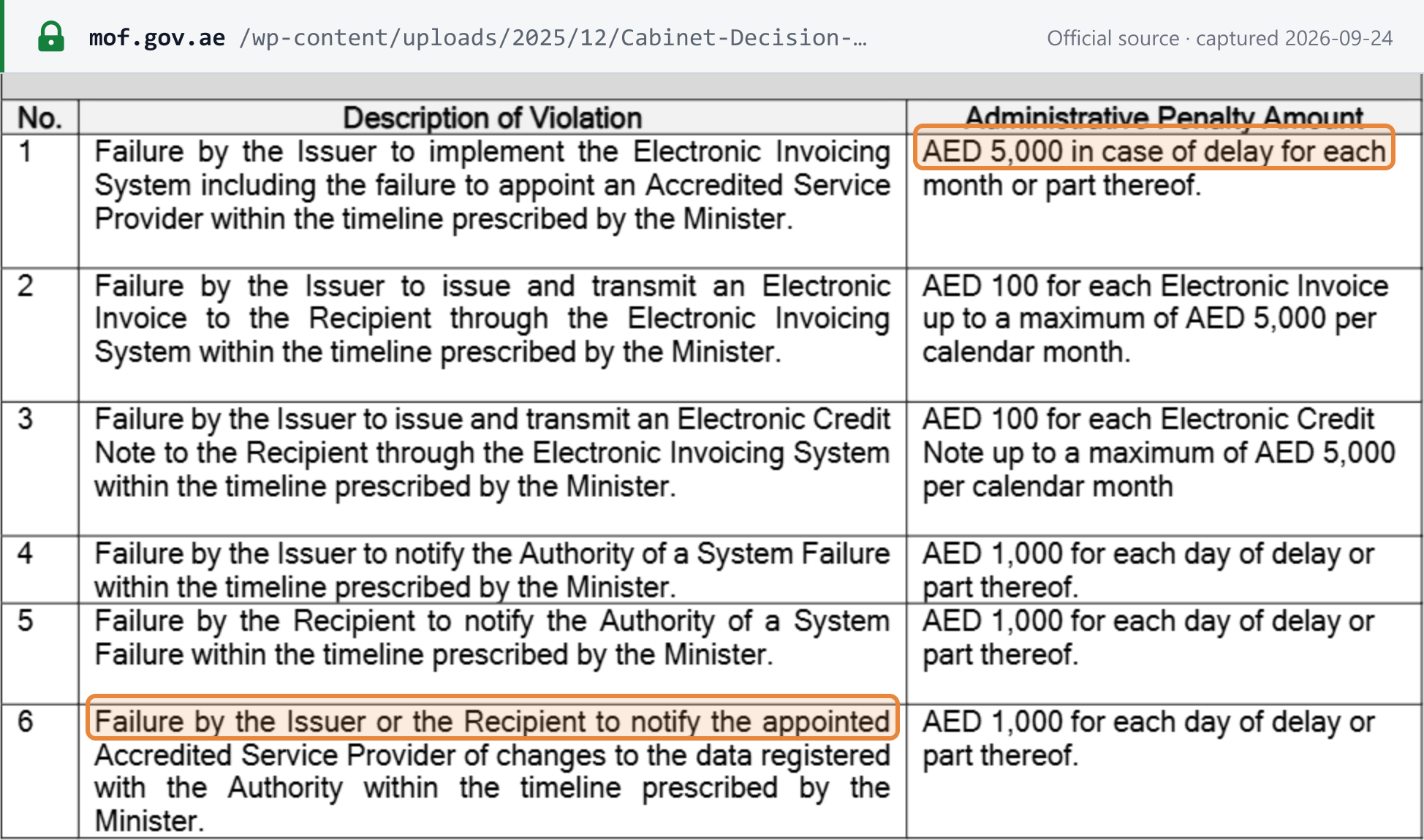 Source snapshot captured 2026-09-24 — original
- Voluntary users. They are outside the Decision (Art. 2(2)). The MoF puts it this way: "persons applying the system voluntarily are exempt from the resolution, and no fines will apply to them until they become mandatorily subject to the Electronic Invoicing System." (MoF news, 8 December 2025, checked 2026-09-24)
- Who is fined. Rows 1–4 fall on the issuer, row 5 on the recipient and row 6 on either. There is no separate penalty for failing to receive.
- Other penalties still apply. Tax-invoice failures remain subject to the general VAT and Tax Procedures penalties in Cabinet Decision No. 40 of 2017 (Guidelines V1.1 §11.1).
- No grace period announced. Neither the MoF nor the FTA had published a grace period or tolerance for the 1 January 2027 go-live as at 2026-09-24.
Frequently asked questions
Our revenue is AED 50 million or more — is 30 October 2026 our go-live date?
No. 30 October 2026 is the deadline to appoint an Accredited Service Provider. Go-live, when you must implement the Electronic Invoicing System, is 1 January 2027. Ministerial Decision No. 66 of 2026 moved the ASP deadline from 31 July 2026 and left the go-live date unchanged. Missing either can cost AED 5,000 for each month or part month of delay under Cabinet Decision No. 106 of 2025. (MD 244 of 2025 Art. 5(1)(a) as amended; checked 2026-09-24)
Do we need an ASP if we only receive e-invoices?
Yes. The issuer and the recipient must each appoint an Accredited Service Provider. One ASP covers both directions: a business "must appoint only one ASP in respect of both sending (e.g. accounts receivable) and receiving (e.g. accounts payable) Electronic Invoices." Recipients must process eInvoices through the system and report them to the FTA. (MD 243 of 2025 Arts. 5–6; MoF Guidelines V1.1 §6.1; checked 2026-09-24)
Our revenue is under AED 50 million but our customer is a large company — when must we start?
Your own phase applies: appoint an ASP by 31 March 2027 and go live by 1 July 2027. You may join voluntarily at any time from 1 July 2026. In the other direction, a supplier already live that invoices a buyer not yet on the system puts the reserved endpoint 0235: 9900000098 on the eInvoice. It must also send a regular tax invoice, e.g. a PDF. (MD 244 of 2025 Arts. 4–5; MoF Guidelines V1.1 §10.2.2; checked 2026-09-24)
Do we still need to send a PDF tax invoice?
Only to buyers who have not yet implemented e-invoicing. For those buyers "regular Tax Invoices (e.g. in pdf) are required in addition to electronic Tax Invoices". For a buyer on the system, the electronic Tax Invoice is the tax invoice, provided it meets the VAT-law requirements. (MoF Guidelines V1.1 §10.2.2; checked 2026-09-24)
Are businesses that are not VAT-registered, or not established in the UAE, in scope?
Yes, unless a transaction is specifically excluded. E-invoicing applies to any person conducting business in the UAE "regardless of their VAT registration status" and "regardless of whether they are established in the UAE". A person in scope that has no tax registration must register with the FTA to obtain a TIN. The MoF's timeline says a newly established company uses projected revenue for the ongoing financial year; it has not said which revenue wave applies to a non-resident without UAE financial statements. (MD 243 of 2025 Art. 3; MoF Guidelines V1.1 ch. 6; MoF eInvoicing hub timeline, note 3; checked 2026-09-24)
Is there a QR code or cryptographic stamp, as in Saudi Arabia?
No QR code or barcode. UAE eInvoices "are issued, transmitted and received in XML format and will not feature a Quick Response Code ("QR code") or barcode." The published MoF material also specifies no invoice-level cryptographic stamp or hash chain. The FTA receives a parallel Tax Data Document from both ASPs instead of clearing each invoice. (MoF Guidelines V1.1 §5.3; checked 2026-09-24)
What if the e-invoicing system or our ASP goes down?
The issuer and the recipient must each notify the FTA of a System Failure within 2 Business Days of it occurring. Late notification costs AED 1,000 for each day of delay or part day. (MD 243 of 2025 Art. 12; Cabinet Decision No. 106 of 2025; checked 2026-09-24)
Will B2C invoices have to go through the system?
Not yet. Business-to-consumer transactions, and businesses that deal only with consumers, are outside the system "until such time determined by a decision issued by the Minister". No such decision had been issued as at 2026-09-24. (MD 244 of 2025 Art. 5(2))
Recent changes
- 2026-07-01 — Pilot Programme started with a Taxpayer Working Group chosen by the MoF (written consent required), and voluntary adoption opened to any person. Mandatory go-live stays 1 January 2027 for revenue of AED 50 million or more. (UAE Ministry of Finance) — see event record
- 2026-05-10 — MoF announced Ministerial Decision No. 66 of 2026 (issued 6 May 2026). It moves the ASP-appointment deadline for revenue of AED 50 million or more from 31 July 2026 to 30 October 2026. Go-live on 1 January 2027 is unchanged. (UAE Ministry of Finance) — see event record
- 2026-04-21 — Optional 4-corner Peppol exchange launched: businesses can select an ASP in EmaraTax and exchange eInvoices before the pilot, without tax reporting. (UAE Ministry of Finance) — see event record
- 2025-12-08 — MoF announced Cabinet Decision No. 106 of 2025 on e-invoicing penalties: AED 5,000 a month for failing to implement or appoint an ASP, AED 100 per late eInvoice (capped at AED 5,000 a month), and AED 1,000 a day for late notifications. (UAE Ministry of Finance)
- 2025-09-29 — MoF announced Ministerial Decisions No. 243 of 2025 (scope and obligations) and No. 244 of 2025 (pilot and phased timeline). (UAE Ministry of Finance)
Related resources
- UAE VAT guide — rates, registration and tax-invoice rules in the country guide
- UAE tax identification numbers (TRN and TIN) — your Peppol ID is 0235 plus the first 10 digits of the TRN
- How to verify a UAE TRN
- E-invoicing status and networks worldwide — the UAE row in global context
- Peppol network explainer
- Saudi Arabia ZATCA e-invoicing (Fatoora) — the GCC neighbour's clearance model, for contrast
- UAE tax-change chronology — every tracked UAE change, dated and sourced
- Validate a UAE TRN
Important websites
- MoF eInvoicing hub — the MoF's stated sole official source: model, timeline and legislative documents
- MoF list of Accredited Service Providers — updated periodically
- UAE Electronic Invoicing Guidelines V1.1 (PDF, 1 June 2026) — its §8.3 table still shows the superseded 31 July 2026 ASP date
- UAE Electronic Invoice Mandatory Fields V1.0 (PDF, 23 February 2026)
- PINT AE specifications (OpenPeppol) — Billing, Self-Billing and Tax Data Document specs
- Federal Tax Authority — EmaraTax login, where onboarding with an ASP starts