Austria lets customs force cash collection of import VAT on suspicion of a tax offence
- Jurisdiction
- Austria
- Tax
- VAT
- Change type
- Compliance
- Status
- Enacted
- Impact
- Plan ahead
- Announced
- 29 July 2026
- Effective
- 1 January 2027
- Instrument
- AT-BGBL-I-62-2026
- Authority
- Rechtsinformationssystem des Bundes (RIS)
- Systems
- Customs, ERP, Tax engine
- Verified
- Fetched from official source · high confidence
Importers into Austria using the deferred import-VAT account under section 26(3)(2) no. 1 of the Umsatzsteuergesetz 1994, where a customs office of the Federal Finance Administration suspects a financial offence under section 80 FinStrG in connection with the import.
If you use the deferred import-VAT account under section 26(3)(2) no. 1 UStG, be aware that from 1 January 2027 a customs office may order mandatory collection of import VAT for up to two years where it suspects a financial offence under section 80 FinStrG. Model the cash-flow effect.
CustomsERPTax engine
Austria’s Budgetbegleitgesetz 2027-2028, published as BGBl. I Nr. 62/2026 on 29 July 2026, amends section 26(3)(2) of the Umsatzsteuergesetz 1994. Where there is suspicion of a financial offence under section 80 of the Finanzstrafgesetz in connection with the import of goods, the customs offices of the Federal Finance Administration may by decision order mandatory collection of import VAT under section 26(3)(2) no. 1 for a period of up to two years. The amendment takes effect on 1 January 2027 and applies first to turnovers and other facts connected with imports occurring after 31 December 2026.
What changed in detail
Austria’s Budgetbegleitgesetz 2027-2028, published as BGBl. I Nr. 62/2026 on 29 July 2026, amends section 26(3)(2) of the Umsatzsteuergesetz 1994. Where there is suspicion of a financial offence under section 80 of the Finanzstrafgesetz in connection with the import of goods, the customs offices of the Federal Finance Administration may, by decision, order mandatory collection of import VAT under section 26(3)(2) no. 1 for a period of up to two years. The amendment takes effect on 1 January 2027 and applies first to turnovers and other facts connected with imports occurring after 31 December 2026.
What it means
Section 26(3)(2) no. 1 is the deferred-payment account that lets a business report import VAT on its periodic return instead of paying it in cash at the border — the mechanism that makes import VAT broadly cash-flow-neutral. From 2027, a mere suspicion of a financial offence lets customs switch an importer off that deferral and onto mandatory cash collection, for up to two years, by administrative decision. The cash-flow effect is the point: an importer that has built working capital planning around deferred import VAT should treat an open customs suspicion under section 80 FinStrG as a trigger to model paying import VAT upfront, not as a formality to wait out.
Proof
Liegt im Zusammenhang mit der Einfuhr von Gegenständen ein Verdacht auf das Vorliegen eines Finanzvergehens gemäß § 80 FinStrG vor, können die Ämter der Bundesfinanzverwaltung mit Bescheid für die Dauer von bis zu zwei Jahren eine verpflichtende Erhebung der Einfuhrumsatzsteuer gemäß Z 1 vorsehen.Where there is suspicion, in connection with the import of goods, of a financial offence under section 80 FinStrG, the offices of the Federal Finance Administration may, by decision, order mandatory collection of import VAT under no. 1 for a period of up to two years.
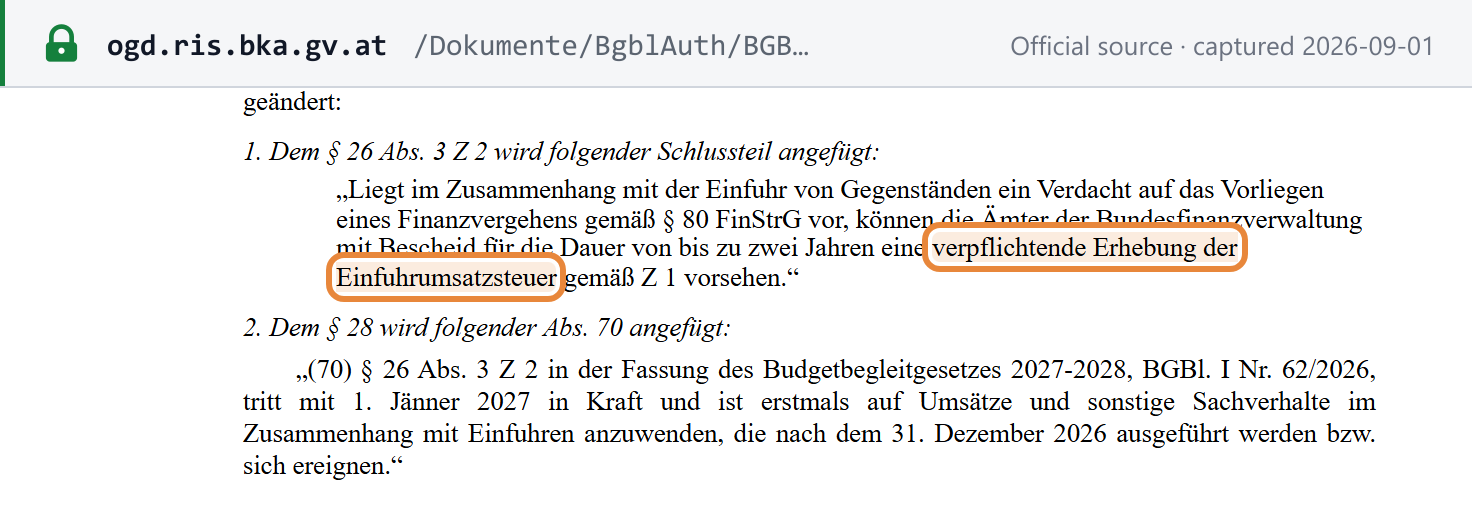 Source snapshot of the official page. Open full size ↗
Archived from the official distribution · ogd.ris.bka.gv.at