E-invoicing in the Republic of the Congo: the SFEC
Overview
The Republic of the Congo (Congo-Brazzaville; not the Democratic Republic of the Congo) runs the Système de Facturation Électronique Certifié — SFEC, the certified e-invoicing system of the Direction Générale des Impôts et des Domaines (DGID), part of the Ministry of Finance, Budget and Public Portfolio (MFBPP). [1] [3]
Three names come up:
- SFEC — the means an economic agent uses "pour émettre, transmettre et stocker les factures": certified invoicing terminals and software, and the online invoicing platform (Décret n° 2026-101, art. 3).
- PGSFEC — the plateforme de gestion des systèmes de facturation électronique certifiés, the tax administration's platform that receives certified-invoice data in real time (art. 3).
- e-Facture — the DGID's free online invoicing platform, at efacture.gouv.cg, also offered as a mobile app.
Legal basis in one line. VAT law (Loi n° 12-97, as amended) articles 31, 34 bis and 34 ter, inserted by the finance law for 2025 (Loi n° 47-2024 du 30 décembre 2024); Décret n° 2026-101 du 31 mars 2026; four arrêtés of 9 July 2026 (n° 1518 to 1521); DGID communiqué n° 07-8 of 30 July 2026. [5] [3] [4]
| Republic of the Congo | |
|---|---|
| System | SFEC (Système de Facturation Électronique Certifié); central platform PGSFEC; free portal e-Facture |
| Model | Every invoice certified at issue (signature, time-stamp, QR code) and transmitted to the DGID's PGSFEC in real time; certified terminals may sync within 24 hours when offline |
| B2B and B2C | In force since 1 August 2026 for enterprises of the UGE, UME and USTPG units and all their suppliers; the SFEC portal gives 1 December 2026 for very small enterprises (UTTPE) |
| B2G | Suppliers to the State issue SFEC invoices; the State and local authorities are dispensed from using the SFEC for their public-service missions |
| Non-residents | The two official texts differ: VAT-law art. 34 bis excepts transactions involving a foreign supplier; communiqué 07-8 includes suppliers "sans distinction de taille ni de résidence fiscale" (see Scope) |
| Format | JSON over HTTPS (SFEC API, OpenAPI 3.0.3); serial-port protocols for fiscal terminals. No UBL, CII or Peppol |
| Network | No interchange network: the supplier's channel certifies with the PGSFEC; the buyer receives the invoice on paper or electronically |
| Integrity | Qualified time-stamp, qualified electronic signature and digital fingerprint, sequential number certified by the PGSFEC, verification QR code, homologation number of the issuing system |
| Authority | DGID (MFBPP); ANSSI for information-security labelling; ACONOQ for import conformity |
| Penalty | FCFA 50,000,000 fine and no VAT deduction (VAT-law art. 34 bis, finance law 2025) |
For the VAT rate, registration and the general invoice rules, see the Republic of the Congo VAT guide.
Mandate status & timeline
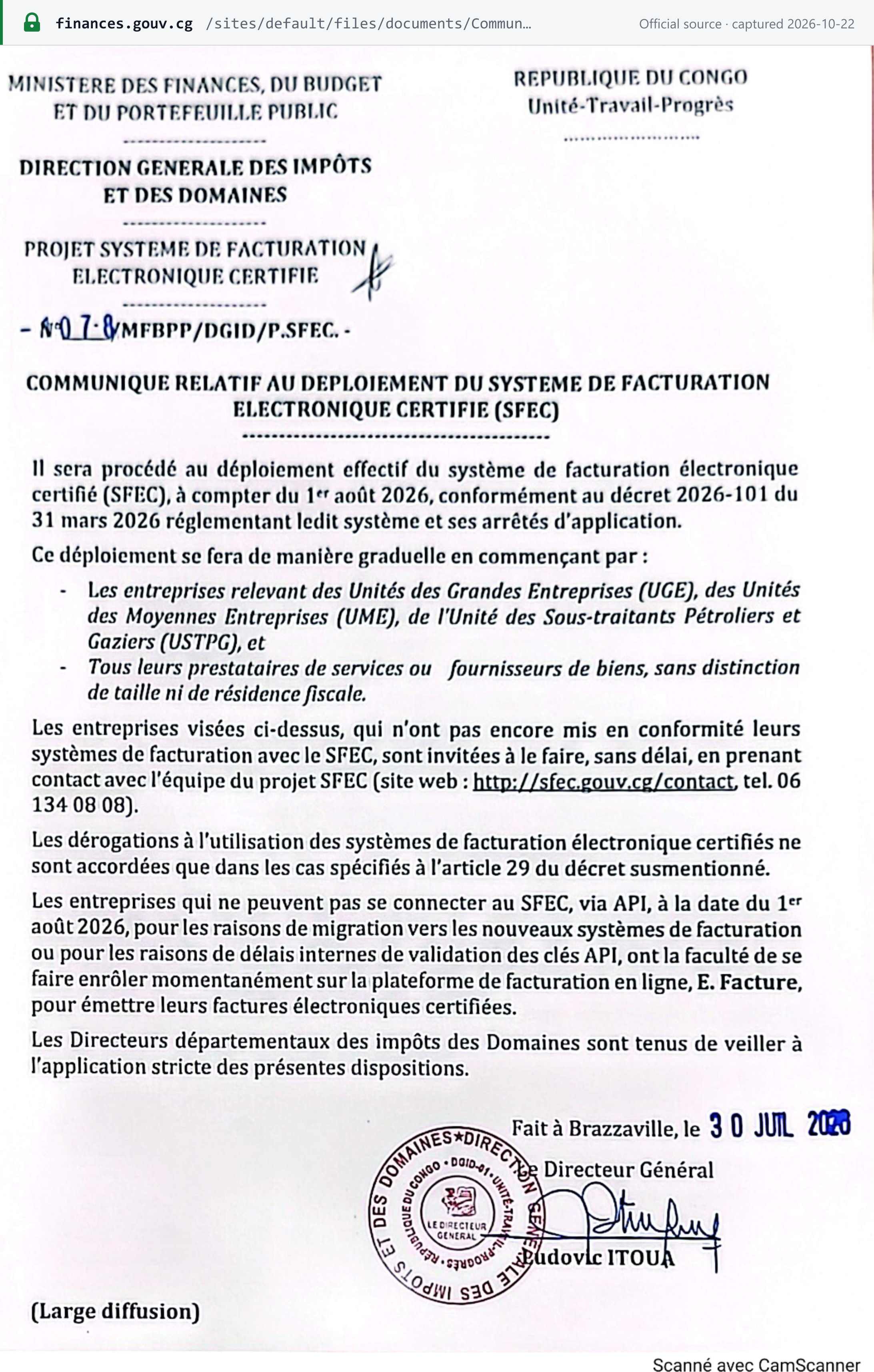
Status (as at 22 October 2026): mandatory and in force since 1 August 2026, phased by taxpayer segment. The operative instrument is DGID communiqué N° 07-8/MFBPP/DGID/P.SFEC of 30 July 2026: "Il sera procédé au déploiement effectif du système de facturation électronique certifié (SFEC), à compter du 1er août 2026, conformément au décret 2026-101 du 31 mars 2026 réglementant ledit système et ses arrêtés d'application." The roll-out is gradual. [2]
| Phase | Who | Obligation | Date | Source | State |
|---|---|---|---|---|---|
| Pilot | A sample of pilot firms (Arrêté 1520 art. 3 names 23 in the signed text on the SFEC portal and 12 in its Journal officiel n° 29-2026 version) | Voluntary issue of certified invoices | From September 2025 | Ministry SFEC page; Arrêté 1520 | Pilot firms qualify for penalty remission until 31 December 2026 |
| Phase 1 | Enterprises of the large-enterprise units (UGE), the medium-enterprise units (UME) and the oil and gas subcontractors' unit (USTPG), and all their service providers and suppliers of goods, whatever their size or tax residence | Issue every invoice as a certified e-invoice through an SFEC channel | From 1 August 2026 | DGID communiqué 07-8 | In force |
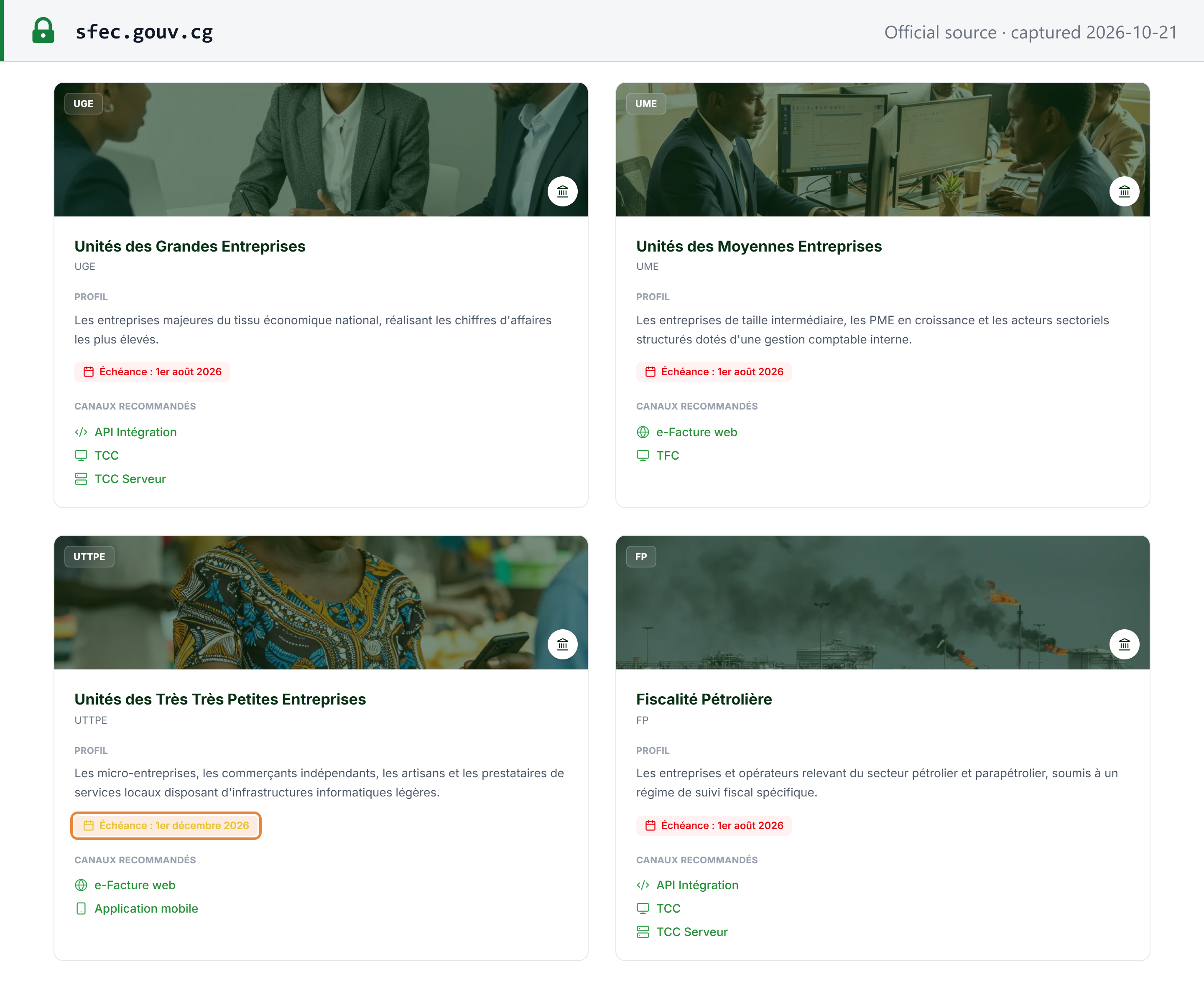
| Phase 2 | Very small enterprises (UTTPE): micro-businesses, independent traders, artisans | Same; recommended channels e-Facture web and the mobile app | 1 December 2026 ("Échéance") | SFEC portal segment card only | Upcoming |
| Voluntary | Small firms not yet phased in | May join early | Any time | SFEC FAQ | Open |
 Source snapshot captured 2026-10-22 — original
Very small enterprises: 1 December 2026, on the portal only. The SFEC portal gives "Échéance : 1er décembre 2026" on its UTTPE card. No décret, arrêté or communiqué fixing that date has been published; the SFEC FAQ says the other categories "seront intégrées selon le calendrier officiel de la DGID" and that small businesses join "dans une phase ultérieure". The portal labels the oil segment "FP — Fiscalité Pétrolière" (due 1 August 2026) where the communiqué says USTPG. [1] [8]
 Source snapshot captured 2026-10-21 — original
Start date: 1 July or 1 August 2026. Official sources still give both dates:
- The Ministry of Finance's SFEC page says businesses have "jusqu'au 1er juillet 2026" to bring their invoicing systems into line. That page has not been updated.
- A Ministry article of 30 June 2026 on the information campaign with employers' unions quotes the UNICONGO president as "informés que le lancement a été reporté au samedi 1er août 2026".
- DGID communiqué 07-8 of 30 July 2026 deploys the SFEC "à compter du 1er août 2026", and the SFEC portal says the same.
No décret or arrêté moved the date. Communiqué 07-8 is the first text that expressly sets deployment from 1 August 2026; Arrêté 1520 of 9 July 2026 (Journal officiel n° 29-2026, 16 July) already used that date as its compliance cut-off (arts. 2 b) and 4). [4] [6] [7] [2] [1]
The decree's transition period. Décret 2026-101 sets no calendar date. Its article 31 gives anyone who supplies, distributes or uses invoicing terminals or software "un délai de trois (3) mois" to comply, counted "à compter de sa date de publication". The decree was signed on 31 March 2026 and published in the Journal officiel n° 28-2026 of 9 July 2026. No official text states the end date of that period. [3]
What survives the move. Systems built for 1 July remain valid: nothing in the decree or the arrêtés depends on that date. A business whose API connection was not ready on 1 August 2026 "pour les raisons de migration vers les nouveaux systèmes de facturation ou pour les raisons de délais internes de validation des clés API" may enrol temporarily on e-Facture (communiqué 07-8). [2]
Early-compliance remission window: until 31 December 2026 (Arrêté n° 1520, see Penalties).
Legal basis
| Instrument | Date / publication | What it does |
|---|---|---|
| Loi n° 77-2022 (finance law for 2023) | 27 December 2022 | Instituted the SFEC, according to the Ministry's SFEC page |
| Loi n° 47-2024 (finance law for 2025), amending the VAT law (Loi n° 12-97) | 30 December 2024 | Art. 31 (new): the deduction statement attached to the VAT return lists "les éléments de sécurité liés au système de facturation électronique certifié". Art. 34 bis (new): use of the SFEC is mandatory, customers must demand certified invoices, transactions involving a foreign supplier are excepted, FCFA 50,000,000 fine, no VAT deduction on non-compliant transactions. Art. 34 ter (new): the tax administration implements the SFEC |
| Loi n° 42-2025 (finance law for 2026), JO spécial n° 3-2026 | 31 December 2025 | Profits tax only: expenses deductible only when backed by an SFEC invoice (CGI arts. 25 and 46); SFEC equipment depreciable at 100% in the year of acquisition (art. 61). It sets no SFEC fine |
| Décret n° 2026-101 réglementant le SFEC | Signed 31 March 2026; JO n° 28-2026, 9 July 2026, pp. 790–794 | Scope and exemptions (art. 2), homologation of terminals and software (arts. 4–10), approved distributors (arts. 11–15), interoperability (arts. 16–17), duties of users, suppliers, distributors and the administration (arts. 18–23), sanctions by reference (arts. 24–26), derogations (art. 29), e-Facture for those without a system (art. 30), three-month transition (art. 31) |
| Arrêté n° 1518/MFBPP/MPTEN/MDIZESPSP-CAB | 9 July 2026; JO n° 29-2026, 16 July 2026, p. 818 | Homologation procedure for terminals, software and ERP systems; self-declaration route for in-house systems |
| Arrêté n° 1519/MFBPP-CAB | 9 July 2026; JO n° 29-2026, p. 821 | Fiscal-compliance requirements: inalterability, NIU validation, certified numbering, the mandatory invoice mentions, terminal and ERP requirements, retention |
| Arrêté n° 1520/MFBPP-CAB | 9 July 2026; JO n° 29-2026, p. 824 | Incentives: penalty remission until 31 December 2026, list of pilot firms, full depreciation of SFEC equipment |
| Arrêté n° 1521/MFBPP-CAB | 9 July 2026; JO n° 29-2026 | Fees for homologation, distributor approval and self-declaration |
| DGID communiqué N° 07-8/MFBPP/DGID/P.SFEC | 30 July 2026 | Effective deployment from 1 August 2026; first segment; e-Facture fallback; derogations only under decree art. 29 |
The decree and arrêtés are also hosted as scans on the SFEC portal's regulations page. The regulations page also cites CEMAC Directive n° 0120/25-UEAC-822-CM-42 as the community basis for certified e-invoicing. [17] [3]
Technical standards. Article 17 of the decree has the DGID, with the ANSSI, publish the technical interoperability specifications, "Elle détermine notamment les normes et les standards des données". What the DGID publishes is its own SFEC API (OpenAPI 3.0.3, "SFEC ERP Invoice API", version 1.0.0) and terminal protocols at docs.sfec.gouv.cg. They bind through Arrêté 1519 art. 10 (ERP software must have an interface "conforme aux spécifications de l'API SFEC publiées par la DGID") and Arrêté 1518 art. 20 (homologation tests check conformity to them). None of the instruments names UBL, CII or EN 16931. [3] [9] [12]
Scope
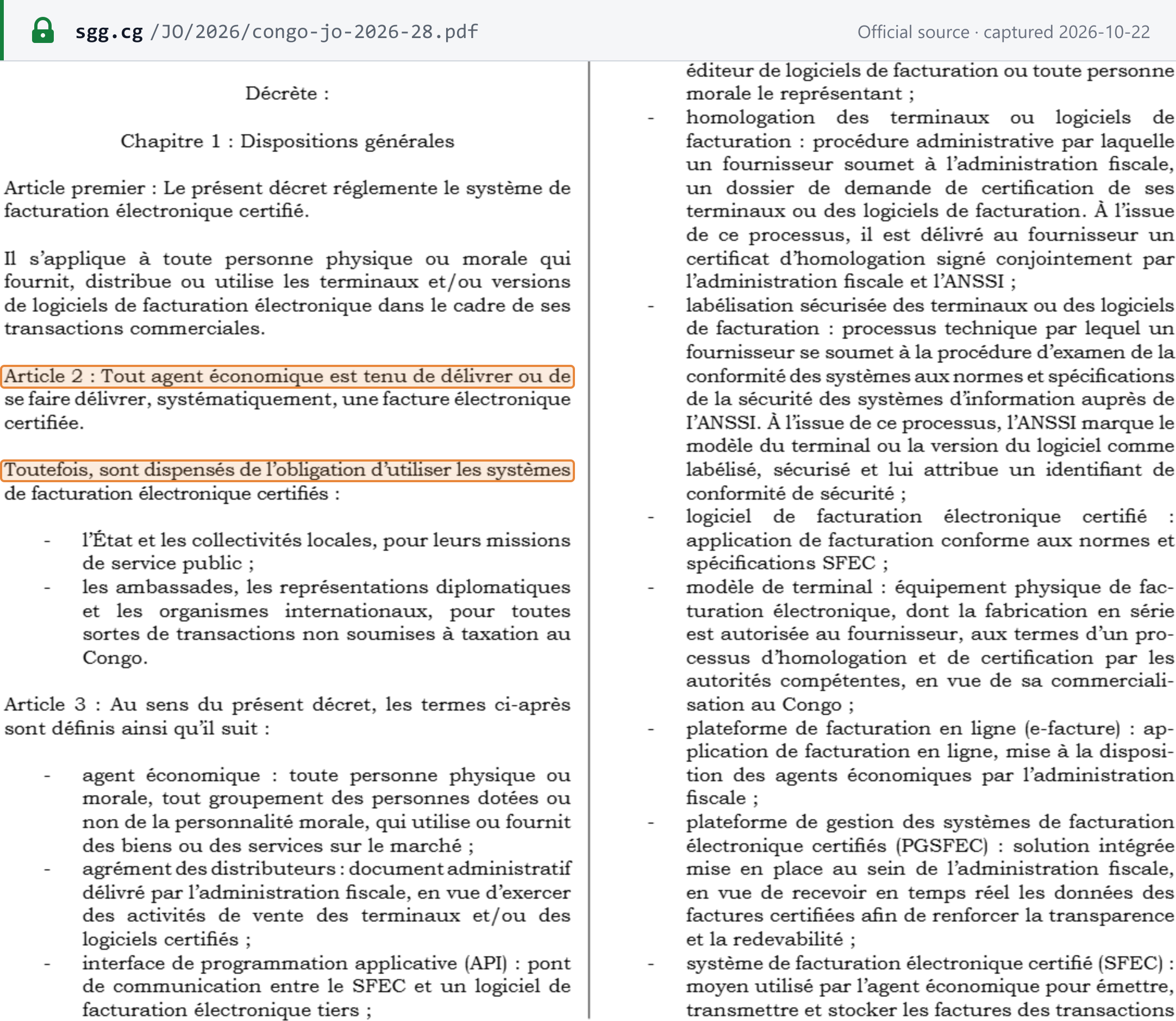
Who. Article 2 of the decree: "Tout agent économique est tenu de délivrer ou de se faire délivrer, systématiquement, une facture électronique certifiée." An economic agent is any natural or legal person, or group with or without legal personality, that uses or supplies goods or services on the market (art. 3). VAT-law art. 34 bis puts the duty on "tout assujetti" and requires every customer, "assujetti, redevable ou non", to demand a certified invoice. [3] [5]
B2B and B2C. In scope together, from the segment's date. Users must generate a certified invoice "pour chaque transaction effectuée" and hand it over "même si ces derniers n'en demandent pas la délivrance" (decree art. 19); Arrêté 1519 art. 11 covers all sales "sans exception, même si le client refuse de prendre la facture". For an individual recipient the API makes the buyer's name, NIU, address, phone and e-mail optional. [3] [12] [10]
B2G. No separate platform. Suppliers to the State issue SFEC invoices like anyone else; the API's government recipient type requires the buyer's name, NIU, phone, e-mail and address. The State and local authorities are dispensed from the obligation to use the SFEC "pour leurs missions de service public" (decree art. 2). [3] [10]
Other exclusions. Embassies, diplomatic missions and international organisations, "pour toutes sortes de transactions non soumises à taxation au Congo" (decree art. 2). The SFEC FAQ adds that a pro forma invoice is not certified, and that a supplier subject to withholding at source still issues a certified invoice. [3] [8]
 Source snapshot captured 2026-10-22 — original
Non-established businesses: the two texts differ.
- VAT-law art. 34 bis (finance law 2025): "Toutes les transactions économiques réalisées sur le territoire congolais sont certifiées par le SFEC, à l'exception de celles impliquant un fournisseur étranger."
- DGID communiqué 07-8: phase 1 covers "Tous leurs prestataires de services ou fournisseurs de biens, sans distinction de taille ni de résidence fiscale."
No DGID text reconciles the two. The finance law (VAT-law art. 34 bis) is a statute and outranks a DGID communiqué; the communiqué shows how the DGID is applying the rule. A supplier resident abroad that sells to UGE, UME or USTPG enterprises should confirm its position with the SFEC team ([email protected]). Non-resident providers of digital services account for VAT through the separate ARPCE regime described in the VAT guide. [5] [2]
Foreign customers. A Congolese business in the SFEC can issue a certified invoice to a foreign client (SFEC FAQ); the API's foreign recipient type requires name, phone, e-mail and address. [8] [10]
Businesses not liable to VAT. The SFEC FAQ says such a business issues its SFEC invoice without VAT and states its tax regime. [8]
Simplified invoices. None of the decree, the arrêtés, the 2025 finance law or the SFEC FAQ provides a value threshold below which an uncertified receipt is allowed. Till receipts are certified through the TCC terminals. [6]
Format & network
The model: certification at issue. The DGID: "Contrairement aux systèmes déclaratifs classiques, le SFEC certifie chaque facture au moment de son émission et la transmet automatiquement à la DGID." Invoices issued through the API or e-Facture are certified online by the DGID platform before the buyer receives them, which works like clearance; certified terminals sign invoices locally and transmit them to the PGSFEC, within 24 hours when offline. There is no buyer acceptance step and no exchange network. The administration has real-time access to the data to reconcile tax returns (Arrêté 1519 art. 4) and may reject any invoice issued under an invalid, suspended or non-existent NIU (art. 6). See CTC e-invoicing models. [1] [12]
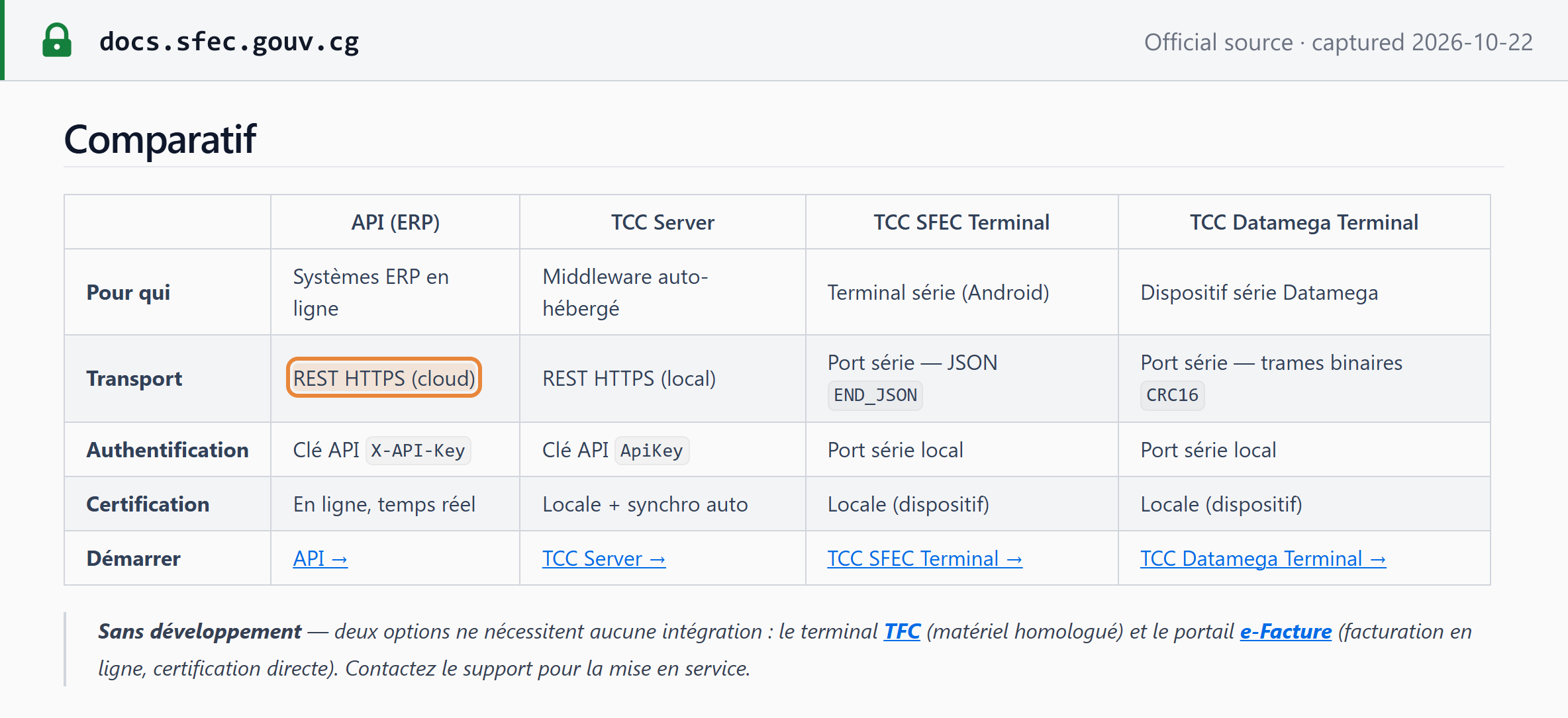
Channels. The SFEC technical documentation lists "quatre modes d'intégration pour les développeurs, ainsi que deux options sans développement". [9]
| Channel | Suits | Transport / format | Authentication | Where the invoice is certified |
|---|---|---|---|---|
| API (ERP) | ERP or invoicing software that is always online | REST over HTTPS (cloud), JSON; POST https://api.sfec.gouv.cg/api/v1/invoices | X-API-Key | SFEC, online, real time |
| TCC Server | Middleware the taxpayer hosts on its own server | REST over HTTPS (local) | ApiKey | Locally, then automatic sync |
| TCC SFEC Terminal | Android fiscal terminal driven by an ERP or till | Serial port, one JSON object per frame ending END_JSON | Local serial port | On the device |
| TCC Datamega Terminal | Datamega tax-control device driven by a till or ERP | Serial port, binary frames with CRC16 | Local serial port | On the device |
| TFC (terminal de facturation et de certification) | Businesses with no invoicing software | Homologated hardware, no integration | — | On the device |
| e-Facture (web and mobile app) | Low-volume or manual invoicing; mandatory for anyone without an invoicing system (decree art. 30) | Browser at efacture.gouv.cg | Account and OTP | SFEC, on validation |
 Source snapshot captured 2026-10-22 — original
The Ministry page names four channels (e-Facture, API, TFC, TCC) and the SFEC FAQ five (adding TCC Serveur); the technical documentation splits the TCC into its two terminal types. The SFEC portal recommends API, TCC and TCC Serveur for UGE and petroleum enterprises; e-Facture web and TFC for UME enterprises; and e-Facture web and the mobile app for UTTPE enterprises. [6] [8] [1]
Data format: JSON; one DGID page says XML. The API specification is JSON (OpenAPI 3.0.3, downloadable at docs.sfec.gouv.cg/openapi.yaml). The SFEC FAQ, however, says "Le SFEC accepte les factures au format XML conforme aux normes établies". The two DGID sources disagree; the published specification that homologation tests check against is the JSON API. It is not UBL, CII or Peppol-based. [9] [8]
Network. There is no interchange network and no Peppol. The supplier hands the certified invoice to the customer "sous forme physique imprimée, ou sous format numérique, transmis par voie électronique, au choix du client" (Arrêté 1519 art. 11), and the customer checks it by scanning its QR code to display the version stored centrally (SFEC FAQ). [12] [8]
What the API returns. On a successful certification the API answers HTTP 201 with exactly seven string fields: signature (64 lower-case hexadecimal characters) and its alias certification_number; short_signature (the first 20 characters, upper case) and its alias identifier; invoice_number (your invoice_id); certification_date (RFC 3339); and qr_code (a base64 PNG data URI). The SFEC generates these; the integrator does not send them. A reused invoice_id is rejected with HTTP 409. [10]
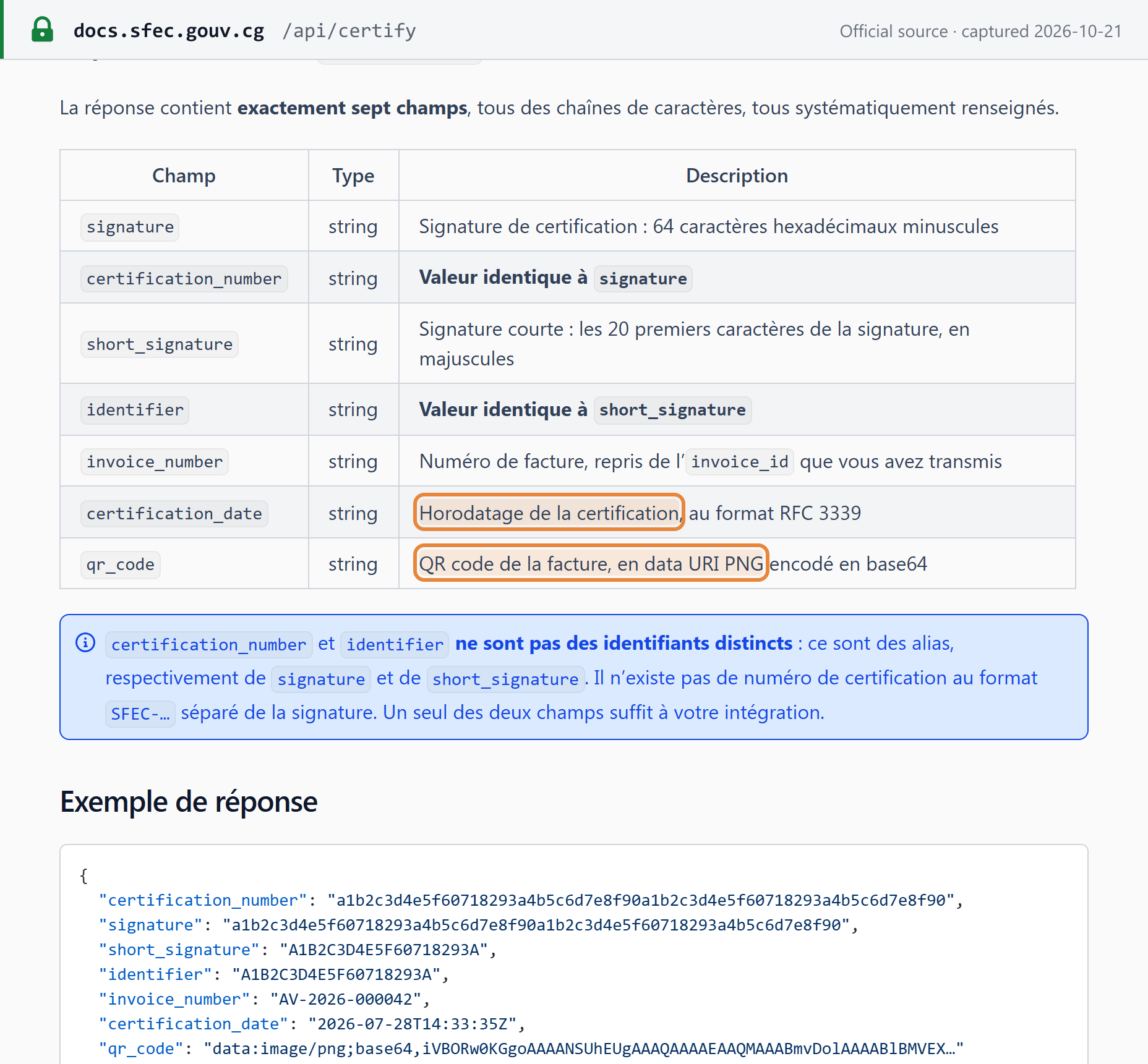 Source snapshot captured 2026-10-21 — original
Integrity mechanics. Arrêté 1519 art. 8 lists the mentions every certified invoice carries "à peine de nullité", including the date and time "issues d'un dispositif d'horodatage qualifié", "le numéro séquentiel unique certifié par la PGSFEC", "la signature électronique qualifiée et l'empreinte numérique de la facture", "le code QR de vérification" and "le numéro d'homologation du système SFEC émetteur". Parallel numbering, a dual system or any process allowing uncertified invoices "constitue une fraude fiscale" (art. 7). Terminals carry a hardware cryptographic module "conforme aux standards FIPS 140-2 niveau 2 ou équivalent" (art. 9). The full list of invoice mentions is in the VAT guide's invoice requirements. [12]
Corrections. A certified invoice is never edited. A cancellation, credit note or rectification is itself a certified document, and the original is kept (Arrêté 1519 art. 5). In the API this is invoice_type creditNote with a reference_invoice_id. Certified invoices are kept for ten years (Arrêté 1519 art. 12). [12] [10]
Offline operation. Terminals must work "en mode dégradé certifié" when the network drops, "avec enregistrement local et synchronisation différée dans un délai maximum de vingt-quatre (24) heures" (Arrêté 1519 art. 9). ERP software must queue invoices so that none is lost (art. 10), and for any terminal or software in a low-connectivity area the NIU validation may be deferred by a maximum of 24 hours (art. 5). The TCC Server documentation syncs every 10 minutes by default and retries for 7 days before marking an invoice SYNC_ABANDONED; that is a software retry setting, not a permitted delay. [12] [11]
Reporting alongside. There is no separate e-reporting obligation. The SFEC FAQ: "Le SFEC ne modifie pas les obligations déclaratives prévues par la législation fiscale." The deduction statement attached to the VAT return must list "les éléments de sécurité liés au système de facturation électronique certifié (SFEC)" (VAT-law art. 31). [8] [5]
Onboarding: how to comply
1. Enrol. The SFEC portal's "Rejoindre le SFEC" path has four steps: [1] [8]
- Contact the SFEC team (phone 06 134 08 08 or the contact form); an adviser helps choose the channel.
- Account opening by the SFEC team, with login details sent by e-mail. Enrolment needs the company name, trade name, NIU (and former NIU), RCCM number and date, SCIEN, creation date, legal form, address, contacts, legal representative, tax residence, tax regime, sector, currency and capital.
- Connection and tests in the test environment, whose invoices are "sans valeur fiscale".
- Homologation and production: after the DGID checks conformity, the account is switched to production.
Every channel needs registration in the taxpayer file, a valid NIU and access to the e-Facture portal. [9]
2. Get an API key (API channel). "Créez une demande d'intégration API (ERP) sur le portail e-Facture. Après validation par la DGID, vous recevez votre clé API." Production runs on https://api.sfec.gouv.cg and https://efacture.gouv.cg; the sandbox on https://sandbox.api.sfec.gouv.cg and https://sandbox.efacture.gouv.cg. [18] [9]
3. Use a homologated system. "Tout terminal et logiciel de facturation électronique vendu ou utilisé en République du Congo doit être homologué" (decree art. 4), by type, version and model (Arrêté 1518 art. 3). Homologation runs in four steps (Arrêté 1518 art. 6): admissibility and technical analysis by the DGID; conformity tests by the tax administration; an information-security evaluation by the ANSSI; and technical control at import by the ACONOQ. The outcome is a homologation certificate signed jointly by the heads of the DGID and the ANSSI (decree art. 9). The DGID answers within "trente (30) jours maximums" of filing (Arrêté 1518 art. 10). Any change to a terminal or software needs a new homologation (art. 26). [3] [13]
- Pilot and API-compatible systems. Systems connected in the pilot phase, and existing systems compatible with the SFEC APIs, are dispensed from fiscal homologation; they have three months from the arrêté's publication to finish the information-security homologation (Arrêté 1518 art. 27). [13]
- In-house systems. A business that built a system for its own exclusive, non-commercial use follows a self-declaration route: conform to the PGSFEC specifications, pass sandbox tests, file with the DGID, and receive an "attestation de conformité d'auto-déclaration" if no anomaly is found within 30 days (Arrêté 1518 arts. 16–19). [13]
- Published list. Arrêté 1518 art. 28 says the list of homologated SFEC systems "est publiée et actualisée sur le site web : sfec.gouv.cg". [13]
Approved distributors. "La commercialisation des terminaux ou des logiciels de facturation électronique certifiés est faite exclusivement par les distributeurs agréés SFEC" (decree art. 11). Approval is granted by the head of the DGID for five years, renewable; only legal persons under Congolese law with an NIU are eligible (art. 14). Approval can be suspended or withdrawn for cessation, a criminal conviction, a breach of obligations, distribution of non-compliant equipment or fraud (art. 15). [3]
Fees (Arrêté 1521). Paid by bank transfer to the Treasury, proof attached to the application, non-refundable: [4] [15]
| Item | Fee | Article |
|---|---|---|
| Homologation of a certified invoicing terminal | FCFA 5,000,000 per terminal model | 7 |
| Homologation of invoicing software or an ERP with an SFEC module | FCFA 5,000,000 per software version | 8 |
| Distributor approval (and renewal) | FCFA 3,000,000 | 10–11 |
| Self-declaration attestation for an in-house system | FCFA 1,500,000 | 14 |
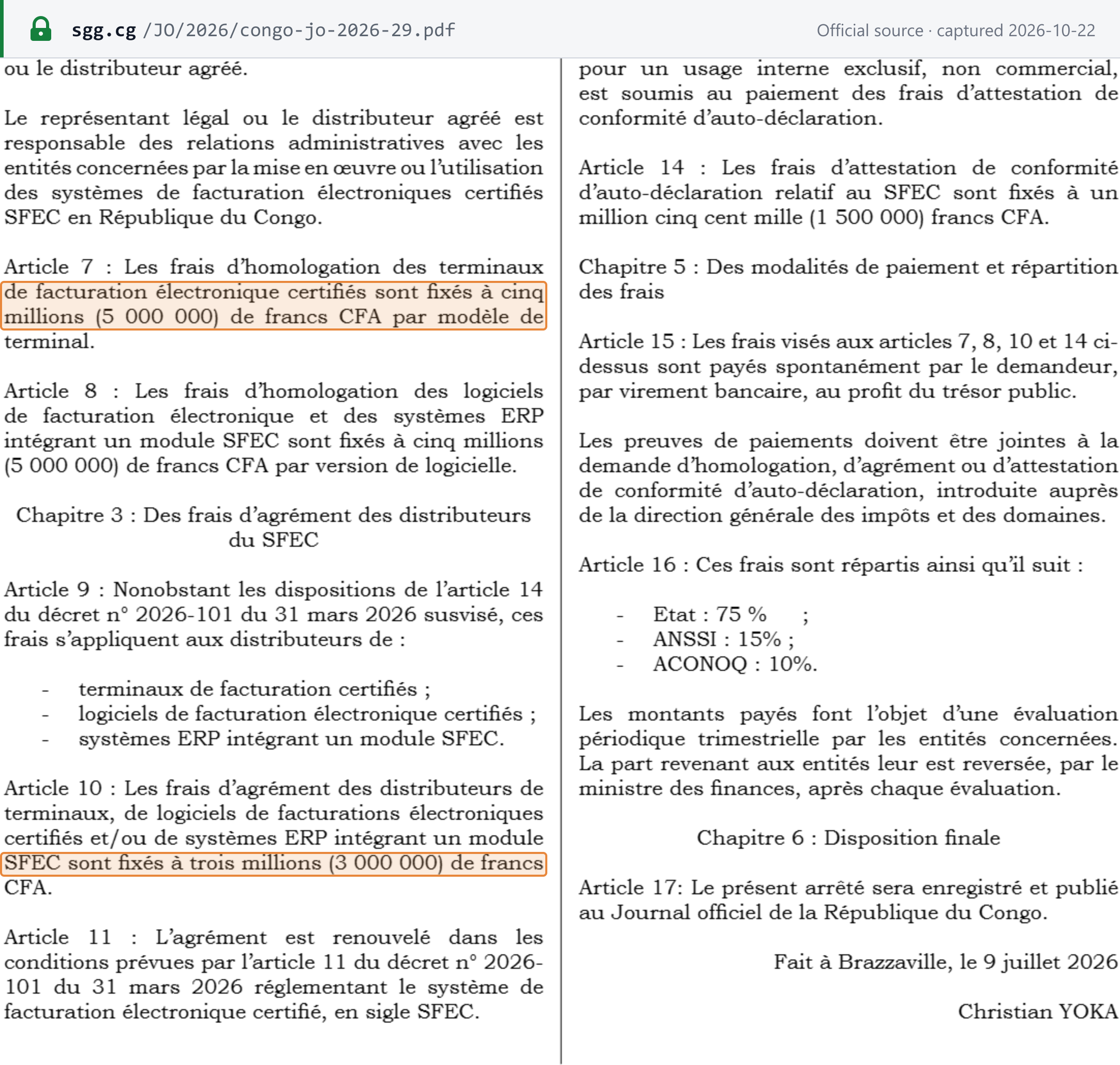 Source snapshot captured 2026-10-22 — original
The SFEC FAQ says "L'homologation auprès du SFEC est sans frais" and that "l'inscription en ligne et la procédure d'homologation auprès du SFEC sont sans frais". Arrêté 1521 fixes the fees above for homologating terminals and software. Its fees are paid by importers and distributors of terminals, software publishers, ERP suppliers and resellers, and representatives of foreign suppliers (art. 4); it sets no fee for a taxpayer's enrolment on e-Facture. Systems built solely for a public administration's internal use and solutions from ratified international-cooperation projects are exempt from the fees, though not from homologation (art. 5). [8] [15]
Ongoing duties of users (decree art. 19; Arrêté 1519 art. 11): use the SFEC at every point of sale; display "exigez votre facture électronique certifiée" where customers can see it; report malfunctions at once to the administration and the distributor; never remove terminal seals or alter billing data; start a deactivation procedure on closure. A change of place of use must be reported "dans un délai de trois jours" under the decree and "dans un délai de trois (3) jours ouvrés" under the arrêté. [3] [12]
Derogations. "Les dérogations à l'utilisation du système de facturation électronique certifié sont accordées par l'administration fiscale, dans les cas de dysfonctionnement prolongé du système ou de toute autre situation indépendante de l'utilisateur" (decree art. 29); communiqué 07-8 confirms they are granted only in those cases. [3] [2]
Penalties
Not using the SFEC: FCFA 50,000,000. VAT-law art. 34 bis, inserted by the finance law for 2025 (Loi n° 47-2024 du 30 décembre 2024): "Toute action de nature à violer l'obligation d'utiliser le SFEC est sanctionnée d'une amende fiscale de 50 000 000 de francs CFA. La TVA supportée dans le cadre d'une transaction non conforme à cette obligation n'ouvre pas droit à déduction." [5]
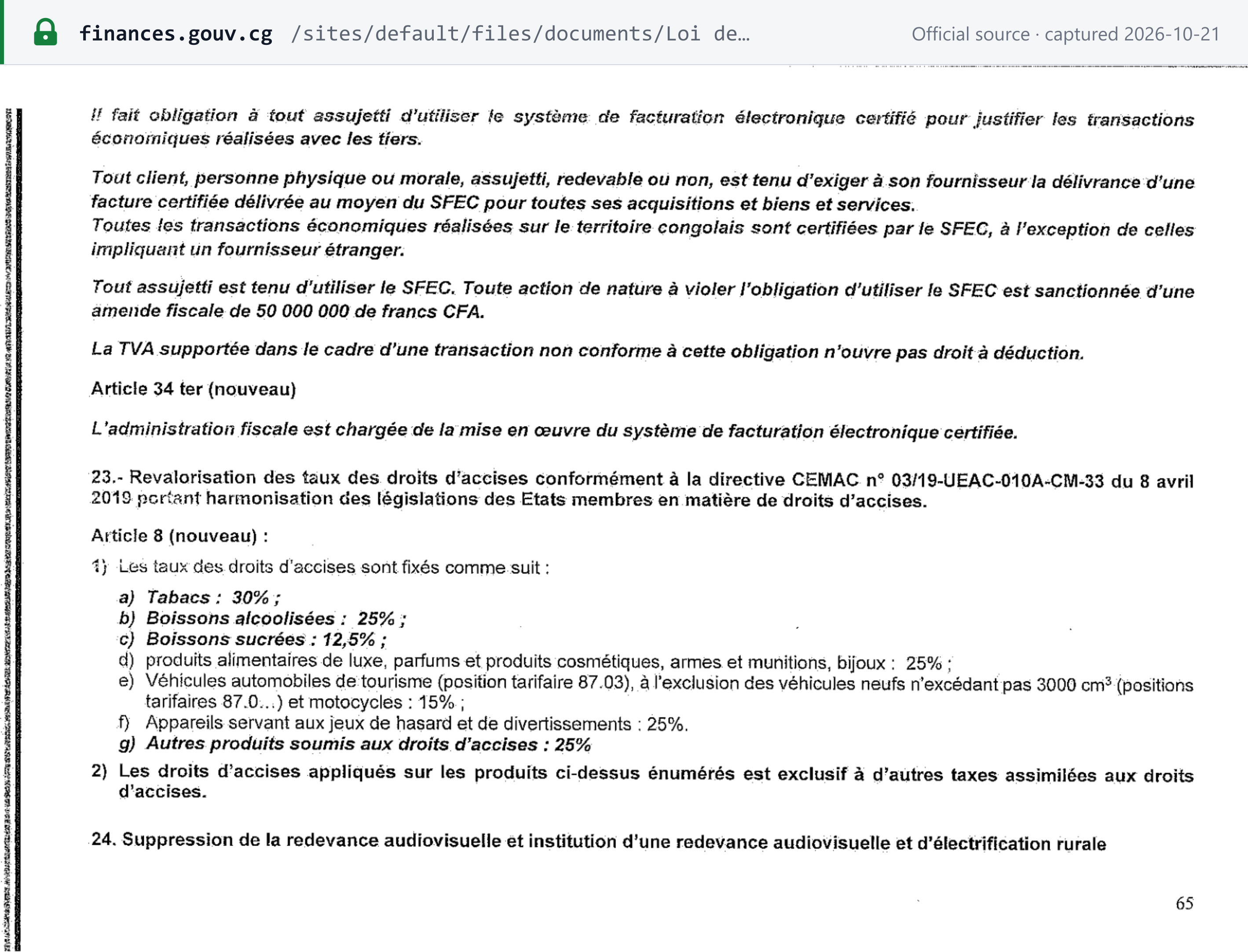 Source snapshot captured 2026-10-21 — original
The decree routes the sanction to the 2025 finance law. Décret 2026-101 sets no amount. Its article 24: "La non-utilisation du SFEC par tout assujetti est sanctionnée, conformément aux dispositions de l'article 34 bis nouveau de la loi n° 47-2024 du 30 décembre 2024 portant loi de finances pour l'année 2025." The finance law for 2026 (Loi n° 42-2025) contains no SFEC fine. [3] [16]
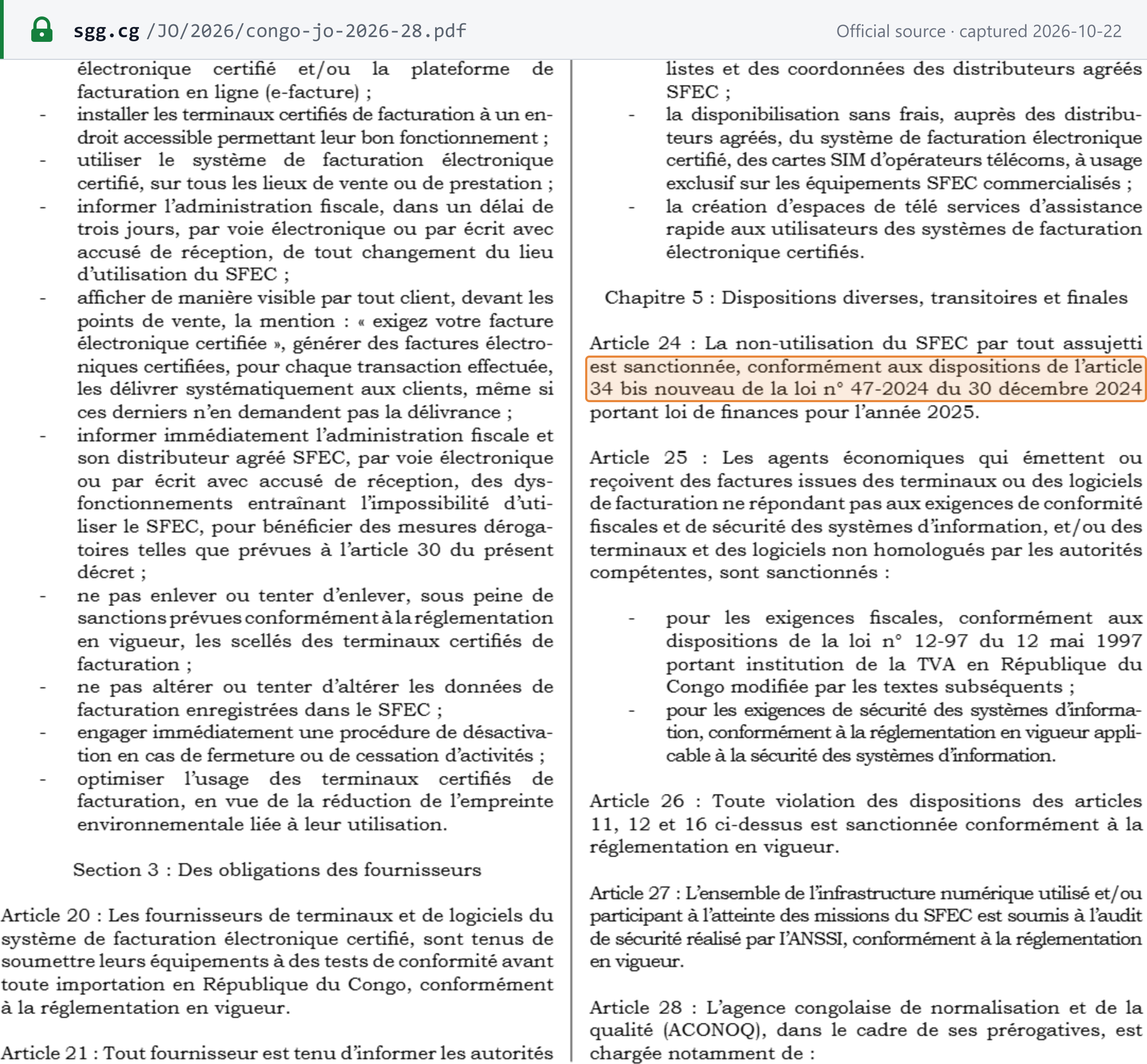 Source snapshot captured 2026-10-22 — original
| Breach | Who | Consequence | Source |
|---|---|---|---|
| Not using the SFEC | Taxable person | FCFA 50,000,000 fine | VAT-law art. 34 bis; decree art. 24 |
| Not demanding a certified invoice | Customer | Must demand one; VAT on the non-compliant transaction not deductible | VAT-law art. 34 bis |
| Expense backed by no SFEC invoice | Buyer | Not deductible for profits tax | CGI arts. 25 and 46 (finance law 2026) |
| Issuing or receiving invoices from non-compliant or non-homologated terminals or software | Issuer and receiver | Sanctioned under the VAT law and the information-security rules; no amount set in the decree | Decree art. 25 |
| Parallel numbering or a dual system | Issuer | "constitue une fraude fiscale"; no amount set in the arrêté | Arrêté 1519 art. 7 |
| Selling terminals or software without approval | Vendor or distributor | Sanctioned "conformément à la réglementation en vigueur"; approval withdrawal | Decree arts. 15, 26 |
Early-compliance remission, until 31 December 2026 (Arrêté 1520 art. 4, under CGI art. 451): [14]
- firms that took part in the pilot and actually issued certified invoices: 60% remission of the penalties, fines and late-payment interest charged for 2025 and 2026 and assessed before 1 August 2026, and 100% for any 2026 tax audit or spontaneous regularisation based on SFEC data;
- firms that brought their invoicing into line with the SFEC before 1 August 2026: the same 100% remission for 2026.
Enforcement posture, dated.
- 30 July 2026. Communiqué 07-8 instructs the DGID's departmental directors to "veiller à l'application stricte des présentes dispositions". Derogations are granted only under decree art. 29. [2]
- SFEC FAQ. "Une facture non certifiée reçue d'un fournisseur UME après le 1er août 2026 n'est pas déductible", whereas uncertified invoices from small businesses not yet phased in remain deductible. [8]
Frequently asked questions
We are a small supplier to a large Congolese company. Are we in the SFEC from 1 August 2026?
Yes. DGID communiqué 07-8 of 30 July 2026 puts in the first phase the enterprises of the UGE, UME and USTPG units and all their service providers and suppliers of goods, regardless of size or tax residence (foreign suppliers: see below). [2]
Did the SFEC start on 1 July or 1 August 2026?
On 1 August 2026, under DGID communiqué 07-8 and the SFEC portal. The Ministry of Finance's SFEC page still gives 1 July 2026, and a Ministry article of 30 June 2026 reported that the launch had been moved to 1 August 2026. No décret or arrêté moved the date; Arrêté 1520 of 9 July 2026 already used 1 August 2026 as its compliance cut-off. [2] [6] [7]
Our ERP's API connection is not ready. What can we do?
Enrol temporarily on the e-Facture platform and issue certified invoices there, as communiqué 07-8 allows for migration or API-key validation delays. Derogations from the SFEC are granted only for prolonged system malfunction or situations beyond the user's control (decree art. 29). [2]
Is the SFEC format JSON or XML?
The DGID's API specification is JSON (OpenAPI 3.0.3), and homologation tests check against it. The SFEC FAQ says the SFEC accepts invoices in XML format; the two DGID sources disagree. The SFEC is not based on UBL, CII or Peppol. [9] [8]
What does homologation cost?
Arrêté 1521 sets FCFA 5,000,000 per terminal model or software version, FCFA 3,000,000 for distributor approval and FCFA 1,500,000 for the self-declaration attestation of an in-house system. The SFEC FAQ describes enrolment and homologation with the SFEC as free of charge. [4] [8]
We are a foreign company selling to a Congolese business. Do we issue SFEC invoices?
The official texts differ. VAT-law article 34 bis excepts transactions involving a foreign supplier, while communiqué 07-8 covers suppliers of UGE, UME and USTPG enterprises regardless of tax residence. No DGID text reconciles the two; confirm your position with the SFEC team. [5] [2]
What happens if the internet goes down?
Certified terminals run in certified degraded mode, record locally and must sync within 24 hours (Arrêté 1519 art. 9). ERP software must queue invoices so that none is lost (art. 10), and in low-connectivity areas NIU validation may be deferred by a maximum of 24 hours for any terminal or software (art. 5). [12]
What is the penalty for not using the SFEC, and which law sets it?
A tax fine of FCFA 50,000,000, and no VAT deduction on the non-compliant transaction, under VAT-law article 34 bis inserted by the finance law for 2025 (Loi n° 47-2024). Décret 2026-101 article 24 refers non-use to that article. [5] [3]
Recent changes
- 2026-09-16 — The DGID added five e-Facture features (gross total, bank name, signatory name, TSCA for insurance, municipal tax on half-day lodging) and, separately, handling of disbursements (débours) in the API. (DGID SFEC portal)
- 2026-08-01 — SFEC certified e-invoicing in force for UGE, UME and USTPG enterprises and all their suppliers (DGID communiqué 07-8 of 30 July 2026); the SFEC portal gives 1 December 2026 for very small enterprises. (DGID) — see event
- 2026-07-16 — Arrêtés n° 1518 to 1521 of 9 July 2026 published in Journal officiel n° 29-2026: homologation, compliance requirements, incentives and fees. (Journal officiel)
- 2026-07-09 — Décret n° 2026-101 of 31 March 2026, regulating the SFEC, published in Journal officiel n° 28-2026. (Journal officiel) — see event
- 2026-06-30 — The Ministry of Finance reported the SFEC launch moved from 1 July to 1 August 2026. (Ministry of Finance) — see event
Related resources
- Republic of the Congo VAT guide — rates, registration, invoice requirements, filing
- E-invoicing status and networks by country
- CTC e-invoicing models explained
- Fiscal devices and certified cash registers
- Republic of the Congo tax changes on Lookuptax
Important websites
- SFEC portal — rules, phases, FAQ, resources, news; regulations page; contact (phone 06 134 08 08)
- e-Facture and the e-Facture sandbox (sign-in required; sandbox invoices have no fiscal value)
- SFEC technical documentation — API, TCC Server, TCC terminals, TFC, e-Facture; OpenAPI specification; technical support [email protected]
- Ministry of Finance SFEC page
- Journal officiel
Reference links
- DGID — SFEC portal
- DGID communiqué N° 07-8/MFBPP/DGID/P.SFEC of 30 July 2026 (PDF)
- Journal officiel n° 28-2026 of 9 July 2026 — Décret n° 2026-101 (PDF)
- Journal officiel n° 29-2026 of 16 July 2026 — Arrêtés n° 1518 to 1521 (PDF)
- Loi n° 47-2024 du 30 décembre 2024, finance law for 2025 (PDF)
- Ministry of Finance — SFEC programme page
- Ministry of Finance — SFEC information campaign, 30 June 2026
- DGID — SFEC FAQ
- SFEC technical documentation
- SFEC API — certify an invoice
- SFEC TCC Server — synchronisation
- Arrêté n° 1519/MFBPP-CAB — fiscal-compliance requirements (PDF)
- Arrêté n° 1518 — homologation of terminals, software and ERP (PDF)
- Arrêté n° 1520/MFBPP-CAB — tax incentives (PDF)
- Arrêté n° 1521/MFBPP-CAB — homologation and approval fees (PDF)
- Journal officiel spécial n° 3-2026 — Loi n° 42-2025, finance law for 2026 (PDF)
- DGID — SFEC regulations page
- SFEC API — FAQ