E-invoicing in Singapore: InvoiceNow and the GST InvoiceNow Requirement
Overview
Singapore's e-invoicing network is InvoiceNow, a nationwide network built on the international Peppol standard and launched in 2019. The tax obligation that rides on it is the GST InvoiceNow Requirement, a joint initiative of the Inland Revenue Authority of Singapore (IRAS) and the Infocomm Media Development Authority (IMDA): GST-registered businesses use InvoiceNow-Ready Solutions to submit their invoice data to IRAS. [1]
Who runs it. IMDA is Singapore's Peppol Authority. It sets the Peppol Authority Specific Requirements, accredits InvoiceNow service providers and runs a centralised Service Metadata Publisher (SMP). In 2018 it became the first Peppol Authority outside of Europe. IRAS administers the GST requirement and receives the data. [5]
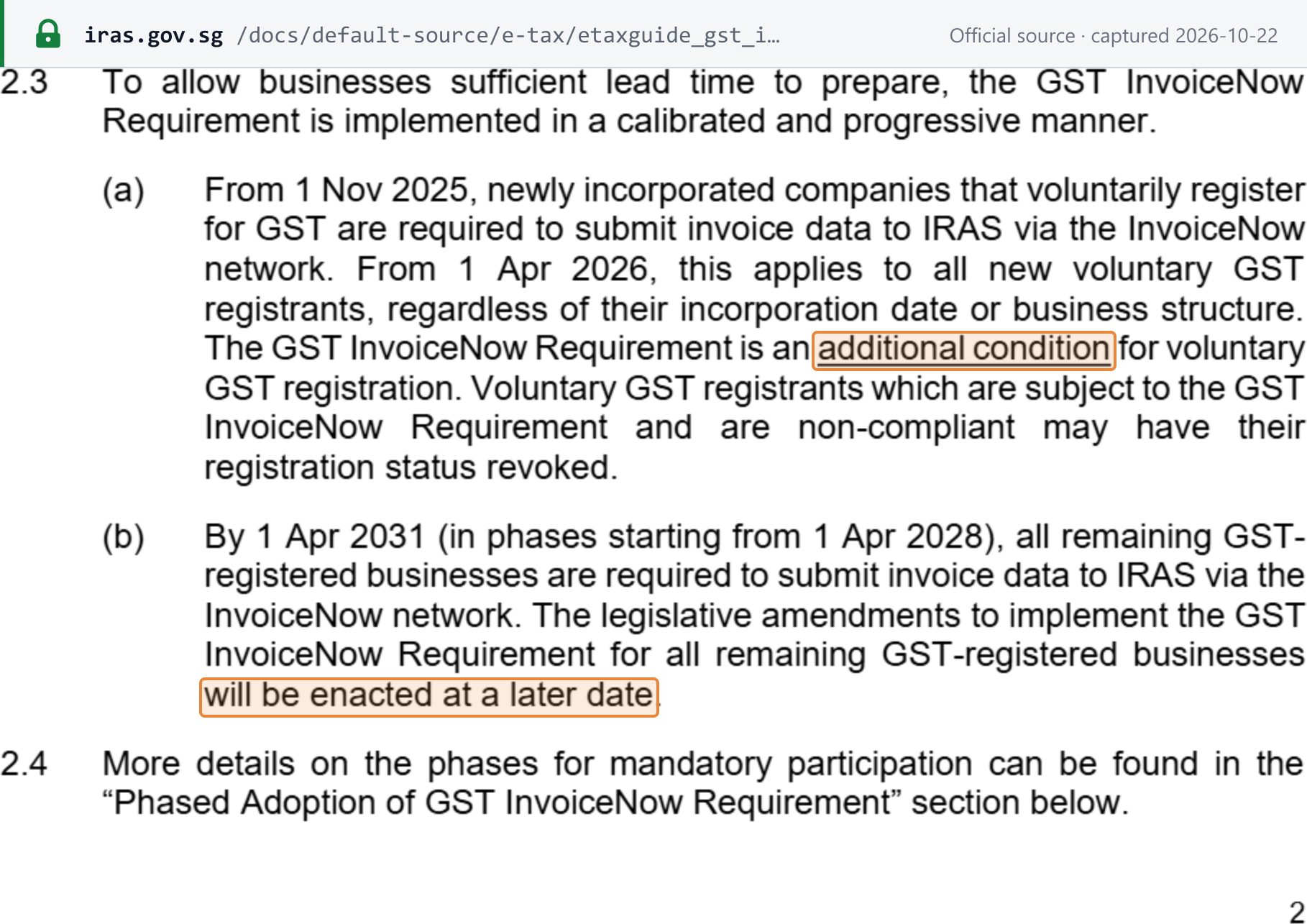
Legal basis in one line. For new voluntary registrants the requirement is an additional condition for voluntary GST registration, set out in paragraphs of IRAS's e-Tax Guide Adopting GST InvoiceNow Requirement for GST-registered Businesses that IRAS marks as having the force of law; the legislation for the 2028–2031 phases "will be enacted at a later date". [1]
| Singapore | |
|---|---|
| System | InvoiceNow (Peppol) and the GST InvoiceNow Requirement |
| Model | Peppol 4-corner exchange, with IRAS added as a 5th corner that receives copies of invoice data. Reporting, not clearance |
| B2B | Invoice data must reach IRAS. In force for new voluntary GST registrants (1 Nov 2025 and 1 Apr 2026); all other GST-registered businesses from 1 Apr 2028 to 1 Apr 2031 by 2025 turnover band |
| B2G | Not mandated; vendors may still bill through the Vendors@Gov portal. InvoiceNow has been a channel to government since 2020; the Government plans to make it the default for registered businesses but has published no date |
| B2C | No e-invoice to consumers required, but B2C supply data is still submitted to IRAS (POS and simplified-invoice sales may be aggregated) |
| Non-residents | Excluded: overseas businesses that must appoint a section 33(1) agent, and OVR pay-only and OVR full registrants. A foreign company with a Singapore branch is in scope |
| Format | UBL XML. PINT-SG is the base data format for the requirement; SG Peppol BIS Billing 3.0 is still used on the network |
| Network | InvoiceNow, through IMDA-accredited Access Point providers and InvoiceNow-Ready Solution providers |
| Authority | IRAS (tax data); IMDA (Peppol Authority) |
| Legislation | GST Act 1993 and IRAS e-Tax Guide paragraphs with the force of law (Second Edition, 9 Mar 2026); 2028–2031 legislation still to come |
For the GST rate, registration threshold and tax-invoice fields, see the Singapore GST guide.
Mandate status & timeline
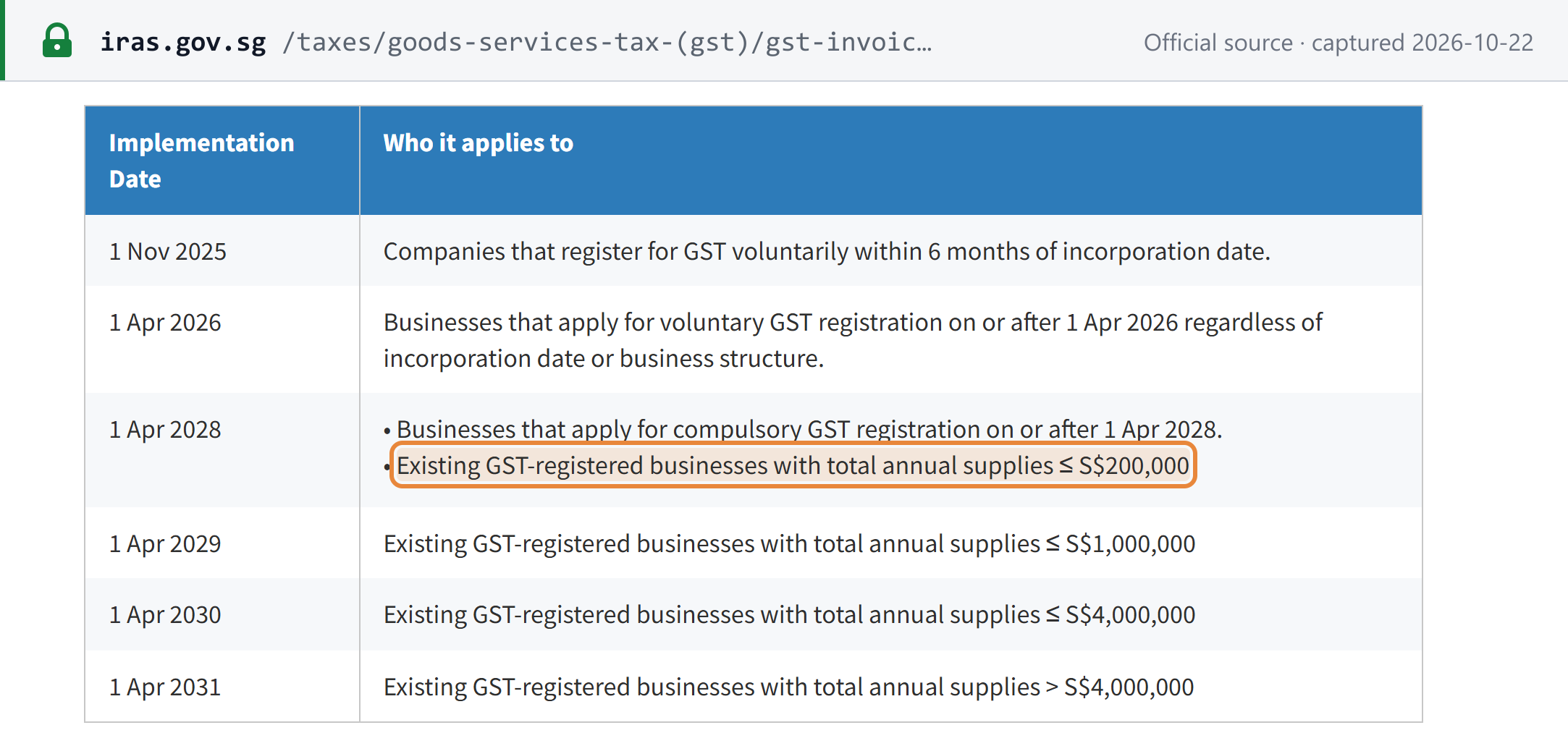
The requirement is phased first by type of GST registration, then, for businesses already registered, by total annual supplies in 2025. Each date is a "from" date: you must comply from that date, or, as a new registrant, from your effective GST registration date. They are not end-of-window deadlines. [2] [1]
| Phase | Who | From | Status (at 22 Oct 2026) | Basis |
|---|---|---|---|---|
| (a) | Companies registering for GST voluntarily within 6 months of incorporation (application on or after 1 Nov 2025) | 1 Nov 2025 | In force | e-Tax Guide §5.5(a), §5.8 (force of law) |
| (b) | All businesses applying for voluntary GST registration on or after 1 Apr 2026, whatever their incorporation date or business structure | 1 Apr 2026 | In force | e-Tax Guide §5.5(b), §5.10 (force of law) |
| (c) | Businesses applying for compulsory GST registration on or after 1 Apr 2028; and existing GST-registered businesses with total annual supplies ≤ S$200,000 | 1 Apr 2028 | Announced; legislation to follow | e-Tax Guide §5.5(c) |
| (d) | Existing GST-registered businesses, total annual supplies ≤ S$1,000,000 | 1 Apr 2029 | Announced; legislation to follow | e-Tax Guide §5.5(d) |
| (e) | Existing GST-registered businesses, total annual supplies ≤ S$4,000,000 | 1 Apr 2030 | Announced; legislation to follow | e-Tax Guide §5.5(e) |
| (f) | Existing GST-registered businesses, total annual supplies > S$4,000,000 | 1 Apr 2031 | Announced; legislation to follow | e-Tax Guide §5.5(f) |
"Total annual supplies" means standard-rated, zero-rated and exempt supplies (Box 4 of the GST return) across all prescribed accounting periods ending in calendar year 2025. [2]
The two phases in force
Phase (a), from 1 November 2025, applies if all three hold: your business is a company; you apply for voluntary GST registration on or after 1 November 2025; and you were incorporated within 6 months of that application. Phase (b), from 1 April 2026, applies to any voluntary GST application made on or after 1 April 2026. In both cases you submit invoice data to IRAS from your effective GST registration date. [1]
IRAS's FAQ settles some edge cases: [3]
- the application date governs, so an application made on 31 October 2025 and approved on 2 November 2025 is not caught by phase (a);
- a redomiciled company is not treated as a company incorporated within 6 months;
- a compulsory application that IRAS approves on a voluntary basis, because the sales forecast was not sufficiently evidenced, is caught.
The 2028–2031 phases and how you learn your date
The extension to all GST-registered businesses was announced at the Ministry of Finance Committee of Supply Debate 2026; IRAS and IMDA's factsheet is dated 26 February 2026. The e-Tax Guide's Second Edition of 9 March 2026 then wrote the phases into §5.5(c)–(f). [4] [1]
IRAS says it has notified businesses registered before 2026 of their mandatory InvoiceNow implementation date from mid-2026. Businesses without GST returns for periods ending in 2025 will be told their date later. IRAS also publishes a GST InvoiceNow Implementation Date Calculator on its InvoiceNow page. [2]
Still to be dated: GST groups. The implementation date for all members of new and existing GST groups and divisions "will be communicated at a later date". A company that registers voluntarily on 1 April 2026 and joins an existing GST group therefore starts on the group's date, not on 1 April 2026. [1]
Pilot, early adoption and postponements
The phased rollout follows a pilot run by IRAS, IMDA, businesses and service providers from September 2020 to June 2023. A sandbox for providers and businesses to test API submissions has been available since September 2024. Businesses outside the in-force phases may adopt early by activating the "GST InvoiceNow Submission" feature in their solution, and IRAS encourages them to do so. [1] [3]
No postponements. The 1 November 2025 and 1 April 2026 dates have not moved since the e-Tax Guide's first edition of 7 March 2025. The 2028–2031 phases were added in 2026; no date was pushed back.
Legal basis
| Instrument | Published | What it does | Binding? |
|---|---|---|---|
| IRAS e-Tax Guide, Adopting GST InvoiceNow Requirement for GST-registered Businesses | Second Edition, 9 Mar 2026 (first edition 7 Mar 2025; amendments logged 30 Jan 2026 and 9 Mar 2026) | Sets the requirement, the phases, the exclusions, the scope, due dates and mandatory data elements | The paragraphs IRAS marks as having the force of law |
| Goods and Services Tax Act 1993 | 2020 Revised Edition | Section 9 and the First Schedule govern GST registration | Statute |
| GST (General) Regulations, regs 11 and 13 | — | Contents of tax invoices and other invoices; the mandatory data elements are "in line with" them | Subsidiary legislation |
| Legislative amendments for phases (c)–(f) | Not yet enacted | Will bring the 2028–2031 phases into law | Pending |
| PINT-SG Billing (invoice and credit note) | Singapore Peppol Authority, on docs.peppol.eu | Base data format for the requirement | Technical standard |
| Invoice Data Submission Specifications for IRAS GST InvoiceNow Requirement | On IMDA's Technical Playbook | Submission documents, schematrons and example files | Technical |
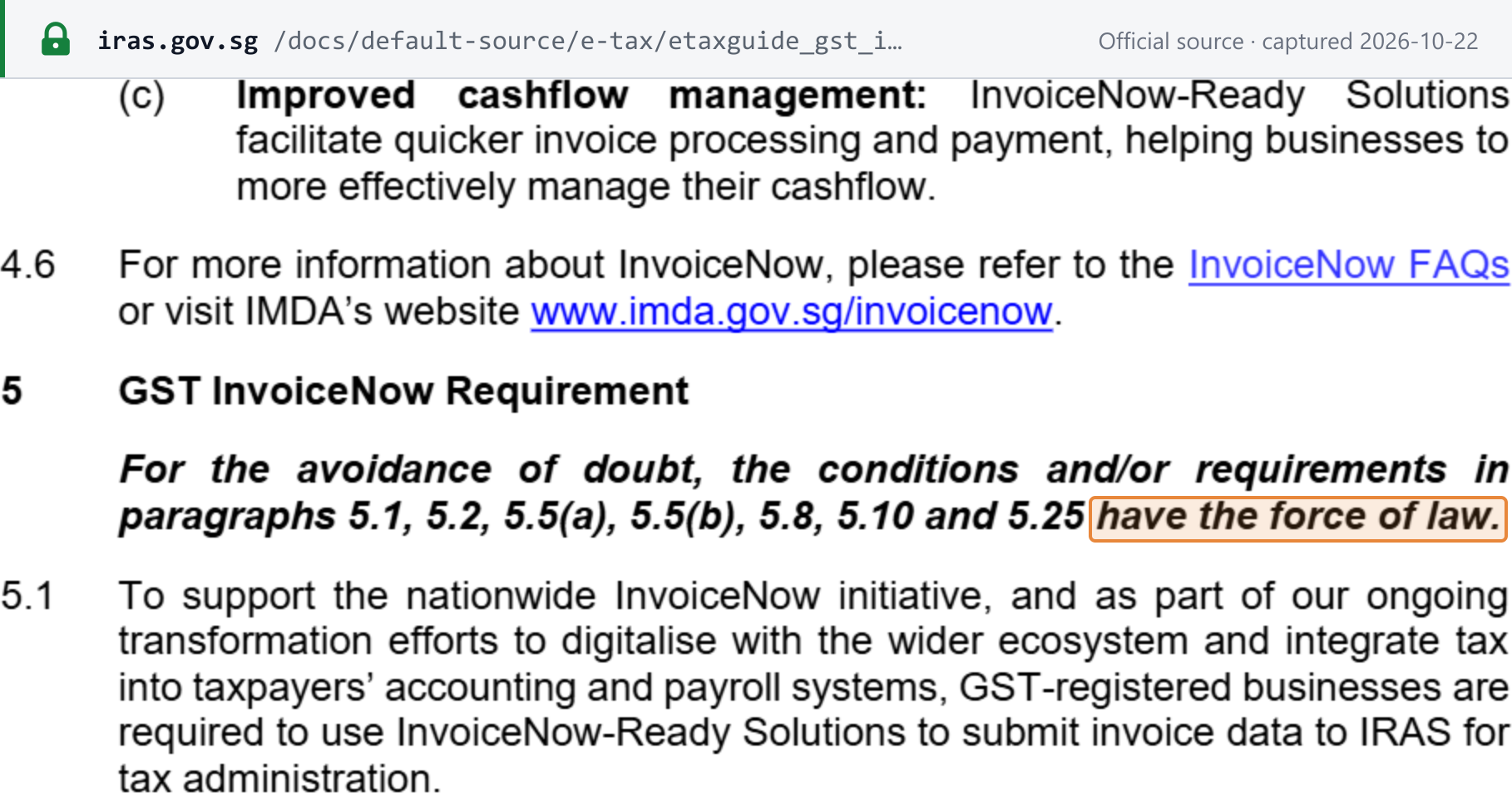
Which paragraphs have the force of law. IRAS states that the conditions in the e-Tax Guide's §§5.1, 5.2, 5.5(a), 5.5(b), 5.8, 5.10 and 5.25 "have the force of law". It marks other paragraphs the same way: definitions (§§3.2, 3.3, 3.5), scope (§§7.1, 7.4, 7.5), due dates (§§8.3, 8.4, 8.6, 8.9), mandatory data elements (§§9.1, 9.2, 9.7), common GST scenarios (§§11.2, 11.4, 11.7, 11.10, 11.13, 11.14) and partially exempt businesses (§§12.9, 12.11). The 2028–2031 phases in §5.5(c)–(f) are not marked, which matches IRAS's statement that the legislation for them will be enacted later. [1]
Scope
What must be submitted. A business in scope submits to IRAS all invoice data reported in its GST return, other than the excluded transactions below. That covers standard-rated, zero-rated and exempt supplies, and standard-rated and zero-rated purchases. Invoices issued outside InvoiceNow, for example to customers not on the network or through point-of-sale systems, are submitted too once recorded in the accounting system. "Invoice data" covers sales invoices, tax invoices, simplified tax invoices, serially numbered receipts, debit notes and credit notes, but not sales orders, pro-forma invoices or statements of account. [1]
B2B: no duty to send customers a Peppol e-invoice. The obligation is to get invoice data to IRAS through an InvoiceNow-Ready Solution. You may still give customers paper or PDF invoices and submit the data separately. A Peppol invoice can only be sent where both supplier and customer are on InvoiceNow. [1]
B2G: not mandated. InvoiceNow is not mandated for B2G; vendors may still bill through the Vendors@Gov portal. The GST requirement has no government-specific rule: supplies to government agencies are ordinary supplies. Government has received e-invoices over InvoiceNow since January 2020, when the Accountant-General's Department connected central government systems, and vendors keep their vendor records on Vendors@Gov. The Government says it will make InvoiceNow the default e-invoice submission channel for all government vendors that are registered businesses "within the next few years", eventually replacing the Vendors@Gov portal for them, and reports that about 50% of government vendors are on InvoiceNow. The plan was first announced in 2023, and no date has been published since. [6] [11] [12]

B2C. No e-invoice to consumers is required, but supplies to individuals are still reported to IRAS. Point-of-sale and simplified-invoice sales may be submitted aggregated, with the customer fields defaulted to "POS" or "STI"; an invoice to an individual uses "NA" for the customer UEN, name and address. [1]
Non-residents and other excluded businesses. These are outside the requirement: [1] [2]
- overseas entities: overseas businesses required to appoint a local section 33(1) agent, and overseas vendors registered under the OVR pay-only or OVR full regime;
- businesses liable to register for GST solely because of reverse charge on imported services or imported low-value goods.
A foreign-incorporated company with a branch or establishment in Singapore is not an overseas entity and must comply, as must a Singapore business with an overseas branch. A business cannot apply to be excluded on other grounds. [3]
Excluded transactions. Even a business in scope does not submit: transactions with no underlying supply or purchase that are still reported for GST (for example deemed supplies and goods exported without sales); reverse-charge transactions; exempt financial services and exchanges or loans of digital payment tokens; import permits; and anything not reported in the GST return, such as out-of-scope supplies or purchases from suppliers that are not GST-registered. If an invoice or credit note has at least one line in scope, the whole document is submitted. [2] [1]
Simplified invoices. A simplified tax invoice is allowed where the total payable, including GST, does not exceed S$1,000. Under the requirement, simplified-invoice sales and serially numbered receipts may be aggregated before submission. [13] [1]
Partially exempt businesses. They must submit all purchase invoice data with GST incurred, except disallowed expenses, whether or not the input tax is claimed. [1]
Format & network
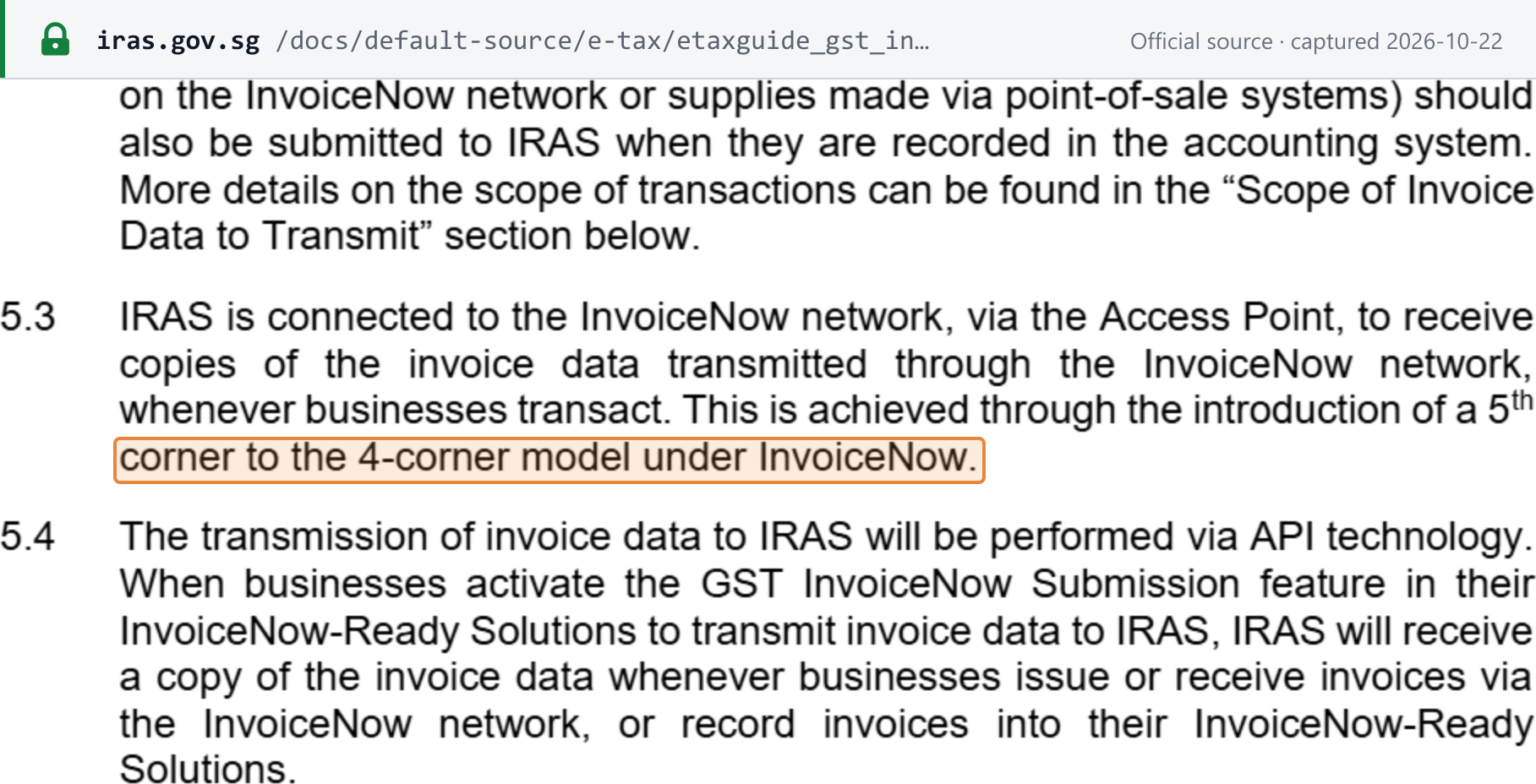
The model: Peppol 5-corner reporting, not clearance. Invoices travel from the supplier through its Access Point to the customer's Access Point and the customer, the usual Peppol 4-corner route. IRAS is connected to InvoiceNow through an Access Point and receives copies of the invoice data as a 5th corner; the data reaches IRAS by API. A Peppol invoice is copied to IRAS automatically once it has been delivered to the customer's Access Point. IRAS does not approve, stamp or return the invoice before the customer receives it. [1]
Four submission types. IRAS sorts what reaches it into four types: [1]
| Type | What it is | How it reaches IRAS |
|---|---|---|
| 1A | Supplier's Peppol invoice sent over InvoiceNow | Copied automatically, generally in real time or near real time |
| 1B | Customer's purchase record of a Peppol invoice it received | Solution-extracted |
| 2 | Supply invoiced outside the network (paper, PDF, POS) | Solution-extracted |
| 3 | Purchase invoiced outside the network | Solution-extracted |
Solution-extracted data is pulled from the InvoiceNow-Ready Solution and sent to IRAS regularly, for example daily or weekly. Credit notes follow the same routes. Debit notes cannot travel over InvoiceNow; they go to IRAS as invoices by the solution-extracted method. [1] [3]
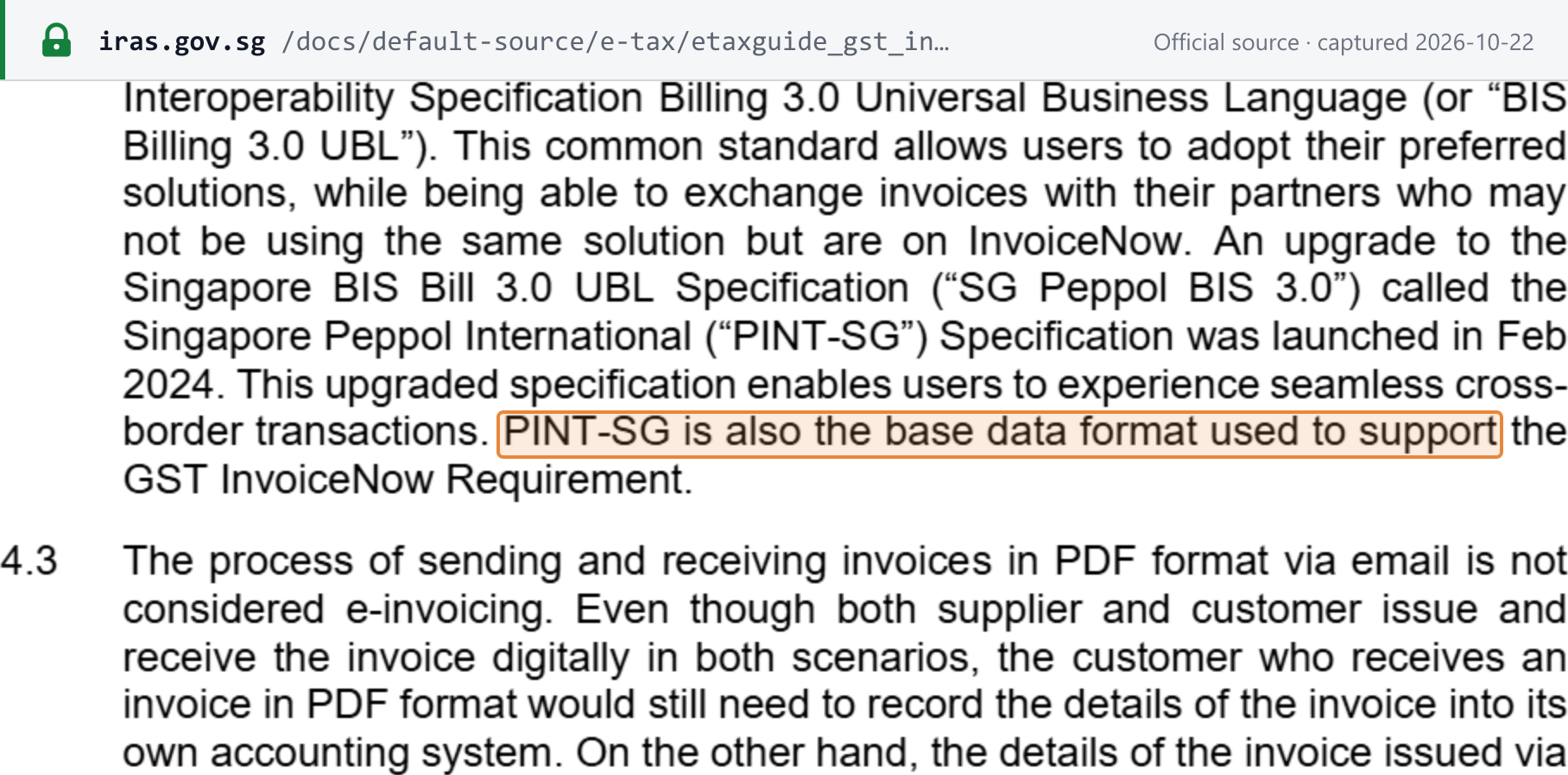
XML format. Invoices on InvoiceNow are UBL XML. Singapore's original specification is SG Peppol BIS Billing 3.0, an extension of Peppol BIS Billing 3.0 for Singapore's needs. Its successor, PINT-SG (Singapore Peppol International), was launched in February 2024 and "is also the base data format used to support the GST InvoiceNow Requirement". Sending PDF invoices by email is not e-invoicing. [1] [8]
- Identifier. PINT-SG Billing invoices and credit notes carry the CustomizationID
urn:peppol:pint:billing-1@sg-1. [9] - Version. The specification published on docs.peppol.eu is PINT SG Billing v1.4.1. The Singapore Peppol Authority issues releases roughly twice a year, each listed with a date until which it stays mandatory; check the Singapore Peppol Guide for the release your provider must support. [9] [8]
- Mandatory data elements. Every submission must carry IRAS's mandatory data elements, among them supplier and customer endpoint ID, UEN, GST registration number, name and address; CustomizationID and ProfileID; document UUID, invoice number, issue date, type code and currency; line-level and subtotal GST category code, rate and amount; and totals with and without GST. GST category codes come from IRAS's own list (for example SR, ZR, ES33, ESN33, TX, ZP, OP). A customer with a UEN gives it, a foreign customer gives its overseas registration number, and an individual gets "NA". [1]
- "Tax Invoice" wording. A Peppol invoice that does not say "Tax Invoice" is still accepted as a valid tax invoice if every other particular required by reg 11 of the GST (General) Regulations is present. Paper or PDF invoices submitted as Types 2 and 3 must still say "Tax Invoice". [1]
- Bulk limits. A bulk API package holds up to 10 documents of the same type and must not exceed 10 MB. There is no line-item cap, but IRAS recommends no more than 999 lines per invoice. [1] [3]
Peppol IDs and directory. Each business registers in the SG Peppol Directory (peppoldirectory.sg) with its UEN and obtains a Peppol ID, through its solution provider or Access Point. IMDA runs a centralised SMP. Singapore-registered businesses need Corppass to complete the know-your-customer checks before transacting on InvoiceNow. To check a UEN or GST number, see how to verify a Singapore UEN and how to verify a Singapore GST number. [1] [6]
QR codes, stamps and hashes. IRAS's e-Tax Guide, FAQ and InvoiceNow page set no QR-code, cryptographic-stamp, hash or IRAS-issued invoice-number requirement. The controls they do describe are schematron files for validating submissions, an IRAS Acknowledgement ID for each successful transmission, and a recommended check against IRAS's Check GST Register API for invoices that wrongly charge GST. IRAS imposes no check between invoice-level and line-level amounts. [1] [3]
E-reporting alongside. The InvoiceNow submission is itself the reporting stream; there is no separate transaction-level report. GST returns and the 5-year record-keeping rules continue, and the records include Peppol invoices kept as XML files with all the mandatory data elements. [1]
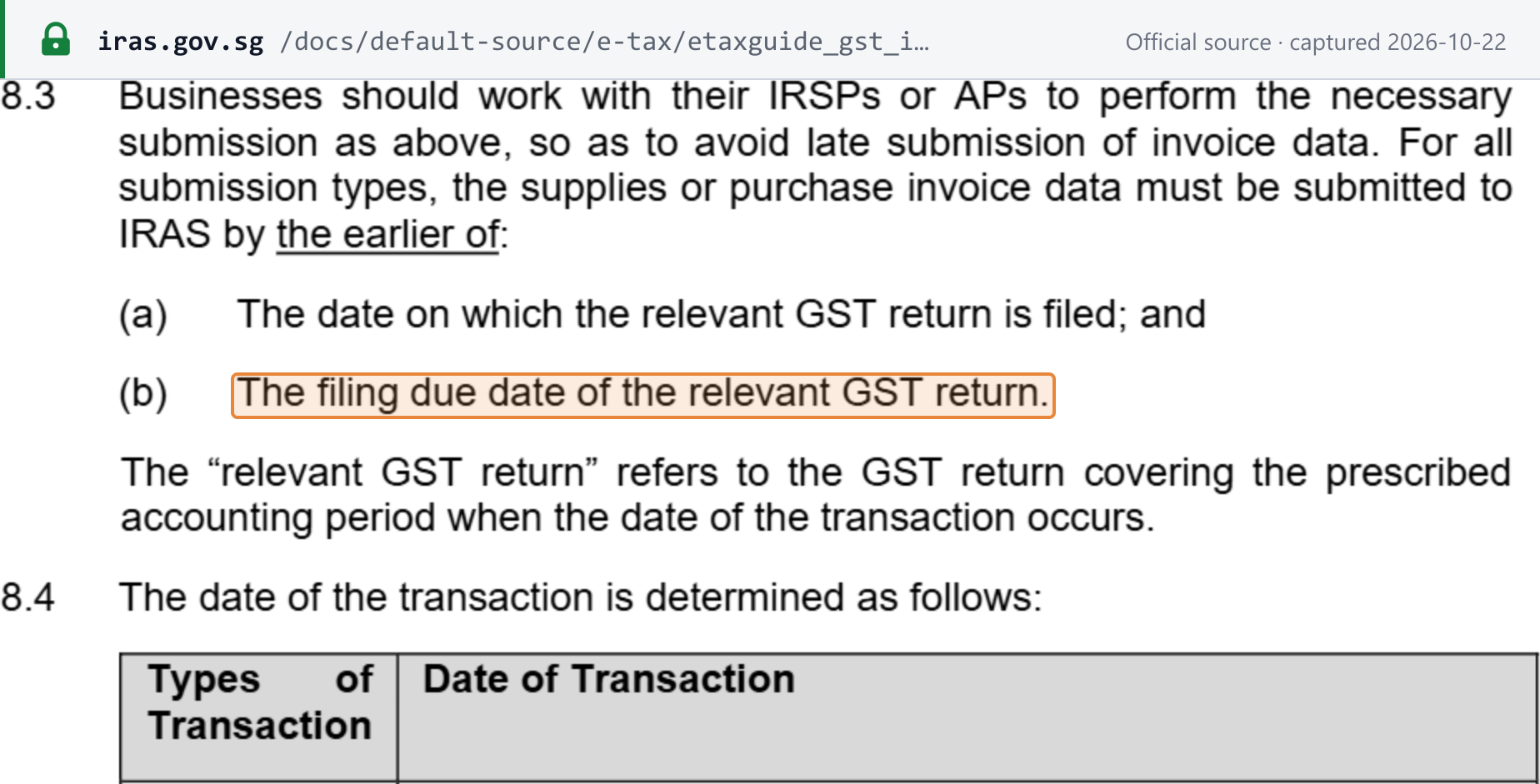
Submission deadline. For every submission type, invoice data is due by the earlier of the date you file the relevant GST return and that return's filing due date. The relevant return is the one covering the accounting period in which the transaction date falls. If IRAS's API is disrupted, IRAS may extend the filing or submission due date at its discretion. [1]
Onboarding: how to comply
- Get an InvoiceNow-Ready Solution. Check that your accounting software is on IMDA's list of InvoiceNow-Ready Solution Providers (IRSPs), or pick a free-of-charge package. A business with an in-house ERP connects through an IMDA-accredited Access Point (AP).
- Get a Peppol ID. Ask your IRSP or AP to register your business in the SG Peppol Directory with your UEN.
- Activate the GST InvoiceNow Submission feature in your solution and test it.
IRAS says onboarding "may take as little as 3 months" and most businesses finish within a year; the e-Tax Guide tells businesses using in-house systems to allow 3 to 12 months for the system connection to IRAS. [2] [1]
Providers. APs run the access nodes on InvoiceNow, enforce Peppol standards and route invoices. IRSPs offer accounting or finance software connected to InvoiceNow through an AP. IMDA accredits both. IMDA's AP list, updated 21 September 2026, names 49 Access Point providers. There is no IRAS portal for uploading invoice data yourself: submissions go through an InvoiceNow-Ready Solution and an AP, and APs cannot convert paper or PDF invoices for you. [1] [10] [3]
Testing and technical documents. The IRAS sandbox, open since September 2024, is reached through your AP or IRSP. The Invoice Data Submission Specifications, schematrons and example files are linked from IMDA's InvoiceNow Technical Playbook; IRAS's API documents are on the APEX portal. [7] [3]
Grants and free packages (as at 22 October 2026). IRAS lists a GST InvoiceNow Transition Grant of S$1,000 for SMEs (annual supplies up to S$4,000,000) and S$5,000 for larger businesses, and an InvoiceNow Queen Bee Grant of S$25,000 for larger businesses with annual turnover above S$4,000,000. Free-of-charge solution packages are available up to 31 March 2031; the current list runs to 31 March 2027, and the list for 1 April 2027 to 31 March 2031 is to follow. Eligibility conditions are on the IRAS and IMDA pages. [2]
Penalties
- Voluntary registrants: refusal or revocation. For the phases in force, the sanction IRAS states is that a voluntary GST application may not be approved, or the registration may be revoked, if the business does not comply. [1] [3]
- Calibrated enforcement at the start. IRAS says it will be calibrated in its enforcement during the initial phases of onboarding where errors in invoice data are genuine mistakes, not due to negligence or made without reasonable excuse. [3]
- 2028–2031 phases. IRAS says only that "enforcement action may be taken" against businesses that do not comply. [3]
- No published fine. IRAS publishes no monetary penalty for failing to submit, submitting late or submitting wrong invoice data.
- Differences with the GST return. Legitimate differences (for example, timing) between invoice data and the GST return are not penalised so long as the business keeps the required records and can produce them to substantiate its reporting. [1]
Frequently asked questions
My company was incorporated years ago. Do I need InvoiceNow if I register for GST voluntarily now?
Yes. Any application for voluntary GST registration made on or after 1 April 2026 is caught, whatever the incorporation date or business structure, and you submit invoice data to IRAS from your effective GST registration date. Before 1 April 2026, only companies applying within 6 months of incorporation were caught. [1]
I am already GST-registered. When do I have to start?
It depends on your total annual supplies (Box 4 of the GST return) across the accounting periods ending in 2025: from 1 April 2028 if they are S$200,000 or less, 1 April 2029 if S$1,000,000 or less, 1 April 2030 if S$4,000,000 or less, and 1 April 2031 if above S$4,000,000. IRAS has been notifying businesses registered before 2026 of their date since mid-2026; businesses without 2025 returns will be told later, and members of GST groups will also be given their date later. [2]
Do I have to send Peppol e-invoices to all my customers?
No. The obligation is to submit invoice data to IRAS through an InvoiceNow-Ready Solution. You can still give paper or PDF invoices to customers who are not on InvoiceNow, and submit that data to IRAS as solution-extracted data. [1]
Do purchases have to be submitted too?
Yes. Standard-rated and zero-rated purchases reported in the GST return are in scope, as well as standard-rated, zero-rated and exempt supplies. Partially exempt businesses submit all purchase invoice data with GST incurred, except disallowed expenses, whether or not the input tax is claimed. [1]
Are overseas businesses registered for Singapore GST caught?
Not if they must appoint a section 33(1) agent or are registered under the OVR pay-only or OVR full regime. A foreign company with a branch or establishment in Singapore is caught. Businesses registered solely because of reverse charge are also excluded. [1]
Do I have to invoice government agencies through InvoiceNow?
It is not mandated; vendors may still bill through the Vendors@Gov portal. Government has accepted e-invoices over InvoiceNow since 2020, and the Government says InvoiceNow will become the default e-invoice submission channel for government vendors that are registered businesses within the next few years, eventually replacing Vendors@Gov for them. The plan was first announced in 2023, and no date has been published since. [5] [6]
What happens if I do not comply?
For voluntary registrants, IRAS may refuse the GST application or revoke the registration. For the 2028–2031 phases, IRAS says enforcement action may be taken. IRAS publishes no fine for InvoiceNow failures. [3]
Recent changes
- 2026-04-01 — The GST InvoiceNow Requirement extends to all new voluntary GST registrants, regardless of incorporation date or business structure. (IRAS) — see event
- 2026-03-09 — The e-Tax Guide's Second Edition writes the 2028–2031 phases into §5.5(c)–(f). (IRAS)
- 2026-02-26 — Committee of Supply 2026: the requirement will extend to all GST-registered businesses, in phases from 1 April 2028 to 1 April 2031. (IRAS)
- 2025-11-01 — The requirement starts for companies registering for GST voluntarily within 6 months of incorporation. (IRAS)
Related resources
- Singapore GST guide: rates, registration, invoice fields
- Singapore tax ID guide: the UEN behind your Peppol ID
- How to verify a Singapore GST number and UEN
- E-invoicing status and networks by country
- Peppol guide and country-wise requirements for Peppol
- Clearance, reporting and interchange: CTC e-invoicing models
- Other Peppol PINT countries: Australia, Malaysia, United Arab Emirates, Oman
- Singapore tax changes on Lookuptax
Important websites
- IRAS GST InvoiceNow Requirement: phases, grants, Implementation Date Calculator
- IRAS e-Tax Guide (PDF) and IRAS FAQ (PDF)
- IMDA InvoiceNow and the InvoiceNow Technical Playbook
- Singapore Peppol Guide and PINT-SG specifications
- SG Peppol Directory
- IMDA lists: Access Point providers (PDF), InvoiceNow-Ready Solution providers (PDF), free-of-charge packages (PDF)
- Vendors@Gov