E-invoicing in Israel: the Israel Invoices allocation-number model
Overview
Israel's system is the "Israel Invoices" model (מודל חשבוניות ישראל, model heshboniyot Yisrael). Before a supplier finalises a tax invoice (חשבונית מס), it asks the Israel Tax Authority (ITA) for an allocation number (מספר הקצאה, mispar haktza'a) and prints that number on the invoice. Above a statutory amount, the buyer can deduct the input VAT on the invoice only if the invoice carries the number. The ITA says the model is meant to curb fictitious invoices, which it says cost the state billions of shekels a year. [1]
It is not a structured e-invoice mandate. There is no prescribed invoice file format and no exchange network. The invoice can still come from accounting software or from a paper invoice book, and the law lets the number be written on the invoice "including by hand". [5]
Legal basis in one line. VAT Law 5736-1975 s.38(a1) and s.47(a2)–(a4), inserted by the Economic Efficiency Law 2023 (Sefer HaChukim 3045) and amended by the 2025 budget arrangements law (Sefer HaChukim 3384). [4] [3]
| Israel | |
|---|---|
| System | "Israel Invoices" allocation-number model: the ITA validates invoice data and returns a number for the invoice |
| B2B | In force. From 1 June 2026, a number is needed where the amount before VAT exceeds NIS 5,000, the invoice carries VAT, the customer is an authorised dealer and the customer asks for a number |
| B2C | Out of scope. The customer must be an authorised dealer |
| B2G | No separate B2G system. Public bodies are caught only as authorised-dealer buyers |
| Non-residents | No special rule. A foreign business registered for VAT through an Israeli representative is an authorised dealer like any other |
| Format | No invoice format prescribed. Software sends invoice data to a REST API in JSON (OAuth2); invoice-book users key it into an ITA web app |
| Network | The ITA's online allocation service (API and web app). Not Peppol |
| Integrity | The allocation number itself. No QR code, hash or digital signature |
| Authority | Israel Tax Authority (VAT division), through its allocation-number service |
| Legislation | VAT Law s.38(a1), s.40B, s.47(a2)–(a4); Economic Efficiency Law 2023 s.38; 2025 arrangements law ss.17–18 |
For the VAT rate, dealer registration and general invoice rules, see the Israel VAT guide.
Mandate status & timeline
The threshold is the invoice amount before VAT, and the test is "exceeds" (עולה על). An invoice of exactly NIS 5,000 is not caught; one of NIS 5,000.01 is. [2] [5]
| Phase | Invoices caught (amount before VAT) | What applies | Date | Instrument | Status (at 22 Oct 2026) |
|---|---|---|---|---|---|
| Web app | Any (voluntary) | ITA web app for requesting numbers goes live | November 2023 | Instruction 01/2025 §3(c)(2) | Passed |
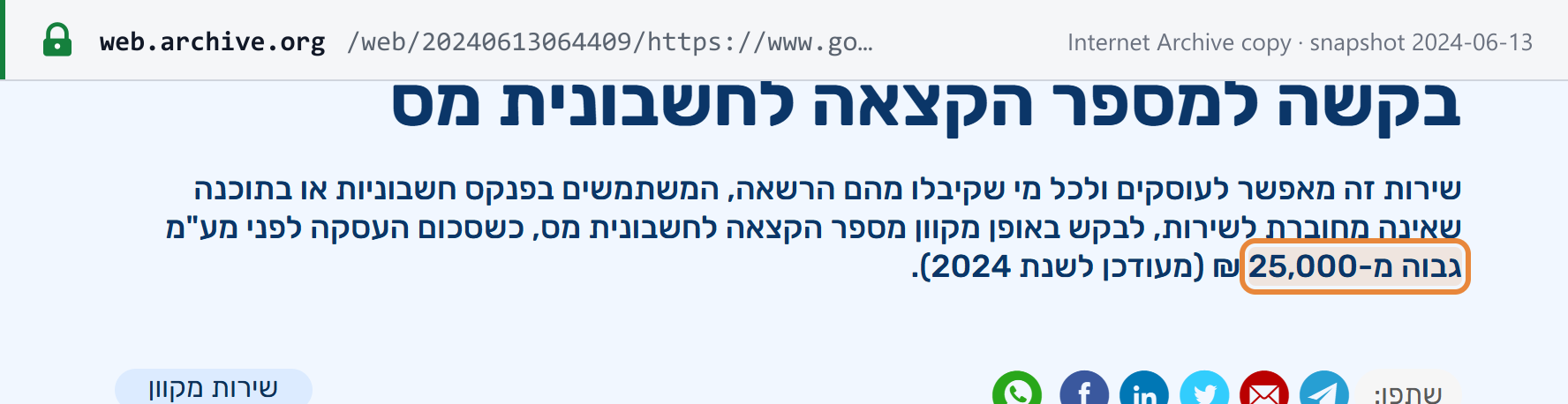
| Start (pilot year) | Exceeding NIS 25,000 | Number required for the buyer's input-VAT deduction; in 2024 the ITA issued a number for every valid request | Statutory start 1 Jan 2024; applied from 5 May 2024 after an extension | Economic Efficiency Law 2023 s.38; Instructions 01/2023 and 01/2025 | Passed |
| Phase B | Exceeding NIS 20,000 | The ITA examines each request and may refuse a number for a suspect invoice | 1 Jan 2025 | 2023 Law s.38(b)(1); Minister's order KT 11668 (31 Dec 2024); Instruction 01/2025 §8 | Passed |
| Step-down | Exceeding NIS 10,000 | Same rules | 1 Jan 2026 to 31 May 2026 | 2023 Law s.38(b)(2) as amended by SH 3384 s.17; Instruction 01/2025 | Passed |
| Current | Exceeding NIS 5,000 | Same rules | 1 Jun 2026 onward | VAT Law s.38(a1); Instruction 01/2025 | In force |
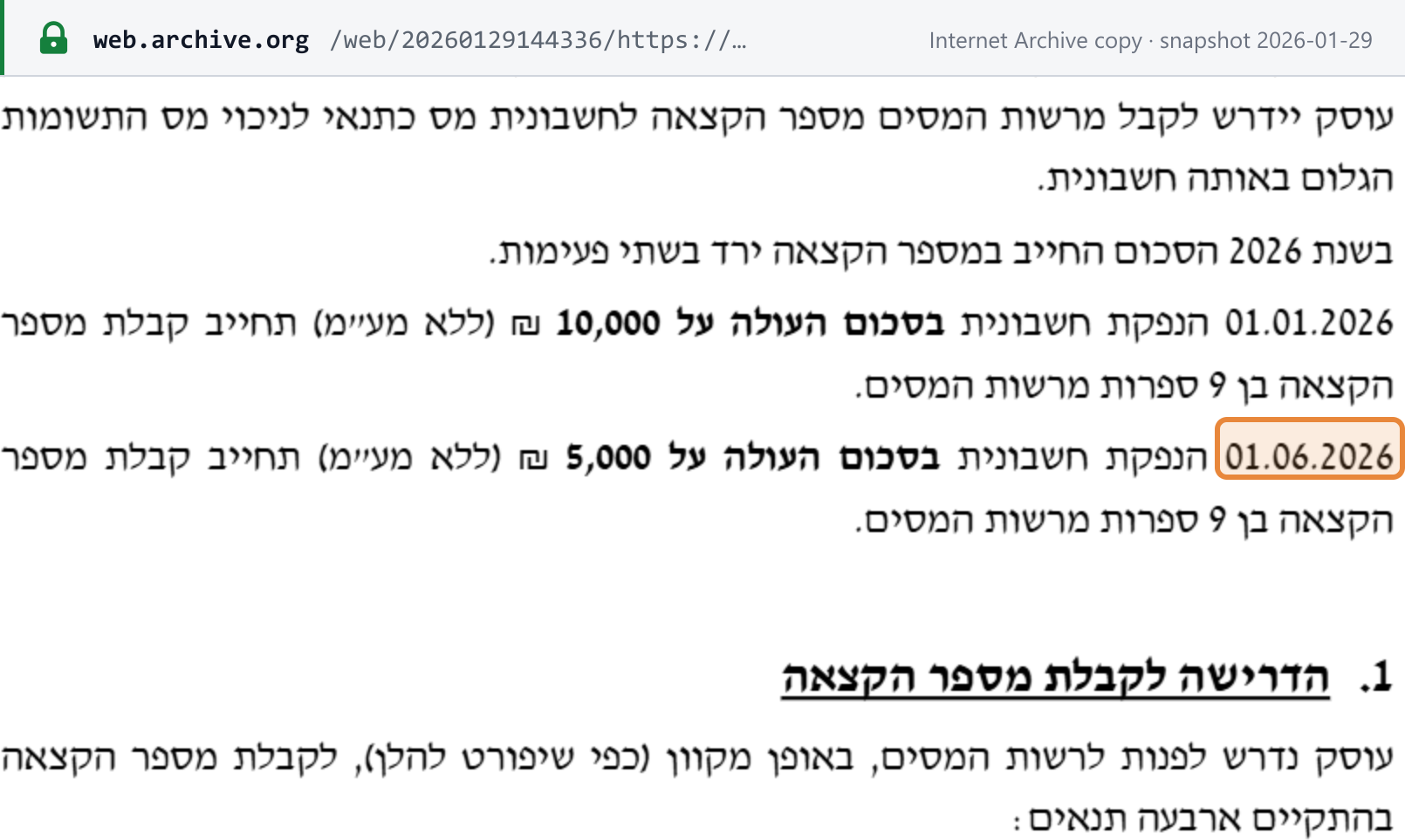
The latest phase. The step to NIS 5,000 on 1 June 2026 was announced in Instruction 01/2025 of 7 December 2025. Its §8 records that phase B began on 1 January 2025, after a decision of the Knesset Finance Committee, and that from 1 January 2026 (above NIS 10,000) and 1 June 2026 (above NIS 5,000) input tax can be claimed only if the invoice includes an allocation number. The ITA's service page, updated 1 June 2026, gives the same figures. [2] [1]
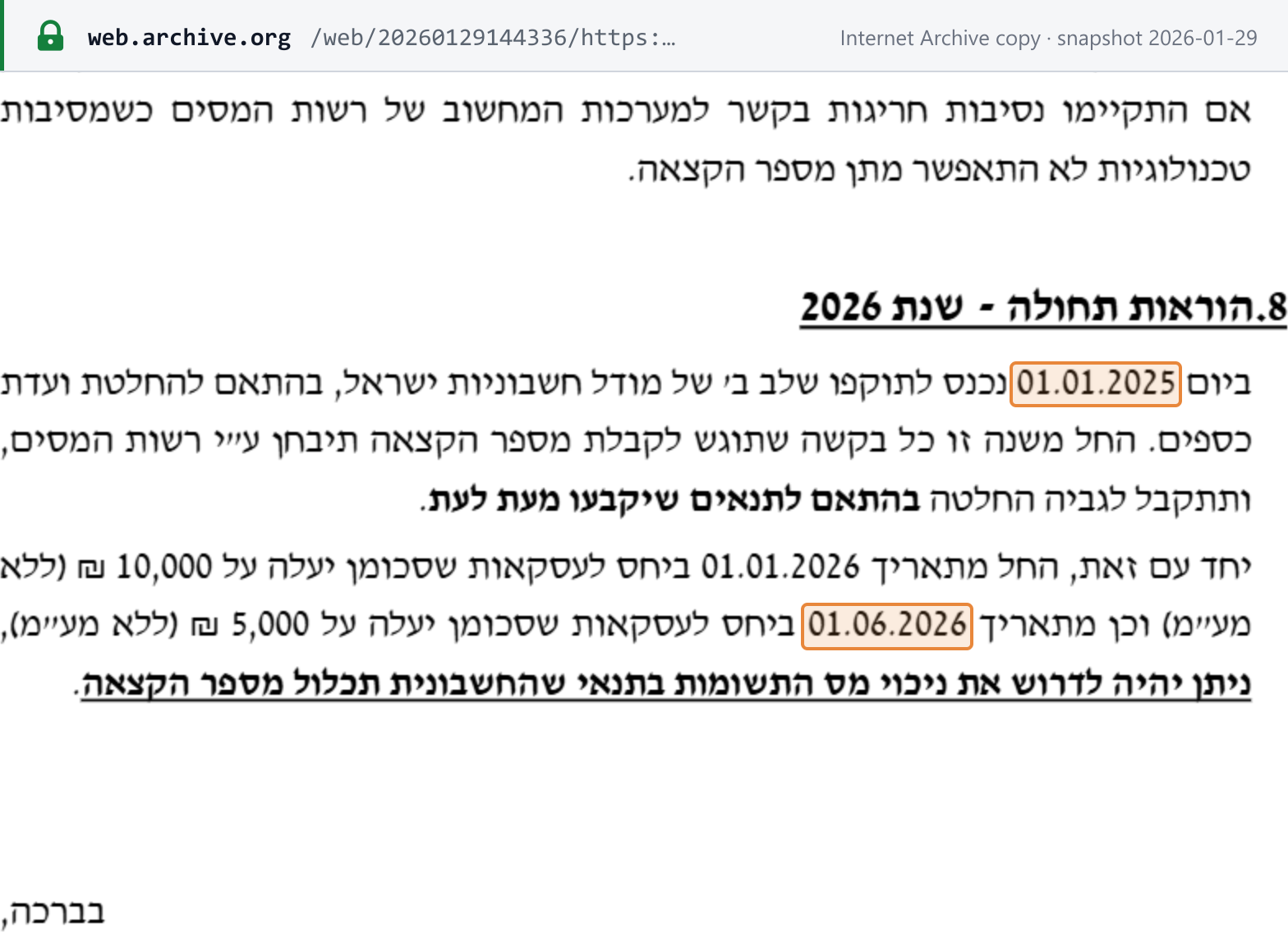
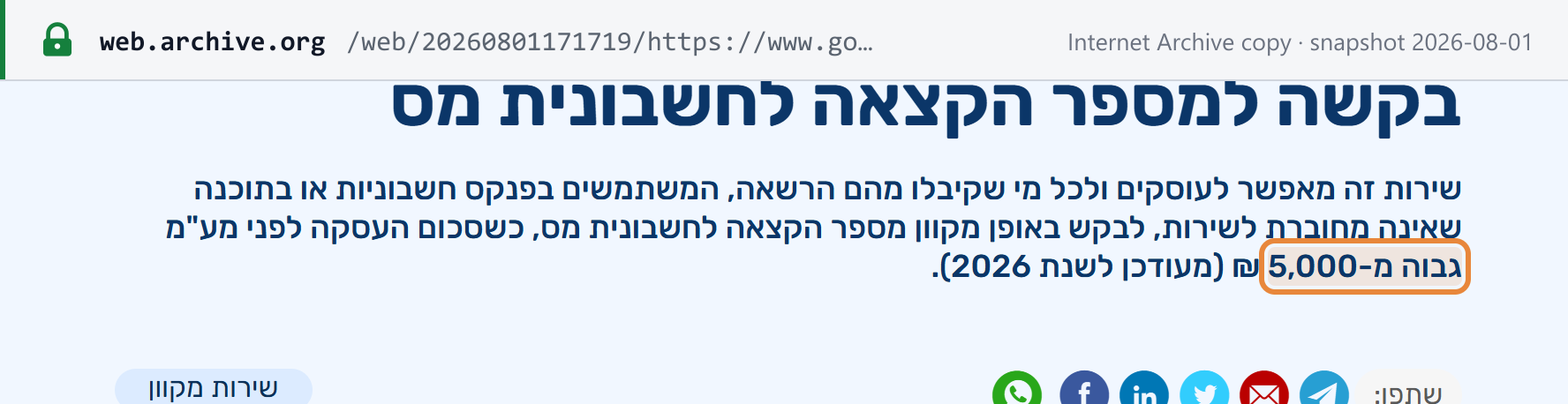
Further phases. The statute fixes NIS 5,000 as the permanent amount (VAT Law s.38(a1)). No lower step has been legislated. [5] [3]
Pilot year
During 2024 the ITA allocated a number to every valid invoice for which one was requested; the API description sets the pilot period as 1 January to 31 December 2024. Refusals began with phase B in 2025. [7] [6]
Postponements and the replaced calendar
- The start date moved twice. The statute set 1 January 2024. The ITA first extended the start to 1 April 2024, and the model finally applied from 5 May 2024 "after an extension was granted" (Instruction 01/2025). [2]
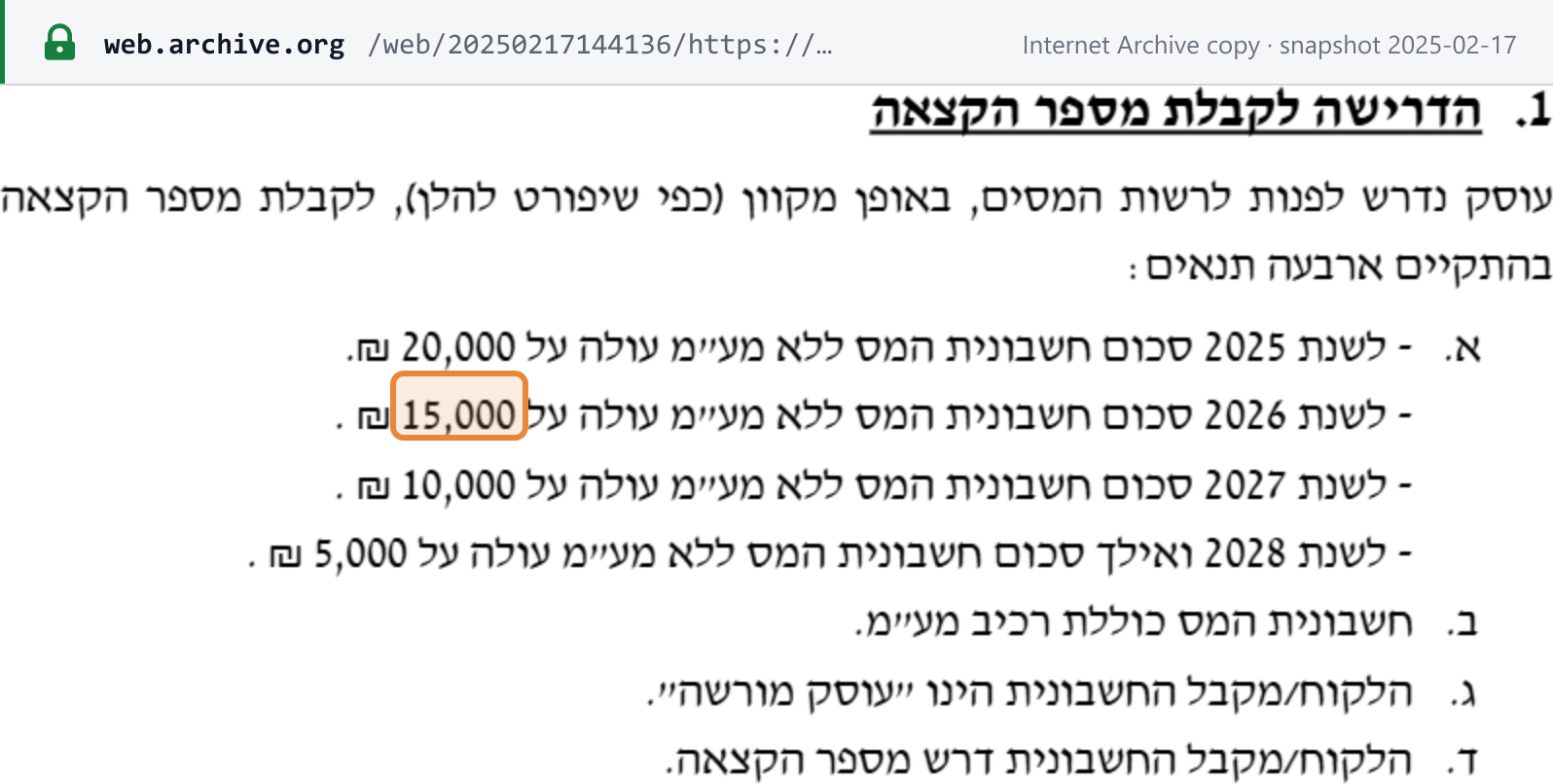
- The 2024 calendar was replaced. Instruction 01/2024 (15 August 2024), and the July 2023 API description, set NIS 20,000 for 2025, NIS 15,000 for 2026, NIS 10,000 for 2027 and NIS 5,000 from 2028. The 2025 arrangements law (27 March 2025) and Instruction 01/2025 (7 December 2025) brought the later steps forward to NIS 10,000 in January 2026 and NIS 5,000 in June 2026. Vendor material that still quotes 2027 and 2028 dates describes this replaced calendar. [8] [3]
- What survives. The 2025 step (NIS 20,000), the four conditions and the refusal regime are unchanged. Only the 2026–2028 amounts and dates moved.
Legal basis
| Instrument | Date | What it does |
|---|---|---|
| Economic Efficiency Law (Legislative Amendments for Achieving Budget Targets for 2023 and 2024), 5783-2023, s.38 (Chapter B, "allocation of invoice numbers") | Sefer HaChukim 3045, 31 May 2023 | Inserts s.38(a1) and the allocation provisions of s.47 into the VAT Law from 1 January 2024, with a temporary step-down in s.38(b) |
| Minister's order KT 11668 (application of s.38(a) and (b) of the Law), 5785-2024 | 31 Dec 2024 | Signed by the Finance Minister with Finance Committee approval; keeps ss.38(a)–(b) in force so phase B starts in 2025 |
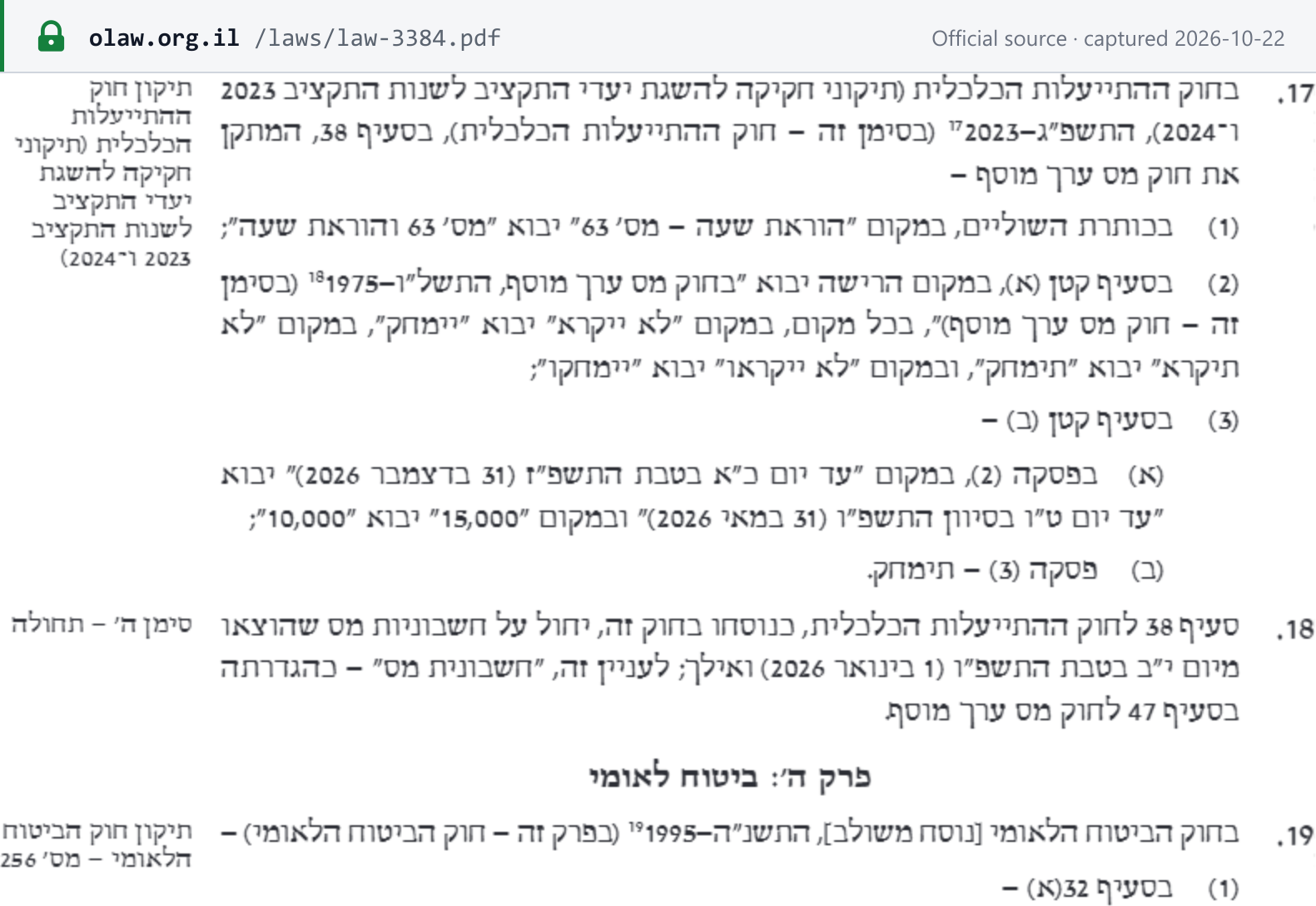
| 2025 budget arrangements law, 5785-2025, Chapter D, Division E, ss.17–18 | Sefer HaChukim 3384, 27 Mar 2025 | Ends the NIS 10,000 period on 31 May 2026 (it had been NIS 15,000 to 31 December 2026) and deletes the 2027 period; recasts the allocation rules as permanent VAT Law amendment No. 63; applies to tax invoices issued from 1 January 2026 |
| Same law, Chapter D, Divisions B–D (ss.9–16) | Sefer HaChukim 3384, 27 Mar 2025 | Lowers the detailed-report threshold to NIS 500,000 (s.9); requires invoices to Palestinian Authority-registered businesses to be submitted online (s.11); denies the income-tax deduction for expenses whose input VAT was refused under s.38(a1) (s.13); adds the request-after-issue rule to s.47(a2) (s.15) |
| VAT Law 5736-1975 (consolidated) | In force as amended | s.38(a1), s.40A(2), s.40B, s.43A, s.47(a2)–(a4), s.69A(b) — see below |
| VAT Implementation Instruction 01/2025 | 7 Dec 2025 | Current ITA guidance on the model; follows Instructions 01/2023 and 01/2024 |
| Israel Invoice Model — Description of API's, edition 7.2023 / v1.0 | July 2023 | ITA technical specification for software houses. Not a statutory standard |
The ITA's instructions are administrative guidance, not legislation. The ITA's service page says that where its information conflicts with the law, the law prevails. [1]
Permanent since 2025. The 2023 Law inserted the rules into the VAT Law as a temporary provision. The 2025 arrangements law changed the marginal note from "temporary provision – No. 63" to "No. 63 and temporary provision", and replaced "shall not be read" with "shall be deleted" throughout, so the inserted text became permanent text of the VAT Law. Only the step-down periods in s.38(b) stayed temporary, and both have ended. Footnotes in the consolidated VAT Law text that still give a period "until 31.12.28" predate this amendment. [3]
The operative VAT Law provisions. [5]
| Provision | Rule |
|---|---|
| s.38(a1) | No input-VAT deduction for a tax invoice whose amount, without the tax, exceeds NIS 5,000 and which lacks a number allocated by the Director |
| s.47(a2)(1) | An authorised dealer may ask for a number for any tax invoice; above the s.38(a1) amount it must do so if the buyer asks. Does not apply to an invoice for a zero-rated transaction |
| s.47(a2)(2) | The request is made online; the number is shown on the invoice, "including by hand" |
| s.47(a2)(3) | Where there is reasonable ground to suspect the invoice is unlawful, the Director may preliminarily decide not to allocate a number |
| s.47(a2)(4) | A number may be requested after the invoice is issued; this does not change the s.38(a) deduction deadline. In force from 1 January 2026 (SH 3384 ss.15(2) and 16(a)) |
| s.47(a3) | Buyer reverse charge where a number is refused |
| s.47(a4) | Hearing, objection and appeal rules |
| s.40A(2) | Pre-registration (start-up) input VAT above the amount is deductible only with a number |
| s.40B | The Director may allow deduction without a number where ITA computer systems failed |
| s.43A | Input VAT on certain real-estate purchases likewise needs a number |
| s.69A(b) | The detailed VAT report must state the allocated number for each tax invoice that has one |
Scope
Who must request a number (B2B). A supplier that is an authorised dealer (עוסק מורשה) must request a number online when all of these hold: [2] [5]
- the tax-invoice amount before VAT exceeds NIS 5,000 (from 1 June 2026);
- the invoice includes a VAT component;
- the customer is an authorised dealer;
- the customer asked for an allocation number.
Because the buyer cannot deduct input VAT without it, suppliers have reason to request a number for every qualifying B2B invoice. A dealer may request a number for a tax invoice of any amount. Requests can be made by authorised dealers (individuals and companies) and by anyone they have delegated to in the ITA's digital-authorisation system. [1]
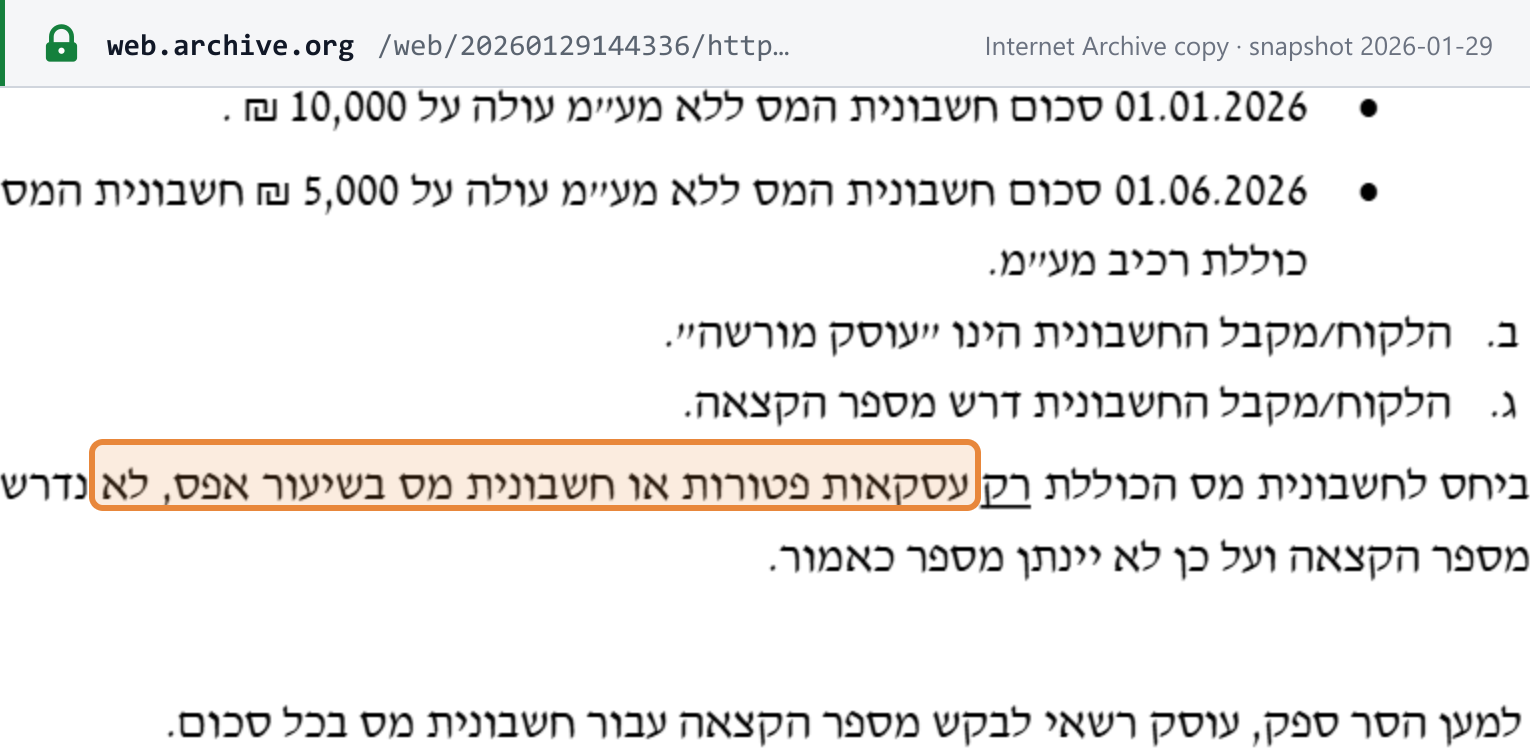
Excluded invoices. A tax invoice that contains only exempt transactions, or is only zero-rated, needs no number, and the ITA will not give one. [2]
B2C. Out of scope. The obligation depends on an authorised-dealer customer asking for a number, and the sanction is the buyer's loss of input-VAT deduction, which consumers do not have.
B2G. No separate B2G system. Public bodies are caught only as authorised-dealer buyers.
Non-established businesses. No special rule. A foreign business registered for VAT through an Israeli representative is an authorised dealer like any other, and the same request duty applies to the tax invoices it issues. For the representative requirement, see the Israel VAT guide.
- Real estate (s.43A). Where a dealer buys real estate in a transaction that would otherwise be exempt, it may deduct the VAT paid only if the invoice carries a number.
- Start-up businesses (s.40A). Input VAT paid before registration to set up the business is deductible above the amount only with a number, even if the invoice is not in the business's name.
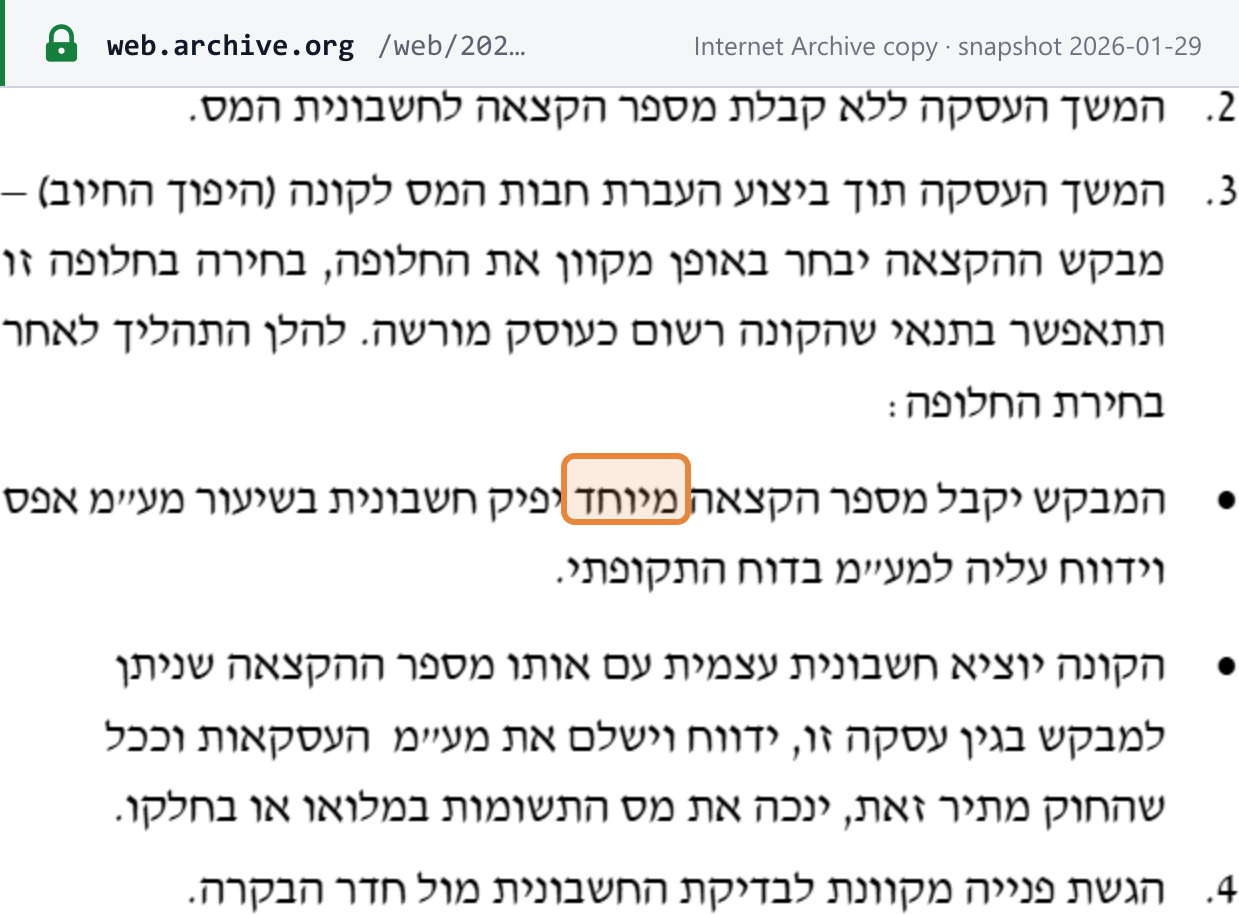
- Cash-basis deals. For a pro forma or transaction-account document, a dealer can request an allocation approval (אישור הקצאה), also 9 digits. It is an in-principle approval of a future number and does not allow input deduction; the document must say so. The approval becomes an allocation number when the tax invoice is issued.
- Invoices to Palestinian Authority-registered businesses. Since 1 August 2025 (SH 3384 s.11), tax invoices to PA-registered businesses must be in a form the Director sets and submitted online (s.47(b)(2)), replacing the earlier approved-printer rule. [3]
Format & network
The model. This is clearance-style pre-approval of invoice data. Before finalising a tax invoice, the issuer sends the invoice data to the ITA's allocation service. The ITA validates it and returns an allocation number, and since 2025 it may refuse one. The ITA does not exchange or deliver the invoice: the supplier still sends the invoice to the buyer by its own means, with the number printed on it. A number can also be obtained after the invoice is created. [6] [5]
- Accounting software adapted to the model calls the ITA's API automatically, and the invoice it produces displays the number. Software houses may plug in third-party "brokerage" components to reach the API.
- The ITA web app, live since November 2023 and usable on a phone, is for invoice-book users and unconnected software. The dealer enters the document number, the customer's VAT or company number, the amount before VAT, the VAT amount and the date. The service is free.
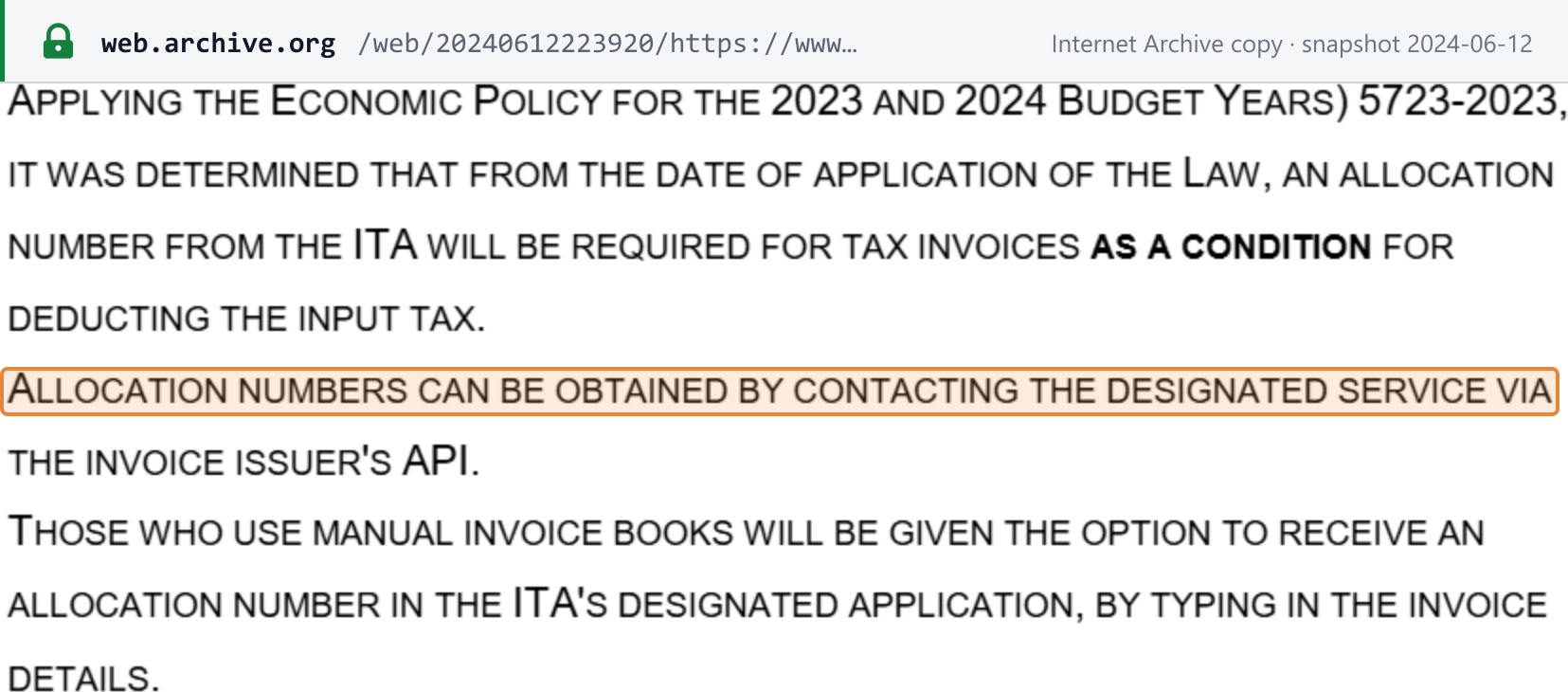
The API. Per the ITA's July 2023 API description (v1.0): [6]
- Protocol. REST with JSON request and response bodies; authentication by OAuth2 ("User Restricted"). Sandbox endpoint:
https://openapi.taxes.gov.il/shaam/tsandbox/Invoices/v1/Approval. The production URL was not published in that edition. - Mandatory request fields include the invoice ID and document type, the issuer's VAT number, the invoice and issuance dates, the accounting software's ITA registration-certificate number (99999999 if none), the amount before discount, discount, amount excluding VAT, VAT amount and amount including VAT. The customer's VAT number is required where the customer is a licensed dealer; line items are optional. Each field maps to a field of the ITA's "Uniform File" book-keeping export.
- Document types that take a number include the tax invoice (305), periodic tax invoice (310), tax invoice/receipt (320), credit tax invoice (330) and pro forma (332, for the allocation approval).
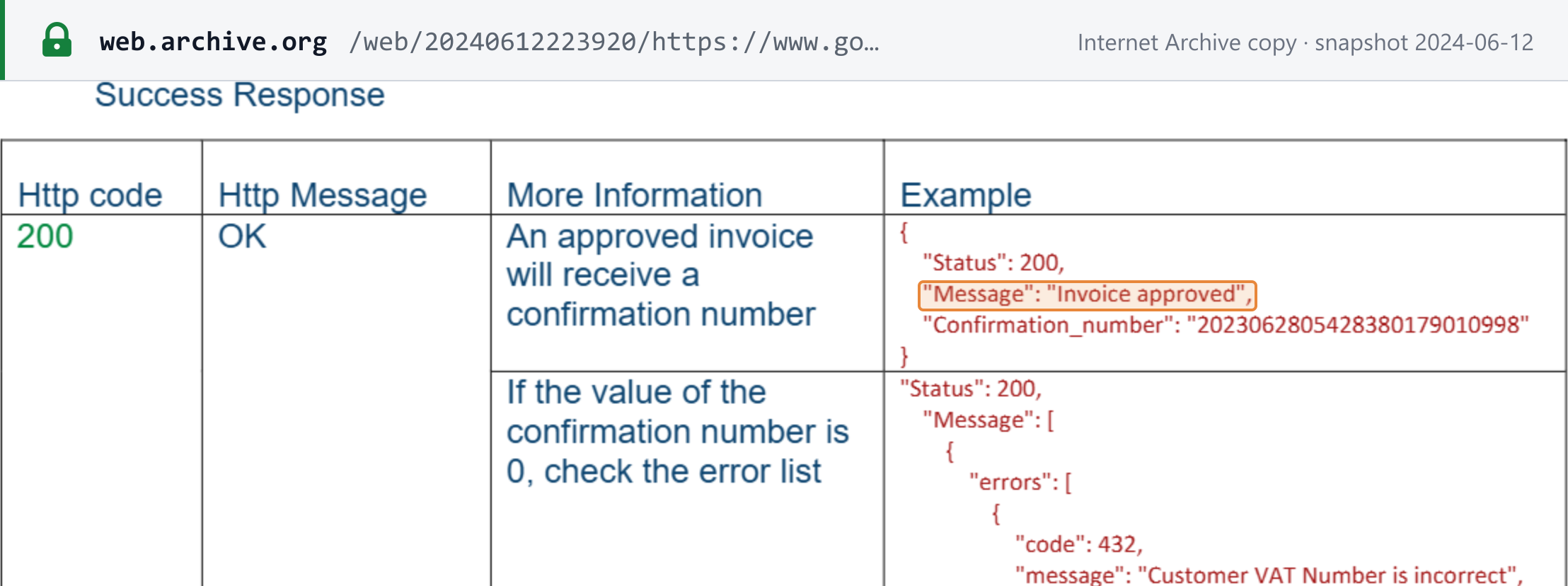
- Response. An approved invoice returns HTTP 200,
"Message": "Invoice approved"and a longConfirmation_number. A confirmation number of 0 means the request failed validation — for example code 432, "Customer VAT Number is incorrect", or code 434, "Invoice date is more than two weeks old". - What to print. The issuer stores the number in the invoice record and prints its 9 right-most digits under "allocation number".
Endpoint and field details above follow the published v1.0 specification.
No prescribed invoice format. Neither the VAT Law nor the ITA's instructions prescribe an e-invoice document format such as UBL, CII or a national XML schema, and paper invoice books remain valid. The JSON payload carries invoice data, not an invoice document. [5]
Not Peppol. None of the ITA's allocation materials mention Peppol or any exchange network. For a contrast with network-based systems, see the Peppol guide.
No QR code, hash or signature. The July 2023 API description contains no QR-code, hash, cryptographic-stamp or digital-signature requirement. The only integrity token is the allocation number.
Reporting alongside. The detailed periodic VAT report (PCN874) must state the allocation number for each tax invoice that has one (s.69A(b)). The API description adds a "shortened allocation number" field — the last 9 characters — on both the sales and the purchases side of the invoice record. The 2025 arrangements law (s.9) lowered the turnover threshold for filing the detailed report in s.69A from NIS 2,500,000 to NIS 500,000, for reports filed from 1 October 2025 (s.10). Detailed filers report monthly, within 23 days. The model itself has no separate periodic submission cycle. [5] [3] [6]
Buyer-side services. A buyer, or its delegate, can check in its personal area that a supplier's invoice details (allocation number, amount, supplier and customer) match what the supplier reported, and can check an allocation approval for a pending cash-basis deal. The ITA states that the display is not confirmation that the content is true. An API service also lets a buyer's bookkeeper pull supplier-invoice data into its books by allocation number. [2] [12]

When the ITA's system is down. [6] [5]
- Software pre-fetches batches of emergency allocation numbers. They may be used only during an ITA system failure, and only after a minimum of 5 failed attempts on the normal service (a figure the ITA says may vary by policy). Failed attempts must be logged, and once the failure ends every invoice issued with an emergency number must be reported to the ITA.
- Separately, s.40B lets the Director allow input deduction without a number where exceptional circumstances in the ITA's computer systems made allocation technically impossible.
Onboarding: how to comply
- Register for the ITA's digital services. Registration in the ITA's computerised identification system, through the personal area of the ITA website, is mandatory for using the allocation system. For a first registration, the ITA recommends having a credit card and the previous year's Form 106 ready, or income-tax or VAT reporting data instead, for identification only. Register as an individual dealer or for a company.
- Delegate. A company must, and an individual may, grant authorisation to the people or bookkeepers who will request numbers, through the ITA delegation service. The delegate receives an SMS or email and must log in and approve. A delegation lasts at most one year, or until cancelled.
- Connect your invoicing. If your accounting software supports the model, link your personal ITA user code inside it; the software will ask you to re-identify from time to time. If you use an invoice book or unconnected software, request each number in the ITA web app.
- Print the number (its 9 right-most digits) on every qualifying tax invoice, and report it in the detailed VAT report.
- Developer portal and sandbox. Integration runs through the ITA Open API developer portal. Only users registered with the ITA by identity number can log in; smart-card login is not accepted. An organisation registers with ADMIN, VIEWER and DEVELOPER roles, defines apps, receives a Client ID and Client Secret, and sets a redirect URI. OAuth2 issues a JWT access token and a refresh token.
- Production approval. Production use requires ITA approval. An authorised signatory registers the organisation in the portal and attaches the signed documents published there; the ITA reviews the request and emails its approval or refusal.
- Registration certificate. Each request carries the software's ITA registration-certificate number, or 99999999 where there is none. ITA registration of book-keeping software is a separate, older regime.
No accredited providers. Israel does not certify e-invoicing providers. Any software, including third-party connectors, can connect through the ITA API.
Support. Email [email protected], or call the ITA on *4954 or 02-5656400, Sunday to Thursday, 08:15 to 15:45. [1] [6]
Penalties
The model's own sanctions fall on the buyer, twice.
- No input-VAT deduction. Input VAT on a tax invoice above the amount that lacks an allocated number "shall not be allowed as a deduction" (VAT Law s.38(a1)). A late request is possible, but it does not extend the buyer's deduction deadline in s.38(a), which requires the deduction to be made within six months of the invoice's issue date. [5]
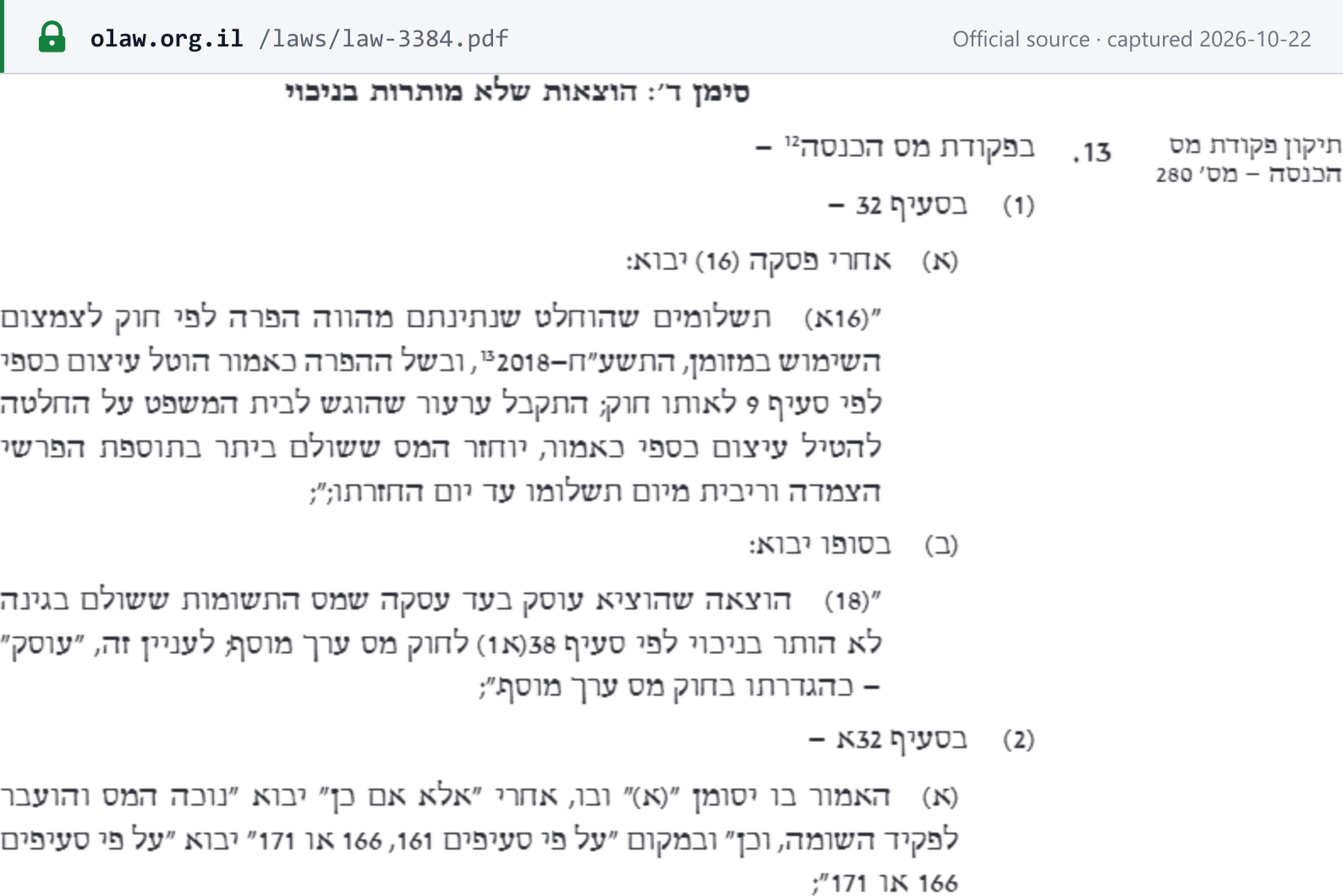
- No income-tax deduction for the expense either. The 2025 arrangements law (s.13(1)(b)) added s.32(18) to the Income Tax Ordinance: an expense a dealer incurred for a transaction whose input VAT was not allowed under VAT Law s.38(a1) is not deductible for income tax. It applies to expenses paid from 1 August 2025 (s.16(b)). [3]
No fixed fine on suppliers. Neither s.38, s.47 nor Instruction 01/2025 sets a monetary penalty for a supplier that fails to request a number. The supplier's exposure is commercial — its customer loses both deductions — plus the general VAT offences below.
Refusal, hearing, objection and appeal. Since 2025, where the ITA has reasonable ground to suspect that an invoice will be issued unlawfully, it sends an online notice and does not give a number. [2] [5]
- Four options. The notice gives the reason and a hearing date. The dealer can cancel the request; issue the invoice without a number; use the buyer reverse charge (only where the buyer is an authorised dealer); or ask the ITA's control room to review the invoice.
- Hearing. Held within 2 business days of the notice, possibly by video. If the Director's decision is not delivered within 1 business day after the hearing, the request is treated as accepted and a number must be allocated.
- Objection. Filed online within 30 days, and decided within 21 business days, or it is treated as accepted.
- Appeal. To the District Court.
- Buyer reverse charge. Under this option the requester receives a special allocation number and issues a 0% VAT invoice; the buyer issues a self-invoice with the same number, reports and pays the VAT, and deducts input VAT as the law allows. See reverse charge explained.
Criminal offences (VAT Law s.117). There is no allocation-specific offence; these general offences are what the model polices. [5]
- Up to 1 year in prison (s.117(a)) — including not issuing a tax invoice when obliged to.
- Up to 5 years, or twice the fine in Penal Law s.61(a)(4) (s.117(b)), where done to evade tax — including issuing a tax invoice, or a document purporting to be one, without making or undertaking the transaction, and deducting input tax without a supporting document.
- Up to 7 years, or five times that fine (s.117(b2)), in aggravating circumstances.
Frequently asked questions
Do I need an allocation number for an invoice of exactly NIS 5,000?
No. The test is that the amount before VAT exceeds NIS 5,000, so an invoice of exactly NIS 5,000 is not caught. An invoice above NIS 5,000 needs a number if it carries VAT, the customer is an authorised dealer and the customer asks for one. [2] [5]
My customer didn't ask for a number. Do I still need one?
The law makes the request compulsory when the buyer asks. But because the buyer cannot deduct input VAT on an invoice above NIS 5,000 without the number, suppliers have reason to request a number for every qualifying B2B invoice. A number can be requested for an invoice of any amount. [5] [2]
Can I get the number after I've issued the invoice?
Yes. VAT Law s.47(a2)(4), in force from 1 January 2026, allows a request after the invoice is issued. It does not extend the buyer's deadline: the deduction must still be made within six months of the invoice's issue date. [5]
Do I need an XML e-invoice, Peppol or a QR code?
No. Israeli law prescribes no e-invoice file format, network or QR code, and the number may be written by hand on a paper invoice. Software obtains the number by sending invoice data to the ITA's JSON API with OAuth2 authentication. [5] [6]
What if the ITA's system is down?
Software can use pre-fetched emergency allocation numbers after at least 5 failed attempts on the normal service, and must report those invoices to the ITA once the failure ends. Separately, VAT Law s.40B lets the Director allow input deduction without a number where the ITA's systems made allocation technically impossible. [6] [5]
The ITA refused my request. What now?
You can cancel the request, issue the invoice without a number, use the buyer reverse charge if the buyer is an authorised dealer, or ask the ITA's control room to review it. A hearing is held within 2 business days; if no decision follows within 1 business day after it, the number is treated as granted. An objection can be filed within 30 days and must be decided within 21 business days, and an appeal lies to the District Court. [2]
Will the threshold fall to NIS 3,000 or NIS 2,000 in 2027 or 2028?
No lower step has been legislated. The statute fixes NIS 5,000 as the permanent amount in VAT Law s.38(a1). Dates in 2027 and 2028 found in older material come from the 2024 calendar that was replaced in 2025. [5] [2]
Recent changes
- 2026-06-01 — The allocation-number threshold falls to tax invoices exceeding NIS 5,000 before VAT. (Israel Tax Authority) — see event
- 2026-01-01 — The threshold falls to invoices exceeding NIS 10,000 (until 31 May 2026), and the amended s.38 applies to tax invoices issued from this date. (Sefer HaChukim 3384)
- 2025-12-07 — ITA Instruction 01/2025 publishes the two 2026 steps, replacing the Instruction 01/2024 calendar. (Israel Tax Authority)
- 2025-03-27 — The 2025 arrangements law brings the step-down forward and makes the allocation rules permanent VAT Law amendment No. 63. (Sefer HaChukim 3384)
- 2025-01-01 — Phase B begins: the ITA may refuse numbers for suspect invoices, and the threshold is invoices exceeding NIS 20,000. (Kovetz HaTakanot 11668)
- 2024-05-05 — The model applies to tax invoices exceeding NIS 25,000, after the statutory 1 January 2024 start was extended. (Israel Tax Authority)
Related resources
- Israel VAT guide — rate, registration, invoice requirements
- Israel tax ID guide — the authorised-dealer number the API's customer field needs; validate an Israeli tax ID
- E-invoicing status and networks by country
- CTC e-invoicing models explained
- Reverse charge explained
- Israel tax changes on Lookuptax
Important websites
- Request an allocation number (ITA service page; English)
- ITA web app for invoice-book users
- Grant or receive delegation for digital actions
- Verify a supplier's invoice data
- Israel Invoices FAQ (ITA)
- ITA Open API developer portal (sandbox)
- Israel Invoice Model — Description of API's (v1.0, July 2023)
- VAT Implementation Instruction 01/2025