E-invoicing in Mauritius: the MRA e-Invoicing System
Overview
Mauritius runs the MRA e-Invoicing System, operated by the Mauritius Revenue Authority (MRA). MRA's description: "providers of products and services will be required to fiscalise their invoices or receipts in real time with the MRA before issuing them to their customers." [1]
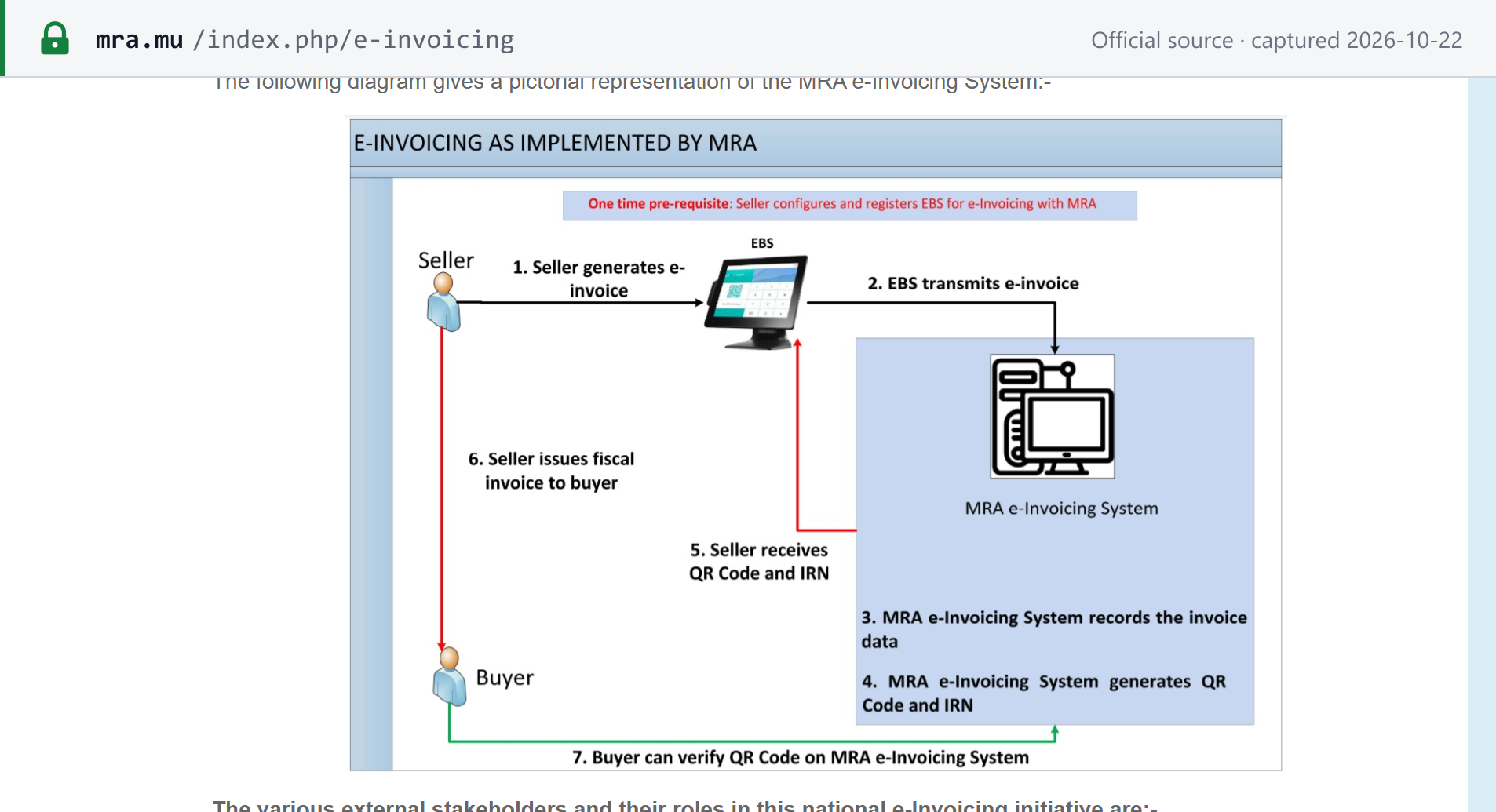
The system has two parts. Each business uses an Electronic Billing System (EBS), MRA's term for the accounting package, invoicing solution, POS, cash register or ERP it bills from. The EBS sends every invoice, debit note and credit note to MRA's Invoice Fiscalisation Platform (IFP), which records it and returns an Invoice Registration Number (IRN) and a QR code. The QR code goes on the invoice before it reaches the customer, who can scan it to check the invoice with MRA. An invoice that carries this fiscal data is a fiscal invoice. [1] [3]
Legal basis in one line. Part VA of the Value Added Tax Act (sections 20A to 20F), the Value Added Tax (E-invoicing) Regulations 2023 (Government Notice No. 132 of 2023), and the Finance Act 2026 amendments to the penalties in force since 1 October 2026. [2] [3] [4]
| Mauritius | |
|---|---|
| System | MRA e-Invoicing System: the taxpayer's Electronic Billing System (EBS) plus MRA's Invoice Fiscalisation Platform (IFP) |
| Model | Real-time clearance ("fiscalisation"): each invoice is registered with MRA before it is issued |
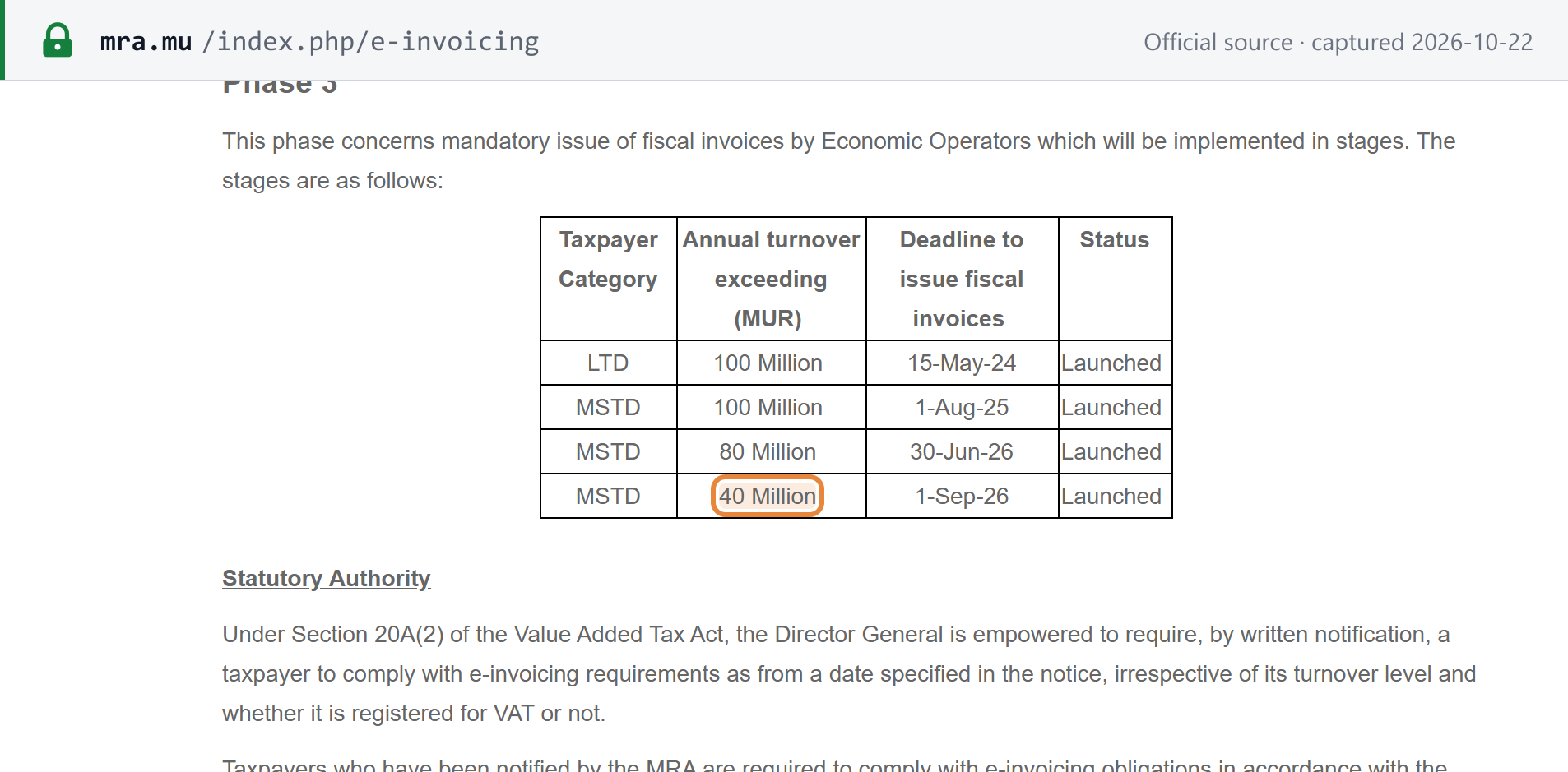
| Who | Persons notified in writing by the Director-General under VAT Act s.20A(2). MRA's Phase 3 schedule reached Large Taxpayer Department (LTD) operators above MUR 100 million on 15 May 2024 and Medium and Small Taxpayer Department (MSTD) operators above MUR 40 million on 1 September 2026 |
| B2B / B2G / B2C | All three under the same mandate: they are values of the mandatory Transaction Types field, and a fiscal invoice is required for each transaction |
| Non-VAT-registered persons | Can be notified: s.20A(3) and MRA FAQ 4 |
| Non-residents | Part VA of the VAT Act, the 2023 Regulations and MRA's e-invoicing documents do not address non-resident suppliers. Section 20(7) of the VAT Act disapplies the ordinary section 20 VAT-invoice duty for foreign suppliers of digital or electronic services. |
| Format | JSON, per MRA's Standard e-Invoice Template and Data Structure (v1.0, 21 June 2023) |
| Network | Direct connection from the EBS to the IFP through an MRA-published API. Not Peppol; no access-point layer |
| Integrity | IRN and QR code from the IFP; digital certificate or MRA-issued token on each transmission; hash of each document carried into the next |
| Authority | Mauritius Revenue Authority, through the e-Invoicing Portal |
| Legislation | VAT Act ss.20A–20F; VAT (E-invoicing) Regulations 2023 (GN 132 of 2023); Finance Act 2026 (Act No. 14 of 2026) s.25(b), (h), (i) |
For the VAT rate, registration and the general VAT invoice rules, see the Mauritius VAT guide.
Mandate status & timeline
Status: mandatory, phased by turnover through Director-General notices; all four Phase 3 stages launched. MRA rolled the system out in three phases. [1]
| Phase | Who | What | Date | Source | Status |
|---|---|---|---|---|---|
| Phase 1 | EBS software developers and solution providers | Register, customise, test and self-certify their EBS on the MRA e-Invoicing Developer Portal | 26 June 2023 | MRA communiqué, 26 June 2023 | Done |
| Phase 2 | Economic operators with turnover above MUR 100 million notified under s.20A | Economic Operator Portal live; notified operators "may start issuing fiscal invoices on a voluntary basis" | 29 January 2024 | MRA communiqué, 29 January 2024 | Done |
| Phase 3 | LTD, annual turnover above MUR 100 million | Mandatory issue of fiscal invoices | 15 May 2024 | MRA e-invoicing page | Passed |
| Phase 3 | MSTD, annual turnover above MUR 100 million | Mandatory issue of fiscal invoices | 1 August 2025 | MRA e-invoicing page | Passed |
| Phase 3 | MSTD, annual turnover above MUR 80 million | Mandatory issue of fiscal invoices | 30 June 2026 | MRA e-invoicing page | Passed |
| Phase 3 | MSTD, annual turnover above MUR 40 million | Mandatory issue of fiscal invoices | 1 September 2026 | MRA e-invoicing page | Passed |
MRA heads the Phase 3 date column "Deadline to issue fiscal invoices", and its page shows all four stages as "Launched". LTD is MRA's Large Taxpayer Department and MSTD its Medium and Small Taxpayer Department. [1]
Your date is the one in your notice. The turnover table is MRA's rollout schedule; the legal obligation comes from a written notice. MRA's page: "Under Section 20A(2) of the Value Added Tax Act, the Director General is empowered to require, by written notification, a taxpayer to comply with e-invoicing requirements as from a date specified in the notice, irrespective of its turnover level and whether it is registered for VAT or not." It adds: "Taxpayers who have been notified by the MRA are required to comply with e-invoicing obligations in accordance with the terms and timelines set out in the notification issued to them." The notices are addressed to individual businesses; MRA's e-invoicing page does not reproduce them. [1]
The voluntary window. MRA's 29 January 2024 communiqué opened the Economic Operator Portal to operators with turnover above Rs 100 million notified under section 20A, who "may start issuing fiscal invoices on a voluntary basis", and stated that mandatory issue was "scheduled to take effect on 15 May 2024". [10]
Where the MUR 80 million stage came from. The Annex to the Budget Speech 2025-2026 said that suppliers above Rs 100 million were "in the process of connecting" and that "During financial year 2025-26, suppliers making a turnover of more than Rs 80 million will join the e-invoicing system". MRA's date for that stage, 30 June 2026, is the last day of that financial year. [13]
The latest stage and what comes next. The MUR 40 million stage, effective 1 September 2026, is the last one on MRA's schedule. MRA has not announced a stage below MUR 40 million, and the Annex to the Budget Speech 2026-2027 deals with e-invoicing only in its penalty measures. MRA's FAQ says only that "Mandatory e-invoicing would then be extended progressively to other taxpayers." [1] [14] [9]
Postponements. None. No published Phase 3 date has moved.
Legal basis
| Instrument | Date | What it does |
|---|---|---|
| Value Added Tax Act, Part VA, s.20A "E-invoicing system" | Part VA inserted by the Finance Act 2018 with effect from 9 August 2018; s.20A repealed and replaced by the Finance Act 2022 with effect from 2 August 2022 | The Director-General sets up a system to register all invoices, "including debit notes and credit notes", and to issue fiscal invoices. A person who carries on a prescribed category of business, or who is given a written notice, must acquire the equipment and software needed and issue fiscal invoices from the date the Director-General fixes (s.20A(2)). A notice may go to any person, taxable or not, including one making exclusively exempt supplies (s.20A(3)). The Director-General's guidelines and technical specifications bind (s.20A(4)(b)) |
| Same Act, ss.20B–20F | Amended by the Finance Act 2026 from 1 October 2026 (ss.20B and 20E) | Penalties and offences: see Penalties |
| Same Act, s.2 "fiscal invoice" | Inserted by the Finance Act 2022 with effect from 2 August 2022 | A receipt or invoice that "bears such data or mark as may be prescribed to confirm that the invoice has been duly registered on the e-invoicing system" |
| Value Added Tax (E-invoicing) Regulations 2023, Government Notice No. 132 of 2023 | Made by the Minister under ss.20A and 72 on 18 September 2023; in operation from 2 October 2023 | The system's two parts (EBS and IFP), taxpayer duties, EBS Solution Provider registration, EBS registration and deregistration, and the particulars of a fiscal invoice |
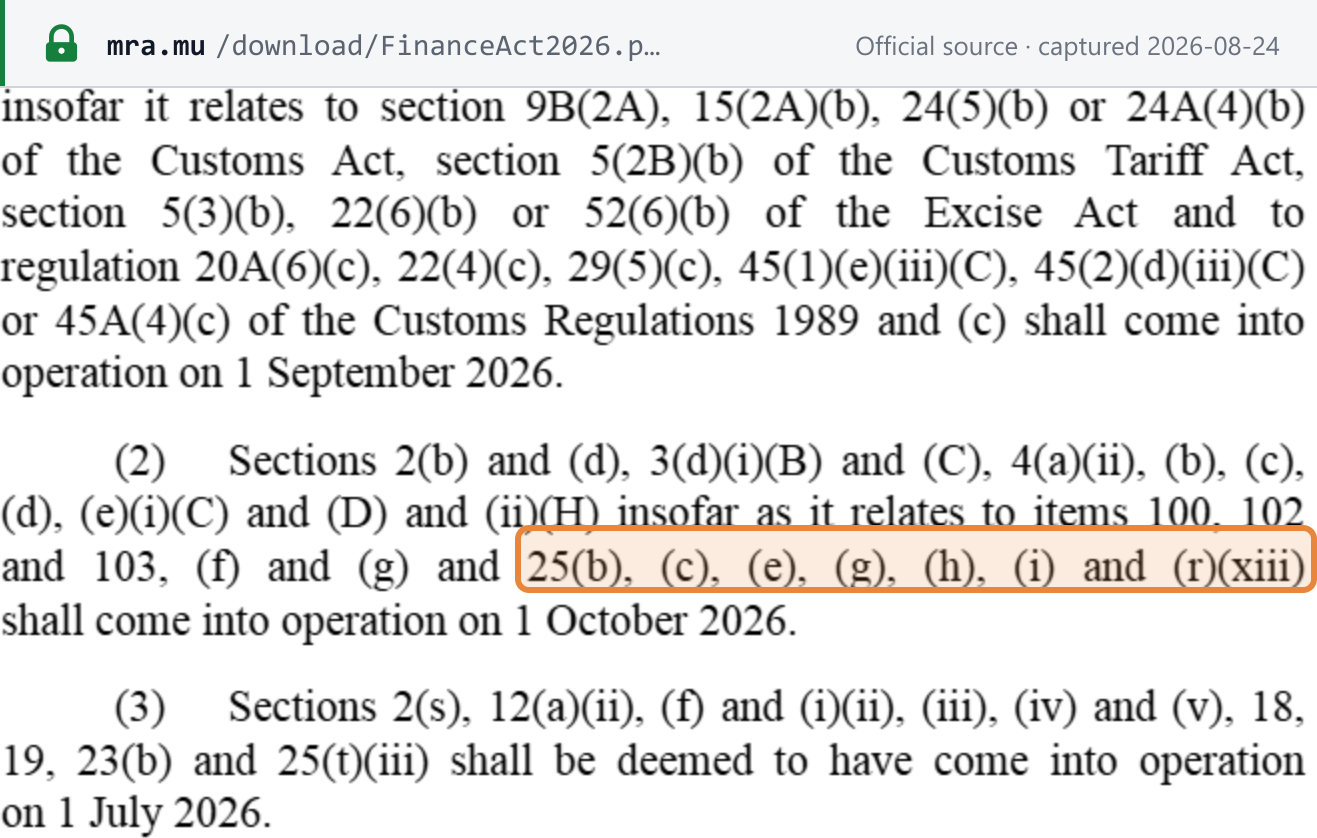
| Finance Act 2026 (Act No. 14 of 2026), s.25(b), (h), (i) | Assented 12 August 2026; these provisions in operation from 1 October 2026 (s.28(2)) | Time-of-supply trigger at 3 months (s.5); the daily s.20B penalty; the higher s.20E offence maximums |
MRA's technical documents. They bind through s.20A(4)(b), which requires every person obliged to issue fiscal invoices to comply with the guidelines and technical specifications the Director-General issues, and the Functional Specifications state that they were issued by the Director-General under that section. [2] [5]
| Document | Version / date |
|---|---|
| Functional Specifications of the Electronic Billing System (EBS) | June 2023 |
| Standard e-Invoice Template | Undated, 7 pages |
| Data Structure of an e-Invoice | v1.0, 21 June 2023 |
| General (non-technical) e-Invoicing Guide for Software Developers | v1.0, 21 June 2023 |
| FAQs: e-Invoicing System | July 2023 |
The Developer Guide also names a "Technical Guide of APIs for MRA e-Invoicing System" and a user manual for the e-Invoicing Portal; neither is on MRA's public e-invoicing page. API documentation sits inside the Developer Portal (vfiscportal.mra.mu) after sign-up. [8]
Scope
Who. Section 20A(2) covers a person who carries on a business of a prescribed category or nature, or who receives a written notice from the Director-General. MRA has rolled the mandate out by written notice, following the turnover schedule above. [2] [1]
Non-VAT-registered persons. In scope once notified. MRA's FAQ 4: "Is e-Invoicing applicable only to VAT Registered persons? No. It is applicable to non-VAT registered persons as well." Section 20A(3) lets the Director-General notify any person "whether or not he (a) is a taxable person; or (b) makes exclusively exempt supplies", and the Data Structure's personType field takes the values VATR (VAT Registered Person) and NVTR (Non VAT Registered Person). [9] [2] [7]
B2B, B2G and B2C. One mandate covers all three, with no separate phase-in by type of customer. Regulation 10(1) requires "A fiscal invoice shall be issued for each transaction", and B2B, B2G and B2C are values of the template's mandatory Transaction Types field. The template also lists exports (EXP) and taxable supplies to exempt bodies or persons (B2E); the Data Structure v1.0 lists only B2B, B2G and B2C. MRA's e-invoicing documents describe no separate platform for invoices to government. [3] [6] [7]
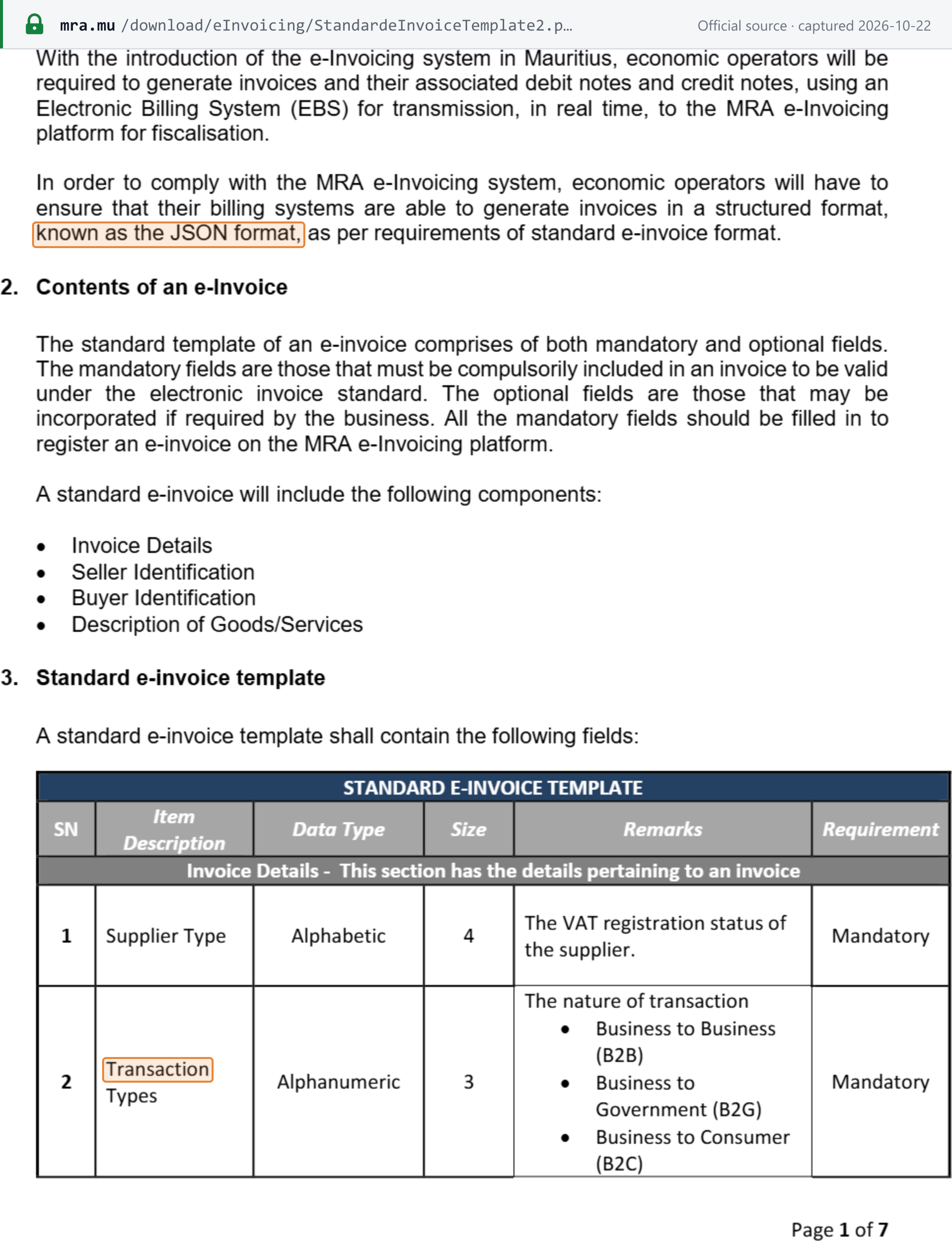
B2C customers. A fiscal invoice carries the customer's Business Registration Number (BRN) if the customer is in business. For a customer who is not in business, the name, address and National Identity Card number appear only "if he requests it" (reg 10(2)(j)–(k)). The template marks the buyer NIC field "To be implemented at a later stage". MRA publishes no value threshold for a simplified invoice. [3] [6]
Non-established businesses. Part VA of the VAT Act, the 2023 Regulations and MRA's e-invoicing documents do not address non-resident suppliers. Section 20(7) of the VAT Act disapplies the ordinary section 20 VAT-invoice duty for foreign suppliers of digital or electronic services. The obligation arises from a prescribed business category or a written notice under s.20A(2); MRA's schedule is framed by its Large Taxpayer Department and Medium and Small Taxpayer Department; and the template requires the supplier's BRN. Foreign suppliers of digital services registered for Mauritian VAT follow their own registration and filing rules (see the Mauritius VAT guide). [2] [1] [6]
Exports, zero-rated, exempt and out-of-scope supplies. All are fiscalised, each with its own code on the template's Types of Supplies list: [6]
| Code | Meaning |
|---|---|
| TC01 | Standard-rated (15% VAT) |
| TC02 | Zero-rated (0% VAT) |
| TC03 | Exempt |
| TC04 | Non-fiscal items that do not affect turnover |
| TC05 | Standard-rated supplies to exempt bodies |
| TC06 | Outside the scope of VAT |
Document types. The template's Document Types are standard invoice (STD), proforma (PRF), training (TRN), credit note (CRN) and debit note (DRN). Training and proforma invoices are transmitted, but the IFP generates an IRN only for other transactions (reg 2, definition of "IRN"). [6] [3]
Manual invoices. Not allowed for a business with e-invoicing obligations. MRA FAQ 11: "Handwritten invoices or invoices written using text editing tools are not considered as electronic invoices. Manual invoices should therefore not be issued by a business having e-invoicing obligations." [9]
Format & network
The model: real-time clearance. MRA's FAQ 2: "At the time an invoice is generated by an economic operator, the invoice details are sent seamlessly by the EBS to the IFP for fiscalisation. The IFP registers the transaction, generates an Invoice Registration Number (IRN) and a QR Code for that invoice and transmits same back to the EBS. The economic operator issues a fiscalised invoice with a QR code to the customer." Under regulation 5 the IFP manages the registration and deregistration of each EBS, authenticates every EBS that transmits to it, receives, records and monitors the transaction data, and "generates an IRN and a QR Code in respect of every invoice that has been fiscalised and sends fiscal data back to the EBS". [9] [3]
What the EBS must do. The Functional Specifications, §1 "General functions", require the EBS to: [5]
- generate invoices, debit notes and credit notes "in JSON format", for transmission "in real time" to the IFP (§1(a));
- stamp each transmission with a valid digital certificate in the taxpayer's name or a token issued by the Director-General (§1(b));
- connect to the MRA e-Invoicing Platform "by using an API published for this purpose by the MRA" to obtain an IRN and a QR code for every invoice, credit note and debit note (§1(c));
- record the IRN with the transaction and insert the QR code on the document before giving it to the customer (§1(d));
- generate a hash of each invoice, credit note and debit note and embed it in the next document in the sequence (§1(e));
- number invoices sequentially (§1(g)).
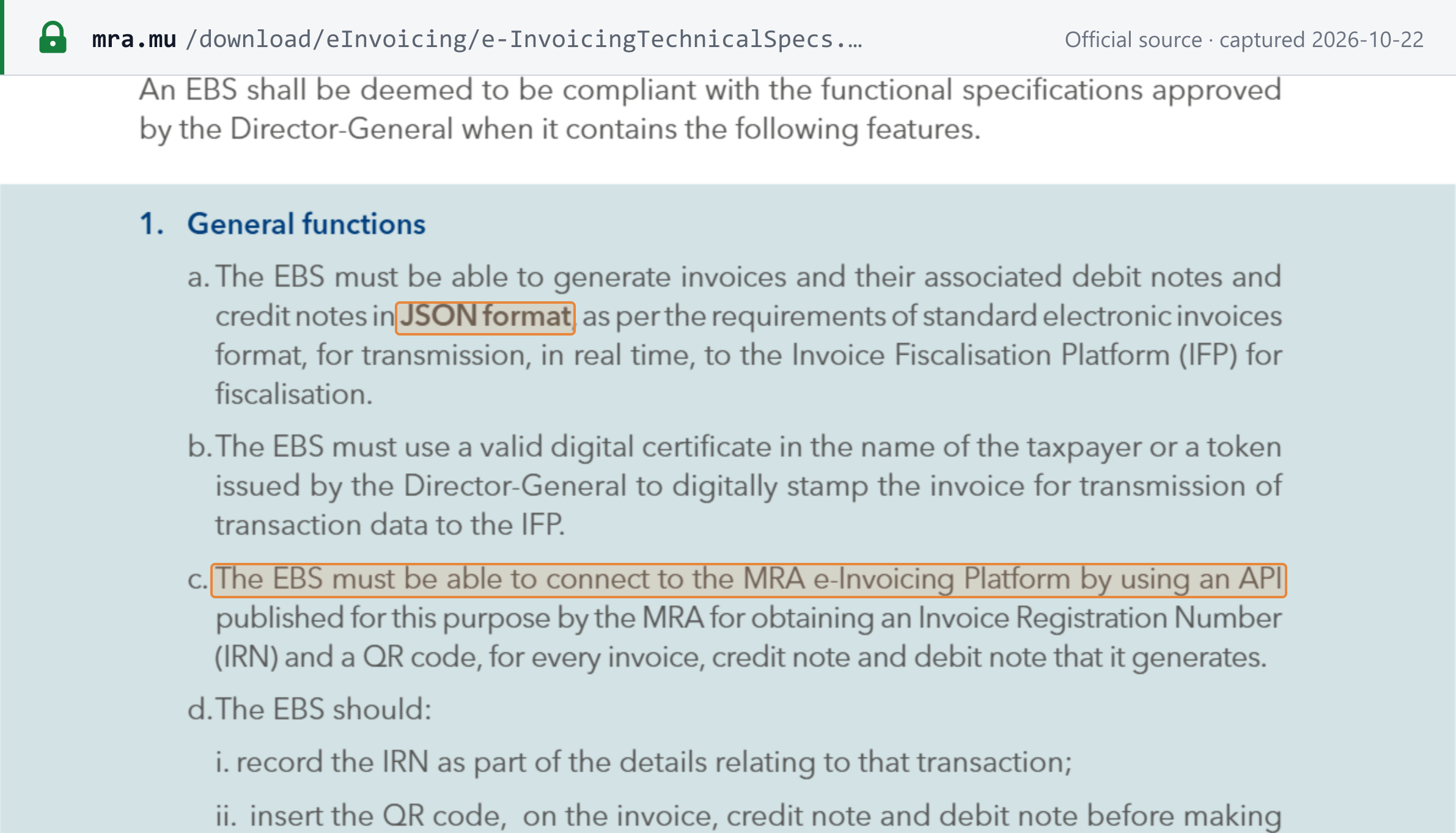
Data format: JSON. The Standard e-Invoice Template: billing systems must "generate invoices in a structured format, known as the JSON format", and "All the mandatory fields should be filled in to register an e-invoice on the MRA e-Invoicing platform." The template has four blocks: Invoice Details, Seller Identification, Buyer Identification, and Description of Goods/Services. The public schema is the Data Structure v1.0 of 21 June 2023, with element names such as invoiceIdentifier, invoiceTypeDesc, transactionType, personType, previousNoteHash, dateTimeInvoiceIssued and totalVatAmount; the DateTime format is yyyyMMdd HH:mm:ss. The template says an MRA product code is "To be published on MRA website" and becomes mandatory at a later phase. [6] [7]
The network: a direct API connection, not Peppol. Each EBS talks to the IFP directly through MRA's API. MRA's Developer Guide describes two APIs: the EBS first calls the Authentication API for a token, then calls the Invoice Transmission API with that token until it expires. The payload is an encrypted JSON string. MRA's e-invoicing documents make no reference to Peppol, UBL or access points, and the system has no certified-intermediary layer: a taxpayer buys its EBS from a registered EBS Solution Provider or registers its own (see Onboarding). [8] [5]
The hash chain. The template defines "Previous Invoice Hash = (Date & Time + Invoice Amount + BRN + invoice number) of previous invoice", with "0" sent for the first invoice; the Data Structure runs the chain separately for each document type. [6] [7]
The QR code and the IRN on the printed invoice. The QR code must appear on the invoice: the template sets it at 2 cm × 2 cm, and the Developer Guide says to affix it "at the top of the invoice". On the IRN, MRA's texts differ: [6] [8] [3]
- Regulation 10(2)(o) of the 2023 Regulations lists among a fiscal invoice's particulars "the QR Code and IRN generated by the IFP in respect of that transaction".
- MRA's Standard e-Invoice Template says: "IRN should NOT appear on the invoice issued to customer". MRA's two specimen invoices show a QR code and no IRN.
- The Functional Specifications require the EBS to record the IRN and to insert the QR code (§1(d)).
MRA's e-invoicing helpdesk ([email protected]) is the place to confirm the treatment for your documents.
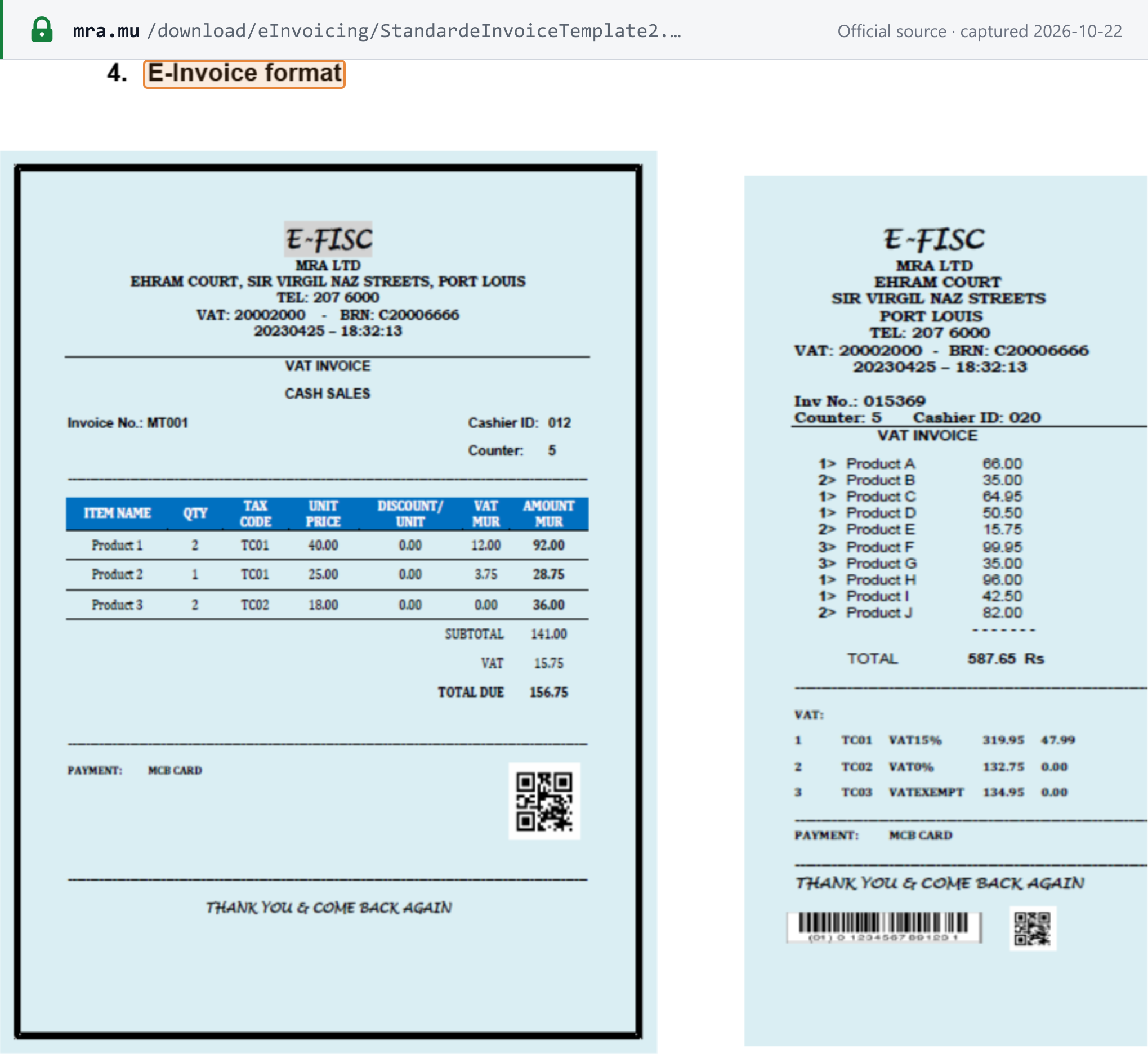
What a fiscal invoice must show. Regulation 10(2): the type of invoice; the type of transaction; the method of payment; the EBS registration number; the name and product code of each good or service; unit price and quantity; total price; the taxes and the rates applied; total amount payable; the customer's BRN, or a consumer's details on request; the supplier's name and BRN and the business premises; date and time of issue; a sequential serial number; the QR code and IRN; and any other information the Director-General determines. [3]
Offline and rejected invoices. If the internet connection drops, "the EBS may issue non-fiscalised invoices to the customers. Once internet connection is restored, the non-fiscalised invoices should be sent automatically by the EBS to IFP for fiscalisation" (FAQ 16; Functional Specifications §1(f)). A turnover-affecting transaction that is submitted but not fiscalised must be resent, after any required amendment (reg 6(2)). MRA publishes no maximum offline period. [9] [5] [3]
Buyer verification. FAQ 17: "The customer can scan the code using a QR reader or smartphone. Once the code is scanned, it will open the verification website link and a summary of the receipt will be displayed." [9]
Reporting alongside. None. The fiscalisation of each invoice is the whole obligation; MRA publishes no separate e-reporting stream for e-invoicing.
Onboarding: how to comply
1. Get a compliant EBS. A taxpayer must acquire its EBS from a registered EBS Solution Provider (reg 4). No one may "sell, rent or make available to a taxpayer an EBS unless he is registered with the Director-General as an EBS Solution Provider of such particular brand and model" (reg 7(1)). A taxpayer that develops its own ERP must apply to the Director-General to register every EBS connected to it before implementing it (reg 8(2)). [3]
2. Register on the e-Invoicing Portal and pass the tests. MRA's page: "Economic Operators must, after they have customised their EBS to be compliant with MRA's e-Invoicing specifications, register themselves for e-invoicing on the MRA e-Invoicing Portal. Some tests prescribed on the Portal must be carried out successfully." [1]
3. Onboard each EBS. Each EBS is then onboarded on the portal before it may be used to issue fiscal invoices. The portal generates an EBS MRA ID, "a unique ID which identifies an EBS and which is used for live transmission of invoices". A taxpayer that stops using an EBS must ask for its deregistration (reg 9(4)), and must give the Director-General prior notice before moving an EBS to other premises (reg 4(2)). [1] [3]
Taxpayer duties under regulation 4. Operate one or more EBS per business; arrange data connectivity "at a speed which enables instant fiscalisation of the transaction"; not use or keep on the premises any unregistered or non-compliant billing system, ERP, cash register or POS (reg 4(1)(e)); and keep credentials and tokens secure. [3]
Testing and self-certification. The MRA e-Invoicing Developer Portal is "a sandbox environment" for EBS developers and solution providers, with sign-up by OTP mobile validation, API documentation with JSON schemas and samples, and a Swagger tool. An EBS is tested in sandbox mode, then switched to a Test Drive against MRA's test script; failing any single scenario fails the drive, which must be retaken from the start. After a successful Test Drive the developer self-certifies on the portal. MRA: "Note that MRA is not a certifying body for EBS. The onus is on software developers to certify that their EBS is compliant with the MRA e-Invoicing System." [8]
The provider list. MRA publishes a list of EBS Solution Providers registered with the MRA; the edition dated 16 September 2026 has 106 entries. MRA calls it "an indicative list of EBS Solution Providers who have expressed their willingness to provide e-invoicing solutions which they have self-certified to be compliant". The Director-General may deregister a provider for non-compliance, non-disclosure or failure to furnish information (reg 7(8)). The Regulations set no duration or renewal for a provider's registration. [12] [3]
Connection mode. The EBS connects to the IFP through MRA's API (Functional Specifications §1(c)). The e-Invoicing Portal is where operators register, run the prescribed tests and onboard each EBS. [5] [1]
Penalties
| Provision | What it covers | Exposure |
|---|---|---|
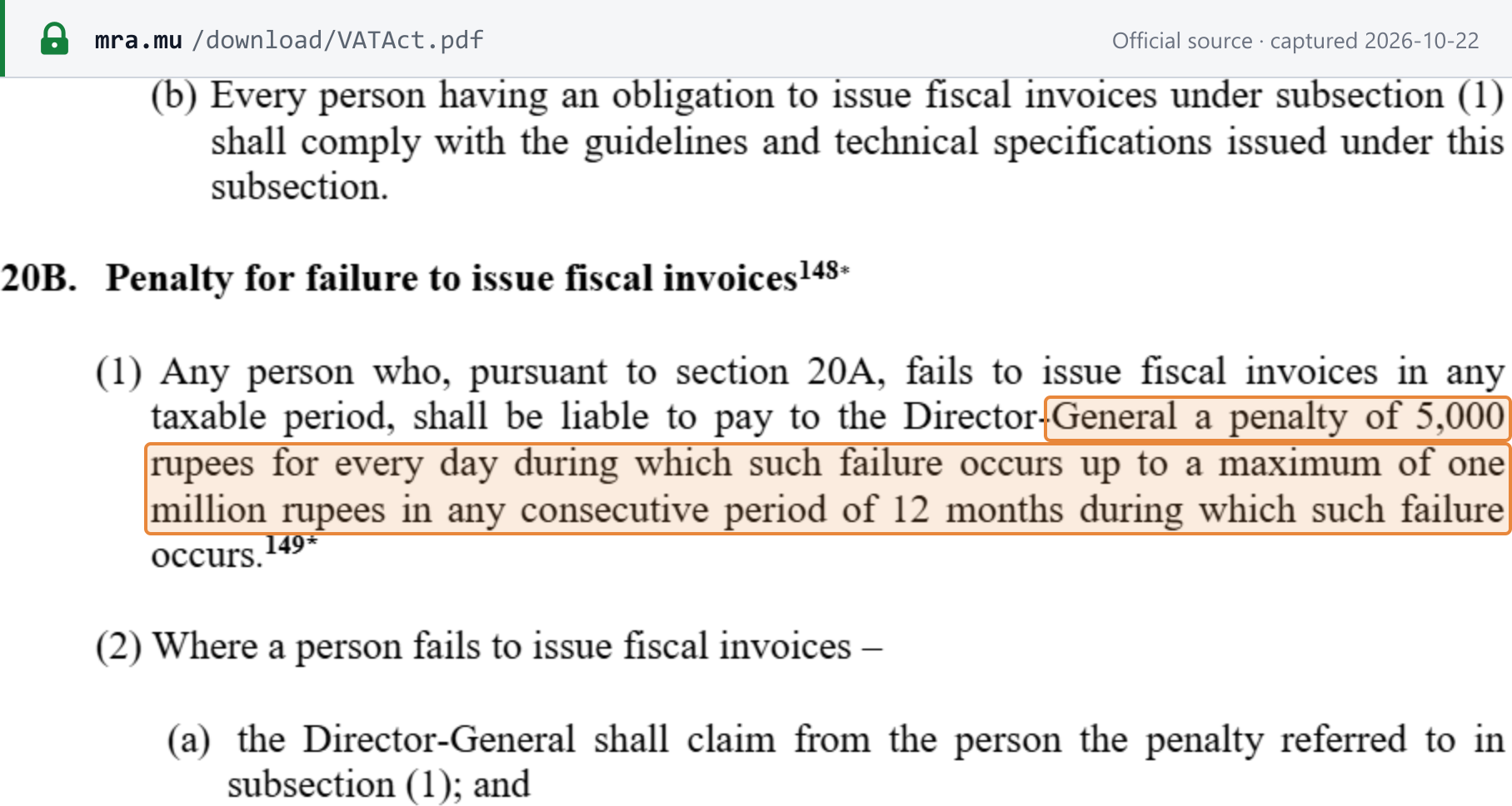
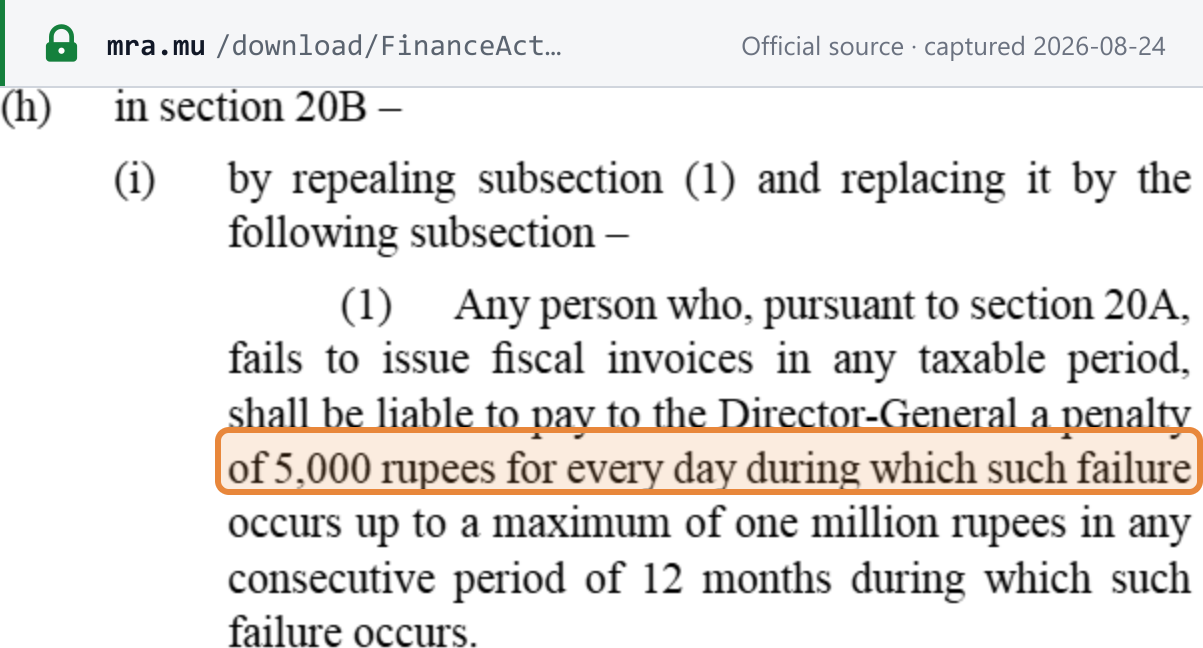
| s.20B (administrative penalty) | Failing to issue fiscal invoices, once obliged under s.20A | From 1 October 2026: MUR 5,000 for every day of failure, up to MUR 1 million in any consecutive 12 months, payable within 28 days from the date the claim is issued. Before: MUR 10,000 per month or part-month, capped at MUR 200,000 |
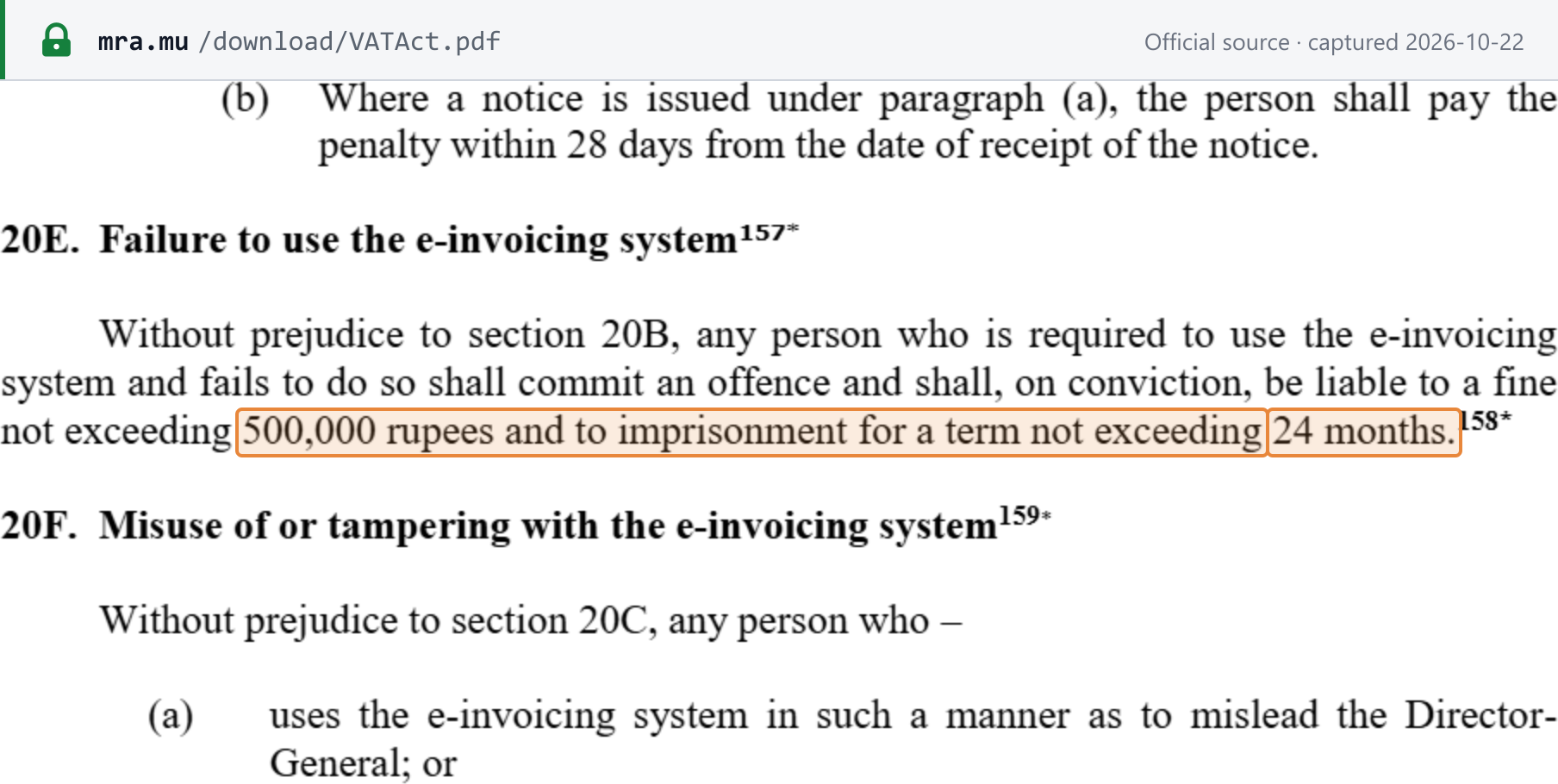
| s.20E (offence) | Failing to use the e-invoicing system when required, "Without prejudice to section 20B" | From 1 October 2026: on conviction, a fine of up to MUR 500,000 and imprisonment of up to 24 months. Before: MUR 200,000 and 12 months |
| s.20C (administrative penalty) | Using the system to mislead the Director-General, or deliberately tampering with it or causing it to work improperly | Up to MUR 50,000 |
| s.20F (offence) | Misuse of or tampering with the system, "Without prejudice to section 20C" | On conviction, a fine of up to MUR 200,000 and imprisonment of up to 12 months |
The Finance Act 2026 replaced s.20B(1) and s.20B(2)(b), the 28-day payment rule (s.25(h)), and raised the s.20E maximums (s.25(i)); s.28(2) brought both into operation on 1 October 2026. The s.20E fine rose from MUR 200,000 to MUR 500,000, two and a half times the old figure, and the maximum prison term doubled from 12 to 24 months. The Budget Speech 2026-2027 Annex announced both measures. MRA's July 2023 e-invoicing FAQ (Q18) still states the earlier MUR 10,000-a-month penalty; the VAT Act as amended governs. [4] [14]
Objections. A person who disputes a s.20B or s.20C claim may object within 28 days of receiving it. The Director-General determines the objection within 4 months; if not, "the objection shall be deemed to have been allowed by the Director-General" (s.20D(9)). Appeal lies to the Tribunal under the Revenue Tribunal Act 2025. [2]
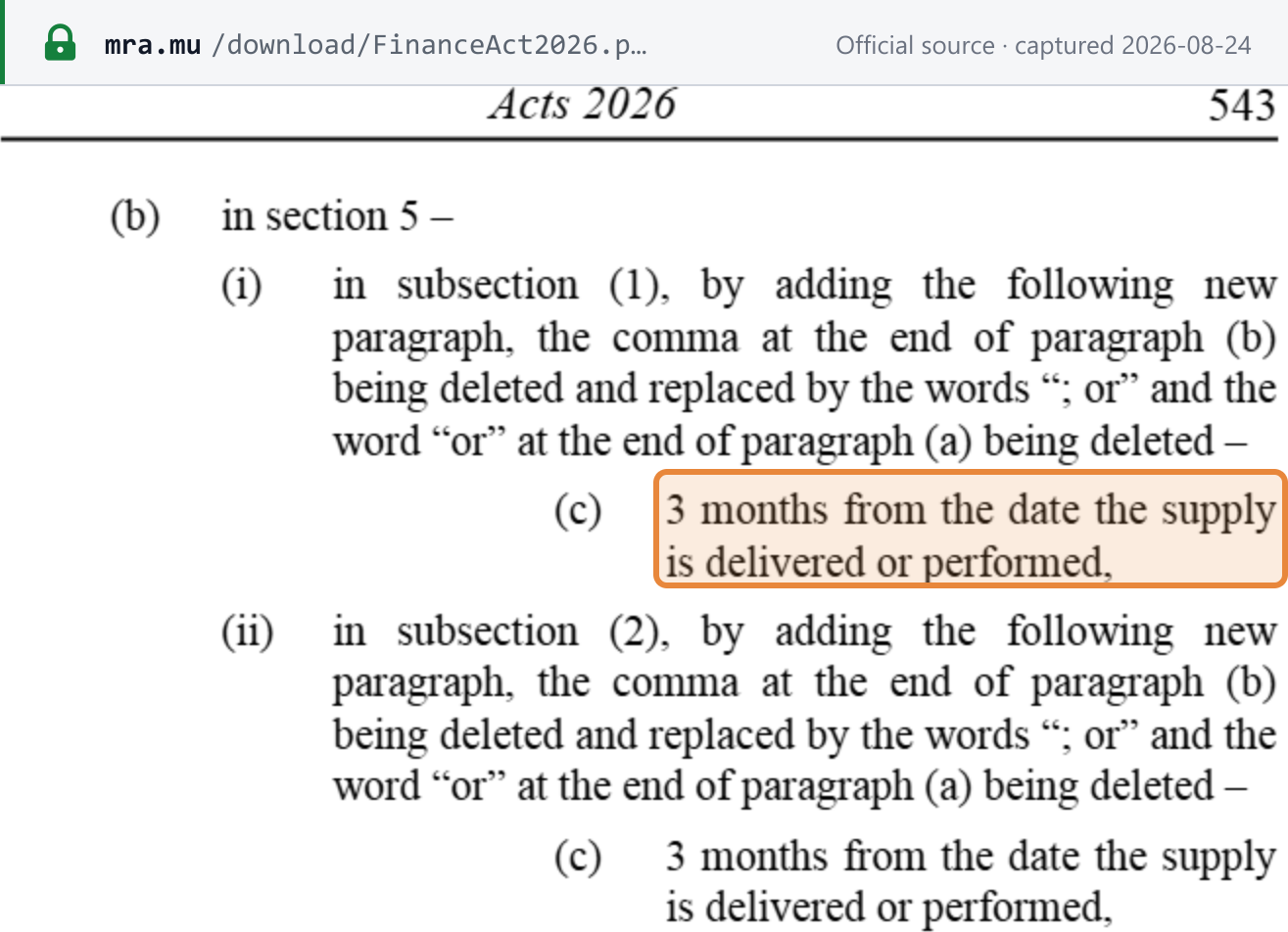
Invoice timing. From 1 October 2026, section 5 fixes the time of supply at the earliest of the invoice being issued, payment being received, or "3 months from the date the supply is delivered or performed" (Finance Act 2026 s.25(b)); the same third trigger applies to continuous supplies and lease agreements. [2] [4]
Frequently asked questions
Our turnover is above MUR 40 million and our file is with the MSTD. From when must we issue fiscal invoices?
MRA's Phase 3 schedule puts Medium and Small Taxpayer Department operators with annual turnover above MUR 40 million at 1 September 2026. The binding date is the one in the written notice the Director-General sends you under section 20A(2) of the VAT Act: MRA says notified taxpayers comply in accordance with the terms and timelines set out in their notification. If you are unsure whether you have been notified, ask the MRA e-invoicing helpdesk ([email protected]). [1] [2]
We are not VAT-registered. Can we still be required to issue fiscal invoices?
Yes. MRA's FAQ says e-invoicing applies to non-VAT registered persons as well, and section 20A(3) of the VAT Act lets the Director-General send a notice to any person, whether or not it is a taxable person and even if it makes only exempt supplies. [9] [2]
Do we print the IRN on the invoice, or only the QR code?
The QR code must appear on the invoice. On the IRN, MRA's texts differ: regulation 10(2)(o) of the VAT (E-invoicing) Regulations 2023 lists the QR code and IRN among a fiscal invoice's particulars, while MRA's Standard e-Invoice Template says the IRN should not appear on the invoice issued to the customer, and MRA's specimen invoices show a QR code and no IRN. Confirm the treatment with the MRA e-invoicing helpdesk. [3] [6]
Do we need Peppol or an access point provider?
No. Your Electronic Billing System connects directly to MRA's Invoice Fiscalisation Platform through an API MRA publishes. MRA's e-invoicing documents make no reference to Peppol, UBL or access points. You do need an EBS from a registered EBS Solution Provider, or your own EBS registered with the Director-General. [5] [3]
What happens if our internet connection goes down?
The EBS may keep issuing non-fiscalised invoices in sequence. Once the connection is restored it must send them automatically to the IFP for an IRN and QR code. A turnover-affecting transaction that is not fiscalised must be resent after any required amendment. MRA publishes no maximum offline period. [9] [5] [3]
What is the penalty for not issuing fiscal invoices?
Since 1 October 2026, section 20B of the VAT Act imposes MUR 5,000 for every day of failure, up to MUR 1 million in any consecutive 12 months, payable within 28 days from the date the claim is issued. Separately, failing to use the e-invoicing system when required is an offence under section 20E, punishable on conviction by a fine of up to MUR 500,000 and imprisonment of up to 24 months. Before 1 October 2026 the section 20B penalty was MUR 10,000 per month or part-month, capped at MUR 200,000, and the section 20E maximums were MUR 200,000 and 12 months. [2] [4]
Can we still issue handwritten invoices for some sales?
No. MRA's FAQ says handwritten invoices and invoices written with text-editing tools are not electronic invoices, and that a business with e-invoicing obligations should not issue manual invoices. Regulation 10(1) requires a fiscal invoice for each transaction. [9] [3]
We are a foreign company. Does the Mauritian e-invoicing mandate apply to us?
Part VA of the VAT Act, the 2023 Regulations and MRA's e-invoicing documents do not address non-resident suppliers. Section 20(7) of the VAT Act disapplies the ordinary section 20 VAT-invoice duty for foreign suppliers of digital or electronic services. The obligation arises for a person who carries on a prescribed category of business or who receives a written notice from the Director-General, and the standard template requires the supplier's Business Registration Number. [2] [3] [6]
Can we defer VAT on a supply by delaying the invoice?
Not beyond three months since 1 October 2026. Section 5 of the VAT Act now fixes the time of supply at the earliest of the invoice being issued, payment being received, or 3 months from the date the supply is delivered or performed. [2] [4]
Recent changes
- 2026-10-01 — The section 20B penalty for failing to issue fiscal invoices became MUR 5,000 per day, capped at MUR 1 million in any consecutive 12 months, and the section 20E offence maximums rose to a fine of MUR 500,000 and 24 months' imprisonment (Finance Act 2026 s.25(h) and (i)). (Mauritius Revenue Authority) — see event, event and issue
- 2026-10-01 — Time of supply gained a third trigger: 3 months from the date the supply is delivered or performed, whichever is earliest (VAT Act s.5, as amended by Finance Act 2026 s.25(b)). (Mauritius Revenue Authority) — see event and issue
- 2026-09-01 — Phase 3 reached MSTD operators with annual turnover above MUR 40 million. (Mauritius Revenue Authority) — see event and issue
- 2026-06-30 — Phase 3 reached MSTD operators with annual turnover above MUR 80 million. (Mauritius Revenue Authority)
- 2025-08-01 — Phase 3 reached MSTD operators with annual turnover above MUR 100 million. (Mauritius Revenue Authority)
- 2024-05-15 — Mandatory issue of fiscal invoices began for LTD operators with annual turnover above MUR 100 million. (Mauritius Revenue Authority)
- 2023-10-02 — The Value Added Tax (E-invoicing) Regulations 2023 (GN 132 of 2023) came into operation. (Mauritius Revenue Authority)
Related resources
- Mauritius VAT guide — rate, registration, invoice requirements and the e-invoicing summary
- Mauritius tax ID guide — the BRN and VAT number that appear on fiscal invoices
- E-invoicing status and networks by country
- CTC e-invoicing models explained
- Fiscal devices and certified cash registers
- E-invoicing in Nigeria and South Africa
- Mauritius tax changes on Lookuptax
Important websites
- MRA e-Invoicing page (helpdesk: 207 6020, [email protected])
- MRA e-Invoicing Portal and Developer Portal
- Functional Specifications of the EBS (PDF)
- Standard e-Invoice Template (PDF) and Data Structure of an e-Invoice (PDF)
- General e-Invoicing Guide for Software Developers (PDF)
- FAQs: e-Invoicing System (PDF)
- List of registered EBS Solution Providers (PDF)
- Value Added Tax (E-invoicing) Regulations 2023 (PDF)
- Value Added Tax Act, consolidated (PDF)
- Finance Act 2026 (PDF)
- MRA communiqué: Phase II, launch of the Economic Operator's Portal, 29 January 2024 (PDF)