Six northern Illinois counties raise the NITA transit tax by 0.25% from 1 August 2026
This page records one dated change. For the rules in United States as they stand today, see the United States guide →
- Jurisdiction
- United States (Illinois)
- Tax
- Sales Tax
- Change type
- Rate change
- Status
- In force
- Impact
- Action required
- Effective
- 1 August 2026
- Instrument
- US-IL-BULLETIN-FY2026-34
- Authority
- Illinois Department of Revenue
- Systems
- POS, Tax engine, ERP
- Verified
- Fetched from official source · high confidence
Retailers and remote sellers sourcing sales to Cook, DuPage, Kane, Lake, McHenry or Will County, Illinois.
Update POS and tax-engine NITA occupation and use tax rates for Cook County (1.25% general merchandise, 1.50% qualifying groceries and drugs, 1.25% titled property) and for DuPage, Kane, Lake, McHenry and Will counties (flat 1.00%).
POSTax engineERP
Effective 1 August 2026 the Northern Illinois Transit Authority (NITA, formerly the Regional Transportation Authority) occupation and use tax rate increased by 0.25% in Cook, DuPage, Kane, Lake, McHenry and Will counties. For titled or registered property such as vehicles, reported on Form RUT-25, the NITA rate is 1.25% in Cook County and 1.00% in the other five counties. For general merchandise reported on Form ST-1 or ST-556, Cook County's combined NITA rate is 1.25%, or 1.50% on qualifying groceries and drugs, and the other five counties apply a flat 1.00%.
What changed in detail
Effective 1 August 2026 the Northern Illinois Transit Authority (NITA, formerly the Regional Transportation Authority) occupation and use tax rate increased by 0.25% in Cook, DuPage, Kane, Lake, McHenry and Will counties.
For titled or registered property such as vehicles, reported on Form RUT-25, the NITA rate is 1.25% in Cook County and 1.00% in the other five. For general merchandise reported on Form ST-1 or ST-556, Cook County’s combined NITA rate is 1.25%, or 1.50% on qualifying groceries and drugs, and the other five counties apply a flat 1.00%.
What it means
A quarter-point is small enough to slip past a rate review and large enough to matter across a year of Chicago-area volume. The trap is that the rate is not uniform across the six counties or across categories: Cook runs three different NITA rates depending on whether the sale is titled property, general merchandise, or groceries and drugs. A single county-level rate in the tax engine will be wrong for at least one of those.
Proof
The new NITA occupation and use tax rate is 1.25% for general merchandise and 1.50% for qualifying grocery and qualifying drugs and medical appliances.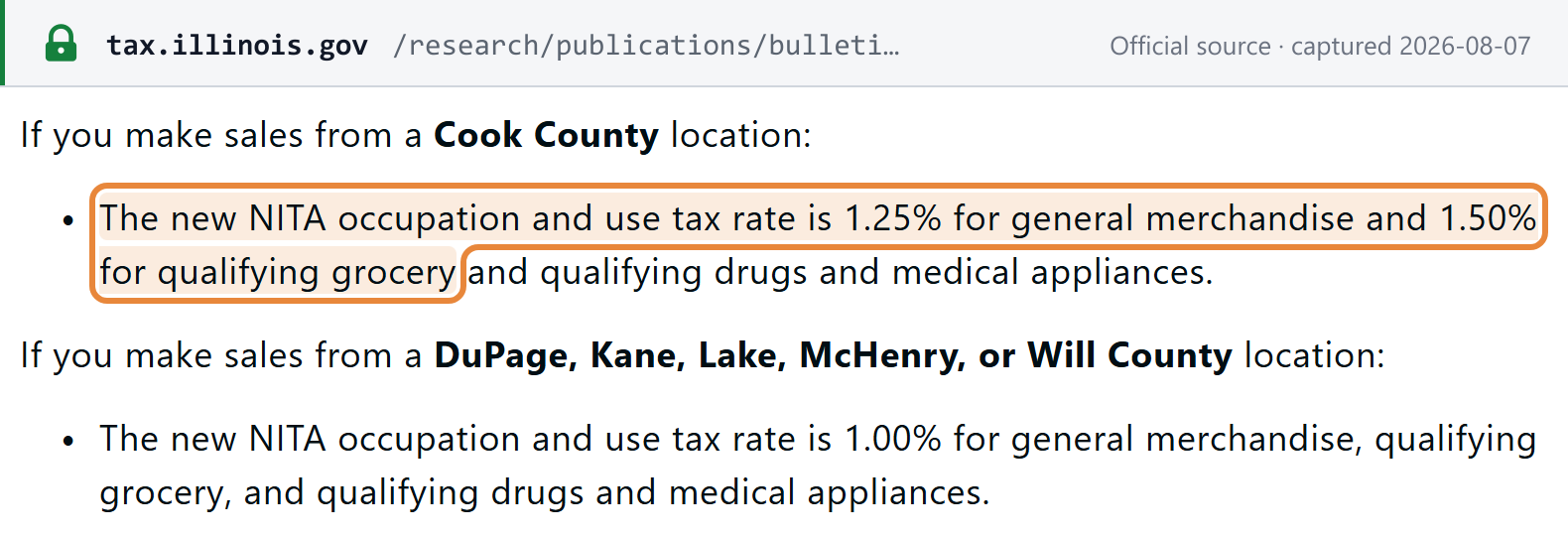 Source snapshot of the official page. Open full size ↗