Ohio narrows its 2026 sales tax holiday to three days and $75 clothing
This page records one dated change. For the rules in United States as they stand today, see the United States guide →
- Jurisdiction
- United States (Ohio)
- Tax
- Sales Tax
- Change type
- Update
- Status
- In force
- Impact
- Action required
- Announced
- 1 May 2026
- Effective
- 7 August 2026
- Authority
- Ohio Department of Taxation
- Systems
- POS, Tax engine, E-commerce
- Verified
- Fetched from official source · high confidence
Retailers and e-commerce sellers sourcing sales to Ohio, in clothing, school supplies and school instructional materials.
Configure POS and e-commerce tax engines to exempt qualifying clothing at USD 75 or less per item and school supplies and instructional materials at USD 20 or less per item for 7 to 9 August 2026 only; the USD 500 threshold used in 2024 and 2025 does not apply.
POSTax engineE-commerce
Ohio's 2026 sales tax holiday runs from 12:00 a.m. on Friday 7 August to 11:59 p.m. on Sunday 9 August 2026, exempting clothing priced at USD 75 or less per item and school supplies and school instructional materials priced at USD 20 or less per item. This returns Ohio to its narrower back-to-school format, after the 2024 and 2025 holidays which ran for approximately two weeks and covered most tangible personal property priced at USD 500 or less.
What changed in detail
Ohio’s 2026 sales tax holiday runs from 12:00 a.m. on Friday 7 August to 11:59 p.m. on Sunday 9 August 2026, exempting clothing priced at $75 or less per item and school supplies and school instructional materials priced at $20 or less per item.
This returns Ohio to its narrower back-to-school format, after the 2024 and 2025 holidays, which ran for approximately two weeks and covered most tangible personal property priced at $500 or less.
What it means
This is the one to watch, because it is a reversion rather than a repeat. Any engine still carrying last year’s configuration will exempt a great deal that is now taxable — a $400 laptop was exempt in 2025 and is not in 2026, and the window is three days rather than two weeks. The failure mode is silent: nothing errors, the tax is simply not charged, and the liability lands on the retailer.
Proof
Today, Governor Mike DeWine announced the 2026 Ohio Sales Tax Holiday, which will take place from 12:00 a.m. Friday, August 7, through 11:59 p.m. Sunday, August 9, 2026.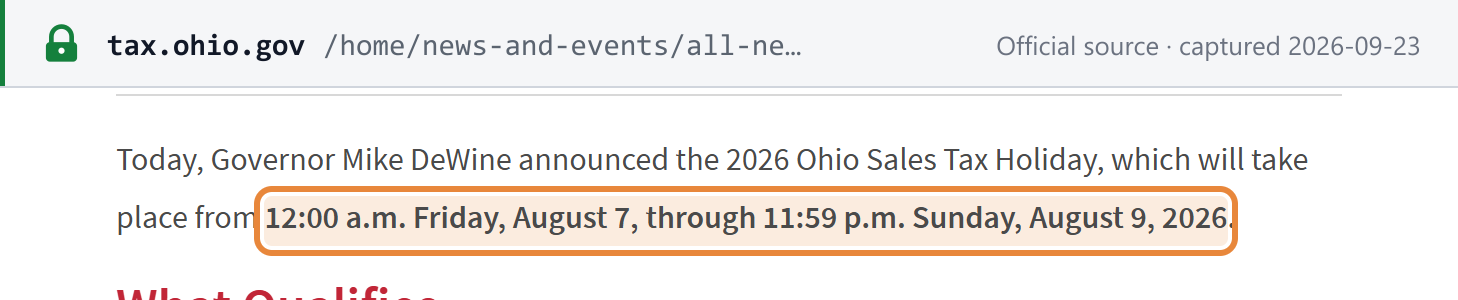 Source snapshot of the official page. Open full size ↗