17 recurring TVA / BTW (VAT) obligations — returns, payments and listings — each with its due rule and official source, plus the dates new Belgium rules take effect.
Dates already include the weekend and public-holiday shift where Belgium applies one — 3 of 17 obligations here do. The rest stand as computed, and each obligation's notes say which applies to it and why. Confirm against the linked official source before relying on a date.
Recurring obligations, with sources
Each deadline cites the official text that states it and the date we last verified it.
Déclaration TVA périodique — mensuelle
TVA / BTW (VAT) · Monthly · return filing
20th of the month after the month endsVerified 2026-08-23
Who files
The default for every VAT-registered taxable person with a right to deduct. Monthly filing is the rule; quarterly is an option you have to qualify for and elect. A taxable person obliged to file the intra-Community listing monthly cannot be on quarterly returns at all.
Notes
Due on the 20th of the month after the period, with the payment on the same date. Where the 20th falls on a Saturday, Sunday or public holiday you get the next working day instead — in 2026 that pushes the May period to 22 June, the August period to 21 September and the November period to 21 December. Watch the contrast with quarterly filing: quarterly returns are due on the 25th and do not move at all, so the two cadences behave differently on exactly the same weekend. If you drop out of the quarterly conditions you must tell the administration by the 10th of the month following that quarter.
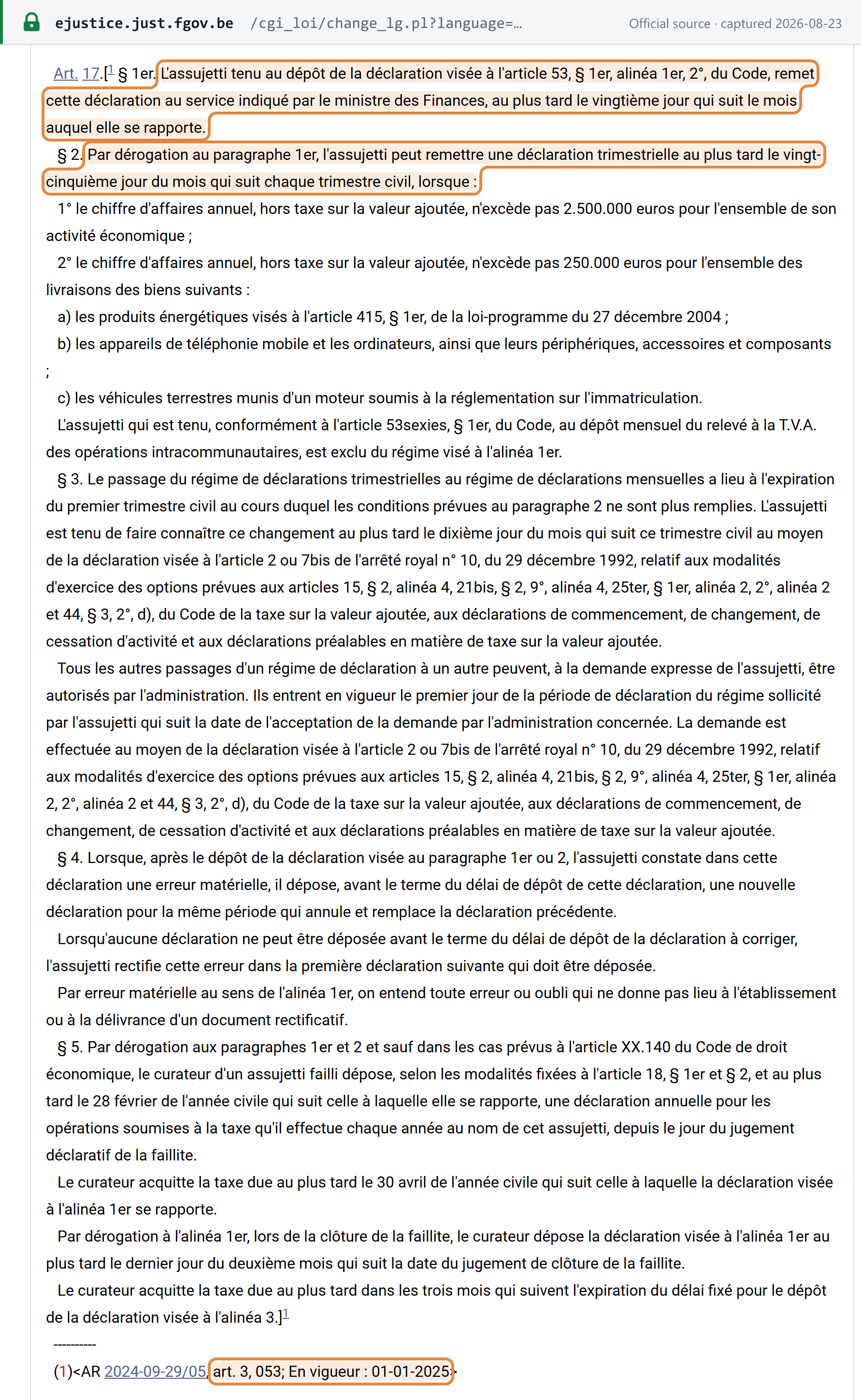
“L'assujetti tenu au dépôt de la déclaration visée à l'article 53, § 1er, alinéa 1er, 2°, du Code, remet cette déclaration au service indiqué par le ministre des Finances, au plus tard le vingtième jour qui suit le mois auquel elle se rapporte.”
Open full size Captured from Justel (SPF Justice / Moniteur belge) — consolidated Belgian legislation on 2026-08-23
Déclaration TVA périodique — trimestrielle
TVA / BTW (VAT) · Quarterly · return filing
25th of the month after the quarter endsVerified 2026-08-23
Who files
Available by election where annual turnover excluding VAT is at most EUR 2,500,000 across the whole business AND at most EUR 250,000 for energy products, mobile phones, computers and their components, and registrable motor vehicles. Not available to anyone obliged to file the intra-Community listing monthly.
Notes
Quarterly returns are due on the 25th of the month after the quarter, not the 20th. The date moved from the 20th for returns filed from 1 January 2025, so older guidance is out of date. And this one does not move: the 25th stands even on a weekend, so the second-quarter return is due on Saturday 25 July 2026 and the third-quarter return on Sunday 25 October. The payment rides the same date. One thing to expect: some official date tables show a later date where the 25th falls on a weekend. The rule is that it does not move, so file by the 25th. If you stop meeting the quarterly conditions, the switch to monthly takes effect at the end of that quarter and you must notify the administration by the 10th of the following month.
“Par dérogation au paragraphe 1er, l'assujetti peut remettre une déclaration trimestrielle au plus tard le vingt-cinquième jour du mois qui suit chaque trimestre civil, lorsque :”
Open full size Captured from Justel (SPF Justice / Moniteur belge) — consolidated Belgian legislation on 2026-08-23
Déclaration TVA spéciale (art. 53ter CTVA)
TVA / BTW (VAT) · Quarterly · return filing
25th of the month after the quarter endsVerified 2026-08-23
Who files
People who do not file periodic VAT returns but still owe Belgian VAT — non-taxable legal persons, and exempt or flat-rate taxable persons — on intra-Community acquisitions of goods or on services received under the reverse charge.
Notes
The return for people outside the ordinary VAT return system who nevertheless owe Belgian VAT — typically a public body or an exempt business that has bought goods from another EU country or received a service under the reverse charge. Quarterly, on the 25th of the month after the quarter, and the date holds even when that is a weekend — 25 January 2026 is a Sunday and 25 April a Saturday, and both are deadlines as published.
“La personne tenue au dépôt de la déclaration visée à l'article 53ter, 1°, du Code, remet cette déclaration au service indiqué par le ministre des Finances ou son délégué, au plus tard le vingt-cinquième jour qui suit la période à laquelle elle se rapporte.”
Captured from Justel (SPF Justice / Moniteur belge) — consolidated Belgian legislation on 2026-08-23
Paiement de la TVA — déposants mensuels
TVA / BTW (VAT) · Monthly · payment
20th of the month after the month endsVerified 2026-08-23
Who files
Monthly filers. The money must have ARRIVED on the administration's account by this date, not merely have been sent.
Notes
The payment date is the same as the monthly return date, and it is the date the money must be on the administration's account — a transfer started that morning can arrive late. If the 20th is a weekend day or a public holiday you get the next working day, so the May 2026 payment is due on Monday 22 June rather than Saturday 20 June. Late payment carries interest at the fiscal rate plus four points, which is 8% a year for 2026, and every started month counts as a whole month.
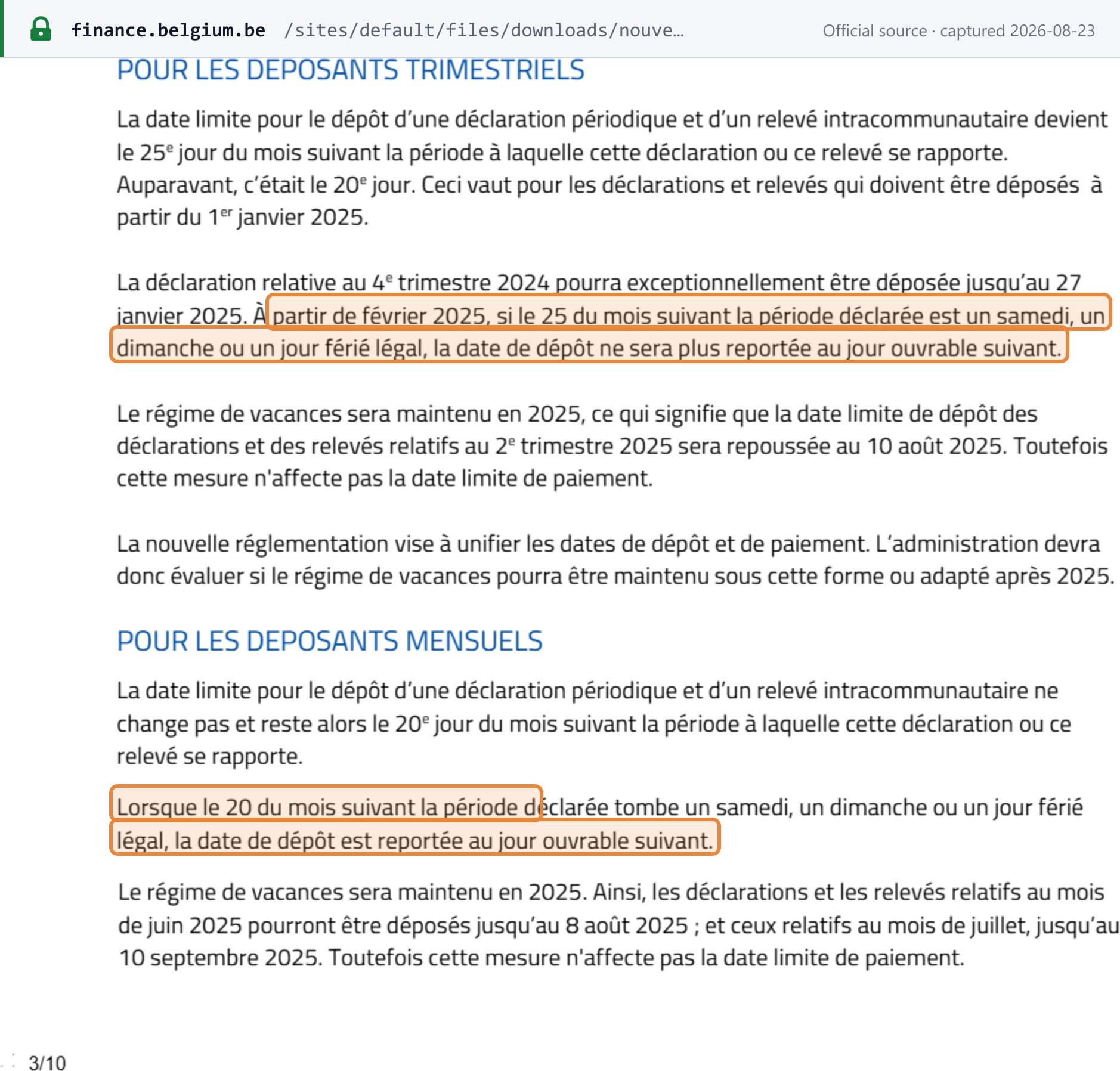
“Lorsque le 20 du mois suivant la période déclarée tombe samedi, un dimanche ou un jour férié légal, le délai de paiement est reporté jusqu’au jour ouvrable suivant.”
Open full size Captured from SPF Finances / FOD Financiën on 2026-08-23
Paiement de la TVA — déposants trimestriels
TVA / BTW (VAT) · Quarterly · payment
25th of the month after the quarter endsVerified 2026-08-23
Who files
Quarterly filers. The money must have ARRIVED on the administration's account by this date, not merely have been sent.
Notes
Quarterly VAT is payable on the 25th, the same day as the return — and unlike the monthly payment it does not move when that day is a weekend or a public holiday. A quarterly filer's second-quarter 2026 payment stands on Saturday 25 July. Plan the transfer around that: the money has to be on the administration's account by then, so a payment initiated on the Friday may not arrive in time. Late payment carries 8% a year for 2026.
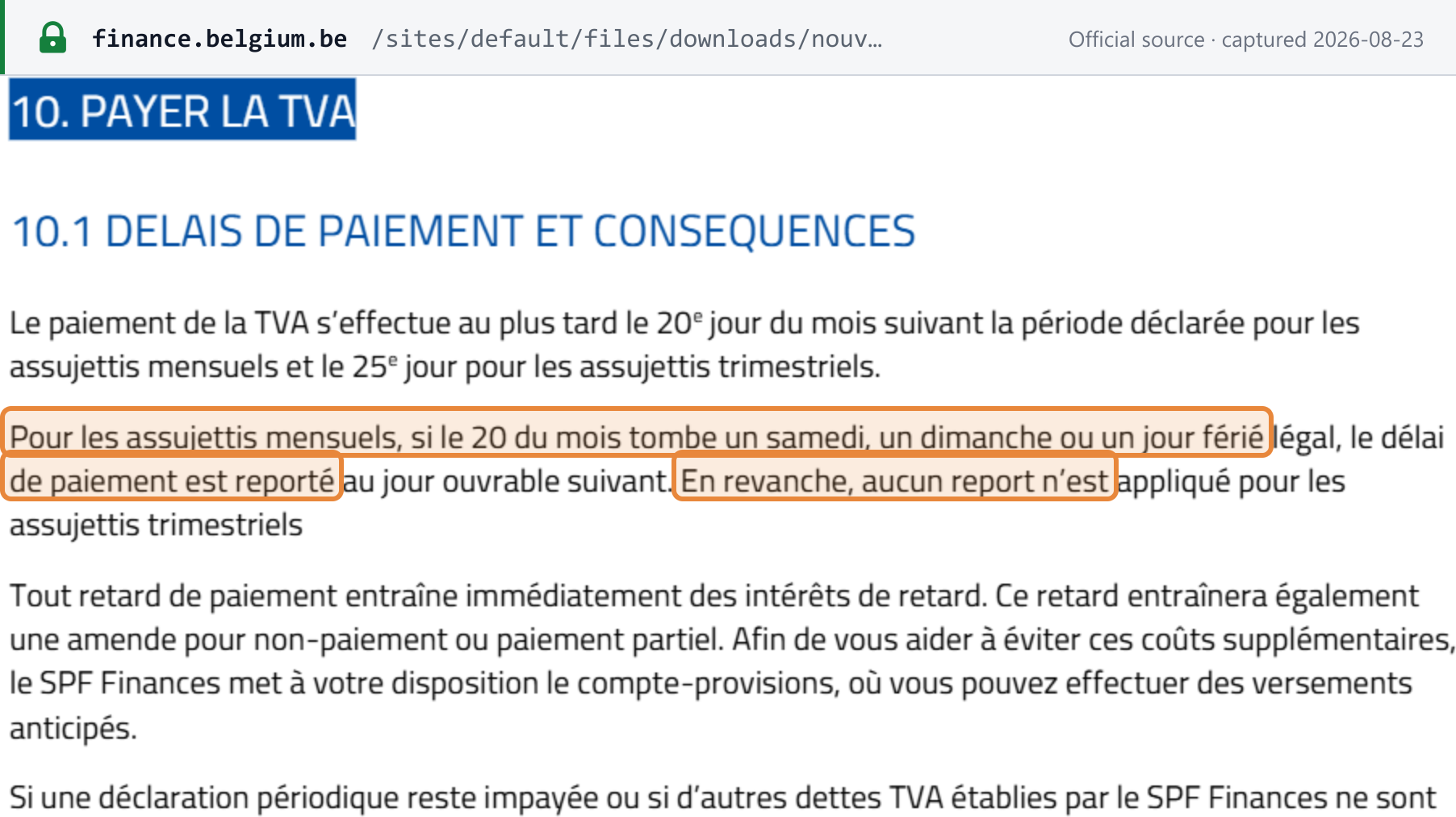
“Pour les assujettis mensuels, si le 20 du mois tombe un samedi, un dimanche ou un jour férié légal, le délai de paiement est reporté au jour ouvrable suivant. En revanche, aucun report n’est appliqué pour les assujettis trimestriels”
Open full size Captured from SPF Finances / FOD Financiën on 2026-08-23
Listing annuel des clients assujettis (formulaire 725)
Every Belgian VAT taxable person, for each customer holding a Belgian VAT number supplied with more than EUR 250 excluding VAT of goods or services during the previous calendar year. Businesses making only art. 44 exempt supplies with no right to deduct are exempt; mixed and partial taxable persons must still file, leaving the exempt operations out.
Notes
A list of your Belgian VAT-registered customers, each with their VAT number, the total charged and the total VAT — but only customers you supplied with more than EUR 250 excluding VAT over the year. The nil duty is where people go wrong, because it depends on who you are: an ordinary periodic filer just ticks the box in grid VIII of the last return of the calendar year, a taxpayer under the agricultural regime has to file an actual empty listing, a VAT-unit member either files an empty listing or writes to their tax office, and anyone else writes to their tax office. Filing late, incompletely or not at all carries a fine of EUR 50 to EUR 5,000 per infringement.
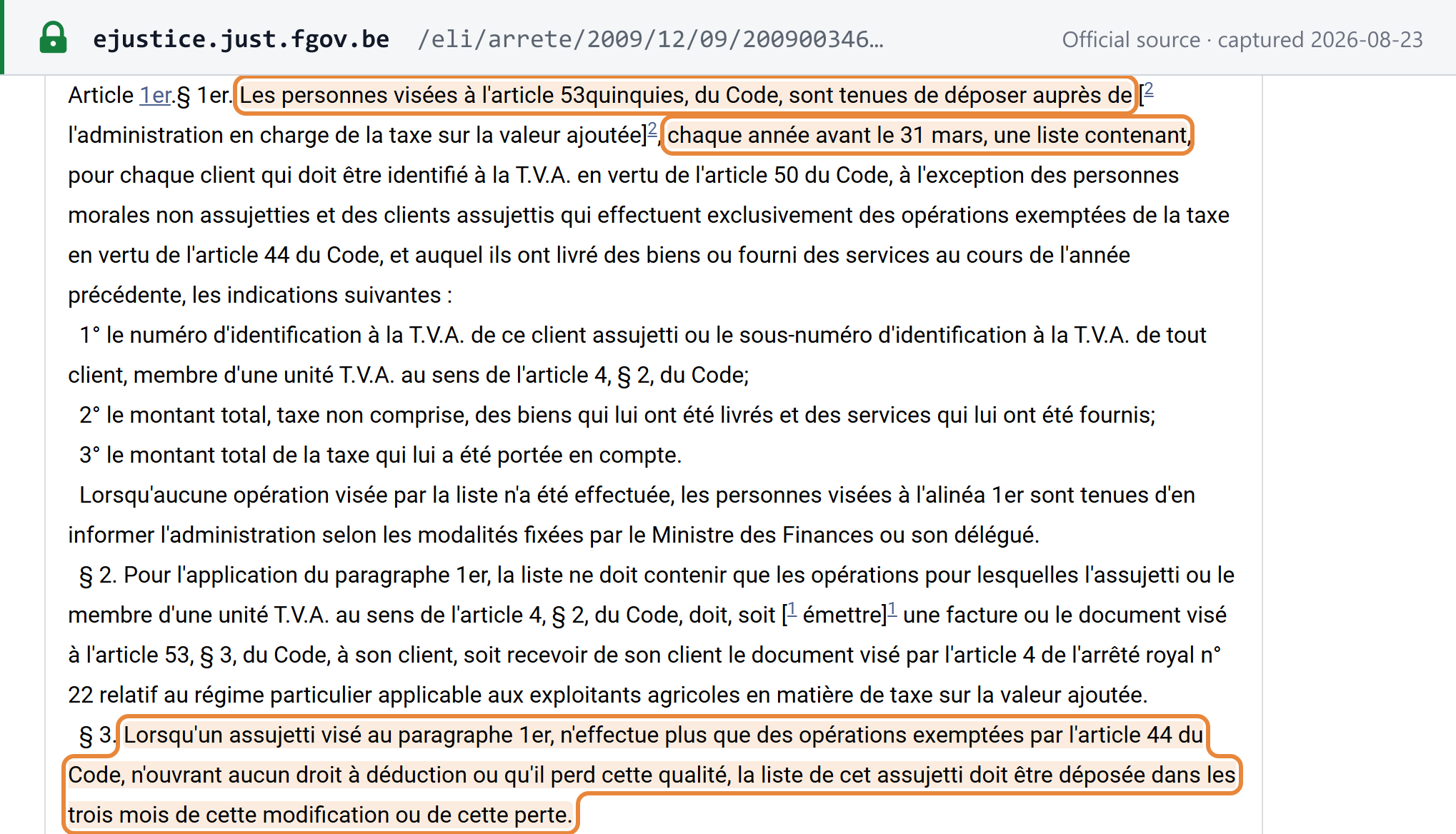
“Les personnes visées à l'article 53quinquies, du Code, sont tenues de déposer auprès de l'administration en charge de la taxe sur la valeur ajoutée, chaque année avant le 31 mars, une liste contenant, pour chaque client qui doit être identifié à la T.V.A. en vertu de l'article 50 du Code”
Open full size Captured from Justel (SPF Justice / Moniteur belge) — consolidated Belgian legislation on 2026-08-23
within 3 months of losing taxable-person status, or moving to art. 44 exempt supplies onlyVerified 2026-08-23
Who files
A taxable person who loses that status or moves to making only art. 44 exempt supplies with no right to deduct; the members of a VAT unit in the same position; and a VAT-unit member who ceases activity.
Notes
Stopping does not release you from the client listing — it just brings it forward. You have three months from losing taxable-person status, or from the point you start making only exempt supplies with no right to deduct. Joining a VAT unit splits the year in two: a listing for the period before you joined, due three months after joining, and one for the period after, due by 31 March of the following year — though the administration will accept a single listing for the whole year by that 31 March if you prefer.
“Lorsqu'un assujetti visé au paragraphe 1er, n'effectue plus que des opérations exemptées par l'article 44 du Code, n'ouvrant aucun droit à déduction ou qu'il perd cette qualité, la liste de cet assujetti doit être déposée dans les trois mois de cette modification ou de cette perte.”
Open full size Captured from Justel (SPF Justice / Moniteur belge) — consolidated Belgian legislation on 2026-08-23
Communication du chiffre d'affaires — régime de la franchise
Small enterprises registered under the Belgian franchise regime — annual Belgian turnover not exceeding EUR 25,000. The figure is reported through Intervat under Listing clients TVA.
Notes
New from 2026, and easy to miss because it did not exist before. If you are a small enterprise under the franchise regime you must now report your total Belgian turnover for the previous calendar year — or 0,00 if you had none — by 31 March, through Intervat under Listing clients. Being exempt from charging VAT does not exempt you from this. For 2026 only the administration allows a nil report to be filed up to 30 April.
20th of the month after the month endsVerified 2026-08-23
Who files
Taxable persons and VAT-unit members making exempt intra-Community supplies of goods or supplying services taxable in the customer's Member State. Monthly is the default; quarterly is available below a threshold.
Notes
Due the 20th, the same date as the monthly VAT return, and it moves off a weekend or public holiday exactly as the return does. Unlike the annual client listing, there is no nil filing: if you had no intra-Community operations in the period and no corrections to make to an earlier listing, you file nothing at all — not even an empty one. If you hold call-off stock you also file part 2 of the listing, which follows the same monthly, quarterly and annual split as part 1 rather than being monthly only. Filing part 2 obliges you to file part 1 electronically too.
“Les assujettis et les membres d'une unité T.V.A. au sens de l'article 4, § 2, du Code, visés à l'article 53sexies, § 1er, du Code, déposent auprès de l'administration en charge de la taxe sur la valeur ajoutée, au plus tard le vingtième jour de chaque mois civil, la partie 1 du relevé à la T.V.A. des opérations intracommunautaires”
Captured from Justel (SPF Justice / Moniteur belge) — consolidated Belgian legislation on 2026-08-23
25th of the month after the quarter endsVerified 2026-08-23
Who files
Taxable persons whose quarterly exempt intra-Community supplies of goods and triangular sales did not exceed EUR 50,000 in the quarter concerned or in any of the four preceding quarters, and who either file VAT returns quarterly or file none at all.
Notes
The 25th of the month after the quarter — this changed from the 20th for listings filed from 1 January 2025. Like every other Belgian deadline on the 25th it does not shift, so four of the five dates the administration publishes fall on a weekend and stand anyway. Break the EUR 50,000 ceiling and the concession stops at the end of that month: you then file month by month from the start of the quarter, by the 25th of the month after the breach, and the administration requires you to stay monthly for at least twelve months afterwards.
“Par dérogation à l'article 1er, la partie 1 du relevé intracommunautaire peut être déposée pour chaque trimestre civil, au plus tard pour le vingt-cinquième jour du mois qui suit la période à laquelle elle se rapporte, lorsque le montant total trimestriel des livraisons de biens visées à l'article 1er, 2°, a), b) et c) n'a pas dépassé 50.000 euros ni au cours du trimestre civil concerné ni au cours d'aucun des quatre trimestres civils précédents.”
Captured from Justel (SPF Justice / Moniteur belge) — consolidated Belgian legislation on 2026-08-23
Farmers under the special agricultural regime who do not file periodic VAT returns. On losing that status the listing is due within three months instead.
Notes
Farmers on the special agricultural regime who file no periodic VAT returns report their intra-Community operations once a year instead, by 31 March. The two 31 March obligations are linked: on the annual client listing you must also state whether or not you owe this one. If you lose the agricultural regime, this listing falls due within three months of that loss.
“Par dérogation à l'article 1er, les exploitants agricoles qui ne sont pas tenus au dépôt de la déclaration visée à l'article 53, § 1er, alinéa 1er, 2°, du Code, déposent chaque année au plus tard le 31 mars la partie 1 du relevé intracommunautaire reprenant les données visées aux articles 1er à 3 relatives à l'année civile précédente.”
Captured from Justel (SPF Justice / Moniteur belge) — consolidated Belgian legislation on 2026-08-23
last day of the month after the quarter endsVerified 2026-08-23
Who files
Businesses using Belgium as their Member State of identification for the Union scheme — intra-EU distance sales of goods and cross-border B2C services. Payment is due with the return.
Notes
Quarterly, due before the end of the month following the quarter — 30 April, 31 July, 31 October and 31 January. The date is the calendar month end whatever day of the week that is — it is not moved for a weekend or a public holiday. A return is due even for a quarter in which you sold nothing under the scheme, and the VAT declared is payable by the same deadline.
“Of u al dan niet verrichtingen hebt uitgevoerd die onder de regeling vallen, u moet de OSS-btw-aangifte indienen vóór het einde van de maand die volgt op het verlopen van het betreffende belastbare tijdperk.”
Captured from SPF Finances / FOD Financiën on 2026-08-23
last day of the month after the quarter endsVerified 2026-08-23
Who files
Businesses not established in the EU that have chosen Belgium as their Member State of identification for supplies of services to EU consumers. Payment is due with the return.
Notes
The non-Union scheme runs on the same quarterly cycle as the Union scheme — due before the end of the month after the quarter, with payment on the same date. Like the Union scheme it is a hard month-end date that does not move for a weekend or a public holiday, and a nil return is due for a quarter with no supplies.
“Unieregeling en niet-Unieregeling De aangiften worden per kwartaal ingediend. De kwartaalaangifte moet worden ingediend vóór het einde van de maand die volgt op dat kwartaal (april, juli, oktober, januari).”
Captured from SPF Finances / FOD Financiën on 2026-08-23
last day of the month after the month endsVerified 2026-08-23
Who files
Businesses registered in Belgium for the import scheme on distance sales of goods imported from outside the EU in consignments not exceeding EUR 150. Where an intermediary acts for you, the intermediary files the return.
Notes
Monthly, due before the end of the following month, so the January return is due at the end of February — 28th, or 29th in a leap year. The month end is the deadline whatever day it falls on, and a nil return is due for a month with no distance sales. If an intermediary acts for you, they file it.
“Invoerregeling De aangiften worden maandelijks ingediend. De maandelijkse aangiften moeten worden ingediend vóór het einde van de volgende maand. Indien een tussenpersoon handelt in uw naam, dient hij uw aangifte in.”
Captured from SPF Finances / FOD Financiën on 2026-08-23
Déclaration annuelle du curateur d'un assujetti failli
TVA / BTW (VAT) · Annually · return filing
28th February each yearVerified 2026-08-23
Who files
A trustee in bankruptcy, for the taxable operations carried out each year in the name of the bankrupt taxable person from the date of the declaratory judgment. Not an obligation of ordinary filers.
Notes
Belgium's one genuinely annual VAT return, and it belongs to trustees in bankruptcy rather than to ordinary businesses. Due 28 February for the previous year, with the tax payable two months later on 30 April — one of the few places in Belgian VAT where the return and the payment do not share a date. When the bankruptcy is closed the return comes forward instead, to the last day of the second month after the closing judgment, with payment three months after that.
“le curateur d'un assujetti failli dépose, selon les modalités fixées à l'article 18, § 1er et § 2, et au plus tard le 28 février de l'année civile qui suit celle à laquelle elle se rapporte, une déclaration annuelle pour les opérations soumises à la taxe qu'il effectue chaque année au nom de cet assujetti, depuis le jour du jugement déclaratif de la faillite.”
Captured from Justel (SPF Justice / Moniteur belge) — consolidated Belgian legislation on 2026-08-23
Paiement de la TVA par le curateur
TVA / BTW (VAT) · Annually · payment
30th April each yearVerified 2026-08-23
Who files
A trustee in bankruptcy, for the tax due on the annual declaration filed by 28 February. Not an obligation of ordinary filers.
Notes
The payment leg of the trustee's annual declaration, and the reason it is worth showing separately: the return is due 28 February but the tax is not payable until 30 April, a two-month gap that exists nowhere else in Belgian VAT.
“Le curateur acquitte la taxe due au plus tard le 30 avril de l'année civile qui suit celle à laquelle la déclaration visée à l'alinéa 1er se rapporte.”
Captured from Justel (SPF Justice / Moniteur belge) — consolidated Belgian legislation on 2026-08-23
Déclaration de modification ou de cessation d'activité (604B / 604C)
TVA / BTW (VAT) · One-off · registration
within 1 month of a change to the registered VAT particulars (form 604B), or cessation of activity (form 604C)Verified 2026-08-23
Who files
Any VAT-identified business changing the particulars given on its identification request — tax address, tax regime, bank account — or ceasing activity altogether.
Notes
Changes and cessations get one month. Getting VAT-identified in the first place works the other way round and catches people out: the identification request (form 604A) has to be lodged BEFORE you start trading, and at least two days after your enterprise is registered in the Crossroads Bank for Enterprises — there is no window after you start. If you leave the small-enterprise franchise regime you cannot return to it until 1 January of the third year after the change.
“Dès que vous modifiez des informations qui figuraient dans la demande d'identification à la TVA (adresse fiscale, régime d'imposition, numéro de compte bancaire…), vous devez le signaler dans un délai d'un mois en rentrant une déclaration modificative d'une identification à la TVA (formulaire 604B).”
Captured from SPF Finances / FOD Financiën on 2026-08-23
TVA/BTW returns and payments, the intra-Community listing, the annual client listing, the new franchise-regime turnover communication and the One Stop Shop schemes. Corporate income tax, payroll withholding (précompte professionnel) and the annual accounts filed with the National Bank sit on the same official calendars but are outside this calendar's indirect-tax scope. Five things a reader should know, none of them visible from a due-date page. First, and most important: the weekend rule is SPLIT, and getting it wrong costs money in both directions. Anything due on the 20th — the monthly return, the monthly payment, the monthly intra-Community listing — moves forward to the next working day when the 20th is a Saturday, Sunday or public holiday. Anything due on the 25th does NOT move. The administration states both halves in consecutive paragraphs of the same guidance note. So a quarterly filer's second-quarter 2026 return and payment stand on Saturday 25 July 2026, while a monthly filer's May 2026 return moves from Saturday 20 June to Monday 22 June. Second, the quarterly deadline is the 25th, not the 20th, and that changed for returns filed from 1 January 2025 under the VAT-chain reform. Any guidance written before then that puts quarterly returns on the 20th is describing superseded law. Third, both advance-payment regimes are gone, and neither died in the recent reform. The quarterly acomptes — the 20th of the second and third month of each quarter — were abolished on 1 April 2017. The December advance payment was abolished on 10 April 2021, so the last one was due 24 December 2020. Neither appears on this calendar because neither exists. Fourth, Belgium has no annual VAT return for ordinary businesses. The periodic return is self-correcting — a material error is fixed by re-filing before the deadline, or else in the next return — so there is nothing to reconcile annually. The only annual VAT return in Belgian law belongs to a trustee in bankruptcy, and it is shown here as what it is. The annual client listing is a listing of your customers, not a return of your own tax position. Fifth, and only for 2026: the summer filing concession is gone, but the fine for missing it is waived this year. From 2026 there is no longer a holiday extension for periodic VAT returns. As a transitional measure the administration will not impose a late-filing fine in 2026 if you file within the old holiday deadline — the June 2026 return is due 20 July but carries no fine until 10 August, the second-quarter return is due 25 July with the same 10 August grace, and the July return is due 20 August with grace to 10 September. Read that narrowly: it waives the FINE only. The payment stays due on the legal date, interest still runs from it, and filing late still extends the period during which the administration can reassess you by a year and holds up VAT refunds for six months. Sixth, payment deadlines are ARRIVAL deadlines. The dates are when the money has to be on the administration's account, not when you send it, so a transfer started on the day is late. Late payment runs at the fiscal interest rate plus four points — 8% a year for 2026 — and every started month counts as a full month. One obligation is missing from this calendar and it is missing for a modelling reason rather than a research one. Belgian excise runs on a weekly cycle: the AC4 release-for-consumption declaration is due by the Thursday of the week following the week of release, with the duty payable when the AC4 is lodged. This calendar has no weekly cadence, and the real interval varies from four to ten days depending on the release day, so the obligation is described here rather than rendered as dates. The cross-border small-enterprise scheme's quarterly turnover declarations are also absent: the administration's own page describes that facility as still being built and publishes no deadline for it.
“Lorsque le 20 du mois suivant la période déclarée tombe un samedi, un dimanche ou un jour férié légal, la date de dépôt est reportée au jour ouvrable suivant.”
Captured from SPF Finances / FOD Financiën on 2026-08-23
What this calendar does not list
Not yet covered Periodic return — The cross-border small-enterprise (SME) scheme's quarterly turnover declaration is a real periodic indirect-tax obligation and it is not modelled here. The regime has been live since 1 January 2025 under CTVA art. 56ter, the EU rules fix the deadline at one month after each calendar quarter, and Belgian small enterprises using another Member State's exemption owe it. It is recorded as a gap rather than shipped as a row because the administration's own SME page still describes the filing facility as '(en developpement)' and publishes no deadline of its own, so a date rendered here would rest on the EU rule rather than on anything Belgium has published. Recorded as a gap rather than left in prose because both slots it might otherwise touch are already answered by other rows, so no build advisory would ever fire for it and it would stay missing silently.
Not applicable Annual or reconciliation return — Belgium has no annual VAT return for ordinary filers. Arrêté royal n° 1 art. 17, as restored by the arrêté royal du 29 septembre 2024 with effect from 1 January 2025, provides only monthly and quarterly returns, and art. 17 § 4 makes the periodic return self-correcting — a material error is corrected by re-filing before the deadline or else in the following return — so no annual reconciliation exists to file. The only annual VAT declaration in the arrêté royal is art. 17 § 5, which applies solely to a trustee in bankruptcy; it is carried as an obligation here so a trustee can find it, but it is not the ordinary taxpayer's answer to this slot. The annual client listing reports counterparties' VAT numbers and turnover per customer rather than the filer's own tax position, so it answers the listing slot instead. Checked against AR n° 1 and the administration's declaration pages on 2026-08-23.
Not applicable E-invoicing / e-reporting cycle — Belgium's B2B structured e-invoicing mandate has been in force since 1 January 2026 and it fixes the FORM and the EXCHANGE of an invoice, not a filing cycle. FPS Finance's own B2B FAQ states that from that date any invoice within scope 'must be in the form of a structured electronic invoice', and — read in full on 2026-08-23 — contains no sentence about reporting invoice data to the administration, no near-real-time reporting and no submission deadline. Belgium's model is the decentralised four-corner Peppol network, with no clearance or portal step between the two businesses. The near-real-time e-reporting that WOULD fix a cadence is a preliminary draft law approved by the Council of Ministers on 18 July 2026 and proposed to start on 1 January 2028; it is not law, so it is a watch item rather than a gap. Recorded as not-applicable rather than as a gap because the question was researched to a conclusion, not left open.
New Belgium rules taking effect
Confirmed changes from the weekly scan — each links to its full record with the official source.
Which Belgium tax deadlines does this calendar cover?
17 recurring indirect-tax obligations — TVA / BTW (VAT) returns, payments and related filings — each with the due-date rule, who must file, and the official source that states the deadline. Direct-tax, payroll and company-registry deadlines are out of scope.
How current are these due dates?
Every obligation carries the date it was last verified against its official source (newest: 2026-08-23). Law-change dates come from the weekly Last Week in Taxes scan and link to their full change records.
Do the dates account for weekends and public holidays?
No — the calendar shows the statutory due date. Where the authority shifts deadlines falling on non-working days, the obligation notes say so. Confirm against the linked official source before relying on a date.

 Open full size Captured from Justel (SPF Justice / Moniteur belge) — consolidated Belgian legislation on 2026-08-23