
India compliance calendar

14 recurring GST obligations — returns, payments and listings — each with its due rule and official source, plus the dates new India rules take effect.

Mon
Tue
Wed
Thu
Fri
Sat
Sun
31
1
2
3
4
5
6
7
8
9
10
11
Return filing Payment Report / listing Law change takes effect

No obligation here shifts for a weekend or public holiday. Where that is India's own rule the date stands as shown; where a shift exists but is not modelled, the obligation's notes say so. Confirm against the linked official source before relying on a date.

Recurring obligations, with sources

Each deadline cites the official text that states it and the date we last verified it.

GSTR-1 — monthly statement of outward supplies

GST · Monthly · return filing

11th of the month after the month ends Verified 2026-08-24
Who files
Registered persons on the monthly scheme (those not opting into QRMP, which is open only at aggregate turnover up to ₹5 crore). Not for composition taxpayers, input service distributors, non-residents, or GST TDS/TCS filers.
Notes
The 11th was fixed by Notification No. 83/2020-Central Tax (10 November 2020) under s.37(1) CGST Act.
Source
Notification No. 83/2020 - Central Tax, 10.11.2020 - extension of the GSTR-1 time limit to the eleventh day GSTN (gst.gov.in)
See the source text
“the Commissioner, on the recommendations of the Council, hereby extends the time limit for furnishing the details of outward supplies in FORM GSTR-1 of the Central Goods and Services Tax Rules, 2017 (hereafter in this notification referred to as the said rules), for each of the tax periods, till the eleventh day of the month succeeding such tax period”
Captured from GSTN (gst.gov.in) on 2026-08-24
GSTR-1 — quarterly statement of outward supplies (QRMP)

GST · Quarterly · return filing

13th of the month after the quarter ends Verified 2026-08-24
Who files
QRMP opt-ins: taxpayers with PAN-based aggregate annual turnover up to ₹5 crore in the current and preceding financial year who have filed their last due GSTR-3B.
Notes
For the first two months of a quarter, B2B invoices can optionally be uploaded through the Invoice Furnishing Facility between the 1st and 13th of the following month, capped at ₹50 lakh per month (Rule 59(2)–(3) CGST Rules); IFF invoices are then excluded from the quarterly GSTR-1.
Source
Notification No. 83/2020 - Central Tax, 10.11.2020, proviso - quarterly GSTR-1 extended to the thirteenth day GSTN (gst.gov.in)
See the source text
“Provided that the time limit for furnishing the details of outward supplies in FORM GSTR-1 of the said rules for the class of registered persons required to furnish return for every quarter under proviso to sub-section (1) of section 39 of the said Act, shall be extended till the thirteenth day of the month succeeding such tax period.”
Captured from GSTN (gst.gov.in) on 2026-08-24

GSTR-3B — monthly summary return and tax payment

GST · Monthly · return filing

20th of the month after the month ends Verified 2026-08-24
Who files
Registered persons on the monthly scheme. Tax is payable with the return — not later than the filing date (s.39(7) CGST Act).
Notes
Rule 61 in this form was substituted with effect from 1 January 2021 by Notification No. 82/2020-Central Tax.
Source
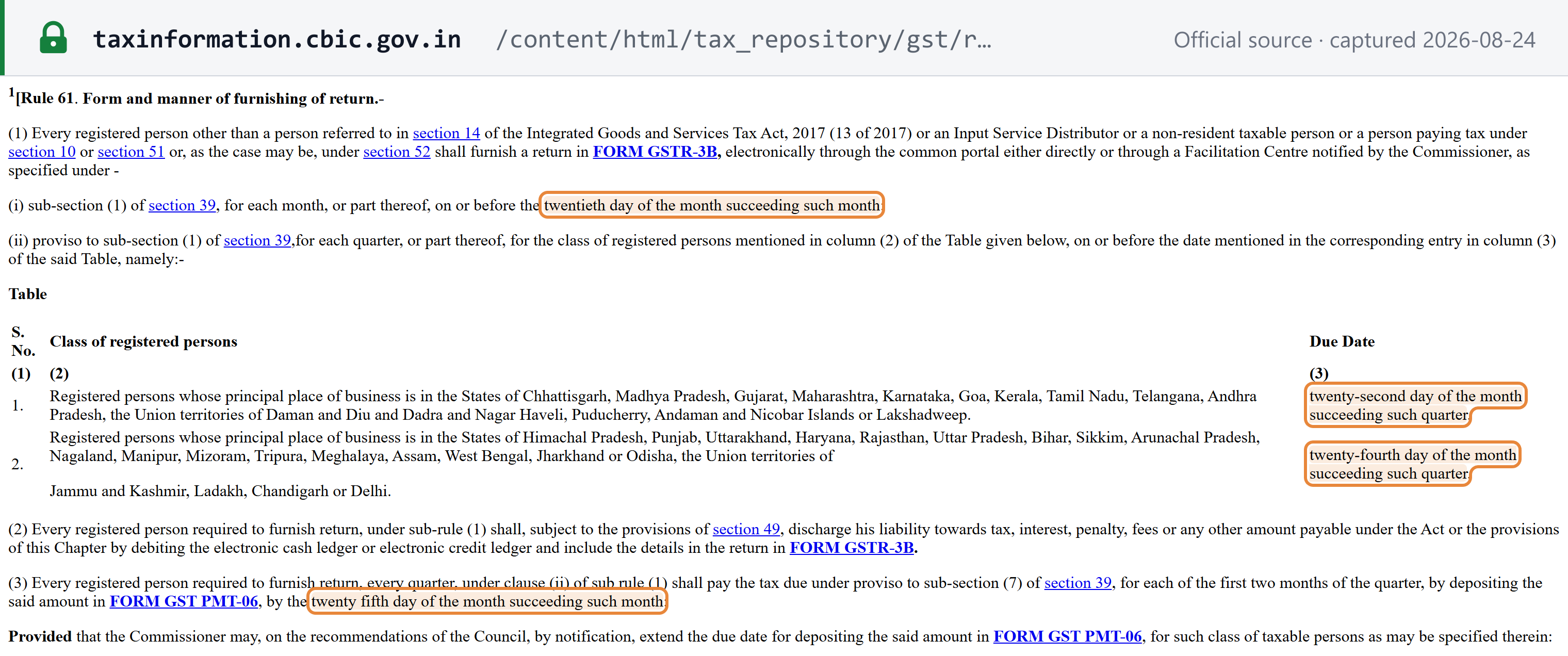
CGST Rules, Rule 61(1)(i) — on or before the twentieth day of the succeeding month CBIC (taxinformation.cbic.gov.in)
See the source text
“Every registered person other than a person referred to in section 14 of the Integrated Goods and Services Tax Act, 2017 (13 of 2017) or an Input Service Distributor or a non-resident taxable person or a person paying tax under section 10 or section 51 or, as the case may be, under section 52 shall furnish a return in FORM GSTR-3B, electronically through the common portal either directly or through a Facilitation Centre notified by the Commissioner, as specified under - (i) sub-section (1) of section 39, for each month, or part thereof, on or before the twentieth day of the month succeeding such month:”
Screenshot of CBIC (taxinformation.cbic.gov.in) showing the GSTR-3B — monthly summary return and tax payment deadline Open full size Captured from CBIC (taxinformation.cbic.gov.in) on 2026-08-24

GSTR-3B — quarterly (QRMP), Category X states — 22nd

GST · Quarterly · return filing

22nd of the month after the quarter ends Verified 2026-08-24
Who files
QRMP filers whose principal place of business is in Chhattisgarh, Madhya Pradesh, Gujarat, Maharashtra, Karnataka, Goa, Kerala, Tamil Nadu, Telangana, Andhra Pradesh, Daman and Diu and Dadra and Nagar Haveli, Puducherry, Andaman and Nicobar Islands, or Lakshadweep.
Notes
"Category X/Y" is calendar shorthand — the rule simply tables the two state lists.
Source
CGST Rules, Rule 61(1)(ii) Table — twenty-second day of the month succeeding the quarter CBIC (taxinformation.cbic.gov.in)
See the source text
“Registered persons whose principal place of business is in the States of Chhattisgarh, Madhya Pradesh, Gujarat, Maharashtra, Karnataka, Goa, Kerala, Tamil Nadu, Telangana, Andhra Pradesh, the Union territories of Daman and Diu and Dadra and Nagar Haveli, Puducherry, Andaman and Nicobar Islands or Lakshadweep. [...] twenty-second day of the month succeeding such quarter.”
Screenshot of CBIC (taxinformation.cbic.gov.in) showing the GSTR-3B — quarterly (QRMP), Category X states — 22nd deadline Open full size Captured from CBIC (taxinformation.cbic.gov.in) on 2026-08-24

GSTR-3B — quarterly (QRMP), Category Y states — 24th

GST · Quarterly · return filing

24th of the month after the quarter ends Verified 2026-08-24
Who files
QRMP filers whose principal place of business is in Himachal Pradesh, Punjab, Uttarakhand, Haryana, Rajasthan, Uttar Pradesh, Bihar, Sikkim, Arunachal Pradesh, Nagaland, Manipur, Mizoram, Tripura, Meghalaya, Assam, West Bengal, Jharkhand, Odisha, Jammu and Kashmir, Ladakh, Chandigarh, or Delhi.
Source
CGST Rules, Rule 61(1)(ii) Table — twenty-fourth day of the month succeeding the quarter CBIC (taxinformation.cbic.gov.in)
See the source text
“Registered persons whose principal place of business is in the States of Himachal Pradesh, Punjab, Uttarakhand, Haryana, Rajasthan, Uttar Pradesh, Bihar, Sikkim, Arunachal Pradesh, Nagaland, Manipur, Mizoram, Tripura, Meghalaya, Assam, West Bengal, Jharkhand or Odisha, the Union territories of Jammu and Kashmir, Ladakh, Chandigarh or Delhi. [...] twenty-fourth day of the month succeeding such quarter.”
Screenshot of CBIC (taxinformation.cbic.gov.in) showing the GSTR-3B — quarterly (QRMP), Category Y states — 24th deadline Open full size Captured from CBIC (taxinformation.cbic.gov.in) on 2026-08-24

PMT-06 — monthly tax deposit under QRMP

GST · Monthly · payment

25th of the month after the month ends Verified 2026-08-24
Who files
QRMP filers, for each of the first two months of a quarter (fixed-sum or self-assessment method). The third month's tax is paid with the quarterly GSTR-3B, so no PMT-06 falls due in the month after a quarter ends.
Source
CGST Rules, Rule 61(3) — deposit in FORM GST PMT-06 by the twenty-fifth day of the succeeding month CBIC (taxinformation.cbic.gov.in)
See the source text
“Every registered person required to furnish return, every quarter, under clause (ii) of sub rule (1) shall pay the tax due under proviso to sub-section (7) of section 39, for each of the first two months of the quarter, by depositing the said amount in FORM GST PMT-06, by the twenty fifth day of the month succeeding such month:”
Screenshot of CBIC (taxinformation.cbic.gov.in) showing the PMT-06 — monthly tax deposit under QRMP deadline Open full size Captured from CBIC (taxinformation.cbic.gov.in) on 2026-08-24

CMP-08 — composition quarterly statement and payment

GST · Quarterly · payment

18th of the month after the quarter ends Verified 2026-08-24
Who files
Composition taxpayers under s.10 CGST Act — preceding-financial-year aggregate turnover up to ₹1.5 crore, or ₹75 lakh in Arunachal Pradesh, Manipur, Meghalaya, Mizoram, Nagaland, Sikkim, Tripura and Uttarakhand (Notification 14/2019-CT).
Notes
Thresholds verified against the GST Council's official copy of Notification 14/2019-CT (gstcouncil.gov.in), in force since 1 April 2019.
Source
CGST Rules, Rule 62(1) — FORM GST CMP-08 till the 18th day of the month succeeding the quarter CBIC (taxinformation.cbic.gov.in)
See the source text
“furnish a statement, every quarter or, as the case may be, part thereof, containing the details of payment of self-assessed tax in FORM GST CMP-08, till the 18th day of the month succeeding such quarter”
Captured from CBIC (taxinformation.cbic.gov.in) on 2026-08-24

GSTR-4 — composition annual return

GST · Annually · return filing

30th June each year Verified 2026-08-24
Who files
Composition taxpayers under s.10 CGST Act. Due 30 June following the financial year (April–March), for FY 2024-25 onwards.
Notes
Moved from 30 April by Notification No. 12/2024-Central Tax (10 July 2024). The period is the financial year ending 31 March of the due year.
Source
CGST Rules, Rule 62(1) proviso — GSTR-4 by the thirtieth day of June following the financial year CBIC (taxinformation.cbic.gov.in)
See the source text
“Provided that the return in FORM GSTR-4 for a financial year from FY 2024-25 onwards shall be required to be furnished by the registered person till the thirtieth day of June following the end of such financial year.”
Captured from CBIC (taxinformation.cbic.gov.in) on 2026-08-24

GSTR-5 — non-resident taxable person return

GST · Monthly · return filing

13th of the month after the month ends Verified 2026-08-24
Who files
Registered non-resident taxable persons, for each calendar month or part-month of registration.
Notes
If the registration expires mid-month, the return is instead due within 7 days after the last day of registration, whichever is earlier (s.39(5)). The 13-day rule replaced 20 days from 1 October 2022 (Finance Act 2022); Rule 63 still carries the stale 20-day wording, so the Act and the GSTN portal govern.
Source
CGST Act s. 39(5) - non-resident taxable person's return within thirteen days after the end of a calendar month GSTN (gst.gov.in)
See the source text
“Every registered non-resident taxable person shall, for every calendar month or part thereof, furnish, in such form and manner as may be prescribed, a return, electronically, within thirteen days after the end of a calendar month or within seven days after the last day of the period of registration specified under sub-section (1) of section 27, whichever is earlier.”
Captured from GSTN (gst.gov.in) on 2026-08-24

GSTR-5A — OIDAR and online money gaming return

GST · Monthly · return filing

20th of the month after the month ends Verified 2026-08-24
Who files
Suppliers located outside India providing OIDAR services to non-taxable online recipients or registered persons in India, or online money gaming to persons in India (scope per Notification 51/2023-CT).
Source
CGST Rules, Rule 64 — FORM GSTR-5A on or before the twentieth day of the succeeding month CBIC (taxinformation.cbic.gov.in)
See the source text
“Every registered person either providing online money gaming from a place outside India to a person in India, or providing online information and data base access or retrieval services from a place outside India to a non-taxable online recipient referred toin section 14 of the Integrated Goods and Services Tax Act, 2017 (13 of 2017) or to a registered person other than a non-taxable online recipient, shall file return in FORM GSTR-5A on or before the twentieth day of the month succeeding the calendar month or part thereof.”
Captured from CBIC (taxinformation.cbic.gov.in) on 2026-08-24

GSTR-7 — GST tax-deducted-at-source return

GST · Monthly · return filing

10th of the month after the month ends Verified 2026-08-24
Who files
Persons required to deduct tax at source under s.51 CGST Act — government departments and establishments, local authorities, governmental agencies and notified persons. This is GST TDS, not income-tax TDS.
Notes
The due-date wording was inserted into Rule 66(1) with effect from 1 November 2024 (Notification 20/2024-CT), matching s.39(3).
Source
CGST Rules, Rule 66(1) — FORM GSTR-7 on or before the tenth day of the succeeding month CBIC (taxinformation.cbic.gov.in)
See the source text
“Every registered person required to deduct tax at source under section 51 (hereafter in this rule referred to as deductor) shall furnish a return in FORM GSTR-7, on or before the tenth day of the month succeeding the calendar month, electronically through the common portal either directly or from a Facilitation Centre notified by the Commissioner.”
Captured from CBIC (taxinformation.cbic.gov.in) on 2026-08-24

GSTR-8 — e-commerce tax-collected-at-source statement

GST · Monthly · return filing

10th of the month after the month ends Verified 2026-08-24
Who files
Electronic commerce operators required to collect tax at source under s.52 CGST Act on supplies made through their platform.
Notes
The date lives in s.52(4) of the Act ("within ten days after the end of such month"); Rule 67 prescribes the form only.
Source
CGST Act s. 52(4) - operator's statement within ten days after the end of the month GSTN (gst.gov.in)
See the source text
“Every operator who collects the amount specified in sub-section (1) shall furnish a statement, electronically, containing the details of outward supplies of goods or services or both effected through it, including the supplies of goods or services or both returned through it, and the amount collected under sub-section (1) during a month, in such form and manner as may be prescribed, within ten days after the end of such month:”
Captured from GSTN (gst.gov.in) on 2026-08-24

GSTR-9 — annual return

GST · Annually · return filing

31st December each year Verified 2026-08-13
Who files
Registered persons, excluding input service distributors, GST TDS/TCS filers, casual taxable persons and non-residents. Taxpayers with aggregate annual turnover up to ₹2 crore are exempt from FY 2024-25 onwards (Notification 15/2025-CT).
Notes
The period is the financial year (April–March) ending in the due year. The ₹2-crore exemption is official-id-corroborated — the notification PDF was not fetchable at authoring time.
Source
CGST Rules, Rule 80(1) — FORM GSTR-9 on or before the thirty-first day of December following the financial year CBIC (taxinformation.cbic.gov.in)
See the source text
“shall furnish an annual return for every financial year as specified under section 44 electronically in FORM GSTR-9 on or before the thirty-first day of December following the end of such financial year through the common portal”
Screenshot of CBIC (taxinformation.cbic.gov.in) showing the GSTR-9 — annual return deadline Open full size Captured from CBIC (taxinformation.cbic.gov.in) on 2026-08-23

GSTR-9C — self-certified reconciliation statement

GST · Annually · report / listing

31st December each year Verified 2026-08-24
Who files
Registered persons whose aggregate turnover in the financial year exceeds ₹5 crore, filed along with GSTR-9.
Source
CGST Rules, Rule 80(3) — FORM GSTR-9C on or before the thirty-first day of December following the financial year CBIC (taxinformation.cbic.gov.in)
See the source text
“Every registered person, other than those referred to in the second proviso to section 44, an Input Service Distributor, a person paying tax under section 51 or section 52, a casual taxable person and a non-resident taxable person, whose aggregate turnover during a financial year exceeds five crore rupees, shall also furnish a self-certified reconciliation statement as specified under section 44 in FORM GSTR-9C along with the annual return referred to in sub-rule (1), on or before the thirty-first day of December following the end of such financial year, electronically through the common portal either directly or through a Facilitation Centre notified by the Commissioner.”
Captured from CBIC (taxinformation.cbic.gov.in) on 2026-08-24

GST obligations only — India's income-tax TDS deposits, payroll (EPF/ESI) and company-registry deadlines exist but are outside this calendar's indirect-tax scope. No row in this file shifts for a weekend or holiday, and that is the right operational call — but it is an inference from how GST law is built, not something CBIC has ever stated, and the note here used to assert it as settled law. What IS sourced: the CGST Rules fix bare calendar dates with no shift clause (Rule 80(1) for GSTR-9, Rule 62(1) for GSTR-4), and they locate the act 'through the common portal' rather than in an office — which matters, because s. 10 of the General Clauses Act 1897 extends a deadline only where the act is directed to be done 'in any Court or office' AND that office 'is closed on that day'. A portal accepting filings continuously is never closed. Practice corroborates it: when 20 November 2024 collided with a declared polling day in Maharashtra and Jharkhand, CBIC had to issue Notification 26/2024–Central Tax under s. 39(6) to move the date by a single day — unnecessary if a holiday shifted GST dates automatically. What is NOT sourced: any CBIC circular, notification or GSTN advisory saying either way whether s. 10 reaches a GST due date. Indian courts have applied s. 10 to other tax filings. So: dates move when the government notifies an extension, and this file models nothing else. The GSTR-9 ₹2-crore exemption rests on Notification 15/2025-CT, identified and multiply corroborated but not yet fetched in the original.

What this calendar does not list

  • Not applicable Recapitulative listing — India is outside the EU VAT system and has no recapitulative statement of intra-community supplies. GSTR-9C is a reconciliation statement filed with the annual return, not a listing, so it is recorded against the annual-return slot instead.
  • Not applicable E-invoicing / e-reporting cycle — India's e-invoicing regime requires an Invoice Reference Number from the IRP at the point of issuance. It imposes no separate periodic submission deadline, so there is no filing cycle to place on a calendar.
  • Not yet covered Registration deadline — Sections 22 and 25 of the CGST Act require applying for registration within 30 days of becoming liable, with shorter windows for casual and non-resident taxable persons. Not yet researched to page grade — no official source fetched — so it is recorded as a known gap rather than stated.

About this calendar

Which India tax deadlines does this calendar cover?

14 recurring indirect-tax obligations — GST returns, payments and related filings — each with the due-date rule, who must file, and the official source that states the deadline. Direct-tax, payroll and company-registry deadlines are out of scope.

How current are these due dates?

Every obligation carries the date it was last verified against its official source (newest: 2026-08-24). Law-change dates come from the weekly Last Week in Taxes scan and link to their full change records.

Do the dates account for weekends and public holidays?

No — the calendar shows the statutory due date. Where the authority shifts deadlines falling on non-working days, the obligation notes say so. Confirm against the linked official source before relying on a date.

Validate tax IDs in 100+ countries

Put these rules into practice — verify VAT, GST, and EIN numbers in real time with the Lookuptax API.