India's 57th GST Council recommends a new return-amendment mechanism from the April 2027 return, plus rate, reverse-charge and registration changes
This change is proposed and is not law. The rules below describe what would change if it is adopted.
This page records one dated change. For the rules in India as they stand today, see the India guide →
- Jurisdiction
- India
- Tax
- GST
- Change type
- Compliance
- Status
- Proposed
- Impact
- Plan ahead
- Announced
- 8 October 2026
- Effective
- 1 April 2027
- Authority
- GST Council / CBIC (Ministry of Finance, Department of Revenue)
- Systems
- ERP, Reporting, Tax engine
- Verified
- Fetched from official source · high confidence
GST-registered taxpayers filing GSTR-1 and GSTR-3B, small e-commerce sellers, suppliers of EV passenger transport and delivery services through e-commerce operators, and B2C-only taxpayers up to Rs 5 crore turnover.
Plan GSTR-3B/GSTR-1 reconciliation and IMS workflow changes ahead of April 2027 returns; await rules.
ERPReportingTax engine
India's 57th GST Council meeting (8 October 2026) recommended: bringing the alternate mechanism for amending liability and input tax credit in GST returns (new rules 86C, 86D, 61(1A)/(1B) and 60(6A)) into force from the return for April 2027; a new CGST rule 14B for automatic registration of small e-commerce sellers in States where they have no physical presence; an optional 5% rate with restricted ITC on electric-vehicle passenger transport and motor-vehicle rental with operator, and 5% without ITC on delivery services supplied through e-commerce operators; reverse charge on specified waste and scrap supplied by unregistered persons; in-principle approval of an optional annual-return, quarterly-payment scheme for B2C-only taxpayers up to Rs 5 crore turnover; and amendments removing several section 17(5) blocked-credit restrictions. These are Council recommendations; they take effect only through later CGST Act amendments, rules and notifications.
What changed in detail
These are recommendations of the GST Council, not law. They take effect only through later CGST Act amendments, rules and notifications. The 57th GST Council meeting (8 October 2026) recommended:
- bringing the alternate mechanism for amending liability and input tax credit in GST returns (new rules 86C, 86D, 61(1A)/(1B) and 60(6A)) into force from the return for April 2027;
- a new CGST rule 14B for automatic registration of small e-commerce sellers in States where they have no physical presence;
- an optional 5% rate with restricted ITC on electric-vehicle passenger transport and motor-vehicle rental with operator, and 5% without ITC on delivery services supplied through e-commerce operators;
- reverse charge on specified waste and scrap supplied by unregistered persons;
- in-principle approval of an optional annual-return, quarterly-payment scheme for B2C-only taxpayers up to Rs 5 crore turnover;
- amendments removing several section 17(5) blocked-credit restrictions.
What it means
The April 2027 return is a recommended date for the new amendment mechanism, not a notified one. Rules 86C and 86D and the other listed provisions still have to be notified.
Finance teams should plan GSTR-3B and GSTR-1 reconciliation and IMS workflow changes ahead of April 2027 returns, and wait for the rules before changing filing logic. The rate, reverse-charge and registration items need separate notifications, so none should be applied yet.
Proof
the provisions regarding alternate mechanism for amendment of liability and ITC in the GST return, may be brought into force from the return of April, 2027.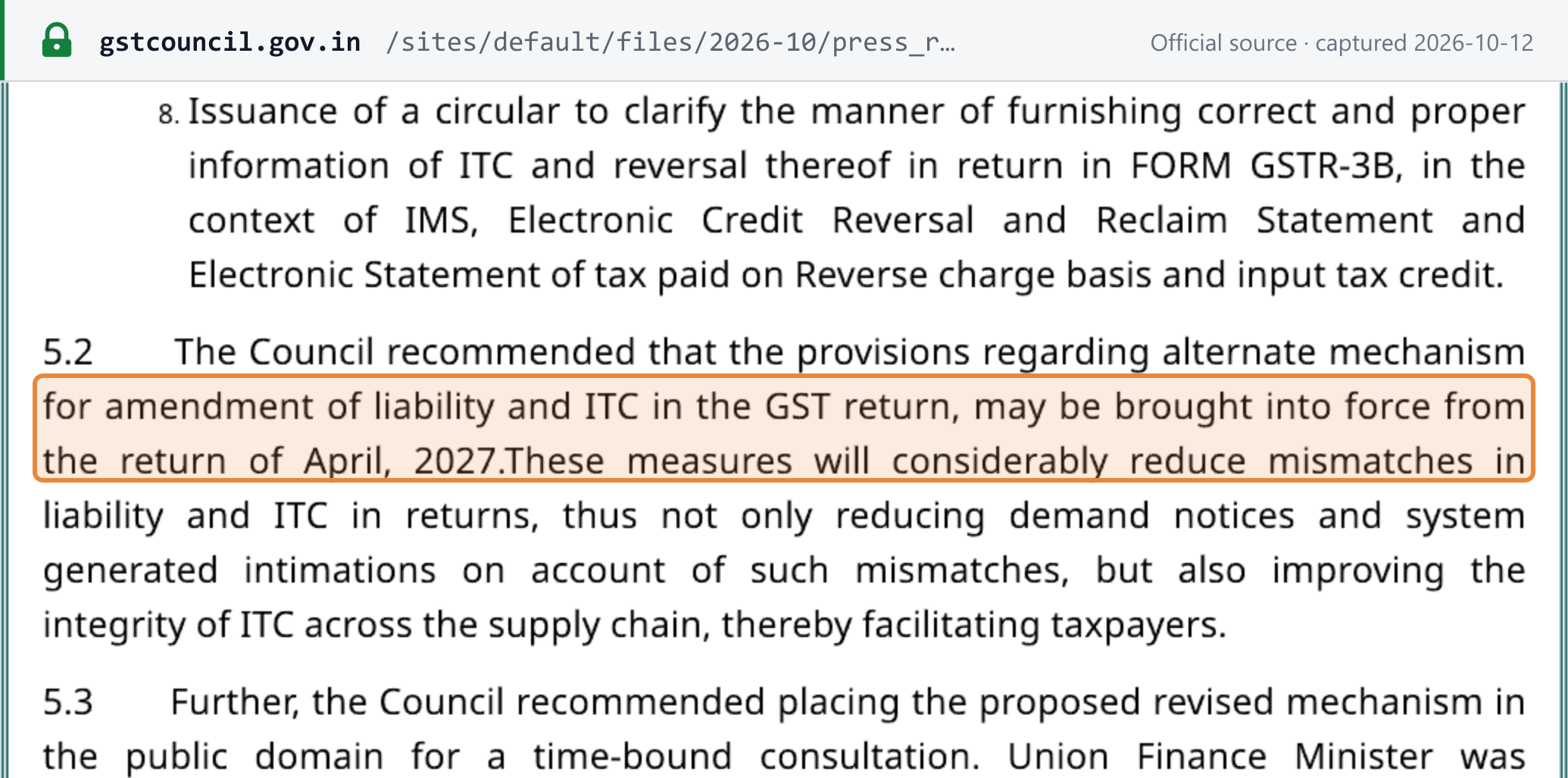 Source snapshot of the official page. Open full size ↗