India GST guidelines
| FACTSHEET | |
|---|---|
| Country code | IN |
| Tax name | Goods and Services Tax(GST) |
| Tax Authority | Central Board Of Indirect Taxes & Customs |
Overview
India's indirect tax is GST — Goods and Services Tax (Hindi: वस्तु एवं सेवा कर). It came into effect in July 2017, replacing VAT, excise duty, service tax and a range of other levies. It is administered by the Central Board of Indirect Taxes and Customs (CBIC) together with the State tax administrations, with rates and policy set by the GST Council. Read more
- Currency: Indian rupee (₹, INR). Amounts in Indian legislation are written in lakh (1 lakh = ₹100,000) and crore (1 crore = ₹10,000,000); this guide gives both forms on first use.
- Financial year: 1 April to 31 March. Invoice serial numbers, the annual return and most turnover tests all run on this year, not the calendar year.
GST is one tax collected under three heads, and which head applies depends on where the supply goes. This is the single thing to get right before reading any rate below — the same 18% supply is billed as 9% + 9% or as 18%, depending on the direction of travel:
| Head | Levied by | Applies to |
|---|---|---|
| CGST — Central GST | Centre | The central half of an intra-State supply |
| SGST / UTGST — State / Union Territory GST | State or UT | The State half of the same intra-State supply |
| IGST — Integrated GST | Centre, then apportioned to the destination State | Inter-State supplies, imports, and supplies to or from an SEZ |
A supply within one State attracts CGST + SGST at half the headline rate each. A supply crossing a State line attracts IGST at the full headline rate. Compensation cess was historically charged on top for a narrow set of goods, but it was fully withdrawn — see Rates.
Registration follows the same logic: it is PAN-based and State-specific, so a business operating in four States holds four GSTINs against one PAN, and each is a separate taxable person to the others.
Registration
The registration in GST is PAN based and State specific. Supplier has to register in each of such State or Union territory from where he effectssupply. A person registered in one State is considered ‘unregistered person’ outside the State.
If a person has unit in SEZ(Special Economic Zone) or is a SEZ developer and also unit in domestic tariff Area (i.e. outside the SEZ) in the same State, then he has to take separate registration for his SEZ unit / as a SEZ developer as a separate place of business of him. The GST law does not have the facility of centralized registration for units across multiple states.
Read more
Who should register for GST
Threshold limits of aggregate turnover for exemption from registration and payment of GST for the suppliers of goods is Rs.40 lakhs and Rs.20 lakhs in the States of Arunachal Pradesh, Manipur, Meghalaya, Mizoram, Nagaland, Puducherry, Sikkim, Telangana, Tripura and Uttarakhand with effect from 01.04.2019
Threshold limit of aggregate turnover for exemption from registrationand payment of GST for suppliers of services is Rs.20 lakhs and Rs.10 lakhs in the States of Manipur, Mizoram, Nagaland and Tripura.
The threshold is tested on aggregate turnover, which is PAN-wide and all-India — it adds up taxable, exempt, export and inter-State supplies across every State, and is not limited to the State you are asking about. A business under the threshold in one State can still be liable there because of turnover elsewhere.
Registration with no threshold at all
Section 24 of the CGST Act makes registration compulsory regardless of turnover for a list of categories. The ones that most often catch foreign and online businesses:
- Non-resident taxable persons (NRTP) making any taxable supply in India.
- Persons supplying OIDAR services from outside India to a non-taxable online recipient in India. Where the Indian customer is itself registered, the customer accounts for the tax under reverse charge instead — see Cross-border rules.
- Casual taxable persons — occasional supplies in a State where you have no fixed place of business.
- Persons liable under reverse charge, and e-commerce operators required to collect tax at source.
- Persons making any inter-State taxable supply of goods. (For services, a notification relieves suppliers below the ₹20 lakh / ₹10 lakh threshold of this requirement — inter-State supply of services alone does not force registration.)
There is no separate "non-resident threshold" to compare against the resident one — it is nil. A foreign supplier in scope registers on the first rupee.
Voluntary registration
A person below the threshold may register voluntarily under section 25(3), and is then treated as a registered person with the full set of obligations — returns, invoices, the lot. The usual reason is input tax credit: an unregistered supplier cannot pass credit to registered customers, which makes it commercially unattractive to sell B2B.
Deregistration
Registration is cancelled under section 29, either on application or by the officer — on closure of business, transfer, amalgamation, a change of constitution, or where the person is no longer liable to be registered. An officer may also cancel where a registered person has not filed returns for a continuous period, or where registration was obtained by fraud. Cancellation is applied for in FORM GST REG-16, and a final return in FORM GSTR-10 is due within three months of cancellation or of the cancellation order, whichever is later. Cancellation does not extinguish liability for anything owed before it.
Group registration
Not available in India. GST law has no VAT-grouping mechanism of the kind found in the UK or Singapore — there is no facility to treat related entities as a single taxable person, and intra-group supplies between distinct persons are taxable. Registration is PAN-based and State-specific, and section 25(2) allows a person to take separate registrations for multiple places of business within a State, which is the opposite of grouping. (Checked 2026-08-17.)
Where to register?
Visit GST portal. Go to Services > Registration > New Regisrtration.
Registration is applied for in FORM GST REG-01. A non-resident taxable person applies in FORM GST REG-09, at least five days before starting business, and must make an advance deposit of tax equal to the estimated liability for the period of registration; an overseas OIDAR supplier applies in FORM GST REG-10. Where the application is complete and no notice is issued, registration is granted within seven working days; if the officer raises a query in FORM GST REG-03 the clock restarts on your reply. Two qualifications matter to foreign applicants: Rule 9(1) allows 30 days instead where Aadhaar authentication fails or is not opted for, or where physical verification is directed — the slow path most non-residents land on; and an optional simplified scheme operational from 1 November 2025 grants registration automatically within three working days for low-risk applicants and those self-assessing output tax on B2B supplies at up to ₹2.5 lakh a month.
Tax Registration number - GSTIN
Once GST regsitration is complete a supplier is issued a 15 digit GST identification number(GSTIN). The first 2 digits of the GSTIN is the State code, next 10 digits are the PAN of the legal entity, the next two digits are for entity code, and the last digit is check sum number. Registration under GST is not tax specific which means that there is a single registration for all the taxes i.e. CGST, SGST/UTGST, IGST and cesses
GSTIN Format
Regular Registration
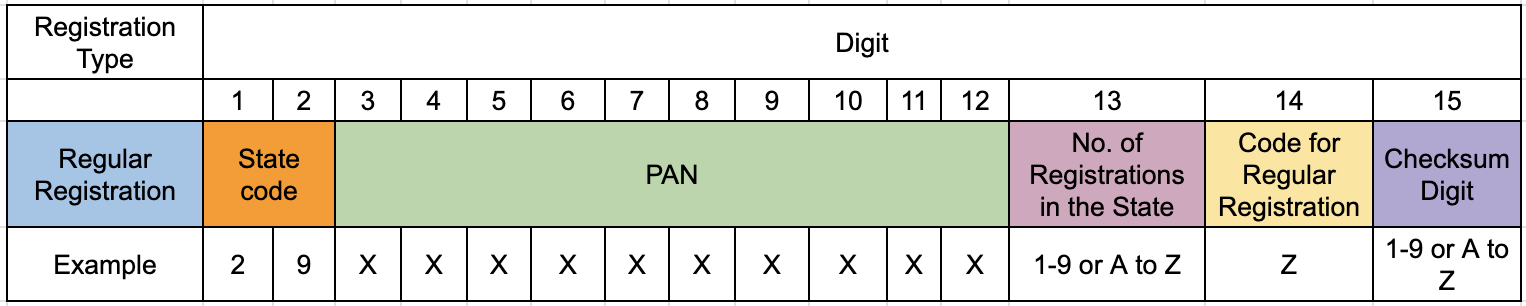
Following are the details of the GSTIN format
- 1st 2 digits: This is the state code as per the Indian Census 2011
- Next 10 digits:This is the PAN of the business entity.
- 13th digit: This denotes the serial number of registrations the business entity has for business verticals in the state, under the same PAN. It can range from 1-9 for businesses with up to 9 business vertical registrations in the state and for more than 9 registrations, from A-Z.
- 14th digit:This will be ‘Z’ by default.
- 15th digit: This digit denotes a ‘checksum’. It may be an alphabet or a number.
Regular Expression(Regex)
\d{2}[A-Z]{5}\d{4}[A-Z]{1}[A-Z\d]{1}[Z]{1}[A-Z\d]{1}
Non Resident Taxable Persons (NRTP) for OIDAR Sevices (Online Information Data Base Access and Retrieval)

- Special Code 99 for 'Other Country'
- Special Code 97 for 'Other Terrritory'
Rates
On intra-State transactions CGST and SGST/UTGST are applied. On inter-State transactions IGST is applied.
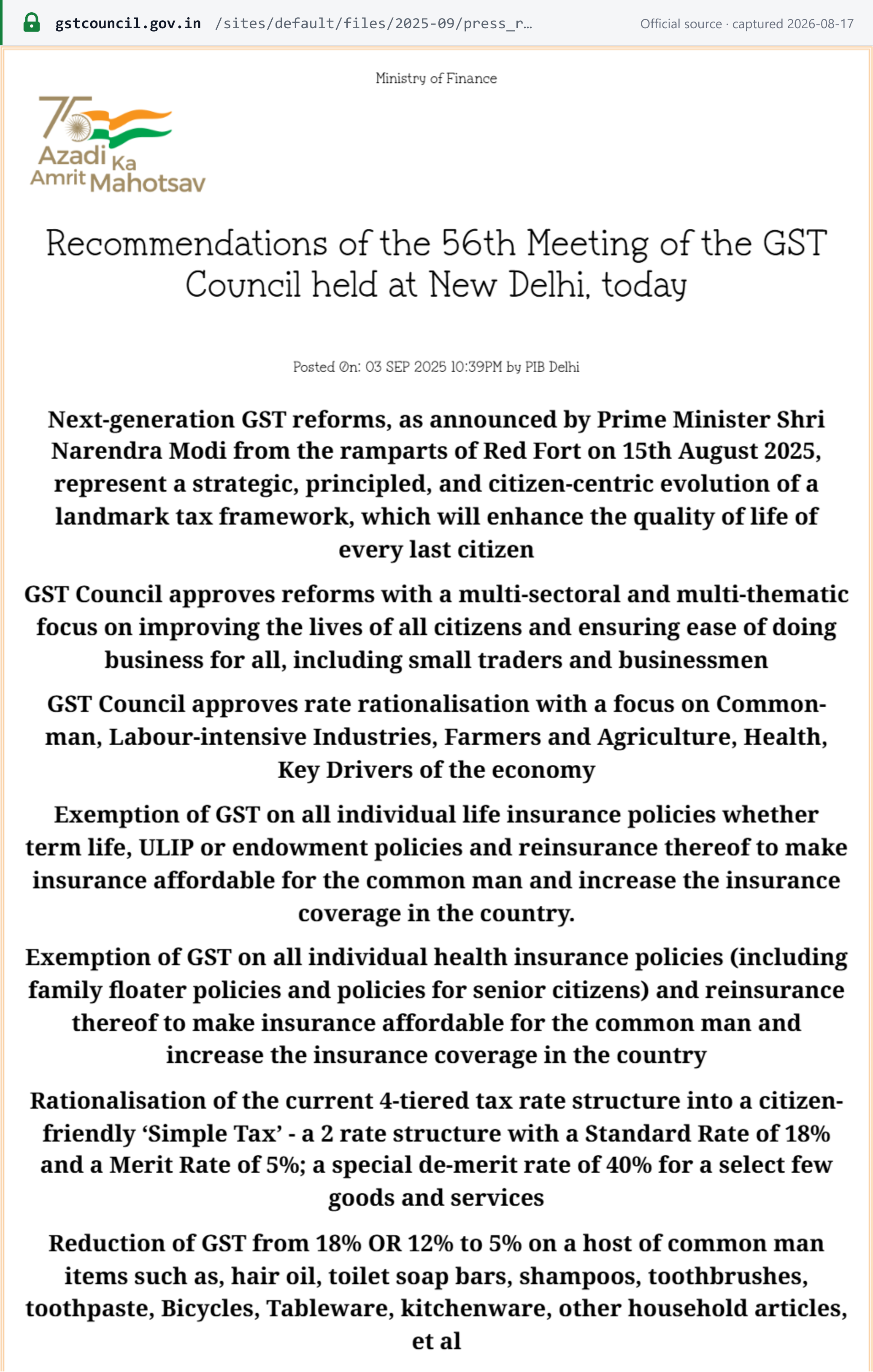
The slab structure changed on 22 September 2025. The 56th GST Council rationalised the previous four-tier structure into two main rates — a Standard Rate of 18% and a Merit Rate of 5% — plus a special de-merit rate of 40%. The 12% and 28% slabs no longer exist. The new structure took effect on 22 September 2025 for services and for all goods except pan masala, gutkha, cigarettes, zarda, unmanufactured tobacco and bidi; those transitioned on 1 February 2026, at which point Schedule VII (14% CGST, the old 28% slab) was omitted from Notification 09/2025-Central Tax (Rate) outright.
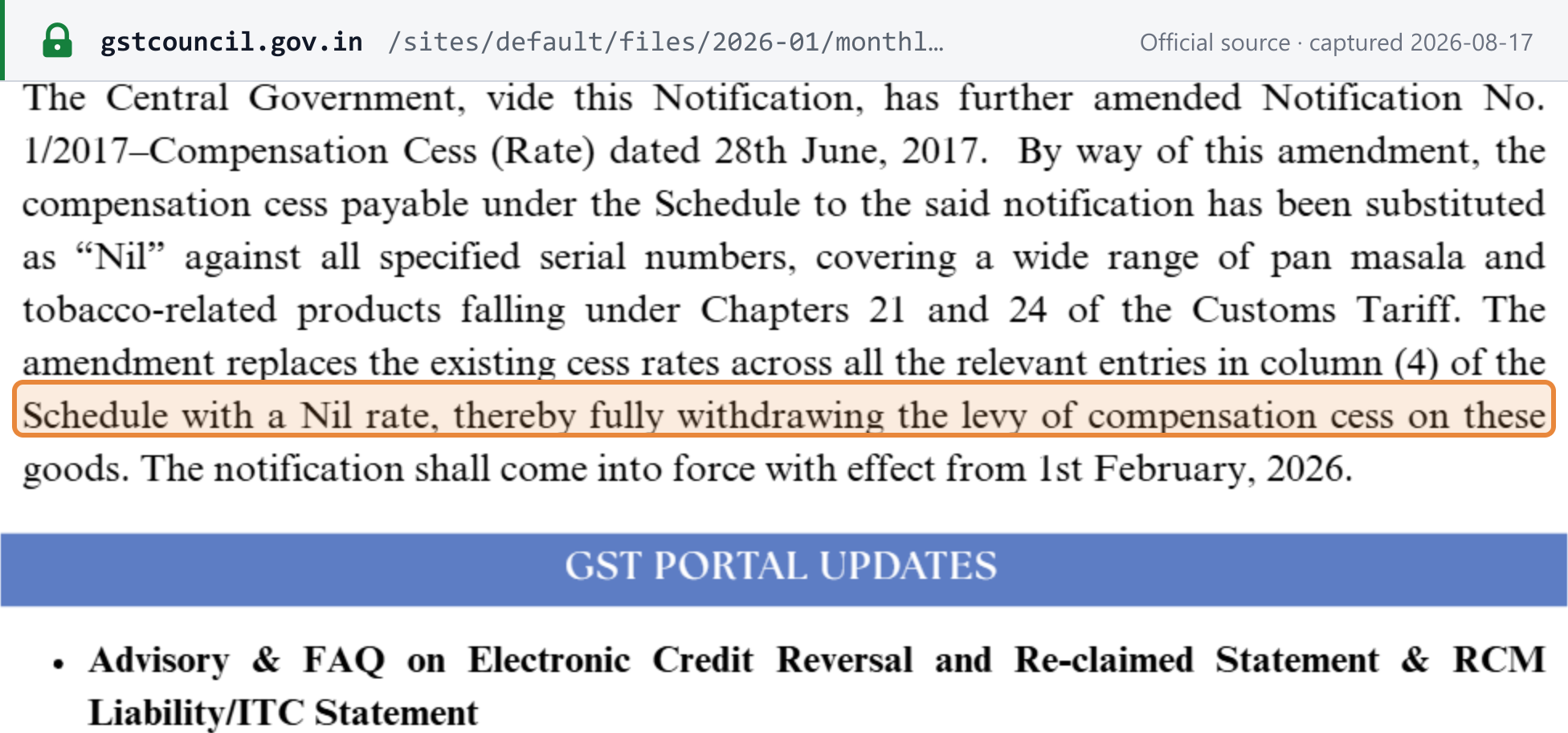
Compensation cess is no longer levied on any goods. Motor vehicles and coal lost it on 22 September 2025 in the same rationalisation (coal moved from 5% to 18%). Pan masala and tobacco kept it only until Notification No. 03/2025-Compensation Cess (Rate) substituted "Nil" against every entry in the Schedule to Notification 1/2017-Compensation Cess (Rate), in force from 1 February 2026.
Reading the table: the IGST column is the headline rate for the supply. The CGST and SGST columns are that same rate split in half for intra-State supplies. An 18% supply is either 9% CGST + 9% SGST, or 18% IGST — never both. The same halving applies to the 40% de-merit rate, which is billed as 20% + 20% intra-State.
| CGST (%) | SGST (%) | IGST (%) | Applies to |
|---|---|---|---|
| 0 | 0 | 0 | Exempt and nil-rated supplies |
| 0.05 | 0.05 | 0.1 | Special rate |
| 0.125 | 0.125 | 0.25 | Special rate — rough diamonds and similar |
| 0.25 | 0.25 | 0.5 | Special rate |
| 1.5 | 1.5 | 3 | Special rate — gold, silver and similar |
| 2.5 | 2.5 | 5 | Merit Rate |
| 9 | 9 | 18 | Standard Rate |
| 20 | 20 | 40 | De-merit rate — pan masala, tobacco, aerated and caffeinated drinks, certain luxury goods |
The rate follows the HSN/SAC classification of the individual supply, so look the item up in the GST rate finder rather than assuming which of the two main rates applies.
Cross-border rules
Place of supply
GST is destination-based, so the place of supply decides both whether Indian GST applies and which head it is charged under. The rules sit in Chapter V of the IGST Act and differ for goods and services, and again for domestic and cross-border transactions.
Where the supplier or the recipient is outside India, section 13 applies. The default is:
"The place of supply of services except the services specified in sub-sections (3) to (13) shall be the location of the recipient of services" [19]
— with a proviso that where the recipient's location is not available in the ordinary course of business, the supplier's location applies instead. Sub-sections (3) to (13) carve out the usual exceptions: services performed on goods physically made available, services relating to immovable property, admission to events, transport and banking. Intermediary services are no longer among them — section 13(8)(b) was omitted by section 157 of the Finance Act, 2026, so the place of supply for an intermediary now falls to the section 13(2) default of the recipient's location, which is what makes those services exportable.
Imports
- Goods. Imports are treated as inter-State supplies. IGST is levied on imported goods under section 3(7) of the Customs Tariff Act, 1975, and collected at the point of customs clearance together with basic customs duty, on a value that includes that duty. Credit of the IGST is available to a registered importer; basic customs duty is not creditable and is a cost.
- Services. Import of services for a consideration in the course of business is a supply. Where the recipient is registered in India, the recipient accounts for the tax under reverse charge — see below.
Exports and SEZ supplies
Exports are zero-rated, not exempt, and the distinction is the whole point: a zero-rated supply carries no output tax and preserves the input tax credit behind it. Section 16 of the IGST Act:
"'Zero rated supply' means any of the following supplies of goods or services or both: (a) export of goods or services or both; or (b) supply of goods or services or both for authorised operations to a Special Economic Zone developer or unit." [20]
Two routes, and the choice is a cash-flow decision:
| Route | How it works | Refund claimed |
|---|---|---|
| Under LUT / bond | Supply without paying integrated tax | Refund of unutilised input tax credit |
| On payment of tax | Pay IGST on the export, then reclaim | Refund of the tax paid |
Export invoices must carry the endorsement set out under Mandatory content above, and show the country of destination.
Foreign companies selling into India
The answer differs sharply for B2B and B2C, and this is the question most non-resident readers arrive with.
| B2B — recipient is registered in India | B2C — recipient is not registered | |
|---|---|---|
| Services (general) | Reverse charge. The Indian recipient self-accounts for IGST. The foreign supplier does not register. | Supplier-side liability; for OIDAR, see below. |
| OIDAR / digital services | Recipient accounts under reverse charge, but the supply is still reported by the overseas supplier in GSTR-5A. | The overseas supplier must register in India and pay IGST. No threshold. |
| Goods | Importer of record pays IGST at customs. | Importer of record pays IGST at customs. |
Reverse charge shifts liability to the recipient. A registered Indian business receiving a service from outside India self-assesses IGST, pays it in cash (not from credit), and then takes credit of it if otherwise eligible. It also issues a self-invoice — within thirty days of receiving the supply, under Rule 47A, in force from 1 November 2024. See Issuance deadline and numbering.
Digital services (OIDAR)
Online Information and Database Access or Retrieval services supplied from outside India are taxed where the customer is. Section 13(12):
"The place of supply of online information and database access or retrieval services shall be the location of the recipient of services." [19]
The recipient is deemed to be in India if any two of seven non-contradictory conditions hold — the address the recipient presents over the internet, billing address, the country of the card used, IP address, bank location, SIM country code, fixed landline location.
The scope widened on 1 October 2023. The Finance Act, 2023 narrowed the definition of a "non-taxable online recipient" and dropped the earlier carve-out for services that were not essentially automated. The practical effect: an overseas supplier of digital services to Indian consumers is in scope whether or not any human is involved, wherever the customer is not registered in India. (Scope turns on whether the recipient is registered, not on whether it is a business: an unregistered business is caught, a registered one accounts under reverse charge instead.) Brought into force by Notification No. 28/2023-CT; the return obligation was restated by Notification No. 51/2023-CT dated 29 September 2023.
An overseas OIDAR supplier registers in FORM GST REG-10 and files FORM GSTR-5A monthly, on or before the twentieth day of the following month, reporting supplies to non-taxable online recipients and to registered persons. Registering does not require a physical presence. Where the supplier has neither a physical presence nor a representative in India, IGST section 14(2) allows it to appoint a person in India for the purpose of paying tax — a permission, not a standing requirement.
Marketplaces and e-commerce operators
An e-commerce operator required to collect tax at source (TCS) must register regardless of turnover, and collects TCS on the net value of taxable supplies made through it by other suppliers. Section 24(x) reaches only operators liable to collect TCS — an operator liable purely as deemed supplier under section 9(5) is not caught by it, and Notification 65/2017-CT exempts such operators below the ₹20 lakh threshold. Separately, under section 9(5) of the CGST Act (and section 5(5) IGST), the operator is treated as the deemed supplier — liable for the whole tax as if it had made the supply itself — for a notified list of services including passenger transport by radio-taxi, accommodation, housekeeping and restaurant services supplied through the platform. For those categories the underlying supplier is out of the loop entirely.
Invoice requirements
GST law prescribes no invoice template — it prescribes a fixed list of particulars. Get the particulars right and any layout is valid. The rules live in Chapter VI of the CGST Rules, 2017 and sections 31 and 34 of the CGST Act, 2017.
The first decision is which document you owe:
| Document | When it is used | Contents prescribed by |
|---|---|---|
| Tax invoice | Taxable supply of goods or services by a registered person. [2] | Rule 46 [1] |
| Bill of supply | Supply of exempted goods or services, or any supply by a person paying tax under the composition scheme (section 10) — a bill of supply is issued instead of a tax invoice and carries no tax. [2] | Rule 49 [6] |
| Invoice-cum-bill of supply | A single document where taxable and exempt supplies go to the same unregistered person. It must carry the particulars of Rule 46 (or Rule 54) and Rule 49. [7] | Rule 46A [7] |
| Receipt voucher | Advance payment received against a supply. [2] | Rule 50 [16] |
| Refund voucher | Advance was received and a receipt voucher issued, but no supply followed and no invoice was raised. [2] | Rule 51 [17] |
| Payment voucher | Issued at the time of paying a supplier where the recipient is liable under reverse charge. [2] | Rule 52 [18] |
| Revised invoice | Supplies made between the effective date of registration and the date the registration certificate was issued; must show the words "Revised Invoice" prominently. [2] | Rule 53(1) [9] |
Mandatory content
Particulars of a tax invoice under Rule 46. Clause references are to Rule 46 unless stated.
| Required particular | Notes |
|---|---|
| Name, address and GSTIN of the supplier | Clause (a). [1] |
| Consecutive serial number, not exceeding sixteen characters | Clause (b) — in one or multiple series, using alphabets, numerals or the special characters hyphen/dash and slash, in any combination, and unique for a financial year. [1] |
| Date of issue | Clause (c). [1] |
| Name, address and GSTIN or UIN of the recipient, if registered | Clause (d). [1] |
| Name, address and address of delivery of an unregistered recipient, with the State name and code | Clause (e) — required where the value of the taxable supply is ₹50,000 or more; clause (f) requires the same details below that value if the recipient asks for them. Where a taxable service is supplied by or through an e-commerce operator or an OIDAR supplier to an unregistered recipient, or in cases involving online money gaming, the invoice must carry the name of the recipient's State irrespective of value, and that is deemed to be the recipient's address on record. [1] |
| HSN code for the goods or services | Clause (g). The Board may notify how many HSN digits a class of registered persons must show, and which classes need not show it at all. [1] |
| Description of the goods or services | Clause (h). [1] |
| Quantity, and unit or Unique Quantity Code (goods) | Clause (i). [1] |
| Total value of the supply | Clause (j). [1] |
| Taxable value of the supply, after any discount or abatement | Clause (k). [1] |
| Rate of tax — central, State, integrated, Union territory tax or cess | Clause (l). [1] |
| Amount of tax charged under each of those heads | Clause (m). [1] |
| Place of supply with the State name, for inter-State supplies | Clause (n). [1] |
| Address of delivery, where it differs from the place of supply | Clause (o). [1] |
| Whether tax is payable on a reverse charge basis | Clause (p). [1] |
| Signature or digital signature of the supplier or an authorised representative | Clause (q). A proviso removes this requirement for an electronic invoice issued in accordance with the Information Technology Act, 2000 — the basis on which an IRP-signed e-invoice needs no separate supplier signature. [1] |
| QR code with the IRN embedded in it | Clause (r) — applies only where the invoice is issued in the manner prescribed by Rule 48(4), i.e. registered on the IRP. See E-invoicing status below. [1] |
| Declaration that Rule 48(4) does not apply | Clause (s) — required where a taxpayer whose aggregate turnover in any preceding financial year from 2017-18 onwards exceeds the Rule 48(4) threshold issues an invoice outside the e-invoice route; the prescribed wording states that the taxpayer is not required to prepare an invoice under that sub-rule. [1] |
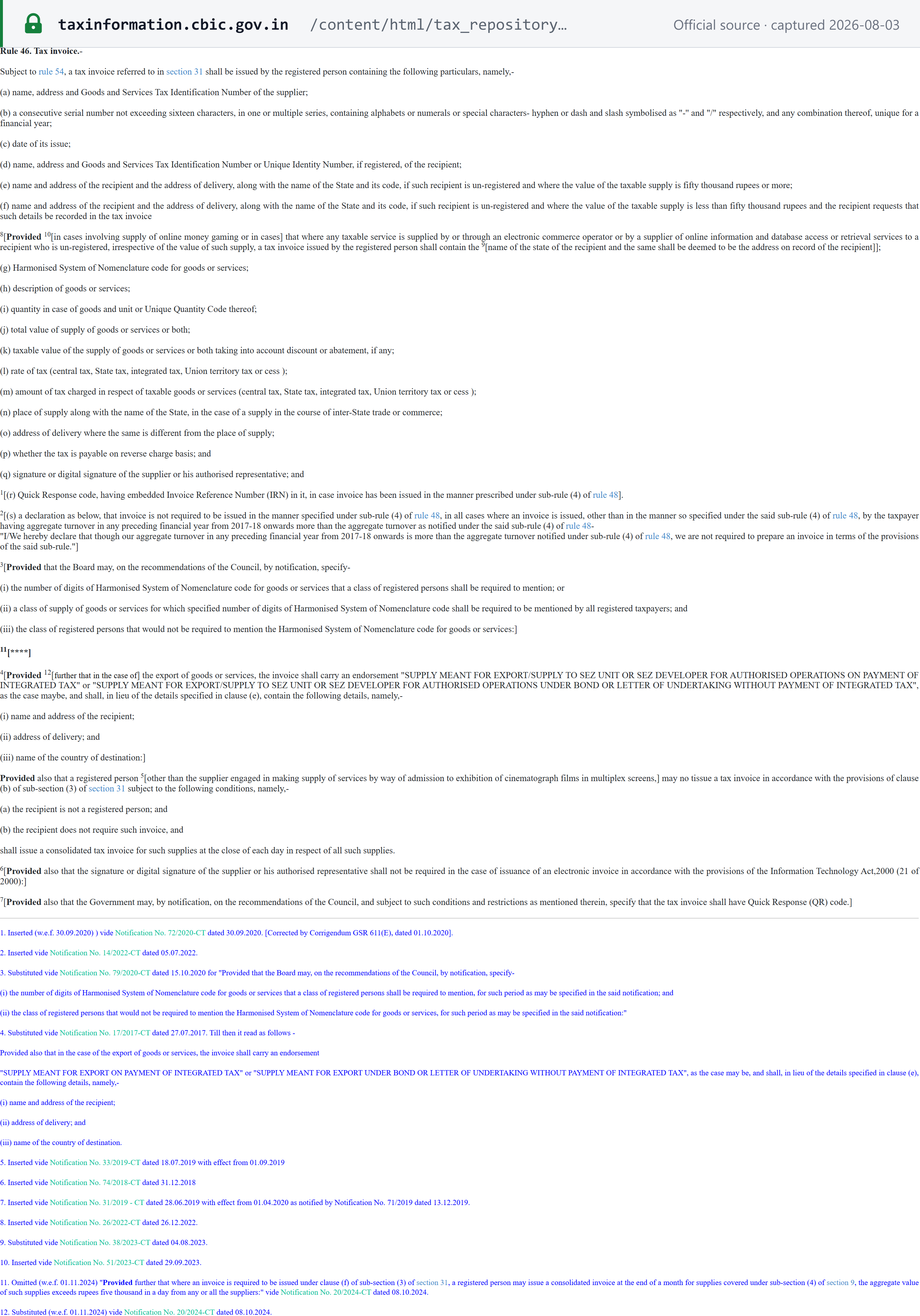 Source snapshot captured 2026-08-03 — original
Export and SEZ endorsement. A proviso to Rule 46 requires an export invoice to carry the endorsement "SUPPLY MEANT FOR EXPORT/SUPPLY TO SEZ UNIT OR SEZ DEVELOPER FOR AUTHORISED OPERATIONS ON PAYMENT OF INTEGRATED TAX" or "SUPPLY MEANT FOR EXPORT/SUPPLY TO SEZ UNIT OR SEZ DEVELOPER FOR AUTHORISED OPERATIONS UNDER BOND OR LETTER OF UNDERTAKING WITHOUT PAYMENT OF INTEGRATED TAX", as the case may be. In place of the clause (e) details it must show the recipient's name and address, the address of delivery, and the name of the country of destination. [1]
A bill of supply carries a shorter list — supplier details, the same sixteen-character serial number, date, recipient details, HSN code, description, value after discount or abatement, and signature; the provisos to Rule 46 apply to it, and an electronic bill of supply needs no signature. [6]
Issuance deadline and numbering
| Supply | Deadline |
|---|---|
| Goods, where the supply involves movement | Before or at the time of removal of the goods for supply to the recipient. [2] |
| Goods, in any other case | Before or at the time of delivery, or of making the goods available to the recipient. [2] |
| Services — general rule | Within thirty days from the date of supply of the service. [3] |
| Services supplied by an insurer, a banking company, or a financial institution including an NBFC | Forty-five days from the date of supply of the service. [3] |
| Those same suppliers, plus telecom operators, supplying between distinct persons under section 25 | Before or at the time the supplier records the supply in its books, or before the end of the quarter in which the supply was made. [3] |
| Reverse-charge self-invoice for a supply received from an unregistered supplier | Within thirty days from the date of receipt of the supply — Rule 47A, in force from 1 November 2024. [4] |
| Continuous supply of goods with successive statements or payments | Before or at the time each statement is issued or each payment is received. [2] |
| Continuous supply of services | On or before the due date of payment where it is ascertainable from the contract; otherwise when the supplier receives payment; where payment is tied to an event, on or before the date that event is completed. [2] |
| Service contract that ceases before completion | At the time the supply ceases, for the supply made up to that point. [2] |
| Goods sent on approval, for sale or return | Before or at the time of supply, or six months from the date of removal, whichever is earlier. [2] |
| Revised invoice for the pre-certificate period | Within one month from the date the registration certificate is issued. [2] |
Numbering. The serial number must be consecutive, no longer than sixteen characters, and unique for a financial year; multiple series are allowed, and only alphabets, numerals, hyphen/dash and slash may be used. The same sixteen-character rule is repeated for bills of supply, receipt/refund/payment vouchers, revised invoices, credit and debit notes, Input Service Distributor invoices and delivery challans. [1] [9] The serial numbers of invoices issued during a tax period must be furnished electronically through the common portal in FORM GSTR-1 (and in FORM GSTR-1A, if any). [5]
Manner of issue. A paper invoice for goods is prepared in triplicate — marked ORIGINAL FOR RECIPIENT, DUPLICATE FOR TRANSPORTER and TRIPLICATE FOR SUPPLIER — and for services in duplicate (ORIGINAL FOR RECIPIENT, DUPLICATE FOR SUPPLIER). Neither applies to an invoice prepared under Rule 48(4). [5]
Credit and debit notes
- Credit note — the supplier may issue one where the taxable value or tax charged on an invoice exceeds what was payable, where goods are returned, or where the goods or services are found deficient. One or more credit notes may be issued for supplies made in a financial year. [8]
- Debit note — the supplier shall issue one where the taxable value or tax charged on an invoice is less than what was payable. For the purposes of the Act a debit note includes a supplementary invoice. [8]
- Contents (Rule 53(1A)) — supplier name, address and GSTIN; the nature of the document; a consecutive serial number of up to sixteen characters, unique for the financial year; date of issue; recipient details (and, for an unregistered recipient, name, address, address of delivery, State name and code); the serial number(s) and date(s) of the corresponding invoice(s) or bill(s) of supply; the value of the taxable supply, the rate of tax and the amount credited or debited; and the signature or digital signature. [9]
- Declaration deadline — a credit note must be declared in the return for the month of issue, and no later than 30 November following the end of the financial year in which the supply was made, or the date of furnishing the relevant annual return, whichever is earlier. The month was changed from September to the thirtieth day of November with effect from 1 October 2022. A debit note carries no such cut-off — it is simply declared in the return for the month of issue. [8]
- Credit-note conditionality (from 1 October 2025) — the supplier gets no reduction in output tax liability unless the recipient, if registered, has reversed the input tax credit attributable to the credit note; in other cases, unless the incidence of tax has not been passed on to anyone else. [8]
- Watching — the Finance Act, 2026 inserts post-supply discounts under section 15(3)(b) as a further ground for a credit note. The CBIC text records this amendment as not yet notified as at this guide's last update. [8]
- Any invoice or debit note raised for tax payable under section 74, 129 or 130 must prominently carry the words "INPUT TAX CREDIT NOT ADMISSIBLE". [9]
Currency and language
Rule 46 fixes the particulars, not the currency, so an invoice may be denominated in a foreign currency — export invoices routinely are, provided they carry the endorsement above. Where the consideration is in a currency other than Indian rupees, Rule 34 fixes the conversion for determining the value of the supply: [11]
- Goods — the rate of exchange notified by the Board under section 14 of the Customs Act, 1962 for the date of the time of supply determined under section 12.
- Services — the rate of exchange determined as per generally accepted accounting principles for the date of the time of supply determined under section 13.
Language: this guide could not confirm any invoice language prescribed by the CGST Act or the CGST Rules, so none is stated here rather than guessed.
Simplified invoices
India has no general "simplified invoice" with a reduced field set. What exists instead is a de-minimis relief plus a set of special-case documents:
- Under ₹200 — a registered person may skip the tax invoice where the value of the goods or services supplied is less than two hundred rupees, but only if the recipient is unregistered and does not ask for an invoice; a consolidated tax invoice must then be issued at the close of each day covering all such supplies. Suppliers of admission to cinematograph films on multiplex screens are excluded from this relaxation. The same ₹200 relief applies to a bill of supply. [2] [1]
- Insurers, banks, financial institutions and NBFCs — may issue a consolidated monthly tax invoice or equivalent document at the end of the month, physically or electronically, whether or not serially numbered and whether or not it carries the recipient's address, provided it contains the other Rule 46 information; no signature is needed on an electronic one. [10]
- Passenger transport — a ticket in any form counts as the tax invoice, whether or not serially numbered and whether or not it carries the recipient's address, if it holds the other Rule 46 information; an electronically issued ticket needs no signature. A multiplex cinema e-ticket is deemed to be a tax invoice on the same basis. [10]
- Goods transport agencies — the invoice or consignment note must additionally show the gross weight of the consignment, consigner and consignee names, the goods carriage registration number, details of the goods and of the origin and destination, and the GSTIN of the person liable to pay the tax. [10]
- Input Service Distributors — a shorter particulars list under Rule 54(1); where the ISD is an office of a bank or NBFC, the invoice may be any document in lieu, whether or not serially numbered, so long as it carries the same information. [10]
- Consolidated revised invoices — for unregistered recipients, and, for inter-State supplies where a supply does not exceed ₹2,50,000, one consolidated revised invoice per State. [9]
Retention
- Seventy-two months — every registered person required to keep books under section 35(1) must retain them until the expiry of 72 months from the due date of furnishing the annual return for the year to which those accounts and records relate. [12]
- Extension where a dispute is live — a person who is party to an appeal, revision or other proceedings before an Appellate Authority, Revisional Authority, Appellate Tribunal or court, or who is under investigation for an offence under Chapter XIX, must keep the related records for one year after final disposal of that matter, or the 72-month period, whichever is later. [12]
- What is covered and where it is kept — accounts together with all invoices, bills of supply, credit and debit notes and delivery challans must be preserved for the section 36 period. Manual records must be kept at every related place of business named in the registration certificate; digitally maintained records must be accessible at every such place. Books are kept at the principal place of business, with each additional place holding its own. [13] [15]
- Electronic archiving is accepted — records may be maintained in electronic form, authenticated by digital signature. A proper electronic back-up must be kept so the information can be restored after accidental loss, and the records must be produced on demand in hard copy or in an electronically readable format, along with file details, passwords and an explanation of any codes used. [13] [14]
Audit trail — a separate obligation, and not one imposed by GST law. Retention says keep it; the audit trail says prove it was never quietly altered. Rule 56(6) supplies the GST-side half: an entry in a register, account or document that needs correction must not be erased or overwritten — the incorrect entry is scored out under attestation and the correct entry recorded, and where records are kept electronically a log of every edited entry must be maintained.
The stricter requirement sits in company law, not GST. Under the Companies (Accounts) Rules, every company using accounting software must use software with an audit trail (edit log) feature that records each change with its date, cannot be disabled, and is preserved as long as the books themselves. It has applied to all companies since financial year 2023-24. A GST-registered sole proprietor or partnership is outside that rule; a private limited company is not, whatever its size. Confirm your entity type before assuming which applies.
Technical format
A format is mandated only for the class of registered persons notified under Rule 48(4): the invoice must be prepared by including the particulars of FORM GST INV-01 — the e-invoice schema, exchanged as JSON — and uploading them to the Invoice Registration Portal to obtain an Invoice Reference Number. An invoice that should have been issued this way but was not is not treated as an invoice at all. [5] For the turnover thresholds, IRP/IRN/QR mechanics and reporting time limits, see E-invoicing status below and the India IRP e-invoicing guide; the schema and API details are set out in the GST e-invoice system detailed overview (PDF).
What a compliant invoice looks like
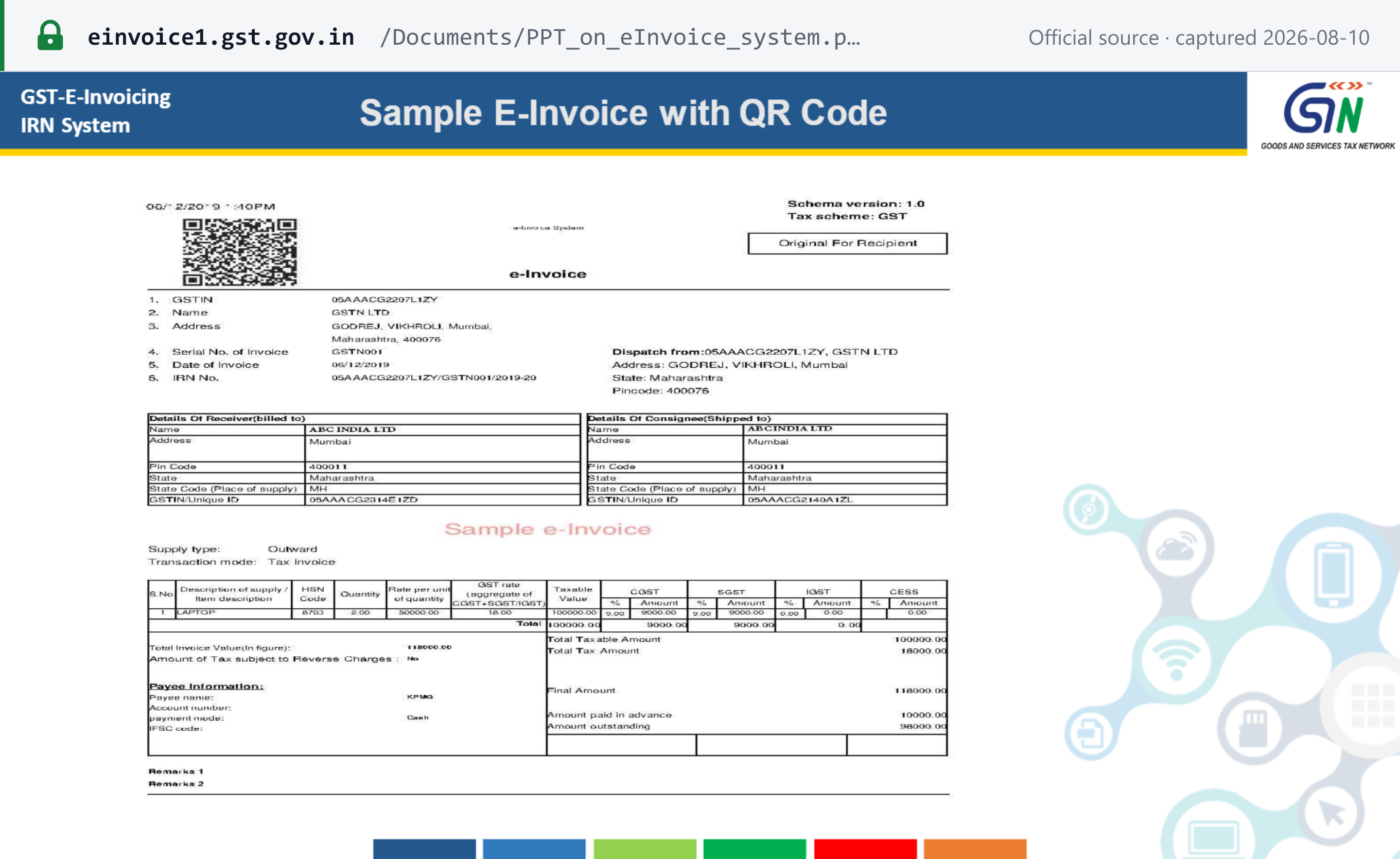
India prescribes particulars and a reporting schema, not a layout. NIC states this directly: a taxpayer may print the e-invoice as a paper invoice "as he is doing today, by also placing entity logo and other information, as needed" — the schema governs only what is reported to the IRP, though the QR code must also be printed, being a mandatory particular under Rule 46. [13]
Within that freedom, GSTN publishes a worked sample showing the Rule 46 particulars alongside the IRN and QR code — supplier GSTIN, name and address, invoice serial number and date, IRN No., separate "billed to" and "shipped to" blocks with place of supply, and a line-item table carrying the HSN code, taxable value and separate CGST, SGST, IGST and cess columns. [14]
 Source snapshot captured 2026-08-10 — original
Every figure in this section is taken from the CBIC tax-information repository's live consolidated text of the CGST Act, 2017 and the CGST Rules, 2017, accessed 2026-08-03.
E-invoicing status
Status: mandatory, phased by turnover. E-invoicing applies to every registered person whose aggregate turnover in any financial year from 2017-18 onwards exceeded ₹5 crore (₹50 million). The test looks back across all those years, not just the last one — cross the threshold once and you stay in scope.
System: the Invoice Registration Portal (IRP), operated by NIC. It is a registration network, not a delivery network — after obtaining an IRN the supplier still has to send the invoice to the buyer itself. This is the key difference from Peppol, which delivers to the recipient.
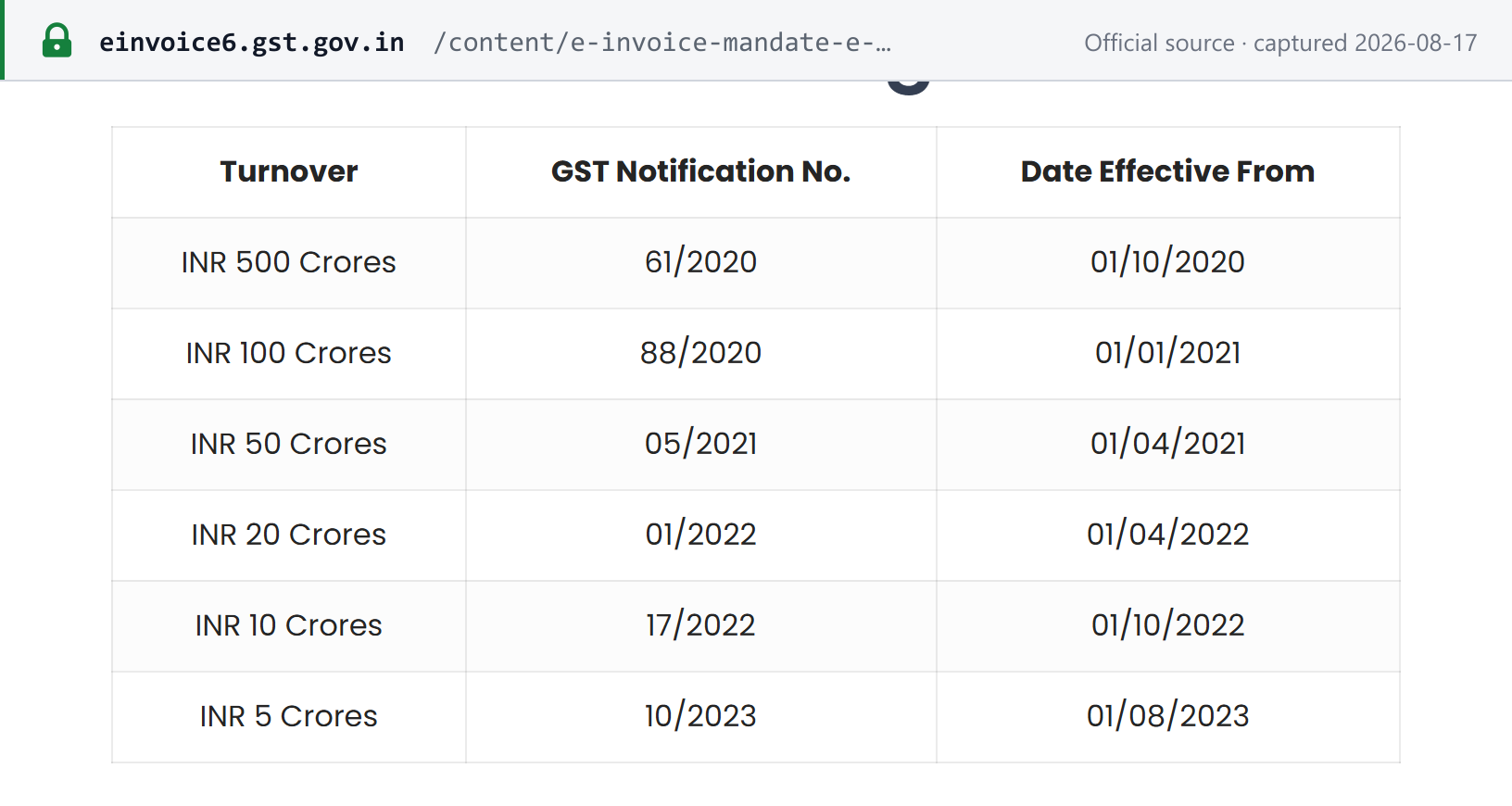
Phase timeline
| Aggregate turnover | Notification | Effective |
|---|---|---|
| ₹500 crore | 61/2020 | 1 Oct 2020 |
| ₹100 crore | 88/2020 | 1 Jan 2021 |
| ₹50 crore | 05/2021 | 1 Apr 2021 |
| ₹20 crore | 01/2022 | 1 Apr 2022 |
| ₹10 crore | 17/2022 | 1 Oct 2022 |
| ₹5 crore | 10/2023 | 1 Aug 2023 — current |
Scope
- B2B — in scope. Supplies to registered persons, plus exports and supplies to SEZ units.
- B2G — in scope, on the same basis as B2B.
- B2C — out of scope. IRN generation is neither required nor accepted; a B2C invoice uploaded to the IRP is rejected. A separate obligation applies instead: taxpayers above ₹500 crore must show a dynamic QR code on B2C invoices (from 1 December 2020). The two mechanisms are unrelated and are frequently confused.
Documents covered: invoices, credit notes and debit notes issued by the supplier. Not covered: bills of supply, delivery challans and job-work challans.
Exempt categories, whatever their turnover: banks, insurers and financial institutions including NBFCs; goods transport agencies; passenger transport services; suppliers of admission to the exhibition of cinematograph films; and SEZ units (SEZ developers are not exempt). Note the direction of travel: an SEZ unit is exempt as a supplier, while supplies made to an SEZ are in scope, as above.
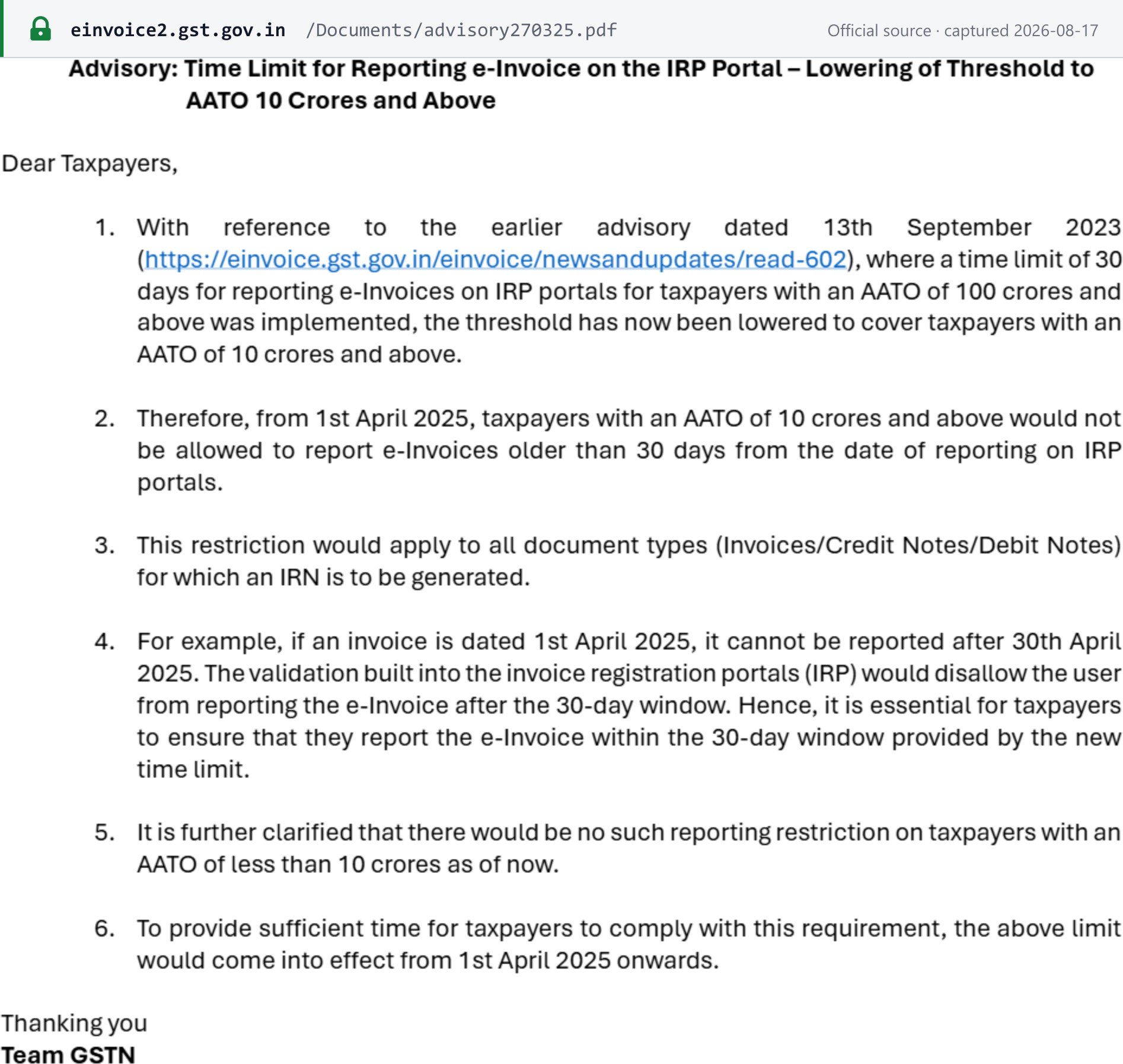
Reporting time limit: taxpayers with AATO of ₹10 crore and above must report an invoice to the IRP within 30 days of the invoice date — in force from 1 April 2025. The portal blocks IRN generation past that window. An earlier 7-day limit for the ₹100 crore band was announced in April 2023 and deferred; a 30-day limit was then applied to AATO ≥ ₹100 crore by advisory of 13 September 2023, and the ₹10 crore rule lowered that band. There is no reporting restriction below ₹10 crore.
Failure to use it is not a paperwork slip: an invoice that should have been issued under Rule 48(4) but was not is not an invoice at all, which strips the customer's input tax credit as well.
Mechanics
Invoices are uploaded to the IRP, which returns an IRN (Invoice Reference Number) and a signed QR code. The QR code must be printed on the invoice given to the buyer; many suppliers print the IRN alongside it. Because the IRP digitally signs the payload, no separate supplier signature is required — see the FAQ below.
e-Way Bill enhancements on hold
GSTN advisory of 29 July 2026 (GST portal news item 668) keeps on hold, until further notice, the e-Way Bill enhancements announced in the advisories of 9 and 17 June 2026 and the FAQs dated 1 July 2026, which had been scheduled for 1 August 2026: mandatory Ship-To GSTIN in Bill-To/Ship-To transactions and the voluntary e-Way Bill closure facility. No production changes are required under those advisories, which together with the FAQs are to be withdrawn from the GST portal. No new date has been given. [1]
Auto-population of einvoice for returns filing
The invoices successfully registered on the IRP will be automatically popluated on GSTR-1. This will be available for download as an excel file. Read more..
State code
It is noticed that the state codes defined by the GST council doesnot match with the ISO code.
Filing and payment
Which returns, and how often
Everyone registered under the normal scheme files two returns per period — an outward-supply statement and a summary-and-payment return.
| Return | What it is | Monthly filer | Quarterly filer (QRMP) |
|---|---|---|---|
| GSTR-1 | Outward supplies, invoice by invoice | 11th of the following month | 13th of the month after quarter-end |
| GSTR-3B | Summary return; tax is paid with it | 20th of the following month | 22nd or 24th of the month after quarter-end, by State group |
What determines your frequency: aggregate turnover of ₹5 crore or less in both the current and the preceding financial year makes you eligible for the QRMP scheme — Quarterly Return, Monthly Payment. Above ₹5 crore, filing is monthly and there is no choice. QRMP is opt-in and applies to both returns together: you cannot file GSTR-1 quarterly and GSTR-3B monthly.
Quarterly filers still pay monthly. That is the whole design of QRMP — tax for the first two months of each quarter is deposited by challan (PMT-06, by the 25th of the following month), and only the return is quarterly. A quarterly filer who wants customers to see invoices sooner can use the Invoice Furnishing Facility (IFF) to upload B2B invoices in the first two months.
The State groups for the 22nd/24th GSTR-3B split are geographic and fixed; check your State against the current notification rather than assuming.
Other returns
| Form | Who files it | When |
|---|---|---|
| GSTR-9 | Annual return, registered persons above the notified turnover | 31 December following the financial year |
| GSTR-9C | Reconciliation statement, larger taxpayers | With GSTR-9 |
| GSTR-5 | Non-resident taxable persons | Monthly |
| GSTR-5A | Overseas OIDAR suppliers | 20th of the following month |
| GSTR-10 | Final return after cancellation | Within 3 months of cancellation |
| CMP-08 | Composition taxpayers | Quarterly |
Payment
Tax is paid through the electronic cash ledger on the GST portal, by net banking, NEFT/RTGS, card or over the counter (subject to limits). Liability is discharged with the GSTR-3B, so the payment deadline is the return deadline for monthly filers. Interest runs on late payment, and the electronic credit ledger cannot be used to pay tax due under reverse charge — that must come from cash.
Input tax credit
Credit is available on inputs, input services and capital goods used in the course or furtherance of business, subject to conditions in section 16 — you must hold the invoice, have received the goods or services, the supplier must have paid the tax, and the invoice must appear in your auto-populated statement. Credit is time-barred: it cannot be taken after 30 November following the end of the financial year to which the invoice relates, or the date of filing the annual return, whichever is earlier.
Blocked credits (section 17(5)) — no credit is available on: [21]
- Motor vehicles for passenger transport with an approved seating capacity of not more than thirteen persons including the driver — unless used for onward supply of such vehicles, passenger transport, or driving instruction. Vessels and aircraft are restricted on the same pattern, as are their insurance, servicing, repair and maintenance.
- Food and beverages, outdoor catering, beauty treatment, health services, cosmetic and plastic surgery, and life and health insurance — unless resupplied in the same category or forming part of a taxable composite supply.
- Works contract services for construction of immovable property, except where used for a further works contract supply; and goods or services used for construction of immovable property on one's own account.
- Goods or services received by a non-resident taxable person, except on imports.
- Corporate social responsibility activities under section 135 of the Companies Act, 2013.
- Goods or services used for personal consumption.
- Goods lost, stolen, destroyed, written off, or disposed of by gift or free sample.
Refunds
Refunds are claimed in FORM RFD-01. The common grounds:
- Zero-rated supplies — either refund of unutilised credit (LUT route) or of the IGST paid (payment route). See Exports and SEZ supplies.
- Inverted duty structure — where the rate on inputs exceeds the rate on outputs and credit accumulates.
- Excess balance in the electronic cash ledger.
A refund claim is generally made within two years of the relevant date. Exporters of goods can receive IGST refunds substantially automatically, matched against shipping-bill data, without a separate RFD-01.
Bad debt relief: not available. Indian GST has no mechanism to recover output tax on a receivable that goes bad — tax is due on the supply, and non-payment by the customer does not reverse it. (The customer's credit is a different matter: a recipient who does not pay the supplier within 180 days must reverse the credit taken.) (Checked 2026-08-17.)
Exemptions
Exempt supplies are notified by rate notification rather than listed in the Act — the operative lists are the IGST exemption and concession list and the current goods and services rate notifications. Broad categories include unbranded staple foods, fresh produce, health and education services, and certain financial services.
Exempt is not the same as zero-rated, and the difference is money. Both carry no output tax. Only one preserves your input tax credit:
| Output tax | Input tax credit on related purchases | |
|---|---|---|
| Zero-rated (exports, SEZ supplies) | None | Preserved — recoverable as a refund |
| Exempt (notified supplies) | None | Blocked — becomes a cost |
| Nil-rated (0% slab) | None | Blocked, same as exempt |
A business making exempt supplies alongside taxable ones must apportion credit under section 17(2) and reverse the exempt share. Treating an exempt supply as if it were zero-rated overstates recoverable credit, and it is the most common error in this area.
Composition scheme. Small suppliers may opt to pay tax at a flat rate on turnover instead of the normal mechanism. A composition taxpayer cannot charge GST on invoices, cannot claim input tax credit, and issues a bill of supply rather than a tax invoice.
Special Economic Zones. Supplies to an SEZ developer or unit for authorised operations are zero-rated. An entity with both an SEZ unit and a domestic tariff area unit in the same State must hold separate registrations for each.
Offences and penalties
Offences and penalties are distinct exposures. The offence is the conduct; the penalty is the money; and for the more serious offences there is criminal prosecution on top of both.
Offences
Following are considered as offenses under GST law.
- Making a supply without invoice or with false/incorrect invoice;
- Issuing an invoice without making supply;
- Not paying tax collected for a period exceeding three months;
- Not paying tax collected in contravention of the CGST/SGST Act for a period exceeding 3 months;
- Non deduction or lower deduction of tax deducted at source or not depositing tax deducted at source under section 51;
- Non collection or lower collection of or non- payment of tax collectible at source under section 52;
- Availing/utilizing input tax credit without actual receipt of goods and/or services;
- Fraudulently obtaining any refund;
- Availing/distributing input tax credit by an Input Service Distributor in violation of Section 20;
- Furnishing false information or falsification of financial records or furnishing of fake accounts/documents with intent to evade payment of tax;
- Failure to register despite being liable to pay tax;
- Furnishing false information regarding registration particulars either at the time of applying for registration or subsequently;
- Obstructing or preventing any official in discharge of his duty;
- Transporting goods without prescribed documents;
- Suppressing turnover leading to tax evasion;
- Failure to maintain accounts/documents in the manner specified in the Act or failure to retain accounts/documents for the period specified in the Act;
- Failure to furnish information/documents required by an officer in terms of the Act/Rules or furnishing false information/documents during the course of any proceeding;
- Supplying/transporting/storing any goods liable to confiscation;
- Issuing invoice or document using GSTIN of another person;
- Tampering/destroying any material evidence;
- Disposing of/tampering with goods detained/seized/attached under the Act.
Penalties
Any taxable person who has committed any of the offences shall be punished with a penalty that shall be higher of the following amounts:
- The amount of tax evaded, fraudulently obtained as refund, availed as credit, or not deducted or collected or short deducted or short collected, or
- A sum of Rs.10,000/-
Any registered person who has not paid tax or makes a short payment of tax on supplies shall be a liable to penalty which will be the higher of:
- 10% of the tax not paid or short paid, or
- A sum of Rs.10,000/-
Any person who contravenes any provision of the Act or the rules made under this Act for which no separate penalty has been prescribed shall be punishable with a penalty that may extend to Rs.25,000/-
Late filing. A return filed after its due date attracts a late fee per day of delay, per return, subject to a cap that scales with turnover, and interest on the tax paid late. The late fee applies even to a nil return. Filing is also sequential — you cannot file a later period until earlier ones are filed, so one missed return blocks everything after it and the fees compound.
Non-compliant invoicing. Failure to issue an invoice, or issuing an incorrect or false one, is an offence in its own right (items 1 and 2 above) and attracts the general penalty. Separately, an invoice that should have been issued under Rule 48(4) but was not is not a valid invoice, which denies the customer's input tax credit — commercially the larger exposure.
Prosecution
The offences above are not only financial. Section 132 provides for imprisonment where the tax evaded, credit wrongly availed or refund wrongly taken exceeds prescribed limits, with the term scaling by amount, and the most serious categories — including issuing an invoice without a supply, or availing credit on such an invoice — are cognizable and non-bailable at the highest band. Certain offences may be compounded on payment. Anyone planning a remediation should read section 132 directly rather than relying on the penalty figures above.
Frequently Asked Questions
No. As per the 14th amendment to CGST Rules (Rule 46, page 51), digital signatures are not necessary on a GST invoice if it is an e-invoice. According to the IRP portal, the IRP digitally signs the invoice after receiving the details from the supplier, authenticating its genuineness — so a separate supplier signature is not required.
No. IRN generation is not required for B2C invoices. However, businesses with annual turnover exceeding ₹500 crores must display a dynamic QR code on B2C invoices from 1st December 2020 (as per GST rules). This QR code enables scan-and-pay functionality but is entirely separate from the B2B e-invoicing mandate. B2C transactions are not covered by the e-invoicing mandate, so no IRN is generated for them.
Yes, you can cancel an IRN within 24 hours of its generation. An IRN cannot be cancelled if a valid or active e-way bill exists for the same invoice. Note that you cannot delete or modify an IRN or invoice — it can only be cancelled. You must then issue a credit note and generate a new invoice with a new invoice number to get a fresh IRN.
No. An e-invoice or IRN cannot be partially cancelled. It must be fully cancelled.
Important websites
Where the work actually happens, grouped by what you are trying to do. (Where a claim on this page came from is in Reference links below.)
Register, file and pay
| What for | Website |
|---|---|
| New registration | GST portal — new registration |
| File returns and pay | GST portal login |
| E-invoicing (IRP) | e-Invoice portal |
| E-way bills | e-Way Bill portal |
Look something up
| What for | Website |
|---|---|
| GSTIN lookup / verify a counterparty | Search taxpayer |
| HSN / SAC code search | HSN search |
| GST rates by item | Rate finder |
| GST State codes | Official PDF |
Law, policy and support
| What for | Website |
|---|---|
| GST Council | gstcouncil.gov.in |
| GST Acts and Rules | CBIC GST acts |
| Notifications | Explore notifications |
| Help desk | 1800-103-4786 |
To check a GSTIN one at a time, use the GSTIN lookup and verification guide. For the format, checksum and structure of the number itself, see the India GSTIN tax identification number guide. To validate GSTINs in bulk or from your own systems, use the India GSTIN validation API.
Recent changes
29-Jul-2026e-Way Bill enhancements (Ship-To GSTIN, closure facility) kept on hold01-Apr-202530-day limit for reporting invoices to the IRP, for AATO ₹10 crore and above- Taxpayers with an aggregate annual turnover of ₹10 crore or more must report an invoice to the IRP within 30 days of the invoice date; the portal blocks IRN generation after that. This is the rule that took effect — the 7-day limit announced in April 2023 for the ₹100 crore band was deferred and superseded. Details
01-Oct-2023OIDAR scope widened — overseas digital suppliers pulled into B2C- The Finance Act, 2023 narrowed the "non-taxable online recipient" definition and removed the carve-out for services that were not essentially automated, so an overseas supplier of digital services to Indian consumers is in scope whether or not a human is involved. Brought into force by Notification No. 28/2023-CT; return obligations restated by Notification No. 51/2023-CT dated 29 September 2023. See Digital services (OIDAR).
10-May-2023E-Invoicing threshhold limit reduced to Rs. 5 Crore from 01st August 2023- CBIC issued a notification mandating businesses with turnover of over 5 crore required to generate e-invoice from August 1. Learn More
06-May-2023Deferment of implementation of time limit on reporting old einvoices- The imposition of time limit of 7 days on reporting old e-invoices on the e-invoice IRP portals for taxpayers with aggregate turnover greater than or equal to 100 crores has been deferred by three months Learn More
13-Apr-2023Time limit for reporting invoices on the IRP portal- The invoices should be reported to IRP within 7 days of generation. This is applicable to businesses with annual turnover of 100Cr and above. Learn More
- Example, if an invoice has a date of April 1, 2023, it cannot be reported after April 8, 2023