
Ireland compliance calendar

26 recurring VAT, Sugar Sweetened Drinks Tax, Electricity Tax and 6 more obligations — returns, payments and listings — each with its due rule and official source, plus the dates new Ireland rules take effect.

Mon
Tue
Wed
Thu
Fri
Sat
Sun
31
1
2
3
4
5
6
7
8
9
10
11
Return filing Report / listing

No obligation here shifts for a weekend or public holiday. Where that is Ireland's own rule the date stands as shown; where a shift exists but is not modelled, the obligation's notes say so. Confirm against the linked official source before relying on a date.

Recurring obligations, with sources

Each deadline cites the official text that states it and the date we last verified it.

VAT3 return and payment — two-monthly (default taxable period)

VAT · Every 2 months · return filing

19th of the month after the two-month period ends Verified 2026-08-23
Who files
The default for every accountable person. A taxable period is two months beginning 1 January, 1 March, 1 May, 1 July, 1 September or 1 November, so periods end February, April, June, August, October and December. Filing and payment share this date — VATCA 2010 s. 76(1)(b) requires the remittance 'at the same time as so furnishing such return'.
Notes
The default for every accountable person. Periods close at the end of February, April, June, August, October and December, and the return and the payment fall together on the 19th of the following month. Revenue extends the date to the 23rd for filers who use ROS, but only where both the return and the remittance are made electronically by then. If either is late the extension is withdrawn retrospectively: a filer who relies on the 23rd and pays on the 24th is not one day late, they are five days late from the 19th. A naming trap of Revenue's own: it calls this two-month cycle 'bi-monthly' and calls the six-monthly cycle 'Bi-Annual'. Deadlines do not move for weekends or public holidays.
Source
When VAT becomes payable Office of the Revenue Commissioners
See the source text
“You must file and pay your Value-Added Tax (VAT) by the 19th day of the month following the end of each taxable period. This should be a true and correct return furnished to the Collector-General through Revenue Online Service (ROS).”
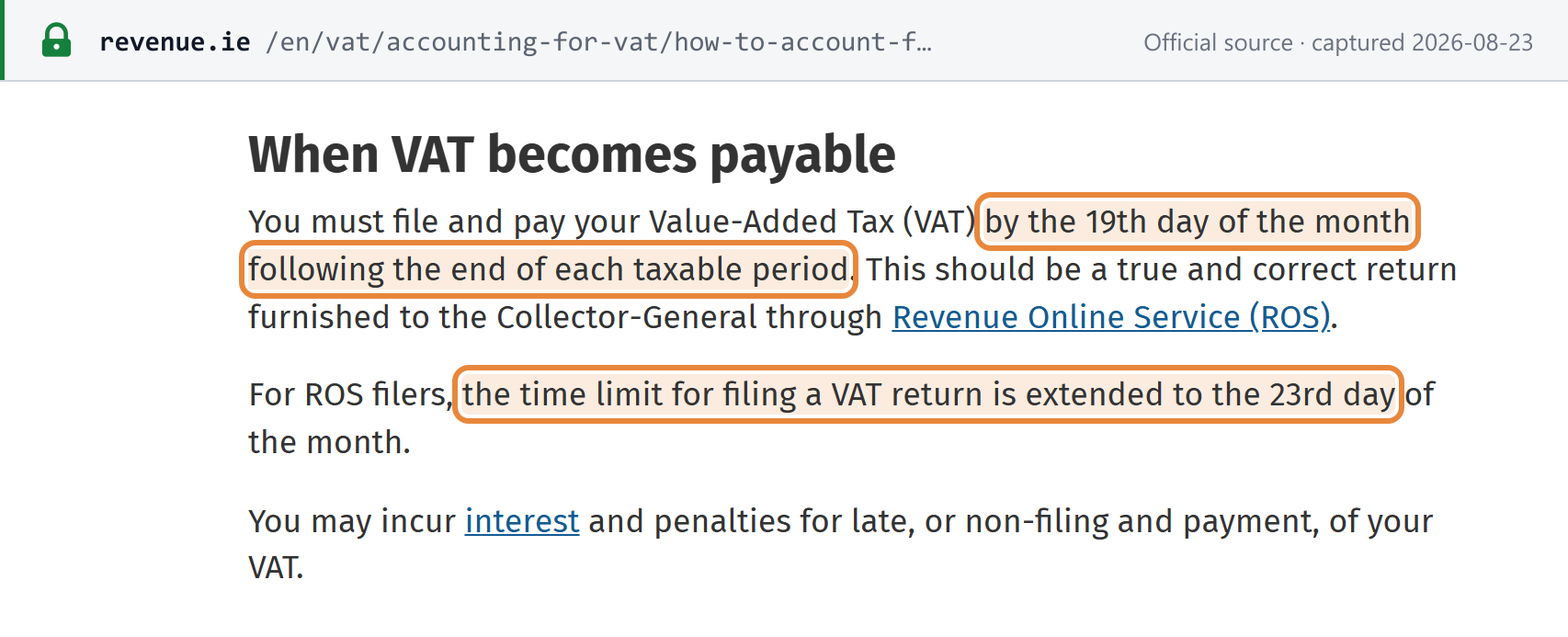
Screenshot of Office of the Revenue Commissioners showing the VAT3 return and payment — two-monthly (default taxable period) deadline Open full size Captured from Office of the Revenue Commissioners on 2026-08-23
VAT3 return and payment — monthly (authorised)

VAT · Monthly · return filing

19th of the month after the month ends Verified 2026-08-23
Who files
Accountable persons Revenue has authorised, on request, to file monthly — in practice those in a constant VAT repayment position. Filing and payment share this date.
Notes
Monthly filing is authorised by Revenue on request, in practice for businesses in a constant VAT repayment position; it is not a cadence you can simply elect. Return and payment fall together on the 19th, in every month of the year. Revenue extends the date to the 23rd for ROS filers, but only where both the return and the remittance are made electronically by then. If either is late the extension is withdrawn retrospectively and you are late from the 19th — five days, not one. Deadlines do not move for weekends or public holidays.
Source
When VAT becomes payable Office of the Revenue Commissioners
See the source text
“Generally, monthly VAT returns are made by taxable persons in a constant VAT repayment position. Revenue may authorise a monthly VAT return, on request.”
Captured from Office of the Revenue Commissioners on 2026-08-23
VAT3 return and payment — four-monthly (authorised)

VAT · Every 4 months · return filing

19th of the month after the four-month period ends Verified 2026-08-23
Who files
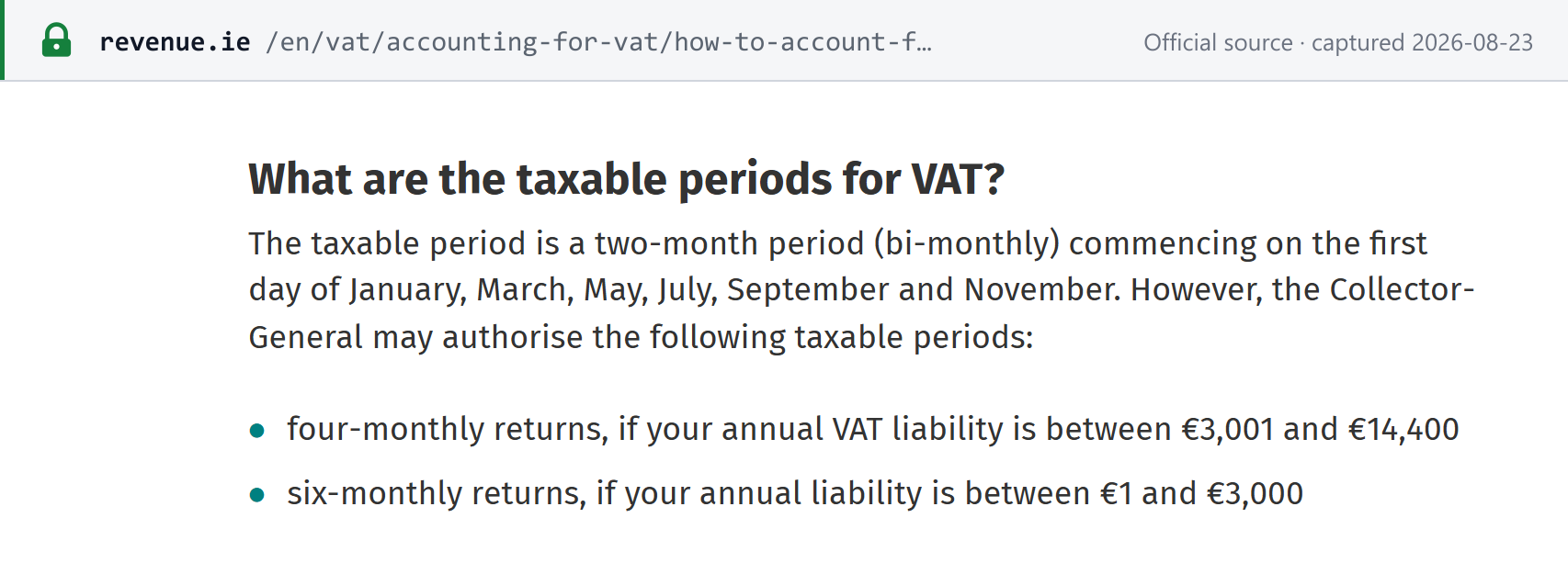
Accountable persons the Collector-General has authorised to file four-monthly, where annual VAT liability is between EUR 3,001 and EUR 14,400. Periods run January-April, May-August and September-December. Filing and payment share this date.
Notes
Periods run January-April, May-August and September-December, with return and payment due together on the 19th of the following month. An authorisation may also require interim remittances — an amount specified by the Collector-General, due on the same 19th for each taxable period other than the final one in the accounting period. Both the amount and whether it is imposed at all are decided case by case. The ROS extension to the 23rd applies only if both the return and the remittance are made electronically by then; if either is late it is withdrawn and you are late from the 19th. Deadlines do not move for weekends or public holidays.
Source
When VAT becomes payable Office of the Revenue Commissioners
See the source text
“four-monthly returns, if your annual VAT liability is between €3,001 and €14,400”
Screenshot of Office of the Revenue Commissioners showing the VAT3 return and payment — four-monthly (authorised) deadline Open full size Captured from Office of the Revenue Commissioners on 2026-08-23
VAT3 return and payment — six-monthly (authorised)

VAT · Bi-annually · return filing

19th of the month after the half-year ends Verified 2026-08-23
Who files
Accountable persons the Collector-General has authorised to file six-monthly, where annual VAT liability is between EUR 1 and EUR 3,000. Periods run January-June and July-December. Filing and payment share this date.
Notes
Periods run January-June and July-December, so the dates are 19 July and 19 January. Revenue calls this cadence 'Bi-Annual' on its calendar and 'six-monthly' in its guidance; both mean twice a year, and neither is the default two-month period Revenue calls 'bi-monthly'. Its two current sources word the same threshold differently: 'between EUR 1 and EUR 3,000' on the deadline page, 'EUR 3,000 or less' in the direct-debit note. The ROS extension to the 23rd applies only if both the return and the remittance are made electronically by then; if either is late it is withdrawn and you are late from the 19th. Deadlines do not move for weekends or public holidays.
Source
When VAT becomes payable Office of the Revenue Commissioners
See the source text
“six-monthly returns, if your annual liability is between €1 and €3,000”
Screenshot of Office of the Revenue Commissioners showing the VAT3 return and payment — six-monthly (authorised) deadline Open full size Captured from Office of the Revenue Commissioners on 2026-08-23
VAT3 return and payment — annual accounting period (authorised)

VAT · Annually · return filing

within 19 days of the end of the authorised 12-month VAT accounting period (VATCA 2010 s. 77(2)(b)) Verified 2026-08-23
Who files
Accountable persons authorised to use a 12-month accounting period, typically alongside a monthly direct debit. The return and any balancing payment fall 19 days after that filer's own year end — which is NOT necessarily December.
Notes
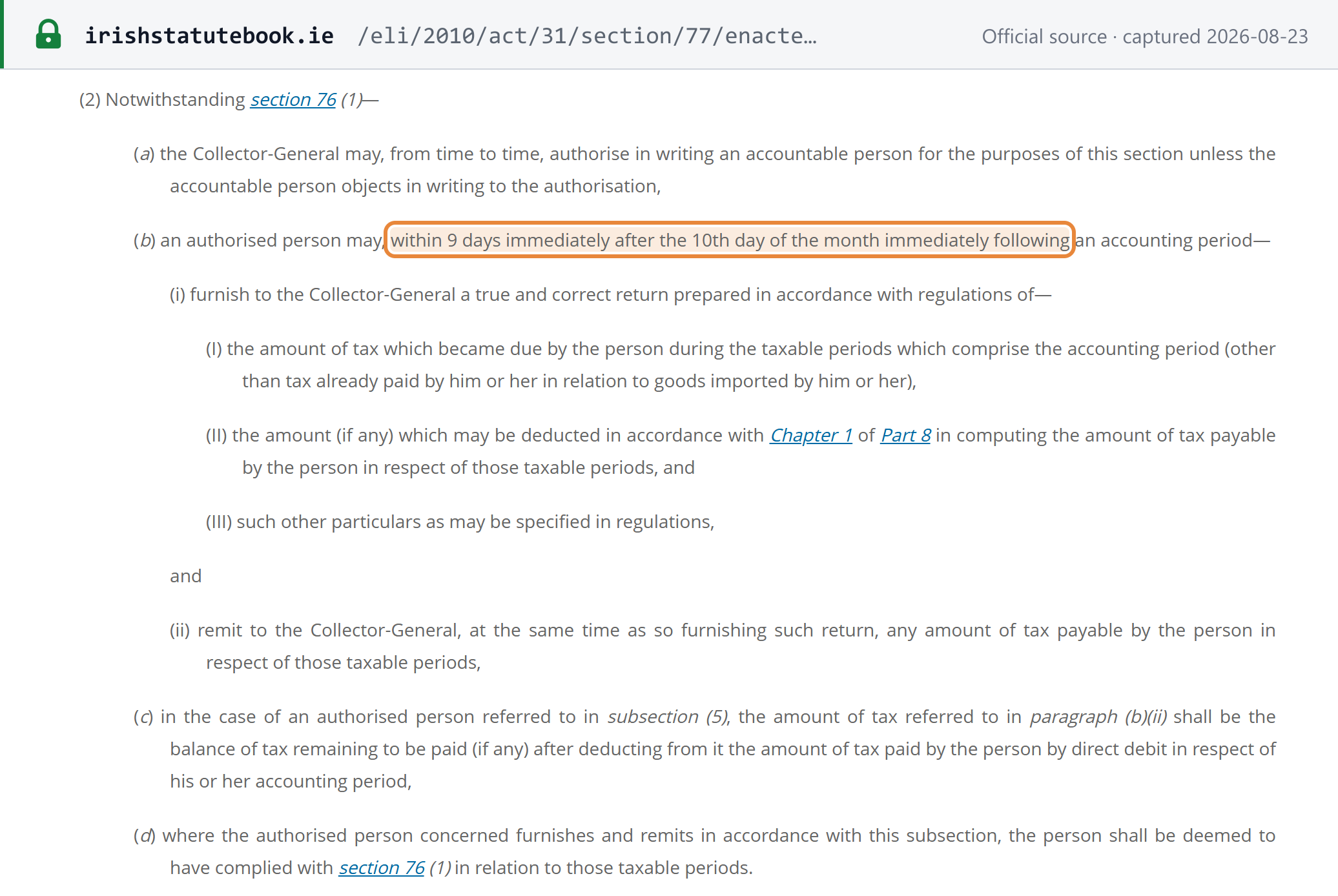
Revenue gives each authorised filer its own 12-month accounting year, so this is not a single calendar date: the return and any balancing payment fall on the 19th of the month after that filer's own year end, which is not necessarily December, and can be up to 35 days after the period ends. This cadence depends on the fixed direct debit, which Revenue intends to stop offering for VAT; moving to variable direct debit means changing from annual to bi-monthly filing. The 23rd is open to ROS filers only if both the return and the remittance are made electronically by then; otherwise you are late from the 19th. Deadlines do not move for weekends or public holidays.
Source
Value-Added Tax Consolidation Act 2010, s. 77 Office of the Revenue Commissioners
See the source text
“an authorised person may, within 9 days immediately after the 10th day of the month immediately following an accounting period— (i) furnish to the Collector-General a true and correct return prepared in accordance with regulations of—”
Screenshot of Office of the Revenue Commissioners showing the VAT3 return and payment — annual accounting period (authorised) deadline Open full size Captured from Office of the Revenue Commissioners on 2026-08-23
Return of Trading Details (RTD)

VAT · Annually · return filing

within 23 days of the end of the accountable person's VAT accounting year (23 days on ROS; 19 days for a filer exempt from mandatory e-filing who does not pay and file on ROS) Verified 2026-08-23
Who files
Every VAT-registered person, whatever their VAT3 cadence. An annual return of total purchases and sales broken down by VAT rate, filed on ROS.
Notes
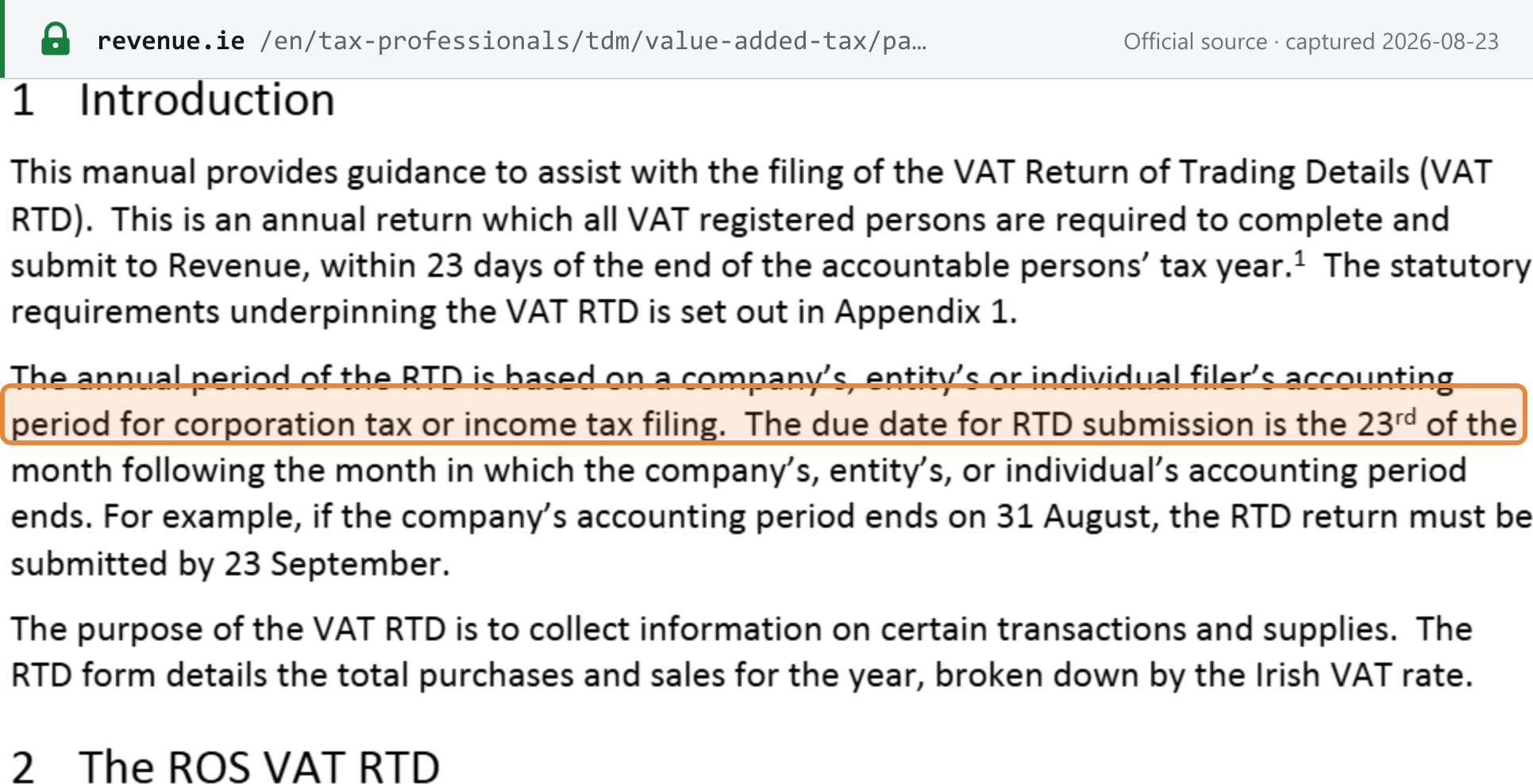
An annual return of total purchases and sales broken down by VAT rate, due within 23 days of the end of the accountable person's own tax year — Revenue's worked example: 'if the company's accounting period ends on 31 August, the RTD return must be submitted by 23 September.' A filer exempt from mandatory e-filing who does not pay and file on ROS has 19 days instead, so a paper filer is due four days earlier. This is the one Irish return where 23 days is the rule rather than a conditional ROS concession. Non-filing has teeth beyond penalties: an outstanding RTD blocks tax clearance and can hold up repayments. Deadlines do not move for weekends or public holidays.
Source
VAT Return of Trading Details (Part 9 – Chapter 3), Revenue Tax and Duty Manual, last updated February 2026 Office of the Revenue Commissioners
See the source text
“This manual provides guidance to assist with the filing of the VAT Return of Trading Details (VAT RTD). This is an annual return which all VAT registered persons are required to complete and submit to Revenue, within 23 days of the end of the accountable persons' tax year.”
Screenshot of Office of the Revenue Commissioners showing the Return of Trading Details (RTD) deadline Open full size Captured from Office of the Revenue Commissioners on 2026-08-23
VIES statement — intra-Community supplies of goods, monthly

VAT · Monthly · report / listing

23rd of the month after the month ends Verified 2026-08-23
Who files
Accountable persons making intra-Community supplies of goods above the EUR 50,000 quarterly threshold, and those who have not opted into the quarterly cadence. A nil statement is required from anyone who has filed for a previous period.
Notes
The 23rd is statutory here, not a ROS concession — unlike the VAT3, where the 23rd is conditional. Monthly is the default for goods and quarterly is the option, which is the opposite way round from services. The threshold is EUR 50,000: a supplier may file quarterly only while supplies stay under it in the quarter and in each of the previous four quarters. VIES statements are additional to and separate from the VAT3, and a nil statement is required from anyone who has filed for a previous period. Deadlines do not move for weekends or public holidays.
Source
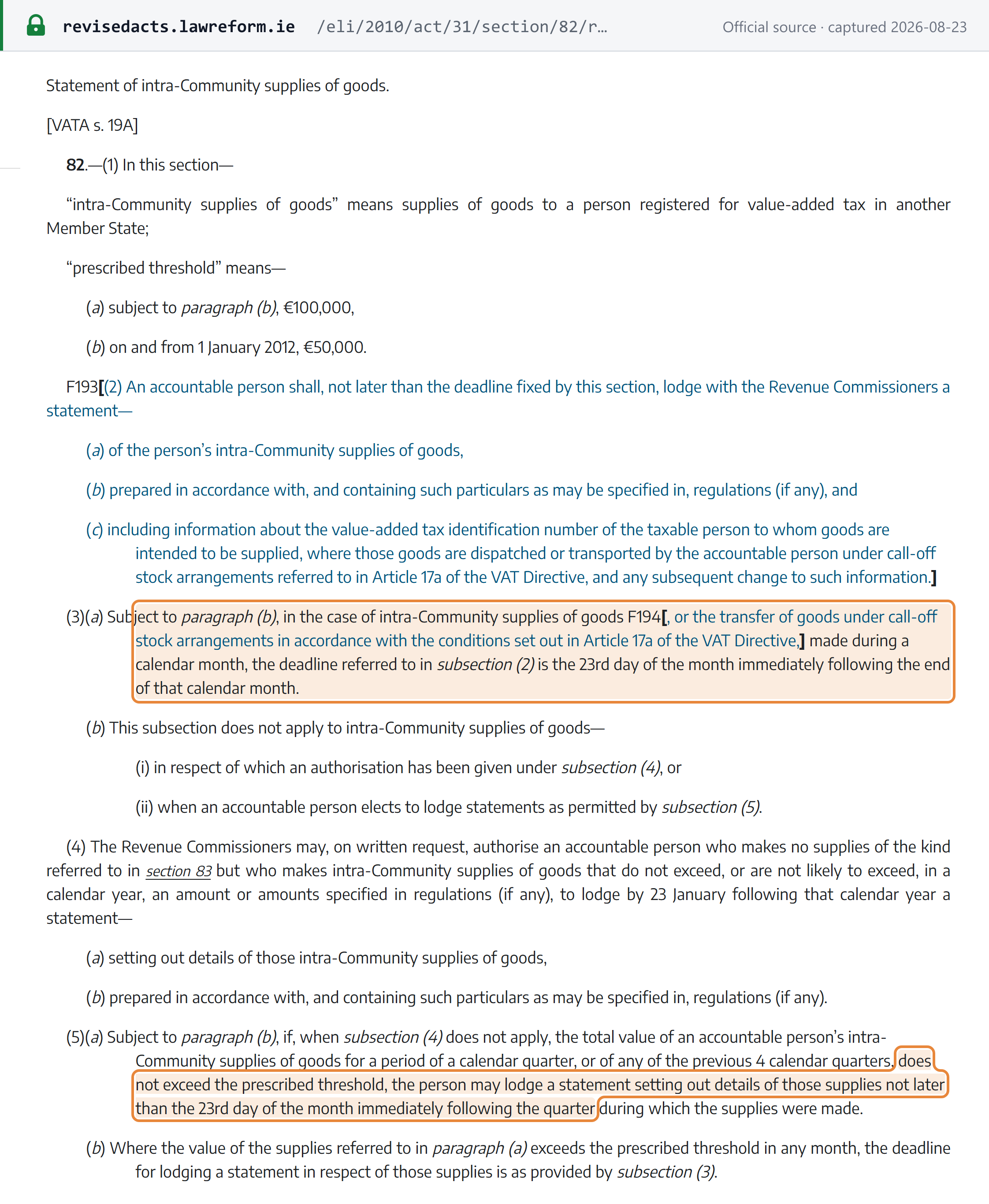
Value-Added Tax Consolidation Act 2010, s. 82 (revised) Law Reform Commission (Revised Acts)
See the source text
“Subject to paragraph (b), in the case of intra-Community supplies of goods [, or the transfer of goods under call-off stock arrangements in accordance with the conditions set out in Article 17a of the VAT Directive,] made during a calendar month, the deadline referred to in subsection (2) is the 23rd day of the month immediately following the end of that calendar month.”
Screenshot of Law Reform Commission (Revised Acts) showing the VIES statement — intra-Community supplies of goods, monthly deadline Open full size Captured from Law Reform Commission (Revised Acts) on 2026-08-23

VIES statement — intra-Community supplies of goods, quarterly

VAT · Quarterly · report / listing

23rd of the month after the quarter ends Verified 2026-08-23
Who files
Accountable persons whose intra-Community supplies of goods do not exceed EUR 50,000 in the quarter or in any of the previous four calendar quarters.
Notes
Note the backward-looking limb: it is not enough to be under EUR 50,000 this quarter, the previous four calendar quarters must also be clear. The 23rd is the statutory date, with no ROS condition attached. An annual statement by 23 January exists for very small suppliers, but only on written authorisation. Deadlines do not move for weekends or public holidays.
Source
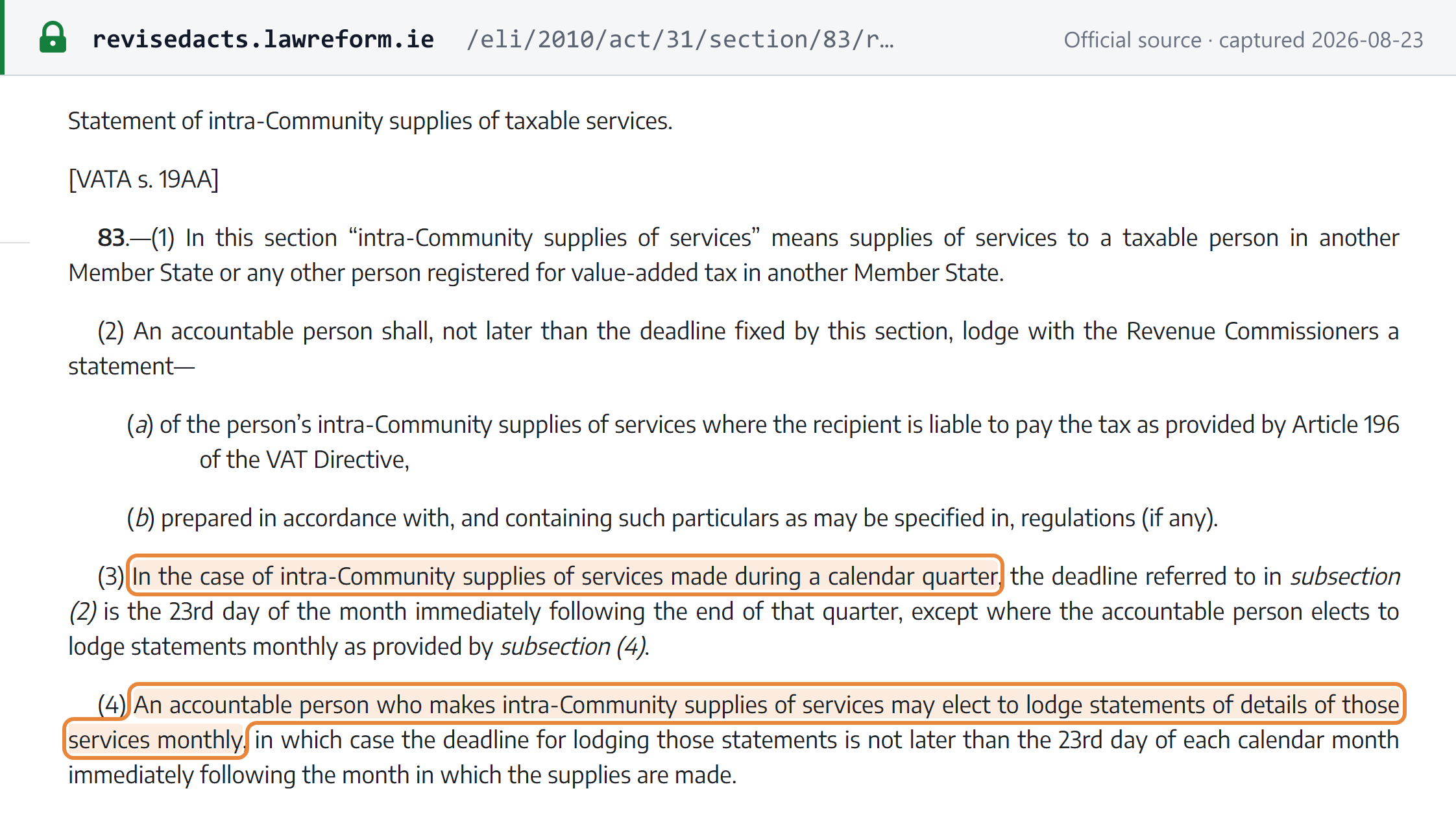
Value-Added Tax Consolidation Act 2010, s. 82(5)(a) (revised) Law Reform Commission (Revised Acts)
See the source text
“Subject to paragraph (b), if, when subsection (4) does not apply, the total value of an accountable person’s intra-Community supplies of goods for a period of a calendar quarter, or of any of the previous 4 calendar quarters, does not exceed the prescribed threshold, the person may lodge a statement setting out details of those supplies not later than the 23rd day of the month immediately following the quarter during which the supplies were made.”
Screenshot of Law Reform Commission (Revised Acts) showing the VIES statement — intra-Community supplies of goods, quarterly deadline Open full size Captured from Law Reform Commission (Revised Acts) on 2026-08-23

VIES statement — intra-Community supplies of services, quarterly

VAT · Quarterly · report / listing

23rd of the month after the quarter ends Verified 2026-08-23
Who files
Accountable persons making intra-Community supplies of services, which are quarterly by DEFAULT regardless of value — the opposite default from goods.
Notes
The EUR 50,000 threshold is a goods threshold and does not apply to services: Revenue states that 'Suppliers of services may opt to file quarterly or monthly statements only'. A business supplying both can therefore be monthly on goods and quarterly on services at the same time. The 23rd is the statutory date, with no ROS condition attached. Deadlines do not move for weekends or public holidays.
Source
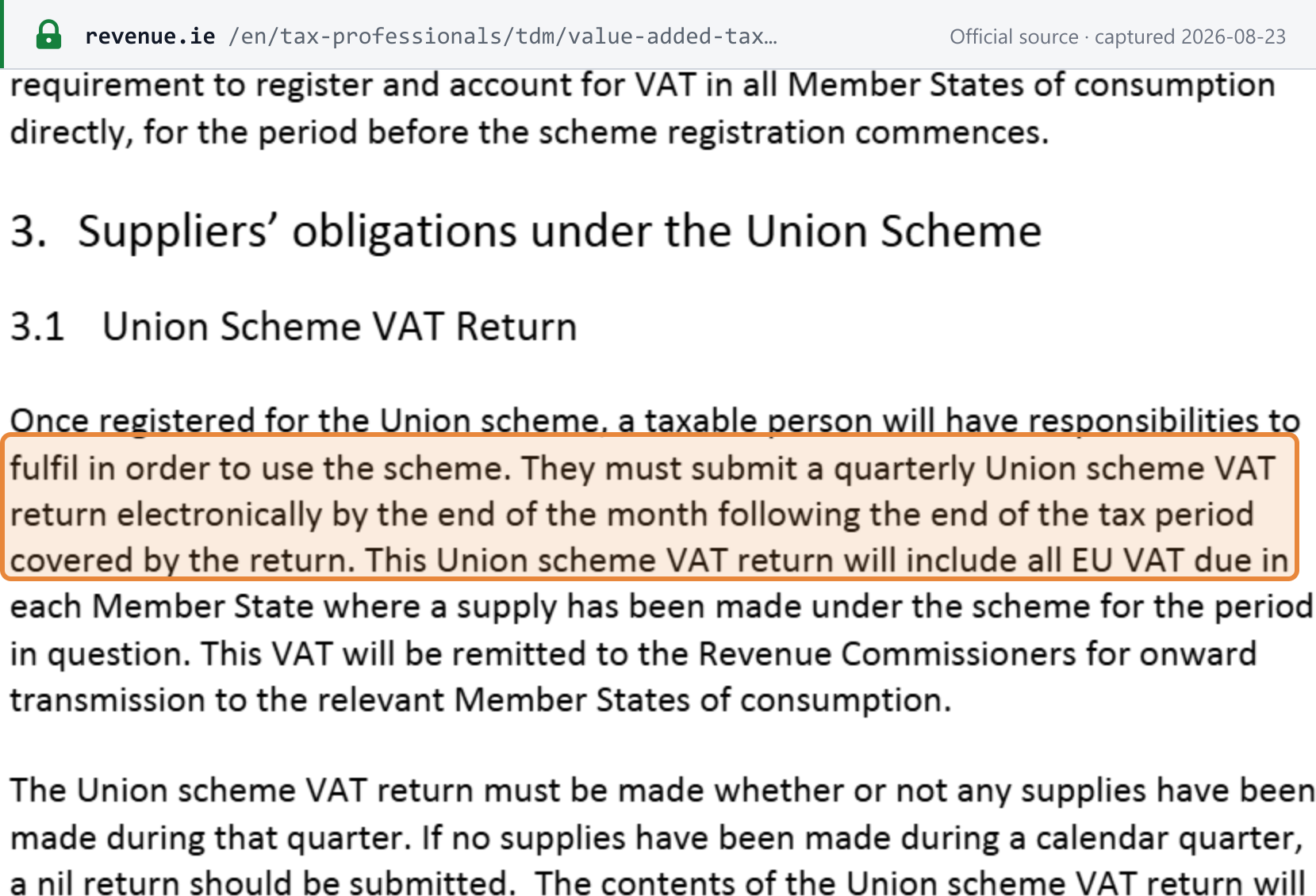
Value-Added Tax Consolidation Act 2010, s. 83(3) (revised) Law Reform Commission (Revised Acts)
See the source text
“(3) In the case of intra-Community supplies of services made during a calendar quarter, the deadline referred to in subsection (2) is the 23rd day of the month immediately following the end of that quarter, except where the accountable person elects to lodge statements monthly as provided by subsection (4).”
Screenshot of Law Reform Commission (Revised Acts) showing the VIES statement — intra-Community supplies of services, quarterly deadline Open full size Captured from Law Reform Commission (Revised Acts) on 2026-08-23

VIES statement — intra-Community supplies of services, monthly (elected)

VAT · Monthly · report / listing

23rd of the month after the month ends Verified 2026-08-23
Who files
Accountable persons supplying intra-Community services who have ELECTED to lodge monthly statements. There is no threshold that forces this cadence for services.
Notes
Election only — for services there is no value of supplies that compels monthly filing. The 23rd is the statutory date, with no ROS condition attached. Deadlines do not move for weekends or public holidays.
Source
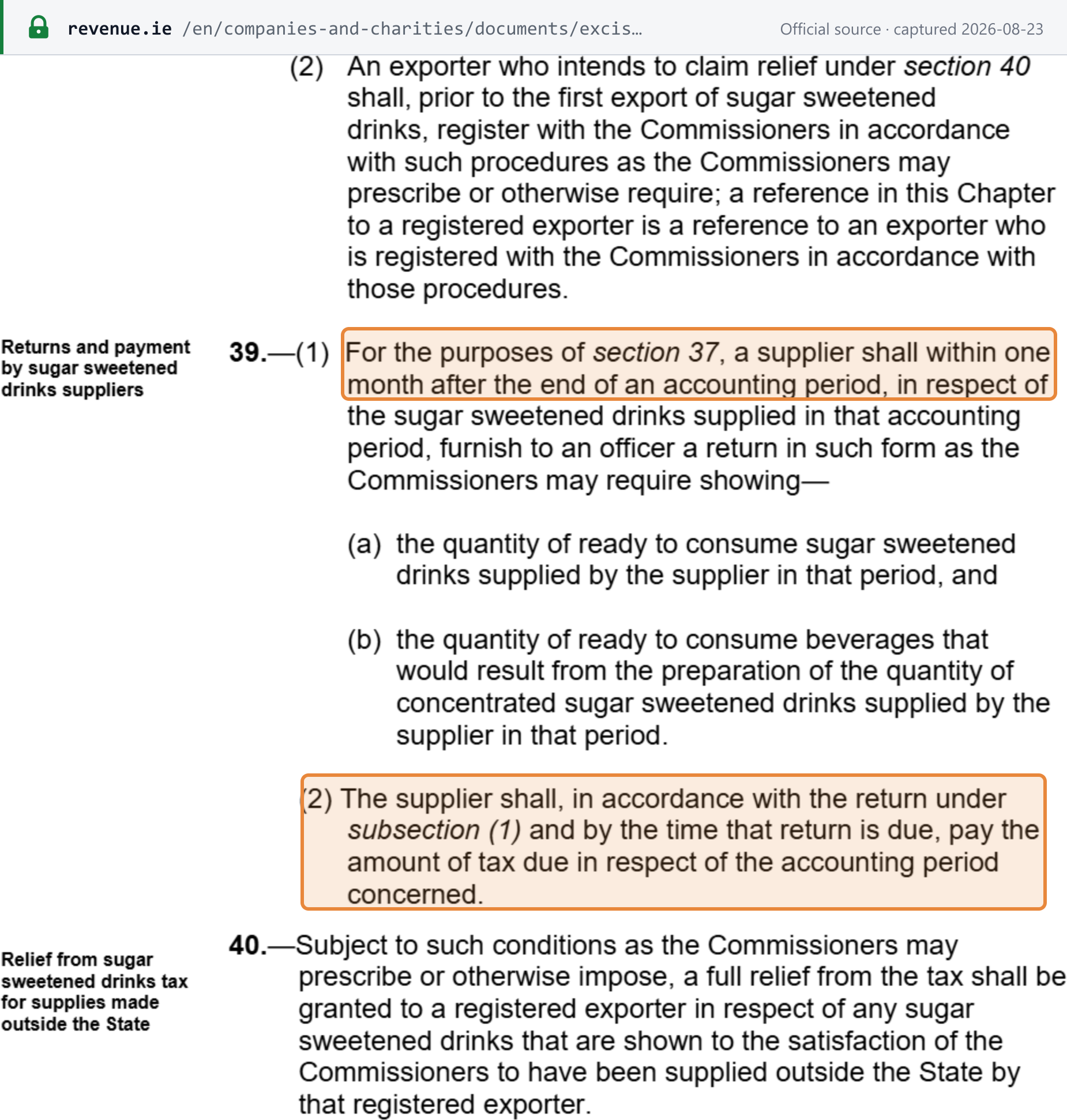
Value-Added Tax Consolidation Act 2010, s. 83(4) (revised) Law Reform Commission (Revised Acts)
See the source text
“(4) An accountable person who makes intra-Community supplies of services may elect to lodge statements of details of those services monthly, in which case the deadline for lodging those statements is not later than the 23rd day of each calendar month immediately following the month in which the supplies are made.”
Screenshot of Law Reform Commission (Revised Acts) showing the VIES statement — intra-Community supplies of services, monthly (elected) deadline Open full size Captured from Law Reform Commission (Revised Acts) on 2026-08-23

Intrastat detailed return

VAT / intra-EU trade statistics · Monthly · report / listing

23rd of the month after the month ends Verified 2026-08-23
Who files
Businesses whose intra-EU trade crosses EUR 750,000 a year in either direction. The threshold is now the SAME for arrivals and dispatches, and is tested per flow: crossing on dispatches does not pull you into arrivals reporting. Nil returns are required.
Notes
Corrects a common assumption: arrivals and dispatches carried different thresholds for years, and from 1 January 2025 both are EUR 750,000. The threshold is tested per flow, so crossing on dispatches does not pull you into arrivals reporting. Once over, you stay in for that flow 'until at least the end of the following year', and may only leave at a calendar year end — so this is stickier than a simple threshold test. Nil returns are required if you had no qualifying trade that month, and late or missing returns may result in penalties. Deadlines do not move for weekends or public holidays.
Source
Intrastat Traders Manual, last updated February 2026 Office of the Revenue Commissioners
See the source text
“Deadlines - Returns must be filed by the 23rd of the following month. - Nil returns are required if you had no qualifying trade that month. - Late or missing returns may result in penalties.”
Captured from Office of the Revenue Commissioners on 2026-08-23
OSS VAT return — Union scheme

VAT — OSS · Quarterly · return filing

last day of the month after the quarter ends Verified 2026-08-23
Who files
Taxable persons using the Union scheme with Ireland as member state of identification, for intra-EU distance sales of goods and B2C services taxable in another member state. Payment falls on the same date. Nil returns are required.
Notes
Due 30 April, 31 July, 31 October and 31 January — the end of the month following the quarter, which is neither the VAT3 nineteenth nor the ROS twenty-third. Payment falls on the same date and a return is required whether or not any supplies were made. Deadlines do not move for weekends or public holidays: Revenue prints 31 January 2026, a Saturday, as the OSS date.
Source
Union Scheme - One Stop Shop (OSS), Revenue Tax and Duty Manual Office of the Revenue Commissioners
See the source text
“Once registered for the Union scheme, a taxable person will have responsibilities to fulfil in order to use the scheme. They must submit a quarterly Union scheme VAT return electronically by the end of the month following the end of the tax period covered by the return.”
Screenshot of Office of the Revenue Commissioners showing the OSS VAT return — Union scheme deadline Open full size Captured from Office of the Revenue Commissioners on 2026-08-23
OSS VAT return — non-Union scheme

VAT — OSS · Quarterly · return filing

last day of the month after the quarter ends Verified 2026-08-23
Who files
Taxable persons not established in the EU supplying services to EU consumers, with Ireland as member state of identification. Same deadline as the Union scheme, different population.
Notes
For taxable persons not established in the EU supplying services to EU consumers, with Ireland as member state of identification. Same deadline as the Union scheme — the end of the month following the quarter — and the return must be made whether or not any supplies have been made during that quarter. Deadlines do not move for weekends or public holidays.
Source
Non-Union Scheme - One Stop Shop (OSS), Revenue Tax and Duty Manual Office of the Revenue Commissioners
See the source text
“They must submit a quarterly non-Union VAT return electronically by the end of the month following the end of the tax period covered by the return. This VAT return must be made whether or not any supplies have been made during that quarter.”
Captured from Office of the Revenue Commissioners on 2026-08-23

IOSS VAT return — import scheme

VAT — IOSS · Monthly · return filing

last day of the month after the month ends Verified 2026-08-23
Who files
Taxable persons, or their intermediary, using the import scheme with Ireland as member state of identification, for distance sales of imported goods under EUR 150. An intermediary files and remits SEPARATELY for each taxable person represented. Nil returns are required.
Notes
Monthly, due by the end of the following month, and required whether or not any supplies were made. An intermediary must file a return and remit the VAT separately for each taxable person represented — one combined return will not do. Deadlines do not move for weekends or public holidays: Revenue prints 28 February 2026, a Saturday, as the IOSS date.
Source
Import One Stop Shop (IOSS), Revenue Tax and Duty Manual Office of the Revenue Commissioners
See the source text
“The taxable person or his or her intermediary must submit an IOSS VAT return electronically by the end of the month following the end of the tax period covered by the return. The IOSS VAT return must be made whether or not any supplies have been made during the month. An intermediary will need to file an IOSS VAT return and remit the VAT due for each taxable person that they represent separately.”
Captured from Office of the Revenue Commissioners on 2026-08-23

EU VAT SME scheme — quarterly turnover report

VAT — cross-border SME scheme · Quarterly · report / listing

last day of the month after the quarter ends Verified 2026-08-23
Who files
Irish-established small enterprises registered to use the cross-border SME exemption. The report covers turnover in ALL member states, including those where the scheme is not applied, entering 0 where there is no activity. Filed via ROS.
Notes
A turnover report under the cross-border SME exemption, not a recapitulative listing. It covers turnover in all member states, including those where the scheme is not applied, entering 0 where there is no activity, and is due within one month of the end of the calendar quarter. Eligibility requires being established for VAT purposes in Ireland only, staying under each other member state's domestic threshold, and staying under the EUR 100,000 Union turnover threshold. Deadlines do not move for weekends or public holidays.
Source
Guidelines for Cross-border Operation of EU VAT SME Scheme (VSME), Revenue Tax and Duty Manual Office of the Revenue Commissioners
See the source text
“The quarterly report must be submitted to Revenue within one month from the end of the calendar quarter as set out in Table below:”
Captured from Office of the Revenue Commissioners on 2026-08-23

VAT registration — notification to Revenue

VAT · One-off · registration

within 30 days of the day the person first becomes an accountable person (VATCA 2010 s. 65(3)(a)) Verified 2026-08-23
Who files
Every person who becomes an accountable person. A separate 30-day duty applies to notifying first engagement in intra-Community trade where the original registration said there would be none, and to notifying any later change in registration details.
Notes
Thirty days beginning on the day you first become an accountable person, so the trigger day itself counts. The same 30-day duty covers notifying first engagement in intra-Community trade where the original registration said there would be none, and any later change in registration details: 'If any of the information supplied by you changes, you must notify your Revenue office within 30 days.' Deadlines do not move for weekends or public holidays.
Source
Value-Added Tax Consolidation Act 2010, s. 65(3) (revised) Law Reform Commission (Revised Acts)
See the source text
“(a) Every accountable person shall, within the period of 30 days beginning on the day on which the person first becomes an accountable person, furnish in writing to the Revenue Commissioners the particulars specified in regulations as being required for the purpose of registering the person for tax.”
Captured from Law Reform Commission (Revised Acts) on 2026-08-23

Sugar Sweetened Drinks Tax — return and payment

Sugar Sweetened Drinks Tax · Every 2 months · return filing

last day of the month after the two-month period ends Verified 2026-08-23
Who files
Suppliers first supplying sugar-sweetened drinks in the State. The accounting period is two calendar months. Return and payment fall together, ROS only, and nil returns are required.
Notes
Due 'within one month after the end of an accounting period', which means the last day of the following month. The accounting period is two calendar months closing at even month ends — Revenue's own example treats May/June as an accounting period, with repayment claims for it accepted from 1 August. Return and payment fall together, ROS only, and nil returns are required. Deadlines do not move for weekends or public holidays.
Source
Sugar Sweetened Drinks Tax, Chapter 1 of Part 2 of Finance Act 2017 (No. 41 of 2017) — Revenue non-statutory consolidated document, January 2026 edition Office of the Revenue Commissioners
See the source text
“39.--(1) For the purposes of section 37, a supplier shall within one month after the end of an accounting period, in respect of the sugar sweetened drinks supplied in that accounting period, furnish to an officer a return in such form as the Commissioners may require showing--”
Screenshot of Office of the Revenue Commissioners showing the Sugar Sweetened Drinks Tax — return and payment deadline Open full size Captured from Office of the Revenue Commissioners on 2026-08-23

Electricity Tax — annual return and payment

Electricity Tax · Annually · return filing

31st January each year Verified 2026-08-23
Who files
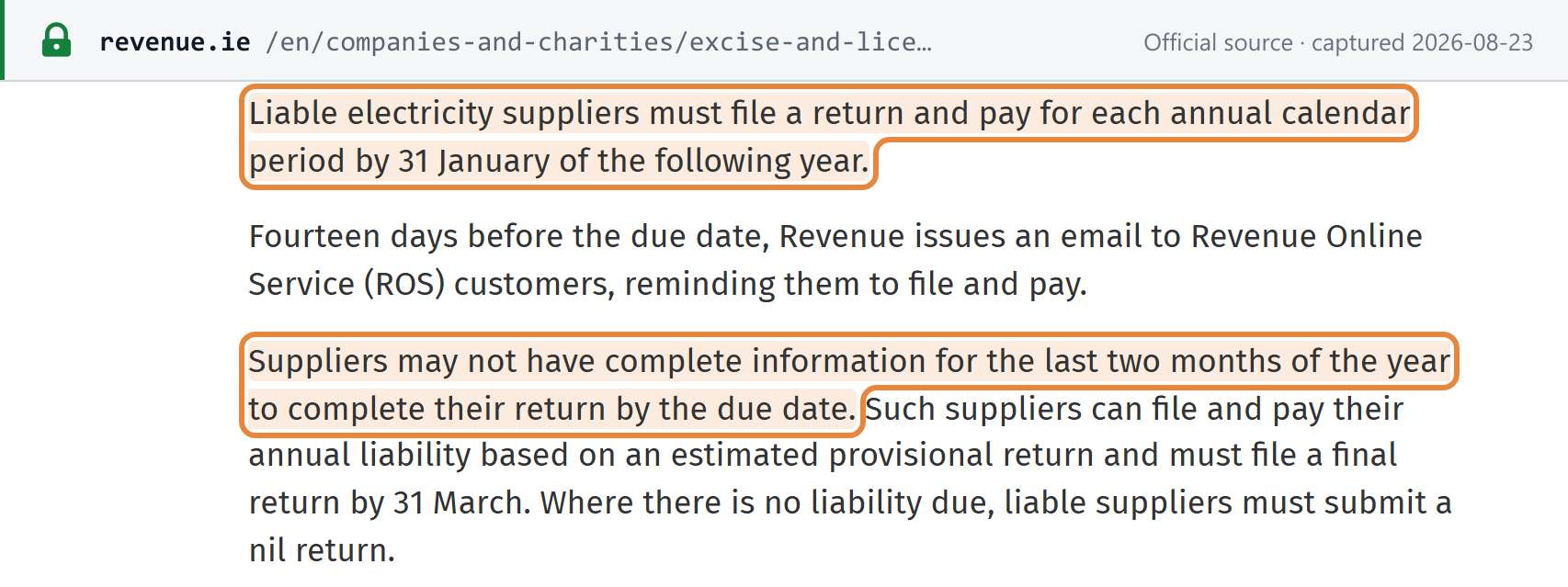
Liable electricity suppliers. Covers the calendar year and falls due on 31 January following. Nil returns are required where there is no liability.
Notes
Covers the calendar year and falls due on 31 January following, with nil returns required where there is no liability. Deadlines do not move for weekends or public holidays: 31 January 2026 is a Saturday and Revenue prints it unshifted.
Source
Electricity Tax — returns and payments Office of the Revenue Commissioners
See the source text
“Liable electricity suppliers must file a return and pay for each annual calendar period by 31 January of the following year.”
Screenshot of Office of the Revenue Commissioners showing the Electricity Tax — annual return and payment deadline Open full size Captured from Office of the Revenue Commissioners on 2026-08-23

Electricity Tax — final return where a provisional one was filed

Electricity Tax · Annually · return filing

31st March each year Verified 2026-08-23
Who files
Liable electricity suppliers who filed an estimated provisional return on 31 January because the last two months of the year were incomplete.
Notes
A conditional second date rather than a universal one: it exists only for suppliers who filed an estimated provisional return on 31 January because they did not have complete information for the last two months of the year. Where there is no liability due, a nil return is still required. Deadlines do not move for weekends or public holidays.
Source
Electricity Tax — returns and payments Office of the Revenue Commissioners
See the source text
“Suppliers may not have complete information for the last two months of the year to complete their return by the due date. Such suppliers can file and pay their annual liability based on an estimated provisional return and must file a final return by 31 March. Where there is no liability due, liable suppliers must submit a nil return.”
Screenshot of Office of the Revenue Commissioners showing the Electricity Tax — final return where a provisional one was filed deadline Open full size Captured from Office of the Revenue Commissioners on 2026-08-23

Betting Duty — quarterly return and payment

Betting Duty · Quarterly · return filing

15th of the month after the quarter ends Verified 2026-08-23
Who files
Licensed bookmakers and remote betting intermediaries. Quarters run January-March, April-June, July-September and October-December. ROS only, and a nil entry is required where no bet was taken.
Notes
The only Irish indirect-tax deadline here that is neither the 19th, the 23rd nor a month end. Revenue's own worked example: 'the return for the quarter ended 31 March must be submitted and paid by 15 April.' ROS only, and a nil entry is required where no bet was taken. Deadlines do not move for weekends or public holidays.
Source
Betting Duty — when do I pay? Office of the Revenue Commissioners
See the source text
“Returns are due on a quarterly basis (January–March, April–June, July–September, October–December). Returns and payments must be made on or before the fifteenth day of the month following the last day of the accounting period to which the return relates.”
Captured from Office of the Revenue Commissioners on 2026-08-23

Solid Fuel Carbon Tax — return and payment

Solid Fuel Carbon Tax · Every 2 months · return filing

last day of the month after the two-month period ends Verified 2026-08-23
Who files
Liable solid-fuel suppliers. The accounting period is two months and the return and payment fall together. Nil returns are required.
Notes
Due by the last day of the month following each two-month period — the period January - February is due 31 March. Nil returns are compulsory: if there are no supplies of solid fuel during a period, a nil return should be submitted. Deadlines do not move for weekends or public holidays.
Source
Solid Fuel Carbon Tax — returns and payments Office of the Revenue Commissioners
See the source text
“Liable fuel suppliers must file a return and pay for each bi-monthly period by the last day of the following month. For example, the due date for the period January - February is 31 March.”
Captured from Office of the Revenue Commissioners on 2026-08-23

Natural Gas Carbon Tax — return and payment

Natural Gas Carbon Tax · Every 2 months · return filing

last day of the month after the two-month period ends Verified 2026-08-23
Who files
Liable natural-gas suppliers. Two-month accounting period, return and payment together, nil returns required.
Notes
Same shape as the solid-fuel carbon tax: due by the last day of the month following each two-month period, so the period January - February is due 31 March. Nil returns are compulsory — liable suppliers must submit a nil return where there is no liability due. Deadlines do not move for weekends or public holidays.
Source
Natural Gas Carbon Tax — returns and payments Office of the Revenue Commissioners
See the source text
“file a return and pay for each bi-monthly period by the last day of the following month. For example, the due date for the period January – February is 31 March.”
Captured from Office of the Revenue Commissioners on 2026-08-23

E-liquid Products Tax — return and payment

E-liquid Products Tax · Every 2 months · return filing

last day of the month after the two-month period ends Verified 2026-08-23
Who files
E-liquid Products Suppliers. Two-month accounting period, return and payment together, nil returns required.
Notes
Ireland's newest excise duty, and word-for-word the same construction as the Sugar Sweetened Drinks Tax: the return and payment are due 'no later than one month after the end of the 2 month accounting period'. Nil returns are required. Deadlines do not move for weekends or public holidays.
Source
E-liquid Products Tax — returns and payments Office of the Revenue Commissioners
See the source text
“All E-liquid Products Suppliers (EPS) are required no later than one month after the end of the 2 month accounting period to: file a return and pay any liability.”
Captured from Office of the Revenue Commissioners on 2026-08-23

Plastic Bag Environmental Levy — quarterly return and payment

Plastic Bag Environmental Levy · Quarterly · return filing

19th of the month after the quarter ends Verified 2026-08-23
Who files
Retailers supplying plastic bags, on the default quarterly cadence. Nil returns are required.
Notes
The 19th here is the same day as the VAT3, but for an unrelated reason and with no ROS extension attached — the 23rd is not available on this levy. Revenue's example: 'the due date for the period January to March is 19 April.' Nil returns are compulsory: retailers must submit a nil return where there is no liability due. Deadlines do not move for weekends or public holidays.
Source
Plastic Bag Environmental Levy — returns and payment deadlines Office of the Revenue Commissioners
See the source text
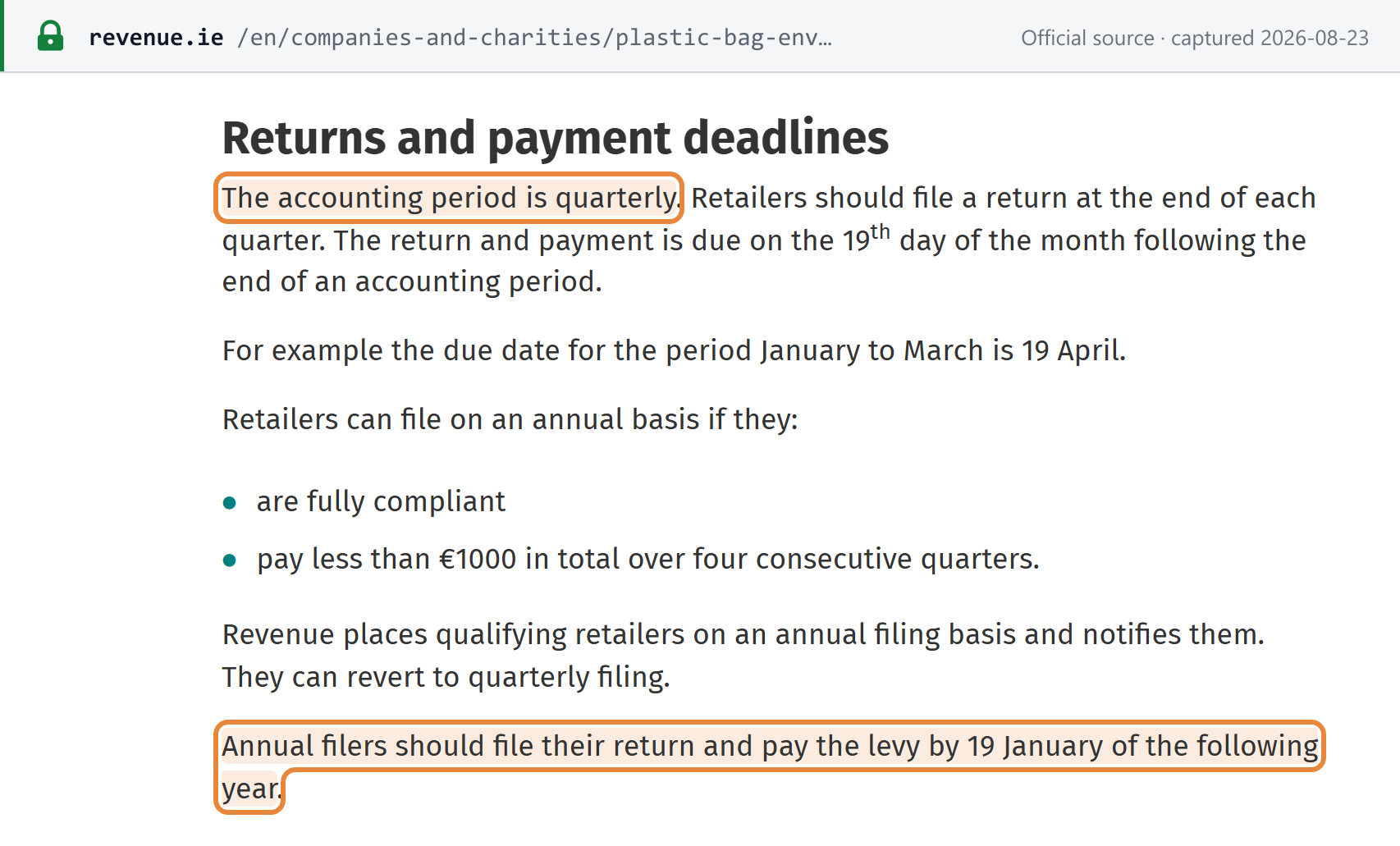
“The accounting period is quarterly. Retailers should file a return at the end of each quarter. The return and payment is due on the 19th day of the month following the end of an accounting period. For example the due date for the period January to March is 19 April.”
Screenshot of Office of the Revenue Commissioners showing the Plastic Bag Environmental Levy — quarterly return and payment deadline Open full size Captured from Office of the Revenue Commissioners on 2026-08-23

Plastic Bag Environmental Levy — annual return and payment

Plastic Bag Environmental Levy · Annually · return filing

19th January each year Verified 2026-08-23
Who files
Retailers Revenue has accepted onto annual filing: those who are fully compliant and pay less than EUR 1,000 in total over four consecutive quarters. Nil returns are required.
Notes
The annual alternative to the quarterly cadence, conditional on being fully compliant and on paying less than EUR 1,000 in total over four consecutive quarters — so it is a status a retailer is granted rather than a threshold they fall under. Nil returns are required. Deadlines do not move for weekends or public holidays.
Source
Plastic Bag Environmental Levy — returns and payment deadlines Office of the Revenue Commissioners
See the source text
“Annual filers should file their return and pay the levy by 19 January of the following year”
Screenshot of Office of the Revenue Commissioners showing the Plastic Bag Environmental Levy — annual return and payment deadline Open full size Captured from Office of the Revenue Commissioners on 2026-08-23

Return of Oil Movements (ROM1)

Mineral Oil Tax · Monthly · return filing

25th of the month after the month ends Verified 2026-08-23
Who files
Every holder of an Auto Fuel Trader's Licence or a Marked Fuel Trader's Licence — authorised warehousekeepers, distributors and forecourt retailers. Mandatory monthly, whatever the volume.
Notes
The only Irish indirect-tax deadline here that falls on the 25th — everything else is the 19th, the 23rd, the 15th or a month end. A narrower population than the carbon taxes, but mandatory monthly for every licence holder in it whatever the volume. Deadlines do not move for weekends or public holidays.
Source
Return of Oil Movements (ROM1) Office of the Revenue Commissioners
See the source text
“Traders must file the ROM1 Return by the 25th day of the month following the reporting period.”
Captured from Office of the Revenue Commissioners on 2026-08-23

Ireland's default taxable period for VAT is two months, beginning 1 January, 1 March, 1 May, 1 July, 1 September or 1 November. Four alternative cadences sit alongside it, each authorised by the Collector-General rather than simply chosen: monthly for businesses in a constant repayment position, four-monthly where annual VAT liability is between EUR 3,001 and EUR 14,400, six-monthly between EUR 1 and EUR 3,000, and an authorised 12-month accounting period. All five are on this calendar. Irish deadlines do not move for weekends or public holidays. Revenue publishes weekend dates unshifted: 19 July 2026 is a Sunday, and 19 September 2026, 19 December 2026, 23 May 2026, 31 January 2026 and 28 February 2026 are Saturdays, all printed as deadlines. Direct tax, payroll, relevant contracts tax and the agricultural flat-rate scheme are out of scope. General excise and EMCS are not listed either, because Revenue states that separate deadlines for paying excise duties and filing returns apply to each specific excise duty, so there is no single rule to give.

What this calendar does not list

  • Not applicable Separate payment deadline — There is no separate VAT payment deadline in Ireland. VATCA 2010 s. 76(1)(b) requires the remittance 'at the same time as so furnishing such return', and Revenue's calendar prints 'VAT 3 return and payment (if due)' as a single entry on every cadence in every month. The same is true of every excise row here. The one genuine exception, the s. 77(4)(b) interim remittance for authorised longer accounting periods, is per-case in both amount and imposition and is recorded in the four-monthly row's notes rather than modelled.
  • Not applicable E-invoicing / e-reporting cycle — Ireland has no B2B e-invoicing or digital-reporting mandate in force, so there is no periodic submission deadline to place on a calendar. Revenue has published a three-phase timetable — large corporates from November 2028, cross-border EU B2B from November 2029, full ViDA from July 2030 — and across all phases the immediate duty is a capability one: businesses 'must ensure they can receive and process eInvoices from any supplier mandated to issue them'. A capability is not a cadence. Revisit when phase 1 approaches.

About this calendar

Which Ireland tax deadlines does this calendar cover?

26 recurring indirect-tax obligations — VAT, Sugar Sweetened Drinks Tax, Electricity Tax, Betting Duty, Solid Fuel Carbon Tax, Natural Gas Carbon Tax and 3 more returns, payments and related filings — each with the due-date rule, who must file, and the official source that states the deadline. Direct-tax, payroll and company-registry deadlines are out of scope.

How current are these due dates?

Every obligation carries the date it was last verified against its official source (newest: 2026-08-23). Law-change dates come from the weekly Last Week in Taxes scan and link to their full change records.

Do the dates account for weekends and public holidays?

No — the calendar shows the statutory due date. Where the authority shifts deadlines falling on non-working days, the obligation notes say so. Confirm against the linked official source before relying on a date.

Validate tax IDs in 100+ countries

Put these rules into practice — verify VAT, GST, and EIN numbers in real time with the Lookuptax API.