20 recurring BTW (VAT) and Accijns (excise duty) obligations — returns, payments and listings — each with its due rule and official source, plus the dates new Netherlands rules take effect.
No obligation here shifts for a weekend or public holiday. Where that is Netherlands's own rule the date stands as shown; where a shift exists but is not modelled, the obligation's notes say so. Confirm against the linked official source before relying on a date.
Recurring obligations, with sources
Each deadline cites the official text that states it and the date we last verified it.
Btw-aangifte (omzetbelasting) — per kwartaal
BTW (VAT) · Quarterly · return filing
last day of the month after the quarter endsVerified 2026-08-23
Who files
The default for entrepreneurs established in the Netherlands — no election and no threshold is needed to be here; Uitvoeringsregeling AWR 1994 art. 25(1) makes the calendar quarter the tijdvak. Filing and payment share this date. A nil return is still due ('0-aangifte' or 'nihilaangifte').
Notes
Due on the last day of the month following the quarter — 30 April, 31 July, 31 October and 31 January. Payment rides the same date and counts by bijschrijving on the Belastingdienst account, so the money must be credited, not merely sent. Filers with a non-calendar boekjaar are on boekjaarkwartalen instead and do not appear here. Software filers meet an earliest submission date as well as a deadline: a return sent before the 24th of the month preceding the end of the tijdvak is rejected with an error. Year-end: the Q4 return is not merely another period. The Belastingdienst requires four annual afrekeningen in the last return of the year — privegebruik of business goods and services, privegebruik of the auto van de zaak, the pro-rata recalculation where the filer has both taxed and exempt turnover, and the personeelsvoorzieningen/BUA correction above EUR 227 per employee or relation per year. The deadline is unchanged; the content of that one filing is not.
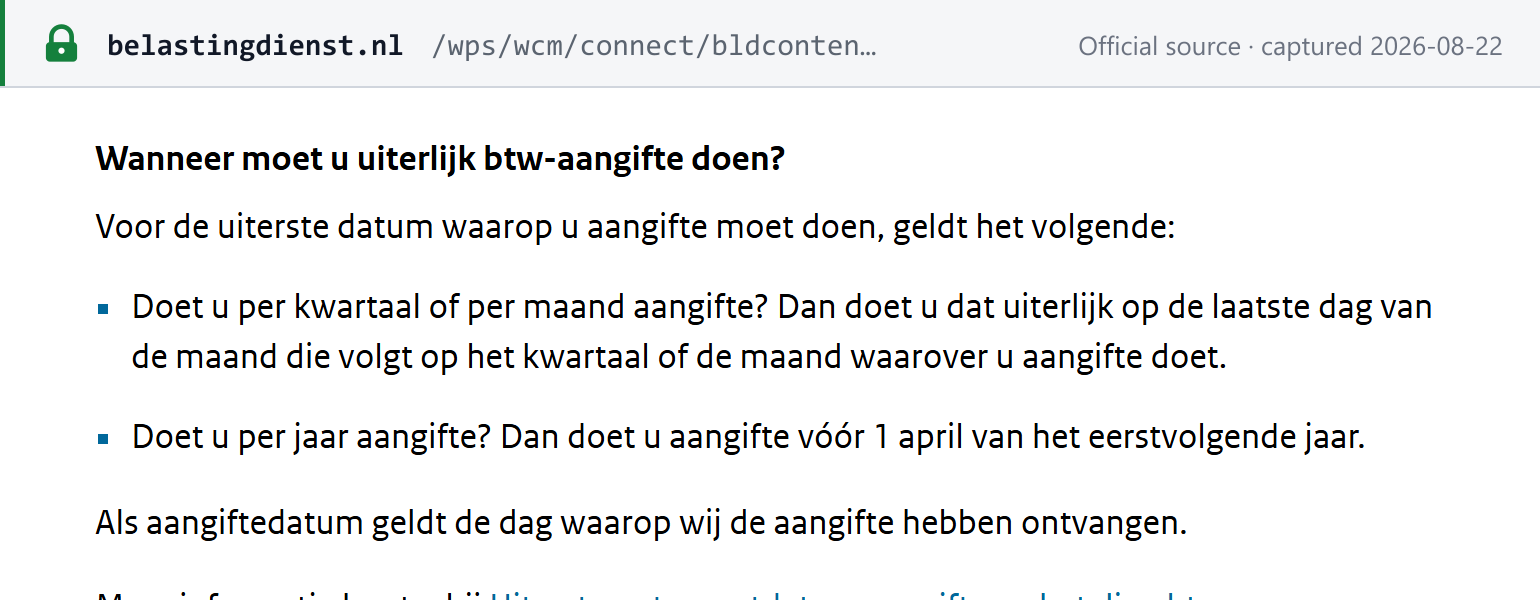
“Doet u per kwartaal of per maand aangifte? Dan doet u dat uiterlijk op de laatste dag van de maand die volgt op het kwartaal of de maand waarover u aangifte doet.”
last day of the month after the month endsVerified 2026-08-23
Who files
Entrepreneurs established in the Netherlands who asked the Belastingdienst in writing to file monthly, and those the inspector has put on a monthly cadence — which the Belastingdienst may impose where returns or payments arrive late. Not a threshold: monthly is never automatic. Filing and payment share this date.
Notes
Due on the last day of the month following each calendar month. How a taxpayer lands here: by written request to the belastingkantoor, or by compulsion after late filing or payment — 'Ontvangen wij uw btw-aangifte of betaling niet op tijd? Dan kunnen wij u verplichten om maandelijks btw-aangifte te doen'. A cadence change takes effect at the start of the next tijdvak and the Belastingdienst replies within 6 weeks. Year-end: the December return is not merely another period. The Belastingdienst requires four annual afrekeningen in the last return of the year — privegebruik of business goods and services, privegebruik of the auto van de zaak, the pro-rata recalculation where the filer has both taxed and exempt turnover, and the personeelsvoorzieningen/BUA correction above EUR 227 per employee or relation per year. The deadline is unchanged; the content of that one filing is not.
“Doet u per kwartaal of per maand aangifte? Dan doet u dat uiterlijk op de laatste dag van de maand die volgt op het kwartaal of de maand waarover u aangifte doet.”
Entrepreneurs granted an annual tijdvak on written request, which requires ALL FOUR of: annual VAT payable under EUR 1,883; no artikel 23 vergunning; the taxpayer is a natural person (eenmanszaak) or a partnership of natural persons only; and under EUR 10,000 per year in EACH of four intra-Community categories counted separately (supplies of goods, supplies of services, acquisitions of goods, services received). Applies on the same date to non-established entrepreneurs. Filing and payment share this date.
Notes
The jaaraangifte is the ordinary BTW return filed once by a taxpayer whose tijdvak is the year. It is not a reconciliation or a wash-up sitting on top of periodic returns: monthly and quarterly filers file no annual return at all, and the Netherlands has no annual VAT reconciliation return. What every monthly and quarterly filer does owe is four mandatory annual afrekeningen inside the last periodic return of the year — privegebruik of business goods and services, privegebruik of the auto van de zaak, the pro-rata recalculation where the filer has both belaste and vrijgestelde omzet, and the personeelsvoorzieningen/BUA correction above EUR 227 per employee or relation per year. Holding an artikel 23 vergunning disqualifies a taxpayer from the annual cadence entirely; existing annual filers who obtain one are moved to quarterly by letter.
Btw-aangifte (omzetbelasting) — per kwartaal, buitenlandse ondernemers
BTW (VAT) · Quarterly · return filing
last day of the 2nd month after the quarter endsVerified 2026-08-23
Who files
Entrepreneurs NOT established in the Netherlands who file quarterly. The return and the payment are both due on the last day of the SECOND month after the quarter — one month later than the domestic track. Filing and payment share this date.
Notes
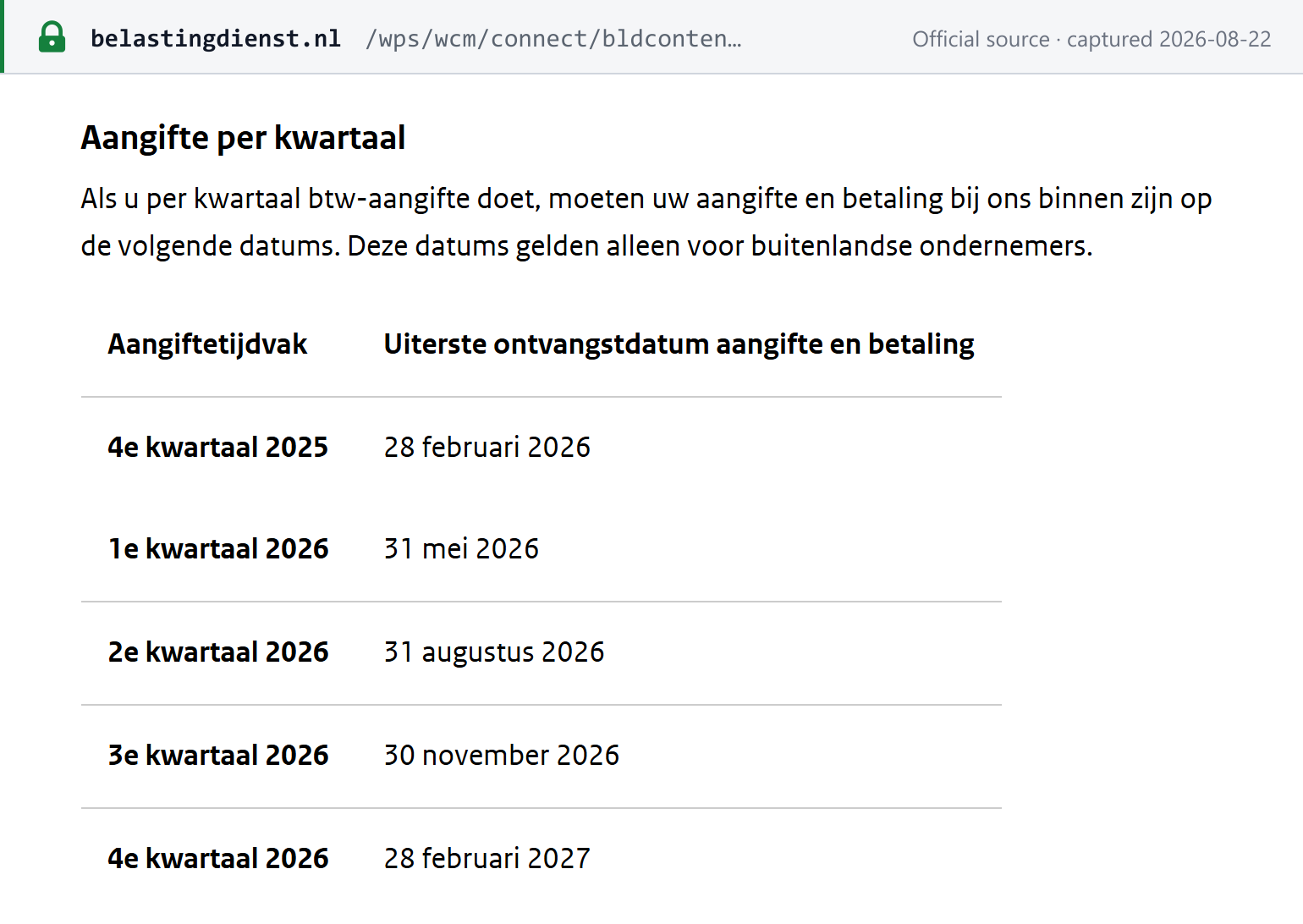
The most easily missed obligation on this calendar. Entrepreneurs not established in the Netherlands get two months, not one: Q4 2025 to 28 February 2026, Q1 2026 to 31 May 2026, Q2 to 31 August, Q3 to 30 November, Q4 2026 to 28 February 2027. Late-filing penalties: aangifteverzuim EUR 82; betalingsverzuim 3% of the unpaid tax, minimum EUR 50, maximum EUR 6,709, plus a naheffingsaanslag.
“Als u per kwartaal btw-aangifte doet, moeten uw aangifte en betaling bij ons binnen zijn op de volgende datums. Deze datums gelden alleen voor buitenlandse ondernemers.”
Btw-aangifte (omzetbelasting) — per maand, buitenlandse ondernemers
BTW (VAT) · Monthly · return filing
last day of the 2nd month after the month endsVerified 2026-08-23
Who files
Entrepreneurs NOT established in the Netherlands who file monthly. The return and the payment are both due on the last day of the SECOND month after the period — one month later than the domestic track. Filing and payment share this date.
Notes
The same two-month term, the same combined filing-and-payment date and the same penalty schedule as the quarterly foreign row: November 2025 is due 31 January 2026 and December 2025 is due 28 February 2026.
“Als u per maand btw-aangifte doet, moeten uw aangifte en betaling bij ons binnen zijn op de volgende datums. Deze datums gelden alleen voor buitenlandse ondernemers:”
last day of the month after the quarter endsVerified 2026-08-23
Who files
Entrepreneurs established in the Netherlands making intra-Community supplies of goods or services, where quarterly reporting is available: goods supplies must not exceed EUR 50,000 in the quarter being reported or in any of the previous four quarters. The EUR 50,000 threshold applies to GOODS ONLY — services may be reported quarterly regardless of amount. Due within 1 month of the end of the chosen tijdvak.
Notes
The ICP cadence is set independently of the BTW return cadence — it need not match, and a taxpayer supplying both goods and services may even report them on different cadences, monthly for goods and quarterly for services. No ICP is due for a period with no intra-Community supplies. Breaching the EUR 50,000 goods threshold mid-quarter splits the quarter, and reverting to quarterly requires four consecutive clean quarters.
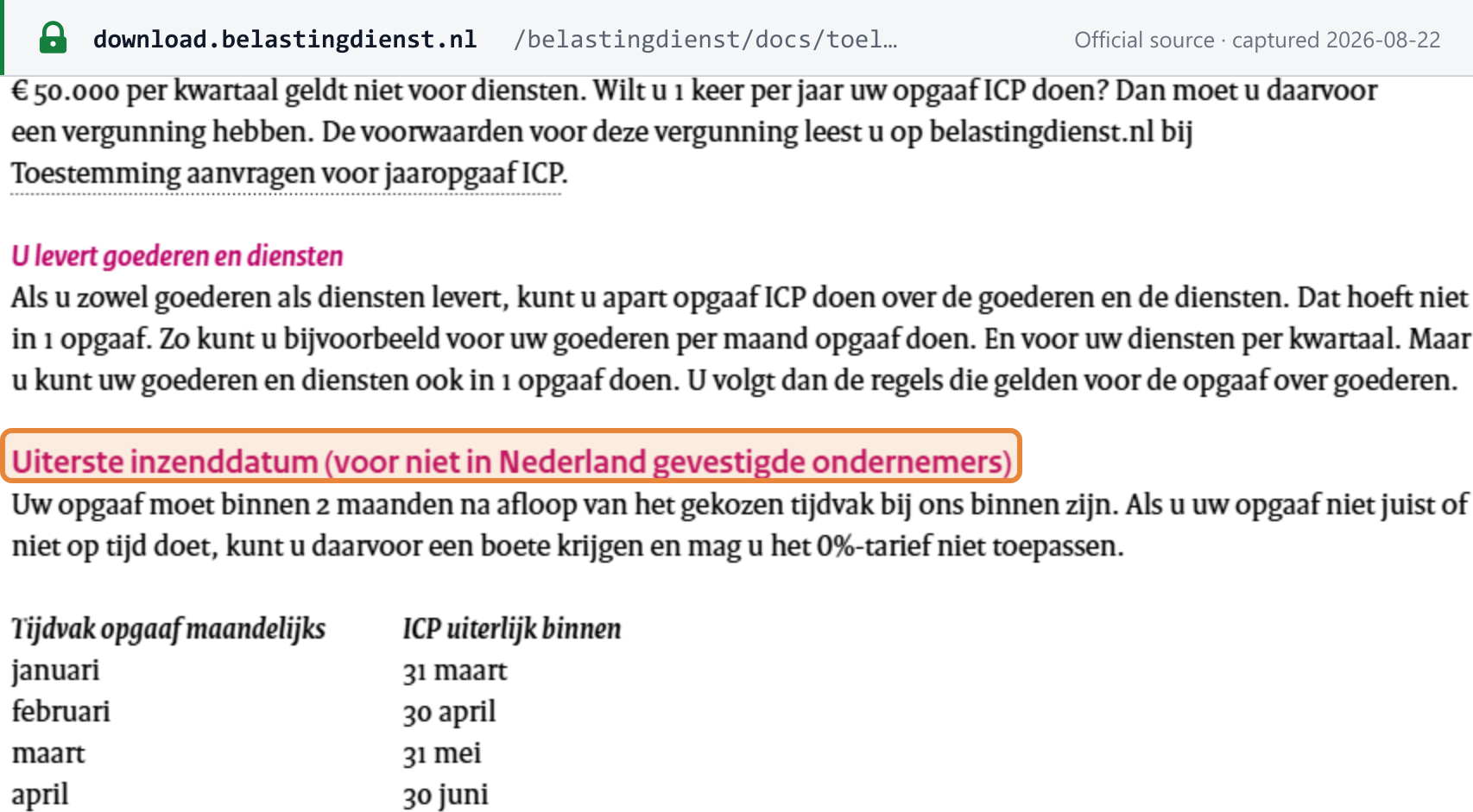
“Uw opgaaf moet binnen 1 maand na afloop van het gekozen tijdvak bij ons binnen zijn. Als u uw opgaaf niet juist of niet op tijd doet, kunt u daarvoor een boete krijgen en mag u het 0%-tarief niet toepassen.”
Captured from Belastingdienst on 2026-08-23
Opgaaf intracommunautaire prestaties (ICP) — per maand
last day of the month after the month endsVerified 2026-08-23
Who files
Entrepreneurs established in the Netherlands making intra-Community supplies, on the monthly cadence — the default where intra-Community goods supplies exceed EUR 50,000 in a quarter, and available by choice otherwise. Due within 1 month of the end of the tijdvak.
Notes
Due by the last day of the month following each calendar month (Wet OB 1968 art. 37a(1)).
“Uw opgaaf moet binnen 1 maand na afloop van het gekozen tijdvak bij ons binnen zijn. Als u uw opgaaf niet juist of niet op tijd doet, kunt u daarvoor een boete krijgen en mag u het 0%-tarief niet toepassen.”
Captured from Belastingdienst on 2026-08-23
Opgaaf intracommunautaire prestaties (ICP) — per jaar
Entrepreneurs established in the Netherlands who hold a vergunning permitting annual ICP reporting. Due within 1 month of the end of the year, i.e. 31 January of the following year.
Notes
An annual report row invites the reader to assume this is a reconciliation. It is not one: it is the recapitulative listing on an annual cadence, which requires a vergunning. Annual ICP reporting is not available to a taxpayer who exceeds the intra-Community thresholds.
“Uw opgaaf moet binnen 1 maand na afloop van het gekozen tijdvak bij ons binnen zijn. Als u uw opgaaf niet juist of niet op tijd doet, kunt u daarvoor een boete krijgen en mag u het 0%-tarief niet toepassen.”
Captured from Belastingdienst on 2026-08-23
Opgaaf intracommunautaire prestaties (ICP) — per kwartaal, buitenlandse ondernemers
last day of the 2nd month after the quarter endsVerified 2026-08-23
Who files
Entrepreneurs NOT established in the Netherlands, reporting intra-Community supplies quarterly. Due within TWO months of the end of the tijdvak — one month later than the domestic track, matching the two-month BTW return term.
Notes
Entrepreneurs not established in the Netherlands report within two months of the end of the tijdvak, not one. The Belastingdienst's buitenlandse-ondernemers ICP web page also quotes the general one-month rule from Wet OB 1968 art. 37a(1); in the non-established context that sentence is wrong and the two-month rule is the correct one, as the 2026 Toelichting sets out with a dedicated heading and a full date table per audience.
“Uw opgaaf moet binnen 2 maanden na afloop van het gekozen tijdvak bij ons binnen zijn. Als u uw opgaaf niet juist of niet op tijd doet, kunt u daarvoor een boete krijgen en mag u het 0%-tarief niet toepassen.”
“Uw opgaaf moet binnen 2 maanden na afloop van het gekozen tijdvak bij ons binnen zijn. Als u uw opgaaf niet juist of niet op tijd doet, kunt u daarvoor een boete krijgen en mag u het 0%-tarief niet toepassen.”
last day of the month after the quarter endsVerified 2026-08-23
Who files
Businesses registered for the Union scheme of the One-Stop-Shop with the Netherlands as their member state of identification, reporting distance sales of goods and B2C services to consumers in other EU member states. A nil melding is still required. Payment accompanies the melding on the same date.
Notes
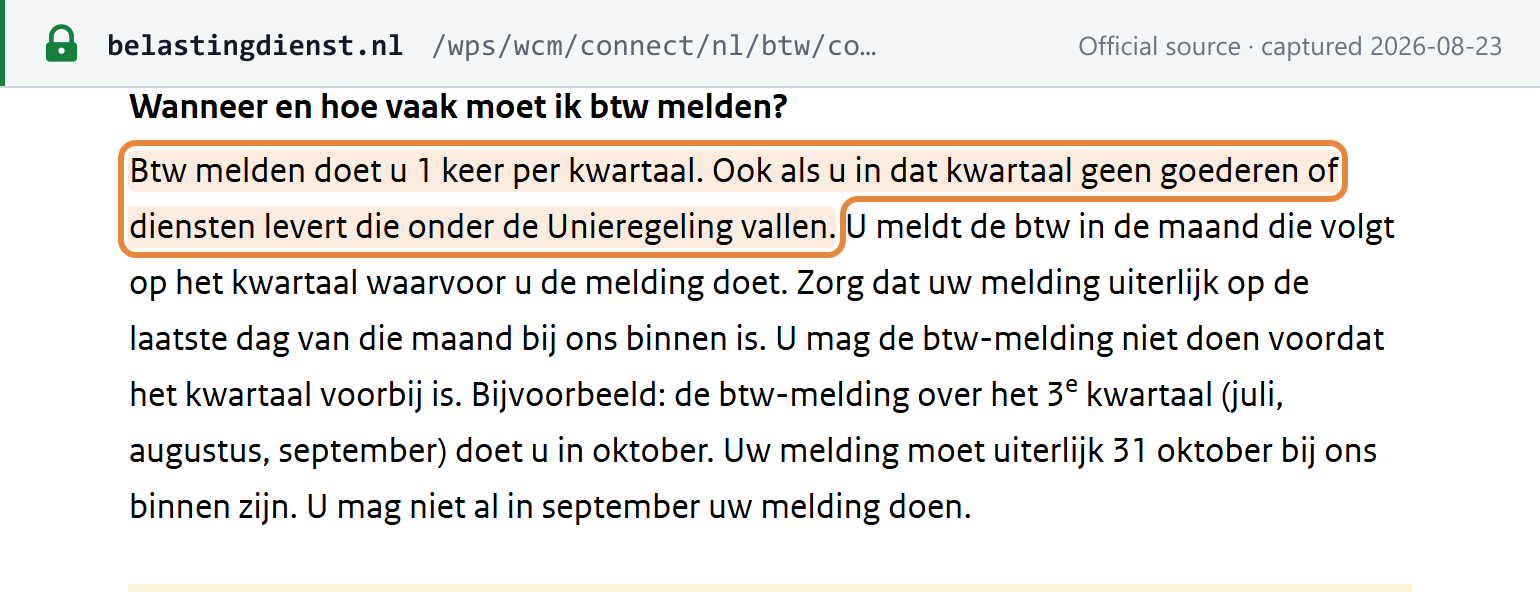
The melding for a quarter is due by the last day of the following month: the melding for Q3 (July, August, September) is filed in October and must arrive by 31 October. It may not be filed before the quarter has ended. Registration timing has its own rule worth knowing: the Union scheme may be used from the first day of the quarter following registration, but a business making its first supply may report it immediately provided the registration reaches the Belastingdienst by the 10th day of the month following the month of that supply.
“Btw melden doet u 1 keer per kwartaal. Ook als u in dat kwartaal geen goederen of diensten levert die onder de Unieregeling vallen. U meldt de btw in de maand die volgt op het kwartaal waarvoor u de melding doet. Zorg dat uw melding uiterlijk op de laatste dag van die maand bij ons binnen is.”
last day of the month after the month endsVerified 2026-08-23
Who files
Businesses registered for the Import scheme of the One-Stop-Shop with the Netherlands as their member state of identification, reporting distance sales of imported goods in consignments not exceeding EUR 150. A nil melding is still required.
Notes
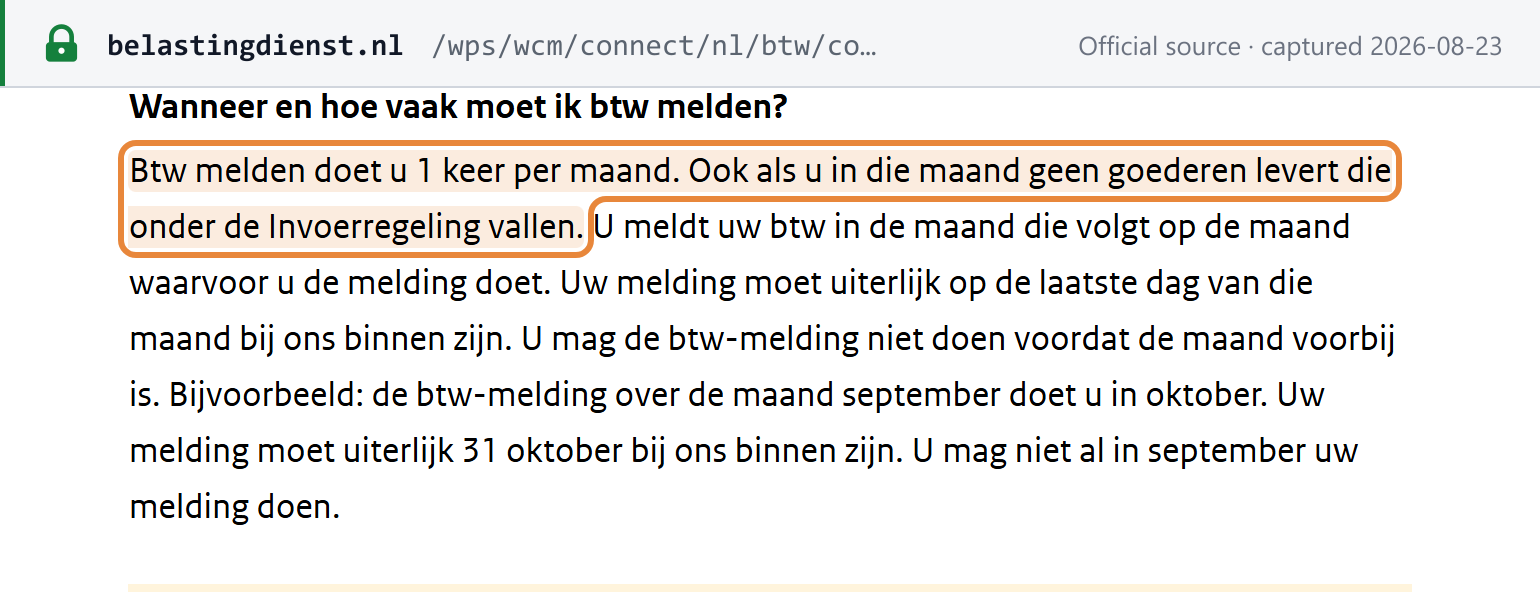
As with the Union scheme, the melding may not be filed before the reporting month has ended.
“Btw melden doet u 1 keer per maand. Ook als u in die maand geen goederen levert die onder de Invoerregeling vallen. U meldt uw btw in de maand die volgt op de maand waarvoor u de melding doet. Uw melding moet uiterlijk op de laatste dag van die maand bij ons binnen zijn.”
last day of the month after the month endsVerified 2026-08-23
Who files
Holders of an AGP (accijnsgoederenplaats) licence, for excise goods removed from the duty-suspension arrangement during the calendar month. The tijdvak is the calendar month under Uitvoeringsregeling AWR 1994 art. 26(1); the return is filed with, and the duty paid to, the Douane.
Notes
Excise goods removed from the AGP on 2 May must have their periodic return filed and the duty paid by 30 June — the last day of the month following the month of removal. Several excise sub-regimes are not covered here; see the jurisdiction notes above.
“De vergunninghouder AGP moet de aangifte binnen 1 maand na het einde van het tijdvak indienen en de op die aangifte verschuldigde accijns betalen (zie ook hoofdstuk 9).”
Captured from Douane (Belastingdienst/Douane) on 2026-08-23
last day of the month after the quarter endsVerified 2026-08-23
Who files
Businesses using the EU cross-border small-business exemption (EU-KOR, in force since 1 January 2025). The turnover report is due within 1 month of the end of the quarter, and is required even for a quarter with no turnover.
Notes
This is a turnover report under the SME scheme, not a listing of intra-Community customers. Filing late has a distinctive consequence: participation in the scheme can be terminated ('Doet u dat niet, dan kan uw deelname worden gestopt').
“U doet uw opgaaf kwartaalomzet binnen 1 maand na afloop van het kwartaal. Bijvoorbeeld: uw opgaaf kwartaalomzet over januari, februari en maart 2025 (Q1) doet u op uiterlijk 30 april 2025.”
Captured from Belastingdienst on 2026-08-23
Verzoek om uitnodiging tot het doen van aangifte (VAT registration)
BTW (VAT) · One-off · registration
within 1 month of the end of the first VAT period for which VAT is payable, where the Belastingdienst has not already issued a return (Uitv.reg. AWR 1994 art. 3(1))Verified 2026-08-23
Who files
A taxable person who has become liable to pay VAT but has not been invited by the Belastingdienst to file. Most businesses arrive here automatically via their KVK registration, which the KVK forwards; entities that cannot register at KVK use the form 'Opgaaf startende onderneming'.
Notes
Registration is triggered by becoming an ondernemer, not by turnover — this is not a 'register within N days of crossing a threshold' rule. The one turnover figure nearby runs the other way: the registratiedrempel exempts a business with turnover of at most EUR 2,200 a year that need not register at KVK, and it is lost at the moment of the supply that breaches it. Where you are claiming a refund rather than paying, the term is six months after the end of the calendar year concerned. The KOR (kleineondernemersregeling) has two notification deadlines that run backwards from a chosen effective date, so neither gets a calendar entry: joining, and voluntary exit, each needing 4 weeks' notice before the tijdvak it takes effect from. Compulsory exit on turnover passing EUR 20,000 in a calendar year is immediate, and the breaching transaction itself is fully taxable. KOR participation removes the VAT return obligation entirely, not merely the payment, though incidental returns are still required for certain EU transactions.
“Moet u btw betalen? Vraag de btw-aangifte dan aan binnen 1 maand na het tijdvak waarover u de btw moet betalen.”
Captured from Belastingdienst on 2026-08-23
Suppletie omzetbelasting (correction of a past return)
BTW (VAT) · One-off · other
within 56 days of establishing that a return for a period in the past five calendar years was incorrect or incomplete — eight weeks, and in any event before the inspector becomes aware (Uitv.besl. OB 1968 art. 15(2))Verified 2026-08-23
Who files
Any taxpayer who establishes that a VAT return for a period in the past five calendar years was incorrect or incomplete, such that too much or too little tax was paid. Triggered by discovery, not by the calendar.
Notes
A suppletie corrects a past return, and it is the reason this jurisdiction needs no annual wash-up return. It is due within eight weeks — 56 calendar days — of establishing that a return for a period in the past five calendar years was incorrect or incomplete. The eight-week deadline replaced the old 'zo spoedig mogelijk' wording with effect from 1 January 2025, so any summary older than that is stale. There is also an outer bound no date can express: the suppletie must be filed before the taxpayer knows or should reasonably suspect the inspector is aware of the error, which can fall well before the eight weeks expire.
“De suppletie moet gedaan worden voordat de belastingplichtige weet of redelijkerwijs moet vermoeden dat de inspecteur met de desbetreffende onjuistheid of onvolledigheid bekend is of zal worden, maar niet later dan acht weken nadat de belastingplichtige de onjuistheid of onvolledigheid heeft geconstateerd.”
Captured from Officiele overheidspublicaties (BWB repository) on 2026-08-23
Opgaaf intracommunautaire prestaties (ICP) — per jaar, buitenlandse ondernemers
Entrepreneurs NOT established in the Netherlands who hold a vergunning permitting annual ICP reporting. Due within TWO months of the end of the year — 28 or 29 February of the following year.
Notes
Two months after the end of the year: 28 February, or 29 February in a leap year, exactly as the Toelichting prints it — 'jaar / 28 of 29 februari van het volgende jaar'.
“Uw opgaaf moet binnen 2 maanden na afloop van het gekozen tijdvak bij ons binnen zijn. Als u uw opgaaf niet juist of niet op tijd doet, kunt u daarvoor een boete krijgen en mag u het 0%-tarief niet toepassen.”
last day of the month after the quarter endsVerified 2026-08-23
Who files
Businesses not established in the EU supplying services to EU consumers, using the non-Union scheme with the Netherlands as their member state of identification. Payment accompanies the melding on the same date.
Notes
Same quarterly cadence and the same end-of-following-month deadline as the Unieregeling, confirmed by the page's own worked example: the melding for the third calendar quarter must arrive by 31 October.
“U moet de btw melden en betalen in de maand die volgt op het kalenderkwartaal waarvoor u de melding doet. Uw melding en betaling moet uiterlijk op de laatste dag van die maand bij de lidstaat van identificatie binnen zijn.”
Captured from Belastingdienst on 2026-08-23
Verzoek om teruggaaf van Nederlandse btw — ondernemers uit niet-EU-landen
BTW (VAT) — refund claim · Annually · other
30th June each yearVerified 2026-08-23
Who files
Businesses established OUTSIDE the EU reclaiming Dutch VAT they were charged. The claim for a calendar year must be filed before 1 July of the following year.
Notes
The most missable annual date for a business with no Dutch establishment. Missing it does not extinguish the claim, which runs five years, but per the Belastingdienst it forfeits the right to bezwaar en beroep, so a late claimant keeps the money at stake and loses the means to argue for it.
“Dien uw verzoek in vóór 1 juli van het jaar volgend op het jaar waarover u btw terugvraagt.”
Captured from Belastingdienst on 2026-08-23
Verzoek om teruggaaf van Nederlandse btw — ondernemers uit andere EU-landen
BTW (VAT) — refund claim · Annually · other
30th September each yearVerified 2026-08-23
Who files
Businesses established in another EU member state reclaiming Dutch VAT, filing through their own member state’s portal. The claim for a calendar year must be filed before 1 October of the following year.
Notes
Three months later than the non-EU deadline, which is a distinction readers routinely get wrong in both directions. Filed through the claimant’s own member state, not directly with the Belastingdienst.
“Doe uw digitale verzoek om teruggaaf van Nederlandse btw over vorig jaar vóór 1 oktober van dit jaar.”
Captured from Belastingdienst on 2026-08-23
BTW (omzetbelasting), the Opgaaf ICP recapitulative listing, the OSS/IOSS btw-meldingen, the EU-KOR quarterly turnover report and accijns (excise). Payroll levies (loonheffingen), corporate and personal income tax and the KVK jaarrekening deponering appear beside these on Belastingdienst and KVK calendars but are outside this calendar's indirect-tax scope. Five structural points a reader should know, because none of them is visible from a due-date page. First, quarterly is the statutory default, not a concession. The kalenderkwartaal is the tijdvak; monthly arises only if the taxpayer asks or the inspector demands it, which the Belastingdienst may do when returns or payments arrive late, and annual is an inspector-designated 'ander tijdvak' granted on request against four cumulative conditions. Second, and the single biggest trap here: entrepreneurs not established in the Netherlands get two months, not one — for the return, the payment and the Opgaaf ICP alike. The Belastingdienst publishes a separate date table for them, headed 'Deze datums gelden alleen voor buitenlandse ondernemers'. Both tracks appear below as separate rows. Third, filing and payment share one date exactly — the Belastingdienst publishes a single column headed 'Uw aangifte en betaling moeten binnen zijn op'. But 'on time' for the payment half means the money is credited to the Belastingdienst account (bijschrijving), not sent, so bank processing eats into the same calendar date. Fourth, Dutch VAT deadlines do not shift off weekends or public holidays. AWR art. 19(5) expressly disapplies the Algemene termijnenwet to the one-month payment term, and the Belastingdienst's own published table behaves exactly that way, carrying 31 January 2026 (Saturday), 28 February 2026 (Saturday), 31 May 2026 (Sunday), 31 October 2026 (Saturday) and 31 January 2027 (Sunday) unshifted. Advisory sites that assert a next-working-day shift for BTW deadlines are wrong. Fifth, the artikel 23 import-VAT deferment licence moves no deadline. It changes where import VAT is declared — box 4a of the periodic return rather than payment at Customs — and therefore the cash flow, not any date. Its only calendar effect is negative: a holder may not file annually, so the licence forces at least a quarterly cadence. Taxpayers with a 12-month boekjaar that does not coincide with the calendar year file on boekjaarkwartalen and boekjaarmaanden. Those periods are per-taxpayer, so only the calendar-year track appears here and such filers should take their dates from their own aangiftebrief or Mijn Belastingdienst Zakelijk, which is in any case the per-filer source of truth. Not covered: the two-month Opgaaf ICP stub period, which is only ever entered after a mid-quarter breach of the EUR 50,000 goods threshold rather than run as a standing cadence; the excise sub-regimes (the weekly return for a geregistreerde geadresseerde, next-day payment for several events, the shortened term the inspector may impose when an AGP licence is withdrawn, and tobacco accijnszegel credit terms); assurantiebelasting, vliegbelasting and kansspelbelasting; the out-of-cycle final return due when a taxpayer ceases, other than temporarily, to be a taxable person; and the verbruiksbelasting van alcoholvrije dranken, kolenbelasting, afvalstoffenbelasting, belasting op leidingwater and energiebelasting.
What this calendar does not list
Not applicable Separate payment deadline — There is no SEPARATE payment deadline for Dutch VAT: the return and the payment fall due on the same date, and the Belastingdienst publishes them in a single column headed 'Uw aangifte en betaling moeten binnen zijn op'. AWR art. 19(1) sets the payment term at one month after the end of the tijdvak, which is the same term as the return. This is a closed question a verifier can test — no Belastingdienst page publishes a VAT payment date differing from its return date, on either the domestic or the buitenlandse-ondernemers track. One asymmetry survives and is stated on every return row instead: the payment counts as made on the date it is CREDITED to the Belastingdienst account ('Als betaaldatum geldt de datum waarop uw betaling is bijgeschreven op onze rekening'), so a reader who initiates a transfer on the deadline is late even though the return filed that day is on time.
Not applicable E-invoicing / e-reporting cycle — No Dutch instrument fixes a periodic e-invoicing or e-reporting submission deadline, so there is nothing to place on a calendar. Three separate things are true and none of them produces a cycle. (a) The only live mandate is B2G: e-invoicing to central government is mandatory, delivered over Peppol or the supplier portal (Logius), and it is invoice-triggered with no period-end submission date. The load-bearing half of this limb is that no submission CYCLE exists, which is confirmed; a commencement date of 2017 and an attribution to Directive 2014/55/EU were both considered and deliberately dropped, because no official page states the date as an operative rule and that directive obliges contracting authorities to RECEIVE e-invoices rather than obliging suppliers to send them. (b) There is NO domestic B2B mandate and no legislated commencement date — the cabinet response to the ViDA e-invoicing study of 10 March 2026 schedules an internet consultation on a draft bill for Q4 2026, which is policy, not law. (c) EU-level cross-border digital reporting under the ViDA package commences 1 July 2030 and is per-transaction rather than period-end, so it will not create a calendar row even then. This is deliberately not-applicable rather than a gap: unlike the French e-reporting case, where a real instrument fixes real periodic deadlines that merely have not started, no Dutch instrument fixes one at all.
New Netherlands rules taking effect
Confirmed changes from the weekly scan — each links to its full record with the official source.
Which Netherlands tax deadlines does this calendar cover?
20 recurring indirect-tax obligations — BTW (VAT) and Accijns (excise duty) returns, payments and related filings — each with the due-date rule, who must file, and the official source that states the deadline. Direct-tax, payroll and company-registry deadlines are out of scope.
How current are these due dates?
Every obligation carries the date it was last verified against its official source (newest: 2026-08-23). Law-change dates come from the weekly Last Week in Taxes scan and link to their full change records.
Do the dates account for weekends and public holidays?
No — the calendar shows the statutory due date. Where the authority shifts deadlines falling on non-working days, the obligation notes say so. Confirm against the linked official source before relying on a date.

 Open full size Captured from Belastingdienst on 2026-08-22