Dutch Parliament adopts the ViDA single VAT registration bill 36 920: Eerste Kamer disposed of it on 6 October 2026
This page records one dated change. For the rules in Netherlands as they stand today, see the Netherlands guide →
- Jurisdiction
- Netherlands
- Tax
- VAT
- Change type
- Registration
- Status
- Enacted
- Impact
- Plan ahead
- Announced
- 6 October 2026
- Effective
- 1 January 2027
- Authority
- Eerste Kamer der Staten-Generaal
- Systems
- Tax engine, Reporting, ERP
- Verified
- Fetched from official source · high confidence
Businesses using the Union OSS and other one-stop-shop schemes in the Netherlands, including those moving goods between member states.
Prepare OSS/Union scheme and transfer-of-goods changes for 1 January 2027.
Tax engineReportingERP
The Eerste Kamer disposed of bill 36 920 (Wet implementatie Richtlijn btw in het digitale tijdperk - enkele btw-registratie) as a hamerstuk on 6 October 2026, after the Tweede Kamer did so on 17 September 2026. Entry into force is 1 January 2027 (or the day after Staatsblad publication, retroactive to 1 January 2027, if published later). No Staatsblad publication found yet.
What changed in detail
Both chambers of the Dutch Parliament have now dealt with bill 36 920, the Wet implementatie Richtlijn btw in het digitale tijdperk - enkele btw-registratie. The Eerste Kamer disposed of it as a hamerstuk (a formality item adopted without debate) on 6 October 2026, after the Tweede Kamer did the same on 17 September 2026. This moves the position recorded in nl-vida-bill-36920-tweede-kamer-passed, where only the lower house had acted.
The bill implements the single VAT registration part of Directive (EU) 2025/516 (ViDA), extending the existing one-stop-shop schemes and gradually abolishing the call-off stock arrangement and replacing it with a new transfer-of-goods scheme.
Entry into force is 1 January 2027. If the law is published in the Staatsblad later, it enters into force the day after publication, with retroactive effect to 1 January 2027. No Staatsblad publication had been found by 12 October 2026, so the law is adopted but not yet promulgated.
What it means
With both chambers done, the remaining step is publication, so 1 January 2027 is now the working date. The retroactive clause means a late publication does not move the date for businesses.
Companies using the Union OSS or holding call-off stock should treat the changes as in force from 1 January 2027 and prepare transfer-of-goods and OSS reporting adjustments. Confirm the final text once it appears in the Staatsblad.
Proof
De Eerste Kamer heeft het voorstel op 6 oktober 2026 als hamerstuk afgedaan.The Eerste Kamer disposed of the proposal as a hamerstuk (without debate) on 6 October 2026.
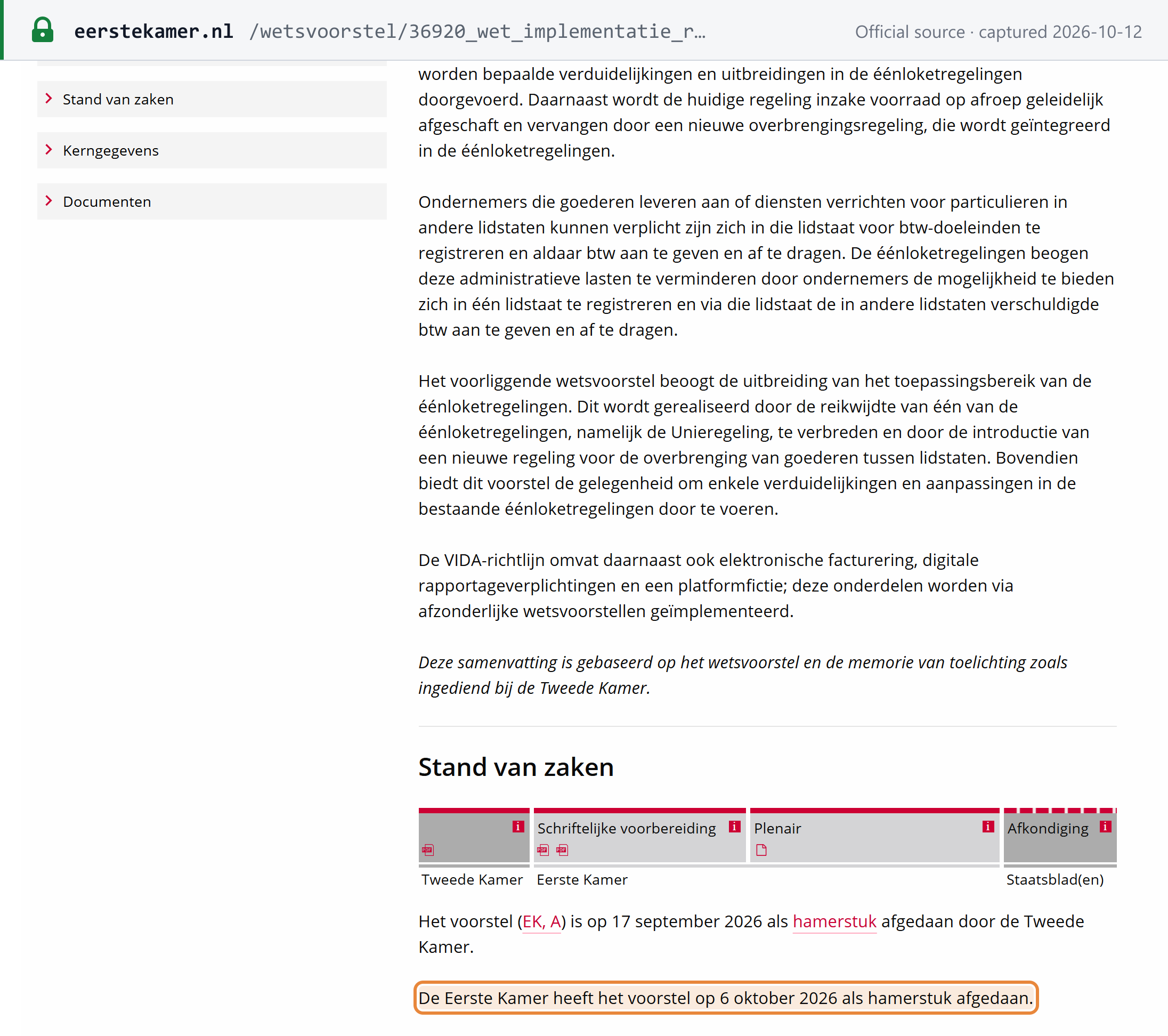 Source snapshot of the official page. Open full size ↗
Sources
What this replaces
- Dutch bill 36 920 on single VAT registration passes the Tweede Kamer and goes to the Eerste Kamer effective 1 January 2027