15 recurring Thuế GTGT (VAT), Thuế tiêu thụ đặc biệt (special consumption tax), Thuế bảo vệ môi trường (environmental protection tax) and 2 more obligations — returns, payments and listings — each with its due rule and official source, plus the dates new Vietnam rules take effect.
Dates already include the weekend and public-holiday shift where Vietnam applies one — 12 of 15 obligations here do. The rest stand as computed, and each obligation's notes say which applies to it and why. Confirm against the linked official source before relying on a date.
Recurring obligations, with sources
Each deadline cites the official text that states it and the date we last verified it.
Tờ khai thuế GTGT — theo tháng (mẫu 01/GTGT)
Thuế GTGT (VAT) · Monthly · return filing
20th of the month after the month endsVerified 2026-08-23
Who files
The default for every VAT-registered organisation. Monthly filing applies unless you have elected quarterly and been accepted; the election is open only where total revenue from goods and services in the immediately preceding year was VND 50 billion or less, and the choice is then fixed for the whole calendar year.
Notes
Filing and payment share this date — Vietnam sets no separate VAT payment deadline, so the 20th is when both are due. If the 20th falls on a weekend or a public holiday it moves forward to the next working day. Monthly is the default: quarterly filing has to be applied for, and you keep whichever basis you are on for the whole calendar year. If it later turns out you did not qualify for quarterly, you must go back and re-file each of those quarters month by month and pay late-payment interest, though you are not fined for the late substitute returns.
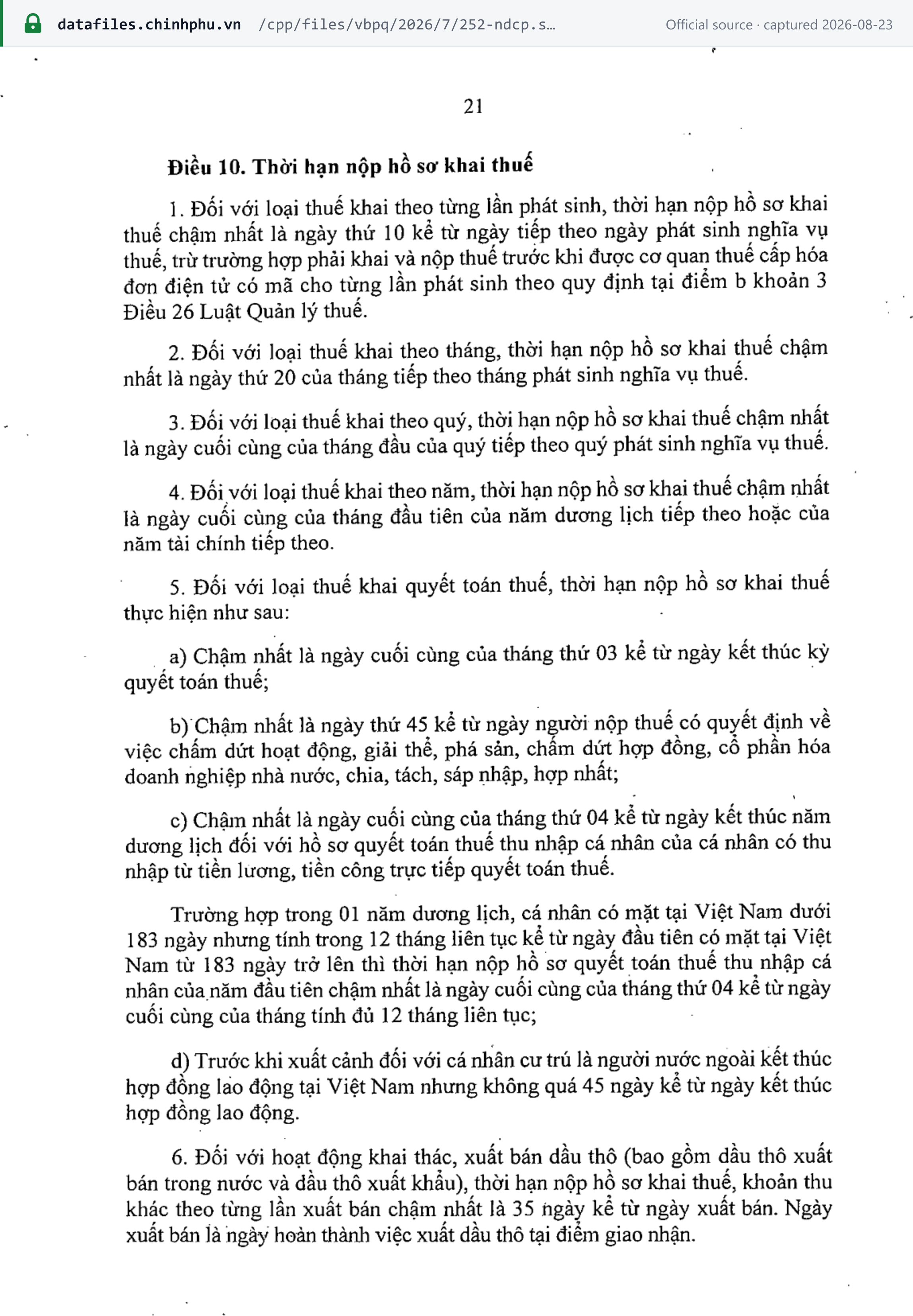
“2. Đối với loại thuế khai theo tháng, thời hạn nộp hồ sơ khai thuế chậm nhất là ngày thứ 20 của tháng tiếp theo tháng phát sinh nghĩa vụ thuế.”
Open full size Captured from Công Báo — Official Gazette of the Government of Vietnam on 2026-08-23
Tờ khai thuế GTGT — theo quý (mẫu 01/GTGT)
Thuế GTGT (VAT) · Quarterly · return filing
last day of the month after the quarter endsVerified 2026-08-23
Who files
Taxpayers who have elected quarterly VAT filing and been accepted — available where total revenue from the sale of goods and supply of services in the immediately preceding year was VND 50 billion or less. A newly-started business may elect quarterly from the outset and re-tests against the preceding calendar year after twelve full months.
Notes
The last day of the first month after the quarter — 30 April, 31 July, 31 October and 31 January. Payment rides the same date, and the deadline moves forward if it lands on a weekend or a public holiday. To move onto quarterly filing you send the election form to your managing tax office by 31 January of the year it is to start, and you can only file quarterly once the office issues a notice accepting it.
“3. Đối với loại thuế khai theo quý, thời hạn nộp hồ sơ khai thuế chậm nhất là ngày cuối cùng của tháng đầu của quý tiếp theo quý phát sinh nghĩa vụ thuế.”
Open full size Captured from Công Báo — Official Gazette of the Government of Vietnam on 2026-08-23
20th of the month after the month endsVerified 2026-08-23
Who files
Producers and importers of goods, and providers of services, subject to special consumption tax — tobacco, alcohol, beer, motor vehicles under 24 seats, petrol, air conditioners, playing cards, votive goods, and services such as discotheques, massage, casinos, betting, golf and lotteries.
Notes
Special consumption tax is a monthly tax with the same 20th-of-the-following-month deadline as VAT, and the same forward shift off weekends and public holidays. Filing and payment share the date.
20th of the month after the month endsVerified 2026-08-23
Who files
Producers and importers of goods subject to environmental protection tax — petrol, oil and grease, coal, HCFC solutions, plastic bags, and certain restricted-use pesticides, preservatives and disinfectants. A producer in a province other than its head office files where production takes place; coal producers and traders file where the mine or trading base is; petrol has its own rule putting the obligation on the lead trader.
Notes
A monthly tax on the same 20th deadline as VAT, with the same forward shift. Where you file matters as much as when: a producer operating outside its head-office province files in the province where production happens, and coal and petrol have their own rules, so a multi-province business can owe several returns on one date.
20th of the month after the month endsVerified 2026-08-23
Who files
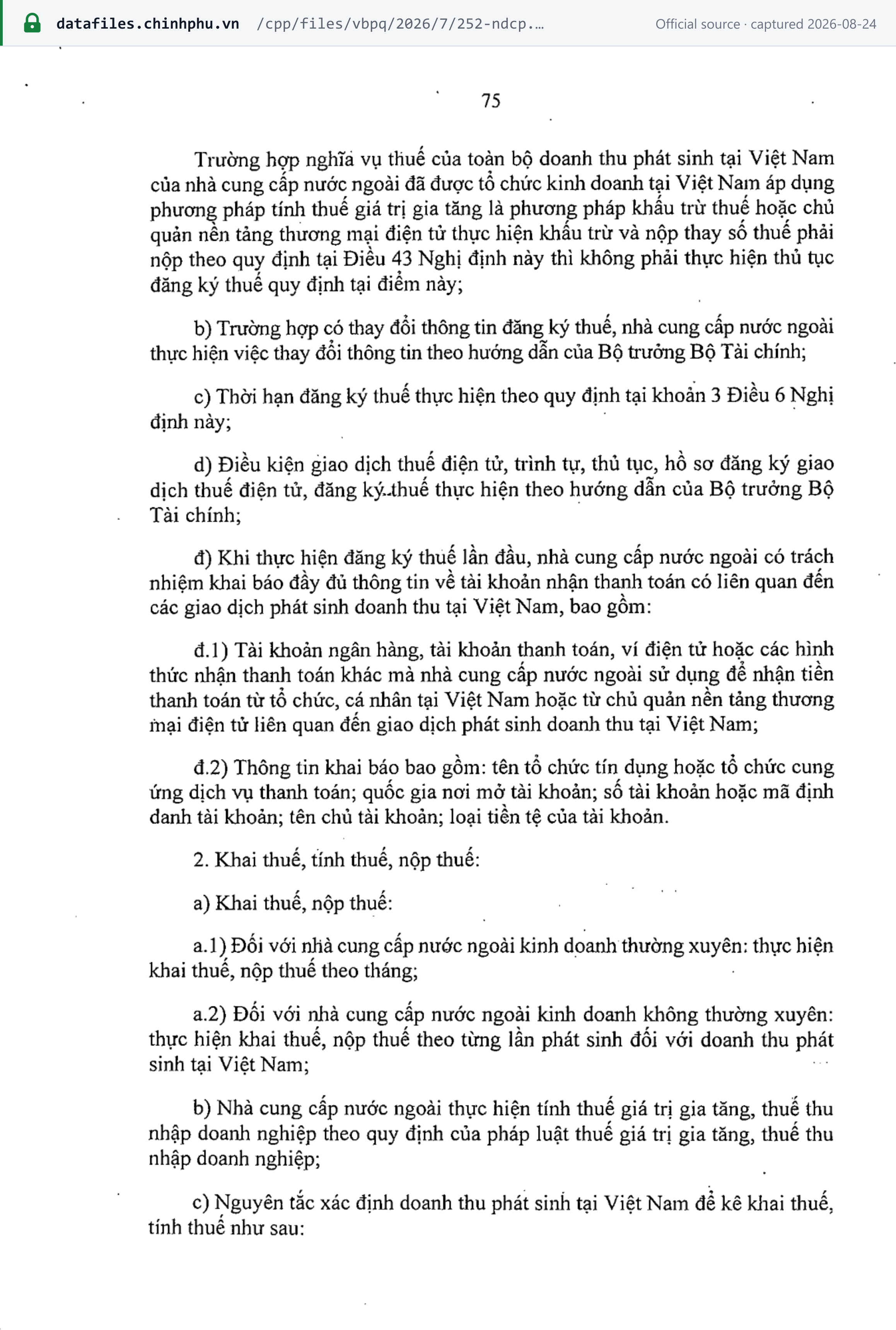
Foreign ORGANISATIONS supplying goods or services to Vietnamese consumers, including through e-commerce and digital platforms, that trade regularly. A foreign organisation trading irregularly declares per transaction instead. Non-resident INDIVIDUALS are not on this grid at all — they file per occurrence under a separate article.
Notes
This regime is monthly, and that is a change most guidance has not caught up with — it was quarterly until 1 July 2026, so any page still describing a quarterly foreign-supplier return is describing repealed law. A foreign supplier that trades regularly in Vietnam files and pays by the 20th of the following month; one that trades only occasionally declares per transaction instead.
20th of the month after the month endsVerified 2026-08-23
Who files
Operators of e-commerce platforms with an online ordering function, and operators of other digital platforms, that withhold and pay tax on behalf of sellers trading through them. Vietnamese organisations in this position declare per occurrence by default and may elect monthly.
Notes
Platforms that take orders online withhold tax from their sellers and pay it over monthly, by the 20th of the following month. The obligation sits on the platform, not on the seller, so a seller trading only through a withholding platform may have nothing of its own to file for those sales.
20th of the month after the month endsVerified 2026-08-23
Who files
Vietnamese parties that withhold a foreign contractor's VAT and corporate income tax and have registered to declare monthly. The default is a declaration per payment; monthly declaration is available by registration where the Vietnamese party pays the contractor more than once in a month.
Notes
If you pay a foreign contractor that does not declare its own Vietnamese tax, you withhold it. The default is a declaration for each payment, but if you pay the same contractor more than once in a month you can register to declare monthly instead and file by the 20th. Unusually for Vietnam, there is no nil return here: a month with no payment to the contractor needs no filing.
last day of the month after the quarter endsVerified 2026-08-23
Who files
Business households and business individuals whose annual revenue is at or below VND 50 billion. Households with revenue at or below VND 1 billion a year are outside VAT altogether.
Notes
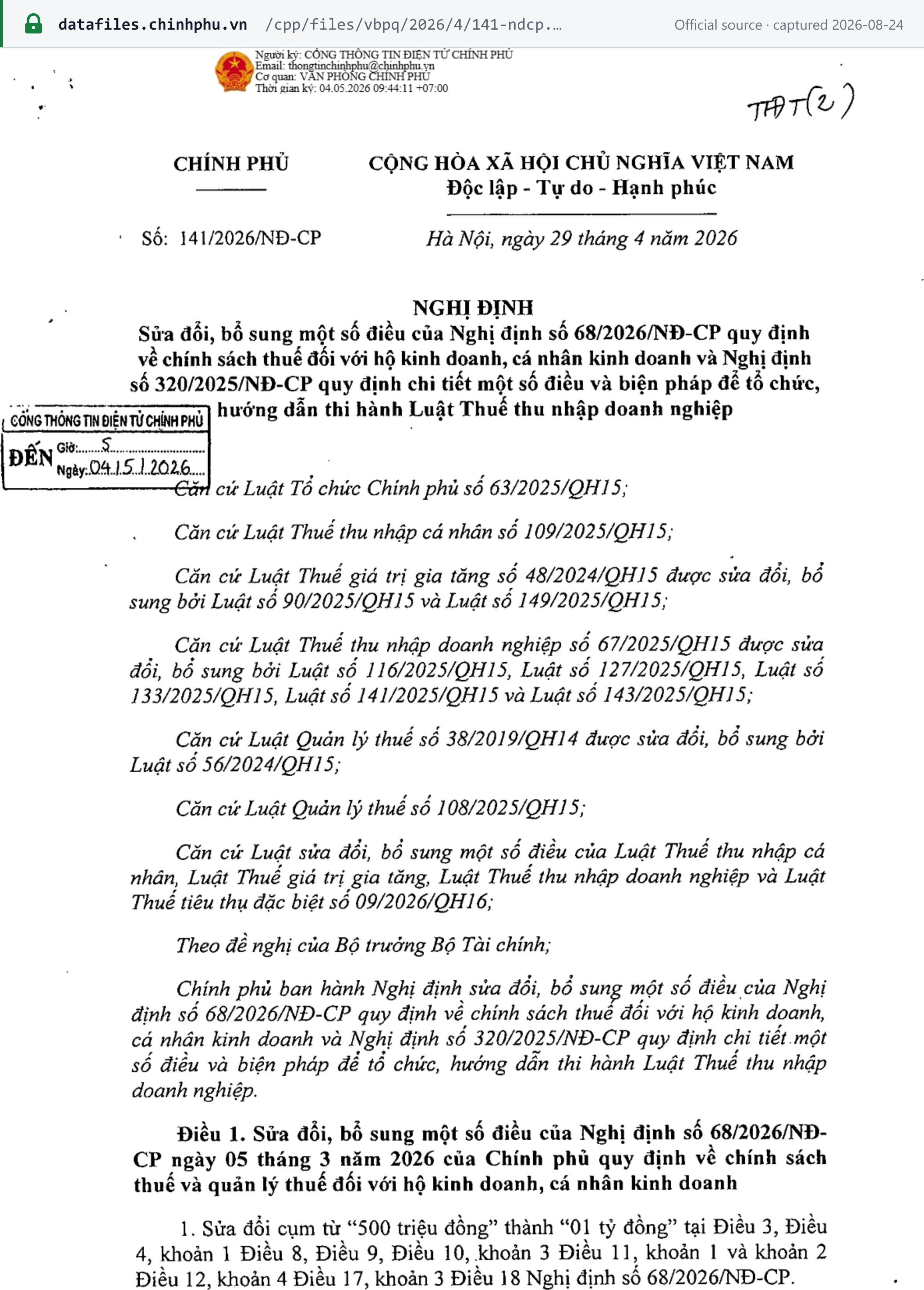
Business households declare quarterly, by the last day of the first month after the quarter. The threshold that matters most is the one below this: if your annual revenue is VND 1 billion or less you are outside VAT entirely. That figure was raised from VND 500 million with retrospective effect to 1 January 2026, so guidance published earlier in 2026 states a threshold that is half the real one.
20th of the month after the month endsVerified 2026-08-23
Who files
Business households and business individuals whose annual revenue exceeds VND 50 billion.
Notes
A business household big enough to pass VND 50 billion of annual revenue moves onto monthly filing, by the 20th of the following month, on the same cycle as an ordinary company.
“b) Trường hợp khai thuế theo tháng thì thời hạn nộp hồ sơ khai thuế chậm nhất là ngày thứ 20 của tháng tiếp theo tháng phát sinh nghĩa vụ thuế trừ trường hợp khai thuế theo quy định tại khoản 1 Điều 18 Nghị định này;”
Captured from Công Báo — Official Gazette of the Government of Vietnam on 2026-08-23
ONLY business households and business individuals whose self-assessed annual revenue is at or below the VAT-exempt floor of VND 1 billion. A household above that floor owes no notification — it files returns instead.
Notes
If your household turnover is at or below VND 1 billion a year you are outside VAT, but you still have to tell the tax office what you actually earned — by 31 January for the year just ended. Above that floor you owe returns instead, and no notification. There is a second date people miss: if you started trading in the first half of a year, the first half-year figure is notified by 31 July and the second by 31 January. Ordinary VAT has no annual reconciliation at all, so a VAT-registered company has nothing further to do at year end.
“thông báo doanh thu thực tế phát sinh trong năm với cơ quan thuế chậm nhất là ngày 31 tháng 01 của năm dương lịch tiếp theo.”
Captured from Công Báo — Official Gazette of the Government of Vietnam on 2026-08-23
Bảng tổng hợp dữ liệu hóa đơn điện tử — theo tháng
Hóa đơn điện tử (e-invoicing) · Monthly · report / listing
20th of the month after the month endsVerified 2026-08-23
Who files
Sellers using e-invoices without a tax-authority code, on monthly VAT periods, in the listed activities: post and telecommunications, insurance, banking and finance, air transport, securities, crypto-assets and carbon-exchange trading; sales of electricity and water where a customer code or customer tax code is held; and sales by foreign organisations trading through an e-commerce or other digital platform in Vietnam.
Notes
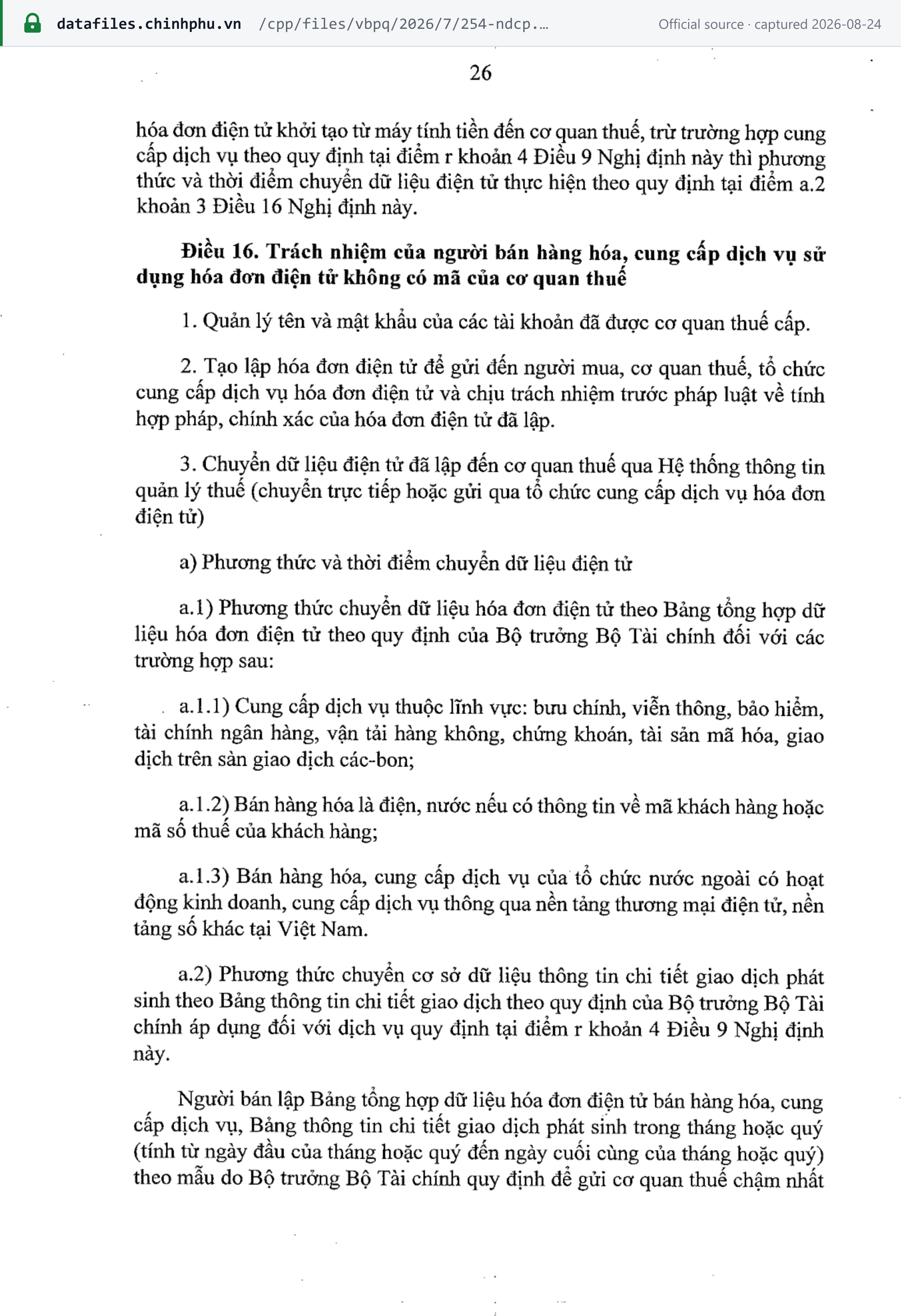
If you issue e-invoices without a tax-authority code in one of the listed sectors, you also send the tax office a periodic summary of that invoice data — and its deadline is defined as your VAT return deadline, so it falls on the same day. It is a separate submission from the per-invoice transmission duty: sending each invoice as it is issued does not discharge this one.
“Người bán lập Bảng tổng hợp dữ liệu hóa đơn điện tử bán hàng hóa, cung cấp dịch vụ, Bảng thông tin chi tiết giao dịch phát sinh trong tháng hoặc quý (tính từ ngày đầu của tháng hoặc quý đến ngày cuối cùng của tháng hoặc quý) theo mẫu do Bộ trưởng Bộ Tài chính quy định để gửi cơ quan thuế chậm nhất là thời hạn gửi Tờ khai thuế giá trị gia tăng theo quy định pháp luật về quản lý thuế.”
Open full size Captured from Công Báo — Official Gazette of the Government of Vietnam on 2026-08-23
Bảng tổng hợp dữ liệu hóa đơn điện tử — theo quý
Hóa đơn điện tử (e-invoicing) · Quarterly · report / listing
last day of the month after the quarter endsVerified 2026-08-23
Who files
The same population as the monthly summary, for sellers on quarterly VAT periods. The summary follows whichever VAT period you are on, because its deadline is defined as your VAT return deadline.
Notes
The quarterly version of the same summary, for sellers on quarterly VAT periods — due on the same day as the quarterly VAT return.
“Người bán lập Bảng tổng hợp dữ liệu hóa đơn điện tử bán hàng hóa, cung cấp dịch vụ, Bảng thông tin chi tiết giao dịch phát sinh trong tháng hoặc quý (tính từ ngày đầu của tháng hoặc quý đến ngày cuối cùng của tháng hoặc quý) theo mẫu do Bộ trưởng Bộ Tài chính quy định để gửi cơ quan thuế chậm nhất là thời hạn gửi Tờ khai thuế giá trị gia tăng theo quy định pháp luật về quản lý thuế.”
Open full size Captured from Công Báo — Official Gazette of the Government of Vietnam on 2026-08-23
Đăng ký thuế lần đầu
Quản lý thuế (tax administration) · One-off · registration
within 10 business days of the establishment licence, the first day of trading, the signing of a contract by a directly-declaring foreign contractor, or the first tax liability, whichever appliesVerified 2026-08-23
Who files
Organisations and individuals that register directly with the tax authority — including foreign contractors and sub-contractors declaring tax directly, and businesses outside the business-registration system. Businesses registered through the one-stop company-registration route get a tax code automatically and have no separate deadline.
Notes
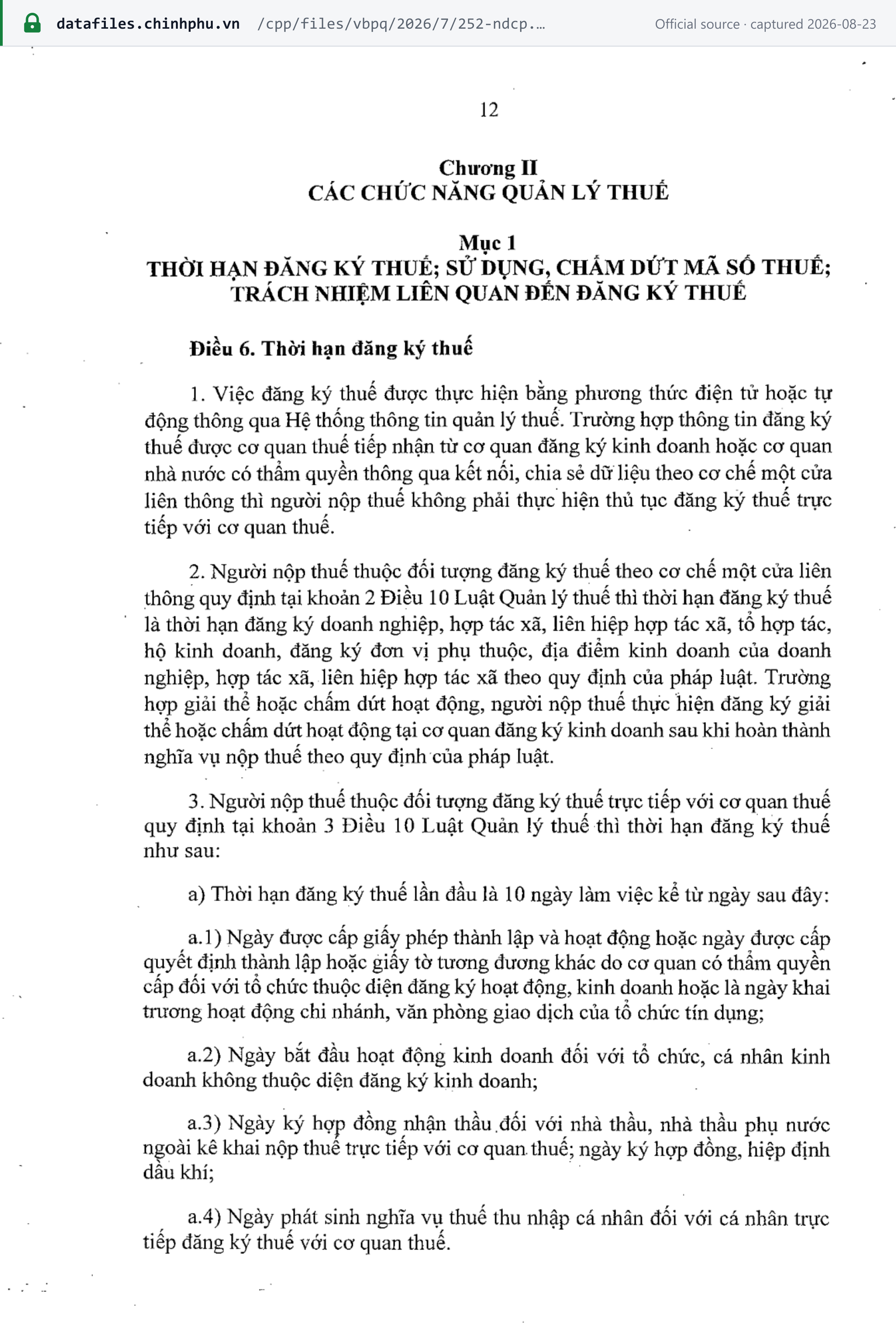
Ten working days, not ten calendar days — roughly two weeks in practice. Most companies never meet this deadline because they never face it: if you register through the one-stop company-registration route your tax code is issued automatically from the business-registration record. It bites on the businesses outside that system, and on foreign contractors that declare their own Vietnamese tax, where the clock runs from signing the contract.
“a) Thời hạn đăng ký thuế lần đầu là 10 ngày làm việc kể từ ngày sau đây:”
Open full size Captured from Công Báo — Official Gazette of the Government of Vietnam on 2026-08-23
Thay đổi thông tin đăng ký thuế
Quản lý thuế (tax administration) · One-off · registration
within 10 business days of a change in the registered tax particularsVerified 2026-08-23
Who files
Taxpayers registering directly with the tax authority whose registration particulars change.
Notes
Changes to your registered tax details must be notified within 10 working days — but not everyone gets 10. An individual changing their name, personal identification number or passport gets 20 working days, and 30 in mountainous, border and island communes. As with first registration, businesses inside the one-stop company-registration system generally update through that route instead.
Quản lý thuế (tax administration) · One-off · registration
within 10 business days of ceasing activity or the event requiring the tax code to be deactivatedVerified 2026-08-23
Who files
Taxpayers registering directly with the tax authority that cease activity or otherwise need their tax code deactivated.
Notes
Deactivating a tax code carries the same 10-working-day window as registering one. Closing down does not end your filing duties until the code is actually deactivated.
“Người nộp thuế nộp hồ sơ chấm dứt hiệu lực mã số thuế đến cơ quan thuế quản lý trực tiếp trong thời hạn 10 ngày làm việc kể từ ngày có văn bản chấm dứt hoạt động hoặc chấm dứt hoạt động kinh doanh hoặc ngày kết thúc hợp đồng.”
Captured from Công Báo — Official Gazette of the Government of Vietnam on 2026-08-23
Thuế GTGT (VAT), thuế tiêu thụ đặc biệt (special consumption tax), thuế bảo vệ môi trường (environmental protection tax), the foreign-supplier and platform-withholding regimes, business households, and the periodic e-invoice data summary. Corporate income tax, personal income tax and social insurance appear on the same tax-office surfaces but are outside this calendar's indirect-tax scope. Four things a reader should know, none of them visible from a due-date page. First, and it invalidates almost every Vietnamese filing-deadline source published before mid-2026: the whole tax-administration framework was replaced on 1 July 2026. The Tax Administration Law, the decree that carried the deadlines, the circular that carried the cohort rules and the e-invoicing decree were all repealed and re-enacted on the same day. If a page cites Law 38/2019, Decree 126/2020, Circular 80/2021 or Decree 123/2020 for a deadline, it is describing dead law, and those pages are still online, so the wrong answer is easy to find. Second, the dates themselves are simple and shared: a monthly tax is due on the 20th of the following month, a quarterly tax on the last day of the first month after the quarter, and an annual one on the last day of January. Filing and payment share a single date — Vietnam fixes no separate payment deadline for any indirect tax. Third, deadlines move forward off rest days. Where the last day falls on a rest day, the deadline becomes the next working day, and the rule covers filing, payment and the authority's own processing alike. Fourth, the foreign-supplier regime became monthly on 1 July 2026. It was quarterly before that, and this is the single change most third-party guidance has not caught up with. Vietnam has no annual VAT return — there is no VAT finalisation in Vietnamese law at all, so a company filing monthly or quarterly has nothing further to do at year end. It also has no recapitulative listing: Vietnam is not part of a VAT union and there is no EC-Sales-List equivalent. The annual obligation shown here belongs to business households, which notify their revenue for the previous year by 31 January.
“Trường hợp ngày cuối cùng của thời hạn nộp hồ sơ khai thuế, thời hạn nộp thuế, thời hạn cơ quan quản lý thuế giải quyết hồ sơ thuế trùng với ngày nghỉ theo quy định thì ngày cuối cùng của thời hạn được tính là ngày làm việc liền kề sau ngày nghỉ đó.”
Captured from Cục Thuế (General Department of Taxation) on 2026-08-23
What this calendar does not list
Not applicable Annual or reconciliation return — Vietnam has no annual VAT return. There is no VAT finalisation in Vietnamese law at all, so a company filing monthly or quarterly has nothing further to do at year end; the phrase does not appear in the Tax Administration Law, the tax-administration decree or the e-invoicing decree. Finalisation exists only for corporate income tax, personal income tax and natural-resources tax, all of which are outside this calendar's indirect-tax scope. The one annual date shown here is a revenue notification owed by small business households that are below the VAT threshold and therefore outside VAT — it is not an annual return, and answering this question with it would tell a VAT-registered reader the wrong thing.
Not applicable Separate payment deadline — Vietnam fixes no separate payment date for any indirect tax. The Tax Administration Law makes the payment deadline for a self-assessed tax the last day of the filing deadline, and the tax-administration decree simply refers back to it, so every date shown here is a file-and-pay date. The one quarterly provisional-payment mechanism in Vietnamese tax is corporate income tax, which this calendar does not cover.
Not applicable Recapitulative listing — Vietnam has no recapitulative or customer listing to file. It is not part of a VAT union, so there is no equivalent of an EC Sales List, and no domestic duty to report your customers to the tax office periodically. The one thing that comes close never reaches the tax authority: a dependent branch or sales agent draws up a list of goods sold and sends it to the establishment that delivered them, so that establishment can raise the VAT invoice, and where volumes are large it may do so every five or ten days. The periodic e-invoice data summary that does go to the tax office is a separate obligation and is listed above.
New Vietnam rules taking effect
Confirmed changes from the weekly scan — each links to its full record with the official source.
Which Vietnam tax deadlines does this calendar cover?
15 recurring indirect-tax obligations — Thuế GTGT (VAT), Thuế tiêu thụ đặc biệt (special consumption tax), Thuế bảo vệ môi trường (environmental protection tax), Hóa đơn điện tử (e-invoicing) and Quản lý thuế (tax administration) returns, payments and related filings — each with the due-date rule, who must file, and the official source that states the deadline. Direct-tax, payroll and company-registry deadlines are out of scope.
How current are these due dates?
Every obligation carries the date it was last verified against its official source (newest: 2026-08-23). Law-change dates come from the weekly Last Week in Taxes scan and link to their full change records.
Do the dates account for weekends and public holidays?
No — the calendar shows the statutory due date. Where the authority shifts deadlines falling on non-working days, the obligation notes say so. Confirm against the linked official source before relying on a date.

 Open full size Captured from Công Báo — Official Gazette of the Government of Vietnam on 2026-08-23