European Commission proposes extending the optional VAT reverse charge and Quick Reaction Mechanism to 30 June 2030
This change is proposed and is not law. The rules below describe what would change if it is adopted.
- Jurisdiction
- European Union
- Tax
- VAT
- Change type
- Update
- Status
- Proposed
- Impact
- Watch
- Announced
- 1 October 2026
- Authority
- European Commission — Taxation and Customs Union
- Systems
- Tax engine, Invoicing, Reporting
- Verified
- Fetched from official source · high confidence
VAT-registered businesses supplying goods and services in Member States that apply the optional reverse charge (Art. 199a) or the Quick Reaction Mechanism (Art. 199b) of Directive 2006/112/EC.
No action - monitoring only. Proposal only; existing Art. 199a/199b expiry of 31 December 2026 stands unless the Council adopts the Directive.
Tax engineInvoicingReporting
On 1 October 2026 the European Commission adopted COM(2026) 515 final (2026/0292 (CNS)), a proposal for a Council Directive amending Directive 2006/112/EC to extend the application period of the optional reverse charge mechanism (Article 199a(1)) and of the Quick Reaction Mechanism (Article 199b(6)) to 30 June 2030. The proposal states that both mechanisms currently expire on 31 December 2026. The proposed Directive would enter into force on the twentieth day after publication in the Official Journal. The Commission transmitted it to the Council on 1 October 2026 (Council doc. 13970/26, dated 2 October 2026).
What changed in detail
This is a proposal, not law. On 1 October 2026 the European Commission adopted COM(2026) 515 final (2026/0292 (CNS)), a proposal for a Council Directive amending Directive 2006/112/EC. It would extend the application period of the optional reverse charge mechanism (Article 199a(1)) and of the Quick Reaction Mechanism (Article 199b(6)) to 30 June 2030.
The proposal states that both mechanisms currently expire on 31 December 2026. The proposed Directive would enter into force on the twentieth day after publication in the Official Journal. The Commission transmitted the proposal to the Council on 1 October 2026 (Council document 13970/26, dated 2 October 2026).
Until the Council adopts a Directive, the existing expiry of 31 December 2026 stands.
What it means
The expiry date is the practical risk. If the Council has not adopted an extension before 31 December 2026, Member States that rely on Article 199a or 199b would lose the legal basis for those measures at year end, so businesses that apply domestic reverse charge for fraud-prone supplies should not assume continuity yet.
Track the Council negotiation rather than reconfiguring invoicing or tax-engine rules now; this is a monitoring item until a Directive is adopted and published.
Proof
The QRM special measure as provided for in paragraph 1 shall apply until 30 June 2030.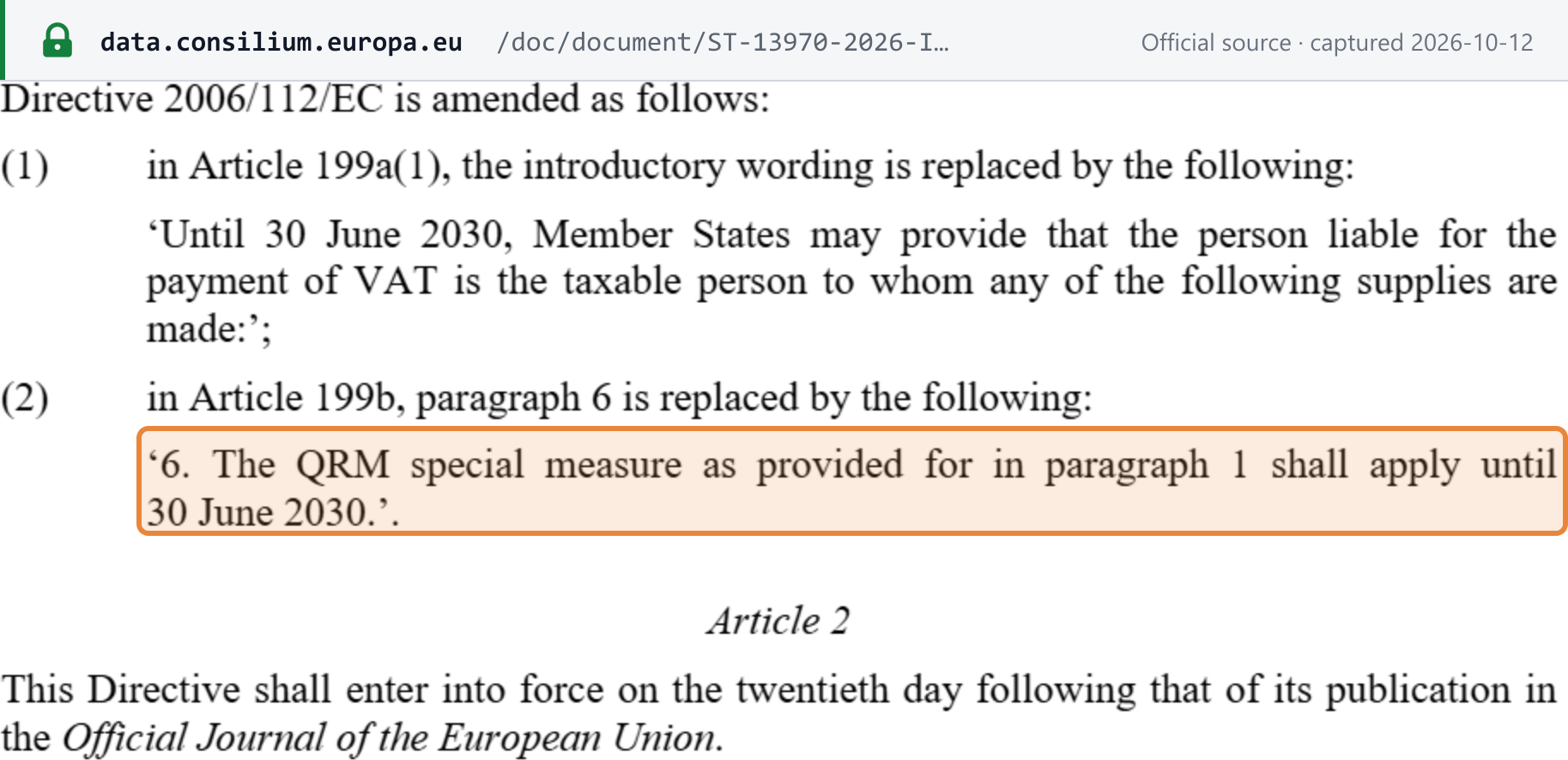 Source snapshot of the official page. Open full size ↗