Japan taxes low-value mail-order imports of JPY 10,000 or less from 1 April 2028 and makes designated platforms the deemed seller
This page records one dated change. For the rules in Japan as they stand today, see the Japan guide →
- Jurisdiction
- Japan
- Tax
- Consumption tax
- Change type
- Digital services
- Status
- Enacted
- Impact
- Plan ahead
- Effective
- 1 April 2028
- Authority
- National Tax Agency (Japan)
- Systems
- E-commerce, Tax engine, Invoicing, Customs
- Verified
- Fetched from official source · high confidence
Foreign and domestic sellers of low-value goods (JPY 10,000 or less per item, excluding tax) shipped to Japan by mail order, and digital platform operators above JPY 5 billion in qualifying sales.
Plan for Japanese consumption tax registration/filing on low-value (JPY 10,000 or less) cross-border mail-order sales and for Type 2 platform designation from 1 April 2028.
E-commerceTax engineInvoicingCustoms
Under the FY2026 consumption tax amendments (Act to partially amend the Income Tax Act etc., Act No. 12 of Reiwa 8), sales of low-value goods shipped from outside Japan to Japan by mail order (consideration of JPY 10,000 or less excluding tax per item; 'specific low-value assets') become subject to Japanese consumption tax from 1 April 2028, to be declared and paid by the seller whether domestic or foreign. Digital platform operators designated by the NTA Commissioner as 'Type 2 platform operators' (consideration through the platform for qualifying foreign-business domestic sales and low-value sales above JPY 5 billion) are deemed to be the seller. A registration system for 'specific low-value asset sellers' accepts applications from 1 October 2027 (Reiwa 9). Initial Type 2 platform determination uses 1 January - 31 March 2027 turnover annualised, with notification due by 30 June 2027 and designation effective 1 April 2028. The import-stage exemption for consignments of JPY 10,000 or less is maintained.
What changed in detail
Under the FY2026 consumption tax amendments, sales of low-value goods shipped from outside Japan to Japan by mail order become subject to Japanese consumption tax from 1 April 2028. These are goods with a consideration of JPY 10,000 or less excluding tax per item, called “specific low-value assets”. The seller declares and pays the tax, whether the seller is domestic or foreign.
Digital platform operators designated by the NTA Commissioner as “Type 2 platform operators” are deemed to be the seller. Designation applies to platforms with consideration through the platform for qualifying foreign-business domestic sales and low-value sales above JPY 5 billion.
Key dates:
- Applications for the registration system for “specific low-value asset sellers” open from 1 October 2027 (Reiwa 9).
- The initial Type 2 platform determination uses 1 January to 31 March 2027 turnover, annualised; notification is due by 30 June 2027.
- Designation takes effect on 1 April 2028.
The import-stage exemption for consignments of JPY 10,000 or less is maintained.
What it means
The 1 April 2028 date is enacted, so the main uncertainty is operational rather than legal. The turnover test period for platforms starts on 1 January 2027, well before the tax applies, so a platform’s exposure to designation is set early.
Foreign sellers of low-value goods to Japanese consumers should plan for registration from October 2027. Marketplaces should check whether their qualifying sales are likely to exceed the JPY 5 billion line, since designation shifts the collection and payment duty onto the platform.
Proof
令和10年4月1日以後に行われる資産の譲渡について適用されます。This applies to transfers of assets made on or after 1 April, Reiwa 10 (2028).
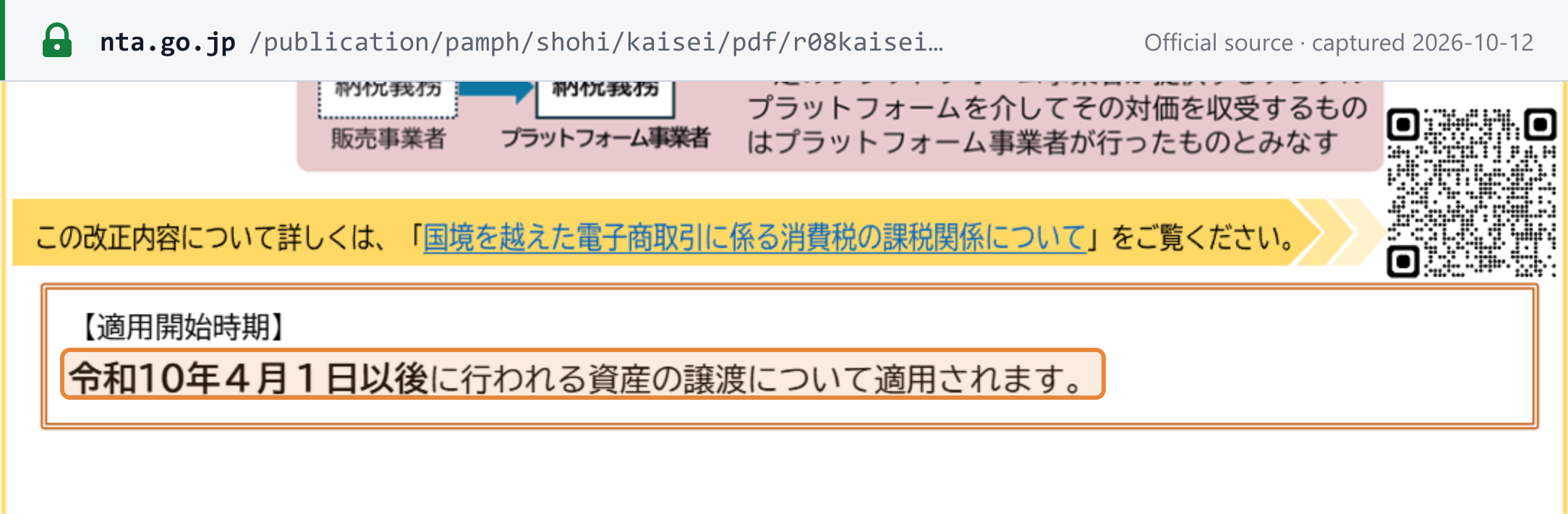 Source snapshot of the official page. Open full size ↗